Tag: Warc

  • Lessons & Guide for Marketing given Covid-19


    By A Correspondent

    The Covid-19 pandemic has caused shockwaves across the globe with major economies falling into a recession like no other in recent history.

    As the advertising industry considers how to proceed, WARC, the global authority on marketing effectiveness, has released a comprehensive, evidenced-based report: The WARC Guide to Marketing in the COVID-19 Recession.

    The guide includes learnings from past recessions, how the COVID-19 recession is different, lessons from China, key actions that brands can take now, and growth opportunities beyond the lockdown.

    Said David Tiltman, VP Content, WARC: “A global recession is now highly likely, and the shape of the recovery is difficult to predict and will vary by sector. With many brands unable to distribute products and services, the usual advice to “keep advertising” may not apply in all cases, and marketers need to take a nuanced approach based on their brand’s situation.”

    Added Lena Roland, Managing Editor, WARC Knowledge: “This WARC Guide to Marketing in a Recession pulls together the best thinking from across the industry on navigating the post-lockdown period. It presents advertisers, agencies and media owners with relevant frameworks, actionable ideas, and offers examples of how major marketers are already putting plans into practice.”

    The five chapters covered in the WARC Guide to Marketing in the COVID-19 Recession are:

    The playbook for ‘normal’ recessions

    A large body of research studies suggest that significantly reducing adspend in a recession has negative long-term impact on brands in terms of sales, market share, growth and return on investment. Companies that maintained investment recovered more quickly.

    WARC has identified five marketing lessons from previous recessions:

    (1) In a recession, media costs decline. (2) Defend your share of voice – cutting ad spend risks damaging market share. (3) Investing in adspend brings long-term advantage. (4) Decline in share can be hard to reverse. (5) “Going dark” beyond six months can weaken brands.


    Recession 2020: What we know so far

    The COVID-19 recession is the first pandemic-driven downturn of the modern era. It is a healthcare crisis, leading to a severe economic slump. That also makes the shape of the recovery hard to predict, as consequences of the lockdown become apparent and there is risk of further outbreaks.

    Sir Martin Sorrell predicts a “reverse square root” recession – a sharp downturn, a partial bounceback then a plateau.

    Cuts in media spend have been immediate and sharp. According to the latest Advertising Association/WARC Expenditure Report, the COVID-19 outbreak will wipe more than £4bn from the total UK ad spend for the current year, across all channels.

    The 2020 downturn is set to be a demand and supply-side shock, caused first by lockdown and then by critical value chain components breaking down, particularly in China, leading to disruption in product and service delivery.

    In a recent interview with WARC, Sir Martin Sorrell, Executive Chairman, S4 Capital, said: “You can’t say to a client spend your way through this. If you don’t have distribution, what’s the point?”

    In a recent GlobalWebindex survey across 17 markets, 83% of consumers say they have delayed a purchase. But the impact of recession varies by brand and category.

    In a new paper, exclusive for WARC, Les Binet, Group Head of Effectiveness, adam&eveDDB, said: “Different businesses face very different problems, and those problems will change as the crisis proceeds. There is no one-size-fits-all solution. Your strategy should be tailored to your business, and it should evolve as your crisis unfolds.”

    Recession 2020: Actions to take now

    As lockdown measures are lifted and the recession takes hold, WARC offers key actions to help brands rebound. They vary depending on a company’s resources, and if operating in a boom or bust category. Brands should:

    (1) Review their lockdown playbook. (2) Keep advertising if they can. (3) If a brand has to reduce adspend, use other levers to remain visible. (4) Maintain creative where possible. (5) Tailor the approach to brand-building and activation. (6) Kill or cut back on ‘dwarf’ brands. (7) Look for signs of new habit formation. (8) Audit e-commerce capability. (9) Build strategic alliances. (10) Review pricing but try to avoid discounting.

    Early lessons from China

    As lockdown is lifted, Chinese consumers remain cautious and media habits are changing again, meaning marketers should retain a degree of flexibility in their media plans.

    According to Publicis Groupe China, online video, social, and news content will be key during normalization. For outdoor ads, the rebound will be primarily in commuting routes, residential areas, and elevator areas.

    Brands are also starting to reconfigure digital initiatives around e-commerce. For example, Friso China registered new customers into its CRM program through e-commerce incentives (discount coupons).

    Restoring consumer confidence is proving a key challenge in China – and many brands are finding that packaging innovations can help resolve this. Meituan, an online-to-offline service launched contactless shields that protect customers from infection when eating.

    The travel sector, one of the hardest hit by the first wave of the pandemic, should prioritise domestic demand based on the experience in China and North Asia.

    The crisis has broadened the role of the big online platforms, such as Chinese retail giant JD; and China’s wide-ranging apps and digital services, which played an important role in the lockdown, are now doing so in the normalisation period, but data privacy is increasingly a concern.

    Opportunities for future growth

    While the return will be gradual and tentative, and the playbook will vary by region and sector, downturns are an opportunity to initiate and accelerate change. WARC highlights opportunities to help brands on the road to recovery:

    1) Supporting small and local businesses is a powerful strategy: SMEs will be among the hardest hit. Consumers may support initiatives that help rebuild local business and communities.


    2) Finance brands can go beyond communications to support hard-hit consumers: According to Google, online searches for “financial help” recently grew 203% in just one week, as unemployment jumps.

    3) Consumer goods brands can play with pack size to meet consumer needs: For brands seeking to defend market share from private-label, adding value through formats, innovation or value-on pack is going to be critical.

    4) Develop a ‘close-to-home’ strategy: People will be eager to leave their homes, but the potential of a further outbreak – combined with economic hardship – means many will prepare their homes as a safe place of sanctuary and safety. Trend forecasting company WGSN (WARC’s sister brand) predicts home health and hygiene will be a key investment category.

    5) Close-to-home means food stockpiling habits may persist: Conagra, the CPG company, says increased trial of frozen food during the lockdown offers a long-term opportunity for the category. Food companies may benefit from range extension and new product development in frozen and long-life products.

    6) The ‘health economy’ will create new opportunities: The pandemic may be the catalyst for radical and lasting transformation of how health and wellness is experienced and delivered. Brands in categories outside health and wellness may be affected too, and should review opportunities to form partnerships that can reassure or help health-focused consumers.

    7) COVID-19 is accelerating the need for digital transformation: Many of the trends caused or accelerated by the COVID-19 require the rewiring of companies around data and digital services. At a time of significant consumer change, there is an opportunity for CMOs to play a leading role in interpreting those changes and acting as ‘superconnectors’ between internal functions.


    Added Jodi Harris, Global VP for Marketing, Culture and Capabilities, Anheuser-Busch InBev: “Marketing is swiftly moving beyond branding and communications to providing business solutions that address people’s needs… We’re taking on a new leadership role, connecting multiple disciplines within the organization to accelerate programs that make a difference in our communities and people’s lives.”



  • WARC unveils report highlighting effective media strategy

    By A Correspondent


    WARC has released the Media Strategy Report 2020, highlighting key trends and themes for an effective media strategy. The insights are drawn from the winners of the WARC Media Awards 2019, a global case study competition rewarding comms planning that has made a positive impact on business results.


    Following an analysis of the shortlisted and winning entries across the four categories – Effective Channel Integration, Effective Use of Tech, Effective Use of Partnerships and Sponsorships, and Best Use of Data – the key insights are:


    1. Influencers are becoming a more trusted component in the media mix

    Brands are turning to micro influencers in particular, combining their followers to achieve further reach. The collective clout of credible influencers and what they can bring to the mix is increasing: brands are expected to spend $10bn globally on influencer marketing in 2020, according to Mediakix. What’s more, as many people across the globe are now based entirely at home, there’s been the emergence of what the Financial Times has dubbed the ‘lockdown celebrity’, influencers in relevant areas such as fitness, education and food preparation.


    2. AI is being deployed in different ways that show off its range and flexibility

    Artificial Intelligence has progressed beyond being a bolt-on or a gimmick designed to generate PR, and instead is at the core of transformational ideas that are firmly rooted in commercial objectives. Data is key to encouraging behaviour change.

    Among this year’s winners were three stand-out uses of AI: a wicket predictor that enhanced the viewing experience of cricket fans in Australia, a hands-free smart speaker to help new parents in China and a video-insertion tool to embed ads within a popular Hong Kong sitcom.


    3. Brands are exploring innovative angles and approaches when leveraging passion points such as sport and music

    Audiences are receptive to original ways that brands choose to engage with them. Connecting with people through their passion points can be a useful way to hit the right target audience at a time when they are already highly engaged.

    Yet effectiveness remains a tricky area. Sport is a popular passion point, though many marketers admit to being uncertain about its effectiveness: $666bn is invested annually in sports sponsorship, yet in a recent Kantar study, 44 per cent of marketers admitted that it was one of their least understood channels in terms of ROI.

    Other areas which were popular among the winning papers included gaming, cycling and running. This year, of course, sponsorship will also bear huge losses because of Covid-19.


    4. A combination of innovative and creative touchpoints can cut through and engage with audiences at all points throughout the customer journey

    Approaching touchpoints in a lateral way that considers the customer journey beyond traditional media can be a highly effective way to capture attention.

    Among this year’s winners were several brands that found highly original and engaging touchpoints to communicate their message more powerfully: for its World Without Walls campaign, Middle Eastern children clothes retailer Babyshop invested in a song, a children’s book and immersive in-store experiences. Chocolate bar Oh Henry! targeted a new audience by using macro-influencers married with a pop-up store; and no-frills New Zealand telco Skinny, wrapped convenience stores in Skinny branding.


    Said Lucy Aitken, Managing Editor, Case Studies, WARC: “Channel selection is one of the most demanding aspects of campaign building. At a time when many countries are locked down and brands all over the world are rethinking their marketing activity, unprecedented levels of agility are currently required to adapt to constant change, while achieving an appropriate balance between performance marketing and brand-building continues to challenge marketers,” adding: “We hope that the insights outlined in our Media Strategy Report 2020 will provide some guidance to media planners and strategists during these unprecedented times.”


  • Warc unveils lessons from world’s most awarded brands

    By A Correspondent


    WARC has released ‘Lessons from the World’s Most Awarded Brands’, a report based on an analysis of the recently released three WARC rankings – Creative 100, Media 100 and Effective 100.


    The study looks at the strategies and approaches of some of the brands placed highly in the 2020 WARC Rankings, an independent benchmark of the world’s most awarded campaigns and companies based on their performance at the industry’s most important global and regional award shows of 2019.


    Said David Tiltman, VP Content, WARC: “To learn from the best, we’ve interviewed the teams behind some of the highly ranked work to see how it came about, and what they learned from it. At a time when marketing budgets are coming under pressure as the threat of recession looms, these are some of the ways marketers can make sure their brands stay relevant.”


    WARC has found nine common marketing themes used by highly successful brands:


    1. They are marketers, not just communicators

    While a lot of the work featured in the rankings is communications, the stories behind that work reveal marketers working across the classic 4Ps spectrum – product, price, place, and promotion.


    IKEA identified a product opportunity to appeal to a new audience and ensured distribution through 3D printing. NRMA Insurance took marketing communications budget and effectively reinvested it in cashback to its customers via its Safety Hub. There is also a growing interest in the breadth of the customer experience, and how to align all interactions with a brand – McDonald’s talks about “feelgood moments” that span ads to packaging to design.


    2. They know how they’re contributing

    A consistent theme through the interviews in the report is that marketers know how their work contributes at a business level. Meaning brand metrics are joined up to commercial objectives. For retailers that link might be very direct – as Colin Mitchell, CMO of McDonald’s points out, they receive sales data very quickly and can see what is working. For others it requires more work. Samsung and its agency Starcom, use search data as a leading indicator of business impact.


    3. They have one eye on the long term

    Long-term marketing investment versus short-term is a very live debate at present. This might involve splitting budgets between distinct ‘brand’ and ‘activation’ work. It also involves the nurturing of ‘distinctive brand assets’ over time, which demands consistency as well as creativity.


    Volkswagen balances brand investment like the ‘Road Tales’ project with very sales-focused work. Meanwhile, Fernando Machado, CMO of Burger King is criticised by some for a ‘stunt’ approach. But as he points out in the report, that is only one element of his marketing plan as he balances high-impact brand activity with everyday executions designed to drive footfall.


    4. They know creativity is key – but only when applied in a business context

    Creativity is a key element as brands seek distinctive and innovative products and communications. Whilst creativity drives distinctiveness, and in some cases delivers a cultural impact, it means nothing if it isn’t achieving broader commercial objectives.


    An example is Burger King’s Whopper Detour: fantastically creative, but with a real business purpose underlying it – to drive downloads and orders through an app.


    5. They tolerate risk

    The decision to do something different – for example, to run a campaign that does not play by category rules, or to divert budget into an untested proposition – can seem risky. But the rewards are potentially much higher. The marketers in this report understand that trade-off. Indeed, some of the brands in the report – even big ones like Samsung and Burger King – take a ‘challenger’ approach. They deliberately flout category rules and use attention grabbing tactics that court controversy to position themselves against a bigger competitor.


    6. They execute flawlessly – even if it takes time

    The scale of some of the work in the WARC Rankings is breathtaking. ‘Whopper Detour’ took a year to come to market due to the technical and legal complexities. Carrefour’s ‘Black Supermarket’ also took a year as the marketing team convinced colleagues, lawyers and lobbyists it should deliberately flout the law to gain an advantage. IKEA’s ThisAbles project took even longer. A genuinely great idea is worth the wait if that’s what it takes to land it seamlessly.


    7. Their purpose is focused

    Purpose has become synonymous with ‘save the world’ communications that have little alignment with a brand’s actual objectives or its impact in the world. In this report, a lot of the marketers use the word ‘purpose’ – but that purpose is usually focused on their customers and their pain points. In other words, they know why their brand exists and how it ought to behave.


    IKEA’s approach to developing add-ons for the disabled community is a textbook example of spotting a new way to serve a specific group, and Volkswagen’s ‘Road Tales’ was built on the simple need to entertain children during a car journey.


    8. They look for the human stories in data

    While a lot of modern marketing revolves around data-driven ideas and tech innovation, successful brands have the ability to spot human stories or ‘small data’ and turn that information into a source of creativity and competitive advantage.


    Much of the success of KFC’s work in China is built around Chinese gaming and e-sports. This in turn was built on the observation that KFC’s meals can be eaten with one hand, leaving the other hand free to hold a controller. Volvo’s EVA initiative was all about data; but what made it powerful was the message that crash test data had become a gender issue.


    9. They build an ecosystem of trusted partners

    Most marketers work with external partners, but much of the work in this report springs from relationships that go beyond supplier and contractor. Some projects involve broader ecosystems, as clients and agencies bring in specialist support. A common thread: it’s not just about hiring the right people – it’s about sharing data, giving them access across the organisation, and setting them briefs that will bring out the best from them.


    Joe Stubbs, Vice President of Global Brand, Interbrand, who provides expert commentary in the report, comments: “Becoming a successful brand is not as easy as having great products and services. Becoming a successful brand is about having the courage to continuously make bold and iconic moves that will drive exceptional results.”


  • WARC unveils Effective 100 rankings

    By A Correspondent


    The WARC Effective 100, an annual ranking of the world’s most awarded campaigns and companies for marketing effectiveness, has been published by WARC.


    The Effective 100 Ranking is compiled by WARC, the international marketing information company, and is produced by combining the results of the industry’s most important global and regional award shows for effectiveness throughout 2019.


    The most effective campaign of 2019 is It’s A Tide Ad, by Saatchi & Saatchi New York / Hearts & Science New York / MKTG New York for laundry detergent brand Tide. Tide became the most loved brand of the Super Bowl and grew consumer loyalty in the US by hijacking other popular ads with the message that if there are clean clothes, it’s got to be a Tide ad. Within two weeks, sales of Tide products increased by 35% and within a year, sales increased to over $75m.


    Said Andrea Diquez – Chief Executive Officer, Saatchi & Saatchi New York: “We’re so incredibly proud that TideAd has ranked #1 for effectiveness. I can only attribute our success to an extraordinary partnership with a very brave client, an amazing and highly diverse agency team and a group of partners that helped us push boundaries and make this idea even bigger than we could have ever imagined. TideAd embodies everything we strive to achieve as an agency. It changed the way other brands behave in the Super Bowl, blurred the boundaries between media, entertainment and marketing and engaged the audience in a compelling and unprecedented way. In the end, this is just more great proof that powerful ideas drive business results.”


    In second place is Oyster Kanji Dictation for Hiroshima Tourism by I&S BBDO Tokyo / BBDO J West Hiroshima. The campaign increased oyster consumption by launching a workbook that educated citizens about the food. In third is National Safety Council’s Prescribed to Death, a campaign by Energy BBDO Chicago / PHD Chicago to raise awareness of prescription opioid overdose in the US.


    There are three agency rankings in the Effective 100: creative, media and digital/specialist. Ranked #1 creative agency is FP7 McCann Dubai, which climbed 13 places to first place after working on six of the Top 100 campaigns. AMV BBDO London is up from 11th place last year to second. CHE Proximity climbs from 9th to third.


    Last year’s 21st placed media agency, Hearts & Science New York, leaped up to the top spot this year through work with Procter & Gamble and AT&T, also contributing to the #1 campaign, It’s A Tide Ad. Two new entrants to the top 50 since last year take second and third place: Mindshare Mumbai and PHD Chicago.


    In top position of the digital/specialist agency ranking is Dentsu Aegis Network’s MKTG New York, having worked on top placed campaign, It’s A Tide Ad. MRM/McCann Shanghai takes second place and Ayzenberg Los Angeles third. All three agencies are in the rankings for the first time.


    McCann Worldgroup holds its position at the top of the networks ranking for effectiveness for a second year in a row, significantly ahead on points of BBDO Worldwide in second place. Ogilvy is in third.


    Suzanne Powers, Global Chief Strategy Officer, McCann Worldgroup, said: “Our mission of helping brands earn a meaningful role in people’s lives is not just mantra to us. It’s a methodology and approach that helps our teams around the world create amazingly impactful work. This top ranking recognizes that focus, and, of course, the great clients with whom we have the honor of working with every day to drive those results.”


    The top nine places in the holding companies ranking remain unchanged from last year,with WPP remaining at the top for a second year. Omnicom Group follows in second place and Interpublic Group is in third.


    Regularly top of the table, last year’s top two brands for effectiveness switched places with McDonald’s coming out on top, ahead of Coca-Cola. Ikea is in third. Despite McDonald’s having one campaign in the top 100 – The McDelivery Pin – a further 30 other campaigns from around the world earned points for the fast food retailer.


    Added Colin Mitchell – Senior Vice President, Global Marketing, McDonald’s: “We’re honoured to be recognised for the effectiveness of our marketing in this prestigious ranking. Effectiveness is what we strive for day in and day out. In an industry often fixated by the short-term, this gives a sense of the long-term value of what our marketers do.”


    For a third consecutive year, Unilever is the top advertiser in the Effective 100 Rankings by a significant margin over The Coca-Cola Company in 2nd place. Unilever’s Lifebuoy is ranked 11th in the brands’ table and a further 32 brands collected points contributing to its first place ranking.


    USA retains the top spot in the country table, but for the first time since the Effective 100 ranking began in 2014, the UK has dropped from second into third place, with India moving up to take its place. The UAE is the biggest mover in the top 10, rising from 29th last year to 5th this year. 71 different countries registered points.


    The most highly ranked campaigns and companies in the 2020 WARC Effective 100 are:

    Top 10 world’s most awarded campaigns for effectiveness

    Rank Campaign title Brand Agency Points
    1 It’s a Tide Ad Tide Saatchi & Saatchi New York / Hearts & Science New York / MKTG New York 75
    2 Oyster Kanji Dictation Hiroshima Tourism I&S BBDO Tokyo / BBDO J West Hiroshima 69.1
    3 Prescribed to Death National Safety Council Energy BBDO Chicago / PHD Chicago 65.9
    4 Vodafone Sakhi Vodafone Ogilvy Mumbai 62.6
    5 Unforgettable Bag Tesco Grey Kuala Lumpur 55.2
    6 The Adaptive Data Lighthouse Lifebuoy Mindshare Mumbai 52.8
    7 Project 84 CALM adam&eveDDB London 51.1
    8 Black Supermarket Carrefour Marcel Paris 50
    9 Everyone is an Amazing Book Amazon Prime McCann Shanghai / MRM//McCann Shanghai 41.1
    10 Faces of the City Coca-Cola McCann Shanghai 40.2


    Top 10 world’s most awarded creative agencies for effectiveness

    Rank Agency Location Points
    1 FP7 McCann Dubai, United Arab Emirates 138.7
    2 AMV BBDO London, UK 98.8
    3 CHE Proximity Melbourne, Australia 91.5
    4 DDB Auckland, New Zealand 80.3
    5 Ogilvy Mumbai, India 80
    6 adam&eveDDB London, UK 78
    7 Saatchi & Saatchi New York, USA 77.2
    8 McCann New York, USA 75.3
    9 Energy BBDO Chicago, USA 74.4
    10 I&S BBDO Tokyo, Japan 69.1


    Top 10 world’s most awarded media agencies for effectiveness

    Rank Agency Location Points
    1 Hearts & Science New York, USA 70.3
    2 Mindshare Mumbai, India 70.1
    3 PHD Chicago, USA 62.5
    4 Mindshare Istanbul, Turkey 62.3
    5 OMD New York, USA 47.7
    6 Starcom Chicago, USA 44.7
    7 Starcom Warsaw, Poland 40
    8 UM Toronto, Canada 39.7
    9 Reprise Petaling Jaya, Malaysia 39
    10 Wavemaker Warsaw, Poland 34.7


    Top 10 world’s most awarded digital/specialist agencies for effectiveness

    Rank Agency Location Points
    1 MKTG New York, USA 57.8
    2 MRM//McCann Shanghai, China 41.1
    3 Ayzenberg Los Angeles, USA 40
    4 R/GA New York, USA 25.9
    5 Arc Worldwide Chicago, USA 25
    6 Fullsix Lisbon, Portugal 24


  • WARC Rankings Media 100 announced

    By A Correspondent


    The WARC Media 100, the independent benchmark celebrating the best media ideas from across the marketing industry, has been released featuring the most awarded campaigns, agencies and brands in the world.


    Compiled by WARC, the international marketing information company, the annual Media 100 Ranking is produced by combining the results of the industry’s most important global and regional media award shows tracked throughout 2019, as determined by the WARC Rankings advisory board and a worldwide industry survey.


    ‘Monty: The World’s First AI Predictive Commentator for Foxtel’, by Mindshare Sydney, is the most celebrated campaign for media excellence of 2019. Australian pay TV network Foxtel ran a game-changing campaign to encourage people to pay to watch cricket, a product they had previously enjoyed for free.


    To deliver more value and transform the viewing experience, Foxtel created Monty, a predictive AI commentator able to forecast when wickets would fall in live games. When Monty predicted a wicket, it triggered mobile display ads, pre-roll video and OOH to get people to watch, delivering an average weekly sales increase of 18 per cent.


    Said Katie Rigg-Smith – CEO, Mindshare Australasia: “As a self-respecting Aussie I love the cricket and I am thrilled to see Monty not only recognised as best in class but best in the world. It shows the power of provocation, one of our core values at Mindshare. It sees a great consumer insight married with powerful AI that delivered innovation and real outcomes. Credit to Jack Smyth and the team for dreaming it up, the Foxtel and the Fox Sports team who were bold enough to back it and our partners at Google.”


    In second place is ‘The First Colonel to Conquer eSports’, by Mindshare Shanghai, which strengthened KFC’s relationship with gamers in China by integrating itself in League of Legends. In third, ‘The Adaptive Data Lighthouse’ by Mindshare Mumbai for soap brand Lifebuoy, targeting people in rural India, at most risk of infections preventable by good hand hygiene.


    Starcom Chicago is ranked #1 media agency, having climbed up from #20 last year. Campaigns for Samsung, Vans, ESPN and The North Face, all ranked in the top 100, driving the agency to the top of the table.


    Added Kathy Ring – CEO, Starcom USA, Starcom: “It’s an honour to be named to WARC’s Media 100 list. It reinforces that Starcom’s Human Experience approach – putting the consumer at the forefront based on astute analytics and insights and arresting creativity – changes behavior that drives business outcomes for our clients.”


    Mindshare Shanghai improved its rank by one place, up to second this year, with work for KFC, Maybelline and Lay’s ranked in the top 30 campaigns. Mindshare Sydney follows in third place, up from 12th last year, largely driven by Monty, the top ranked campaign.


    Mindshare Worldwide claims top position as the most awarded Network, improving its rank from third last year. The media network had 27 different agencies contributing to its total points, eight of them in the top 50; and an impressive 16 campaigns ranked in the top 100. MediaCom drops down to second place and IPG Mediabrands is up one place to third.


    Said Nick Emery – Global CEO, Mindshare: “The best media agency the world. How cool is that? My Mum is impressed! The only reason we get out of bed in the morning is to produce great work and have some fun doing it. I could not be prouder of our whole network. Thank you to all our clients who took the risks and if anyone else wants to break some rules and share our values of speed, teamwork and provocation then you know where to come!”


    WPP continues its run at the top of the media holding companies ranking, driven by the strong performance of its Mindshare Worldwide network, together with a further 10 networks in the top 50. Omnicom Group retains its second position, as does Interpublic Group in third.


    A strong performance in Asia by KFC led the fast food retailer to the top of the brand rankings this year, with two campaigns in the top 100, including #2 campaign, The First Colonel to Conquer eSports.


    Foxtel improved its rank from sixth last year to second this year and Lifebuoy moves up from 13th to second place. Three brands entered the top 50 for the first time: Sport Chek / Canadian Tire goes straight in at #7, while Uber Eats and Uber rank #9 and #10 respectively.


    Unilever improved its rank to hit the top of the advertisers table this year. The FMCG giant has three brands in the top 50 – Lifebuoy, P/S, Knorr – with a further 25 brands contributing to its success. Yum! Brands follow in second place and Procter & Gamble in third.


    Added Conny Braams – Chief Digital & Marketing Officer, Unilever: “We’re thrilled to be announced as the #1 Advertiser in WARC’s Media 100 for 2020. We’re proud of Unilever’s consistent achievement in this category of media excellence. This is testament to the innovative and effective work of our media teams and media agencies across the world and we look forward to more such accolades in the future.”


    USA retained its top country rank for a third year with 22 campaigns in the top 100, three of which made the top 10. Australia improved its rank by one place to take second place, with 10 campaigns within the top 100. China jumps from sixth to third place with 11 campaigns.

  • Online ads to account for over half of $660bn adspend in 2020: WARC


    By A Correspondent


    Global advertising spend is set to rise by 7.1 per cent to $660 bn this year, buoyed by 13.2 per cent growth in internet investment. But traditional media, combined, are expected to record 1.5 per cent growth to $324.2bn – the first rise since 2011 – finds WARC, the international marketing intelligence service.


    The traditional media total is expected to be boosted by a return to growth for TV; here spend is set to rise 2.5  per cent to $192.6bn, helped in no small part by the US presidential election campaigns and the Summer Olympic Games in Tokyo. But advertising revenue for the duopoly (Alphabet and Facebook) is forecast to reach $231.9bn in 2020, having topped the TV total for the first time in 2019.


    Alphabet’s ad income is forecast to rise 10.5 per cent to $149.0bn worldwide, equivalent to 23 cents in every ad dollar. A full 72.4 per cent – $107.8bn – will come from Alphabet’s core Google search platform – this gives Google a 77.0 per cent share of the global search market. YouTube is expected to earn a further $18.5bn for Alphabet in 2020, a 22.1 per cent rise from 2019 and equivalent to 29.0 per cent of all online video adspend worldwide.


    Facebook’s ad revenue is projected to rise 19.0 per cent to $82.9bn; much of this growth is organic though the social network will benefit from the US presidential campaigns this year. Amazon’s ad income is set to rise 21.4 per cent to $17.1bn, Twitter’s 9.2 per cent to $3.3bn and Snap’s 34.1 per cent to $2.3bn. All will contribute to an overall rise of 13.2 per cent in internet ad investment this year, to a total of $335.4bn – over half (50.9 per cent) of the global total for the first time.


    Said James McDonald, Managing Editor, WARC Data, and author of the research: “Internet ad growth has been far stronger than the state of the global economy would suggest, rising seven times faster on average since 2015. But, regulation aside, online platforms are bound by the law of large numbers, and revenue growth is easing for key players like Alphabet and Facebook. We are yet to amend our forecasts in light of the COVID-19 situation, as we would expect – if the crisis is contained – displaced spend to be reallocated later in the year. Advertising’s relationship with GDP is strong, but a slowdown in economic output as a result of the virus will not necessarily translate into reduced advertising investment. If events such as the Tokyo Olympics and UEFA Euro 2020 tournament are postponed or cancelled, however, we would expect a notable impact.”


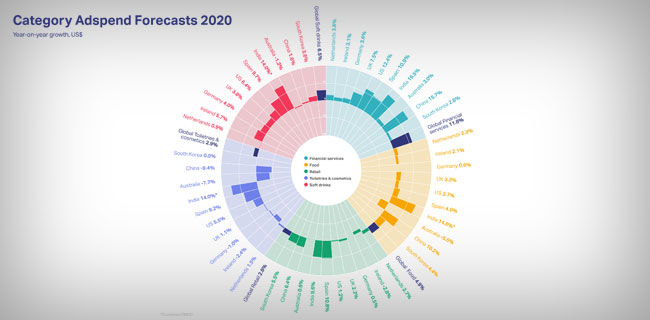
    All product categories are expected to see growth in 2020

    Adspend is set to rise across all of the 19 product categories monitored by WARC. The financial services sector is expected to lead growth, with a forecast rise 11.8% to $53.4bn in 2020. A full 53.9% of spend is directed towards online formats; banks in particular are looking to build brand resonance with youth demographics (increasingly via social media).

    At the other end of the scale, a rise of 2.6% in the retail sector is soft compared to the global rate of 7.1% but would still represent the strongest growth since 2013, lifting market value to $65bn.

    Consumer packaged goods (CPG) sectors such as soft drinks (+6.5% to $17.3bn) and food (+4.9% to $28.1bn) are expected to grow just behind the global rate this year, alcoholic drinks (+6.9% to $9.7bn) and automotive (6.8% to $57.2bn) are roughly par.


    Trends by platform

    • Alphabet: Alphabet’s advertising revenue – across Google Search, YouTube, and Google Network Members (third parties that host Google ads) – is forecast to rise 10.5% to $149.0bn this year – 22.6% of global advertising spend (up from 21.9% in 2019). This is before the deduction of traffic acquisition costs (TAC), which amounted to $30.1bn in 2019.

    • YouTube: Advertisers are forecast to spend $18.5bn on YouTube this year, a rise of 22.1% from $15.2bn in 2019. This gives YouTube a 29.0% share of all online video advertising spend, and a 2.8% share of total adspend.

    • Google: By far the largest service in Alphabet’s portfolio, Google’s ad income is expected to rise 9.9% to $107.8bn this year – 77.0% of global search spend and 16.3% of all adspend.

    • Facebook: Advertisers are expected to spend $82.9bn across Facebook, Messenger, WhatsApp and Instagram this year, a rise of 19.0% from 2019. This gives Facebook a 12.6% share of global advertising investment.

    • Amazon: Amazon is forecast to record double-digit ad revenue growth again this year, with income amounting to $17.1bn, a 21.4% rise from 2019. This gives Amazon a 2.6% share of global advertising spend.

    • Snapchat: Ad investment in Snapchat is forecast to rise 34.1% to $2.3bn in 2020, 2.2% of all social and messaging spend and just 0.3% of total adspend.

    • Twitter: Twitter’s ad income is expected to ease into single digits, with a total of $3.3bn representative of a 9.2% rise in 2020.


    Trends by media and format

    • TV: Spend is forecast to rise 2.5% to $192.6bn, 29.2% of all global spend this year. This only partially reverses a 4.4% dip in 2019. A third of the global TV total is transacted in the US – where, TV spend is set to rise 4.0% to $62.9bn. Just over $4bn will come from presidential campaigns.

    • Out of home: Spend across billboards, transport and retail/point of sale (PoS) locations is forecast to rise 5.9% to $43.5bn this year, the sixth consecutive year of growth. The sector is benefitting from the increasing penetration of digital sites in advanced markets.

    • Radio: Advertiser investment in radio is forecast to rise 1.8% to $32.8bn, recouping losses from a 1.3% dip in 2019.

    • Print: Spend is set to fall by $3.2bn, or 5.8% in 2020, but this is half the rate of decline recorded in 2019. Digital revenue now accounts for over a third of total ad income for publishers worldwide, though this share is closer to a half at the New York Times.

    • Social media: Spend is forecast rise 19.5% to $102.4bn this year, 15.5% of global advertising spend. Facebook (including Messenger, Instagram and WhatsApp) is expected to draw 80.9% of this investment, or $82.9bn, though this share is down from 81.2% in 2019. Just over 42% – $35bn – of Facebook’s ad revenue will come from the US this year.

    • Online video: Spend is forecast to rise 21.4% to $63.7bn this year, equivalent to 9.7% of global advertising spend. YouTube is expected to account for three in ten cents.

    • Search: Spend is forecast to rise 12.7% to $140.1bn in 2020, 21.2% of global adspend. Google is set to draw 77.0% of the market, down from 79.0% in 2019.


    Trends by region

    • North America: Total market growth forecast at 8.4% this year – to $250.3bn – following a 4.5% rise in 2019. The US ad market is expected to grow 8.8% to $238.2bn, while Canada is projected to grow 1.9% to $12.2bn

    • Asia-Pacific: Advertising spend is expected to rise 7.5% to $205.0bn in 2020, with China (+9.7% to $98.5bn), Japan (+3.2% to $40.2bn), Australia (+2.4% to $13.3%) and India (+15.6% to $11.2bn) all set to record annual growth.

    • Europe: European adspend is forecast to rise 6.9% to $158.7bn this year, with France leading key market growth at +10.0% (to $18.2bn). The UK (+3.2% to $31.3bn), Germany (+1.3% to $24.9bn), Italy (+2.7% to $10.5bn) and Russia (7.6% to $10.5bn) will continue to see rising investment.

    • Latin America: The region is heavily susceptible to the strength of the US dollar, which resulted in an 1.1% decline in adspend last year. A further fall, of 2.5%, is forecast this year, with Brazil recording a 4.3% dip to $14.3bn.

    • Middle East: Spend is expected to fall 1.7% to $12.0bn in 2020, following on from a 3.7% fall in 2019.

    • Africa: Spend is expected to rise 5.6% to $6.9bn this year, reversing a 1.5% dip in 2019.


    Other new key media intelligence on WARC Data across regions


    Global:

    Consumers: Ad blocking rises to all-time high of 764m people

    Brands & Advertisers: Food, drink and automotive brands see lowest email CTR

    Media & Tech:E-sports investment to reach $800m this year


    Americas:

    Consumers:One-quarter of Americans now own a smart speaker

    Consumers:Netflix subscriptions in Latin America top 30 million

    Media & Tech: NFL, NBA and MLB to draw $4bn from sponsors in 2020


    Asia Pacific

    Brands & Advertisers: Southeast Asian brands most active on WhatsApp

    Media & Tech: OTT to halve APAC pay TV growth by 2024

    Media & Tech: Sponsorship investment for Tokyo Olympics to triple


    Europe, Middle East and Africa

    Consumers: 26% of 18-24 year olds use TikTok in the UK

    Brands & Advertisers: Less than half of marketers use consumer data systematically

    Consumers:Connected TV use in Portugal flatlines for second year

    A sample of The Adspend Outlook 2020 report can be downloaded here.


  • Warc Marketer’s Toolkit 2020 report sheds focus on impact of digital

    By A Correspondent


    Digital platforms are growing ever-more influential and marketers are increasingly tasked with building their brands within ecosystems over which they have little or no control. Building brands in the ‘walled gardens’ is the main theme highlighted in the Industry chapter of Warc’s Marketer’s Toolkit 2020 an annual report that assesses the influences on marketing strategies for the year ahead.


    Said David Tiltman, VP Content, Warc: “For the Industry chapter, we’ve taken a close look at the drivers dictating the competitive environment.

    Customer experience (CX) will remain a priority for marketers’ time and investment and will continue to drive the digital transformation agenda, and in-housing of adtech will continue as brands take charge of their data. However, we see the major story for next year being the growing reliance of advertisers on ‘walled gardens’, the digital platforms that combine paid advertising and payment tech or e-commerce fulfilment.”

    Walled gardens combine advertising with payment

    The report predicts that Amazon is chipping away at Google’s supremacy of the search advertising market and is projected to earn $13.9bn from advertising in 2019. Advertising accounts for a fifth of Tencent’s global revenues, worth over $8bn, while Alibaba and JD.com dominate the retail landscape in Asia, with combined annual revenues of nearly $450bn.


    These walled gardens increasingly combine paid advertising with payment and e-commerce fulfilment, with the promise to marketers of much more visible links between marketing investment and sales performance. However, as those platforms grow ever-more influential, marketers are increasingly tasked with building their brands within ecosystems over which they have little or no control.


    Said Xian Wang, Global Content Director, Edge by Ascential: “Digital ecosystems become the primary place to engage with consumers… The reach of digital marketplaces offers convenient comparisons for shoppers meaning suppliers will have an increasingly difficult time differentiating from the high volume of other vendors.”

    Facebook moves into payment as retailers move into media

    The report also notes that ease of payment is a key pillar to platforms’ success. The mass adoption of apps such as Alibaba’s Alipay and Tencent’s WeChat Pay in China has inspired Facebook’s attempts to launch a cryptocurrency, the Libra Association, and accompanying digital wallet, Calibra.


    Said Sanjib Kalita, Editor-in-Chief, Money 20/20: “Digital platforms have redefined convenience. By eliminating the time between item selection and payment, digital platforms have maximised the opportunity for impulse purchases.”


    While digital companies possess rich user data, including all-important signals of intent from previous search behaviour, physical retailers have an additional advantage in the form of in-store purchase insights and are now copying platform business models.


    Added Jill Baskin, Chief Marketing Officer, The Hershey Company: “The bigger ecosystem coming online is that retailers [like Walmart and Target] are starting to sell media. They’ll have closed ecosystems, so we should be able to see immediately who’s buying, what they’re buying and whether it’s working. That could be huge if it works.”

    Amazon is focused on winning brand advertising dollars in 2020

    Most spend on Amazon is currently linked to performance outcomes. But, as Amazon sets its sights on the brand dollars still being spent on TV media, the platform must decide the extent of compromising user experience to allow brands to engage consumers in more immersive and potentially less efficient ways.


  • WARC’s global trend sheds focus on search advertising

    By A Correspondent


    WARC has found that investment in search advertising will rise 9.6 per cent this year, to $135.9bn – equal to 22.0 per cent of all advertising spend worldwide. But this growth rate is the softest since 2015 and is a marked slowdown from the 16.9 per cent rise in 2018. Search’s share of internet advertising has now flatlined at 45.8 per cent – the lowest in more than a decade.


    The squeeze on Google’s main source of revenue has forced it to confront Amazon head on in the smart speaker market, as it looks to facilitate voice search in future paths to purchase. But Amazon has a first-mover advantage in many markets, notably the US, UK and Japan. Control of voice search could be critical to either’s success in future; most marketers understand its potential in the coming years but few have plans to use voice search today.


    Mobile is driving growth in the search market

    Mobile search adspend is expected to rise 19.2per cent to $88.1bn this year – almost two-thirds (64.8per cent) of total search spend worldwide. The US alone accounts for 43.0per cent of this total (US$38.1bn in 2019), while a fifth (21.8per cent, or $19.3bn) is transacted in China. Japan ($6.1bn, a 6.9per cent share) and the UK ($5.3bn, 6.0per cent) follow.

    Google accounts for 95.4per cent of all mobile searches worldwide, higher than its share of desktop search traffic (88.6per cent). Google’s share of mobile search traffic in the US (94.4per cent) and UK (97.9per cent) is close to its global rate but in China its share is near zero, with Baidu the incumbent on 79.9per cent.

    Mobile’s share of search advertising investment is rising ahead of mobile’s share of search traffic, which has plateaued globally since 2017 as consumers spend more time in app (over 80per cent of mobile usage is in-app, according to comScore).

    Research by Mindshare shows that Instagram is used by 69per cent of consumers to discover products, ahead of Snap at 64per cent and Facebook at 61per cent. Google is used most to research, with 70per cent of consumers utilising the platform in this way (versus 51per cent for second-highest Pinterest). Crucially, however, Amazon is used most to buy; 78per cent of Amazon users report this, compared to 40per cent using Google for the same purpose.

    One in three (32per cent) online purchases in the UK begins on Amazon, rising to 52per cent for entertainment products, 50per cent for children’s products, 47per cent for household items and 40per cent for electronics. Comparatively, one in five (19per cent) online purchases begins with a search engine, such as Google.

    Amazon made $35bn from e-commerce in Q3 2019, up by a fifth from the previous year and putting it on course to reach close to $150bn in sales for 2019 as a whole. Over one in ten (11per cent) product page views come from sponsored ads, according to data from Jumpshot.


    Voice is becoming a new search battleground

    Voice is an area of growth for search advertising, aided by the rising popularity of smart speakers – an area where competition between Google and Amazon is fierce. More than one in ten internet users in the US and UK now own a smart speaker. Amazon enjoys a healthy lead over Google in a number of key markets, including the US, where three-quarters of smart speaker owners use Alexa. In the UK, that share is 77per cent.

    The ‘first-mover’ advantage is crucial here, however. Google was first to launch in Australia and enjoys a comfortable lead over Amazon (86per cent penetration versus Amazon’s 15per cent), and the same is true in Singapore (76per cent versus 24per cent). This may not bode well for Facebook, which is developing an AI assistant for its Portal devices and is playing catch up to win market share in this area.

    For all the potential, voice search remains a niche pursuit for advertisers today: only one in ten US practitioners plans to include it within their marketing strategy for 2020. A quarter (25.2per cent) believe it will be an ‘extremely’ important marketing channel within the next three to five years, but half (48.9per cent) have no plans to utilise the tech in the short-term.

    Said James McDonald, Managing Editor, WARC Data, and author of the research: “Search has boomed over the last decade as practitioners have put a greater emphasis on performance-related advertising to lift ROI – few marketing strategies exclude a search element today. WARC research shows that practitioners regard it as the easiest channel to measure accurately, and it is more cost effective in driving conversions when compared to online display formats such as video. But the industry is beginning to question whether this focus has been beneficial in the long run, with a number of large, consumer-facing businesses considering a pivot back to more conventional brand building formats. This could explain, in part, the slowdown in search investment this year, a cooling which will reignite Google’s drive to control the next frontier: voice-assisted search.”


  • Global adspend to grow to $656bn in 2020

    By A Correspondent


    WARC has found that advertising spend is set to rise next year across all 19 product categories monitored by WARC, culminating in global growth of 6.0 per cent to $656bn. This is a marked uptick from the 2.5per cent rise estimated for 2019 but is down on the 7.3per cent growth recorded last year.

    Eight product categories are set to increase advertising investment ahead of the global rate next year: financial services (+11.8per cent), household & domestic (+10.5per cent), transport & tourism (+9.0per cent), telecoms & utilities (+8.5per cent), technology & electronics (+8.4per cent), alcoholic drinks (+6.9per cent), automotive (+6.8per cent) and soft drinks (+6.5per cent). Internet is the fastest growing ad medium in each sector except technology & electronics, where out of home (OOH) is set to rise fastest at 11.4per cent.

    Globally, internet formats will account for over half of advertiser investment for the first time in 2020, with a combined value of $336bn. Investment in performance marketing, online video and social media is driving total market growth; advertiser investment excluding money spent on Facebook, Google and Amazon is flat or falling globally.

    The report states that Internet formats, combined, will account for over half of global ad investment for the first time in 2020, and social media, search and online video – the largest of these – are effectively shorthand for Facebook, Google and (Google-owned) YouTube. Google and Facebook, known as the ‘Duopoly’ drew two-thirds of online ad investment in 2018 before traffic acquisition costs (TAC) were paid out to Google’s partners, and WARC expects this share to rise closer to three quarters next year.

    Amazon is small by comparison but is becoming increasingly important to advertisers looking to connect with consumers close to the point of purchase. Amazon’s share of global ad investment is forecast to rise to 2.5per cent next year, Alphabet (Google and YouTube) 23.1per cent, and Facebook 12.9per cent (38.5per cent combined). The central role these three companies – known collectively as the ‘Triopoly’ – play in advertising is stark: advertiser investment beyond them has been flat since 2012.

    The report further states that growth in advertising investment is expected to be recorded within all 19 product categories monitored by WARC next year, although rates vary substantially.

    The financial services category leads with a projected 11.8per cent rise in spend to $53.4bn next year, as brands, particularly in the banking sector, are looking to connect with younger consumers on social media to inform often lifelong choices over their account provider. More than half of sector investment is directed towards online formats.

    The retail sector – the largest in this analysis – is expected to post the lowest growth next year, though a 2.6per cent rise would still be the strongest since 2013. Competition is fierce, from supermarkets to restaurants, and incremental dollars are mostly spent online, with TV, radio and print down over recent years.

    Said James McDonald, Managing Editor, WARC Data, and author of the research: “Weak macroeconomic indices, waning business confidence and rising geopolitical tensions have increased the possibility of a recession in 2020. Within this climate, our forecast of six percent growth in global advertising investment may seem optimistic, but these projections are in line with those from the IMF and Euromonitor for GDP and consumer spend, respectively,” adding:  “Incremental adspend during quadrennial events – the Tokyo Olympics and US presidential campaigns – may be muted next year but will still have a positive net contribution to global growth, as would a stronger yuan and a business-favourable ‘Brexit’. Advertisers also intend to increase spend on Google, Facebook and Amazon properties, with global media spend ultimately flat elsewhere.”


  • Globally, most products are moving adspends online: WARC report


    By A Correspondent


    TV still attracts over two-thirds of advertising investment within the soft drinks sector, while a similar share is seen in the food category – both sectors are far less likely to have been disrupted by e-commerce, so the need for high levels of digital adspend to facilitate a path to purchase is reduced.

    But across all categories, ad investment is shifting heavily into internet formats. The pivot to online advertising is particularly stark within financial services and retail, with both sectors having heavily developed digital platforms to serve their customers in recent years.

    These are some of the findings by WARC, the global authority on advertising and media effectiveness, drawn from an analysis of its newly relaunched WARC Data product, which provides a new industry standard measure of net advertising investment data across 19 product categories in 23 markets, including the United States, United Kingdom and China.


    Said James McDonald, Managing Editor, WARC Data, and author of the research: “In a multichannel world, it has become harder than ever to track campaign performance, measure ROI, or to even trust third-party data. Additionally, the problem is compounded by an environment of ad blocking, fraud, and consumer distrust, and is hazed by walled gardens, programmatic stacks and opaque practice. This results in millions of ad dollars wasted each year. But it is essential that ad investment works harder in the media mix to obtain optimal reach and effectiveness. As such, our latest research into product category insights provides vital data to help brand owners, agencies and media strategists and planners inform their decision making.”

    In WARC’s latest ‘Global Advertising Trends – Benchmarking ad investment by product category’, the industry intelligence included in the report sheds light on how different sectors value advertising media, and how this has changed over time.

    Key findings for five of the 19 product categories available include: 

    Financial Services

    :: Total global adspend in 2018: $43.2bn (+13.0% year-on-year)

    :: Median revenue ROI for successful campaigns: 2.93

    :: Media spend: Internet $19.7bn (+24.4% year-on-year). TV $12.9bn (+4.0%).

    :: Radio $3.7bn (+5.1%). Other $7.0bn (+6.7%)

    :: Ad/sales ratios: Financial services (3.6%). Banks, credit, loans (6.7%). Insurance (0.8%). Investment (1.5%).


    Close to half of the $43.2bn financial services brands invested in advertising last year was directed towards internet formats. The data show a dramatic shift to digital over the last five years; internet’s share of sector spend has grown 22.0 percentage points (pp) since 2013, to 45.5% last year. This is just above internet’s share of global adspend (44.1%). As a share of sales revenue, the sector spends 3.6% on advertising, rising to 6.7% among banks.


    Food

    :: Total global adspend in 2018: $25.3bn (+1.4% year-on-year)

    :: Median revenue ROI for successful campaigns: 2.93

    :: Media spend: TV $16.5bn (+1.0% year-on-year). Internet $3.7bn (+7.9%). Print $2.8bn (-12.7%). Other $2.3bn (+15.3%)

    :: Ad/sales ratios: Food (2.6%). Confectionery (5.6%). Dairy (0.6%). Meat, fish, poultry (0.7%).


    Almost two-thirds of the $25.3bn in ad investment within the food category last year was spent on TV, nearly double TV’s global share of 33.3%. TV spend in the sector rose 1.0% year-on-year to $16.5bn in 2018 but has dipped by 3.7% each year since 2013 on a compound basis. Print also accounts for a greater share of food adspend than is the case globally, with newspapers’ (-2.6pp) and magazines’ (-2.1pp) share dipping mildly over the last five years.


    Retail

    :: Total global adspend in 2018: $62.3bn (+0.0% year-on-year)

    :: Median revenue ROI for successful campaigns: 4.40

    :: Media spend: Internet $21.5bn (+9.1% year-on-year). TV $20.3bn (-0.6%). Print $9.6bn (-15.5%). Other $10.9bn (+0.8%)

    :: Ad/sales ratios: Retail 2.3%. Clothing & fashion (2.9%). Restaurants (2.0%). Supermarkets (1.2%).


    Global advertising spend in the retail sector was flat in 2018 at $62.3bn. The $1.8bn in extra internet spend (up 9.1% from 2017) was offset by a decline in spend for all other media bar out of home (+12.7%) and cinema (+4.9%). Ad investment among the retail sector has tracked downwards in recent years, recording a compound annual growth rate of -1.8% since 2013. However, online advertising has become far more valuable to the sector during this time.


    Soft drinks

    :: Total global adspend in 2018: $15.1bn (+1.1% year-on-year)

    :: Median revenue ROI for successful campaigns: 2.84

    :: Media spend: TV $10.5bn (+1.1% year-on-year). Internet $1.9bn (+28.3%). OOH $1.3bn (-24.1%). Other $1.4bn (+1.3%)

    :: Ad/sales ratios: Soft drinks (5.9%). Bottled water (5.9%). Carbonated (5.9%).


    At 70.0%, TV’s share of soft drinks brands’ adspend is higher than all other categories studied for the report. The $10.5bn spent on TV ads in 2018 was up 1.1% from 2017

    and has grown at a compound rate of 2.0% each year since 2013 – bucking the global trend. However, investment in other media – chiefly internet – has eroded TV’s share of sector spend by 4.4pp over the five years to 2018. Internet formats still draw a relatively small amount of investment, at 12.8%; this is almost three times less than the global level and is likely a reflection of how little e-commerce has disrupted the sector.


    Toiletries & cosmetics

    :: Total global adspend in 2018: $25.7bn (-3.6% year-on-year)

    :: Median revenue ROI for successful campaigns: 2.06

    :: Media spend: TV $14.9bn (-3.9% year-on-year). Internet $5.6bn (+9.7%). Print $2.9bn (-12.0%). Other $2.3bn (-15.9%)

    :: Ad/sales ratios: Toiletries & costmetics (16.9%). Bath toiletries & soaps (12.3%). Fragrances (21.5%).


    At a top line level, ad investment within the toiletries & cosmetics sector has dipped 4.1% each year since 2013 on a compound basis, to a total of $25.7bn last year. This is largely due to how this spend has been allocated historically: in 2013, TV accounted for two-thirds of adspend while print drew a further fifth. Both of these media have recorded declining spend over the period, with internet (+10.7pp) and out of home (+4.7pp) gaining most in share but from a low base -depressing total investment growth in recent years. Print still accounts for 11.4% of sector spend, with magazines alone worth over $2bn, but this total has more than halved since 2013.


  • The Future of Strategy Report 2019


    By A Correspondent


    Marketing service research firm Warc  has released the results of its annual worldwide survey of senior strategists, distilling their opinions on the changing role of strategy within a shifting marketing landscape.

    Warc’s Future of Strategy report, now in its third year, is based on a survey of 800 senior strategists from around the world to provide an in-depth study of both the challenges and opportunities for strategists going forward.

    Said Amy Rodgers, Managing Editor, Research & Rankings, Warc: “Warc’s Future of Strategy 2019 report reveals a discipline that is changing. We see an increased focus on customer experience, growing competition from non-agency shops, and the continuing battle to sell and price its value. And whilst the influence of strategists has increased, the role needs clarity in both function and value if it is to thrive.”


    The key findings from the report include:

    – The rise of CX offers new opportunities

    Customer experience (CX) is dominating the marketing agenda. Almost half of the strategists surveyed are doing more work on CX for clients this year, and for a quarter, work for direct-to-to-consumer (DTC) brands has increased. Respondents see this as an exciting opportunity as the strategist role and craft skills evolve to shape brand experiences and brand truths.


    – Most strategists want to leave agency life

    The growth in CX is driving demand for the strategic services of consultancies, which have used their tech and data heritage to position themselves as experience experts. One outcome of increased competition is that strategists are becoming untethered from their traditional place within agencies, with more career options to choose from. Whilst 40 per cent of strategists surveyed say their team has grown over the past year, 63 per cent do not think their next role will be with an agency.


    – Lack of clarity undermines strategy’s value

    The movement of strategists away from agencies may be exacerbated by the perception that strategy is being undervalued in agencies. Though most believe their influence is growing internally, selling the value of strategic services to clients is a challenge in an environment of budget cuts and a lack of understanding around the role. Strategists see their value in working on upstream business problems and drawing insights from data. However, the reality is that they spend their time juggling both upstream and downstream work.


    – Despite all the data, strategists need the human touch

    Strategists were almost unanimous (92 per cent) in the feeling that they would do a better job if they had more access to client data. In the age of ‘big data’, the disciplines of strategy and analytics are increasingly merging as strategists are being asked to make use of the wealth of first-party data that brands now own. However, data alone will lead to predictable, unexciting advertising. Strategists need to retain the link to ‘real life’ and use their understanding of consumers and culture to drive creativity.


  • Warc reveals the ‘Best of the Best’ across six key categories

    By A Correspondent


    Warc has released a ‘Best of the Best’ ranking of campaigns, agencies and brands showcasing the best all-round performances in the automotive, drinks, financial services, FMCG, food and retail sectors.


    The six separate product category reports are based on the analysis of the combined data of the three annual Warc Rankings — the Creative 100, Effective 100 and Media 100 rankings — compiled from the results of the most prestigious and rigorous award shows of 2018.


    Said Amy Rodgers, Managing Editor, Research & Rankings, Warc: “These sector analyses, the last of a series of reports produced based on the results of the Warc Rankings, provide category intelligence and an industry benchmark showcasing the top all-round sector performers across creativity, effectiveness and media excellence.”


    Automotive category highlights:

    With Audi topping two of the three automotive rankings, it is no surprise that Audi not only ranked #1 as a brand, but its owner Volkswagen Group came out as top automotive advertiser.


    This success is reflected through the companies who worked with Audi, with BBH London ranked as the #1 agency with its campaign ‘Clowns’ topping the automotive creative ranking. Strong performances from PHD Worldwide agencies drove the network to the number one spot.

    #1 campaign for creativity: Clowns, Audi, BBH London

    #1 campaign for media: Lead Generation, Kia, Havas Media Madrid

    #1 campaign for effectiveness: Beauty and Brains, Audi, BBH London / Salmon London / MediaCom London / PHD London

    #1 agency: BBH London

    #1 agency network: PHD Worldwide

    #1 brand: Audi

    #1 advertiser: Volkswagen Group


    Drinks category highlights:

    In the top ten agencies for drinks, there is a three-way split between Auckland (3 agencies), London (3 agencies) and Latin America (3 agencies), with MediaCom Mexico City taking first place and Africa São Paulo second. Touché! Montreal is the only agency representing North America.


    With campaigns featuring in two of the three drinks rankings, Coca-Cola has topped the brands list and is ranked #2 in the drinks advertisers list. Anheuser-Busch InBev is in first place.


    In the drinks category, MediaCom Mexico City tops the agency list and its network, MediaCom, ranks #4. BBDO Worldwide leads through the contribution of a range of agencies including AMV BBDO London (#7) and Colenso BBDO Auckland (#8).

    #1 campaign for creativity: Tagwords, Budweiser, Africa São Paulo

    #1 campaign for media: The Awesome Is Here, Cerveza Victoria, MediaCom Mexico City

    #1 campaign for effectiveness: No More Excuses, Heineken, Publicis Milan / POKE London / Starcom Amsterdam / Publicis London

    #1 agency: MediaCom Mexico City

    #1 agency network: BBDO Worldwide

    #1 brand: Coca-Cola

    #1 advertiser: Anheuser-Busch InBev


    Financial Services category highlights:

    Due to the long-term success of Fearless Girl, which topped both the Creative and Effective 100 for financial services, State Street Global Advisors ranks #1 for brands and its owner State Street Corporation leads the advertiser rankings in the financial services sector.


    Following on from this success, McCann New York, which worked on the campaign, tops the agency ranking and McCann Worldgroup is ranked #1 network with its agencies in Sydney, New Delhi and Mumbai also contributing to its success

    #1 campaign for creativity: Fearless Girl, State Street Global Advisors, McCann New York

    #1 campaign for media: The Animals’ Own Emergency Number, DNB, TRY/APT Oslo

    #1 campaign for effectiveness: The Impact of Fearless Girl, State Street Global Advisors, McCann New York

    #1 agency: McCann New York

    #1 agency network: McCann Worldgroup

    #1 brand: State Street Global Advisors

    #1 advertiser: State Street Corporation


    FMCG category highlights:

    With Colenso BBDO and AMV BBDO London taking first and second place in the FMCG sector agencies’ ranking, it is no surprise that BBDO Worldwide is the top network, ahead of MediaCom in second.


    Whilst Pedigree topped the FMCG brands list, this performance could only drive its owner Mars to #3 advertiser with Procter & Gamble ranked #1 through the performance of brands including Gillette, Procter & Gamble and Tide.

    #1 campaign for creativity: #Bloodnormal, Bodyform/Libresse, AMV BBDO London

    #1 campaign for media: I Don’t Roll On Shabbos, Gillette, MediaCom Connections Tel Aviv

    #1 campaign for effectiveness: Healthy Hands Chalk Sticks, Savlon, Ogilvy Mumbai

    #1 agency: Colenso BBDO Auckland

    #1 agency network: BBDO Worldwide

    #1 brand: Pedigree

    #1 advertiser: Procter & Gamble


    Food category highlights:

    Skittles is the top brand with campaigns featuring across all three food rankings: Exclusive The Rainbow #1 for creative, Let Out The Sour #1 for media and Breaking Conventions With Pride joint #4 for effectiveness.


    The agencies that worked on the winning Skittles campaigns all feature in the top ten agencies’ league table. The highest ranked is adam&eve DDB London, with work for Skittles as well as Marmite. DDB Chicago, which worked on the Exclusive The Rainbow is ranked #2. The success of these agencies alongside DDB’s offices in Paris, Johannesburg, Mexico and Moscow propelled DDB Worldwide to top network.

    #1 campaign for creativity: Exclusive The Rainbow, Skittles, DDB Chicago

    #1 campaign for media: Let Out The Sour, Skittles, MediaCom Dubai

    #1 campaign for effectiveness: Cheetos Museum, Cheetos, Goodby Silverstein & Partners San Francisco / OMD New York

    #1 agency: adam&eveDDB London

    #1 agency network: DDB Worldwide

    #1 brand: Skittles

    #1 advertiser: Mars


    Retail category highlights:

    Mindshare Shanghai tops the agency list for retail having contributed to three of the top ten campaigns in the category in the Media 100 ranking, driving Mindshare Worldwide to #2 network.


    Ogilvy is ranked #1 retail network, in part due to DAVID Miami’s work on Google Home of the Whopper, which came second in both the retail Creative 100 and Effective 100. This, along with Scary Clown Night (#1 creative campaign) meant that Burger King topped the retail brand list, with its owner Restaurant Brands International leading the retail advertisers table.

    #1 campaign for creativity: Scary Clown Night, Burger King, LOLA MullenLowe Madrid

    #1 campaign for media: Turning KFC Into Gamers Playground, KFC, Mindshare Shanghai

    #1 campaign for effectiveness: How Lidl Grew A Lot, Lidl, TBWA\London / Starcom London

    #1 agency: Mindshare Shanghai

    #1 agency network: Ogilvy

    #1 brand: Burger King

    #1 advertiser: Restaurant Brands International