Tag: Warc

  • Social advertising growth slows down, notes WARC report

    By A Correspondent


    Marketing services research firm WARC has found that advertising revenues among key social and messaging companies rose 26.2 per cent year-on-year during the first three months of 2019 to reach $17.9bn – the second-highest total on record.


    However, while this growth outpaced all other advertising sectors, it was roughly half the rate of expansion seen just one year earlier (51.6 per cent in Q1 2018). All six companies studied in the report – Facebook, Pinterest, Snap, Twitter, Tencent (WeChat/QQ), Weibo – recorded an easing in ad revenue growth during Q1 2019.


    In North America, the largest market for social advertising ($8.0bn in Q1 2019), user growth has stalled over the last 12 months. Time using social platforms has also stagnated in the region, remaining at two hours per day for the last three years. Facebook has 186m daily users in North America, Snap 80m, and Twitter 28m – numbers that are mostly flat or down from the previous year.


    Further, European user growth across Facebook’s social properties (including WhatsApp and Instagram) slowed to its lowest rate on record (1.4 per cent), while Snap’s users in the region fell for the first time. Daily social media usage fell by four minutes to 1:49 (hours:minutes) across Europe year-on-year, according to GlobalWebIndex.


    Instead, growth is emanating from Asia, in particular from India, Indonesia and the Philippines. Daily social time is also ticking up in the region, reaching 2:11 compared to 2:09 a year earlier. But users here monetise at a far lower rate than their Western counterparts.


    The slowdown in social ad growth comes at the same time as the tech sector in general, and Facebook in particular, is under pressure over its use of consumer data. Recent research by YouGov, Dentsu and Universal McCann, among others, finds that half of consumers believe tech and social media companies have too much power and influence, while a similar proportion feel more industry regulation is required.


    As advertising revenue growth cools, social media companies are increasingly looking to diversify. Facebook has already announced its intention to launch a new cryptocurrency, ‘Libra’, by 2020, with emerging markets being its prime focus, alongside ‘Calibra’, a digital wallet which will be integrated into Messenger and WhatsApp.


    While social shopping is still nascent on Western platforms, in China, the ease of mobile payment has made social shopping a norm. Tencent made RMB21.8bn ($3.2bn) from FinTech in the first three months of this year. But in the US, security and privacy are cited as major concerns for the development of social commerce, and this is a core challenge Facebook will need to confront.


    Summing up, James McDonald, Managing Editor, WARC Data, and author of the research, said: “The social sector is still expanding at a rapid pace – amassing $17.9bn of ad money in the first three months of this year alone – but growth has eased over recent quarters and has halved from a year ago. Further, user growth has stalled in North America and consumer trust in social platforms is waning.


    “Facebook is looking to diversify its revenue streams with the launch of Libra which, the company says, will not be used directly to enrich the consumer data it has harvested for ad selling purposes. However, the cost of advertising on Facebook’s social platforms could feasibly rise if the company proves a relationship between the ads it serves and an increase in Libra-facilitated sales.”



  • Five lessons for impactful advertising


    To coincide with the start of Cannes Lions International Festival of Creativity, marketing intelligence and research firm WARC has released ‘Anatomy of Effectiveness’, a white paper for brand marketers and advertising agencies alike, highlighting five key priorities for brands seeking greater impact.


    The report has been created by distilling evidenced best thinking, expert opinion and real case studies, all combined with 30 years of WARC’s experience on helping the industry advertise effectively.


    Says Paul Coxhill, Managing Director, WARC: “Poor marketing wastes money, time, attention and resource. All of which we can ill-afford in this fast-moving, resource constrained world. With ‘Anatomy of Effectiveness’ we provide five lessons to help combat this and make marketing more effective.”


    Data suggests that advertising, in its current forms, is not driving the growth it should be. Advertising spend is not having the intended impact, and, at its worst, it is alienating the people it is supposed to be engaging:

    :: A study by the Advertising Research Foundation found that 69 per cent of all US TV commercials receive no visual attention (putting up to $40 billion of investment at risk in the US alone); 27 per cent air in an empty room.

    :: A focus on short-termism has halved the business impact of creativity, according to researcher Peter Field.

    :: Only 12 per cent of supposedly ‘viewable’ ads are actually noticed by consumers, according to Lumen Research

    :: Nielsen reported that only 53 per cent of the impressions served in the UK reached their intended target.

    :: More than 600 million devices now have ad blocking, in what US journalist Doc Searls called the biggest boycott in history.


    Says David Tiltman, VP Content, WARC: “Against this background, we wanted to pull together the best thinking from around the world on effectiveness. This white paper examines what the current range of evidence shows, and where it is being challenged by a fast-changing industry.”


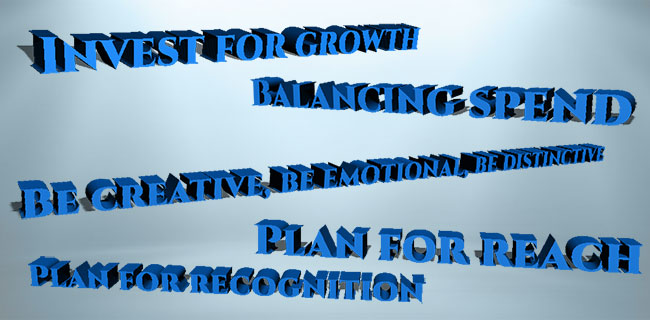
    WARC’s ‘Anatomy of Effectiveness’ highlights the following five priorities for brands who want to improve the impact of their advertising:

    :: Invest for growth: Covers the wide range of factors that marketers need to consider when drawing up budgets, setting objectives and working out what they want a campaign to deliver.

    :: Balancing spend: Sets out the frameworks for investment between brand-building and performance marketing.

    :: Be creative, be emotional, be distinctive: Analyses the arguments for investing in creativity – including the power of emotional communications and the importance of distinctiveness.

    :: Plan for reach: Discusses the factors to be considered when planning media spend.

    :: Plan for recognition: Focuses on the need for strong brand assets in an era of short-form ads to ensure consumers know whose ads they are seeing.


    Adds Tiltman: “While it sounds simplistic, none of these concepts is easy to apply. Every element involves trade-offs and hard decisions on where to invest. And, of course, insights and creative thinking are required to bring it all to life – that’s what makes marketing such a dynamic industry. The five priorities are not a linear process. We increasingly live in a world where media selection and creative development go hand in hand, where creativity can be at the heart of business strategy, and where real-time feedback can allow strategies to evolve during the campaign. We hope this report promotes the evidence that exists to help advertisers – and ultimately their consumers.”


    For each of the five key priorities on how to advertise more effectively, the white paper includes evidence, what’s changing, common mistakes, examples, and expert commentary from industry experts including Paul Dyson, founder of Data2Decisions; Les Binet, Head of Effectiveness at Adam&Eve DDB; Peter Field, Marketing Consultant;, Faris Yakob, Co-founder of Genius Steals; and Jenni Romaniuk, International Director of the Ehrenberg-Bass Institute.


  • WARC announces winners of ‘Effective Use of Brand Purpose’ award

    By A Correspondent


    Campaigns for premium vodka Absolut, fast-food restaurant KFC, museum Louvre Abu Dhabi, antiperspirant Rexona and feminine care brand Stayfree are among the winners of the Effective Use of Brand Purpose category of this year’s WARC Awards, a global search for next-generation marketing effectiveness.


    Thirteen campaigns from around the world – one Grand Prix, four Golds, three Silvers and five Bronzes – have been selected as winners in the category, which rewards marketing initiatives that have successfully embraced a brand purpose and achieved commercial success as well as a benefit for a wider community. Three special awards, recognising specific areas of excellence, have also been given.


    Mindshare India won a Gold and the Evaluation Award with a campaign for Lifebuoy from Hindustan Unilever. ‘The Adaptive Data Lighthouse’ campaign targeted the people most at risk of infections preventable by good hand hygiene to increase sales in rural


    A campaign by FP7 McCann Dubai for Babyshop has won the Grand Prix and the Smart Spender Award. In ‘Al Umobuwah – Putting ‘Mum’ into ‘Parenthood’, the children’s retailer used a multichannel approach and created a new Arabic word that embraced the concepts of both motherhood and fatherhood (the Arabic word for parenthood translates only to fatherhood) in order to drive brand meaning – and sales – in the Middle East.


    Commenting on the Grand Prix winner, judge Nazia du Bois, Founder, Principal Consultant, rice bowl, said: “Inserting a word into what’s essentially a hermetically sealed language is remarkable, especially given the 50k budget.”


  • WARC’s Best of the Best


    WARC has released a ‘Best of the Best’ ranking of campaigns, agencies and brands showcasing the best all-round performances in the automotive, drinks, financial services, FMCG, food and retail sectors.


    The six separate product category reports are based on the analysis of the combined data of the three annual WARC Rankings — the Creative 100, Effective 100 and Media 100 rankings — compiled from the results of the most prestigious and rigorous award shows of 2018.


    Said Amy Rodgers, Managing Editor, Research & Rankings, WARC: “These sector analyses, the last of a series of reports produced based on the results of the WARC Rankings, provide category intelligence and an industry benchmark showcasing the top all-round sector performers across creativity, effectiveness and media excellence.”


    Automotive category highlights:

    With Audi topping two of the three automotive rankings, it is no surprise that Audi not only ranked #1 as a brand, but its owner Volkswagen Group came out as top automotive advertiser.


    This success is reflected through the companies who worked with Audi, with BBH London ranked as the #1 agency with its campaign ‘Clowns’ topping the automotive creative ranking. Strong performances from PHD Worldwide agencies drove the network to the number one spot.

    #1 campaign for creativity: Clowns, Audi, BBH London

    #1 campaign for media: Lead Generation, Kia, Havas Media Madrid

    #1 campaign for effectiveness: Beauty and Brains, Audi, BBH London / Salmon London / MediaCom London / PHD London

    #1 agency: BBH London

    #1 agency network: PHD Worldwide

    #1 brand: Audi

    #1 advertiser: Volkswagen Group


    Drinks category highlights:

    In the top ten agencies for drinks, there is a three-way split between Auckland (3 agencies), London (3 agencies) and Latin America (3 agencies), with MediaCom Mexico City taking first place and Africa São Paulo second. Touché! Montreal is the only agency representing North America.


    With campaigns featuring in two of the three drinks rankings, Coca-Cola has topped the brands list and is ranked #2 in the drinks advertisers list. Anheuser-Busch InBev is in first place.


    In the drinks category, MediaCom Mexico City tops the agency list and its network, MediaCom, ranks #4. BBDO Worldwide leads through the contribution of a range of agencies including AMV BBDO London (#7) and Colenso BBDO Auckland (#8).

    #1 campaign for creativity: Tagwords, Budweiser, Africa São Paulo

    #1 campaign for media: The Awesome Is Here, Cerveza Victoria, MediaCom Mexico City

    #1 campaign for effectiveness: No More Excuses, Heineken, Publicis Milan / POKE London / Starcom Amsterdam / Publicis London

    #1 agency: MediaCom Mexico City

    #1 agency network: BBDO Worldwide

    #1 brand: Coca-Cola

    #1 advertiser: Anheuser-Busch InBev


    Financial Services category highlights:

    Due to the long-term success of Fearless Girl, which topped both the Creative and Effective 100 for financial services, State Street Global Advisors ranks #1 for brands and its owner State Street Corporation leads the advertiser rankings in the financial services sector.


    Following on from this success, McCann New York, which worked on the campaign, tops the agency ranking and McCann Worldgroup is ranked #1 network with its agencies in Sydney, New Delhi and Mumbai also contributing to its success

    #1 campaign for creativity: Fearless Girl, State Street Global Advisors, McCann New York

    #1 campaign for media: The Animals’ Own Emergency Number, DNB, TRY/APT Oslo

    #1 campaign for effectiveness: The Impact of Fearless Girl, State Street Global Advisors, McCann New York

    #1 agency: McCann New York

    #1 agency network: McCann Worldgroup

    #1 brand: State Street Global Advisors

    #1 advertiser: State Street Corporation


    FMCG category highlights:

    With Colenso BBDO and AMV BBDO London taking first and second place in the FMCG sector agencies’ ranking, it is no surprise that BBDO Worldwide is the top network, ahead of MediaCom in second.


    Whilst Pedigree topped the FMCG brands list, this performance could only drive its owner Mars to #3 advertiser with Procter & Gamble ranked #1 through the performance of brands including Gillette, Procter & Gamble and Tide.

    #1 campaign for creativity: #Bloodnormal, Bodyform/Libresse, AMV BBDO London

    #1 campaign for media: I Don’t Roll On Shabbos, Gillette, MediaCom Connections Tel Aviv

    #1 campaign for effectiveness: Healthy Hands Chalk Sticks, Savlon, Ogilvy Mumbai

    #1 agency: Colenso BBDO Auckland

    #1 agency network: BBDO Worldwide

    #1 brand: Pedigree

    #1 advertiser: Procter & Gamble


    Food category highlights:

    Skittles is the top brand with campaigns featuring across all three food rankings: Exclusive The Rainbow #1 for creative, Let Out The Sour #1 for media and Breaking Conventions With Pride joint #4 for effectiveness.


    The agencies that worked on the winning Skittles campaigns all feature in the top ten agencies’ league table. The highest ranked is adam & eve DDB London, with work for Skittles as well as Marmite. DDB Chicago, which worked on the Exclusive The Rainbow is ranked #2. The success of these agencies alongside DDB’s offices in Paris, Johannesburg, Mexico and Moscow propelled DDB Worldwide to top network.

    #1 campaign for creativity: Exclusive The Rainbow, Skittles, DDB Chicago

    #1 campaign for media: Let Out The Sour, Skittles, MediaCom Dubai

    #1 campaign for effectiveness: Cheetos Museum, Cheetos, Goodby Silverstein & Partners San Francisco / OMD New York

    #1 agency: adam&eveDDB London

    #1 agency network: DDB Worldwide

    #1 brand: Skittles

    #1 advertiser: Mars


    Retail category highlights:

    Mindshare Shanghai tops the agency list for retail having contributed to three of the top ten campaigns in the category in the Media 100 ranking, driving Mindshare Worldwide to #2 network.


    Ogilvy is ranked #1 retail network, in part due to DAVID Miami’s work on Google Home of the Whopper, which came second in both the retail Creative 100 and Effective 100. This, along with Scary Clown Night (#1 creative campaign) meant that Burger King topped the retail brand list, with it’s owner Restaurant Brands International leading the retail advertisers table.

    #1 campaign for creativity: Scary Clown Night, Burger King, LOLA MullenLowe Madrid

    #1 campaign for media: Turning KFC Into Gamers Playground, KFC, Mindshare Shanghai

    #1 campaign for effectiveness: How Lidl Grew A Lot, Lidl, TBWA\London / Starcom London

    #1 agency: Mindshare Shanghai

    #1 agency network: Ogilvy

    #1 brand: Burger King

    #1 advertiser: Restaurant Brands International


    Download a sample report of the ‘Best of the Best’ in automotivedrinksfinancial servicesFMCGfood and retail sectors.


    The full reports for each of the six sectors are available to WARC subscribers and include the top ten campaigns across creativity, media and effectiveness, as well as agencies, networks, brands and advertisers. Additionally, the story behind four top ten ranked campaigns for each sector are featured, including information on the challenge, strategy and results.


  • The Good Report celebrates best campaigns for social responsibility

    By A Correspondent


    ACT Responsible, the international non-profit association and global source of the world’s best ads on social and environmental issues, in collaboration with WARC, has come up with The Good Report, aranking of the world’s best use of creative communications to promote sustainability and social responsibility to raise awareness of major social and environmental issues.


    A total of 827 campaigns produced by 534 agencies for 685 advertisers from 74 countries were evaluated for this latest Good Report. The Good Report ranking is created by combining the industry’s recognition of the best performing campaigns as tracked by the WARC Creative 100, with the promotional effort behind the campaigns and the general public’s recognition from public votes organized by ACT Responsible.


    Of the 40 campaigns featured in The Good Report 2018, 27 are for NGOs, institutions and foundations and 13 are for commercial brands. The Top 25 agencies are made up of six independents and 19 networked agencies. In the top 19 Networks list there are three independent networks and 18 networks owned by holding companies; and the top ten Advertisers include eight NGOs/Institutions and two for-profit companies.


    Said Hervé de Clerck, Leader, ACT Responsible: “With The Good Report, ACT Responsible continues its mission of promoting, inspiring and federating the communications industry for the greater Good. We truly believe advertising has a major role in educating and promoting good to help make the world a better place and we are proud the celebrate this work every year. Producing The Good Report with the collaboration of the WARC Rankings team is a great privilege.”


    Added David Tiltman, Head of Content, WARC: “Whilst purpose-driven campaigns are playing a key role in today’s brand marketing, Act Responsible, together with Gunn Report, have been shining a light on communications for good causes for nearly two decades. Following the recent rebrand of the Gunn Report to WARC Rankings, WARC is delighted to continue this collaboration.”


    Most successful Campaigns promoting good causes 2018:

    #1 Trash Isles, AMV BBDO London, LadBible and Plastic Oceans Foundation

    #2 Prescribed to Death, Energy BBDO Chicago, National Safety Council

    #3 No Conditions Apply – Sindoor Khela, FCB Ulka Mumbai, The Times of India

    #4 Destination Pride, FCB/SIX Toronto, PFLAG Canada

    #5 Touching Masterpieces, Geometry Prague, NeuroDigital for National Gallery of Prague


    Most successful Agencies promoting good causes 2018

    #1 BBDO New York, USA

    #2 AMV BBDO London, UK

    #3 Colenso BBDO Auckland, New Zealand

    #4 la chose, Paris, France

    #5 J. Walter Thompson New York, USA


    Most successful Networks promoting good causes 2018

    #1 BBDO Worldwide

    #2 FCB

    #3 J. Walter Thompson Worldwide

    #4 McCann Worldwide

    #5 Havas Group


    Most successful advertisers promoting good causes 2018

    #1 Amnesty International

    #2 WWF

    #3 Greenpeace

    #4 Procter & Gamble

    #5 Plastic Oceans Foundation


  • Google and Facebook to make $176bn from advertising, pushing share of internet marketing to over 60%: WARC

    By A Correspondent


    WARC, the international marketing intelligence service, has found that of the $590.4bn spent on advertising worldwide last year, $144.6bn (24.5%) went to the Google and Facebook ‘duopoly’, which equates to almost one in four dollars. The duopoly’s adspend share is up from 20.3% in 2017 and is more than double the 10.8% recorded in 2014. WARC predicts a further increase to 28.6% ($176.4bn) this year.


    Looking only at the internet advertising market, the duopoly took over half (56.4%) of ad money in 2018, a share which WARC expects to rise to 61.4% this year. This growth, notes the report, is squeezing other online media owners, as the pool of ad money available to them is now in decline for the first time, down 0.7% to $111.0bn.


    Said James McDonald, Data Editor, WARC, and author of the research: “One of the main reasons for the duopoly’s success is their creation, and subsequent ownership, of the digital formats perceived to be most effective by adland’s decision makers: paid search and social. Several surveys in the past year have shown search and social to be highly regarded by advertisers in terms of meeting campaign objectives. Google dominates the search engine market, handling almost all mobile searches worldwide and nine in ten on desktops. Meanwhile, ad buyers can target Facebook’s 1.48bn daily users by leveraging a rich cache of personal data. Beyond major brands, the accessibility of the duopoly’s ad buying tools has attracted a long tail of small- and micro-advertisers, creating a competitive advantage which has been core to revenue growth.”

    Against this backdrop, WARC’s research on the duopoly highlights three key trends:

    Google and Facebook are directly competing for video dominance: The value of the online video market across WARC’s 12 key markets – Australia, Brazil, Canada, China, France, Germany, India, Italy, Japan, Russia, UK, US – is $30.2bn, which equates to 21.5% of linear TV, and is growing rapidly. Much of this money is spent on social media sites, including Facebook and YouTube (e.g. 86%, or £1.9bn in the UK).

    Both Google and Facebook hope to unlock brand budgets while also controlling the trade of targeted performance advertising. Regulation appears to be the principle threat to the duopoly’s growth, which currently shows no sign of a significant slowdown.


    Google is battling Amazon on two fronts to defend its search market dominance: Google handles 63,000 search queries per second – or two trillion in an average year – but its dominance of the paid search market may soon come under threat from Amazon. The e-commerce giant is developing its own search business, looking to pair advertisers with consumers close to the point of purchase.

    Whilst WARC expects Amazon to make $13.9bn from advertising this year (compared to Google’s $107.4bn), its ad business is growing much faster than Google’s, with 69% of marketers in a recent WARC survey stating that they intend to up their ad investment on Amazon this year.

    Amazon, which has a rich database of consumer purchasing habits, has also stolen a march on Google in the emerging area of voice search. Its Echo devices are used by 63% of American smart speaker owners, well ahead of Google’s Home devices on 26%.


    Younger Americans are leaving Facebook’s core platform for Instagram: Instagram is now the main driver of daily user growth for Facebook, with estimates suggesting that as many as 15m US users have left Facebook’s core platform since 2017.

    Instagram’s rise in popularity hasn’t gone unnoticed by marketers, with Instagram recording a net budget increase (the number of practitioners intending to increase budgets minus the number intending to decrease) of 67% in a recent WARC survey, ahead of Amazon on 63%, YouTube on 60%, and Facebook on just 13%.

    Facebook is responding by pivoting to an encrypted messaging service to regain consumer trust, and to build a secure environment for online payments. The company spent $1.1bn on advertising worldwide last year in the wake of the Cambridge Analytica scandal.


    Global media analysis – The Duopoly

    28.6% Google and Facebook’s combined share of global adspend this year, up from 24.5%in 2018

    41.0% search and social media’s share of US adspend

    51.8% share of attainable users Facebook reaches every day

    61.4% the duopoly’s expected share of the online ad market this year

    82.7% Facebook’s share of US social adspend in 2018

    86.0% social’s share of UK online video advertising spend

    Other key media intelligence new on WARC Data


    Seven in ten companies are not GDPR compliant

    TV’s reach key to cross-channel campaigns

    Flipkart lags behind Amazon India in adspend

    5G to triple mobile speeds by 2022

    94% of UK youth access TV streaming services

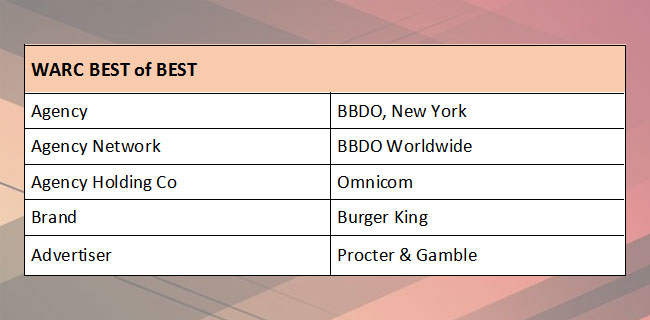
  • BBDO, Omnicom, Burger King & P&G top WARC ‘Best of the Best’

    By A Correspondent

    WARC has released the results of its first-ever ‘Best of the Best’ global index of excellence, to showcase the best all-round agencies and brands by aggregating results from across all three recently released WARC Rankings – Creative 100, Effective 100 and Media 100. No Indian agency or brand features in the Top 10.

    The WARC Rankings, successor to the Gunn Report and WARC 100, are annual rankings providing a global benchmark for campaign, agency, network, holding company, brand and advertisers’ success.

    The Best of the Best 2019 has been calculated by combining the 2018 results of the most prestigious and rigorous global and regional creative, effectiveness and media awards shows and competitions as determined by the industry following a worldwide survey and consultation.

    Said David Tiltman, Head of Content, WARC: “The culmination of the WARC Rankings is the newly launched ‘Best of the Best’. This identifies the best-performing companies across our three benchmarks of marketing excellence – creativity, effectiveness and media excellence.”

    BBDO New York and BBDO Worldwide are the best agency and network respectively across the WARC Rankings. BBDO New York performed strongly in both creativity and effectiveness, and its parent network, BBDO Worldwide, had a total of 59 offices contribute to its winning network total.

    Commenting on their success, Andrew Robertson, President and CEO, BBDO Worldwide, said: “‘The ‘Best of the Best.’ It literally can’t get better than that when it comes to public recognition of BBDO Worldwide. I am proud of, and grateful to, our clients and all of the people in our agencies who made this happen. Having four agencies from four regions all ranked in the Top Ten, including BBDO New York at No.1, demonstrates the breadth of talent in the network.”

    Omnicom Group tops the Best of the Best holding company ranking. BBDO Worldwide’s strong performance was supported by top 10 ranks for DDB Worldwide, PHD Worldwide and TBWA Worldwide.

    “It’s a proud moment to see Omnicom and its agencies topping the ‘Best of the Best’ list as the #1 network, #1 and #2 agency, and #1 holding company,” said John Wren, Chairman and CEO of Omnicom Group. “Employees across the globe come to work every day ready to deliver world-class services for our clients, and that shines through as they’re recognized by WARC for their creativity, marketing effectiveness and media excellence. Congratulations to all our people who can take great pride in these accomplishments.”

    Burger King tops the Best of the Best brands, with placings in the top 50 in all three rankings, and in first place in the Creative 100. The retail brand had 23 award-winning campaigns across all three rankings.

    Procter & Gamble topped the advertiser ranking by less than a point, as the two leading FMCG players continue to produce highly successful work, particularly in effectiveness and media. However, neither had a brand in the top 10. Instead, both had multiple successful brands throughout the depth of the rankings.

    The top companies in WARC’s Best of the Best 2019 are:

    The world’s top 10 agencies across the WARC Rankings

    RankAgencyLocationPoints
    1BBDONew York, USA489.8
    2adam&eveDDBLondon, UK466.7
    3McCannNew York, USA413.1
    4AMV BBDOLondon, UK410.8
    5MediaComLondon, UK390.8
    6Colenso BBDOAuckland, New Zealand351.8
    7LOLA MullenLoweMadrid, Spain343.1
    8McCannLondon, UK316.6
    9Host/HavasSydney, Australia288.3
    10AlmapBBDOSão Paulo, Brazil281.0

    The world’s top 10 agency networks across the WARC Rankings

    RankNetworkPoints
    1BBDO Worldwide3207.1
    2McCann Worldgroup2912.0
    3Ogilvy2006.7
    4DDB Worldwide1746.7
    5MediaCom1511.2
    6IPG Mediabrands1430.9
    7PHD Worldwide1395.2
    8TBWA Worldwide1315.0
    9Dentsu Aegis Network1298.2
    10Mindshare Worldwide1174.2

    The world’s top 10 agency holding companies across the WARC Rankings

    RankNetworkPoints
    1Omnicom Group8926.6
    2WPP8556.4
    3Interpublic Group5772.1
    4Publicis Groupe2714.6
    5Dentsu1398.5
    6Havas Group1151.5
    7Accenture260.3
    8Hakuhodo DY Group259.3
    9MDC Partners189.8
    10BlueFocus152.7

    The world’s top 10 brands across the WARC Rankings

    RankNetworkPoints
    1Burger King593.2
    2McDonald’s465.0
    3IKEA339.0
    4Coca-Cola327.9
    5Pedigree321.0
    6KFC299.6
    7Greenpeace260.4
    8Skittles260.3
    9Palau Legacy Project258.0
    10Nike257.8

    The world’s top 10 advertisers across the WARC Rankings

    RankNetworkPoints
    1Procter & Gamble969.8
    2Unilever969.1
    3Mars963.3
    4Restaurant Brands International593.2
    5Anheuser-Busch InBev567.6
    6Volkswagen Group553.8
    7McDonald’s573.5
    8The Coca-Cola Company469.5
    9Heineken382.3
    10PepsiCo347.3

    The Best of the Best ranking aggregates points across the three rankings. To ensure performance in each ranking has equal weight in the Best of the Best tables, a weighting for the effectiveness and media rankings has been calculated that inflates their scores versus the creative rankings. For this reason, points in the Best of the Best are not simply the total of the three individual rankings.

    An annual survey will be held to ensure that the WARC Rankings remain independent and the competitions tracked reflect the opinion of the industry.

  • WARC reveals trends for effective media strategies


    By A Correspondent


    WARC has released its 2019 Media Strategy Report, highlighting key trends and themes for an effective media strategy. The insights are drawn from the winners of the global WARC Media Awards, recognising communications planning which has made a positive impact on business results.


    Said Lucy Aitken, Managing Editor, Case Studies at WARC: “Against a backdrop of greater automation in the media landscape, the rise in search budgets and the inexorable rise of Amazon as an ad platform, the 2018 WARC Media Awards winners were an impressive combination of data-driven insight, precision targeting and well thought-out strategy.”


    Following an analysis of the shortlisted and winning entries spanning 31 countries, the key insights include:

    Imaginative phasing can reach elusive audiences

    Effective Channel Integration winners in the 2018 WARC Media Awards show how to reach elusive audiences through imaginative phasing and leveraging the right combination of paid, owned and earned media. Grand Prix winner, Droga5’s ‘Dundee’ campaign for Tourism Australia, shows how a massive media moment can be successfully leveraged and how a breakthrough creative concept, when combined with a full-funnel, orchestrated approach, can unlock true effectiveness.


    TV is a flexible tool for successful partnerships

    TV proved to be an agile channel in the Effective Use of Partnerships and Sponsorships category. In its quest to appeal to millennial women, the Grand Prix winner, ‘Suzuki Ignis: An Ignis Adventure’, by the7stars London, created an entire TV show from scratch when it couldn’t find the right programme to partner.


    Tech can create new channel opportunities

    Tech is entering new territory, enabling brands to communicate their unique propositions. And context is playing a key role. Grand Prix winner The National Safety Council’s ‘Prescribed to Death’ initiative by Energy BBDO used 3D printing to put the faces of real victims of opioid overdoses onto pills – but then used a memorial as the backdrop for a compelling art installation.


    Data is key to encouraging behaviour change

    Many Effective Use of Data winners showed the vital role for data in instigating positive behaviour change. Grand Prix-winning ‘Lifebuoy: The Adaptive Data Lighthouse’ by Mindshare Mumbai, used a data-driven algorithm to promote hand hygiene and increase sales in rural India.


  • FCB Ulka’s ‘Sindoor Khela’ is #9 in WARC’s Most Creatively Awarded list

    By A Correspondent


    WARC has released the results of the WARC Creative 100, an independent global index of creative excellence in advertising, and successor of the Gunn Report. The rankings feature the most awarded campaigns, agencies, networks, holding companies, brands, advertisers and countries, based on an analysis of the results of the most important global and regional creative awards shows in the world in 2018, as determined by the advertising industry.


    ‘Palau Pledge’ by Host/Havas Sydney, is the most creatively celebrated campaign of 2018. In order to tackle mass tourism, the Palau Legacy Project, a sustainable tourism body, created a visa policy for the island of Palau to protect the nation from environmental damage.


    Ranked second is ‘#Bloodnormal’ by AMV BBDO London for feminine hygiene brand Bodyform/Libresse. The campaign centred around an online video to break taboos by showing period blood in a positive light.


    In third place, ‘Project Revoice’ by BWM Dentsu, Sydney, for The ALS Association, a non-profit organisation tackling motor neurone disease, developed innovative technology which enabled ALS patients to speak again.


    BBDO agencies have had an impressive performance around the world with nine agencies ranked in the top 100, three of which are in the top 10. BBDO New York moves up from their second position last year in the Gunn Report, to be crowned best creative agency in the world. AMV BBDO London climb to second place having been ranked #20 last year and adam&eve DDB London follow closely in third position up from fourth.


    BBDO Worldwide heads the networks table for an impressive 13th consecutive year – 12 under Gunn Report and now under WARC Creative 100 – with 22 different offices contributing to their total. DDB Worldwide is in second place and McCann Worldgroup third.


    No changes to the top half of the Holding Companies league table compared to last year as Omnicom takes pole position followed by WPP in second and Interpublic Group in third.


    Global fast-food chain Burger King, having dropped to 7th position last year, has bounced back to take top place in the brands table for the very first time. Nike is down from first place to second, with Pedigree in third.


    Mars, the global manufacturer of confectionery, pet food, and other food products, is the most creative advertiser with campaigns for Pedigree, Skittles and Snickers ranked high.


    USA retains its place as the most creatively awarded country in the world by far. United Kingdom and Australia follow.


    The most highly ranked campaigns and companies in the WARC Creative 100 are:


    Top 10 world’s most creatively awarded campaigns 

    Rank Campaign title Brand Agency Points
    1 Palau Pledge Palau Legacy Project Host/Havas Sydney 250.3
    2 #Bloodnormal Bodyform/Libresse AMV BBDO London 199.5
    3 Project Revoice The ALS Association BWM Dentsu Sydney 189.5
    4 Exclusive the Rainbow case study Skittles DDB Chicago 175.6
    5 It’s a Tide Ad Tide Saatchi & Saatchi New York 154.8
    6 Scary Clown Night Burger King LOLA MullenLowe Madrid 154.4
    7 The Gene Project Marmite adam&eveDDB London 139.1
    8 The Talk Procter & Gamble BBDO New York 133.1
    9 No Conditions Apply – Sindoor Khela The Times of India FCB Ulka Mumbai 128.9
    10 Go With The Fake Diesel Publicis New York / Publicis Milan 125.9


    Top 10 world’s best creative agencies

    Rank Agency Location Points
    1 BBDO New York 403.2
    2 AMV BBDO London 295.9
    3 adam&eveDDB London 291.0
    4 LOLA MullenLowe Madrid 280.3
    5 McCann New York 258.6
    6 Host/Havas Sydney 204.9
    7 McCann London 193.6
    8 Colenso BBDO Auckland 190.9
    9 BWM Dentsu Sydney 189.5
    10 Saatchi & Saatchi New York 185.5


    Top 10 world’s best creative agency networks

    Rank Network Points
    1 BBDO Worldwide 1700.5
    2 DDB Worldwide 1028.7
    3 McCann Worldgroup 1027.9
    4 Ogilvy 991.0
    5 TBWA Worldwide 590.8
    6 MullenLowe Group 452.5
    7 Dentsu Aegis Network 392.0
    8 VMLY&R 365.5
    9 FCB 337.2
    10 Grey Group 336.0


    Top 10 world’s best creative holding companies

    Rank Holding company Points
    1 Omnicom Group 3494.1
    2 WPP 2206.1
    3 Interpublic Group 2009.7
    4 Publicis Groupe 832.9
    5 Dentsu 468.6
    6 Havas Group 314.4
    7 Hakuhodo DY Group 214.9
    8 Accenture 126.6
    9 MDC Partners 83.5
    10 BlueFocus 82.2


    Top 10 world’s best creative brands

    Rank Brand Product Category Points
    1 Burger King Retail 391.6
    2 Nike Clothing & Accessories 208.2
    3 Pedigree Household & Domestic 200.1
    4 Palau Legacy Project Non-profit, public sector & education 200.0
    5 Bodyform/Libresse Toiletries & Cosmetics 199.5
    6 IKEA Retail 198.7
    7 The ALS Association Non-profit, public sector & education 189.5
    8 Diesel Clothing & Accessories 177.7
    9 Skittles Food 177.6
    10 McDonald’s Retail 170.9


    Top 10 world’s best creative advertisers

    Rank Advertiser Location Points
    1 Mars USA 478.2
    2 Restaurant Brands International USA 391.6
    3 Procter & Gamble USA 306.9
    4 Nike USA 232.3
    5 Samsung South Korea 218.4
    6 Volkswagen Group Germany 218.2
    7 Unilever Netherlands 213.0
    8 Essity Sweden 204.0
    9 Palau Legacy Project Australia 200.0
    10 IKEA Sweden 198.7


    Top 10 world’s most creative countries


    Rank Country Points
    1 USA 2988.6
    2 United Kingdom 1241.8
    3 Australia 971.7
    4 Brazil 698.4
    5 Spain 687.6
    6 Germany 633.5
    7 India 405.3
    8 France 380.8
    9 South Africa 336.9
    10 Japan 320.1


    Said David Tiltman, Head of Content, WARC: “The WARC Creative 100 delivers an unbiased and transparent global benchmark for the industry, shining a light on the best creative and inspirational ideas from around the world and the companies behind them. We congratulate all those who have made it into these rankings.”


  • WARC forecasts global adspends to grow 4.3S% to $616bn

    By A Correspondent


    New forecasts based on data from 96 countries by WARC predict a 4.3 per cent rise in global advertising spend this year, pushing total investment to over US$616bn. This follows on from a 5.4 per cent rise in 2018 – the strongest growth since 2011 – according to WARC’s latest Global Ad Trends report.


    Despite a healthy topline growth, the research suggests that total internet adspend – inclusive of desktop, mobile and tablet – will decline by 7.2 per cent this year beyond the Google and Facebook duopoly. Conversely, ad income for the two online giants is expected to rise 22.0per cent to US$176.4bn, equating to a combined share of 61.4per cent of the online ad market (up from 56.4per cent in 2018).


    Said James McDonald, Data Editor, WARC, and author of the research: “While advertising investment is stable at the top line level – maintaining a 0.7per cent share of global GDP since 2011 – the market’s undercurrents have changed dramatically in recent years. The amount of ad money available to online publishers beyond Google and Facebook is now in decline, and the repercussions are potentially far-reaching, with several high-profile announcements of job cuts seen among online publishers already this year. Print publishers have already been severely hit by the migration of ad dollars online, and while traditional media excluding print have fared admirably to date, their collective take of ad investment is also trending downwards.”


    The report states that Internet is the driving force in global advertising growth, with spend expected to rise 12.1 per cent to US$287.4bn worldwide this year. This would give internet a 46.Z per cent share of media spend globally, but in the US – the world’s largest ad market – internet is expected to account for over half (54.0per cent) of all media spend for the first time this year.


    Within internet, mobile adspend is expected to rise 21.9 per cent to reach US$165.7bn in 2019, placing it as the second-largest ad channel worldwide across 96 markets; however, across WARC’s 12 key markets – Australia, Brazil, Canada, China, France, Germany, India, Italy, Japan, Russia, UK, US – mobile is predicted to overtake TV to become the largest ad channel this year.


    Globally, TV will remain the largest single advertising medium in 2019, attracting US$195.5bn, though this represents a 1.3per cent dip from 2018. Despite this, TV spend will have grown 0.4per cent each year on average since 2011.


    Print continues to lose share, with a further dip of 9.5per cent predicted in 2019. Legacy news publishers in particular are feeling the impact, with many looking to diversify their businesses to make up for lost ad revenue.


    Out of home (OOH) is benefitting from the increasing penetration of digital sites in advanced markets, with digital out of home (DOOH) expected to account for all of the 2.3per cent growth in OOH this year (as it already does in the UK).


    Elsewhere, radio adspend is forecast to grow 1.0per cent to US$32.5bn this year, following on from a 1.2per cent rise in 2018. Cinema is expected to be the only ad channel other than mobile not to lose share of global advertising spend this year; cinema spend is expected to rise 7.7per cent to US$4.7bn.


  • Insights from Effectiveness


    By A Correspondent


    WARC has released an insights report examining current effective marketing trends following an analysis of the winning campaigns from the 2018 IPA Effectiveness Awards, an international competition rewarding campaigns that demonstrate payback on marketing spend.

    Said Lucy Aitken, Managing Editor, Case Studies, WARC: “WARC’s IPA insights report analyses the metadata of the winning entries to establish themes and trends to improve the understanding around what typifies effective advertising. A more sophisticated understanding of emotion-led ad campaigns, the flexibility of TV, distinctive assets to achieve cut through and the power of influence were four clear themes to emerge from the 2018 IPA Effectiveness winners.”

    Added Neil Waller, Co-Founder, Whalar: “The effective influencer campaigns are not just using influencers as an audience rental opportunity that’s been bolted onto a campaign with a little bit of leftover budget to tick the influencer marketing box.”

    The 2018 global IPA Effectiveness Awards attracted 70 entries, of which nine Golds, 19 Silvers and 11 Bronzes, along with 10 special prizes, were awarded to companies from six countries.


    The following are the main insights from the winning campaigns of the 2018 IPA Effectiveness Awards are:

    :: Understanding how emotion works

    Emotion is a key creative driver among the awarded 2018 IPA Effectiveness papers as advertisers develop their understanding of how emotional marketing works. 55% of winning campaigns, including the Grand-Prix winner Audi, cited emotion as their main creative strategy.

    However, in the report, Phil Barden, Managing Director of DECODE Marketing and author of ‘Decoded. The Science Behind Why We Buy’ points out the complexities of using emotion and highlights the importance of a motivational message to trigger an emotional response to prompt purchase. He comments: “To impact consumer behaviour we need to get both the emotional impact as well as motivation drivers right.”

    :: A TV-led model continues to dominate

    The 2018 Awards confirmed the appeal of TV advertising, with 71% of winning papers using it as a lead medium. Brands such as The Automobile Association (UK) relied on TV to help turn around their businesses, while others, including Guinness and Audi, depended on it to build fame. “TV is evidently not dead,” writes Tom Sussman, Planning Partner, adam&eve DDB. “The internet has not terminally unplugged our television sets.”

    :: Succeeding in a low-attention economy

    Many winning campaigns used distinctive assets to help gain attention. Aldi’s Kevin the Carrot Christmas campaign (UK) achieved instant-recognition distinctiveness which, according to Tom Ewing, Head of Communications, System1 Group “is a major driver of brand growth”. System1 calls these assets ‘Fluent Devices’ and there were many examples among the winning papers. Having assets that are distinctive in this way represents an opportunity for brands to short-circuit capturing people’s attention.

    :: The growing power of influence

    Nearly all campaigns that were entered into the Awards had a social component, with 71% of winners using social in their media mix. Some of the most striking uses of social, however, leveraged its ability to attach shared meaning to brands. For instance, L’Oréal Paris True Match’s 23 Shades, 23 Stories campaign used social media and influencer marketing to story-tell and communicate its inclusive message.


  • WARC Global Advertising Trends – TV at a crossroads


    By A Correspondent


    Linear TV, inclusive of real time and catch up viewing, remains by far the top medium for global display advertising spend, attracting over $140bn ad investment in 2018 – more than double mobile internet in second place on $58bn.

    Linear TV’s core strength is reach, and whilst daily viewing time has fallen worldwide in recent years – coinciding with the steady rise in internet penetration – advertiser demand has not diminished.

    As the industry looks ahead, despite the challenges, addressable TV – the ability to show different ads to different households based on consumer data – may be where future growth lies.


    TV continues to dominate global display adspend but its share is falling

    Linear TV is estimated to have accounted for 41.9% of the total display advertising investment this year, or $140bn, in WARC’s 12 key markets -Australia, Brazil, Canada, China, France, Germany, India, Italy, Japan, Russia, UK and US. This represents a rise in spend of 1.0% from 2017 and a share 25.1 percentage points (pp) ahead of the second-largest display medium, mobile internet.

    However, linear TV’s dominating position has been eroding since 2009, mostly at the expense of mobile, which has grown 16.6pp since then.


    TV’s reach is unparalleled, making it high in demand from advertisers despite viewing times decreasing

    TV’s core strength is reach, and its function to facilitate top-of-funnel building, which it does far more effectively than other media, especially over the long-term. Data collated by The Global TV Group from national monitoring organisations show that TV reaches 96% of individuals in key markets each month, and 71% each day on average.

    But daily time spent viewing linear TV has fallen worldwide in recent years – it registered one hour 54 minutes during the first half of 2018, down four minutes from 2017 and 21 minutes from 2012 – coinciding with a steady rise in internet penetration.

    The decline in linear viewing has not, however, led to a reduction in advertiser demand. This has driven up spot cost-per-thousand (CPM) in all key markets this year, ranging from rises of 14% in India, 4% in the US, 2% in the UK to 1% in Japan.


    TV takes almost two-thirds of brands’ successful, high-budget campaigns

    WARC’s Media Allocation Report, which draws from campaign data from over 15,000 case studies, shows that successful, high-budget campaigns invest more in TV while the proportion of budget allocated to digital decreases. Globally, successful brands in the alcoholic drinks and financial services sectors are the biggest spenders on TV.

    In the UK, research has shown that, in the long-term (over three years), TV advertising is responsible for 71% of total ad-generated profit and in the short-term (three to six months), TV ads are responsible for 62%. In both cases, TV accounts for the largest share of profit when compared to other media.


    TV’s effectiveness is undervalued

    Despite research by the Advertising Research Foundation (ARF) showing that sales returns dip $3 for every $1 reduction in TV advertising, and data from Ebiquity showing that TV ranks as the #1 most effective ad medium, 32% of brands responding to WARC’s recent Marketer’s Toolkit survey stated they intend to cut TV investment in 2019. Just under half (49%) intend to retain current levels of investment, while only 18% plan to increase TV spend.


    Addressable TV will bring new challenges to the planning process

    Smart and connected TV penetration reached 35.2% worldwide in 2018, paving the way for forays into addressable TV.

    Whilst still in its infancy, addressable TV technology gives advertisers the ability to leverage user data to combine TV’s reach with an expanded relationship to sales and lower-funnel KPIs.

    But research shows that US viewers are largely unwilling for their personal data to be collected to facilitate such advertisements. Other concerns include measuring addressable TV’s ROI accurately, and brands will need to weigh the benefits of its efficiency and frequency against increased media and creative costs.

    James McDonald, Data Editor, WARC, summing up, says: “TV is a stalwart of the advertising industry, used to deliver effective brand building campaigns with positive ROI to a mass, engaged audience.

    Addressable TV will be the next stage of evolution, though the $1bn spent worldwide this year is a fraction of total TV investment. As live TV still accounts for the majority of daily video consumption, the lure for advertisers is leveraging consumer data to get the right message in front of the right people at the right time.”


    Global media analysis: A round-up of TV
    :: 10.0% addressable share of TV ad impacts by 2022
    :: 41.9% TV’s share of global display advertising spend
    :: 56.4% live TV’s share of total daily video viewing in the UK
    :: 61.5% US consumers unwilling to have their personal data collected for more relevant TV advertising
    :: 62.0% TV’s allocation in successful high-budget (10m+) campaigns
    :: 71.0% proportion of long-term advertising-generated profit by TV