Tag: Warc

  • Marketing outlook healthy despite Europe budget dip

    By A Correspondent


    Marketers are continuing to report confidence in the state of the industry, according to the latest results from Warc’s Global Marketing Index (GMI).


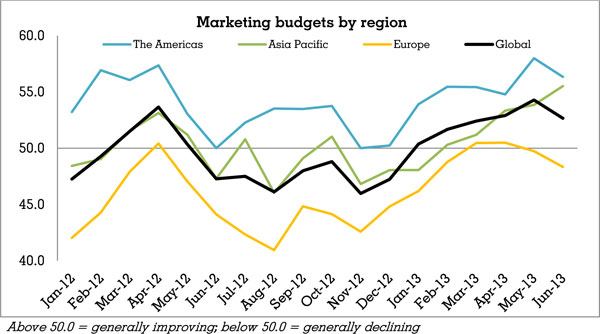
    Globally, marketing budgets were increased in June (54.3) but there were regional variations on this index. Marketers in the Americas continue to be most optimistic on 56.3, followed by Asia Pacific on 55.5 – the region’s highest reading since this index began – but Europe slipped further to 48.3, representing a second month of decline.


    The GMI is a unique indicator of the state of the global marketing industry. Every month it tracks conditions among marketers within their organisation and region. A GMI reading of 50 indicates no change, and above 60 indicates rapid growth.


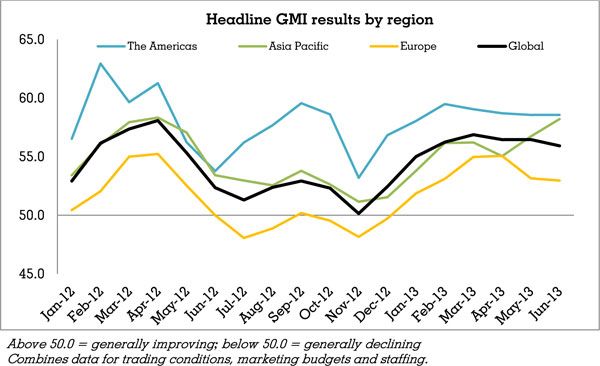
    The headline GMI measure – which takes into account marketers’ expectations for trading conditions, staffing levels and marketing budgets – registered a global value of 55.9 in June, consistent with May’s reading.


    Region by region, the headline GMI registered 58.6 for the Americas, 58.2 for Asia Pacific and 53.0 for Europe.


    The index of global trading conditions, the second component of headline GMI, continued to demonstrate confidence among the marketing community this month, registering a value of 58.1. Regional index values stand at 60.2 for the Americas, 59.9 for Asia Pacific and 56.1 for Europe.


    The index of staffing levels remains positive, at 57.1 globally. Regional index values stand at 59.2 for both the Americas and Asia Pacific and 54.7 for Europe.


    Suzy Young, Data and Journals Director at Warc, said, “Globally, marketing budgets continued to rise in June but this stems from solid growth in the Americas and Asia Pacific. European marketers are less confident and have reduced budgets for a second month.”


  • Global marketing outlook remains positive in May: Warc index

    By A Correspondent


    Marketers are showing continuing confidence in the state of the industry, according to the latest data from Warc’s Global Marketing Index.


    The index of marketing budgets rose for the fifth consecutive month, to reach its highest value since the index began in October 2011: 54.3 (up from 52.9 in April).


    In the Americas, the index for marketing budgets rose 3.2 points to 58.0, the highest regional figure for marketing budgets recorded so far. Asia Pacific’s index also increased, to 53.8. Europe, on the other hand, slipped back below 50, to 49.7.


    Warc’s Global Marketing Index is produced in association with World Economics.


    The GMI is a unique indicator of the state of the global marketing industry. Every month it tracks conditions among marketers within their organization and region. A GMI reading of 50 indicates no change, and above 60 indicates rapid growth.


    The headline GMI measure – which takes into account marketers’ expectations for trading conditions, staffing levels and marketing budgets – registered a global value of 56.5 in May, identical to the reading from April. Region by region, the headline GMI registered 58.6 for the Americas, 56.7 for Asia Pacific and 53.2 for Europe


  • 4 from India in Warc jury for Asian strategy prize

    By A Correspondent


    Warc has unveiled the judging line-up for the 2013 Warc Prize for Asian Strategy, a cash prize for the case study that demonstrates the most insightful marketing strategy in the region. The judging panel consists of 18 senior marketers and strategy experts from around the world. It will be chaired by Leanne Cutts, VP Marketing, Mondelez International.


    The panel of 18 senior marketers and strategy experts that will judge Warc Prize for Asian Strategy includes:

    • Leanne Cutts, VP Marketing, Mondelez International, Asia Pacific (chair)
    • Steve Blakeman, Chief Executive, OMD, Asia Pacific
    • Tim Broadbent, Global Effectiveness Director, Ogilvy & Mather
    • Damien Cummings Regional Marketing Director, Digital & Social Media, Samsung Asia
    • Mike Ewing, Professor of Marketing, Monash University
    • Ajay Kakar, Chief Marketing Officer – Financial Services, Aditya Birla Group
    • Bessie Lee, CEO, WPP China
    • Siddhartha Loiwal, Head – Marketing Development and Strategy, Marico
    • Richard McCabe, Regional Strategic Planning Director, McCann Worldgroup Asia Pacific
    • Rohini Miglani, Director, Brand Building Integrated Communication, P&G Asia
    • Madeline O’Connor, former Chief Marketing Officer, OCBC
    • BV Pradeep, VP Consumer & Market Insight for D&E markets , Unilever
    • Fredrik Sarnblad, SVP, Group Strategy Director, Mullen
    • Partha Sinha, Managing Partner, BBH India
    • James Thompson, Chief Marketing Officer, Diageo Asia Pacific
    • Joanna von Felkerzam, Director, Research and Insights, Asia-Pacific, Starcom MediaVest Group
    • Martin Weigel, Head of Planning, Weiden + Kennedy Amsterdam
    • Andy Wilson, Head of Strategy, BBDO/Proximity Asia


    The entries will be competing for a US$10,000 prize fund, including five new awards for 2013. The competition, now in its third year, offers a Prize fund of US$10,000. In addition to the $5,000 Grand Prix for the region’s best strategy case study, Warc has introduced five $1,000 Special Awards that recognise brands and agencies responding to Asia’s biggest strategic challenges.


    Leanne Cutts said, “With the ever-growing influence of emerging markets in Asia, this year’s entries promise to reveal inspiring ideas, informed by fresh local perspectives, to ignite creative approaches in targeting new markets, addressing changes in consumer behavior and contending with bigger competitors.”


    Free to enter, the contest is open to brand owners and agencies in any discipline. Entrants must submit a case study detailing an example of strategic thinking making a difference to a brand. Further details can be found on the Prize website, www.warc.com/asiaprize.


    The deadline for entries is June 14, 2013, and the winner will be announced in September. All cases that win an award will be showcased in the inaugural Asian Strategy Report, a study of smart strategic thinking in the region published after the competition has ended.


  • Global adspend to rise 3% in 2013 & 5.4% in 2014: Warc

    By A Correspondent


    Marketing intelligence service Warc (www.warc.com), expects global advertising spend (based on 12 major markets) to increase by +3.0 percent at current prices in 2013 and by +5.4 percent in 2014, according to its latest International Ad Forecast.


    If forecast inflation is taken into account, global adspend is expected to rise by just +0.6 percent this year and by +2.4 percent in 2014.


    This follows estimated adspend growth of +3.8 percent at current prices in 2012. The predicted slowdown for 2013 is due to the absence of last year’s adspend boost from the Olympics and the US presidential election, alongside on-going concerns about the health of the global economy, particularly in relation to the eurozone debt crisis.


    Forecast adspend growth in 2013, % change year-on-year Current prices Constant 2005 prices* Percentage point change vs November (current prices)
    Australia 2.2 -0.4 –0.4
    Brazil 9.5 3.4 0.0
    Canada 2.7 1.2 –2.0
    China 9.0 5.3 –3.5
    France -0.7 -2.3 –2.0
    Germany 0.9 -0.9 –0.8
    India 7.9 -0.2 –1.1
    Italy -2.9 -4.8 –4.6
    Japan 1.3 1.3 +0.3
    Russia 12.4 5.6 –2.2
    UK 3.1 0.7 –0.9
    US 2.2 0.3 –0.3


  • Marketing budgets, staffing see positive leap: Warc data

    By A Correspondent


    The outlook for global marketers continues to improve, according to the latest data from Warc’s Global Marketing Index. The headline GMI, a metric which combines trends observed in marketing budgets, trading conditions and staffing levels, registered a reading of 56.2 in February, it noted.


    According to the data, the index has recorded month-on-month improvement for three successive months. Marketers in Asia Pacific registered the strongest improvement in outlook, with the headline GMI rising from 53.8 last month to 56.2. The Americas continues to be the most positive region, with its headline GMI showing a strong reading of 59.5, up 1.5 points from January. The headline GMI for Europe also shows continued improvement, reaching 53.1 in February, albeit remaining slightly less optimistic than the other measured regions.


    The GMI provides a unique monthly indicator of the state of the global marketing industry, by tracking current conditions among marketers. A GMI reading of 50 indicates no change, and a reading of over 60 indicates rapid growth.


    The index for global trading conditions indicates rapid improvement for February and now stands at 59.4 (up 1.5 points from January). This is the index’s highest reading since April 2012. The outlook for trading conditions remains most positive in the Americas on 60.9, followed by Asia Pacific (59.7) and Europe (57.4).


    The index of global marketing budgets registered further growth in February (51.7). Marketers in the Asia Pacific region registered an increase for the first time in four months. The index rose by 2.2 points compared with last month to record a marginal net expansion on 50.3. Marketers in the Americas continue to display the greatest confidence (55.5). Marketing budgets continue to be cut across Europe, but the European index recorded a value of 48.8 in February, an increase of 2.6 points compared with January.


    The global index of staffing levels – the third component of headline GMI – registered further improvement in February (57.6). Staffing levels continue to rise in all global regions, with the Americas on 62.1, Asia Pacific on 58.5 and Europe on 53.2.


    Suzy Young, Data and Journals Director at Warc, commented, “The continued upward trajectory in headline GMI is encouraging. The outlook for global marketing budgets has improved since the start of the year with both the Americas and Asia Pacific recording positive growth.”


  • Wow! Ogilvy Mumbai is Most Effective Agency Office globally as per Effie Index


    By A Correspondent


    It’s decidedly one of India’s creative agencies and has also been very widely hailed as doing some exceedingly effective work for its clients. It wasn’t much of a surprise hence that when the global results of the Effie Effectiveness Index were released by Effie Worldwide and Warc yesterday, Ogilvy Mumbai was declared the Most Effective Agency Office globally in 2012


    The index, launched in 2011, recognizes the architects of the most effective marketing communications ideas from around the world.


    Talking about the recognition, Hephzibah Pathak, President, Ogilvy & Mather Mumbai, said: “This is brilliant news. A wonderful reward for the champions in Mumbai office and our great client partners and another testimony to the twin peaks of creativity and effectiveness.” Ogilvy & Mather Mumbai is the only Indian agency office to rank in the top 5 agencies globally.


    Said Kawal Shoor, Head of Planning – Ogilvy Mumbai: “This recognition makes us even more proud of the stuff we do. We’ve always believed that to be truly effective you need to have an outstandingly creative and insightful piece of communication. This is a vindication of the relentlessness of our people, the confidence of our clients, and the sheer width and variety of the office’s skillsets.”


    For the second year in a row, the WPP Group is the Most Effective Advertising holding company while Ogilvy & Mather is the Most Effective Advertising Agency Network.


    Ogilvy Mumbai was also declared the Most Effective Individual Agency office in Asia Pacific in the 2011 Effie Effectiveness Index and ranked number 2 worldwide.


    Meanwhile, Unilever is the most effective advertiser and McDonald’s is the most effective brand, for the second year in a row. McKinney (USA) is the most effective independently held advertising agency.


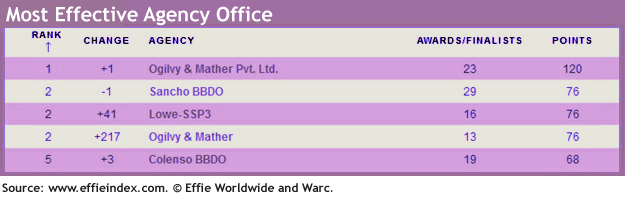
    O&M Mumbai leads in the global individual office ranking. Sancho BBDO from Bogota, Colombia, which led last year, slipped to number 2 followed by Lowe-SSP3 (also from Bogota) and Ogilvy & Mather (New York). The top 20 also includes agencies from countries as diverse as China, Hong Kong, Australia, Argentina, New Zealand, Egypt, Peru, Ukraine and Israel.


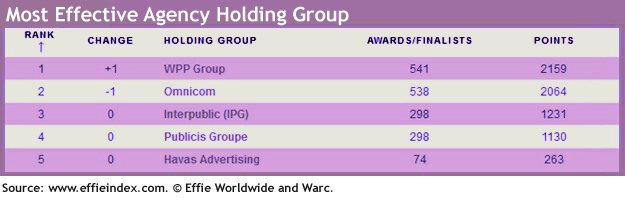
    WPP leads as the most effective holding company to be followed by Omnicom, IPG, Publicis Groupe and Havas Advertising.


    While Unilever is the most effective advertiser, Procter & Gamble has lost its top position since last year and slipped to number 2. Nestle is at number 3 followed by McDonald’s at number 4 and Pepsico at number 5 in the list of top 5 most effective advertisers.


    As for the brand, McDonald’s retains its numero uno position. Surprisingly, a technology company, IBM is the second most effective brand. Coca-Cola is at number 3 followed by Axe at number 4 and Pepsi at number 5.


    The Index was launched in June last year and is led by Effie Worldwide.  It is said that the Effie Effectiveness Index will become the industry standard. The Effie Effectiveness Index identifies and ranks the marketing communications industry’s most effective agencies, advertisers, and brands by analyzing finalist and winner data from Effie Worldwide competitions. It is the world’s most comprehensive ranking of agency and advertiser performance and a valuable resource for anyone interested in marketing effectiveness.


    The 2012 Effie Effectiveness Index is derived from almost 2,000 finalists and winning entries to Effie Award competitions worldwide between June 13, 2011 and June 12, 2012.


    The Index is constructed by converting every Effie award and finalist into points – 12 for a Grand Effie, eight for Gold, six for Silver, four for Bronze and two for a finalist (with contributing agencies receiving half these points). In a change from the inaugural year, if several agencies from the same agency network or holding group worked on a campaign, the network and holding group only receives one set of points for each winning effort.