Tag: TAM

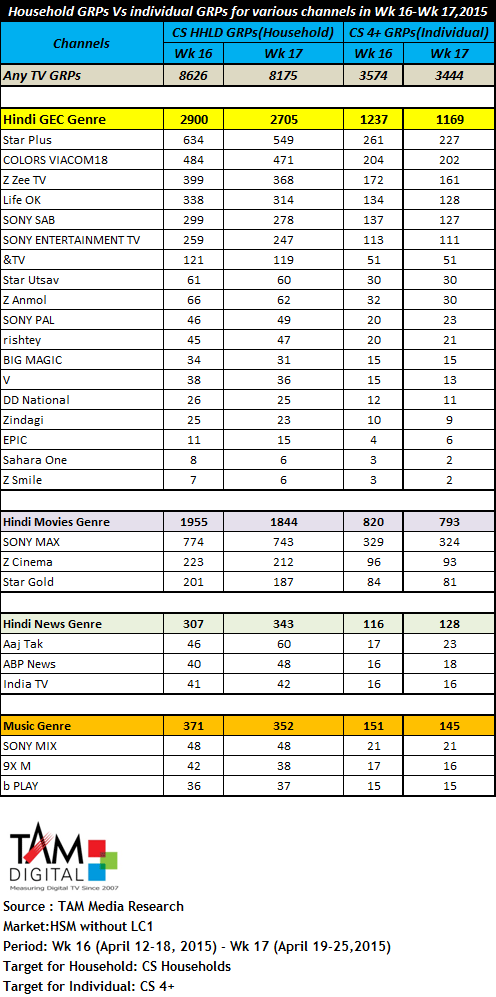
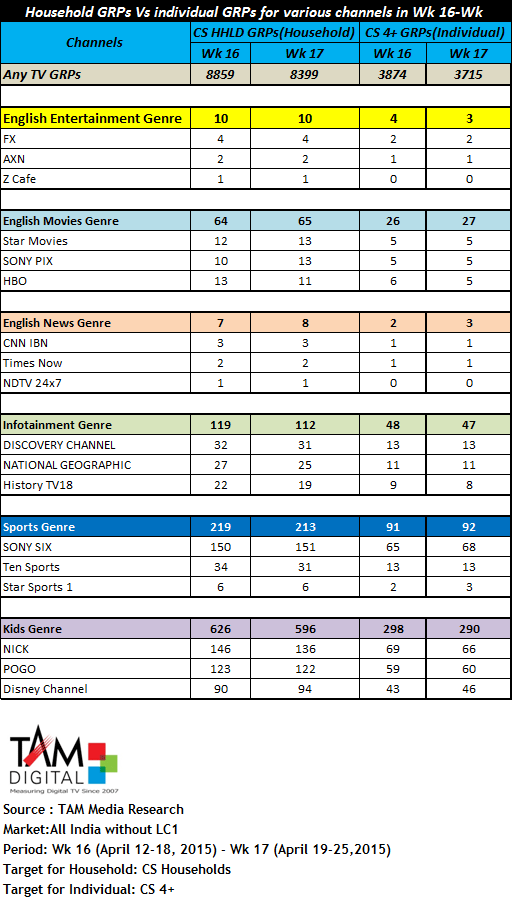
  • Zee is ahead of LifeOk in TAM’s Week 17 data for Households & Individuals

    TAM has released data for Week 17 (April 19 to 25) for CS Households and Individuals for HSM and All-India, offering a comparison between Week 17 and of the previous week (April 12-18). Take a look at the data below (and also at the data released by BARC India).


  • BARC is ready, but IBF?


    By A Correspondent


    Update @ 1.49pm: The fears have been allayed. BARC’s future-ready TV audience measurement data will be released today

    The coconuts were ready to be broken. A new sun was rising today. Data analysts made it to their offices early. There was indeed much anticipation. We almost didn’t sleep. Okay, that last bit was an exaggeration. We did catch some winks. But you know why all this tamasha:  the first data from Broadcast Audience Research Council (BARC) was scheduled to be released today.


    Till late last evening though, the BARC big bosses were grappling with a new problem, and this didn’t concern set-top boxes, the technology, etc etc. Some members of the Indian Broadcasting Federation, the apex body of broadcasters, wanted the release of data to be delayed. They reportedly wanted some more stability.


    When we teased whether it was BARC’s IRS moment, given all the madness that happened (and is still playing out) with the print readership study IRS, we were told it wasn’t that bad. These were just reservations. Niggling problems. And no it wasn’t raised by a network whose sporting activity is getting many numbers. In fact all the GECwallahs are pretty happy with the way BARC is going about its task. It’s the smaller channels, specifically some news channels who are upset. There is a conference call scheduled at 12.45pm today to deliberate on the issue.


    Meanwhile, TAM, which was until recently subscribed by most broadcasters, still exists, but key stakeholders – television channels, media agencies and advertisers – and have in fact released data comparing household versus individuals. It may be noted that BARC is currently only due to publish household viewership data.


    Partho Dasgupta

    The diversity in cultural and media consumption in the country makes the work of the Broadcast Audience Research Council (BARC) India the most challenging service governed by a single joint industry body for the entire country, said BARC CEO Partho Dasgupta on the eve of the release of data. With the number of TV-viewing households likely to go up from 20,000 to 50,000 in four years, the process will become even more complex, he added.


    Over 300 channels having ordered for the watermarking technology, and with over 272 channels already live, BARC India’s stakeholders – broadcasters, media agencies and advertisers  have, got together some of the top vendors from across the globe offering technology and solutions.  BARC India, has invested 76% of its budget on technology, it is learnt.


    According to Dasgupta, around 3000 professionals have been trained with the BARC India Media Workstation (BMW). NCCS, or the new SEC system, will be the norm to follow for accurate classification and data analytics. The pre-launch and post-launch audit processes were conducted by Ernst and Young’s  Florida team.


    Meanwhile, TAM, a joint venture of Nielsen and WPP-owned Kantar Media, is considering an urban-centric audience measurement service. There have also been rumours that BARC could well either buy over TAM’s TV audience measurement facility or turn its sole subscriber. When asked what TAM and he plan to do after BARC data is released, CEO LV Krishnan, who has helmed TAM since 2000, told MxMIndia in an interview yesterday: “On May 1, I’ll still be in business and there is never an end-of-the-road for anything. There will be a new kind of a craft that we will create…”


    So what happens to BARC now? We’ll know for sure by 1.30pm what course the conversation takes. Hmmmm.


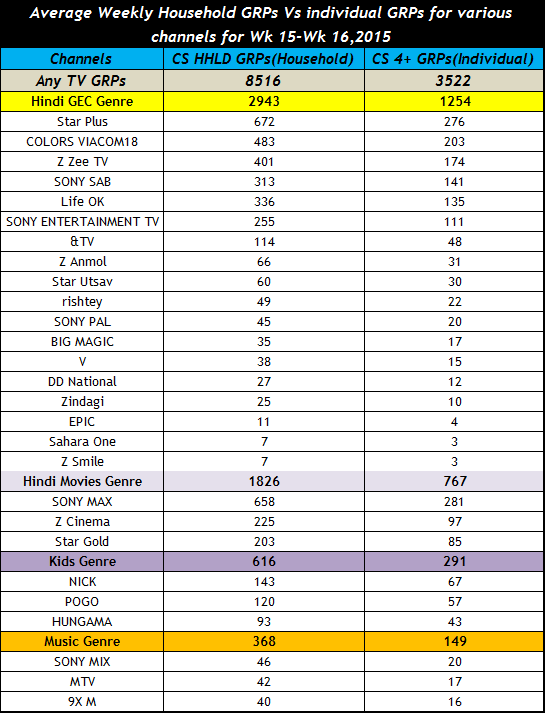
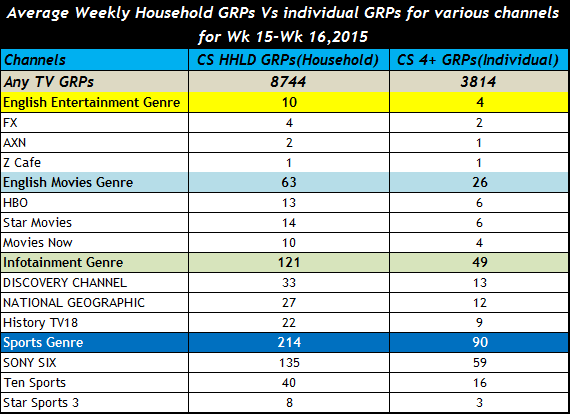
  • TAM data for Household & Individual GRPs for Week 15-16

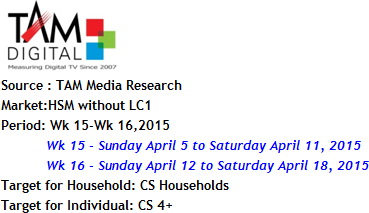
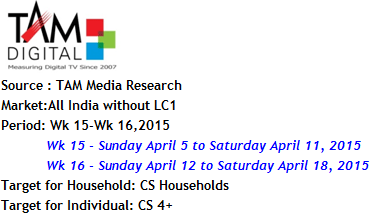
    Here’s data sourced from TAM giving us Average Weekly Household GRPs Vs individual GRPs for various channels for Wk 15-Wk 16,2015, without LC1.


  • As industry gets set for a new measurement regime, TAM gears for new innings!


    The new BARC television viewership measurement service is scheduled to kick off tomorrow (Wednesday, April 29). While there have been multiple measurement providers in the past, for over a decade, TAM, a joint venture of the WPP-owned Kantar Media and Nielsen has been in existence.


    There has been some resentment against TAM over the years. Not all the reasons though were well-founded. The sample size was one, but stakeholders were unwilling to pay more for increasing the sample size then. Part of the problem these imported and hence attracted a customs duty. The other peeve was the integrity of data. And another was the frequency in which data was disseminated, a cause of great concern to the news channels.


    However, what can’t be denied is the contribution of TAM and its team to the broadcast ecosystem over the years. L V Krishnan, CEO of TAM for the last 15 years, took time off to chat with Pradyuman Maheshwari about life after BARC data gets released… which is tomorrow.


    So what happens to TAM after BARC starts releasing its data?

    Whether BARC exists or not doesn’t really impact TAM. There are two databases allowing users to look at information and analyis for decision-making. It’s a measure of what one wants depending on business needs. I believe the market is large enough for a BARC and TAM to co-exist as long as we provide service or information that covers the essential needs of a consumer…


    But most of your key, high paying clients like Zee and Star have opted out and you obviously need monies to run a service like TV viewership measurement.

    Clients can move out of the business and come back again later if the service is crafted back to what their requirements are. There’s no permanency in the evolving, constantly changing marketplace. When you become the only provider of data, bringing in change may be a little slower because there’s a large constituency of users you need to take into consideration before you make changes on a continuous basis. Yet, I think the productiveness of time during the digitisation phase as well as during the-ever changing environmental space of homes moving from analogue to digital in a non-DAS market reflects the fact that as the market has changed, the system has evolved by itself. If a customer feels that there’s another system that provides a better value, they’re all free to go and subscribe to that system. That doesn’t mean that TAM has to close its offices and cannot deliver information that it’s designed to deliver. What TAM needs to do is to re-craft its business because as of today there are different scales of thought that come into play.


    One, the mass volume game where I measure every corner of the country and try to deliver that information back to the user’s homes which is what BARC’s mission is…. cover urban, rural, J&K to Kerala, North East to Gujarat. That’s not TAM’s endeavour, we don’t have those kind of funds to do that kind of an enlarged exercise. But, we also realise what’s happening in the environment today. From 2001-11, the number of towns with a one million population has almost doubled from 35 to 55 towns. And if you do the projection for 2015, you’re talking about 62-plus towns in the 1 million market. We believe that you don’t need to reach out to the population, the population is reaching out to markets and areas where there’s growth happening and sustained possibility exists and at the same time where they believe that fundamentally the growth prospects for them and family are much more stronger. Migration is one of the biggest elements here.


    So what you’re saying is that TAM will continue as an urban index?

    We believe that urbanisation is going to continue to progress which is what we see in the overall data. When you look at the census data of 2011, it talks about a 65-35% of urban to rural where rural has come down from 2001 from 72 to 65%. Either the population is migrating to big urban markets or more and more markets are becoming urban in nature. In that kind of a situation, given the diversity of the population existing in the 1 million plus markets, does that create an opportunity for segmenting of audiences & bringing in understanding of the behavior of audiences toward media?


    Will your ownership pattern (of being a Kantar-Nielsen 50:50 jv) change when you adopt this new approach?

    Yes, very much, the ownership continues the way it is actually. The service may undergo a sea change. The urban places will be the focus, not the small towns.


    So, will LC1 will go off your serice?

    Possibly. LC1 may not be in the radar, as also rural. It’ll be a permanent urban market. With the focus on the 1 million plus markets which is where we feel segmentation and targeting are becoming more and more easier


    Will GroupM subscribe to this urban-centric service… given that despite being a sibling (owned by WPP),  it unsubscribed to your service?

    We’ve always looked at GroupM as a customer as much as a Star and Zee. From our perspective if they want to try out a new service, they’re welcome to do so. At the same time, we believe that there are opportunities in the market where we can craft the service to the needs of a new customer and we continuously have a dialogue with the old customers too and as and when they feel the new crafted service is important for the old customers, we’ll make it useful for them too.


    When are you announcing the new service?

    There need not be an announcement. It’s a gradual evolution. It’s not like one day we announce this and next day stop it. The way we graduated from analog to digital… it’s a continuous process of evolution.


    You’re not going to be switching off…

    There’s no switching off.. we’re in the data providing area and there are enough customers in the market.


    We’ve had heard rumors of TAM selling its service to BARC… some talks initiated by Sir Martin Sorrell…

    I’m not aware of it. If that’s so, I’ll go with what the industry wants. If they seek a combination of services provided by TAM with an existing talent pool to assist  BARC, I don’t see any reason why we shouldn’t.


    Would you recommend that as…

    I don’t see a wall between us and BARC. There’s always a bridge that can be constructed between two service providers if it’s in the benefit of the industry. Ultimately the customer needs to decide.


    It’s not just the benefit of the industry, it’s the ego too.

    We don’t have any egos that rule. We think it’s the customer and his needs that rules.


    As you see the industry rallying around BARC and as you look back on your 15 years, do you think you should’ve also got the same amount of industry attention and monies?

    TAM is an industry-supported service.


    But it was a joint industry body that endorsed it, right?

    I mean price or spend supported. When it was created, it was a formulated idea. There was  no seed funding for the formation of TAM. It was primarily from subscription itself. When ownership doesn’t exist and it exists with two multinational research firms, then obviously one expects the fact that they will fund and push the services ahead. The difference between the TAM and the BARC system is that in the latter the industry has put money behind it to fund it, and that’s why they are standing behind it. It ultimately comes down to stakeholders. If they are two giant international research companies, they’d want to put the money behind it, make it run and they’ve done that. From where we were with 750 meter and five cities in 1999-00 to a 12,000 meter running the urban panel, it’s a huge milestone that’s being covered. If the subscription money was higher, we could’ve increased it to even higher levels, but frankly speaking there are no regrets to that now. At the end of the day, the stakeholders of BARC believe that they’ll be able to take it to a much more higher level. No regrets at all.


    Do you think that this wouldn’t have happened had the various stakeholders been more actively involved?

    There are two parts to involvement. One is from a technical perspective and the other is a price or a value perspective. When you involve yourself in a technical perspective, some recommendations help in making the measurement sharper. When it comes to price or value part of it, it becomes an investment yield question, in respect to sample size. In the case of TAM, the joint industry body took a call in late 1999 saying they won’t involve themselves in the price or value part of it at all. They only wanted to be the advisory technical perspective. There’s nothing TAM can do about it. It had to then depend on the two parent companies to see how much funding can be possible to keep expanding on a continuous basis. There has been all kind of involvement from a technical perspective into even as late as in 2012 when digitisation was around the corner when the AAAI, ISA and IBF appointed a three-member technical committee to work with TAM to work from analogue to digital. From a financial perspective, could there have been better involvement from them? I don’t think we could’ve rejected it if they wanted to come into it. At the same time, they took a call they didn’t want it. So, we couldn’t push them…


    Do you think they should’ve taken you as one of the components of BARC’s new measurement system.

    We welcomed BARC right from the time they announced it and we also participated in the RFI and then RFP. We’ve no biases on not wanting to be a part of BARC or any industry movement.


    There was no response to RFI or RFPs and we expected the fact that there’ll be a discussion on some of the proposals we put forward.


    Perhaps there was an issue that the then government had about the ownership of TAM, given that GroupM is owned by one of your co-owners?

    I don’t know where the government got involved because it had no role to play on an industry issue. If that’s so then today the way BARC stands, they shouldn’t have allowed that till the information was an all-India service.


    Do you think the industry should’ve continued with TAM and let the BARC system settle in?

    Well, some of the small and medium level users of data are not taking calls at this time. They believe that both systems have their merits or demerits and they want to look at it from their business perspective at what’s important and what’s not. Many of them are taking a call saying there is a new measurement system coming up which will provide the same measurement that TAM has but will have a larger sample and may have more number of markets to cover up in future.


    What could you’ve recommended?

    3 to 6 months is a good time frame.


    What about the dialogue with AAAI and IBF?

    I was never given an opportunity. I was surprised more with the letters even before I could ask for a meeting with the industry body.


    Moving on to one of the fears we’ve expressed in MxM, we’ve seen a joint industry body like MRUC which is populated by key newspapers and publications having a problem like IRS. Here you have an industry populated body and when the results came out the members were up in arms. Do you think that’s a fear for the numbers that are going to come up in BARC? You yourself in a sense faced it. Very recently after LC1 and digitization there were some very dramatic shifts of data. Given that and given the IRS example, do you think there’s a reason for fear?

    One needs to reflect back on the industry and where it stands. Media is a very peculiar category which isn’t an industry but actually a power centre. It’s close what a government or judiciary is. When you look at it in from that perspective, the key factor governing these sectors is power. If power is the centre, nothing else other than remaining at the top or growing continuously matters. And sometimes you tend to know what the ground reality looks like, but at the same time you don’t have anybody to tell you what that ground reality is. It’s in negativism, demoralizes people, runs into quite a few other conundrums that you don’t want to think about at that point of time. From that perspective, measurement is a harsh reality. Whether it’s for the government and the government doesn’t like it, whether it’s for a judiciary who at least gives it a thought and sees how it can overcome that with some way or the other and for media, definitely it’s not something they’d like to see again and again. The only reason why media needs measurement is fundamentally because 50% of the money in print or 75% of the money in television or 100% of the money in radio all runs through advertising. Or else, I don’t think measurement will exist at all in a public, common platform.


    Given the experience that you’ve had in the recent past, reactions to LC1 etc, is there some kind of piece of advice that you would like to give to the BARC folks, as to how they should possibly tackle the media/

    Frankly the fact that it’s a service that is funded by industry bodies should take care of things….


    But in the case IRS that didn’t happen?

    But I don’t think over there, the funding happen with everybody.  The stakeholders were only the publishers.


    Did it upset you at all that TAM has over the years become the favorite whipping boy of everybody, whether it is members of Parliament, industry folks etc. And the whole degradation of content and television, the sensationalism of news television, everything is blamed on TRPs?  

    No, it doesn’t bother me because it was expected, because you are the only one who are providing that particular data. What bothered me was the politicization of that particular exercise…


    Politicization by the politician or by the people in the industry?

    I could say anyone who is doing it.


    Who was a tougher evil, industry folks or the politician?

    The politicisation couldn’t have happened just because of the fact that the government was interested in the measurement exercise…


    So the industry folks…?

    Now one can’t easily draw a line, because at the end of the day some of the broadcasters, owners are also politicians and some of the politicians have also become broadcasters, specifically, if you look at the regional level. So, it’s a very difficult to say where the politicization happened.


    What are your sentiments like as the transition to the new service happens? TAM and you were after all a hugely influential factor in broadcasting over the last 15 years!

    I need to set the emotional aspect of this business aside and look at it very rationally. I can get carried away with emotions of the past but what needs to be look at is the present and the future.


    Well, the fact is that it’s about emotions. I have seen you over the last few years and your contribution to the ecosystem has been tremendous but and you have been the the lone and the sole voice of the rating business… in fact things couldn’t have progressed so far without you!?

    I’ve been lucky to be in this particular phase, of how the industry has taken shape, and I’m thankful to God for giving me a team that actually saw the same objective as me in driving the industry through a measurement exercise. The team has done a herculean task in the last fifteen years and we have worked very well with the industry for whatever misses that we might have had with them or missiles they might have fired at us, that’s part and parcel of the game. On May 1, I’ll still be in business and there is never an end-of-the-road for anything. There will be a new kind of a craft that we will create…


    Any personal high, you would like to look at? Would like to do go on a holiday now?

    There was a high point whenever we came out from a meeting, having heard the client, and we offering our perspectives with the client accepting and implementing it and seeing results getting delivered. Beyond that, I don’t think there is any other major high point. For us it’s always been the fact that there is a customer at the other end, we’ve got to listen to him/her and resolving issues. That’s what finally mattered and matters.
     

  • Sony Max goes past Star Plus in TAM Week 16

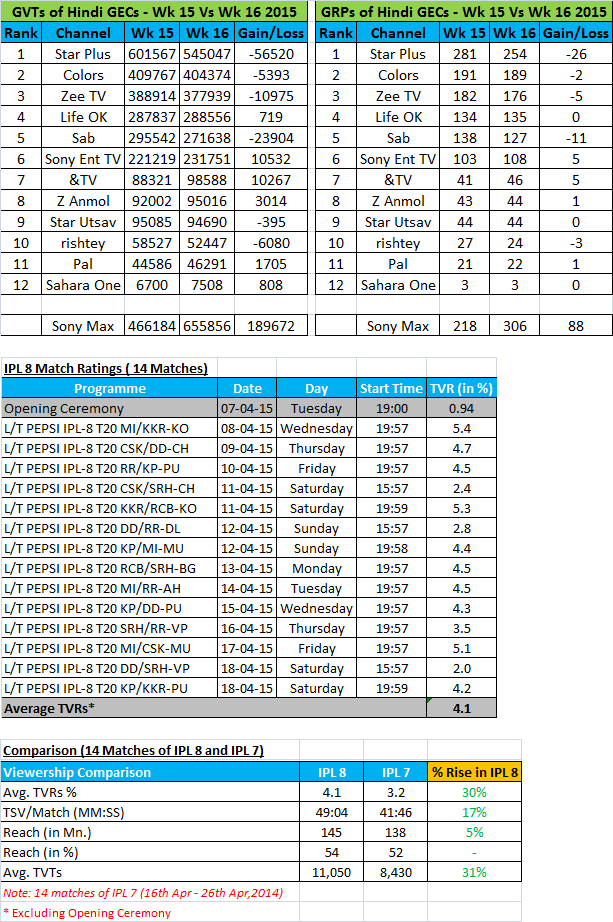
    This is indeed big news. Sony Max has earned 306 GRPs in Week 16 of 2015 as per TAM ratings even as Star Plus has got only 254 GRPs, losing 26 from last week. Interestingly Colors and Zee haven’t lost much, though Sab has lost 11 GRPs. This is of course early days of the IPL still.


    These are highlights of the IPL numbers:

    • 14 matches of IPL 8 were sampled by 145 million unique viewers.
    • Time Spent by Viewers per match was 49 Minutes and 4 Seconds; which is 17% more compared to IPL 7.
    • Avg. TVTs showed a growth of 31% for IPL 8 compared to IPL 7.
    • 14 matches of IPL 8 garnered 4.1% Avg.TVR which was 30% more compared to its previous edition.
    • 54% of the All India Universe tuned to watch IPL 8 matches.


    Do take a look at the ratings.


  • TAM ratings for Hindi GECS for Week 14 and 15

    By A Correspondent


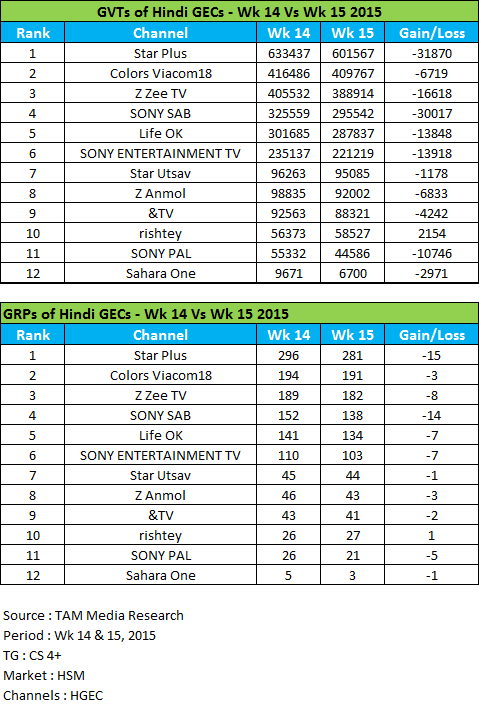
    We told you so. TAM, the television audience measurement agency set up by Kantar and Nielsen, has sent us ratings numbers for the Hindi general entertainment channels for Week 15 and 14 of 2015.


    We could go on and on, but the numbers tell you the story. Enjoy.


  • IPL8 is more than 40% more popular than IPL7: TAM data


    By Our Research Editor


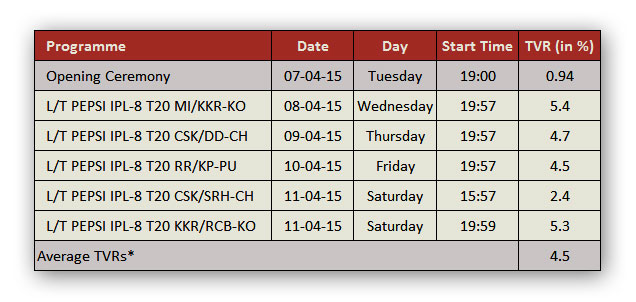
    Here’s a confession: this makes news for more reasons than one. First, it’s info about the ongoing eighth edition of the Indian Premier League and how it’s doing in viewership. And, second, it’s data released by TAM.


    The status that we have given this news is thanks to the second. Remember, effective April 1, many leading stakeholders of the broadcast sector have unsubscribed from TAM’s TV viewership measurement service. This basically means that while some key television networks like Star, Zee, Network18 and MSM (Sony) have pulled out as also leading media agencies such as GroupM, IPG Mediabrands etc, TAM can continue its business.


    Some channels though are continuing to subscribe to TAM data, and TAM says it will continue to be in business.


    Note:  prominent among the unsubscribers of TAM data is GroupM, the media services conglomerate that is owned by WPP which in turn owns Kantar Media, the co-owner of TAM. In fact when we asked two GroupM honchos for their comments on the data via their PR agency, we were told GroupM will not comment on viewership data of TAM or BARC until April 30. (Aside: Is April 29 the date when BARC is launching its viewership data?)


    So if TAM is releasing the IPL viewership data, don’t be too surprised if it also releases its weekly channel data soon. And if continues to do so even after April 30 or from whenever BARC is gonna to release its viewership data, don’t be surprised if TAM continues to coexist and confuse things. Sigh.


    Remember our story on BARC buying over TAM which we later heard could also be in the form of TAM supplying all its data to BARC and adding it to its own.  We hear the talks happened since the story broke, but it’ll happen is what we understand (folks at Adgully who also ‘scooped’ the story, please note).


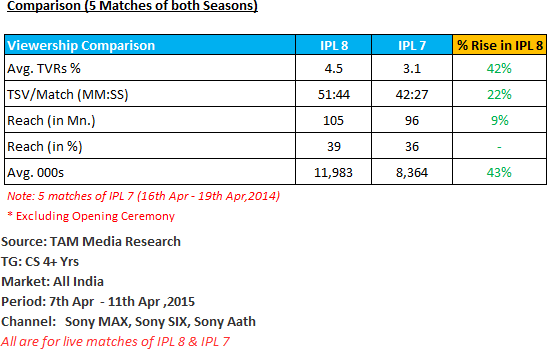
    So here is an interpretation on the IPL published along side this bit:

    :: 5 matches of IPL 8 were sampled by 105 million unique viewers
    :: Time Spent by Viewers per match was 51 Minutes and 44 Seconds; which is 22% more compared to IPL 7
    :: Avg. TVTs showed a growth of 43% for IPL 8 compared to IPL 7
    :: 5 matches of IPL 8 garnered 4.5% Avg.TVR which was 42% more compared to its previous edition
    :: 39% of the All India Universe tuned to watch IPL 8 matches


    All of this should obviously ring the right bells at the offices of Multi Screen Media, the owners of Sony Max and Sony Six (and Kix). The question is will they be able to quote these numbers officially to advertisers? Wink, wink.


  • Eric Salama slams MxM report. Says no selling TAM to BARC. MxMIndia stands by story

    By A Correspondent


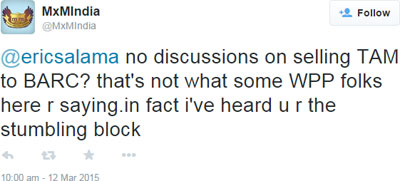
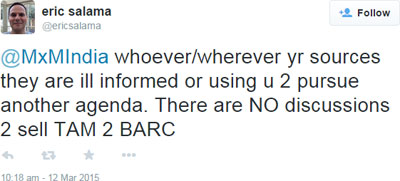
    Kantar Media CEO Eric Salama tweeted us back Thursday evening saying: “Whoever/wherever your sources, they are ill-informed or using you to pursue another agenda. There are no discussions to sell TAM to BARC.”


    This followed an earlier tweet where he said: “Happy to cooperate with BARC to improve ratings but no discussions for us to sell TAM to BARC.”


    This was reacting to our tweeting the link to the story to Mr Salama and other industrypersons.  We responded to this tweet by saying: “No discussions on selling TAM to BARC? That’s not what some WPP folks here are saying. In fact I’ve heard you are the stumbling block.”


    We are normally not so direct or rude, but in this case, we’ve heard from more than one source – on the WPP and the industry side – that the counter-offer made by the Kantar CEO was unacceptable and hence a potential deal-breaker. In fact, some industry sources even told MxMIndia in confidence, that it was because of some statements made by someone senior at WPP (suggesting Mr Salama, but not confirming it) that the talks with Kantar fell through in the early days of the BARC contract finalisation.


    One senior industryperson associated with BARC was even told that BARC will not be able to run its business without the intervention of Kantar. In fact the senior industryperson feared the future of his career because the offensive was pretty strong, he told us.


    Meanwhile, MxMIndia strongly stands by the story it published yesterday. The fact of the matter that a deal is being looked at. This could also mean that TAM will publish its ratings every week and hand over the data to BARC which will then use it for its purpose or club it with its panel size and present to its consumers.


  • &TV opens with 90612 GVTs

    The numbers are out. &TV has opened at 90162 GVTs in the first week of its launch.


    With only five-and-a-half measurable days as per the TAM measurement cyle, newly launched flagship Hindi GEC &TV from the Zee Entertainment stable has opened at 90612 GVTs. The launch happened with roadblocks across the Zee network of channels as well as very visible outdoor and print campaign.


    Detailed ratings of the various shows including Shah Rukh Khan’s ‘India Poochega – Sabse Shaana Kaun?’ are awaited


  • Exclusive! BARC in talks to buy TAM?


    By A Correspondent


    Entertainment television is all about twists and turn in the fictional serials. Cricket, as you would’ve heard several times over, is a game of glorious uncertainties. So why then should there be surprise over the possibility of BARC buying up TAM.

    Okay, let’s cut the tease. Broadcast Audience Research Council (BARC) has indeed been in discussions to buy the television audience measurement business of TAM, the firm jointly owned by WPP’s Kantar Media Research and Nielsen. And, yes, it’s March 12 today, not April 1.

    According to reasonably reliable sources, there have been a detailed dialogue between the joint industry body-managed BARC and TAM owners Kantar and Nielsen. The talks haven’t concluded yet and the mid-point formula that was suggested by a WPP representative has been reportedly rejected by BARC bosses.

    Both BARC and TAM were unavailable for comment, but from what one learns, BARC was seriously considering the buy.

    So why gobble up TAM when the audience research measurement activity of the measurement body was under question? Well, even as doubts were being raised, there is no denying that broadcasters, advertisers and media agency use TAM as the currency for their buying decisions. Also, as industry analyst told us, TAM comes with a ready 12,000-odd panel, established processes and teams and archival data.

    And from TAM’s point of view, why sell out to BARC? Given that all stakeholders have contributed to the BARC kitty, it’s evident that sooner or later all TAM subscribers will exit the system or want to renegotiate. Given this, it’s best to sell the existing well-oiled measurement machinery to BARC which would find it of use, said the analyst we spoke to earlier.

    TAM has already made it known to subscribers (and the media) that it will continue operations even as there is a significant number (in billings at least) of subscribers who have said they would like to unsubscribe. If TAM continues to exist, there will be several comparisons made with the new measurement system, and those subscribers who may be rated poorly by the BARC system vis-a-vis TAM may quote the latter. This could even lead to advertisers questioning the BARC data and hence cause a confusion in the marketplace.

    As reported on MxMIndia earlier, the ghost of the Indian Readership Survey has raised anxiety levels in the industry. For, MRUC and RSCI, the bodies running IRS are jointly run and owned by various stakeholders in the industry. And despite it being an industry association, print players are up in arms against the new IRS.

    BARC, meanwhile, is said to be only in the discussion with the television audience measurement business of TAM. Other divisions such as the Strategy or S Group which offers advisory service on measurement, AdEx India, RAM for radio audience measurement, Eikona for measurement of earned media and PR activity and TAM Sports, which offers special analysis of sports ROI will not be part of the deal if it goes through.

    So where do things stand now? At the time of writing, the talks have been suspended. But as the date approaches for the launch of the system, and the stakes for both BARC and TAM grow higher, the deal could well be inked. Like on television, be ready for the climax.


  • TAM numbers for Hindi & Regional Channels in Week ​8

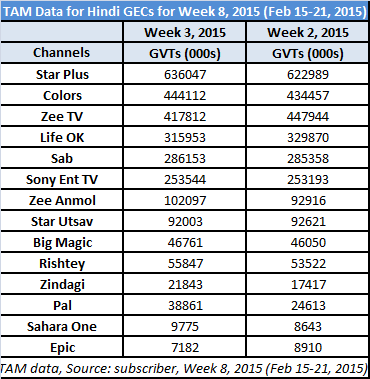
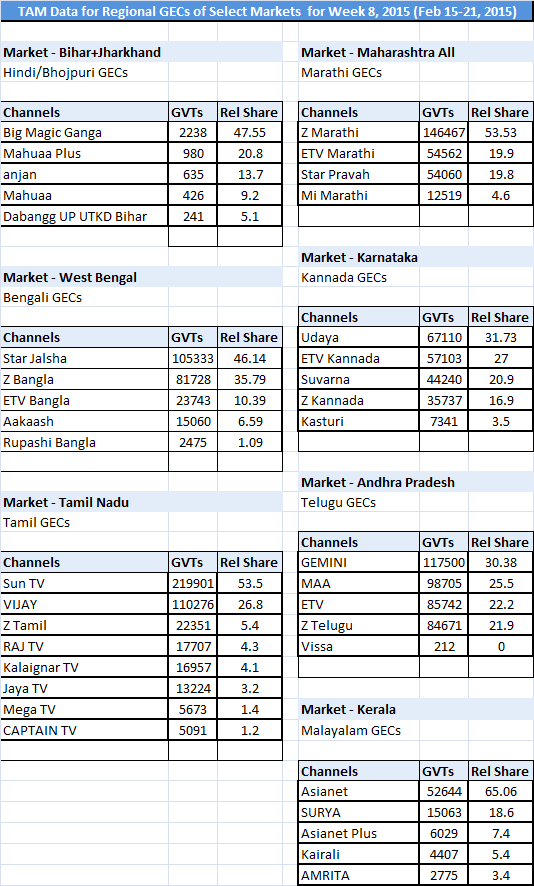
    Namaskaar, Vannakkam, Hello. It’s that TAM, er, time, of the week when we bring you TAM ratings for the key GECs. So here we are presenting you TAM data for various Hindi and regional entertainment channels for ​​Week ​8​ of 2015 (that’s for ​February 15-21, 2015).


    Note this list is not exhaustive and does not include some key and growing regional markets. Also, as you possibly know, this data is not sourced from TAM. So we’ve sourced it from a friendly subscriber. While we are confident that the numbers are correct, we urge advertisers and our readers in general to verify the data.​ Hopefully once BARC starts supplying data, we will get it from them directly and don’t have to write this silly disclaimer every week.​


  • Ghost of IRS mess may force BARC & TAM to co-exist


    By A Correspondent


    The ghost of the Indian Readership Survey released last year is seeing its impact on the new television audience measurement regime of the Broadcast Audience Research Council. IRS is still in a state of disarray even though stakeholder associations have okayed it.


    Although we are told that the next round of numbers is to be out soon, the industry is still waiting.


    MxMIndia spoke to a variety of folks in broadcast and in media agencies.  While none of them were ready to go on record on the sensitive issue, they are worried about the outcome of the BARC study. And the reason:  the proposed BARC study is dramatically different from what TAM does. So it’s not that the same sample is being studied, also the BARC’s panel is twice that of TAM. “The goalpost has moved. It’s as if the game was being played on clay and now on astro-turf.”


    A senior media planner told MxM that one must remember it’s a statistical exercise and not a census. When asked as to how does one explain the shockingly low readership figures for some publications like BusinessLine or Hitavada in IRS 2013, the planner told us: “It’s a sample survey. The sample was selected scientifically. It’s a matter of chance that those selected didn’t read these two publications. So you can’t fault IRS for this.”


    Hmmm. The third-party revalidation process conducted by veteran researcher Praveen Tripathi and adopted by the IRS determined that the process followed by IRS was okay.  “The problem with audience research is never the process. It’s the fieldwork,” said a senior executive of a research firm which has had some experience in audience measurement.  “Media companies are known to influence these in order to get favourable numbers. This is more easily done with print readership and tougher with television. When you are dealing with human beings and human intervention, you can never say. The problem is compounded because the trade associations refuse to act against erring media entities.”


    So where is the anxiety on BARC?


    The big channels needn’t worry. One hears that the BARC validation process will ensure that if there’s anything astray from the existing, it will be looked into. However, with the number of people sampled having leapfrogged, there is bound to be some change from what TAM dishes out every week presently. The unease amongst broadcasters is whether the change will be as significant as it was in the IRS results? “Yes, be ready for a few surprises. Logically, there should be no validation, because if the process is right and the industry is mature, there is no need for being alarmed. “


    So are we saying that the media industry isn’t mature? “Perhaps,” said the senior planner we spoke to earlier. “The stakes are too high, and in the case of the IRS there was an unfortunate charge that one newspaper group had influenced the field work.” But there is also a view that the MRUC and RSCI, the people associated with the IRS, did not handle the IRS mess-up too well. “You can’t be behaving like cowboys when you are dealing with sensitive stuff like audience measurement. The existence of a media brand is in question with an incorrect survey,” a media-owner had told this writer a few months back. “ MxMIndia is awaiting  a response from the MRUC chairman to a few questions.


    After this report was filed, our attention was drawn to a report in The Economic Times as well as on IndianTelevision.com on the same issue. The ET story indicated that there could be a blackout period post February until BARC ratings start since subscribers may pull the plug on TAM. The IndianTelevision report quotes Zee MD and CEO Punit Goenka saying that IBF has taken no decision to pull out of TAM. The statement assumes significance as Mr Goenka is also BARC chairman and one of the most powerful members of the IBF.


    But what puts the lid on the discussion is an emphatic assertion from TAM (to MxM) that it will not discontinue ratings even after BARC starts transmitting its data.


    “Will you’ll stop when BARC starts,” we asked. “No, we won’t,” the TAM spokesperson told us. The question of course is not of TAM continuing to publish its data, but how many agencies and broadcasters will subscribe to it.


    There have been industry rumours that GroupM, the largest media agency conglomerate in the country, which is owned by WPP which in turn is 50 percent owner of TAM via Kantar Media may still be in favour of TAM’s continuance. Although the FAQs released by BARC have clearly stated that GroupM has committed itself to BARC by investing in monies, there is a belief that the media services conglomerate will maintain a hawk’s eye on BARC.


    The good thing for BARC is that all those leading it are doing it with pragmatism and are wise enough to know where they need to exercise more caution. Also, data has already started flowing in and being assessed by BARC bosses.


    Watch this space for more.