
Tag: TAM

  • AdEx on all media drops much in Nov 2017 (vis-a-vis Oct)


    By A Correspondent


    Every week, MxMIndia in partnership with TAM AdEx brings you a scan of advertising expenditure across print, television and radio in various categories. And on a monthly basis, we bring you a view on how the adspends have been for a calendar month vis-à-vis the previous calendar month.


    October this year was particularly bad for television, though not as bad for print. But, in November, after the frenzy of the festive season, the drop is significant for print too.


    The data we bring you above and below is hence of particular interest:


  • Analysing the MxMIndia-MRSSINDIA Poll on English News Channels


    By A Correspondent


    We can be sure to see a lot of action over the next few days as BARC releases its data for English news channels. Already, there are reports on news broadcast organisation NBA complaining about the presence of multiple feeds of Republic.


    Sadly, the complaint has raised questions on NBA’s impartial conduct but that’s an issue for the channel-managers to decide and sort out.The complaint is bizarre, and one isn’t sure if the TRAI should get into all of this. But, of course, if it does set a rule, it will be applicable to one and all.


    Meanwhile, the MxMIndia-MRSSINDIA poll on English news channels has had huge traction in the media, advertising and marketing communities.


    And the study itself deserves an analysis.

    While commissioning the research, one does of course factor in the issue of how well does research on a sample reflect the mood of the entire viewing population. But, then, that’s how surveys are conducted, and it has been statistically proven that surveys are scientific. Loads of $$$s are spent on research worldwide, and the findings do help guide corporate decisions.


    In the past, a similar factor is attributed to the efficacy of audience measurement tools like the one from BARC India, TAM and IRS.


    Be that as it may, the findings of the study are interesting.Here’s the summary of the findings that we published, and our analysis below that in italics:


    :: Majority of English news channel viewers mentioned they are aware of ‘Republic TV’ English news channel and most of them (41%) perceive it to be ‘Better than Others’.


    Since the measurement data seen for English news channels is for 22-year-plus in cities with a population of more than one million homes, this data is critical. However, in the data thrown in the study, Times Now isn’t too far behind Republic. So the BARC numbers could well be interesting to look at.

    :: Centre wise, Mumbai (41%) perceive it as ‘More Credible’, Delhi (39%) find it ‘Old Wine …’, Bengaluru, Chennai, Kolkata and Ahmedabad English news channel viewers find Republic TV ‘Better than others’.


    This had us puzzled. The viewer in Delhi thinks Republic is Old Wine, but the one in Kolkata – who one would assume is more discerning – doesn’t think it’s old wine at all. However, Kolkata viewers find the noise factor very high. It’s important to note that Mumbai finds Republic more credible, given that RajdeepSardesai is the Most Trusted Anchor here. Kolkata trusts Arnab more, nothwithstanding the noise.


    :: Aggressive approach is found more appropriate for Debates, Breaking news and Analysis & interpretations. whereas, softer approach is found more appropriate for News deliver, soft news, sports and business news.


    Well, it’s interesting to see how Kolkata doesn’t mind a noisy and aggressive debate. So obviously some variance from an early view.


    :: Most viewers look at News channels to be opinionated but there is also a strong sense of believe that news channels should also play a vital role in bringing about political or social changes.


    It’s interesting that a majority Mumbai and Delhi viewers don’t think news channels should be opinionated and activisty. However, it’s not a very wide margin.


    :: Overall, print is a more trusted source (51%), closely followed by News channels, currently online (websites) are not considered a trust worthy source. News paper is more trusted by viewers in New Delhi, Bengaluru, Kolkata and Chennai. News Channels are considered better trusted source by viewers in Mumbai and Ahmedabad.


    This is the status as of today, and one is certain that online sources will rise significantly in the future.


    :: When it is need to verify news, the first source is News Television (54%). This is more in Chennai (54%), Kolkata (68%) and Ahmedabad (67%).


    These throw some interesting insights on the choice of media of news followers. Once again, expect the numbers to grow for digital offerings in the next two years.


    :: ArnabGoswamiand RajdeepSardesaiare considered the most trusted news anchor by close to 1/3rd of the viewers. BarkhaDuttcomes at third place. While Goswamileads comfortably in Bengaluru and Kolkata. Sardesai has higher trust value in New Delhi, Mumbai and Chennai. Duttis relatively strong in Ahmedabad and Chennai.


    This is a worry for Times Now as its key anchors don’t fare well here. There’s also an opportunity for India Today with Rajdeep Sardesai scoring high across the cities surveyed.


    :: Among the English news channels visited in last 1 week, Republic TV was 41%, Times Now is 35%, followed by NDTV 24×7 is 32%.


    This is a data point that could obviously change in the BARC numbers. But it’s interesting that Republic TV is ahead of Times Now in this sample, albeit not very significantly.


    All in all, even as we say this ourselves, the MxMIndia-MRSSINDIA study builds the excitement for the numbers that are expected on Thursday and in the forthcoming weeks.


  • Now get TAM AdEx updates via MxM


    In a special arrangement with MxMIndia, the platform trusted by discerning advertising, media and marketing professionals, ​TAM AdEx, a division of TAM India, will provide weekly scans of spends across television, print and radio.


    How do you get it? Simple. Simply ensure you subscribe to the MxMIndia newsletter.


    In addition, we will also provide a monthly overview of the spends, like we are doing today. The first of these newsletters will be sent out tomorrow and thereafter every Monday morning.


    Read on and Enrich yourself.


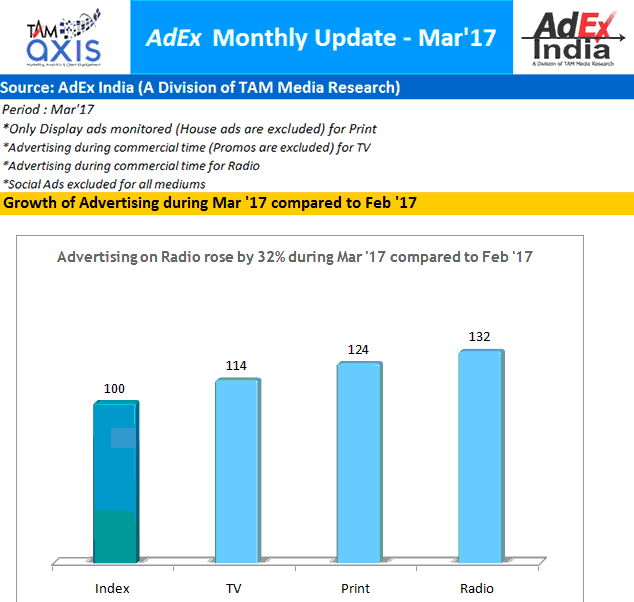
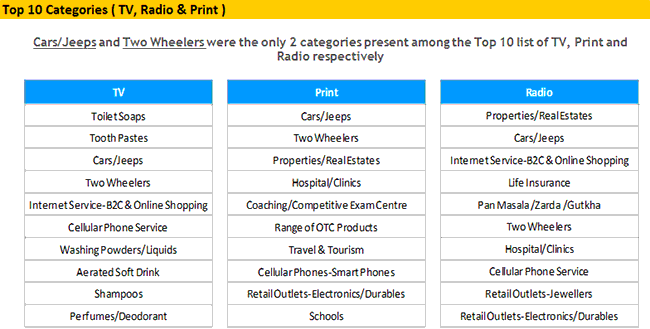
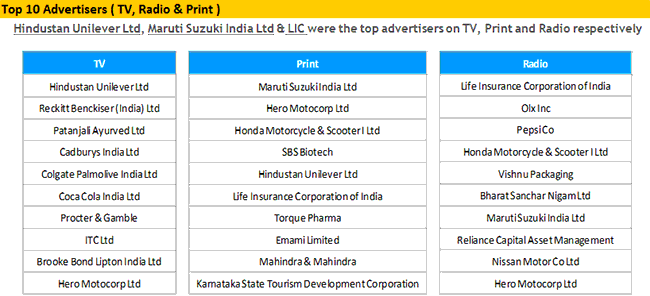
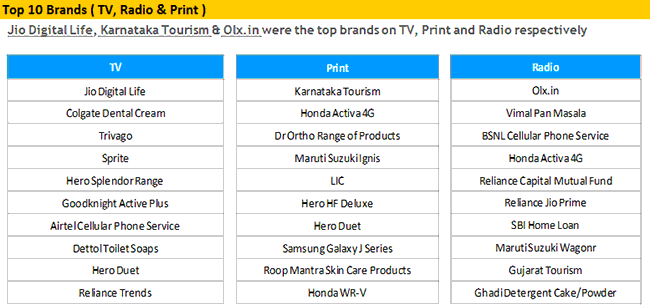
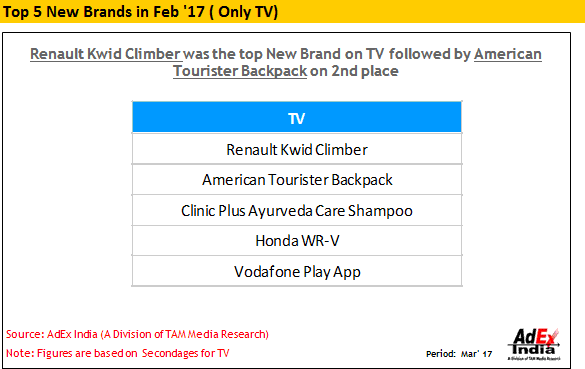
    AdEx Monthly Update – Mar’17

  • Z-plus security for BARC boss

    By A Conespondent


    Measurement is a thankless job. TAM CEO LV Krishnan ensured he built his endurance to the vagaries of the business by following a punishing fitness regiment. Last heard he could do 56 push-ups at one go. Now we have heard of some people having 56-inch chests, these many crunches is a bit much.


    But in the case of the BARC, things are different. The industry-constituted body has been acting tough with broadcasters. Homes are being monitored to check if broadcasters are influencing them to only watch certain channels. Erring channels are also being warned to behave or else.


    Now, media in this country is controlled by all sorts of people. By gentlemen and ladies, and by the not-so-gentle people too. Reportedly at some of the meetings, the BARC CEO has been threatened of crazy consequences.


    And now with a minister also questioning the BARC measurement system regime, it was felt that a Z-plus security may be appropriate.


    Please follow this link for more

  • So what should one make of BARC’s TAM meter jv?


    By A Correspondent


    So you have already read about the BARC India-TAM jv being solemnised. Now let’s try and understand what it means for all stakeholders, and more importantly for BARC and TAM.


    Tears for TAM?

    Of course, it’s been in existence for over 15 years. Has done yeoman service to the industry. The adspends on television would’ve grown any which way, but the presence of a robust measuring system ensured the more discerning and price-sensitive advertisings looked at television (over print).


    What happens to LV Krishnan?

    Don’t know yet, But one has to acknowledge the great work put in. Take a bow, LV!


    So, effective March 1, BARC will be a monopoly?

    Ah, well, yes. TAM will cease to be in existence for television measurement.


    Monopolies are bad news. How does this new one help television?

    Yes, a monopolistic situation isn’t good news, but don’t underestimate Nielsen and Sir Martin Sorrell’s WPP. They could well enter the scene again – directly or indirectly. In the short run, it will help stabilise BARC.


    But TAM meters were bad na? Will the 12,000 meters really add up?

    Hmmm, in all probability a fair number of them won’t be mainstreamed into the BARC system eventually. They may be deployed on rural or not-so-significant areas.


    So are we thinking of what you are thinking?

    We are all thinking, but we don’t have an evil, cynical mind!

    No, that basically the gobbling up happened because they wanted to kill competition!

    The weather in Mumbai is so horrible these days. I really wish I was in Delhi


    Okay, okay, we got the answer. But, pssst, just between you and me only, and not for the entire world, how did it help doing that?

    Because ever since BARC started releasing data from April 29 last year (2015), some broadcasters – large networks and minor ones – have been fussing about the data. And always comparing the BARC data with that of TAM. So, that was a pain in the you-know-where


    So you have a created an unfair monopoly?

    Why do you such words. Keynes ka distant cousin, kya?


    What happens to TAM’s digital-television measurement system which it announced with IMRB last year?

    Most probably it will be killed too. BARC is coming up with something similar. Plus TAM can’t be doing TV, so finito for the TV measurement part of the service possibly!


    And what the other stuff… RAM?

    Other businesses continue. The press release clearly says that it will continue to serve AdEx services of TV, Print & Radio AdEx, Daily & Weekly Sales Index Reports, Bollywood & Music Monitoring Dashboards; Audience Measurement in Radio (RAM); Sports Sponsorship ROI Measurement (TAM Sports) and PR Measurement data & Audit services (Eikona) to its valuable clients.


    But?

    No buts. But, yes, the main horsepower would come from TV


    So why did Kantar and Nielsen do it?

    Because they had lost substantial business any way. While broadcasters have the propensity to pay for two currencies, their associations would frown upon them continuing to back a company it had opted against.


    What about GroupM? Isn’t it owned by WPP, the people who half-own TAM via Kantar?

    Sir Martin Sorrell is a smart businessman. And his people here are wise. They know what’s good for the industry


    And where the wind is blowing?

    Why don’t you change from kurtas to shirts?


    Any more questions we should be asking?

    Yes, so when will it start getting warmer in Delhi


  • Panel-based measurement is better: LV Krishnan


    Last week, the Kantar Media-Nielsen jv TAM Media and Kantar-owned IMRB announced the TeleWeb ratings for an integrated study of viewership on television screens and the internet – desktop/laptops as well as on devices. We caught up TAM CEO LV Krishnan to understand the finer details of the offering…


    You had spoken about the multiscreen measurement earlier. But do you think it could’ve come in a year or two earlier?

    Well, it required a lot of work to put it together because one is a non-linear medium and the is a linear one. To bring together both into the same database and be able to tell an advertiser that using a combined medium maybe better than using one medium etc requires work. We did a lot of groundwork. If only publishing numbers in terms of saying which sites were getting hits and which sites were getting what kind of profile of audiences. it could’ve been easy. It could’ve happened much before than now. Probably about 4-5 months back. But to integrate both, this is the earliest we could’ve got to.


    Given that there is an MoU with BARC on meters the merger move is work in progress, what happens after the merger happens?

    We’ll see it at that time.


    BARC is also doing something similar, it is also looking at multiple screen measurement.

    From our perspective we are looking at the present moment of time. We’ve done almost a year-and-a-half of work into this exercise. Obviously, since we are still running the television panel, the idea was to launch it and help the industry use it. What will happen a couple of months down the road is something we haven’t thought about at all. From our perspective, the work on TAM BARC integration is going well at a high speed level. That’ll continue.


    Since IMRB’s digital measurement exercise has been on for some five years now, couldn’t this have happened earlier?

    Two important things. Before we launched something like the integrated data we also needed to ensure the fact that the two panels are stable. TV was completely stable. The online one was a new one launched around 2011-2012. So it took time for that panel to settle down and get used on a regular basis because at that time if you look at it the advertising online was hardly around 2-3% of the advertising that was going over there. So, even if we had launched at that particular moment of time, the integrated quotient, the usage could’ve been very low. The demands coming in from the advertisers that we need do it the integrated way. Only in the last one year, in the beginning of 2014, when we were interacting with advertisers that there was a huge push going towards digital. Probably also because of the fact that most of the advertisers were MNCs were also being pushed by the global directors saying that let’s get starting investing on digital because globally digital was picking up strongly.


    What we previewed at the press conference last week was about English channels and the Hindi news channels. But I’m sure the difference is significant with English GECs.

    English GECs are basically international sites. So, we need to see what you want to track within that and how much of it is with the Indian audience largely. So, probably with time we’ll look at English entertainment also as a next step.


    Do you see a lot of viewing happening online in the case of all GECs?

    There is dailymotion.com, Hotstar, Sonyliv, Ditto, all of them are coming in the Top 50 sites. Platforms like Hotstar are among the Top 5.


    Now a channel like Colors has ‘Comedy Nights With Kapil’ which is among the most watched as per your numbers, but a channel like Colors which targets urban audiences is not in top channels list in tele-web, vis-à-vis Zee which is on the list?

    That’s because of Ditto TV. Ditto is the push for Zee. It has certainly got some audience in the metro markets. Colors is yet to have a platform that could be visible and for which audiences are walking in.


    So, will you say OTT is playing a big role?

    Yeah, certainly.


    What is the kind of response that you’ve seen from the advertising community, from the advertising agencies and media agencies?

    We don’t know yet the response because we just launched today but we’ve been working with the advertisers on this for almost a year now. We connected with them and we realised what they are looking for. So, therefore from that perspective this is exactly matching up to what their expectation was from a feasibility perspective of trying to alleviate a campaign on a multimedia level.


    There is no joint industry body to contend with the way you work. There is no industry association as such…

    No, there is no industry association involved in this. We are on our own and like any other research we are marketing it on our own for users to take their independent decisions whether they want to buy it or not or use it or not.


    There have been views on the entire element of panels. In the case of television, the cost of set-top boxes ensured that the sample size of panel homes couldn’t grow. But no such thing exists for the internet, so why only 6-8000 sample size? Do you think it can be browser-driven so that anyone can download and install?

    There are two different kinds of measurements that happen across all media. One is measurement based on universe and second one is measurement based on panels and specific sub-groups of profiles. The problem comes in when the universe study is when you don’t know who the individual is, who is responding to a particular viewing. So, most of the dynamics related to the universe measurement is already available with the publishers themselves like a Google or a Facebook knows about their customers largely and to that extent Facebook I could say knows it even better because age and gender is something they capture apart from the geographic location which is universally available to them. So, therefore, from a universe perspective, limitation is a fact that while you’ve a larger base you don’t know who that base is, who that individual is in terms of profile. So when you are targeting it, you are targeting more based on the behaviour pattern of the respondent rather than on the basis of demographics. In a panel0based exercise you are able to measure demographics as well as in terms of behaviour patterns together. So you know individually what the profile of the guy is, what profile of home he comes from, what are the numbers in the home, what are the platforms they have in the home that can be access point or a competitive perspective, a competitive touchpoint. So, all this kind of information is available on a panel-based exercise. Therefore, we are able to integrate between two mediums very effectively in this kind of a panel-based exercise. In a universe level it’ll be very difficult to integrate two measurement systems. So, largely speaking, for an understanding of a consumer behaviour and trying to monitor it on the basis of his behaviour, a panel makes sense actually. But in the longer run, we could actually do it the way it happens in television where the set top box data and the panel data work together. To therefore use a panel data is to optimize the set top box data. Similarly here too the panel-based data can be worked on to the universe data. You could mine better data at smaller discreet levels. These things will happen in future.


    How much of the TAM sample are you looking here?

    Six metros put together will be about 10,000 individuals actually, which is close to 2500 paneled homes.


    On a lighter note, had the news on NDTV scoring so high on TeleWeb come in earlier, things would’ve been much nicer for TAM?

    No, we take it as it comes. For us the most important thing is to indicate what is happening in the behaviour front. Business decisions are taken by users.


  • BARC-TAM: Did the industry kill TAM?

    By Our Research Editor


    Let’s be clear on this. The only people responsible for TAM getting out of the television audience measurement business are the people who set up the body to do the job.


    There were complaints of pilferage, corruption and incorrect data and analyses. Some of these complaints continue to come in for BARC data also, but since here the BARC stakeholders are all of those who could be complaining, we have murmurs and not shouting.


    So TAM was made to exit, be it the politics of the industry or simply apathy.


    While it was set up by a joint industry body, how much did they monitor and guide TAM?


    Was there enough clarity, the way it is today?


    Did the politics between the stakeholders see TAM in?


    But, then, also did Nielsen and Kantar also not be progressive enough and make attempts to streamline operations and make it future-ready? Couldn’t the boxes have been manufactured locally?  Did Nielsen and Kantar use TAM to shore up their own global bottomline?


    Many of these questions will stay unanswered and/or brushed under the carpet.


  • BARC-TAM deal: Win-win for all


    By A Correspondent


    The evening was organised to celebrate GroupM’s continuing dominance in the country, but there were just two things that were being discussed in not-very-hushed tones at a cocktails hosted by Mark Patterson, APAC CEO of the media services giant.


    The first was the INX Media founder Indrani Mukerjea with whom many of adland’s swish set had a muah-muah relationship, and the second was of course something that’s virtually as big a story as a Coca-Cola buying over Thums Up in the 1990s. That BARC has got TAM out of the audience measurement business in India in the form that it has been doing. And not just TAM, but even if it’s co-owners the WPP-owned Kantar Media and Nielsen.


    For BARC, it’s a huge win.

    1. It ramps up current meter strength of 22,000 to 34,000

    2. It kills a huge competitor in TAM

    3. Subscribers – channels and media agencies – will now not be able to compare the two systems, as TAM will cease to exist in the audience measurement space

    4. Having been around for a while, the TAM system is a well-oiled machinery

    5. It’s a no cash deal. Earlier, it was rumoured that TAM wanted Rs 70-odd crore for selling out completely. Now, it emerges that BARC is not paying any dosh upfront. But it needs to share 49 per cent of the spoils on the sourcing of the raw data, which may get diluted as BARC’s boxes increase if Nielsen-Kantar don’t invest more monies


    For TAM, it’s not a bad deal

    1. It’s an honourable exit

    2. Agreed it’s not going to make money upfront, but the 49 per cent (as against Rs 70crore upfront) isn’t a bad sum. The 49 per cent may get diluted to 25-odd per cent if its joint owners don’t put in any more money to grow the number of meters to 50,000


    What’s not been spoken about

    1. The announcement is following the signing of the term sheet. It’s going to take a minimum of three to four months for things to really happen. Until then it’s business as usual

    2. There are some 900-950 people in the PeopleMeter business. While a lot of them will be absorbed in some way by the new company, there may be some who will not be


    And the million dollar question

    What happens to LV Krishnan?


    The new truncated TAM Media is too small an operation for someone like LV Krishnan to run.  For, even though he’s young too be called that, but he’s surely the Father of TV Audience Measurement in India though of course some folks like Praveen Tripathi etc were around in the early days (and is now associated with BARC). From what we heard earlier, LV will help in the transition and get absorbed in the Kantar-WPP fold. Or he may well be hired by a broadcaster to help interpret numbers. Or he may set up his own consultancy.


    What we do know about LV is that he is not just a fighter, he’s got the endurance. From a record 56 push-ups at MCA Club in Bandra, to loooooong meetings with stakeholders, you’ve got to acknowledge that he is – as of today – the best in the business. He can tire you down, but he seldom gets tired of work.


    Back to the GroupM party, it’s ironical that the discussion and the clinking of glasses to celebrate the announcement happened for an organisation which reportedly batted much for TAM in the BARC boardrooms in the early days. Interestingly though it’s after sibling GroupM unsubscribed from TAM that people said BARC has arrived.


    PS: MxMIndia has been at the forefront of the coverage on the measurement business. Some of the best interviews given by all stakeholders have been published by us at MxMIndia, including the tearjerker of an interview of LV Krishnan that appeared a day before BARC ratings were launched. We will continue in our coverage. Accurate and fair. Keep the faith!


  • Flashed yesterday: BARC to turn sole TV aud measurement co with TAM meters in tow


    By A Correspondent

    BARC India, the joint industry body formed by broadcasters, advertisers and advertising agencies will acquire the Peoplemeter boxes of TAM India, the television audience measurement joint venture between Kantar Media and Nielsen Kantar. This was announced with the formation of a new meter management company which will run the meter operations and will supply raw data to BARC India. Thus the BARC data will be the sole audience measurement currency in India.

    It may be noted that MxMIndia was the first report that BARC was in discussions for the buying out of TAM. Well, the tie-up is not exactly the same, but we will wait to see what happens.

    Commenting on the development, Punit Goenka, Chairman of BARC India said, “This partnership is a big step forward and in this era of cooperation, we welcome this move forward as a joint industry body. The technology and methodological prowess of BARC, combined with the extra meters and the field force will definitely help the industry progress.”

    “This new venture represents our organization’s commitment to providing precise and stable data around the world, and draws strengths from both BARC India and TAM India,” commented Steve Hasker, Global President, Nielsen. “We look forward to the great coverage and representation this new partnership will deliver.”

    Eric Salama, CEO of Kantar said: “We are happy to cooperate with BARC India to be able to provide clarity and a large single sample for the industry and to keep India as a key market for us.”

    The meter company will have the meter assets and panel management operations of the present BARC Indiaand TAM India panels,which will be jointly owned by BARC India, Nielsen and Kantar with management control resting with BARC India.  To start with, the company will have 34,000 meterscovering all of India,and will supply raw data to BARC, which will use its own statistical processes and sampling design.The details of the formation and roll out of this new company will be shared in the coming weeks.

    TAM India will continue to provide its non-TV ratings services to the market, notably AdEx – Advertising Expenditure for TV, Print, Radio, RAM – Radio Audience Measurement, Eikona – PR Audit, TAM Sports Measurement and S-Group Consulting.


  • Shailesh Kapoor: Rural Ratings: Interesting Days Ahead


    By Shailesh Kapoor


    It’s not been long since the official TV ratings of the media industry shifted from TAM to BARC. But BARC has moved ahead at good speed. When it was first announced that BARC will report only 1Lac+ towns data initially, and that urban LC1 (<1Lac) towns and rural will be added later, one was prepared for a long wait.


    But it’s good to be pleasantly surprised. As per a recent announcement, we may see urban LC1 and rural data as early as September 2015. Well done, BARC!


    Urban LC1 is not unfamiliar territory for broadcasters. TAM started covering this pop stratum in 2013, and broadcasters, especially the mass players, have made considerable investments in distribution, marketing and research in these markets since then. I’m sure BARC would refrain from the nomenclature “LC1”. I have been told it stands for two different things: Less Than Class 1 (Towns) and 50-100K population towns (L being 50 and C being 100 in Roman numerals). I suspect the former is the more accurate description. But who dreams up names such as “LC1” anyway?


    The addition of rural markets, in contrast, is an absolute first. There is no taste of rural ratings from the past, and there’s a mystery box feel to the whole thing. In one of their roadshows, BARC indicated that 50% of the universe would be rural, though the sample would be more skewed towards the more heterogeneous urban markets. We can expect ‘Urban+Rural’ and ‘Urban Only’ data cuts to be available soon.


    The inclusion of rural may not impact several genres, including those based on the English language, infotainment, lifestyle, etc. But it could wreak potential havoc for mass channels, read GECs and Movies. Two other categories that are likely to be impacted are News and Kids, though many advertisers may continue to buy them on Urban Only data.


    Impact on programming is likely to be significant as well, especially if the 50% weightage indeed becomes reality. Early prime is bound to gain more importance, and we should be prepared to see more mythology, culture reinforcement and patriarchy. It may not seem like a step in the right direction, but if it is closer to an accurate representation of what India watches, we can’t fault the logic.


    In a parallel universe, the internet and smartphones are enabling content consumption for a sizeable audience base (at least 10% of the Indian population). This content, as we know, looks nothing like what’s on TV. With the addition of rural markets to measurement, the gap will widen even more.


    At some stage then, an advertiser may have to choose which India it wants to target. Most research worldwide shows that television and Internet are complimentary media, and not competing ones. But the India story can pan out differently. We shall wait and watch.


    For now, it’s time to welcome Rural India to the world of television ratings. It was long overdue.


  • TAM fortifies its mobile App with Version 2.0

    By A Correspondent


    Highlights of TAM Mobile App Version 2.0 are:


    • GRP Numbers: The new version will have TV Viewership GRP data sets for all markets and all genres along with existing data points (GVT, Reach & Relative Shares)
    • TVR Data: Along with TVTs for the Programs, TAM India Mobile App 2.0 will provide TVR for Top Unique Programmes
    • Addition of Markets: As compared to the earlier version, TAM India Mobile App 2.0 will have data sets for Assam & Orissa along with existing 7 Markets (Maharashtra, Andhra Pradesh, Karnataka, Kerala, Tamil Nadu, West Bengal, PHCHP)
    • Modified TG: Every Genre and market will have a TG as per the requirements of each section
    • Modified Graphical Representation: TAM India Mobile App 2.0 will have Graphs representing weekly data instead of the earlier format of 4 weeks average.
    • New Pay Version: TAM India Mobile App 2.0 will be accessible even to the non-TAM subscribers at a minimal subscription cost.

    After a successful launch of its TV viewership mobile app last year, TAM Media Research has released an upgraded Version 2.0 of the same application. This new version is fortified with added data sets and customized user friendly features that will make the mobile consumption of TAM’s TV viewership data even more easier and enjoyable, notes a communiqué. It is available for Android and Apple devices.


    Some of the features this version boasts of are: TV Viewership data in GRPs, TVRs for unique TV programmes and data for new two markets – Assam & Orissa.


    Talking about the upgraded app, LV Krishnan, CEO, TAM Media Research, said, “We set a trend last year when we provided this mobile App facility to Industry users. We have received tremendous response during the last one year. Version 2.0 is a fortified version that will allow not only existing but even new users to enjoy the benefits. The purpose behind this Mobile App, very simply, is to enable users to access viewership information anytime, anywhere on the go so that they can take informed business decisions at the spur of the moment.”


  • TAMWatch: Aaj Tak, Times Now gain much on Lalit Modi story

    By A Correspondent


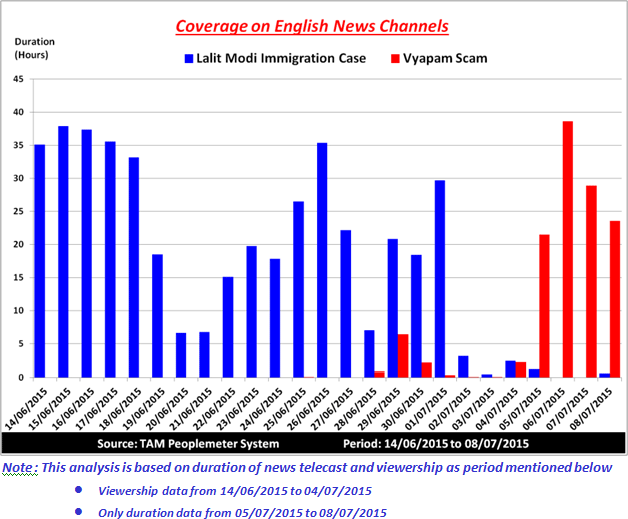
    The focus of all news channels has shifted to the ‘Vyapam Scam’ while the ‘Lalit Modi Immigration Case’ (or ‘LalitGate’) has witnessed a sudden drop in coverage. It would be interesting to see if the ‘Vyapam Scam’ turns out to be the next big thing for news channels in terms of viewership. Aaj Tak garnered maximum ROI for this story, followed by India TV within Hindi News Genre. (HSM, CS 15+). Times Now devoted the maximum time to ‘LalitGate’, that too with the ROI three times that of genre average (All India 1 Mn+, CS 25+ Males AB). The coverage of ‘Lalitgate’ on Times Now was highest among all the news channels. This emerged from the analysis conducted by the S Group, the analytical research arm of TAM Media Research.


    Both Hindi and English news channels covered the Lalit Modi case extensively till July 1, post which there has been a shift of focus. Before that, news channels have made sure to gain viewership from the same.


    Both Aaj Tak and Times Now would be hoping to carry the momentum into ‘Vyapam Scam’. As on July 8, both these channels were leading in terms of coverage. We will have to wait for the next week’s TAM data, to see who the winner in ‘Vyapam Scam’ battle is.