Tag: TAM

  • Peace or Perish!


    [updated with India Today Group quote & Republic TV statement]

    By Pradyuman Maheshwari


    Ask present and past TV audience measurement professionals who or what is pulling down the reputation of their business, the response would be an emphatic: news channels.


    TAM, a joint venture of Nielsen and Kantar (then owned by WPP and now majority owned by Bain), lost its measurement contracts from broadcasters, advertisers and agencies thanks essentially to news channels warring against it. Premier news network NDTV took TAM to court over allegations of faulty data, and this hastened the effort to set up the joint industry owned body Broadcast Audience Research Council (BARC). Eventually TAM sold its measurement business to BARC.


    Like TAM in the past, the BARC team faced turbulent times from the news channels, and in a letter to the BARC chairman Punit Goenka, the News Broadcasters Association (NBA) is said to have expressed its reservations about the BARC leadership of the past.


    There are murmurs that BARC CEO Sunil Lulla too has experienced some angst from news channels.


    The problem is always with ratings. That some of the channels have deep political connections makes matters worse. So every time there is a peeve, news channels flock to the I&B minister for intervention. In the past, matters have also gone to Parliament and there have been committees set up to examine nuances of the business. And if it’s not the law-makers who assert themselves, it’s regulator Telecom Regulatory Authority of India (TRAI) which intervenes.


    Frankly, the government ought not to have role in the business of news television. Except for running its own Doordarshan news channels, its publicity department DAVP which doles out advertising and monitoring objectionable content and addressing the media on issues and make announcements.


    But by running to the government often, channel owners have invited the ministers and bureaucracy to step into a territory which they shouldn’t be treading on.


    For instance, BARC’s weekly viewership data ensures that advertisers and the agencies make wise media buying decisions. It also helps broadcasters and content-makers better their content, sales and marketing act.


    But the ecosystem dominated by broadcasters inflicted on itself the government’s intervention (or interference?) and got BARC to be governed by a set of rules and regulations.


    There’s nothing new with what happened on Thursday. It occurred when TAM was around and it’s taken place under the BARC regime. There has been pilferage of information on the placement of set-top boxes, but the machinery is well-oiled to issue alerts when necessary.


    That’s what happened when Hansa Research, one of BARC’s vendors on engagement with panel homes, alerted the police about a mess up.


    Was Republic named in any written complaint? We don’t know. An FIR shared with MxM has a mention made of the India Today channel. Both Republic and India Today (by way of a report on the site) have presented their points of view.


    What we did find last night was various channels shaming Republic TV and founder, editor-in-chief and managing director Arnab Goswami. Newspaper reports today – owned by media companies which also run news channels as well as a few others – have also named Republic and Goswami prominently. The reference to other channels and India Today has been understated or is missing.


    So when did it all start? The war of words and ratings began even when Goswami was with Times Now. The channel was doing exceedingly well, on the back of the heated debates that it would air.


    But when Goswami quit the Times Network to start Republic, the daggers were pulled out from all directions. All sides are to blame. Times Now had its issues with Goswami for quitting, hiring some ex-staffers and making no bones of the fact that he was taking on his former employer. The others got on to the act the moment Republic shot to #1 in the ratings roster. ‘News without Noise’, became India Today’s credo.


    Various attempts were made to isolate Republic, including the rest of the news channels pulling out their watermarks so as to boycott BARC. On its part, Republic too countered the others – and compared its ratings with that of the others. Nothing wrong with it, except that the comparison was accompanied by much bombast. Surefire formula to rile others.


    But the war took on a new turn when Goswami launched Republic Bharat. While English news channels are influential and earn fair monies, the real bucks is in Hindi news. Aaj Tak, ABP News, Zee News have been raking in the moolah over the years. While Bharat made its presence felt, it didn’t create much of a dent until the Covid-19 pandemic-led lockdown happened and the Arnab Goswami brand of hyper-aggressive, right of centre journalism took over.


    And then came the controversy around actor Sushant Singh Rajput’s death. The line that Republic Bharat took on the controversy ensured it was numero uno. And not just for one week, but for now many weeks.


    Advertisement buying decisions are not taken in a hurry, but buoyed by its success, Republic Bharat has hiked its ad rates.


    On Thursday evening, the Mumbai police commissioner named Republic TV based on what appear to be unverified complaints and allegations. Later, on its primetime bulletin, Republic TV showed scans of the FIR naming India Today. The joint commissioner of police is reported on the India Today website stating that while India Today was named in the FIR, neither the accused nor the witnesses supported the claim. “On the contrary, the accused and witnesses are specifically mentioning the names of Republic TV…”


    The India Today Group issued a statement late on Friday: “There is a malicious campaign on right now by a few vested interests to drag the name of the India Today Group into the TRP scandal that broke out on October 8, 2020,” adding: “We welcome any probe the police may wish to conduct and are fully confident that we will come out unscathed as we have not acted in any inappropriate manner. What we have right now is nothing but malicious, unsubstantiated allegations by a vested party.”


    Republic TV has taken on the Maharashtra government and Police Commssioner Param Bir Singh over the last few months in Sushant Singh Rajput case. Meanwhile, Goswami has threatened to sue Singh.


    So what next on this? The news channels business in India is a divided house. There is the News Broadcasters Association (NBA) which comprises most of the big players operating nationally and there’s News Broadcasters Federation (NBF) which is spearheaded by Goswami and Republic. Recently TV9 pulled out of the NBA with the association lodging a complaint with BARC saying that the network had used unfair means to forge ahead on the ratings roster. The network is now back as its member.


    Singh was quoted on a channel saying that advertisers may also be called for interrogation. So will Amul managing director R S Sodhi have to make the rounds of the commissioner’s office? Perhaps he will be. Will media agency network bosses Prasanth Kumar of GroupM and Shashi Sinha of IPG Mediabrands also be questioned by the cops? If Sodhi is, surely Kumar and Sinha will be called in.


    It suits the government perfectly well to have channels warring each other. But if the police summons advertisers and agency bosses for questioning, there could be trouble. Large, pedigreed advertisers would prefer to stay away from the murky world of news television. Channel owners would do well to smoke the piece pipe.


    If warring countries and corporates can get together, surely Arnab Goswami and Rajdeep Sardesai can.


    Updates:


    Media agency bosses Sam Balsara, Shashi Sinha and Prasanth Kumar have been called to the police station for seeking information. So these may not be summons, but a request from the cops is never for a chat about the weather. There are rumours that names of certain advertisers have also been handed over to the police.


    The Republic Media Network has issued a press release: https://www.republicworld.com/india-news/general-news/full-news-release-from-republic-media-network.html. “The Republic Media Network has approached the Honourable Supreme Court of India. We have served notices of our legal action to the Maharashtra Government as well. While we will follow the law, we are determined to seek a legal remedy against this atrocious witchhunt,” the release says.


    Although Pradyuman Maheshwari is Editor-in-Chief and CEO of MxMIndia, the views here are personal and are not necessarily that of MxMIndia. He can be reached via Twitter at @pmahesh. A version of this has also appeared on The Wire at The ‘TRP Scam’ Could Open the Doors for the Government to Enter the Picture



  • Subhash Kamath is ASCI chairman

    By A Correspondent


    Subhash Kamath

    Subhash Kamath, Chief Executive Officer at BBH & Publicis Worldwide, India, has been unanimously elected chairman of the Board of Governors of the Advertising Standards Council of India (ASCI). The vote was held at the Board meeting that followed the 34th Annual General Meeting on Thursday, September 10, afternoon.


    NS Rajan, Managing Director, Ketchum Sampark was elected Vice-Chairman and Shashidhar Sinha, CEO, Mediabrands India P. Ltd was reappointed as honorary treasurer at the same meeting.


    The Board of Governors includes: Abanti Sankaranarayanan, Co-Chairman & Board Member, ISWAI;  D Shivakumar Group Executive President, Aditya Birla Management Corporation P. Ltd; Girish Agarwal, Director, Dainik Bhaskar Group ; Harish Bhat, Director, Tata Consumer Products Ltd; KV Sridhar, Chief Creative Officer (Global), Nihilent Ltd; Madhusudan Gopalan, CEO, Procter & Gamble Hygiene and Health Care Ltd; Rohit Gupta, President – Network Sales & International Business, Sony Pictures Networks India P. Ltd; Prof SK Palekar, Centre For Developmental Education, IFIM Business School; Priya Nair, Executive Director Beauty and  Personal Care, Hindustan Unilever Ltd; Prasun Basu, President – South Asia, Nielsen (India) P. Ltd; Sivakumar Sundaram, President Revenue, Bennett Coleman & Co. Ltd; Umesh Shrikhande, CEO, Taproot India Comm. P. Ltd.


    Said Kamath: “It’s a genuine privilege to accept this role as Chairman of ASCI. Having served ten years on the board, I have had the honour of working and learning from very senior and experienced leaders of the industry. More importantly, I have learned the immense value of self-regulation and the far reaching impact of the work ASCI has done over the years. Our industry today is at a crucial stage. With the digital revolution influencing brand messaging and engagement with consumers, advertising is evolving rapidly. And with the recent formation of the Central Consumer Protection Authority constituted by the government, self-regulation will be even more crucial in promoting consumer confidence and trust. As I have always said, with great creative power, comes great responsibility. So I look forward to working closely with the ASCI team to continue the good work set up by my predecessors and to introduce some newer, more future-facing initiatives as well.”


    Recalling his year-long tenure at ASCI, outgoing chairman Rohit Gupta added: “I thank all my colleagues, ASCI members and everyone who was part of this incredible journey. I am glad I was given an opportunity to drive the body that spearheaded important changes in the advertising industry. This year has been the most eventful for ASCI as we tackled several challenges. The pandemic saw many misleading ads, which were dealt with immediately. The Ministry of AYUSH reached out for help in flagging misleading advertisements regarding prevention and treatment of Covid-19.  We also signed up with TAM to monitor 3,000 digital portals for misleading claims. We successfully met the three objectives we had set: increasing our consumer base, monitoring the digital space and working closely with government bodies. I wish Kamath and the board the very best.”


    At the AGM, veteran mediaperson Roger Pereira presented a tribute to Brahm Vasudeva, non-executive chairman of Hawkins Cookers and the first chairman of ASCI, who passed away in July. ASCI members missed his presence at the AGM where Vasudeva would always come up with pertinent and well-researched questions.


  • Is Legacy Media Recovering in the Unlocking?


    By Indrani Sen


    During the last two or three weeks, we saw many reports on how the AdEx has improved in June 2020 ensuring us that not only digital, but TV and print are also on the path of recovery after Covid-19. TAM AdEx for June has shown that TV advertising volumes increased by 74 per cent per day in June compared to April, when adspends declined sharply due to decline in demand during the nationwide lockdown. TV ad volumes saw 46% growth in June compared to May.
     

    Print, which suffered a bigger hit in terms of revenue due to distribution problems during lockdown, has recorded a higher increase of 325% in average ad volume per day in June 2020 when compared to April 2020. Most of the business newspapers and industry websites reported on the recovery of digital and TV media. None of the articles highlighted the comparison between the first quarter and the second quarter of 2020 which could have given a better idea about the recovery of ad volumes in digital and TV media.


    I saw only one article in details on Print AdEx on the recovery of Print AdEx which also did not have any such comparison (https://www.financialexpress.com/brandwagon/print-advertising-on-the-road-to-recovery-as-average-ad-volumes-per-day-rose-325-in-june-2020-tam-adex/2032701/). This trend of lack of reporting on print clearly indicates that the medium has lost its position to digital not just in terms of share of the advertising pie, but also in the share of mind map of the audience, the advertisers and agencies.


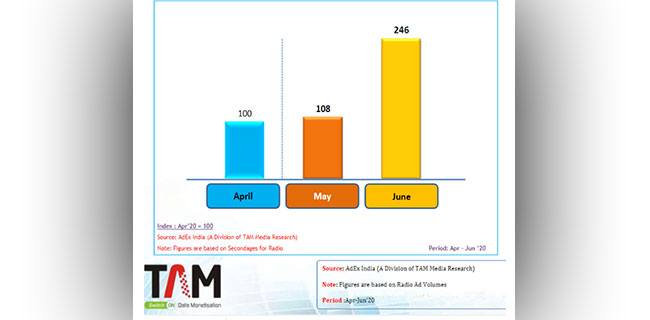
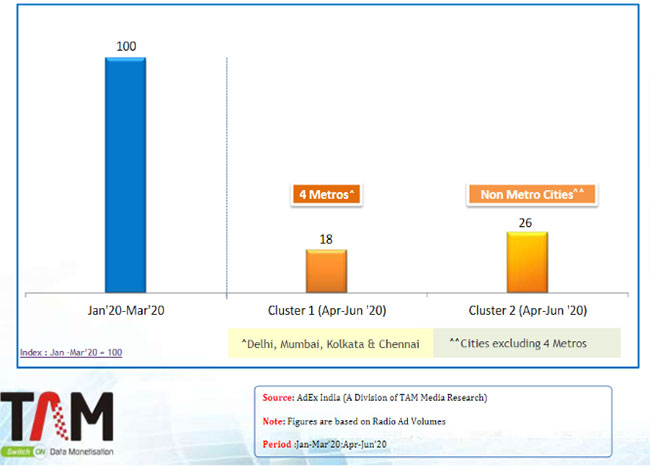
    The Advertising Report on Radio – April-June 2020 published by TAM shows that average ad volume per day increased by more than two-fold in June compared to April and May. However, a comparison with the first quarter of the year (Jan-March) shows that the ad volumes in radio are still much below the pre-Covid-19 phase. It is interesting to note that FM Radio ad volumes in Non-metro cities have recovered better than metro cities.


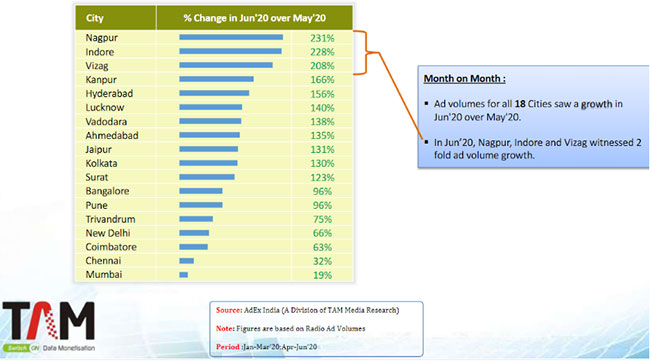
    The ad volumes of radio advertising in all 18 cities grew in June 2020 over May 2020. The chat below shows that the eight non-metro cities, Nagpur, Indore, Vizag, Kanpur, Hyderabad, Lucknow, Vadodara and Ahmedabad have shown much better growth in June 2020 compared the four metro cities. Kanpur, Indore and Vizag led the chart with each accounting for two-fold growth in ad volumes. Among the four metro cities, Kolkata has shown the highest percentage change in June 2020 over May 2020 with Mumbai showing the least percentage change. The listenership of FM radio increased during the period of lockdown and has retained the level, but advertisers across different cities are investing in the medium in different way.


    The report has detail analysis of radio advertising by categories, advertisers and brands as well as city wise analysis of the performance of radio AdEx. It also presents comparative analysis of TV and radio and digital and radio advertising during Jan-June 2020. The Top 10 common categories, advertisers and brands between TV and radio shows that during the first six months of 2020, Top 10 common categories, advertisers and brands added 33%, 14% and 4% on TV while they added 10%, 7% and 4% on radio.  Similarly, the Top 10 common categories, advertisers and brands between digital and radio shows that during the first six months of 2020, Top 10 common categories, advertisers and brands added 47%, 18% and 12% on digital while they added 19%, 2% and 1% on radio. The role of radio in the media mix needs to be reassessed by advertisers and agencies for the growth and survival of the FM radio industry during this period of unlocking and subsequent return to normalcy.


  • Reminiscing the BARC set-up days

    Partho Dasgupta: Screengrab from Video


    By A Correspondent


    Over the last five-odd years MxMIndia would’ve done over a hundred-odd stories on television audience measurement and central to all of them was Partho Dasgupta, former CEO of BARC India.


    Dasgupta joined BARC in June 2013 and in November last year handed over operations to his friend and former colleague, Sunil Lulla.


    He is now using his experience and learnings to various places in the world, setting up BARC-like entities as an expert. He is also consulting broadcast and new media companies as a management consultant. And overseeing performance management. He of course continues to be President of the Advertising Club.


    Earlier this week, we interviewed Sunil Lulla, CEO, BARC India on the eve of its fifth anniversary. We now speak with Partho Dasgupta, the former CEO of BARC India and get him to reminisce the days before operations began on April 29, 2015.


  • On eve of BARC’s 5th birthday (of ops), TRAI issues recommendations on TV audience measurement

    By A Correspondent


    On April 29 (that’s tomorrow), television audience measurement body BARC India (short for Broadcast Audience Research Council) celebrates its fifth anniversary of operations. And before we could sing Happy Birthday and bring out the bubbly, the Telecom Regulatory Authority of India (TRAI) has issued recommendations on the way television audience measurement should happen in India in the form of   “Review of Television Audience Measurement and Rating System in India”.


    Notes a press release: “Several concerns relating to neutrality and reliability of the existing rating system have been raised  by  stakeholders,  which  necessitated  a  need to review of existing Television Audience Measurement arid Rating system in India. A consultation paper was issued in December 2018 seeking comments from all stakeholders.


    After considering all comments received from stakeholders during consultation process and further analysis of the issues, the Authority has finalised its  recommendations.  The  salient  features  of  the recommendations are given below:

    1. Structural reforms are required in the Governance structure of BARC to mitigate the potential risk of conflict of interest, improve credibility, and bring transparency, and  instill confidence of all stakeholders in the TRP measurement system

    2. The composition of the Board of BARC India should be changed as part of the proposed structural reforms.

    3. The Board should have at least fifty percent  independent members which should include one member as a measurement technology expert, one statistician of national  repute  from among the top institution s) of the country and two representatives from the Governments Regulator.

    4. Restructured Board of BARC India should provide for equal representation of the three constituent lndustry Associations, namely, AAAI, ISA and IBF and with equal voting rights irrespective of their proportion of equity holding

    5. Tenure of the members of the board shall be for two years.

    6. Active participation of representatives of the Advertisers and the advertising agency will bring more accuracy, transparency, credibility, arid neutrality in  the  system,  due  to  their  inherent need of advertisers to reach viewers accurately.

    7. The constituent industry associations shall be entitled to nominate their representatives to the board membershlp subject to the condition  that  a  cooling  period  of  4  years  shall  be applicable between two consecutive tenures, for any such nominee member.

    8. Tenure of the Chairman of the Board should not be more than two years. Chairmanship of the Board shall  be  rotated  among the constituent industry associations in every two years.

    9. Number of members in the technical committee should be increased to 5 with addition of two external technical experts

    10. An Oversight Committee should be formed to guide BARC India in the areas of research, design and analysis,  constantly  improving the rating system

    11. The Oversight Committee should have representation from the National Council of Applied Economic Research, IIM, IIT, media research expert and demography  expert,  nominee  from  the Ministry of Information & Broadcasting, and TRAI.

    12. The   Committee   should   also   be    responsible    for nomination/ appointment of independent members  of  the Board as well as to give policy direction to BARC India, if it is so required.

    13. To create credible and accurate collection of data, multiple data collection agencies need to be encouraged.

    14. Competition and multiple agencies for data collection and processing would bring in new technologies, new research methodologies, new methods in  analysis,  new and  better  ways to ensure better data quality.

    15. BARC should be at an arm’s length from its own subsidiary, Meterology Data Pvt Ltd., which is the sole data collecting  agency for BARC, as of now; so that the entire process of measurement is carried out independently to ensure inherent checks in data inconsistency.

    16. Efforts may be made to withhold the  identity  of  the  channel’s name and number while collecting and  processing  the data from the field, to bring more transparency in the complete process.

    17. BARC should also separate its functions in two units (a) one unit should be responsible for prescribing methodology  of ratings/ validation of data, publishing the data and audit mechanism and (b) the other unit for processing the data, watermarkirig or any other such technical work including management of data collection agencies.

    18. Once multiple agencies come forward for rating, BARC should limit its role to publishing the ratings, and framing methodology and audit mechanism for the rating  agencies,  so  that  the number of agencies can develop multiple rating system  leveraging new technologies.

    19. The  rating  agency  should  be  mandated  to  increase  the  sample size from the existing 44,000 to 60,000 by the end of 2020, and 100,000 by the end of 2022 using the existing technology.

    20. BARC shall immediately  conduct a study in collaboration  with   the Indian Statistical Institute or  any  other institute  of  repute,  to estimate the appropriate sample size, and to get the correct representation of the viewership including regional and niche channels. Sample size once increased; i1 will make the data tampering an arduous exercise. On the basis of the study conducted, BARC should reach the target of  reaching  the  sample size in a time-bound manner.

    21. There  should  be  some  financial  disincentives  prescribed   as penal provisions including the cancellation of registration, if the specified target is not met by BARC .

    22. MIB should amend the DTH License and MSO registration so as to mandate STBs capable of transferring viewership data and adoption of RPD technology.  This transfer  of data can be done by establishing a return path / connection from MTB to the remote servers of the Audience Measurement agency

    23. Anonymised viewership data should be transferred electronically to the Audience Measurement agency for statistical analysis and Television Rating purpose. No data from any STB should be transferred to Rating agency without explicit consent from the subscribers

    24. DPOs should be allowed to mutually negotiate the terms and conditions for sharing the data with Measurement Rating  agency within the overall framework prescribed by TRAI from time to time. Such framework shall be prescribed by TRAI once these recommendations are accepted by MIB.

    25. BARC should keep all relevant data such as original data (meter-level data) arising out of the household panel, the data de1eted/ ignored/ not considered for ratings and the resultant processed data for TRP rating at least for one year in the same format and pattern as in the final ratings, declared to the subscribers including Broadcasters, advertising agencies, and advertisers.

    26. BARC should review / frame its outlier policy based on scientific study and market survey conducted from time to  time.  BARC should automate data processing in such  a  manner  that  no  manual intervention is required before the final TRP rating is released. Any type of manual intervention in the meter level / raw data arising out of household panel  must  be  avoided. Manual intervention,  if  any,  in  abnormal  circumstances  should be reported and informed to the auditors also.

    27. Adequate framework for grievance  redressal  may  be  made  having nodal officers and Appellate body.

    28. BARC should get annual audit conducted  by  an  independent agency to ensure conformance with TRP rating methodology-, Sample size, and grievance redressal methodology and  publish audit report on their website after board approval within three months after end of the financial year.

    29. The full text of recommendations is available on TRAI’s website (www.traigov.in)

    Meanwhile, when asked for a statement, a BARC India spokesperson said: BARC India spokesperson. “The TRAI recommendations have only just been received. BARC India is reviewing the same in consultation with its Board and stakeholders.. All Stakeholders from the Industry and the Government and related bodies are aware of the scientific, statistical and technical robustness of the data collated and released by BARC. BARC truly represents all facets of the Industry comprising Advertisers, Agencies and Broadcasters regardless of size, as the Currency of What India Watches. We do not wish to comment at this very early stage.”


  • BARC, three others form alliance for video measurement

    By A Correspondent


    Television audience measurement body BARC has joined hands with its counterparts in France (Mediametrie), Canada (Numeris) and Japan (Video Research) to collaborate on “the future of audience measurement initiatives including the development of common technical standards and operational processes, in order to benefit the existing currency services each member operates, in their respective market, through their current organisation and measurement partners.” Brad Bedford, a veteran audience measurement executive, has been appointed Global Managing Director of GAMMA.


    Said Partho Dasgupta, CEO, BARC India: “Audience measurement across the world needs to constantly innovate to keep pace with emerging trends. We at BARC India have always been open to learning from our global counterparts and this international alliance offers a tremendous platform to not only learn from our peers, but also to contribute.”


    Added Bedford: “There is an ever-increasing demand for cross device measurement internationally and the partnering of these audience measurement companies seeks to facilitate continued movement in that direction. I am truly honoured to represent this effort on a global scale. We are confident GAMMA will be a source of great knowledge sharing and continued learning for the industry.”


  • Is TRAI justified in damning BARC?


    By Your Editor


    The Telecom Regulatory Authority of India (TRAI, in short) has been accorded the dual responsibility of the broadcast policy-maker and regulator. Note broadcast (and radio) are the only media entities that are governed so actively and aggressively. Print is dealt with kid gloves, as always. Radio also has suffered thanks to excessive government intervention, and an active social media has ensured that the government can’t do much with digital media. Save GST.


    Hum Aapke Hain Koun?

    For many, many years, there existed a measurement system governed by TAM – a joint venture owned by WPP-owned Kantar and independent research major Nielsen. TAM won the mandate of broadcasters, advertisers and ad agencies to run the measurement system, and although there may not have been very active handholding by industry representatives, the fact that TAM owed its survival to subscription monies from broadcasters and other stakeholders, it couldn’t afford to mess things. Hence, the market ensured that it behaves and operates well.


    But, first, let’s understand who and why we need audience measurement?

    In order to get to the bottom of the problem, let’s understand why we need measurement. It’s simple: broadcasters air content. They say their wares are very popular, but there needs to be some tool for them to convince advertisers about this. This tool could be inhouse, but then will advertisers trust it? Hence, a third party measurement system. Now, if I am a large network of media agencies – like GroupM or IPG Mediabrands or a large advertiser like Hindustan Unilever or even the annoying Trivago, I can have my own team or firm doing this exercise of measurement. But these media agencies chose not to do so and relied on another body – in the case of television, TAM earlier and now BARC.


    If GroupM/ IPG Mediabrands/ HUL… even Trivago had their own measurement firms, could the government/TRAI police them?

    Of course not! How advertisers spend their money is their business. And how media agencies spend the money of their advertiser clients is their problem. Ditto with the measurement mechanism. Clearly, there is no role for government to police measurement. Yes, the government can set up its own measurement mechanism – like TAM or BARC – and hope and pray that they have enough paying subscribers to be able to run a tool. But they’ve been running Air-India, operating hotels and doing several things they shouldn’t be getting into.


    The genesis of the problem?

    What if you get bad marks in an exam? You grin and bear it. Curse your luck. Resolve to study harder. Or complain to some authority. The government. The local goon. Whosoever. Now this is what happened in the not-too-distant past. There were some influential channels which complained against TAM about the measurement mechanism. They said the process was flawed. That the boxes could be tampered with. That some broadcasters got to know where the boxes were placed and hence influenced the individuals living them. There were also a few people who complained that the content of news and entertainment channels had dipped considerably as some channels were tailoring content only to garner higher ratings. “Hey, we’d love to have shows talking about the chick pea crop, but kya karein, thanks to ratings we need to focus on chicks instead,” was the kind of reply one would get.


    Both situations were not far from the truth. Yes, there was tampering, and, yes, there some broadcasters who influenced panel homes. But does this mean that the government should get into the act? Should the government concern itself with the content quality of channels? If there are takers for dumbed down content, let there be.


    Hey, aren’t there industry bodies for broadcasters, ad agencies, advertisers?

    Of course they exist. And they are all headed by very senior and respected industry folk. One must also reiterate: not only are they currently headed by senior/respected folk, even in the past they were spearheaded by senior/industry folk. So why did they allow the government to intervene (or interfere)? Why did they allow policy-makers to let TRAI to govern them. We don’t have answers to these questions.


    Broadcasters do owe it to the government for uplinking/downlinking…

    Since the government gives the licence to broadcasters to uplink and downlink signals, it can lay conditions. But in the case of BARC… what’s the government got to do with viewership measurement?


    If broadcasters, advertisers and advertising agencies are unhappy with BARC, they’ve got the remote control in their hands. They can express a loss of confidence, debate/ discuss, put them on notice and if they are still unhappy, they can stop their subscriptions. It’s as simple as that.


    Could the problems have been eliminated if BARC wasn’t a monopoly?

    Competition always helps, but it must be remembered that television viewership measurement is an expensive proposition. Setting up measurement meter boxes isn’t cheap. Clearly there is no stopping multiple bodies in the business of viewership measurement. But, then, will people subscribe to them?


    When TAM existed, there was another measurement firm called aMap which existed but thanks to lack of patronage, it had to shut shop. So, while the more the merrier, does the industry have the appetite to pay for multiple players?


    So should the government/TRAI intervene?

    This question doesn’t need a wordy response. The answer is simple. No. Let me repeat: No. Yet again: No. Nahin, Nako, Na, Illai….


    Now what’s the current problem?

    The government, via the TRAI, thought it would be a good idea to administer a new Tariff Regime for channel subscriptions. That one can pick and choose channels, a la carte. All of this has led to some upheavel in the availability of channels and millions of homes have now been subject to the non-availability of some popular channels. While the problem is not as severe for DTH subscribers, for those connected to cable operators (like this writer), things are not as simple.


    Therefore, the viewership of many channels has been impacted with the change of regime. Since it typically takes four to eight weeks for life to settle down, various broadcast stakeholders decided that it would be incorrect to base buying decisions on the current set of numbers, and BARC decided that while it will give out viewership numbers to its subscribers, it will not publish them on its website or via Twitter.


    TRAI wants BARC to publish on website?

    We don’t really know why. The numbers on the BARC website are only very indicative, and are topline. Advertisers and agencies do not base their buying decisions based on these numbers.


    If the website data is inconsequential, why raise BP levels… just go ahead and publish them!

    True. But it’s got nuisance value. And if a channel has dropped its leadership position only because of some subscription issues, it’s unfair to make things public because they could be misused.


    The questions posed in the headline and summary: Is TRAI justified in damning BARC? Conversely, is BARC right in showing the finger to the broadcast regulator?

    No, TRAI isn’t justified. And, yes, BARC is right in showing the middle finger. But, but, but, BARC’s stakeholders must share the blame for the current stand-off. If they had resisted all the pressures earlier, they (and we) wouldn’t have suffered today.


  • Gung-ho TV Advertising Trends


    By Indrani Sen


    Indrani Sen

    The recent TAM Axis report on TV advertising trends in India in 2018 published in ET Brand Equity (https://brandequity.economictimes.indiatimes.com/slide-shows/tv-advertising-at-a-glance-tam-report/68096082) on February 22, 2019 shows that contrary to the popular belief TV advertising revenue did not suffer in 2017 after introduction of GST. Demonetisation in 2016 was a big blow which crippled the growth rate, but the advertising revenue was back on its growth track in 2017 which accelerated in 2018.

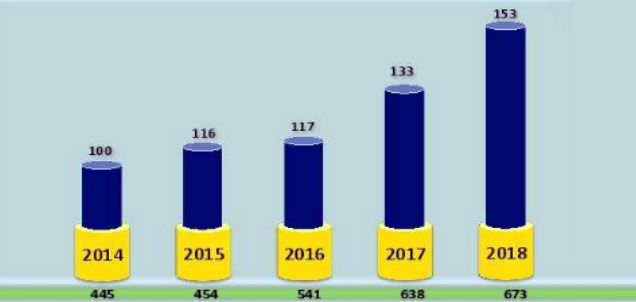
    Indexed growth rate of TV ad revenue 2014-2018: Source TAM Axis (AdEx India)

    N.B. The number of channels covered by AdEx is shown under each year in the green line.

    The above table shows that from 2014 to 2015 the index rose by 16 points and after adding only 1 point in 2016, it jumped by another 16 points in 2017 followed by 20 points in 2018. Over the last five years, from 2014 to 2018 there has been an overall growth of 53% in TV advertising revenue.

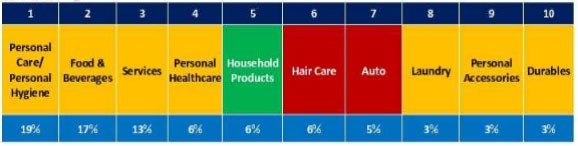
    Top 10 sectors in TV advertising in 2018: Source TAM Axis (AdEx India)

    The Top 10 sectors and the Top 5 sectors respectively account for 81% and 61% of total TV advertising revenue in 2018. While the Top 2 sectors retained their positions, household products rose from rank 7 to rank 5 with 43% growth in TV advertising in 2018 over 2017. Hair Care and Auto ranked lower in 2018 as compared to 2017 while Laundry, Personal Accessories and Durables held on to their ranks.

    It is interesting to note that of the Top 10 categories, 3 (Toilet Soap, Tooth Paste & Perfume /Deodorant) belong to Personal Care/ Personal Hygiene sector; 2 (Washing Powder/ Liquids & Toilet/ Floor Cleaner) belong to Household Product sector; 2 (Milk Beverages & Chocolates) belong to Food & Beverage sector; 2 (Two Wheeler and Cars/ Jeeps) belong to Auto sector and 1 (Shampoo) belongs to Hair Care sector. Though Services and Personal Healthcare hold the 3rd and 4th ranks among the top 10 sectors, no category from the two sectors feature in the list of top 10 categories which collectively account for more than 25% of the total TV advertising revenue.

    Top Ten advertisers accounted for 30% while top 50 advertisers accounted for 56% of the total TV advertising revenue in 2918. Hindustan Unilever topped the list with 10% share, followed by Reckitt Benckiser (India) and ITC who rose from 8th rank in 2017 to 3rd rank in 2018. Wipro and Amazon Online were new entrants among top 10 advertisers in 2018.

    The 2017-18 Annual Report of the Telecom Regulatory Authority of India (TRAI), published last week, indicates that the subscription revenues accounted for 59.5% of the overall TV industry revenue as it rose from Rs 38,7007 crore in 2016-17 to Rs 39,3007 crore in 2017-18. The report quoted the FICCI-EY Report 2018 which indicated that TV advertising revenues rose from Rs 20,1007 crore in 2016-17 to Rs 26,7007 crore in 2017-18, at a much higher rate of 32.8 per cent than reflected in the analysis of TAM Adex data for 2018, albeit referring to a different time period.

    Regardless of different reports based on different time periods, it is a reality that with close to 200 million TV households and 836 million TV viewers In India (Source: BARC Establishment Survey 2018), the Indian advertisers will continue to invest in TV medium for reaching out to the masses. The detailed analysis of TV AdEx data of 2018 by TAM Axis seems to indicate that Indian TV advertising revenue is all set for a roller coaster ride in 2019.

  • AdEx for Festive Advertising in 2018


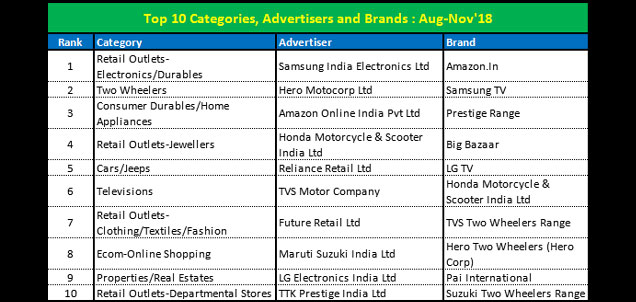
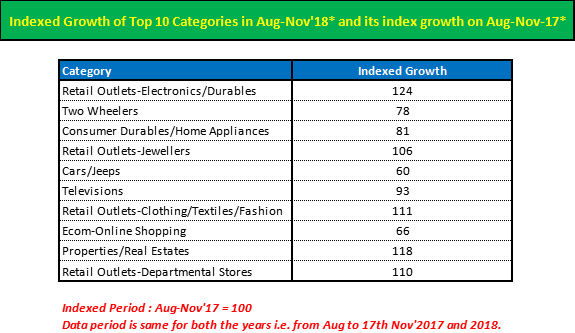
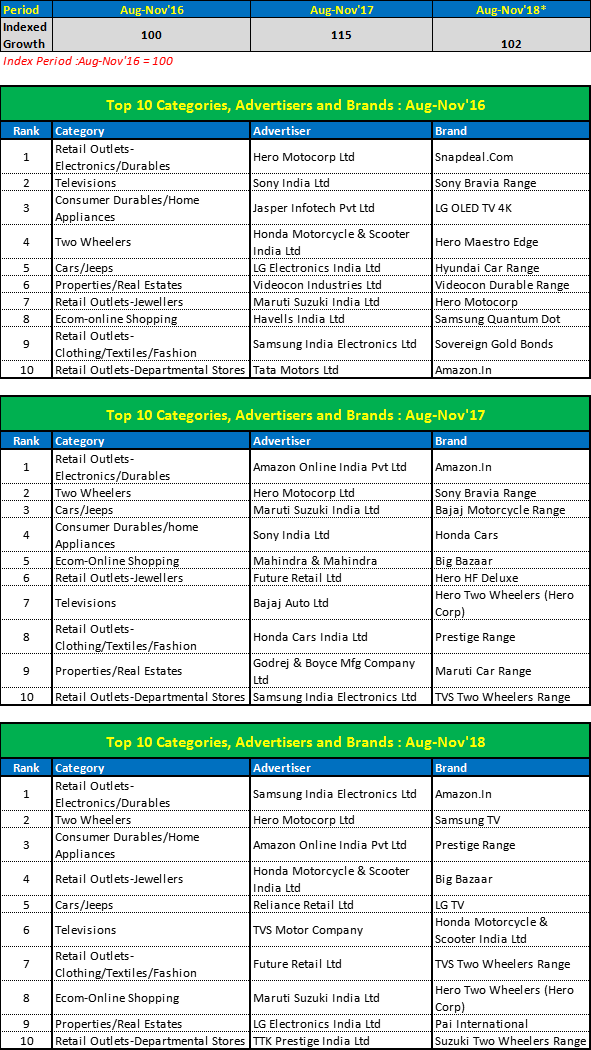
    TAM AdEx, a division of TAM Media Research, has shared with MxMIndia numbers for festive advertising for 2018. The data tells the story:


    This is a very important chart. Index grew to 115 in 2017 but only 102 in 2018. Below the first chart are the Top categories, advertisers and brands for 2016, 2017 and 2018 (also above as the main story image)


  • Advertisers on FIFA World Cup 2018 & IPL 2018

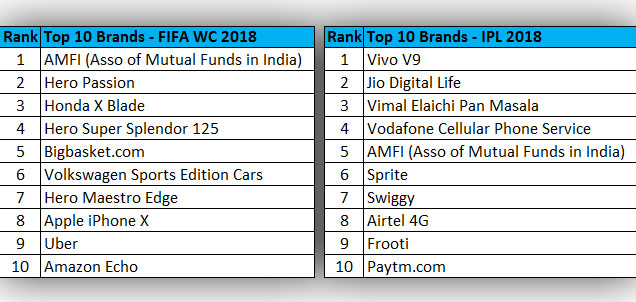
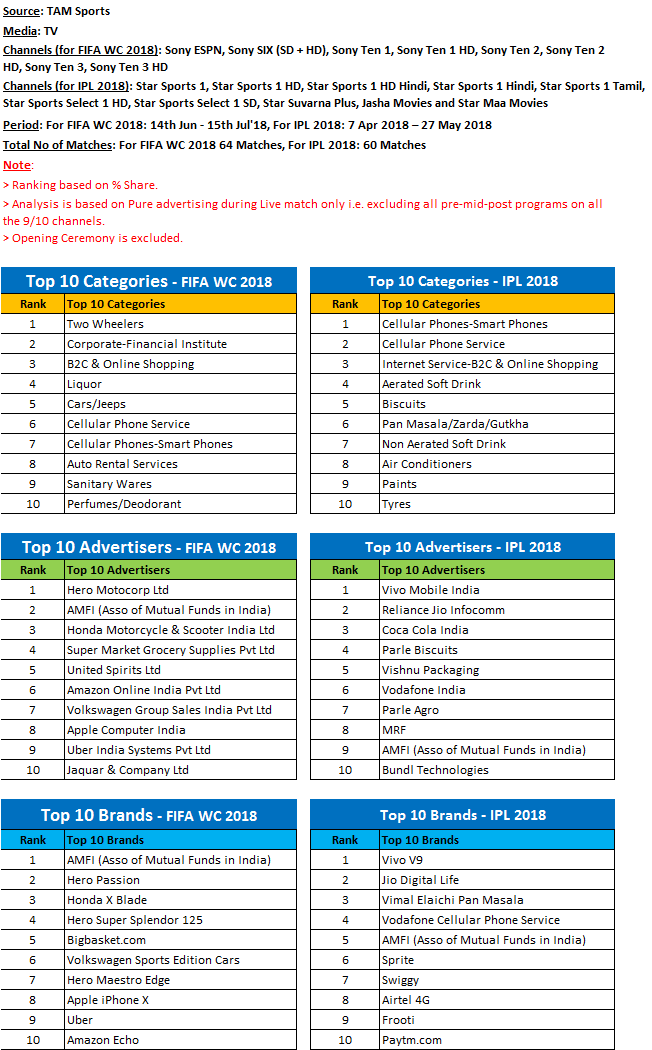
    TAM Sports, a jv of Kantar Media and Nielsen, tracks leading sporting events. In the set of tables below, we have a list of the leading categories, advertisers and brands across the television coverage of the 2018 editions of FIFA World Cup and the Indian Premier League (IPL).