 By Paritosh Joshi
By now the trade is probably abuzz with concerns about how the suspension of TAM reporting is going to play havoc with the lives of broadcasters, agencies and advertisers. Must this be so?
Broadcasters and agencies have got accustomed to trading in television inventory using the ratings as currency. However, here’s the simple truth: what the trading system prices is not what the advertiser buys.
Peoplemeter markets represent not just a minority of the overall population, they represent a minority of the television household population too. Indeed, thanks to the rapid growth of DTH in rural India, they represent a minority of digital households.
Here’s the truth hiding in plain sight. There is a study that covers 30 times as many households as TAM does which also picks up who watches what. And this study is possibly far better suited to picking up the ever lengthening ‘long tail’ of television channels better than the ~9000 TAM Peoplemeter homes. It is called Indian Readership Survey.
The IRS, which everyone sees as a readership measure- and it does this role with commendable certitude- is actually a comprehensive study of all media, new and old. In addition, it picks up the household’s consumption of a very wide range of goods and services that enable strategists to develop a sharper understanding of how media consumption and product /category usage correlate with one another.
While TAM takes a monadic view of television channel consumption and deals with nothing else, the IRS sees both sides of the picture: input (as represented by media consumed) and output (goods and services). IRS picks up demographic information in much more detail and actually takes a dynamic view of how different segments are changing in size and composition while TAM ratings have a population grid that stays unchanged for long periods of time- running into years. This, in a country that is experiencing change at unprecedented pace. Finally, IRS is based on a simple random sample, each home showing up in the study only once and not on a panel where familiarity may breed contempt.
Today, instead of worrying about the absence of TAM in the weeks to come, use the opportunity to understand TV in IRS.
Paritosh Joshi has been a marketer, a mediaperson and a key officebearer on industry bodies. He is developing an independent media advisory practice. He can reached via his Twitter handle @paritoshZero

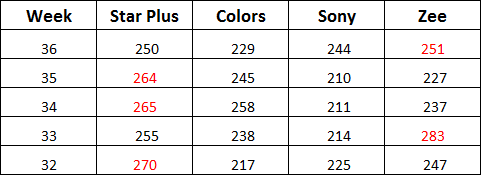 According to Anita Nayyar, CEO, India and Southeast Asia, Havas Media, in the GEC space there are four top channels – Star Plus, Sony, Zee and Colors – and their ratings keep fluctuating among themselves, which isn’t a recent phenomenon. “One week, one channel is peaking so the other week it’s another channel’s chance. Also, there isn’t much difference between their GRPs; it’s a matter of only a few numbers that they fall short of each other in the race. Therefore, it’s nothing alarming even for the clients who follow the GRPs to the T. However, we do keep in mind the trends and what gets the eyeballs to the channel. For instance, KBC taking Sony to number slot was expected. One needs to keep such issues in mind and plan accordingly.”
 By A Correspondent
 TAM Media Research’s part-owner WPP (via Kantar Market Research) finally broke its silence on the law suit filed by NDTV Limited in New York, USA.