Tag: Swiggy

  • Criteo powers Swiggy’s offsite retail media

    Criteo, the commerce media company, has partnered with Swiggy to power its offsite retail media campaigns. The collaboration will bring Criteo’s advanced technology to help Swiggy and brands drive full-funnel marketing outcomes outside of the Swiggy website.

    Commenting on the partnership, Amitkumar Banka, Head of Growth Marketing, Swiggy, said: “Quick commerce is growing rapidly in India, with a 77% YoY growth, and is expected to continue growing at a rate of 40-45%[1]. Our partnership with Criteo will allow our partner brands and non-endemic brands to reach and engage with quick commerce shoppers across the open internet.” Kashish Vasandani, Director Growth, Swiggy, adds, “The success stories with Kellogg’s and other CPG brands showcase the effectiveness of Criteo’s retail media capabilities that can unlock value for all players in the advertising ecosystem.”

    Added Medhavi Singh, Country Head, India at Criteo: “Criteo has a leading market footprint in retail media, including 65% of the top 30 retailers in the Americas and 50% of the top 30 in EMEA, and we are broadening our retail media presence in India and APAC. We are proud to partner with Swiggy, one of the leaders in the quick commerce space, to power their offsite retail media campaigns to further scale in the industry. As the needs for retail media in India grow rapidly, Criteo’s retail media solutions powered by its advanced AI and commerce data enable businesses to make informed decisions and optimise media planning for better results in one unified platform.”

  • And also for Swiggy Instamart

    Swiggy Instamart, the quick commerce delivery platform, has taken its ‘Yeh Se Leke Woh Tak’ campaign a notch higher with an out-of-home (OOH) activation. This ongoing campaign, featuring cricket icon Rohit Sharma, positions Swiggy Instamart as the ultimate ‘Sab Milega’ (everything) store, showcasing its ability to deliver any item imaginable to your doorstep in just 10 minutes. This is at Kempegowda International Airport at Bengalur where passengers make their way to the baggage claim area.

    JCDecaux, which holds the advertising rights at the Bengaluru airport, conceptualised and executed this activity in collaboration with authorities at BAIL.

    Said Mayur Hola, VP – Brand, Swiggy: “We kicked off the ‘Yeh se leke woh tak’ campaign with Rohit Sharma earlier this month to showcase our extensive assortment at Swiggy Instamart. Our intention with the airport activation was to surprise and delight travellers by showcasing our swift service, turning an ordinary moment into a delightful and engaging experience, much like ordering on Swiggy Instamart. Meanwhile, our hoardings with Rohit Sharma highlight the extensive range of products available on Swiggy Instamart, emphasizing our commitment to delivering convenience and variety in just minutes.”

  • GroupM leads in COMvergence 2023 New Business Barometer

    COMvergence, the independent research and data consultancy which analyses mediaspend investments and produces benchmark studies on new business performances, released its latest New Business Barometer for FY 2023 for India.

    Maruti, Reckitt, PhonePe, Proctor & Gamble (digital), Swiggy, Pernod Ricard,Vivo Mobiles, Beiersdorf, Ferrero, Berger Paints and Jaguar Land Rover were among some of the account moves and retentions that dominated the Indian market from January 2023 to December 2023.

    The Media Agency Groups were led by GroupM by a wide margin with a total new business value of +$654M, followed by IPG Mediabrands at +$200M new business value and Omnicom Media Group with a new business value of +$128M.

    Wavemaker, Mindshare and Lodestar UM led the media agencies’ ranking followed by EssenceMediacom and Havas Media.

    In 2023 COMvergence, assessed an overall of 215 account moves and retentions, with media spends estimated to be around $1.5BN.  Out of these Local pitches dominated the Indian market, whilst 55% of the total pitches held globally were local in nature ( country specific pitches), making India  well above this average with 91%  of total pitches being local whereas global and multi- country pitches made up only 9% of the pie for India.

    2023 saw a whole of 192 local pitches estimated to be around $1399M and 23 global and multi market pitches were estimated to be around $132M in India.

  • What business are the aggregator apps in?

    What business are the aggregator apps in?

    With apologies to none at all

    By Vikas Mehta

    Vikas MehtaA few weeks back I had written on the decline in the services of aggregator apps and related my personal experiences with a few apps. You can find the article here.

    Some of you readers wrote back and asked me for the reasons of this decline. As one put it, usually new offerings with new technology get ironed out over a period of time. So, why should the aggregator apps be an exception to this? Fair question and it set me thinking.

    Before I continue, I would like to convey my thanks to Hamsini Shivkumar, Brand Consultant and Semiotician par excellence. It was she who nudged me into thinking deeper and we had a fair exchange of ideas. Much of what I write today is the result of her thoughts.

    Let’s look at this decline in quality, first by looking at the Indian consumer.

    Most of the aggregator apps like Ola, Uber, Swiggy, Oyo; when they came on to the scene, they offered a new service, promising higher standards of delivery at cheap rates. I am using the word cheap deliberately. The transport aggregators offered cabs at your doorsteps within minutes and their rates were lesser than a traditional ‘kaali-peeli cab’. They offered not only the convenience of quick service but also avoided the hassle of looking for a cab and the cabbie declining to take you to your destination.

    Food service apps suddenly provided one with the comfort of home delivery from various restaurants at no extra cost.

    Oyo provided cheap hotels with a minimum quality assurance.

    Make My Trip offered everything one needed to travel including air schedules and bookings across airlines, railways and gradually also bus service. Hotels, cab pick-up and drop-offs and even guides for tourist places were gradually added on. And there was hardly any extra charge in the beginning.

    And almost all of them started peddling discount coupons and more offers to make the deal even sweeter.

    That’s why I used the word cheap. New services, new comforts and new conveniences were available cheaply.

    All these were targeted at the Indian middle class. And the Indian middle class still confuses value with cheap. Typically, value could be defined as same for less. Or more for same. Or more for more. Or even less for less.

    Same for less means cheaper, discounts. More for same means you add some more benefits. Buy one get one free or 200 gms extra in a pack of 500 gms at the same price of 500 gms. More for more would be pay only Rs 500 extra for buffet breakfast with a room. Less for less would be a star hotel giving you a room but not allowing you the facilities of a gym or a swimming pool.

    The Indian middle class as a generalisation picks up more for same or same for less. Give them a room at a discounted price and they are happy. Free airport drop and pickup is accepted. But adding buffet breakfast at a marginal cost may not be appealing. No extra money shelling out. Period.

    This is not to say that the middle class is not quality seeker. But they want best quality at low prices. They are not even looking at more for more. That’s why howls of protest arose throughout the country as transport aggregators started charging peak hour or rush hour or traffic surge surcharge. So much so, that public opinion forced some states to ban these surcharges by law! The typical middle class consumer has no problems accepting discounts but when charged extra due to high demand it demurs!

    More for more works for the luxury good or premium service seekers. These may not be the typical middle class. So, a Vistara charges you higher fare as they give wider seats, more leg space and free food and it has its premium users. Or these are people who will not want an anonymous biryani but a biryani from Paradise or Shah Ghouse in Hyderabad. The premium- or luxury-seekers are fine with these.

    And such people are few in numbers compared to the vast middle class who mostly is looking for more for same or same for less. The focus is solely on the price.

    Therefore, when the aggregator apps were launched and everything was same for less or more for same, these were lapped up. Cabs available at your location without any extra fees and maybe even cheaper than metered kali-peeli cabs were a hit. Food delivered in fast time without any delivery charge was a success. Hotel rooms available at much cheaper price with a promise of cleanliness and sanitation were lapped up.

    Now let’s see this picture from the viewpoint of the aggregator. Understanding the propensity of the middle class, they offered value but focussed on price. For the aggregator, it was hot food offered at the comfort of home at no extra cost but for the consumer it was about food at some discount too. It was not about cabs available quickly at your location without the fear of being declined by the cabbie but about great rates. It was not about an alternative available between 3-star and hole-in-the-wall shady hotels but about shady hotels available cheaper. To be honest, for both the cab aggregators and hotel aggregators, the story about cabs without declining and hotels with a standardised hygiene version were played up but these advantages were soon frittered away.

    Their partner service providers had been acquired also on the lure of substantial earnings. Hotels and restaurants were promised big incremental revenues. The delivery riders were promised lucrative, per ride fees. Transport aggregators too were giving the drivers big monies. And as word spread about easy money, more partners accrued.

    Discounts and price-cuts and subsidising of partners lasted for some time. And soon the aggregators were under pressure to improve margins. Move towards profitability. VCs wanted IPOs to cash out.

    The partners became disenchanted when aggregators cut the big incentives, subsidising of vehicles and even helping spruce up the hotel property. Rider fees were slashed. And delivery charges crept in. Travel aggregators included convenience fees. The situation became piquant as the consumer suddenly realised that the free or discounted does not make sense as extra charges were levied. So, s/he demanded more accountability. The brunt of this was faced by the partners such as delivery riders, hotels, cab drivers, airlines etc. In turn, these partners resorted to all sorts of jugaad. This led to service standards declining.

    And the jugaad mindset led to ingenuity of the partners. Cabbies, not wanting to travel short distances, would deliberately arrive late. Forcing the customer to call them. And on enquiring the destination, they would cancel the booking or say that they did not find the customer. Thus, not only causing major unhappiness but also destroying the advantage of ‘no declining’ as in traditional cabs. Restaurants realised that they could, in their own areas, do their own delivery. Hotels started asking regular visitors to book directly and gave them equal if not more discounts.

    The aggregators tried to control the partners with technology. OTPs, rating points, incentives based on ratings were introduced. But service is an interesting concept. It can be aided with technology but it cannot replace the human touch. The aggregators, under cost and margin pressure did not accentuate the human touch. Nor did they expand technology to aid the human touch. In fact, the reverse happened. It used to be difficult to get through customer service numbers. Now the customer service numbers just disappeared. Bots supported by AI came in. Social media sites were flooded with complaints. This spooked the investors who put more pressure on the aggregators. Things just went downhill.

    Another thing about service is that it becomes increasingly difficult to deliver consistent service online. In offline, service expectations differ according to customer segment and their location. Someone with a premium service mindset in Gurugram cannot be treated in the same way as a discount-oriented customer in Saharanpur. But in online, we have a single set of guidelines. We have one operating SOP. And this fails to deliver. No attempt has been made into moving into customisation of service.

    And because most aggregator apps have not defined their target group but want to engage all possible users, they are dealing with different set of users. This results in trying to keep all segments happy without aiming at anyone in particular. To use a mathematical analogy, this results in service systems which cater to the lowest common denominator, LCD. And not HCF, the highest common factor.

    Offline service standards are tweaked depending upon the location and your target customer. That’s why service companies do attain good standards, offline. But online, heavy investments are required to make it reach the customized HCF level. A luxury which the under-pressure aggregators cannot afford.

    And that’s why, all these aggregator apps, while realising that they are in different business must also realise that by being an aggregator, their core is about service. Transportation, food delivery, rooms, travel is the second level of tangible benefit. The most important tangible benefit is service.

    I think Amazon is the only aggregator which has focused on service. It openly declared that it isn’t in the business of ecommerce or entertainment. But it is in the service business. This has helped it achieve higher customer satisfaction and loyalty than other aggregators. And Flipkart which had the first-mover advantage in India, is today owned by Walmart, a discount store brand. Maybe therein lies a tale.

  • Swiggy Instamart unveils new TVC

    Swiggy Instamart, the grocery delivery platform, has launched its latest campaign, ‘#SuperPapa’. Centered around the theme “Go from papa to super papa in 10 minutes,” the campaign featuring an endearing father-daughter duo exemplifies Swiggy Instamart’s commitment to delivering unparalleled convenience to every consumer in every situation.

    Said Aparna Giridhar, VP, Marketing, Swiggy:”Raising a child can bring curveballs, making the parent the default fixer. This campaign embodies how Swiggy Instamart has parents’ backs no matter what the sudden ask. Swiggy is known for capturing everyday, relatable, slice-of-life situations and this campaign, capturing moments between a father and his teenage daughter is no different. With home needs across 30+ categories delivered in 10 minutes, Swiggy Instamart is his saviour, elevating him to a “super papa” in the eyes of his daughter.”

  • Swiggy Dineout unveils ‘Sharma Ji Ki Beti’ campaign

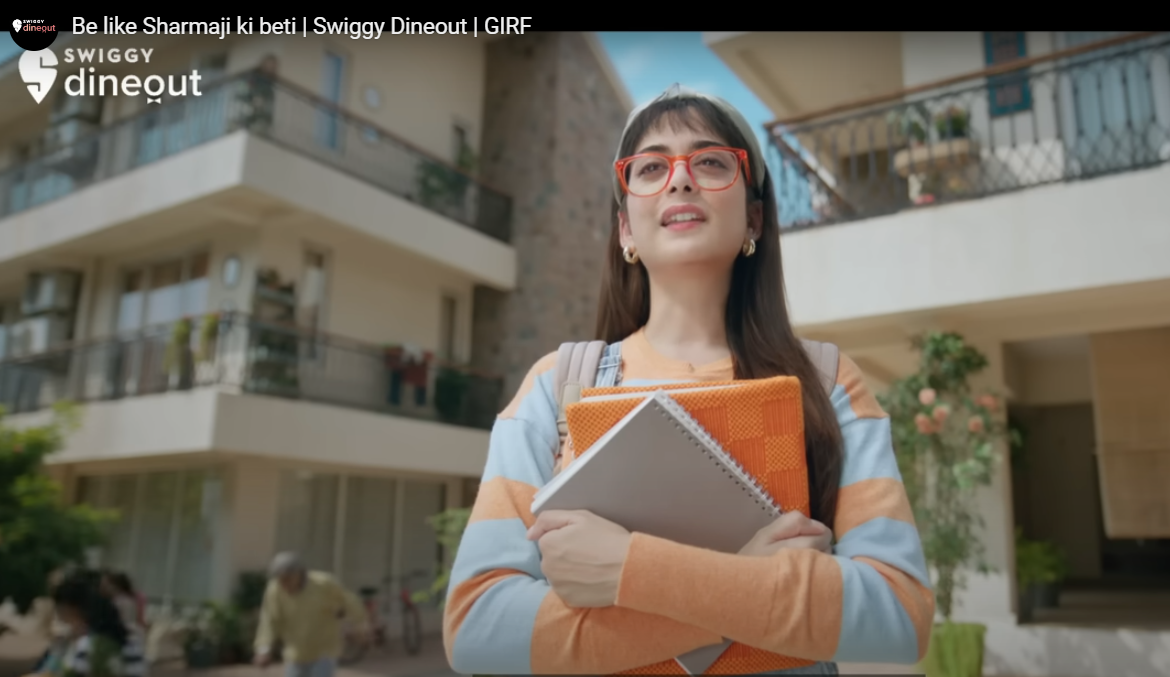
    Swiggy Dineout recently launched its latest campaign, Sharma Ji Ki Beti, aimed at “revolutionizing” the dining out experience for Indian consumers. The campaign was conceptualised by Toaster India.
    Said Aparna Giridhar, VP, Marketing, Swiggy: “This creative route plays up a new social validation of using Swiggy Dineout before stepping out as the right way to eat out, especially during our biggest annual festival. By humorously portraying this, we encourage users to emulate ‘Sharma ji ki Beti’ for seeking the best dining benefits in town. Building on our core mission of providing unparalleled convenience to consumers, this campaign highlights Swiggy Dineout’s proposition of seamless & joyful dining with maximum savings.”

    Added Ira G Chief Creative Officer, Toaster India: “Swiggy Dineout is a dream client for any creative team and we’re so kicked we got to collaborate and create a campaign with them. Humour and a strong insight are given with a brief like this and we hope to do a lot more with Sharmaji ki beti as a character.”

  • Swiggy Instamart launches new OOH campaign

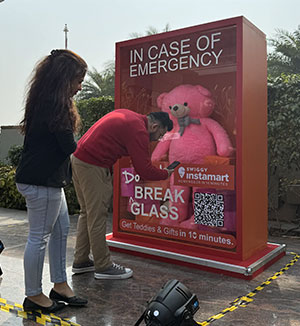
    Swiggy Instamart has launched a new OOH campaign to promote the concept of eleventh-hour gifting. The campaign is conceptualised and executed by Havas Media Tribes.


    To gain maximum visibility and engage consumers in a memorable way, these installations were strategically placed at Worldmark 2, Gurugram and the Bandstand at Bandra, Mumbai.

    Talking about the innovation, Aparna Giridhar, VP – Marketing, Swiggy, said: “During such occasions, the challenge is to consistently distinguish ourselves with a disruptive concept and push the boundaries. With this Valentine’s Day campaign, we marked a paradigm shift in how we approach festive marketing.  Swiggy and Havas Media Tribes team worked in close collaboration in identifying and precisely tapping into customer sentiments, making this campaign a success.”

    Added Uday Mohan, Managing Director, Havas Media India: “As we strategically placed these interactive installations in high-traffic areas, Swiggy Instamart’s Valentine’s Day campaign redefined moment marketing. We seized this opportunity to captivate audiences by offering a distinctive fusion of convenience and romance, thereby reaffirming the brand’s dedication to customer satisfaction.”

  • IPL16 ads: They don’t make ’em like it anymore


    By Sanjeev Kotnala


    Sanjeev KotnalaI am a loyal IPL follower, and I watch the match telecast every evening. The quality of telecast and the options for the viewer have increased exponentially. However, that cannot be said for the ads telecast on IPL. Watching them makes me overtly nostalgic. In earlier IPL seasons, the brand and agency people invested much more effort into crafting and developing the advertisements. It is much more about media muscle and frequency than the craft today. Somewhere high frequency seems to be a substitute for creative content.

    IPL 2008, the first edition, had everyone excited. It was expected to become the Super Bowl equivalent for advertising in India. Today, IPL is one of the richest sports leagues, with two months-plus of excitement and engagement, delivering eyeballs and loyal enthusiasts on digital and TV. IPL advertising almost defines the advertising spending trend for the nation. It should be common sense that the brands wanting to exploit the IPL matches across the season need multiple creatives to avoid overexposure and audience apathy. Unfortunately, the advertisements hardly reflect the thinking. The advertisement content and creative lack high engagement. It makes me think- They don’t make them like it anymore.


    IPL- everything is not lost.

    A few brands stand out in the scores of brands trying to effectively use the IPL platform across TV, OTT and Digital.


    RuPAY

    RuPay, with its UPI plus credit card communication, is an excellent example of focused communication. All three advertisements are interesting and engaging. The ‘Silver Helping Hand’, ‘Catch Expert- Chaos in Museum’, and the ‘Slippery Spy- mole’ are fun to watch and communicate the message.

    Unlike the Tata Tiago example of reasons to go for an E-SUV, which may not be the best and most effective way for the brand. Do people still need reasons to buy an electric vehicle!


    DREAM11

    DREAM11 has been consistent through the IPL seasons and has always worked on ‘All will play’. This season is no different. The brand continues the good work. The Bollywood and cricketers’ interactions as opponents in the game are engaging and funny. ‘Lal Singh’, ‘You don’t go for awards’, ‘Dialogue Delivery’, ‘Viral’, ‘All is well’, ‘Duplicate‘, ‘Lagaan’, ‘Riaaz’ and ‘Retake‘ are a few of the ads. Hope to see more situations in the rest of the matches.


    MYCIRCLE11

    MyCircle11 has also done well with its ‘Second prize 1 crore- toh pehla prize kya hoga‘ communication, continuing the Giant theme and format. However, the situations and the excitement are missing as the idea becomes a prisoner of the format. And for some reason, the 2023 videos are unavailable, and even the site showed Jeeto 1 crore everyday campaign in 2021.


    AMAZON

    The ‘Aaj Amazon se kya Khareeda’ series is another set of communication that makes the point while engaging the audience. It slowly builds on categories- the order size and common everyday items.


    IPL ADS- ALL-TIME FAVOURITES

    All of us will have different advertisements telecast with IPL seasons as favourites. Here are the ads that stand out. If I have missed some really good ones- do let me know.


    VODAFONE ZOOZOO

    The Vodafone ZOOZOO would rank as an all-time favourite of all IPL ads. The way the ads were conceived, executed, released, and the build-up was well planned and executed. In fact, they were produced and timed with the IPL season.


    AMAZON CHONKPUR KE CHEETAHS

    My other favourite of mine has been Chonkpur ke Cheetah by Amazon. Even today, in the Amazon ads, telecast on IPL16, the brand is extending the same- similar concepts like A-to-Z, Aapni Dukan, and a platform for everything, including your everyday items. Chonkpur was another instance and example of IPL-specific communication. The slow unveiling of the journey of Chonkpur ke Cheetah was well planned and executed, keeping the excitement high.


    CRED – NOT EVERYONE GETS IT.

    When the ‘Cred – Not everyone gets it’ series started, it had a mixed reaction. But, the way the series progressed and the brand kept unleashing fresh creative starring another popular celebrity, it grew on you as an audience. A well-thought-through and executed campaign.


    SWIGGY, NO ORDER IS SMALL.

    Swiggy and Zomato both exploited the audience’s interest in watching the telecast. They have offered various schemes to make people order during the matches. However, what stands out are Swiggy ads of ‘No order is small’ and ‘What is the score’. It also introduced the actor who became known as Swiggy Uncle and was featured in many more TV films.


    ADD-ON

    Not IPL Ad- but the Kid-adult format by FLIPKART was an engaging experiment killed by overexposure and format constraints.  Another series that was engaging and interesting was Voltas Murthy.

    Similarly, Make My Trip’s consistent use of celebrity Alia, and Ranveer Singh continues to be superbly executed with its own fun quotient while delivering the message. However, that cannot be said for Ranbir Kapoor – Asian Paint ads which lack engagement- proving that consistent use of celebrity is not the solution and the content remains the king.


    NET-NET

    Want to associate with IPL and exploit the platform? Then the brand must understand that the ads are the real breaks and the interruption in the audience’s interest. And the season is long, and the media cost is too high to associate. The brand message should be simplified and relayed to the audience through multiple creatives to keep the engagement levels up and excitement with the brand. Do invest in creative development and execution even at the cost of losing out on frequency of exposure. An excellent /Good creative exposed less number of times is a far better proposition than a mediocre/average creative exposed many, many times.

    Just for the suggestion watch this ever favourite ad of mine. Ericsson One Black coffee ad.


  • Swiggy unveils brand icon Gulab Jamun uncle in new campaign

    By Our Staff


    Swiggy, the food delivery app, released a short video ad to celebrate its Gulab Jamun Uncle. This follows Swiggy’s recent campaign ‘Why Is This A Swiggy Ad?’ through OOH, front-page print ads across metros and on social media. Created by Talented advertising agency, WITASA is a User-generated content (UGC) marketing campaign.

     

    The new 18-minute video announced winners to last week’s campaign. There are 10 winners in all who will take home Rs. 1 lakh Swiggy money. Who made the cut? Find out here:


    Said Ashish Lingameni, Head – Brand, Product Marketing and Sustainability at Swiggy: “Among our many objectives with WITASA, the biggest was conversations, share of Voice and engagement. Which this campaign has fulfilled beyond expectations. There’s also science to this madness. Swiggy food delivery, Instamart and Genie are all top of mind through just one campaign and that’s what defines the success of this campaign.”


    Added PG Aditiya, CCO and Co-founder, Talented: “No other brand could have done this campaign. It took a brand that had immense existing brand love, woven into our cities’ cultural fabric & with tons of personal memories for each user to qualify for something as absurd as this campaign. To us, WITASA is design-thinking & culture-marketing at its best. It also proved that Gen-Z has longer attention spans than we think. You, me, all of us – we all became Swiggy’s ad agency for a whole week. And while we’ve (kinda) answered the burning question… we won’t blame you for not being convinced. Maybe we’ll never know why it was a Swiggy ad. But as long as we keep thinking about it, we’re answering our own question.”


  • Swiggy unveils 4 new TVCs for IPL 22

    By Our Staff


    Swiggy, online food ordering and delivery platform, has launched four TVCs as part of its brand new campaign this Tata Indian Premier League (IPL) 2022. It has been conceptualised by Brand David.


    Commenting on the new campaign, Ashish Lingamneni, Head of Brand at Swiggy, said: “By asking a simple question – Aap kiske saath dekhoge? This IPL season, we aim to highlight how Swiggy, with both Instamart & food delivery will make the match-viewing ritual for fans who are watching with family, friends or just by themselves more enjoyable. The ads bring alive the convenience users turn to Swiggy for, while also underlining the brand’s benefits in a likable and engaging manner. The TVCs are a mix of consumer insight, targeting and product communication which is clutter-breaking.”


    Added Piyush Pandey, Chairman Global Creative & Executive Chairman, Ogilvy India: “Swiggy is the friend that makes our experiences better. It always helps add that extra mazza and without it, any game experience won’t be the same. #AapKiskeSaathDekhoge is an invitation for more and more people to enjoy the company of Swiggy. I am proud of the work done by the teams across Ogilvy and Brand David.”

  • Havas Sports & Entertainment relaunched

    By Our Staff


    Havas Media Group India has announced it is relaunching Havas Sports & Entertainment, the sports and sponsorship vertical of the agency. To begin with, Havas Sports & Entertainment India has facilitated a two-year deal between Board of Control for Cricket in India (BCCI) and Swiggy Instamart, as the official on-ground partner for Indian Premier League (IPL) 2022 & 2023.


    Rana Barua
    Rana Barua

    Said Rana Barua, Group, CEO, Havas Group India: “The sports advertising market in India is estimated upwards of Rs 8000+ crore. The sports genre is pegged to explode further giving advertisers across sectors various opportunities to create long term value. The relaunch of Havas Sports & Entertainment 2.0 comes at a significant time, and we’re excited to kickstart its journey by facilitating a landmark partnership between India’s biggest sporting event, IPL, and our long-standing unicorn client, Swiggy. We look forward to further consolidating our position in the sports and experiential market by forging many more strategic partnerships and offering integrated and meaningful solutions.”


    Ashish Lingamneni
    Ashish Lingamneni

    Added Ashish Lingamneni, Head of Brand, Swiggy, said, “Over the years, our association with the mega cricketing event has helped establish the fact that food and cricket go hand-in-hand. IPL is one of the most celebrated sports leagues in the world, and this year, we are excited to partner with the BCCI to offer a wholesome experience to audiences with our large assortment of munchies, beverages and other snackable options through our quick commerce grocery service, Instamart. The association brings with it the IPL fandom and reach to elevate the match viewing experience of millions of viewers. It will additionally help us drive clutter-breaking campaigns, varied consumer engagement, and business offerings at scale.”


  • Swiggy Genie & Dentsu Webchutney to deliver gifts like Santa

    By Our Staff


    Dentsu Webchutney has launched the #SantaOpenToWork campaign for Swiggy Genie. It depicts how gift-givers can outsource all their delivery tasks to Swiggy Genie this Christmas, just the way Santa is.


    Said Sneha John, Director- Marketing, Swiggy: “We wanted to remind Swiggy users and non-users alike that they can depend on Swiggy Genie to take care of gift deliveries and other chores this Christmas season. The #SantaOpenToWork campaign does just that, with some Christmas cheer and smart humour.”


    Added Sanket Audhi, Creative Director, Dentsu Webchutney: “Our starting point was quite simple: if Swiggy Genie is taking over deliveries, what will Santa Claus do? But we knew we had a winner when we thought of crafting the entire campaign around the #OpenToWork feature, which has become an instantly recognisable mnemonic. I hope people have as much fun watching the campaign as we had creating it.”