Tag: social media

  • Flashed y’day: O&M launches Social@Ogilvy

    By A Correspondent


    Ogilvy & Mather announced today the launch of Social@Ogilvy, a worldwide practice connecting all of the agency’s social media experts to deliver solutions across all areas of business.


    What was once a specialty offering within Ogilvy Public Relations has now expanded across all marketing disciplines into a dynamic, global network of social media experts from the complete Ogilvy family. Social@Ogilvy connects marketing, communications, CRM, sales enablement, shopper marketing experts and more to deliver seven big social solutions. In addition to Social Media Marketing and Communications, these solutions now include Social Shopping, SocialCRM, Social Care, Social Business Solutions, Listening and Analytics, and our measurement model, Conversation Impactâ„¢.


    Social@Ogilvy enables the firm to more efficiently and effectively serve the complex needs of clients, as social solutions become true business solutions.


    “Now, no matter which door clients walk through at Ogilvy, they will connect with the Social@Ogilvy team to deliver agile and measurable solutions. That’s access to social experts deep in every marketing and communications discipline,” says John Bell, Global Managing Director of Social@Ogilvy. “We have worked hard over the last seven years to define and apply ‘best practice’ use of social media to business. The real power of social media for business in 2012 and beyond lies in fully integrated solutions, not stand-alone social programs.”


    With over 550 dedicated social media experts around the world – and another 4,000 digital experts – the Social@Ogilvy team is the largest network of social media strategists delivering global and local solutions. Headquartered in New York, the team is led by John Bell, Global Managing Director, Tom DeLuca, Chief Operating Officer and Thomas Crampton, Director of Social@Ogilvy in Asia-Pacific.


    In Asia Pacific, Social@Ogilvy extends to 23 cities in 15 territories.


    “The demand for world-class digital and social media solutions across Asia Pacific is growing rapidly. Social media has been the fastest growing discipline over the last two years,” said Paul Heath, Chief Executive Officer, Ogilvy & Mather Asia Pacific. “Social@Ogilvy brings our social media specialists from all disciplines into an integrated team that supports clients at every stage of the game.”


    (based on a press communique received from Ogilvy India)

  • Delegates from 15 countries to attend ad:tech New Delhi 2012

    By A Correspondent


    With less than ten days remaining, ad:tech, the world’s No.1 digital marketing, media and advertising event, is on its way to be oversubscribed again. ad:tech New Delhi 2012 has been registering an unprecedented number of entries from delegates, exhibitors and sponsors from all over the world, to make it even larger than last year.


    The event is being held over three days instead of two days as last year, and has an agenda full of insightful keynotes, panel discussions, workshops and networking opportunities. To be held between February 22 and 24 at Hotel Leela Kempinski Gurgaon, the first day of this conference and exhibition will be dedicated to in-depth master-classes on social media and search techniques for marketing professionals.


    The Master Classes will comprise of a hands-on, interactive workshop to provide in-depth learning on developing a web presence, digital brand building, SEO 2.0, evolution of technologies in PPC, social media monitoring, and imbibing search and social into an organization’s DNA. Leading experts from Google, Communicate2, Simplogy, Quova and Value Pitch will be conducting sessions during these pre-registered master classes.


    Rammohan Sundaram, Event Chairman, ad:techIndiaand Founder, CEO & Managing Director, Networkplay Media Pvt. Ltd. said: “This year is going to be a big game-changer forIndiain the digital marketing arena, and ad:tech is proud to be at the forefront in bringing the very best of minds together on one platform. We have global digital heads of top brands like Nestle and Pepsi are among the over 90 expert speakers fromIndia, APAC and the world.”


    Commenting on the people coming down to India to attend ad:tech, Mr Rammohan said: “Apart from India, we already have confirmations from delegates and speakers of as many as 15 countries, including USA, UK, Singapore, Australia, Japan, Indonesia, Singapore and Korea”.


    As the largest gathering of online marketers, the event also promises to showcase leading Indian and global brands, including Pepsi, Coca-Cola, Nestle, Hindustan Unilever Limited, Facebook, Dell, FordIndia, IBM, Nokia, Sony Entertainment Television, Bharti Airtel, LG Electronics, MTV, Linkedin, Homeshop18, Godrej Appliances, comScore, Ogilvy, Avaya, mydala.com, Yatra.com, Kotak Mahindra Group, Tata Teleservices, MotorExchange, and Domino’s Pizza.


    Mr Rammohan said: “We see a renewed energy among brands this year. Such an unprecedented response from brands puts to rest any doubt on the future of digital media in India, and proves that digital is the new arena where real marketing wars will be fought, and probably much sooner than we expect.”


    Besides the master classes, this year’s ad:tech will also feature an exclusive exhibition area for start-up companies in the digital space, which is almost full booked already.


    ad:tech, world’s No. 1 digital marketing ,media & advertising event made its successful debut inIndiain April 2011, withNew Delhi being the first city to host the two day event. With 10 shows in 7 countries, ad:tech has been providing media, marketing and technology professionals with the tools and techniques required to succeed in a changing digital world for over a decade.


  • Vedanta unveils first ever national corporate campaign

    By A Correspondent


    The Vedanta Group, a globally diversified natural resources major with interests in aluminum, copper, zinc, lead, silver, iron ore and oil & gas, has unveiled its first ever national corporate campaign under the platform of ‘Creating Happiness’.


    The integrated campaign combines a unique first-of-its-kind film competition forIndia’s next-gen filmmakers along with social media and traditional media outreach. As a part of the campaign, Vedanta is releasing 39 films – a 90 seconds film by Piyush Pandey of O&M and 38 three minute films made by student film-makers from across the country.


    Vedanta Chairman Anil Agarwal’s vision of contributing to building sustainable communities and integrating sustainability as a core part of the business is at the heart of this campaign.


    114 students from top media and film schools in the country including FTII, Whistling Woods, Symbiosis, School of Convergence, MGR FTI, IIMC, Assam University, Xavier’s, Christ University, AAFT, ZIMA, Tezpur University, IP College and Ravenshaw have produced 38 short films that tell the stories of the people and communities whose lives have been changed by Vedanta’s community initiatives, creating happiness in the process. Each film was made by a group of three students.


    The students travelled to the interiors of Rajasthan, Goa, Karnataka, Tamil Nadu, Orissa, and Chhattisgarh to meet with an Indiathat is full of inspiring stories and came back with their experiences and films. The films are open for public voting on YouTube till 20th March, 2012. The films will also be judged by the jury that includes Piyush Pandey, Shyam Benegal and Gul Panag.


    The face of the campaign is ‘Binno’, a little girl who was chosen from one of Vedanta’s community initiatives in rural Rajasthan. The television ad film, which has been conceived and scripted by veteran adman Piyush Pandey takes a real slice out of Binno’s life, with her parents, friends, doctors and school teachers playing their parts.


    It shows how her life is different from that of her earlier generations, in the process, highlighting the many changes that have come about over the years.


    The film has been shot on location in Rajasthan by award-winning director Shivendra Dungarpur of Dungarpur Films and the music has been composed by Rajat Dholakia, who has won two national awards as best music director for ‘Dharavi’ and ‘Sunday’.


    The television campaign, with the Binno film, will go on air from January 30 and student films are available for public voting on youtube.com/Vedanta group.


    Piyush Pandey, Executive Chairman, O&M said: “The Vedanta ‘Creating Happiness’ campaign is extremely close to my heart for it’s all about enablingIndia. I have worked on this campaign along with my team as an excited young copywriter and I look forward to the people ofIndianot just appreciating Vedanta’s efforts, but getting inspired to do something on their own to makeIndiaa happier place.”


    Senjam Raj Sekhar, Director – Communications & Brand, Vedanta group said: “Vedanta has several compelling stories to tell about the work that is being done in community and sustainability. Our aim is to tell the world the Vedanta story under the platform of ‘Creating Happiness’. With the film competition, we opened up all our projects and locations to budding independent film makers. The idea was to enable them to experience it first hand and make films on impact that the projects were having on the community. The results are tremendous – we have got 38 heartwarming stories capturing hope, change and empowerment in rural India”


    Vedanta Resources plc (“Vedanta”) is aLondonlisted FTSE 100 diversified global natural resources major. The group produces aluminum, copper, zinc, lead, silver, iron ore, oil & gas and commercial power. Vedanta has presence in India, Zambia, Namibia, South Africa, Ireland, Liberia, Australia and Sri Lanka.


  • The Anchor: 7 painful social media trends

    1. Idiotic “movements”:

    Social media is a place to hang out and chill with friends. And inane conversations are part of the mix. But some of these private conversations are going public and turning into hotly debated topics, communities and even “movements”. Like the WTF or “Women Take Forever” movement that has caught the fancy of over 31,000 men who have hit the “like” button because they think women take too long to get dressed.


    2. Contests… and some more contests:

    The Indian social media scene is exploding with contests of all kinds. Not much wrong with that, except that it’s become one of the few ways to draw attention. What’s worse, each contest seems exactly the same as the previous one. In a single day, I spotted three recipe contests on Facebook from different brands.


    3. Cloned content:

    Everyone’s talking about the same thing, whether it is Sachin’s pending century, Farhan Akhtar’s birthday or a certain song about soup boys. And then comes the copy-pasting of one-liners, jokes, images and videos. Facebook Walls and Twitter feeds are the new SMS, perhaps.


    4. Meaningless Twitter fights:

    Person A (usually a celeb) tweets something. Person B objects. Or Random Person sends hate tweets to celeb. Celeb responds with anger, sarcasm, close to a personal attack. Fight ensues. Enough said!


    5. Everyone’s talking, no one’s listening:

    Conversations, discussions, polls are all great ways to talk to fans and customers. But how about listening to them for a change? Bad product and service experiences abound, and they aren’t necessarily on the brand’s Facebook Page.


    6. Missing the brand story:

    For most brands, the only constant is to post “something”, with the brand’s voice, depth of content and messaging almost an afterthought. For instance, most media brands use social media only to post links to stories on their website, rather than encouraging debate and discussion or positioning the brand.


    7. Lots of fans, no engagement:

    We all know Facebook brand pages with thousands or even lakhs of fans, but take a look beyond the numbers, and the community seems moribund. Very low or no engagement, silly comments and disinterested fans. Wonder what will take the page admins and brand managers to shake things up.


    Rohini Kapur works in social media and web strategy and runs a fashion blog

  • Rahat Beri: New realities of public relations in India

    By Rahat Beri


    The Indian PR industry, though fragmented, is gradually growing and transforming. In India, the industry size is merely Rs 150-200 crore .What the Indian PR industry needs now is to move the communications business into the next stage of evolution, and that can only happen with awareness of the depth and scope of PR.


    In the last decade the market has evolved and also the coporate’s need for image building and leveraging strategy. Technology has started to transform the way public relations works today. Social media is redefining the PR tools, giving this huge opportunity to professionals to truly interact not just with press but public at large. In the Indian corporate sector, PR is well understood and accepted. More companies are investing in PR as social media is in sync with any communication in India and globally as well.


    With the emergence of blogs, user-generated content and other social media tools, there is a lot of debate about the digital space being the final frontier for brand communication. The face of PR is, of course, in digital. But, let us not forget that we are in a country which is still only beginning to explore the variedness and pluralism of traditional media. In fact India will be a great case study for blossoming PR since clients are amazingly enthusiastic about experimenting with new forms of communication, at the same time blending with traditional and alternative methods of communication.


    The new realities

    In addition to the modern organizational culture in India, it is evident that corporates understand the importance of managing both corporate reputation and brand image. Also increasingly stakeholders are more aware, educated and sophisticated about the choices they make. Social media specifically has enhanced the role of a PR agency. In a fast-evolving market-place, 2010 saw the continued expansion of digital and social media with companies and government agencies adopting new channels to communicate and engage with consumers, key influencers and all brand stakeholders.


    PR is becoming broader and strategic. PR professionals will need to develop a new hybrid set of marketing and communication skills, which will include the factors of management consulting, business intelligence, advocacy, reputation management, direct marketing and Internet strategy.


    PR is moving beyond media relations to digital communications, continuous flow of information, advocacy and image management. Digital will probably be the single biggest change in the business as it is new, innovative and dynamic, and gives quick results. Digital communication will ultimately change everything about business.


    PR industry is increasingly embracing new technologies, emerging trends, and the IT industry in a way that fosters honest communication and true relationship-building for both its clients and itself.


    PR is becoming more integral to the overall marketing communication of the company. It is getting integrated within the cultural profile of an organization, within the values embedded in the organization; and it is one of the strongest ways to ensure commitment and loyalty for the organization from various brand stakeholders.


    The rise of various forms of media has not only made the PR department more important in the overall marketing plans of a company but has also expanded the key responsibility areas for a PR agency.


    Given, PR companies gear up to undertake this new route to do business effectively. It is no surprise that public relations firms in India will be thriving provided they meet the following industry challenges.


    Challenges for the PR industry

    The high-growth PR industry is unfortunately caught in the classical trap of oversupply of clients and a shortage of good talent. One of the biggest challenges being faced is the lack of talent entering the industry – both in quality and the quantity.


    The PR business will need to develop a more consultative, brand custodian and strategic approach to meet the increasingly sophisticated challenges faced by its clients.


    PR professionals will need to unite around a measurement standard that emphasizes business results rather than media results.


    The state of PR pedagogy in India is yet to attain rigour and is theoretical. The industry needs to move cohesively towards a curriculum and talent that will be able to meet their needs.


    The PR industry will need to fend off competition from other disciplines that believe they have the skills to help companies communicate and engage with their stakeholders.

    The industry will need to recruit and retain top talent, persuading people that public relations is a worthwhile and rewarding career, a perception problem of the PR industry.

    If the Indian PR industry can meet these challenges, the potential for growth over the next decade is nothing but spectacular. There is immense opportunity to make PR a more important part of the communications arsenal using digital tools.


    Rahat Beri is COO – Percept Profile.


  • Curb online voices? No way, Mr Sibal

    By Akash Raha


    Telecom and Information Technology Minister Kapil Sibal stirred up a hornets’ nest when he recommended censorship of online content. Both freedom of expression and the new world of social media came into focus, with several organizations hosting forums on the issue, such as the Foundation for Media Professionals’ panel discussion on December 19 in New Delhi, titled ‘The new puppeteers: Curbing Social Media’.


    The media has come down heavily on Mr Sibal’s suggestion that pre-screening or pre-censorship should be carried out to keep a check on the content of social media platforms. Anuradha Raman, Associate Editor, Outlook said that the government is still following the age-old programme codes set for Doordarshan and All India Radio which were formulated in 1982, and which are constantly used to rattle today’s media. She said that if the government wants to wall up websites and dot.com, why not bring it under a code through legislative sanctions rather than arbitrary discrimination? She said that the current system of censorship of media lacks accountability and there is a need for parliamentary representation to spell out these codes properly.


    Lawrence Liang, a lawyer from Centre for Internet and Society, said it is important that the freedom of speech and expression has to be extended to the terrain of internet rights. The issue of National Security has been brought out repeatedly and it is fine to keep it in mind but not at the cost of free speech and freedom of expression. The government is hereby performing a quasi-judicial role. Moreover, there is lack of transparency in the internet censorship proposal, and today, the work of censorship is being outsourced. He pointed out that the only place where pre-censorship exists is in the case of cinema.


    Saikat Dutta, Delhi Bureau Chief, DNA, said, “In the name of national security the government is increasing its surveillance footprint.” This has led to the growth of what he called the business of surveillance, which is today a multi-billion-dollar industry. The more the government wants to spread its ambit on surveillance, the more companies selling surveillance services will benefit. He went on to say that these days the government is coming down upon several sites and blocking them and if a site is blocked, no one will ever know what happened. There is no information on why something is blocked.


    Narayan Madhavan, a senior columnist from Hindustan Times said, “The right of free speech is a constitutional right and not a government-given one. Freedom should be a rule and not an exception. The government is not the state, it is only an arm of the state temporarily given the right by the people.” He added that National Security has become a more fashionable word to use for censorship and that while it is essential, but it should not be used to curb freedom. In a tweet earlier he had written, “Twitter is the new parliament and Facebook is the new café.” He observed that social media is an interactive media and pre-censorship sounds like an act of desperation or lack of technological knowledge.


    Government has the right to monitor social media just as we can monitor the government by RTI, but there has to be accountability involved. He added that we are culturally an open society and the government cannot put a lid on this. The rights vested by the constitution should not be blocked by a few in the government. This attempted curb should not be seen as a curb only on social media but on media as a whole. It is important to understand when we talk about censorship on social media that the content owners are those who post. Facebook therefore acts as a printer and not as a publisher.


    Sheela Bhatt from Rediff.com noted that there are still a lot of taboos against the digital medium and the online world, which needs to change quickly. The cause is lack of knowledge about the online space. She started off by condemning the censorship which Mr Sibal talks about, and dwelt on the issue of social media, its powers and nuances. She gave the example of the India Against Corruption page on Facebook and how it became a powerful tool to stand against corruption. She said that the government does not appreciate the form of media which is the internet, and such a mindset is regressive and hampers growth.


    Nikhil Pahwa of Medianama said that the censorship that we are discussing is already prevalent. The problem is that we don’t know why a certain site is blocked. National Security is a “nice and easy” way to serve political agendas. He said, “For example, if my site is blocked, I don’t know why it is blocked, who blocked it or how to unblock it… all it says at times is, this site is being blocked on request from DoT… We don’t know who gives the order for blocking and unblocking and there is no transparency.” He said that IT and surveillance rules under the garb of National Security needs to be fought as it threatens democracy.


    Prabir Purkayastha from Delhi Science Forum observed that there are serious problems for any new technology and the same is the case with the internet and social media. “For example, the boundaries of private speech and broadcast are diminishing in the world of social media. What earlier used to be broadcast, now with the internet has become multi-cast. Private censorship is what the government wants right now and it’s not like the one China practices. For China they have a hammer and for them everything else is a nail. But the Indian government is being clever here. It’s like the government is providing safe harbour to those who accept everything that the government is saying and for everyone else, it’s a lost battle. And it’s not social media versus traditional media any more, as what is traditional media is already on social media. The power of surveillance is more pervasive than ever before. The issue is that the government is checking you 24 hours a day, where you are and what you are doing and snooping into your conversations in the name of national security. Today, the new and the old media have to understand that they are not different, and work together to protect themselves.”


    Mishi Choudhary, Executive Director, SFLC.in, observed, “Taking offence on other people’s behalf has never been as fashionable as it is today,” and censorship has become the new name to protect this. The positive aspects of social media are ignored when there was a tsunami and an earthquake. What really bothered the government is the Arab spring and the revolution in Iran and the Anna Hazare movement.”


    Shubham Vij of Kafila.org said that pre-censorship of information is not feasible and possible in the current scheme of things and it is only a matter of time before the government realizes this too.

  • [PR Channel] Social media empowers to changes the world, says youth

    By A Correspondent


    In a nationwide survey conducted amongst the youth of India, nearly 76 per cent believe that social media empowers them to bring change to the world. They are convinced that causes for women and movements against corruption can be driven through this medium that is now growing as a source for information. In fact, as many as 28 per cent source information from social media sites whereas around 54 per cent prefer a mix of print, television and social media.


    With a sample size of 1200 in the age category of 18 to 35 years, covering the major cities of Delhi (NCR), Mumbai, Kolkata, Chennai, Hyderabad and Bangalore, the survey titled Youth in the day and age of Social Media conducted by Indiabiz News & Research Services, clearly shows that the youth feel empowered by the ability to express themselves and make their own choices.


    The respondents indicated that while they primarily engage in this space to connect with peers and garner information, they also feel that they almost influence consumer choice, human rights and social change, politics and policy making and corporate governance.


    What in many ways rebukes those who think that the youth believe only in symbolism, best described by clicking on the ‘like’ button for a Facebook group, about 70 per cent believe that ground realities cannot change by merely being part of a group. A lot more work on ground is needed.


    These trends are obviously turning into being areas of concerns for politicians and even corporations (who now engage a lot in this space). What would be a cause of concern for them is that anti-corruption has emerged as the most prominent social cause endorsed by 32 per cent of the respondents and 35 per cent of the youth saw protection of the girl child and violence against women as a significant issue.


    The power of this space, even though it cannot be measured in a comprehensive manner, is indicated by the increasing number of hours spent by the youth there. An India Biz survey conducted a year ago stated that this age group spent about an hour on social media sites. Now the time spent is one to two hours. And the advent of smart-phones, according to 82 per cent of the respondents, has helped increase connectivity.


    What is evident is the growing sense of empowerment that the youth of India feel with social media. They choose their friends, determine which group they should be associated, pick information that they think matters to them, influence public debate and reject or accept icons or leaders. As stated in one of the many comments, ‘Social media can always create revolutions – positive or negative is upon its moderator and how the debate evolves.’

  • The Anchor: Karthi Marshan’s 5 rules for engaging financial services consumers on social media

    By Karthi Marshan


    Social media engagement for brands have many uses, and just like dating, socializing and evangelizing, there are things we must keep in mind. Here are a few of mine.


    #1 Listen first

    Obvious, isn’t it? Yet, we’d be amazed at the number of brands that ignore all the digital chatter their brands already enjoy / suffer, and dive blithely into a ‘campaign’ that plugs a product or extends their offline messaging. Just like you would at a party you have entered late, identify a group where some interesting conversation is happening, hang around and listen long enough to understand the mood, and then maybe, yes maybe consider interjecting with your two bits.


    #2 Speak human

    While it is contingent upon brand ambassadors to ensure propriety and appropriate representation of the brand’s stature, it would be prudent to eschew any language guidelines that the stuffed shirts throw at you and talk like you would at home or in a restaurant. It’s amazing how the people who run brands seem to check their human selves at the door when they communicate on behalf of brands, and start spouting what can only be described as ‘brandese’. Big words don’t impress, sincere ones do. So chill, be real, stay cool.


    #3 Chat, don’t plug

    Don’t be misled by it being called social ‘media’. Do not just blindly run your ads here. Just like you wouldn’t turn up at a friend’s cocktail party and start singing your brand’s jingle, apropos of nothing. Talk about what they are talking about. Be interested first, and then hopefully interesting. For heaven’s sake, don’t plug your messaging. Social media users are very sensitive to blatant plugging, and will flame the brand so badly, Hades (the place, not the person) will seem like Manali.


    #4 ‘Fess up

    When you join discussion groups or respond to comments about your brand and category, be clear about your identity. Don’t pretend to be just another regular guy who just ‘happens to really love the brand’. It smells a mile away. It’s perfectly fine to be a representative of the brand and defend it where relevant. So ‘fess up straight off the bat, don’t be cute.


    #5 Tell the truth

    While this sounds like a twin of ‘fess up’ there is a nuance I am trying to convey. Lots of brands are happy to troll the web and selectively display only the compliments they receive for good service. Stinks. If you want to share the bouquets, have the body parts to show off the brickbats also. So long as your intent to address the brickbats sincerely is evident, ‘they’ will understand. And just like in your marriage, saying sorry sincerely is usually more than enough. You will be forgiven and allowed to stop sleeping on the couch.


    Karthi Marshan heads marketing for the Kotak Mahindra Group.


  • Hard Knocks: Why this Kolaveri Di, indeed! Why?

    By Anil Thakraney


    When I first came across links to Kolaveri Something on the social media sites, I quickly ignored them. Thinking this is another one of those time-pass videos that keep getting shared by virtual pals. But the video went viral in a matter of days, and by now millions have watched it and the world is talking about it.


    As a result I was compelled to click on it and must say I was left pretty unimpressed. A regular kind of sod sings some nonsense inside a recording studio, words that sound like a cross between Tamil and rustic English. I found it neither funny nor entertaining. And was left wondering what I had missed out here. Incidentally, I felt the same when the Pakistani band Beygairat Brigade went viral.


    Three observations I have to make in this matter. One, it’s abundantly clear that you can now use only social media to launch a brand with a huge bang. If there ever was any doubt on that, then it can be laid to rest now. Owners of mass media need to pay close attention because as time goes by, more and more advertisers will take social media a lot more seriously, and not as a ‘secondary’ medium which it is currently treated as. These are not freak incidents but a clear warning sign for the future.


    Two, no one can predict with any degree of accuracy what can go viral in the virtual world. I found the Kolaveri video quite stupid, but millions of people don’t think that, they love it. Maybe a study needs to be conducted on this subject, and it would be quite helpful. However it’s clear people have found a way to showcase their ‘talents’. I already see many imitators busy at work.


    Three, my own guess is that the best chance to strike gold on the net is to be as absurd and loony as possible. And the more rustic and unrefined you are, the better your chance of getting noticed. Now all of us have a real shot at being stars!

    ***


    PS: So, Cyrus Mistry is the chosen one, and by all accounts this seems to be a decision made purely on meritorious considerations. However, one wonders if things may have been different had Ratan Tata married and had his own children. Would the Dynasty Raj have played a part? Like it happens in all walks of life in India? Well, we’ll never know. My own hunch is this: Mr Tata would still have used merit as the yardstick. Indeed, it is this culture that makes the group unique in this nation.


  • AdAsia: From chat rooms to Twitter

    By Akash Raha

    That the digital revolution is already here, and is here to stay, is a given. But marketers are still perplexed on how to make full use of this phenomenon. In AdAsia 2011 a complete session was devoted to this very issue, and to be more precise, the subject of social media was discussed. The session in context was called ‘From chat rooms to Twitter… what next?’

    The panelists at this session were Kate Day, Communities Editor, Daily Telegraph Online, Arvind Rajan, Managing Director & Vice President, Asia Pacific and Japan, LinkedIn and Earl Wilkinson, Executive Director and CEO, INMA. The session was moderated by Rishad Tobaccowala, Chief Strategy and Innovation Officer, Vivaki.

    The session proposed that discussions were going to be a reverse of what this conference is about ‘Uncertainty: The new certainty’. What the session proposed was ‘Certainty: The new uncertainty’. It is certain that over the next few years the driving force will be social media. However, the uncertainty aspect is only what it means to marketers, media company etc.

    Ms Day said, “The question one often asks is, ‘What is the next big platform?’ My answer is it’s all about the people rather than the technology. Actually the underlying shift is with the patterns of behaviours of the people involved and audiences. Brand and customer relationship is the key. If that’s the case, then what platform is next does not matter because the people are here.”

    All the panelists stressed on the need to build consumer relationship and make the social media experience more real and humane. The consumers today want to interact with a human rather than with an automated interface, they want real conversation, moreover, in real time. It is essential to “get your own house in order and make the customers feel at home”. Also, often while we talk about social media, there are assumptions made about the product, content and consumers. Such clichés are something one should stay away from and not base one’s social media plans on them. Crating content and platform for ones invaluable customers is the key.

    FB, Twitter and LinkedIn are three global platforms, but as Mr Rajan said, the reason they are used still remain different. Twitter is a syndication platform. FB is for friends and family and LinkedIn is a professional network. The social media platforms are still new, there is still a lot to be done and lot of understanding needed. The essence is to have meaningful conversation with the audiences, connect with the customers and once that is done, it can be leveraged upon.

    Earl Wilkinson, of INMA also shared his learning in the field of social media apropos newspaper publishers across the globe. He pointed out how sharing has becoming the value added special sauce for journalism online. And in a way, he emphasized that digital times have saved journalism. Now that social media is here already, and everyone knows that communication is essential, the trick is how to structure the communication. For newspaper publishers, the way forward is going to be projecting newspapers and news brands as a trusted voice out in the community and the blog-sphere and get the audiences back on the websites.

    Arvind Tobaccowala of Vivaki said that the essence to being leader in social media space is differentiating content. Speaking about social media platforms he expressed hope for Google+. He said “Google is an amazing company… Believe it or not, Google+ will work, and it will work in a very big way. I don’t know how it will fit into broader eco system but it will be interesting to watch.”

    Pointing to sharing content on the social space as an interesting behavioural aspect and social media phenomenon, the panelists expressed hope that it will only grow further as it is a great way to engage with the audiences. Mr Tobaccowala also pointed out that on the social media space it is important to understand the behavioral aspects of the consumers. There are heavy users and heavy influencers. Right now the focus is less on heavy influencer… Heavy influencers can be further be divided into advocates and detractor. In a nutshell, he stressed that it’s imp to talk to detractors because they are the ones who are more vocal, even more than the advocates. Social media helps rediscover the idea of sharing in new and different ways to new and different audience. The essence is to start with Social media and start with it now. The panelists beseeched everyone to get on it and one might stumble upon something wonderful… “It is not necessary that you always know what you are doing,” said one of the panelists. Also, one should not look for any returns, one will get it eventually. Social media is new and still developing. Not everything that one experiments with comes out right, but one should try nevertheless. Ms Day emphatically suggested, “Don’t throw the baby out with the bathwater,” advocating that even if a few ideas don’t turn out right, it is a must to explore social media, as it is the big thing of the future.


  • ‘Social media is an explosion’

    By A Correspondent

    Companies in India have gauged the might of social networking and are currently spending over Rs 1,200 crore with 30 to 40 per cent of marketing budget on digital media according to the findings of a study titled ‘Explosion of Social Media: Transforming The Corporate Business Scenario,’ by The Associated Chambers of Commerce and Industry of India (Assocham).


    Releasing the highlights, Assocham secretary general DS Rawat said, “Goods and services worth about Rs 23,000 crore are traded currently on the social networks across the world and the figure is likely to swell to about Rs 1.35 lakh crore by 2015 with India’s share likely to cross Rs 10,000 crore mark during the course of next three to four years.”


    It was observed that majority of start-ups, leading national and international companies operating in India are embracing the social media to enhance their business and on an average spending anywhere between Rs 2 lakh to Rs 50 lakh a year on social marketing campaigns.


    A large number of national and multi-national corporations in India are using the services of social media management companies that help small, large brands to manage, heighten their social network presence and maximise their exposure in the newsgroups and newsfeeds of the people logged on the social networks.


    “The significance of social media in the current scenario can be gauged from the fact that the department of information technology (DIT) has recently advised all government departments to make the most of social media in their day-to-day work and communicate with citizens effectively,” said Mr Rawat.


    Assocham interacted with about 1,400 directors, chief executive officers, chief financial officers, chairmen, managing directors, executive directors et al from sectors as diverse as BFSI (banking, financial services and insurance), auto, FMCG, manufacturing, IT, telecom, biotech, education, infrastructure, consumer packaged goods and healthcare to ascertain the extent of their spending on online activities and about 75 per cent of them said that they have doubled their spending on social media this year.


    “Companies both large and small are turning to social media platforms as the percentage of internet users on social networking sites continues to climb,” said Mr Rawat while releasing the survey that was carried out in Ahmedabad, Bangalore, Chennai, Delhi, Kolkata, Mumbai and Pune between April and August. “Brands today cannot afford to ignore the significance of social media as a key medium to target their identified customers and connect with them,” said Mr Rawat.


    Companies are taking advantage of social media to advertise, launch new products, study consumer behaviour pattern and communicating, interacting directly with their customers and wooing new clientele. Assocham interacted with 200 representatives of various companies in Delhi and about 60 per cent of them said that they have a dedicated staff who work round-the-clock and are constantly plugged into the web to monitor online traffic on their web portals.


    As many as 110 respondents said that they have hired employees specially for their social and interactive media cell who perform the task of tracking conversations, blogs, discussions, chats on social networks to ascertain the consumer preferences and perceptions towards their products and services. Nearly 40 per cent of respondents in the city said that started their campaigns on social networking websites with a tiny budget and clocked revenue of about three to four times their budget in a span of about five to six months terming it a successful venture.


    Almost all the respondents said that their dependency on traditional print media for advertisements has reduced drastically and people logged on social networks are their core target group and social media allows them to directly interact with consumers Currently, there are over six crore mobile internet users and about eight crore users using internet across India.


    Facebook, Twitter, YouTube, Google+, Linkedin, Orkut, Hi5, Friendster and BigAdda are certain popular social networks used by companies in Delhi to carry out their social media campaigns. “Low cost coupled with higher visibility and wider reach on social media is the grave reason behind this surge in number of companies cashing in on inevitable social media platform to reach young customers as highest number of active social media audience in the country is in the age group of 15 to 25 years,” the Assocham study emphasizes.


  • In your Facebook, in your brand?


    By Ritu Midha


    Though there have been, and are other social networking sites, none match Facebook – whose growth has been phenomenal – in terms of usage and the buzz around it. Brands, keen to be where their target audience is, seek it out and in spite of issues like low internet penetration, power cuts and low literacy levels, social media and more specifically Facebook is seeing exponential growth in India.

    A study by Experian India released in September 2011 indicates that Facebook, YouTube and Orkut are the top three social networking websites in the country.

    As per the study, search engines continue to be number one in terms of visit share in the month of August 2011 with 17.25 percent visit share, while social networking and forums are at number two with 13.99 percent.

    The study also indicates that social networking sites are amongst the top three sources of traffic for these industry categories: Automotive, Community, Computers & Internet, Education, Entertainment, Food & Beverages, Health & Medical, Lifestyle, Music, News & Media, Shopping & Classifieds, Sports and Travel.

    When it comes to specific social media sites Facebook is at number one with a 52.47 percent visits share, while YouTube is a distant second with 20.34 percent share (July 2011). And when one looks at percentage change this August vis-a-vis August 2010, Facebook has seen a whopping 88.46 percent growth from 27.85 percent to 52.49 percent.

    And as per a global Cisco study, within certain countries, including India, updating Facebook was ranked as the highest priority, even more than hanging out with friends. Of all the countries surveyed in the study India ranked highest in the frequency of Facebook interaction, with 92 percent of students and 98 percent of employees checking it daily.


    Facebook, thus, has arrived in India, and if the growth rate is any indication it is not a storm in the frying pan. However, one wonders if Indian brands have really begun to value the impact of social media, or is being on social media just a feel-good factor for them? Says Mr Ashok Lalla, President – Digital, Euro RSCG, “There certainly is a lot of enthusiasm among Indian brands to get onto the social media bandwagon. Unfortunately, most get on thinking that a fan page, or an app or a Twitter handle is all that it takes to crack the social media code. However, we are also seeing some brands take a more mature view of social media, and these also better integrate social marketing with the rest of the marketing and communications mix.”

    Mr Alok Kejriwal, CEO and Co-Founder, Games2win, too agrees that brands are at different stages of evolution as far as social media goes. He remarked, “Some of them use social media well, some of them are learning and some of them are completely ignorant. The brands who get it are those who have young CEOs and managers rather than the ‘Silver Foxes’ who run the companies that run the brands who live on the dark side of the moon. Think Vodafone vs Air India.”

    Talking specifically of Facebook, where most of the consumer action is at the moment, while a few brands are working on specific Facebook strategies, others just want to fit it in. Mr Lalla said, “I’m not sure if brands have reworked their overall communication strategies, but they certainly have recast and extended them to include social media. Facebook clearly is the first and most popular part of most social media plans. That’s not surprising, since it’s got the largest number of social media-active people in India.”

    Interestingly, one notices that brands look at gaining as many ‘likes’ as possible – a ‘like’ on a page can get a fan Rs 1,000 off on a luxury cosmetics brand – while a few others believe that the ultimate is to make the customers win a contest, and give away an expensive handset. These mostly work as tactics for the moment. As soon as the contests and discounts are over – so is the people’s interest in that specific page.

    What, then, would be an ideal Facebook strategy for a brand? Kejriwal explains, “Listening and not marketing. Brands and their decision-makers need to listen to the whispers on social media – their ears should be on the railway tracks picking up tremors and the train before it arrives in their face. Facebook is a reactive and conversational media for brands rather than a pro-active and defensive media.”

    It effectively means that ‘likes’ are not a good enough benchmark for a brand page on Facebook. Mr Kejriwal declared, “No way! Likes are silly. It’s like saying that the number of units sold of a sachet is the sign of the success of a brand! Less Is More on Facebook for a brand. The quality of conversation – not the quantity – is important.”

    “The real impact comes when brands look at ‘Life beyond the Like’. And focus on identifying and nurturing the ‘fans’ that have real brand love, and the potential to turn into brand advocates,” added Mr Lalla.

    Social media, and more specifically Facebook, opens doors for two-way communication between the brand and its audiences – and it is that conversation that brings the biggest value to a brand. Mr Lalla elucidates, “Today a brand is no longer about what marketers tell consumers it is, but it is what consumers tell other consumers it is. In this context, it makes immense sense for a brand to be receptive and responsive to its audience. That’s where a two-way communication (conversation) helps.”
    It is largely youth brands looking at a presence of Facebook – an effect of the perception that it is largely young and happening who spend time of Facebook. However as per Mr Lalla, the fastest growing demographic on Facebook worldwide is the over-50s. So, used right, social marketing via Facebook can make a difference for more than just youth brands. Brands, perhaps, are waiting, to witness a few big success stories before taking Facebook more seriously. In times to come it will become even more intrinsic to marketing, and brands will gradually learn to appreciate the influence it can create on their audiences.
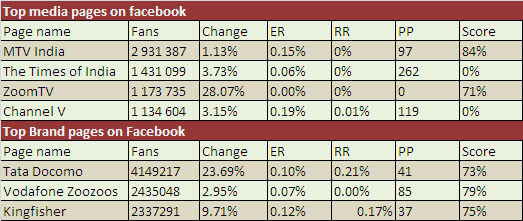
    ER = Engagement Rate, average number of total interactions to the pages posts divided by the number of fans in the last 30 days
    RR = Response Rate, the pages response rate to the user questions posted on the wall in the last 30 days
    PP = Page Posts, the number of the posts by the page in the last 30 days
    Score = The score of the Facebook page, a Socialbakers only metric that we create out of 30 different parameters

    Source:

    http://www.socialbakers.com/facebook-pages/brands/india/
    http://www.socialbakers.com/facebook-pages/media/india/