Tag: social media

  • Authenticity and engagement is what brands must give consumers: MTV youth summit

    By A Correspondent


    Brands today need to listen, learn and begin to engage with the youth; they need to be authentic as young people today are willing to speak positively about the brand they trust. These were some of the points discussed at the ‘MTV Power of One’- Youth Marketing Forum 2012.


    Ms Angela Barkan, Senior Director, Marketing and Publicity, Sony Music Entertainment; Mr Chetan Bhagat, Author of five blockbuster novels; Mr Andrew Ridley, Executive Director and Co-Founder, Earth Hour; Mr Henri Holm, Senior Vice President, Rovio Entertainment, the creators of Angry Birds; Simon Smith, European Digital Director at Interbrand were some of the speakers at the Youth Marketing Forum which saw presentations and a panel discussion on ways to engage the youth in the digital media era.


    Aditya Swamy

    The MTV Youth Marketing Forum 2012 kick-started with Mr Aditya Swamy, EVP and Business Head, MTV India sharing some of the findings from the MTV’s study on the Indian youth. The study titled ‘Power of One’ was unveiled on Friday, April 27. Mr Swamy said that over 5,000 youth were interviewed across the Country and an overwhelming 76 per cent said that they are happy with their life. According to the findings, for today’s youth family is more important than their friends, as a lot of young people see their parents as their role model.


    The survey also says that 97 per cent of the youth believe that they can bring about change and that social media has given them a voice, thus making them feel empowered. “Single screen engagements are not going to work, today web and mobile are required to engage the youth. Today the youth do not need inspirations but engagement, so there needs to be a two way conversation. If brands learn to keep the promises they make to their consumers, it will see more people, particularly youngsters flocking towards their brands” Mr Swamy added.


    Andrew Ridley

    A good idea needs good platform:

    Mr Andrew Ridley, Executive Director and Co-Founder, Earth Hour spoke about how the movement first started in one city -Sydney, before it became a global movement. He spoke about how every individual has the power to change the world they live in and how social media strengthens that power and provides a vehicle to take action. Citing the example of how Earth Hour was designed to build reach and increase its reach to billions of people around the world, Mr Ridley was of the view that a good idea needs a good platform in order to reap rich benefits. “I believe that for the first time we have the power to connect. We are still at the initial stage of creating a big change, but if our core idea is relevant and connected to the young people in particular, it will lead to a huge change in the world” said Mr Ridley.


    Henri Holm

    It’s all about communication…

    Speaking on the success story of Angry Birds, Mr Henri Holm, Senior Vice President, Rovio Entertainment, said that it took the company nearly eight years to be where it is today. He also spoke about how to engage the younger generation with the powerful concept and the characters and also how the distribution channels were also chosen carefully to reach out to the millions and to be of service to the fans. Since youth is the core TG, Rovio Entertainment hopes to stay relevant, connected and constantly find new ways to engage the youth.


    Besides the online experience, Angry Birds also gave the audience offline experience of the game, thus not only engaging its TG but even getting newer audience. “One of the reasons for the success of Angry Birds is its simplicity. We put a lot of weight on communication and feedback from our audience, therefore for us it is all about building business with fans and not features. Angry Birds is a permanent part of the youth culture and our aim is to further service the youth efficiently in the years to come.”


    Chetan Bhagat

    Reaching out through social media

    Author of five blockbuster novels, Mr Chetan Bhagat, also known as the marketing guru gave his insights on marketing. He said that social media is a good way to execute the power of one: “Social media has become very popular today and one must know what a Facebook or a Twitter is. As far as I am concerned social media is a great platform, my goal is to reach out to maximum number of people and social media is one of the ways to reach out.”


    He said that one of the reasons why his books worked was because the plots were tight, they were unputdownable, the language was simple, and the characters were relatable. Mr Bhagat also gave some insights into the mind of the youth. He said that the youth today has the ‘hunger’ to do well in life, to gain respect and make money; that they want an education that could provide them skills that would help them make money. Besides the love for their careers and seeking out their love, youth today deeply care for their country and are willing to clean up the system.


    Simon Smith

    The power of one

    Mr Simon Smith, European Digital Director, Interbrand spoke about the power of conformity, and the willingness to conform publicly in order to attain social rewards. We need to understand the power of one and how powerful it is. The power of one, I believe, is simply about being human. One must not move with the crowd but, remain an individual he or she is supposed to be. “Fundamentally, as humans, we haven’t changed much, but our expressions to our needs have dramatically changed with technology, society and changing power structure. The relation between brand and consumer has fundamentally changed, so if a brand makes a promise to its consumers, it better deliver on those promises or the consumer will never trust the brand and influence others to rebuke the brand too.”


    Angela Barkan

    Authenticity and the art of listening to the youth

    Ms Angela Barkan of Sony Music International spoke about millennials, youngsters aged between 12 to 30 years. She was of the view that millenials are multi-taskers and optimists, that they expect brands to be authentic and have two way communications with them. She also said that this is a group which loves to share and that they define themselves by what they share. She also said that this unusual group is found mostly online. “Collaborations and interactions are very important when talking about music as it results in lifelong fans. However, there is a need for brands to be authentic because if a brand is authentic, then millenials are willing to speak positively about the brand they trust.”


    Reaching out to the youth

    A panel discussion which included eminent panelists like Mr Avinash Pant, Marketing Head, Nike India; Mr Sumeet Pahwa, DGM – Marketing, TATA Docomo; Mr Vikram Malhotra, COO Viacom 18 Motion Pictures; Mr Bejoy Nambiar, Director and Screen Writer; and Mr Ayushman Khurana, VJ turned Actor and was moderated by Mr Nikhil Chinappa, VJ and Founder, Summer Sunburn Festival spoke about the difficulties of marketing to the young generation and the possible ways of reaching out the youth. They also spoke on the role of social media marketing and whether social media is actually an effective tool to reach out to the youth.


    Mr Pahwa spoke about how the social media is a big platform to engage the youth citing the example of how it helped Tata Docomo successfully engage the youth by having a two way conversation with them.


    According to Mr Malhotra, “Brands need to listen a lot more, even to criticisms, and problems must be solved as and when brought by the consumers. The attitudes of the youth are fast changing, today they trust their family and friends more than the brands, hence brands need to listen, learn and begin to engage with the youth.”


    Mr Pant was of the view that the youth today are looking for innovation: “Things are moving so fast today that our conventional thought process itself needs to change drastically. We have to think a lot more digital.”


    Ayushman Khurana pointed out that the youth do not have the patience to listen, but they do have a strong opinion about films or any other product or brand. So one needs to understand its audience and find ways to connect with the audience and have a two way communication with them.


    Be authentic, have a two way communication, listen a lot more to your consumers, respond to criticisms and fix problems because young people are willing to be advocates of brands on social networking sites as long as they trust it otherwise brands must be ready for a backlash. These are some of the lessons to be learnt from the MTV Youth Marketing Forum 2012.

     

  • Emerging markets offer potential that we digital natives thrive on: Amanda Richman

    It has been a dream run for Starcom MediaVest Group that bagged a series of client wins in 2011-12 and saw it post commendable growth numbers for the network. Of the many divisions under the network, probably the unit that surprised one and all with its performance was its digital arm – SMG Digital that managed to deliver 200 per cent growth in 2011. according to amanda Richman, President – Digital, MediaVest Worldwide & Digital Lead for Emerging Markets, Starcom MediaVest Group, that’s an impressive milestone, and a testament to the digital talent and the focus of the new leadership team at SMG.


     

    On a short Indian sojourn, Ms Richman took some time out of her busy schedule to reply to MxMIndia’s Johnson Napier’s questions about the strides made by the digital agency in India and around the globe. While India continues to deliver spectacular growth, Ms Richman asserts that the next phase of digital growth will come from Greater China,Russia, as well as the Middle East and Central Europe.


    It’s the size and scale of the BRIC markets that offers unprecedented growth opportunities for SMG, as well as its clients, she affirms. Ms Richman also delves on how social media will change the advertising ecosystem going forward and what is SMG Digital’s plans for India.


    as you continue to deliver above-par growth in the realm of digital, could you elaborate on a few eminent strides that MediaVest has managed to gain under your leadership over 2011-12?

    Our focus on designing and delivering human experiences as an agency puts digital at the core of what we do, and demands that we build that skill set across the organization.

    From developing connection strategies based on digital behaviours, to integrated video buying approaches, to building capabilities in social, mobile, content and analytics, digital growth has been a singular focus of the entire agency, and that drives momentum.


    How would you sum up the growth put up by the digital division here in India?

    SMG Digital delivered 200 per cent digital growth in 2011 – that’s an impressive milestone, and a testament to the digital talent and the focus of the new leadership team.


    How do the other asia Pacific countries stack up against India vis-a-vis harnessing the digital tide?

    Each market has its own success stories, driven by our client’s objectives and digital appetite. What’s unique aboutIndiais the focus on cost and scale – the constraints of investment can lead creative innovation in how we build and scale ideas more efficiently.  There’s also an inherent creativity in this market linked to such a strong appreciation for technology. This networked mindset inIndiacan see new possibilities in both, the art and the science of digital.


    How would you describe the agency’s growth in your global markets, including the US, Europe and elsewhere?

    Digital growth continues to be strong in our core markets, driven by our integrated approach. When you start with human insights at the core, and build out experiences based on creating value, it naturally leads to opportunities with social, content and mobility, and we’re seeing tremendous growth in these three areas. However, it’s a more measured growth in theUSandWestern Europe, whereas the emerging markets offer that unbridled enthusiasm and potential that we digital natives thrive on.


    Despite the current digital boom being witnessed in India, the country is still in its infancy, gripping with the sudden demand for the medium. What are the pros and perils of being a young, yet highly sought-after, market?

    Hyper-growth, and the resulting chaos, creates a climate of intense creativity – and we’re clearly in that phase of opportunity inIndia. However, there’s a risk that this energy is expended on chasing apps and shiny objects, rather than building a digital foundation. It’s important during this early stage that we balance the passion for innovation with the need to execute the ‘brilliant basics’, train our talent to have a digital mindset over skillset, and find solutions that will grow our clients business – not simply check the box on doing digital.


    Will social media emerge out of the shadows of the web and take on a singular role of being a popular medium for advertisers?

    Social media is more than an ad opportunity – social is human behaviour that will increasingly power the web. Paid advertising is one part of the experience, but the real value is in understanding the human interactions and conversations, so that marketers can learn and engage in ways that provides real value in their consumers’ lives. That’s the real opportunity with social.


    Of the three screens, television, web and mobile, which would be the most definitive in terms of ROI and reach for clients?

    We approach the ROI challenge uniquely for each client, based on their objectives and audience goals.  While television is still a great reach driver with strong ROI, online has proven to deliver better ROI for several clients and targets, and mobile is quickly gaining ground as both a reach, engagement and acquisition tool vehicle.


    Despite the huge buzz, spends on digital are still abysmally low, atleast here in India. What do you advocate the industry needs to do to attract more revenues?

    In theUnited States, we faced the same level of resistance in the early 2000s, as marketers questioned the value of digital relative to traditional, proven media.  The shift to Internet being the #2 media came thru a series of wake-up calls:

    • For performance marketers, search and performance display was proven to be high-performers, resulting in ‘digital first’ planning, and quickly setting the pace for double-digit investment.
    • as time spent online exceeded time spent on most other media, brand marketers realized they needed to follow the consumer across all digital touchpoints.
    • as brand marketers began to engage with real dollars, they quickly realized how digital not only offered unique targeting opportunities, but also could complement v/s compete with their traditional media investments, serving as an activator towards the sale. The era of integrated planning took hold.
    • The advent of video, social and gaming demonstrated an unprecedented level of engagement that couldn’t be delivered elsewhere, leading to greater investment in creating digital content.
    • as mobile and smartphones usage increased, it was clear that digital was an always on, always connected medium that warranted deeper investment and experience design across all three screens.


    Which are the new and emerging markets being tapped by your agency for the future?

    Our emerging focus spansIndia, Greater China,Russia, as well as the Middle East andCentral Europe.  Clearly the size and scale of the BRIC markets offer unprecedented growth opportunities for SMG as well as our clients.


    As you move forward, is there a vision that you’d want the agency to abide by as it prepares to take on the future?

    Our dream is to grow our clients’ business by transforming behaviour through uplifting, meaningful human experiences. That vision transcends digital and market boundaries, and enables a level of creativity and commitment that motivates our entire organization.


  • Govt ought to leverage social media for public consultations: DoT secy

    By A Correspondent


    The World IT Forum 2012 came to a close on Wednesday after two days of deliberating on the role of ICT in agriculture, education, health and e-governance, within the overall theme of ICT for sustainable human development.


    On the second day, during the Plenary Session on ‘Networking – connecting people’, R Chandrashekhar, Secretary, Department of Telecommunications, Ministry of Communications and IT acknowledged the need for the government to have a systematic engagement on social media. He said the government has prepared the draft of a Social Media framework.


    Underlining the importance of social networking, Mr Chandrashekhar said there are issues and programmes like NREGA, Food Security Bill and e-governance projects where it is imperative for the government to engage the public through consultations. This is where the government can leverage the power of social media.


  • For LinkedIn, it’s abt being relevant & contextual

    By A correspondent


    While social media in India is largely about congregating on two of the busiest portals in the space, mostly for the sake of networking and fun, there is another experience – led largely by B2B marketers – that is setting the business community abuzz for a while now.


    Having arrived in India only in 2009, LinkedIn has emerged as one of the fastest growing professional networks in India, being valued by its members as professional, trusted, and creating a remarkably different social environment. Having managed to outperform expectations by clocking over 14 millions+ users in a span of just two years and further generating business leads in the range of 149 million, it was an opportune time for the network in India to get together the community responsible for driving such a change.


    B2B Connect 2012 was the first such attempt by the network as they bought together marketing enthusiasts – led largely by blue chip clients, evangelists and practitioners to look into the scope that the medium offered for professionals to liaise, interact, get business leads and even look out for talent – new and experienced. Not wanting anyone from the network to miss out on the excitement, the Indian contingent were even successful in getting the otherwise hesitant global CEO Jeff Weiner to be a part of the event as they got him to kick-start the proceedings with a keynote address.


    Mr Weiner began by admiring the efforts and innovations bought in by late Apple CEO, Steve Jobs, who he described as a talent to reckon with. “The reason Apple is what it is, because it managed to find the right talent for the right opportunity. Obviously, it helped in having a team that was as instrumental in achieving the desired objective.” Likewise for LinkedIn, the focus was on making sure that the right talent matched with right opportunity in making the association with professionals more productive and successful. Emphasising on the three key attributes that would drive the network in the future, Mr Weiner said that it would be about creating an Identity, Insight and being Everywhere.


    Throwing up impressive numbers put up by the three divisions at LinkedIn, Mr Weiner said that Hiring Solutions contributed about $261 million, Marketing Solutions contributed about $156 million while Premium Subscriptions contributed about $106 million to the overall growth. Overall, the network witnessed a growth in excess of 100 per cent YoY.


    Dhiman Mukherji

    According to Mr Weiner, India was at top of the the markets that were putting up an exciting show, as it grew by more than 300 per cent in terms of user base. Drawing from what Mr Weiner had expressed at the event regarding India being a force to reckon with, Dhiman Mukherji, Director, Marketing Solutions said that the focus is on how the network is positioning B2B in the forefront of everything it does.


    In an interaction with MxM India, he said: “What has really worked is that we have been able to create a B2B marketplace and this event is a celebration of that. In two years’ time we have been able to leverage with some of the leading brands in India and that is what has helped us take our business to new levels. When I joined the company in 2010, we were at 3 million-odd user base and today we are at 14 million users. So it’s all a result of not only good trade marketing that has happened but a lot of PR communication drive that has taken place. The fact that increasingly people are finding value in the LinkedIn proposition is what is making this medium click.”


    Having already created a strong user base in the realm of IT, according to Mr Mukherji, the focus, going forward, would be to break into each and every vertical, including energy, construction, real estate, and so on. In fact, they are already seeing some amount of traction in these verticals as well. “Going forward we would be increasing our focus towards financial, travel & tourism, auto, and others,” he said.


    Providing an APAC perspective, Olivier Legrand, Senior Director – Marketing Solutions, APAC said that India’s current hold is such that “some of the most sophisticated campaigns that have been running in Asia Pacific have been coming out of India. The Indian market has proven to be successful from the users’ perspective. Even in terms of the marketers, as they are really leveraging what’s really available on the platform. We have been consistently working with marketers on what are they trying to achieve and how we could help them in their journey,” he said.


    On how India stacks up to other Asia Pacific countries for LinkedIn, Mr Legrand said, “APAC and India are very critical for us in achieving our objective of connecting professionals. Of the 150 million professionals that we have connected thus far, about 25 million are from APAC. We are anticipating a big part of the growth in users to come from this part of the world. Other markets that have been delivering good growth include Australia, Malaysia, Korea, Japan.” He further stated that the key markets going forward would be Indonesia and Malaysia.


    On comparisons being drawn to other popular social media platforms of today, Mr Mukherji said: “The two pillars that separate us from the rest is relevance and context because at LinkedIn, it is all about being relevant and contextual. It’s about a network of people who are bonding to share insights, to get feedback from each other and really benefit from each other. Our solutions are such that they give marketers an ability to position their brand in a way that it turns out to be productive and in a manner which is in context to whatever is happening around them.”


    Mr Legrand has another version to offer. For him, it all boils down to the mission set by the network: “To connect the professionals in a way so as to make them productive and successful. So what we bring is focus, what we bring is professional identity online, what we bring is opportunities for users to connect with businesses.”


    According to him, other social media firms deliver different values. “For example, if we look at Facebook, it deals with fun, entertainment, pictures, and so on and is an environment that has an interest for certain categories for users but we are a place for professionals and are very attractive for B2B marketers. So that’s how we are positioned and that’s what’s going to be our focus going forward. We are about providing identity, providing insights and being everywhere.”


    When asked on the growth put in by the Marketing Solutions division, Mr Mukherji said: “Where Marketing Solutions is concerned, we have grown by leaps and bounds. Not only has the user base grown but the sheer number of marketers who want to experiment with LinkedIn – that in itself is growing. So we have been growing substantially from where we started off in 2010.” Even the Hiring Solutions and Premium subscriptions too, contribute significantly to its business, he revealed.


    As for the goalpost of increasing the user base in India by a large sum this year, Mr Mukherji said: “We are not in a hurry to add more users as its basic philosophy is putting the user first. Have we improved the experience for the existing user – that is the core of our philosophy. If I can make his current experience on LinkedIn better by giving him access on the mobile, i-Pad, smartphones and others that’s what we would ideally like to concentrate on. So yes, we are not in a tearing hurry to get in more users; that will come when the experience in itself sees an improvisation over a period of time and when it starts benefiting our online community at large.”


    The event saw an impressive line-up of guests present interesting case-studies and examples of leveraging LinkedIn for deriving success for their brands. Dell, Philips, Citi India, Microsoft, HCL Technologies, Siemens were some blue chip clients who came in good numbers to imbibe meaningful solutions from the meet.


  • Burson-Marsteller releases list of the most influential political voices

    By A Correspondent


    Burson-Marsteller, a leading global public relations and communications firm, on Monday released a list of the top 10 most influential political voices on Twitter inIndia. This list was developed as part of a global research study- G20 Influencers – that named the 200 most influential political voices on Twitter across the G-20 nations.


    G20 influencers is a study conducted by Burson-Marsteller, a leading global public relations agency working with Klout, the social media analytics company. The study aims to identify the ten most politically influential people on Twitter in each country of the G20. The study measures influence by using a tweeter’s Klout Score. Burson-Marsteller created a list of over 900 politically influential people on Twitter across 26 countries. This included politicians, journalists, bloggers, public affairs specialists, NGOs, and industry and trade associations. The data used for the study was taken in March 2012 based on activity over a 90-day period.


    The list of the top 10 political tweeters was determined using data from Klout (klout.com), the standard for influence. Klout analyzes engagement across social networks and creates a Klout score, based on this data to help users understand and unlock their influence.


    Burson-Marsteller’s global public affairs and digital consultants drew up a list of close to 1000 people on Twitter who are politically influential in the G-20 nations. Klout then assessed and scored them against its influence metric, set on a scale from 1-100, measuring influence based upon a user’s ability to drive action.


    The ten most influential Twitter accounts inIndiaare (alphabetically):


    1. Kiran Bedi – @thekiranbedi

    2. Anand Mahindra – @anandmahindra

    3. Narendra Modi – @narendramodi

    4. Derek O’Brien – @quizderek

    5. Vir Sanghvi – @virsanghvi

    6. Jonathan Shainin – @jonathanshainin

    7. Digvijaya Singh – @digvijaya_28

    8. Dr. Subramanian Swamy – @Swamy39

    9. Sushma Swaraj – @SushmaSwarajBJP

    10. Shashi Tharoor – @ShashiTharoor


    “The G20 study is representative of how social media is an increasingly trusted and utilised platform for shaping public opinion here inIndiaand around the world,” said Rahul Sharma, president of Genesis Burson-Marsteller’s public affairs practice. “Citizens are not just seeking new information, but looking for a forum through which their voices can also be heard. Twitter is definitely becoming a preferred medium for delivery and discussion of new ideas, policies and whatever else that is the shaping the political and social landscape.”


    The study found that the top political tweeters inIndiaare politicians, journalists, bloggers and campaign advisors. The study found that over a 90-day span these influencers: received an average of 28,110 re-tweets; received an average of 24,600 mentions and had an average of 337,964 Twitter followers.


    The other countries covered in this study include Argentina, Australia, Brazil, Canada, China, France, Germany, India, Indonesia, Italy, Japan, Mexico, Russia, Saudi Arabia, South Africa, South Korea, Turkey, United Kingdom, United States and the European Union (including Latvia, Netherlands, Poland, Portugal, Spain and Sweden).


    Burson-Marsteller, established in 1953, is a leading global public relations and communications firm. It provides clients with strategic thinking and program execution across a full range of public relations, public affairs, reputation and crisis management, advertising and web-related strategies. The firm’s seamless worldwide network consists of 69 offices and 80 affiliate offices, together operating in 107 countries across six continents.


  • [PR] We challenge to innovate & thereby set trends: Khalid Jamal

    It ain’t a small agency but its ’boutique’ way of doing PR, where it goes beyond the obvious towards building, managing, reinforcing and protecting reputation is what endears the agency to its clients and goes a long way in laying solid foundation for a long-term partnership. Much of the agency’s good showing could be attributed its leader Khalid Jamal.

     

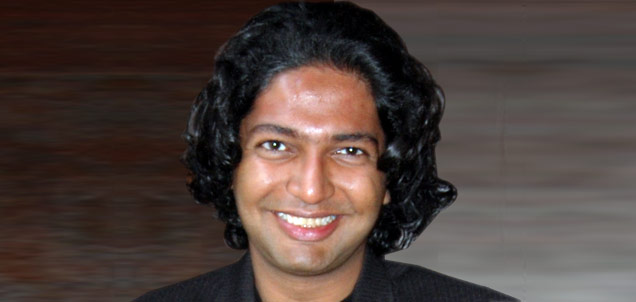
    Mr Khalid Jamal possesses close to two decades’ experience in Reputation Management having handled over 300 key clients drawn from across all sectors. He has also been awarded numerous awards by IMM and PRSI for innovative work done by him.


    In an interaction with MxMIndia’s Johnson Napier, Mr Khalid delves on Orion’s journey in the country thus far, on the two units that have been delivering top-notch growth for the agency and also scrutinises the current state of the PR industry inIndia. Excerpts:


    How has Orion PR delivered on the growth front in 2011-12?

    The year 2011-12 has been excellent for Orion PR as we doubled the growth digit compared to previous year. Two verticals which contributed to this growth are: Crisis Management/Issue Advocacy Practice and Social Media/Digital.


    How would you assess your client roster across the several domains that your offer your services in?

    We work with a number of clients from established Indian corporates to MNCs. However, the new users of PR (the growing mid-level companies and large SMEs) are going to drive PR more significantly than the good-old PR users, and hence, would be our focus for growth.


    How would you rate your agency on the parameter of client retention?

    Performance-delivery on each account at Orion PR is well-above average in the industry. However, one has to be guarded against the general tendency to compare ‘PR account retention’ with that of ‘advertising account retention’; the two are different disciplines; hence the parameters to be applied have to be different, contextually. I would imagine that this aspect should be compared with that of Management Consultancy firms, where the periodicity of the accounts are determined by the scope of the assignment and the clients’ needs.


    How do you review your practices each year so as to stay ahead of the curve on a consistent basis?

    You have to feel the pulse of the clients’ businesses and its operating environment and challenge yourselves to innovate and align with clients’ interests. If this is followed in spirit, there is all the reason why you will be on cutting-edge. At Orion PR, we constantly challenge ourselves to follow this operating philosophy: challenge to innovate and thereby set trends.


    What is the shift you observe in the way PR as an industry functions today to what it did, say, about a decade ago?

    Absolutely nothing. It is what it used to be. However, you will see a change effecting over the next few years as the old give way to the new in mind and material; as the old-gen of PR moves over and the new gen takes over. The good news is that PR has started attracting some real good and fresh talent, and not the second shifties as it used to happen till recently. This is a significant development in the Indian PR industry and I hope it continues for good.


    Where do you see Orion PR placed in the PR pecking order amongst its contemporaries?

    I do not believe there is such a thing as pecking order in PR. Unfortunately, it’s an industry which is famed and defamed by a few big mouths who bask in their own wishful thinking and ‘number crunching’. That’s fine if they get their share of five by one cc quote with a mug shot. It’s nothing beyond that. Any service which is driven by the practioners’ expertise can’t be, and shouldn’t be, compartmentalised into the so-called numbers and pecking game. By the way, the whole process of defining a pecking order of the Indian PR firms suffers from the lack of credibility and a credible process. So lesser said the better.


    As for Orion PR, we are distinguished by our rich experience and expertise which attracts our clients, especially for high-end strategic PR campaigns, which remain our focus area, and not the vanilla services.


    How do you think social media has impacted PR and its functioning?

    Orion PR has a dedicated social media division called Orion Digital which has done some path-breaking work. We do not pay lip-service to digital, but rather produce integrated campaigns which make measurable contributions to clients’ communications initiatives.


    We have invested significantly in social media and digital for over the last three years which has begun paying dividends only now.


    However, if you talk of overall PR industry scenario, Social Media hasn’t impacted PR as much as it should have. Clients still have to make a choice between the digital wings of ad agencies and PR agencies; and this is where the dichotomy lies. PR agencies have a lot of catching up to do in this domain to be able to compete with the digital outfits of ad agencies. However, with the growing online activism, PR agencies will be advantageously placed to handle social media/digital.


    Including talent, what are some of the big challenges facing the PR industry in India?

    I don’t think ‘talent crunch’ is a big challenge today. With the infusion of fresh talent into PR and with a little reorientation of the pool, this problem, by and large, could be resolved. The real problem of ‘talent’ is at the senior level like any other industry, and there is no quick-fix solution for this. As the industry matures, this issue too will be naturally addressed.


    The other problems facing the PR industry are:

    1. Lack of understanding of its functioning by majority of clients

    2. ‘Cottage industry’ type of internal functioning, and haphazard growth

    3. Lack of consistency and respectability

    4. Lack of organised industry forum

    5. Ethics


    What are your views on international agencies venturing into India?

    It’s good as long as it adds value in terms of learning and development. Else, it’s just another dot on the map of their reach.


    What is the future you foresee for the PR and communications space in India?

    PR inIndiawill see exponential growth in strategic services for which very few agencies are prepared or are ready in terms of expertise. The vanilla PR services will see a solid decline, and I fear, would continue to be the cause as to why PR is yet to get its due recognition. I hope we will be the profession who didn’t miss the bus!


  • Tweets take wing in airline social media study


    By A Correspondent


    Social media has transformed the customer into a powerful entity. No longer does one need to call customer service to express opinions or share concerns. The tendency of content on social media to spread at a rapid rate can easily build or tarnish the reputation of a brand. This is the single most important reason why brands have started to monitor conversations and manage their online reputations.


    The domestic airline industry in India is growing at a healthy rate of 12 percent annually, and serves 2 percent of the world’s population (an extremely high figure). Therefore, it becomes necessary to understand what the customers want and what their concerns are. This can not only help in better customer service, but also increases brand fidelity.


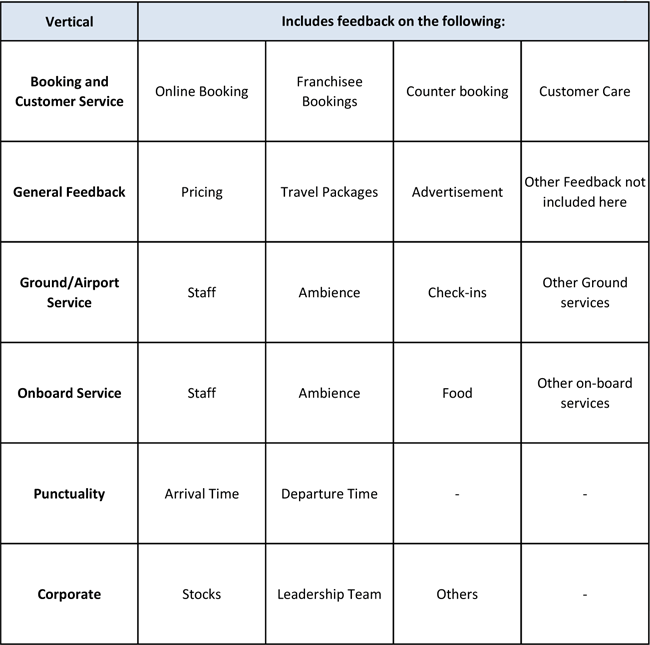
    Explaining this, Social Wavelength has monitored and analyzed conversations for the top 7 domestic air carriers in India to understand how they fare for different service types and departments, according to their customers. Using keywords that are most relevant to these carriers, they conducted a search of conversations on social media at the end of December 2011 and beginning of January 2012, and found 2712 relevant conversations. Each relevant conversation was classified into 6 verticals – Booking and Customer Service, General Feedback, Ground/Airport Service, Onboard Service, Punctuality, and Corporate (table shown in the Annexure). The output results were analyzed and the sentiment of each conversation was judged. The carriers considered for this study are Air India, Kingfisher Airlines, Jet Airways, GoAir, Indigo Airlines, JetLite, and SpiceJet.


    Share of Voice

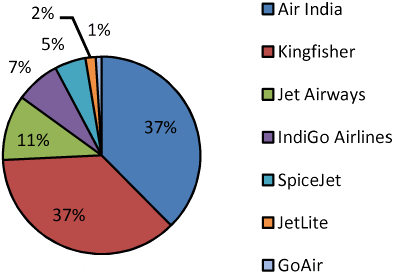
    The two most prominent carriers in India by volume on social media are Air India and Kingfisher Airlines. Together, they accounted for 72 percent of the total volume of results. As observed in many other scenarios, the Pareto rule is found to be true here. (This rule states that, for many events, roughly 80 percent of the effects come from 20 percent of the causes.)

     

    Jet Airways and Indigo Airlines come in at the third and fourth positions respectively. JetLite and SpiceJet were found in a very low number of results.


    The SWL Index

    Social Wavelength said it has derived the Social Wavelength Index (SWL Index) to calculate the sentiment share for each carrier with respect to the airlines industry. It is calculated as explained below:


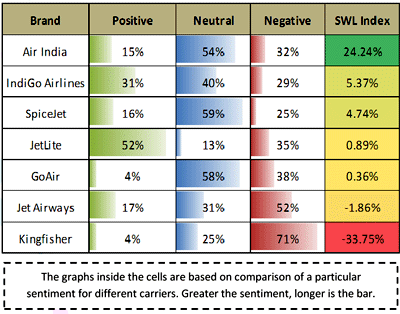
    On the basis of the SWL Index for conversations, we ranked each carrier vertical-wise and overall. Air India, due to the high share of positive and neutral conversations, ranked at the top of the table. Kingfisher Airlines, on the other hand, was the lowest in terms of SWL Index, having the maximum share of negative conversations in the overall data. Apart from Kingfisher, Jet Airways was the only carrier that had more negative conversations than the sum of positive and neutral conversations.
     

    How The Verticals Fare…

    Punctuality was the biggest concern among customers for almost every carrier monitored. This vertical had the lowest SWL Index at -9.07% and more than 85 percent of the conversations in this vertical were negative in tone. However, Indigo Airlines was mostly praised for timely arrivals and departures. In fact 89 percent of all punctuality-related positive conversations pertained to Indigo Airlines.


    Onboard Services too had a substantially negative SWL Index, at -5.48 percent. Kingfisher ranked better in this department, due to mostly neutral results. Air India, though having more conversations about its onboard services, had more negative results too, which affected in its SWL Index falling to the lowest amongst carriers (-18.38 percent). A recent incident, where the in-flight crew of Jet Airways was in news for being fined for refusing to serve alcohol to a female passenger, decreased its SWL Score to -14.23 percent. Without these results, Jet Airways’ SWL Index would have been better by 7.10 percent. This shows that even one incident can greatly affect the overall reputation of a brand.


    Although there were fewer conversations for the Booking and Customer Service vertical, the share of its negative conversations was second only to the punctuality vertical. The reason it fared better than the Onboard Services vertical was because it had fewer negative results out of the total volume. SpiceJet had the best ranking for its Booking and Customer Service, while Jet Airways had the lowest. Social Wavelength’s analysis of this showed that that there were a few customers that were unhappy with the online booking procedures for Jet Airways, and few complained about not getting refunds for cancelled flights.


    Conversation Sources

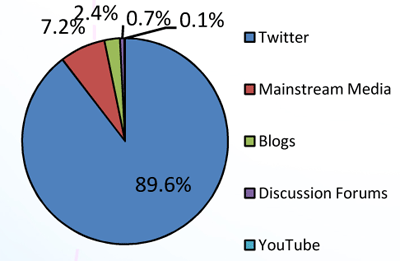
    Twitter accounted for the most number of conversations – 9 out of every 10 conversations. This platform has been very popular to share ideas and opinions, due to short updates that people find easier and less time-consuming to read. Mainstream media followed with 7.2 percent of the total relevant conversations, consisting mainly of news websites and articles.


    Sentiment Analysis of Conversations on Twitter

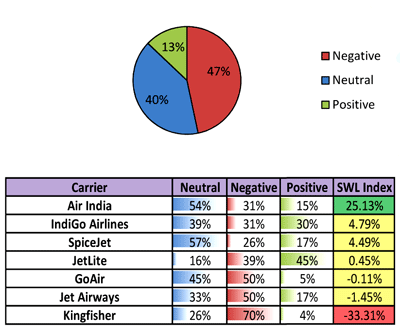
    Twitter, due to the high volume of conversations in the data, was the most influential platform for the overall sentiment of every carrier. When carriers were ranked based only on their conversations on Twitter, the results were very similar to the overall table. Almost half of the conversations found on the micro-blogging site were negative in tone. Being the single most prominent source of conversations, Twitter needs to be actively monitored by carrier companies.


    Demographics (Twitter)


    Top News

    There were a lot of mainstream news articles in the period between December 19 and December 26, 2012. These are the top news items for this period. (Since the number of conversations for Indigo Airlines, GoAir, JetLite, and SpiceJet is low, they have not been included.)


    Influencers

    Social Wavelength found a few notable Twitter users and bloggers who tweeted about the services of carriers.


    *True Reach is the number of people a twitter user influences, both within his/her immediate network and across their extended networks. Source: Klout.com


    Synopsis:


    The details of the verticals considered when analyzing conversations:


    Social media agency Social Wavelength was founded in 2009 and its clients include Channel [V], Kotak Mahindra, Idea Cellular and Havells, among others.


  • Denizen explores social media to create buzz

    By A Correspondent


    Denizen, the youth brand from Levi Strauss & Co, has been using social media effectively to connect with its consumers, the most recent example of this being its ‘We are Explorers’ initiative which has been quite a success in its first phase.


    Talking about the genesis of the idea, Arvind R P, Marketing Controller, Denizen, explained, “We know that the youth of today are increasingly spending time on social media engaging with friends & making new connections. Given that Denizen is a new brand, we have been exploring ways to connect strongly with the youth and be a part of their conversations. One of the exciting ways to deliver this is to have brand ambassadors who participate in the brand’s activities, get deeply involved in the brand programs and then build around these conversations. This is an exciting way to create buzz around the brand.”


    He aded, “Denizen is a global brand and hence this ‘We are explorers’ programme had to be on a global scale. We have Denizen brand ambassadors from India, China, Mexico, Singapore and Pakistan travelling to India, China and Mexico, in three phases.”


    When the initiative kicked off, there were about 200,000+ fans on Facebook which till date has more than doubled. This is for just Phase 1, with Phase 2 and 3 yet to happen in April. Most importantly, the quality of conversations around the brand has been heartening which is something that the brands today are increasingly looking at. Not to mention that this has helped drive buzz around the brand.


    The six young explorers, chosen from a large pool of hopeful applicants via a global casting call, hail from countries where Denizen clothes for youth can be purchased. This includes China, India, Mexico, Pakistan and Singapore. The explorers will be paired up as they head to their destination country during the next two months – March and April. They will embark on an action-packed trip where they will meet new people and take on tasks and challenges centered around creating new styles of denim based on their experiences. ‘We are Explorers’ campaign is being executed in three phases while the first phase is over, the next two phases will help in maintaining the momentum and buzz over a longer period of time. The company hopes that post this global program, the brand would have attained a sustainable base of fans and been a significant part of youth conversations. The plan is to build upon it and enrich the conversations around the brand.


    On other marketing initiatives around the brand, Mr Arvind said, “An important part of Denizen’s plans is to excite the youth with relevant innovations. Super shape, a new fit for young women which enhances the body curves, has just been launched. It has a more defined curve, a slimmer waist and longer leaner legs. We are planning a sustained promotion to build the women’s franchise with this innovation.”


    The brand Denizen has been designed keeping in mind the aspirational desires of the youth who increasingly identify with global trends. Leveraging LS&Co’s rich heritage and fit expertise of over 138 years, Denizen is re-inventing fits for this young generation of consumers. Affordable yet aspirational, the brand delivers great fitting and quality jeanswear with innovations.


    Denizen had taken the social media route when it was launched in India, where it used the social networking platform to engage its consumers and did events around the seven letters that spell Denizen, including a fashion show.


    In 2010, Levi Strauss & Co launched the Denizen brand in Asia – the company’s first brand launched outside the United States. In India, Levi Strauss Signature has transitioned into Denizen in 2011. Since its launch, the brand has gone to have over 300 exclusive brand stores and over two thousand multi-brand outlets.


  • 10 takeaways from ad:tech 2012

    By Shruti Pushkarna


    ad:tech 2012 concluded in New Delhi on Feb 24, with the two-day conference witnessing invigorating keynote sessions and insightful panel discussions. MxMIndia takes a look at some of the major takeaways from the biggest digital marketing, media and advertising event.


    The world has gotten a lot more challenging for marketers- With 30 billion status updates published on Facebook every month, 250 million tweets published every day and 5.3 billion views in a 24-hour period on YouTube, marketers have a lot to compete against. With this kind of crazy amount of penetration, it’s a horrible time for marketers. Shiv Singh, Global Head of Digital, PepisoCo said, “From a marketer’s standpoint, from strategy and insight to execution takes a whole bunch of research, figuring out a creative, writing a script, it’s all a several months’ task. It’s so hard to compete with a tweet or a Facebook status update that is published in five seconds.” If Facebook were a country, it would be the 3rd largest in the world. With consumption patterns changing, it is important for marketers to take cognizance of where their customers are.


    Everyone’s a storyteller- In the changing digital world, the source of information has ceased to matter. Everyone is becoming a storyteller, a relevant owner of content. Marketers need to realise that consumers are also content creators for brands. Arun Tadanki, Managing Director, Yahoo India said, “The purchase cycle is far more complex because consumers are not simply recipients of your brand messages, they are curators of your brand message.” Anurag Mehrotra, Vice President, Marketing, Ford India said, “People want to co-create, the control of messaging is shifting and consumers are increasingly critical of manufacturer-speak.” Viral Oza, Marketing Director, Nokia said, “Give the people the tools and a message and they will tell your story.”


    Brands are now publishers– In a world where consumers are bombarded with messages, brands need to find a way of telling their message differently, they need to embrace the art of storytelling to engage users. Marketing needs to be inside the content. Nikhil Rungta, Country Marketing Head, Google India said, “Users will go and find you if they have a need. The user today is saying don’t come knocking at my door- users are beginning to ignore your message.” To fight this situation, marketers need to learn a new and better way of telling their message differently. They need to be content creators rather than just being content distributors. If they can create content, in a digital social world, the consumer will act as a vehicle to carry that content across. Therefore it is important for brands to understand the compelling need of enveloping their message in pure content form. Brands have to go beyond sponsorship, and become curators and creators of content.


    Growing influence of social media- Study says that 57 percent of people talk to people more online than they do in real life. 78 percent of people trust consumer opinions posted online. Gian Fulgoni, Executive Chairman and Co-Founder, comScore said, “Social networking has exploded globally. Nearly 1 in 5 minutes online is spent on social networking sites.” Brands need to take notice of the value of social in fundamental areas like connecting with people, finding long lost friends, sharing experiences. Personal connection on social can help brands connect and engage better with consumers. Digital is increasingly becoming a part of life and so marketers need to weave social media into everything they do.


    Listen, engage, transform- The new mode of communication is Dialogue. Brands need to first listen to their consumers and then engage them in a dialogue to transform and inspire their purchase intent. Viral Oza, Marketing Director, Nokia shared data stating, more than 30 percent of consumers refer to internet for accessing information on brands. 40 percent of those convert into referrals. 30 percent recommend products to their peers based on their experience. Therefore a marketer’s dilemma is really to adapt or die. With millions tweeting, it becomes important for the brands to listen in rather than throw out more messages at the increasingly bored consumer. Narasimha Jayakumar, COO, E-commerce, Homeshop18 shared that in their model of business, social media served more for listening to consumers and helping solve their issues. He said, “We use Facebook mainly to address consumer issues, problems with products etc. Once your consumer knows you are listening it is easier to start a dialogue.” Pete Blackshaw, Global Head of Digital Marketing and Social Media, Nestle said, “Three operating pillars of our roadmap at Nestle are “listening, engaging and transforming.”


    Technology matters less- An interesting point emerged from debates and discussion that it is the basics in the business that matter the most and technology should be looked at as a vehicle for delivering a powerful message. Technology enhances the message and the experience but marketers should not start with the technologies. They matter less, marketers need to focus more on user behaviours and the data they generate. Karthi Marshan, EVP & Head, Group Marketing, Kotak Mahindra Bank Ltd quoted Douglas Adams, “It’s technology if it was born after you.” The idea is to believe in the power of storytelling, believe that a strong narrative still helps engage and not be intimidated by technology.


    Shrink, Simplify, Serve- Small is the new Big. Marketers need to rethink digital in a world of smaller and smarter screens. Pete Blackshaw, Global Head of Digital Marketing and Social Media, Nestle said, “We need to think harder about simplifying our messaging and serving the consumer. We need to shrink, simplify and serve. Our screens are shrinking and so we need to simplify to serve better.” The future of shopping is small screens and the world is increasingly becoming contextual. Richard Dunmall, Vice President, Global Accounts & Agencies, Microsoft Advertising said, “Every surface can become a digital source of content in the future.” Marketers need to focus more on creating simpler messages that can reach consumers in any form.


    Youth driving internet consumption in India- Gian Fulgoni, Executive Chairman and Co-Founder, comScore shared data that indicates that young people drive internet consumption in India today which in turn suggests that future overall usage will rise dramatically. com Score’s extensive research on the state of global internet also indicates that Indian internet users are much younger than the global average. 75 percent of audience is under 35 years compared to 52 percent of the world and 55 percent of the region. India’s heaviest internet usage comes from people in the age group of 26 to 34 years.


    Move beyond the click- Gian Fulgoni shared some lessons learnt from online advertising in his presentation on the state of global internet. Research indicates that click is at best an ‘incomplete’ and at worst a ‘misleading’ metric. Clickers represent a small and declining segment of internet users. Global click ratio on individual campaigns are pitifully low. So, ad effectiveness needs to be measured beyond the click. Marketers need to go beyond the click and explore other ways of measurement. Mr Fulgoni said, “There are two other ways. One is that you measure the change in behaviour, so what we do in the case of comScore, we take the comScore panel, take the people who are exposed to the campaign and a group of people who weren’t exposed to the campaign and then measure how their behaviour changed. And that behaviour change could be, did they go and visit the brand website, did they conduct a search using the brand name, did they get information or did they buy the product, did they buy it online or offline. Those are all behavioural metrics. You can also see if you changed the attitudes. Did the awareness of the brand go up, did recall go up, did favourability go up, did purchase intent go up? But those are all kind of intervening attitudinal metrics and not hard behavioural ones. But both sets can be used and I think they are far better predictors of the effect of a campaign than a click.”


    ad:tech is here to stay: ad:tech has emerged as ‘the’ premier destination for digital media, advertising and marketing and the organisers announced that the next year’s congregation would also happen in New Delhi on Feb 20-23.


  • Nokia, Reckitt etc outsource @Twitter to woo consumers

    By Shelley Singh


    Abhishek Roy, a 25-year-old commerce graduate from Delhi University and a diehard believer in social media, has more than 100 followers to his Twitter account. But that’s not the only account the heavy-metal addict operates on the social networking and micro-blogging service. Mr Roy also tweets for a living.


    As an employee of Bloggers Mind, a social media-focused start-up that promises to ‘multiply your brand buzz’, Mr Roy spends his working day putting out tweets that typically promote products and services of companies. One of the companies that keeps Mr Roy busy is Nokia, which has outsourced its Twitter handle to Bloggers Mind.


    “A great app to become an amazing cook! bit.ly/zo6bvd. Here’s a review of the app from @mynokiablog,” is just one of Mr Roy’s tweets that go out to some 15,000 followers of Nokia India.


    In Mumbai, 26-year-old Upasana Sanyal’s typical day is no different. Ms Sanyal, who joined technology services provider Mahindra Satyam six months ago, sends out 300-400 tweets a month. A recent one was on the company’s quarterly results.


    Q3, Re dip gains mixed; volatility high,” was the cryptic but crisp message to the twitterati following the company. “Tweets spike around results time or key announcements. It’s a good deviation from the mundane,” said Ms Sanyal, a consultant with Mahindra Satyam.


    At Dell India, Suyesh Shankar, 39, a marketing manager for consumer and small- and mid-sized businesses, spearheads the US firm’s social media agenda, which comprises a Twitter team that sits out of the company’s Bangalore-based Social Media Command Centre.


    Roy, Sanyal and Shankar are the communicators with the mandate to capture consumer attention in 140 characters. While Mr Roy is with a specialist social media services provider, the latter two are key members of in-house Twitter teams.


    Across India Inc, Twitter has fast transformed from an individual tool into a key platform to create and sustain brand buzz. The communications range from customer feedback and new jobs announcements to customer grievances and no-holds barred promotional blitzes.


    While companies such as Nokia India, Kotak Securities, Reliance Digital, Reckitt Benckiser and TripAdvisor outsource their Twitter handles, others such as ICICI Bank, Dell, IBM and Flipkart manage it in-house. Other agencies, such as Bloggers Mind, that provide third-party tweets include Convonix, Interactive Avenues and OgilvyOne.


    Twitter for most corporates is one link in an integrated marketing chain. “Our Twitter team is an extension of our ‘khayaal aapka’ effort and brings to life our commitment to be where our customers are,” said Anita Pai, senior general manager, ICICI Bank. In a typical month, ICICI Bank monitors 200,000 social media mentions, out of which 70,000 are tweets.


    Handset major Nokia India manages between 400 and 700 tweets a month via Bloggers Mind. “We use Twitter to engage with consumers on a real-time basis, share tips, information and address feedback or queries,” said Viral Oza, director (marketing), Nokia India. Bloggers Mind has a nine-member team for Nokia and four for Reckitt Benckiser.


    Aditya Vaidyanathan, account director for Nokia at Bloggers Mind, said: “We have a weekly planner with clients as to what messages to send out and how to address queries.” This includes promotional trivia such as: “Did you know that 360,500 text messages are sent out from Nokia phones every second”; or answering queries like: “How do I add new dictionary words to Nokia Lumia?”


  • Red Digital bags social media duties for Mirinda

    By A Correspondent


    Red Digital has been awarded the social media mandate for PepsiCo’s Mirinda. Red Digital will build and execute social media strategies that will help Mirinda, as a brand, reach out to their audience on social media platforms. The agency will play a key role in creating online buzz about the brand’s new offerings along with launching various campaigns and building engagement across social networks.


    For Mirinda, Red Digital’s immediate mandate on social media is to create an impact for its latest breathless campaign, with which it has launched two new flavours, Mirinda Orange Masala and Mirinda Orange Mango, while continuing with the base Mirinda Orange flavour.


    The launch is supported by a robust 360-degree campaign called the Taste Twister Challenge, supported via Radio, Outdoor and On-Ground activities, along with social media.


    Red Digital will help in bringing the experience to Facebook and On-ground. The program requires consumers to call or SMS at 08800033333 to choose the Taste Twister of their favourite flavour and recite it repeatedly in one breath for as long as possible; longer the recording, greater are the chances of winning exciting prizes, including 10 MP3 players and 1 tablet PC every day. Red Digital has replicated this experience on Facebook and Android tablets for on-ground activation, making the programme truly 360-degree.


    Red Digital is also geared to exploit the new disruptive full sleeve packaging that captures the taste and fun experience of drinking Mirinda through applications on Facebook. These applications use the most prominent aspect of the packaging: the emoticons, to bring alive the new flavours. The applications range from allowing fans on the Mirinda India Facebook fan page to enter into an augmented reality world and play with the emoticons to classifying friends in various taste categories. The agency will also be creating an augmented reality iPhone and Android application.


    The campaign, for the first time ever, will also see Red Digital creating TweetMobs through the duration of this campaign. These will be high-impact subjects being tweeted by Mirinda and re-tweeted by a group of people within a specific time frame. Red Digital will connect with the Twitteratis and get as many people to tweet about the topic with various Mirinda branded hash tags creating a plethora of endorsements for Mirinda.


    Commenting on the development, Harsh Jain, Founder & Managing Director, Red Digital said: “Social media provides seamless opportunities to build interest groups. Digital is no longer just about showing banners and clicking on them. It’s about generating engagement, activation and creating convergence between the online and offline worlds. We are glad to have an innovative partner like Pepsi Co onboard and look forward to creating path-breaking innovations in new media in the near future. The new activities for Mirinda brand emphasize our continued focus on digital innovation aimed at bringing value to our clients.”


    Speaking on Mirinda’s partnership with Red Digital, Ruchira Jaitly, Executive Vice President – Marketing, Beverages (Flavours), PepsiCo India said: “Social Media has become a very important tool for engaging with consumers and having a dialogue with them on a constant basis. We are pleased to have Red Digital on board as our social media partner for this initiative. Their prior experience in handling leading brands coupled with a deep understanding of consumer behaviour in the digital space will ensure there is a high level of engagement and traction for Mirinda’s campaign on three flavours.”


  • MSL Group on overdrive with social media


    By Rishi Vora


    MSL Group, the Publicis Groupe’s flagship speciality communications and engagement network, is upbeat about its foray into the growing world of social media. Afer it acquired communications major Hanmer & Partners and later PR and social media firms 20:20 Media and 20:20 Social respecitively, it has now clubbed the social media practices of Hanmer and 20:20 Social under the umbrella of MSL Group India Social.


    The group has adopted a unique approach towards tapping the social space for clients in India and abroad – it has created three key capabilities: Plan, Build and Engage. Of the two, Plan and Build are the revenue-drivers, wherein a lot of work goes into providing insights, strategy planning and developing web, mobile and social applications; creating content, communities and conversations.


    The company recently launched its proprietary tool – The People’s Lab, a global crowdsourcing platform and approach designed to help businesses embrace innovations. It is a platform which works across multiple application areas; provides end-to-end support, including custom design and content creation.


    In 2010, Dell India used an early version of People’s Lab platform to create the Dell Go Green challenge for design students and others to share ideas on how to redesign, reuse and recycle gadgets to make them go green. The idea to create Dell Go Green challenge came from the fact that the client owned a recycling programme, besides having conducted several other CSR programmes.


    A mini site was created using the People’s Lab and the result was quite pleasing: About 650 ideas got shared, 25,000 members on Facebook and 8,000 votes.


    As is known, Gaurav Mishra launched 20:20 Social and now heads the group’s social media business in India. He is Asia Director – Social Media, MSL Group. Mr Mishra told MxMIndia that the company now plans to launch many more tools that will offer clients comprehensive social media solutions. “Our core differentiation in the social media space is in offering tools; we are in the business to create platforms which bring people together and programmes which energise people. We want to create more tools, more frameworks, so that we can go to clients and offer them solutions that’ll contribute in solving much bigger problems.”


    Parveez Modak

    People’s Lab was created in India, led by Parveez Modak and is now sold to clients in Singapore and Italy. “We’re discussing with clients in US, Poland, Taiwan, and in India,” informed Mr Mishra.


    He added: “Once we have developed enough tools and capabilities in India, we will look to educate whole of our network and make efforts to spread awareness to our group companies in different parts of the world.”


    MSL Group India Social is now working towards creating a corporate citizenship offering globally. As Mr Mishra explained, it is a network of 150 senior members of the group spread across regions – board members, global board members, regional presidents and others. The idea is to bring forward a thought leadership team that can provide insights, views and opinions on various topics ranging from “How clients are looking at Change Management Differently” to Employee Engagement, Corporate Citizenship, Innovation, business opportunities and so on.


    How will the Social space evolve in India? Where is it headed? What kind of solutions are clients seeking from specialists? According to Mr Mishra, the market for social media services will pick up dramatically now, and clients will be on the lookout for companies that possess the talent to develop in-house capabilities, and solve greater and much complex marketing solutions within the social space.


    Globally, MSL Group has about 200 professionals dedicated to social media; about 60 of them in Asia and, for now, 30 in India. Mr Modak, who other than social media also leads the integration function at Hanmer and Mr Narendra Nag at 20-20 Social constitute Mr Mishra’s core team for MSL Group India Social.

    “Revenue-wise, India is still fairly small, China is becoming increasingly big in terms of size of the market, but there is ample opportunity in India,” concluded Mr Mishra.