Tag: social media

  • Teens say ‘for you’ algorithms get them right

    Teens say ‘for you’ algorithms get them right

    By Nora McDonald

    Social media apps regularly present teens with algorithmically selected content often described as “for you,” suggesting, by implication, that the curated content is not just “for you” but also “about you” – a mirror reflecting important signals about the person you are.

    All users of social media are exposed to these signals, but researchers understand that teens are at an especially malleable stage in the formation of personal identity. Scholars have begun to demonstrate that technology is having generation-shaping effects, not merely in the way it influences cultural outlook, behavior and privacy, but also in the way it can shape personality among those brought up on social media.

    The prevalence of the “for you” message raises important questions about the impact of these algorithms on how teens perceive themselves and see the world, and the subtle erosion of their privacy, which they accept in exchange for this view.

    Teens like their algorithmic reflection

    Inspired by these questions, my colleagues John Seberger and Afsaneh Razi of Drexel University and I asked: How are teens navigating this algorithmically generated milieu, and how do they recognise themselves in the mirror it presents?

    In our qualitative interview study of teens 13-17, we found that personalized algorithmic content does seem to present what teens interpret as a reliable mirror image of themselves, and that they very much like the experience of seeing that social media reflection.

    Teens we spoke with say they prefer a social media completely customized for them, depicting what they agree with, what they want to see and, thus, who they are.

    If I look up something that is important to me that will show up as one of the top posts [and] it’ll show, like, people [like me] that are having a nice discussion.

    It turns out that the teens we interviewed believe social media algorithms like TikTok’s have gotten so good that they see the reflections of themselves in social media as quite accurate. So much so that teens are quick to attribute content inconsistencies with their self-image as anomalies – for instance, the result of inadvertent engagement with past content, or just a glitch.

    At some point I saw something about that show, maybe on TikTok, and I interacted with it without actually realising.

    When personalised content is not agreeable or consistent with their self-image, the teens we interviewed say they scroll past it, hoping never to see it again. Even when these perceived anomalies take the form of extreme hypermasculine or “nasty” content, teens do not attribute this to anything about themselves specifically, nor do they claim to look for an explanation in their own behaviors. According to teens in our interviews, the social media mirror does not make them more self-reflective or challenge their sense of self.

    One thing that surprised us was that while teens were aware that what they see in their “for you” feed is the product of their scrolling habits on social media platforms, they are largely unaware or unconcerned that that data captured across apps contributes to this self-image. Regardless, they don’t see their “for you” feed as a challenge to their sense of self, much less a risk to their self-identity – nor, for that matter, any basis for concern at all.

    The human brain continues to develop during adolescence

    Shaping identity

    Research on identity has come a long way since sociologist Erving Goffman proposed the “presentation of self” in 1959. He posited that people manage their identities through social performance to maintain equilibrium between who they think they are and how others perceive them.

    When Goffman first proposed his theory, there was no social media interface available to hold up a handy mirror of the self as experienced by others. People were obligated to create their own mosaic image, derived from multiple sources, encounters and impressions. In recent years, social media recommender algorithms have inserted themselves into what is now a three-way negotiation among self, public and social media algorithm.

    “For you” offerings create a private-public space through which teens can access what they feel is a largely accurate test of their self-image. At the same time, they say they can easily ignore it if it seems to disagree with that self-image.

    The pact teens make with social media, exchanging personal data and relinquishing privacy to secure access to that algorithmic mirror, feels to them like a good bargain. They represent themselves as confidently able to tune out or scroll past recommended content that seems to contradict their sense of self, but research shows otherwise.

    They have, in fact, proven themselves highly vulnerable to self-image distortion and other mental health problems based on social media algorithms explicitly designed to create and reward hypersensitivities, fixations and dysmorphia – a mental health disorder where people fixate on their appearance.

    Given what researchers know about the teen brain and that stage of social development – and given what can reasonably be surmised about the malleability of self-image based on social feedback – teens are wrong to believe that they can scroll past the self-identity risks of algorithms.

    U.S. Surgeon General Vivek Murthy discusses the harms teens face from social media

    Interventions

    Part of the remedy could be to build new tools using artificial intelligence to detect unsafe interactions while also protecting privacy. Another approach is to help teens reflect on these “data doubles” that they have constructed.

    My colleagues and I are now exploring more deeply how teens experience algorithmic content and what types of interventions can help them reflect on it. We encourage researchers in our field to design ways to challenge the accuracy of algorithms and expose them as reflecting behavior and not being. Another part of the remedy may involve arming teens with tools to restrict access to their data, including limiting cookies, having different search profiles and turning off location when using certain apps.

    We believe that these are all steps that are likely to reduce the accuracy of algorithms, creating much-needed friction between algorithm and self, even if teens are not necessarily happy with the results.

    Getting the kids involved

    Recently, my colleagues and I conducted a Gen Z workshop with young people from Encode Justice, a global organisation of high school and college students advocating for safe and equitable AI. The aim was to better understand how they are thinking about their lives under algorithms and AI. Gen Zers say they are concerned but also eager to be involved in shaping their future, including mitigating algorithm harms. Part of our workshop goal was to call attention to and foster the need for teen-driven investigations of algorithms and their effects.

    What researchers are also confronting is that we don’t actually know what it means to constantly negotiate identity with an algorithm. Many of us who study teens are too old to have grown up in an algorithmically moderated world. For the teens we study, there is no “before AI.”

    I believe that it’s perilous to ignore what algorithms are doing. The future for teens can be one in which society acknowledges the unique relationship between teens and social media. This means involving them in the solutions, while still providing guidance.The Conversation


    Nora McDonald, Assistant Professor of Information Technology, George Mason University. This article is republished from The Conversation under a Creative Commons license. Read the original article.

  • Social media can in fact do a fair deal of good…


    By Ian Anderson, Gizem Ceylan and Wendy Wood


    Is social media designed to reward people for acting badly?

    The answer is clearly yes, given that the reward structure on social media platforms relies on popularity, as indicated by the number of responses – likes and comments – a post receives from other users. Black-box algorithms then further amplify the spread of posts that have attracted attention.

    Sharing widely read content, by itself, isn’t a problem. But it becomes a problem when attention-getting, controversial content is prioritized by design. Given the design of social media sites, users form habits to automatically share the most engaging information regardless of its accuracy and potential harm. Offensive statements, attacks on out groups and false news are amplified, and misinformation often spreads further and faster than the truth.

    We are two social psychologists and a marketing scholar. Our research, presented at the 2023 Nobel Prize Summit, shows that social media actually has the ability to create user habits to share high-quality content. After a few tweaks to the reward structure of social media platforms, users begin to share information that is accurate and fact-based.

    The problem with habit-driven misinformation-sharing is significant. Facebook’s own research shows that being able to share already shared content with a single click drives misinformation. Thirty-eight percent of views of text misinformation and 65% of views of photographic misinformation come from content that has been reshared twice, meaning a share of a share of a share of an original post. The biggest sources of misinformation, such as Steve Bannon’s War Room, exploit social media’s popularity optimization to promote controversy and misinformation beyond their immediate audience.

    How social media algorithms drive misinformation.


    Re-targeting rewards

    To investigate the effect of a new reward structure, we gave financial rewards to some users for sharing accurate content and not sharing misinformation. These financial rewards simulated the positive social feedback, such as likes, that users typically receive when they share content on platforms. In essence, we created a new reward structure based on accuracy instead of attention.

    As on popular social media platforms, participants in our research learned what got rewarded by sharing information and observing the outcome, without being explicitly informed of the rewards beforehand. This means that the intervention did not change the users’ goals, just their online experiences. After the change in reward structure, participants shared significantly more content that was accurate. More remarkably, users continued to share accurate content even after we removed rewards for accuracy in a subsequent round of testing. These results show that users can be given incentives to share accurate information as a matter of habit.

    A different group of users received rewards for sharing misinformation and for not sharing accurate content. Surprisingly, their sharing most resembled that of users who shared news as they normally would, without any financial reward. The striking similarity between these groups reveals that social media platforms encourage users to share attention-getting content that engages others at the expense of accuracy and safety.


    Engagement and the bottom line

    Maintaining high levels of user engagement is crucial for the financial model of social media platforms. Attention-getting content keeps users active on the platforms. This activity provides social media companies with valuable user data for their primary revenue source: targeted advertising.

    In practice, social media companies might be concerned that changing user habits could reduce users’ engagement with their platforms. However, our experiments demonstrate that modifying users’ rewards does not reduce overall sharing. Thus, social media companies can build habits to share accurate content without compromising their user base.

    Platforms that give incentives for spreading accurate content can foster trust and maintain or potentially increase engagement with social media. In our studies, users expressed concerns about the prevalence of fake content, leading some to reduce their sharing on social platforms. An accuracy-based reward structure could help restore waning user confidence.


    Doing right and doing well

    Our approach, using the existing rewards on social media to create incentives for accuracy, tackles misinformation spread without significantly disrupting the sites’ business model. This has the additional advantage of altering rewards instead of introducing content restrictions, which are often controversial and costly in financial and human terms.

    Implementing our proposed reward system for news sharing carries minimal costs and can be easily integrated into existing platforms. The key idea is to provide users with rewards in the form of social recognition when they share accurate news content. This can be achieved by introducing response buttons to indicate trust and accuracy. By incorporating social recognition for accurate content, algorithms that amplify popular content can leverage crowdsourcing to identify and amplify truthful information.

    Both sides of the political aisle now agree that social media has challenges, and our data pinpoints the root of the problem: the design of social media platforms.The Conversation


    Ian Anderson is a PhD student in Social Psychology, USC Dornsife College of Letters, Arts and Sciences; Gizem Ceylan is a Postdoctoral Research Associate, School of Management, Yale University, and Wendy Wood is Provost Professor Emeritus of Psychology and Business, USC Dornsife College of Letters, Arts and Sciences. This article is republished from The Conversation under a Creative Commons license. Read the original article.

  • Is social media causing mental illness? Perhaps.

    The hours spent – and the content viewed – by teens on social media can lead to depression, anxiety and body image issues


    By Emily Hemendinger


    Media influences and conventional beauty standards have long plagued society.

    This issue took on new urgency in May 2023 when the U.S. surgeon general issued a major public advisory over the links between social media and youth mental health.

    Research shows that images of beauty as depicted in movies, television and magazines can lead to mental illness, issues with disordered eating and body image dissatisfaction.

    These trends have been documented in women and men, in the LGBTQ+ community and in people of different racial and ethnic backgrounds.

    Experts have long suspected that social media may be playing a role in the growing mental health crisis in young people. However, the surgeon general’s warning is one of the first public warnings supported by robust research.

    The U.S. surgeon general says the youth mental health crisis is the ‘defining public health challenge of our time.’


    Social media can be toxic

    Body dissatisfaction among children and adolescents is commonplace and has been linked to decreased quality of life, worsened mood and unhealthy eating habits.

    As an eating disorder and anxiety specialist, I regularly work with clients who experience eating disorder symptoms, self-esteem issues and anxiety related to social media.

    I also have firsthand experience with this topic: I am 15 years post-recovery from an eating disorder, and I grew up when people were beginning to widely use social media. In my view, the impact of social media on diet and exercise patterns needs to be further researched to inform future policy directions, school programming and therapeutic treatment.

    The mental health of adolescents and teens has been declining for the past decade, and the COVID-19 pandemic contributed to worsening youth mental health and brought it into the spotlight. As the mental health crisis surges, researchers have been taking a close look at the role of social media in these increasing mental health concerns.


    The pros and cons of social media

    About 95% of children and adolescents in the U.S. between the ages of 10 and 17 are using social media almost constantly.

    Research has shown that social media can be beneficial for finding community support. However, studies have also shown that the use of social media contributes to social comparisons, unrealistic expectations and negative mental health effects.

    In addition, those who have preexisting mental health conditions tend to spend more time on social media. People in that category are more likely to self-objectify and internalize the thin body ideal. Women and people with preexisting body image concerns are more likely to feel worse about their bodies and themselves after they spend time on social media.


    A breeding ground for eating disorders

    A recent review found that, as with mass media, the use of social media is a risk factor for the development of an eating disorder, body image dissatisfaction and disordered eating. In this review, social media use was shown to contribute to negative self-esteem, social comparisons, decreased emotional regulation and idealized self-presentation that negatively influenced body image.

    Another study, called the Dove Self-Esteem Project, published in April 2023, found that 9 in 10 children and adolescents ages 10 to 17 are exposed to toxic beauty content on social media and 1 in 2 say that this has an impact on their mental health.

    Eating disorders are complex mental illnesses that develop because of biological, social and psychological factors. Eating disorder hospitalisations and the need for treatment have dramatically increased during the pandemic.

    Some reasons for this include isolation, food scarcity, boredom and social media content related to weight gain, such as the “quarantine15.” That was a reference to the weight gain some people were experiencing at the beginning of the pandemic, similar to the “freshman 15” belief that one will gain 15 pounds in the first year of college. Many teens whose routines were disrupted by the pandemic turned to eating disorder behaviors for an often-false sense of control or were influenced by family members who held unhealthy beliefs around food and exercise.

    Researchers have also found that increased time at home during the pandemic led to more social media use by young people and therefore more exposure to toxic body image and dieting social media content.

    While social media alone will not cause eating disorders, societal beliefs about beauty, which are amplified by social media, can contribute to the development of eating disorders.

    According to a report from the Centers for Disease Control and Prevention, 42% of high school students say they feel ‘persistently sad’ and ‘hopeless.’


    ‘Thinspo’ and ‘fitspo’

    Toxic beauty standards online include the normalization of cosmetic and surgical procedures and pro-eating-disorder content, which promotes and romanticizes eating disorders. For instance, social media sites have promoted trends such as “thinspo,” which is focused on the thin ideal, and “fitspo,” which perpetuates the belief of there being a perfect body that can be achieved with dieting, supplements and excessive exercise.

    Research has shown that social media content encouraging “clean eating” or dieting through pseudoscientific claims can lead to obsessive behavior around dietary patterns. These unfounded “wellness” posts can lead to weight cycling, yo-yo dieting, chronic stress, body dissatisfaction and higher likelihood of muscular and thin-ideal internalizsation.

    Some social media posts feature pro-eating-disorder content, which directly or indirectly encourages disordered eating. Other posts promote deliberate manipulation of one’s body, using harmful quotes such as “nothing tastes as good as thin feels.” These posts provide a false sense of connection, allowing users to bond over a shared goal of losing weight, altering one’s appearance and continuing patterns of disordered eating.

    While young people can often recognise and understand toxic beauty advice’s effects on their self-esteem, they may still continue to engage with this content. This is in part because friends, influencers and social media algorithms encourage people to follow certain accounts.

    Not all teens are on social media.


    How policy changes could help

    Legislators across the U.S. are proposing different regulations for social media sites.

    Policy recommendations include increased transparency from social media companies, creation of higher standards of privacy for children’s data and possible tax incentives and social responsibility initiatives that would discourage companies and marketers from using altered photos.


    Phone-free zones

    Small steps at home to cut down on social media consumption can also make a difference. Parents and caregivers can create phone-free periods for the family. Examples of this include putting phones away while the family watches a movie together or during mealtimes.

    Adults can also help by modelikng healthy social media behaviours and encouraging children and adolescents to focus on building connections and engaging in valued activities.

    Mindful social media consumption is another helpful approach. This requires recognising what one is feeling during social media scrolling. If spending time on social media makes you feel worse about yourself or seems to be causing mood changes in your child, it may be time to change how you or your child interact with social media.The Conversation


    Emily Hemendinger is Assistant Professor of Psychiatry, University of Colorado Anschutz Medical Campus. This article is republished from The Conversation under a Creative Commons license. Read the original article.


  • Why social media makes you feel bad – and what to do about it


    By Divna Haslam


    Have you ever found yourself scrolling through social media and noticed you felt a bit down? Maybe a little envious? Why aren’t you on a yacht? Running a startup? Looking amazing 24/7?

    The good news is you are not alone. Although social media has some benefits, it can also make us feel a little depressed.


    Why does social media make us feel bad?

    As humans we inherently compare ourselves to others to determine our self-worth.
    Psychologists call this social comparison theory.

    We primarily make two types of comparisons: upward and downward comparisons.

    Upward comparisons occur when we compare ourselves to someone else (in real life or on social media) and feel they are better than us (an unfavourable comparison for us) in whatever domain we are assessing (such as status, beauty, abilities, success, and so on).

    For example, comparing your day at work to your friend’s post from the ski fields (we’re looking at you Dave!) is likely to be an upward comparison. Another example is making appearance comparisons which can make you feel worse about yourself or your looks .

    Although upward comparison can sometimes motivate you to do better, this depends on the change being achievable and on your esteem. Research suggests upward comparisons may be particularly damaging if you have low self-esteem.

    In contrast, downward comparisons occur when we view ourselves more favourably than the other person – for example, by comparing yourself to someone less fortunate. Downward comparisons make us feel better about ourselves but are rare in social media because people don’t tend to post about the mundane realities of life.


    Comparisons in social media

    Social media showcases the best of people’s lives. It presents a carefully curated version of reality and presents it as fact. Sometimes, as with influencers, this is intentional but often it is unconscious bias. We are just naturally more likely to post when we are happy, on holiday or to share successes – and even then we choose the best version to share.

    When we compare ourselves to what we see on social media, we typically make upward comparisons which make us feel worse. We compare ourselves on an average day to others on their best day. In fact, it’s not even their best day. It’s often a perfectly curated, photoshopped, produced, filter-applied moment. It’s not a fair comparison.

    That’s not to say social media is all bad. It can help people feel supported, connected, and get information. So don’t throw the baby out with the bathwater. Instead, keep your social media use in check with these tips.


    Concrete ways you can make yourself feel better about social media

    Monitor your reactions. If social media is enjoyable, you may not need to change anything – but if it’s making you exhausted, depressed or anxious, or you are losing time to mindless scrolling, it’s time for change.

    Avoid comparisons. Remind yourself that comparing your reality with a selected moment on social media is an unrealistic benchmark. This is especially the case with high-profile accounts who are paid to create perfect content.

    Be selective. If you must compare, search for downward comparisons (with those who are worse off) or more equal comparisons to help you feel better. This might include unfollowing celebrities, focusing on real posts by friends, or using reality focused platforms like BeReal.

    Redefine success. Influencers and celebrities make luxury seem like the norm. Most people don’t live in pristine homes and sip barista-made coffee in white sheets looking perfect. Consider what real success means to you and measure yourself against that instead.

    Practise gratitude. Remind yourself of things that are great in your life, and celebrate your accomplishments (big and small!). Create a “happy me” folder of your favourite life moments, pics with friends, and great pictures of yourself, and look at this if you find yourself falling into the comparison trap.

    Unplug. If needed, take a break, or cut down. Avoid mindless scrolling by moving tempting apps to the last page of your phone or use in-built focus features on your device. Alternatively, use an app to temporarily block yourself from social media.

    Engage in real life. Sometimes social media makes people notice what is missing in their own lives, which can encourage growth. Get out with friends, start a new hobby, embrace life away from the screen.

    Get amongst nature. Nature has health and mood benefits that combat screen time.

    Be the change. Avoid only sharing the picture-perfect version of your life and share (in a safe setting) your real life. You’d be surprised how this will resonate with others. This will help you and them feel better.

    Seek help. If you are feeling depressed or anxious over a period of time, get support. Talk to your friends, family or a GP about how you are feeling. Alternatively contact one of the support lines like Lifeline, Kids Helpline, or 13Yarn.The Conversation


    Divna Haslam is Senior Research Fellow, Queensland University of Technology and Sabine Baker, Research Fellow, Queensland University of Technology. This article is republished from The Conversation under a Creative Commons license. Read the original article.

     

  • The Puzzled Zombie Awakens


    By Shashidhar Nanjundaiah


    Shashidhar Nanjundaiah“So, you’re finally looking at my LinkedIn posts!” said an email subject line today. As unusual as it was, its linkage to the world’s biggest incident of the day was clear: After every Facebook-owned platform faced an outage for more than six hours, it felt like the world had come to a standstill. But when I run out of cookies in the kitchen at stealthy midnights, I invade the humble peanut jar. LinkedIn must have basked in surprise surge today as Facebook, Messenger, WhatsApp, Instagram, and Oculus fell victim to a massive outage after-as The Verge explains-Facebook’s border gateway protocol routes, which help networks pick the best path to deliver internet traffic, were suddenly “withdrawn from the internet”. The outage happened around 12 pm New York time, which is 9:30 pm IST, so the impact was understandably somewhat muffled, except for the usual night owls.



     

    It was “seize the day” time for many marketers who depend on social media platforms. Many parallel platforms promised better service. Some derived metaphors and allegories in their advice: “You should diversify your social media apps to stay connected. Similarly when it comes to investment you should diversify between equity, bonds, gold, international equity etc.”


    “My tip for you now is to take these 5 minutes and think about what you were going to post or what you were going to send and ask yourself, ‘what is the purpose?’”


    Some advice was the more familiar variety: “I am writing this while looking out of the window and the rain is torrential. So, I suggest we all look for a rainbow.”


    Some betrayed their schadenfreude, penning ungrammatical delight at what was surely Mark Zuckerberg’s downfall, right?


    And while on social media about social media, can conspiracy theories be far behind—and worse, how do we know they are conspiracy theories—about internal sabotage due to the whistleblower on CBS “60 Minutes”?


    It would be fallacious to assume that people were merely capitalizing on the outage by using alternative platforms, or wallowing in ennui while missing their favourite meme from their politically charged group leaders, or doing a primal scream because they didn’t know what their fave Insta influencer was doing, or feeling helpless because their timed marketing campaigns didn’t take off. Marketing campaigns can mostly wait, but our dependence on seamless communication can’t. In India, these days, many businesses communicate with their customers officially on WhatsApp. (If you don’t have a smart phone, well, you shouldn’t seize the privilege of doing business that depends on your smart phone, right?)


    Constant communication has become an integral part of conducting business because it is a world of mutual surveillance between us and them, thanks to the media. Indeed, a researcher says, today’s media survives on mutual surveillance. Only a few hours before this social media apocalypse, a friend told me, he had met a senior editor who was working through their meeting—on WhatsApp.  In India, we see that phenomenon all the time. Social media has made work so portable that we carry our work on our smartphones even to casual meetings. Our social media dependency—a theory that claims that we learn about our world from the social media—runs far deeper than its self-conferred role of connection and communication, or, as its marketers hope, constancy of engagement.


    Media scholars over the past decade have been busy writing about mediatization: One of my favourite books from the past decade is Media Life by Mark Deuze, who argues that we’re all like zombies, neither alive nor dead. We are inseparable from the media—we no longer merely “use” the media, and the media no longer “influences” us because we have integrated ourselves so much, both “immediatising” and immortalising our lived experience, while media itself becomes ever-evolving at our hands.


    That part is true about social media. It is constantly evolving because we’re constantly morphing it. And social media is right at the centre between the mainstream and the media prosumer—it is the amphibious media crucible where the prosumer constantly adds new stuff, constantly stirring the pot to make facts and misinformation indistinguishable. Little did scholars like Deuze know our lives would be so much more mediatized today, thanks to the pandemic—a mediated pandemic, I call it, so much are we dependent on our media to inform us about the pandemic. Over the past eighteen months or so, we have grown uncomfortably accustomed to staying virtually connected while staying physically disconnected.


    When that constancy breaks, it’s time for the zombie to wake up.


    Shashidhar Nanjundaiah has been a senior journalist and headed schools of journalism and media in India. Currently, as a research scholar based in the United States, he feels the need for better news literacy especially among younger audiences. 


  • The Hyperlocal Exposure of Covid Truths


    By Shashidhar Nanjundaiah


    Shashidhar NanjundaiahA sensational headline from The Guardian that’s doing the rounds these days reads, “The system has collapsed: India’s descent into Covid hell”. To this dramatic text, a friend and a media lecturer from Patna, Rajeev Sharan, remarked that the famed UK daily’s headline is just being charitable. “Actually, the system has not collapsed. It just stands exposed. This is the system here.”


    “Meanwhile, people are asking where their vaccine dose is,” the story by BBC’s India correspondent Yogita Limaye concluded. After presenting the ugly political bickering around vaccines in India, that was the bottom line-their immediate, proximate reality.


    People in a crisis mostly care about the truth that they need-blood, oxygen, vaccines. People whose relatives are dying in hospitals often blame the system for their fate. “The doctors are helpful, but government is not helping.” Blame goes onto a distant, unreachable entity that we call the system. Yet it is the local, a-systematic entity with tremendous reach and is yet very local that often cuts through the red tape and helps.


    It is fair to assume that many of the people whose relatives are dying are surely those who are also intemperate in their hypernationalism and protecting national image, which, hitherto, was more important than reality. Yet, the same technology-enabled social system comes to their rescue when the need is immediate and critical.


    As a system, the social media has proved that is both a boon and a curse in these trying times of Covid 2.0. On the one hand, it is replete with nationalistic “triumphalism” and booster doses for Modi’s image. Much has been documented and argued-including by this author-about the perils of such ongoing government-induced, often unscientific euphoria that has caught the fancy of politicians and the social media distributors of their messages.


    So it is evident that a system of fake news has arisen right before our eyes. To that extent, sections of our media that do question the system-however raucously and irritatingly-drill down the bottom line, that people are at the bottom of it all. They remind us that the system is not “the other”-we are the system. Yet by being selective in accountability-seeking, they are exposing the media’s own system.


    Yet, on the other side of that disturbing new social system is a much more heartening alternative of how the social media is doing what our media has largely failed to do: help people. This kind of crisis is where the word “social” in the term social media is validated. Geographically apart strangers are helping one another, appealing for blood donation or oxygen.


    Although its meaning is obvious and un-tricky, hyperlocal has taken on a new meaning. This new definition is about not the reach but the origin. It means hyperlocal is not about geographic proximity, but about the dissemination of a reality from a locality. An important book, self-explanatorily titled Hyperlocal Journalism: The Decline of Local Newspapers and the Rise of Online Community News by David Harte, Rachel Howells and Andy Williams (2019), albeit largely in a west European context, includes a pertinent discussion around “excessively local”-so local that local, crowdsourced information is too culturally specific for its mass distribution to bear the right connotations.


    One argument can be that such news is too mundane, too ordinary. But like all news, it is at times of crisis that its true relevance and value kick in. The hyperlocal nature of social media lends that personal touch to a global technology, and in a sense, it defies what system is. Even the most local of the so-called mainstream media must resort to anecdotal evidence or broad generalisations. It is only the sum of all anecdotes that can make the reality emerge as it stands, devoid of headlines and bottom lines.


    It should be evident, therefore, that hyperlocal news is both informational and cultural. It is informational when it is immediate and proximate, and a cultural informant when it is not. Last Saturday, the first weekend of a curfew in the Garden City, The News Minute published pretty pictures of a few leafy streets to support the headline “Roads deserted, shops shut during Bengaluru weekend lockdown”.


    Let’s think about the political, social and cultural undertones in that news item. What this headline will not tell us it is showing only a part of the reality. It would be fallacious for the reader to assume that all roads are deserted, all shops shut. (Clearly, they were not.) The headline is important for a variety of reasons, after all-they tie together an un-complex form of truth, providing a conveniently one-sided evidence for newspapers and portals to evidence a strict weekend curfew, individuals point out that traffic is almost normal in their neighbourhood. Additionally, to someone who is geographically removed, it connotes-falsely-that the city has been totally compliant and disciplined.


    That is why it is the social media that can provide the actual truth-whether it is in the form of exposing the underbelly of our society or our minds, whether it is depressing for many of us to know how much hatred there is, or whether it is delightful to know how much compassion there is. Where there is no hatred or compassion, there is pretence of either—which is also a reality. It is what people want to convey about themselves. Like its mainstream counterpart, this crowdsourced messaging is best at, and worst at ‘news you can use’. It could lend itself to use or misuse, but hyperlocal is the most organic counter to hypernational.


    As the founder of Being Responsible, the author, Shashidhar Nanjundaiah, is attempting to build awareness via Responsible Media Literacy. Prof Nanjundaiah has led media institutes to positions of repute and leadership. You can reach him at shashi.nanjundaiah@hotmail.com. His views here are personal.

  • How social media can play a key role in wealth management


    By A Correspondent


    With increasing impact of globalization and interlinkages between economies. trade is becoming highly interdependent and inclusive globally. Globalisation became even more widespread with introduction of social media platforms with rising impact of internet in people’s lives throughout the world. More than 90 per cent of investors aged between 18-24 years of age are using social media regularly for wealth management purposes.


    Trade has become smoother and easier through social media platforms since companies can now reach target audience and clients in a cost-effective manner. Many social media platforms like Facebook, Instagram, Snapchat, LinkedIn, Google+, Pinterest, Vine, Tumblr, twitter, etc. is becoming extremely popular. Many major market players of this sector globally include Deutsche Bank, Goldman Sachs, Morgan Stanley, Klout, Credit Suisse, UBS, Julius Baer, Flickr, CreditEase, Deutsche Bank, JP Morgan, Nutmeg, Standard Bank, WeChat, Fidelity Investments, AJ Bell, Youinvest, American Century Investments, Salesforce, Vouched For, LinkedIn ProFinder, Socialware, Hearsay Social, Coutts, Ritholtz Wealth Management, GremIn, Financial Conduct Authority, FCA, FINRA and Hong Kong Monetary Authority.


    Key drivers in the sector

    Rising influence of social media has increased substantially in last two decades due to various factors as follows:

    :: Technological progress

    With technological advancement and improvement a large chunk of global population is active user of smartphones, laptops, PC and tablets. Boom in use of internet service has been witnessed in every single nation throughout the world. This is why use of social media for wealth management is increasing due to easy accessibility.


    :: Cost-effective method

    Both normal and HNW investors are using social media for researching about various investment prospects on social media in an inexpensive way. Companies use social media as an inexpensive way of building firm-client relationship, for rising brand awareness, for researching about prospective clients and to reach target audience.


    :: Ease of using social media

    Social media can be used in an effortless manner to provide and impart information easily. This simplicity associated with use of social media is making it a popular platform for wealth management.


    Thus, we can say that social media has played a crucial role in wealth management across the world. Investors are using social media on a regular basis to understand current investment trends. Companies are using social media for building client-firm relationship, for targeting prospective clients, to provide customer services, to build brand reputation and to research about potential customers and existing clients.


    Ken Research has announced its latest publication “Social Media in Wealth Management; Reaching clients and prospects on social media.” which describes role of social media in wealth management. It inclusively examines chief industrial and market trends which escalated the influence of social media in wealth management practices. It provides information about the major social media platforms globally which are used by both investors and firms aggressively. It provides information about regulatory framework and policies which are examining social media globally. It elucidates the advantages a firm can exploit by making optimum use of social media.


    More at: https://www.kenresearch.com/banking-financial-services-and-insurance/financial-services/social-media-wealth-management/39977-93.html


  • Social media to play key role in Kerala & Tamil Nadu elections: IAMAI

    By A Correspondent


    The poll outcome in as many as 71 high impact assembly segments out of 140 constituencies in Kerala will likely be influenced by social media users, a report by IAMAI said. Ninety two percent of social media users in Tamil Nadu are following the election on social channels, with 28 per cent of the 234 constituencies likely to see netizens play a decisive role in determining the winner.


    Taking the theme of “Impact of Social Media on Elections” a level deeper than General Elections, the Internet & Mobile Association of India (IAMAI) with the support of The Campaign 360, has released a report titled “Social Media Impact on the Kerala & Tamil Nadu Elections, 2016.” This report is a part of the series of assembly election reports, and follows the hugely successful social media impact report that IAMAI published in 2014 on the eve of the General Elections.


    According to the report, there are 71 High Impact constituencies in Kerala, the results of which are likely to be influenced by social media users in the state. There are 4 medium impact and 65 low impact constituencies in the State. The report contends that 51 per cent or as many as 1 out of 2 constituencies, which have been classified as High Impact could determine the eventual winner in the State.


    There are 66 High Impact constituencies in Tamil Nadu, the results of which are likely to be influenced by social media users in the state. There are 14 medium impact and 154 low impact constituencies in the State.  The report contends that 28% or more than 1 in 4 Constituencies, which have been classified as ‘High Impact’ could determine the eventual winner in the State.


    Conducting a web survey of a representative sample of 250 social media users each in Kerala and Tamil Nadu, it was found that in Kerala, TV (53 per cent) and Print (48 per cent) still stand as the most trusted media sources for election related content, while 31 per cent rely on Social Media and only 9 per cent access Digital News. In Tamil Nadu, 32 per cent rely on Social Media and only 15 per cent access Digital News, while reliance on TV is 46 per cent and print is 40 per cent.


    During the 10 day tracking period between 11-20 April, using social media “listening tools”, Corruption emerged as the topmost topic of discussion. Oommen Chandy, the incumbent Chief Minister was the most discussed leader in Kerala while BJP was the most discussed party. The LDF has minimal presence on Facebook and Twitter both from a Party and Leadership perspective. The incumbent UDF makes up for 1 in 3 mentions with a 9% negative sentiment. The Left on the other hand makes up for the least negative sentiment though its share of volumes are significantly lower than its vote share in the State.


    In Tamil Nadu, the DMK alliance dominates the conversation on social media channels. However, the net sentiment is negative. The AIADMK has significantly lower presence but also very high negative conversations, with 1 in 3 conversations about the AIADMK on Social Media are negative. The same trend impacts all the other parties/alliances except the small PMK which has more positive than negative conversations.


  • How Social Media is influencing WB polls


    Taking the theme of “Impact of Social Media on Elections” a level deeper than General Elections, the Internet & Mobile Association of India (IAMAI) with the support of Facebook India and The Campaign 360, has released a report on the impact of social media in the West Bengal Assembly elections. This report, the first in a series of Assembly election reports, follows the social media impact report that IAMAI published in 2014 on the eve of the General Elections.


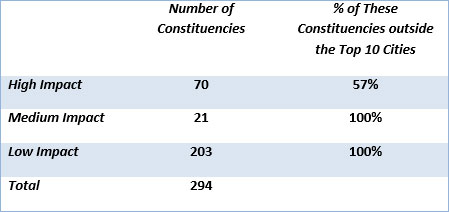
    According to the report, there are 70 High Impact constituencies in West Bengal, the results of which will likely be influenced by social media users. There are 21 medium impact and 203 low impact constituencies in the State.  The report contends that 24% or 1 in 4 Constituencies which have been classified as ‘High Impact’ could determine the eventual winner in the State.


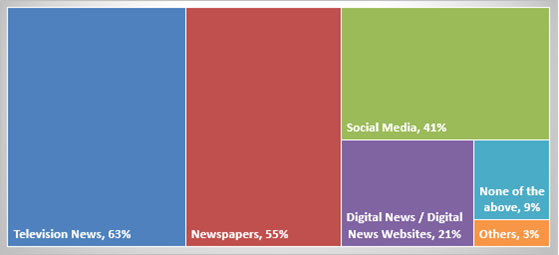
    A web survey of a representative sample of 250 social media users also found that TV and Print still stand as the most trusted media sources for election related content, while 41% rely on Social Media and 21% access Digital News. The report finds that 2 out of 5 Social media users in West Bengal also consider Social Media as the most reliable source of election information.  A vast majority, 90% of Social Media users are following the Bengal Election on Social Media.


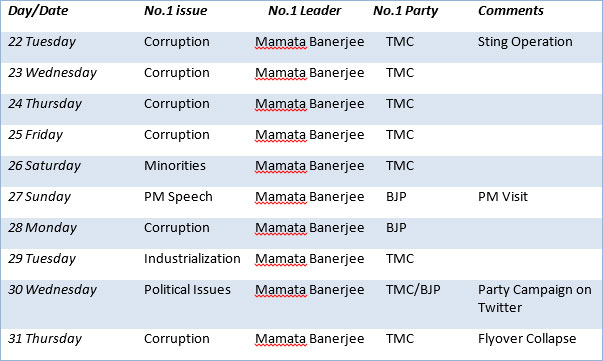
    Additionally, during the 10-day tracking period between March 22 and 31 using social media “listening tools”, corruption emerged as the topmost topic of discussion. Mamata Banerjee was the most discussed leader in Bengal while TMC was the most discussed party. The Left Front has minimal presence on Facebook and Twitter both from a Party and Leadership perspective. The BJP on the other hand has high exposure but relatively little presence (39% Social Media Share versus 17% vote share in 2014) on the ground. The new Facebook feature ‘Facebook Live’ (Live video feature) is among the most popular with politicians.


  • Rural India outperforms Urban India in Social Media Usage


    By A Correspondent


    Usage of Social Media in Rural India has grown by an impressive 100 percent during the last one year with 25 million users being recorded in rural India. On the other hand, Urban India registered a relatively lower growth of 35 percent with the total number of users at 118 million as on April 2015. According to the Social Media in India 2014 report by the Internet and Mobile Association of India [IAMAI] and IMRB International, there are 143 million social media users in India as on April 2015.


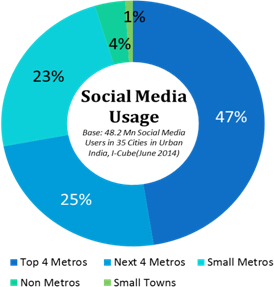
    The report also finds that the top 4 Metros continue to account for almost half of the Social Media users in Urban India.


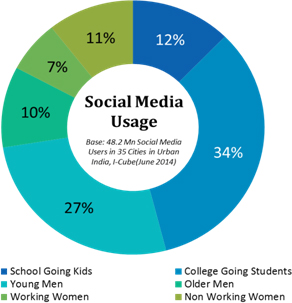
    According to the latest report, the largest segment accessing Social Media consists of the College Going Students with 34 per cent followed by Young Men at 27 per cent School going children constitute 12 per cent of the social media users. College Going Students and Young Men still form the 60 per cent of the Social Media users in Urban India.


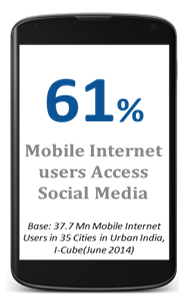
    The report further finds that 61 per cent of these users access Social Media on their mobile device. The fact that almost two thirds of the users are already accessing social media through their mobile is a promising sign. With the expected increase in mobile traffic the number of users accessing social media on mobile is only bound to increase.


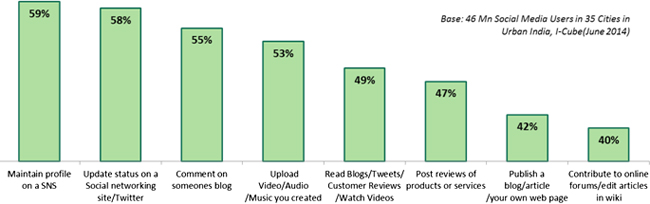
    According to the report, maintaining a profile on social networking sites are a top activity of users followed by updating status.  Commenting on a blog site is the third most popular activity among users in social networking sites.


  • Experience Commerce bags digital duties of Lenovo

    By A Correspondent


    Experience Commerce (EC) announced their recent win of digital & social marketing duties at Lenovo. Lenovo has mandated EC with the digital marketing campaign for the entire Lenovo portfolio of products including the latest social media campaign for the launch.


    Jump starting the relationship with an innovative launch of the new Yoga Tablet 2 on digital, #YoGa2bFree, the agency roped in four Twitter influencers, including actor Ashwin Mushran, gadget guru Ankit Vengurlekar, film reviewer Mihir Fadnavis and food blogger Kalyan Karmakar and trapped them in a box.


    “Gadgets such as tablets are designed to help us lead a more connected, productive and fun life; but take them out of the box and you often see yourself enslaved and tethered to these devices. This campaign is designed to raise awareness about how you can free your life from restrictive technology – discover a brand that promises to adapt to you,” said Sandip Maiti, CEO & Chief Creative Officer, Experience Commerce.


    This campaign uses large-scale interactive video-based story-telling on yoga2bfree.com where the four trapped Twitterati provide clues to the audience who attempt to free them up.


    “We have been active on Social Media since 2010, and were in the market for a new kind of agency who understands the digital born consumer and can help us craft an unique social voice for brand Lenovo. We look forward to a creative partnership with EC to tell the story of Lenovo for this millennial generation and build a strong community of advocates around its smartphones, tablets and laptop categories”, said Bhaskar Choudhuri, Director of Marketing, Lenovo India.


  • Stars not on Facebook, Twitter could lose on endorsements

    By Ratna Bhushan


    Last month, a Bollywood A-lister actress lost out a Rs 3-crore-a-year endorsement deal for a multinational beauty brand to a relatively new actor. Reason: the latter was much more active on Twitter and Facebook and the brand wanted to reach out to social media audiences.


    And despite Hrithik Roshan’s new release Bang Bang proving a super hit, consumer goods firm Emami, which signed Roshan for HE men’s deodorants this summer, is looking for a new face for social media. “Hrithik has a huge mass connect on traditional media. But with different audience logging on to social media, we may rope in a new face only for social media,” Emami director Harsh Agarwal said.


    With social media emerging as one of the most popular hangouts for Indians, brand endorsement deals in the country are getting hugely influenced by how active celebrities are on Twitter, Facebook, Instagram and blogs. “Celebrities who engage actively on the social media space are getting paid at least 25-30% higher than those who don’t, even if the latter have huge mass connect,” said Vinita Bangard, promoter of talent management firm Krossover Entertainment, which represents Priyanka Chopra and Shah Rukh Khan.


    “The socially active ones have a clear edge not only in terms of higher fees but also in getting more endorsement deals.” Chopra, with over 7 million followers on Twitter, is a hot favourite, along with stars like Amitabh Bachchan, Shah Rukh Khan, Aamir Khan and Salman Khan who all have more than 8 million followers. Some firms, including Coca-Cola India, have begun inserting a clause in their endorsement contracts that celebrities will popularise the brand on their social media assets, for an additional fee.


    So, Farhan Akhtar, who endorses Coca-Cola, and Salman Khan, who is the face of Thums Up, not only feature on the brands’ advertisements but also are regularly tweeting and posting photos of themselves with the brands they promote. Many brands now go for exclusive social media endorsement deals at just about 10%-20% fees of a television endorsement deal.


    For example, a reigning A-grade actress who charges Rs 1.5-1.7 crore for a television endorsement deal, charged only Rs 30 lakh to tweet for two months about an upcoming consumer brand, a talent firm head said. Endorsement deals exclusive to social media are being inked at Rs 20-50 lakh a year, while top celebrities’ fees for TV commercials range from Rs 2-6 crore annually. “It (social media) completely optimises spends and has become an extremely effective medium,” said Atul Kasbekar, promoter of celebrity management firm Bling Entertainment.


    Chocolate brand Cadbury Dairy Milk has had a series of upcoming faces including Bollywood starlet Hazel Keech and model Karishma Kotak tweeting about their experience of eating Dairy Milk Silk Caramello chocolate. The tweets created the necessary buzz for the brand at about one-fourth the cost that Cadbury would have to otherwise shell out to rope in a well-known star for television.


    Likewise, PepsiCo used hugely popular actor Ranbir Kapoor only on social media earlier this year for its biggest ad platform — the IPL T20 cricket tournament, though cricketers MS Dhoni and Virat Kohli were shown extensively on television ads. “We leverage our brand ambassadors through campaigns and activation via different mediums,” PepsiCo senior director, marketing (social beverages), Ruchira Jaitly said. With social media ad spends rising faster than traditional media, the online celebrity endorsement business is now growing 25%-30% faster than the traditional space. “Digital isn’t an option anymore.


    It’s something we have to do to make ourselves future ready,” said KK Chutani, executive director for marketing at Dabur, which recently dropped Bipasha Basu as the face of Dabur Honey and roped in celebrity chef Vikas Khanna to endorse the brand on social media because he is active on Twitter and Facebook. Chutani said close to half of ad spends of Dabur’s juice brand Real is now directed at the digital space.


    Source:The Economic Times

    Copyright © 2014, Bennett, Coleman & Co. Ltd. All Rights Reserved

    Licensed to republish