Tag: social media

  • #Scamadgate: Social media bats for Bobby Pawar

    By A Correspondent


    Bobby Pawar may have suffered much humiliation with #Scamadgate, but there was a tone of bravado as he updated his Facebook status with this: “As long as I have them and my family I have everything.” The message accompanied a photograph of members of his family.


    Elsewhere, the Twitterati was getting restless. @abanith17h wrote: if Berlusconi can make a come back so can you! God Speed dude!


    But there was another sentiment that was growing. @mintmayhem wrote: What’s more tasteless than d #Ford Ads is JWT not owning up to their creative team aft consciously entering ads for Abby’s.


    @TinuCherian echoed a similar sentiment: Shaming and Firing your employee publicly is the last thing a company should be doing.


    Meanwhile, there were many outpourings of support  in response to his Facebook post. Since these are not in the public domain, we have withheld the name of the person quoted with just the initials. Note there are several more messages, all of which praising Bobby and his work. We’ve picked only a few of these….


    MJ: totally agree, the family is the reservoir of strength.


    SPB: Well sir, you also have a wit that quite a few with their narrow thinking lack! The sun will shine again tomorrow, I’m sure!


    SS1: N the fraternity family! I still do not understand how u responsible – moraly or otherwise..u r not expected to see all pieces of work especially those which will never get published or is a client brief..


    RS: At the end of the day, that’s all that matters, Bobby. And you know the whole industry knows what this is all about. A $2Billion ad budget is a tough thing to be weighed against. Yet you walk away with an unscathed rep…Godspeed!


    SR: its 2 billion dollar that mattered more than its own people! we have seen the true color of jwt now.


    AG: very true bobby..family is indeed the source of everything


    SS2: All I know is Sachin is Sachin,Yuvi is back at his best, Tiger Woods is again no 1 and waiting for Bobby to deliver big time


    SK: U rock bobby. Been there done enough seen enough lead enough. Enough said. Though you would want always to do more.


    SS3: That’s right brother! You are the best person I have had the good fortune to meet iin a long, long time. I cannot tell you how outraged I feel and how close I feel to Sampy, Iti, Ari and you at this moment. You cannot keep a good person down. Certainly not someone as good as you!!!


    VM: We all believe in you Bobby. Nothing to worry. A good person and good intentions are important. And you are/have both..


    SG: i dont care what they say… i have immense respect for you..


    MHS: Jobs come and jobs go and public memory is short. But a true leader sticks by his guns and protects others. That’s what you did and You should be proud of taking the moral responsibility. The industry respects you. It’s sad that the agency didn’t have the balls. Good luck Bobby. Big hug! Xxx


    JT: Hey Bobby, When you have your family you don’t need nothing. Move on to bigger happiness that awaits.


    NS: I had thought that some juniors will be made scapegoats and thrown under the bus. Don’t know the back story for this decision,but as M said earlier, you should be proud of sticking to your guns and taking responsibility. Best of luck.


    There are posts elsewhere too echoing a similar sentiment. There is also outrage against WPP, JWT India boss Colvyn Harris and against Ford. Sample this:

    PKS: Sorry, Sir Martin Sorrel, you failed your agency.


    AD: CYA policy… cover your ass… and the buck had to stop at someone


    AL: Every controversy needs a fall guy…really sad that it had to be Bobby Pawar


    MM (edited): While the JWT India scam ad for Ford was dumb, sacking Bobby Pawar for it is dumber. Now I hear he might be hired back as a “consultant”. Smacks of testicular deficiency all around I think. Stand up for your creatives, @Colvyn Harris. Don’t sell them out at the first sign of trouble. Now who with a brain and a backbone will work for you?


    KR: Without Ford agreeing to this JWT India scam ad, this would have never ever seen light of the day. All I feel is that, Ford India folk’s heads should have been rolled, not JWT India guys..!!!


    IS: Unimaginative. I’d have the creative team, creative bosses and Ford work on and fund a significant campaign against violence against women.


    SP: … the days of circa 1990 trikaya , of people with balls is a a tad rare!


    RP: Typical of bosses….running away…they dont have the guts to protect their own people…


    What Ford and JWT wouldn’t have bargained for was the international media attention that the controversy has generated.


    Sample these:


    Huffington Post:

    http://www.huffingtonpost.com/2013/03/27/ford-ad-jwt-india_n_2962649.html


    BBC:

    http://www.bbc.co.uk/news/business-21949622


    Financial Times (blog):

    http://blogs.ft.com/beyond-brics/2013/03/27/india-jwt-staff-leave-after-bondage-ad/New York Times (blog)


    USA Today:

    http://www.usatoday.com/story/money/cars/2013/03/27/ford-jim-farley-bondage-berlusconi/2024141/


    Wall Street Journal (requires subscription):

    http://blogs.wsj.com/cfo/2013/03/26/fords-crash-course-in-reputation-risk/


    Anindya Banerjee still trying to figure out the ‘sexist’ portion in the ads. Looks like a mystery that’s not going to be answered.


  • Social media users in urban India to reach 66mn by June

    By A Correspondent


    The number of social media users in Urban India reached 62 Million (Mn) by December 2012, and it is estimated to reach 66 million by June 2013, according to a report on Social Media in India, by the Internet and Mobile Association of India (IAMAI) and IMRB. According to the report, about 74 percent of all Active Internet users in Urban India use social media.


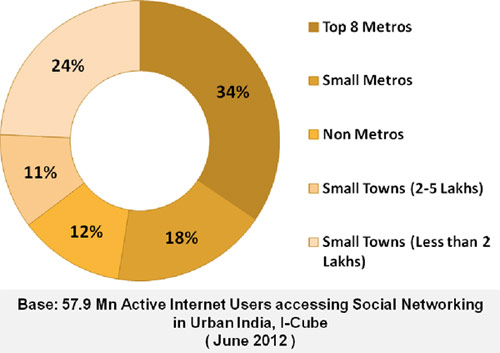
    The report also finds that of the social media users, 34 percent are from the top 8 metros while 35 percent of the total users are from small towns of population up to 5 lakh.


    Figure 1 – Social Networking Profile by Town Class


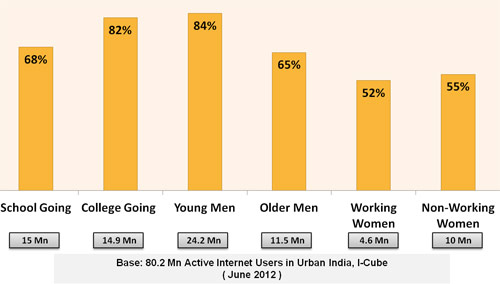
    The report further finds that the highest proportion of social media usage was observed among the demographic segments of “Young Men” and “College Going Students”, with 84 percent and 82 percent penetration levels respectively.


    Figure 2- Social Networking Profile by Demographic Segments (Proportions)


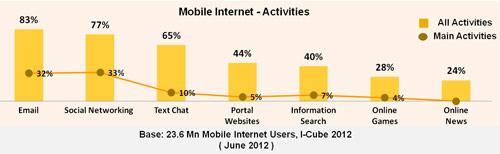
    Social media usage is also fast catching up with mobile internet users. According to the report, 77 percent of the users use mobile for social media. Email, social media, search, app store and chat / IM are used everyday by those accessing internet through mobile.


    Figure 3 – Activities Done by Mobile Internet Users (Top 35 Indian Cities)


  • How social media can reveal the mystery of brand loyalty


    G.K Suresh – General Manager, ITC Foods


    Let’s face it. Customers are no longer loyal or rather they are loyal but to brands that understand and engage with them in the new world. The messages carried by the advertisements are no longer compelling. For years, brands were able to suppress the consumers’ voice. But now, all it takes is a Tweet or a Facebook update from an irate customer and the world knows about it. Honesty has become most brands’ top priority.


    Maintaining brand loyalty has suddenly become the biggest challenge. Moreover, the entire concept of loyalty is vague. All thanks to Facebook, where one person is interacting with several competing brands, all at once. In such a scenario, traditional branding exercises are no longer effective in getting the attention of customers. This is further complicated by the variety of devices where such micro eco-systems exist.


    This is the result of the digital convergence of culture, business and economy into bits and bytes. So, this is where lie not only the challenges but also huge opportunities for brands to understand their customers. Digging into the wealth of social media data, brands can today discover consumer insights like never before.


    By A Correspondent


    Having taken the corporate world by storm, social media today is today spreading its wings far and wide and is no longer just a casual hangout for users. The possibilities that it offers are endless, and it’s been proven beyond doubt that social media is no longer a fad. It means serious business for brands. But with this realization there is also the truth – about enterprises not being equipped with right tools and human resources to leverage social media.Simplify360, a firm that enables organizations to effectively implement social media concepts into core business functions, has released an e-book titled ‘Predictive Analytics 2013: The future of social media.’ The study saw the firm connect with different professionals active in the field of social analytics and learn from them about the future of social media. The book is an attempt by Simplify360 to reach out to the experts in the social media field in order to learn the meaning of what predictive analytics meant in social media and its role in the future of social media.


    Predictive analytics has been around for a long time and slowly these analytic tools are finding their way into the marketing and social media arenas. What predictive analytics does is use behavioural data from past to predict how individuals will behave in the future. Some of the experts who have contributed in the book include Ajay Kelkar of Hansa Cequity, GK Suresh of ITC Foods, Ankita Gaba of Social Samosa, Bhupendra Khanal of Simplify360 and the others. MxMIndia presents extracts of the article by GK Suresh who has written on ‘How Social Media can reveal the mystery of brand loyalty’.


    There are 4 steps to understanding customer insights through social media:

    # Find out what people are talking about and why

    # Find out who is talking and influencing the crowd

    # Use this intelligence to optimize your brand’s message to impact in real-time.

    # Measure your interaction and influence of the messages and optimize them.


    One brand that has successfully utilized the above steps is Bingo! with the launch of Bingo! Tangles on Facebook. With over 3 million fans, Facebook offered Bingo! a great window into understanding consumers conversations. Consumers use these forums to talk about their likes & dislikes and welcome new information on product as they find it appetizing, tempting &satisfies their need for variety. Consequently we decided to launch the new Bingo Tangles first on Facebook and give a chance to loyal Bingo! fans to discover the product and also taste it before it hit the market. A teaser contest was created for Facebook fans which encouraged them to decipher the brand name and the winners could taste the product before it was made available in the market. Thousands of fans participated in the contest and packs of Bingo Tangles were sent to the winners. This campaign helped us connect with the brand advocates and also use Facebook as a launch platform for various other brands.


    Data is a vital raw material for building the business infrastructure in the information age. Brands that can put systems in place to access, process and utilize the data will be the most successful in connecting with the customers and influence their decisions.


    The key idea behind customer loyalty is customer retention. There are already different programs, which   businesses employ like reward programs, referral programs and 1-to-1 marketing campaigns to ensure that customers stay with the brand. But social networks are taking over these programs in terms of gaining a deeper relationship with the brand.


    There are 3 ways to use social media data to improve and make social programs much more effective:


    1. The Brand should genuinely care

    When you embark on the social media journey, be prepared to respond to negative as well as positive feedback and genuinely do something about consumer problems. On the Aashirvaad Multigrains Facebook page one of the fan brought to our notice unavailability of Aashirvaad Multigrains atta in her area. We used this info to investigate the issue with our sales team and figured out that there was an issue with the sales person operational in that area. Action was taken immediately and we called back the consumer to validate that her problem had been addressed.we figured out that this was an issue due to the sales person operational in that area. Thus listening to a single fan, who was representing a cluster of consumers in that region, we were able to resolve issues faced by many such consumers in that region.


    2. Engage without losing focus on your brands

    Many times the focus on the content posted on Social Media platform goes to extremes. Either it is too generic or it is too brand centric. There should be a proper balance.


    3. Brands have to learn to converse with consumers as equals

    Brands are too used to speaking to consumers from a position of authority & knowledge and not as a friend. But today brands need to learn to converse with the consumers on equal terms & be seen as an enabler.


    The key thing is to do it without compromising on the brand “personality”. Hence the voice of Bingo! is more youthful & contemporary; the voice for Aashirvaad is always joyful & optimistic while that of Kitchens of India is authentic & welcoming.


    So we now know why and how social media can help decipher the mystery of brand loyalty. But the last portion and the most vital one, is to understand how to measure this in social media. There are 4 factors, which one must consider while looking into brand loyalty in social media:


    1. First of all, what are customers talking about your brand and how? What are their attitudes and sentiments towards your brand? What is their feeling towards your brand? Are they neutral, friendly, hostile or ignorant? This helps brand not only understand the emotion but also map them along the brand attributes and identify the missing bits.


    2. Secondly, to understand the emotional connection between a customer and your brand and measuring the strength of the bond. Most often an out-burst by a customer is temporary, and can be mitigated easily. Hence, identifying such customers is vital. Many a times the reverse is true as well. There was once a complaint on Facebook by a consumer on the quality of Atta. Before we could begin to address the problem, 3 other consumers had responded asking the fan to check the storage conditions at the outlet of purchase as well as her kitchen.


    3. Thirdly understand that the customer is likely to buy more than one segment of products from the brand. This sends much a stronger signal of loyalty.


    4. And finally, know which platforms are more effective in communicating with the customer. Email, Social Networks, Mobile, TV, Tablets and the list goes on. The avenues where customers are present are wide. Hence identifying the top engaging platforms and optimizing them is vital.


    Mining social data and building your decision systems on top of it is the secret of successful customer retention. The main goal is to make an emotional connection with the customer in each interaction to increase referrals, retention and acquisition.


  • Chitralekha upbeat on social media

    By Ananya Saha


    It took two years for Chitralekha to reach two lakh fans on its Facebook page. According to the official numbers provided by Chitralekha, 96% of these fans are from India with 87% under 34 years. Close to 35,000 active fans make it a highly interactive community. While the group has focussed on FB till now, and is present on Twitter, it will be looking seriously at the latter in 2013.


    Mitrajit Bhattacharya

    While many media brands are taking the social media route to be interact with the audience, it is known that beyond the ‘likes’, not many engage with them on a regular basis. However, Mitrajit Bhattacharya, President & Publisher, Chitralekha Group is upbeat about the statistics. “We are very active on FB as a community. We inform, entertain and empower our fans. For instance, the songs in a specially-compiled music CD with our anniversary issue were chosen by our fans, questions to celebs in our popular FB activity – “Chhoti Si Mulakat” are normally contributed by our fans etc. We also share jokes, pics and breaking news regularly. All these translate into an engaged fan base,” he said, while adding, “Regional brands have a huge power to connect with their audiences as friends. We have been a friend to the Gujarati community for over six decades. Social media helps us to be in touch with them closely, particularly the younger lot. Gujaratis are also very heavy users of digital devices, which help the process of connectivity.”


    The social media strategy of the group extends to Chitralekha’s brand philosophy “of being friend to our fans and being loved to a completely new younger audience.”


    Does an engaged fan base imply an engaged advertiser community as well? Mr Bhattacharya said, “Monetizing social media is a tricky issue, however there are many marquee clients who are actively looking at our online offerings currently.” He insisted that Facebook has played a large role in helping traction onto Chitralekha’s websites.


    With no choice but to be present on social media to stay in the game, Mr Bhattacharya concluded, “Digital is the future. All our major titles are available on tablets and smart phones. Our print copies get delivered to over 100 countries (sometimes, we learn about small countries from our subscriber’s database). Just imagine the power of digital, which avoids the problems of physical distribution due to geographical distances, both within and outside the country!”


  • The Anchor: 5 errors brands made on social media in 2012

    By Rajiv Dingra


    #1 The brands assumed that everything that works offline also works online. Just because you might have a sexy campaign offline, does not imply that it will remain sexy on social media.


    #2 Purely looking at marketing, and not looking at social media as a customer-relationship medium.


    #3 Focusing more on content more than communication. There is too much focus on gifts, contests and participation, with very little focus on what message is being passed through.


    #4 Inability to differentiate between customers and users. There are people who come to your fan page and ask serious queries about products. But we are chasing numbers of fans instead of individually replying to those customers.


    #5 Larger number of fans or spread of platforms does not mean presence on social media. Social media is as good as your last update, or campaign, or how it engages the fans. Social media is an ongoing daily effort to be responsive, interactive. Presence on platforms does not imply that you are doing social media.


    Constant innovation, and constant upgradation, is the need of the hour.


    Rajiv Dingra is CEO of WATConsult.com


  • Does social media boost ROIs for e-commerce sites?

    By Robin Thomas


    Merely setting up shop is not enough today, and brands are not limiting themselves to advertisements on television, print, radio or even the internet alone. They are logging onto social media in a big way, interacting with and updating their consumers about new products or other initiatives, and e-commerce sites are not far behind. Myntra, for instance is already said to have registered over 7 lakh Facebook fans. Myntra also has a fashion blog, ‘Style Mynt’, wherein it shares information about the latest celebrity fashion trends, new product offerings on Myntra.com and so on. Another e-commerce site, Indiatimes Shopping, started its Facebook page early this year and is said to currently have more than 2 lakh fans on Facebook.


    eBay on the other hand claims to answer over 1,200 queries every month across social media platforms. It is said to resolve over 120 post-transaction complaints every month and is ranked sixth in Social Bakers’ ‘Top 100 Global Brands on Facebook’ index and is also said to be the third most engaging FB Brand Page in India. In addition to these, eBay also conducts online contests enabling the e-commerce site to engage with its consumers. For instance, it conducted a contest called ‘Battle of the Fans’ around the IPL last year. It also launched a Facebook application called ‘Battle of the Fans FB App’ for the contest. As a result, the ‘Battle of the Fans’ app is said to have become the most popular Facebook IPL app two years in a row. Simultaneously, over 15,000 streams were said to have been published from within the app and is also said to have witnessed nearly 27 percent click-through from app-to-merchandise on the site. Besides Facebook, e-commerce sites like Indiatimes Shopping, Myntra, eBay India, Olx etc. are also active on other social networking sites like Twitter, Google Plus and so on.


    Social media vs sales targets

    Ashutosh Lawania

    According to industry estimates, nearly 25 percent of the time spent online is on social media platforms. Out of this, 50 million are said to be on Facebook, and 13 million on Twitter. The question however is, do social media activations lead to better ROI’s (Return on Investments)? Do the ‘likes’ and interactions or engagements with consumers translate into sales? According to Mr Ashutosh Lawania, Co-Founder and Head – Sales & Marketing, Myntra.com, “Though engagement is our focus on social platforms, the activities there do contribute to traffic and sales on Myntra, and we keep track of it. Contributions from these platforms are in the lower single digit figures (percentages) when compared to other channels but they do add up. Besides, Twitter and Google Plus, we also use Facebook for advertising along with generating organic traffic. About 80 percent of all Facebook traffic on Myntra is paid with the remaining 20 percent driven via organic.”


    Subhanker Sarker

    Myntra uses tools such as Facebook, Twitter, Pinterest, Google Plus to make announcements about new products, trends and to give out regular fashion updates which Mr Lanwania observed results in increased awareness and in turn influences purchase decisions.


    Having a slightly different take on the impact of social media activities on the sales, Subhanker Sarker, COO,Indiatimes Shopping was of the opinion that social media activities at times do result in better ROI’s. “Experimentation is the key. There is a certain tonality of communication, a very precise targeting of the message and a very strong follow through that can work magic. Social media is an excellent tool to keep expanding the circle of trust. The offer ads introduced recently drive a lot of sales for us now. The revenue percentage would still be in low single digits, but it all depends how you define it. Measured over a longer time period and favourable attribution logic, it touches double digit percentages.”


    Kashyap Vadapalli

    Kashyap Vadapalli, Chief Marketing Officer, eBay India observed, “Social media channels get us over 12% of our daily traffic which translate into deeper reach and higher conversions. In terms of ROI, they are one of the cheapest tools for generation of daily visits and excellent mediums for acquisition & retention marketing.”


    Anurag Gupta

    Anurag Gupta, MD, DGM India was also of the opinion that social media activities surely do reflect on the sales and revenues of e-commerce business. “Most of the e-commerce companies are using advertising on social media to drive transactions in addition to engagement activities. This is on an increase especially since platforms like Facebook have begun providing re-targeting capabilities. Sub-optimal use of social media platform by brands happened earlier, now brands have graduated and are using social media beyond likes and onto engagement and transactions.”


    The road ahead

    Social media is said to play a significant role in driving rapid growth for e-commerce brands. Only recently Myntra is said to have used social media platforms to launch its latest TVC before launching it on other media platforms. “It is an important platform to engage the audience, increase awareness and drive top of mind recall. It also plays a significant role in collecting feedback and giving customers a platform to voice their opinion and share their views on what they like or dislike” explained Mr Lanwania.


    According to Mr Gupta, social media activities for brands are increasing significantly. Most brands today have their presence on social media, including e-commerce brands. The brands are now using social media for engaging with users and a lot of e-commerce brands are increasingly using social media for commerce as well.


    However Mr Sarker was of the opinion that although social media has become a very significant platform today, brands must not be seen intruding their consumer’s privacy. “Social media can give you immense insights into your customers psyche. How you leverage that is up to you. Hence it is definitely significant for everybody. But one must respect the privacy of the audience. They are on social media mainly to socialize. If they were in the mood of buying something they would be on an e-commerce website. Intrusion is not taken kindly. We see social media as a customer insights opportunity rather than a sales one.”


    Taking social media onto a different level altogether, e-commerce sites are beginning to effectively use advertising on social media to drive their transactions. Although the revenue generated or the revenue percentage from social media activities are still said to be in single digits, it is believed to grow depending on the innovations and the engagement that e-commerce sites have to offer to their consumers.


    “Offline shopping tends to be a social phenomenon, and this will catch up with online shopping as well. We foresee online shopping getting integrated with social media as more and more enthusiasts will start seeking opinions before they indulge and seek compliments post indulgence. This could take the form of deeper and richer integration of social tools in the online shopping experience. One would also e-commerce players leveraging the social graph to add engaging ways to enable users to talk & share about shopping on various social media channels” concluded Mr Vadapalli of eBay.


  • Jaldi 5 with Zafar Rais: Likes mean nothing

    Zafar Rais

    01. Have the clients become more open to pushing boundaries when it comes to their social media strategy in the recent past?

    Absolutely! Clients have evolved and welcomed social media. They are keeping themselves adept with the latest campaigns and case studies by brands and their competitors and are keen to do bigger and better. It is, however, up to their agency to provide them with the right guidance and conviction to invest in mindshifting campaigns versus basic presence management on social media. It’s only when you go beyond the ordinary that you truly can optimize social media.


    02. Can you give an example of your recent work that is a perfect example of pushing boundaries in the digital domain?

    We recently had a campaign on Twitter for Reliance 3G to announce the association with Google Android. We started this campaign on a Monday norning when people usually Feel Blue because of the start of a long week ahead and got influencers across twitter to interact by using the Hashtag, #FeelingBlue. As the day went by, we got the same influencers and more across India to join in and use the Hashtag in a positive manner, denoting how #FeelingBlue is now a happy emotion. As the campaign progressed, we go not just India but the world using the hashtag in a positive manner.


    At the end of the campaign, the hashtag trended in every city in India, country-wide and worldwide until the next day. To add to it, the Reliance twitter handle trended too.


    What we tried to achieve out here was for users to have fun and interact on the platform, while subtly getting the message across. The fact that the twitter handle of the brand trended too was an indication that brand outreach was created too.


    While a lot of inhibitions was showcased prior to the campaign, needless to say, the Reliance 3G team and their partners were #FeelingBlue and excited after the campaign. This trend received 800 tweets in less than an hour. The contest held by twitter influencers for this campaign witnessed more than 4000+ entries. The campaign witnessed a total outreach of +8.1 Million (81,26, 612) Link to case study: http://www.slideshare.net/MindShiftInteractive/reliance-3g-feelingblue-case-study


    03. There is also the campaign for Chetan Bhagat’s book, how did it help in ‘What Young India Wants’ reaching such phenomenal numbers?

    We ran #18ThingsIWant campaign for Homeshop18.com in order to launch Chetan Bhagat’s new book, What Young India Wants. We decided to use twitter and get users to voice their demands. What followed was a gush of Indians who truly wanted to achieve something or get things sorted out in their Country. Right from abolishing corrupt politicians to getting high grades in school, the demands were aplenty.


    The end objective: trended for 2 days while also drawing connect between homeshop18 and lead to a drastic increase in sales for the book via homeshop18.com. The campaign trended in all the Cities, India and Worldwide and it started trending in less than 15 minutes of its launch. It had a cumulative reach of over 1.6 million, over 1.3 million mentions and over 3 Lakh RTs. Link to case study: http://www.slideshare.net/MindShiftInteractive/home-shop18-18thingsiwant-campaign-report


    Some other case studies that have become industry best practices are #ChappalMaaro , #KiehlsMumbai.


    04. What are the keys to assure that a campaign becomes a viral hit?

    1. Insights: Understand who your consumers and what they’re talking about. Create your campaign around that.

    2. Brand Next: Don’t start a campaign with the objective of getting brand awareness. You’re on social media so think engagement. Your requirement to ensure your brand gets leveraged will follow naturally.

    3. Innovate: Once you gain the right insights, evaluate the right trends your campaign will automatically start short listing as a new wave creator. Ensure a level of innovation and uniqueness by actually coming up with something that has never been done before.

    4. Market it: As a social media agency, your role is to optimize the campaign beyond just waiting for it to kick start. Create the buzz through your klout. A Kolaveri Di didn’t get viral automatically!


    05. If ‘likes’ don’t necessarily mean an active audience, why is it still so important for a client?

    Unfortunately, a lot of people “sell” social media and that’s when the wrong numbers become a priority for clients. Clients and Agencies need to understand that the number of Likes means nothing if your Engagement ratio is poor. It’s embarrassing for a brand with 1 Million fans to have only 1,000 people talking about it. Tap on Targeted Fans if you’re in for the long haul.


    (Interviewed by Tuhina Anand)


  • Jaldi 5 with Sanjay Mehta: 1 billion users strong, Facebook can influence elections

    Sanjay Mehta

    When Facebook gently proclaimed that it now had touched the magical one billion users figure, most of us just dismissed it as a milestone. But it’s an accomplishment that cannot be ignored by not just individual users – but also marketers, sociologists, governments and all those who need to reach out to the masses.


    We asked Sanjay Mehta, Joint CEO, Social Wavelength some very fundamental questions on this achievement including whether there is any reason to fear the platform being abused of destabilizing nations.


    1 Would it be right to say that a good reason for the Facebook users reaching 1 billion would be thanks to the growth in recent years in India?

    LOL… no. We cannot take too much credit considering the Indian userbase, at this time, being a nominal 50 mn in FB’s total of 1 bn. So while the Indian user base has contributed to the overall numbers, it has been a nominal percentage.


    Would you say that Facebook is the single biggest marketing development of the 2000s?

    Well, I would say Social Media is the single-biggest marketing development. And Facebook is a key player in that social media space. Also though, I would also not claim this to be the greatest development of 2000s. That is a long period, and we have had other key developments including search engine advertising, which have been impactful. But in the last 2-3 years, it has been a clear emergence of social media as a marketing platform, and Facebook is its most significant component!


    With one billion users, Facebook users constitute the single largest community of individuals after China and India? Do you think it’s right for it to be seen like that?

    Well, yes, sure. So let’s take that analogy ahead.  What does a single group – be it citizens or China or India, or registered users of Facebook – mean?  That they do share some characteristics (citizenship in case of countries, Facebook in the latter case), but there are enough differences amongst them too. All citizens are not the same kind of people, nor are all registered users of Facebook. Likewise, there is no easy way for a marketer to reach “all Indian citizens” (wouldn’t THAT be a dream?!), and so also, there is no easy way to reach the billion Facebook users.


    Except perhaps, for the governments and for Facebook!! But the citizens and Facebook users do constitute a ‘group of sorts’ and there are opportunities built in there, for marketers.


    2 Do you think marketing in the present day can be done without a Facebook strategy in the media plan?

    All marketing plans may not need Facebook. So there IS a possibility for a few marketing campaigns to not include Facebook However, Facebook is making constant changes to become interesting for more and more brands and perhaps over time, most campaigns will have a Facebook extension! Or a Facebook core!


    But is there a lot of abuse of Facebook – fake likes, fictitious users and various strategies adopted to alter perception by marketers. Is there reason for skepticism when people refer to success thanks to ‘Facebook marketing’?

    The scepticism is with a few people only, and it is also misplaced. The number of fake accounts or fake likes is a small percentage again, and the matter has been exaggerated. There is also an extent of click fraud in Google ads. But due to good algorithms, this is controlled to a small level. Same is the case with fake profiles and fake likes. It is a small percentage. Facebook does not like these. Recently it identified about 80+ mn fake accounts and went about deleting those.


    Can Twitter be put in the same basket as Facebook for marketers?

    Well, it depends on what you’d call the basket. So yes, it is also part of the social media space, and in a sense, the marketer will reach the social media active user, via Facebook or Twitter. But within that framework, there is a difference between the two platforms. Not just that, within Facebook or Twitter usage also, there are different patterns of usage and user profiles. So marketers cannot just “go to Facebook or Twitter”. There is a further science in terms of what they want to achieve, whom they want to reach, etc., and based on which campaigns are planned and executed.


    3 Just as Orkut was a rage once upon a time and faded out eventually, do you think Facebook could see the same eventuality soon? What do you think is the next big idea?

    If I have learned something in the last 10-15 years observing the tech space, it is that, ‘nothing is permanent’ or ‘no platform / brand / service remains on the top for very long’. Facebook could be the exception to this rule, or it could also fall out of favor in sometime.


    However, at the present moment, stock price apart, Facebook is extremely well-entrenched as a powerful leader in the space.


    If something or someone can displace it from its position, I do not have the crystal ball to gaze into and tell you, what that may be! It could be a platform that is currently present and becomes larger, or it could be something that is being developed in some garage or lab in some part of Silicon Valley or Israel or even Mumbai or Bangalore!


    Let’s keep watching the space and discover when it happens!!


    4 Do you see social media like Facebook being used by politicians to influence public opinion?

    Absolutely! Politicians are also brands that need to be sold, no disrespect meant here! So like any other brand that uses the medium to influence its target market, a politician also needs to do the same, for their communication messaging.


    Whether social media will impact an election result or not, just yet, it hard to say. But it will definitely influence few votes!


    5 Can there ever be a fear of Facebook being misused to destabilize countries… just as there is a fear of various media vehicles?

    We live in interesting times. Many of us are logged into our Gmail accounts all day. There is a decent amount of our web behavior that Google knows about.


    We use applications like Whatspp or Truecaller, and we share our contact lists with these applications. And a lot of us do so, and the applications then, know a lot of our cross connections and relationships.  Likewise we use Facebook, where we share our relationships, we talk about our vacations, put our photos and videos, and let people know our political preferences or movies that we like.


    There is truly a lot of information about us, out there.  And this is with a variety of sources, whom we consciously trust, or sometimes do not realize, but end up giving our trust!  Just as data stored and flowing through electronic pipes is always susceptible to leaks like Wikileaks, so also our personal data is always susceptible to being abused.  Either by means of hackers exploiting some holes, or worse, if the sources that we trust, turn rogue!


    We live in hope that these guys don’t turn rogue, and there is no major abuse of our privacy. Each morning, along with the prayers for your health, wealth and prosperity, you must also pray that Google, Facebook, Whatsapp and other such applications do not turn rogue ever!!


  • Anil Thakraney: Blocking websites is stupid

    By Anil Thakraney


    And, we Indians are back to doing what we do best: Try to cure malignant cancer by prescribing a dosage of Crocin tablets. This is exactly what the government has done, by threatening to block social media sites and by blocking many URLs. And by enforcing a rationing of SMSes. All this to deal with communal tensions present in the nation.


    Well, here’s what will happen: More web pages will be created. And mischief-mongers will figure out innovative code lingo to abuse social media. And the tamasha will simply carry on in this juvenile cat and mouse game. Totally ridiculous.


    What the government needs to do, is to come up with two solutions, one technical and the other political. There has to be continuous, smart monitoring of the internet, in collaboration with the website hosts, to regularly keep track of hateful and illegal content. This will ensure the culprits are quickly identified, and punished, if possible. And this will leave the 99.9999 perceent of the rest of the users to continue enjoying the internet freely. This is exactly what happens with offline crimes. If there are rapes happening in Delhi, you nab the rapists, you don’t lock up all Delhi men inside their homes. The truth is, the government hasn’t kept pace with the tech revolution, and is now trying to combat it like a headless chicken. There has been no comprehensive policy drafted in this matter, they’ve been caught napping.


    Secondly, and more importantly, this nation has a serious fault line, and it shows up again and again. Which is that, encouraged by the divide and rule policies of the various political parties, India is forever sitting on an active communal volcano, which can (and does) erupt now and then. This is where the metaphor of malignant cancer comes in. Our politicians should be investing their energies into solving this deadly disease. Because all the rest of the nonsense that happens is a symptom of this. You quit the divisive agenda, and with time, communal hatred will get diluted. But is there a political will to get to the root of the problem? Nope, there isn’t.


    Which is why threatening to block the social media is a joke. The time has come for the super-excited chicken to get its head back.


    ***


    PS: Ah! Finally, a cool way to test a person’s creativity skills. Here’s what I suggest you do, if work in an agency creative department: All those clients, client servicing dudes and account planners who think they are more creative than you, ask them to take this test. If they score high marks, great! If they f miserably, they’ll quit telling you what to do. 🙂


    Link: http://99u.com/articles/7160/Test-Your-Creativity-5-Classic-Creative-Challenges


  • MxM Mondays: Why do marketers not spend enough on digital media?


    By Ananya Saha and Robin Thomas


    According to the latest IAMAI-IMRB report on Digital Advertising, as of March 2012, the total advertising spends, including classifieds, was valued at Rs2,850 crore. It is expected that by FY2013 the digital advertisement spends will be Rs4,391 crore.


    Search advertising constitutes about 20 per cent of the total online advertising spend or about Rs570 crore. Display advertisement, which has many components, forms a sizeable portion of advertising spends. Advertisements on portals and vortals form 13 per cent of the overall pie (Rs369 Crores). Advertisements on Social Media, Email and Videos over the Internet form 3 per cent (Rs94 Crores), 5 per cent (Rs144 Crores) and 2 per cent (Rs59 Crores) respectively. Mobile ads form nearly 4 per cent (Rs90 Crores). A major proportion – around 53 per cent of the overall digital advertising spends – are classifieds listings (Rs1,496 Crores).


    These numbers seem impressive, but there has been some concern that marketers are not spending enough on Digital Media. The theme for this week’s MxM Mondays is ‘Why do marketers still not spend enough on digital?’ While marketing spends may be shifting to the digital media globally, in India, television and print still rule. Is it because digital still doesn’t reach the masses, and homemakers, in particular? Or is that the bucks (hence commissions) are still big in TVCs? MxM spoke to some players in the industry to find out:

     

    Ambika Sharma

    Ambika Sharma, MD and CEO, Pulp Strategy

    The shift to digital media is not happening as fast as the industry would like it to be. However, we are witnessing an increase in aptitude and attitude with regards to usage of digital media. Marketers are not using the media aggressively as they prefer to wait-and-watch. Even then, they are aggressive on ‘search marketing’, but not other aspects of digital media.


    There is hardly any youth brand which is currently not on digital platform. Education is one prominent category that has been using digital media. The cents for digital, however, remain restricted. But as the impact of digital media grows, the impact of mobile advertising has seen a decrease as most people now do not prefer to click on banner ads on mobile screens. Some studies show that in the past one-and-a-half-year, the user has been ignoring banner ads.


    The digital spends depend on ROI, search and impressions, which needs robust backend engine. E-commerce websites have been the heavy users of digital advertising to create impressions. But there is little or no response mechanism on impressions and the visibility is highly fragmented. The numbers, like there is TAM for television, are not available for digital media. If a marketer advertisers on three digital platforms, every platform gives their own numbers. So, there is no comprehensive measurable strategy.


    Going forward, digital media will grow, but it will be a long while before it catches up with other media vehicles. Lotof factors such as measurability, reach, people not preferring to buy online are affecting the growth.

     

    Gyan Gupta

    Gyan Gupta, CEO, I Media Corp Limited (IMCL), Dainik Bhaskar

    In the US, the online spend is 29 per cent of the total advertising pie; in UK, it is 26 per cent. Now if you see the figures in India, it is not even 5 per cent. The trend shows that there will be 50 per cent increase.


    But I will not say that marketers in India are spending enough yet. The typical spender (who spends on television) is yet not on-board. Till the main spenders come on-board, the growth will be limited. FMCG’s have a deep share of the pocket, and it is necessary that they spend on digital media. Auto companies, e-commerce companies, financial companies have been heavy spenders on this medium.


    What are the marketers spending on, and how they spend also becomes important. What needs to be analysed is if the cost of acquisition is happening, if the leads are getting generated, how much a brand is spending on digital activation vis-a-vis on brand promotion. Trending is happening. This year will actually showcase the brands spending on digital media.

     

    Harneet Singh Rajpal

    Harneet Singh Rajpal, Vice President-Marketing, Domino’s Pizza India

    The use of digital media is picking up in India. For any marketer present in India, the digital media is beginning to become a part of their media plan. It is on radar for everyone, especially in the categories where youth is the target.


    For Domino’s, digital media has been important ever since we began our online ordering platform. Currently, it helps us drive traction. Hence, our media spends for digital medium have increased over the last two years. For us the return-on-investment is visible for every buck we spend on this media, since it results from direct conversion from inventory to revenue generation.


    We now spend close to 4-5 per cent of our total advertising budget on digital marketing, from almost nothing in the last two years. We work with leading publishers in the domain to create applications for Google search, Facebook and social media. I must say that on Facebook, we have the largest number of fans in the food category, and also followers on Twitter.


    Social Media management needs time and investment. It is important that the brand keeps the target in mind when planning the digital activations. Going forward, marketers will have to evaluate the prospects digital media brings. Of course, that depends on category to category. Digital media is still limited because of its reach, whereas traditional media garners higher reach. Also, the confidence about using the media is not too high among the marketers since there are no hard numbers to prove its success. The penetration of internet and the efficacy of the media will be tested over time.


    Jonathan Bill, Senior Vice President and Business Development, Vodafone India

    Digital Advertising is a growing medium in India. It will be everything we are hoping it to be and that too quicker than we think, so I think the business is starting to get in a healthy shape. The advertisers are starting to embrace digital more openly and they should do so, because India has the third largest internet population on the planet.


    On TV and Print bagging bigger ad share, I think that is a legacy issue among advertisers, but I do get a sense that it is fast changing. In the West, however, TV and Print advertising have declined in favour of online advertising. Print, therefore, has very less revenue share from advertisers as compared to online advertising and now online is beginning to even threaten television as a medium.


    I think we just need to continue on the path we are going. The quality of sales and, to a certain extent, the market needs to be made. The West took nearly two or three years to be made as far as the start of digital advertising market is concerned and in India we are only about a year ready. So, I am very bullish on digital advertising in India, particularly on mobile on three to five years timeline.


    Narayanan SP

    Narayanan SP, Senior Vice President, and Head VAS Mobile Commerce and Long Distance, Idea Cellular

    Compared to the global benchmark, certainly advertisers in India are not spending as much money on digital or mobile, but this is something which will change over a period of time. Marketers are experimenting to see if it makes sense for them to connect digitally for certain set of products/features and whether digital is the right medium to communicate or engage their brands. Thus, lot of experiments are happening.


    On the internet front, we are already seeing a significant traction which may not be as big as the international market because of the low internet penetration in India. So if you are looking at a certain type of product wherein the target audience are already digitally connected, then it makes immense sense to go digital. Digital, I believe, will evolve as more and more customer profiling is done and advertisers are able to target their customers precisely. When advertisers are able to measure the ROI (Return on Investment), then we definitely believe that a lot more investment will come into digital.


    The fact that TV and Print still bag more advertising share will definitely change over a period of time in terms of mobile being one of the vibrant channels. This does not mean print and television advertising disappear but, you will see an increase in spends on digital advertising and mobile advertising in particular over a period of time. This is because mobile is able to give the advertiser not only a more precise profile of the customer which makes it a lot easier for the advertiser to reach out to its consumers effectively, but it also allows the advertiser to interact with customers and measure the results of their campaigns effectively.


    Mobile industry, for instance, has a wealth of data in terms of customer usage, but there has not been much mining of the data which can be heavily leveraged by the advertisers. However over a period of time, you will see a lot more advertisers leveraging this data.

     

    Rakesh Rao

    Rakesh Rao, National Sales Head, Zapak Digital Entertainment

    The digital media has been growing exponentially. The year-on-year growth of this media vehicle is close to Rs2,800 crore, and is supposed to reach close to Rs4,000 crore in a year. So to say that it is not a preferred media would not be the right statement. Of course, it is not a dramatic growth, but given the growth of internet and smart phones, digital media is becoming a part of our daily life. The marketers are also following the trend.


    The ROI, when compared to TV and radio, is much more measurable. Cost per lead and cost per click measure actual conversions. This is the only interactive platform too, while rest of the media only give reach.


    Education, travel, finance are becoming the biggest spenders on digital because of conversion aspect. E-commerce, and categories like travel that look at selling inventory believe in digital media.


    The challenges that this media is encountering is getting TV-centric brands such as FMCG onboard because of reach. It is a given that while TV is cost-effective when it comes to reach, digital media will catch up in some years. About 60 per cent of these brands are on digital, but 40 per cent need coaxing. There is no hindrance apart from the fact that broadband numbers need to grow. Digital media is here to stay and grow.

     

    Sandip Tarkas

    Sandip Tarkas, President (Customer Strategy) and CEO, Future Media and T24

    As far as Future Media is concerned, our advertising spends on digital have been increasing year-on-year. Despite a lot of digital activities done by marketers specifically on social media, it does not reflect in spends. The problem with digital is not a lack of a credible or universal measurement system, but the fact that it is too measurable as people try to measure every little thing. Although there are so many metrics which evaluate the digital medium, I don’t think it is a lack of measurability at all, as in digital we are clearly able to measure our CPM’s (Cost per Thousands) and so on. Digital is something we use for more engagement rather than reach because it does not offer reach.


    We look at advertising based on two things – reach and cost efficiency. And then you look at everything else – whether the medium is interactive and so on. So, it is primarily about reach and cost efficiency. Digital media spend in India is a reflective of India’s internet penetration, whereas in a lot of markets digital penetration is very high. In those markets both print and television advertising have declined and digital advertising has been growing.


    In India too, digital is growing much faster than the traditional media, and the growth of the media certainly shows the growing importance of digital. The current size of the digital advertising pie is reflective of the kind of inroads it has made in the country.


    On digital being a 360-degree medium in itself and the role of online video and social media advertising, the biggest gain happening in digital at present is the fact that it is changing quite rapidly. Since the late 90s when we first started using digital advertising until now, the role of the medium has changed quite drastically.


    Digital today not only offers more opportunities for engaging the consumers, but the vehicles used in digital have also been changing with time. For instance, in the early days television ads would continue for quite a lot of time, but today with more options, even the television channels have begun to announce that the programme will be back in say a minute or two. So as consumers have more choices, the way the medium gets utilized also changes. Digital, I believe, be it in any form – video, social, mobile – if it is not going to be interactive, it will not be very successful.


    For anybody targeting the youth, digital is an inescapable medium. I believe the biggest change in digital advertising will take place through mobile, particularly mobile VAS and the data cost. Growth spurt in digital advertising will also come through the increase in smart phone usage and the lowering of data cost will revolutionize digital advertising.


    This is because India has a very high tele-density and today mobile phones have reached the lower-most strata. I believe digital advertising in India will explode once mobile advertising comes of age but, right now it is still in its infancy.


    Eventually digital advertising will impact television and print ads as marketers will have to allocate their budgets for digital advertising, once it comes of age. It may probably hit print advertising first and then television but for that to happen there is still some time.

     

    Sanjay Tripathi

    Sanjay Tripathy, Executive Vice President – Head Marketing and Direct Channels at HDFC Life

    There is still limited spend on digital due to lack of knowledge about the medium and utilizing it effectively as a part of marketing plan; reach/penetration of the medium; and its ability to create impact in the short term. Digital still reaches about 10 per cent of the Indian population and there hasn’t been much of a development in building infrastructure to support the growth of internet. TV continues to be the mass medium which gets the maximum eyeballs and reach.


    While the ROI variables will drive spends to digital, marketing needs a serious mind shift to look at the additional advantages which digital brings along –  a medium which allows two-way dialogue  and measurability to the last mile.


    Thirty per cent of our budgets are dedicated to digital this year – a big move from the fact that we spent a negligible amount last year. As BFSI marketing and advertising becomes more ROI focused, digital media will play an important role. Digital budgets will have a healthy growth each year and will also account for a significant part of the marketing budget.


    While marketing spends may be shifting to the digital media globally, in India, television and print still rule. This is because reach plays an important role. Penetration of Internet in India is still low compared to international markets. The consumption of non-traditional online media is still low and 360 degree integrated communication planning in India has not evolved to have online as an integral part of marketing plans. Also, online medium do not works in sync with other media.


    While there has been a tremendous amount of growth in the usage of internet among SEC A, SEC B audience, internet is yet to gain as big an audience in tier 2 or tier 3 cities. TV continues to be the mass medium due to lack of digital infrastructure. It is the reach and channel affinity which mainly drives the spending and this is where a traditional channel like TV gets one up over digital. There is also a problem of lack of content on digital. Either the content has not been customized to cater to the audience or often the language becomes a hindrance in consuming the content.


    But digital media will make a huge impact. Level of engagement, interactivity and ROI afforded by the medium means it has big role to play. For brands which don’t engage their users online will tend to lose their relevance. As reach increases, the importance and level of competition will also increase –  YouTube already affords a higher reach compared to most of the TV channels and is increasingly becoming an important part of the traditional media mix.


    Digital offers tremendous potential for business – whether it’s about spreading awareness or generating business even in the face of a slowdown. In fact, as people tighten up their purse strings, they will want to do more research before they arrive at a purchase making decision and internet remains the primary medium of product research.


    I see the spends going up because the whole media pie has been asymmetric- if you look at the reach-frequency formula and compare it to TV, print, radio and then digital. There are more people spending time on digital in comparison to other traditional media touchpoints. I see the digital percentage increasing in the overall pie.


    Youtube and pre-roll videos have become a mainstay when it comes to hosting TVCs on digital and these unique ad formats are as effective in reaching out to audience as a TVC. For print QR codes help bridge the gap between offline and online world.

     

    Saugata Bagchi

    Saugata Bagchi, Senior VP, Tribal DDB India

    The primary challenge is the need of cracking an ROI metric, which is acceptable by advertisers across the board.  The media spends are happening, but is it delivering enough clickthrough rate goes unanswered. Digital media cannot ensure high reach like television, but with 12 per cent penetration among various categories it can definitely give high frequency. Currently, only 25-30 per cent of population is online; hence, the spending on this medium will remain lower than other mediums.


    The point of advantage is that there is a big influx of youth, and they are ready to spend. While the marketers would want to catch the youth online, they (marketers) get no justification in form of numbers to spend much on media. Hence, they prefer doing mall activation to spending on digital platform. The agency and publishing community need to be more forthcoming to speak to the marketers, and in their language.


    Digital media is currently registering 15-18 per cent year-on-year growth, but it is important to note the gap between digital and television media.


    Since the offices of MxMIndia are closed on Monday, August 20, there will be no MxM Mondays next week. We will announce the theme for the next edition on Tuesday, August 21.



  • Another win-win digital equation


    By Johnson Napier and Robin Thomas


    ‘By 2015, we want to be the top 3 player in every single sphere we operate in’
     

    What led you to shortlist Communicate2 as the partner of choice?

    Communicate2 is one of the largest and oldest firms in the area of search & performance marketing in India. Vivek Bhargava, as you’d know, is considered to be the guru of search inIndia. He is also one of the guys to be Google-certified and has been in this business since 1997 – a time when the internet and search was in its absolute infancy. In our view, nobody else managed the quality and scale of the business that he has built up, and therefore he was a preferred partner of choice.


    The other important reason for choosing Communicate2 was chemistry – Aegis Media has a certain vision and value outlook which is very close to our heart and Communicate2 seemed to have gelled very well with those attributes. There was a lot of comfort on both sides. So these were some of the key reasons for us to choose Communicate2.


    Will you be laying enhanced emphasis on Search with the current acquisition…

    The focus is on search because it is one of the fastest growing parts of our business. Clearly, Communiacte2 is the biggest player in the space and now with iProspect and Communicate2 together, we are straight away the number one player of search in India. So that’s how it is placed as of now.


    How long has it been since you have been pursuing Communicate2? Did you scan the market for other potential candidates?

    We were working with them about 4-5 years ago, but nothing more came out of that deal. This recent move has been in the works for a few months. Also, we did scan the market as anybody else would and we did have a few names that we shortlisted and we narrowed down to Communicate2.


    The deal seems heavy on the investments front. Would you share with us the monetary plans you engaged in towards snapping the agency?

    An agency that is the oldest and has a workforce of more than 130 people is not going to sell out cheap. I cannot disclose the amounts behind the deal, but I can say that it has been fairly priced.


    The market has been abuzz with news of big communication houses buying out specialist digital agencies in the recent past. What would you infer of this trend that everybody is taking a liking to?

    I cannot comment about others, but there is a clear strategy that Aegis Media believes in and that is by 2015, we want to be the top three player in every single sphere that we operate in – be it out-of-home, search or digital. As part of our strategy to be in the top 3, the best way of getting there was by partnering with Communicate2 because their expertise, their client base and their search professionals coupled with the iProspect tools and knowledge would be an unbeatable combination.


    In an acquisition it is very important that you have to see how the acquisition fits with the plans of your company. So the task of integration becomes key, which is why the quality and type of people and the chemistry become important. So companies that are blindly going out and buying companies will fall flat on their face, but those who are able to acquire and integrate companies and have a great bond with the partners will be successful in the long run.


    Globally, digital contributes more than 35 per cent for Aegis Media. What is it that you anticipate from the Indian market post the acquisition of Communicate2?

    We are looking at being the clear No 1. Globally, iProspect is the world’s largest search network, and in India we now become No 1 with this venture. But we want to be No 1 by a long distance. We want to be double the size of the No 2 guy in a few years.


    What are the immediate changes that will be seen on ground?

    There is a new office that we are in the process of doing up in Mumbai; their staff will be moving into that new place soon. Likewise the Delhi team too would be amalgamated in our office. With this the entire Aegis Media clients will have benefits from Communicate2 and vice-versa.


    As for people, Vivek will be the MD of the new venture. He already has a management team. Of course, as growth happens we will keep recruiting more people. All other aspects remain the same.


    The announcement comes just weeks after Dentsu acquired a stake in Aegis Media. Has this deal been inspired from that takeover…

    These things do not happen overnight; it has been ongoing much before that. The two are not related.


    Future plans from Aegis Media…

    As I said, we will be the top 3 player in every space that we operate in. In some instances we will do that organically, in others we will do that inorganically – provided we get a good partner. We are not on the lookout as of now but if any new opportunity does come up we will not be turning a blind eye to that.

    No doubt people would talk about the number of medals won and the records that were broken in Olympics 2012; but what it will be most remembered for is the use of digital media, particularly social media. All of the Olympics events are being streamed live on YouTube for the first time; there has been an increase in the number of Facebook users and Twitter accounts and one can even get live news updates online. Even Google has been putting up doodles on its home page, giving users information and updates on the Olympic sport of the day. These are just few signs that digital has arrived.


    The past few months have witnessed quite a few mergers and acquisitions in the digital space. Standalone digital agencies, particularly those with over four years of existence, are being acquired by larger advertising networks. Only recently Publicis Groupe has announced the acquisition of Resultrix, a digital marketing agency, with the aim of strengthening Publicis Groupe’s presence in India as well as its digital dominance. Prior to this, JWT, one of the leading advertising agency acquired a majority stake in Hungama Digital Services, the digital and promotions marketing division of Hungama Digital Media Entertainment. Also recently Gruner + Jahr, the publishing division of European media conglomerate Bertelsmann AG, acquired a majority stake in Network play,India’s digital ad network company.


    On August 09, the media and digital communications group Aegis Group plc (“Aegis”) announced that it has acquired Communicate 2, a performance marketing and search agency in India.  With this acquisition, Aegis Media becomes one of the strongest agencies in the digital space in India. Communicate 2  will be merged into iProspect India’s existing operations; strengthening its network in key cities across India and providing additional service capabilities for its clients.


    Speaking to MxMIndia about his views on the increasing trend of big communication houses buying standalone or specialist digital agencies, Mr Ashish Bhasin, Chairman India & CEO South East Asia, Aegis Media said: “I cannot comment about others, but there is a clear strategy that Aegis Media believes in and that is by 2015, we want to be the top three player in every single sphere that we operate in – be it out-of-home, search or digital. As part of our strategy to be in the top 3, the best way of getting there was by partnering with Communicate2 because their expertise, their client base and their search professionals coupled with the iProspect tools and knowledge would be an unbeatable combination.”


    “In an acquisition it is very important that you have to see how the acquisition fits with the plans of your company. So the task of integration becomes key, which is why the quality and type of people and the chemistry become important. So companies that are blindly going out and buying companies will fall flat on their face, but those who are able to acquire and integrate companies and have a great bond with the partners will be successful in the long run,” he added.


    Mr Vivek Bhargava, Managing Director, Communicate 2 was of the view that these are signs that digital media has arrived and that even brands have accepted this reality. “Digital marketing in India has now arrived. More promoters and senior management people now believe that digital is a very critical part of their marketing endeavour. So they are spending a lot of time around the medium. About 3-4 years ago we were talking about digital being the future and today digital is now considered as present. Earlier digital used to attract a small budget from marketers, but now they position it as their first priority and question whether they need conventional media or not.Mobilehas given digital three times the reach of television. So I believe digital is going to be the dominant medium in the future.”


    MxMIndia also spoke to a few industry players to gauge their take on the recent mergers and acquisitions in the digital space, especially Aegis Media acquiring Communicate2′.


    Anurag Gupta

    According to Mr Anurag Gupta, MD, DGM India, it is a win-win situation for Aegis Media and Communicate 2: “Vivek Bhargava has done well for himself, he has created a fairly good outfit and the testimony for this is the fact that it has been acquired. This is a good sign. I believe that this trend will continue – most of the standalone digital agencies will get merged with larger offline agencies. Both search and performance advertising are growing robustly. In fact, a completely new category in digital has emerged in the past one and half years – e-commerce business. They are doing a lot of search and performance advertising, so there is lot of growth.”


    Mr Amardeep Singh, Co-Founder and CEO, Interactive Avenues was also of the view that the Aegis acquiring Communicate2 is a win-win situation: “I believe it is a good move for both Aegis Media and Communicate2, as this kind of transaction will help Communicate2 to scale from where they are currently placed. It doesn’t matter whether an agency is part of, or not part of, a larger advertising networking, if it continues to operate as an independent agency despite being owned by a larger network then it retains its identity. Typically, a specialist agency is able to provide a holistic solution to the clients and everything happens in-house for them. What happens is that when an agency offers an offline as well as online service, the focus on digital is lost. A standalone digital agency is able to give its clients that much more focus than an agency which offers both offline and online services.”


    So, while the Aegis Media acquiring Communicate 2 is seen as a win-win situation by industry players, it is also believed that this is just the beginning in the digital space.


    ‘It was a meeting of the best minds of the world’
     

    The buzz was that you were being hounded by most big communication players in the market for a takeover and now you’ve finally given in to Aegis Media. How would you describe the takeover journey?

    We had the opportunity to talk to every single large player and we found that the way the market is growing, there is going to be a lot of technology components required in it and iProspect globally has the best technology in the world. Also, we are a very dominant agency as far as search and performance marketing is concerned in India while iProspect was the world’s largest search company, so it was a meeting of the best minds of the world. The digital market in India has matured to the level where clients are looking for the best in the world and we felt that with the expertise that iProspect had to offer, it was a perfect solution to offer to our partners. And we endeavour to take decisions for our partners as much as it helps us.


    What is your view on big communication players showing sudden interest in digital in India?

    Digital marketing in India has now arrived. More promoters and senior management people now believe that digital is a very critical part of their marketing endeavour. So they are spending a lot of time around the medium. About 3-4 years ago we were talking about digital being the future and today digital is now considered as present. Earlier digital used to attract a small budget from marketers, but now they position it as their first priority and question whether they need conventional media or not.Mobilehas given digital three times the reach of television. So I believe digital is going to be the dominant medium in the future.


    What is the value that you’d be leveraging from this partnership?

    Globally if you see, there are clients like GM, Nokia, Philips and others who have operations in 60-70 countries and they are aligned with Aegis Media. I see tremendous opportunities there. As for us, we are a 140-people agency which makes us the largest digital agency in the country. So with the clients we have and with the kind of team we have in the enterprise sector, I see it as a perfect marriage of the two. I see tremendous value in the venture.


    How have clients responded to this move of yours?

    I had spoken to clients even before this venture and they seemed pretty positive about it. Also there is no change as such in the team and talent, so there was a comfort level there. Generally they are happy with the merger.


    Do you see the gap between digital and advertising being bridged?

    If you ask me the demarcation between digital and conventional media will probably go away. This is going to be an advertising agency and digital is going to be an integral part of the advertising medium, probably the largest. Demarcation is something that we have created for ourselves but it is about giving out advertising solutions.