Tag: social media

  • The Impact of Social Media on Luxury Goods


    Presenting excerpts from Deloitte Touche Tohmatsu Limited (DTTL)’s  1st annual report on ‘Global Powers of Luxury Goods’


    Controlling all aspects of business has been the hallmark of luxury brands. From product design to sourcing of raw materials, to distribution and marketing, luxury brands have kept tight control, thus guaranteeing brand-appropriate quality and service levels. While companies serving the mass channel took to outsourcing manufacturing and sourcing of materials to support more rapid growth, purveyors of luxury goods continued to do it the old-fashioned way, satisfied with their healthy profit margins, although perhaps with muted revenue growth.


    The internet has changed all that, forcing executives to rethink the tight control typical of luxury brands. The internet leveled the playing field, putting more power in the hands of the consumer with a platform that enables them to shop on their terms, when and where they want, while providing price transparency. Consumer expectations regarding price, value, and brands have all been elevated by increased information and access, and this ubiquitous access undermines one of luxury’s core tenets-exclusivity. The lack of intimacy in the virtual world can diminish brand loyalty, and the ease of comparison shopping and the fluidity of pricing further exacerbate the control issue. What follows is a closer look at the challenges and opportunities that this digital revolution presents to luxury brands.


    The Indian luxury goods market appears to be on a lower growth trajectory as pointed out in the Deloitte Touche Tohmatsu Limited (DTTL) 1st annual report on ‘Global Powers of Luxury Goods’. In 2012, India once had the fastest growing luxury markets in the Asia pacific region. India grew much faster than China but lost steam due a lack of sustenance of the growth which once made the country an attractive market.


    “The entire luxury goods market in India has seen a significant dip in the growth rate and is likely to see a couple of more turbulent years. However, the long term outlook remains positive and India’s luxury market is expected to rise with a strong performance. To supplement this long term growth trajectory, holistic implementation of new reforms and initiatives by stakeholders and regulators would only facilitate the vision,” said Gaurav Gupta, Senior Director, Deloitte in India.


    ‘Global Powers of Luxury Goods’ highlight the fact that along with Indian markets, many emerging markets like China, Brazil and Russia have seen deceleration of growth in the past year. This follows a period of rapid growth that was driven by several factors. Going forward, the emerging world is likely to have a year or two of disappointing growth while imbalances are unwound.


    In the last five years, the expanding global middle class in the emerging markets has supported growth in the luxury sector and is continuing to grow through 2018. According to Euromonitor the emerging markets like Asia Pacific, Latin America, Middle East and Africa combined together accounted to 9 per cent of the luxury market in 2008 these figures spiked to 19 per cent in 2013 and is expected to leap up to 25 per cent in 2025.


    The developed economies like U.S. and Europe benefits from the emerging markets. Over the 2012 to 2017 Euromonitor projects China to lead the tourist expenditure growth followed by India and the other emerging Asian countries. The appetite for American and European brands in the underpenetrated markets is strong and growing many luxury companies to expand its international presence hence creating opportunities in emerging markets like India.


    Ubiquity versus exclusivity

    E-commerce is the fastest growing retail channel, accounting for up to 20 percent of a retailer’s or brand’s total volume. According to WWD (December 16, 2013), industry sources estimate Amazon’s fashion business at $95 billion in global revenues in 2013; it is considered one of Amazon’s fastest growing businesses, with an expanding portfolio of aspirational brands. Luxury brands, however, were late to e-commerce, with many assuming that the aesthetics of their selling experience in the designer’s atelier or the flagship ‘maison’ would be difficult, if not impossible, to replicate on the internet.


    The potential loss of exclusivity and the prestige associated with luxury brands’ bricks and mortar locations are hurdles that can be difficult for luxury brands to overcome, but they are surmountable, and some brands have clearly embraced the technology-one can shop Louis Vuitton’s website for selected handbags, accessories, and shoes and its social media tab connects the user with Louis Vuitton on Facebook, YouTube, Google+, Twitter, Instagram, Pinterest, and Foursquare.


    Ultimately, luxury brands, like most consumer-facing brands, need to deliver an interactive, exciting and efficient shopping experience to all their customers regardless of channel, from flagship to mobile and everything in between. Many luxury brands reluctant to sell online have begun to use their websites to house brand stories, fashion shows, celebrity product sightings, and the like.


    Social media

    With the advent of social media, consumers had a new voice, increasing their individual and collective power, and communities of both brand advocates and critics sprang up. While this erodes message control for luxury brands, the internet, along with mobility and e-commerce, is one of the most effective means to introduce new products globally and provide instant gratification to shoppers in any part of the world. Moreover, social media can be used effectively as a vibrant storytelling medium for luxury brands, communicating brand heritage and iconography to a new audience of potential clients.


    The visual nature of Instagram, the social photo and video sharing app purchased by Facebook in 2012, makes it a natural platform for luxury and fashion brands. Users have been known to spend hours tracking their favorite brands, looking for a particular fashion silhouette, or posting pictures. With 150 million monthly users, Instagram is a powerful new social media platform: according to Pew Research, most of its users are between the ages of 18 and 29, and about 17 percent have incomes of $75,0001 and above.


    Michael Kors ran the first company sponsored advertisement on Instagram on November 1, 2013 and, according to Nitrogram, which ranks the most popular brands on Instagram, the brand’s increase in followers was 16 times more than it would have been following a non-sponsored post. Nike, Gucci, and Louis Vuitton all have official Instagram presences and each company has millions of followers on the platform.


    Omnichannel

    As retailers and mass brands have adopted omnichannel or channel agnostic distribution strategies to keep pace with consumer expectations, luxury brands would be wise to acknowledge that the internet has radically altered the path to purchase with shoppers nimbly navigating from cyberspace to store visits in pursuit of their desires. The virtual world is vital in the discovery and path to purchase. According to a recent Deloitte U.S. study, during the 2013 holiday season, omnichannel shoppers- defined as consumers who shopped online, on their smartphones, and in-store-spent 76 percent more than store-only shoppers in total2.


    Consumers are spending increasingly greater portions of their day online and are connected with smart phones and tablets. As uncomfortable as this change may be, for luxury players, it is participate or perish. While an entire brand’s assortment needn’t be available for sale on the internet, a luxury brand can offer, for example, a select group of accessories that help promote its brand story and keep the customer happy.


    To remain relevant, luxury brands have to go where their consumer and new consuming audiences are-social communities. Consumers have extremely high expectations for luxury brand sites, from design layout, functionality and ease of navigation, to brand iconography, and strength of overall brand presence. A brand strategy that encompasses the internet holistically can be successful generating interest, brand affiliation, and, ultimately, evangelism, where a customer feels compelled to share ‘brand good news’ with others through social media or word of mouth. Aspirational or premium brands such as Coach, Kate Spade, Michael Kors, and Tory Burch have been quick to adapt to the internet, as well as to social media and omnichannel strategies, and increasingly we see the most exclusive luxury brands joining the ranks.


    **


    The internet has created new distribution channels for luxury fashion brands to keep up with consumer demand for the latest fashion at a value price. In addition to ebay.com, where individuals and businesses bid on used and never-worn fashion items, flash sites such as Gilt.com provide discounts up to 60 percent off original prices, while Rent the Runway allows for temporary ownership of designer apparel and accessories, and TheRealReal.com is an online consignment shop of designer and luxury products.


    Custom and bespoke initiatives

    Luxury brands can retain exclusivity while still broadening their client base with the expanding market for luxury goods with custom made products, limited editions, and exclusive assortments for the internet, wholesale and flagship locations. These efforts create demand, drive store/site traffic, and elevate exclusivity while sustaining the distance between a luxury brand and a mass fashion brand. Moreover, client involvement in product design, from Van’s and Nike’s $100 sneakers to a Louis Vuitton bag for $60,000, creates an emotional attachment with the brand, driving loyalty and brand advocacy.


    From communication to conversion

    According to Elizabeth Canon, founder and president of Fashion’s Collective, luxury brands have spent the last few years exploring the risks and opportunities that existed for them on social media and e-commerce: “should a luxury brand have a Facebook page? How should they collaborate with bloggers? How should brands translate their offline store experience to an immersive web store?” It is likely that going forward such brands will increase their focus on how big data can increase conversion and on tracking global consumers, with return on investment and data metrics supporting branding and marketing decisions.


     

  • WCup on Facebook: 31 days, 3 billion interactions


    By A Correspondent


    The 2014 edition of the FIFA World Cup was special. While the social media existed in the 2010 edition, it played a huge rule in the build-up to the tournament and while it was on, and even after the final whistle was blown. Facebook’s data team looked at the overall conversation for the 2014 FIFA World Cup, along with the top social matches and moments, demos, countries, most-talked-about players, and the most-engaging content posted by World Cup athletes. The tournament was a unique moment for Facebook, which measured the highest level of conversation for any event in history.


    From June 12 – July 13, 350 million people joined the conversation on Facebook, generating 3 billion interactions (posts, comments and likes) related to the World Cup. About 88 million people generated 280 million interactions for Sunday’s final between Germany and Argentina, making the match the single most-talked-about sporting event in Facebook history.


    The stats include:

    Most Social World Cup Matches

    1. Germany vs. Argentina final (88 million people with 280 million Facebook interactions)
    2. Brazil vs. Germany semifinal (66 million people with 200 million Facebook interactions)
    3. Brazil vs. Croatia opening match (58 million people with 140 million Facebook interactions)
    4. Argentina vs. Netherlands semifinal (39 million people with 83 million Facebook interactions)
    5. Brazil vs. Chile round of 16 match (31 million people with 75 million Facebook interactions)


    Most Social World Cup Moments

    1. Brazil vs. Germany semifinal (29′): Sami Khedira scores Germany’s fourth goal in seven minutes, giving them an inconceivable 5-0 lead with a full hour remaining in the match.
    2. Germany vs. Argentina final (full time): The final whistle blows, crowning Germany as World Champions for the fourth time.
    3. Brazil vs. Germany semifinal (26′): Toni Kroos scores his second goal of the match, increasing Germany’s lead to 4-0 over a stunned Brazil team and home crowd.
    4. Germany vs. Argentina final (113′): Mario Götze scores from a beautiful Schürrle cross to give Germany a 1-0 lead over Argentina deep in extra time.
    5. Brazil vs. Croatia opening match (29′): Neymar scores his first World Cup goal, and Brazil’s first goal of the match, to level the score 1-1 with Croatia.


    Most Talked About Players

    1. Neymar (Brazil)
    2. Lionel Messi (Argentina)
    3. Cristiano Ronaldo (Portugal)
    4. Luis Suárez (Uruguay)
    5. David Luiz (Brazil)
    6. Júlio César (Brazil)
    7. Thomas Müller (Germany)
    8. Mesut Özil (Germany)
    9. Hulk (Brazil)
    10. Arjen Robben (Netherlands)


    Honorable Mention:  Mario Götze (Germany)

    Top 5 countries in terms of unique people:

    1. Brazil: 55 million people in Brazil joined the conversation about the World Cup from June 12 – July 13
    2. USA: 48 million people in the United States joined the conversation about the World Cup from June 12 – July 13
    3. Mexico: 19 million people in Mexico joined the conversation about the World Cup from June 12 – July 13
    4. Indonesia: 18 million people in Indonesia joined the conversation about the World Cup from June 12 – July 13
    5. India: 14 million people in India joined the conversation about the World Cup from June 12 – July 13


  • Cheil Worldwide appoints Avinash Joshi as Head of Social Media

    By a correspondent


    Cheil Worldwide SW Asia has announced the appointment of Avinash Joshi as Media Director, where he will be responsible for the agency’s social media practice.


    Joshi is an accomplished digital marketing expert with over 15 years of experience in leveraging social insights, trends in emerging technology and human interaction to understand, explain, predict and influence consumer behaviour in digital, social and emerging channels.


    Hari Krishnan

    Confirming the appointment, Hari Krishnan, COO, Cheil Worldwide, SW Asia said, “Avinash is an incredibly passionate yet methodical advocate of social media. His multi-faceted experience across project management, creative, technology and media will be immensely valuable for our clients at Cheil India.”


    “While most of the digital verticals are headed by seasoned skill leaders at Cheil India, social media leadership had remained a gap area for us. With Avinash coming onboard, am sure, we will not just offer best in class social solutions but strengthen our overall digital offering to clients,” said Rajesh Bhatia, Senior VP & Head Digital, Cheil Worldwide, SW Asia.


    Joshi joins from SapientNitro were he was serving as Digital Account Director and Social Media Lead-India, growing the practice through relationships in North America, Europe and APAC.


    Over the years he has managed brands including Coca Cola – Burn, Sprite & Thums Up, Citibank India, Citibank US, Unilever – Lifebuoy & Lipton, Pernod Ricard – Chivas Regal & Blenders Pride, Yum – Taco Bell India, Fiat Chrysler – Fiat and Jeep India, Abbott, MetLife, Carlton and United Breweries, Lava International – Xolo, United Nations, UNICEF, United Nations Statistics Division, United Nations Development Programme, etc.


  • Social Media finds its use in corporate HR


    By Priyanka Sangani


    When Marriott International announced it was opening a new Courtyard by Marriott property in Bilaspur, it got over 300 CVs through its Facebook page. The page was launched just a month ago and already has 1.1 million likes.


    A few months ago, Godrej Consumer Products started using Yammer, an enterprise social networking site, not unlike Facebook. What surprised Sumit Mitra, head – group HR and corporate services, the most is the rapidity with which employees caught on to it, irrespective of age, location and hierarchy. It is rapidly emerging as a platform to share best practices across the business, and has now been rolled out across the Godrej Group.


    Cisco Systems has brought down its usage of placement agents from 50% to less than 5% of the total people hired over the last four years bringing down recruitment expenses by over Rs 30 crore a year, while L’Oreal India saved on 93% of its recruitment costs last year by using social media.


    Look closer and you realise that these aren’t stray examples. From a time when Indian companies instructed their IT departments to put in firewalls to block access to all kinds of social media, they are now exploring how these sites can be leveraged. “We are past that stage where we debate the impact social media will have on productivity; you have to learn to channelise it creatively,” says Prasenjit Bhattacharya, CEO, Great Places To Work, India.


    Godrej first started experimenting with social media as an HR tool in July 2012 for Godrej Loud, its campus recruitment programme. “After the initial campus visit, all communication for this initiative was done through Facebook and Twitter. The benefits in terms of reach, cost effectiveness and productivity are significant,” says Mr Mitra. Apart from the tangible cost incurred in flying people across the country multiple times, there was a high hidden cost in terms of management time and productivity. The company has now moved its entire summer internship (and campus recruitment) process to Facebook.


    Platform Play

    At L’Oreal India, the use of social media stretches up to mid-management positions as well. Mohit James, director-HR, says that the company has its own company page on LinkedIn and has hired for over 20 senior level positions in functions like IT, marketing innovations and development through social media platforms: “The hiring process becomes a lot more open, cost effective and has a faster turnaround time. Using social media allows you to reach out to far more people than you could have earlier, and it also gives them a chance to see what the brand is all about before they even apply.”


    While a number of companies have signed up with Microsoft’s Yammer or are simply using Facebook for their online communities, for those with the tech expertise and inclination, building your own platform is always an option. At HCL Technologies, MEME was the result of a group of enthusiasts who went ahead and created an internal social networking platform despite feasibility concerns from the IT department. With over 80,000 active employees, this is now an integral part of the communication process at HCL. Prithvi Shergill, chief human resource officer, HCL Technologies, says, “The company is present in 31 locations and this is a convenient way to reach out to everyone.” There are special interest pages and the human resources department even uses it to get people’s opinions on policy changes before actually rolling them out.


    One big reason why social media is gaining acceptance as an effective communication tool for companies is the entry of the digital natives into the workforce. Over 60% of the employees at Cisco are under 30. The company uses Webex Social, its own social networking platform for all internal communication, including buying and selling things. Subash Rao, senior director – human resources, Cisco Systems says, “It is essential to reach out to employees in a manner that they are most comfortable with. So with most people spending more time on their phones, we’ve ensured that Webex Social and Cisco Jabber, an instant messaging service, are both accessible on the mobile.” The company is now in the process of shifting static intranet pages like blogs to this platform which will make the exchange far more interactive.


    “While traditional channels continue to exist we are increasingly finding that our audiences prefer to consume information at their own pace. Moreover, given the dynamic nature of our business employees feel the need to connect informally in addition to connecting formally with their peers,” says Microsoft India’s head of human resources, Rohit Thakur. In August, Microsoft created a special employee microsite using SharePoint for their annual kick-off meeting. “The microsite provided our employees with the facility to register for the event, learn about the agenda and logistics and comment on the topics covered in the meeting. We also used the microsite to poll our employees about their feedback. This will help us design next year’s event in line with the audience needs. All this was possible due to enterprise social technologies such as Yammer, SharePoint and Lync. I also strongly believe the engagement during this meeting helped us drive significantly better business momentum during the quarter,” says Mr Thakur.


    Mr Bhattacharya, who has observed various companies up-close says, “Social media is an enabler and allows a multi-dimensional view of the organisation as against the earlier unidimensional view where the conversation was restricted to job description and compensation. Whether you like it or not, social media has an impact on the perception of the organisation. If you are smart about it, you will allow access and use it to promote discussions and dialogues on the company and the brand.


    Godrej for instance tried using blogs earlier but with limited success given that the degree of interaction was far lower. “We were looking for a platform to connect employees across the world where we could have a free flow of ideas without hierarchies,” says Mr Mitra. So, if a distributor has run a successful promotion in a small town, he can post details and pictures within minutes and share his experiences. Earlier this kind of knowledge exchange would have taken a few months. It helps that the senior management is fairly active on this platform as well, with Godrej Consumer MD Vivek Gambhir ensuring that he spends at least 30 minutes a day on it. Mr Mitra himself is a part of various groups related to HR and people management.


    Last year, Polaris Financial Technology launched its own enterprise collaboration portal, Octopus, which primarily functions as a project management platform. Employees have access to all the details related to the project they are working on, but what sets it apart from other such portals is that it integrates various other social networking features into itself. “The site facilitates sharing of knowledge through the technology wikis and design wikis, and also provides a platform to ask questions. Chances are that someone else may have already encountered the problem you are facing and has a solution, so you don’t need to reinvent the wheel,” says Sashi Mohan, CIO and CTO, Polaris FT. The company also has a popular video sharing channel, KTube which it uses to share videos on a wide range of issues, not just related to technology.


    However, using social media to communicate with your employees, or as a recruitment tool, isn’t necessarily idiot proof. “While finding people may have become easier, a recruiter needs to know how to engage, network and harvest a talent group and not just use social media as a search engine. LinkedIn is more than a platform to acquire talent; it is a medium to build candidate consideration and employer branding as well,” says HCL’s Mr Shergill. Cisco has a separate page for campus recruitments where it gets the alumni from these institutes who are working at Cisco to talk about their experiences as it builds a far stronger connect with potential employees. The biggest challenge, says Mr Rao, is that most companies still don’t take social media very seriously. “You need to have a dedicated resource monitoring social media. If activity levels on your page lag, it has an immediate fall out or impact on people’s interest levels.” This is also perhaps one of the biggest challenges of using social media – constantly updating it with relevant information. While it definitely helps cut down on the deluge of emails and brings in a lot more democracy to the communication process, companies need to ensure that they are providing meaningful -and not distracting- content.


    Marriott International launched its dedicated jobs and careers page on Facebook as a result of the traction they were getting from (potential) employees on their hotels page. In addition to job postings, they also update the page with excerpts from Chairman Bill Marriott’s blog and employee success stories. Gurmeet Singh, area director of human resources-Indian subcontinent, Maldives, Marriott International says, “Attrition in this sector is high at about 35% so it’s useful to employ non-traditional methods of sourcing. Besides, the generation is also such that you can reach them more effectively through social media.” A clear indication of how seriously the company takes its social media initiatives is that it has fairly detailed corporate and regulatory guidelines on how to use social media. These have been in place for three years, but are constantly evolving. Prasad Iyer, cluster ecommerce- India, Malaysia & Maldives, Marriott International, says that this is a double-edged sword. “While you want to reach out to people externally, you have to manage expectations internally as well. At the end of the day, it’s a social platform and cannot replace the existing professional systems you have.”


    Mr Shergill echoes this sentiment adding that it’s primarily an enabling mechanism and you cannot devote all your energies to it. Then again, there will always be topics that won’t generate the kind of interest you want in these forums and at such times, it’s best to revert to email or face-to-face conversations. It’s also important to ensure that the posts don’t get offensive or aggressive.


    Going ahead, while a lot would depend on how these particular platforms themselves will evolve, most companies are working towards moving their e-learning initiatives to social media. Another trend that’s rapidly gaining traction is gamification. L’Oreal has been using an offline game Brandstorm globally for two decades now, and has recently introduced two online games, Reveal and RU HR? The company tries to recruit about a third of its managers through these channels. While RU HR? requires participants to deal with real human resource situations and develop an HR strategy, Reveal is aimed at non-marketing professionals who can get online and participate in say a discussion on supply chain issues and solve a problem to move to the next stage. James says that the benefits are twofold. “Not only does this expose people to L’Oreal, but it also allows the company to assess them in terms of brand fit based on their reactions to various stimuli.” This is followed up with an actual interview since there’s always the danger that it could be a group of people playing the game as one candidate. “The two most important benefits of gamification are crowdsourcing and collecting powerful customer data. Crowdsourcing helps in solving complex business problems where participants bring in a fresh perspective to solve tricky situations. As these games require comprehensive research and study, it also helps the organisation to collect important customer data and statistics,” he says.


    One thing that is clear is that as just as social media influences how we communicate in our personal lives, it will have a bearing on how we communicate at work and companies would do well to adopt it, albeit with caution.


    Source:The Economic Times

    Copyright © 2013, Bennett, Coleman & Co. Ltd. All Rights Reserved

    Licensed to republish


  • GroupM hires Manu Prasad as Social Media Head for South

    By A Correspondent


    GroupM has strengthened its digital practice as Manu Prasad joins it as South Head for the social media practice in Bengaluru. Mr Prasad was heading the social media practice at Myntra.com.


    In his new role, Mr Prasad will report to Karthik Nagarajan, National Head for Social Media.


    Speaking on his appointment, he said, “Group M has an exciting roster of clients, and I am thrilled at this opportunity to work with a diverse set of brands – across product categories, and at different stages of their lifecycle and social evolution. The goal would be to make each of them the gold standard in social, in their respective domains.”


    Commenting on the appointment, Mr Nagarajan said, “Manu brings in a wealth of marketing leadership experience, across media platforms. His experience of having built a social media program ground up, in a category as dynamic as e-commerce, will be a huge asset. Our clients, especially the ones in the southern markets will benefit substantially from his contribution.”


    Group M India manages the social media journeys of over 70 different brands with its key clients including Nestle, Arvind Mills, P&G, Frito Lay’s, PepsiCo India, Titan Industries and Star TV.


  • Crowd-funding, crowdsourcing and cinema in the age of the social media

    By Fatema Rajkotwala


    The influence of the internet age and social media has left few areas of creativity untouched and has then seeped into how this creative output is produced, marketed, received and consumed by the audience. Indian cinema and filmmakers are no exception to the impact of social media. What is the future of the Indian film industry in this scenario? What is the untapped potential of social media in India compared to the West and what are some of the detrimental ways in which it affects us today?


    In a freewheeling and candid conversation, Rohan Sippy, Director and Producer and Guneet Monga CEO, Anurag Kashyap Films Pvt. Ltd joined Pragya Tiwari, Editor-in-Chief, The Big Indian Picture at the GroupM office in  Goregaon on Day 4 of Social Media Week Mumbai 2013. The panel discussed and debated the areas of Indian filmmaking that have been impacted by social media, alternate ways of marketing and crowdfunding, censorship, criticism and box-office collections for an enthusiastic audience that devoured in each tidbit of the views of the respected movie makers.


    While crowdfunding, as an instrumental tool for raising funds for a project through social media networks such as Kickstarter, Indiegogo and Wishberry is gaining popularity, crowdfinancing and equity financing has still not picked up in India. Voicing her strong belief that the Indian film industry needs to come together to form an ecosystem, new wave producer of films such as Gangs of Wasseypur – Part 1, Peddlers and The Lunchbox, Ms Moonga said, “We cannot function in isolation. The indie community really needs to come together and we need more people talking.” Ms Moonga has successfully used new age techniques like crowdfunding for her films and believes that raising money on networks such as Kickstarter has worked well for many. “Raising money through crowd funding is comparatively, much more structured and popular in the West.”


    Talking about the importance of word-of-mouth promotion and freedom from censorship in the advent of social media, the panelists shared their personal experiences on movies such as The Lunchbox, which gained immense buzz on social networks. Movies such as The Good Road, Ship of Theseus and Grand Masti also came up in conversation when the matter of box-office collections came up. Mr Sippy admitted that social media networks such as Twitter as a great leveler but confessed to missing the blissfulness of the simpler ways of filmmaking and marketing of the earlier days. “Taking a film out there still faces a lot of challenges beyond raising money. While it is great that there are now conversations on social media networks and people are getting in touch, these people are now bombarded by everyone. The joy of using these networks was of genuine discovery of something that people are talking about but with the corruption of trending and bought popularity on social media, is lost. There are no rules here and fans can turn a conversation in a national debate. For mainstream films, television is still big in terms of marketing.”


    On the issue of box-office reviews and collections, Ms Tiwari asked the panelists if marketing budgets are eating into film budgets and how much is one to believe in the social media popularity for a film’s success. Mr Sippy expressed his refreshing points of view, “Marketing efforts are driven towards the first week of screening, which results in collections and ticket sales tapering down to almost 30 per cent soon. Studios have sold their souls to exhibitors by accepting this arrangement. The pros of social media are that people are listening to their peer groups due to a possible lack of connect made by film critics but we can’t be sure now with marketing hawks having taken over Twitter too.” On the flipside, he agrees that a film can be affected by negative word-of-mouth. “We like shouting; that is the nature on Twitter. Sometimes a big budget film’s collections may also get affected by these immediate bad reviews.”


    Ms Guneet differed in her opinion here, “There is only this much you can do for small budget films in terms of promotional efforts. Money on television is so high so this is where word-of-mouth helps. We have seen a standard pattern in box-office collections across our films. In the grander scheme of things, the audience for mainstream movies is huge for even one time watchers and B and C sectors.”


    Social media is also showing us a new way of watching films -niche or genre films such as zombie films but the panelists agreed that this still doesn’t guarantee it commercial success. “This is good for personal interest. Kids these days like to collect movies because the internet is limitless.”


    Moving on to the topic of alternate movie release platforms that are popular internationally, such as Netflix, what hopes do we have for India in this regard and as a way to curb piracy? Playing the devil’s advocate, Mr Sippy light-heartedly admitted, “What else do we have other than hope? Satellite television is so big in India that the bureaucracy results in us having to show a movie on television within two months of release.” On a practical front, he believed that alternate platforms are good for audiences but making it sustainable is a different matter. “We are a different culture of audiences from the Netflix subscribers abroad. Youngsters have a fixed entertainment budget and if they can avail of a censored free version and watch it online, then something is better than nothing.”


    Ms Moonga cited Voodoo.com that has turned piracy into a money making model. She believes that Video on Demand is the future in India. “VOD is bigger than satellite television rights in the West and is waiting to happen.”


    Ship of Theseus was the first film in India to use crowdsourcing as a way to zero in on filming locations. Lamenting on the closing down of many iconic theatres in Mumbai such as Liberty Cinema, Mr Sippy said, “We have to engage exhibitors who want to maximum ticket sales with the highest prices and more popcorn sales. Conversation on social media is great but it finally results in buying a ticket and watching the movie, which will encourage exhibitors.”


  • Brands make a Shubh Aarambh with Twitter


    By Shephali Bhatt


    16,000 retweets, 18,000 Facebook likes and 5,000 Facebook shares were registered within the first hour of the Oreo tweet during the Super Bowl XLVII blackout. ‘You can still dunk in the dark’ said the Twitpic (a tool for people to post pictures on Twitter) and it was followed by analysts tracking Mondelez’s rising interest in digital, predicting a love-story brewing between the brand and the medium. The two announced their marriage plans less than two weeks ago. The salient facet of their pre-nuptial agreement being that Twitter will have dedicated teams working for Mondelez in India, Brazil, the UK and the US. As soon as the knot is tied, Mondelez will be able to leverage Twitter’s real-time analytics capabilities.


    Mondelez, in return, is bound to have made an ad spending commitment to Twitter which only aids the latter in building its share and profile in the market before it goes public and launches its IPO in early 2014.


    This pact that brings the bird closer to the delicious confectionary world has been facilitated by Mondelez’s global media buying agency Starcom MediaVest. According to eMarketer, Twitter is set to capture $580 million of ad spend this year which is double the amount they garnered last year. This move will only help Twitter surge upwards as far as that prediction is concerned. The partnership will also allow Mondelez to avail of a preferential media rate, an access to brand boot camps (training on brand building strategy), research and a first-look access to Twitter’s beta products.


    Mondelez is currently working with Twitter’s global team to chalk out the details of the resource embedding. Without disclosing any details on the magnitude of the deal, Bonin Bough, VP – global media and consumer engagement at Mondelez International, said that the development reflects a commitment to dedicate 10% of global marketing spend on mobile. Boosting impulse sales has been the snacking brand’s top priority starting 2013. In May, Mondelez signed a mobile-only deal with Google to develop m-commerce tools to give a fillip to in-store purchase of brands such as Cadbury and Oreo. This was followed by hiring AKQA, We Are Social, Vice and Proximity to expand the digital imprint of Trident and Belvita in international markets. Closer home, Mondelez India works with multiple digital partners like Madison Digital, Grey Digital, Pinstorm and Interface communications.


    While the zeitgeist terms this as “exciting news”, it’s critical to understand how these Twitter teams will add value to a brand that’s already being handled by a plethora of digital and social media agencies across countries and continents.


    To begin with, the deal should help Mondelez get earlier access to what’s likely to trend so that it is better equipped at reacting to news. It’s a step towards making timely tweets the norm and not the exception. The brand will then be in a position to convert trend based insights into brand relevant messages. Venkat Mallik, president at Tribal DDB and RAPP India, equates it with Amul’s outdoor strategy of creating topical ads. Only that Mondelez will be playing it on Twitter which will have a faster turnaround and a global impact.


    Moreover, these Twitter teams will definitely have a better understanding of their own tools versus any specialist. “Their offering will come with far more evolved features than we’d know of, simply because we are trying to understand the medium while they are its creators,” states Manan Mehta, Sr VP and head of business in India for Razorfish, a digital marketing agency from Publicis Groupe. Mehta also believes this move makes logical sense for the Indian market in particular. “We lost the desktop race, this is our chance to win the mobile race,” he points out.


    So, a meeting of minds, and a consolidation of specialists to bring in fine-tuned insights on how to make the existing tools work; but how does it change the lives of the existing digital agencies of Mondelez? Says Sindhuja Rai, AVP – media at Cadbury India, “The Twitter teams will work with us directly and collaborate with our digital agencies at the same time. Since we have multiple partners, it makes sense for us to drive this centrally from within Mondelez.” For all those wondering whether the existing digital partners might lose their clout in Twitter’s presence, there’s nothing much to worry about just yet. One, because Twitter is a medium and not an agency. Generating content is not its forte, putting the content in the right context is. So, agencies that generate great (and now Twitter-specific) content, will have an increasingly relevant role. Two, Twitter is just one of the many aspects that comprise the vastness of social and digital media. So, specialist agencies will continue to have a bigger role.


    This might just serve as a paradigm for the new collaborative model, a tripartite model involving the agency, the client and the platform. And if you ask Vivek Bhargava, CEO of iProspect Communicate2, this is just Twitter catching up to Google and Facebook. “Google has been doing this for 10 years now. I don’t think Amazon has its own agency, Google has dedicated teams that work for them,” he mentions. Bhargava feels that the current social media landscape is not built to meet the needs of large enterprises. Perhaps that explains why only a brand increasing their digital expenditure becomes news; because it’s still a rarity. A move like this translates into a big opportunity for Twitter to provide customised application and solution based offering to suit the needs of large enterprises.


    With all the buzz around real time engagement initiatives, Cadbury India has tasted a bit of success with hashtags like #ShubhAarambh during IPL and with #NotSoSweet for Bournville resulting in high engagement and buzz around the brands. “The idea is to build on this success further by leveraging Twitter’s scale and analytical capabilities,” avers Rai. The pundits are predicting this marriage would be a success. Are there more such on the cards? Well, Twitter’s CEO Dick Costolo is tightlipped for now. But we can always ask: how many of you brands are up for an inhouse Tweetdeck?


    Source:The Economic Times

    Copyright © 2013, Bennett, Coleman & Co. Ltd. All Rights Reserved

    Licensed to republish


  • Amith Prabhu: Public Relations has a bigger stake in Social Media than any other stream

    By Amith Prabhu


    This one is special because it is the first one I’m writing sitting in India after I began this column in June. For the record, all the previous columns were written out of Chicago. This trip to India is special as I’m visiting to help organise the only weekend Public Relations summit that takes place later this week at Lavasa. What struck me about this week is that India will host its first Social Media Week in Mumbai. Having attended a few social media week events in Chicago earlier this year I know important the series of events that unfold are. A range of events take place at various venues giving people a chance to learn, network and share in the realm of social media.


    Why would one choose to write a PR column on the social media week? The answer is simple. Social media is the becoming the new traditional media in Public Relations the world over. The eternal debate of who owns social will never be answered but the common sense answer is that smart firms that recognise the potential and advances of social media will own this space. Ad agencies that offer earned media solutions. PR firms that offer media buying services and Media planning companies that offer creative ideas that can be smartly executed in the owned and eared space will lead the way.


    The overlaps are taking place and organisations are investing heavily in acquiring the right talent. Ad agencies and PR firms have created or are in the process of creating business units that cater to social media for existing clients or for new clients that want to be marketed only through this medium. Numerous social media shops are mushrooming offering tweeting, posting and blogging services. Where does all this lead to? To the point where the debate of who owns social media unravels. In my opinion, there will never be a clear answer but if there is one group who will have a greater stake in this business it is those who have traditionally worked in PR firms.


    Social media is about conversations that organisations and brands have online with stakeholders that can emerge from the stakeholder or from the organisation. But ultimately the external stakeholder – most often the client or customer has his or her way on this medium which can break or make reputations. Public Relations therefore plays a huge role in owning a large chunk of this space. This week two events are taking place in this space. One is the Mumbai chapter of the global Social Media Week and the other is the second edition of PRAXIS. While one has PR people in the list of speakers and advisory board, the other has social media champs playing a variety of roles.


    Three cheers to the growth of social and to the growth of social in the world of Public Relations. May the social media week go to many more Indian cities and may the Indian citizen continue to exploit all that social media has to offer. There is no quicker, cheaper and closer stakeholder outreach than that which takes place on social media.


    Amith Prabhu is founder of The PRomise Foundation which organises PRAXIS – the annual summit for PR & Corp Comm professionals in India. During the day he is a full-time employee at a leading PR firm’s Chicago office. Views expressed here are the author’s own and don’t represent those of his past, present, future employer or of MxMIndia. You can connect with him on Twitter @amithpr


  • Celebs now include social media in endorsement contracts, get paid separately for tweeting

    By Vijaya Rathore & Ravi Teja Sharma


    Indian health portal is close to signing a special endorsement deal with Bollywood actress Priyanka Chopra, not for her strikingly good looks but for the 4.2 million followers that she has on Twitter. She will tweet about the portal.


    Celebrities in India, like their counterparts in the West, have started including social media like Twitter and Facebook in their brand endorsement contracts or are getting paid separately for tweeting about brands, as marketers scurry to reach their online fan base.


    Several big and small celebrities and sports stars including Chetan Bhagat, Anusha Dandekar, Shruti Haasan and Unmukt Chand have already started raking in the moolah through social media deals with brands, while others such as cricketer Yuvraj Singh are close to such contracts, their managers say.


    “Twitter is a very big aspect of a celeb’s reach. Sponsored tweets are certainly gaining traction in India,” says Bunty Sajdeh, chief executive officer of Cornerstone Sport & Entertainment that manages endorsements for celebrities and sportsmen like Sonakshi Sinha, Virat Kohli, Prabhu Deva and Sania Mirza.


    Mr Sajdeh says he has had discussions with brands on including social media in endorsement contracts but he always insisted that it should be separate contract and a separate discussion.


    Social media contracts, which include Twitter, Facebook, blogs, Instagram and websites of celebrities, cost a brand up to 25% of a traditional endorsement contract with a celebrity.


    Vinita Bangad, founder of Krossover Entertainment that manages Priyanka Chopra and Shah Rukh Khan, while confirming Chopra’s social media deal says, “Talks are on with a few more brands.”


    In the past, Krossover Entertainment helped VJ Anusha Dandekar ink social media contracts with ITC and Crocs shoes.


    Anusha tweeted about Crocs shoes with pictures while the brand on its Facebook page also made sure that her association was hyped up.


    Online apparel and accessories brand American Swan signed actress Shruti Haasan and cricketer Unmukt Chand in similar deals earlier this year. The brand organised live chat sessions for fans to connect with them, which the celebrities actively promoted on their social media handles including Twitter.


    “These were 2-3 month-long contracts which were targeted to connect with the right set of audience in a focused manner,” Anurag Rajpal, director and chief executive officer of The American Swan Lifestyle, says.


    He says deals like these can range anywhere between Rs 10 lakh to Rs 30 lakh for three months, but depend on the popularity of the celebrity in the digital space.


    For brands, social media deals are far more cost effective than traditional endorsement deals, particularly in the case of top stars. For instance, if a star charges Rs 1.5 crore for a traditional brand endorsement contract for one year, the person would charge just over Rs 35 lakh for a social media deal.


    Social media deal, however, costs at least 1.5 times that of what a brand pays to advertise in the online space. Then there are celebrities who are getting paid per tweet by brands and that could go up to Rs 5-7 lakh per tweet for a celebrity who has about two million followers.


    “Today, social media certainly has the power to influence customers and brands,” says Shailendra Singh, joint managing director of Percept.


    Earlier this year, cricketer Yuvraj Singh, who has over two million followers on Twitter, was requested by Birla Sunlife Insurance, a brand that he has been endorsing for a while, to tweet one of the brand’s campaign after his recovery from cancer.


    While he did not charge the brand for that tweet, Singh’s manager Nishant Arora says many companies have started approaching the cricketer for separate social media contracts. “A few deals are likely to be announced in the next couple of months,” Mr Arora says.


    Writer Chetan Bhagat, with 1.2 million followers, is a prolific tweeter but says only a very small number of his total tweets are related to the brands he endorses or shows he does on TV. “My followers want to know about me and not the brands, which is why I make sure that I do not abuse my fans by pushing some brand message across,” he says.


    Mr Bhagat, though, is often found tweeting about new launches from Huawei or about Shaadi.com, two brands that he endorses. “Financial considerations too are involved at times,” he says.


    Not every celebrity, however, is comfortable with monetising their fan base on Twitter and Facebook. “They aren’t very comfortable doing promotions for a brand on their Twitter timeline. It’s a personal space and they want to keep their association with their fans authentic,” says Anirban Das Blah, founder of celebrity management company Kwan that works with actors like Akshay Kumar, Deepika Padukone, Ranbir Kapoor and Nargis Fakri.


    What some big celebrities are comfortable with, though, is discreetly, tastefully and aesthetically done tweets when it comes to brand promotions.


    In the West, especially the US and UK, however, celebrities often use Twitter to promote brands unabashedly.


    It was reported that Kim Kardashian, who has a whopping 18 million Twitter followers, could earn around 7,000 pounds for a single tweet mentioning a specific product. Others like Elizabeth Hurley, Victoria Beckham, Justin Bieber and Wayne Rooney have all tweeted about brands that pay them either per tweet or have endorsement contracts with them.


    Source:The Economic Times

    Copyright © 2013, Bennett, Coleman & Co. Ltd. All Rights Reserved

    Licensed to republish

  • Narendra Modi is most mentioned political leader on social media: Blogworks study

    By A Correspondent


    As the countdown to the general elections 2014 begins, social media conversations around possible candidates for the top positions have gathered momentum.


    Marketing, communication and research services firm Blogworks has launched the first edition of its monthly India’s Most Mentioned Political Leaders index analyzing the Top 20 Most Mentioned Political Leaders online for the period January 2013 – April 2013.


    Some of the key highlights of the report:

    – The top five ‘Most Mentioned Political Leaders’ online are Narendra Modi, Rahul Gandhi, Manmohan Singh, Sonia Gandhi and Arvind Kejriwal (in that order)

    – Narendra Modi leads with more than thrice as many mentions as the nearest contender, Rahul Gandhi

    – Narendra Modi (63%) is marginally behind Rahul Gandhi (67%) in terms of percentage of mentions by the youth between the age-group of 18-34. It is noteworthy that ArvindKejriwal and Sushma Swaraj’s mentions are from a relatively older age-group of users between 45-54 years of age

    – Narendra Modi has the highest mentions by women (30%) followed by SushmaSwaraj (24%)

    – Though Narendra Modi has the highest total reach on Twitter, M Karunanidhi leads in terms of being connected with the most influential users onTwitter followed by Arun Jaitley, J Jayalalithaa, AnnaHazare and Omar Abdullah.


    A copy of the report can be downloaded from http://www.blogworks.in/post/most-mentioned-1/.


  • Facebook is India’s most liked for engaging customers: E&Y


    Community building and highlighting company news are the top reasons for social media use by organizations in India. They are also increasingly using social media to generate leads, provide customer service, conduct research, get customer feedback, understand customer behavior and do competitive benchmarking, according to Ernst & Young’s new report titled ‘Social Media Marketing – India Trends Study 2013’


    The findings of the report are based on a survey of 48 social media-savvy organizations in India as well as secondary research. Key questions that the study attempts to answer include what is the business objective for using social media, what are the commonly used strategies and measures, the average social media budget and its future prospects.


    } 95.7% use social media to build communities and advocate usage, while 76.1% use it to highlight brand news

    } 83% use social media ads, majorly to promote contests/campaigns or for brand awareness and 81% measure their success through platform-specific parameters such as’Likes’, ‘People Talking About This’, etc

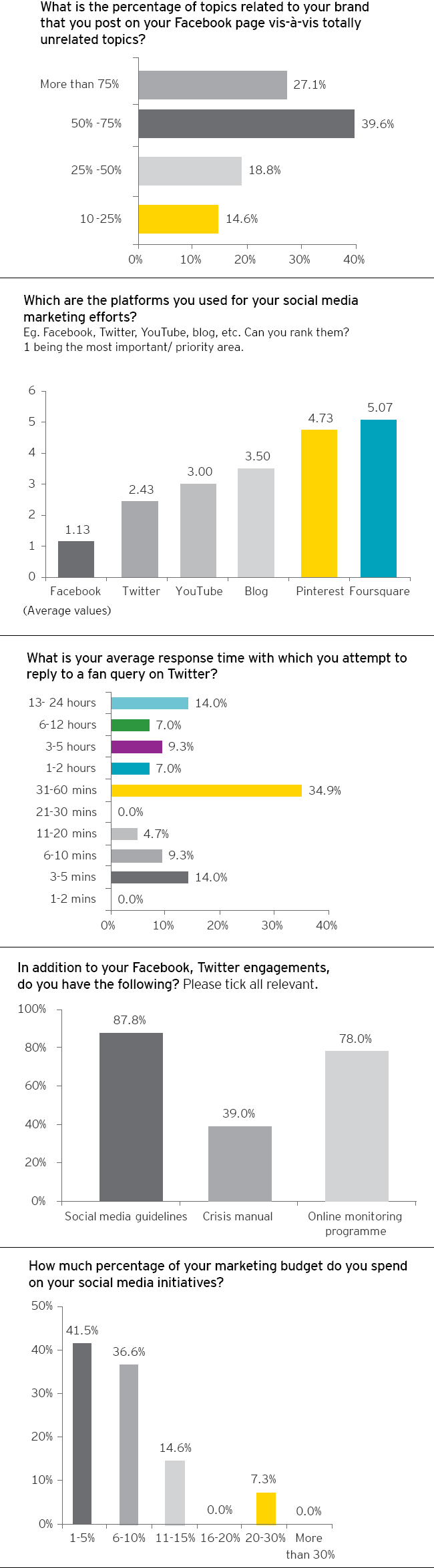
    } 41.5% spend around 1%-5% of their marketing budget on social media; most social media budgets are below INR10 million

    } 76.7% have their marketing department handling social media with the rest being handled by a cross functional or PR/communications team

    } For social media campaigns, 73.8% organizations have chosen standalone digital agencies as compared to PR/ advertising agencies and freelancers


    According to the report, Facebook is the most popular social media platform in India with more than 62 million users, and is the favorite playground for social media savvy organizations to banter in everyday conversations and engage in promotions and contests for its fans. Additionally, almost half of the organizations surveyed are already using emerging platforms such as Pinterest, Google Plus, and Foursquare.


    Dinesh Mishra

    “Social media is fast emerging as a means of partnership between organizations and their customers, leading to continuous engagement and deeper loyalty. Many Indian organizations are already using social media in an advanced manner, even though there are ample growth opportunities. The future is looking bright with increase in scale and sophistication; however, social media savvy organizations need to analyze their maturity level and explore new opportunities. They can move beyond marketing and see which other departments can benefit from using social media. Clarity of purpose and engaging universally accepted approaches in calculating ROI from social media marketing will help organizations make bigger investments in this area.” said Dinesh Mishra, Advisory Director and Leader – Customer Practice, Ernst & Young.


    More than half of the social media-savvy organizations in India, who participated in the survey, post two to three updates on their Facebook pages a day. A quarter of the organizations surveyed said that they post one update per day on their Facebook pages. About one-third said that they post more than 3 tweets a day on Twitter, while 28.9% said they tweet two to three times a day. On the speed of response – one-fourth of the surveyed organizations respond to fan queries on Facebook within an average of 30 minutes of the query being posted, which indicates a robust monitoring and response structure in place. On Twitter, 28% respond to their fans and followers within 30 minutes. However, 14% of the organizations still take 13-24 hours to respond.


    With social media becoming a key component of the Marketing strategy for companies, the need to appease online fans comes as a natural extension. 64.6% of the surveyed organizations said they have organized exclusive deals for online fans and 20.8% said they are likely to organize such deals in the future. 83% of the surveyed said that they have used social media advertisements majorly to promote a contest/campaign or for brand awareness and 88.6% said they find social media advertisements beneficial in achieving their objectives.


    Almost all of social media efforts in India are managed by in-house teams: 76.7% of the surveyed expressed that social media is handled by their marketing department with the rest being managed by a cross-functional team or by the Public Relations and Communications team. Other than using it for Marketing activities, 34.6% said they use social media for thought leadership while 26.9% use it to promote corporate social responsibility. A majority (70.2%) said they have an in-house social media expert in middle management.


    Knowing how the social media governance situation looks like within an organization comes with many benefits such as recognizing strategic opportunities, enhancing competitive advantage, conducting efficient recruitment, cost reduction, generating revenue, creating valued relationships and controlling strategic, operational, reputational and legal risks.


    “Social media-savvy organizations are very optimistic about the role of social media in their organizations. Organizations have realized that social media generates great insights and helps engaging with customers on a continuous basis, and in some cases also generates sales and leads. Social media has helped organizations to create their own communities of fans, customers and prospects. The huge growth and demand of internet connected devices in India is only going to further strengthen the influence and power of social media in customer engagement, and organizations may well look at meeting their strategic goals and business needs through this channel in future,” said Mr Mishra.


  • Aaj Tak upbeat on social media

    By A Correspondent


    Hindi news Channel Aaj Tak has crossed the one-million mark on Facebook. The channel boasts of more than a million fans in the digital world. Aaj Tak on Facebook has been actively engaging with the audience by using various tools and mediums such as debates, polls, issues & news. Social media is a high interaction platform where the communication is between both the parties. The channel has been raising issues on the digital platform.


    The digital platform at Aaj Tak is currently managed by the in-house team. Salil Kumar, CEO – India Today Group Digital said that it is critical for a news channel to be present on social media. He said, “In today’s environment the audience we cater to is always on the move, their content consumption devices and hence the patterns have evolved and will continue to do so. He is connected to the world, almost 24 X 7. He not only is someone who consumes content (consumer), but has also become a contributor (social editor) and a disseminator (publisher / share), and a critic (feedback / dislike).  He seeks news not only through hard core news sites / channels but also through his social network. Hence FB and its community is a critical part of our overall strategy.”


    Aaj Tak is also monetizing its FB page, though Mr Kumar did not divulge further details.


    Going forward, the channel plans to leverage the social media connect aggressively. “The social media connect will always remain an integral part of Aaj Tak. Going forward, I would like to leverage the social connect to build a large collaborative community helping us interact and  stay connected with our audience and will be a permanent place holder on the second screen,” concluded Mr Kumar.