
Tag: Shailesh Kapoor

  • The Silver Lining to India’s World Cup Exit

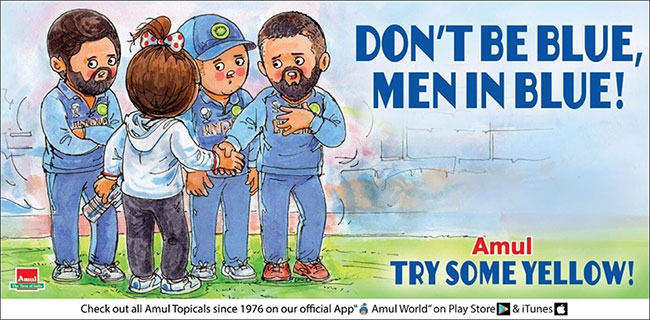
    The Amul topical ad after the Indian team’s loss in the semi-finals of the Men’s World Cup Cricket 2019


    By Shailesh Kapoor


    This week has been headlined by India’s semi-final exit from the 2019 Cricket World Cup. In a semi-final played over two days, league-stage toppers India went out to New Zealand, albeit after giving a tough fight in a run chase that had gone all wrong within minutes of it starting. While the end of India’s World Cup dream has meant heartbreak for many fans, it has easily been the most mature media and fan response one has seen to India’s elimination from a World Cup in years.


    Take 2015, for example. India lost to Australia in a fairly one-sided semi-final, falling 95 short of a big run chase. Having stayed unbeaten in the group stage, it was India’s first defeat in the tournament, but it was enough to send them home. Many would remember Arnab Goswami’s “Shame In Sydney” coverage from that night, and the social media backlash it received. But he was not the only one. Several news channels, across languages, did not take too kindly to the defeat. India had been simply outplayed by the host nation on the given day, but that this can happen in sport was not important for the electronic media to understand. They played to, what they thought is, the sentiment of the fans. Except that social media now allows you to gauge the fan sentiment in real time. And the social media verdict was clear: There was no shame in losing to the better team on the day after playing a great World Cup for more than a month. While the print media too was mature and restrained the next morning, the TV coverage was the old-school, of the ‘Match Ke Mujrim’ variety.


    This week, even the electronic media has fallen in line. Perhaps it’s the late surge from Jadeja and Dhoni, who took India within striking distance, that played a role in how the story was played out. If India had folded up for less than 150, a very likely option at one stage, the daggers may have come out in more numbers. But on Wednesday, the few, like ABP News, who presented India’s exit story as a “failure” were firmly rebuked by big numbers on social media.


    I find this evolution of the Indian fan fascinating. We are not a sporting nation by culture, and understanding defeat in big-ticket sport doesn’t come intuitively to us. But somehow, over the last five years, there has been a sobering down of reactions after losses in key matches. Perhaps it’s a function of us winning more often than not these days. But there’s also little doubt that sobering and influencing voices on social media that have been able to influence how fans think about and approach the game.


    As a follower of cricket over the years, if you have seen the agony of 2007, you have seen it all. India’s early (first week) exit that year was torturous, to put it mildly. It brought out the worst in fans and the media. But the performance was so lacklustre that even the most moderate voices found it difficult to appeal for restraint. It took an unlikely World T20 win later that year for that ghost to be buried. Though for many like me, that one week featuring losses to Bangladesh and Sri Lanka will remain the worst week in Indian cricket for a lifetime.


    We have come a long way since then, both on and off the field. There has been ample dignity at display this week. And that’s a wonderful sign for the future.


  • India-Pakistan Ratings: Busting the Fragmentation Myth

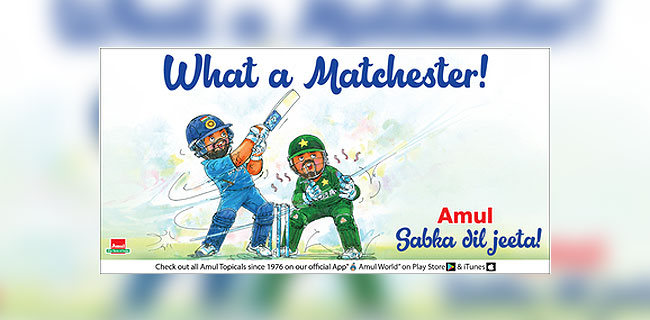
    The Amul ad on the India-Pakistan World Cup match


    By Shailesh Kapoor


    The ratings for the India-Pakistan World Cup cricket match on June 16 are out. The hopelessly-one-sided game scored a whopping 18+ TVR (Urban All India). Ratings nearing 20 can only evoke nostalgia for those following the Indian TV market over the years. It’s in the first half of the decade of 2000s that one would see such numbers for daily shows, with Kyunkii… and Kahaani… leading the way for a while. Thereafter, the numbers progressively dropped, a trend that’s generally believed to be an outcome of the launch of more channels and the resultant fragmentation of content choices available.


    The top Hindi GEC show moved from the 20-mark in early 2000s to the 10-mark late in that decade. In the first half of the decade starting 2010, the 5-6 level was aspiring enough. Today, even a 3-level is gold.


    Movie ratings have also shown a downward trend, but nowhere close to soaps. The top movie could do 15+ rating about 15 years ago, the equivalent of which is a 7-8 rating today. That’s a 50-60% drop, vis-à-vis an 80%+ more drop when you compare the top Hindi GEC shows across the same two periods.


    The popular belief has been that with the expansion of the measurement universe over the years, the true heterogeneity of the Indian market has a more and more significant impact on the TV ratings. That, combined with a multiplication in the number of channel options, would mean that fragmentation, and the resultant creation of a long tail, is inevitable.


    The India-Pakistan match ratings challenge this notion head on. The message from the audience is clear: If there’s content that carries a certain level of appeal and viewer pull, India can be fairly homogenous after all. Yes, there are more options and more diversity in the universe today. But there’s always content that cuts through, because it enjoys that broad-based appeal. And hence, justifying sub-3 numbers as the best-case scenario is only a self-fulfilling prophecy, whereby content creators and broadcasters are justifying low ratings as a market behaviour, than questioning them as symptoms of a loss in the collective ability of the industry to make truly mass, pan-India shows.


    One may argue that big-ticket sporting events have the ability that genres like drama, comedy and non-scripted content lack. That’s a fair argument too. But one is not expecting the top show to deliver 18-rating. Even the inert and one-sided India-South Africa match touched the 6-mark (averaged over more than seven hours, no less!). That’s surely a level a top Hindi GEC show should aspire to achieve. But today, even half of that is being celebrated as an outright success.


    If these signs continue, we may soon be a television market where sports, news and movies become the staple, and drama the alternative. It has already started happening during events like the IPL, the elections and now the World Cup. It could be a matter of time when more routine days begin to exhibit this trend too.


    If all the content creators can take a week’s break from their OTT pre-occupation and think about this, I’m sure they have the collective ability to come up with something worthy. The real question is: Do they have the will? Or has television already been reduced to a fuddy-duddy medium that’s not even cool to ideate about?


  • Cricket World Cup So Far: Still Waiting to Launch?


    By Shailesh Kapoor


    It’s three weeks since the ICC Cricket World Cup started in England. 22 days and 26 matches later, the excitement is still waiting to build up. A multitude of factors have ensured that this probably the least exciting Cricket World Cup in a long time, from a cricketing perspective.


    From a marketing and media perspective though, there are no such concerns. India matches have rated very well, and the India-Pakistan ratings, which will come in next week, are likely to hit the roof anyway. Brands have piggybacked on the once-in-four-years tournament well, and the match timings are highly conducive to India, making the Cricket World Cup a highly lucrative media event.


    But all of the above is an India story, and an off-field story too. On field, the tournament has struggled. Four of the 26 matches have been rained off so far. Thankfully, the rains have relented over the last one week, preventing this World Cup from becoming a farce purely on grounds of poor weather.


    But even as the rains relent, cricket fans wait for exciting games. Only 3-4 games have reached a point where the winner is not evident with 10 overs to go in the second innings. It seems only five teams have really turned up, prepared to play hard. Four of these – Australia, England, India and New Zealand – are near certain to be the four semi-finalists, while the fifth – Bangladesh – has put up better fights than more seasoned teams like South Africa, Pakistan, Sri Lanka and West Indies.


    It’s a format tailormade to enable tight scenarios on the points table, where one can be waiting till the last few games to know the final composition of the semi-finalists. It happens in IPL every year, and happened in the 1992 World Cup too, when this format was last used. Pakistan, the eventual winners, had to win virtually everything in the second half of the league stage to qualify. And they did!


    But so far, chances of any such drama happening in the last one week look very remote. It seems that the next two weeks will only decide who plays whom among the four near-certain semi-finalists. And that is sure to rob the World Cup further of excitement.


    Now, a lot of this is not in ICC’s control. You cannot worry about South Africa looking sub-par and not being able to win more often, for example. But much as ICC can’t control it, there is enough and more for them to reflect upon. Attendances at the Asia matches have been very good, with Indians and Bangladeshis in particular packing the stadia. But this sub-continental colour that cricket is acquiring surely cannot be healthy. I was in the UK for the first 10 days of the World Cup, and there was no buzz or talk about the tournament at all. The local newspapers dedicated 2-3 full pages to football, vis-à-vis half a page to an England game in the Cricket World Cup. You could drive around the city of London for 2-3 hours and stare pointedly at every hoarding, and yet, not know that there’s a big cricket event going on here.


    Cricket has faced the globalization challenge for years now. While Afghanistan and Bangladesh have come in stronger over the last few years, there hasn’t been much progress in the rest of the world. 50% of the teams in the World Cup are from the sub-continent. Surely, this cannot be a right step in the direction of globalization. Something for ICC to worry about deeply.


    It’s perhaps also an issue with the 50-over format itself. Eight hours of viewing is not a premise on which you can grow a sport in today’s age. Perhaps T20 needs to take the centerstage after all, and Test cricket can be the variant for the connoisseurs. ODIs seem to have a questionable future at this point of time. But these are difficult calls, and the playing nations will be understandably reluctant.


    We may still see a late surge by one of the weaker teams, and this World Cup could suddenly light up. And eventually, in the last one week, it will be about what India’s final outcome is. That’s the beauty of sport and the passion it evokes.


  • World Cup 2019: The Stage Is Set


    By Shailesh Kapoor


    Less than two weeks from now, a six-week long cricket festival will be underway. The ICC Cricket World Cup 2019 in England is set to be one of the Top 2 media events of the year, at par in hype and excitement with the General Elections, another six-week long event that will conclude days before the World Cup.
     

    T20 cricket has overtaken the longer 50-over version in terms of popular interest over the last decade. But the World Cup is still by far the most coveted title in cricket. Coming only once in four years, it has managed to retain its charm even as eight hours of cricket viewing at a stretch becomes an otherwise consumer-unfriendly idea in the fast-paced times we live in today.


    Two specific aspects will aid the engagement with this World Cup even more. The match timings are extremely friendly to India, with 3pm starts for most matches, including all India matches, the semis and the final. 3-11pm is inarguably the best eight-hour time-band for Indian television, and the second innings is particularly well-timed, starting at 7.15pm.


    The second factor is the format of the World Cup itself. The tournament is back to easily its most interesting format ever, used only once previously in the 1992 World Cup in Australia-New Zealand. In this format, each of the 10 teams plays each other once each in an elaborate 45-match league format, followed by the three knockout games. Reducing the number of total teams from 12 or 14 earlier to 10 means that the inconsequential minnow games, which would earlier be almost 35-40% of the total draw, are eliminated altogether. Afghanistan, a rising International cricket team with some top-level cricketers, is the ‘minnow’ of this World Cup. They are sure to spring a surprise or two, and given their recent track record, no competition is going to take them lightly.


    Recent formats had eight teams reaching the quarter finals, which made the league (group) stage come across as a long and tedious warm-up. This time, four out of 10 positions have to be hard-earned, and we can expect a tight points table throughout, much like the 1992 World Cup and the IPL in most years, including 2019.


    The hype for the World Cup is nowhere close to peaking right now. The media’s and public’s pre-occupation currently is the General Elections. We are two days away from exit poll results and exactly a week away from the big results day. The World Cup buzz will begin to pick up soon after May 23, and it will be unrelenting thereafter, all the way till md-July. Or even longer, if India wins the title.

    It’s time to brace yourself and be prepared for thrilling sports extravaganza.


    Shailesh Kapoor is going on a short vacation from next week. His column will be back on MxMIndia on June 14.


  • Avengers: The Marvelous India Story

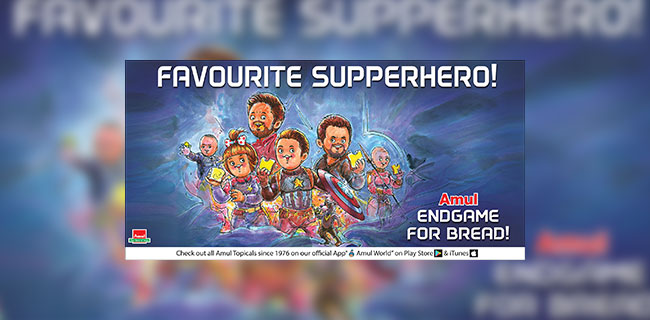
    An Amul ad capturing the popularity of the latest Avengers release


    By Shailesh Kapoor


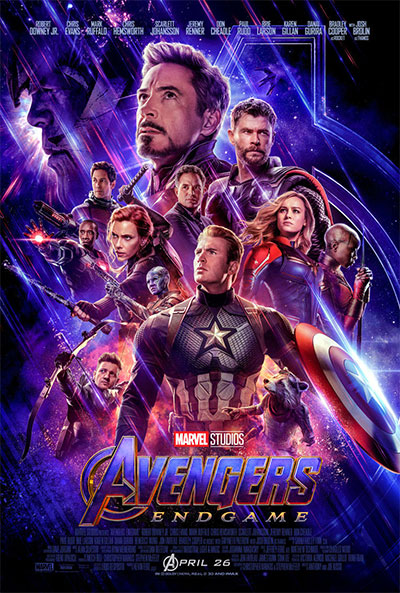
    Two weekends ago, Avengers: Endgame released in India as easily the most-anticipated Hollywood film ever. At a staggering 52 Cr+ business on the first day (net of GST), the film beat the record of the previous film in the franchise (Avengers: Infinity War) by a wide 60% margin. Not only that, it beat the biggest Hindi opener till date too, surpassing the opening-day collections of Thugs Of Hindostan, without having the benefit of a huge nationwide holiday like the Aamir Khan film.


    Avengers: Endgame is on course to do 375-400 Cr business in India, which will beat the lifetime box office record held by Avengers: Infinity War by about 150 Cr. Normally, such records are broken after a gap of a few years, because ticket rates go up and new multiplexes open up, giving films a wider number to achieve on the same demand. But that’s not the case in the Avengers example. The market scenario is largely similar to last year, barring a reduction in GST on movie tickets. A steep 150-Cr growth in just 12 months clearly highlights the growing equity and stature of brand Marvel in India.
     

    If one was to do a list of the most powerful media brands in India, there’s very high chance that Marvel will top it. In a country where the language barrier itself limits the reach of International content, how the Marvel Cinematic Universe (MCU) has managed to penetrate itself, through not just metros or mini-metros but the smallest of towns, is a testimony of what genuine movie craze can be. The language accessibility helps, and the dubbed versions have contributed more than 40% of the box office of Avengers: Endgame. But even with that, the mainstream, mass status MCU has acquired in India, one film after the other, is an achievement to marvel at.


    This genuine movie craze is about a deep and organic connect built with the characters in MCU. There are films like Thugs Of Hindostan, and the various Salman Khan films, where the lead star has massive appeal, and if you prop up the promotions leading up to the release, you build the requisite “hype” and the film opens well, and thereafter, the content takes over to decide how long its legs are.


    But there’s a difference between “hype” and “craze”. MCU films, especially the bigger ones, are success stories based on craze, not hype. As was Bahubali 2. But almost every other film that’s big-ticket is a hype product. Hype doesn’t lead to genuine craze. It propels audience to visit the theatre, often because it’s the in-thing to do, and one doesn’t want to miss out on riding the hype wave. It’s an inorganic, marketing-driven way of getting a film to open well. More like a consumer push.


    But when there’s genuine craze, the hype builds organically on its own. Avengers: Endgame was being marketed by crazy fans in digital media and the real, offline world. The much-written about late night and early morning shows on the opening day could have been a marketing ploy by another film, but in this case, it was a certification of the craze that existed. A consumer pull that’s so strong that the film belongs to its audience even before they have seen it.


    We are in a push marketing era in general. Bombarded with messaging across online and traditional media, consumption of content and brands is often a function of one brand outshouting the other. In such a marketing climate, Avengers: Endgame is a rare exception that stands out. Can anything Indian, on TV or in films, match up to this level of craze anytime soon?


  • Bees Din Baad: May 23 Beckons


    By Shailesh Kapoor


    Twenty days from today, the grand election event will come to an end (though many believe the days that follow May 23 will be highly dramatic). Over the last two months, the General Elections have owned the mindspace of people at large. “Will Modi come back?” is 2019’s why-did-Katappa-kill-Bahubali type of question.

    The media coverage of these elections has been nothing remarkable, to put it mildly. These elections lack a big idea like the previous one, where anti-incumbency and the projection of Narendra Modi as the face of a new India created a narrative laced with optimism and joy. Even the BJP campaign this time doesn’t have the punch of simple but memorable phrases like Achhe Din, Ghar Ghar Modi, etc.

    In the absence of an inherently strong narrative, the media has struggled to find a peg on which to cover these elections. Hence, what we have got is a series of individual stories, which lack a larger missing thread. The only somewhat constant idea in some of these is the alleged toothless-ness of the Election Commission, but that too has been covered only by select sections of television, print and online media.

    The absence of creativity and imagination is also apparent. Are there any marquee election shows that have stood out as first-of-their-kind? Is there one programming idea that can genuinely be called “new”? Far from it. There have been the usual debates (and more debates) and the usual coverage from the ground. Politicians give fodder and media debates and dissects it. That’s been the default position.

    One particular irritant that stands out is the absence of comedy and light-heartedness in the coverage of these elections. Political satire has traditionally been a popular genre of content. But over the years, it has faded away in India, perhaps because everyone is too sensitive and in a perpetual apology-seeking mode nowadays. Barring an odd OTT show, there are no proper attempts to do stand-up or sketch comedies around the elections.

    This collective bankruptcy of ideas, which all major media houses are guilty of, is baffling and saddening, both at the same time. It cannot be that we have slowly lost the ability to think creatively as an industry. It surely has to do more with the brief itself. It seems that “curb creativity, go after the tried and tested” is the operating mantra across the board today.

    The good thing with elections, like sport, is that it provides adequate drama and entertainment on its own. As a viewer, you will still find that one ridiculous quote, that one goof-up, that one shoe-hurl or black ink and that one pants-dropping moment that would make you chuckle, sometimes cynically.

    But the mediocrity of coverage is too apparent if one goes beyond the bizarre and the dramatic. Come May 23, I predict exactly the same panels, the same graphics and the same studio set-ups as all the major elections since 2014. And if I knew who was winning, I’d have even predicted the headlines!


  • Shailesh Kapoor: Delhi Crime: Investigative, Insightful & Incisive

    By Shailesh Kapoor


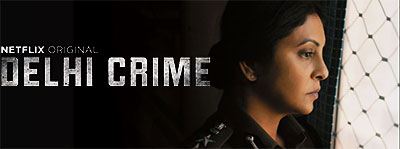
    The OTT content market is buzzing with excitement. Every time we think the traffic of new shows will ease up, there is more, and then more, that comes our way. The last month has been particularly fertile, with a series of launches across all major and minor platforms. And there’s one amongst them that stands tall: Delhi Crime.

    Netflix’s Delhi Crime, based on the police investigation following the ‘Nirbhaya’ gangrape case, has been created and directed by Richie Mehta, a Canadian of Indian origin. The production and technical crew are dominated by foreigners, and hence, the show cannot be called entirely homegrown. But it’s based in India, on an Indian story, and has an eminent Indian cast, and the primary language is Hindi. And it’s truly Indian in its spirit, tonality and texture.

    Delhi Crime rivets you with the police perspective of the much-discussed gangrape case from 2012. We saw various accounts unfold in the news media when the incident happened. A large part of the focus, and rightly so, was on the victim’s story. The girl became the ‘face’ of a women’s safety campaign that followed, creating social awareness, and eventually leading to amendments in rape laws.
    What we have not been exposed to thus far is the police’s point-of-view. TV show Crime Patrol touched upon this, covering the case in a two-part special that broke all rating records for the show in 2013. Delhi Crime dwells into this fascinating world, through the eyes of its protagonist DCP Vartika Chaturvedi, played to perfection by the much-underrated Shefali Shah. What unfolds is a thrilling quest to nab the victims in a real-time pressure cooker scenario, with the media and the political class breathing down the police’s neck.

    Like Meghna Gulzar’s Talvar (2015), where the narrative sided with the parents, Delhi Crime too decides to take a firm position. Its point-of-view is pro-police in no uncertain terms. After watching Delhi Crime, I revisited some of the news material on the case on YouTube. An interview with the victim’s male friend, where Zee News celebrated him as a hero of the nation, particularly stood out as being in sharp contrast to the narrative in Delhi Crime, which paints him as an opportunist, trying to garner media attention through the case. It’s this taking-a-stand approach that makes Delhi Crime even more interesting, and prevents it from being a sterile account at any point of time at all.

    While there is a lot to appreciate about the show, two aspects stood out in particular for me. The first is about the non-filming of the actual incident itself. While every detail of the case is carefully covered in the investigation, and the audience always has an insightful, insider’s view to what happened, the actual incident is never shown, not even suggested. Surely, this would have a conscious decision. And quite a brave one too.

    The second aspect is about the use of humour in the show. Mehta and her writing team infuses the show with characteristic Delhi humour, using situations and lines to evoke a smile, a chuckle, and sometimes even a laugh, in a show that Netflix classifies as “gritty” and “dark”. Amazingly, at no instance does this come across as insensitive. The humour blends into the purposefully grim narrative, and even adds to it, providing deliciously incisive commentary of the workings of Government officials at large in Delhi.

    In all the hype around OTT shows over the last year or two, Delhi Crime will stand out as a genuine achievement. The under-marketed show may take several weeks and months to find its true reach. But it’s arguably the best online show to have come of India till date.

  • Shailesh Kapoor: IPL 2019: Language-led Growth & more…

    By Shailesh Kapoor


    The 2019 season of IPL has taken a flying start. Ratings for the first week have come in and they look better than ever before. The reported Hotstar numbers are an all-time high too. Even at a conservative level, we could be looking at a 25-30% jump in the total (TV + digital) viewership over the last season by the time this season reaches its finale.

    There hasn’t been anything particularly different about the cricket itself compared to last year. There have been close matches and some high-scoring ones too, but the first week of IPL 2018 had more thrills and actions cricket-wise. This makes the jump in ratings even more significant. The league opener this time was a low-scoring and one-sided game, with CSK chasing only 71 against RCB. Yet, the game has rated way higher than last time’s opener, which was a high-quality thriller penned by Dwayne Bravo.

    The regionalisation of IPL is one of the definite contributing factors at play. Weekend games are on air on 20+ channels, including the HD ones. This is more than double (perhaps triple) of the number of channels last year. Cricket has no language, but for casual viewers (and IPL has loads of them), the commentary experience can be a key engagement driver, and that’s why the multi-language initiative by Star is so relevant. With the benefit of hindsight, Sony may be wondering if they missed the bus on this one all these years.

    The IPL story on Hotstar may take a few more weeks to emerge clearly. But it will not be surprising if growth upward of 40-50% is seen. Timed well with IPL, Hotstar has launched its new slate of shows under the umbrella Hotstar Specials. Roar Of The Lion, a docudrama on CSK’s 2018 journey, and Criminal Justice, an adaptation of the acclaimed BBC series, are the first two out, the latter having launched this morning.

    Hotstar has also launched Hotstar VIP, a more affordable subscription service compared to Hotstar Premium. All this action leaves one wondering what will happen when Disney’s global OTT platform launches. Will Hotstar continue to exist as an independent brand? But that’s at a least a year away.

    While Star has done so much right this year around the IPL, the Select Dugout initiative that they started last year has been the big dampener this time. It seems like a classic case of overthinking a good idea and tinkering with it needlessly. The audio is awry on Star Sports Select HD this year. You just don’t get the stadium feel watching the channel because of the audio mix. And there is way too much going on between the commentators, who seem to have been over-briefed to come across casual and funny, along with being knowledgeable. Hope someone at Star is working on fixing this soon.

    But that apart, the cricketing season has taken off to a very good start. There’s only an 18-day gap between the IPL final and first game of the ICC World Cup in England. So, from now till July 14, when the World Champions are crowned, it’s a non-stop cricket feast.


  • Elections & IPL: Both Battlefields are Ready


    By Shailesh Kapoor


    The elections are here! Sixty-two days from today, we will know the outcome, when the results are announced on May 23. And over these 62 days, we will see a political battle unfold across electronic, print and digital media. A battle bigger than anything we have seen before in Indian politics.

    General absence of class and dignity in this political face-off is expected. The standards have dropped over the last decade, and one can expect more degeneration over the next two months. When both sides are willing to lower their standards all the time, the new low can be a really low one.

    In such a scenario, it’s the media that could potentially play a pivotal role. That of being the sane voice of fact and truth, and bringing a sense of calm and balance in the political cacophony that will go on uninterrupted for more than two months. But practically speaking, there is little chance of that happening.

    The media is politically polarised more than ever before, and there’s a general feeling, especially in the electronic media, that unless you are at one end of the spectrum, you will not be a popular option for your target audience. Whether that’s true or not is a matter of some deep and layered analysis. But for now, that’s the perception with which all news channels, and most newspapers and digital platforms, begin their respective ‘campaigns’, leading towards May 23, 2019.

    I’ve always found the behind-the-scenes coverage of elections more interesting than the in-the-face variety. Speeches, rallies and one-liners are for everyone to see and interpret. It’s the strategy that goes into aspects like seat allocation, alliances, political messages, media plans etc. that is rarely covered in any depth. And this is where the fascinating stories often are.

    Good election coverage is not about reporting speeches and debating them with a politically-polarised panel. Good election coverage is not about being the fastest on the results day either. Good election coverage is about providing an insight into how political parties approach elections and the key decisions they take during this period. More of this is what I’d wish for in the next 62 days.

    On a different note, a new season of IPL starts tomorrow. Unlike the previous election years (2009 and 2014), when IPL had to be shifted outside India (to South Africa and UAE respectively) in part or whole, there has been no such talk this time. The season that kicks off tomorrow is important for its pre-World Cup timing. On the media front, we can expect digital consumption to grow further, to make IPL 2019 the most-watched digital content in India’s history by a comfortable margin.

    Digital media has already warmed up to IPL 2019. Earlier this month, Netflix launched Cricket Fever: Mumbai Indians, a fascinating behind-the-scenes view of the Mumbai franchise from the 2018 season. And then, earlier this week, Hotstar launched Roar Of The Lion, a documentary series based on the journey of Chennai Super Kings in the season following the two-year ban on the franchise.

    With these two series (which are worth a review here in the coming week or two), IPL has found great content extensions beyond actual live cricket. One hopes to see more such interesting content roll out in the coming years. Because cricket, for the immense popularity it enjoys in India, has been a grossly under-leveraged sport when it comes to mainstream entertainment content.

    But that can wait a few weeks. For now, let the games begin. Of the political and the sporting kinds.


  • OTT: Ride Along, Because It’s Buzzing!


    By Shailesh Kapoor


    It’s all buzzing on the original content front in the OTT space. The five-year-old category in India began to find its feet in 2018, as covered in this column written in September 2018. Since then, over the last six months, the buzz has got stronger by the month. Hotstar is the latest entrant in the big-ticket original content play in the digital space, with the much-publicised launch of shows under the umbrella ‘Hotstar Originals’. Netflix and Amazon Prime Video continue to scale up their India offerings, while Zee5, ALT Balaji and others continue to launch shows by the week. There’s another new entrant in MXPlayer from the Times group, and of course, the guys who started it all, TVF, are very much in the mix too.


    The original OTT content ecosystem in India can no longer be called nascent. Over the last 12 months, its broad contours have evolved in a definitive way. The column linked above spoke about the need to prioritize ‘quality over quantity’. While quantity still dominates, quality is slowly beginning to come our way too. And as someone who has had the opportunity to get a peek into some of what’s lined for later this year, I can say with some confidence that 2019 will be the best year for the category quality-wise.


    No one is currently bothering themselves too much with the question on where the money (revenue) is going to come from. It’s apparent now that there’s a sound future in this category, and eventually, its economics will work themselves out as the category settles down, maybe by 2021. But you need to be an early entrant and have a substantial subscriber base by then, and that’s what the top players, most of which have deep pockets, are prioritising.


    The myth that OTT will kill mainstream television still prevails, and keeps coming up in coffee machine conversations across media houses. It’s the only genuinely-misguided piece in the OTT story. Over the last two weeks, in the aftermath of Pulwama and then Balakot, news ratings have more than doubled. As mentioned in this column last week, sports and news may gain big this year, at the cost of general entertainment. But television will survive alright. Cord-cutting is still a hugely niche metro phenomenon, and there isn’t much to say on it in a country as large as ours.


    The intriguing question, then, is: Where are people getting all this additional time in their lives to watch digital content, especially in an age when ‘fast life’ and ‘not enough time’ are commonly-expressed grouses? The answers may not please social or medical experts. It seems that this time is being created at the cost of more ‘developmental’ activities like reading, spending time with family and friends, and… sleep. But that’s another topic for another day.


    Last week, Akshay Kumar, currently Bollywood’s most popular male star, walked onto a stage after setting himself on fire, to announce the launch of his new Amazon Prime series (working title: The End). That visual, coming within days of the launch ad of Kumar’s 2020 cop flick Sooryavanshi, sums up where the OTT category is heading. It’s going to be about big guys and big bucks. It’s going to be quite a ride over the next two years, and I, for one, am not blinking.


  • Shailesh Kapoor: 2019 Likely to be Hindi GEC’s Worst Year Ever?

    By Shailesh Kapoor


    We are now in the third month of an already eventful year. It’s the year of the elections and the World Cup. But while the excitement around those two events builds up, a busy news phase has already started, from the Pulwama attacks in mid-February to the events around it thereafter.

    Specifically from a television perspective, the news and sports genres should make significant gains this year. The election dates are likely be announced soon, and one doesn’t expect there to be a dull moment on the news front for 3-4 months at a stretch. Similarly, there’s the IPL and then the World Cup, which will collectively run for a similar period of 3-4 months too. Match timings in the World Cup are highly conducive to Indian audiences, with the second innings in most matches coinciding with India’s prime time. That India will be one of the favorites in the tournament makes it even more luring.

    Where does this leave the rest of the television genres, especially the General Entertainment Channels (GECs)? Not in a very strong position. The Hindi GEC category, in particular, has had a torrid period over the last 3-4 years, losing category share to news, movies, sports and regional GECs. 2018 saw some stability in the genre, but the general symptoms of category fatigue still exist, and it’s taken big-ticket reality shows to bail out the category time and again over the last two years in particular.

    With the IPL, the World Cup and the elections season, reality shows themselves will have competition from outside the genre, not to mention how fiction shows can struggle even more with so much other topical content available.

    Usually, one would see such a period as a blip, and expect that the Hindi GEC category will show a temporary drop from April to early July, and then recover to current levels thereafter. But this can be tougher than it seems. Three to four  months is a long period, and news and sports collectively can break the consumer habit of watching daily soaps as a routine. Even if this happens in a small fraction of households, its impact will be felt on viewership numbers once normalcy is restored after the World Cup final on July 14.

    It’s also the year of TRAI’s new tariff order, and that can further complicate things on ground, though the exact impact will be known only as things settle down by April-end (assuming no further extensions are given).

    You cannot sympathise with a category that should have seen this coming from at least two years ago. Deadwood content has no place in an entertainment ecosystem that’s driven by an overload of options. This column is now in its seventh year, and the topic of Hindi GEC content inertia has been a regular feature for at least five of those seven. And now, a year has come where it could all spiral down further in a hurry. Be prepared for some very poor numbers from the Hindi GEC category this year. They could be worse than you think.


    Shailesh Kapoor is Founder and CEO, Ormax Media. This column appears on MxMIndia every Friday. The views here are personal


  • Shailesh Kapoor: 2019 and the Politics of Entertainment

    By Shailesh Kapoor


    It’s the election year, and we can feel the vibe. Politicization of entertainment has been a tactic used by our politicians for decades now. But as we get closer to the General Elections, we can sense more and more of it.

    Over the last few years, politics of entertainment has impacted all categories, ranging from films to television to OTT. Each such incident is usually passed off as a one-off. But no longer. The incidents get too frequent, and it’s a continuum at play now. Here are four recent incidents, from 2019 itself, that show how political influence on entertainment is spreading wide, very wide.

    1. The Sidhu ‘Sacking’

    Navjot Singh Sidhu has been a notorious politician for the Congress to handle, since he shifted from BJP to the party. Those who have followed cricket over the years will recall how Sidhu left the Indian squad on tour to England in 1996 in a huff, because he could not get along with the then captain Mohammed Azharuddin. Sidhu’s contrarian, almost problem-child-like, ways continue. But now, Pakistan is often a subject of his comments, which obviously does not go down well with most people in India. His recent ‘sacking’ from The Kapil Sharma Show was triggered by his comments on the Pulwama attack, which were seen as pro-Pakistan in their stance. That he is still a part of the Congress party spells the irony around this instance.

    The sacking demand started on social media, in what seemed like an orchestrated anti-Sony campaign, whereby users put up screenshots and videos of them uninstalling the Sony LIV app from their devices. Yesterday, IFTDA (Indian Film & Television Directors’ Association) issues a pledge to not work with ‘Navjot Singh Sidhu and Pakistani artists and singers as a homage to the martyrs’.


    2. India-Pakistan World Cup Match

    Call for boycott of all things Pakistan seems like a reasonable one in the current circumstances. But not playing Pakistan in a multi-nation tournament on a neutral venue can be questioned as a far-fetched extension of this boycott idea. If neutral, multi-nation interactions are a no-no, we should not even be in the United Nations with Pakistan. Will we let go a Gold Medal at next year’s Olympics in Tokyo if we have to play Pakistan in a final match in an event? And what happens if India forfeits its league match against Pakistan in the World Cup and then ends up facing Pakistan in the final? Will we forfeit that too, and let Pakistan win the World Cup in a no-contest?

    The pressure on current and former cricketers to support a boycott publicly is understandable. In a world of false binaries, any call against such a boycott can be quickly classified as pro-Pakistan and hence anti-national. Full marks to the select few like Sunil Gavaskar for bringing in a sane perspective. I hope better sense prevails over the next few days on this topic.


    3. Political Films

    Less than eight weeks into the year, we have already seen three ‘political’ films releasing in the Hindi language alone. Uri, a fictionalized account of the surgical strikes, has been a runaway blockbuster. The Accidental Prime Minister did not get much success, but set an important precedent of using real character names while not being an account endorsed by those characters. The family-endorsed Thackeray biopic completes the trio.

    When PM Modi used Uri’s now-iconic ‘How’s The Josh’ line at a film event (launch of the National Museum of Indian Cinema) in January, it made for great copy. The selfies that followed were instant hits on the social media. Coming close on the heels of the decision to drop the GST slabs for movie tickets, the current Government has done well to build some sort of a fan base in the film industry.


    4. Azaadi, the Gully Boy way

    The most random and unexpected controversy has been the one around the Azaadi song in the film Gully Boy. The song has been criticized for trying to be politically sterile, compared to the original Kanhaiyya Kumar speech, from which the idea of using the word ‘Azaadi’ emanated. I’m not even sure if I get the exact issue here. A filmmaker and her team liked a word and felt it fitted a situation in their film, and then went on to write words that fit the context of that situation and the characters therein. And it’s not as if ‘Azaadi’ is such an esoteric, Tharoor-like word. The filmmaker Zoya Akhtar, and her lead actors, have been very mature in handling questions related to this criticism in the various interviews, before and after the release of the film. Let’s hope a great film is not remembered for something as silly as this!


    So, as we progress closer to April-May, expect this list to get longer. As they say, often like a cliché now, picture abhi baaki hai mere dost!