Tag: Shailesh Kapoor

  • Fake news still a concern: Ormax Media study

    By Our Staff


    Media consulting firm Ormax Media has announced the launch of the third round of its report titled ‘Fact Or Fake?’. The report measures the credibility of various news media, as well as the perception around ‘fake news’, through a survey of 2,000 news consumers across 15 states in India. The first edition of the report was released in September 2020, followed by the second edition in April 2021.


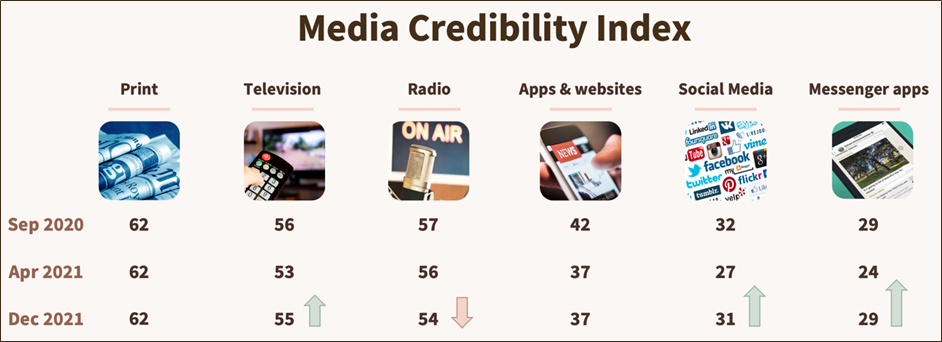
    According to the third edition, 64% Indian news consumers see fake news as a major concern. The News Credibility Index is unchanged since last track (65%), highlighting that fake news continues to be a huge concern amongst Indian news consumers.


    Print media continues to lead, with a Credibility Index of 62%, followed by Television (55%) and Radio (54%). Traditional media have higher news credibility than digital media, though most digital media have seen a marginal improvement in their credibility in this track.


    Twitter continues to remain the most credible digital medium for news, albeit with a drop in its Credibility Index over time: 57% (Sep 2020) to 47% (Apr 2021) to 42% (Dec 2021).


    Shailesh KapoorCommenting on the findings of the report, Shailesh Kapoor, Founder & CEO – Ormax Media said: “Fake news, and lack of news credibility in general, continues to be a growing concern globally. Almost 2 out of 3 Indians see fake news as a problem, and that should be a major cause of worry for all news companies. We launched this report in 2020 to enable more informed conversations on this topic. In the subsequent editions, we plan to study these indices by languages, to understand if there’s a difference in news credibility between Hindi, English and other major Indian languages”.


  • Indian Cricket on a Sticky Wicket?


    By Shailesh Kapoor


    Shailesh KapoorCricket is an expensive sport from a media perspective, even a minor loss in fan base can be a source of concern. Broadcasters have to shell out more for cricket rights with each passing year, and ad


    January 2022 has been the most unpleasant month for Indian men’s cricket team in many years. The team lost two Test matches and one ODI in South Africa, all from winnable positions. The remaining two ODIs may put that streak to an end, but it’s been a poor start to the year on all accounts. Even more so because of the unexpected decision by Virat Kohli to quit the Test captaincy.


    Cricket is by far the most popular sport in India. In our soon-to-be-released report on the sports category, the estimated number of cricket fans in India are almost three times the No 2 sport on the list. The consistency in the Indian team’s performance has managed to keep the sport relevant, especially to the younger audience. However, it now seems that the purple patch is over. The ICC recently announced its World XIs for 2021, and no Indian makes it to the ODI or the T20 teams.


    There’s, of course, the IPL to ensure that cricket remains exciting and relevant. In the report mentioned above, IPL emerged as having a stronger following than all forms of nation vs. nation cricket, including T20s.


    MS Dhoni and Virat Kohli have been the two icons around which the sport, even IPL, has been built over the last decade. The former has retired, and the latter, we know by now, can come up with surprise career decisions without any prior notice. Except Rishabh Pant and Jasprit Bumrah, there are no younger stars who carry an aura around them. And despite all the talent that the IPL unravels, the batting middle order is the weakest in the last 30 years.


    The Indian cricket team last saw an extended lean patch in the 90s, when they were winning very little overseas. But there was one Sachin Tendulkar then to keep the interest in the sport alive. And there was no competition from other sports, such as kabaddi or football either. We are in a different era today, and a lean patch, if it comes, may be trickier to dodge. Football is a younger sport in India than cricket, and it can make significant inroads as a result.


    It’s not to say that cricket runs any risk of losing its no. 1 status in what is still a one-sport nation. That’s not happening in our lifetime. But because cricket is an expensive sport from a media perspective, even a minor loss in fan base can be a source of concern. Broadcasters have to shell out more for cricket rights with each passing year, and advertising on cricket is becoming increasingly unaffordable for many brands. This commercial model, which is driven by IPL at its heart, did not exist in the 1990s and the 2000s, when the team used to win some and lose some. This model is based on the implicit foundation that India generally wins. But what if that is not true from 2022?


    As a fan, I hope it doesn’t come to that. But if it does, a lot of calculations may go awry.


  • News Ratings: “Approval” Received


    By Shailesh Kapoor


    Shailesh KapoorAdvisory. Directive. Missive. Instruction. Notice. Approval. Order. Go-ahead.


    These are some of the words that have described the communication sent by MIB to BARC India, for the latter to release new channels ratings with “immediate effect”.


    While the decision to revive news channel ratings has been long overdue, that such a decision must come from MIB and not from BARC India itself encapsulates the core issue with India’s television ratings system (or Indian television, in general) today. The industry must suffer from the vagaries arising out of too much interference from government bodies such as TRAI and MIB.


    To begin with, some of this interference is extra-constitutional. MIB has no official role to play in BARC India, which is an independent industry body. Some may argue that the MIB note is just an advisory that’s not legally binding on BARC India. But we know that’s not how things actually work. If MIB has said news ratings must restart, BARC India has no practical option but to comply.


    The restarting of news ratings is a welcome step. But the MIB statement begs the question: Whose decision was it? Why now, just before some big state elections? Have the “problems” that warranted the stopping of ratings in late 2020 been fixed?


    When founded as an independent industry body, BARC India would have aspired to hold the positioning of a credible and progressive TV ratings measurement company of one of the biggest TV markets in the world. It’s a highly technical role, and one that should command immense respect from stakeholders across the board. But today, they are positioned as an agency that’s at the beck and call of ministers and administrators, who seem to know more about research, measurement, and statistics than the company set up to run the show. The role of BARC India CEO should have been arguably the most enviable position in the Indian media and entertainment industry. Instead, it’s one burdened with controversies and bureaucratic hassles.


    It’s difficult to say how we reached here. Did BARC India make the mistake of opening its doors to “interference” in its early years? Avoiding government interference in media altogether may be difficult. After all, you never know when an “advisory” or a notification is coming your way. Perhaps BARC India could have pre-empted some of this, and worked on setting committees and processes in its formative years.


    So, we will soon have news ratings back. That, in isolation, is a good development on several counts, though some would argue that our news channels have become marginally more watchable since the ratings went out of their lives. But the real issue is: The government is finding new ways to run the Indian television industry by proxy, with no apparent logic at the heart of it. From the disasters called NTO and NTO 2.0 to the involvement in BARC India, the government seems to be back in the old Doordarshan mindset: That the state must exert its influence over the media, even if it is just to flex its muscles. And the television industry must grin and bear it!


  • Best of 2021: Top 10 Shows or Films


    By Shailesh Kapoor


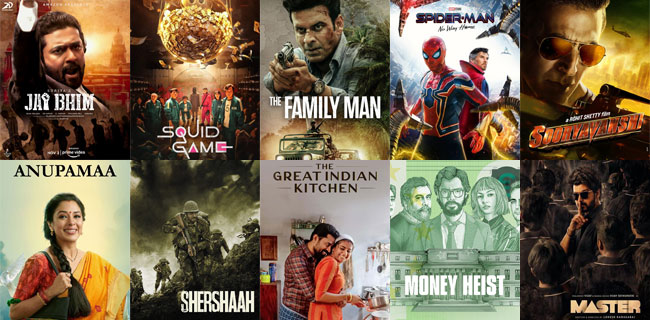
    Shailesh KapoorTwenty twenty-one, with all its disruptions, saw a lot of content being produced and distributed in India, across media. While much of it did not have any lasting impact, some shows and films stood out during the year, not only because they received appreciation and commercial success, but also because they played a role in shaping the future of video entertainment in India. Here’s my list of the Top 10 shows or films of 2021:


    10. Master: It needed a full-blown Tamil superstar vehicle to get audiences back to the theatres in January 2021. Even as Hindi cinema waited, this Vijay and Vijay Sethupathi entertainer reaffirmed that the big screen will never be out of business.

    09. Money Heist: Netflix may have struggled with its Indian originals for most part of 2021. But the final season of Money Heist, with its multiple dubbed versions, managed to receive a lot of love from the audience, recording more viewership than most prominent Indian series in 2021.

    08. The Great Indian Kitchen: The much-appreciated Malayalam film, along with Drishyam 2 and a few others, spearheaded the Malayalam cinema movement in 2021. The national audience, especially in big cities like Mumbai, Delhi, Pune and Kolkata, took notice of Malayalam films, which became a popular OTT sub-genre among those seeking discerning content.

    07. Shershaah: While many theatrical films went the OTT way, very few of them made you feel they deserved a theatrical release. Captain Vikram Batra’s biopic Shershaah topped this list, and was also the soundtrack of the year by a wide margin.

    06. Anupama: The lone GEC show in the list, Anupama set new benchmarks for success, breaking the 4-TVR barrier, something unthinkable for any show at the start of the year. The show continues to go strong, providing a silver lining to an otherwise inert year for Hindi GECs. You can read my recent column on the show here.

    05. Sooryavanshi: It took a while, but Rohit Shetty’s Sooryavanshi finally got the Bollywood box-office back on track in Diwali 2021. Like Master, the film was a confirmation of the power of the theatrical medium, and of the value of larger-than-life, mass entertainers.

    04. Spider-Man: No Way Home: In December 2021, the true might of the Marvel Cinematic Universe (MCU) was on display at the Indian box0office, as the new Spider-Man film became the biggest theatrical success of the year in India, becoming only the third Hollywood film to break the Rs 200 crore barrier at the Indian box-office.

    03. The Family Man S2: In a year that saw many webseries (more than 130 in the Hindi language itself), one stood out as being head and shoulders above the rest. The first season of The Family Man was an unqualified success, but the second season actually managed to raise the bar further, with its nuanced handling of characters, relationships, politics and plot. From ‘Don’t Be A Minimum Guy’ to ‘Chellam Sir’, the show has found its way into pop culture too, and is now the definitive gold standard for Indian web-series to surpass.

    02. Squid Game: Korean content found a sizeable audience in India in 2021. But it was Squid Game that went truly mass, attracting viewers from the smallest of towns in India, capturing their imagination through a story that combined human emotions with thrills and adrenaline.

    01. Jai Bhim: It is only fitting that the top entry in this list is not in the Hindi language. Suriya-starrer Jai Bhim received whole-hearted appreciation from across the country, recording more viewership than many starcast-led Hindi films in the Hindi markets. The film worked both as social commentary and a legal drama, and proved decisively that good content can find audience across languages and geographies.


  • The Year to Remember… The Year to Forget


    By Shailesh Kapoor


    Shailesh Kapoor2021 has been a treacherous year, and it’s been generally hard to predict what’s in store next. Even as I write this on the last morning of the year, a third Covid wave knocks on our doors, and this time, we know it’s an inevitability. That it’s likely to be a wave of milder infections is the silver lining we latch on to.


    The media and entertainment business has done well to stay afloat in a difficult year. Two categories had the maximum opportunity to make the most of it: OTT and News. The streaming players did their part, and came up with content across languages to keep us engaged while we were locked down. The focus, however, was on quantity over quality. More than 200 series and 75 films launched on streaming platforms in India in 2021, and only about a dozen of these managed to make an impact. It often came down to international content to save the day, such as Squid Game and Money Heist for Netflix. That does not reflect well on an industry that, till not very long ago, had announced itself as the torchbearer of a new content revolution in India.


    The news story has been a dichotomous one. While television news shed all pretense and became unequivocally subservient to the powers that matter, the print media, especially in the Hindi language, kept the flag of good journalism flying high. If I had to choose a media brand of the year from India, I’d seriously consider Dainik Bhaskar for that award. It takes courage to go against the tide, and stand up for the truth. Even the subsequent IT raids did not deter them.


    Digital news platforms were persistent in their coverage of the second wave too. But that ecosystem is still struggling to find a viable business model, as they try and convince Indians to pay for their news, which is at least two degrees away from the first frontier for any pay digital platform to surpass: To convince audience to pay for content, of any kind at all.


    The television sector, in general, would have had another forgettable year, with stagnant viewership and no breakthrough achievement in content. But we can always bank on TRAI to inject some nuisance to counter the dullness. Much of the year saw broadcasters and TRAI tussle over NTO 2.0, and the last chapter of that story has still not been written. There was also the mega-merger of Zee and Sony, which opens immense opportunities for the new entity, with their complementary strengths. But that’s another topic for another day.


    We can hope for a lot from 2022, but it’s not a year you want to write a script for. There are going to be surprises on the way, and this time, one hopes they are more pleasant than those in 2021.


  • Two views on the Mi-17 crash


    News channels this week: One Wedding & 13 Funerals


    By Shailesh Kapoor


    Shailesh KapoorThe tragic clash of the Mi-17, in which 13 people, including the Chief of Defense Staff Bipin Rawat, died, has understandably dominated news headlines since Wednesday. The accident carries strong national importance, and the human stories around it makes the tragedy even more relevant for the general audience.


    But that’s not how the week started for our news channels. They were gearing up for the Bollywood wedding of the year. Katrina Kaif and Vicky Kaushal tied the knot yesterday. The private event at a luxury resort in Sawai Madhopur, Rajasthan had seen the now-predictable news channels build-up since last week. Anchors in the studios, despite no access to the event, were ready to headline the wedding, and ‘reveal’ its intricate, even inconsequential, details to their viewers.


    On Wednesday, that story took a backseat, with the Mi-17 crash being the dominant news. Through the afternoon, news was hard to come by, with no official announcements from the Government of India till later in the day. The coverage was passable, with news channels waiting for official Government sources to confirm the actual details.


    Once Rawat’s death was officially confirmed, the coverage morphed into tributes, with some analysis of what may have led to the accident. The patriotic spin, something our news channels don’t like to miss out on these days, was easy to spot. A couple of Hindi channels even wondered if there was a “saaazish” involved.


    A day later, i.e., Thursday, the anticipated wedding got muted coverage on some Hindi news channels, while the follow-up to the crash story continued. It would have been interesting to see how the channels would have made this choice if they had access to the wedding itself.


    Which brings me to the larger point: Has our news become entirely studio-led now? Even in the Mi-17 crash coverage, ground reportage has been minimal (and restricted to off-prime hours), and most coverage has unfolded through studio shows, with anchors indulging in soliloquys, debates and expert interviews on the subject. In the wedding, that would have been the only method, because the only source of any “footage” is the social media feed of the couple. Indeed, those pictures, shared last night, are likely to be a part of our Hindi news channels, if not the English ones, through the day today.


    In my growing-up years, the top news anchors of the time were always on the ground, reporting from there, cutting their teeth and getting us a good story. Over the years, the reporters on the ground have become nameless, faceless journalists, who seem interchangeable and replaceable. The sad part here is that this perception may actually be the truth. An Indian news channel doesn’t need the same firepower on the ground as it needed earlier. Basic reporting, with no insight most of the time, passes muster. Even during the second Covid wave, some of the best ground coverage came from BBC, CNN and digital news platforms like Mojo, or the Hindi newspapers. TV channels had cursory ground reports, and prime-time debates that generally were useless exercises in blame-game or pontification.


    Judging basis the rock-bottom expectations we now have from our news channels, they have done well over the last two days. But at an absolute level, there isn’t much to write home about.


    Media responsibility missing in action

    This absurdity of 24-hour “news” channels has been around India for ages to know what the rules of the game are, writes Ranjona Banerji


    Ranjona BanerjiBy Ranjona Banerji


    The terrible helicopter accident near Conoor which led to the deaths of 13 people in Conoor on December 8 shocked everyone. On board were Bipin Rawat, Chief of Defence Staff, his wife Madhulika, Brigadier LS Lidder, Lt Col Harjinder Singh, Squadron Leader K Singh, Naik Gursewak Singh, Naik Jitender Kumar, Naik Vivek Kumar, Naik B S Teja, Havaldar Satpal, the pilot Wing Commander Prithvi Singh Chauhan, JWO Das, JWO Pradeep A.


    Group Captain Varun Singh is the sole survivor.


    It took 20 minutes of reading through newspaper websites to get all the 13 names of the casualties. The Times of India was the one I found which had most names, but not all. I had to pick up three names from Twitter, from various ex-armed forces handles that I follow.


    The death of CDS Rawat, 63, was a tremendous shock, there is no doubt about that. But the very least a responsible media can do is to at least acknowledge all those who died in the crash.


    But media responsibility was missing in action when the news of the helicopter crash broke, especially with television news which is the first port of call for breaking news. Whether it is laziness and lack of basic journalism in television newsrooms (my hypothesis) or the various budget cuts which have led to ground reporting staff being hacked (people kinder than me), viewers get short-changed either way.


    As an aside, budget cuts for newsgathering are not new in media houses. No one has had reporters, photographers, videographers everywhere for ages, if they ever did. But all newsrooms should have a network of agencies, freelancers, and local outlets that they can rely on.


    As news of the helicopter crash broke however, you would have been hard pressed to find satisfactory on-the-ground reporting or even straight forward information on what exactly had happened. The nation’s first Chief of Defence staff being in a helicopter crash is big news. It is not enough to just focus on it. You need to have more information than anyone else.


    Instead, our channels quickly sank into their fallback position: studio discussions. When an incident is unfolding, there is absolutely no sense in collecting a bunch of “experts” to speculate on what has happened. If you cannot go to the scene yourself, tie up with someone who is at the scene until your nearest people can get there. You see this happening all the time with international channels.


    This absurdity of 24-hour “news” channels has been around India for ages to know what the rules of the game are. They know how tough it is. News doesn’t “break” nonstop for 24 hours. And yet, when something big does happen, less and less can they manage to get the basics right. Hopefully, they might junk the studio discussion if something happens outside their studio gates but don’t hold your breath on that either.


    I am sure that television newsrooms are full of journalists who know how to do the job. I just wish there was more evidence of it. What seems evident from the outside is that whoever or whatever is in charge, does not know enough about the basics of journalism.


    There is a place for opinions in a news outlet but it comes after the event. It cannot become the event. That TV has turned this axiom on its head points to the miserable state of the bulk of the Indian mainstream media today.


    In case you think I’m being unfair, you will find that most of the subsequent coverage has been about famous people condoling the deaths, arriving at the funeral, getting out the car at the funeral and so on.


    Ranjona Banerji is a senior journalist and commentator. She writes on MxMIndia every Tuesday and Friday. Her views here are personal

  • Death of the Niches


    By Shailesh Kapoor


    Shailesh KapoorThe last two years have been ridden with anxiety for the Indian television business. The uncertainty around the pandemic continues, and with all the NTO mess that has been inflicted upon the industry, a general sense of instability prevails, especially in the group of channels popularly called “niche channels”.


    The term “niche channels” came in about two decades ago, to describe channels that cater to specific interests, and hence, cannot be expected to have ‘mass’ viewership numbers. There is no formal definition, and the term is loaded with subjectivity. For example, is a Hindi movie channel that airs only retro films niche or mass? Is the top Punjabi music channel, which garners more viewership than any Punjabi GEC, niche or mass?


    The ambiguity in terminology notwithstanding, the issue with genres outside the Top 4-5 is for everyone to see. English entertainment channels have either shut down or contemplating the same. It’s not just the NTO but also the rise of the paid OTT market that has led to this reality. Core viewer base of English entertainment genre, when it was at its peak about four-five years ago, is far less than the paid OTT subscriber base in India today. Which essentially makes the genre irrelevant. English movie channels are currently in a more favorable position, but it’s not going to be a comfortable one over the next two-three years.


    Music and youth channels have struggled too, for very similar reasons. Audio streaming apps and YouTube are now primary destinations for new music, and channels running old music cannot claim to be offering much beyond digital music options either. It’s a matter of time that we see more music and youth disappear from our TV sets.


    The infotainment genre is facing the challenge too, because of the same two factors: NTO and digital content. So far, they have managed to stay afloat. But the consumption is gradually shifting to the OTT options being offered by the same networks, and it may just be a case of slow death of the linear versions.


    That essentially leaves us with five genres, including their language variants: GECs, Movies, News, Sports and Kids. These genres address a wider demographic, where the rising OTT penetration is unlikely to be a cause of concern anytime soon. These genres are also family-friendly (unlike youth channels, for example), and hence, largely immune to the OTT factor.


    A medium that was known for its variety may no longer be holding that position. The number of channels on your TV may continue to go up, but the number of channel types (or even sub-genres) will not. You can churn a movie library across six (or even more) network channels, but it’s simply more exposure to the same movies. The total viewing time will not drop, but will consolidate around these five genres.


    That’s the nature of a mass medium like TV, in India. It does not go well with the idea of segmentation and niches. It’s more like a one-size-fits-all medium within each language, now more than ever before. Segmenting audience to identify niches from a content perspective may be a sub-optimal, even flawed, approach for a channel operating in any of these genres to take.


    Segmentation is the strength of the streaming medium, where the target audience can conceptually be one in number. This polarisation of approaches is perhaps the single-biggest impact of OTT growth in India. In a way, OTT has shaped Indian television’s immediate future in a definite direction. And big networks should not hesitate to accept this reality, than prolong the agony that their niche offerings in the linear space will have to inevitably face.


  • Anupama: The Rare Hindi GEC Success Story


    By Shailesh Kapoor


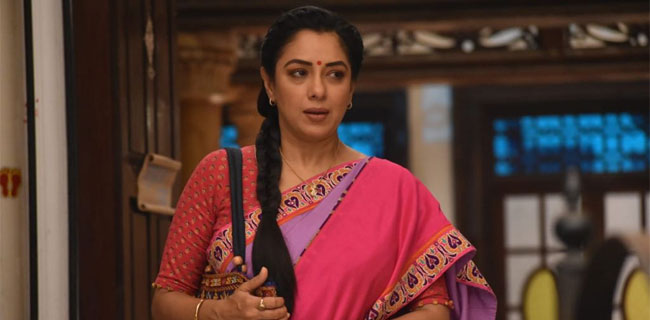
    Shailesh KapoorAmid all that’s wrong with the Hindi GEC category (and readers to this column will know that I have a long list), there is an occasional spark that brings some joy. After being the most-loved Hindi GEC character on Ormax Characters India Loves for 39 consecutive months (from July 2018), Jethalal from Sony Sab’s Taarak Mehta Ka Ooltah Chashmah passed on the top rank to Anupama, the titular character from Star Plus’ 2020 launch.


    Anupama, an adaptation of the Bangla show Sreemoyee on the same network, has been a runaway hit, achieving the unthinkable 4% rating mark in urban Hindi-speaking markets in recent months. In a category where a 2% rating is now considered an achievement (though Netflix’s Dhamaka tells you that you lose your job as a new anchor at 70% ratings, which is available live!), Anupama’s numbers have been exceptional. An average Anupama episode doesn’t rate much less than an IPL game, for example. And while IPL airs only 45 days a year, the show has managed to sustain this for several months, six days a week.


    With its multitude of well-etched characters, Anupama is one of the few well-written Hindi GEC shows currently on air. The storytelling is in broad strokes, but the characters and the conflicts are consistently engaging, and there’s enough entertainment on offer too in what is essentially a high-voltage drama of late.


    The casting and the performances are a notch above the operating level of the Hindi GEC category too. And the lead actress Rupali Ganguly has made the character very much her own, layering the portrayal with mannerisms that can possibly not be written on paper. It’s easy to guess that the show’s creative development process has managed to break away from the daily soap assembly line rut.


    If an OTT show would have even been half as good as Anupama, the press and the internet would have gone ballistic singing its praises. But GEC content earns no such respect in recent years. Not that the channels, including Star Plus, have anyone else to blame but themselves. They continue to diss their own category on air, an inexplicable thing to do. “Don’t act like a daily soap mother-in-law” and “There’s always a daily soap running in your house” are just two examples of dialogues (translated from Hindi) that you will hear in some of the top HGEC shows, including Anupama. When a category decides it can write a joke on itself, and the joke does not even come across as a joke but is taken in all seriousness by the audience, you know there’s a lot wrong at so many levels.


    Nevertheless, Anupama deserves even more love. It’s that rare sensible show that can potentially change some people’s perception about Hindi serials, only if it reached them. But the more important question is: Can there be more like it, or is Anupama a one-off? If there’s enough talent in the Hindi fiction television industry to pull off a show as interesting as Anupama, why are other shows so drab in comparison?


  • Woken up, and smelling the popcorn!


    By Shailesh Kapoor


    Shailesh KapoorAfter 20 long months of what seemed like a never-ending wait, Bollywood box-office sprung back to life last week. Rohit Shetty’s Sooryavanshi opened to very good numbers, and has since sustained its box-office run, becoming the first major Bollywood hit since Tanhaji in January 2020.


    There have been hit films in the South languages over the last year, but Bollywood has waited for its turn. And the floodgates have now opened. Of India’s 146 million (14.6 cr) theatre-going population (number of people who visited a movie theatre at least once in 2019, as per Ormax Media’s pre-pandemic report titled Sizing The Cinema), an estimated 47% (69 Million) have already visited a movie theatre at least once since theatres re-opened in October 2020. In the coming weeks, we can expect this number to rise further, and touch at least the 100 Million mark by the end of January, if not earlier.


    It just took one Diwali weekend to debunk the argument that OTT may have killed the movie-going habit. As I walked into a theatre earlier this week, for the first time in 2021, the smell of the popcorn was unmissable, even in a somewhat sparsely-occupied multiplex on a Tuesday evening. In that instant, I wondered if analysts who have been scripting the death of the big screen factored in the rich sensory experience the theatre environment provides.


    The road ahead is not free of challenges. A few states, including Maharashtra, are still on 50% occupancy cap. Multiplex owners and producers are sparring over revenue sharing. Films are going to clash despite release dates being available for both films to come on separate weekends. But none of that takes away from the huge positive endorsement the Hindi audience has given to the cinema halls since November 5.


    Ironically, streaming platforms, who were supposed to be responsible for the doomsday scenario for the theatres, will be one of the biggest beneficiaries of the return of the cinema culture. Big-screen friendly event films like Sooryavanshi will get more audience on streaming eight weeks after the theatrical release, than any direct-to-OTT film will ever hope to get. The stamp of scale that a theatrical film carries makes it reach wider. And these are the films that can pull in new subscribers for the platforms, while the originals are more suited to retaining these subscribers over time by offering them variety.


    2019 saw a gross business of INR 10,948 Cr (109 Billion) at the India box-office, across languages. Can that mark be breached in 2022? Even with headwinds like a weak first-quarter pipeline because of shooting disruptions over the last year and a half, I’d be tempted to put my money on a new record in 2022. In any case, even if it falls short, it will only be by a small margin.


    More power to the movie-going habit. And to the popcorn too!


  • Shailesh Kapoor: Language No Bar?

    Shailesh KapoorBy Shailesh Kapoor


    Netflix’s Korean survival drama Squid Game is now the platform’s most-watched show ever, having found success across the world, including in India. In our tracking tool Ormax Stream Track this week (Oct 15-21, 2021), Squid Game scored higher on buzz among Indian streaming audience compared to Kota Factory S2, Sardam Udham, Shiddat & Little Things S4, recent Hindi language launches that had significant promotional spends backing them. Squid Game, in contrast, has grown through organic methods such as referrals and (unpaid) media coverage.


    For a show that has way too many people dying (and that’s not a spoiler), Squid Game is a surprisingly easy watch. The same can be said for Netflix’s other September launch Money Heist S5 (Vol. 1), a Spanish show that’s now an established franchise in India. Money Heist also trumped big Indian shows on buzz a month ago.


    Money Heist does not have the social sub-text of Squid Game, but there’s a lot in common otherwise between the two shows, especially when seen from an Indian audience lens. Both rely on elements that are, for most part, cultural-agnostic, and are more visual than language-led in their storytelling. These two features have helped content from different geographies, within and outside India, find audiences in languages not native to the content.


    Over the last few years, the success of the Bahubali franchise and the Marvel Cinematic Universe in India has highlighted that when dubbed in a language of choice, content can find a much larger audience in India. However, these were seen as exceptions than rules, and a lot else has not worked in dubbed formats, including some prominent Hindi films that got no audience when dubbed in Tamil and Telugu.


    The pandemic, however, has accelerated the breaking down of the language barrier. Streaming, by its very nature (choice of audio feed and subtitles) allows for multi-language consumption. Two languages that have made major gains in awareness and popularity in India in the pandemic period are Malayalam and Korean. But that could just be the start. With theatres now open across most of India, the breaking of the language barrier (though the phrase is a misnomer, as the consumption is often in a dubbed version in the native language) will be tested in a new medium. Some big films from the South are lined up for release, and carry aspirations of huge business from their Hindi dubbed versions. How these films, like KGF Chapter 2 and RRR, perform in Hindi will tell us if there truly has been a shift.


    But there are so many factors at play in this topic, which can lead to strategically-flawed decisions on the part of makers, marketers and distributors of content. There’s, of course, the culture-agnostic and visual-led filter mentioned earlier. Then there’s the entire nuance of subtitling vs. dubbing. And finally, the medium itself. What may work on streaming (Malayalam films with subtitles) may find no takers in theatres. What may work in the film format (South dubs on Hindi movie channels) may find no takers in the series format in the same medium (multiple attempts at dubbing foreign content in Hindi for mass television has failed miserably). The tendency to take a success story from one medium-context combination and apply it to another has been a known problem in the Indian entertainment industry. And that will be on test in the ‘language movement’ that we are witnessing.


    India was always a complex, multi-language culture, but with the introduction of content from other countries, India’s content-language ecosystem is poised to be most intricate and fascinating. The next two years will tell us where the Indian market stands on this subject. And some surprising, even shocking, success stories are not to be ruled out at all.


  • Ormax Media launches audience analytics tool for TV channels

    By Our Staff


    Ormax Media has announced the launch of a new audience analytics tool Ormax Televate. The tool is designed to help TV channels identify a focused and consumer-centric strategy for viewership growth, based on data on parameters built through Ormax Media’s 13 years of work in the television industry.


    Ormax Televate currently covers the Urban Indian market, and addresses 157 channels in the industry, in 36 genres across languages. The tool is available for GEC, movies, news, kids, music and infotainment genres across all major Indian language


    Shailesh Kapoor
    Shailesh Kapoor

    Speaking about the tool, Shailesh Kapoor, Founder & CEO – Ormax Media, said: “TV channels make various efforts in the areas of content, marketing, branding, distribution, acquisition, etc. to increase their viewership. However, these initiatives are often like hit-and-trial, and a lot of time and resources are spent on activities that may have incremental value at best. In Ormax Televate, using consumer data, advanced analytics and our deep expertise in the television domain, we will help channels identify the most critical aspects of their business they must fix from a viewership perspective. These are the only things that the leadership team should spend their time on”.


    Added Keerat Grewal, Partner – Ormax Media: “TV channels conduct a lot of ongoing consumer research to build their consumer understanding, over and above the ratings data available to them. However, this often leads to data overload, where there’s too much information available, but very little clarity on how to process and action it. Ormax Televate is an audience analytics engine that cuts through this information clutter, and identifies three priority areas a TV channel must focus on to achieve sizeable viewership growth, and lays out a detailed strategic roadmap for each of them.”


  • India’s Sports Story: Looking beyond IPL


    By Shailesh Kapoor


    Shailesh KapoorAn unusual season of the Indian Premier League, held over two parts separated by six months, is concluding next Friday. Despite being held overseas, and hence no home stadia and home fans coming into play, it has been a fairly successful season, with the primetime matches ratings consistently well, with those featuring Mumbai Indians, Chennai Super Kings or Royal Challengers Bangalore being a notch higher than those featuring the other teams. Add the streaming numbers to the TV viewership and IPL looks stronger than ever.


    But by now, that’s a known thing. The success of IPL, now in its 14th year, is not exactly breaking news. I remember how the 2011 season, coming on the heels of India’s Cricket World Cup victory, had performed below par. So much so that it created reasonable doubt in the minds of stakeholders if the IPL is losing its sheen.


    That’s unimaginable today. Even a choppy IPL season would be immune to that level of dip in viewership. It is now easy to predict what an IPL match will rate, if you know the teams involved and the time slot. The audience is not ‘testing’ IPL as an idea anymore. They have embraced it already. And some years ago.


    IPL is an annual fixture that has different kinds of importance for different people and businesses. It is a career opportunity for aspiring cricketers, a solid marketing platform for brands, and the ‘known devil’ for GECs, who no longer fret about what their content strategy during IPL should be. They simply replicate what they did the previous year, and for good reason too. There is no mystery left to unravel after all.


    And that brings me to a question that’s been bothering me for a while now: Are we satisfied with just one blockbuster sporting property in this huge country? A host of sporting leagues have been launched over the last decade, and none of them have achieved even a fraction of IPL’s success. Pro Kabaddi League (PKL) is the best of the lot, having resurrected a dying sport from a viewership perspective. But the numbers are not exactly ‘mass’, and it remains to be seen how the league performs when it is back later this year (or early next year) after a two-year hiatus.


    Indian Super League, an attempt at cashing in on the growth popularity of football among India’s urban teenage and youth population, has not grown stronger with time. And the other leagues have barely managed to survive. I suspect some of them may have died a silent death during the pandemic, and may never come back at all.


    Cricket itself, outside IPL, is not growing in viewership. The Olympics had great media visibility because of India’s best-ever performance, but very little numbers to show. I fear that we may have reached a point where except the IPL (and the Cricket World Cups, which are not annual fixtures anyway), we have a big hole in our sports viewership story.


    India does not have a strong sporting culture, and it is that much harder to build that in a one-sport nation. The broadcasters, especially Star, have done a fair bit, such as to bring up Kabaddi as a prominent option. But the road ahead remains a tough one even there.


    In 2025, will IPL still be the only sporting story India has to offer? Or is the next big idea round the corner, and we just don’t know it yet?