
Tag: Sanjeev Kotnala

  • So what’s wrong with Gender Stereotypes in Advertising?


    By Sanjeev Kotnala


    Gender Stereotyping is everywhere. Questioning its usage in advertising is an excellent thing to do. I may be hated for saying so, but it is my definitive personal view that when some regulator starts defining how it should be, it is imposing too many constraints. It is trying to solve some other problem by finding a scapegoat that is easy and glamorous to hang. This is my shout-out for freedom in the business of branding and communication. Some of you may agree with me bit continue to be diplomatic in this chaotic ecosystem that curbs dissent.

    The argument for controlling Gender Stereotype representation in an advertisement is selective in nature. It is said that advertisement push people to look at stereotypes differently. They help reinforce gender-biased stereotypes.

    Honestly, are we not overestimating the power of these communications? Are we not isolating one channel and trying to solve a more significant problem? Oh, I forgot to add, are we not taking the easiest way out?

    What about literature, cinema and other such mediums?

    UK Adventure In Banning Stereotypes!

    So, suddenly, when the UK decides to consign Gender Stereotypes to history, I can only term it as a Don Quixote moment. I am equally surprised with many from the Indian advertising fraternity wanting ASCI to help replicate it.

    Why Stereotypes Are So Important?

    Stereotyping, Generalising and Distorting are the biggest problem in any communication. They act as a filter through which we accept communication. They help us see a pattern and ease memory. They help our most lethargic organ, the brain to connect the pattern and slot information. They help us decrease dissonance. Still, we wish to further generalise and distort the representation of the current ecosystem by pushing a non-existent stereotype.

    What Is The Correct Stereotype?

    Simple answer, I don’t know what the new correct gender stereotypes are. But, I applaud this act of UK. The earlier questionable gender stereotypes (mostly of women) will not be shown in advertising in the UK.

    Like you may no longer see married housewife overtly concerned about how her sofa smells or a dad who knows nothing about how washing machine works or women not knowing how to evaluate a house loan.

    Stereotype Vs. Reality?

    What is being called a stereotype in advertising is a reality. I am not too sure how the ban will help stereotypes disappearing from real life. It is wishful thinking and in reality  a showroom dressing.

    What we are in fact saying is that, if I don’t see it, it does not exist. Too simplistic an approach.

    Brands Must Have Creative Freedom To Use Stereotypes.

    Brands have a business proposition. Advertising is a business. Brands spend money on research and understanding their market/audience segments. The brands’ deep dives to find insights that best help them press levers to generate disproportionate sales. They can’t work with some lazy stereotypes from Dark Age. And if they do, they have reasons for doing so.

    These stereotypes pressing the desired overt or covert levers, emotional or functional, help them garner sales. I hypothesise that the TG understands and appreciates these stereotypes. To them, it is a true reflection. Why take this liberty from brands.

    The old stereotype is as much of lies or reality as is the new one. A husband sharing household workload. The girl touching pickle during her period.  The man getting life insurance when his wife dies.

    These ads, communication and activation are excellent. They get awarded. They have made a beginning and that is their choice.

    As a progressive society, we must highlight newer possible stereotypes. I agree we must contribute to this positive movement. Not forced into it.

    Brands Must Have Freedom Of Expression & Representation.

    I am all for freedom of expression and how the brands operate. No one other than the brand has the right to define or dictate how the brand communication should lead the audience or what stereotypes are allowed to be used in this politically correct ecosystem.

    No one must dictate how the story should be narrated. There must not be any restriction. The brands remain and should have a right to use whichever and whatever stereotypes they wish to exploit until it violates the rule of law.

    Whenever rules are flouted, or when the brands take excessive liberty, corrective forces come into play. Social media asks them to react and defend. The sales drop and brand love is lost. And that is the right way. Until then, the brands and their agencies must retain the freedom to express their brand promise, service or experience in the way they want.

    Creative Expression Vs Stereotypes.

    Remember Dec 2017. The Government banned condom brands from adverting on TV between 6 a.m. to 11 p.m. at night.  It was not a category issue but a creative issue. There was no ban, control or restriction on condom advertising in print or OOH. Maybe children not read newspapers or see hoardings?

    Let me share a hilarious incident that recently happened at Mumbai Airport terminal 1 departure area.

    It was early morning. The departure area was as crowded as Churchgate station at 6 p.m.  Sunny Leone was watching every moment of passengers from Manforce flavoured condom signage plastered all over the area.

    You could be forgiven for mistaking the condom pack for a fruit juice pack. There was this dominant salivating splash of strawberry juices all over the pack. A very un-motherly seductive Sunny Leone was prompting you to taste the flavour of love.

    It was visually misguiding.

    No surprise that I caught a young brat demanding it. The kid was throwing a tantrum. He continued to embarrass his young mother, repeatedly asking for the flavoured drink.

    Where Will You Stop With Gender Stereotype?

    You start with Gender Stereotype control. Tomorrow I am sure we will have to stop a seductresses like Sunny Leone appearing on condom ads. Why stop there? Why not break every stereotype that affects, impacts and reflects something we must avoid?

    So say no to a Sardar truck driver, a Marwari businessman, an eye-patched villain, a pot-bellied victim of humour, a girl not getting married because she is educated, a bride wanting to be fair, or a spoiled brat as a villain.

    You find that odd.

    What about a toy manufacturer?  What’s wrong if they believe that showing girls in pink playing with dolls are going to get them more sales? Do you really believe their dolls will be sold when they show boys playing with dolls?

    Let Advertising Stereotypes Be Decided By Market Forces.

    No one needs research to tell that reflecting the right audience references in communication helps lift brand score. So, when brands realise they are losing out by sticking to the so-called Dark Age stereotypes and not converting to the ill-defined newer stereotypes, they will be the first one to change.

    Trust me, that is how a change in communication should happen.

    Trust me, if all the people who crib about fish-market ‘news hour debate at 9’ stop viewing it, then many loud-mouthed self-appointed judges will stop circus entertainment at 9 p.m. TRP down Programme out.  Changes happen like that.

    Brands Must Take The Decision That Works For Them?

    Brands need to be in sync with their core target group. They want to be aspirational and purpose led. Some of them, like Whisper, Dove, and Ariel, have taken bold steps in that direction. They have been delivering a fresh perspective and questioning existing stereotypes.  We all applaud the act.

    On the other side, many like Gillette and Durex in their drive to a purpose-led may end up creating problems of different nature. They must also move in the right direction.  Only time has the answer.

    None of the above brand initiatives are forced. The brands are doing what they believe they must do. Freedom to chose the expression remains with the brands. And that’s the way it should be.

    Let the Brands decide which stereotypes are right to use.

    Brands can take a leap of faith and reflect newer possibilities. That’s where they move with the societal changes. Or they can ignore the shifting realities.

    When brands chose to show the new politically right Gender Stereotype in their communication, it is absolutely Okay. In fact, it is welcome.

    However, when there are guidelines and rules crafted to channelise creative thinking and expression, it is not okay.

    Some of you may agree with me and protest against constraining creative rights of a brand, whenever this so-called ill-advised ban hit our shore.

    Time we acted to save advertising and its right for expression.


    Sanjeev Kotnala is a senior marketing strategist and educator. He writes weekly on MxMIndia.com. His views here are personal


  • When it’s Tough being a Man


    By Sanjeev Kotnala

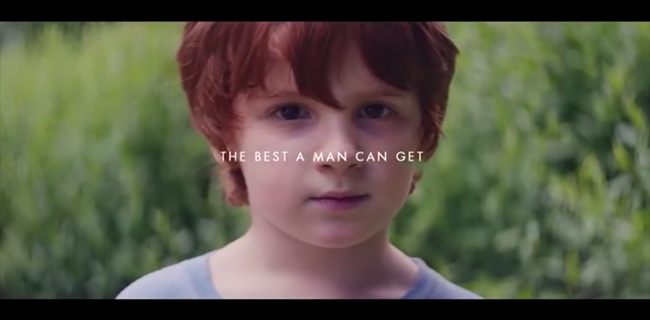
    Nowadays, it is becoming tough to be a man. And even Gillette is getting into the act.

    I am into this simple brand-feature-benefit-transactional relationship with the multi-edged Gillette razor, when suddenly from every article on marketing communication and potential award list now has started questioning me.

    Gillette Started The Battle Of Toxic Masculinity.

    When on January 13, Gillette tried its toxic masculinity concept and was brave enough to accept that maybe it was wrong to project the kind of masculinity that they have a party to. And perhaps they have been inappropriate in their reflection and projection of not only men act against woman but the woman herself.  (The toxic masculinity advertisement has some 700,000-plus dislikes on YouTube). How right!

    The brand told  you “We believe in the best in men: To say the right thing, to act the right way. Some already are in ways big and small. But some is not enough. Because the boys watching today will be the men of tomorrow” and I ask, who gave Gillette the right to contextualise and define what is wrong and what is right.

    Surely, I have multiple sources to listen, read and follow then a razor brand sharing this purposeful new doctrine. Well, the brand, in a way, went on to almost stereotype all the men in one bucket.

    All that from the fundamental insight ‘I am not the bad guy, but I don’t know how to be a great guy,’. Wow, is that advertising trying to be defining a cultural context. And which man does not know the difference between right and wrong, it’s as much as can’t and won’t.

    You are free to hold another point of view. That’s Okay.


    Is Gillette Advertising Really Purpose-Led.

    I want a razor and not a lecture on morality.

    Sincerely, I don’t like drifting aimless advertising.

    I thought that was international. And then suddenly we have this Spain Gillette asking you Are you man Enough?

    The definition of masculinity and what really is a man has been shifting. You can ask the razor brand that is finding it difficult to add more edges to its multi-edge blades.

    https://youtu.be/sfL2vpJJ1uE

    We have indeed been domesticated at home. We have been along with the daughters of the world lived through a generation of can’t, don’t and won’t. It was always more about how to behave, and that meant more of what not to do.

    We have grown with the idolised definition of what a man is or should be. Across the country, there are various definitions of masculinity.   Masculinity, revenge, honour, bravery, money, wishes and dreams were rolled into an undefined heterogeneous mix of directives.  Add virility, beard and performance into that list, and that’s what we know.

    Tear, fear and accepting defeat was never part of that definition. It’s still not,  other than the time when on social media, one wants to be politically right. And now this silly hair-cutting tool manufacturing company believing research wants men in Spain to re-evaluate the stereotypes as it makes the real man feel uneasy.

    The Complete Man Was Another Level Of Masculinity.

    Raymond’s ‘The Complete Man’ has been trying to tell us what is the construct of a perfect, complete man. It is non-intrusive and has been working. It never shouted or disturbed you with the question, Are you man Enough? And I am still talking of the earlier ‘The Complete Man’ series that was subtle and moderate by any standards.

    Men Will Be Men Is Another Polarised Masculinity.

    It is okay.  It is absolutely fine when we men laugh at ourselves. Look at the Imperial Blue ‘Men will be Men’ series. Don’t they teach you and remind you of obnoxious silly behaviour. They tell you in many ways what’s wrong or what’s right. And we men knowing what’s in it for us can take it easily. We don’t need this sharp blade razor manufacturing brand to overtly threatening tone to ask ‘Are you man enough?” or I will…

    Gillette Disturbs Asking – Are You Man Enough?

    Funny then for someone to ask “Are you man enough to admit you’re afraid?” And in the Spanish version, it begs the viewers if they are man enough to be a queen? I don’t think Gillette is thinking of asking such questions in India.

    Every research points out that the new age consumers are looking for brands with a purpose. But this? Seems like someone searched for the purpose and then tried fitting in the brand.

    I am not sure how easy or tough it was for the team at Proximity, Madrid, Spain to internalise this changing definition and shifting stereotypes before they made the client see their way.

    Oh, it is different when the question gets mellowed down to a simple and more acceptable format. “Are you man enough to be you?” Now, you see, the communication is far too convoluted and complexly un-related with the brand.

    It may be artistically exceptional and commercially well-produced. It may be superbly directed and well-executed. The truth remains that it is trying to be courageous in contextually correcting its earlier smooth shave gets you everything approach. It’s good that the brand is trying to GLOCALISE the concept, as there will be a razor-sharp difference from well-executed to downright polarised failure.

    The brand wants you to relate it to another simple fact that “It takes a real man” to do things, to be himself and do things that may not be right but a must. And this it thinks will add and facilitate an inclusive freer world. Help identify the new modern idealistic stereotype of contemporary man. Follow that changing expectation Gillette have moved from its own admissible toxic masculinity of “The Best that a man can get” to “The best men can be”. Well, that for a change is definitely within the challenging new definition. Gillette seems to be man enough to express regret and change.

    …………………..

    Gillette May Not Affect Toxic Masculinity Or Help You Find the Answer- But It Will Win Awards

    Why do I have a feeling that this long-term commitment to a right directional swipe by the brand is going to get a lot of awards: ‘The Best that a brand can get’.

    Do not forget, in Spain under this programme is a small scale prototyped 20,000 students connect programme by sociologist and psychologists. Additionally, there is that judges polarise Gillette Interactive teen chats focussing on real masculine values. There the teens will debate, reflect and surely realise (for the brand’s benefit) that masculinity means a lot different. They will get rejuvenated and charged for breaking barriers that that stop them from being themselves.

    Admit, Gillette Has Been Courageous In Their Act. Now They Need To Just Hold On To Their Belief. They may be saying it right and the way they want to say and shake up male thinking and stereotyping – but then I personally see a lot of gap between product-brand and the purpose. Hopefully I am not alone in it.

    …………………………………………………….

    DUREX STABS MEN.

    Meanwhile, another Man’s friend in need- DUREX CONDOMS tried starting a conversation under # OrgasmInequality. It is talking about a woman faking orgasm to satisfy the male performance ego.


    You’ve heard the numbers, you’ve heard the women and you’ve heard the men. Now it’s time we hear you! It’s time to talk #OrgasmInequality and Fake Orgasms. Ask a question, tell us your story or just be part of the conversation with #IFakedItToo. pic.twitter.com/cxeZRHkA0N

    — Durex India (@DurexIndia) May 31, 2019


    Something that every man knows but is afraid to speak about.

    The best friend Durex did not trade sides but reminded Man that lovemaking is all about mutual intimate pleasure.

    Horrible brand, it is asking women to share their fake orgasm story under #FakedItToo. Even if they open about these stories to the man they are intimate with, it can hurt many dudes psychologically to the level of dysfunction.

    It is different that in our country, not many women will share such stories even if it is  Swara Bhaskar and Pooja Bedi prompting them, but everyone would play their stories in mind. It did have an expected adverse playback from men. There was a lot of twitter debate about it. Yet, think the brand is still the winner.

    Another brand making it tough to be a Man knowing that the females can really influence the choice. The brand knows that it is absolutely true in the case of condoms. A man will get what everything that gets him the action and boosts his ego. And anyway it is all about Durex Mutual Climax Condom- another pressure point..

    This is confusing, as it is the case of “The best men can be” to “The Best that a man can get”. I just hope people get what is being said above. I hope the stance and comments are not taken at face value.


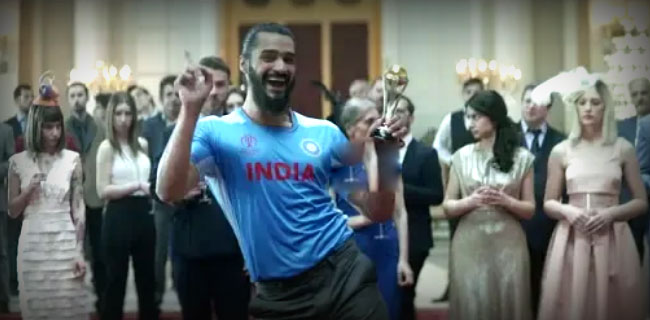
  • Reliving ‘Mauka Mauka’ as the stage sets for the Cup!


    By Sanjeev Kotnala


    Mauka Mauka’ was an iconic communication engaging and entertaining cricket lovers 2015  to 2018. So, it is natural for the reference to come up in May 2019.

    On May 23, as I was  the 2019 election results on TV, the seat swing with BJP winning was unprecedented. Someone teased the Congress supporters in the family with ‘Mauka Mauka’. It said it all.


    I know it is a bit early.  India only plays Pakistan https://www.icc-cricket.com/teams/men/20/pakistan/overview on Sunday, June 16. A date most of us have marked in our calendar. As it is early


    In the discussion, Star Sports’  current ICC #WorldCup2019 communication was compared with ‘Mauka Mauka’. And one can say  the cricket enthusiast in me wants another ‘MAUKA MAUKA’. However, the professional me knows in spite of intense rivalry, a serialised communication like ‘Mauka Mauka’ is simply not possible.


    One remembers the launch TVC. The full song #Won’tgiveitback.


    https://youtu.be/K-nNFWdBtB8


    In the last video, the Pakistan supporter with his arsenal of crackers lands at the Star Sports studio. It continued in many forms in Champion’s trophy, T20 World Cup 2017 with a lot of consumer generated spoofs and somewhere died finally with the Asia Cup. The CGS is already on like this SAPHIRA and films by Seven Pictures.


    And when you are at it:  watch this too. Spoofs are far more entertaining and touch a chord.


    The current World Cup has 10 teams. It’s an open tournament with a team playing all the other teams. The Top 4 qualify for the semi-final spot. And the chase is on.

    The current communication ‘Cricket Ka Crown Hum Le Jayenge’ by Star Sports is entertaining and exciting.


    The extension ‘Tum Suro Karo Hum Aate Hai’ promises that the broadcaster is not going to leave any Mauka of engaging the audience. And there is my hunch that ‘mauka-mauka’ will make an appearance sometime at least in the social media.  Meanwhile, the rivalry intensifies at every level


    I am really waiting for this ICC World Cup 2019 communication from Star World to take some twist and keep entertaining.

    …………………………


    It is cricket time. I must mention that I am enjoying the simple yet very celebratory communication from ”DREAM 11′. Dhobhighat, Bush and  Keys, all of them one relates too.


    And when it is cricket- the AMAZON campaign Chonkpur Cheetahs will always be remembered.  I missed them. I always feel that there was a lot ,more potential to this series than what we have seen.


    https://youtu.be/mM16sepxvZo


    Sanjeev Kotnala is a senior marketer, strategy consultant and educator. He writes weekly for MxMIndia. The views here are personal


  • Slice of Death Advertising


    By Sanjeev Kotnala

    The only sure thing in life is death. Rest is just a probability.

    We appreciated ‘Slice of life’ (SOL) advertising, however, we rarely see brands leveraging ‘Slice of Death’ (SOD) imagery and references.

    Death is all around us.

    Death is all around us. It is there in the newspapers, in the TV news and serials, in social media, and is an integral dominant theme in video games. However, the use of death in advertising remain taboo.

    Grief-exploitation is not my interest or focus of this piece. I am not referring to a few brands trying to get into a conversation during tragedy, calamities or death of a celebrity.

    Death Beyond Insurance And Social Messaging.

    Insurance brands flirt with death. Some social cause advertising like ‘drunk driving’, ‘Anti-smoking’ have  also explored the unchartered arena of death. But what about brand and services not directly liked with death. Do they leverage this certainty of life in their communication.

    Can death trigger the right context for brand/product/ service usage?

    Death is a simple phenomenon but a complex emotion. A certainty that we don’t want to acknowledge. Its relevance as a shock and clutter breaker cannot be disputed. Unfortunately, it evokes  strong negative emotions, and hence, brands fear to associate with it.

    Death is hardly aspirational. No one want’s to die. Even on our birthdays, we celebrate the end of another fruitful year on planet earth. But, we hate if someone reminds us we have walked another year closer to the end.

    Death Exploitation Can Be Misinterpreted By Audience.

    The ads by McDonald’s ( Child Grief- the kid being told of dead father’s liking for Filet-O-Fish ) and Nation-Wide ( Super Bowl-drowning kid- prevention of childhood accidents) in the US have faced adverse consumer reaction. If you carefully analyse, there was nothing wrong in them.


    We know the consumers’ purchase decision is more based on emotions than on information and features. We know death is a powerful stage and triggers extreme emotions. Yet, it remains an area of a no-go.

    Humour In Death.

    We have seen some of the brands cautiously using death to their advantage. Most of the time, it has been used as a scare but to make a point humorously. Remember the M-SEAL ad, where a drop of dripping water changes the will.

    Here I must share the fantastic ANTI-SMOKING communication featuring Sunny Leone and titled Eleven Minutes. A beautiful way of delivering the message to its TG.

    Even radio brand MIRCHI used the Ruddali concept and their engagement with death so powerfully.

    On the other hand, the Lifebuoy soap hinted at young under-five mortality rate and how death can be avoided in its communication. Here death is central to the theme but has a brief reference that does not raise high adverse reaction.

    Insurance Can’t Avoid Death

    On the insurance side, death is unavoidable. However, the way death can be used, dramatised and contextualised is the key to effective communication. Here are two examples.

    Max Life Insurance used the fear of death in its communication. My mother hated this communication as the protagonist name is my name. I am not sure if the brand used the most prevalent regional nicknames in their language dubs. But this one worked.


    Policy bazar has been flirting with death and eventuality of it, to push people to pick term insurance early. They have a dead man coming back to life for that short time and talk of term insurance or Yamraj getting angry at the person for not taking the term plan when he/she had the time.


    BEAUTIFUL DEATH

    There is no definitive answer to some of the basic questions. And as there is subjectivity and personal bias, there are no clear directions. Should a brand use death and its effect? Does shockvertising works? What is the right way to leverage death? Can death be the clutter-breaker?

    Here is an example of flirting with death. This short digital film was not produced by the brand and its agency but is highly associated with its theme ‘KEEP WALKING’. A simple story of two brothers visiting the places of common interest and togetherness for one last time.

    And maybe this is incomplete without sharing yet another communication developed by the same team that did the ‘Keep Walking’ film. ‘ABC of Death’ is about being alive. And the reference is death. Life and death- after all are two sides of the same coin.

    Metro Melbourne for their rail safety did what is now known as the most delightful horrible creation- a song telling people there are more similar almost as dumb ways to die as losing one’s life by being unsafe near train tracks. Any time I discuss this particular creative, I am reminded of daily deaths in Mumbai Local. I am not sure why such a beautiful message has not been localised or inspired some such release in India.

    DEATH IS NOT SO BAD.

    Few research reports do suggest that elderly people react more adversely to the use of death in communication than youth. However, none of them tells us as to what is an appropriate way to reflect and contextualise?

    And in this era of APP for everything, there is WeCroak. It is a simple app that reminds you of death five times a day. You download it from any of the play stores and make a payment to subscribe. Then it will message to remind you of death. And expect that such messages will help you to better contemplate life.

    In our Brand-I workshop, we take on exercises where we consciously focus on the possibility and certainty of death as an integral part of life. We talk of death as a motivator for the delegates to realise how much time you have to achieve the long list of wishes you may have.

    Death As Curative.

    Death is such a strong negative that even the terminally ill patients and their families don’t encourage discussion on the subject. As if ignoring it can push the inevitable. Last Laugh or Last Word for ‘Indian Association Of Palliative Care’ has taken death head-on and in the process raised awareness of Palliative care.

    And here is a wonderful example where the elderly person fakes his own death to get the family together. Here is a perfect example of using such a potentially negative emotion during the festive period but leverage it contextually for a beautiful, powerful emotional takeaway.

    So when you can and do celebrate life- why give death a step-brotherly treatment. It may give rise to strong emotions but rightly contextualised it can still be used by brands.


    PS: I would like to know of some brand communication (other than Insurance and social messages) where the brand has flirted with death and its vignettes. Most cases I have seen, its primarily the male who dies, has some Indian brand used the death of the female in its communication? Do share at Facebook sanjeevkotnala and twitter S_kotnala


  • 1980s imagery dominates 2019 Mothers’ Day


    By Sanjeev Kotnala


    Every year on Mothers’ Day, I get a sinking feeling that we are in a time warp. Or at least the Indian mother is has decided to drop anchor in 1980.

    I love sharply defined relationships and even the vague unmanned relationships too. In India, we have many such relationships. The relationship between daughter-in-law and mother-in-law. The bhabhi-devar relationship. The jeeja–saali relationship. The guru-shishya relationship. However, nothing beats the well defined sacred bond between a mother and the child.

    Mothers And Mothers’ Day in Indian Advertising.

    Mothers in Indian Advertising have failed to evolve out of the desperate emotionally volatile arena captured by Indian cinema. The sacrificial relationship with its predefined expectations and socially constraining coordinates still reflect the absolutely iconic expression ‘Mere Pass Maa Hai’.

    The imagery of self-less-love, a mother going out of her way, fighting all the odds, eyes with tear dams, will do anything for my child that defined the mother of 1980s still describes the mother in 2019.

    The acts that made Farida Jalal, Lalita Pawar, Rakhee and Nirupa Roy imagery as the ultimate mother still dictates the overt expressions in the mother-child relationship.

    Not that there has been a tectonic shift in the imagery and expectations of mothers. They still sacrifice their lives and ambitions for the future of their children. They still work like a superwoman. They are still seeking more empowered roles outside the home.

    So, when brands think of celebrating Mothers’ Day with some specific communication, they tend to remain chained to the overexposed mushy-mushy imagery. It is an easy way out.

    Why don’t these communications are more celebratory?

    Why mother’s day only has memories and situations aimed to bring tears to your eyes and make you feel emotionally drained?

    Mothers’ Day 2019 – Another Missed Opportunity.

    The brands are missing opportunities and at the same time insulting motherhood. By continuing to live with the pre-historic imagery, we are saying to the mothers, you have failed to evolve. Your work scope, responsibilities and a multidimensional personality is yet to get registered in the blinkered mindspace of Indian families and society. And dear Moms, we the advertisers, can only digress that much. We can only mirror what we believe our audience will like and not necessarily what you as our audience may appreciate. It’s business as usual.

    CATCH THE 1970s MOTHER

    So, catch the EPSON Mother, going out late in a rainy night to her neighbours. She is getting colour prints to help her daughter participate in a contest. Meanwhile, the WhatsApp-charged millennial daughter is only cribbing. You know the situation would have been easily managed if she had a printer at home.

    Don’t you forget the taste of food, that only mother can make. GITS has you covered with orphanage setting. Parleji is busy milking the old sentimental space of ‘Mother knows without being told’.  And, yes, she is duty-bound to everything for her children. MOTHER’S RECIPE (Gift of Time) shares a hamper of its products to help create some time for her. There is nothing wrong. At least it is direct and relevant.

    Some brands are still trying to ask, what does being a mother means? Motherhood is a phenomenon.  BIBA the apparel brand is trying to stand apart and tell you that we can be a mother in more ways than one. Shaadi.com is rightfully trying to push its own agenda and give a new flip to the relationship.

    SUNFEAST tries something different. The brand explores an extended student’s relationship with AMMA at the tea (or is it coffee) joint outside the college. It is at least interesting.

    Then There Is Mothers’ Day.

    So, when I see HOPSCOTCH Mother RAP. The swag of a Mother proudly proclaiming to be the stylist for her children. I see it differently. It is fresh and full of brand relevance. It refuses to be clamped down by expected imagery.  There is a blatant, right in your face product promotion.  At the same time, it remains relevant to the occasion and sentiments. I love it. It statically lacks craft-style, and that is a plus. I will be impressed if it can get the Mother Rap to happen on TikTok too.

    The Preganews gender-agnostic good news communication though ‘hat ke’, makes a relevant point.

    Brands must Converse Throughout The Year.

    If mothers are an integral part of your brand ecosystem, then the brand must remain in conversation with them throughout the year.

    The audience knows when the brand is being cheeky in using the particular date and day to make a statement. The audience is no longer fooled by it.

    Teri Maa Ki. Xhamster Joins The Call.

    Meanwhile abroad, a PornSite xHamster is planning to ask the valued customers searching for MILF on its sight, to hold back for a second and call their mother. TERI MAA KI. MILF can wait for your mother can’t.


  • Future Shock or Fixed?


    By Sanjeev Kotnala


    Sanjeev Kotnala

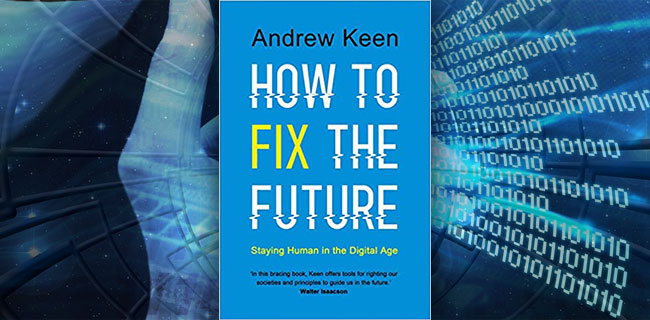
    I knew all along, there was something drastically wrong with the way the future is unveiling itself. I was on the lookout for a debate on ‘How to fix the future’. Andrew Keen’s session at the IAA World Congress held at Kochi, India in February this year probably opened new spaces for the discussion.

    We are under constant surveillance. Our behaviour is slowly being nudged towards what the dominant biggies Google, Amazon, Facebook of the business want. It is the new era of ‘Winner-takes-it-all’ business that is creating polarisation of wealth rather than distributing it.

    We are ignorantly working towards bettering their algorithms. We believe we are getting all this free. Not realising there is nothing free.

    The internet is a boon, but may be the price we are paying for its services outweigh the benefits.  Internet is the new morphine. Like many of us, I feel trapped in the system. I am addicted to it. I am unable to withdraw or detox.

    After having read ‘Internet is not the only thing’ by Andrew Keen, and having an equally polarised view of the internet, it was logical for me to pick his next book ‘How to Fix The Future: Staying Human in the Digital Age’.

    And if this is the trailer, what profound changes Artificial and Alternate Intelligence can unleash on mankind, unless we pre-plan to control the damage. History is witness to the fact that we are blinded by our vision of advantages and rarely humans have thought of the future repercussion while it adopted a new regime of services and products.

    Talking of the influence of internet-based services and addiction, I find it amusing and true. A potential threat humans failed to appreciate at the initial stage. “In the 1960s, we swam through the waters with only a few hooks: cigarettes, alcohol and drugs that were expensive and generally inaccessible… “In the 2010s, those same water are littered with hooks. There’s the Facebook hook, Instagram hook. The porn hook. The email hook. The online shopping hook. And so on. The list is long –far longer than it’s ever been in human history, and we’re only just learning the power of these hooks.”

    On the other side, humankind has always been smart enough to get out of the damage path by intense social pressure, tweaking of the technology and bringing new guidelines and reforms to control the damage.  Half of us would believe that we would once again succeed in doing so with the Internet and AI.

    In his book, Keen makes a very pertinent point: ‘The computer is the “Brain Outside ourselves” our “Second Brain”. From an evolutionary point of view, there we have taken an exponential leap. The new brain has outpaced our heart, our morality and beliefs. We are so preoccupied looking down at the second brains, that we forget how to look smartly at ourselves. As these devices get faster and faster, we appear to be standing still, as they produce more and more data about us, we are getting any more intelligent: as the devices become more powerful, we might lose control of our own lives. Instead of the singularity, we actually be on the brink of antithesis- let’s call it the “duality” –  an ever-deepening chasm between humans and smart machines and also between tech companies and the rest of humanity.

    He adds what I call a real possibility:  ‘In the future, we may no longer be in charge of our own creation… Our technology might be developing a mind of its own, thereby excluding and disempowering, and enslaving us. The existential threat of self-conscious algorithms is very real. They might be our final invention.’

    May be the answer lies in genuinely finding ‘What the Humans are good at’ and will always be a wee bit better than the machines. The current answer is ‘Nothing’. And we in our quest of making machines equally smart and emotive with a better power to process and take decisions are clearly on the path to wipe out any difference. I have my doubts. I am part of the small subset that believes; we are on the way to hastening the end of mankind. And one of the reasons I like reading Andrew Keen.

    Most of us are intellectually challenged to understand the enormity of the technology revolution, the amplified inequalities, the creation of parallel power centres feeding on our data and the race to harnessing Alternate intelligence.

    No doubt, Keen is open and transparent in stating: ‘This is a maybe book, based on the belief that the digital revolution can, like the industrial revolution, be mostly successfully tamed, managed and reformed. It hopes that the best feature of this transformation – increased innovation, transparency, creativity, even a dose of healthy disruption – might make the world a better place.”

    The book title ‘How to fix the future’ is misleading. There are no solutions. There can’t be.

    Keen presents a strong argument in favour of his belief that “No, not even the smartest technology can solve technological problems. Only people can”. I agree with him as he shares a few example and stories of how people are solving the thorniest problem in the digital age.

    Though there are directional paths from education to governance, to fixing it well in time. The example quoted in the book of Governance in Estonia and the always-on technology for betterment in Singapore shows some promise. The concept of ‘Universal Basic Income’, paid to everyone for ‘Not Doing Anything’ is also explored but be warned that can never be the solution. The only good part is that Andrew Keen is raising the issue. He at least presents a possible solution around competitive innovation, government regulation, consumer choice, social responsibility by business leaders, and education. It is up for healthy discussion.

    What I disliked was the constant reference to the 1516 work of Thomas More’s Utopia. It comes across as a framework of an idealistic world-inspiring Keen. But that is hardly the way life is expected to turn. Though it was interesting to note that if seen from a perspective More’s Utopia Map resembles a skull. May be there is a cryptic message in the map design that we are missing.

    Go read this interesting book that may sound fiction to many followers and admirers of internet-led ease in life.


  • Sanjeev Kotnala: IRS 2019/Q1 gives print Publishers reasons to Smile

    Sanjeev Kotnala

    By Sanjeev Kotnala
     

    The Indian Readership Survey (IRS) Quarter 1, 2019 findings are out. It brings good news to print publishers. Their reach and readership continue to expand. The total monthly reader touches new peak at 42 crores, a growth of 4.4%.  In this period, the number of households has also grown by 4%. Any daily reach remains unchanged at 39% all India level, 53%. Urban and moves from 32 to 33% in Rural. Reason enough for print publishers to smile.

    The results are based on a sample size of 3.24 lakh households, making it perhaps the biggest survey after the census in the country.  The country must be doing something right as NCCS D/E has also shrunk from 40 to 38%. The percentage of the population having a gas stove has moved from 66 to 72%. BJP should be happy to note, the scheme has made an impact.

    This growth in durable ownership is seen across the parameters that define NCCS, like Electricity, Ceiling fan, Mobile phone, Colour TV and as they cross the 66% mark, the need for a new more sharply defined segmentation system becomes that much acute.

    The findings show a gradual increase in percentage reach in 12-plus individuals across media. It also makes the print publishers happy, that the population that has accessed the Internet in last one month has only increased from 33 to 39% in urban area and 12 to 16% in rural areas.  The market impression has been different. With the enhanced accessibility, affordability and availability of digital data, one expected even sharper growth.  More reasons to smile for Print Publishers. However, the ONLY 2019 Q1 Unrolled data shows the segment of Active Internet users is at 51% in Urban and 28% in Rural.

    If one looks deeper, there is a small increase in the Up to 7 days (U7D) readership for English, which is a reflection of an almost dramatic rise in population of ‘Can Read and Understand English’. I believe that it will give the English print a surge in future.

    The online newspaper readership on a 1-month basis at 26% seems to be inching towards the magical tipping point of 32% for NCCS A1 segment. It is still miles away, as this is a monthly readership and not a daily or weekly figure.  Reason enough to smile.

    The findings are based on a further strengthened and digitised robust survey process.  IRS promises to be on track and to release quarterly data in the future. Not that much of tectonic changes are expected every quarter, but buzz with every survey does help in keeping the medium in focus. Meanwhile, a group of print publishers have come together for the ‘Print is proof’ campaign.  I have reasons to believe that there is positivity in the Print publishers ecosystem.

    Every measurement system is always Work-in-Progress, and it evolves with time and users input.  There will always be detractors and followers of such measurement systems. In the media ecosystem, the second largest media cannot do without measurement and IRS 2019, has adopted a robust methodology in its attempt to iron out the earlier issues and shortcomings.

    Compliments to MRUC which itself is a body with representatives from advertisers, agencies and publishers to have done the excellent work. Now it is time for the industry to support and use it to the best of advantage.


  • ‘Print Is Proof’ needs wider collective commitment


    By Sanjeev Kotnala


    Sanjeev Kotnala

    The coming together print publishers is a rare celestial aberration. However, this is not the first time when some of the largest print houses have got together. We know when they collectively questioned the IRS and hence MRUC some years back. Even at that time, people viewed it as a disturbing disruption, but it led to something good, a better more robust IRS.

    In the current era of the voyeuristic audience with limited attention, video-led consumption, social platform-based news sharing necessitating instant gratification, the print is unfairly being treated as a media that has lost its sheen.

    May be a bit late, but the Empire is trying to hit back with a simple communication celebrating Print in its regality.

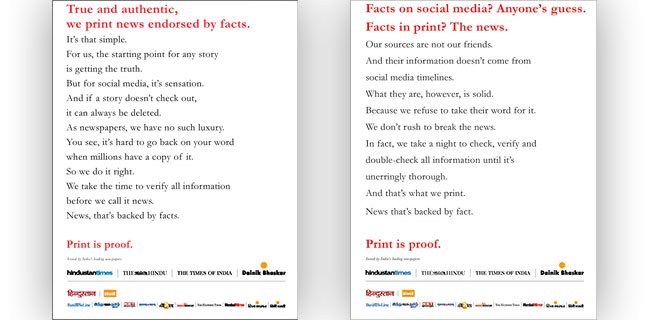
    A few weeks back, major print players – Dainik Bhaskar Group,  The Hindu Group, Hindustan Times, The Times of India, released their campaign on owned media. Full-page advertisements shoutig ‘Print is Proof’.

    It will be great if the HT campaign ‘Print is the Answer’ or another such campaign can get teeth by print coming together in a heightened B2B initiative.

    There is no doubt that print is still the most credible media by a margin. The barrage of fake news and the impulsive sharing of it is something everyone has experienced. I hope that many other print houses bury their hatchet and believe in each other’s intent to join the movement. Even if it may just be doing a post-purchase dissonance correction among the loyalists…

    Print proposes and wants the audience to believe that in the fastest-finger-first digital media, tracing the origin of news is a tough proposition. And that only in print the story before it is printed and delivered to you goes through multiple filters and crosschecks.  Unfortunately, the argument is not without holes. And the current generation does not believe the statement print makes: “If we don’t have the facts, we don’t print the news. It’s that simple. For us, the starting point of any story is verification”. Or ‘if a digital story doesn’t check out, it can always be deleted’.

    In its current avatar, the new generation feels that print is also as much about sensation, colouring, tinting and or manipulation of news. In the polarised and pressurised ecosystem prevalent in the country, it is foolish to believe that ‘No one edits the editor’. However, a large part of the audience from the print dominant era still believes ‘What’s Printed Is True’.

    India is one of the few countries where print still holds its position and continues to grow in circulation.

    I would be personally thrilled if the print houses can come together and do a collective correction in cover pricing. It’s much needed. In my view, it will still deliver a better financial position, even if the fringe readers drop out. Print needs it.

    Whatever may be their reasons to join the initiative, it needs to continue its momentum. More groups need to join in and help sustain the campaign and widen its reach through multimedia exposure funded by a collective kitty. Being in print alone is not the answer.

    Some other print advantages are capabilities to keep the story alive till its natural conclusion, share-and re-share the ground facts and developments, address individual sub-segment differentially and place advertisements contextually. But, just ‘Print is Proof’ may be a weak war cry that can lose steam fast.

    ……………………………………

    DISCLAIMER: I must confess I have not been able to check if the campaign has a digital, TV and or an outdoor avatar. It will be great if it exists and or the collective takes the initiative in this direction.

  • Tonic Worldwide creates #WakaoMoment for Dinshaw’s

    By A Correspondent


    Dinshaw’s Ice cream has launched its summer 2019 campaign titled, #WakaoMoment. The campaign focuses on celebrating the moments of happiness.


    The campaign is released dominantly in digital media and is supported by radio and outdoor in major markets of Maharashtra, Andhra Pradesh, Telangana, Chhattisgarh, Madhya Pradesh, Orissa and Uttar Pradesh.


    Said Jamashp Bapuna – Joint Managing Director and Zervin Rana – Director Sales & Marketing and Dinshaw’s Dairy Foods said: “Taste, quality, sensuality and romance have been overexploited in Ice Cream category. The consumer does not necessarily look for these. The brand needs to connect with them at their life moments and give them an emotional reason to engage. Hence the 2017 campaign celebrated friendship and togetherness under the theme was “Dil Ki Dosti pighalti Nahi” and 2018 campaign “Taste in tongue out” celebrated the temptation to eat ice cream. Salivating tongue-out whenever people see someone eating ice cream humorously represented it. The 2019 campaign addresses the core target group of today’s youth and tries to speak to them in their language. It is again slice-of-life representation. The brand is part of their life and is providing them with a new currency to express the excitement and happiness of their #WakaoMoment.”


    Added Sanjeev Kotnala, Marketing Advisor with the brand: “When you don’t have a word to express sudden happiness shout Wakao.  #WakaoMoments are simple moments and not rare in life. We have been conscious of the fact that the situations we use represent the lifestyle and local connections for the consumers in our markets. We are conscious of the fact that happiness should be the most democratized emotion and feeling. There is no measurement and process to evaluate happiness. But we through our own life, constraints and freedom, experiences and examples have created our measurement of happiness. So, it is entirely individualistic and unique for each one of us. And we have our unique ways to demonstrate happiness verbally and through actions. Just find a #WakaoMoment and celebrate it with Dinshaws Ice Creams.”


    Said Sudish Balan, Chief Business Officer, Tonic Worldwide: “Wakao is a creative expression for all celebratory moments and slice of life moments of happiness which strategically placed Dinshaw’s in the centre of all celebrations. The objective is to get people to celebrate all these moments with Dinshaw’s leading to brand love and sales. Additionally, it creates an emotional connect with youth audiences looking for a cool conversational lingo.”


  • Unsolicited advice to help make Goafest2020 better


    By Sanjeev Kotnala


    In the article yesterday, I discussed ‘what you missed, and they messed?’ with reference to advertising industry’s biggest festival of creativity and ideas. Goafest2019 finished on April 13, 2019. Like always, it had its own moments of the Good, the Bad and the Ugly.  There has been tremendous change as the festival keep evolving.

    Here I am sharing few inputs, that may help the Goafest Managing Committee see things differently:

    1. REALIGN. Do meet the absentee agencies now. Show them the new picture and help to get them positively polarised towards the fest.

    2. Launch a Goafest2019 survey among delegates. Provide a platform for free, honest expression and suggestions. Run it with all delegates and all sponsor and organisations on the corporate level.

    3. ENHANCED TRANSPARENCY. STOP SCAMS. Share all entries in their totality at the time of Shortlist. Give it enough time for people to check and raise an objection. Make the association protocol, SOP for objection resolution public.

    4. ENHANCE EFFICIENCY AND FESTIVAL CONSTRUCT. Capture data to make more sense of priorities and preferences. Track people movement. Record entry and exit details from different zones.

    5. TRANSPARENCY. Include a session where jury members express and share what they were looking at, what kind of discussion happened, and what favoured the significant winners.

    6. SESSIONS OF IMMEDIATE RELEVANCE. The festival needs more sessions like the one by Ambarish Mitra, CEO & Founder, Blippar who spoke about augmented reality, virtual reality and its rapid evolution in the marketing and advertising realm.

    7. SCHEDULE SHARING. Speaker schedules should be shared much in advance along with the title and synopsis for every speaker activity. Stop hiding timeline inefficiencies by creating a block of activities. Restrict evening dinner timing. Force discipline and movement to the after-party.

    8. HELPING GETTING SPONSOR THE DUE. (A) Once after-party starts, stop all ports serving drinks. Helps maximise sponsor return from parties. (B) Rightsize and re-position the sponsor logo on stage panels to ensure they are part of the picture frame.

    9. DELEGATE COMFORT.(A) Introduce premium seats that one can pre-book by session or by day. (B) Include a section in the app where the participants can see the complete list of questions asked to a speaker. (C) Let the speakers choose the question, or the moderator choose the question. Or a third panel to select the question to be raised.

    10. GOA QUOTIENT. Think about somehow increasing the missing Goa quotient, else we may as well call it the ‘Hyatt Advertising Fest’. Even if that means adding a feni stall. Floral-print-T-shirts, food items. May be offer some discounts.


    Like every piece of unsolicited advice, I hold no liability if it does not give the desired results. So act on your own risk.


    Sanjeev Kotnala is a senior marketing and strategy consultant. His columns appear on MxMIndia every Wednesday and on special occasions. The views here are personal


  • Goafest2019: What You Missed & What They Messed


    By Sanjeev Kotnala


    On Day 2 of Goafest2019, I tweeted ‘This is best Goafest Day ever’. Few have asked me as to what made me say so? Honestly, it has nothing to do freely availability of cold beer, lovely breakfast at Grand Hyatt or that the unfinished story had a new beginning. I will answer it at the end of this article.

    What was important was something entirely different.


    BLURRING OF LINES AT GOAFEST2019.

    Goafest2019 awards reflected reality. The lines defining the roles and expectations in the industry are blurring. The only relevant definition is being ‘creative solution contributor to growth’. The pseudo-line of controls like digital, creative, craft, print, traditional are no longer relevant.

    It surprises me when some industry stalwarts fails to recognise the new reality.

    What is there to be shocked of, if a digital agency wins PR Agency of the Year, a digital agency is the Direct Marketing Agency of the Year and a TV station is the Creative Agency of the Year. If you look at the second row of awards, you will find more such surprises.

    You can’t limit the scope of any organisation by the charter and contract. The festival itself has moved away from a sharply focussed singularly stated theme (Like Brand Dharma) to a broader eclectic mix of sessions.

    However, when Viacom18 won the top creative award, there was no point in rechristening it as ‘Company of the Year’. The era of brand purpose and growth, instead of relooking at redefining who can enter or who is an agency or a company, we should move to purpose-agnostic ‘Organisation’ terminology.


    MORE REAL WORK WINNING AT GOAFEST2019.

    The scam quotient is under control. The awards juries have been phenomenal. More Real Work Is Winning, as said by Shashi Sinha, Chair, Awards Governing Council GoaFest2019.

    The displaying of the Abby Shortlist for people to file objection seems to be working. I wish they displayed not just a list but also the complete entry. For example, how would anyone know what is the creative associated with ‘Meri Doosri Country’ campaign by Sony Ten 2’s for the FIFA World Cup 2018, until it is accessible?

    If the full entry is displayed at the Shortlist level, it will solve my second demand automatically. I have voiced it many times. At Goafest2019, I personally spoke with people managing the show. We must make available full winning entries for the public. It can quickly be done digitally.

    It will help demonstrate that genuine creative is winning at the festival. And students and practitioners who could not make to Goafest2019 will have access to this precious information.


    SCAM PREVENTION IS NOT JUST GOAFEST’S RESPONSIBILITY.

    No awards body can control and check a scam winner. They rely on the client and the agency collectively signing an undertaking about creation, inspiration, originality and exposure.

    If a scam does happen after this, we must look inwards and question our inaction. To stop scam winners, we have to act like a professional vigilance team. Just like citizen vigilance helps stop terrorism, only professional vigilance can stop scam entrants.

    So, for a moment think about how you can contribute. Pledge that next time when anyone seeks help to stop such scams, you will find the time to raise objections if any.


    KNOWING EVERYTHING DOES NOT COUNT.

    Day 1- started with Dr A Velumani of Thyrocare shaking up delegates. Presenting his story of struggle and hardship, dedication, passion and nothing to lose approach.  Ravi Desai of Amazon followed it with ‘7 seminal shifts’ in marketing.

    I sat through Ravi’s presentation with a bored expression. I know all this. What are you adding to my knowledge?

    Later at night, I was discussing it with dear friend Sumit Roy of Univbrands, he questioned my reaction. I realised where my bias was creeping in. There is a huge gap between  ‘I know Vs. I think Vs. I act’. Our knowledge has changed, but behaviour has not seen a shift. There is a need for individual behavioural change and attitude re-referencing before we can expect industry level shift.

    By the time we had Phil Kemish, Co-Founder, Disrupt Marketing and Brandtrepreneur, speaking about the four Ps (Purpose, People, Passion and Physical – bringing the brand to life) of marketing attitude. I was a different listener, a different delegate.

    Once, you realise and want to bridge the gap between  ‘I know Vs. I think Vs. I act’, your reaction as a delegate will change.


    THINGS REDEFINED AT GOAFEST2019.

    Overall, there is a tremendous change. We are getting better at time management. I still do not subscribe to Chairman or anyone extending any session. It happened during Unplugged and few knowledge sessions.

    The shifting of live entertainment to just after lunch slot worked. It eased the pressure on the evening schedule. It helped in starting post-lunch sessions and the evening awards on time. It also ensured that in the after-party, there was enough time to serve drinks before the 1 am closure deadline.

    The festival delegate average age is sharply falling. There is a shift towards smaller organisations and digital companies participating. Suddenly, it felt as if I was in some other industry do.

    However, there is a significant change in the number of delegates visiting display areas. I am sure they are interested, but the tight schedule of sessions and awards leave no time. May be we can make them available on a pen drive as part of the festival kit. I am not sure how does this impact sponsorship, or it opens space for further activities.

    One understands and appreciates the magical sponsor slot. However, it needs to be monitored and curated in terms of straight plugging and content. The way Google launched Google Creative was absolutely understandable and appreciated. However, everyone was not like Google. Some brands overtly pushed their agenda masquerading as knowledge.


    GOAFEST2019. DAY-2. THE BEST DAY EVER.

    The Day 2 had an absolutely fantastic set of speakers in the knowledge session. Madonna Badger opened the day with talking about ‘Women are not objects’. She made her case with examples – Women are equal, but their objectification makes them less than equal. Gorden Bowen made a strong case for creativity. He pointed out the need to be Creativity Lead, data-driven and tech-supported way of working.  Barry Wacksman empathised on the need to be proactively being a disruptor.

    Harshvardansinh Zala, Founder and CEO Aerobotics, topped this with an exciting session. He is just 16. His inspiring talk made the delegates look inward. It at least made me re-evaluate my journey. Lt Gen Hooda spoke of training and values defining the work ecosystem in armed forces. More than talking of the Uri attack, he sensitised delegates sitting in the comfort of an AC, the hardship frontline soldiers face at the border in extreme positions.

    Cricketer Virender Sehwag batted all questions upping the run rate. Part of the leadership series, he differentiated three leadership styles with relatable examples. Saurav Ganguly; creating the team, Anil Kumble; setting the target and keeping focus, and MSD- getting work done by the team.

    The only blip on Day 2 was Sidhant Chaturvedi and Kalki Koechlin talk. It went nowhere in spite of the interviewer Kubbra Sait trying her best. Jonita Gandhi’s unplugged session was nice. She got the crowd involved and moving with her.


    GOAFEST2019. CHANGE AND STRUGGLE THE NEW CONSTANTS.

    Change is a constant. The struggle is another constant in life. Without it, even the change does not make sense. Struggle in life happens at multiple fronts. In a multi-dimensional festival like GoaFest, it’s a churn towards the better.

    This time round there was so much learning in what is loosely called celebrity slots. Harshwardansinh Zala, Lt Gen Hooda, Virender Sehwag, Pankaj Tripathi and Mary Kom. You could have them as entertainment and/or as an inspiration. The choice is yours. But do put your filter through the test of the filter of ‘I know Vs. I think Vs. I act’

    Unlike the Mumbai roads that are repaired just before the monsoon, I hope Goafest management committee will visit the challenges now, much in advance. And we will have a brilliant Goafest 2020 on 10-11-12 April, the second Thursday-Friday-Saturday of April.


    TOMORROW: GOAFEST2020. Unsolicited advice to help make it better.


    Sanjeev Kotnala is a senior marketing and strategy consultant. His columns appear on MxMIndia every Wednesday and on special occasions. The views here are personal


  • Getting the most out of Goafest


    By Sanjeev Kotnala


    Goafest was fun when it used to be held at the Cavelossim Beach. It was hot and humid. One needed sunglasses, a hat and suntan lotion as standard accessories to navigate through the venue. I have been one of the stupids who questioned the relevance of some of fun activities including raindance, and I regret it.

    Certain limitations, costs, security, liabilities and other management issues moved Goafest to a hotel venue. The air-conditioning is excellent and the sessions are mighty comfortable. There used to be sundowner, after-hours party and enough beer to go around. But, in the process, Goafest missed out on both GOA and the FEST.  The fun element had taken a beating.

    It still holds its charm. It provides ample opportunities for ice-breaking, networking, training, knowledge sharing, deal closure and even informal business commitments. And it keeps evolving with time.

    This year we are moving to Unplugged entertainment of 30 minutes right after lunch. It may be a tough act. However, it achieves few things. It used lunch break as stage set-up time. It wakes up and recharges delegates. It gets them into the hall early and hence help in starting the post-lunch knowledge session on time.  Moreover, it allows the awards to start early without the long entertainment set-up period. And that will help start the after-parties early. My issues with this masterstroke are very few. Why even have these 30 minutes of entertainment. And such entertainment on a full stomach… does it sync? It may not work.  On top of it: just a 30-minute performance? What are we trying to do?

    For all we know, this is a mellowed down version of the real disruptive idea. Have the entertainer or the star performer as first slot of the day to help start conference on time.


    Goafest is fun when you are a part of a group.

    It’s pure fun when you are part of a group nominated by your organisation to attend Goafest. However, there is another subset of delegates. Independent individuals. These are start-up guys, entrepreneurs, small agency owners, media representatives and consultants. For them, it is a challenge to be a part of a group for long. And that includes the group from your ex-organisation.

    Whatever may be the subset you belong to, Goafest becomes chaotic by Day 2. It does not matter how big your group is. And by Day 3, people are bored of being with the same colleagues. The conversations dry up.  At this stage, Zombies takes over. You find delegates missing knowledge sessions and relaxing in their rooms. Sometimes it is just late-night partying and stressed out socialising/ networking that is the culprit. Sometimes, it’s the sequencing of the sessions.


    So, what can you do at Goafest?

    Get up early.  Take a walk along the beach. Many of you may not be near the beach. It’s okay, catching the early morning soft-flowing Goa breeze is a fabulous experience.

    Spend some time watching the shortlisted entries. Move to the display area early in the morning when the rest of the delegates are still deciding what to do. Now that you are there, don’t just glance over them, invest time. Study and understand them. If you find something that stuns you, compliment that agency or people when you meet.  Sometimes this is the best way to network. Everyone wants more appreciation!

    Pick the 2-5 sessions you definitely want to attend. Pick the first half and close it with the Unplugged session or may be start your day with it.

    Use your fingers and check about the author and the subject. Priming dry land before showers always helps. You will find that your interest in the subject and session gets enhanced. May be you already have the question you want to ask. Draft it and save it in your SMS. And when the time comes, plug that in the Goafest App.

    Avoid the sessions you do not want to attend. Don’t get pulled into them for any reason. The time is better utilised at the display area, networking outside, having drinks or just relaxing. I recommend early morning or the lunch time extending into the Unpugged session for this. There is nothing more tiring than listening with resourcefulness to something you are not interested in.

    Remember, networking and introductions happen in less crowded situations. So, create opportunities by being early at the start of the day, post-lunch session and awards night. A wee bit earlier than the hall doors open up and you may find it rewarding in term of connects you make. Do work like a homing pigeon. Make the networking worth for the other person too. So be ready with your deeply researched true networking opening conversation.

    Find the missing GOA in Goafest. Step out. Go to another beach. Eat at shacks. Have streetfood with friends. Find that lovely seafood joint or just land up at a casino for the adventure. Do something beyond Goafest!

    Most importantly, switch-off your e-mail and social media notifications. Do continue to post from the fest. People must know you are there. And respect the speaker, organisers and delegates by putting your phone on silent when you are attending any session.

    Find out the free Wi-Fi spots and passwords at the hotel. Check the connectivity. And at night update all your apps.

    Place three-alarms on your phone. Slot 15-20 minutes for an unhurried clean-up and replies of your inbox. Maybe at 0830, 1330 and 1830 Hrs.  Practice upward delegation. Check up how you can stop playing e-mail ping-pong and kill it with a phone call.

    Trust me, if there is fire, the right people have your number to reach you. Use your mobile camera to capture the moods, selfies and groupies. Select the picture you want to keep, delete all others and post the images (if you’re going to) then and there. Timing is everything.

    This Goafest, may you get what you deserve from it. May it create an all-new benchmark and reference of what to do in future. And may I meet Miss2016.