Tag: Sanjeev Kotnala

  • Sanjeev Kotnala: Self-regulate or Be Regulated

    By Sanjeev Kotnala


    F.N0. N-4407/10/2014-BC-1 dated 21st August 2014. Govt of India, I&B Ministry. Shastri Bhavan. Government intervenes to help ASCI (Advertising Standards Council of India) ensure channels do not telecast banned ads. A reason to rejoice for consumers. But a clear signal to the industry. REGULATE OR BE READY TO BE REGULATED. It is for us to decide if we wish to go back to the era of prior approvals and submitting storyboards.


    Maybe our insensitiveness is defined by our previous experiences. For example, no concrete steps have been taken on an earlier advisory. N0. 3105/74/2012- BC-III dated 7th June 2013 in reference to earlier directive on 23.05.2010 and 29.11.2011. It warns channels not to telecast programmes and sponsored slots (looking like programmes), which promote superstitions, highly debatable impact solutions and blind belief.


    I would suppose that the new consumer centric and media savvy government is willing to act. The signals should not be misunderstood. Regulation is a serious threat to the industry


    ASCI has primarily been acting on unsubstantiated claims made by advertisers. Not just the small advertiser but include large advertiser, which engage best of advertising agencies for their campaigns. This clearly indicates that the problem of unsubstantiated and misleading claims needs to be treated at the creation level.


    Rules or no rules. ASCI or NO ASCI. The gang  of Advertisers, Creative and media  agencies and the Media need to move in sync. Walk the talk of being reader-/viewer- and in turn consumer-centric.


    Few Simple Steps may Help Strengthen Self Regulation And Remove The Threat Of External Regulation:

    1- Creative agencies to seek  claim substaintiation from clients.

    2- In case of doubt; Client and agencies to use ASCI pre-check system

    3- Creative not to over exxaggerate claims or be based on unsubstaintiated clains.

    4- Media to insist on Advertiser guarantee  for  claims in their ads. Media should be held responsible only for following the process. Media should only be penalised if they release the advertismenet before getting a claim guarantee from advertisers. (The media agencies could be the carrier for it).

    5- If a communication banned by ASCI is still released, the client/ brand/ product/ service should be banned for a given time. Here media agencies may be penalised for releasing a banned ad as it is easy to keep track of banned ads of one’s client.

    6- Other than the classified ads, all ads must be released through an accrediated / licensed agencies. These agencies if found releasing unsubstaintiated claim ads should also be penalised. Just like every trade, a creative / media agency must be licensed registered with the governing body. Accrediation is a higher level of acceptance that provides for certain facilities including credit.


    Is it really tough to adhere to the simple ASCI CODEadvertisements should be truthful and fair to consumers and competitors within the bounds of generally accepted standards of public decency and propriety. Not used indiscriminately for the promotion of products, hazardous or harmful to society or to individuals particularly minors, to a degree unacceptable to society at large’.


    ASCI meanwhile has been doing exemplary work. Guidelines with industry involvement have been created for categories including magical remedies and education. The long-awaited fairness products guidelines impacting big advertisers is ready. Enforcing it  will be a real test for ASCI. I will wait and watch, how the fraternity abides by the guidelines or find ways to sidestep.


    ASCI, as a Self-Regulatory Body, has unfortunately been treated as a toothless lion. Its recommendations remained recommendations and suggestions. Brands, agencies and media have been busy exploiting loopholes. Industry too was not helping out by banning erring advertisments. Are We  Waiting For Consumer Courts To Take Suo Moto Action Against Offending Ads? Our behaviour definitely  lays the foundation for such an action.


    ASCI is purely guided by the prevalent societal norms, values and consumer protection. It is far more contemporary than the rules that govern the Indian advertising industry. ASCI has been the real internal censor/guardian. It has been shouting hoarse but no one listenned.


    Let’s accept this: earlier ASCI processes had multiple holes. These were routinely and knowingly exploited. The process itself was translucent and slow. The offending party was expected to withdraw the campaign. By the time even this verdict/ recommendation used to come, the damaged was already done.


    ASCI now has frequent meetings and is committed to faster decisions. You can also request fast-tracking of complaint on payment of a fee. You could send an appeal or a complaint digitally. Ads with serious breach of ASCI’s code come under SPI; ‘Suspension Pending Investigation’ (SPI). It mean they will be withdrawn immediately pending decision of Consumer Complaint Council (CCC).


    ADDITIONALLY it is essential that few other steps are taken at an industry level:

    1- To be really relevant in current scenario, ASCI need to fast track its Radio and Internet projects. May be even cover outdoor.

    2- People engaged in the process of campaign creation are educated on the laws governing it. Industry definitely needs to bridge this gap.

    3- Government must contemporarize outdated laws. Many of them are really old. Like the Drugs and Cosmetics Act, (1940), Emblems and Names Act, (1950) Drugs and Magic Remedies Act (1954), Copyright Act, (1957), Monopolistic andrestrictive trade practices act (1969), Consumer protection act (1986), Indecent Representation of Women Act, (1986) and Trademarks Act, (1999)


    It’s time that we took our business and its impact on the society a lot more seriously. And if we believe in the power of persuasion, our work can deliver, we must ensure that the message is not misleading. We owe that much to ourself.


    Read more about ASCI at http://www.ascionline.org/.
     

  • Introducing a new weekly column by Sanjeev Kotnala: Time we recalibrated UnMetro Consumer Understanding

    It’s surprising to see the lack of studies in understanding the consumer in these markets, writes Sanjeev Kotnala in a new weekly column


    By Sanjeev Kotnala


    I am surprised that there is still an ambiguity among Citizens of Planet ‘Media Buying and Planning’ and ‘Marketers’ about UnMetro market potential and possibilities. Because, it  silently crept in while they remained glued to their ivory tower windows with a limited view. The result: no one understands it. All they have is a scrap book filled with decades of old metro-centric planning to refer.


    No doubt, there is a gap, a result of a lack of investment in understanding it. There is really no champion of its cause. One who would go beyond lip service but really push the envelope. UnMETRO, the event by the Dainik Bhaskar group, was the most visible and serious one.


    This apathy towards UnMetro is unnatural. The business has shifted and to survive /grow, marketers have to tap these markets. It’s surprising to see the lack of studies in understanding the consumer in these markets. Tackling the metro consumer successfully is no guarantee of success with the streetsmart UnMetro consumer.


    UnMetro is a huge market. It is the true reflection of the oft-quoted vignette of cultural-social-economic diversity, which creates differential mindset. Most of the marketers have maintained an arms length relationship with these markets. But, this will change. The punishment posting will become hard-earned chip on the shoulders. One who understands these markets will command premium.


    In UnMetro,the policy of one-size-fit-all does not be work. One needs to dig in and best exploit local a medium like print, radio, OOH etc. One will have to tweak the offering in its tonality even within the state. Neither will the old understanding take you anywhere, nor will the inferences drawn on comments by internal resources work. The real UnMetro representatives within the industry migrated a long time back. Most live with a picture that is no longer valid. In fact the marketers, the media and the creative agencies must get their licence to address the UnMetro consumer renewed.


    Old UnMETRO is dead. The towns that suffocated with stagnant infrastructure are gone. No longer higher studies mean compulsory migration. No longer ambitions need to be strangulated under pressure of relationship, care and family needs. Sacrificing possibilities and opportunities is a rarity and not a rule.


    The hunger and desire for brands, experiences and service is not a result of untapped / unserviced built-up demand. It is the outcome of newly acquired  prosperity and a never-say-die attitude to life. The old leaders in industry saw UnMETRO as something  not critical for their success. The new guard is not so myopic.


    The real literacy in UnMETRO is on a high. Parental confidence and commitments are fueling new heights of ambition and dreams. The media revolution and ease of information coupled with positive government initiatives bridging the gap. Mass media – TV and Print – rules. Radio aptly supports the new ecosystem of aggravated lifestyle needs.


    It’s essential for marketers to re-evaluate their filters. Look into the opportunities with open arms and mind. Invest in understanding, so that they can recalibrate their tools to face the challenges it offers. ‘India’stands stumped while ‘Bharat- UnMetro’ is live and kicking.


  • Somewhat Seriously: Martin beats Arnab 7-4 in Shadow Boxing


    By Sanjeev Kotnala


    Thank you IAA for making it possible. One can see why the IAA India Chapter won the most active IAA Chapter award recently.


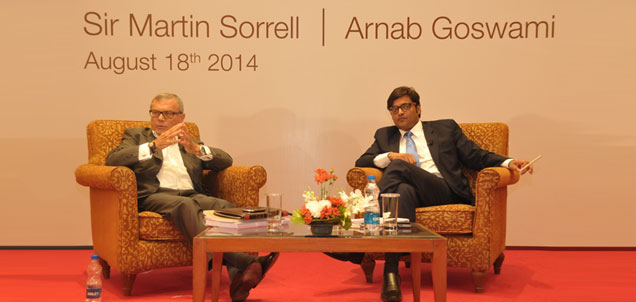
    Sir Martin Sorrell (SMS) gave a basic course in TACKLING Arnab Goswami (AG). From the world GO, SMS opened with Cricket stating that it seems MSD seems to be a captain with fixed thinking. Then he fired His question. How have the elections been for you? An open-ended conversation that followed with: why was there a gap between the Rahul and Modi interviews?  It forced AG to go in a detailed explanation. It was half-way through his comment that AG realized it was he who was supposed to be asking the questions.


    The election discussion closed with SMS probing. When the Congress says the media is to blame for their debacle, were they referring to media as media or you? AG in self-congratulating mode pointed out the Rahul English media exposure was limited to Times Now.


    I wish that Indian politicians should not watch this show when it’s telecast or is on Youtube. They may learn how a tactfully well-prepared person, with smile and humour can enjoy the discussion. How to be precise in your answer, not allow AG to corner you or allow him to put words in your mouth. SMS seem to have taken the advice in yesterday’s post.


    AG started with -‘I am honoured to be interviewing you and I have great regards… ‘ Was turned by SMS into a class for politely being rude. SMS said ‘you can be sure it’s going to be tough one and dam sure if the guy says ‘Personally I have nothing against you’.


    AG – there is respect in your well-preparedness and being very focused in your approach and questions. You as always were well-prepared with your data, quote and historical references. But today, you did meet someone who betters in it.


    SMS ON MEDIA: There is a mismatch between, the amount of time the consumer devotes or by the way the consumer consumes media and the investment (read advertising revenues) by agencies and client in it. Pointed out that this will find its balance. Fragmented media is a challenge and it will get more challenging with time.


    SMS ON TAM:  AG half-volley  ‘Your comment on TAM’ was met with a nice cover drive ‘Nice Company’.  Keeping the Indian scenario out of discussion, SMS pointed out that in most  (I did hear him say all) of the companies there is only one TV audience measurement currency. Can there be 1-2 or 3 measurement currencies is something that the market will decide.  AG doosara on does TAM (read SMS) need to wait for government directive for enhancing TV Meter numbers was hit hard. SMS pointed out that additional meters means additional cost and it must be shared by the agencies, client and the channels must share the burden.  Reiterating that WPP is committed to provide the most accurate measurement, he made a point that it’s not meters alone but a willingness to shift measurement process with change in consumer habits is required. Giving an example he cited the use of C+3 and C+7 meters that track not only on-air but deferred viewing.


    SMS ON INDIA AND CHANGES: The Independence Week made AG continuously probe SMS outside the off-stump. Is India at the Vortex of change? Can India- made media be global?  SMS showed a straight bat. He was optimistic that the new strong leadership in government is coupled with strong commercial leadership, then India which has been in the wrong side of the history for so long would definitely see a change.  And that it is advisable for the businesses to first exhaust the local opportunities before looking out.


    SMS ON FURTHER INVESTMENT BUYOUTS IN INDIA: He rattled off that WWP business in India is about 499 Million. And growing @ 10%. Talking to Sam (Balsara), he said: ‘If there is a business opportunity that is 50 million worth, he would consider it and is willing to write a blank cheque.” SMS thinks that his competitors in recent past have made some ill-advised low-leveraged investments and that is starting to reflect in their figures.


    SAM AND SMS: Sam raised a probing question that in the Indian situation where TV and Print (the legacy media) dominants. The foreigners (like you) come and talk just digital-digital. Are you not missing the bus?  In SMS’s view: “This is true as of now but all businesses have to look future-ready. I am not sure when the tipping point will come and change the dynamics. But it will come surely, with the speed of change speeding up’.


    SMS ON THREAT.  The biggest threat is not competition but Complacency, Arrogance, Satisfaction and lack of energy. He said he is a disruption freak. All his life the growth has come from disruption.


    SMS ON BALANCE. He referred to his divorce as an example. His lawyers had two possible solution and they asked: what was more important – business or family.  Not surprising, the answer is both.  This was when AG tried creating a 2×2 matrix between King and God on one side and Data and Analysis on another. SMS went to the extent of drilling the point home in more ways then one. As per him, creative and data, science and art, gut feel and analysis are such a pair where balance is more important.  Balance is not something that’s 50-50, but the right mix. Whenever the pendulum would swing to one side creating a biased skew: correction will be needed.


    MY SPECIAL:  (1) SAM, can we raise the same question on legacy v/s new media for all the discussion that happens in Indian forums? And many such places you are one of the guiding force? (2) I am surprised at the limited attendance to the event. At any stage, there were not more than 120 people in hall set for 150-plus. IAA could start planned invitation push (even paid) public beyond their members for such an event.  (3) Liked SMS referring to AG as a fly buzzing. (2) Liked AG comparing SMS to a Smart Politician and we would know where that feeling was coming from.


    Disclaimer: The above personal interpretation of the discussion.


    Aside: In a fraternity meet like this, with most being media or IAA invitees or senior people- this long introduction of SMS and AG- was that required?  I personally felt it went too long.


    Sanjeev Kotnala is Head Catalyst, P1P2Solutions. The views expressed here are his own


  • In Jest | Sanjeev Kotnala: Sir Martin’s Secret 7 Steps for Encounter with Arnab

    By Sanjeev Kotnala


    MARTIN Vs ARNAB promises to be an interesting Reality Shadow Boxing Show. Live today at 3:30pm at ITC Grand Central, Lower Parel. Mumbai.


    Sources in WPP and IAA requesting anonymity tell us: “A lot went into ensuring Sir Martin Sorrell (SMS) 69, CEO, WPP to agree to converse with Arnab Goswami (AG), the 9pm dude of Indian television. It’s a great combination and a must-watch for the audience. Hope AG does not tone down his usual theatrics.”


    AG the sport that he is was willing to grill SMS risking his future. You don’t know what Martin buys next. IAA convinced him that Martin is no Rakhi Sawant or Lalu and could not guarantee TRPs at 9pm. ‘Frankly Speaking with Arnab’ was out of question. Hence the 3:30pm slot with a live audience.


    It started with the head of one of the Martin’s many companies pushed by the polite tall gentleman of IAA approaching Martin for the Encounter. Who is this Arnab Goswami? Is he head of some media business that you guys want Martin to meet was a natural question raised by SMS’s secretary.


    Primary research over the Net revealed AG, born 1973, writer of missing-from-the-racks ‘Combating Terrorism’, is an Indian journalist + Editor-in-Chief + News anchor of ‘Times Now’ and primarily responsible for all the Noise at 9pm. He has 21K+ likes on his Facebook pages (FB does not count Hates). While ‘NATION WANTS TO KNOW’ is his pet verse, truth is AG already knows and decides what and how much the nation should know.


    This was insufficient information for SMS who believes in knowing the ememy. WPP India team was directed to provide a complete dossier incuding list of Youtube videos to watch. Due to conflicting views, SMS finally made his own assumptions. Child’s play, he uses the same technique for understanding any thing Indian, including the economy.


    For the last seven weeks, SMS been preparing for the Encounter wrongly named Conversations. And here is the exclusive step-by-step action of the 7-week preparation programme.


    Step I: Watch Youtube videos and track social media on AG. Avoid polarised performance vedios with Rahul Gandi and Modi.


    Step II: Practise raising voice. AG loves a fight. SMS went to the best, he has been coached by Thirumurugan Gandhi who holds the record for outshouting AG.


    Step III: Dodge questions on Economy, FDI and cross-media ownership.  Fighting AG is a waste of time. Polite conversations will be the best weapon. AG after all is ill experienced to handle politemess and logic.


    Step IV: Build immunity to shouting.  With no body to shout at him, this was identified as the weakest point. Now, SMS is expected to  allow AG to shout when he breaks down the discussion to few limmited  focussed points, without  bothering if he was stating things out of context. Right context. WPP Generals have informed him audience would love it.


    Step V: Carry no notes. Sit straight. No gestures. Head must always be held above AG line of vision this makes AG nervous. Only AG can hold paper and bang the table or raise his voice shouting ‘The Nation wants to know”.


    Step VI: Shuffle through recnet past. Read all your past comments. Articles- interviews and even the SMS and Whatsapp messages. AG is bound to bring something from your past that even you may not remember.


    Step VII: Minor details major impact. AG is known to wear suit with white shirt. SMS been advised to stick to light pastals. SMS expected to avoid Dark Red and sit facing North. AG is allergic to anything Red or South. If he reports in wearing just shirt and trousers, be on guard, this is his style of trapping you.


    The two parties agreed on a NO-DISCUSSION LIST.


    Point 1: Salary and Copensation. SMS Total calculated compensation 2013 was 2.98 crore GBP. SMS is staunch supporter of salary hikes for CEO and Board members.


    Point 2:The failed merger of Publicis Groupe and Omnicom Group. It is old news.


    Point 3: Need for media measurement. Both WPP bosses IAA and the publication houses has warned AG on it.


    The tall gentleman from IAA been extra-cautious. No playing ‘My Funny Valentine’ by Chet Baker and Gerry Mulligan, especially the trumpet. It is known to change SMS’s mood. Deva oh Deva or ‘mai doll hu peetal di‘ is not allowed as AG natural instincts get charged and errupt out of context, just like some of his debates.


    Media Punters taking bets on (1) How late will the programme start  (2) How long will Martin last (3) How many times will we hear ‘The Nation wants to know’ ( The audience wants to know would qulify) (4) How many non-planted questions will be asked. *Conditions apply.


    No bets are being taken decibel level beyond perisible limits. Punters do not take bets on facts – truth and near certainty.


    Disclaimer: Late update reveals that it’s going to be mellowed down AG taking in equally polite SMS. With no satellite beam and lack of people to switch and noute; Arnab is expected to show his other side that audience will hate to love.


    If you are on Twitter, just go ballastic at the conversation


    Sanjeev Kotnala is Head Catalyst, P1P2Solutions. The views expressed here are his own


  • Sanjeev Kotnala: Nothing wrong if the Boss cooks

    By Sanjeev Kotnala


    Another point of view on The Innocent Simple TVC by Airtel.


    I am happy to note that the spot is still on air. It demonstrates that the client is not spooked by criticism. And I appreciate it.


    Media, creative expert and social science adventurers have not been able to see how progressive the TVC is. We must applaud   this progressiveness. Or the barbaric assault on creative will make many creative people chained to retro ideas.


    This has only increased viewing of a mediocre ad. Let’s not forget that the consumer of the brand has audience beyond metro and hence the creative expression cannot be judged by metro standards alone. Truly, the giant step of wife, as a boss, could only be accepted if the man was the boss at home, equating to wife cooking at home and waiting for him.  Let creative be analyzed for its creative and strategic intent.


    Bura Jo Dekhan Main Chala, Bura Naa Milya Koye

    Jo Munn Khoja Apnaa, To Mujhse Bura Naa Koye

    [I searched for the crooked man, met not a single one Then searched myself, “I” found the crooked one]


    It is probably the first brand in India bold enough to create WIFE-AS-THE-BOSS scenario outside the home. First to demonstrate the AMBITIOUS, NO-NONSENSE HIGHLY PROFESSIONAL SIDE of woman, if she demands performance her command must be obeyed. She in her professional avatar is away from the bonds of family and social relations and so called hierarchies. Yet she is caring.


    May be the crowd criticizing it on its myopic vision fails to appreciate. Sari in office and shorts and top at home is such a brilliant piece of costume designing.  Promoting sari as a office wear is so nationalistic and shorts and top at home show respect for the tradition and culture, but freedom in relationship. The choices being made are independent with self will and not being forced.


    Is there anything wrong in her lovingly cooking at home, seducing him with visual delights of definitely appetizing dishes and being in touch with her husband? Would the reaction been positive if after coming home, she played with the infant kid, breastfeeding the baby and showing those pictures on smartphone to her husband. Would that not still be sticking to the stereotyped images? Many would have questioned her need to work with an infant baby. Because, they need to serve; deep-fried stale creative comments with high frequency.


    May be the creative team did discuss the possibility of her ordering pizza at office and at home and eating in virtual togetherness created by the smartphone screens. May be they missed this insensitive highly progressive twist.  Why do we shy away and find fault at reflecting what is really happening in our society?


    How did they miss the macho male progressive trick of senior male boss taking load from an obviously overworked junior lady and allowing her to go home? Then from home, when the clock struck 11, the junior- who is also wife-, would have shown the dinner to him and her silently requested ab toh ghar aa jao.


    Though technically the whole premise of boss wife is weak.  Most companies do not appreciate/ allow/ employ husband wife combo and definitely not in a direct reporting structure.


    Think most of the baiters have missed the last lines of the ad. The relentless professional boss in caring wife avatar does not take the bait by an equally emotional husband.


    WIFE : Boss ko bol wife bula rahi hai

    HUSBAND :Tuh hi bolo na boss ko

    WIFE : Zaldi aana wait karoongi


    And they miss that it is just an episode of their life. How cute and loving the real relationship between these two would be. Why negate and why not look at positives.


    Maybe the next ad from Airtel must could make the Boss wife stay back for a meeting. Husband to comes back and cooks for her. End visual almost same with role reversed. Double stroke of breaking stereotypes and appreciation form this crowd.


    Hopefully that will never happen. Brands do not need to always looking at creating social revolution. Nothing wrong in being sensitive caring and easily adapting to changing role requirement.


  • Sanjeev Kotnala: 11 Learnings from the World Cup


    By Sanjeev Kotnala


    The sudden vacuum post the final last night brings alive the whole World Cup alive in short burst of captured moments. And in the process filter with ease and least effort some learnings that are tough to miss out.


    1. YOU CAN’T CREATE A TEAM IN MIXER GRINDER. Brazil is the case in point. Other than 4-5 of its team members all play for different European clubs. Ingrained in them are a mix of different styles and tactic. Contrast this with Robben and Persy, the smooth comfort of dependency and confidence is visible to naked eyes


    2. INDIVIDUAL BRILLIANCE IS NOT ENOUGH. Football is a perfect example of teamwork in an organization. Success only comes when the team performs as one single unit. You cannot have 2-3 stars and expect to win. Even Messi’s brilliance is no answer to German teamwork. And Neymar alone can not be credited for Brazil reaching the semis.


    3. REJUENATE OR FAIL. Teams without differentiated strategy and approach have perished in the initial test. Teams investing to adapt to the new defined needs have flourished. The surprise factor will always (read most of the times) work. Luis Felipe Scolari’s commitment and confidence in an old style with hardly any innovation presented it as a known enemy to other teams. Easy to work out.


    4. SEX HAS GOT NOTHING TO WINNING THE MATCH. Throw away the old theories that blame sex with the loss of power and stamina. Now that the teams with sex-curfew or allowing non-acrobatic passion falling in the way. This means that others benefited from relaxed norms. QED


    5. TOUGH TO CHANGE THE NATURE. Don’t expect a player known for repeated violent offence to change his colours. Don’t expect people to perform duties that they have not been prepared for. But expect them to raise their level in their area of expertise. Luis Suarez is a classic example of frequent burst of this nature and Robben the rising in level of expertise.


    6. INERTIA – MOMENTUM MATTERS. What better example than the Netherland’s defeat of Spain or Spain’s defeat by Netherland. Look at it any way. The team’s future performance was coded that very day. The semifinal Brazil Vs Germany, the heartbreaker 11th minute goal by Thomas Muller which opened the gates for another 4 in 6 minutes.


    7. EMOTIONAL CHARGE A TWIN-SIDED SWORD. Over hype and expectation a pressure that the players are expected to carry at this stage. And I suppose that Brazil would have been okay if Neymar was out of the match due to red / yellow card. But the purely unintentional incident in quarterfinal, the injury and the relayed expectation charged the environment. It was too much and pushed them back- as everyone wanted to be the savior. They simply lost the objective.


    8. CONSUMERS DEMAND QUALITY. Much nearer home. The broadcaster lazy start of Café Rio with novice masquerading as experts was one such move, that the channel had to change later. And I think the outcry against Robben dives ensured that it was missing in the semis though there were possibly galore.


    9. RISK IS AN INTEGRAL PART OF THE GAME. Be it the formation- substitution or change in tactic. Until unless you are willing to take risk the rewards may not accrue. The last-minute substitution of the goalkeeper was termed a master stroke- but what if it had failed. You take conscious open-eyed risk and are willing to live with the results.


    10. LUCK IS IMPORTANT: No team better demonstrate this than the other finalist- Argentina. They have been scrappy and just about making through the stage. But sooner or later the luck will start siding with the talent.


    11. IT IS A YOUNG GAME : I guess that the average age of stars is coming down. The young talent is challenging the strong hold of tacticians. Neymar, James Rodriguez, Paul Poga, Memphis Depay are just a few of the names that have shown a different level of passion, commitment and hunger.


    DISCLAIMER: football is not my game. But this World Cup was my most watched cup. And that would take me to expert level-licence to comment. The above are the list of professional learning even an amateur like me could not miss out.


  • Sanjeev Kotnala: 20 things Goafest must do to be in the reckoning

    Sanjeev Kotnala

    By Sanjeev Kotnala


    Goafest 2015 will happen at Goa – that’s as much certainty you have about India’s premier advertising-marketing event.  Basking in the glory of a successful Goafest 2014, it’s natural for not to look at the issues and problems with it and try addressing them in Jan 2015.


    As an industry that claims to be at the forefront of designing marketing and advertising solutions for client , we would have once again failed. Trust me, the debate if it would / should / could been a Festival / Celebration / populist /  Boycott / Barat / knowledge platform / scam will never be finished. It’s been a mix of all of them and will remain so.


    There are more problems than solutions at Goafest.  And the Kyoorius Awards night at NSCI has upped the benchmark raising new set of questions. But, Congratulations is due to the team that made Goafest 2014 possible.  The 2/3 day pass was definitely a relevant innovation. Getting the I&B Minister immediately after the election was a coup. ‘AIB’ and  ‘AAP developers’ a masterstroke. Publisher and Broadcast Abby a positive stroke towards wider inclusion. But these cosmetic victories does not provide the answer indstry and the young brigade been seeking.


    Complicated and well-documented issues like Egos / Sponsorship / Permissions / International Speakers / Scams / Formats / Awards have been slowly eroding its percieved value of the fest. I fondly remember the euphuria when the first fest happened and again when AAAI and Advertisng Club came together to create one single award. After so many years, it remains an iffy. Come to think of even if spoken in humour, the Goafest signature seems to be ‘Beer & Rain Dance’.


    It starts with the basic. Today we know the dates for Cannes. Spikes, MediaAsia  and  AdAsia. But for Goafest, please, wait for the new president to take over in Feb 2015. Can Ad Club and AAAI not agree to give the Goafest President/Chairman a three-year tenure. And are we still so underfunded that we cannot have a full-time-paid -secretariat working on the event. Before we single out Goafest, let’s be clear: this is true about all the industry events. The large acclaimed advertising-marketing bodies have not been able to create signature events with fixed schedules.


    I have attended all editions of Goafest. I personally found new ways to enjoy the differentiated offering every year.  But most of them got nothing to do with the fest itself. The problems facing Goafest are well-known and mostly been stated in macro terms. More so and may be the same set ot people been trying to fight to on too many fronts. But truly seaking, the solutions are also with them.


    Today, the time is just right with 10-11 months to go for Goafest 2015 for them to prioritise their problems to attack. The problems are so inter-leveraged that solution to P1P2 ( Priority 1 and 2) are bound to set series of domino crashing.


    If you look at the Goafest – the problems are Participation / Boycotts / Bad publicity / not enough publicity/ Entries / Jury / Awards / lack of excitement / April-May / Fee and many more.


    Sincerely, I believe that given the scope, time, experience and mutual respect, the solutions should not be really tough for an industry that has solved many complicated brand positioning and execution problem. The personal belief remains that Goafest is a deat of celebrating great communication and should be cosnidered the flagsip event of the industry in India. But then beliefs do not count for anything till the issues remain.


    1. DATES / TIMING :

    Easier said than done. Can we just adapt 1st Thursday of April start date?

    Why can’t the Goafest committee be in place now?


    2. FEE : 

    Oh, they have started moving northward but are somewhat manageable. Or we need to find innovative ways. What about a refund that is based on the number of knowledge seminars you actually attended.
    The amount of activation- fun and energy creating stalls and activity centres have been decreasing with the years. Trust these add to the whole space and the kick of attending Goafest


    3. SPONSORSHIP:

    Unlike international festivals we don’t see any agency or marketer non-media sponsors. Depending on media like Discovery, Goggle, Hindu, HT, Colors, Star, Dainik Bhaskar is going to be suicidal in the long run.


    4. SPONSOR EXPERIENCE:

    One of the biggest issue. What is being done n the experience and promise part of the deal. Currently with the sponsor matrix of ROI and ROE not being answered we have to chase sponsors. If this is taken care of the sponsors would be willing to do a long-term deal.


    5. OUTSOURCING. Or is it unthinkable?

    I am also aware that a body of people did made a case of outsourcing the event with acceptable financial and on the terms that Ad Club and AAAI would have wanted. I am sure that may take it to another level.And if you do look within the industry many such consotiums willing to bite the bullet exist.


    6. INDUSTRY UNITY:

    Toughest of all. Divided we stand and united is the image we would want to project. Every year the issues get voiced nearer the event. They need then to be tackled with the back to the wall. Mostly full of illogical, irrational at times seemingly ego-centric personal agenda-led crap creating volcanic fires tending to polarise the industry. it definitely does is to give the event a bad name and dampens individual interest.


    7. AWARDS AND JURY:

    Time to re-categories and re-look at the number of  awards and create a group for the 3 nights that remains consistent. The clubbing of awards are also by the categories / media / entrants and interest. Deep dive and understand the root cause beyond the apparent stated reasons and solve the participation issue.


    8. KNOWLEDGE PRESENTATIONS :

    For every delegate and participating company there has to be something of interest and relevance.  This year I was surprised at many under powered presentation. I thought they should have been booed not clapped. One clear case was the presentation that aimed at enlightening developing Indian advertising industry with  last year social media Cannes winners. I presume that delegates at Goafest mostly likely would have have seen / heard / read about last year Cannes winners. That is ancient for a dynamic subject  like social media. The claps were just an echo of ‘Athethi Devo Bhav’ syndrome.


    9. Who is the P1TG ( Priorty 1 Target Group) : 

    The young professionals or the industry influencers or just the industry from metro centers. The bigger agencies or upcoming talents. Personally I have never seen a more diffused campaign than the  Goafest 2014 campaign.


    10. TAKING IT BEYOND MUMBAI:

    Would be nice to know what has been the % of delegates that came from places other than Mumbai. I am surprised that as an Industry body we have hardly made any successful efforts to rope in the Unmetro industry centres.


    11. MARKETER DELEGATES :

    How have we failed to engage them. What can be done to get them in ?


    12. REPLACEMENT DELEGATES:

    Where will they come from?  Have we mined the data to see how the delegate composition and participation details. More and more people I met kept threatening not to come next year. Normally they would come for 2 more cycles from the period they start thinking in this way before Goafest drops out of their radar. If replacement delegates are going to come from Unmetro Markets- what we doing to tap them.


    13. WHAT ARE WE :

    Are we about INDIAN LEARNING AND RELEVANCE OR A GLOBAL KNOWLEDGE PLATFORM OR ARE WE ABOUT ADVENTURE AND NETWORKING?


    14. INCONSISTENCY.

    Oh that’s our signature. Otherwise, how could we have treated winners differently across the three nights with three different formats. You can’t be so casual that category and the brand names are referred as ‘this’ and ‘that’.  You can’t in one night honour bronze winner on stage and next night decide not to give the bronze winners in other categries the celebratory walk.


    15. EMPTY HALLS:

    I would like to beleve that it was the function of the size of hall and not the content or the beer and networking. I know you can not force people to attend.  Can / should we really give a cannes trip to lucky-dip winner with delegate badge scanned in more than 80% sessions. Ensure we fill the front rows frst before openning slots fro perpetual backbenchers.


    16. SIMPLE OVERSIGHTS OR WHAT :

    What about having the winning category plate on the trophy.  What happened to the young professional contest designed and executed  at the fest. Where is THINK PRINT – you would definitely find sponsor and get huge participation for it and it would definietly be a winner. Or even a campaign designed at the fest for a national problem / CSR or an NGO.


    17. LEARNING ORGANISATION:

    Are we analysing and learning from other successful international formats and events. Or we have pledged to remain the knee jerk tactical – ‘let’s get over with the fest this year’ attitude.


    18. LACK OF BUZZ.

    There is enough happening at Mumbai before the fest. But what do we do during the fest that would ensure that the buzz continues.who miss out feel really bad. Maybe it’s time that Goafest hired a PR agency. Trust me, it’s a Goafest for the advertising- marketing crowd of Mumbai with dismal participation from even Delhi, Bangalore, Kiolkatta, Hyderabad etc


    19. RESTRICTIVE SCHEDULE.

    Without parallel sessions you are too cramped for choices


    20. TRANSPORTATION:

    Can we get dedicated flights and trains (at least 1st class and II AC Bogies)  off from main delegate contributory centres !  What a talk that could be. The bus shuttles at GOA working on time and with a wider route-map.

    There definietly be many more hot urgent critical issues to be addressed. But one thing is sure that that theGoafest team definitely needs to prioritise its problems and attacked P1P2 (Priority 1 and 2) to make Goafest a benchmark in itself.


    Sanjeev Kotnala is Head Catalyst, P1P2Solutions.


  • Sanjeev Kotnala: Curious how things will be after #Kyoorius

    Sanjeev Kotnala

    By Sanjeev Kotnala


    On the 12th night when I entered the NSCI Stadium, I cannot be faulted for thinking that I have reached the wrong destination. But the miniature Black Elephant magnetically attached to my shirt and the big bold Kyoorius branding made me comfortable. The signs were there – expectations have been raised and the acid test was few minutes away. I was so floored by the whole ambience including minor but relevant thoughtful things – the centresquare bar (already operational at 7pm), the tall tables with the snacks placed under cellophane covers, a designated comfortable smoking area and a very informal scattered seating. There was definitely a style and class statement being made.


    My first tweet of the evening was a tribute to the efforts placed by Rajesh Kejriwal and team  and my mistake in not really pushing the brand to associate. This was a business of Trust and Vision and I had come short on that.


    “I can say, missing the opportunity to associate with #kyoorius awards the biggest mistake for the brand this year”. And I know here the sponsor has signed a long-term deal and the opportunity has really been lost.


    Though the event started a bit later than it should have been, the whole event management made you forgive them on this count. The very short speech, adding to the very comfortable MC’s, who were neither loud nor crass was amplified.


    The house announcement on ‘Don’t Drink and Drive’ with Meru cabs available at the end of the function took few worries off people mind and added to the energy flowing. “What a thought, Make me drink with central bar open through the evening and then keep #MERU on call. Nice. #Kyoorius”


    The awards were really well-synchronized with no glitches. It’s not their fault if people still do not know their right hand from their left, and in spite of politely announcing would sit at distant corners resulting in inordinate delays. Yes, initially I thought the ramp was a bit long, but then when the presentation AV started, all fell in place. More so, I believe the long walk on the ramp allowed the winners that extra nano movement of enhanced celebration.


    Now, this award had already won a few battles. Starting as an outsider, the sponsors were in place, the intent and priorities of the organizers were absolutely right, the entries count was robust, the jury well constructed (maybe needed a bit more Indian touch) and with the Open Jury session (though cramped) won the war on being progressive, transparent and innovative. There were some scam ads, which were withdrawn further adding to the attractiveness. No doubt we had people who have shunned Goafest walk the ramp, with a smile and a fist rising through the air accept the award in all their humility. Seeing industry leaders at the event was a well-appreciated fact. The support that the award could garner was something not missed.  “Seeing people who refused entering Goafest collecting awards at #Kyoorius #Meetmerit places them (Awards) at a league above the rest”. This was summation of thoughts overheard at many conversations.


    ‘Now ball is on #abby #AAAi #ADCLUB court. #Kyoorius #meetmerit throws a challenge. Rejuvenate or Die’. Now that maybe too harsh a statement – but in many ways a reality. I have overhead a few people talking in these terms. Goafest 2015 would be a defining year. The hope has been extended – one can use that to climb, set out an agenda and create a new benchmark or could use the rope to…


    “#Kyoorius awards. WTF Expression. Well done. Like it already. Set a benchmark’. Did we all not agree that competition is good.


    And dear Rajesh, there are a few things that I thought I will discuss with you in person.


    Sanjeev Kotnala is Head Catalyst, P1P2Solutions


  • Mosaic II: Reliving the Best of Print


    By Johnson Napier


    Goafest 2013 saw agencies, big and small, make a beeline with their coveted entries at the Zuri White Sands in Goa. The hope was that the absence of the number one agency would lead to high possibility of others winning some metal at the festival. To everyone’s surprise, the number of entries that were submitted at the festival was the maximum ever entered so far.


    While the deserving entries across categories were awarded their share of merit at the festival, it was not just the teams from agencies who were rejoicing at the wins. They were joined in spirit and body by clients who were as excited in seeing their brand make an impact in the marketplace.


    While clients now acknowledge the uniqueness that the forum offers and make it a point to attend the festival, there is still not enough done from their end in recognizing the efforts put in by the workforce across agencies. Sensing an opportunity, print major Dainik Bhaskar Group showed its appreciation by unveiling the second edition of their much-appreciated work, Mosaic at Goafest.


    Through Mosaic, the Dainik Bhaskar Group lends recognition to and establishes a platform for creative agencies to showcase their best print work. Grander than its previous edition, Mosaic 2012 features 121 print campaigns across 105 brands from 31 top agencies. This number is significantly higher than the first edition where works by 70 brands created by 23 leading creative agencies in India was curated by the Dainik Bhaskar group. In fact, this year is more special as it features additional inclusion of select regional print work and the personal favourites section wherein industry experts offer their insight on what makes a print ad work.


    Highlighting the experience witnessed in compiling the second edition, Sanjeev Kotnala, VP – Brand & Marketing, Dainik Bhaskar Group said, “The second edition has more campaigns and brands in it. And yes, this time we do see a decent inclusion of regional – language work too. Also, the favourites have been picked by a mix of seniors from marketing and media.”


    Mr Kotnala added, “The entries featured in the book are by invitation only. We have, in consultation with our partner Afaqs, invited large agencies well-known for their creative to submit their work – agencies that have in the past won awards.”


    The book features creatives handpicked by creative heads across agencies. While each agency has submitted 5 entries, an exception has been made with DDB Mudra that sent 12 campaigns. Said Mr Kotnala on this decision, “The team looking through the entries found that all the entries submitted by them should be included for their excellence. Dropping any one would have been wrong in this case.”


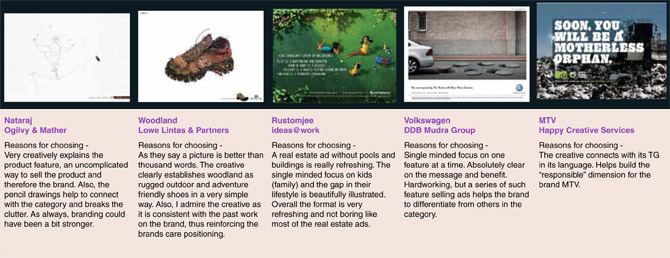
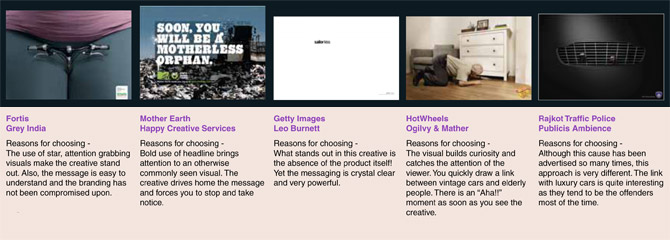
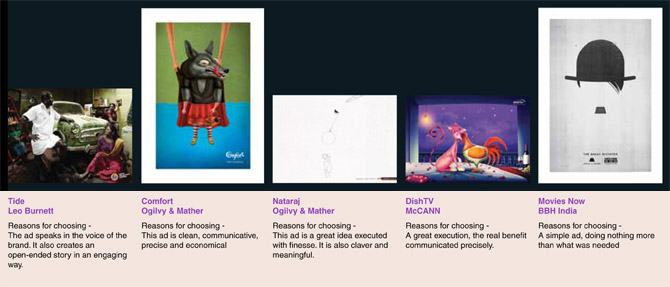
    As was the case with the first edition, the second edition also contains a section – A different point of view – which sees seven industry heads select their favourites among the lot. Manish Vyas of VIP industries, Manisha Lath Gupta of Axis Bank, Santosh Desai of Future Brands, CVL Srinivas of Group M, Lara Balsara of Madison World, Mallikarjundas CR of Starcom Mediavest and Shripad Kulkarni of Allied Media have all presented their favourites from the list.


    The book was unveiled on the sidelines of Goafest along with the Dainik Bhaskar-sponsored IAA Debates by media industry captains: Prasoon Joshi, Vikram Sakhuja, Partha Sinha, Monica Tata, Anupriya Acharya, and Srinivasan Swamy. Industry stalwarts like Sam Balsara, Shashi Sinha, Nakul Chopra, Jishnu Sen, Alok Lal, Sanjay Naik, Bobby Pawar and KV Sridhar among others were present too.


    On the response that the book has managed to elicit so far, Mr Kotnala said, “The second edition has been appreciated and we had enough people at Goafest coming and asking for it. It is too early, but last year we had more than 8,500 downloads and more than 4,500 copies distributed. We expect the second edition to obviously fare better.”


    In fact Mr Kotnala and team are already brainstorming on what the third edition of the book should look like. On his expectations from agencies for the third edition he said, “Agencies qualify themselves for it. And we do not have any preference or bias but hopefully we would see more work being produced in languages.”


    And it’s no surprise where the third edition of the book will be launched. Asserted Mr Kotnala, “We shall, like this year, bring out Mosaic III before or during Goafest.”


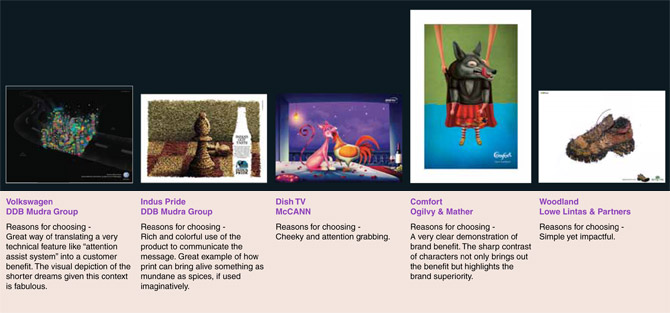
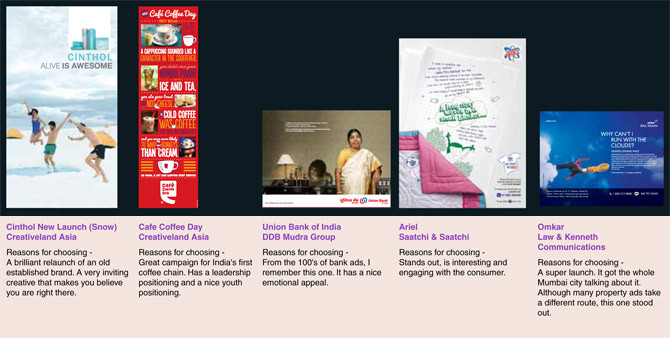
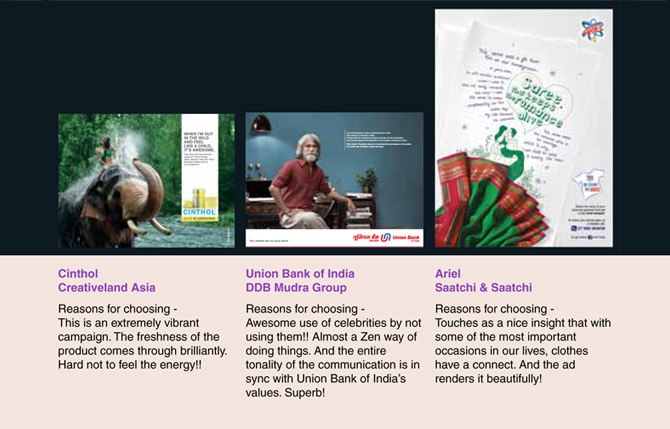
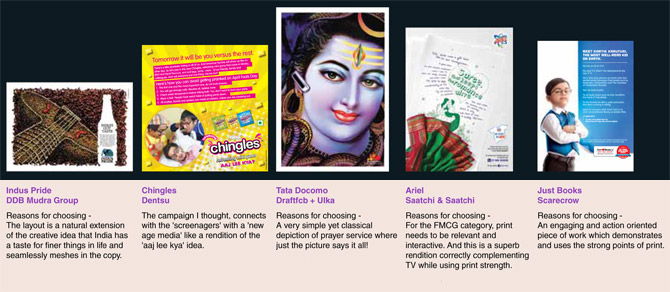
    MxMIndia presents glimpses of some of the creatives shortlisted by experts…


    Manish Vyas
    Vice President – Marketing, VIP Industries Ltd.

    “A great initiative to bring together some of the best work in the industry. I am sure it will inspire many greater campaigns in the future.”


    Top 5 choices

    Click on the image for larger view


    Manisha Lath Gupta
    Senior Vice President and Chief Marketing Officer, Axis Bank

    “This book is a great study, as there is so much to learn from this collection of print ads. Many of them inspire marketers to think differently and take more risky decisions on creative.”


    Top 5 choices

    Click on the image for larger view


    Santosh Desai
    Managing Director and Chief Executive Officer, Future Brands Ltd.

    “Its a good initiative but needs more real work to become truly meaningful.”


    Top 5 choices

    Click on the image for larger view


    CVL Srinivas
    Chief Executive Officer – South Asia, GroupM

    “Hats off to Dainik Bhaskar for continuing this initiative. This compilation is adequate proof that print as a medium can be as effective as any other.”


    Top 5 choices

    Click on the image for larger view


    Lara Balsara
    Executive Director, Madison World

    “Great idea to further the cause of print. Can become a collector’s item.”


     Top 5 choices

    Click on the image for larger view

    Mallikarjunadas CR
    Chief Executive Officer, Starcom MediaVest


    Top 3 choices

    Click on the image for larger view


    Shripad Kulkarni
    Chief Executive Officer, Percept Media”An excellent initiative which can probably be taken to a higher plane and level to address the serious concern of lack of support to print from ‘creatives’ in a more holistic manner.”


    Top 5 choices

    Click on the image for larger view


    Text and images published with permission of the Dainik Bhaskar group. The e-book can be downloaded from http://www.bhaskar.com/mosaic/

  • Dainik Bhaskar Group announces top 5 finalists for ‘Crack the Case’ contest

    By A Correspondent


    With the final round of ‘Crack the Case’ just two days away, the Dainik Bhaskar Group is all set to welcome the five finalist teams.


    This is the first time the group has created this opportunity for management students and the industry to provide a solution. The case study has received an overwhelming response with 340 plus registrations for the contest – across organizations such as Maxus, Rediffusion, Deloitte, Network 18 Media, O&M, IMRB, Titan, and HDFC, and from top B-schools like XLRI, IIM Bangalore and Kolkata.


    The five shortlisted teams for the final round are one each from leading media agency Maxus and renowned research firm IMRB International, two from IIM Bangalore and one from XLRI.


    Commenting on this venture, Sanjeev Kotnala, VP, Dainik Bhaskar Group said, “It was a difficult task to shortlist 5 from the lot, we found that a lot of entries have really made efforts to understand the business nuances of newspaper and have used secondary data beyond what was provided in the case. The final 5 made the cut after lot of debate within the Round 1 Jury. The jury placed extra focus on the logic and process of arriving at the decision than on the decision and presentation style. I do look forward to some interesting analysis and logic”.


    In the final round participants will have 20 minutes to present their solution in Mumbai on October 31st, to a jury which includes Prof. Seema Gupta from IIM Bangalore


    In the contest, participants are asked to suggest which new territory Dainik Bhaskar Group should address next, based on the case study by IIM Bangalore titled ‘Aspiring Growth’ focusing on the Maharashtra success of the Dainik Bhaskar group.


  • Dainik Bhaskar Haryana gives ‘Pehle Se Bhi Zada’

    By A Correspondent


    Dainik Bhaskar Haryana celebrated its 12th Anniversary by making the news more reader-centric – reflecting the preferences of the new age readers.  The refreshing changes are encapsulated by ‘Pehle Se Bhi Zada’ which makes for enhanced reader delight.


    Based entirely on the pattern of news consumption by its base of 12.68 lakh readers in Haryana, Dainik Bhaskar has realigned its 12 page main issue to provide insightful focus on government and political issues. It has also added a weekly page talking about latest developments in agriculture practices along with opinion and interviews of experts for the agrarian state. The paper has gone even more hyper local in its approach providing depth of information and opportunities within the state with local news finding prominence in the special supplements on Hissar, Rohtak, Ambala and Sonipat.


    Along with the focussed localisation, investigative journalism finds its place with an aim to help empower the readers with information that is relevant. Speaking about ‘Pehle Se Bhi Jyada’, Ashu Pharkey, COO (CPH) Dainik Bhaskar Group said: “Over the last decade, the confidence of our readers is high as we remain relevant,  innovative and have continuously evolved with the changing reader ecosystem.”


    Commenting on the ‘refreshing’ strategy, Sanjeev Kotnala, VP Dainik Bhaskar Group said: “At Dainik Bhaskar Group, we always look at some way to contribute toward socio-economic development of our markets. There is a constant formalised research and informal feedback mechanism that allow us to track the changing needs of our readers and hence evolving with them.”


  • IRS Q4 2011: Dailies flourish Year-on-Year


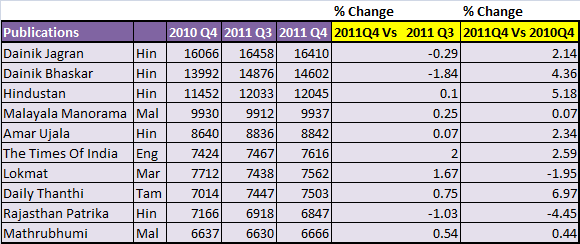
    The fourth quarter results of 2011 for the Indian Readership Survey were published on Monday and a quick look at comparing the numbers of IRS Q4 2011 versus Q4 2010 data, eight of the Top 10 publications – Dainik Jagran, Dainik Bhaskar, Hindustan, Malayala Manorama, Amar Ujala, The Times of India, Daily Thanthi and Mathrubhumi ­- have grown in their AIR (Average Issue Readership) Year-on-Year (YoY). Tamil daily Daily Thanthi and Marathi Daily Lokmat and Hindi Daily and the second most popular newspaper, Dainik Bhaskar  have registered the highest growths in AIR.


    When we compare Q3 2011 V/s Q4 2011, Dainik Jagran, Dainik Bhaskar and Rajasthan Patrika witnessed a slight decline in their readership. Dainik Jagran, Dainik Bhaskar, Hindustan, Malayala Manorama and Amar Ujala have retained their spots as the top five publications.


    After looking at the numbers, MxMIndia spoke to some of the publications for their views on the IRS Q4 2011 Topline numbers. Mr Rahul Kansal, Chief Marketing Officer, Times of India Group said: “Overall, I am quite happy with results, we have done pretty well in most of the markets including Delhi, Mumbai and Chennai, where we have seen very good growth.”


    However, Mr Rajiv Verma, CEO of HT Media Ltd, is disappointed with the IRS numbers but said in a statement, he will continue with investments in various markets. “While Hindustan Times has for long been No 1 in Delhi and No 2 in Mumbai, and Hindustan and Mint have consolidated their positions in their respective markets, as a group we are disappointed that these IRS numbers don’t reflect the full picture of our growth, and the reality of our investments and our efforts in the various markets across the country. However, we will continue to invest in various markets, to meet the needs of our readers and our advertisers, and will hope that the readership growth will be fully captured going forward.”


    Mr Sanjeev Kotnala, Vice President, Dainik Bhaskar Group said: “The IRS figures justify our focus on the urban, non-metro cities. Dainik Bhaskar is the only Gujarati newspaper to have a readership of more than 10 lakh in cities like Jaipur and Ahmedabad. If you see the figures for only the urban, non-metro cities, then you will realise that Dainik Bhaskar dominates the list. As far as the overall figures are concerned, we feel that it is a minor fluctuation, nothing major as far as our own perspective is concerned.”


    Speaking on trends from IRS Q4 findings, Mr Gautam Dalal, Vice President, Marketing, DNA said: “We observe that within Mumbai there is an increase in the overlap of English dailies readership – for every two readers there are three dailies being read. Mumbai, therefore, is seeing more penetration of English dailies and the trend of reading multiple newspapers is on the rise. Having such a high overlap percentage is a positive sign.”


    “In Mumbai we have had the highest number of growth for DNA, and these numbers are a testimony to our stand of having a high level of copy supported by the cutting edge editorial and by a focused market programme,” he added.