Tag: Sanjay Gupta

  • News Update: Full-house at INMA South Asia 2013 Conference

    By A Correspondent


    The 2013 edition of the International News Media Association South Asia Conference took off in New Delhi to a full-house.


    Over 30 speakers including management experts like Rama Bijapurkar, media agency honchos, equity and consulting firm captains are scheduled to speak and deliberate on the theme ‘Print: Thriving in the age of digital’.


    Sanjay Gupta, President, INMA South Asia and CEO, Jagran group and BCCL President and conference co-chair Arunabh Das Sharma had made their opening remarks at the time of filing this report.


  • Star launches sixth sports channel – Star Sports 2

    By A Correspondent


    ESPN Star Sports has expanded the sports bouquet with the addition of a new channel – Star Sports 2. The new channel is being launched especially for the Indian sub-continent today (March 11). Star Sports 2 will be the sixth channel to be launched by ESPN Star Sports in India after Star Sports, Star Cricket, Star Cricket HD, ESPN & ESPN HD. Meanwhile, the fate of the new identity for ESPN and ESPN HD is not known after NewsCorp’s acquisition of ESPN in the region. An MxMIndia report that the channel may be rechristened Fox Sports and Fox Plus was denied by the ESPN spokesperson. However, the PR team at ESPN was in denial mode on Star Sports 2 too, so the rechristening to Fox Sports cannot be ruled out.


    Star Sports 2 will showcase live and non-live events across sporting categories like Cricket, Soccer, Tennis, Motor Racing and golf. The new channel promises to offer more sports, more action, more excitement, more passion, more emotions, more exhilaration and more heroes to follow for sports fans across the country.


    Sanjay Gupta

    Speaking on Star India’s strategy for sports business, Sanjay Gupta, Chief Operating Officer, STAR India, said in a communique, “Our vision is to expand the sports viewership in the country. Star network has acquired some of the best sporting properties in every genre and is committed to taking sports broadcasting to a new level. These include broadcast rights to the BCCI national and domestic Cricket for 6 years; broadcast rights of Spanish La Liga, Italian Serie A and English FA Cup and England international matches.”


    Apart from exciting live content, we are also innovating in the way we present sports, Mr Gupta added. “Our brand new Hindi presentation on the live cricket broadcast allows audiences to enjoy the game in their preferred language, which was very well received by viewers. Similarly our recent launch- www.starsports.com- enables us to engage with passionate cricket fans like never before, and we are delighted with the site’s ramp up in the last 2 months. The launch of our new channel – Star Sports 2- is an extension of the same strategy. It allows us to broadcast a wide array of sports content across channels, and cater to multiple live events simultaneously. Star Sports 2 will further our commitment towards continued, effective and unprecedented coverage of all major events which are of interest to a diverse set of audience across the country.”


    The sports broadcaster has launched a high decibel on-air campaign to promote Star Sports 2. This campaign is running across the Star India network. In the first month of its launch, Star Sports 2 will cover tournaments like Serie A and La Liga soccer, BPL action, Nascar racing and prime tennis from the Men’s ATP Tour amongst others. It may be recalled that many tennis fans were upset with the coverage of the Australian Open (see link: http://www.mxmindia.com/2013/01/ranjona-banerji-an-open-letter-to-espn-star-sports/). One hopes that with the entry of the sixth channel of the bouquet, sports lovers will not feel slighted.


  • Star India deal with Ajay Devgn for Rs 400 crore for movie rights till 2017

    By Nandini Raghavendra


    Bollywood actor Ajay Devgn has signed a deal worth about Rs 400 crore with Star India for exclusive satellite rights to all his upcoming releases until 2017, the second such contract that the network has sealed after it inked a pact with superstar Salman Khan last month.


    Mr Devgn, the only other Bollywood actor apart from Khan to have four films in the Rs 100 crore-club, said he could ensure a better value for his films than his producers.


    “Business is becoming increasingly open and clear, so it’s easier to deal directly,” said Mr Devgn, talking from Bhopal, where he was shooting for Prakash Jha’s Satyagraha.


    “I am securing the producer a higher value, so he benefits eventually,” said Mr Devgn, explaining the impact of the deal with Star India which is for a period of five years and is said to include at least ten films. Producers, depend on satellite rights to bankroll at least 35% of the cost of production.


    “But I am also ensuring a certain amount for myself. For the rest, like actors fees etc, all depends on the relationship between an actor and producer,” he added. Besides the yet-to-be-released films, the network has 18 of his earlier films, including Singham, Golmaal, Zameen and Gangajal.


    Among the films to be released, is Sajid Khan’s Himmatwala, which studio Disney UTV releases at the end of the month. The next is Prakash Jha’s Satyagraha, followed by an action film with Prabhudeva and a sequel to Singham with Reliance Entertainment. “This should keep me busy for the next year-and-a-half at least,” said Mr Devgn.


    The deal has strategic value for the network, said Sanjay Gupta, chief operating officer of Star India.


    The small screen is the new cinema hall where a premier of a big film can attract 20-30 crore viewers, ten times that in theatres, Mr Gupta said. Research shows that television viewers spend 20-30% of their time watching movies on the small screen, impacting the television rating points keenly followed by advertisers.


    “We have been growing this space aggressively as also buying more films. Our spend on buying films has increased 20% year-on-year,” said Mr Gupta, who the network”s fiction and non-fiction programmes, helmed by Bollywood talent. For Mr Gupta, adding movies also contribute at least 25-30% Gross Rating Points or GRPs for his network. Star India has two movie channels apart from the main general entertainment channel.


    A film is considered a success on TV if it can manage to garner an average 2.5 television rating points or TRPs through the year, apart from the high number it garners on premieres.


    The last three premieres on Star Gold starring Mr Devgn averaged 6.2 TRPs.


    Source:The Economic Times

    Copyright © 2013, Bennett, Coleman & Co. Ltd. All Rights Reserved


    Photograph: Fotocorp


  • Is Digital eroding relevance of TV and Print?


    By A Correspondent


    The traditional media of print and television are under siege, as it were. Though they are still dominant media, they are seeing a sea change in the way they are being consumed. The explosion of new media also threatens their relevance and hold. Or so it is believed. But is it an overreaction and does digital not pose that much of a threat to TV and print?


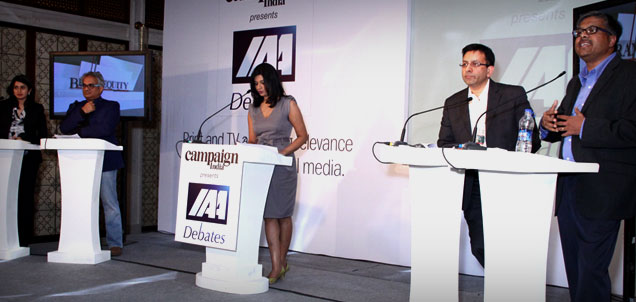
    To find out, the India chapter of IAA organised a debate in Mumbai on Monday (Feb 18) on whether television and print are losing relevance with the growth of digital in India. The debate series is being sponsored by Campaign India and the co-chairs of the IAA debates initiative are Partho Dasgupta and Neville Taraporewalla.


    Seasoned professionals Virginia Sharma of IBM and Mahesh Murthy of Pinstorm (and Seedfund) argued for the motion while Sanjay Gupta of Star TV and Arunabh Das Sharma of The Times of India group argued against the motion. The debate was moderated by Sonali Krishna, Anchor of Brand Equity show of ET Now. A cross-section of industry professionals were in attendance. As were some representatives from MxMIndia.

    We bring you some of the highlights of proceedings. Note, this is only a part of what was discussed.


    Mahesh Murthy: If you look at the Census report, if you see rural India there are just 33 percent homes that have television vis-a-vis 54 percent that have mobile phones. Overall if one compares, urban plus rural, TV used to take 32 percent penetration in 2001 which has grown and is at 47 percent at the moment. But mobile has grown from 9 percent in 2001 to 56 percent today. Mobile today is 24 percent larger in Indian households especially rural where the number is about 50 percent more.

    If you look at the numbers further, television has about 111 million viewers whereas mobile has about 133 million users – which further consist of 400 million users of SMS, 900 million SIM cards, etc. When one compares the publication number of The Times of India that is at 3-4 million which is dwarfed by 18 million users of Facebook every day in India.

    If you look from the consumer’s POV the three most desired audiences from an advertiser’s perspective is the 15-24 yr-old youth that barely reads a paper or watches TV and is highly digital-savvy; 25-34 yr-old females – Facebook alone has 11 million of those and I do not think any other medium in India can give you that kind of access to this age group; and finally 35+ age group – it will be hard-pressed to reach a CEO today as long as he is on his tablet or i-Pad or email, etc.

    When we move on to the advertisers, all of two years ago digital was all of two percent of the ad pie which has now become about 8.5 percent, meaning that digital has grown by 400 percent while the share of television or print has gone down.

    If you look at how digital has been explored by other people like politicians who have more than 200 people to handle just the digital medium, which I do not think is the case with other media. Even when one looks at the credibility factor, Nielsen states that the most credible medium is word-of-mouth, followed by what strangers write online followed by what is written on websites and then comes print.

    So what we are seeing is that print and television are not going zero; while they still have relevance they are losing their relevance because of the advent of digital. I’d like to end by requesting each one to ask themselves as to where do you see yourself in the future – whether five years from now you’ll be seeking a job in a company that does not do digital. The honest answer will decide where your preferences will skew towards the end of this discussion.


    Arunabh Das Sharma: I’d like to begin by saying that what we are discussing here is relevance. Is it about ad dollars; is it about ‘x’ percent more mobile penetration or is it about what these media have stood for the longest time – which is curated content. What digital has done is created a proliferation of choice and when that happens big becomes bigger. In such a situation everything grows. I’d like to share here an example of how the growth of social media has fuelled the growth of television and print and how they the two mediums are getting healthier now that the investment in content is becoming stronger and stronger.

    In the 1950s, it was said that radio was going to kill the medium of print and was followed in the 1970s where it was said that television would kill the medium of radio… none of that happened. There is a reason why different media play different roles in our lives. A recent study by research firm Ipsos talks about what are the global rules that different screens play in your life. So while the mobile screen is a lover, the computer screen is a sage while the tablet is a wizard but the fact of the matter is that you need a lover, wizard and a sage; the fact of the matter is that every medium has a special role to play and we ourselves will be very myopic if we assume that television is linked to a cathode ray tube or that a newspaper is linked to a piece of paper.


    Virginia Sharma: Is your motion that TV and print continue to be relevant or that they are growing in relevance?


    Arunabh Das Sharma: I think the topic needs to be redefined whether print and TV are losing relevance but whether digital will ever gain relevance? In fact I’d like to say here that 2012 saw some of the biggest gains in stock prices of print companies because of one aspect – they had figured out their business model. The issue was that in 1992 when the readership started dropping they had to figure out a business model which wasn’t to be.


    Virginia: Do you have any comparable stats to validate your observation?


    Arunabh: It doesn’t even show on the scale for India. I’d like to add here that a lot of people wouldn’t know about this but a gentleman in the US just brought a bunch of regional newspapers with the assumption that the growth of print will happen through hyper-local and regional papers, which is exactly what will happen here too.


    Virginia Sharma: I’d like to start off by answering the question, ‘What does relevance mean?’ In today’s world relevance means business impact. The fact that it was said that digital does provide a platform of choice is correct; also the fact that social as a medium has grown is also correct.


    Arunabh: If relevance is defined as business impact, are we talking the same scale in that sense in India?


    Virginia: What I am saying is business relevance to advertising agencies…


    Arunabh: But I thought it was also about ad dollars…


    Virginia: No ad dollars is about expense. Business relevance is about business outcomes and about what the CEO measures, particularly the RoI. To quote numbers from a CEO study that was conducted, the use of social and web from 11 percent to 48 percent for social and from 37 to 49 percent for the web in the primary way to interact with the customers.  That for me is business impact and what the boss sees this as a way to engage the audience. What do most brands like Coca Cola, Pepsi, ICICI, HDFC etc have in common – it’s their innate belief that this medium is relevant and their investment in this medium is not just what the ad agency says it is.

    So, two big cases. First, the primary metric of the CEO study for marketers for success is RoI. You can measure RoI based on the ability to understand customers and target them with what they need. You can only measure digital better than you can measure print and television. Therefore the future for marketing where RoI is concerned as a primary measure for success has got to be digital if you want to make the case.


    Arunabh: I think the challenge is not about measurement but about conversion and that’s how a medium works. Measurement that you are saying is how many people have seen the ad not how many people because they have seen the ad went and watched something.


    Virginia: Measurement for me is actually measuring consumer behaviour and doing it successfully. To sum up, the business case is very simple, if you want a good RoI you have to use digital as a key medium to be able to feature consumers and that ultimately is going to be key.


    Sanjay Gupta: When I started working 20 years ago I thought print is going to die and today print is about Rs 14,000 crore from Rs 6,500 crore it was a decade ago. For television the growth has been from 5,000 crore to 16,000 crore. The key points that I’d like to present here are that firstly, consumers love television and it is thriving. The thing is that if you find something relevant you spend time with it. Around 700 million people in this country spend three hours every day watching TV. When they start it is for two hours, which then picks up to three hours. Also in the last one year, 70 million new people have started watching television. That’s more than the number of people who watch digital in any given point in a month. The same is the case in developed countries like the UK and the US where the time spent is around 4-5 hours every day.


    The other thing is that big is becoming bigger on television. The belief is that proliferation of choice will make users fragment. A recent example I’d like to share is of the movie ‘Dabangg’ which was watched by 150 million people. Even shows like Balika Vadhu etc aggregate about 40-50 million viewers in that half an hour. The point I’d like to make is that social media is actually helping the business become bigger and better. The people fall in love with our characters and they do that only on television and not anywhere else.


    Mahesh: So essentially your point is that even TV uses digital…


    Sanjay: TV does use digital. To quote an example our show Satyamev Jayate was the biggest show that we did and we used the channel of social media to make people come and watch it. It was in fact the highest trending topic on Twitter. So what I am saying is that digital is driving our business to do better.


    Virginia: Is it content that drives behaviour and interest or is it the medium?


    Sanjay: It is content. To cite figures, in the UK people watch about 80 minutes of video and out of that 80 percent is either pornography or YouTube – that’s the power of that medium there. Whereas if you provide good content it makes the viewer keep coming back to watch more and more.


    As to what is changing, digitization is changing the way television companies do business. Till now only 20 percent of the revenues from digital medium came to the broadcaster but the transparency with DTH that number is moving from 20 to 100 percent. So subscription revenues of TV companies have grown five times and what does it give us – the power to invest in content. That is what will make it even more relevant in the future.


    Murthy: So your point is that television is using DTH or rather digital to deliver itself to homes?


    Sanjay Gupta: The point I am making is that the medium is powerful, profitable and is growing. The fact is that people will not consume any one or two mediums, they will consume all the mediums. The question is: how do we use the power of each of these mediums as they have to be relevant.  So print and TV will not lose their relevance they will continue to grow. The real question is that we need content aggregators and devices. Digital as a medium is just an aggregator of content and fundamentally the question we need to answer is how meaningful can this content get on the medium if it has to grow even further.


    Arunabh: Statistics do give us a picture. The fact of the matter is that both these media are huge and growing. If they were not then we could have turned around and said that it is not but like all new media they are finding newer ways – whether through a screen, a mobile, an app – of growing the medium. We are not here to debate whether one medium is better than the other, the fact is that we as consumers love to consume media and do it the way we want to. It is not about whether x, y or z is losing relevance, the fact is it is bigger and it is growing. In fact the next round of growth is already visible to us – it is coming from regional markets. Because of our infrastructural issues it will take digital some time to pick up speed but until such time our friends in the digital world would do really well to figure out what kind of content creates stickiness and what kind of content keeps readers going for 175 years. The day one of these digital mediums complete a 175 years in the form and fashion from what they started then we can talk about it further.


    Virginia: I think the four of us together have made a very compelling case for the growing relevance of digital and that it is powerful, profitable and here to stay. Such a combination would make this medium indeed relevant. Print and TV is going digital, decision-makers are going digital, politicians are going digital… the big question is, which side do you want to sit on? And no, digital does not want to be the medium it was 175 years ago, it wants to keep up with the times as well as the generation it is catering to and it will constantly evolve and is eager to change. It will make money regardless of the shape it will take. The question is, are you ready for the future – digital?


    The debate was won by the team against the motion. Before the debate started, 44 people from the audience were against the motion and 31 were for it. After the debate ended, the numbers were 42 against and 34 for.

  • How M&E CEOs are embracing digital growth


    After years of uncertainty and caution in the digital world, CEOs are now more optimistic than ever about the digital future, notes leading consulting firm Ernst & Young. “This was the primary theme that emerged from our 2012 CEO study, in which 34 CEOs from leading global media and entertainment companies shared their views on how the industry will benefit from the digital future.The CEOs we interviewed represent leading global companies with combined annual revenues exceeding US $300 billion.”


    Five industry captains from India were among the 34 interviewed. These being: Messrs Ravi Dhariwal, CEO-Publishing, Bennett Coleman & Co Ltd; Sudhir Agarwal, MD, DB Corp; Sanjay Gupta, CEO and Wholetime Director, Jagran;  Tony D’Silva,  Group CEO, Sun Network (now with the Hindujas) and Punit Goenka, MD and CEO, Zee.


    Excerpts from the report:


    Four key actions from CEOs
     

    1. Focus on the customer.

    “The world’s greatest company will have the customer at the center.” “Having a direct relationship with the consumer will translate into new revenue stability and growth.” “Companies understanding and concentrating on the consumer’s need will do better than those that concentrate inwards.”


    2. Create differentiated content.

    “First, second and third things will be the creative success of our brands and studios.” “Being able to navigate the waters with compelling, cost-efficient movies that people have to see.” “Strong content delivered in exciting ways.”


    3. Deliver a seamless experience to the customer across all devices, platforms and geographies.

    “We are looking to be with the customer all day with tablet, iPhone(R), online and IPTV.” “Providing seamless delivery of all content on a global basis.”


    4. Recruit and retain the right people. They will be the ones who will drive success.

    “Digital reduces the number of levels of hierarchy, allowing the CEO to interfere in debates that are not necessarily his.”

    “Our company needs to become more horizontal and less vertical.” “I want my people and teams to (1) be well-grounded, (2) be competitive with a desire to win, and (3) take responsibility and be decisive.”


    Courtesy: Ernst & Young Media and Entertainment practice (http://www.ey.com/IN/en/Industries/Media-Entertainment)


    The 34 media and entertainment CEOs interviewed for Ernst & Young’s 2012 CEO study are optimistic about the opportunities in today’s digital world. They see digital as key to their revenue and margin growth. It is their present and their future. This contrasts with E&Y’s 2008 study, which showed that CEOs were more tentative about digital’s potential.


    However, every path has its risks. In addition to sharing their insights into the opportunities digital offers, CEOs also admit they face challenges.


    Getting the consumer to pay fair value and developing their “digital muscles” across the front, middle and backoffice continue to be key focus areas for media and entertainment companies.


    And yet, CEOs are meeting these challenges head-on and are regaining control of the reins of their future long-term growth. In today’s rapidly changing digital marketplace, CEOs remain undeterred about the role digital will play in their companies’ future


    Summary of key points

    CEOs are optimistic about digital. They are no longer tentative about digital. They see opportunities for growth in both revenues and margins.


    Connected technologies drive growth and create transformative digital ecosystems. This growth is being driven by connected technologies that are, in turn, creating transformative ecosystems.


    CEOs are thoughtful about where to invest. CEOs currently see new distribution methods and new types of content as the most attractive investments. CEOs see these investments as central to setting them apart from their competition.


    Exploiting digital opportunities comes with challenges. CEOs are working to make sure customers pay a fair price for content, and they are building the competencies in their back, middle and front office to maximize their advantage in a digital world.


    Digital drives double-digit growth

    Today, CEOs see digital as a core part of their business, as well as a key driver of growth. As one respondent commented: “everything we do is digital.”


    Definitions of what constitutes digital can vary by subsector and even by companies within a sub-sector. With this caveat, CEOs were asked what impact digital would have on their own company’s revenues and margins over the next three years. Sixty-four percent of study participants expect digital to drive revenue growth of 10% or more. Forty-eight percent of CEOs also expect margins to increase by 10% or more in the same time frame.


    This compares to the 2008 study, where CEOs were more focused on protecting their traditional business than pursuing digital opportunities. One respondent worried that “digital media may not be as economically attractive as old media.” Another suggested that “media is trading analog dollars for digital dimes.” For many, digital media was still viewed as a new frontier – a place only for gamblers willing to take a chance on the unknown.


    Intuitively, there is a prevailing belief that digital margins should be higher because media and entertainment companies no longer have the cost of physical distribution. In the short-term, investments required in infrastructure to enable digital will tend to drive margins lower. However, that is only in the short-term. Once companies have the required digital infrastructure in place, we expect their margins will rise.


    Tablets and smartphones are driving growth

    So what is driving this double-digit growth in digital revenue and this foundational shift in consumption? When CEOs were asked which technologies they see having the greatest impact on their individual sectors, 79% suggest tablets, 62% say smartphones. The impact these devices have on the consumer experience is obvious to each of us in our daily lives.


    These devices are supported by the technology that respondents see as having the third biggest impact on the media and entertainment industry in the next three years: cloud hosting services and digital lockers.


    When CEOs were last surveyed in 2008, consumer tablets were not even on the market, cloud computing was a niche product and smartphones were focused on email and texting as opposed to video and apps. Today, more digital content across more platforms and available on more devices has created new and significant monetization opportunities for media and entertainment companies.


    Conclusion

    CEOs have a clear vision of a digital world

    When CEOs survey the future, they see the opportunities that digital media presents. Whether it is B2C or B2B, the direct relationship that applications, ecosystems and technologies enable is fundamental to their vision. It is about the ability to drive an outstanding consumer experience by offering differentiated content on an array of platforms and devices, anytime, anywhere.


    Their success will depend on how quickly they can optimize their back, middle and front offices to overcome challenges they face – getting consumers to pay fair value, managing content and optimizing their supply chains.


    It will also depend on their people. It will depend on having the right people with the right skills to win in a fast-paced, ever-evolving digital landscape.


    Once a gambler’s enterprise, CEOs today see digital as necessary for future long-term growth. Undeterred by their challenges, CEOs are optimistic and they have greater confidence their companies can take full advantage of the opportunities that exist in today’s digital world.


  • Complexity presents opportunity @INMA 2012


    By A Correspondent


    The sixth edition of International Newsmedia Marketing Association (INMA) South Asia Conference opened to a packed house on August 6 in New Delhi. The theme ‘Complexity Advantage’ was not only explored, but dissected and deconstructed. The sessions at the event saw discussion on various topics ranging from the need of newspaper companies to become multimedia organisations to the future of news, and if cost deflation is an achievable matrix.


    Mr Sanjay Gupta, President INMA South Asia and CEO & Editor, Jagran Prakashan Ltd welcomed the delegates and Mr Ravi Dhariwal, President INMA Worldwide & CEO, The Times of India Group, gave the inaugural address. Talking about the volatile Indian newspaper landscape, Mr Dhariwal outlined five key points: “There is great optimism even when things have not been going great economically. There is a very big opportunity in tier II and III cities, which every newspaper is witnessing. On the back of multimedia and strong publishing business, companies have been witnessing double digit growth. However, the newspaper business is being treated as ‘one shot fits all’. Going forward, this strategy will have to change as the consumer needs customisation according to their needs and interests.”


    He went on to say that publishing, as a business, has a bigger purpose of being at the forefront of change, and gave the example of TOI’s ‘Lead India’ and ‘Teach India’ campaigns.


    Ravi Dhariwal
    [youtube width=”400″ height=”225″]http://www.youtube.com/watch?v=qdAI1R8UBTw[/youtube]

    His also commented on how advertisers are struggling with value: “We need to deliver and innovate to deliver extra value to the advertiser. My fourth point would be that the competitors need to join hands and collaborate to give better value to the readers and advertisers. If we do not do that now, we might bleed like the newspaper industry bled in the West.” He concluded by saying that fleeting FMCG advertisers who prefer TV as a valuable medium to advertise: “Should be given single rate from all newspapers.”


    Mr Bhaskar Das, President & Principal Secretary to MD, The Times of India Group, who acted as a sutradhaar at INMA noted: “The newspaper business is rapidly changing. There is no equilibrium, only punctuations. The businesses today are caught in ‘complexity science’- any business can and will survive if they adapt to the changing environment.”


    Mr Nandan M Nilekani, Chairman, UIAI, Planning Commission, Govt of India raised important points about how newspaper industry should integrate its print version with digital format to reach out to the larger, younger audience: “The advancement of computing technology is bringing dramatic changes in how media is being consumed. It is important to understand the interplay of demographics, cloud computing, content, mobility, and access to technology, to create a business model that integrates the disruptive advertising and subscription models.” He summed his theory as: “Get ready for online mobile-aware resident.”


    Earl J Wilkinson
    [youtube width=”400″ height=”225″]http://www.youtube.com/watch?v=sKl9f2Yjxyg[/youtube]

    Highlighting the fact that advertisers want quality reach, target richness, engagement, purchase intention, and actionable audiences from the newspaper media, Mr Earl J Wilkinson, Executive Director & CEO, INMA spoke on ‘The new growth path and how to get there’. Talking about the learning and examples from the US and UK markets, he said that Indian newspaper industry is at crossroads because of: growth beyond demographic changes; the struggle being less about circulation but more about readership; delivering value to advertisers even as multimedia and digital pose challenge.


    Mr Wilkinson said: “The integration of content across platforms is bound to happen. And this is not true for content only, but also for the readers and advertisers. The problem of complexity does arise across platforms, but herein lies the opportunity. As the integration becomes a norm, the organisation models of newspaper companies will also change. The companies need to ‘aggregate’ and ‘atomize’.”


    The new model, according to him, would focus more on competence and value that it gives than the product itself. He further said that most news would be consumed via mobile by 2015. “Mobileand social media would result in exponential engagement. We, as newspaper industry, need to be more relevant to the nebulous pursuit of quality. Going forward, the multimedia organisations need to manage print for profit, and digital for growth,” Wilkinson concluded.


    The session on ‘Future of News’ brought interesting perspectives as the panel discussed if the attractiveness of news can be synchronised with commerce and content. ‘Winning the ad growth challenge’ saw industry veterans talking about factors that impact ad revenues.


    The highlight of the day was the interesting session with young college students on ‘Walking through the mind of the post-90 born: ‘Creating a newspaper I would like to read”. The session gave interesting insights to the delegates about how newspaper is not a necessarily a chore for the 19-21-year-olds. They consume news on-the-go, and read newspaper “when they have nothing else to do.” Moreover, the young panel highlighted that they preferred going through trending articles and video links, showing how digital was their preferred medium of news consumption.


    ‘Battle of  Bulge: Is cost deflation a utopian expectation?’ was moderated by Mr Mohit Jain, Executive President, Supply Chain, BCCL. He pointed out the three challenges of newspaper business when it cones to cutting costs, “Globalisation of cost structure, supply chain issues, and volatility of newsprint.” The session spoke on how new business models of publishing and printing newsprint are managing the currency, size and quality; how newspaper companies need to unlock internal manpower potential across board; and effective supplier partnerships.


    Mr Ashish Pherwani, Partner-Advisory Services, E&Y noted that newspaper organisations should pool-in their back-end resources, such as printing facility, to cut costs. Mr Pawan Agarwal, Non Executive Director Bhaskar Group echoed Mr Pherwani’s thoughts, and added, “We have created a common infrastructure for two or more of our editions. This helps in capping my Opex and Capex.” Mr Piyush Gupta, Group CFO, HT Media agreed: “Co-sharing is already happening in aviation department. If it can happen there, it can happen here as well.”


    Mr Pherwani added: “Every newspaper industry goes through three stages: chopping off wastage; optimisation, and partnering with vendors. Currently, the Indian newspaper industry is going through the third cycle. It is imperative that we build a right product at right price by creating a win-win relationship with vendors.”


    The panel also highlighted the fact that harnessing inner potential is important for any and all newspaper organisations to achieve its top-line growth. The panel also noted that what is core to a business and what can be co-shared: this will emerge as a real game changer for a newspaper organisation.


    Giving a different perspective to the newspaper session was the speaker Mr Santrupt Misra, CEO, Carbon Black Business and Group HR Director, Aditya Birla Management Corp who spoke on ‘Managing cultural asymmetry in a multi-media organisation’.


  • INMA 2012: ‘News is not static but dynamic’

    By Shruti Pushkarna


    Sanjay Gupta
    [youtube width=”400″ height=”225″]http://www.youtube.com/watch?v=alB7H-4TpGU[/youtube]

    The International Newsmedia Marketing Association (INMA) hosted its 6th annual South Asia conference in New Delhi on August 7. With its theme of ‘Complexity Advantage’, Day 1 of the INMA conference witnessed some power packed sessions.


    One such session, ‘The Future of News’, was moderated by Jacob Mathew, Executive Editor, Malayala Manorama and President, WAN-Ifra. The session saw a lively discussion by the two eminent panelists, Mr MJ Akbar, Editorial Director, India Today & Headlines Today and Mr Sanjay Gupta, CEO, Jagran Prakashan Ltd.


    The technological innovations and its resultant empowerment of individuals have significantly changed the way people consume news today. Introducing the topic,’The Future of News’, Mr Mathew raised a few key questions: “Would the existing formats be relevant to the future? How will we ensure that news is available anywhere anytime in any format to be consumed by our readers?”


    He added that the growth of print has still not been affected as much in South Asia and that the countries in the region should learn from the mistakes made by colleagues in the rest of the world.


    MJ Akbar
    [youtube width=”400″ height=”225″]http://www.youtube.com/watch?v=Z5gZXE8988w[/youtube]

    Addressing the basic worry around the future of news, Mr Akbar said: “The reason why news will always be in demand is because man is not a hermit. Man lives in a community and in any community, ignorance is the basis of all conflict. Curiosity is elemental to human experience and as long as curiosity remains a vital part, news will thrive.”  He added that news needs a vehicle and that will be provided by news organizations in the future as well.


    Mr Akbar alleged that the real problem facing the society today is not the future of news but the future of a ‘journalist’. He pointed out two traps that journalists today increasingly fall into: “One trap is a fish trap where a journalist looks at the bait and swallows it. This trap is a dangerous challenge to credibility of news as this form of journalism is based essentially on what the journalist has ‘heard’. The other trap is delusion trap where the journalist thinks he/she is more important than news.”


    Mr Akbar also compared the newspaper to a ‘thali’ which has a variety of food ranging from healthy ‘dal and rice’ to not-so-healthy ‘achaar'(pickle). He said: “No thali is complete without achaar, but on the other hand, achaar cannot replace dal and rice.”


    Coming back to the basic point in question of how big a threat does technology pose for the print industry, Mr Akbar said: “No technology completely destroys another. They all continue to exist together. The only thing that will be destroyed in the future will be your business plans which will have to be reoriented.” He added that there is no essential competition between products (radio, TV, newspaper), every product has its own rationale and news organizations have to be ‘format-driven’.


    He concluded: “As long as the newsmaker and the news owner understand that news is not static but dynamic, there’s no reason to worry.”


    Mr Gupta echoed Mr Akbar’s views and maintained that there will be news as long as there’s society and as long as there are incidents taking place. He said that the new technology does help in uncovering the truth faster and in an easier way sometimes, but the basics of news is to uncover the truth. It is important, he said, that news media engages audience in a public debate over issues that matter.


    Mr Gupta added that good journalism is good business and he concluded by quoting Google’s head of news products, Richard Gingras: “The pace of technological change will not abate, and to think of our current time as a transition between two eras, rather than a continuum of change, is a mistake.”


  • INMA to address ‘Complexity Advantage’ at Sixth Annual Conference

    By A Correspondent


    The International Newsmedia Marketing Association (INMA) is set to host its sixth Annual South Asia Conference on August 7-8 in New Delhi under the theme ‘Complexity Advantage’. In today’s scenario of accelerated change and complexity, strategic competitive advantage is created by the combination of strategy, culture, systems, brands, products, services and by the people that operate throughout the organization.


    The INMA South Asia Conference aims to address some of these tectonic shifts that are creating the complexities in our business, so as to stimulate the industry towards evolving a roadmap to convert the various existential challenges into opportunities. As such, the theme of this conference is aptly titled ‘Complexity Advantage’.


    Sanjay Gupta

    Mr Sanjay Gupta, who was elected as the President INMA South Asia 2011, and is the Director, CEO and Editor of Jagran Prakashan Ltd said: “This year’s theme would discuss driving readership and circulation. My expectation from the conference is that the industry people from South Asian countries can get their act together when it comes to talking about how to tackle various issues, including digital revenue models.”


    Mr Bharat Kapadia, INMA Board Director, and Chairman of Whatuwant Solutions, said, “Even though India is better off when it comes to print market, the last quarter can only be described as tough. The two-day seminar will get the industry to come together and talk about the challenges and work towards a better future.” He added that the complexities of businesses in driving revenues and circulation will be the focus of the conference.


    Bharat Kapadia

    INMA aims to bring together top newspapers from South Asia into a two-day, fast-paced tour de force of ideas and innovations to grow newspaper advertising, circulation and brand across titles and across consumer platforms. Over 35 speakers, several partners, press and over 180 delegates from 25 newspapers and another 20 companies across India, Pakistan, Bangladesh and Europe will be attending this conference.


    INMA is the only industry association that is able to pull together South Asia’s top publishers and specifically executives charged with growing advertising, circulation and brand. There will be excellent opportunities to network and share the “INMA conversation” among this exclusive fraternity of the world’s most innovative newspaper executives. INMA is the world’s leading provider of global best practices and marketing ideas. It provides its members thought leadership and practical ideas to grow audience, advertising, brand and profit. Currently, INMA has over 5,000 members in over 82 countries worldwide, which include several members from Indian and now Bangladesh and Pakistan newspapers.


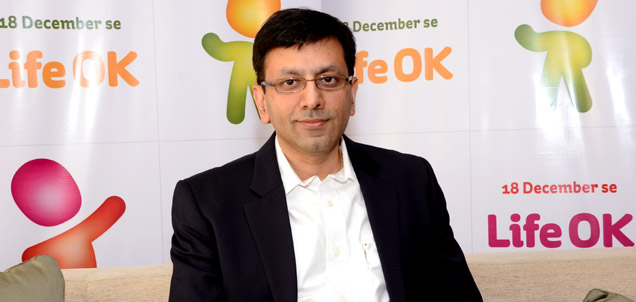
  • Life Ok will compete with Star Plus: Sanjay Gupta


    By Rishi Vora


    The new gleam in the sky from broadcast major Star India promises a unique viewing experience, differentiated content and a philosophy which it will thrive on. The idea is to have a challenger brand, one that’ll challenge even Star Plus – the No 1 channel in the GEC line-up today.


    Life Ok – the new avatar for Star One – was launched on December 18, 2011. The channel will target to first get to the 60-70 GRP mark, and from there its first big milestone – to be a significant player by winning the No 4 position and beating one of the four big players.


    How well it suits the Indian viewers is something to look out for. Meanwhile a quick glimpse of what the management is thinking. MxMIndia’s Rishi Vora speaks to Chief Operating Officer Sanjay Gupta on his expectations, and much more. Excerpts:


    Q: Why the decision to shut down Star One and launch Life Ok?

    Star One as a channel has been there for several years. But it delivered a very average sort of performance. It catered to a niche audience and never quite made an impact. In GRP terms, it clocked about 30-40 GRPs. So there was a need to ask tough questions. We thought there was an opportunity in the GEC landscape to come up with a channel that is unique and differentiated, going by the viewer and the way he consumes content. So we decided to rebrand Star One to Life Ok.


    Q: It is said that Star One was not given the required strategic push to compete with Star Plus and other GECs.

    Every business can reach its potential. The business idea, in the case of Star One, was to be a niche channel. So in thought terms, I don’t think we were very sharp. We did not have a content offering that was differentiated enough to create a long-lasting impact on consumers’ minds.


    Q: So was Star One treated like a second channel? Was it a conscious call that it should not compete with Star Plus?

    The question that we asked ourselves was: Should we continue to have a channel which is a second channel or should we really continue to have a channel which fights? Which may be second, third or fourth, but that’s not very important. We thought we should have a channel that’ll compete with every channel – be it Zee, Colors, Sony or even Star Plus. The whole idea of changing the name to Life Ok was to liberate the channel so that it could cater to consumers as a brand and as a content destination. So that it could be different and unique and in the process have a more meaningful presence than Star One.


    Q: So Life Ok is not going to be the second Hindi GEC channel of the Star Network?

    It is in the Hindi GEC, one more offering from Star India. Star Plus is our first offering. The reason why we have changed Star One to Life Ok is because this channel has come up basis our understanding of viewers and we believe there is a gap. The name carries a philosophy. Unlike Star Plus for example, where we connected Star and Plus-and it became Star Plus, Life Ok is a name with a purpose.


    Q: Was there any research done on the name? What was the thought process behind naming it Life Ok?

    The idea was to have a name which captures the philosophy of the channel. A lot of research and consumer work has gone into deciding the name.


    Q: Can you elaborate on the philosophy?

    Let me explain. We’re entering a very, very tough competitive market – the Hindi GEC market. So why will this work? In my view, this is likely to work is because this channel comes with a very unique promise which consumers and viewers will see every day. Stories and characters of this channel will come on every day – not for five days but for all seven days in a week. As a viewer you want to seek whatever you like – it can be music, films, radio, newspapers, and also in my mind the characters of the shows you watch on daily basis. So content will be offered to consumers seven days a week.


    Also, stories on other GECs are not pacy enough, in terms of the speed. So what we’re doing on this channel is, we will tell three stories in an hour unlike the norm which is two stories every hour. We will tell a story in 20 minutes, so when viewers come to our channel, they will find the stories very pacy.


    Q: What is the thought process behind the two-minute break?

    The two-minute break is again a viewer experience. I don’t want a big break. As a viewer that will put me off. A lot of people get distracted with a long break and end up not watching your show. So with three stories in an hour and the two-minute breaks, we’re telling the viewers that they don’t need to go anywhere. They know it’s coming back in two minutes, so they are more likely to be on your channel if the commercial breaks are not very long.


    Q: But that means there will be an impact on the bottomline.

    In the short run, yes. But in the long run, it brings you more eyeballs. Once we have a set of viewers, we can then make up…


    Q: What is the programming strategy for the weekends?

    Fiction shows, non-fiction shows, we will use Sach Ka Saamna every day including the weekends. We will also have movies on weekends, in the afternoons. Afternoon time is very important-the whole family gets together and watches TV. So yes, we will have a variety of content running on the weekends.


    Q: We’ve seen some failures in the broadcast industry – 9x and Real being prime examples. So what are the things that you need to be extra careful about?

    Doing a new channel is a very costly exercise. Therefore, there will be a huge amount of risk that you always run, whether you refresh a channel or you create a new channel. In either of the cases, it is important to have a differentiated offering. If the viewer is getting the same thing on many other channels, why is he going to watch yours? The idea for this channel, therefore, is to keep the viewer at the centre and offer him something unique. So if you’re able to stick to that – not only in the philosophy and the thinking, but also on the content you offer every day, then it gives you more chances of being successful.


    Q: True, but second GECs which have launched in the past haven’t done well. SAB, you may say, is an exception.

    Yes, Sony is a good example where it has two channels – Sony and SAB. And they’re working well, so if there is an appropriate positioning, relevant content, it would work. I think the learning which I mentioned earlier, if we have a unique proposition, keeping the consumer at the centre and differentiated content, it should work. And Sony and SAB is a good example in my mind to quote. Hopefully, Star One can learn from that and create a more meaningful positioning.


    Q: Are you going to roll out shows which cater specifically to the youth, the single largest segment of India? Something like Bigg Boss which does well in that department?

    We’re very focused on youth because we believe that is an important target audience. So if you look at the non-fiction we are beginning with – Sach Ka Saamna with Rajeev Khandelwal, where the big issue which we are tackling is corruption. Now, that is something which is at the top of every young person’s mind in the country. From the content, which you will see in the next few days, in terms of the message it delivers, it is not about saying let’s point fingers at others. It is about saying, ‘If somebody has to clean up the system, he or she has to start with us.’ That’s the message. And it is very much focused on the youth of India. Another show – Devon Ke Dev… Mahadev – we’re talking about one of the biggest gods of the country for whom most youngsters, especially women, fast for Mahadev in their early teens and before marriage. So that is a very unique thing we have on the channel and that’s the beginning of FPC every day. The rest of the content is dealing with absolutely the key issues which youth will emphasise on in a really big way.


    Q: But mythologies haven’t done very well for other channels. Colors and Imagine have tried it and haven’t produced fantastic results.

    I think Colors did fairly well on Jai Shri Krishna – the mythology serial they had. So if positioned well, it can work. We believe there is a market for mythology in a big way. It will have a different kind of emotion being catered to consumers.


    Q: Did you consider doing a big-ticket show like KBC, Bigg Boss, bringing a popular celebrity hosting the show?

    I think we have been very careful in the kind of emotions we want to deliver. And we wanted to be true to the philosophy of the channel that we’ve created. So we’ve stepped away from bringing a big celebrity. If somebody comes, he or she should be able to respect the values of the brand. And it is about cherishing what you have as a philosophy ‘Jo Apne Pass Hai Woh Khas Hai‘ and that’s why all the content pieces are on the lines of that philosophy. In fact everything we’re doing is true to that. And that’s the reason we’ve stayed away from having a big celebrity on the channel.


    Q: So going forward if there is a need to have a Amitabh Bachchan or a Shahrukh Khan, would you go for it?

    At this point in time I would say if it fits in nicely with the philosophy of the channel, then we will definitely consider it.


    Q: Why Madhuri Dixit as the Sutradhar?

    There is a lot of learning that’ll come out from the shows we’re putting up on the channel. What we wanted to do by bringing Madhuri was: as we show the content, everybody takes away their own understanding. What she does on the channel is, she poses questions, brings in her understanding and her life reality, and really puts a lens in front of viewers to evaluate and see the content well. And therefore, it really raises the question – are we really cherishing what we have or not? Or are we worrying only about possibly the dreams of future alone? And, in her life she’s done the same. She has been one of the big superstars and has taken a break – been a family person. So she has balanced her life very well. So the persona fits in well with the channel’s philosophy. And she hopefully will be able to raise the questions in everybody’s mind and help viewers view the content through a new lens.


    Q: But what is the fan following of Madhuri Dixit today? Do you think there are enough fans, because quite clearly, her days are gone.

    Firstly, all big stars have a really valuable equity in consumers’ minds. But the important thing is how this fits in with the channel’s philosophy. And in my mind, it fits in very, very well.


    Q: How has the response been from the trade?

    Mixed response, I would say. People are surprised that the brand name doesn’t carry Star in the name – that’s been one of the questions from a trade point of view. And they’re wondering why. And also the other trade response is that we have a good variety of content. So they feel that the content looks very powerful and hopefully, the next few months will tell us how the business goes.


    Q: What will be the channel’s reach on Day One?

    Star One today reaches out to around 40-45 per cent of people every week. Those are the people who come every week to view Star One. Hopefully those people would definitely come to see the channel and basis the marketing campaigns, other sets of viewers will get curious about the channel and they’d come and like to watch it. So anywhere between 40-45 per cent definitely should come and maybe some more would like to come and check out the channel. And finally the content strength will determine how many people will become regular watchers.


    Q: Do you expect to be the No 4 channel, beating Zee, say in a month’s time after launch?

    Star One is at around 40 GRPs right now. And if we grow significantly, that’s the first good number to look at, because this journey is a long journey. We are not starting it to really take a big leap in week 1or week 4. If you’re able to grow from where we are significantly, that’ll be the first milestone. And as I said earlier, it competes with every channel in the GEC space. If the content is powerful, it’ll grow – but the first initial aim would be to get to a 60 or 70 GRP mark. That will be an important milestone for us.


    Q: How long will the aggressive marketing campaign continue?

    We started this campaign around a week ago. We started it on December 12, it continues in full intensity now and it will continue for another few weeks. So it will be a four-week campaign which will run supporting the channel launch.

  • INMA 2011: Readership, Rate Cards & a small newspaper’s success

    By Tuhina Anand


    On Day 1 of INMA-5th South Asia Annual Conference, there was a CEO Roundtable which saw discussion on the topic: ‘Have we reached an end to readership growth?’ The session was moderated by Bhaskar Das, President, The Times of India Group and on the panel were Sanjay Gupta, Director, CEO and Editor, Jagran Prakashan Ltd, KN Tilak Kumar, Joint Managing Directorand Editor, Deccan Herald, Shahrukh Hasan, Group Managing Director, Jang Group Pakistan and Tariq Ansari, MD, Mid-Day Multimedia Ltd.


    Mr Das started the session by saying that it’s a known fact that the newspaper business is undergoing challenging times and one of them is about finding a balance between a content that caters to a diverse age group at many Indian homes and remaining relevant. He also remarked that if one is bothered about physical readership when a consumer is accessing media through various touch points, shouldn’t virtual readership also be considered? He also questioned the merit of measurement vis -a-vis frequency and periodicity.


    Mr Ansari said, “The truth is that the readership of urban English newspaper has reached a plateau and the growth in terms of numbers in SEC C and D but the question is if that category is also the one which advertisers would be interested in and then the answer becomes doubtful.”


    The session also looked at growing readership in a new market with an old product as well as raised question on the need to show yoy growth of readership where in actuality it should be yoy growth of advertiser?


    In all this grim scenario, Titak Kumar of DH brought the example of Karnataka language daily which has been seeing growth since both income and literacy levels have gone up.


    Another staggering point that gives players to think about is the pricing of a newspaper. While in India, the you can get a newspaper even at Rs 1.50, Shahrukh Hasan from Jang Group pointed that in Pakistan the paper would cost anywhere between Rs 15-23 and yet not cover its production cost.


    The idea that emerged was to innovate and seize the opportunity in the industry today. Also if multiple touch points is the new reality how does one update, upgrade and monetize from these various platforms.


    In another session, the panel discussed, ‘The Advertising Challenge: Space Selling in the Age of Multiple Platforms and Vanishing Rate Card’. On the panel were, Ambika Srivastava, Chairperson, ZenithOptimedia and Vivaki Exchange, Bijou Kurien, President and Chief Executive, Lifestyle, Reliance Retail, Jayen Mehta, GM, Marketing, Gujarat, Co-Operative Milk Marketing Federation, Rohit Gupta, President, Sony Entertainment Television, Bhaskar Das, President, The Times of India Group and Aritra Sarkar, VP, Strategy, ABP Pvt Ltd.


    The panel discussed if the rates cards have a value and Ms Srivastava endorsed this view along with Bhaskar Das though he differed that the rate card can be in different format and packaged differently to create a value proposition. Mr Gupta however giving the TV industry side of the story was of the opinion that in his industry rate cards doesn’t apply as the window of opportunity is less in television and rates vary from deal to deal and client to client.


    There was another session on ‘Good Editorial Content and Credibility are Good Business Also’  where Harisvansh, Chief Editor, Prabhat Khabar took the audience on the journey of success of the newspaper which is through doing hard hitting, pro people stories that have brought transformation in the lives of a common man. For them its trust and credibility that has paid off and just like Indian Captain MSD who is also from Ranchi like Prabhat Khabar both have emerged victorious by being dependable.

  • Newspapers: Reinvent or Perish?


    By Tuhina Anand

    The newspaper industry is undergoing transformation and the only way ahead is to look within and reinvent. While it may be too much to say that for the print industry the only option is to reinvent, else they will perish, but it won’t be far from the truth to say that if they don’t adapt to the changing times they will be groping in the dark and will only pave the way for their downfall. Early adoption and partnership with technology are a few ways by which the industry can look at transforming itself to cater to the Gen Y.

    Expressing his view, Mr I Venkat, Director, Eenadu, said, “Yes, we have to reinvent. I think the time has come when we no longer can continue in the traditional way. While the future of newspapers in India is still strong and will be for at least for 10-15 years and what happens henceforth I can’t really say. But in that time period, one should have reinvented and come up with multiple platform and strengthen them so that they become established models to generate revenue.”

    He maintains that printed word will remain sacrosanct though the content would undergo change to meet with the various platforms. In fact, Mr Venkat points that even now the way news is being consumed is changing where they have witnessed a significant rise in people coming to digital platform to access news.

    Shahrukh Hasan, Group Managing Director, Jang Group, Pakistan is of the opinion that the newspaper industry would not perish even if they don’t reinvent because there is lot of inherent growth still left in the print business. He said, “That said, I think reinvent I would, even if there are no threats as it is imperative for our continued growth. As it happens the print media is under lot of strain and we have seen globally it has been losing readership but in our part of the world the fundamentals that drive the business is strong, like literacy rates going up, growing middle class, migration from rural to urban areas, a very young population and the erosion of the joint family system. These are factors which impact growth and circulation. In fact they are all working in our favour.”

    “The important thing is that we have to realize that the business we are in is evolving and we have to adapt for that reason. We have to abandon tradition and adapt to reengineer to remain relevant. We are not competing with new media or television but we have to adapt in terms of how we process the news and understand what kind of news we have to provide to our readers in these changing scenario where different platforms with different speed of delivering news exist.”

    While Mr Hasan points that reinvention is not necessary but he will still go with it to be future ready. There is also another opinion which stresses that the newspaper business doesn’t need to be reinvented but it’s the newsroom that need to reinvent. Sanjay Gupta, Director, CEO and Editor, Jagran Prakashan Ltd, said, “Newspapers will remain. It will never die and it’s seen that in the most advanced economies where digital has taken over newspaper still exist. But it’s their relevance to the marketers that is changing.” Newspapers may not be relevant to the marketer as a touch point because of more varied and systematic approach that digital offers and for media companies to make journalism sustainable, Mr Gupta points that there is need to go into different revenue streams and digital comes into play in that aspect.

    So the interesting point that comes in this discussion is the decreasing relevancy of newspaper to a marketer hence bringing the digital platform to up the revenues. Also many media company pointed of unbundling of packages to advertisers that comprised a 360 degree approach.

    Reinvention in terms of digital may be the mantra for many to follow but for KN Tilak Kumar, Joint Managing Director and Editor Deccan Herald, the potential in print in its existing avatar is immense.  He said, “There is a lot of scope for print media especially rising population, growing literacy and urbanization signify that there is a lot of potential for print media to grow. We have been trying to reinvent in terms of content, design and layout. Digital is the future but it’s not a concern In India as we see it now.”

    Content is the key and even for Prabhat Khabar’s MD, KK Goenka. He reaches to his consumers in Bihar, Jharkhand and West Bengal and the paper has reached the status of the 7th largest read Hindi daily and this has happened primarily by the physical newspaper. Digital he says doesn’t play a role in the growth of his paper but yes content is the key. He says, “It’s the credibility and trust of people that we have built over the years that is responsible e for our success. It’s the issue that we have taken that is no less than a movement that has helped in building what Prabhat Khabar is today.”