Tag: Radio Mirchi

  • Quirky annual report garners Radio Mirchi the Gold Midas

    By A Correspondent


    Radio station Radio Mirchi 98.3 FM won the coveted Gold Midas at the Midas Awards, World’s Best Financial Advertising, for its Annual Report 2011-12, titled Reimagining Radio.


    Reimagining Radio is an annual report containing the financials of 2012 but is also an example of innovation. The Annual Report in fact was a direct mailer to shareholders communicating the next big strategy of Radio Mirchi – that is, Digital. It shows the way Mirchi is redefining consumer engagement with its listeners from FM radio to the mobile and internet platforms.


    Reimagining Radio captures the essence of the shift from traditional to a new age media company. While listenership of FM radio has shifted almost entirely to mobile phones and digital radio sets, the public perception of radio remains the old-fashioned “box” receiver. The annual report cover juxtaposes the modern with the traditional. The design combines both, the new online platforms where Mirchi engages with its digitally savvy consumers, and the cover has an actual working radio fitted inside which catches terrestrial FM frequency.


    G G Jayanta, National Marketing Head said, “Gold at Midas shows that our Annual Report is as hot as our music. We are delighted to receive this award and shall continue to be innovative in our approach”.


    Awards that Radio Mirchi has won in the past few months include Popular Radio Channel of the Year at Global Awards for Brand Excellence, Merit at Designomics Awards for Digital Innovation Using Technology for an on air contest called Mirchi Music Housie and a Bronze at Big Bang Awards (Ad Club Bengaluru) for Excellence in Communication & Media for the Purani Jeans Direct Mailer.


  • Radio Mirchi, HDFC Life launch Season 5 of Spell Bee

    By A Correspondent


    Radio Mirchi 98.3 FM and HDFC Life have announced the launch of the fifth season of ‘HDFC Life Spell Bee – India Spells 2013, the Indian counterpart of the highly acclaimed Scripps Spelling Bee, USA. With the theme ‘Celebrate Words. Save the Language,’ the spelling extravaganza will travel to 35 cities and will aim to reach more than 5,00,000 students from Standard 5th to 9th. This year’s Spell Bee will be backed by Times NIE in promoting the campaign and encouraging participation.


    The National Champion of Spell Bee – India Spells 2013 will win a grand prize of Rs. 2,00,000 apart from the opportunity to witness the prestigious Scripps National Spelling Bee with a parent and the school principal/teacher in Washington DC, USA, in an all-expenses paid trip. The four semi-finalists will win a cash prize of Rs. 50,000 each.


    Sanjay Tripathy

    Commenting on the launch, Sanjay Tripathy, Executive Vice President and Head, Marketing, Product and Direct Channels, HDFC Life said, “The era of abbreviated text messaging is having a detrimental impact on the English language, with an increased surge in their acceptance as a convenient replacement for the original word. HDFC Life Spell Bee – India Spells, an annual spelling completion, has been making an effort over the last four years to improve the spelling skills of students in a unique and stimulating format. To maximize the reach, we are continuing with the digital leg, giving an opportunity to students across the country to register and participate online.”


    Prashant Panday

    Prashant Panday, Executive Director and CEO, Entertainment Network (India) Limited said, “We started off Spell Bee with an aim to sensitize young children to the basics of the language. The hunt to find spelling enthusiasts, since then, has continued. Already in our 5th season, we are expecting tremendous success and phenomenal participation. This year Spell Bee will raise the bar of competitiveness as we seek registrations from across 35 cities. It gets tougher as participants from previous seasons re-enrol to make this championship fiercer. Like every year, the competition will be televised to encourage and prepare students for the upcoming season.”


    In the initial phase, an on-ground exercise will be conducted across 1,000 schools where children will be given spelling tests. Later they progress to the city finale round. The top two students from each city will then appear for an online test which will choose the best 16 spellers across India. These students will then battle it out in the grand finale to be held at Mumbai to win the title of Spell Bee Champion.


  • Former news anchor and RJ Akash Banerjee is Radio Mirchi Delhi programming head

    Akash Banerjee

    Radio Mirchi today announced the appointment of Akash Banerjee as the Programming Head for Delhi station. Mr Banerjee’s first stint at Radio Mirchi was in 2002 as a Radio Jockey where he used to host the station’s popular late night show ‘Dil Chahta Hai’


    As the programming head, Akash would be responsible for conceptualising the station programming in accordance with the brand vision and Delhi’s pulse and flavour.


    Commenting on his appointment, Mr Banerjee said, “I am happy to be a part of the ENIL Group again. I am thrilled to be part of such an iconic brand and look forward to new challenges and responsibilities.”


    Prior to joining Radio Mirchi he worked with the TV Today network as Senior Special Correspondent and Anchor. He has also done a stint with Times Now with his book ‘Tales from Shining and Sinking India’ that draws from his experiences on the field (and has a foreword by Arnab Goswami).


  • Manav Dhanda to head programming @ Big FM

    Manav Dhanda

    By A Correspondent


    Manav Dhanda has been appointed as Network Programming Head for 92.7 Big FM. In this second stint with Reliance Broadcast Network Ltd (RBNL), he will be taking care of the programming strategy of the Stations across the country. His first stint was in 2006-08. He will be reporting to Tarun Katial, CEO, Big FM.


    A media professional for over 15 years, Mr Dhanda began his career with directing serials and working as a freelance writer. He has worked with Sony Entertainment Television, Radio Mirchi and Miditech.


    Before returning to RBNL, Mr Dhanda was associated with World Band Media – a Canadian company with operations in the multicultural, multiplatform media market in the United States – as the Chief Operating Officer.


    While RBNL sources have confirmed that Mr Dhanda joined the organization in early September, there is no official communication on the development.


  • Radio Mirchi appoints Starcom as media partner

    By A Correspondent


    Starcom Worldwide has bagged the media mandate of leading radio network Radio Mirchi. The account will be handled from Starcom’s Mumbai office. It was previously with Madison. The agency is reported to started work on the new business.


    The win adds to a series of new business wins at Starcom MediaVest Group (SMG) since the middle of last year, among which are Aircel, Dabur, Axis Bank, Zee Learning, Supermax, Sterling Holidays etc. SMG has also been aggressively strengthening their media product in India. The agency recently launched its proprietary Web+TV optimiser, billed as the first of its kind in the market.


    Confirming the news, G G Jayanta, National Head of Marketing, Radio Mirchi said: “we are pleased to appoint Starcom since we needed a partner who is future focussed and can help us navigate the new media landscape. Their in-house research and tools are very impressive and their media product and philosophy are pretty solid. We look forward to a long and rewarding association with Team Starcom”.


    Commenting on the win, Malli CR, CEO of SMG India said: “We are thrilled to win the Radio Mirchi account. Given the developments in this sector, we look forward to exciting times. We have planned some specific research and insights projects using our proprietary tools and optimisers”.


  • The Half-Year That Was


    By A Correspondent


    It’s July 2 today, and the first six months of the year have passed. While the slowdown has impacted spends in a major way, most of the 182 days from Jan to June have been eventful. On the positive side: new television channels, new agencies – media and creative, consolidation, people and account movements, government issues, digitization, awards… the list could go on. And on the negative: a channel being shut, pink slips, pay cuts, appraisals deferred, digitization delayed… the list could go on here too.


    We have already embarked on the second half of the year, but as we do that, here’s a quick look at how industry captains review the half-year. We present you the half-yearly review in two parts… the first today and the second mid-week… on Wednesday.


    As you would gather, there is much gloom in the industry, though no despair. Not yet.


    ADSPENDS:


    Nagesh Alai, President, Advertising Agencies Association of India (AAAI) & Executive Director, India Operations, Draftfcb Ulka Group

    Nagesh Alai

    If I were to summarize the indications of the economy, then one has seen softness beginning last November and December leading to a situation of downturn. The macro-economic indications like rupee falling, impact in production and fall in demands have also reflected in the consumer behaviour in a negative way. The last quarter of 2011-12 (Jan-March) has seen a fall in GDP to 5.3 per cent. All this have impacted the manufactures as well as service providers, with the mood being that of postponing a decision. While some would have thought that the situation would not impact FMCG, but that one has seen a resistance from that sector too.


    So in terms of advertising, the impact being in terms of ad outlays and remuneration; while the latter has been up for constant negotiation and any further would only impact the quality of service being provided, it’s the latter that is being hit now. I think this year one would see a growth of maximum 10-12 per cent as compared to 14-15 per cent in the past. While print and TV still comprise 80 per cent of the spends, but advertisers are looking at newer mediums, where the spends is not high and get better mileage for monies being spent.


    I personally believe that even if government were to take corrective measures, one will only begin to see the recovery by mid-2013. The mood can be aptly summarized as being that of cautious approach.


    PRINT:


    Narendra Kumar Alambara, COO, Thanthi Group

    Narendra Kumar Alambara

    In terms of the regional publications, I would say that the past six months have been good and bad. If one looks at readership and circulation, the regional dailies have seen an increase vis-à-vis the English language publications. However, there is a need to be bold and unconventional when it comes to regional publications, both by those selling this space and advertisers themselves. In today’s time when every paisa has to be accounted for in terms of returns, I think regional publications would have been an excellent answer to have targeted reach because of the value they provides for the money and reach.


    However, we have failed to do that. Today when most media houses are not restricted to being uni-dimensional and have different platforms for advertisers be it television, print, digital and even regional newspapers and channels under their umbrella; I think the solution lies in integrating various offerings, including the regional to get a better value and growth.


    Krishna Prasad, Editor-Outlook

    It’s difficult to put a number as yet on the kind of growth that has been witnessed, but you will always see print being challenged by television and other mediums. As far as the past six months are concerned, I would say the growth of print has been at par. By this I mean that even though most advertisers have huge monies, they are shying away from advertising with this medium. This is somewhat similar to what was observed during 2008, where companies didn’t have any reason to opt for cost-cutting, but were up for it. Many advertisers are seeing this downturn as a reason to go easy with their spending and not be too extravagant.


    Most newspapers today, especially in Delhi like Delhi Times, Hindustan Times and others appear chunky in their appearance, which gives you a sense that all is well but that may not necessarily be the case. Most of them are actually going slow with their spending and are trying to play it safe. I expect things to look better from October onwards – around the festival period. So largely, the growth of media will be dominated by how the economy transforms itself; it’s not operating in a vacuum. That’s the best case scenario.


    But the worst case scenario is that it may take a little bit longer for things to get better; perhaps with the elections coming up soon, with the country seeing a new Finance Minister and the markets going topsy-turvy, the print industry may still take some time to stabilise itself.


    RADIO:

     

    Prashant Panday

    Prashant Panday, CEO, Radio Mirchi

    The radio industry has been hit just as hard as any other segment. Maybe a little less than print and a little more than TV. The economic slow-down and the policy freeze has made advertisers a little wary. They are not exactly cutting spends, but they are demanding more from broadcasters. A broadcaster can either cut prices or offer more for the same. In some sectors, the advertising cut has been more severe like telecom, real estate and so on. But there are other segments that have done better – like core retail, and even auto.


    Given the economic conditions, and the lack of new frequencies, radio has done as well as it possible can.

     

    Rabe T Iyer

    Rabe T Iyer, Business Head, BIG FM

    The last financial year was alright, but the last three months have been pretty flat. The reason for that is because categories like BSFI, Auto and some of the campaigns of the usual summer categories were a bit slow. Nevertheless, we expect the next three to six months to be a good run. This is because people ultimately want to keep their goods moving, and hence the next three to six months are going to be good. The last three months were flat for the industry because the dollar exchange hit the sentiments and some categories which were expected to fire up in the month of May-June have taken some more time, mainly because of the overall economy conditions and the sentiments attached to it, and also because of the fluctuating dollar prices. This has directly impacted the ad spends, not just on radio, but across the portfolio on media brands.

     

    Ashit Kukian

    Ashit Kukian, COO, Radio City

    The last six months has been very good for the radio industry. One of the reasons I would say is because the core advertising categories in radio namely: Telecom, FMCG, and Entertainment channels to name a few, had increased their advertising spends on radio.


    DIGITAL:


    Chhaya Balachandran Aiyer, CEO and MD, BCWebWise

    Chhaya Balachandran Aiyer

    More and more brands are getting ready to seriously look at digital media and those who have been using it already, are increasing their spends. Digital is expected to deliver more cost-effectively. Amazingly, even production charges of films are expected to be cheaper, if they are being produced by digital agencies. It would help if brands which see real value in digital and see it delivering, also realize that results won’t come if they tighten their purse strings so much. Fortunately, there are a few clients who have realized the quality v/s quantity value and are waking up to the real digital age and extending their budgets.



    Rajiv Hiranandani

    Rajiv Hiranandani, Co-founder and Executive Director, Altruist, Mobile2win

    I think the mobile industry has underperformed in last six months, as per the overall outlook was supposed to be, in terms of number of handsets sold and amount of value-added services (VAS) consumed. Mobile industry has seen its slowest growth, and this has been also because of the negative outlook in the economy. Some of the reasons have been people waiting for better handsets models, the overall mood of economy not being good, and mobile VAS seeing a lot of restrictions in terms of TRAI guidelines.


    OOH:


    Noomi Mehta, Chairman and Managing Director, Selvel One Group

    Noomi Mehta

    The last six months have not been good for the out-of-home (OOH) industry. The month of June, however, has seen a significant improvement, which is perhaps because the IPL campaigns in the months of April and May have fructified. Otherwise, I believe, the industry figures have been down. The markets, by and large, seem to be in a depressed state, along with the economy. Going forward, one of the basic steps needed to improve the industry’s performance is the need for a common currency for measurement. OOH is part and parcel of the country’s economy, and hence it will also be subject to the same pressures as the economy.


    Image: Rafiq


  • Jobs Not OK Please!


    By Johnson Napier


    If you’re among those contemplating switching jobs given growth constraints at your current place of work or just the sheer temptation to move on to a job more thrilling, you better think twice. Going by the reactions drawn from the Indian media and entertainment marketplace and from consultancy firms dealing with manpower issues, companies are in no mood to go on a recruitment drive, unless of course, there is a dire need for the same.


    With 2012 starting off on a sluggish note and with the crisis making a fresh comeback, the growth forecast for the media and entertainment sector is being questioned unabatedly by all and sundry: will media will touch the 12% ballpark growth figure that was estimated for year 2012. This in turn will dictate whether there are enough opportunities for brands and clients to go talent hunting or whether they’ll have to make-do with internal makeshift arrangements to handle extra responsibilities.


    But the prevailing sentiments definitely don’t appear inspiring on the jobs front, be it for clients looking to source great talent at the senior level or for those wanting to explore opportunities beyond their current realm. Explaining the current sentiment in the marketplace, Abha Kapoor, Executive Director, K&J Search Consultants that specialises in placement services for media executives reckons that after 2008-09, the M&E sector has become a lot more conservative in terms of both headcount and pricing. She observed, “The trend being observed currently is that mid-level people are being involved to do high-level jobs. There is also lack of funds coming in from P/E, venture capitalist firms into the sector. For example, our firm K&J is used to working for three start-ups simultaneously including mid- to CEO level. We’ve always had a television start-up, a radio start-up, an internet start-up but that’s because the money was coming into the sector. Right now that is not the case.”


    According to Ms Kapoor, this trend has led to a shift in paradigm. “First there was lot of chasing that was done for talent, and salaries too were high, but right now there is lot of talent that is available but the headcount is not that high,” she reasons. According to her, there are no new jobs being created and there are also not enough replacement requirements.


    Agreeing with Ms Kapoor’s observations is Pankaj Raj, Managing Partner, Search Value, a firm specialising in placement services for senior media execs. “Earlier, people were not willing to accommodate new talent due to financial constraints but right now they are saying, do not go overboard with the hiring; do so only if extremely critical or make-do with internal replacements only,” he said. “So the current trends suggest internal movements as the in-thing and also, salaries are not being hiked to the levels that it was done earlier.”


    Reasoning the recurrence of the slump, Sarabjit Sachar, Founder and CEO of Aspirations said, “My reading is that it is a consolidation phase; it’s not going to go away easily. If you assess the media in the recent past, there were several takeovers that took effect like that of Nai Dunia being taken over by Jagran Group etc. This led to many senior people looking out for options at other places. Many organisations felt that they could either absorb them or give them roles as per the necessity. But what happens in a takeover is that the roles are not that enriching. Secondly, there is a lot of realignment that is taking place where the whole organisation’s business is being realigned into certain other businesses or products. Here the trend is that they want to retain the same resource and not hire anybody from outside. Thirdly, it is also about consolidation where most units are facing shutdown due to larger plans by parent groups. So while the falling value of rupee, hike in petrol prices etc have played some role more than that it is solely about consolidation.”


    According to Mr Sachar, it is due to consolidation that there is a shortage of senior positions in organisations. “Due to this, senior executives will find themselves in two situations, one is where the role is not enriching and therefore they would want to leave, or they would not be left with a choice and therefore would leave the organisation.” According to the response that his firm has been eliciting, there has been a big drop in senior positions within organisations. “There are a lot of candidates at the top level who are not able to shift jobs due to lack of decent availability. I think the figure is somewhat in the range of 30-40 per cent. Even amongst the media companies, what they would’ve hired at the top level is down by 25-30 per cent this year.”


    Industry in caution mode

    On the strains being felt across domains, Mr Raj opined: “Sector-wise if analysed, radio isn’t hiring anyone right now, print is on a business-as-usual kind of hiring while television is almost zero. That said, digital is the best performing of the lot and is seeing hiring taking place in full swing. Overall the mood is of caution and being sensible.”


    Providing an insight on the trend being felt in the broadcast space, Yannick Colaco, COO, Nimbus said, “From what I understand, the MIB has recently issued licences for new channels and more channels means more jobs. Also, with the digitization drive in full swing that should act as a boost for the industry as it will increase monetization abilities of all broadcasters. All these factors will lead the industry to its next phase of explosive growth. Today, everything is a function of demand. If you have more number of channels coming up it will only have a more positive impact on the overall growth of the industry.”


    Throwing light on the trend at his organisation, Colaco said, “There are specific functions in the company for which we are hiring people. For example, World Series Hockey that was taken up by us was a new project and we went ahead and hired a whole bunch of people for the job. So as business grows, we will obviously need more talent. The thing is that when you have explosive double digit growth one year and when you move to single-digit growth in the next, it is considered to be a bad thing. So even if the growth is not what was expected from the medium, it is still a good single digit growth and that is what should be considered by the industry.”


    The status at the Discovery Network is also not gloomy. Said Discovery Network, Rahul Johri, Senior Vice President and General Manager (South Asia): “Discovery continues to expand its business in India. We have a robust portfolio of eight distinct brands satisfying curiosity of millions in India. We recently announced our foray in the kids genre with the launch of Discovery Kids that offers entertainment embedded with learning. Discovery is committed to the Indian market and will continue to invest here.”


    Jaisurya Das, COO, Sakal Media Group expressed concern with the current situation as he said that the print sector was indeed experiencing rough weather. This had to do with the rise in oil prices, fall in value of the rupee and global uncertainty. But that didn’t have to do anything with his organisation which has been recruiting people as and when the need arises. But things are not that rosy for the sector, going by what Alok Sanwal, Project Head & Editor, iNext had to say. He said: “From what I have heard it is not an extremely upbeat mood where recruitment is concerned. As far as new recruitment drives are concerned, they would be faced with a challenge but then again I haven’t come across organisations that’re on retrenchment mode or anything like that. So the jobs scenario too is on a cautious and alert note, so to speak.”


    The tide is not as bad for media agencies, it seems. Lara Balsara, Managing Director, Madison Media said that they were recruiting people for replacements and new positions because they had won some new businesses. Similarly, Sujay Ghosh, Senior Vice President, DDBMudra South said, “We are still recruiting as per our plan, because we don’t see any major dip in our revenues. Also, our involvements with clients have gone up significantly, so we can’t afford not to hire. But I have heard that in some industries, hiring freeze has started.”


    A similar sentiment was felt by radio players like Red FM who prefer to see an upside to the whole issue. B Surender, Senior Vice President and National Sales Head, Red FM seemed confident as he said: “The job scenario is still very good within the radio industry and it is not facing any extreme situation. In fact, radio tends to retain quite a lot of talent and it is handling the current situation quite well compared to other mediums and thus is better prepared to handle the slowdown than any other medium.” Echoing his thoughts, Prashant Panday, CEO, Radio Mirchi said: “At Mirchi, we continue to attract the best in the industry. We recruit our senior management cadre from FMCG, telecom, durables, auto and allied industries. We have no problems in hiring excellent quality talent…”


    So while caution is the name of the game, recruitment will be an exercise that the industry will engage only if essential. Those seeking an exponential growth in salaries and designations in the shortest possible timeframe may have to hold on to their wishes, unless, of course they bring exceptional value to a company. For the others, it is about waiting for the right moment to take the leap.


    With inputs by Robin Thomas


  • Reduce Your Carbon Footprint: Radio Mirchi

    By A Correspondent


    Radio Mirchi’s RJ Raaj – Majja Run patron –  dressed as a green crusader in a black robe with a huge life size cut out of a foot all made from recycled biodegradable products to spread the message of reducing carbon emission in Bengaluru. He won the first place at the Kingfisher ‘Run in Costume’ Green Crusader segment.


    RJ Raja went out to spread the message on how each one of us can take a green oath by reducing the carbon emission in our daily lives by adopting simple practices such as turning the lights, televisions and computers off when not in use, keeping fridge doors closed, drive less, do the weekly errands in a single trip or pay bills online, walk, bike, ride the bus or carpool and so on.


    Excited about his win, Beat Raja Raaj said: “It is a great high to win the contest for the second time in a row. I have always been an avid follower of green practices in my daily life and hence took up the carbon footprint concept.”


    Commenting on the occasion, Sangeeta Rath, Station Head – Radio Mirchi said: “We have been very actively participating in the World 10K for the last five years and every year RJ Raaj designs looks that are very topical in nature. This year it was the green message, it is commendable of RJ Raaj to come up with this unique and meaningful depiction! Kudos to him for winning second time in succession.”


  • Mirchi maxes IRF awards, Red FM is best station

    By A Correspondent


    The much awaited Excellence in Radio Awards (ERA) was held in Mumbai on May 22. Although the turnout at the IRF (India Radio Forum) 2012 was dismal, the awards concluded with fanfare. A total of 40 awards were given out this year and three new categories were introduced – Best Radio Programme (Marathi); RJ of the Year (Marathi); and Best Radio Promo – Inhouse (Marathi).  The award winning radio stations at ERA this year include – Radio Mirchi, Red FM, Big FM, Radio City, Radio Mango, Club FM, MY FM, Suryan FM and Fever FM.


    Digital Radio Broadcasting Ltd or Red FM won 7 Awards including the awards for the ‘Best Radio Station’ and ‘Best Breakfast Programme/ Show (Hindi)’ to name a few. Suryan FM won one Award for ‘Best Radio Promo (In house) Tamil’.


    Reliance Broadcast Network Limited or Big FM also won 7 awards, including the award for the ‘Best Programme Broadcast after 11am (Hindi)’ and ‘Best Programme Broadcast After 11am (Tamil)’. Big Magic Pvt Limited won an award for ‘Best Use of Music / Song / Jingle by an Advertiser in a Radio Spot’.


    Radio Mirchi won a total of 12 awards, making it the most awarded radio station at the Excellence in Radio Awards 2012.


    Speaking to MxMIndia, Mr GG Jayanta, National Marketing Head, Radio Mirchi said: “Winning 12 awards is in itself a matter of pride, innovation always wins and good work will always be recognized. These awards will most certainly encourage us to deliver better work as it is a great motivational tool for us.”


    Mr Rajat Uppal, General Manager- Marketing stated: “We saw good participation from the industry, we are glad to have won the Best Radio Station, The RJ of the Year, the Best Breakfast show and others. It shows the kind of work we do is high on quality and high on innovation as well. We won the awards that matter the most to us and our aim will be to continue delivering quality work for listeners and advertisers.”


    Music Broadcast Pvt Ltd or Radio City won a total of 3 Awards, Radio Mango also won 3 awards, Club FM won 2 awards, Fever FM and MY FM won one award each.


    Mr Praveen Scheruchari, Senior Creative Manager, Radio Mango said: “For a regional station like us, winning these awards and that too at a national level is a huge achievement as well as a great opportunity for us. These awards will encourage us to deliver better work for our clients and listeners.”


    The awards for the ‘Most Effective Use of Radio in an Activation Campaign’ and ‘Most Outstanding Use of Radio in An Ad Campaign’ were the winners from ‘The Radio Pitch Challenge’.


  • Can a Satyamev-like show be created for radio? Yes, say broadcasters

    By Robin Thomas


    Aamir Khan’s ‘Satyamev Jayate’ is the hope to recreate the Sunday morning appointment viewership that was probably lost with the entry of multiple cable television channels in the late 90s. The Sunday morning programme, which premiered on May 6 with much fanfare, has already received rave reviews from viewers and marketers alike.


    Appointment viewing in television has become a common practice, with examples galore like season one of Kaun Banega Crorepati (KBC) or soap operas suchas ‘Kyun Ki Saas Bhi Kabhi Bahu Thi’ or even earlier epic programmes like the Ramayana and Mahabharata, wherein viewers would often set the time aside for their favourite shows.


    But can the same be said about radio? Does a radio programme have appointment listenership? Can they create shows of the calibre of ‘Satyamev Jayate’?


    One of the reasons why television programming has evolved is said to be only because of multiple channel offerings, similarly radio programming is also said to evolve with more channel offering, different genres and thus big property shows which could draw more loyal listeners.


    According to GG Jayanta, National Marketing Head, Radio Mirchi, a similar kind of experience exists on radio, albeit on a smaller scale, despite the fact that music is the largest chunk of programming on most radio stations. “The breakfast show, from 7am to 11am, usually tackles issues that resonate with local sentiments – be it the case of the battered girl child or petty corruption or question paper leaks or pot-holed roads. There are expert opinions, listener call-ins, diverging points of view et al – but the tone and manner is always upbeat and offers a ray of hope to the listener – entertaining, but not frivolous. It makes for engaging content leaving the listener with a feeling that there is someone listening to their plea. This interactivity is what makes radio powerful.”


    One of the challenges for radio today is the lack of differentiation in content as most radio stations arguably sound the same, especially in the kind of music they play. Gone are the days when radio programmes like ‘Binaca Geet Mala’ and ‘Sangeet Ke Sitaron Ki Mehfil’ were highly popular with listeners who set aside time to listen to these programmes.


    Anil Machado, National Programming Head, Radio One, felt: “Radio has a lot of appointment listeners, mostly during the weekends. Programming in every medium is a challenge today, but it depends on how you create a differentiation in your content. The moment a radio station begins to move away from the herd and create a differentiated content, it will attract more listeners and thus bring appointment listenership.”


    Nonetheless, those were the days when there were not as many FM stations and the television onslaught was yet to take place. Whether or not multiple frequencies in FM Phase III would create differentiated and innovative shows and shows that of a ‘Satyamev Jayate’s’ calibre, only time will tell. But radio broadcasters would like to disagree. “In fact, Aamir Khan was on air with RJ Jeeturaj on Radio Mirchi Mumbai, wanting to interact with the audience and gauge their reaction to the show. Therefore, a similar sort of programming can happen on radio or for that matter any medium but, what is important is the audience should feel enriched,” said Mr Jayanta.


    Radio broadcasters are of the view that such programmes have always been part of radio and that the next step forward for the industry should be attempts to create differentiation in content in order to create more appointment listeners. But there are some who feel that more than shows like Satyamev Jayate, what would work on radio are shows with localised content.


    Sarthak Kaushik, Director, Programming, Hit FM felt: “A radio version of Satyamev Jayate’s calibre will not work because radio is an intensely personal and a local medium, so essentially it is the local issues that work on radio. As far as appointment listenership is concerned, it is mainly depends on the maturity of the audience. Radio is one medium which allows a lot of experimentation, all one needs is courage to experiment with a programme and how confident one is to promote that programme.”


  • RAMcheck: Besides Mumbai, no change in #1s

    By A Correspondent


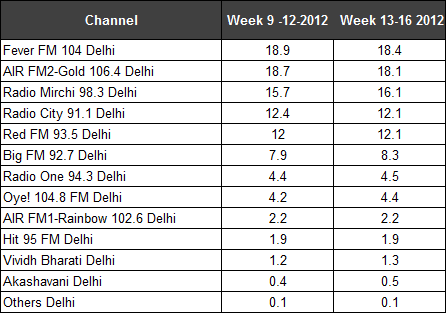
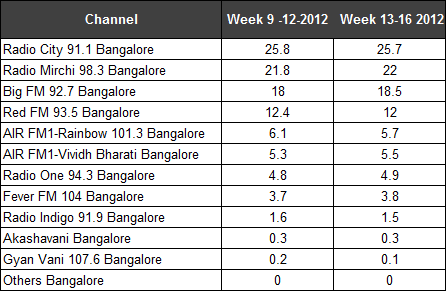
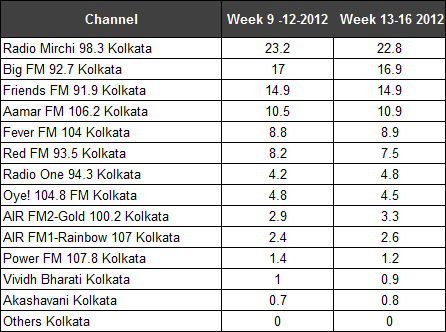
    TAM Media’s Radio Audience Measurement (RAM) – which covers four key metros, Mumbai, Delhi, Kolkata and Bengaluru – released its latest radio listenership figures for wk 13 to wk 16, 2012 (Last week of March to first three weeks of April, 2012). According to the latest RAM data, for listeners of 12 years of age and above, all places of listening, and according to radio channel shares, RadioCity, Radio Mirchi, Fever FM, Big FM, Red FM, Radio One, Oye! FM continue to be the top FM stations in the big four metros.


    Mumbai:


    Radio Mirchi emerges as the number one FM station in Mumbai with a market share of 15.3 per cent, followed closely byRadioCityat 15.2 per cent. The two FM stations are closely competing for the top spot, but what remains to be seen is which of these two FM stations retains the top spot. AIR FM2 Gold, Fever FM and Big FM make the top five FM stations in Mumbai. The other FM stations in the Mumbai market include Red FM, Radio One, Oye! FM, AIR FM1 Rainbow, Vividh Bharati and Akashavani.


    Delhi:


    Fever FM continues to be the most popular FM station in Delhi with a market share of 18.4 per cent, its nearest rival is the AIR FM2 Gold which is comfortably placed at number two with 18.1 per cent market share. Ranked three is Radio Mirchi followed by RadioCity which is ranked four and Red FM as ranked five in theDelhimarket. The rest of the FM stations in Delhi include Big FM, Radio One, Oye! FM, Hit FM, AIR FM1 Rainbow, Akashavani and Vividh Bharati.


    Bengaluru:


    RadioCity continues to maintain its leadership position in the city. RadioCity, Radio Mirchi and Big FM are the top three most popular FM stations in Bengaluru. RadioCity received a market share of 25.7 per cent whereas Radio Mirchi and Big FM received a market share of 22 per cent and 18.5 per cent respectively. Ranked four is Red FM with 12 per cent and the fifth most popular FM station is AIR FM1 Rainbow with 5.7 per cent. The other FM stations in Bengaluru include AIR FM1 Vividh Bharati, Radio One, Fever FM, Radio Indigo, Akashavani and Gyan Vani.


    Kolkata:


    Radio Mirchi is the clear winner in Kolkata with a market share of 22.8 per cent. The top three FM stations in Kolkata haven’t changed as Radio Mirchi continues to be the number one FM station of the city followed by Big FM with a share of 16.9 per cent and at the number three FM station of Kolkata, Friends FM received a share of 14.9 per cent of the share. Ranked four and five are Aamar FM and Fever FM with a share of 10.9 per cent and 8.9 per cent respectively. The other FM stations in the city are Red FM, Radio One, Oye! FM, Power FM, AIR FM1 Rainbow, AIR FM2 Gold, Vividh Bharati and Akashavani.


  • Govt policies anti-small radio stations: Goyal

    Tarun Goyal is the Founder, Director of Radio Chaska, a radio station which was founded in 2006 by the Goyal family. In conversation with MxMIndia’s Robin Thomas, Mr Goyal speaks about the challenges facing the station in achieving break even, the issues that need to be resolved before the phase III rollout, on their plans to revamp their official website and whether the radio industry has been hit by slowdown?


    Founded in 2006, when you look back, how would you say the journey has been for Radio Chaska?

    The journey since 2006 has been a different one. We started a radio station in Gwalior, thinking that FM radio will catch the fancies of the people, and it did. Over the years there has also been a shift in the advertiser perspective about the medium. However it is the support from the government that we are lacking today, they are spending very less on radio. On a positive note, despite odd challenges, radio has managed to grow tremendously over the last many years, and has also contributed to the development of the city as well.


    What is the Gwalior market like for radio?

    Well, it certainly is very different from the metros. People invGwaliorvhave an altogether different taste for radio itself.  The advertising category on radio is mostly retail. We mainly play music all the time – mostly latest Hindi or Bollywood hits.


    Apart from advertising, what are the other sources of revenue generation for Radio Chaska?

    We do generate some revenues from activations, a good pie of our revenues also come from Radio Mirchi (ENIL), with whom we are instant partners for sales and then we rely on our local revenues. Although activations help increase our revenues, the profits generated are low, mainly because of the high costs in activation. Thereby, we primarily have to concentrate more on advertisements because that’s where a good portion of our revenues comes from. Nonetheless, more number of activation definitely helps us increase our brand value in the city, which in turn, helps us get more local advertisers.


    So, has the strategic sales alliance model worked? How does it benefit both Radio Chaska and Radio Mirchi?

    Since we are a single station owner in Gwalior, this partnership has been a strategic move for both Radio Chaska and Radio Mirchi. Since Radio Mirchi is present across Chhattisgarh and Madhya Pradesh except inGwaliorand Radio Chaska is present in Gwalior, therefore Radio Mirchi (ENIL), in strategic sales alliance with Radio Chaska, has created a space for itself in Gwalior as well. It is quite hard to sell a single station and keep track of various campaigns coming from different parts of the country. This strategic alliance with ENIL gives Radio Chaska an edge in reaching out to other parts of the country and the state. Thus we have had an extremely good partnership with ENIL ever since the inception of Radio Chaska.


    What are your break-even plans? When do you see Radio Chaska achieve break-even?

    I don’t know when we would be achieving break-even as the costs are escalating and hence we are unable to increase the revenues as anticipated. Unless we have some good policies from the government, small stations will never achieve break-even. Government policies, I believe have gone against the small radio broadcasters and, besides, there are other small issues which if resolved would help small stations achieve break-even.


    Music royalty is one of the issues that are yet to be resolved. The escalating fuel cost is another worry because it is adversely affecting the industry. A company’s five to seven per cent cost is always burnt in fuel because the government is unable to provide electricity. These may be small issues but nevertheless they are vital in helping the business sustain in the market.


    The MIB (Ministry of Information and Broadcasting) has already given its nod to news on private radio stations, multiple licenses are allowed, FDI limit has been marginally increased. How does Radio Chaska view these developments? Will these benefit smaller stations?

    We welcome this move, but issues like music royalty need to be sorted out first and only then I believe FM radio stations can probably flourish in the long run. Right now challenges for smaller stations, in particular, are many and only time will tell how FM phase III will benefit the industry. Nonetheless we welcome the policy and we too would try and be part of the phase III policy.


    So, will you approach phase III more cautiously? Will you expand to other markets? What are your phase III plans?

    We are eyeing for expansion in parts of Madhya Pradesh as well as in other markets, but yes, our approach will be a little cautious. We will not hype up the prices and bid unnecessarily. If we find the scenario viable only then we will bid, otherwise we will stay away.


    How significant a role does the website play for a radio station? Do you plan to add new features or redesign your website someday?

    Yes, we will be upgrading our website very soon, probably in next two months. Official websites have also become a medium for radio stations to interact with their listeners. Our RJs regularly interact with listeners on social networking sites and today official websites have also become an integral part of a radio station.


    It is said that the radio industry being hit by the economic slowdown. Do you agree?

    Yes, I do agree that the radio industry too has been hit by the economic slowdown. The telecom industry, for instance, was one of the highest spenders on radio and in the last three or four months we have not received any business from the telecom sector. So, yes there is a slowdown and radio has been affected by it, but nevertheless radio is surviving the slowdown.