Tag: Radio Mirchi

  • [MxM Radio] Prashant Panday on Mirchi in A’Dhabi, what’s wrong in Delhi & how radio ads aren’t rip-offs from TV

    By Robin Thomas


    Prashant Panday has been with Radio Mirchi right from its inception. He has several achievements to his credits including the phase II roll-out of the company radio stations, and now expanding the FM station to the UAE in association with the Abu Dhabi Media Company. Radio Mirchi is available in 32 markets across India and boasts of commanding a market share of 42 per cent in terms of revenue. Radio Mirchi is a listed radio company and claims to lead in listenership in 25 markets out of the 32 markets.


    In conversation with MxMIndia, Mr Panday, who is Executive Director and CEO, Entertainment Network (India) Ltd (ENIL), spoke at length about Radio Mirchi’s foray into the UAE. He also shared his views on why FM listenership is on the decline and why he disagrees with the RAM numbers.

     

    Q: How would you rate the year 2011 for Radio Mirchi? Are you satisfied with the growth numbers that have been thrown up?

    No one can say that 2011 was a great year! The first quarter (Jan-March 2011) was of course fantastic, but the next three quarters (April – December) have been very muted for most media companies. For Mirchi, we had a terrific first quarter, decent 2nd and 3rd quarters and a not-too-exciting 4th quarter!


    Q: You have recently moved into the UAE – what are the listenership trends in the market there?

    The UAE is an extremely important country from an Indian radio station’s perspective. It’s very rich, and its people are much sought after by advertisers. It’s a heterogeneous mix, with many people from South India, UP/Bihar and of course, all over India. Most of the radio listenership in the UAE is in cars. Since many people travel between Abu Dhabi and Dubai on a regular basis, there are long drive times and long radio listenership hours. Our research and our initial response data indicates that Mirchi is a much sought after brand in the UAE.


    Q: Can you throw some more light on the proposed UAE venture – content, RJ mix, language of songs, etc?

    Our associate in the UAE is a well-respected and large media group, whose business includes TV broadcast, newspapers and radio stations. Radio Mirchi in the UAE is similar to Radio Mirchi in Delhi or Mumbai or any of the other Hindi markets. We are largely a contemporary Hindi music station, with a show dedicated to 1990s music in the afternoon and one dedicated to retro music (1960s-80s) in the night just as in India. The RJs are brilliant! They are from India but they are smart enough to adjust to a new country. In any case we want to create a nostalgic feel about being back home in India, and hence we chose India-based RJs to be the voice of Mirchi in the UAE.


    Q: What does the launch of an international FM station mean for Radio Mirchi? Is the business model going to be advertising-led or otherwise?

    The business model will vary from country to country depending on the regulations of the country; the opportunity there; and the timing. In the UAE, we have a brand licensing agreement with the Abu Dhabi Media Company (ADMC). We provide all programming insights as well as proprietary Mirchi content (not music). We also provide guidance in revenue generation, in which we are particularly good. I cannot share details of the financial agreement with ADM – suffice it to say that it is a win-win deal for both ENIL and ADMC.


    Q: Mirchi had no competition in Delhi for a long time, but now the competition has become tough. What went wrong? Did the programming strategies backfire? Because everything seemed to have gone well until there were few changes in programming…

    Nothing has gone wrong. The RAM research in Delhi (alone) is flawed. In reality, Fever is the #4 or #5 station in that market. Just check IRS and you will know what I mean. The RAM fieldwork in Delhi has probably been compromised. Not only IRS, we have at least three other research data points – all of which show that Fever is a #4 or #5 brand. We normally do not question any research data – but in the case of Delhi, the error is humongous. Mirchi is by far the leader in Delhi followed by Radio City, Red FM and Big FM. Fever is not even 40 percent of Mirchi in Delhi by IRS.


    Q: IRS results too for a while have been highlighting a decline in listenership. Do you agree? What reasons do you attribute to this decline?

    Well, there are two factors here. One is that there has been no growth in the number of radio stations for 4-5 years now while in the same time, there has been a surge in the number of TV channels and newspaper editions. So radio is losing out competitively against these two mediums. Secondly, I do feel that IRS may be perhaps under-reporting the reach of all the radio stations. At least, that’s what a comparison of RAM and IRS indicates. While RAM indicates that there are 1.4 crore-odd listeners in Delhi, IRS indicates a figure around 30 percent of this. How can this happen?


    Q: Does FM radio lack good creatives or radio commercials? Most of them we hear are a rip-off from television… Do you agree?

    This is absolutely wrong. These days, radio creatives are part of a larger campaign plan. Hence all creatives – radio, TV, print – reflect the same basic theme. You may think they are similar because you start with TV and then say radio sounds similar. If you started with radio, you would find TV ads to be a copy! In reality, radio is now integrated into the overall creatives and hence each medium builds uniquely on the same theme.


    Q: On a lighter note, what is a typical day like for Mr Prashant Panday, Executive Director and CEO, Entertainment Network (India) Limited?

    Making sure my team works really really hard and I spend time writing my blog, or sampling new music, or running in the gym or watching a film or sampling good food at new restaurants or answering queries from inquisitive journos like you!


  • Lokmat’s initiative puts Indian Guinness Book

    By A Correspondent


    In a rousing display of patriotism and unity, the voices of thousands of Aurangabadkars singing Jana Gana Mana created history. With a tally of 15,243 people singing the national anthem, they landed India into the Guinness Book of World Records for ‘the most people singing a national anthem simultaneously’, erasing the previous record held by Pakistan with 5,800 individuals.


    Andrea Banfi, Head of Adjudicators, Guinness World Records Limited, who had flown in from London, handed over the certificate to Rajya Sabha MP and Chairman of Lokmat Media Limited, Vijay Babu Darda, who accepted it on behalf of each and every Aurangabadkar who created the world record for India.


    Other Guinness World Records Limited officials present on the occasion were Lucia Sinigagliesi, Adjudications Manager, and Nikhil Shukla, Adjudicator - India.


    Commenting on the achievement, Rishi Darda, Editorial Director – Lokmat Media Ltd, said: “This is our gift, as a responsible media house, not just to Aurangabadkars, but to every Indian. We are delighted that Aurangabadkars responded so splendidly to our initiative for the world record attempt to commemorate the completion of 100 years of Jana Gana Mana, since it was first sung.”


    It will be recalled that Jana Gana Mana was first sung at the Calcutta Session of the Indian National Congress on December 27, 1911. It was declared the Indian National Anthem by the Constituent Assembly on January 24, 1950.


    Lokmat Media had pulled out all stops to inform every Aurangabadkar of the world record attempt. While Radio Mirchi was the radio partner, MCN Hathway, IBN7, IBN Lokmat and CNN-IBN were the TV partners, and Abhishek Advertisers was the outdoor media partner. The sponsors were WS Developers, while the Phadnis Group was the co-sponsor. “I would like to thank our sponsors and media partners who ably supported us in the initiative,” said Mr Darda.


    As early as 7 am, all roads leading to the District Sports Complex in Garkheda witnessed traffic jams, with students, working people, housewives and families making their way purposefully to take part in the historic world record attempt. The entire stadium, with an official capacity of 45,000 was jam-packed, with no standing room, and the gates had to be shut on thousands of eager locals waiting to get in and be part of the world record attempt. The final tally of 15,243 people came as a surprise to everyone.


    GWR head adjudicator Andrea Banfi said: “We were not able to include all the people present at the stadium in the count, as it was physically impossible since they were so closely packed. And after the first singing, many people left. But, for us to do a proper count as per the stringent GWR standards, we had to request Lokmat Media to ask the people to assemble once again, in a particular, countable order, and to sing the national anthem again. The figure of 15,243 is what we arrived at after the second singing.”


    Leading the swelling crowd in the chorus on stage were Shankar Mahadevan, Mahatma Gandhi’s grandson Tushar Gandhi, Prashant Damle, Roopkumar and Sonali Rathod, Vaishali Samant, Swapnil Bandodkar, Pramod Sarkate, Mrs Salaskar (widow of 26/11 martyr Vijay Salaskar) and others, who sang with Aurangabadkars to create the world record.


    “Our National Anthem is a wonderfully inspiring composition, and is a part of everyone’s psyche. I am truly excited to have been a small part of this gigantic experience,” said Shankar Mahadevan.


    Tushar Gandhi, grandson of Mahatma Gandhi, said: “I am very happy to be among the enthusiastic people of Aurangabad, who have given such a wonderful response to this initiative by the Lokmat group. It reinforces the magic of those 55 words written a hundred years ago by Rabindranath Tagore.”


    Prashant Damle, actor and singer said: “It is moving to see the surge of patriotic sentiment at the grassroots, as I have witnessed here in Aurangabad.” Singer Vaishali Samant said: “It has been a great experience to mingle with thousands of Aurangabadkars on this momentous occasion. I am happy to have paid my tribute to the Nation by singing with one and all.”


    The Fictitious Group, winners of talent reality show India’s Got Talent mesmerised one and all with their power-packed acrobatic dance routines.Vernonfrom Fictitious said: “It’s exciting to dance in the service of our Nation! We salute those who laid down their lives for the country.”


    Smita Salaskar, widow of Vijay Salaskar, who laid down his life defending his countrymen on November 26 2008, said: “I am overwhelmed by the patriotism of the people inAurangabad.” She urged the young students to study hard and serve with the defence forces, which need good officers.


  • The Anchor: 5 reasons online radio will grow in India

    By Prashant Panday


    #1 Variety in Music Programming

    As internet radio grows it will offer much more variety in music programming. The internet is the future of everything, and radio happens to be part of it. Radio is currently hamstrung by the music royalty license issue, but we hope that it will get sorted out soon. Once that happens, all Indian radio stations will be available online.


    #2 No Geographical Boundaries

    Geographical boundaries that exist today will be demolished. What will happen is that a listener in Mumbai will be able to hear a Delhi radio station and vice- versa, or a New York station in Mumbai etc.


    #3 Higher Interactivity

    There will be far higher interactivity. For example, if I like a song, I will be able to download it instantaneously. In fact, download speed will further increase as 4G services will be available; and as broadband internet penetration increases, it will bring more users on board.


    #4 It Will be Wonderful for Artists

    As online radio grows strong it will help artists make a mark in the music industry merely on the back of great content; whereas today, a whole lot of marketing support is required.


    #5 New Challenges and New Opportunities

    For broadcasters it will bring new challenges because there will be much more competition, it will also offer new opportunities because then the whole world will be our oyster.


    Prashant Panday is CEO, Radio Mirchi.


  • FM Radio rocks in South India… and how!

    By Robin Thomas


    The FICCI-Deloitte report on Media and Entertainment in South India says that radio in South India will grow with a CAGR (Compounded Annual Growth Rate) of 20 per cent by 2015. The reach of FM radio is said to be far higher in South India than its counterparts in other parts of the Country. According to Ms Nisha Narayanan, Senior VP Projects and Programming Red FM, South India has 28 per cent share of existing radio channels and it will have 28 per cent representation in FM phase III as well.


    Besides the larger FM stations like Red FM, Big FM, Radio Mirchi and Radio City, there are many local or smaller FM stations as well, such as Radio Hello, Club FM, Best FM, Suryan FM and Radio Mango, to name a few. Unlike the North, FM radio stations in the South play music in multiple languages as prominence is given to the local language. Big FM for instance plays only Kannada music in Bengaluru whereas in Hyderabad it plays Telugu and Hindi music. Club FM, a Kerala-based FM station, plays mainly Malayalam music with a mix of Tamil and Hindi music whereas Red FM in Andhra Pradesh mainly plays Telugu.


    Rabe T Iyer
    Nisha Narayanan

    Rabe T Iyer, Business Head, Big FM, the radio arm of Reliance Broadcast Network was of the opinion that compared to the rest of the country, the reach of radio in south India is much higher. Mr Iyer was also quick to point out that in some key markets like Bengaluru, Chennai and Hyderabad the reach of radio is significant, higher than most news channels, and is on comparable terms with leading GECs.


    “Given the inherent strengths of the region backed by a strong film and music Industry, added to its rich cultural diversity, it is not surprising that radio in South India has relatively higher penetration than other regions. The south of India has done some innovative radio over the years. It continues to be a huge focus area for all players given that it has three big metros which are important from both listenership ratings and revenue perspective,” he added.


    Nisha Narayanan of Red FM said, “South has been an integral part of radio and its growth in India. Radio is more close to people’s lifestyle here than any other part of India. Radio Ceylon had created a strong base for radio even before the advent of FM radio in India. FM radio penetration is the highest in South India, particularly in Tamil Nadu. In the long term, obviously there is tremendous growth and we are in the early stage of that growth.”


    Shaan Menon, Manager Content, Club FM noted, “FM in South India is going to take a huge leap as it is waiting for the next bidding. Even the smaller cities and small townships in Kerala will get a chance to taste the feel and warmth of FM culture. South Indian film music is the strongest music industry in terms of production. Although CD sales are deeply affected due to rapid downloads, FM industry is full of the new genre of music and music directors.”


    Challenges and Opportunities

    Some of the key advertisers in the south are retail, textile, jewellery, real estate, hospitality, FMCG, consumer durables etc. Big FM claims its advertising and content ratio to be 1:4, while Red FM says it plays 45 minutes of music and 15 minutes of ads every hour during off peak season whereas in peak season the inventory time is slightly more. One of the reasons why radio is said to be doing well in the south is because of its strong regional film and music industry. “Given the diversity, there is tremendous potential for localization which radio can capitalize on and deliver. The opportunities to create a unique brand identity in this market are immense,” explained Mr Iyer.


    He further said, “A challenge any product faces in its life cycle is finding the ‘differentiating quality’ after the market matures. The same applies to the radio industry and its many players. With a market that has matured and grown manifold and poised to grow further, novelty and innovation in content will be a key component for success and will decide further growth of the category.”


    Ms Narayanan on the other hand observed that time has come for radio to look for new revenue streams. She was also of the view that radio stations must experiment beyond the traditional programming formats, and that music royalty still remains a challenge. “Content has to evolve a lot as most of the programming strategies are music based. We are still into traditional programming formats and the time has come to take it to the next level. The ability to create new revenue streams is ideally needed at this hour, as the only source of revenue for radio stations has been advertising sales. Music royalty is another area of concern as we pay needle per hour, whereas the international markets follow the revenue sharing model. These are the challenges faced nationally too.”


    The road ahead

    The much awaited FM Phase III policy seeks to extend FM radio services to about 227 new cities. Phase III will cover all cities with a population of one lakh and above, simultaneously there will be a total of 839 new FM radio channels in 294 cities. The local players in particular expect to further expand their radio station into the southern markets. However, one of the possible challenges after FM phase III is launched could be to attract listeners to the medium and then to sustain its listenership.


    Mr Iyer of Big FM observed, “We foresee huge growth in the radio industry in the coming years. There will be more stations leading to more innovation in content and communication. This will result in more revenues and hence more profitability for all players.”


    Ms Narayanan remarked, “South India has 28 per cent share of existing radio channels and it will have 28 per cent representation in phase III as well. Radio will be a national medium and the true mass medium with the number of channels coming in Phase III. In the south 75 to 80 per cent of the licenses are for the ‘D’ and ‘C’ cities which will be a great boost for advertisers as a medium breaking across demography.”


    Mr Menon stated, “The challenge during FM Phase III is to convince the small town public that FM radio is equally or more entertaining than TV. It will be difficult to make them taste the sample, but the current popularity of FM industry in the main towns will definitely help to fight the difficulty of convincing the new public.”


  • Radio Mirchi and Birla Sun Life’s campaign to protect families

    By a Correspondent


    After a TVC and launch of an independent microsite, Birla Sun Life Insurance roped in Mindshare and Radio Mirchi to spread the message of their campaign, Protection Solutions. The idea behind the campaign is to make the masses aware that their life, dreams and future are not necessarily in their control. There is always an element of the unexpected – fate – and it is best that they don’t leave dreams to fate. The objective of the campaign is to inspire people to secure their families, and not to leave their dreams to fate.


    Mr. Ajay Kakar, Chief Marketing Officer, Financial Services, Aditya Birla Group, said: “As a brand, we believe in identifying unarticulated needs of our customers and contextualizing the role that we can play to meet these needs. It is important to play a role of a facilitator to sensitize the customer to the uncertainties of life and empower him with solutions that protect his priceless dreams. In order to communicate and effectively engage the customers, it was important for us to select an appropriate activation and media planning partner and our association with Mirchi and Mindshare best helped us to reach out to the masses.”


    The campaign is spread over three weeks, across eight markets and encompasses the theme of ‘safety, security and protection. Mindshare and Radio Mirchi urged people to come forward and share their stories of luck and survival.


    Abhishek Ray, of ‘Sahib Biwi Aur Gangster’ and ‘I am Kalam’ fame and Kavita Krishnamoorthi, the versatile singer and former actress, are said to have come together to create a song that will inspire the listeners to take the necessary steps and protect their families.


    Radio Mirchi also organized a massive on-ground activity in 64 housing societies across 8 metros. The activity, ‘Birla Sun Life Insurance presents My Family Day’, mixed a lot of fun activities while giving an opportunity for families to bond together. This gave most family members to display various strengths to protect their families.


    Birla Sun Life Insurance also gave away a maroon coloured band to individuals who pledged to protect their families. The idea behind the activities was to get the audiences to take a pledge to protect their families.


  • RAMcheck: No changes in top rankings in four metros

    By A Correspondent


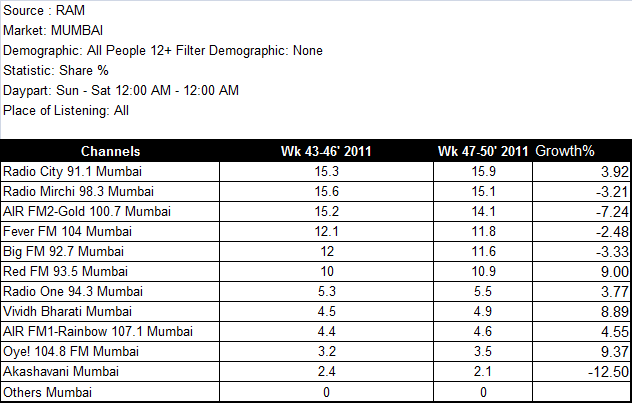
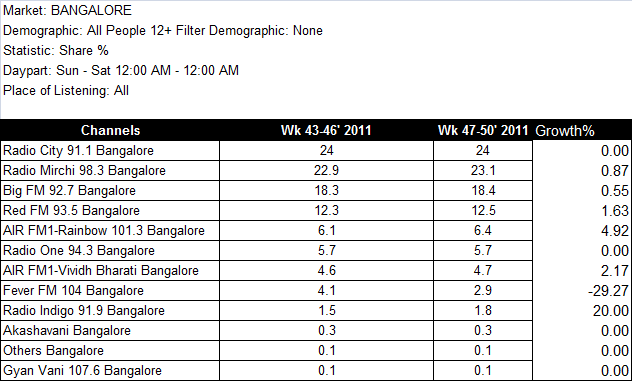
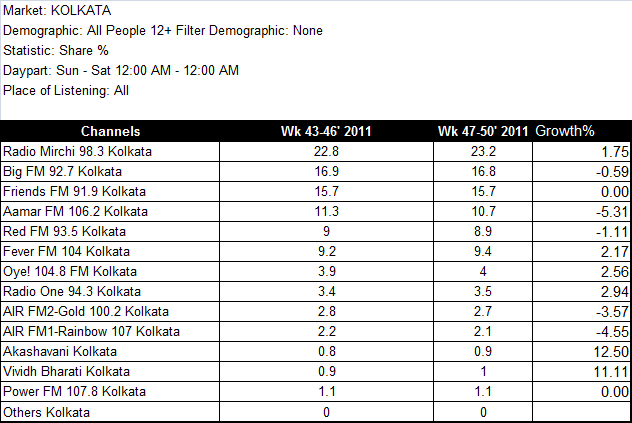
    On Friday, January 6, 2012, Radio Audience Measurement (RAM) – which covers four key metros, Mumbai, Delhi, Kolkata and Bengaluru – released its latest radio listenership figures for Wk 43-46 (last two weeks of October and 1st two weeks of November 2011) Vs Wk 47-50 (Last two weeks of November and 1st week of December 2011).


    According to the latest RAM data, for listeners of 12 years and above, and according to radio channel shares, Radio City, Radio Mirchi, Big FM, Red FM, Fever FM, Radio One, Oye! FM were some of the top FM stations in the big four metros.


    Mumbai:

    In Mumbai,Radio City further strengthened its leadership position in Wk 47-50 as against Wk 43-46 with a growth of 3.92 per cent in its channel shares. Radio Mirchi was rated the second most popular FM station in terms of channel shares followed by AIR FM2 Gold, Fever FM, Big FM, Red FM and Radio One. The other clusters of FM stations in the city are Oye! FM, Vividh Bharati, AIR FM1 Rainbow and Akashavani Mumbai.


    Besides Radio City, Red FM, Radio One, Oye! FM, AIR FM1 Rainbow, Vividh Bharati and Akashavani Mumbai are the only radio stations to have shown growth.


    Delhi:

    Most radio stations inDelhiwitnessed growth in the channel shares in Wk 47-50 as against Wk 43-46. AIR FM2 Gold emerged as the number one FM station inDelhi, its channel share however remained stagnant. Fever FM slipped to the number two position in Wk 47-50 after its channel share saw a decline as compared to Wk 43-46. Fever FM and AIR FM1 Rainbow were the only two FM stations inDelhito have seen a decline in channel shares on Wk 47-50 as against Wk 43-46.


    Radio Mirchi was the third most popular FM station followed by Red FM, Radio City, Big FM, Radio One, and Oye! FM. The other clusters of radio stations inDelhiinclude AIR FM1 Rainbow, Hit FM, Vividh Bharati and Akashavani Delhi.


    Bengaluru:

    There was no change in the station rankings in Bengaluru.Radio City continued to lead Bengaluru followed by Radio Mirchi and Big FM. While Radio City showed neither growth nor decline in its channel share, Radio Mirchi and Big FM saw marginal growth. Fever FM, however, was the only FM station that showed decline in its channel shares.


    Kolkata:

    Kolkata too saw no change in its station rankings. Radio Mirchi, Big FM, Friends FM, Aamar FM and Red FM were the top five FM stations in Kolkata in terms of their channel shares. Radio Mirchi, the most popular FM station in Kolkata has further strengthened its leadership position with a growth of 1.75 per cent in channel shares in Wk 47-50 as compared to Wk 43-46.


    While Radio Mirchi’s nearest rival in Kolkata, Big FM came a distant second with a slight decline of 0.59 per cent in terms of its channel share, the third most popular FM station in Kolkata, Friends FM remained stagnant. Besides Radio Mirchi, Fever FM, Oye! FM and Radio One were the only private FM stations in Kolkata to have witnessed growth in channel shares.


  • Radio Mirchi to enter Abu Dhabi as ENIL ties up with ADMC

    By A Correspondent


    Entertainment Network (India) Ltd has informed BSE that the company intends to enter into strategic business arrangement with Abu Dhabi Media Company (ADMC), a public joint stock company based inAbu Dhabi,United Arab Emirates.


    ADMC is a multi-platform media organisation and is inter-alia in the business of providing media content across various platforms including television, publishing, radio, digital and so on. ADMC owns multiple radio frequencies which broadcast across the UAE.


    As part of business arrangement, the company shall provide limited advisory services to ADMC for launch of a radio station in the UAE. The company will also grant a conditional license to ADMC for use of its Brand ‘Radio Mirchi(R)‘.


    Some of the other radio stations run by ADMC are Quran Kareem, an institution for more than 30 years, broadcasts both live and recorded recitals of the Holy Quran; Emarat FM, a pioneering Khaleej radio station that attracts listeners from the UAE and the Gulf with its interactive and entertaining programs that combine entertainment, songs, music, news and live shows; Abu Dhabi FM, the oldest Arabic radio station in the Gulf; Star FM, which targets bilingual, expat Arabs in the 15-35 year age range who have had some exposure to Western musical tastes and culture; and Abu Dhabi Classic FM, the first Western classical music radio station in the Gulf.


  • IBN7 partners with Radio Mirchi for 2G

    By A Correspondent

    IBN7 has partnered with Radio Mirchi for the promotion of IBN7’s new show, 2G that offers an off-beat look at current events, politics, people and happenings in a satirical tone. For the first time, Radio Mirchi is set to present on the television RJ Naved. Now viewers across the country will get a double dose of Mirchi Murga both on the Mirchi airwaves and on the television live and exclusive on IBN7’s brand new show- 2G.

    Commenting on the association, Mr Sachin Tagra, Vice President, Cluster Head, ENIL said, “We are thrilled to present RJ Naved on the television celluloid to his fans. Over the years, the concept of Mirchi Murga has become widely popular amongst our listeners owing to its novelty. It is a special treat for our fans this time as we bring Mirchi Murga to them LIVE on 2G on IBN7. We hope that we continue to add entertainment and fun to the lives of Mirchi listeners”

    Mr Piyush Jain, COO, IBN7 adds, “IBN7 has always believed in content innovation and bringing something different for our viewers. A show like 2G brings a daily dose of humour and lightens up the mood in the very serious genre of news. The concept of political satires is very popular across the world and an association with Radio Mirchi will help popularize this here as well. RJ Naved of Radio Mirchi was an obvious choice as a co-host of the show since he has all the wit and the brain to fit in the portfolio.”

  • FDI’s 26% allowance: Are radio players happy?

    By Shubhangi Mehta


    The government has enhanced the foreign investment limit for FM radio to 26 percent from the earlier 20 percent.


    This change ensures conformity of the foreign investment limit with other similar activities in the Information and Broadcasting sector.


    Rana Barua

    Is the increase adequate or was there more that was expected?

    Mr Rana Barua, Chief Operating Officer at RED 93.5FM, put forth his views by stating,” it’s a positive sign for sure for the industry .

    Whether Red Fm is looking at upping the Astro stake, Mr Barua said, “We will try and look at that but this will all depend on internal decisions hence there is not much to be said on this as of now”.


    “It is a welcome change but we will be able to gauge its real value closer to the bidding date of phase3 when migration policy is clear.  While radio in india is possibly one of the highest CAGR media in the world, the global economic situation needs to be accounted for in order to ascertain foreign investment’ interest,” said Mr Vineet Singh Hukmani, MD, Radio One.


    Apurva Purohit


    On this Ms Apurva Purohit, CEO, Radio City 91.1 FM said,”The increase in FDI in Radio sector from 20 to 26 percent is not really going to make any dramatic impact on the industry. It is too less and even now not on par with other media like TV or DTH.”


    Prashant Panday


    Mr Prashant Panday,CEO,Radio

    Mirchi, remarked, “A higher FDI limit will help FIIs to trade more in radio stocks that are listed. Till now, the limit was 20 percent and when FIIs approached that number, they had to take special permission from RBI to buy more. Now that limit has been raised to 26 percent and that will help increase volumes on listed radio stocks.”


    Will this encourage more foreign players to invest in the market?

    On this Mr Panday said,” Whether it will have any impact on strategic investments from foreign companies in India or not remains to be seen. On the one hand, the radio sector in India offers tremendous growth opportunities. But on the other hand, the sector’s profitability has been in question for much of the last five years. Even going forward, if bidding in Phase-3 becomes unreasonable, profitability could be in serious jeopardy. Further, foreign ncompanies are themselves operating under uncertain conditions in their own markets. Whether they will be willing to invest in India at this point in time remains to be seen.Also, given the condition of the money markets in India right now, it is unlikely that fund raising will be very easy. Given all of this, I think FDI investments into the radio sector in India will be limited.


    Mr Barua on the same said,” I’m still not sure if the rise will encourage new players to enter the market. The rise is there but when it comes to analysing it, I have always encouraged a higher percentage. In my opinion this rise is not high enough and leaves us with a doubt if it will actually egg on more foreign players”.

  • McCann wins Agency of the Year at Mirchi Kaan

    By Shubhangi Mehta

    The 8th Mirchi Kaan Awards  were announced yesterday in Mumbai. McCann Worldgroup continued its dominance this year as well, bagging the Agency of the Year award.

    Prasoon Joshi, Executive Chairman, McCann Worldgroup, said, “We are delighted to have won this award. McCann has outshined as a strong agency over the years in this award. This is also special for us as Radio is a difficult medium to write for, unlike television, hence the team is even happier to have won this.”

    Prashant Panday, CEO,Radio Mirchi said, “The Mirchi Kaan awards are a very emotional event for us. This is a night we spend with friends and recognize and reward their brilliance. For us, the benefit is when radio becomes as creative a medium as television or print. We are happy with the way the creative quality has improved over the past eight years. The pride for us is the quality of the jury, and we owe a debt of gratitude to them.”

    The 8th Mirchi Kaan Awards received about 250 entries across 16 categories. In addition there were special awards for the best writer, best voice and the crystal award for most outstanding radio commercial of the year.

    The jury this year consisted of Agnello Dias, chairman and co-founder, TapRoot, Deepa Krishnan, president, creative, Lowe Lintas, Prathap Suthan, chief creative officer, Iyogi, Rekha Nigam, managing director, Vihaan Communications, Sunil Thoppil, vice-president, McCann Erickson, Ashish Khazanchi, national creative director, Publicis ambience, Josy Paul, chairman and chief creative officer, BBDO India, Amit Akali, senior vice-president and national creative director, Grey, Ramanuj Shastry, chief creative officer, Saatchi & Saatchi, Malvika Mehra, national creative director and senior vice-president, Grey, Prasoon Joshi, executive chairman and regional executive creative director, McCann Worldgroup, Meera Sharath Chandra, K S Chakravarthy, national creative director, Draftfcb Ulka and Manoj Shetty, senior creative director, Ogilvy India.