Tag: Radio

  • Why FM is more than just a recall medium: Rabe Iyer

    By Rabe T. Iyer


    Old media don’t die! They just bounce back in new avatars. Not so long ago, radio had been written off as dreary, downmarket and not so cool. Television and, later, “new media” were touted as being media of the future. Thanks to advancements in technology and a change in lifestyle, radio has made an incredible comeback.


    FM radio stations are one of the most popular entertainment mediums, offering millions of Indians a great mix of shows covering music, contests, discussions, humour and gossip, delivered in local flavour by popular young radio jockeys.


    Radio is a medium of the senses, bringing the listener’s imagination to life and taking him into an exciting new world of his own. Thanks to local FM stations, marketers have been able to connect with their target group, especially the youth, like never before.


    According to industry experts and analysts, there are 250-300 million radio users today. This penetration is surprisingly more than that of newspapers, known to be the oldest among present day media. In addition, at 145-150 minutes per day, the consumption time of radio is more than that of television, which stands at 140.  Today, 80-90 per cent of mobile users access the radio on their phones.  The fact that the medium is mobile has clearly helped to increase its usage and popularity.


    With the rollout of Phase III licensing, the Indian radio industry is optimistic of huge growth. The industry, which currently brings in around Rs1,100 crore revenue, will see 800 new radio stations across 300 towns coming up.


    Here, radio-based advertising can be used effectively for communication and positioning. It is to be used well since it can target a large audience because of its immense reach. It is useful in increasing awareness about a brand or business and helps in enhancing the brand image. The past couple of years have witnessed a flurry of activity in the FM sector. Not surprisingly, the radio industry of today can be compared to television in the early and mid-nineties, and one that is all set to boom further.


    With carefully worded scripts, brilliantly created situations, and tailor-made strategies, radio advertising is getting more innovative and effective day by day. It is perhaps one of the simplest yet most cost-effective and powerful means of communication in today’s world.


    Studies indicate that instead of two back-to-back commercials on television, one commercial on television and another one on radio give about a 20 per cent higher brand recall. Also, a television commercial, if aired on radio, works very well as the listener can then visualize the entire advertisement. Hardly surprising that over the years, print based publications and television channels have been using radio as a support medium, as a reminder medium, and as a mean to building up frequency.


    As mentioned earlier, another interesting facet of the Indian radio story is the mobile phone explosion and its convergence with FM. This has exponentially increased the width and depth of the market.


    Radio offers tremendous opportunities for advertisers and media planners who need to explore various options, following which they can effectively use the medium in their media mix. Conversely, broadcasters need to develop the market by being more responsive to an advertiser’s needs. This will provide an opportunity for the market to arrive at the final verdict on the effectiveness of the medium inIndia.


    Rabe T. Iyer is Business Head, 92.7 BIG FM


  • Hello and Welcome to MxM Radio!

    Hello and Welcome to MxMIndia’s exclusive ‘channel’ for Radio… FM, All India Radio, Community Radio, Internet Radio and whatever else is happening in the world of radio in India.


    There have been various attempts to cover radio, but not being the most fashionable of media segments, it’s largely neglected. The reason is perhaps that there isn’t enough money backing the business.


    As we completed five months of existence yesterday, we stepped back to our commitment of Day 1: cover media like no one else in the business. At MxMIndia, we are committed to support the ‘underdogs’ amongst the various media segments. So: journalism came first. Then PR and now Radio.


    With Phase 3 set to take off soon and a maturing of minds – from amongst listeners and the players, we expect a lot of activity in radioland. MxMIndia has a dedicate resource to bring you a ringside view. Senior Correspondent Robin Thomas painstakingly covers radio like few others in the trade.


    We do not hesitate to ask the tough questions and cover issues that some may find uncomfortable. For instance, should RJ mentions be considered as paid content.


    So, behenon aur bhaioan, stay tuned in to MxM Radio. And do let us have your feedback.


    Email Robin who is coordinating the channel. He can be reached at robint [at]mxmindia.com. And feel free to call any of us in the MxM team.


    Cheers!


    Pradyuman Maheshwari

    Email: pradyumanm[at]mxmindia.com,

    BBM: 23050B5D

    Gtalk: pradyumanm[at]gmail.com,

    Twitter: @pmahesh

    Telephone: 98338 76278.


  • Is radio not good enough for premium brands?


    By Robin Thomas


    Over the years, growth of Radio as a medium has been restricted, thanks to TV. But, to the credit of many a radio expert over the years and advertisers who have believed in the medium, radio continues to sail; and sail even more promisingly when times are choppy.


    Also, sample this: The FICCI-KPMG Indian Media and Entertainment Industry Report 2011 states that the radio industry in India is expected to grow at 20 per cent CAGR (Compounded Annual Growth Rate) from the current base of around Rs 1000 crore. Radio’s share of media spends is also expected to rise from 4 per cent to 5 per cent by 2015. Among categories that advertise on Radio, Real Estate, Telecom, Retail, Education and TV channels are the ones advertise the most.


    The medium promises reach, greater recall and marketing solutions that are cost-effective. Despite this, why do premium advertisers shy away from advertising on the medium? It is known that premium brands prefer speciality magazines, internet and mobile and TV more than radio.


    Harish Bijoor, CEO, Harish Bijoor Consults agrees that premium brands don’t advertise much on radio. “Premium brands look at radio as a non-premium medium. There is ample research available which reveals that premium-category shopper do not depend on awareness scores for luxury brands from radio. In fact, radio tends to negate effort for luxury brands as of now and proves counter-productive to the effort. Radio is much too mass for luxury brands.”


    According to B Surender, Senior Vice President and National Sales Head, Red FM, the share between national and local advertisers on radio are 50:50 of which premium advertisers contribute merely six to eight per cent of the overall national advertisers. BMW, Volkswagen, Mercedes, Skoda, Blackberry, Marks & Spencer, Louis Philippe, Tanishq, smartphones , Lufthansa , British Airways ,Virgin Atlantic, Singapore Airlines, Emirates are some of the premium advertisers advertising on radio.


    For most of these premium brands radio is more or less a reminder medium, it is an extension of the television or print advertisements. Luxury watch brand, Seiko for instance does not advertise on radio at all whereas Jet Airways and HDFC Life heavily advertise on internet and television.


    Both internet and television have an edge over radio on premium luxury brands. While television has the benefit of being an audio-visual medium, internet is a highly interactive medium.


    Manish Dureja, Vice President, Marketing, Jet Airways said that the airline brand banks more on internet and mobile as against radio. “We are not advertising much on radio or on television as most of our marketing budget is performance driven, where we look to generate sales through search engine marketing and predominantly digital marketing. With internet penetration and the emergence of internet mobile, it has become mandatory for us to be present in the online domain. Radio, on the other hand is a localised medium and caters to a specific city. More importantly through digital media, I am able to reach consumers far more effectively than any other medium.”


    For Sanjay Tripathy, Executive Vice President-Head Marketing and Direct Channels, HDFC Life, television and the internet are the preferred medium because of the reach and better ROI. “Television is the preferred medium for HDFC Life because of the awareness it creates, and maximum reach it offers, whereas the internet has delivered better ROI for us. Radio on the other hand is more of a brand recall medium so most of our marketing budge or the media spends is skewed towards television and the internet” he said.


    Disagreeing that premium luxury advertisers are apprehensive about advertising on radio, B Surender of Red FM said that although there was a perception issue in the past, some of them wrongly assumed that the quality of FM listenership profile may not be very good. “Contrary to this belief, there are instances of advertisers abroad specifically using radio to target billionaires and rich entrepreneurs, since radio could reach out to them better than other mass media. But, in the past one or two years there is a positive change in our country as well with more and more premium brands in automobile, international airlines, consumer durables, telecom, jewellery, finance, retail etc have regularly started using radio as a part of their media plan. However, I feel there is enough scope to further improve the usage of radio by luxury brands in the near future.”


    With the rollout of phase III, radio will see an increase in reach in India. Multiple frequencies will allow FM stations to offer targeted or niche programming for the elite listeners. However, there are many challenges too: The radio industry will have to educate the premium luxury advertisers, not only about the effectiveness of the medium in delivering better ROI for their brands, but also about the quality of its listenership profile.


    Perhaps for now at least, radio is too large, too ubiquitous; a bit too common a medium for the un-common luxury brand. There is more thinking required on the part of radio station heads to get premium brands on board.


  • The Anchor: 5 reasons why radio is very effective in tier 2 and 3 cities

    By Harrish Bhatia


    #1 Radio offers localised content:

    Radio speaks to consumers in their own language or dialect, and the degree of connect of the local content with people in these markets is far higher than any other medium.


    #2 People have more time for radio consumption:

    Since the level of activity in these markets is lower than in metros, people have more time to spend for themselves. This is where radio fills the gap. The increasing number of FM-enabled handsets has further increased the consumption of radio. Radio measurement survey conducted by RAM has proved that the average time spent listening to radio per day is 244 minutes inNagpurand 206 minutes in Jaipur as compared to 127 minutes in Mumbai and 124 minutes inDelhi. (Source: RAM Sweeps 1.0)


    #3 Radio serves as key source of information because of lower literacy rates:

    Literacy rates in these markets are much lower than in metros and as a result, radio serves as the primary source of information. Another critical point is that radio provides regular updates throughout the day whereas a newspaper provides news only in the morning.


    #4 Radio works even when there is no electricity:

    Since tier2 and tier3 cities have fewer electricity connections as compared to the metros and also suffer more frequent power cuts, radio serves as a main source of entertainment for people, instead of television. As a result people tune into radio using transistors and mobile phones.


    #5 Low internet penetration:

    Low internet penetration and inadequate bandwidth in these markets means that internet remains a distant dream. Thus, in the absence of internet, radio serves as a major source of engagement and personal entertainment.


    Harrish M Bhatia is the CEO, MY FM.


  • FM in the North-East – a foggy picture

    By Robin Thomas


    Phase III of FM is likely to bring more radio services to the North-East, a region known for being music-crazy. Currently, Guwahati, Shillong and Gangtok are the only cities in the region to have any FM radio services. While Red FM and Big FM are the only national players present in this region, the local players are Radio Misty, Radio Gupshup, Nine FM and Radio Ooolala.


    The music generally played in these markets is a mix of regional, English and Bollywood songs. One of the major challenges facing the North-East players, particularly the local FM stations, is the high music royalty rates, and that revenue generation is comparatively lower than the metros, making it a little difficult for survival.


    Nisha Narayanan, Senior VP Projects & Programming, Red FM explained, “Radio as a medium is very popular in the North-East as the North-East has a very strong music connect, it has a rich music culture. The drawback however is the lack of government support for radio in this region. Most radio stations in the North-East are local players, there are not many national players because they do not see too many benefits from these markets.”


    Nishant Mittal, CEO Radio Misty said, “We are in Gangtok and Siliguri, and both these markets have been very good for us and for radio because the youth in this region are very inclined to music.”


    Low advertising revenue

    Most of the advertisers in radio are local, particularly from the retail category. National or corporate advertisers in radio are said to be very few in the North-East. The national-local advertising ratio of Radio Misty, for instance, is 40:60.


    According to S Wassim Ahmed, Station Head, Radio GupShup, the spot rate for radio in North-East is even Rs 100 per spot, thus making it tough for the medium in these regions. “Regional advertisers’ response initially was bad. You cannot blame them, they were not educated about the impact of the FM radio. The national advertisers were equally apathetic towards the Guwahati market (North-East market is non existence for all the practical reason). The spot rate is pathetically low. It is invariably below 100/spot. Radio life is toughs in these parts of the country.”


    The challenge

    Some of the challenges for radio in the North-East according to the industry players are huge royalty rates. Revenue generation is comparatively lower than those in other parts of the country, and the challenge to get the right talent because of limited man power.


    According to Mr Ahmed of Radio GupShup increased government support and minimized capital outflow will ease the burden of the FM radio business in the North-East. “For the radio business model to be sustainable in these remote parts, the capital outflow should lessen. Just like government subsidy is available in any other industry in the North-East, radio too should also get those benefits. Government support in terms of DAVP advertisements would be a great boost.”


  • The Anchor: 6 lessons radio can learn from abroad

    By Vehrnon Ibrahim


    #1 Throw a rock rather than chucking small stones:

    Heart FM London went after 25-44 women. About 20 percent of overall available listenership, but in a market where there are 20-odd stations 20 percent is actually a huge opportunity. I like to say it’s like throwing small stones at a target; you will hit it, always no matter how bad your aim is, but never leave an impact. Chuck a well aimed rock at the target and you will destroy it. If the proposal to allow more frequencies in major metros goes through we will hear many different formats of radio as all the new players will want to go up against players who target such wide demos.


    #2 Don’t just Post-it, stick to it:

    People listen to radio for entertainment and that mostly means music – so why loyalty in a market when everyone is pretty much playing the same music? Promise becomes important. Call it a brand, call it a position, and call it a culture, it’s all about telling the listener what you have to offer and making sure you offer that. K-Earth 101 in LA says “Classic Hits” and that’s all they ever play. So when you tune in you know what you will get.


    #3 Don’t be anti-social:

    Hitz.FM in Malaysia has a quarter of a million Likes on Facebook. They have cut down dramatically on marketing and messaging spends. Jake Abdulla demonstrated to me by posting a message which generated over 200 likes within 30 seconds! That’s huge, and it went on. It’s a bigger deal in India than we are giving it credit for, and in months to come we will all be using social media for our messaging to our core listeners, our existing CUME.


    #4 One promotion every sweep:

    Virgin radio stations around the world do this very effectively. This is an old chestnut in markets where ratings happen once every quarter or half etc… Anytime the diaries go out or the PPM come to town the radio stations send out the artillery and blast away for share. We are the only country in the world to have a 52-week diary. So that implies we should be doing a promotion all the time, and that’s exactly what we should do. Short bursts of firepower don’t win wars, it’s the long-term campaign that works.


    #5 Heavy ball, long chain:

    Lay down the boundaries of what the content will cover and make sure the programming team stay within it. London’s Capitol FM is a local station in a capital city. They cover entertainment and London, that’s it. If it’s happening in London or if it’s entertaining then it is happening on Capitol FM.


    #6 Character over content any day (my personal mantra):

    Terry Wogan of BBC Radio 2 has been on air for nearly 55 years but once upon a time he was a fledgling talent looking for a break. Though he is not even from the UK, he is a national treasure there. We need to approach recruitments at a different angle and hire for the future, rather than steal from competition and inherit a jock who will continue to give ratings to his old station for years to come.


    Vehrnon Ibrahim is the National Programming Head, Oye! 104.8 FM


  • IRS 2011Q3. Digital growth bestest. Cinema, Radio decline

    By A Correspondent

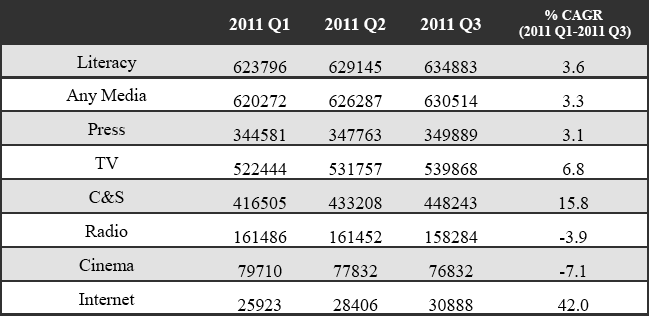
    As per the Indian Readership Survey (IRS) 2011 Q3 data, Cable & Satellite (C&S) and Internet are the two sectors which have shown the maximum growth in total reach. Radio, on the other hand, showed negative growth of 3.9 per cent CAGR with numbers declining from 161.45 million to 158.28 million. Internet, the fastest growing sector, recorded a growth of 42 per cent CAGR with the reach going up from 28.41 million in Q2 to 30.89 million in Q3.

    The total reach of the television media has also gone up by 6.8 per cent CAGR to 539.87 million in Q3 from 531.76 million in Q2 making it the third fastest growing sector.


    The Cable & Satellite (C&S) sector recorded a growth of 15.8 per cent, the only other sector to record double digit growth. C&S total reach is up at 448.24 million in Q3 compared to 433.21 million in Q2 2011. Cinema also recorded negative growth of 7 per cent with reach declining from 77.83 million in Q2 2011 to 76.83 million in Q3.


    All figures are in Average Issue Readership. Like media buyers, MxMIndia only endorses Average Issue Readership as the currency for readership measurement. Please note that these are only topline figures which have officially been supplied to the media. Sensible buying and planning happens when more data is available.


  • Digital is the future, not competition to radio

    By Robin Thomas


    While digital was and probably is still seen as a threat to the growth of print and television, for radio, on the other hand, the digital medium is said to be a complement and not competition.


    Some examples of digital successfully complementing radio to provide good content are Radio Mirchi’s VAS application – ‘Mirchi Mobile’, which allows mobile users to listen to any Radio Mirchi station from any city by just dialling a particular number across any telecom operator. Radio City’s music portal, PlanetRadiocity, in addition to its extensive music content, offers web radio, said to be India’s first and only multi-genre, live and interactive ‘Web Radio’ station that plays a variety of content 24×7. Radio Netherlands Worldwide (RNW), the Dutch international public broadcaster recently launched a website on sex education. Radio Maska is another internet radio portal available inIndia.


    Rachna Kanwar

    The one common factor among FM radio stations is that they want to stay connected with their listeners even when they are not tuned in. Hence most of them are finding new and innovative ways to engage their listeners online.


    Radio jockeys are going online by putting up blogs, videos and audio clips of their programmes on their FM station websites. Almost all FM stations today have made their presence felt on social networking sites like Facebook and Twitter.


    MxMIndia spoke to couple of FM stations to find out the significance of digital media to FM radio today.


    Rachna Kanwar, Vice President and Business Head, Digital Media and New Business, Radio City feels that digital medium has helped them connect with their audiences not only in India but even those settled abroad. “With the astounding rate at which the medium is growing, it is obvious that nobody can ignore digital media today.RadioCityhas used the medium effectively to reach out to our listeners. Digital media has also enhanced our engagement with listeners and has helped us in promoting our offerings to a larger audience base,” she said.


    Rahul Balyan
    Amitabh Srivastava

    In order to engage the listeners and ensure that they tune in to the radio station, the traditional FM stations will have to continue re-inventing themselves a lot more around what the listeners want and how they want, especially since the choice for a listener will be infinite on digital platforms.


    Rahul Balyan, Senior Vice President and Head of Digital Initiatives, Radio Mirchi said, “We have realised that at least 20 per cent of Radio Mirchi listeners are online, and have a lot to say; the digital platforms allow us to connect them on a one-on-one basis. We have got a tremendous response on Facebook, Youtube, Mobile VAS and our website. All of it is driven by the equity that Radio Mirchi has created with the listeners.”


    Convergence of traditional broadcasting platforms with digital platforms is perhaps inevitable as digital media has become significant, not only for radio but for all media.


    Amitabh Srivastava, Country Manager – South Asia, Radio Netherlands Worldwide pointed out: “Digital is the future and not competition to radio and I see a lot of potential for internet or digital radio inIndia.Mobilehas also become very important today as most people listen to radio on their mobile phones and as technology will progress and internet usage grows inIndia, internet radio will also see growth.”

  • Big FM appoints Vivek Malhotra as head of marketing

    By A Correspondent


    Reliance Broadcast Network Limited (RBNL), on Tuesday, announced the appointment of Mr Vivek Malhotra as Head, Marketing for its radio brand, BIG FM. Mr Malhotra will be responsible for developing the overall brand and communication strategy for the business and implementation rollout across the stations. He will be closely associated with the product, operations and revenue teams.


    Speaking about his new role, the immediate challenges and the shift to a new medium altogether in an email interaction with MxMIndia, Mr Vivek Malhotra stated: “Radio, as a medium, appeals very differently and does indeed have a connect with the audience at a very personal and emotional level and it is amongst the most inclusive media formats in the country.”


    “Accordingly, the challenge to truly differentiate and connect more closely with the audience is distinctly different. The leadership position enjoyed by the network added to the fact that radio is welcoming the most interesting times ahead, made this an opportunity very few would miss” he added.


    In a prepared statement, Reliance Broadcast Network stated: “We are delighted to have Mr Vivek Malhotra on board. He brings with him vast experience across marketing, media research, trade management, sales support, AFP solutions, distribution and corporate strategy. With a strong understanding of business and tremendous creativity, we are confident Vivek Malhotra will play a key role in leading the team to continue the development and growth of the radio business.”


    Prior to joining Reliance Broadcast Network, Mr Malhotra was the senior Vice President – Marketing, PR and Research at Bloomberg UTV. He played an integral role in setting up the entire marketing system and repositioning the product to new brand values, along with the additional responsibilities of distribution planning and coordination. Vivek Malhotra also worked with STAR News Network, wherein he is said to have not only led their trade engagement and research unit but also acquired valuable experience around regional products like STAR Majha.

  • FM radio: Waiting in the wings for how long?


    By Ritu Midha


    Television and print continue to be the mainstay of any media plan. The buzz around launch of new channels and publications (largely newspapers) is difficult to ignore. Digital media, too, has become a medium of ‘now’. Meanwhile, radio continues to struggle, with cost to operate being quite high while profitability is still an issue. Is it time, then, to ring the alarm bells? Is radio getting lost even before it has acquired a national footprint?

     

    Prashant Panday

    Radio: Today

    Prashant Panday, CEO, ENIL, emphasises: “There is no evidence of that yet, though if Phase III expansion gets delayed, this is bound to happen. The Indian media scenario has new brand launches happening all the time. Newspaper reports say that since August this year, the Ministry of I&B has given permission for 745 new TV channels – about half of which are news channels. Likewise, if you look at newspapers, there are editions opening across the country almost every month. It’s the same with outdoor sites and internet portals. In a scenario like this, if there is no addition in the number of radio channels, then the sector will get affected. That is one reason we are waiting for the 800 odd new radio licenses to be issued under Phase III. At present though, radio continues to grow, and its share continues to be just under 5 percent of total advertising spends.”


    Media planning and buying fraternity, in turn believes that radio as a medium is gaining popularity, and that is largely because of its content which touches a cord with the local consumers. Mohit Joshi, Managing Partner, MPG India, explains, “While there is not as much buzz about radio, I don’t think it is losing out. It has developed a unique role in the communication mix, which straddles ATL and BTL. Advertising support on the medium has been growing at 11 percent over the years.”
     

    Ashit Kukian

    Increase in FDI Limits: Low impact

    Media owners are of the view that increase in FDI in radio would not really impact the sector, unlike retail where the proposal for FDI in multi-brand retail has raised a storm. The common belief is that not many foreign players would be interested in the medium because of low profitability.


    Mr Panday says, “Remember, FDI only enters sectors where there is profitability and where the regulatory regime is favourable and stable. Today, most radio broadcasters are barely hitting EBITDA break-evens. This, after half the license period of ten years, is already over. I personally feel that the higher FDI/FII limit will help increase trading in listed radio stocks like ENIL and RBN, but apart from that, the impact might not be that high.


    Ashit Kukian, COO and President, Radio City, agrees, “The increase in FDI in radio sector from 20 to 26 percent is not really going to make any dramatic impact on the industry.”
     

    Vinish Joshi

    Slowdown: Whither goes Radio?

    While FM in India continues to struggle, impact of the slowdown, interestingly, on radio, as per the expert opinions might be the least, courtesy its local content. As per Mr Panday, with a slowdown in ad spends, the overall ad industry is unlikely to grow at more than 5-8 percent. His belief is that radio may grow slightly higher at 10-12 percent. “Almost all sectors are seeing a slowdown. We attributed the slowdown in the 1st quarter to the higher spends in the preceding 4th quarter on account of the cricket. However, the 2nd quarter also has been weak,” he says.


    Vinish Joshi, GM, Mediacom, too believes that radio might see a higher percentage growth than other media – largely due to its reach and content. He says, “Increasingly FM-enabled mobile phones are driving radio growth in India and phase III is expected to extend radio’s reach to 294 towns and 839 stations. If any medium stands to gain from this slowdown, it is radio, as during the periods of slowdown, marketing activities get more focused. The concern remains on accountability, as marketing will also be more accountable during this period and comprehensive measurement tool for Radio industry will be critical.”

     

     Mohit Joshi

    Measurement currency: A catch-22

    Indeed, the tighter times lead to a lot more stress on RoI, and measurement currency becomes very important. The radio players feel that there is need for a more robust radio measurement system. Mr Panday says: “The present system is a diary system which has many flaws. What we need is an electronic measurement system which accurately captures listenership. We also need more sample sizes to better capture the heterogeneous habits of our cities.”


    This sentiment of the media players is shared by media planning and buying fraternity. While, they agree that attempts being made to capture a larger listener base are commendable, they believe that it needs to broaden further.


    Mohit Joshi says, “Effort is already on for increasing the coverage of the network of the current Radio Measurement systems. Today, when we have radio stations across most of the key cities, the coverage also needs to mirror that growth. The better the data, the easier it would be to establish the role of Radio.”


    It would be interesting to find out how much is the fraternity ready to invest in improving the measurement system and currency. It is a known fact that research and measurement is cost-intensive. With RoI being an issue, most of them might find it difficult to make a major investment in anything.


    FM stations: Same, same – no different

    Radio, at the moment is suffering from me-too syndrome – which to a large extent can be attributed to investment constraints. There is definitely a need for differentiation – enter localised communication.


    Mr Kukian says, “Radio as a medium has the ability to create customized communication for pocketed audiences and impact millions of Indians due to its wide coverage and personal connect. This coupled with the medium’s innovation quotient gives it one up over other media in terms of fulfilling advertisers’ requirements.”


    Vinish Joshi shares a similar opinion, but he qualifies, “Inserting rapid-fire weather forecasts and traffic reports is just providing minimum local content. Local radio, by my definition, is the real interaction of radio personalities, announcers, the people on the air, with listeners both on and off the air. As long as radio maintains its local presence, something that other syndicated forms cannot provide, there will always be a need for its services.”


    Unfortunately local content on radio, largely restricted to traffic reports and contests, seems to be similar on all the stations. The reason for this, yet again, is operating costs and limited number of stations. The game might change once there are more radio stations post Phase III.


    Mr Panday states, “Very little content differentiation will happen unless more frequencies are released. Let’s take an example. Suppose only 10 TV channels were allowed by law. Which channels would exist then? My guess is that the 4-5 GECs would still exist, there would be 1-2 news channels and 2-3 other channels. The reason for so much content differentiation in TV is that there are so many channels. The second reason is that broadcasters are allowed to own and broadcast several channels, so that the cost of operating smaller format channels is reduced.”


    He continues, “In radio however, we suffer from restrictions on both the above mentioned requirements. There are only 7-8 channels in the major markets and broadcasters are allowed to operate only one channel per market. The Phase-III regulations are going to relax the second condition, but till the number of channels increases significantly, we cannot expect much content differentiation. And if the auctions happen the way they are planned – e-auctions for one frequency in Delhi and two in Mumbai – then the license fees will shoot up and niche formats will become unviable. The government needs to release more spectrum BEFORE auctions are conducted. We have even given them a formula to do this – just reduce the “separation” between two adjoining radio channels from the 800 kHz at present to 400 kHz.”


    If the separation between two adjoining channels is helved, the number of channels would double – broadcasters will be able to compete better with TV and print, the government will get more license fees through auctions. And it just might help in increasing FDI investments in the sector by raising the bar and the competition.

     

  • RAMcheck: Media agencies on new FM listenership numbers

    By Robin Thomas


    The latest RAM data on radio listenership for the month of September to mid-October has thrown up a few surprises in radio listenership. New leaders have emerged in cities that were once strongholds of their rivals. Barring Kolkata where Radio Mirchi continues its leadership position, the remaining three markets – Mumbai, Delhi and Bengaluru have new No. 1s.


    Take Mumbai for instance, once a Radio Mirchi bastion, the latest RAM figures (category: all people 12+, all places of listening, shares) show Radio City as the number one private FM station in the city, slightly ahead of Radio Mirchi. However this time (i.e. week 38-42, 2011) Radio City had to share the No. 1 slot with the government owned FM radio – AIR FM2-Gold. Bengaluru where Big FM held its number one status for a very long time is now overthrown by Radio City. In Delhi Fever FM has become number one taking over from AIR FM2- Gold, Radio Mirchi which was number one in the city for very long time has slipped to number three position. These figures are according to RAM, All People 12+, all places of listening and all daypart (i.e. Sunday to Saturday 12 am to 12 am).


    In addition to these developments we find that when we compare week 35- week 38, 2011 (last week of August to 1st three weeks of September, 2011) and week 39- week 42, 2011 (Last 2 weeks of September and 1st two weeks of October, 2011) not all FM stations have witnessed growth in their listenership. When asked whether FM stations have reached a stagnation point in listenership, Mr Janardhan Pandey, Associate VP, Mudra Max explained, “It has not reached a stagnation point, but a period of stabilization. To further increase listenership, FM stations will have to take the quality of content and programming to the next level along with higher-level product promotions.”


    Mr Ajay Rao, Vice President, Dentsu observed, “FM stations do not have novelty working for them any more. It is today a force of habit for people who find themselves without a smartphone to keep them going. For the young people FM is losing out to other more engaging past times. Can one differentiate basis the content? Listeners tune in for music and switch channels during breaks.”


    AIR FM2- Gold which has been growing strong in listenership particularly in Mumbai and Delhi where it has emerged as a strong number two contender. What remains to be seen is whether this trend continues or will it see a decline or stagnation in listenership. Media planners are however of the view that since AIR FM2- Gold offer only specific contents it is not considered as often as the private stations. Mr Narendra Kumar Alambara, Vice President, Starcom Chennai was of the view that, “Since the entertainment content is limited in AIR, the advertisers do not consider AIR as often as compared to the private stations.”


    “AIR FM- Gold has been consistently delivering impressive numbers, this suggest that the music is most important content of a radio station and RJ/ innovations and promotions alone cannot keep you on top,” said Mr Janardhan Pandey.

  • RAMcheck: Some surprises in 4-metro stats for Aug to mid-Oct

    By Robin Thomas


    On Friday, December 2, Radio Audience Measurement (RAM) released its latest radio listenership figures for Week 35 to Week 38, 2011 (last week of August to 1st three weeks of September, 2011) and Week 39 to Week 42, 2011 (Last 2 weeks of September and 1st two weeks of October, 2011). RAM covers four key metros – Mumbai, Delhi, Kolkata and Bengaluru.


    According to the latest RAM data, for listeners 12 years and above, from all places of listening and according to share value, Radio City, Radio Mirchi, Big FM, Red FM, Fever FM, Radio One, Oye! FM are some of the top FM stations in the big four metros.


    Mumbai:

    In Mumbai Radio City emerged as the number one FM station in Mumbai, followed by AIR FM2- Gold, Radio Mirchi, Big FM, Fever FM, Red FM, are the top six FM stations in Mumbai. The other FM stations in Mumbai include Radio One, Vividh Bharati, AIR FM1 Rainbow and Oye! FM.


    If we compare growth of FM listenership in terms of shares from Week 35 to week 38, 2011 and Week 39 to Week 42, 2011 we find that Radio City, AIR FM2- Gold, Big FM, Fever FM, Radio One and Vividh Bharati are the only FM stations to have witnessed growth. Interestingly, AIR FM2- Gold emerged as the fastest growing FM station, with a share of 12.59 per cent. Radio City, number one FM radio station grew 0.63 per cent in shares. Big FM, the fourth most popular FM station as per the latest RAM figures remained stagnant whereas Fever FM saw a marginal growth of 0.88 per cent. Radio One also saw good growth of 6.25 per cent.


    The FM stations which saw a decline in their listenership share are Radio Mirchi, Red FM, AIR FM1- Rainbow and Oye! FM. While Radio Mirchi is the third most popular FM station in Mumbai after AIR FM2- Gold then Radio Mirchi saw a decline of 7.19 per cent. Oye! FM on the other hand saw a decline of 11.43 per cent in their listenership share.


    Delhi:

    The RAM figures for Delhi too have thrown some interesting figures. Fever FM emerged as the number one FM station from week 39 to week 42 (i.e. Last 2 week of September and 1st two week of October, 2011). Fever FM took the leadership position from AIR FM2- Gold which was number one in Delhi from week 35 to week 38, 2011 (i.e. (last 1 week of August to 1st three week of September, 2011).


    Ranked one is Fever FM with a share of 20.7 per cent as on week 39 to week 42, 2011. Fever FM is closely followed by AIR FM2- Gold with a share of 20 per cent. Ranked three is Radio Mirchi with a share of 16.7 per cent and Red FM with a share of 11 per cent as on week 39 to week 42, 2011. While Big FM and Radio One received a share of 5.6 per cent and 5 per cent respectively, Oye! FM and Hit FM received 3.6 per cent and 2.1 per cent share respectively.


    The FM stations that witnessed growth in their listenership share (i.e. comparing ‘Week 35 to 38, 2011’ and ‘Week 39 to 42 2011’) we find Fever FM, AIR FM2- Gold, Big FM, Radio One, AIR FM1- Rainbow, Hit FM and Vividh Bharati are the FM stations to have witnessed growth. Fever FM which leads Delhi in terms of listenership share grew 5.61 per cent, Big FM grew 5.66 per cent, Hit FM grew 5 per cent, AIR FM1- Rainbow grew 4 per cent. Radio One emerged as the fastest growing FM station in Delhi with a listenership share of 5 per cent as on week 39 to 42, 2011 which is a growth of 8.70 per cent as against 4.6 per cent share on week 35- week 38, 2011.


    Radio Mirchi, Radio City, Red FM and Oye! FM on the other hand saw a decline in their listenership share (i.e. when we compare Week 39-42 as against week 35 to 38, 2011). Fever FM, AIR FM2- Gold, Radio Mirchi, Radio City, Red FM, Big FM, Radio One and Oye! FM are the top 8 FM stations in terms of listenership share.


    Bengaluru:

    Radio City continues its leadership position in Bengaluru, it is closely followed by Radio Mirchi, Big FM, Red FM and AIR FM1- Rainbow are the top five FM stations in Bengaluru.


    Big FM which held the number one position for a long time in Bangalore is now ranked three after Radio City and Radio Mirchi. However with a listenership share of 18.3 per cent (on week 39 to week 42, 2011), Big FM witnessed a marginal growth of 0.55 per cent as against its listenership share of 18.2 per cent (from week 35 to 38, 2011). The other FM stations to have witnessed growth are Radio City, Radio Mirchi, AIR FM1- Rainbow and Radio Indigo. Radio City received a share of 24 per cent on week 39 to week 42, 2011 as against 23.6 per cent from week 35 to 38, 2011, a growth of 1.69 per cent. Radio Mirchi on the other hand grew 3.65 per cent after receiving a share of 22.7 per cent on week 39 to 42, 2011 as against a share of 21.9 per cent from week 35 to 38, 2011.


    The other private FM stations in Bengaluru are Red FM, Radio One and Fever FM which received a share of 11.6 per cent, 5.5 per cent and 5.4 per cent respectively. Red FM for instance in Bengaluru received a share of 11.6 per cent (from week 39 to 42, 2011), week 35-38, 2011, the FM station received a share of 12.3 per cent, a decline of 5.69 per cent. Radio One declined 5.17 per cent after receiving a share of 5.5 per cent on week 39 to 42, 2011 as against 5.8 per cent share on week 35 to 38, 2011. Fever FM on the other hand received a share of 5.4 per cent (on Week 39 to 42′ 2011) as compared to its share of 5.8 per cent on week 35 to 38, 2011, a decline of 6.90 per cent.


    Kolkata:

    The top five FM stations in Kolkata are Radio Mirchi, Big FM, Friends FM, Aamar FM and Red FM. While Radio Mirchi continues to lead the Kolkata market with a share of 23.1 per cent (for week 39 to 42, 2011), the second most popular FM station as per week 39 to week 42 data, Big FM is a distant second with a share of 17.4 per cent. Friends FM maintains its third rank in Kolkata with a listenership share of 15.5 per cent, Aamar FM came next with a share of 10.5 per cent and rank five is Red FM with a listenership share of 9.3 per cent.


    The other private FM stations in Kolkata are Fever FM, with a share of 8.5 per cent, Oye! FM with a share of 3.9 per cent, Radio One with a share of3.8 per cent, Oye! FM received a share of 3.9 per cent and Power FM received 1 per cent.


    Radio Mirchi, Big FM, Friends FM, Red FM, Oye! FM, AIR FM1- Rainbow, Akashvani and Vividh Bharati are the only radio stations to have witnessed growth in the week 39 to week 42 data as against their numbers in week 35 to week 38.