Tag: Pradyuman Maheshwari

  • Only 59% (&not 87%) digitization achieved!


    By Pradyuman Maheshwari


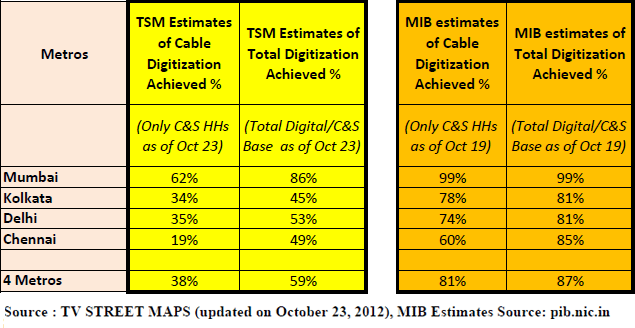
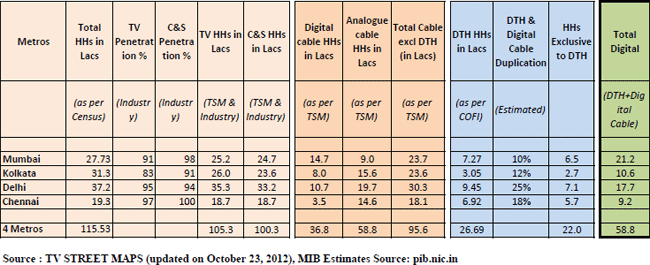
    Only 59 per cent of digitization has been achieved in the four metro as per the first ever independent survey of the extent of digitization in the four metros was conducted by Television Street Maps for MxMIndia. This number is in sharp variance to the claim made by the Ministry of Information and Broadcasting that 87% of the four metro was digitized.


    The figures for the four metros tell the story:


    For Cable & DTH:

    Mumbai: 86% (Govt: 99%)

    Delhi: 45% (81%)

    Kolkata: 53% (81%)

    Chennai: 49% (85%)

    The gap grows when you look at the achievement of digitization only in cable homes.


    Mumbai: 62% (Govt: 99%)

    Delhi: 34% (78%)

    Kolkata: 35% (74%)

    Chennai: 19% (60%)


    On Tuesday, we made a clarion call to the mandarins of the Ministry of Information and Broadcasting urging them to put an end of this charade of make-believe numbers of digitization.


    MxMIndia strongly believes that digitization is THE ONLY way in which the broadcast business can survive and thrive. For too long there has been much confusion amongst stakeholders. With half-baked regulations and guidelines, certain sections of the ecosystem were getting away with unethical practices.


    India has been among the most happening markets in the global broadcast business. Most of the world’s media superpowers are here. What was needed was some order in the business. Which digitization was going to bring in this, as it happened internationally. Unfortunately, the government has appeared to have missed  a trick in its attempt to execute this.


    The Sunset Date for the switch from analogue to digital transmission in the four metros was first fixed as June 30, 2012.  Then it was shifted at the last-minute to October 31.  When this writer mentioned that even that date looks tough to achieve, there were many in the industry who said that the momentum will build eventually.


    Although MxMIndia had been running a series starting 100 days to the June 30 deadline, we didn’t look at digitization in a big way until there 50 days left for November 1. But soon after interacting with all stakeholders, we figured that none of the numbers on the extent of digitization achieved that were being dished out could be believed.


    Jaldi 5 with Joydip Kapadia: Data based on ground-level info + professional & expert assumptions
     

    The government claimed an 87% achievement of digitization while the study conducted for MxMIndia by Television Street Maps showed this achievement to be only 59%. While this figure is for cable and DTH homes, that in cable homes alone is a low 38% as against the I&B ministry claim of 81%. MxMIndia spoke to Joydip Kapadia, Business Head, Television Street Maps on the issue:01. There is a huge variance between the TSM study figures of 59 per cent total digitization as against 87 per cent which the government is quoting. Why do you think do we have this huge difference between the two figures?

    I wouldn’t be in a position to comment on the numbers quoted in other studies. After all, whether its the authorities or TSM or other third parties releasing info about the ground, we all have to resort to diverse methodologies and assumptions. Sometimes the estimates of individual studies could vary due to the underlying assumptions considered. These assumptions work at multiple levels – each or all of these assumptions levels could influence the end result. For instance, differences in defining the areas within the city, definition of Digital TV (including or excluding DTH), total cable homes in a city extrapolated from census and other sources – are just some of the places where assumptions taken upstream within the analysis could produce variations in numbers coming out downstream – at the end of the analysis. All I can say is that our data is based on information obtained from the ground overlaid with our professional and expert assumptions.


    02. By your estimates how much do you see the 59 per cent grow to by October 31?

    It’s difficult to predict given the scale of the initiative and the number of players and variable involved. I wouldn’t like to hazard a guess.


    03. Would you see broadcasters lose out because of the delay (given more carriage fees, the delay in transparency, but then assured reach)

    We have actually not looked at these aspects so I wouldn’t like to say anything on that.


    04. Is there any one thing that you would like to see being done right if there’s a delay in the date and/or for the digitization for the rest of the country?

    We are not direct stakeholders in this and cannot offer any advice in this regard.


    05. 05. Do you think it would be prudent for the government to push the digitization date in the four metros by another three months?

    The math for all stakeholders comes down to what is the overall target to achieve vis-a-vis the seeding pace of the industry to reach that target. If that Math adds up then great, else the verdict would be to budget for greater time.


    It is then that we commissioned Television Street Maps (TSM),  India’s largest and widest channel distribution monitoring service covering over 1500 headends across  675+ cities/towns, to conduct this study. TSM placement monitoring data is provided on a weekly basis to its clients who include names such as Indiacast, One Alliance, Viacom18, MSM, Star, UTV, etc. Besides providing distribution monitoring for analogue and digital for Class-1 towns, TSM has recently started providing distribution monitoring for LC1 towns as well as Digital Track, a system to analyse Digital offerings of MSOs and DTH companies.


    Over the last two years, TSM has been tracking cable headends on a daily basis and reporting on a weekly level in almost a cable census style – covering every headend for the geographies it represents. While the data provided here are just the toplines we intend to provide detailed insights to our client on DAS. (see box: Jaldi 5 interview with TSM Business Head Joydip Kapadia: Data based on ground-level info + professional & expert assumptions ).


    Methodology of Data Capture:

    Over the last two years, TSM has been capturing TV channel distribution on a daily basis – the expanse of which is now a staggering 1500 headends across 675+ towns. This daily activity has been augmented since August 2012 for the four metros to capture the movement from analogue to digital at a more granular level. This augmentation/ expansion has been done using extensive ground intelligence and multiple verifications due to the criticality of the data. To ensure correctness of the data, more frequent scans were done in the last few days. The current release is for the ground situation as on October 23, 2012.


    The ground info on Analogue versus Digital has been layered with metro universes data collated from census and other third party sources to ultimately validate and put together the digital penetration data for the 4 metros.


    The sharp variance in the numbers as per the TSM survey and those put out by the government is reason for worry. But this is precisely what led MxMIndia to commissioning this study. No one really believes the numbers that are being put out by the government though MxMIndia, like other media, has been publishing these.


    MxM View

    MxMIndia recommends that the government act in a mature way on the issue. While a delay will mean a loss of face, it’s better to schedule for a time when 100 percent digitization is truly achieved. At the time of writing, we’ve heard of rumours that the government may well announce a delay by two months. We would urge the government to not look at December 31 as the Sunset Date. There is a fair amount of special programming on television planned on that day and the government would be well advised to look at a date like January 31.


    However, while doing so, it must get assurances from the governments in West Bengal and Tamil Nadu on compliance. The government must also meet all stakeholders to ensure that everyone is on the same page and is working towards the greater common good. It may be a good idea for it to appoint a full-time Officer on Special Duty for digitization. Either someone from its ranks, or pulled from the industry.


    A note of caution: there is a general election coming up in 2014, possibly earlier. Elections have been lost due to grave national issues and teary ones like onion prices. If there’s any mess-up with digitization, the government can ill-afford a crisis where the masses won’t get to watch their favourite shows on telly. Then, the cry will surely be: alag chahiye!



  • MxM Monday: Has the role of PR diminished?


    By Ananya Saha

    It’s a trend that’s not going unnoticed. Increasingly, companies prefer to be socially more active than depend on good PR. Journalists prefer to reach out directly to the spokesperson, bypassing the PR altogether. And given that every company, well almost, has a corporate communication department, the PR agency role appears to have  diminished. But has it really? Has the PR role limited itself to preparing documents and slot meetings? Or is it that the PR role has now evolved and moved beyond just that of a ‘postman’, thanks to the way media itself is changing? The issue that we are discussing on MxM Mondays today is:  has the role of PR diminished?

    We spoke to a cross-section of industrypersons for their (in alphabetical order of their last names) and added our own:


    Hemant Kenkre

    Hemant Kenkre, VP, LinOpinion

    PR has evolved tremendously social media. Both the sectors are increasingly cross-pollinating, which has grown beyond the traditional media relationship. The brand uses both the mediums: PR and media, to amplify the message. Media is the biggest tool that PR uses since the messaging has to go out. And hence, PR and media share a symbiotic relationship. PR needs to work with the media, and media need to work with PR to get across to the information they need.


    The most well-known brands rely solely on PR to get their message across. PR played the biggest role if you look at the brands that have been built over time. PR is not only the biggest tool, it is the most critical tool too.


    Prema Sagar

    Prema Sagar, Principal and Founder, Genesis Burson-Marsteller

    Society, Government, Corporations, Consultants, Media – all, need and depend on each other. So therefore, in this case too, Media, Corporations and other Stakeholders have to necessarily work together.


    Companies have small teams to manage external communications as a function. They need national reach – including new markets that go beyond metros. The mediascape is complex with different languages, sensitivities and expectations. Therefore the Public Relations industry is thriving.


    Genesis Burson-Marsteller and some other firms are known for developing the Message and the Campaign Plans that they create for the client. This is critical to building the Reputation of a client. The experience of working with several organisations, gives the public relations professionals the width and depth to develop a strategy that has insights and expertise. Public Relations firms today have domain expertise and multiple services that go beyond public relations – public affairs, advocacy, corporate responsibility, financial communication, digital and content creation – while others are a pure play media relations.


    Journalists reach out to us and a great relationship develops while managing communications during issues and crisis for our clients. In fact, most often, one develops a great working relationship between the journalist and ourselves during such a time.


    We have no issues about relevant journalists and CXOs from client organisations engaging directly. For us, the larger role of discussing and developing Thought Leadership platforms with publications, co-creating story ideas and participating in significant events – is the value we bring to clients. Innumerable journalists reach out to us for interviews, story ideas and industry issue-led discussions with clients. This is our role.


    If your question was the reverse – ‘Can PR function without Media?’ – No! Even though online and social media is taking over. So we have to stay focused on providing value to our clients and the media.


    Deeptie Sethi

    Deeptie Sethi, Head of Corporate Communications at Ford India

    No. Media cannot function without well informed PR. To build brands more and more companies are relaying increasingly on public relations and the function is critical to contribute and be part of the success of the business. The PR industry has significantly evolved and people who are serious about the business of PR understand the value this can bring to a brand. PR companies are no longer considered a ‘post-office’ service to disseminate company information. They have to be engaged deeply with the brand and its philosophy to define how, when and where to communicate with consumers with the power of relationships, understanding of media platform that are measurable. In today’s evolved environment, PR has a more conclusive role to perform.


    At Ford India, the Communications plans are integrated with the marketing plans to create a holistic approach to deliver a more compelling and consistent story telling. We truly understand the power of one plan and a good example of that is Ford Figo’s exemplary launch in India. Much before the car was launched, our PR strategies kicked in to create brand awareness and essentially single-handedly drove the buzz for close to two years in the pre launch phase and marketing complemented when the product was available for retail – our booking were in tune of 10,000 units in the first month of launch itself.


    When it comes to social media, it’s a platform for engagement and listening – and more importantly to get feedback real time! The conversations are already happening and it’s up to a company if they want to participate in them or not. Both social and PR mediums have their own identities and have a role to play in shaping communication strategies. One has to define what each of them will achieve for the company and tread carefully to keep the distinction.


    Jaideep Shergill

    Jaideep Shergill, CEO, Hanmer MSL

    The media and public relations (PR) enjoy a strange relationship – deeply symbiotic, yet edgy. Depending on which side you stand, you would think that PR is an invaluable source of information and access or that it’s little more than a mouthpiece for brands.


    The digital age is changing the way consumers interact with the media and brands. Round-the-clock news, the internet and social media have created an aware and empowered consumer. This has, in turn, changed the relationship between the media and PR professionals.


    When you analyse the relationship, it’s important to remember that media relations is only a subset, not PR as a whole. Hence, while connecting with the media is important, establishing a solid relationship with the consumer is vital. In so many cases, traditional media do not figure in a PR plan at all.


    PR is about understanding and shaping your stakeholders’ perception of the brand. These stakeholders include consumers, employees, vendors, government and the community, not just the media.


    In the past, a well-thought-out media relations campaign was considered the best way to achieve the PR objective. However, the internet has changed the rules. We can now reach out across borders to spark the connections a brand needs, bypassing traditional media altogether. Now, when we think of media, we include social media influencers, bloggers, YouTube, podcasters, etc.


    All this means that PR is getting less dependent on the media, but it also means that the media doesn’t always need PR to get information or for access to the relevant people for their stories.


    However, it would be a mistake to think that the relationship is dying or is being scaled down. PR firms are managing the information flow from businesses to the outside world, which in turn is being tapped by the media. Also, strong big-picture PR campaigns are often the first level of engagement for the media. Websites, blogs, electronic newsletters, etc, are becoming important media touchpoints, and they’re being managed by PR professionals. All this is vital to the media looking for news, resources and data.


    So, can the media do without PR? In my opinion, no!


    Pradyuman Maheshwari

    Pradyuman Maheshwari, Editor-in-Chief, MxMIndia

    Can PR function without the media? And can the media function without PR? The answer to this question could’ve been in the negative, but for the various things technology has facilitated in the last decade, and especially in the last 18-odd months.


    By PR, my reference is to an organized public relations activity in an organization or outside of it, via a specialized consulting firm. There are several individuals and organizations continuing to reach out to the media without a designated PR manager or agency. Some of these have been doing fantastically well, but my sense is that it’s the scale of operations which eventually decides whether there is a need of a specialized resource, or if it can be managed without one.


    Mind you ,there are enough on people on both sides of the fence who would rather not do with each other. For, the fact is that there is enough disdain for the PR-persons from journalists and vice versa. So while the relationship ought to be that of an ally, it’s often of an adversary. Sad.


    I must confess that there are enough rotten apples out there. Journalists who just don’t take calls or play too hard to get.  And PR honchos and executives who don’t really do their homework well (on the journalist or the client/industry s/he is dealing with) or, like journalists, are just not available when they are needed the most. Adding to these issues are assorted forms of corruption, dishonesty and inefficiency.


    Thankfully, technology has been an equalizer. PR newswires aren’t as ‘hot’ in India as they are elsewhere in the world, but it’s possible to bypass a PR official to get information. And, yes, journalists are not necessarily the only people who are sought after PR professionals. Bloggers, regular tweeters and even regular Facebookers are aggressively sought after by corporates, celebrities and PR agencies.


    In fact, there are many organizations – especially in the technology and lifestyle space – who reach out to bloggers (and now even ‘tweeters’) ahead of traditional media in the PR exercise. So while the process has gotten more complex in the sense there are more people to reach out to in multiple media, the mainstream print, electronic and digital media entities aren’t the only vehicles available for publicity. In fact I have often heard murmurs of discontent amongst some journalists on how the social media and blogs were being given preferential treatment by tech biggies for sneak peeks to products and access to top management.


    However, even though there is simmering between the two sides of the fence, I don’t see either side doing without the other.  Not in the near future in India at least. The human interface of a specialist will not fade away in a hurry.


  • One Year & Counting: MxM@1

    Design often drives content. Every morning (or the previous evening), we set ourselves thinking on the Big Story image. It isn’t easy. An Amitabh Bachchan or Yuvraj Singh pic that you saw last week is a luxury we don’t have every day, One needs to think up ideas for themes like jobs, slowdown or how agencies have fared at the Cannes Lions.


    Our trusted lieutenant Rafiq who works on the Big Story images faces another handicap. MxM rules clearly disallow what’s a common practice amongst many publications – Google an image, right-click and copy! If there’s a watermark, it’s Photoshopped. Sad. This policy to be legit also has an impact on our bottomline… recently when we did a special booklet on the Hindi hinterland, all the photographs were legally sourced and paid for.


    On Friday, when we were sure to have an emblem as our main image, we set ourselves thinking on what should be our credo to be inscribed within the media or plaque.


    First Person Team accounts on The Year That Was by

    Alok Kapuria, Tuhina Anand, Vidya Heble, Johnson Napier, Shruti Pushkarna, Ananya Saha, Meghna Sharma, Akash Raha, Robin Thomas, Shubhangi Mehta,
    Insiyah Rangwala, Rafiq Barak & Kishor Kate.


    Anil Thakraney: Behind the interview


    Ranjona Banerji: End to innocence


    Our galaxy of weekly and other regular columnists and contributors to write and/or reminisce. By Invitation

    Peter Mukerjea, Jaisurya Das, Sundeep Nagpal, Deepa Gahlot, Paritosh Joshi, Shailesh Kapoor & Sorbojeet Chatterjee.


    The Anchor: Ajay Kakar on 10 reasons why the Ad & Marketing world needs independent publications like MxMIndia


    Journalism with integrity & credibility? MxMIndia will eventually be more of an information repository than just journalism, so that was out. Image, Integrity, Innovation was a suggestion. We cover and uncover all, a third. Or a flip Hinglish: Hum Honest Hain.


    It’s sad that we need to underscore the fact that we are honest, credible and do whatever we do with integrity. Shouldn’t all of this be par for the course? A given that if you are in the business of news, you need to do so ethically.


    This is an argument which I have kind-of figured is soon going to be as outdated as M K Gandhi’s call for non-violence. Okay, the comparison to Bapu’s ahimsa is a bit of a stretch, but you know what I mean. The fact is that some of Indian media’s best brains turn a blind eye to some regressive (and reprehensible) acts.


    But we aren’t here to change the world. We can’t do it, though we keep trying.


    What we have done though is ensure that we don’t indulge in the same. Trade or B2B media has got a bad name for cash-for-content deals. Before we set out to build MxMIndia, we formulated a Code of Ethics which each of us have resolved to follow.


    I am not going to go on and on about the MxM philosophy – you need to track it for over a week or so to know what it’s like, and I have also written about it in the past: here and here.


    ~~


    By around June last year, we were sure we wanted to build MxMIndia. Once we had a core team in place, we set out with the task of getting a web developer and an office. Work started in right earnest around July, and while the list of people who I would like to thank is rather long, there are some without who MxMIndia wouldn’t have been around: above all: my friend Prashant Basrur and the Deadline team in Mumbai and Bengaluru and all his friends who I have leaned on – Shree, Pandian, Radha and more.


    Thanks to: our web partners – Mediology with Manish Dhingra, Gaurav Bhatnagar plus Arun Nair and his team. Our landlord in Mumbai – Turakhiabhai, our CA – Deepak A Joshi and his team, our legal advisor – Nandita Saikia (Saikrishna & Associates). Our printing and email co-partners – Spenta, Advantedge and Netcore. Our syndicate partners: Times Syndication and Fotocorp. A variety of friends – very many of them who have guided and helped us – that list is endless.


    Huge thanks to all those who reposed the faith in us by way of revenues. To the various people whom we are speaking to for our funding process. To all our columnists – thank you for accepting our invitation to be part of the MxM family.


    And, last but not the least: to all my colleagues – present and past, their families and my own family: eternal gratitude. Yes, MxMIndia couldn’t have attained these heights without your active contribution. Often long hours, hardships, sacrifices… Salute!


    ~ ~


    So where do we go from here? Those who have tracked us closely would be aware that we have missed out on a few self-promoted projects: the print edition being the foremost. Well, we did produce six fully sponsored magazines, but a regular print edition requires surer revenues and/or deeper pockets. We’re in the process of licking this with some benefactors on board, but it’s taking its time. Suffice to say we’ll be there in print soon.


    To start with, we are looking at beefing up our sales team. Build a marketing team. On the content front, we are trying to expand our coverage, be even more on the ball, and have more commentary.


    What will stay unchanged, I can assure you, is our commitment to the cause and our ethical standards. Our allegiance is essentially to you as a reader.


    Best wishes,


    Pradyuman Maheshwari

    Email pradyumanm@mxmindia.com

    Gtalk pradyumanm@gmail.com

    BBM 29FEA79C

    Twitter @pmahesh


  • Is news media ownership a cause for worry?


    By Shruti Pushkarna


    Hardly had the news of the acquisition of English news channel NewsX by ITV Media Group and Hindi news channel Live India by Prosperity Agro filterd in, there were murmurs on whether it was vital for the government to impose entry barriers for the news media. ITV of course has been in the news for around five years and Live India already had a sizeable stake by a property developer HDIL.


    As part of MxM Mondays, we spoke to a cross-section of news media practitioners to offer their views on the issue.


    This issue of media ownership has been debated on in the past, and more so recently, because of the entry of corporate groups into the news media. Earlier this year we saw two big corporates enter the media domain, when Reliance Industries bought a stake in Raghav Behl-led Network18 and Aditya Birla Group invested in the Aroon Purie-led Living Media India.


    While big business owning media is not a new phenomenon, there are numerous instance of politicians owning and controlling sections of the media, especially in Southern India.


    Hence the question arises: Is it a cause for worry when people with non-media interests start owning the mass news media?


    Here are a cross-section of views from captains of the industry (in alphabetical order of their last names):


    Tariq Ansari, Chairman and Managing Director, Next Mediaworks Ltd

    Tariq Ansari

    The worry is not around who owns the media but whether they act in a way that is consistent with journalistic standards of integrity and fair play. We seem to have forgotten simple journalistic conventions like a declaration of interest from the owner of the publication/channel on stories in which there is a substantial commercial interest.


    Media, much like steel or fertilisers or communications, will eventually belong to those who have the means and desire to invest in it. The point about it being the preserve of a few is inexplicable. Nobody is stopping anyone from raising the capital to start a newspaper/magazine/TV station/radio station/website. We live in a free country. Anyone who has the ability to own media should be able to do so, without limitation. Clearly my preference would be that criminals or those with clear vested interest should not own media, but I am not sure if the law of the land can prevent this from happening.


    Vinod Mehta

    Vinod Mehta, Former Editor-in-Chief, Outlook magazine

    I am worried. Media diversity is very important for freedom of the press. I don’t want Media in the hands of a few owners. It should be open to all.


    And here’s what MxMIndia’s regular columnists say:
     

    Ranjona Banerji, senior journalist, columnist and Contributing Editor, MxMIndia

    Media ownership is a worry to the extent that journalists are not able to withstand corporate pressure. For instance, the Birlas started Hindustan Times and the Tatas has a stake in The Statesman (to name just two) and the battle between marketing and editorial is as old as the profession. The problem comes when senior editors capitulate and reader interest is surrendered or sacrificed. I would turn the spotlight back on journalists: are we fighting the good fight?


    _______________________________


    Mediaah/Pradyuman Maheshwari, editor-in-chief, MxMIndia:

    Many years back when I asked a leading industrialist why he was keen on starting a news channel he replied with the famed Deewar dialogue (some alcohol in the system did the trick): Aaj mere paas buildingey hai, gaadi hai, bank balance hai, but even then these guys owning newspapers and channels are ruling the world. We were in the late 1990s, and journalists and news media owners were indeed much sought after. That may have waned over the years, but the desire to own news media stays. What hasn’t changed is that the intent of owning the news media goes far beyond returns on investments.


    When the British ruled India, it was the desire to mobilize public opinion that led to several national leaders and even businessmen to embrace news. Post-Independence, with the birth of a new economy, it was a mix of nationalistic sentiment and also to use it as an ally in a tightly controlled business environment. The ’60s and ’70s saw the media taking off with magazines like the Illustrated Weekly of India, later India Today and several others in regional languages. The imposition of the Emergency got people to realize the importance of the news media as the liberalization of the economy and and the airwaves ensured that there is no looking back.


    Being a democracy, there are no entry barriers to the media. And rightly so. However, when a few years back a few real estate and assorted players jumped into news television there were representations to the information and broadcasting ministry that there ought to be tighter controls.


    The current murmurs are being heard because NewsX has been acquired by businessman Kartikeya Sharma. ITV, his media company, also runs the newspaper Aaj Samaj and regional and Hindi news network India News. And the reason for the concern: it was feared that being the brother of Manu Sharma who has been convicted in the Jessica Lallmurder case, he could misuse his position to influence the executive and the judiciary. Well, the Supreme Court upheld its sentence of life imprisonment in 2010, so evidently he didn’t achieve much. To be fair to Sharma, a senior editorial and business executive who has worked with him, told me that he saw no interference on content, especially on the Manu Sharma front.


    Clearly, the money power of rich businessmen and politicians cannot bring in readers or viewers, as the case may be or make a success of the media enterprise. In the late’80s, the Ambanis acquired Commerce Weekly and converted it into a business daily. They also acquired The Sunday Observer that was once edited by Vinod Mehta and was exceedingly popular.  The Ambani indulgence in the media failed despite hiring top journalists and publishing executives. They could only use the papers to fight a few minor battles, and even those without much success.


    Mehta worked and fell out with industrialists Vijaypat Singhani and L M Thapar as both found news too hot to handle and counter-productive to their primary businesses (and revenues). One had assumed he would meet the same fate when Rajan Raheja, a then-emerging industrialist with some interests in real estate, set up the Outlook magazine group. Mehta has led many battles with the mighty and powerful in his magazine and both Raheja and Mehta have survived each other.


    Save the Outlook example which is a good indicator of business interests and independent journalism co-existing, clearly big money is not enough to drive consumption of news media. My worry though lies elsewhere:

    1. Lack of transparency in the ownership of media.

    2. Creation of a monopolistic scenario with business groups investing in multiple and similar vehicles

    3. Level playing field for competition in case of vertical and/or horizontal cross-ownership, and

    4. Diversification of media companies  into entities beyond news


    1 & 2. Transparency requirements in media ownership are critical. When the government announced recently that a certain conglomerate doesn’t not have interests in the media, is it really the case, or is that what is on paper and hence deemed correct? While doubts have been raised about how the acquisition of a sizeable chunk of Network 18 via an independent trust would impact the editorial independence of the group, the real worry is the rumoured interests of the group in other media ventures too.


    Could we have a situation that a genre of channels or newspapers or the media entities in particular region of the country be owned – directly or indirectly – by one group? How do we tackle a monopolistic scenario such as this?


    3. The PR head of a radio station in Delhi once complained that she could never hope to get her press release into the two main English dailies in the city because both had their own FM stations. So, while the most inane event from the group’s radio station gets covered, the lady’s FM frequency never got a mention even for a big activity. So rampant is this blacking out of a rival group’s activities that it’s now considered standard practice. In many countries there are strict rules for horizontal and vertical cross-ownership. While the TRAI has suggested restrictions in vertical ownership (a TV channel can’t fully own a DTH or cable platform etc), horizontal ownership is fine (so a TV channel can also run a newspaper, radio station etc).


    4. The last of my worry areas can be a bigger concern, and, if misused, even graver than big business or a political party getting into the media. Many news media groups have invested in sectors outside of news and doubts have been expressed if there is any connect between the relationships with governments via the news media and the winning of such contracts.


    Even though the government at the Centre is weak, and we can be sure it will flex its muscles often enough in the run-up to various elections until 2014, I don’t see any immediate solution to the problem. But what can play a deterrent for those who abuse the media will be public opinion via social media.


    Sevanti Ninan, Editor, thehoot.org and Columnist, Mint

    Sevanti Ninan

    Yes, it is a cause for worry when people with vested interests start owning the mass media because political ownership of the media is increasing, and there are no transparency requirements on media ownership.


    Readers and viewers are unable to discern ownership-related biases. There is also a renewed trend of corporate investment in media increasing. Media companies are supposed to file ownership details with the registrar of companies, but one, it is not properly done, and two it is very difficult for lay people to access the correct and latest data.


    On the issue of media being a preserve of only a certain groups, even now it is fairly widely owned.


    Maheshwar Peri, Chairman, Pathfinder Publishing India Pvt ltd

    Maheshwar Peri

    In my opinion there is no cause for worry. I think, increasingly, the cause for worry comes from a few industrialists who’ve gotten into media. But if you go back to the flag bearers of Indian journalism in the 1980s, Indian Express was owned by RNG, an industrial group. So, to say that ownership by industrialists would hurt media is a slightly wrong way of looking at it.


    There is definitely a cause for worry when people get into media for reasons other than running it as a professional empire. If you look at some of the politicians who’ve come into media or political parties that are launching their own channels, that’s a cause for worry because they have a reason to dish out news which suit their needs and opinions.


    So there is a problem when people in public office get into media, but it’s not so much of a problem if industrialists or venture capitalists or any others moneybag get into it because they want to make it a commercially viable operation. And they know they can make it commercially viable only when the reader/viewer respects them. In case of politicians, they are not interested in making it commercially viable; they just want to ensure that their point of view finds a space in the public domain.


    I think unless a reader or consumer respects you, you won’t be able to sell beyond a point. So all of us, whether or not owned by corporates, are always trying to ensure that we give unbiased and credible information so that the reader continues to respect us as well as the advertiser continues to invest in us.


    And what makes one think that they have a better opinion about media than a fruit vendor? I don’t think there can be a classification of who has a better opinion about certain things in this country – we are a democracy. So the worse thing is to say that ‘these’ kind of people can get into media and ‘those’ kind cannot.


    Tarun Tejpal, Editor-in-Chief, Tehelka magazine

    Tarun Tejpal

    To some extent, there is cause to worry about media ownership. We have to air, discuss and examine issues of monopolies, cross media ownerships, and of cross business ownerships. And to try and build in some structural safeguards that both help ensure the financial viability of honest, robust media, and deter media owners from using their media instruments for unfair advantage in their other businesses.


    Theoretically, it (media) should be open to all. But we must build in safeguards that minimize the misuse of public discourse and public instruments of media. This is not easy, but a discussion must start on this issue at all levels.


    Paranjoy Guha Thakurta, Senior Journalist

    Paranjoy Guha Thakurta

    The growing corporatization of the Indian media is manifest in the manner in which large industrial conglomerates are acquiring direct and indirect interest in media groups. There is also a growing convergence between creators/producers of media content and those who distribute/disseminate the content.


    In India’s unique ‘mediascape’, it is often contended that the proliferation of publications, radio stations, television channels, and internet websites is a sure-fire guarantor for plurality, diversity, and consumer choice. There were over 82,000 publications registered with the Registrar of Newspapers. There are over 250 FM radio stations in the country. Despite these impressive numbers of publications, radio stations and television channels, the mass media in India is possibly dominated by less than a hundred large groups or conglomerates, which exercise considerable influence on what is read, heard, and watched.


    One example will illustrate this contention. Delhi is the only urban area in the world with 16 English daily newspapers; the top three publications, the Times of India, the Hindustan Times, and the Economic Times, would account for over three-fourths of the total market for all English dailies.


    However, what is unacceptable is media barons using news outlets as tools to further their business interests. In this country, as in the world over, large media corporations are clearly playing a bigger role in the political economy that they report on. Though a free media is fundamental to the existence of a liberal democracy, concerns about the accountability and transparency of media companies remain. For instance, the RIL deal has enabled Network 18, Eenadu, and the merged group to expand its offerings to benefit its stakeholders and its advertising target audiences. What remains to be seen is whether clear boundaries can be etched between the boardroom and the newsroom.


    There’s absolutely no doubt about the fact that if it’s truly going to be a responsive media, then the media should reflect the views, the interests, the aspirations of a larger section of population as possible. The problem with much of our media is that they are too busy trying to ‘reach’ consumers to potential advertisers than providing information to citizens.


    Next Week:

    Why do we all like to damn TAM?

    The Sectoral Innovation Council recommendations last week said that there was need for an alternative to TAM, short for the media research company formed by a jv of two international research biggies: Nielsen and Kantar. This is a view that has been expressed several times over the years.


    One of the main peeves against TAM is the number of Peoplemeter boxes present to collect data. Can 8000+ boxes effectively poll a populace of 1.2 billion, is what many broadcasters keep asking in public. In private though, not many are ready to pay up by increasing their subscription fee to enable the installation of more boxes across the country.


    Also, what’s happening to BARC, the joint industry body that was to provide an alternative?


    MxMIndia will speak to a cross-section of the industry to get answers. Meanwhile, if you have a view, email it to us at editor@mxmindia.com with the subject ‘MxM Mondays #2’


  • The Anchor: 5 reasons why Digitization may not happen even by Oct 31

    By Pradyuman Maheshwari


    It was unfortunate to see broadcasters forced to change their business projections and content strategies when digitization was less than a month away from the scheduled dates in June. And, now, the information one seems to be getting from the ground in the four metros is that the October 31 deadline also may not be met with.


    1. Momentum is lost: TAM CEO LV Krishnan said this in an interview to me last week. The urgency to go in for set-top boxes and the momentum that existed in April and May has been lost.

    2. The masses will wait and watch. Making it mandatory for cable operators and MSOs responsible for giving info is of no use. It’s the public – you and me – who have to be motivated enough to buy the box and go digital.  Don’t be surprised if the conversions fail  to pick up till the last week…

    3. Analogue will not vanish in the lower strata: TAM may not measure these homes in the four metros, but that’s not really a concern for lakhs of families who can’t afford a set-top box and the revised tariff.And just as it’s impossible to control petty crime, I don’t think the government will be able to nab the pirates in the metros.

    4. Old set-tops offer < 500 channels: Remember, the true pleasures of digitization will be felt only when you can watch those obscure television channels… Jewelry Television, may be. Or Create, a channel that shows D-I-Y and assorted instructional programming. Regrettably, many of those who embraced digital early own set-top boxes that may not be able to accommodate 500 without a tweak

    5. MIB must lead from the front: Any significant process for change must be led from the front and with the minister, her deputies and the secretariat on the ground. Are they doing it? No visible signs yet.


  • Mediaah! Pathetic performance at Cannes + Twitter stats + Medianama turns 4

    By Pradyuman Maheshwari


    The Cannes Lions is no Olympics, so if India returned home with no Grand Prix and just three Golds, there is no reason to despair.  Yes, there’s a jury out there, and there are many people comprising each of them, so it’s not easy to please all or most of them. Hence those who have come home with the honours deserve a huge pat on their back since they’ve managed to impress some of the best brains in the business from across the world.


    Sad, because India is big news internationally. This is because of our bigness. People know that the real consumers exist in China and India. The one billion-plus population ensures that. The world recognises that being a democracy means that a lot of commerce-friendly measures are tough to implement. So there is much action in China and hence sexier work in advertising. That last bit also translates to more awards in the tally and more attention to that country.


    This year’s Cannes Lions has seen a Abby-like controversy. I’m sure the folks at the Advertising Club Bombay will say “See, it happens there too”. While the Cannes Lions organisers aren’t at fault for what could’ve happened, but I guess there’s got to be some action else the festival will not see the 11000+ delegates who turned up for one or more days.


    #CannesLions Stats

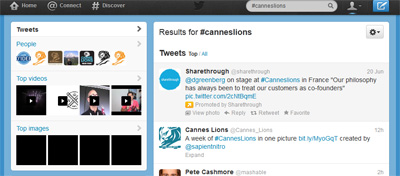
    I was unable to get to Cannes as there was more pressing work here, but the best way to keep track was decidedly #CannesLions. In fact, as someone said, even if you were physically present at Cannes, it was a great way to get the buzz.

     

    Here are some stats courtesy the Twitter Advertising blog (http://advertising.twitter.com/2012/06/twitter-celebrates-users-and-brands.html):

    • There were 103,389 mentions of #CannesLions on Twitter during the six days of the festival – a substantial increase from the 20,000 in 2011. Over 5,000 pictures were tweeted.
    • That’s 17,232 Tweets a day and 718 Tweets an hour with a peak of 3,000 Tweets an hour during key seminars – up from 40 per hour on average in 2011.
    • The total #CannesLions earned media on Twitter has been calculated at over 61 million impressions.


    Often, the 3k tweets an hour looked a hundred thousand. They just didn’t stop coming! And even after the last day, there were several tweets on celebrations, discussions and there’s one exceedingly painful on a book written on the future of advertising. Tweets are fun, informative but can also be a pain!


    Nikhil Pahwa’s Medianama is 4

    My hearty congratulations to Medianama and Nikhil Pahwa on the popular tech-telecom-media site’s fourth anniversary.

     

    I know there are some who think Nikhil is brash, but that’s only because a lot of people in important offices are used to puffs and plugs from journos and trade sites. Although it may be styled as a blog, I am aware that he follows the same rigour as any journalist ought to.


    Medianama went live on June 27, 2008. It’s got a small team and has advertisers on board. So revenues are happening. When I asked Nikhil about revenues, he replied (rather tweeted back): “Healthy. We’re slowly learning to grow. Is tricky, but learning.” Guess I know what he means.


    Buzz me if you have a story to tell. Confidentiality assured. There are various ways you can reach me: pradyumanm[at]mxmindia.com, Gtalk pradyumanm@gmail.com, Twitter @pmahesh and of course the mobile: 98338 76278.  The views expressed here are my own


  • Mediaah! Why Ambika Soni is to blame for the delay in digitization

    By Pradyuman Maheshwari


    I have been a huge fan of the current information and broadcasting minister Ambika Soni. After the likes of Priyaranjan Dasmunshi and Anand Sharma, Madame Soni’s tenure came as a breath of fresh air. And a much-needed one, because she didn’t make life miserable for the broadcasters like her predecessors did (and I am told wanted her to).


    The I&B minister’s job is a thankless one. Several hundred Parliamentarians and politicians, consumer groups, corporates, lobbies and alert citizens writing to her with comments and requests, and most of which cannot be ignored.  If Colors didn’t face any problems with Balika Vadhu or Star Plus didn’t have to pull out Sach Ka Saamna, it’s thanks to the minister warding off various pressures.


    I think just keeping all these complainants at bay and letting the various players do their job is an achievement. She has also gently ensured that news and non-news broadcasters adopt a stringent (and effective) self-regulatory mechanism.


    So what’s the problem? Well, part of it is thanks to successive I&B secretaries having short tenures. Uday Kumar Varma, the incumbent, also has a two-year stint prior to retirement or an extension. Mr Varma has the advantage of having worked with MIB in the past at senior positions so he didn’t spend a few months understanding the nuances of the job as a few of his predecessors may have had to.


    Over the last few months, several industry captains and observers have told me that the ministry is inefficient which I have vociferously countered by saying Ms Soni’s achievements need to be counted by her proactive opposition to regressive forces. At least one CEO even told that me that I was too pro-MIB. Perhaps, but that’s because she’s not regressive.


    However, the fact is that the ministry lacks the initiative to deliver on bold measures. Nothing happened with Doordarshan even as much was promised when it celebrated its golden jubilee in 2009. The radio sector is still floundering: there is still no news on radio even as television stations even in the most sensitive of zones in the country are allowed to air news. The minister wasn’t able to stand up to her colleague in the food and consumer affairs department on ad regulation and more recently it’s made a mess of the entire digitization process.


    The Minister and her secretariat were aware of the requirements of the process, so even before accepting the TRAI regulations, they ought to have looked at whether the Sunset Date of June 30 was achievable. It wasn’t as most stakeholders told us.


    Even now, as a few of the people familiar with the situation on the ground have told me that October 31 is going to be a tough ask.


    It’s critical that the government monitors the execution carefully and ensures that there is no room for any further delays. Care must also be taken to ensure that the respective state governments and municipal corporations are taken into confidence… especially in Chennai and Kolkata.


    As to those who raise the bogey that digitization puts television out of the reach of the lowest common denominator, the answer is that they can always access terrestrial transmission. Quality software must be paid for.


    Meanwhile, all is not lost for the Honourable Minister. She must get aggressive on digitization and various other pending issues in her ministry. Or let history remember her as one more ineffective I&B ministers that India has had.


    Buzz me if you have a story to tell. Confidentiality assured. There are various ways you can reach me:

    pradyumanm[at]mxmindia.com, Gtalk pradyumanm@gmail.com, Twitter @pmahesh and of course the mobile: 98338 76278.  The views expressed here are my own.


  • Sony’s stake hike allows MSM flexibility: Man Jit Singh. Regional/niche channels on anvil

    This is one soap that Sony Entertainment Television bosses are happy to see the end of. Over two decades ago, a group of seven entertainment industry biggies (including then superstar Jackie Shroff) and Sony Pictures got together to launch Sony Entertainment Television.  There were also rumours of senior minister Sharad Pawar’s brother-in-law Sadanand Sule having a stake. Multi Screen Media, as the company was called, had a complex shareholding, as is the case with many Indian corporations.
     

    Four years back, the minority shareholders were in a legal tangle which was finally resolved, but it was evident that they wanted to cash out soonest.


    So when the communique reaches media inboxes on Sony Pictures’s announcement of an agreement to acquired around 32 per cent of MSM’s shares currently held by Grandway Global Holdings Limited and Atlas Equifin Private Limited. The transaction, which will bring Sony’s stake in MSM to a little over 94 per cent, will close by end-December 2012.


    Under the terms of the agreement for this acquisition, aggregate cash consideration of $271 million will be paid by SPT to Grandway and Atlas, subject necessary government approvals, with $145 mn to be paid by December 2012 when the transaction ends and the balance $126 million will be paid in in three equal annual installments starting from the fiscal year ending March 31, 2014.


    “SPT has enjoyed great success with our channels in India and this acquisition further demonstrates our commitment to entertaining Indian audiences,” said Andy Kaplan, president, worldwide networks, SPT in a statement. “We’d especially like to thank Grandway and Atlas for their entrepreneurial spirit that helped to get this venture off the ground 17 years ago.”


    MSM chief executive Man Jit Singh (who as a Sony representative was chairman of the Board even when Kunal Dasgupta was CEO) spoke to MxMIndia’s Pradyuman Maheshwari from London on phone. Excerpts from the interview:


    This thing has been going back and forth for a while between Grandway, Atlas and Atlas.

    Yes, it’s been some time.


    So, is it only a cash transaction or with there be a non-cash consideration as well?

    As stated in the press release that it is $271 mn transaction of which there is a upfront payment of $145 mn and then three equal installments.


    And the balance 6-odd per cent?

    The balance 6 per cent  is held by a fund called the Capital Group which is not part of this transaction.


    Capital has had some stake for a while…

    Yes, they’ve held the stake from 2001. The Indian stakeholders are exiting. Capital Group is another transaction.


    Are you happy with the 1 bn-odd valuation of the company?

    We are delighted with the valuation which happened at the end of an extensive private equity process which determine the market value and then Sony stepped in and decided to acquire the stake, which for us is great news. Because now: a) it show Sony’s commitment towards India and to the channel operation and b) it will give us a lot of flexibility in running our business. And we’ll be able to make investments as we go forward. So, we are delighted with this news.


    In the year around 1999, I think the evaluation was something around 2.5 bn. And that was of course the first high that Sony had reached. And now it’s come down quite a bit.

    As you know, perhaps it was a little later. But as you know during the dotcom period the valuations which were thrown around were extraordinarily high. I think that it was a moment in time, the markets have settled and businesses have fairly matured and I think the valuations are where they are and they are correct.


    You mentioned that this will allow some more freedom for doing various things so anything on the anvil. You’ve spoken about regional channels in the past and you did buy this Bengali channel. Anything more…

    As you know, we are in the process of acquiring a stake in Maa TV which we have announced already and that will continue. We’ll take opportunities as they come and we now have the flexibility to move quickly and consummate those opportunities. And we look forward to doing that.


    Is there any particular direction that you are looking at?

    We are certainly looking at regional channels as we are interested in regional channel space. And as you know we have made a major investment in our sports channels. And we expect that sport is an area where you have to continue to buy rights when they become available because you have to bid for them. And we’ll be in a position to make those investments when they come to us.


    But those investments you have made. Sony is already investing a fair bit for this acquisition and you’ll have to make a lot more investments for all of this.

    Correct.


    That mandate you have received…

    Yes. By investing in MSM, Sony has shown its willingness and enthusiasm for the Indian market. And they are very very open to continue….


    Is there anything else you are looking at other than channels because digitalization will allow all that to happen?

    Absolutely. We believe that digitalization is going to make us able to deliver different kind of content to smaller segments of viewership. So we believe that there will be opportunity to create niche channel. This will certainly help us by allowing us to look at all those opportunities. We believe there is a good amount of things that can be done over the next two-three years.


    The last two years have been tremendous for MSM because we have Sony doing so well, SAB is doing so well and IPL hasn’t been too bad. So would you credit that for the way things are right now and at Sony’s commitment?

    I think you have to look at Sony’s commitment which was committed in the good times as well as in the bad times to MSM. It is only that its bigger commitment is to the Indian market. Sony has always believed that India is one of the most important of the BRIC countries and it’s a place where Sony must invest and grow the market. So there has been a commitment to India. So we should give them credit for being consistent in their beliefs that India should be one of the key markets in which certain focus is on. And not only that but on the channel business, our electronic business side, it is a growth market for us on both sides.


    And will we see some synergies with all of that all, in the near future?

    Absolutely. This will give us much more flexibility to be able to create synergies between our electronic groups and our channel business. And we see opportunities to bring things together.


    Is there a possibility of a change of the company name now that Sony’s ownership is near-total? Perhaps Sony Entertainment Television…

    Why you don’t like MSM?


    No, I love it. One has got used to it. But still the fact is that now since it’s a Sony it could well be called that. Is it on the cards?

    I’ll be honest; we don’t have any plans to do that. But thank you, I’ll think about it (laughs). I’m quite happy with MSM, maybe because we all came up with it. There is no such plan. We are quite satisfied with it. Also, the channel is Sony Entertainment Television. So, I’m not sure if we’ll need to change the company name. Let’s put it this way, there has been no talk on this.


    With inputs from Meghna Sharma


  • Making brand the hero with BPN


    Just when you thought that the media agency space is getting crowded in India comes the news of another agency setting up shop in India. Brand Connections that was present in 12 countries across the globe excluding India and the United States, will now be rechristened Brand Programming Network. In effect this will be the official launch of BPN in India. And simultaneous with the rest of the world. This will make the agency the third such offering from IPG Mediabrands in India. It already has two in the form of (Lodestar) UM and (Lintas) Initiative. BPN will work under the LMG umbrella.


    Says Lynn de Souza, Chairman and CEO of Lintas Media Group in a communique, “For media agencies thus far, the starting point has always been the advertiser. Consolidation, portfolio management, aggregation etc. are all client focused and to some extent consumer data driven. BPN will focus on the brand. The time has come to turn back several chapters and make the brand the hero of all communication effort, and BPN has developed processes to do just that.”


    BPN will take on the service mandate of clients like Jyothy-Henkel, Bajaj Auto, Samsonite, and several other clients of LMG to start up with a billing volume of over Rs. 1000 crores, in Mumbai, Delhi, Hyderabad, Kolkatta and Cochin.


    In India the agency will be led by Suresh Balakrishna, who has assumed charge as CEO of the agency. While BPN will be essentially a media agency, it will play the game differently by focusing on the brand. “Everything that we are recommending is going to be from a brand strategy direction,” assures Mr Balakrishna, as he gave MxMIndia a quick peek of what to expect from the agency in India, hours before it was unveiled.


    In conversation with Pradyuman Maheshwari and Johnson Napier, Mr Balakrishnan delves on how BPN will be different from the others, on the increased emphasis that will be laid on social media and digital and the new initiatives to look forward to from BPN in the coming few months. Excerpts:


    Is Brand Programming Network old wine in a new bottle?

    No, it is not. The usual answer that comes up about a third agency is that it is created due to a conflict of clients, allowing you to take on more of the similar clients. But with BPN, it is a thought-out strategic decision. If you look at India, there is no immediate conflict business (from network agencies) that is being parked in BPN. If you look at Mediabrands, for the last 10 years it has had a network called Brand Connections in other countries. But as markets have developed, especially a market like India, we find that there are enough businesses out here to have a third agency with a different character, a different way of thinking…and of course help handle conflict in the long run. So it’s not a knee-jerk old wine in a new bottle reaction from our end.


    The reason we ask you this question is that you have reallocated some of your existing businesses here. Does this also mean that Initiative and BPN could be in conflict with each other?

    It could be. In our system we can compete for businesses for the same pitch and may the best team win. Therefore we have a Lodestar UM, an Initiative and a BPN; we have three networks here in India and all three can compete for a business if necessary.  We do believe there is enough business out there and why leave some money on the table…


    What is it about BPN that differentiates it from others?

    A few things actually. Firstly, we are turning the clock back as an agency. We are going back a little in time and therefore the name Brand Programming Network. The whole idea is to focus on the brand. Earlier, media used to be in one house there used to be much more brand focus, even the media guys owned the brand. But over a period of time, media has become more professional, accountable, larger, etc but somewhere in the process we believe that brand connect has got lost. Therefore, BPN would be an agency that would focus on the brand; everything that we are recommending is going to be from a brand strategy direction. To give an example, in the last four months we have won over four-five businesses and in almost all the business pitches the client fed back to us saying is this a creative agency presentation or a media agency presentation? So you can imagine the extent to which we are spending time to analyse the brand, looking at brand strategy, looking at TG, etc. We are focusing on that aspect of the business and of course at the end of the day media is just a delivery vehicle.


    In fact Mr Shashi Sinha even hinted in an interview with us that we need to return to the full-service agency model. Are you in agreement with that statement?

    Half-way house, I would say. We are calling ourselves a full-service media agency in the sense that the touchpoints today have become all-pervading. For example, the touchpoint would be you ride on content. But who creates that content? You have an instance where the customer himself creates content in digital and then you have specialists who create content. So content itself has no owners and therefore reaching out to the customer has become that much more complex and you can only do it of you have the fabric of the brand and what it wants to convey.


    But the same thing could even be said by the creative agency bosses like, say, R Balki of Lowe, etc who feel that creative is alright but we also need to add some media to it. They could also be thinking on those lines…

    So what if they think the same, but I think at the end of the day to deliver media, you need a certain size… in fact many media heads today are CFOs; they are not media people. They have a commercial bent of mind and manage money.


    So are you saying that a media agency can be a full-service agency but a creative agency cannot be a full-service agency…?

    In today’s context yes, I believe you can say that.


    Sorry to be asking you this for for the third time in different ways, but getting back to BPN, in a sense it will be a brand agency…

    Yes, and across the world in the 13 other countries that we are present in apart from India, we have a lot of retail businesses and that is another area of growth that BPN is seeing. That seems to be the character of the agency globally – handling a lot of retail clients on a local basis.


    Will you only handle products and not brands in other sectors?

     There will be no category and geographical limitation. What the agency will bring to the table is brand perspective. In many cases, we have seen that clients do not want a brand perspective from a media agency. They get enough of it from a creative agency and want only the media bit from us. So I may not be the right pick. But being part of an agency like LMG I may bring along a necessary clout; I am big enough to matter and small enough to care. But that is not going to be my reason to be.


    In fact for BPN, one of the things being discussed is India as the analytics hub for BPN worldwide.


    Is it likely to happen soon?

    Yes, it is going to happen very soon.


    Wouldn’t analytics have done better as a separate unit like what the other networks offer?

    Maybe if it did well it could become a separate agency but to begin with it will be a part of the service that we are offering.


    Somewhere in your press release you have emphasised on laying adequate stress on social media. Is BPN going to be basically a digital or social media agency?

    No. But globally, and in India, I believe that digital and social media has much more mindspace than wallet space. So it really has a long way to go. Having said that, digital is growing very rapidly globally. One of the things that you will hear from us is a tie-up of sorts with a large platform about which you will hear soon.


    Will social media be the mainstay for BPN…?

    Not in India but worldwide, yes.


    So here you will be doing the traditional stuff plus digital and social…

    Absolutely.


    Could you delve a bit on the team that will drive the function for you in India?

    We have Premjeet Sodhi as the COO, Patrick Gomes would be the head in Mumbai, Mahesh Motwani would be head of Kolkata, Vidya Nanda Kumar will be head of Kochi…we have identified a head for Delhi and Hyderabad that we will announce very soon. We have a staff strength of about 70 and about 40 clients till now.


    Going forward, will BPN and Initiative be sitting together and pitching for a business?

    All the existing businesses in Delhi, Bangalore etc will belong to Initiative while Mumbai, Kolkata, Kochi etc will belong to BPN. We will be having separate offices which ever cities both of us are present.


    Any other plans on the anvil for BPN?

    Yes, we would be having a training and consultancy cell for media houses. The other thing will be branded content….


    Paid news?

    No (laughs). AFPs, in-film branding etc.


    You have always been a print man, do you still have a soft corner for the medium compared to television which is more popular of the two?

    Brands of course want television but I think print also works. Ours is the only country where print is still growing.


    But TV is growing a bit faster.

    Yes.


    What will the the revenue mix of BPN look like in future… if it’s 99 traditional and 1 digital?

    Going by your 99-1 yardstick, it will be 80 per cent traditional and 20 per cent from other mediums. Possibly even 75-25.


    If BPN has business worth Rs 1000 crore, how much will Initiative be?

    It would be the same. LMG as a group is Rs 2000 crore.  All the businesses in Delhi and Bengaluru belong to Initiative while Mumbai, Kolkata, Kochi are now part of BPN.


    In Indian corporates, there is a tendency to guard one’s fiefdom. Did Initiative feel bad you took away some of its businesses?

    They haven’t expressed anything as yet.


  • Mediaah: Should Ambika Soni delay digitization?

    By Pradyuman Maheshwari


    Yes, she must. There’s no point making a charade of it when the on-ground reality is not what it should be with just 23 days left for the scheduled compulsory switch to digitally transmitted television in the four metros of Chennai, Kolkata, Mumbai and New Delhi.  Over the last five months, MxMIndia has been speaking to various stakeholders on digitization. In fact right from the day our countdown started when there were 100 days to go for the June 30 Sunset Date, key stakeholders have been telling us that the deadline is unachievable.


    The government has itself to blame. The digitization deadline has been known for a while, and one would’ve expected it to have moved faster if it was serious about the Sunset Date. The tariff order came in rather late, and one would’ve expected the babus to have worked backwards and establish a foolproof schedule.


    Now, we have a situation that’s going to embarrass all.


    A senior industry professional told me that after the June 1 taskforce meeting it was clear that deadline will be pushed by at least two months, if not three. Some influential cable professionals have been rooting for six months, but I think three months is fair, with a diktat that within six months, it ought to be total.


    I also believe that there ought to be a significant incentive for early birds. Those who’ve switched subscribed and those who will in by September 30. The government must cut its levies and ask for these to be passed on to subscribers. Something like: buy a set-top box and get free connectivity for six months! Ensure this offer is only for the first three months, and after that it should be withdrawn. Also, subscribers should be allowed to pay in instalments.


    Today, Anil Thakraney’s maid asked him for a thousand-buck loan. I am sure I am going to be asked for the same soon. It’s critical that the lowest common denominator in our country – and there is a sizeable population that can’t make ends meet – is finding it tough to embrace digitization. There’s of course the argument that no one likes to pay for software in India, but there is no denying that the move will impact the household budgets of crores of Indians.


    So what’s the solution. Extend the deadline, yes, but just by two or three months. Offer an incentive for this period, and then bring back the taxes. Let this be the first deadline and have a final one of six months and ensure that all comply post that. A ‘Good Night’ date after the ‘Sunset’.


    Buzz me if you have a story to tell. Confidentiality assured. There are various ways you can reach me:

    pradyumanm[at]mxmindia.com, BBM 23050B5D, Gtalk pradyumanm@gmail.com, Twitter @pmahesh and of course the mobile: 98338 76278.


    Disclaimer: Although he is CEO and Editor-in-Chief of this site, Pradyuman Maheshwari’s views in Mediaah! are not necessarily those of the rest of the team and MxMIndia.com.


  • Why media purists needn’t worry about Kumar Mangalam Birla’s 27.5 % in Living Media

    By Pradyuman Maheshwari


    On April 10, the TV Today network clarified to the Bombay Stock Exchange on rumours that the Aditya Birla group was acquiring a stake in the India Today group. The clarification said the Company (TV Today) was not aware of any such transaction and was not in a position to confirm the contents of the media reports.


    A little over a month later, the same organization sent the BSE a copy of the press release stating that 27.5 per cent of Living Media India, better known as the India Today group, was sold to the Aditya Birla group.


    A senior member of the AV Birla group told this correspondent that the investment was made by chairman Kumar Mangalam Birla on a personal level and not by any of the group companies.  After the customary approvals in a few months, we would get to know the real numbers. Late on Friday, Ashish Bagga, recently appointed CEO of the entire group (including TV Today), informed staff of the development by way of an email.


    The question which everyone wants to know is the price that Mr Birla paid for the 27.5%. There have been various figures floating around… that the money paid is in the region of Rs 350-500 crore. In the communique issued, Mr Birla is quoted saying: “The media sector is a sunrise sector from an investment point of view. I believe that Living Media India offers one of the best opportunities for growth and value creation.”


    Also read:

    AV Birla group buys 27.5% in India Today group


    Birla may use personal money for buy, Mail Today may now launch editions in Mumbai, other metros


    Loss of plurality is worrying: Paranjoy Guha Thakurta

    And here’s what Aroon Purie, chairman of the India Today group said: “I am delighted to partner with the Aditya Birla group to aggressively address the current and future potential of the Indian media business which is at a tipping point. The Aditya Birla group with its strong leadership global footprint, diversified business interests and its shared values of integrity, commitment and social responsibility make it a perfect fit with the India Today group.”


    So where’s the money going to be used? For one, it would mean expanding its current businesses. Specifically, Mail Today to move to markets like Mumbai and other cities and for TV Today to get into the regional space, and possibly a business channel. With a question mark on overall growth of newsmagazines, Living Media needs to invest its resources on segments with a growth potential.


    It has already done so by investing in smaller, niche magazines which have a smaller print run and attract fair amount of advertising as also bringing in international content.


    The TV Today network has also been in pressure in recent months with competition gaining ground. The radio station -Oye 104.8 – also needs to grow on the ratings roster.


    And what does it mean for the industry? Although a 27.5% equity will give Mr Kumar Mangalam Birla a toehold in media, it’s not significant enough for him to wrest editorial control. However, while there is fear of how big business money may impact the media, the fact is that it is already doing so. Even today, there exist managements and editors which buckle under pressure from large advertisers and influential individuals. There are enough stories of vested interests at play in Indian journalism, and for the media as a whole, the infusion of money from big business houses and foreign players could possibly ensure better salaries and hence lesser corruption. Standards of journalism are bound to improve.


    Also, it’s not that business empires haven’t been in the media already. The KK Birla group runs Hindustan Times, the Tatas would own the Indian title of Reader’s Digest until it sold to Living Media and there are other smaller players too who are known to back media players. Zee TV’s Subhash Chandra has a successful enterprise running under the Essel brand and even The Times of India group’s Jains have had long-standing interests in other fields.


    Since the media needs to increase scale, it needs the money for expansion. A route followed by some groups like Dainik Jagran, Dainik Bhaskar and Deccan Chronicle has been to go public. Still others – like Network 18 and Television 18 – have been public and also secured investment. Last year, the Abhey Oswal group bought 14.17% in NDTV.


    The Reliance Anil Ambani group has significant presence in the media with radio and television. It has also acquired a majority stake in business channel Bloomberg UTV. Just yesterday (Sunday, May 22), one saw a programme airing consumer complaints with a subscribers’s peeve against Reliance Communications. So it’s not that Bloomberg UTV blanks out all criticism of Reliance ADAG activities.


    According to me, more than the possibility of business empires exerting pressure after investing in the media, the worry is when the situation reaches oligopolistic proportions. This has in fact been seen with media groups having a stake in allied business like radio, television and events.


    Buzz me if you have a story to tell. Confidentiality assured. There are various ways you can reach me:

    pradyumanm[at]mxmindia.com, BBM 23050B5D, Gtalk pradyumanm@gmail.com, Twitter @pmahesh and of course the mobile: 98338 76278.


    Disclaimer: Although he is CEO and Editor-in-Chief of this site, Pradyuman Maheshwari’s views in Mediaah! are not necessarily those of the rest of the team and MxMIndia.com.


  • Apology + Rs 500cr: Is Indian Express right in sending Open a legal notice?


    By Pradyuman Maheshwari and Shruti Pushkarna


    Shekhar Gupta

    It was the most read story on MxMIndia yesterday. As the news of the legal notice served by a lawyer representing Indian Express, Shekhar Gupta and three others filtered in, there were heated discussions in newsrooms on whether the Express and its legal eagles were right in serving a legal notice to Vinod Mehta, Open and its senior staffers.


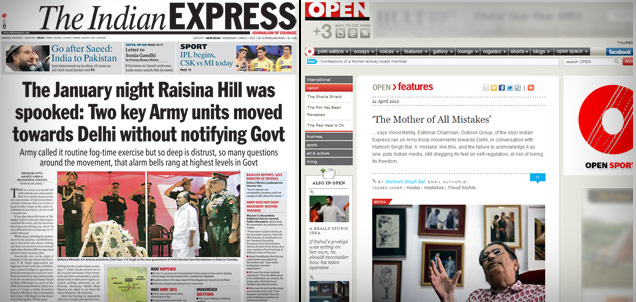
    First some background. On April 4, The Indian Express carried a story by editor-in-chief Shekhar Gupta with Ritu Sarin and Pranab Dhal Samanta on two key army units moving towards New Delhi without informing the government. Ajmer Singh contributed to the report.


    Vital Links
    The Indian Express report (April 4, epaper)
    The Open interview (April 21)
    The ‘notice’ (May 15, note: source unverified and unknown)

    There was outrage and denials issued by all and sundry in the government and armed forces. However, save the outbursts, it wasn’t proven that the Express story was incorrect.


    Meanwhile, ever since the report appeared, The Indian Express – while still respected as a no-nonsense, credible newspaper – was the butt of ridicule by commentators and on social networks. Those in print may have been a lot more gentle, but a few television discussions were indeed scathing.


    And then came this interview with Outlook’s editorial adviser (and former editor-in-chief) Vinod Mehta in newsmag Open on the issue. The headline of the interview said it all: The Mother of All Mistakes (issue dated April 21, 2012). In his inimitable style, Mr Mehta suggested that Mr Gupta was taken in by a story that was planted on the Express.


    While a magazine has a limited readership, since the article was freely available on the internet and it carried a very pointed allegation by one high profile editor on another, the interview viralled in the media fraternity a great deal.


    This legal notice by a lawyer representing The Indian Express and the four writers of the story – Shekhar Gupta, Ritu Sarin, Pranab Dhal Samanta and Ajmer Singh – came less than a month of the publication of the interview.


    One would’ve let the notice be, but its contents make for interesting reading. So while Mr Mehta may be suggesting in the interview (and he also said  amidst some cheer at the Press Club Bombay awards recently) that he quit the Independent owning moral responsibility of an incorrect story, the notice points out that in his memoirs (Lucknow Boy), he projects that he was compelled to do so. “Till now, I am unsure why I had to quit.”


    The notice asks for an apology and pulling the story off Open’s internet edition openthemagazine.com. At the time of filing this report, Open hasn’t done either and two senior staffers told MxMIndia that the magazine does not intend to do either.


    The notice also demands damages of Rs 100 crore each to the lawyer’s clients. That’s five of them – the Indian Express, Shekhar Gupta, Ritu Sarin, Pranab Dhal Samanta and Ajmer Singh. The Rs 500 crore damages have to be paid regardless of the apology.


    MxMIndia asked a few senior editors for their views on the issue. While many of them did not want to be drawn into the controversy, there were a few who told us that they didn’t know enough of the matter to be able to comment.


    Our questions were: Is the media too sensitive to criticism? Just as the Express, Shekhar Gupta & Co sent a legal notice to Open and Vinod Mehta, can governments, politicians, businesspersons and even film-makers who are critiqued by the media also send notices and ask for crores as damages?


    Here are reactions from four veteran commentators:

    Dileep Padgaonkar

    Dileep Padgaonkar, former editor-in-chief, The Times of India:

    Of course it is… the media is sensitive to criticism. The media thinks it is fit to criticise everyone but the minute everyone points a finger at the media, the media bristles. I think media should take criticism directed against it in its stride, this is part and parcel of democracy. And I don’t think one should be too prickly in these matters unless of course there is a clear case of personal attack, defamation… in that case legal course is available but otherwise one should ignore these things and go on.


    As it is, the censorship of cartoons was a dismal warning of the sensitivity of the political establishment. Now if media is going to go at another section of media, there is going to be a free-for-all and the big casualty out here would be good, decent, honest journalism.


    Sevanti Ninan

    Sevanti Ninan, editor, The Hoot, columnist and media-watcher:

    Criticism is not an accurate word for what Vinod Mehta called The Indian Express story. He essentially said it was a planted story and it was a huge mistake to carry it. Considering that the first byline on the story was that of the chief editor, that is quite statement to make. You are saying the chief editor and his colleague are susceptible to plants, thereby seriously questioning their credibility. So I guess the Express could hardly ignore it. IE did come in for a lot of criticism on the import of the story and the display given, including a critical editorial in the Hindu but nothing quite as damning as Mehta’s statements.


    This is the 3rd 100 crore notice involving the media over the past year, in any case. So it is becoming more common.


    Paranjoy Guha Thakurta

    Paranjoy Guha Thakurta, independent journalist and commentator:

    I think The Indian Express has over reacted. I think it’s gone a little over the top. They may disagree with what Vinod Mehta has said… my personal view is that it’s a point of view which obviously the Express doesn’t agree with but I don’t think that what Mr Mehta has said can be construed to be criminally defamatory. And the kind of damages sought are excessive. They are as excessive as the damages that Justice Sawant has sought from Times Now and what Times Now has sought from TheHoot. I mean these are ridiculous sums of money.


    I think we’ve become an extremely intolerant society. I think people talk about freedom of expression being a fundamental right but I don’t think people are really believing in Article 19(1)A of the Constitution of India. Like so many sections of Indian society, including our political leadership which is very upset about these political cartoons that have appeared in textbooks, I think even sections of the media are becoming extremely intolerant of criticism. If you are in a democracy, you have to give the right to everybody to disagree with you.


    Sucheta Dalal

    Sucheta Dalal, senior journalist and commentator, consulting editor, Moneylife:

    Well, not the media, but The Indian Express is too sensitive to critcism… It’s an interesting thing, it’s the first time it is happening and we should see where this goes, whether they follow through by actually filing a case. It’s the first time that somebody in the media is suing another person in the media, we need to look at how it goes… as I said everybody else is sensitive, everybody else does send defamation notices but I don’t know how many of those notices actually get converted into legal action. So we have to wait and watch.


    Otherwise the notice is also a way of making a point, it’s a way of putting pressure. It’s not just Vinod Mehta, if he looks at what was said about that story on the social media, then there are a lot more people that they would probably need to sue. So maybe he is making a case out of Vinod Mehta and Open magazine, we need to see whether they follow through. I would say that the test is not in the legal notice, the test is in seeing whether they are actually going to follow through, stand in court and argue it out.