Advertising like the other arts of cinema, music, is the perfect mirror of an emerging society. Often the arts can lead society, and at other times, it may just be a mirror of where society is today. It’s important for a brand to constantly search for cues from our daily living. So, a brand can often be a mirror of where we are but equally a brand may lead society into their own future.
But advertising like cinema is good at constantly exploring emerging societal trends. Of picking up something that exists today but may not still be big. I think it is brave for any art to pick up an emerging trend that is not necessarily popular or fits societal norms. Titan is one brand that comes to my mind which is constantly leading from the front. Unfortunately, it has also meant that it has often come under fire for being experimentative. You will remember how it got trolled for the Tanishq ad last year which showed a real situation which revolved around an inter-faith couple and the husband’s family. One can’t deny that inter-faith marriages do exist in India and perhaps they are only growing. But that ad was from one of the Indias and trolled by the other India.
Another ad that got into trouble with one of the Indias, was the Manyawar ad featuring Alia Bhat. Because of a play of words that the ad engaged in where the ritual of Kanyadaan was interpreted as Kanyamaan.
And now comes another ad from Tanishq again in the area of marriage and relationships. And I can’t help feeling that it has done a good job of appealing to both Indias. Or has is?
The conversations between the couples in the ad are very real, honest and portray the trust and confidence that two partners can place with each other by sharing their innermost doubts, desires and thoughts with each other. But equally I think it portrays a certain equality between a man and a woman in a relationship.
For years, we have portrayed the Indian woman as subservient, something that is backed by the new GenderNext report (https://ascionline.in/gendernextreport/2/index.html) from the ASCI which says:
“Women being featured in care-taking roles, placing the good of the family and friends as their primary focus and concern
:: Women being targeted for beauty products featuring an unrealistic and unobtainable standard of beauty
:: Women being informed and educated by the voice of a male authority figure”
The Tanishq ad I thought breaks the traditional stereotype of how women have been portrayed in advertising. It is steering the portrayal of women in a very positive direction, while simultaneously exploring the deep relationship and trust that life partners can place with each other.
Is the real India like this one may ask? Yes and No. I think, that in urban centres we can see man-woman relationships like the ones in the ad, but I can’t help feeling that as we move down the population strata, it may still be quite unrealistic.
This ad may still be appealing to only one of the Indias and most probably this is the Tanishq target audience. What is different and perhaps a lesson for advertisers in the future is that it is possible to talk to only one of the Indias without upsetting the other!
Humour is a powerful communication device if used in the right way. Film,advertising and the other arts are often a mirror of society’s interests, attitudes and behaviour. As Ogden Nash once said: Life imitates art far more than art imitates life.
Oscar Wilde affirms that what is found in life and nature is not what is really there, but is that which artists have taught people to find there.
If a cool-headed Martian were to descend on to us to examine the state of humour in our art he could possibly find that we are probably losing our sense of humour. In fact no one is laughing these days, barring the laughter clubs that I encounter on my morning walks. And even those are forced laughs because there is actually nothing to laugh about.
In Indian cinema, comedy was a central part of the Bollywood industry of earlier years. Look at Bollywood’s Jaane Bhi Do Yaaro. Never before was there such a great team of talent together. Kundan Shah, Om Puri, Pankaj Kapur, Bhakti Barve, Ravi Baswani, Naseeruddin Shah and Satish Shah to name a few.
If Bollywood is no longer producing comedies, humour which always been a key way to communicate for advertising has nearly all but disappeared. The advertising figures of speech are very much like grammar isn’t it? There are just a few figures of speech that advertising plays around with.
First there is the Torture Test. Where a product is put through strenuous and extreme conditions to prove it’s a good product. Take any tyre advertising and this is easy to see while the ad will put the tyre through extreme conditions like potholes and rough terrain.
Then there is Hyperbole. Where you take a product attribute and exaggerate it just to make a point. You don’t expect consumers to literally believe it, but it helps to accentuate a particular point about a product.
Another ploy that advertising uses is the Parody. The Parody uses humour to make a point about a product. It entertains them. It helps to sell a unique attribute of the brand.
This is what I am missing now in Indian advertising. Commercials are becoming too serious and striving for a deep emotional response rather than entertaining people. And often portraying too much reality is getting advertisers into trouble as we have recently seen, with advertising getting trolled and ultimately having to withdraw their commercials.
Look at some of the parodies that were created in yesteryears. What stands out amongst them and is relatively more recent is Mentos. I am just wondering why the ad industry is not attempting any more advertising in this genre. Another common ploy is Juxtaposition. Where you take opposites to make a point. Big, Small – Black, White, etc.
Then there is Personification. This is very common in Indian advertising which is constantly using celebrities in the hope that some of the qualities of the celebrity might have a positive rub off on the product being advertised.
The last category of advertising uses A Moment of Captured Reality. Attempts that fail are called Slice of Life.
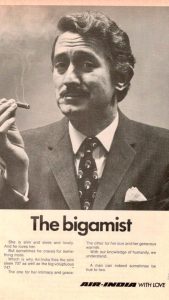
How Air India used humour in its ads
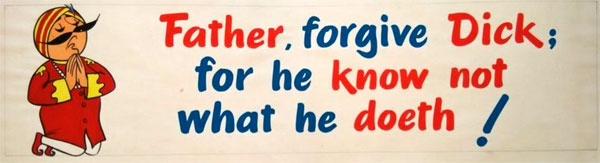
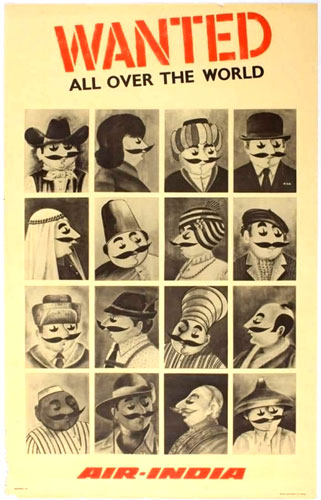
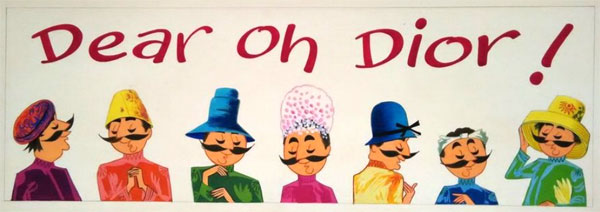
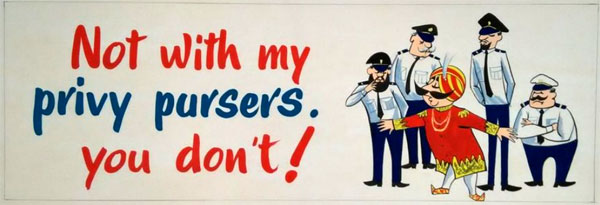
All of Air India’s advertising was really based on humour. It was the Maharajah having a laugh at current events both in India and overseas. Which is why an Air India hoarding would always bring a smile to your face. Even advertising without the Maharajah employed humour as a ploy to make a particular point about the airline.
Stand-up comedy is relatively new to our country. Maybe just a little over 10 years old. Although audiences are relatively small, we have proven that we are very close to the global standard of stand-up comedy. Unfortunately, our comedians seem to be getting into trouble with the law all the time. This is unlike other countries where comedians have a free rein to entertain people. Which leads me to the conclusion that perhaps we can no longer appreciate parody, and we have lost our ability to laugh both at ourselves and at others.
So, coming back to the question that I started with. Are we losing our sense of humour? I certainly hope not. If we are, then it’s time we did something about it.
When WPP won a large part of the Coca-Cola business worth $4 billion, it was an affirmation that the holding company once looked upon as just a holding company that does nothing but inspects individual company, P&Ls had transformed themselves into an integrator of their individual companies.
True integration has eluded the ad agency business for over two decades now, if not more. Sir Martin Sorrell took the lead for integration by pitching for large businesses globally. Mark Read has followed quickly in his footsteps by employing the same methods to win the global Coke business easily one of the top advertisers in the world for a long time.
Conflict of Interest
Once upon a time, agencies got bogged down by conflict of interest to handle more than one account in the same category. This is because the traditional agency was unable to build an effective firewall that convinced clients that conflicting accounts could be handled without a leak of confidential information within the agency. No longer.
Because holding companies have been able to put together special teams hand-picked from each of their operating companies offering a wide range of disciplines for mainline advertising to digital, to form individual units that handle each conflicting account, it promises a very effective firewall which means that clients are no longer worried about conflict. WPP’s GTB for Ford, Red Fuse for Colgate-Palmolive and now Open X for Coke are just examples of how these specialist units can operate.
While it may seem like an innovative way to handle clients, the Japanese have been doing this for the last many decades. If you have been to the Dentsu or Hakuhodo buildings in Tokyo, you will notice that there can be as many as three or more automobile accounts being handled by these agencies, with each agency unit being located on a different floor.
For example, Nissan could be on the 13th floor, Honda on the 17th, Suzuki on the 20th and Toyota on the 25th. The beauty of this structure is that employees working on a particular floor do not have access to any floor but their own therefore providing an effective firewall that ensures confidentiality of the individual account.
WPP’s Coke win includes creative media and marketing technology business for 200 countries so it is a fully integrated business. I quite liked the Open X name for the WPP unit which handles the Coke integrated business. Unusual for Coke who has been hesitant to commit themselves to any agency in the past although IPG has had the longest run. I remember a time when Coke thought that it did not need their creative agency McCann and began flirting with individual Hollywood producers for their commercials.
It’s a pity that the major new creative platform of Real Magic was launched just two weeks before the WPP announcement. While I thought that the Real Magic commercial worked well, initial feedback from the gaming community suggests that it has put the brand back by a few years. Tim Crow sports and eports advisore says, “Gaming is not a divided world. They are a big tribe that doesn’t need Coke’s help to connect with each other because they already are. Games are about fun and the competition brings people together… Coke [came off as] tone deaf about gaming and what it is. They’ve put themselves back years with the gaming community with this globally.”
It would be interesting to see how WPP takes this theme of Real Magic forward.
There was a time when mechanical watches were considered the simpler and cheaper option to buying a watch. When I was growing up to have an automatic watch was considered superior and expensive. Then of course came the quartz watch which was supposedly more accurate and save the change of a battery every few years, was supposed to work tirelessly forever almost. In fact quartz watches didn’t really cost much more because they had fewer guarantee claims, since they were almost fault-free. Also, the amount of labour perhaps was much less than a mechanical watch or one with automatic movements.
My first watch was a mechanical and it was an HMT, those considered the pride of India. If I am not mistaken, they cost about Rs 500 those days in the 60s. Over the last few years, I have been collecting the old mechanical HMT watches just to relive the magic of mechanical watches. My first project was to restore my father’s HMT Jubilee watch which was also probably bought sometime in the 60s.
Then a couple of years ago I noticed that the quartz and even automatic watches were no longer as fashionable as they were once upon a time and the clock had wound back to the mechanical watch in terms of fashion and exclusivity. Rolex for example introduced mechanical watches a few years ago. And they were not cheap. In fact, the price reversed your opinion that mechanical watches had to be cheap.
They were more expensive than quartz watches. The Louis Moinet mechanical on the left, for example, costs only about Rs 45 lakh!
Titan has done well to cash in on this trend of mechanical watches and have just launched their own range of mechanical watches in line with the global trend.
Again they are not cheap. The first watch I saw on their website was Rs 195,000. Which I think is a pretty steep price for a Titan given that the brand does not carry the same attraction as better known Swiss watches.
But mechanical watches are labour-intensive, handmade and produced in smaller quantities, making it more expensive to manufacture. The new TV spot highlights the inventiveness of mechanical things.
The story is about a damsel in distress on a lonely mountain road when her tyre gives away. Prince Charming in the usual formula for such stories passes by and noticing the damsel in distress and immediately starts to fix the girl’s bike. He pulls out what looks like a twig from the grass nearby and all the viewer can guess at this stage is that he is doing something to the wheel. Pull back to reveal that he has attached his front wheel to form the rear wheel of the girls cycle. A nice element of surprise there.
As a cyclist for many years I have never known anything like this to happen, in fact if one were to actually attempt this mechanical engineering feat I guess one would need a lot of tools (unlike our protagonist who tightens nuts with his bare hands). But I suppose it is eminently possible.
The man and woman then merrily cycle away with the Titan baseline for mechanical watches ‘Move your world’. The spot is nicely done. The fact that the couple wasn’t carrying the damaged tyre and seem to have just left it behind, is of course creative licence. All in all, I thought a good TV commercial that explains the ingenuity and labour involved in a mechanical watch with the cycling metaphor.
Someone once said that a watch over $200 is a piece of jewellery. The Titan mechanical is definitely a piece of jewellery.
Public service advertising has always afforded creative people a chance to do some breakthrough creative work. But it is not always that that the opportunity is exploited. On the occasions it does, typically you do get the breakthrough idea.
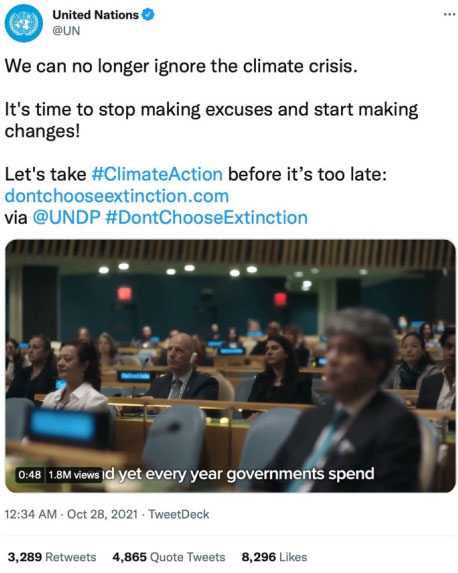
The UNDP Dinosaur ad has certainly exploited that opportunity. It is not always that the UN creates breakthrough creative work, but the UNDP commercial does stand out. Firstly, the topic of fossil fuels and climate change is now on top of everyone’s mind thanks to the several well-known people who are pushing the case.
But tying up our fossil fuel consumption with extinction has never been made as strongly as it has done with this commercial.
What makes the commercial stand out?
For one, the element of surprise when the dinosaur walks into the iconic United Nations General Assembly Hall is truly captivating.
I liked the everyday simple voice of the man on the street for the dinosaur. For a moment, I was wondering what the dinosaur was going to sound like, but he sounded like any of us humans.
The text of the dinosaur’s speech is written extremely well. “You’re headed for a climate disaster, and yet every year, governments spend hundreds of billions of public funds on fossil fuel subsidies. Imagine if we had spent hundreds of billions per year subsidizing giant meteors,” the dinosaur says, speaking at the United Nations’s General Assembly in New York.
The video’s timing is perfect. It comes just before global leaders meet at the U.N. climate summit COP26, where countries gather to discuss climate goals and climate change.
It is quite well known that countries are not abiding by the Paris climate agreement. The dinosaur in the commercial says: “So here’s my wild idea: don’t choose extinction”.
“Think of all the other things you could do with that money. Around the world people are living in poverty. Don’t you think that helping them would make more sense than… paying for the demise of your entire species?” says the dinosaur.
The wonderful thing about the commercial is that it is fun and engaging while making a very strong point about a very serious issue – it has very high impact on the viewer.
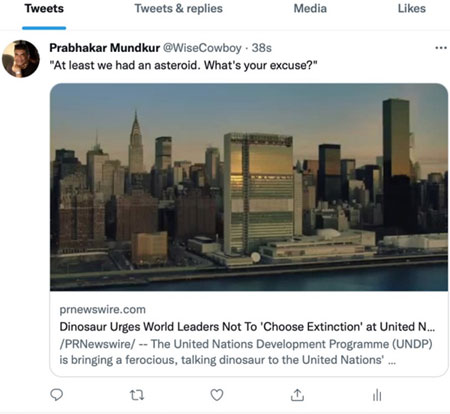
I also thought the PR releases made it easy for anyone to tweet the commercial with a message. I did so myself.
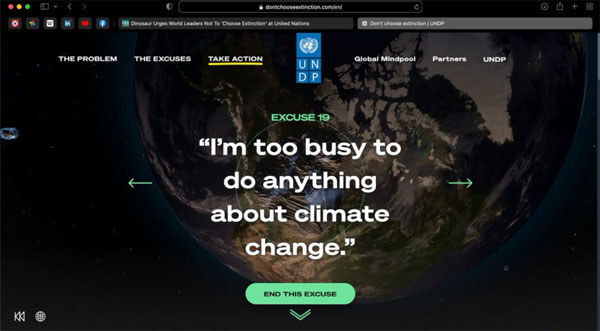
I loved the way their website dontchooseextinction.com was structured into five different sections: The Problem, The Excuses, Take Action, Global Mindpool, Partners and UNDP. It included all the barriers to climate change. For example, it gave all the reasons that people give to not do anything about climate change.
A great commercial backed by media digital extensions that makes it a truly 360º campaign.
“Think different” was written by Craig Tonamoto, art director at Chiat/Day who also did the initial concept work on Apple. In a way that shattered the notion that art directors are meant to do art and copywriters are meant to do copy. But the world had changed already in 1997 when this tag line was written, breaking the boundaries between different disciplines in creative, a notion that existed in the advertising business of the 60s and 70s.
October 5 of course brought back memories of Steve Jobs because it has now been a decade since he passed. As an Apple user for the last 15 years, I couldn’t help feeling a twinge of sadness when I read the statement that his family put out on this memorable day.
“For a decade now, mourning and healing have gone together. Our gratitude has become as great as our loss.
Each of us has found his or her own path to consolation, but we have come together in a beautiful place of love for Steve, and for what he taught us.
For all of Steve’s gifts, it was his power as a teacher that has endured.
He taught us to be open to the beauty of the world, to be curious around new ideas, to see around the next corner and most of all to stay humble in our own beginner’s mind.
There are many things we still see through his eyes, but he also taught to look for ourselves. He gave us equipment for living, and it has served us well.
One of our greatest sources of consolation has been our association of Steve with beauty. The sight of something beautiful – a wooded hillside, a well‑made object – recalls his spirit to us.”
With that statement was also released a film that encapsulated the essence of Jobs and Apple.
Before I started using Apple, I would be amazed at the instant connection that two Apple users felt in a room when they first discovered each other to be Apple users. The connection was almost electric. It was magical, the sense of camaraderie and the feeling of belonging to a secret cult of Apple lovers.
When I saw the shape of the newly launched iPhone 13 this month, I couldn’t help feeling that it reminded me strongly of the Apple iPhone 5 which was the last phone launched by Jobs.
I can’t get over the brilliance of the commentary of the Think Different commercial. It makes me proud to belong to a cult of Apple users.
Here’s to the crazy ones
The misfits
The rebels
The troublemakers
The round pegs in square holes
The ones who see things differently
They are not fond of rules
And they have no respect for the status quo
You can quote them, disagree with them,
Glorify them or vilify them
About the only thing you can’t do is ignore them
Because they change things
They push the human race forward
While some may see them as the crazy ones
we see genius
Because the people who are crazy enough to think
They can change the world, are the ones who do
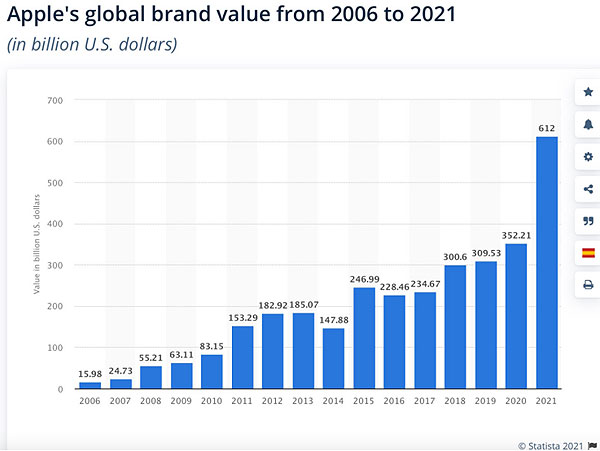
It was to catapult the Apple being one of most worthy brands on the planet. Today, it is worth $ 612 billion.
In many ways, the commentary of Think Different glorified the Apple user and made her/him feel a strong part of a tribe around the world.
As we remember Jobs, this powerful and shared feeling carries on.
The tirade against the Maharajah is almost as old as that against the airline itself. The Air India top management, the aviation ministry and their new advertising agencies have been wanting to do away with the Maharajah for almost 30 years now. The agency HTA* that created him and nurtured him, even lost the Air India business after handling it for over half a century, maybe because they were the creators of the Maharajah.
It is really a wonder he has survived this long. He doesn’t look the same, he doesn’t speak the same language that he spoke years ago when I handled the business, he has lost his unique sense of humour and wit, he is completely out of touch with current affairs, in fact he is a mere shadow of his former self and he might as well have been executed than allowed to linger like this on a ventilator. He was born on the corner of a letterhead, and he has gone back to being there, making me wonder if he might also be buried there.
On Richard Nixon during Watergate
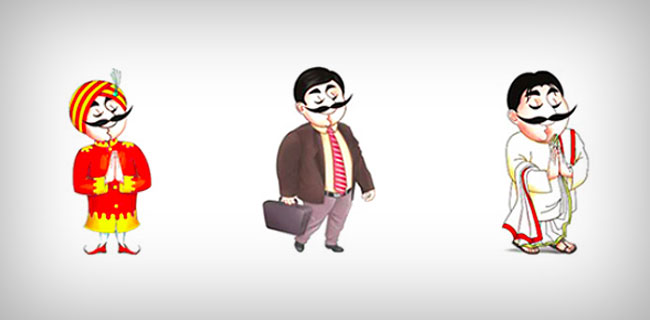
Most people who have this point of view don’t understand that he is not just a Maharajah. He is a mascot who embodies the soul of Air India. Only his garb is that of an Indian prince. When he was conceived, he was meant to stand for everything that Air India stood for. Just like well-travelled Indian royalty that could speak authoritatively to both India and the world. Also, the Maharajah was not just the Maharajah. He took many shapes and forms disguised for the country he was meant to represent.
Sawant, one of the Creative Directors at HTA who could draw the Maharajah in 15 seconds. was so inspiring that HTA once created a film, by making Sawant draw the Maharajah in real time, with a camera following his talented hands.
K ‘Bobby’ Kooka, the Commercial Director of Air India, is once known to have said: “We call him a Maharajah for want of a better description. But his blood isn’t blue. He may look like royalty, but he isn’t royal.” Famous for having conceived the Maharajah along with Umesh Murdeshwar Rao of JWT in 1946, the Maharajah is one of the oldest mascots in the world. Kooka was later Chairman of Hindustan Thomspon Associates*) and watched the Maharajah and Air India advertising grow in stature and popularity.
Ivan Arthur, earlier National Creative Director of JWT, and now educator and author, when asked about the Air India advertising, said: “Conceived as a letterhead design, the Maharajah broke the fetters of the line drawing and became flesh with a personality and DNA of his own: the double helix of gracious exotica. That DNA did not permit him to stand in the street corners of conventional media and tout his destinations like a cheap ticket salesman. His famous romps on those hoardings were not advertising. They were non-advertising: parlour talk, one-liner points of view, camaraderie, provocation and good humour, all of which did not ask you to buy an Air India ticket. In fact, in many of the hoardings, he refused to have the Air India logo as sign-off. He was the sign-off. He was no commercial mascot. He became a national figure. Much loved and respected.
The Maharajah dies a 100 deaths
Come the ’80s, however, frequent changes to the Chairman of Air India position resulted in the Maharajah dying a 100 deaths. Air India chiefs were keen to kill the Maharajah in lieu of something new and more contemporary. One such case was when in the late ’80s one Air India chief hired Landor, the well-known design firm, to redesign the logo of Air India in 1989. An airline identity change is one of the most expensive identity changes for any industry because it involves repainting all the aircraft, the livery, the ground vehicles and every signage in every country. But Air India went through all that bravely, eager to dump both the Centaur, which was their logo for the longest time and the Maharajah who was accused of not being in tune with the times. Rajan Jetley, then Managing Director of Air India, had said in defence of the new logo: “It is a public statement of change and a product exercise in the classic marketing sense.”
Air India’s new identity created by Landor
This was painted on the tail of the aircraft and the Boeing 747 Rajendra Chola became the first aircraft to carry the new logo and the livery. This facelift is known to have cost Air India $35 million back in 1989. But the public started questioning the change, immediately missing their familiar brand Air India. Questions were also raised in Parliament about the change of identity. But in spite of the identity change, the Maharajah seemed reluctant to leave the brand and its advertising. For every one person who didn’t want him, there was a loyal fan who wanted him back.
Abolition of privy purses 1971
Changing a brand’s identity is not an easy task. It is easy to say the Maharajah is an anachronism for those who don’t understand the Maharajah and the brand. Colonel Sanders who died in 1980 is still a part of the KFC logo. The Marlboro cowboy first made his appearance in 1954 while the cowboy era ended in 1885 at the end of the American Civil Revolution. They are not anachronisms. They are timeless just like the Maharajah. As Piyush Pandey, Chairman of Ogilvy is known to have said to Economic Times last week: “The Air India Maharaja stands for India. For any brand, any mascot, any logo, any identity is as meaningful as what they do with it.”
With the Air India brand firmly with the Tatas, one wonders what the future of the Maharajah might be? Considering that the Maharajah is a crucial part of Air India’s brand equity and having worked on the brand, I can only hope that he will be re-incarnated.
Coke and Pepsi have been at it for half a century, trying to outsmart each other both for marketing share and advertising that makes the brand relevant to the youth. Real Magic, the new commercial by Coke, I think has taken a giant leap and does manage to outsmart Pepsi.
Firstly, it is rooted in Gen Z passions by basing the idea on gaming. The gaming market is expected to reach USD 398,950 million by 2026 growing at an annual rate of 11%. Secondly, the Coke commercial is based on a philosophy that makes more sense than ever before.
Says Manolo Arroyo, marketing lead at Coca-Cola: “The ‘Real Magic’ philosophy is rooted in the belief that dichotomies can make the world a more interesting place-a world of extraordinary people, unexpected opportunities and wonderful moments.” The philosophy itself is not new – the hippie revolution believed in this more than anyone else right since the 60s. The world is growing more apart as we celebrate our differences rather than our similarities. The real idea behind the wave of globalisation was to embrace our dichotomies.
” ‘Real Magic’ is not simply a tagline or a one-off campaign,” says Arroyo. “It is a long-term brand philosophy and belief that will drive and guide marketing and communications across the Coca-Cola trademark.” Maybe it was about time for Coke to try something new given its sluggish sales in the recent past. Real Magic then succeeds ‘ Taste the feeling’ which was first introduced in 2016. BETC London, along with director Daniel Wolfe made the film.
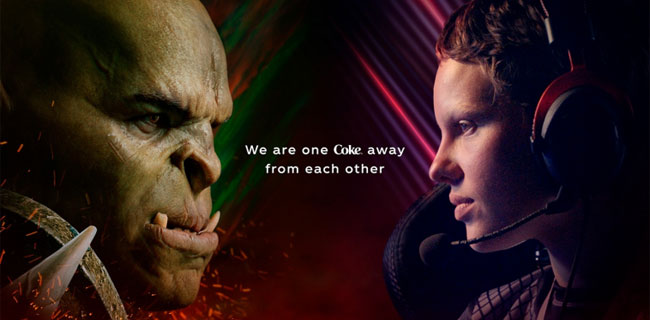
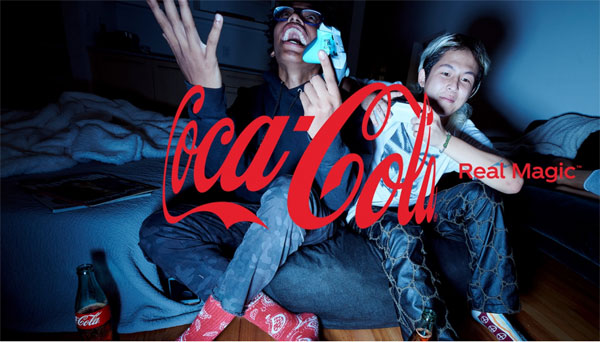
The campaign also uses the Coca-Cola logo to wrap around the campaign images. I thought this was a pretty unique treatment of the logo given that the curvature of the Coke bottle or can always makes the logo seen this way.
Also the tagline ‘We are one Coke away from each other’ is reminiscent of the six degrees of separation theory first propounded in 1929 which said that we are on an average six or fewer social connections away from each other. With the expansion of the internet and social media to cover people around the world has often meant that we might very often be just one connection away from each other. Or one coke away from each other. Clever!
The commercial shows a World of Warcraft type of battle in progress until one of the contestants opens a can of Coke. After the contestants first sip, Orc in the game is overcome with feeling and throws away his battle axe, picks up his opponent and there is suddenly peace in the gaming universe. A metaphor for World Peace?
There is a lesson to be learnt here for the world. After all we if we all threw out our weapons nuclear or otherwise, one of the principles of nuclear disarmament, we might be all less threatening to each other.
Having grown up as a teenager in the 60s, all these little nuggets of philosophy make great sense to me, although it is supposed to appeal to Gen Z. And if Gen Z does think like this maybe we can hope for World Peace as eulogised by John Lennon in his immortal song Imagine!
Never has marketing communication been under the scrutiny of so many, ever before in its history.
First, there are the regulatory bodies who look over your shoulder. While working in China in the late 1990s, and when censorship was much stricter perhaps than it is today, I remember having a tough time. In a commercial of mine, a student acts cheeky with his teacher. It was intended to be tongue-in-cheek, but the humour of the situation was lost on the powers that be. We were told that it went against the norms of the teacher-student relationship which went back to none other than Confucius who had articulated with great lucidity on the subject. I even remember, Close-up toothpaste, which was then running the ‘Kisses’ campaign in the US my version of the campaign for China, had two toothpaste tubes of Close-up coming together to suggest they were kissing. At the time, it was a big hit in countries like Indonesia, which again had strict censorship rules in place.
Coming back to the present moment, with the addition of the Department of Consumer Affairs being added in the last few years, means there are two watchdogs, a government watchdog and the Advertising Standards Council of India (ASCI) which is the self-regulatory industry watchdog. One is not quite sure what the government watchdog has been up to since they don’t publish their achievements, but the ASCI publishes every quarter the cases disposed of by them which run into a few thousand. In addition to the regular cases which come under the Advertising Code, we now have a third entity that is policing advertising and that is the consumer.
The Culture Police
The Tanishq ad that got shot down by social media last year would have had no objections from either the ASCI or the Department of Consumer Affairs. But the social media police is quite another story. These are typically the cultural watchdogs if one may call them that. They scan the environment for cultural misdoings like the Tanishq ad which was innocently launched during Diwali last year to promote its Ekvatam collection. The YouTube description for the ad said: “She is married into a family that loves her like their own child. Only for her, they go out of their way to celebrate an occasion that they usually don’t. A beautiful confluence of two different religions, traditions, cultures.”
It was story of a Muslim family, with a Hindu daughter-in-law which was helping her to celebrate her own festivals. But the social media immediately jumped on to a conspiracy theory called ‘love-jihad’ which which accuses Muslims of converting Hindu girls to increase their own population.
A lot of people were shocked with the objections but nothing doing, Tanishq was forced to take the ad off the air to appease the social media groups especially when the danger manifested itself in crowds wanting to damage their Tanishq showrooms.
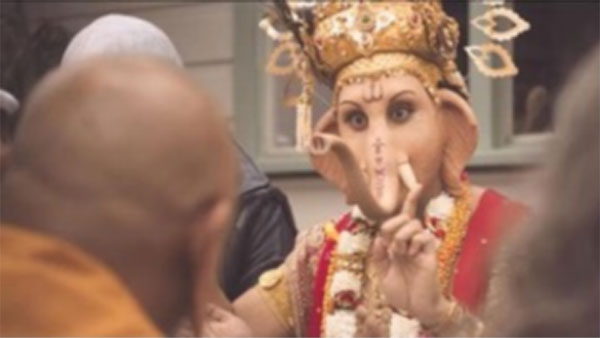
This is not just an Indian phenomenon but the culture police also exist in other countries. This is very familiar to the Ganesha ad that got shot down in Australia. Meat and Livestock Australia put our favourite Lord Ganesha in an ad which showed meat-eating.
This enraged the local Hindu groups who of course besides staging protests to Ad Standards, in Australia
The ad showed Lord Ganesha sitting and enjoying the meat with Jesus Christ, Moses, Aphrodite, lord Buddha, Zeus, Obi Wan Kenobi from Star Wars franchise along with Ron Hubbard, the founder of Scientology. Ad Standards Australia upheld the complaint from local Hindu organisations and the ad went off air.
The latest ad questioned by the Culture Police is Manyavar Mohey ad (Mohey is the brand for women) featuring Alia Bhatt which was received with mixed feelings. While the ad was trying to break away from the age-old practice associated with marriage, where the daughter like a commodity, ( kanyadaan), the ad proposed greater respect for women (kanyamaan ). Unfortunately, when celebrities like Kangana Ranaut join the culture police, the attack on ads become stronger. She is known to have said: “Don’t use religion to sell products.”
Again, not very different from the Pepsi ad which showed supermodel Kendall Jenner leading a Black Lives Matter movement with a fizzy can of Pepsi.
It provoked Martin Luther King’s daughter to make a blistering remark on Twitter, that read: “If only Daddy would have known about the power of #Pepsi.” Bernice King’s tweet was accompanied alongside a photo of her father being pushed back by police.
Another ad that was forced to bite the dust.
The Human Rights Police
Here the human rights police objected to the extreme conditions that Zomato delivery men are put through when they don’t even get a moment to themselves between orders. In the commercial, Hrithik Roshan goes in to get his mobile to get a selfie with the Zomato delivery man. But the delivery man is so busy that he forgoes the opportunity of a pic with Hrithik because he is getting late for his next order. Zomato was quick to appease the trollers with their tweet which read, “We have been listening intently to the chatter about gig workers and the problems associated with this part of the economy. We understand you expect more and better from us”.
Advertising uses Figures of Speech
A few advertising regulators coupled with public groups on social media who keep a watch, means that advertising will have to be more careful than before. Diversity and inclusion is no longer an option, it is an imperative. In 2021, it will need to become a habit for most advertisers.
For the last 100 years or so, advertising has used figures of speech to communicate. So parody (humour), hyperbole (exaggeration ) to make a point, and metaphor (where a word or phrase is applied to an object or action to which it is not literally applicable ) are some of the main figures of speech that advertising uses to make an impact. Advertising can continue to use them but now will have to keep away from sensitive subjects.
A long time ago, Jerry Della Femina said: “I honestly believe that advertising is the most fun you can have with your clothes on”.
I am not so sure it is any longer for more than one reason. The times they are a changing!
Prabhakar Mundkur is a former advertising agency captain and has spent over four decades in marketing services across geographies. He is a prolific writer and was a few years back rated as among the top voices by LinkedIn. Other than advertising and writing, Prabs, as he is known to friends, is a very active musician and a self-taught producer of music. In the pandemic, he has performed and produced nearly 50 songs, including one with the very accomplished Usha Uthup. Mundkur’s views here are personal.
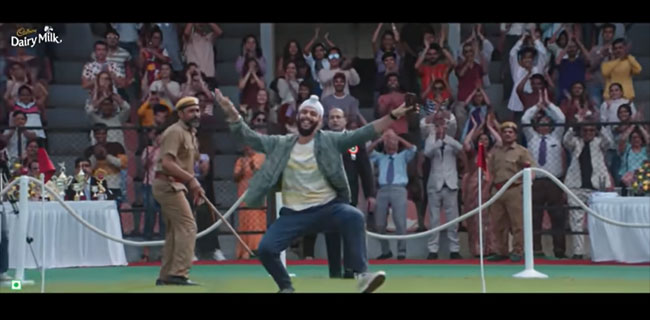
As I write this, I am sure the latest Cadbury’s ad has already gone viral if that is a measure of its success. The latest message I got on WhatsApp went like this:
“In 1994, Ogilvy India made an ad for Cadbury Dairy Milk.
In 2021, Ogilvy India made the same ad for Cadbury Dairy Milk, with a difference.
Check both out!!!”
The praise showered on it has had no bounds over the last two days. One of the comments went like this: “It’s a follow-up to the ad the great Piyush Pandey wrote in 1994 which catapulted him to advertising fame.” No doubt Piyush is a shining star in the advertising firmament, but I am not sure this criterion can be used to judge an ad, both by commoners or 50-year-old advertising executives. I never thought of an ad as great only because David Droga or Bruno Bertelli wrote it. In any case, I am getting used to the hysteria and adulation India accords its heroes. Just yesterday, we saw a union minister likening our Prime Minister to God. And later, the Prime Minister’s Report Card handle on Facebook posted the Cadbury ad, giving it record likes and shares. God himself then has endorsed this ad. So, who am I, a mere mortal to even start evaluating it?
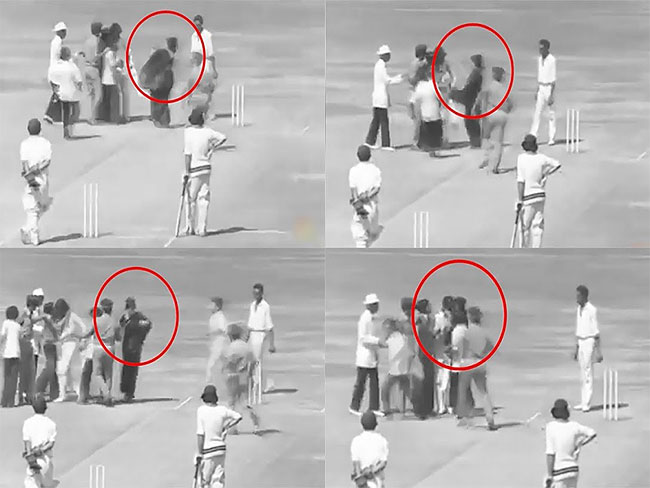
I must admit I am an aberration of the Indian consumer because I spent the better part of the 90s working overseas and could not use the 1994 ad as a reference. It seemed like just another cricket ad to me, or simply put just a typical scene from Indian cricket which we have seen repeatedly, for much longer than the Cadbury ad. After all, didn’t a woman do the same thing to Brijesh Patel when he scored a century in 1975? She went past the security (India’s disrespect for the law is legendary), right until the pitch and then planted a kiss on Brijesh’s cheek. I know cricket is a hot button in this country, but the 99 runs on the scoreboard with a sixer coming up is both a bit trite and hackneyed.
Which brings me back to one basic question: if this ad was trying to capitalise on nostalgia marketing, was it aimed at people who were over 50 years old? We don’t know Cadbury’s strategy, but it could well be that they no longer wanted their brand to be seen as a young person’s brand. If the target audience were expected to have seen the ad in 1994, it does mean that this ad is talking to people who are in the age group of 40-50 years at least or even more.
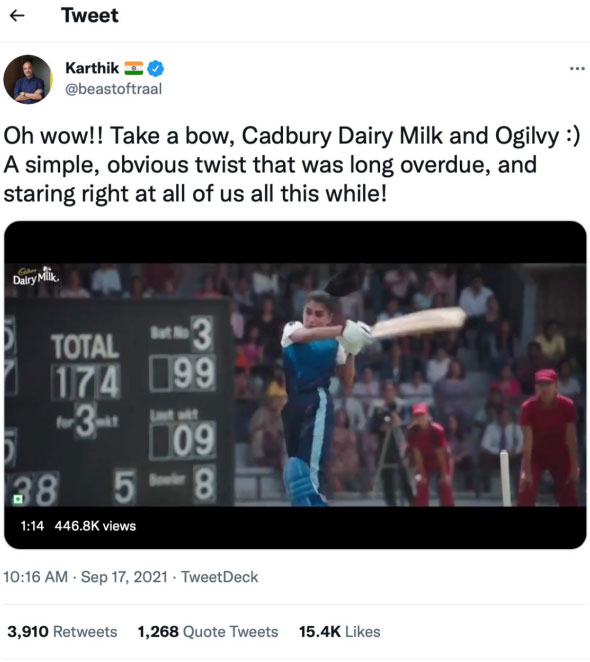
Of course, while arguing my way through the merits and demerits of the ad, many people stoutly defended the ad saying that it was brilliant, even as a standalone, and even if people had not watched the 1994 version. Maybe, but I would imagine that the people who had seen the 1994 ad would rate it 5x times better than the people who hadn’t seen the 1994 ad. People who first posted the ad on social media were mostly older, but the overall hype was so overcoming that I believe the youth had taken to sharing the ad later, on Instagram. Take this tweet for example which got a rousing response. I don’t know Karthik personally, but I am willing to wager that he is at least 40 years old to have seen and remembered the 1994 ad.
But somehow the Cadbury ad seems to have touched a chord and has got accolades for showing a woman in the lead role. Many people have commented that this was a long time coming. Of course, any ad like Cadbury’s is a welcome addition to the tirade against gender discrimination. India for centuries has discriminated against women, and there is still scope to do much more. India ranked 131 in the 189-country survey on the Gender Development Index. So, any commercial or full-length movie that goes towards portraying the importance of women is welcome because it can help to change the status quo. I see advertising and cinema as important influencers in pushing the envelope for social change.
Oscar Wilde in his 1889 essay ‘Decay of Lying’ posed the rhetorical question, whether Art imitates Life or Life imitates Art. I firmly believe that Art must do its bit to change society so that Life can start to imitate Art. The Cadbury ad from that point of view is a step in the right direction.
Except that as I said earlier, the Brijesh Patel incident also raises the question if this is Art Imitating Life? It could well be!
Oscar Wilde was right in posing this queer and difficult paradox.
Prabhakar Mundkur is a former advertising agency captain and has spent over four decades in marketing services across geographies. He is a prolific writer and was a few years back rated as among the top voices by LinkedIn. Other than advertising and writing, Prabs, as he is known to friends, is a very active musician and a self-taught producer of music. In the pandemic, he has performed and produced nearly 50 songs, including one with the very accomplished Usha Uthup. Mundkur’s views here are personal.
“Tomorrow is nothing, today is too late, the good lived yesterday”.
Marcus Aurelius
Rediffusion has come a long way since WPP’s Martin Sorrell made a bid to up his 26.7% stake in the agency in the early millennium, which had a tripartite shareholding of WPP, Dentsu (13.3%) and 60% owned by Dewan Arun Nanda and Ajit Balakrishnan. The two international shareholders holding 40% were strange bedfellows making the once highly regarded agency a bit of an oddity. The agency touted some of the industry’s best people once upon a time including the late Dr Ashok Bjiapurkar and Kamlesh Pandey who later moved on to script writing in Bollywood. Not to mention many other well-known names like V Shantakumar. Why, even Mohammed Khan was one of the original founders before he went on to start Enterprise.
Like many agencies of its ilk, it kept attracting back some its best names in some consultative capacity or the other. Mr Nanda is known to have had good ties with most of the people who worked for him and that could be the reason.
According to the grapevine those days, Nanda might have paid dearly for refusing Sorrell’s offer to increase his stake in the early millennium. Sorrell was known to be very clear in the ownership patterns of his acquisitions. He always wanted a clear majority and typically the starting point would be at least 51% share before engulfing most of the remaining stake in the shortest period of time. People those days spoke in hushed whispers that Sorrell had threatened that if he couldn’t increase his stake in the agency, he would pull out its largest piece of business which at that time was Colgate, being a global Y&R account and terminate the Y&R partnership with Rediffusion. Moving global accounts to another agency is not a piece of cake, but Sorrell finally seems to have carried out his threat by moving Colgate to Bates 141, which created a special unit to handle the account, reporting directly to the Y&R global management. This gave credence to what thus far was attributed to agency gossip.
Team Colgate was a typical WPP style business unit that that had become Sorrell’s favourite model, a prime example being GTB for Ford. This ensured that Sorrell had direct control over some of the most important global accounts in the group. There is a bit of history there, since the agency heads of individual accounts can become quite powerful with time. A great example was Peter Schweitzer at JWT, who by heading the Ford account which once upon a time contributed to almost 25% of JWT’s global revenue, grew too powerful for Sorrell’s liking. When Schweitzer retired as CEO, Sorrell quickly moved Ford from JWT into WPP’s special unit called GTB thereby retaining direct control over this large piece of business.
When Colgate left Rediffusion, it was a telling blow. Losing large accounts didn’t faze Rediffusion. They had lost Airtel in the first decade of the millennium. And after Colgate they it lost the Tata Sons PR business which was placed in their partnership with Edelman to Adfactors.
In the M&A business, timing is critical. Both for the buyer and the seller. Rediffusion no doubt was well past its best valuation having waited too long for someone to come along. But the ego and the resilience of the founders kept it plodding along. What has Sandeep Goyal really bought into, one is not quite sure. The press release talks of its past glory rather than anything else clearly making it a ‘has been’.
So it would be interesting to speculate on what Goyal would do with the agency he has bought. He would necessarily have to fill the shell with some meat. If one goes by his earlier reputation, he is known to walk into agency pitches with a bag full of advertising campaigns, something that used to shock advertising professionals 20 years ago because it painted a picture of the ‘servile’ model for advertising. Servility in the advertising business has peaked since then and also contributed to its downfall.
The industry did little to continue the legacy of equal partnership and mutual respect with clients. It needs to be seen however whether the same tactic will work today. His long-term gameplan of course would be to dress up the bride. For this, he would need to build adequate value in Rediffusion to attract a global agency for an acquisition. Of course he can hardly be underestimated. His aggressive business stance is well-known. As is his passion for hard work, and particularly his extreme dismay at losing.
But it may take a while for the once famous agency of yore to re-acquire its earlier halo! For Rediffusion, Sandeep Goyal might well be its Angel Gabriel, the Arch Angel of Resurrection, the Voice of God and the Bringer of good news.
Prabhakar Mundkur is a veteran advertising person, a former agency CEO – in India and elsewhere in the world, a musician, a music producer, a talkshow host, a prolific commentator and a great conversationalist with an infectious laugh. His views here are personal.
Prediction on the death of advertising started at the turn of the millennium. Perhaps the first stirrings on the death of advertising almost started with the birth of the internet. Pooh-poohed for most of the time, most advertising folk refused to accept the death of their industry and were filled with a strong sense of self-denial. The way that people consume media has probably dealt the final blow on the advertising industry.
When I joined advertising in 1977, advertising was considered an art form. And like most art there was an air of gay abandon about it, that went well with its brand of creativity.
The Big Bang
In 1987, WPP which swooped down on poor old J Walter Thompson who was ripe for an acquisition attack. Poor old ‘Commodore’ Thompson might have flipped in his grave. Ogilvy was acquired two years later. David Ogilvy is known to have called Sorrell an ‘odious little shit’ later softened to ‘odious little jerk’ by the media.
I call this the first Big Bang in the advertising industry. The culture of ad agencies was to start to change forever. They would become so bottom line oriented that all other lines in the agencies including strategy planning and creativity would start to become affected. You can imagine the shock – a math man running a bunch of mad men. I was at JWT at that time and the first effect I saw was suddenly the exit of the best minds in JWT.
The second Big Bang was the painful extraction of the media business from the main agency to create stand-up independent media agencies. In 1998, I was in JWT Shanghai at the time, and we were the second JWT office in the world to create an independent media agency and tear it away brutally from the creative agency. The 15% media commission which was beginning to break down any way suddenly became the norm rather than the exception. The net effect of this Big Bang was that the media plus creative function was being paid much less than ever before. This resulted in less training, lower salaries, less interest from business school graduates to join advertising, less travel, and less talented people finally willing to join advertising. In a way it was the beginning of the slow downfall of advertising.
Famous ads written by Sir David Ogilvy
Enter the New Millennium
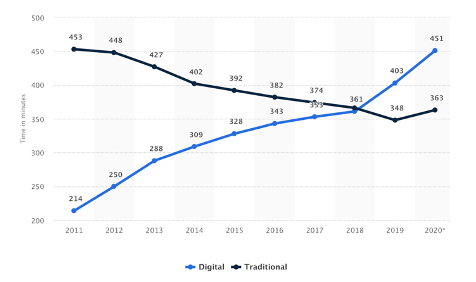
The new millennium brought with it some profound changes. The internet was beginning to change the way people live, read, do business, buy, and connect with other people. In 2004, Mark Zuckerberg launched Facebook. We learnt a new term called ‘social media’ with its advent. LinkedIn was launched earlier in 2003 and Twitter later in 2006. A host of other social media would completely change the way we live. So would advertising unfortunately. Because people were spending much less time watching television and reading the newspapers and listening to radio. In 2019 people spent more time with digital media than with traditional media in the US.
Time spent per day
Source: statistica.com
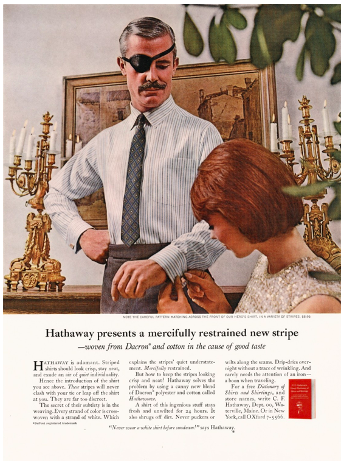
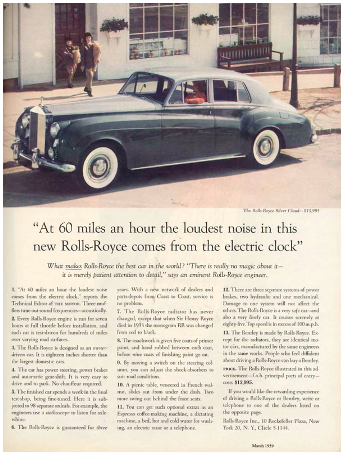
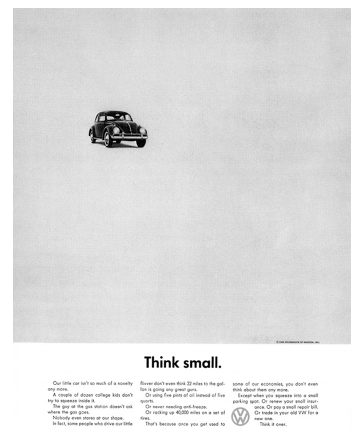
The world of digital and social media meant new ways of talking to consumers. This gave rise to new techniques in communicating. It meant that the skill needed to produce the famous Volkswagen Beetle ad by Bill Bernbach that made it a cultural icon that sold millions of cars were no longer needed. One can’t forget of course the degree of difficulty posed to sell an ugly German small car soon after World War II, to Americans used to the luxury of large cars, something the Volkswagen ads achieved admirably.
1959
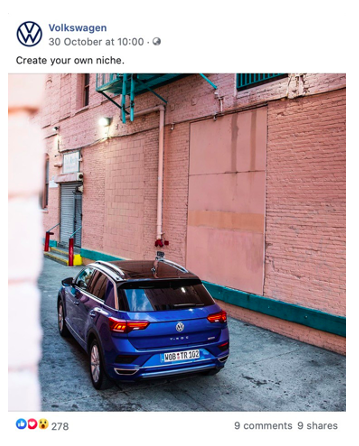
2019
In fact, the brilliance of the written word employed by master craftsmen like Bill Bernbach and David Ogilvy or the keen visual eye of Helmut Krone was perhaps no longer needed. In the new millennium creativity had played hide and seek behind a much-abused word called ‘content’. Content was very forgiving of real creativity and happy to make friends with mediocrity. In contrast to the Think Small ad, the Facebook ad of today for Volkswagen will be judged by the number of likes, comments and shares. And not purely by how much the ad moves you like the Thing Small ad. In fact, there seems to be no particular skill this Facebook ad might need either in terms of word or visual craftsmanship. Suddenly communication had become the domain of data scientists and engineers whose province was machines, algorithms, big data and artificial intelligence. And perhaps creativity was reluctantly but surely taking a back seat.
How Advertising finally died
While many predicted the death of advertising no one quite predicted how it would go.
In the last year, it certainly seems that advertising agencies will get gobbled up by digital agencies in the same group. Grey Advertising is the most recent example which merged with AKQA to form AKQA Group. Last year similarly JWT merged with Wunderman to form Wunderman Thompson. And Y&R merged with VML to form VMLY&R. I wonder who is next?
Suddenly the heritage of a 100 years seems to have gone into the dust. And with the merger goes their history and great creativity of several decades. When a brand dies, everything it meant to people dies along with it. It is ironic that WPP the group that bought over JWT, Ogilvy, Y & R and Grey is also the company that killed those very iconic advertising agency brands.
It’s a pity that advertising had to die so suddenly and just get obliterated from the face of this earth.
Prabhakar Mundkur is a veteran advertising professional and now a prolific commentator. He spent 17 of his 42 years in advertising with the agency once known as J Walter Thompson working with them across three continents. He has also worked with Havas and Hakuhodo. He has been voted Top Voice on LinkedIn, one of the Top Emerging Voices in yourstory.com and has written nearly 400 articles in the last four years. He was once an HMV and Polydor recording artist playing both the guitar and piano and still joins the occasional gig for friends. You will find him on Spotify and Apple Music with his recent compositions. He can be reached via Twitter at @wisecowboy. His views here are personal.

 Advertising like the other arts of cinema, music, is the perfect mirror of an emerging society. Often the arts can lead society, and at other times, it may just be a mirror of where society is today. It’s important for a brand to constantly search for cues from our daily living. So, a brand can often be a mirror of where we are but equally a brand may lead society into their own future.

 My first watch was a mechanical and it was an HMT, those considered the pride of India. If I am not mistaken, they cost about Rs 500 those days in the 60s. Over the last few years, I have been collecting the old mechanical HMT watches just to relive the magic of mechanical watches. My first project was to restore my father’s HMT Jubilee watch which was also probably bought sometime in the 60s.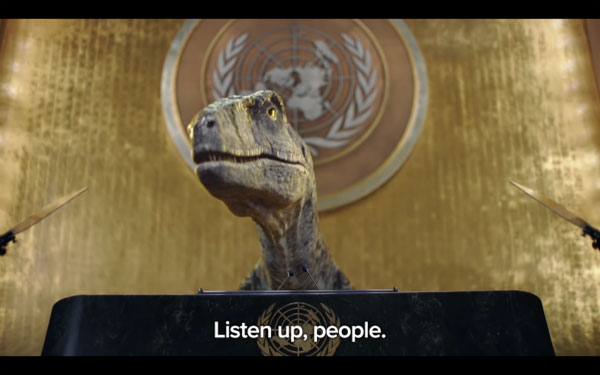

 The tirade against the Maharajah is almost as old as that against the airline itself. The Air India top management, the aviation ministry and their new advertising agencies have been wanting to do away with the Maharajah for almost 30 years now. The agency HTA* that created him and nurtured him, even lost the Air India business after handling it for over half a century, maybe because they were the creators of the Maharajah.