Tag: PepsiCo India

  • Lay’s Maxx TVC redefines macho-ness

    By A Correspondent


    Lay’s Maxx, part of Pepsico’s Lays product range, has released a new commercial that portraysa macho man who has the innate style to win over situations effortlessly.


    Speaking about the campaign, Dilen Gandhi, Marketing Director, PepsiCo India, said: “Lay’s has been the most loved potato chip for years, and Maxx, the global, premium superhit from our portfolio,has witnessed equal zeal and enthusiasm by the consumers since its launch. We are confident that the new TVC will fortify our brand presence in the market.”


    Commenting on the creation, Senthil Kumar, Chief Creative Officer, J Walter Thompson added:“The TVC brings alive the distinct taste and flavors that define the powerful Maxx experience. We hope that our consumers will connect with the storyline and identify Lay’s Maxx for its rugged and rustic nature.”


  • Pepsi unveils campaign celebrating global moments

    By A Correspondent


    The best moments are those when you decide to let go, choose to act, follow your passion – nothing holds you back. It’s summer, and this is the theme of the new Pepsi ad.


    Speaking on this campaign, Vipul Prakash, Senior Vice President, Beverage Category, PepsiCo India, said: “Through the Moments campaign, we have once again taken a progressive approach to truly reflect today’s generation with a relatable packaging innovation. ‘SochaNahiJi Gaya, Pepsi Thi, Pi Gaya’ is our campaign philosophy and we see our purpose in being able to seed spontaneity in the life of our new age consumer. At PepsiCo, we have always celebrated packaging, which is our strongest asset, and a key driver for our Shelf to Media approach. We are confident that our Moments campaign will truly make Pepsi stand out on the retail shelves.”


    Added Senthil Kumar, Chief Creative Officer, J Walter Thompson India:”Pepsi has always been an iconic brand that mirrors millennials and creates popular culture. This summer Pepsi is celebrating the spontaneity that defines today’s generation, with a set of three summer special commercials that capture how icons and new age consumers themselves are seizing the moment and doing it with a swag that represents the great taste of Pepsi. The insight remains the same as our ‘Pepsi Thi Pi Gaya’ campaign; there are some things in life that you can’t say no to, a chilled bottle or a chilled can of Pepsi.”


  • Mountain Dew salutes Risk Takers of India through latest initiative


    Mountain Dew is set to bring its philosophy of ‘NaamBanteHain Risk Se’ to life through an initiative that salutes the real Risk Takers of India. The new TVC salutes the real life heroes and Risk Takers of India for rising above the ordinary and seeks to inspire the youth of today to do the same.The initiative is based on a powerful insight from Mountain Dew consumers who said that they don’t want to end up ordinary and that greater risk means greater success.


    Speaking about the campaign, Vipul Prakash, Senior Vice President- Beverage Category, PepsiCo India says, “Mountain Dew has always been about celebrating real heroes by encouraging people to break out of the ordinary to make a name for themselves.Through ‘Risk Takers of India’, we want to drive a purposeful message around breaking out of your boundaries to rise above. It is our way to salutethe unsung Risk Takers of India, who have overcome challenges and brought accolades not only to themselves but the country as well. Their illustrious journeys set an example for everyone and Mountain Dew is proud to present this platform to encourage youth to take risks.”


    According to Senthil Kumar, Chief Creative Officer, J Walter Thompson India: “The creative idea was to push Mountain Dew’s core idea of taking risks even further. We decided to go real and authentic and get inspired by real life heroes. And came up with India’s first biopic in Indian advertising. It is our way of recognising and acknowledging these risk takers in real life who battled the elements and came out on top. It is our attempt to inspire the youth of India to go out there, take a risk and make a name for themselves. And what better way to do that than by showing the journey of man who did it for real all alone ,nonstop across the seven seas…and became the first and only Indian to do so.”


    Mountain Dew Risk Takers of India will showcase the stories of five real-life risk takers – Deepa Malik, ArchanaSardana,Arjun Vajpai, SatyendraVerma and Bhakti Sharma. Each of the five heroes recognised by Mountain Dew have overcome hardships and risked their lives to rise above the ordinary and make a name for themselves.


  • Gatorade India appoints PV Sindhu as brand ambassador

    By A Correspondent


    Gatorade India announced that it has signed on PV Sindhu as its brand ambassador. Gatorade plans to have PV Sindhu work with the Gatorade Sports Science Institute during the period of the partnership, to better understand her training and match-day nutrition


    Announcing the partnership, Vipul Prakash, Vice President-Beverage Category, PepsiCo India said, “We are delighted to welcome PV Sindhu into the PepsiCo India family. We believe that Gatorade is the perfect fuel for PV Sindhu and we are happy to partner with her. Gatorade is a scientifically formulated sports drink that provides the right hydration and fueling during a strenuous game or a training session. PV Sindhu personifies the spirit of the brand through her determination and winning attitude.”


  • Indians spend more time on cellphones than TV


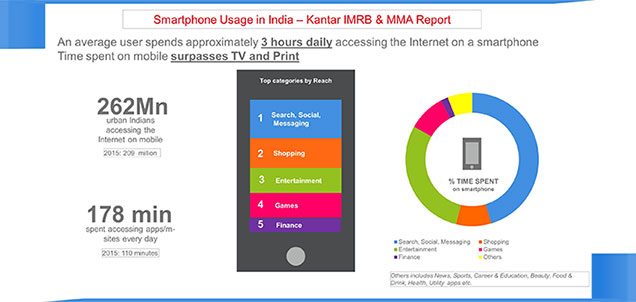
    The Mobile Marketing Association (MMA) in association with Kantar IMRB has released a report on Smartphones and Feature Phones Usage and Behaviour 2016-17 in India. The report studies the evolving nature of the Indian mobile consumers, and provides insights and behaviors individually on smartphones and feature phones.


    KEY FINDINGS ON SMARTPHONES

    I. Time spent on mobile surpasses any other media

    An average consumer spends 3 hours per day on their smartphones (an increase of 55% from 2015), which surpasses time spent on TV or any other media. Social media and messaging apps were the clear leaders accounting for almost 50% of all time spent on smartphones.

    II. Women more engaged than Men

    The study shows that Women spend 2x more time on their smartphones compared to Men – on YouTube and games. They also spent 80% more time on Facebook than their male counterparts.

    III. Online shopping gains in leaps and bounds


    Another finding revealed the rise of online shopping category, which now has 15% higher reach than the entertainment – making it the second most popular category in terms of reach.


    KEY FINDINGS ON FEATURE PHONES

    I. Prime users are from upper SECs

    The study shows a whopping 75% of feature phone users were from the upper SECs, while only 25% of respondents were from SEC C, D and E (NCCS).

    II. Feature phone users don’t intend to switch

    A big revelation has been that almost 85% feature phone users do not intend to switch to smartphones on their next purchase indicating that the functional benefits of feature phones combined with their durability, battery life and ease of repair were highly coveted by these users.

    III. Feature phones users spend more on mobile plans


    Feature phone users spend more money on their mobile plans. The ARPUs was almost 20% higher compared to the national average.


    Said D Shivakumar, Chairman and CEO, PepsiCo India Holdings and Chairman of the Mobile Marketing Association: “With over 85% mobile penetration, we are today one of the largest mobile markets globally and insights on mobile usage in India are of critical importance to the modern day marketer. We are in an age now where we need to seriously think about marketing measurement and attribution, giving marketers better measurements, tools and confidence in connecting marketing to business outcomes.  A thorough understanding of the differential usage and consumer segments that are using smartphones and feature phones will only help marketers use their monies more efficiently. While most designing and applications are being targeted at smartphones, this report is a wake-up call. Today, the mobile is undeniably the closest we can get to our consumers, and it is this that will help marketers seek to understand – and leverage – a consumer’s path to purchase”.


    Added  Preeti Desai, Country Manager, Mobile Marketing Association India: “Mobile is clearly the third largest mass medium in terms of Ad spends in India today, with estimated spends in 2016 amounting to ₹.4,200 Cr. Hence it becomes very important for the industry to have credible research and measurement guidelines and reports, to help fully understand and leverage mobile’s ability to drive the future growth of business. With this in mind, MMA India has collaborated with Kantar IMRB to deep-dive into the dynamics implications and impact of smart phones and feature phones India focusing on each category separately and giving each their due focus. The insights of this study will be published in a series of industry reports that will go a long way in helping marketers use the medium effectively and efficiently. It is a great data set for marketers to reassess and optimize their spending with the most impactful allocations in their marketing mix, while leveraging mobile with double digit spend.”


    Hemant Mehta, Senior Vice President, media and retail, Kantar IMRB, said, “Mobile has had an outsized influence on the way consumers interact with each other, make decisions, transact and shop. This has significantly impacted the way companies and brands connect with their consumers and do business. But we’ve only seen the tip of the iceberg. With the advent of 4G, reduced data costs and free voice and SMS, we expect to see even more rapid changes in the mobile landscape. It is, therefore, important to keep a continuous pulse on the way consumers interact with and use their mobile phones. Along with MMA, we at Kantar IMRB have embarked on a journey to help marketers understand the impact of these changes and to identify emerging trends. The Smartphone and Feature phone reports are a step in this direction – providing an unbiased and insightful view on the evolution of mobile usage in India.”


    The report enables all members of the ecosystem to stay updated with consumer mobile trends and media consumption habits. Also at the same time, it elaborates the role of mobile as an influencer in the consumer path-to-purchase.


  • Being Indian & Quaker Oats unveil festive video campaign

    By A Correspondent


    As the festive mood gathers spirit in the country, Culture Machine’s digital channel Being Indian along with Quaker Oats, have released a video ‘Ek Muthi Sonu ke Naam’ to urge people to pause and spare a thought to the millions of children who go hungry. The video is based on the vision behind the noble #QuakerFeedAChild initiative.


    Said Deepika Warrior, Vice President – Nutrition Category, PepsiCo India: “We believe that ‘Ek Muthi Quaker’ has the power to make a difference in people’s lives. Quaker Feed a Child is a social extension of what ‘Ek Muthi’ can do. The video articulates a powerful thought urging us all to make every festival more meaningful by simply pledging a fistful to feed a child.”


    A Being Indian statement read: “It is saddening that despite the progress made by science and technology, hunger still tops the reason for death today. Along with Quaker, we aim to enlighten people about this and inspire people to make a change in their everyday lives in a way to contribute to the society.”


  • IndIAA Awards set for September 16

    By A Correspondent


    The India Chapter of the International Advertising Association (IAA), launched the IndIAA awards “for real creative advertising that was backed by real budgets” last year. Nominations for the second edition were invited and unprecedented number of nominations was received and reviewed.


    D Shivakumar, Chairman & CEO, PepsiCo India, chaired a jury of senior business leaders, which included Shantanu Khosla, VL Rajesh, GeetuVerma, Sanjay Behl and Amit Syngle.


    Said Shivakumar: “We just finished seeing over 100 shortlisted commercials from 19-20 categories. We spend about four-and-a-half hours reviewing some outstanding and some average work. We judged the commercials and the whole campaign under three parameters: 1) does it make us think on the brand and the category in a fresh way 2) Is the benefit visualised brilliantly as a lot of it is in the audio visual medium 3) How campaignable is this. I must say that the whole process has been outstanding and the results have been pretty simple and clear. I wish all the winners the very best and for those who haven’t won, best of luck for the next time”


    Pradeep Guha

    Added Pradeep Guha, Chairman, IndIAA Awards: “In our second edition, advertising campaigns that were released between July 1, 2015 and June 30, 2016 will be honoured in multiple product and service categories. To qualify for the Award, the campaign should have film (TV or Digital) as one of its elements. In each product or service category, no more than an overall winner was awarded. The awards ceremony is slated for September 16 at the ITC Maratha, near Sahar Airport in Mumbai.”


    Srinivasan K Swamy

    Said Srinivasan Swamy, President, IAA India Chapter and SVP, IAA Global: “At the IndIAA Awards event, you will see campaigns that have been watched and loved, and went on to impress our stellar jury. Therefore, we will invite on stage all the co-creators of the campaign to accept the award. This will include the marketing team, the agency creative team, the media team and other agencies that contributed to the success of the campaign. A special website www.indiaa-awards.org now hosts all the nominees of the campaigns across 20 categories. Advertising and Marketing professionals can review the work and indicate their choices by clicking on the ‘like’ button.”


  • Hail the consumer @ IAMAI Marketing Conclave


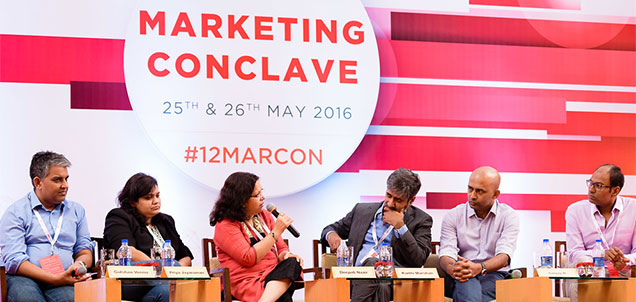
    ‘Untangling Marketing Convolutions’ is the tagline for the 12th Marketing Conclave presented by the Internet And Mobile Association of India (IAMAI).  And ‘Untangling’ it was from the word go. Day 1 of the two-day event started with a welcome address by Tushar Vyas, Managing Partner- South Asia, GroupM and a special address by D Shivakumar, Chaiman and CEO, PepsiCo India. The day was predominantly centered on digital marketing, better way of utilising the platform and the digital future of India.


    A chat about ‘Global Marketing’ was conducted by Virginia Sharma, Director- Marketing Solutions, LinkedIn India with Sameer Desai, Head of Consumer Healthcare, Mundipharma and VP Asia Pacific, World Federation of Advertisers. At the start of the conversation, Sharma announced that 58 per cent of LinkedIn consumers access the network through mobile, which began the conversations on what are the learnings from emerging and global markets. Desai shared his own experience and challenges that he faced when he entered the pharma sector and about global marketing. He said: “The challenge was to consumerise the pharma model.” Desai also said that it is very important to understand the internal organisational culture while going global. “Working together and maintaining coordination within each department is the key,” he said when asked to give some tips for being a business leader. Sharma and Desai both praised the way e-commerce has fared in India and suggested that instead of looking West, we should be focusing within the country. In conclusion, Desai said research is an important part but it should not dominate decision making, the moment that happens, people stop being marketers.


    Moving from global marketing to marketing technologies, the first panel discussion moderated by Sourabh Gupta, Engagement Manager, Tata Strategic Management Group started. ‘The age of marketing technologists’ was the topic and panelists included Manav Sethi, Group Head- Marketing and Digital Platforms, Head- Classifieds and Deals, AskMe Group India and Malaysia, Gunjan Soni, Chief Marketing Officer, Myntra, Pallavi Chopra, Head Marketing, redBus.in, Mohan Menon, Head Marketing, Max Healthcare and Sanjay Tripathy, Senior Executive Vice President- Head Marketing, Analytics, Digital and E-Commerce, HDFC Life. The discussion was divided in to four parts: the cultural change in companies due to digitisation, KPIs beyond sales and marketing, the changes in roles within the organisation and leveraging digital marketing dashboard. In the context of digitization, Soni said: “It has impacted quality and speed of decision making” and was quick to add that digital is a way of living for Myntra. The panelists agreed that the widespread digitisation has helped in breaking the hierarchies within a company. Consumer engagement and creating a consumer centric product were some of the major talking points in this discussion. Chopra shared that his company has developed a unique algorithm bus code to understand the consumer demands better and so that the bus operators start taking the consumers seriously. A case study session was being taken in parallel by Theodore Hayes, AVP Analytics, iProspect Communicate 2.


    Next was a presentation followed by a discussion session with the presenters. The presenters included Apurva Chamaria, Vice President and Head Corporate Marketing, HCL, Virat Khullar, Head Marketing, Renault India, Karthik Jain, EVP Head Marketing and Customer Analytics, HDFC Bank and Raja Hussain, Chief Executive Officer, Airloyal, who also moderated the discussion. The topic was ‘ Maketing Automation: Golden opportunity for marketers’. Chamaria was the first presenter, he discussed the transition from MarCom (Marketing Communication) to MarTech (Marketing Technology) and now, MarOp (Marketing Operations). He said there is a need for agile marketing strategies in MarTech through personalisation , geo-based targeting, programmatic SEO strategy etc. The next presenter, Khullar shared how Renault launched its new car Kwid in the digital platform and developed an exclusive app for it. He emphasised on the effective usage of social media for marketing automation. Jain, named his presentation ‘Sharper Marketing’ and he said that it is very important to be customer centric. He also advised that the Analytics and Campaigning teams have to work closely to succeed. Last but not the least, Hussain focused on how feedback is the life blood of marketing and it can be used to make a bigger impact. The discussion that was followed mainly highlighted the personal experiences and the challenges that each panelist faced in their respective fields. The common consensus of the discussion was that it is important to understand the consumer psyche and change the mindset about digital, that is digital should be looked as a priority.


    Parallel case study sessions were held by Deepak Kumar, Vice President- Ambient OOH, Posterscope India Group and Martin Nygate, Founder and Chief Executive Officer, Gentay Communications, who took the session on ‘Mobile advertising is killing your brand. What if we could make it powerful?’


    After an insightful discussion on various techniques of marketing, Tushar Vyasconducted a one-on-one with Prasant Peres, Director- Marketing (Chocolates), Mondelez India. They discussed about ‘The old-new age curve of brands: how new age brand’s marketing techniques are different than old age brands and vice versa’. The chat started with a quick volley of questions thrown at Peres, from which it was concluded that: the ad character Lalitaji is still stuck with him and he is a Kishore Kumar and Shahrukh Khan admirer. After the fun beginning, Vyas was back to the topic of discussion. He asked Peres to describe the evolution of marketing. “Marketing evolved not in the last 10 years but in the last five years, which was quite dramatic. Digital is a big change and we have become a mobile nation”, was Peres’s reply. He also added that he was awestruck by the transformation in mobile. “Engagement has become a core point of marketing,” Peres said. Another interesting point that was raised by Peres was that family TV viewing might become nostalgia as the current scenario demands focus on individual demands. He also said the success and failures in digital should be treated similarly as in traditional mediums.


    The post-lunch panel discussion was moderated by Deepali Naair, Advisor, IAMAI and the topic was ‘Beyond numbers: The art of digital marketing’. Karthi Marshan, Head Marketing, Kotak Mahindra Bank, Gulshan Verma, Chief Revenue Officer, Times Internet, Priya Jayaraman, Cofounder and Business Director, Propaganda India, Gyan Gupta, Chief Executive Officer, DB Digital and Sanjay R, Marketing and Network Head, Flipkart ads were the panelists. ‘Brand building’ and ‘brand engagement’ dominated most of the discussion. With everyone agreeing that digital offers ample opportunities for brand building and should be used to its potential. A workshop on ‘Out of stock in 24 hours- Marketing Exclusively on Digital’ was being conducted simultaneously by Anthony Padayachi, Associate Creative Director, BC Web Wise and SiddharthPednekar, Business Director, BC Web Wise.


    This was followed by a session on ‘Mobile Storytelling’ by Vishal Rupani, Business Head, M-Canvas, Affinity. The highlight of his presentation was he drew analogies between the immensely popular HBO series ‘Game of Thrones’ and the mobile storytelling. He demonstrated a few examples on how advertising can be made interactive and engaging for the audience. “Seduce your consumers through beautiful story telling through brands” was his tip to every marketer.


    The last panel discussion was moderated by Milind Pathak, Chief Operating Officer, Madhouse and the panelists were Dhruv Chopra, Chief Marketing Officer, Carwale, PrakashSikaria, Business Head, Flipkart ads, Gaurav Gandhi, Chief Operating Officer, Viacom 18 Digital Ventures (Voot) and Vishal Rupani.  The topic was ‘Mobile: Is it minor screen or the major screen?’ “Digital marketing is equal to mobile marketing” said Pathak at the start and set the tone of the discussion. There was a unanimous agreement that mobile should be given more importance and content for mobile should also be given thought about seriously. “Mobiles should be the only screen looked at,” said Chopra in answer to the topic. “We believe that over time data price will neutralise and you will have opportunity to charge for content as well. The future looks very good of online video per say and eventually every screen will be connected.” said Gandhi, when MxM asked him about consumers not being ready to pay for content.


  • Lays leans on ‘Love to love it’ in new campaign

    By A Correspondent


    Lays has unveiled a new campaign that celebrates the love for the great taste of Lay’s in a way that is edgy, humorous and will appeal to the Indian youth.

     

    The campaign idea for ‘Love to Love it’ is based on a simple but powerful snacking insight, that a delicious snack like Lay’s is tempting enough to trigger change in people’s demeanour, even if it be for a moment. It can make people act in uncharacteristic ways in order to get to their hands on a pack of Lay’s.The campaignunfolds through a series of exciting films featuringbrand ambassador Ranbir Kapoor,essaying offbeatandnever seen before characters. The campaignwill see Ranbir Kapoor in humorous, playful situations that will give consumers a reason to go out of character for the love of Lay’s.


    According to Partho Chakrabarti, Vice President, Snacks Category, PepsiCo India, “Our new campaign has been built on the insight of the basic human truth of how on seeing something tempting, one can do whatever necessary to get it; even if it means acting out of character. The campaign has been woven around the great taste of Lay’s, which triggers an intense urge in people to get the pack.The campaign highlights the fact that you just can’t help loving the great taste of Lay’s & hence the tagline ‘Love to Love It’.”


    Speaking about the creative thought behind the ad films, Babita Baruah, Senior Vice President and Head, PO1 Unit, J. Walter Thompson- Delhi said,“Love to love it is based on a simple truth. That you can’t help loving the great taste of Lay’s. The creative idea is about how you can go to any length to get your Lay’s. The films are a humorous take on the proposition, with Ranbir Kapoor in unexpected roles. There is an integrated campaign being developed on this idea.”


  • Can the new Nestle CEO restore confidence in Maggi?


    By Kala Vijayraghavan & Ratna Bhushan


    More than allegedly selling Maggi with excessive lead content or mislabelling packs, perhaps Nestle India’s biggest transgression in the run-up to the noodles hitting the fan in early June may well have been the inadequate communication with government and regulators. Small wonder, then, Suresh Narayanan, the 55-year-old Indian managing director at Nestle India, who’s been brought in to douse the fire, talks about “stepping up engagement with the government.” This, of course, will be in addition to taking “all necessary steps to engage with the consumer,” and the “first task” of getting “Nestle as an organisation to regain its self-confidence.”


    Narayanan’s predecessor, Etienne Benet who took over in October 2013, replaced another expat, Antonio Helio Waszyk. To be sure, Nestle India has almost always had expat CEOs since it began operations in the country over a century ago; and Narayanan is the first Indian in that role, although he has come in from an overseas Nestle outpost (the Philippines).


    Having an Indian at the helm is doubtless good for perception, credibility and communication, with regulators, consumers and even employees, reckon human resource experts. Says R Suresh, founder of RGF Executive Search: “Some European companies tend to have a mindset that expats should be at the helm of the company. But for Nestle India, which wants to get Maggi up and going, an Indian as CEO is a great decision.” D Shivakumar, chairman of PepsiCo, feels two strengths of Narayanan will come to fore at Nestle India. “He excels at customer management and boosting the morale of those who work with him.”


    The new CEO, though, will be the first one to remind you that he does not have “a magic wand,” and the journey back to normalcy promises to be a long, winding one. Nestle posted its first loss in over three decades for the April-June 2015 quarter (of Rs 64.4 crore compared to a net profit Rs 288 crore in the corresponding quarter a year ago), thanks to the disruption in the instant noodles business. Consider what Maggi is up against: the 30-year-old brand with over 75 per cent market share has disappeared from shelves, virtually overnight. The national food regulator has banned sale of Maggi noodles nationally citing excessive lead levels, more than the permissible quantity of 2.5 parts per million; mislabelling on packs which declared ‘no added MSG (monosodium glutamate, a controversial flavour enhancer); and for selling Maggi oats masala noodles without product approval. Nestle has insisted that neither its noodles nor pasta contain added MSG, adding that many packaged foods contain hydrolysed groundnut protein, onion powder and wheat flour, all of which contain glutamate. The matter is in the courts.


    For its part, the top brass at Nestle stresses that Narayanan has not been airdropped just because of his nationality, although being Indian has its advantages. Says Wang Ling Martello, executive vice president, Nestle SA, head of Zone Asia, Oceania and Africa: “Suresh is Indian, knows the market here, can hit the ground running. But when I scanned the world, I did not look for nationality. I looked for the skillsets… We don’t pick people depending on nationalities,” she says.


    A former CEO at a multinational consumer goods company points out that an Indian in the hot seat is also good for PR – a front Nestle hasn’t emerged smelling of roses not just in India but globally too. In 2010, for instance, the Swiss MNC found itself at the receiving end of flak from environment group Greenpeace – and consequently on social media – which accused it of not heeding a cry to stop buying palm oil from an Indonesian company that was allegedly consciously destroying Indonesian forests. Nestle was duly slammed on social media for its apparent arrogance.


    When the Maggi crisis broke in June, fingers were similarly pointed at Nestle India for living in denial, not communicating with consumers and a poor attempt at countering the criticisms on social media. The former CEO at the MNC says Nestle culturally has had condescending attitude towards the marketplace. “This is a world where leadership and brands have to be humble —to admit that, yes, we made mistakes, we will rectify them, and move on”.


    “It is a tough one to resolve. Nestle allowed too much delay and let doubts creep into consumers’ minds, who have moved on to rearrange life around new habits. The company failed to present a different story. It will not be easy for Suresh even as an Indian to fix the damage,” says Santosh Desai, MD & CEO, Futurebrands, a brand management and marketing consulting firm.


    Rajeev Bakshi, a former CEO at PepsiCo India, reckons that more than winning over the consumer, Narayanan’s biggest challenge is to win over the government. “This is not an attack from third party, unlike when Pepsi was attacked by an NGO.” In 2010, the Centre for Science and Environment had alleged that leading food brands including PepsiCo’s Lays, McDonald’s, KFC and, yes, Maggi, were guilty of “large scale misbranding and misinformation.” But today the government is the protagonist. “Nestle can’t afford to take an adversarial role here. They have to align and collaborate with the government,” says Bakshi, now managing director of wholesaler Metro Cash & Carry India.


    Fifty-five-year-old Narayanan, who began his career with Hindustan Unilever, doubtless has his toughest mandate yet. “Deep down in my gut, the words that come to me are, we shall overcome… we (employees, colleagues, associates) can rebuild brick by brick, together.”


    They’ll need plenty of help from government and consumer.


    Source:The Economic Times

    Copyright © 2015, Bennett, Coleman & Co. Ltd. All Rights Reserved

    Licensed to republish


  • 7UP hinges on ‘Body ka Top UP’ proposition in new TVC

    By A Correspondent


    7UP Revive has unveiled a new campaign “Body Ka Top UP”. The commercial highlights the importance of hydration when one is out and about in the sun.


    The film begins with group of youngsters enjoying a game of beach-volleyball on a sunny day. However, they soon feel thirsty and sweaty from this out and about activity and opt for a break. In the next frame they are seen at a shack asking for a ‘top up’, the shack owner responds by saying that they will find the mobile shop in the main market. The group grins and says that they are not looking for a mobile top up but ‘Body ka top UP’, the protagonist then reaches out for a bottle of 7UP Revive.


    Talking about the TVC, Vidur Vyas, Senior Director- Marketing at PepsiCo India said, “Our objective is to educate consumers and create a new category of products starting from 7UP Revive. The film is simple, it talks about how with the goodness of vitamins B3, B6 and B12 and electrolyte like Sodium and Potassium, 7UP Revive helps to re-energize and replace the fluids the body needs.”


    Commenting on the creative, Sandipan Bhattacharyya, Executive Creative Director, BBDO India said, “Habit often stems from relevance and this idea attempts to give consumers a relevant metaphor for replenishing what the body loses in the sun. The film kicks off a surround campaign that will see ‘Body ka top UP’ find even more relevance across various consumer touch points.”


  • Weekend blues: Less than 10 days to go & Star Sports doesn’t have lead sponsor for the World Cup!

    By John Sarkar


    India’s dismal performance in the recently concluded tri-nation series Down Under has left advertisers uncertain. With less than 10 days left for the ICC Cricket World Cup, Star Sports, which will broadcast the tournament, has not yet found a lead sponsor.


    With 90% of TV viewers in the country having watched the previous edition of the World Cup, advertisers expected that the flagship tournament of ODI cricket would garner millions of eyeballs. But India’s poor form, lack of star players, the waning appeal of ODIs, non-primetime telecast and the impending IPL has made advertisers play safe. They would rather prefer to sit on the fence and wait for the right moment.


    “We will look at it match by match. Depending on India’s performance, we will decide whether to buy on-air advertising slots or not. We don’t want to put all our eggs in one basket. The IPL starts right after the World Cup and the return on investment for it doesn’t depend on a single team’s performance, like it does on India’s in the World Cup,” said a senior executive with one of the world’s largest FMCG firms.


    According to people familiar with the matter, most on-ground sponsors (commercial partners) of the World Cup, such as PepsiCo India and Hyundai India, have not yet bought on-air advertising spots. When contacted, spokespersons from PepsiCo India and Hyundai India declined to comment.


    However, a Star Sports spokesperson said that on-ground sponsors too have plans which include on-air, digital, activations, screenings, though he refused to divulge any names.


    Lead sponsorship for all feeds and languages is being offered at around Rs 60 crore, the associate sponsorship for over Rs 40 crore for all feeds and over Rs 20 crore each for English and Hindi feeds, and about Rs 10 crore for HD feed.


    “We already have confirmations for over 80% of our inventory for the opening match of India vs Pakistan, with many more confirmations to be closed over the next 10 days. Considering the response, we might have to drop at least 20 to 30 spots in the very first match. We are almost sold out for the top 13 games (all India plus knockout games) and are in the process of closing the balance,” said the Star Sports spokesperson.


    Market experts say not everyone is sitting on the fence though. Many first-time World Cup sponsors, including Nestle, Marico, Yepme, Paytm and Raymonds, have signed up. A lot of advertisers are eyeing digital feeds that allow online streaming and is more affordable than TV ads. But media buying experts said on the condition of anonymity that a significant amount of total ad inventory is still sitting idle.


    Source:The Economic Times

    Copyright © 2015, Bennett, Coleman & Co. Ltd. All Rights Reserved

    Licensed to republish