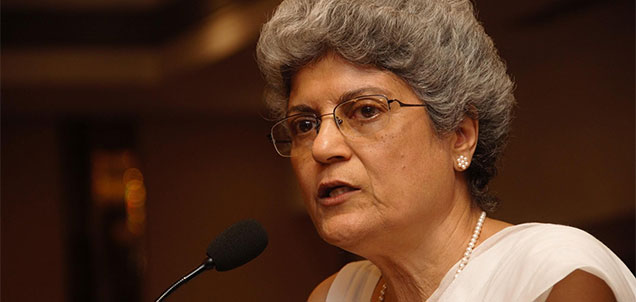
It was supposed to have reached us last weekend, but it didn’t. Normally we would’ve forgotten about it. But, as we were urged at the event itself, and then later via Twitter and various Whatsapp messages, we decided to wait for it, and publish Roda Mehta’s acceptance speech on her being presented the Lifetime Achievement Award by the Advertising Agencies Association of India. As is.
Yes, the speech is a little long and may not seem very relevant to those who entered the profession after 2000-odd, but one would say it’s essential reading for every advertising profession in India. So, sit back, and enjoy.
Nakul Chopra and the Managing Committee of the Advertising Agencies Association of India, Ashish Bhasin and members of the Selection Committee, and the many who have graced this occasion with your presence.
It never ever occurred to me that one day I would be back again before you! This award has come as an unexpected surprise, for in the past 19 years since I left this industry, I have thought and worked on much else than advertising!
You are honoring me for much today. As far as I can remember, all I did was a good day’s job, followed by a good night’s sleep, and that was all there was to it! That all these developments took place at a time of rapid change was entirely coincidental!!! But since you have chosen to honor me for it, let me share how this came to be.
Back in 1971, at the age of 21, faced with the choice between an unknown called advertising that was asking for computerisation of the National Readership Survey 1970 and a known called banking, the advice of a professor guided me: “If your aim is to contribute and grow, take the former. If you want a steady path in your career, take the latterâ€. I took the former and was completely undecided on the wisdom of that choice for the first two years. I remember the first day I stepped into HTA at Express Towers, Heather Almeida, a senior Account Executive, exclaimed “What is an MBA doing in Media?†That pretty much summed it up! For, unknown to me, Media was primarily a clerical function, releasing advertisements created by the agency. Not too long after came the realization that with only printed data on offer, computerisation was well nigh impossible. All this laid bare the very reason for my being there!
Those first years were spent studying the NRS inside out, linking it to other sources of information like the Audit Bureau of Circulation, Census data, etc., and in developing Reach and Frequency estimation methods with sister agency IMRB. Those formative years developed my knowledge and set the foundation for what was to come.
In 1973, the Clarion-Mote Media Model was presented at the Advertising Club of Bombay and HTA was asked to critique it. The talk catapulted me onto the industry stage. A two-month secondment to the Indian Space Research Organisation for their Satellite Instructional Television Experiment, working with some brilliant minds, followed, and then a study across markets on the impact of Hindi Cinema on young adult behaviour. My first industry experience was on the Advertising Club Committee for All India Radio. In 1972, an assistant in the Account Servicing Department requested for training in Media and was assigned to me. Her name was Roxane Guzdar. Others followed. One day, a media clerk came up and said, â€You train outsiders, but you never train usâ€. It came as a jolt. That day I vowed that no one, irrespective of his or her job role, should be held back from working at his or her full potential. But by then, I was close to leaving HTA.
The formal offer from Ogilvy Benson & Mather came without a meeting; so I asked to interview the Managing Director! I placed before him two conditions – complete independence in work and no politics! Mani Ayer accepted and I moved to OBM as Media Group Head in August of 1975.
The very first media presentation made to the Marketing Director of an international food company was in the presence of Mani Ayer and the full servicing team. After many appreciative comments, the client left and then sent back its usual list of publications for release! That experience drove me to targeting one client every year to scientific media planning. Â Fortunately, client companies had also begun hiring MBAs as trainees and promoting them to Brand Management. As we spoke the same language, very soon scientifically conceived media plans were being accepted down up.
Now unlike HTA, where Account Servicing would analyse and decode client brand marketing briefs for Media, at OBM, client briefs were handed over directly to Media. With limited resources and ambitious targets for an over-stretched function, I remember storming into Mani Ayer’s cabin one morning stating that Account Servicing was not doing its job and was merely passing down client marketing briefs, to which he quietly responded, “Then you do itâ€.
That is how the Media functioned, through backward integration, started market-consumer-media analysis that became a part of every brand media strategy. Â Clients took to this approach instantaneously and often fine-tuned their own objectives through this process.
Now to every direct approach made by the Media to clients came the response: “Our agency decides our media plansâ€. With nowhere else to go, they learnt soon enough that a visit to OBM necessitated a deep understanding of their product – its content and layout, advertising categories (particularly use by classifieds), advertising placement strategies, distribution network, printing quality, etc. Why was this necessary? Because the projections in the NRS from small sample sizes at each target group level needed other measures to ratify media choices. Publishers began changing their selling approach, training sales personnel with a study of their readers, with intra-media and inter-media competitive profiling, etc. Thus Media began to hire differently and to professionalize its service.
A detailed conceptual understanding of media definitions and the manual process involved to develop plans became great training ground for new entrants. It also became the engine for new business acquisitions. And soon Media was the place to be in. Talent began applying from all over – banking, account management, the print media, graduates from management schools, etc. By the mid-80s, Media at OBM was on a roll. Not unexpectedly, it also became readymade hiring ground for other agencies. While it was not easy to loose talent, the realization dawned that these trained professionals, imbued with a strong work ethic, would assist in the professionalisation of this industry.
While these developments were taking place in OBM, there was much churning in the mass media. When I joined the industry, there was only B&W print advertising, radio spots and cinema films or slides.  Then 1976 saw the launch of B&W commercial television in the four metros. Inclusion of Hindi films and film song sequences led to smart growth in demand for TV sets across the entire social spectrum. Six years later, in 1982, television went color with the Asian Games held in New Delhi, followed by the setting up of transmitter-a-day across 141 towns in the country.  These developments proved to be a game changer in every way. Television set sales grew exponentially. Cinema, a monopoly medium that had resisted audience measurement, got wiped out for advertising. Print found itself confronted by a very strong competitor with live News telecasts generating publisher nightmares. For advertisers, strong demand-pull was a new experience as consumers chased products, demanding rapid distribution expansion.
In all this turmoil, when needed most, Media audience measurement was slow to respond, appearing after long gaps – in 1978, 1983, 1989. So the impact of rapid changes in audience consumption was either not captured (as in rural India) or not delivered in time for sound planning. Furthermore, the bandwidth and financial resources of research agencies to host a National Readership Survey before recovering costs, raised issues of reliability due to high projections on low target group sample bases. These two factors finally led to the formation of the Media Research Users Council after AAAI and IENS declined undertaking future NRSs. Conceptually the Council was a very sound idea as it made users the owners of information with full inputs on questionnaire design, sampling structure, fieldwork reviews, data analysis etc. – in short its reliability. So when a newspaper from another state entered Rajasthan and the IRS data revealed a decline in the readership of the then leading newspaper, we held back for three months to conduct incognito checks to gauge the reliability of the findings. Once verified, the data was released.
During these years, industry fortunes see-sawed, as did advertiser spends. Media budgets saw many periods of stagnation or marginal increase. But media costs kept rising.
To ensure that brand budgets went the extra mile, we looked at print pricing structures and found that add-on charges for double-spread, bleed, newspaper positions, etc. using the same quantum of newsprint was unfair. That is how the need to negotiate began. It was always done with a view to get more for the given level of brand spend, and for no other reason. We also worked much harder on small budgets. This led to agency-level negotiations for benefits to be passed across all brands.
On television, the major issue was a completely irrational rate structure. The Advertising Club of Bombay under Amol Bose set up a committee for Doordarshan rate rationalisation but we made no headway at all. As David Ogilvy would say “Search your parks in all your cities. You’ll find no statues of committeesâ€! In 1984, at a last quarter OBM Board meeting, we came face-to-face with the reality that clients had been unable to spend 30% of their customary Diwali budgets for want of Doordarshan commercial time. I resolved that day that the situation had to change. So every month from then, I walked the corridors of the Ministry of I&B, getting to know every official that had anything to do with Doordarshan, building a case for rate rationalization, as well as meeting everyone from programming to commercial to audience measurement at Doordarshan. In the early days it looked like a hopeless case with All India Radio personnel appointed at the helm.  Then in July 1986, Bhaskar Ghose, an IAS officer, was nominated as Director General. Independent of decision, he was nevertheless open and understanding, and many an hour was spent educating and convincing him. When the much sought-after rationalization of rates finally got introduced, it benefitted both industry and Doordarshan’s coffers. As an aside… In late 1987, Mani Ayer received a call from Mr. Ghose requesting him to second me as Additional Director-General, Doordarshan. Mani replied that I would be of greater service outside Doordarshan than inside. The following year, Bhaskar Ghose was summarily removed as DG because a news feature had shown the Congress party in unfavorable light! What a lucky escape!
When a new person joined OBM, s/he went through an induction programme during which David Ogilvy’s Agency principles on advertising and “the way we do things here†was shared. Each hiring came with a six-month probationary period. If the person had the right attitude and showed promise, confirmation came within 3 months. After a year, came responsibility under the guidance of a Media Supervisor. Each year-end, appraisals were sacrosanct across all offices, and every person’s progress was reviewed with me. Increments were decided with Servicing, Creative and Media sitting together and negotiating proposals. In fact, there was a time when Mani Ayer, the Creative Director Suresh Mullick and I interviewed a potential hiring, as the aim was to get seamless teamwork.
David Ogilvy’s credos of “We Sell or Else†and “First-class business in a first-class way†was fundamental to the working of the agency. If a publisher said, “Take it or leave it†when we complained about poor reproduction, we left it, no matter how important that publication was. If attempts were made to get business in anything other than a well-reasoned way, we not only refused it but also discussed it openly in the department so everyone learnt from it. And they knew that I would never ask of them anything that I would not do myself.
The concept of “One Agency Indivisible†seeped through the fabric of Media. Every office was on par, irrespective of the size of its media spend. In fact, offices were assigned to Media teams along with their clients. The day the person in Delhi office, assigned for Doordarshan storyboard approval for all offices, alerted a Media team in Bombay of a competitive brand launch, forewarning the client, it ratified a neatly ticking network, unaffected by narrow territorial constraints and client loyalties. It was teamwork at its best.
After OBM crossed a hundred-crore billing, the Board was asked how we could help take this further. Evaluating our client spends across media, I realized that we were not delivering on 16% of their spend as we did not have any expertise in outdoor as a medium. At the time, this medium formed a part of regional sales budgets, and was entirely discretionary. To change the client’s approach was the first objective. For which the foremost problem was lack of data on the value of the medium. Even till today, media has not realized that data, even if it offers challenges, also provides opportunities to adapt, modify and grow. The one attempt to professionalize this medium through the Indian Outdoor Survey in 2009, I am told, was not subscribed to by a single outdoor owner! By now, Outdoor should have been a strong medium contending for the advertising rupee on a scientific platform, and supported by the advertising community in the face of regulatory enforcements. Instead, it has remained an uncoordinated band of owners, intent on navel gazing.
In 1991-92, at a Blue Sky thinking program, Media mooted the view that brands were moving into rural areas and it was an opportunity for the agency. Thus began the journey of initiating a rural network to service brand communication needs. It took 3 years to establish, but it has not looked back ever since.
You honor me today for what, in hindsight, was primarily a 16-year period — from 1976 to 1992 — before I moved on to other assignments within the agency.
Three factors made this possible.
Firstly, the only reason I came into this industry was because of media measurement. And to think that in a developing country like ours, conflict of interests have led to 2 national-level readership surveys at very high cost and with conflicting outcomes, that outdoor measurement is non-existent, that radio measurement is meager, and that Internet measurement has not even begun begs some questions, among which is the viability of the current media remuneration system that must surely inhibit investment in time and resources for sound measurement studies.
Secondly, Suresh Mullick.
A Creative partner whose work spoke for him. When I returned from London in December 1980, OBM had just won the Cadbury’s Dairy Milk Cholocate business that had thus far promoted the nutritional glass-and-a-half of milk. To grow the market by re-positioning the brand, Suresh had created the “Sometimes Cadbury’s can say it better than words†campaign in full color with salivating close-ups. There was not a single publication that could have saved face for not featuring that campaign. This gave Media the negotiating strength to buy adequate frequency from a major newspaper by changing its policy on the minimum size for color advertising. Of the 10 best campaigns in the Decade of the 80’s announced by the Advertising Club of Bombay, Suresh, won for OBM, 4 out of 10 – not a bad tally at all! Campaign after campaign, Suresh’s partnership raised Media’s delivery to new highs.
The fact is that advertising space will always be there if the medium or vehicle exits. Is the role of Media then merely to choose which vehicles and at the lowest price? At a very early stage, I came to realise that unless Media recommends a medium, Creative does not develop the experience and skill sets for it. A case in point was television in the early days. At best, creative would offer film slides with radio jingles! And then when radio was not recommended for quite some years with the rush to television, creative forgot how to create advertising for radio! Or when we began outdoor, print ads were what we got! Rural advertising was another matter altogether. Likewise, if a brand promise is better communicated by Creative via certain media or in certain lengths, Media has to adapt and tweak its plans to allow for its full expression. It is completely beyond me how Creative and Media can be disassociated.
Finally, Mani Ayer.
In your citation to him for the Lifetime Achievement Award, it said and I quote: â€Over the years, Mani’s position as a leader in the industry and one of the most successful managers in advertising has been unquestioned…. his leadership is inspirational and at all times encourages civilised behaviour. His acumen in the business of advertising is unquestioned and widely acknowledged.â€
You were so right! Being given the top job when he was just 34 years of age, led to the emergence of an agency where grey hair or gravitas was not material, where heirarchy was not in the reckoning. Merit and performance were all that counted. Given the task of turning around an agency in the red, he sought exceptional people across the board, and then gave them full rope. I can think of no other reason why at 26 years, he made me head of Media. I never had to look over my shoulder, my decisions and actions were independent, and he stepped in whenever support was needed. He would tell others: “Roda is her own bossâ€. It needs a very secure person to be able to say that. So Mani Ayer delivered in every way on his promise when I first met him. He led this agency through reflected glory.
Inherently, Mani, Suresh and I were all trainers. We knew that our partnership set an example of mutuality of interest within the entire agency, across all offices and disciplines. Even as we spread out to larger teams across levels and offices, we aimed to be inclusive, to build across the board and across disciplines. The many fine professionals trained to service client and brand needs are evidence of that. We built others even as we were growing the agency. The memories of those who passed through the agency ratify to those having been the best years of their careers. Those were OBM’s Camelot years when we trained knights to join the round-table.
Being essentially an Indian agency with Ogily & Mather Worldwide as a minority partner, and with the Indian shares widely held across all offices and disciplines – from a peon to the Managing Director – the sense of ownership was very strong; and the dividends reaped each year renewed employee commitment. Under David Ogilvy as Chairman during the latter years of the 80s, we were encouraged to undertake work in the public domain. When he wrote to dissuade me from taking the Doordarshan offer, he said: “I applaud you for wanting to contribute at a national level. But marketing TV would not be much of a contribution, compared, for example, with running the population programmme or the information department in the Prime Minister’s office. ….If I owned OBM, I would set up a think-tank in Delhi, to advise all departments of the Government on how to communicate with the public on issues of national importance.â€
So you see, the critical ingredient that set this agency apart was that while others were slugging it out for the top slot, OBM’s orientation was creating value for brands, for the industry and for the nation. Had its focus been on size, the agency would have been a very different place.
So let it be said today, that I could never have done what you honor me for today had it been any other agency or had it been at any other time in the history of this agency.
Across the spectrum of advertisers, agencies, research and all arms of the media, this industry will be preserved only through the masterpieces of women and men who through their organizations serve the interests of all, who through their Associations seek the betterment of all, and who through their actions deliver what is best for all.
Thank you.
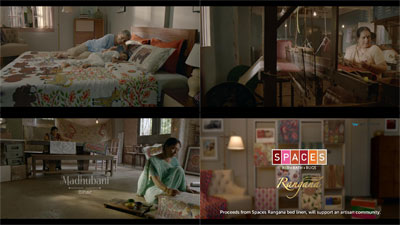 Spaces has launched its brand campaign on ‘Thoughtful Living’ to complement the launch of its brand new festive home linen range called Rangana.