Tag: news

  • Azim Premji wins Forbes India’s inaugural philanthropy award

    By A Correspondent


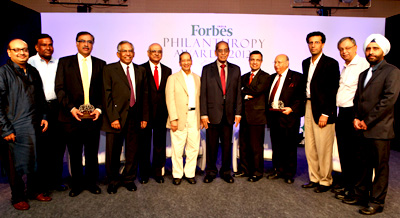
    Azim Premji with the jury (L-R): Abraham Moses, Sanjiv Sarin, MV Subbiah, AN Singh, Bhawarlal Jain, Narayanan Vaghul, Nachiket Mor, Lord Raj Loomba, Ashish Dhawan, Dr Madhav Chavan, Gurmeet Singh

    Azim Premji, chairman of Wipro Ltd, won the inaugural Forbes India Philanthropy Award in Outstanding Philanthropist category for 2012. Mr Premji, 67, the third richest Indian with a net worth of $12.2 billion, has pledged close to $2 billion from his personal wealth to Azim Premji Foundation, which is working to improve elementary education across India. He was among the ten outstanding individuals who received the award under different categories.


    The philanthropy awards were instituted by Forbes India to recognize the efforts of individuals who have given time, money, skill and expertise to solve some of the most pressing societal issues, to create model institutions and to inspire others. The winners received their awards – metalwork keepsakes depicting the Mubhi Tree, which symbolises the art of giving – at an event in Bangalore on Wednesday.


    “Our hope is that business should emerge as a strong force for good in this country and that our list of nominees for each of the ten categories will continue to grow as more and more people from the world of business step up and find new exciting ways to give back to society,” Indrajit Gupta, editor of Forbes India, said during the event.


    Mr Premji spoke about how his foundation’s university, which has 230 students and 70 professors, complements the field work they do in education. “Our objective is that we have to get more results and to scale up much more significantly in the grassroot level in the field,” he said. Later, he joined his fellow winners N Vaghul, former chairman ICICI Bank and MV Subbiah, former chairman Murugappa Group in a fireside chat to discuss what it takes to build a network of engaged corporate citizens, deepening the culture of giving back, galvanising corporate action, and how to take philanthropy in India to the next level. The session was moderated by Subroto Bagchi, chairman and co-founder Mindtree.


    In yet another fireside chat, Nachiket Mor, Chairman of the Board of Directors, SughaVazhvu, Ashish Dhawan, Founder and CEO of Central Square Foundation and Ramji Raghavan, founder Agastya International, discussed the challenges that philanthropists face when they work with multiple stakeholders, especially the government, in bringing about change. Ajit Rangnekar, dean of the Indian School of Business in Hyderabad, moderated the session.


    The event was attended by entrepreneurs, executives and academics with interest and passion for philanthropy and social good. They shared their views on themes related to philanthropy. Kiran Mazumdar Shaw, chairman and managing director of Biocon said that philanthropy is about making changes, and partnerships play a crucial role in that. Mr Mohandas Pai, Chairman of Manipal Global Education, and one of the driving forces behind Akshayapatra a mid-day meal programme, said he was motivated to do more when he realised that he was lucky to have won ‘the ovarian lottery’, many others aren’t so fortunate. Lord Raj Loomba, founder of clothing company Rinku Group, whose foundation works for the cause of widows, said his inspiration was the story of his mother, who became a widow when Raj Loomba was just 10 years old.


    The latest edition of Forbes India devoted to philanthropy was also released. Containing features on philanthropy with detailed case studies about each of the award winners, the special edition has four covers, featuring four of the winners Azim Premji, N Vaghul, MV Subbiah and Ashish Dhawan and a caption that runs across four covers: Philanthropy, done right, is too important to restrict to one cover.


    Speaking on the occasion, Gurmeet Singh, CEO, Forbes India said, “We at Forbes India strongly believe that Wealth and Philanthropy are two sides of the same coin. Therefore it was logical that we scaled up our earlier events on “Purpose Of Wealth”, “Business as a Force For Good” and “Conscious Capitalism” into a full-fledged Philanthropy Awards Evening.  Forbes India Philanthropy Awards and Dinner was a very well attended evening bringing India’s biggest philanthropists, guides and catalysts on the same platform and exploring what motivates leaders to embrace philanthropy and how India Inc needs to bring a stronger giving culture”.


    The winners were selected by a jury comprising of Narayanan Vaghul, Former Chairman, ICICI Bank, Madhav Chavan, Founder and CEO, Pratham, Shashi Tharoor, Member of Parliament and Dr Devi Shetty, Founder Chairman, Narayana Hrudayalaya Hospitals.


    The complete list of award categories and winners:


    Outstanding Philanthropist:

    The flagship award recognises an outstanding individual whose leadership and contributions of time, money, skill and expertise has brought in new thinking into solving complex social issues.

    Winner: Azim Premji, Chairman, Wipro Ltd


    Outstanding Corporate Foundation

    This award honours foundations that have taken up a social issue and have long term vision, strategy, a sustainable model and have created significant impact in their chosen areas.

    Winner: Tata Trusts


    Distinguished Family of the year

    This award honours families who have dedicated their private wealth for public good and benefited an institution or organisation in recognisable and sustainable ways across different generations

    Winner: Murugappa Family


    NextGen leader in Philanthropy

    This award recognises the accomplishments and contributions of emerging leaders in philanthropy, those who have signaled their intent through meaningful giving, have also begun to contribute significant time, skills and resources to the causes they have helped advance.

    Winner: Ashish Dhawan, Founder, Central Square Foundation


    Cause Marketing

    This award is for a company that has successfully marketed products or services in conjunction with a charity and brought significant benefits to both parties.

    Winner: Tata Tea – Jaago Re


    Corporate Catalyst

    This award is for a senior business leader who has used his influence to promote the cause of giving back not just in his or her company, but also across the entire industry.

    Winner: N Vaghul, Former Chairman, ICICI Bank


    The Good Company

    This award recognises pioneering strategic initiatives undertaken by large business corporations, where they have used market-based models to balance the twin objectives of doing well, while also doing social good.

    Winner: Jain Irrigation Systems


    The Good Samaritan Award

    This award is for an exceptional individual at any level in a company who has successfully led and galvanised support within the organisation to mount programs that help more people within that organisation to support worthy causes and give back to society.

    Winner: Abraham Moses, Director, Administration & Facilities, MindTree Consulting


    Distinguished Non-Resident philanthropist

    This award is for a non-resident Indian who has contributed significantly to a social cause in India, by giving wealth, time and expertise.

    Winner: Raj Loomba, Loomba Foundation


    The Crossover Leader

    This award seeks to recognise a professional who has successfully made the transition from a thriving career in the corporate world to work for the social or not-for-profit sector and has served as an inspiration and role model for others.

    Winner: Nachiket Mor, Non-Executive Chairman of the Board of Directors at SughaVazhvu

     

  • Are we really Free to post online?

    Cartoonist Hemant Morparia’s take on the controversy. First appeared in Mumbai Mirror. Republished with the permission of the cartoonist


    By Ananya Saha


    “Everyday thousands of people die. But the world still moves on. Just due to one politician dead. A natural death. Everyone just goes crazy. They should know. We are resilient by force, not by choice. When was the last time did any one show some respect or even 2 mins silence for Shahid Bhagat Singh, Azad, Sukhdev, or any of the people because of whom we r free living Indians. Respect is earned, not given. N definitely not forced. Today, Mumbai shuts down. (sic)”


    These are the words, posted as her Facebook status, that got a 21-year-old girl arrested. Not only that, her uncle’s hospital was ransacked in protest. If you cannot say ‘what’s on your mind’ on Facebook, and share with your friends, what good is social media? Well, you could have ‘Liked’ the status, and landed up in jail too. That is what happened to her friend. Both have now completely logged off Facebook. And everybody is left asking, what is wrong with the system?


    Maheshwar Peri

    Maheshwar Peri, Chairman, Pathfinder Publishing opined, “It is ridiculous whoever accepted the complaint based on a Facebook status. Social media is all about interaction with my friends and whoever subscribes to or believes in my opinion.” According to him, if the private discourse on internet or otherwise has been intruded upon leads to a police complaint and the police acts on it, it is ridiculous.


    The girls were charged with 505 (2) of the IPC and 66 A of the IT Act, arrested and later granted bail. The last few months have seen some interesting places in this regard, whether it is Aseem Trivedi, Karthi Chidambaram or the present case, which only point to the inefficacy of Indian cyberlaw.


    Pavan Duggal

    Pavan Duggal, Advocate, Supreme Court of India and President, Cyberlaw Asia, explained, “The entire case has demonstrated the complete inadequacy of the Indian Cyberlaw. The language and scope of provisions used under Section 66A are very wide and are capable of distinctive varied interpretations. Seen from another angle, Section 66A can be effectively used as a tool for gagging legitimate free online speech. The problem under Section 66A is that it comes up with extremely wide parameters which have not been given any specific definition under the law. These parameters are capable of being interpreted in any manner possible, by the law-enforcement agencies. As such, while Section 66A talks about sending any information that is grossly offensive or having menacing character, the law does not give any guidance as to what is grossly offensive or information having menacing character. Thus, it is left to the subjective description of the law-enforcement agencies in this regard. Further Section 66A(b) talks about sending any information by means of a computer resource or a communication device which a person knows to be false, but has been sent for the purposes of causing annoyance, inconvenience, obstruction, insult, injury, criminal intimidation, enmity, hatred or ill-will, persistently by making use of such computer resource or a communication device. All these wide meaning terms used under Section 66A have not been defined, which itself provides huge amount of flexibility in Section 66A to be used in any circumstances perceivable. Thus, huge portions of legitimate free online speech could also be brought within the ambit of Section 66A of the amended Information Technology Act, 2000.”


    The present case has once again brought to the forefront as to what is the concept of liking on Facebook and its legal ramifications. Mr Duggal further pointed out that when a person clicks on “Like” button on Facebook, it does not constitute an offence under Section 66A. “Technically speaking, a person is only clicking the button of “Like” but is not per se either sending any information that is grossly offensive or has menacing character. Neither is the said person sending any information which he knows to be false but which has been sent for the purposes of causing annoyance, inconvenience, obstruction, insult, injury, criminal intimidation, enmity, hatred or ill-will. In the present case, Section 66A has been erroneously invoked,” he pointed out.


    While Pranesh Prakash, Policy Director at Centre for Internet and Society, maintained that just because something is published ‘online’, it does not mean that it is exempt from law, he added, “The online laws in India are even worse than the laws applied offline and some of those laws that are applied online, are unconstitutional.” The fact that people were posting their views about Mumbai Bandh on various other media, it remarkably shows the unconstitutional application of the applied laws.


    “Indian cyberlaw is only aimed to be an enabling legislation for promoting growth of e-commerce, m-commercial and online free speech. Indian cyberlaw should not act as an impediment to the evolution and growth of online free speech, nor should it be seen as a handle to suppress free online speech. Section 66A needs to be serious quickly reviewed and amended so as to ensure that it does not become a tool for silencing genuine legitimate online free speech, under the garb of the parameters detailed therein,” said Mr Duggal.


    But that is exactly what it is doing, according to Mr Peri. He said, “If you look at the entire ecosystem we are living in, you have a govt which enjoys control, you have a law which can be misinterpreted, you have law enforcement agencies which are not as free as they are supposed to be and you have a mainstream media which is fearful of the big and mighty. Three of the four pillars of democracy are fearful of repercussion. How can you and I enjoy personal freedom then?”


    However, as Mr Duggal explained, certain restrictions have been put online free speech. “For example, the online free speech does not give the license to defame. Similarly, the entire issue pertaining to the Facebook status needs to be examined more carefully. There are various nuances under the Information Technology Act, 2000 which could be applicable,” he said. The present controversial action arose because Section 66A provides parameters for its inherent misuse. There are tremendous loopholes under the existing law. There is a need for ensuring that the Information Technology Act, 2000 needs to be amended in such a manner so as to ensure that the provision like Section 66A of the amended Information Technology Act 2000 are not used to the detriment of online free speech.


    Mr Duggal asserted, “In this particular case, it is well possible for the Government to have adopted the route available under the Information Technology Rules, 2011. In this case, Facebook is an intermediary under Section 2(1)(w) of the amended Information Technology Act, 2000 and could be mandated by virtue of direction by the Government under the Information Technology (Intermediary Guidelines) Rules, 2011 to remove such content. Such an action could have been done best in a manner that would have ensured minimal disturbance and yet would have ensured that the relevant language is removed.” However, what we are now seeing on the Internet is that more and more people reproducing the same lines and content that the girls posted.


    Section 66A also brings up the huge conflict that it has with the Article 19 of the Constitution of India. Article 19 (1)(a) of the Constitution of India guarantees to all citizens the fundamental rights to freedom of speech and expression. The restrictions given under Article 19(2) are the guiding lights for regulating free speech including online free speech. However, the parameters and restrictions granted under Section 66A are far more broad and wider than Article 19(2) of the Constitution of India. “Seen from another angle, Section 66A appears to be perfect tool to promote and propagate the concept of Internet censorship and censorship of free speech inIndia,” said Mr Duggal.


    The complexity of India may make it easy for such assaults on freedom of expression. But the democracy of India is where the solution lies. Is India’s social fabric strong enough?


  • NDTV expands global reach; launches in Malaysia

    By A Correspondent


    Expanding its reach in the international markets, New Delhi Television Limited has also launched NDTV 24×7, NDTV Good Times and NDTV India in Malaysia. The channels are part of Asia Broadcast Network’s (ABN) new platform in Malaysia and available in a combination of basic as well as especially dedicated NDTV branded packages.


    NDTV channels have long been available in more than 18million homes in 75 countries internationally and this agreement marks the first time that three of NDTV channels will be available in Malaysia. Each channel is the category leader in Asia’s largest pay TV market – India and this partnership with ABN will now see them become accessible in South East Asia’s largest pay TV market – Malaysia. Under its slogan ‘Access for All’, ABN aims to offer over 200 channels of news, education, entertainment, movies, sports and local programming, and has signaled plans to offer full triple play services such as video-on-demand, social TV and interactive gaming, alongside high-speed Internet and voice services over a hybrid fibre-coaxial (HFC) network.


    The Head of NDTV Network Distribution & Affiliate Sales, Rahul Sood, said, “We are delighted to be part of the ABN platform and reaching new viewers in Malaysia. NDTV has been serving the Indian Diaspora across 75 other countries worldwide and we are glad that the 2million plus Indian community in Malaysia will now also get the chance to see some of the most iconic programs produced out of India. We hope the viewers of Malaysia will be pleased to be informed and entertained like our viewers in the rest of the world.”


  • Jaldi 5 with M R Srinivasan: Chennai could need 3-6 months for digitization switch-over

    01. The court has extended the sunset date. How is the situation in Chennai post the extension?
    In Chennai currently, there is a big confusion. One day we went to the court and got interim order stay and now the case has gone to the Bench, which will have the hearing on 19th. Secondly, despite our letters to MSOs and MIB from our end, none of them are importing the set-top boxes. SAB said that they will be able to import boxes in 21 days provided the LCOs deposit advance money. But some of our members have already deposited two lakh rupees as advance last month. They are yet to receive to boxes. We will be submitting the dealing to the Court on 19th.


    There is uncertainty also because Arasu cable has not been given license yet to provide STB, and once it is given the license it will conquer the market. So, the existing MSO and licensed players are not sure of importing the boxes yet. As they may get wiped out once Arasu gets license.


    Four out of eight players who have got license, only three have installed head-ends.


    02. What are your expectations from the Bench on 19th?

    Well, they should extend the deadline. And if the extension is given, I&B Ministry should take views from all stakeholders. And all the information should be furnished clearly for and by stakeholders in front of MIB. Verification should be done if the said number of STB have been installed and activated. It should be made known as to how many boxes have been imported and how many of it installed by every player, since the imported boxes are usually smuggled in Middle East or Sri Lanka.


    03. How much of Chennai has been digitised, according to you?


    Right now, as per active status given to broadcasters by SAB it is 1.25 lakhs. As per our calculation, the active status is 1.3-1.5 lakhs only. DTH players are claiming that they have sold seven lakh connections. Most of these boxes, almost about 300-400 per month, are smuggled out of Chennai. In Chennai, about three-four lakh of these claimed DTH connections are active. We require about four million boxes in Chennai metropolitan area, which also covers the outskirts of Chennai.


    04. Even if the extension is given, how much time would Chennai require to reach 100% digitisation?

    Chennai would need 3-6 months to switch completely to digital signals. It is well-known that analogue signals are still on in Delhi and Mumbai where 100% digitization has been claimed. In Delhi and Mumbai, boxes are available aplenty and still they have analogue signals. Here in Chennai, we do not have STBs. It is important that analogue signals are not switched off.


    05. How does analogue benefit the stakeholder?

    We have 4G spectrum, but TRAI has not wiped out 2G. With digital, 10-15 analogue channels should be available. Not everyone can afford a STB. One should also think of low-income households.


    As told to Ananya Saha


  • @India, living in China: Burson-Marsteller finds out

    By A Correspondent


    When everything else, or so it seems, is “Made in China”, why should India’s Twitter handle not originate from there? The fact that it has not happened by design is – or should be – a source of embarrassment for the Incredible India peddlers, for this is a strange fact unearthed by Burson-Marsteller – that the @India account is owned by an Indian person living in Guangzhou, China.


    The public relations and communications firm has released the second part of its “Twiplomacy” study (http://twiplomacy.com), looking specifically at country branding on Twitter. The study shows that only 9 governments out of 193 UN member states own their country name Twitter handle.


    In the case of @India, the account owner shares pictures from his daily life and has made it clear that his Twitter handle is not for sale. With respect to other social media channels, India is one of just 19 YouTube channels owned by the tourism office.


    The accounts of @GreatBritain, @Israel, and @Sweden are the most significant examples of country promotion on Twitter. @GreatBritain is part of the ‘Britain is Great’ campaign launched in March 2012 to highlight everything that is great about the United Kingdom.


    @Israel is the country’s official Twitter channel, maintained by the Foreign Ministry’s Digital Diplomacy Team. The account is one of the most followed country accounts with more than 66,000 followers and serves as the focal point for Israel’s government Twitter activity.


    The Twitter accounts of @AntiguaBarbuda, @Barbados, @Lithuania, the @Maldives, @SouthAfrica, and @Spain are run by their respective official tourism organisations to promote tourism in each country.


    However, three out of five country accounts are either protected, dormant, inactive, or suspended and almost half of the 71 remaining active accounts are tweeting an automated news feed broadcasting news about the country.


    “Looking at the findings it becomes clear that few governments and tourism organisations have understood the power of country branding and marketing on Twitter,” said Matthias Lüfkens, head of the Burson-Marsteller EMEA Digital Practice. “There is a huge opportunity for countries to use Twitter as part of their communications to engage with a large and growing audience.”


    Data used was taken in November 2012 looking at the Twiter handles of the 193 UN member countries. Burson-Marsteller used Twitonomy (http://twitonomy.com) to analyze tweeting patterns and the Twitter history of each account.


    To access the complete analysis of these findings, visit: http://twiplomacy.com/country-promotion.


  • WATConsult wins Godrej Nature’s Basket’s digital and social mandate

    By A Correspondent


    Social media strategy consulting agency WATConsult has won the social and digital duties of Godrej Nature’s Basket, the gourmet retail venture of the Godrej Group.


    The account has been won recently and the execution for the same is slated to begin soon. With the addition of Godrej’s Nature Basket, WATConsult extends its current portfolio and takes the total number of clients to 55+.


    Commenting on the win, Rajiv Dingra, Founder & CEO, WATConsult said, “I am delighted with the win of the new account. Since our inception in 2007, it has been the constant endeavour of WAT Consult to create path-breaking creative campaigns that not only make an impact digitally but leave a mark across media. Godrej Nature’s Basket is a leader in its respective industry and by providing excellent quality innovation through strategy, technology and quality of management; we hope that we deliver exceptional performance.”


    Mohit Khattar, Managing Director, Godrej Nature’s Basket said, “Social media plays a pivotal role in building strong consumer engagement for Godrej Nature’s Basket. Understanding the importance of this platform, it was integral for us to get on board an agency that can help us drive our vision towards being a preferred world food destination. We look forward to a long and sustained association with WAT Consult.”


    Currently, WATConsult manages various brands from the Godrej Group. These brands include Godrej Appliances, Godrej Locks and Godrej Security Solutions.


  • Enough backers for payback series?


    By Johnson Napier


    The India-England cricket series that kicks off from November 15, 2012 is being billed as a revenge or payback series by most scribes who follow the sport closely. Be it the media, analysts, critics or even players/commentators, virtually all are going gaga about how the current series would be the one to watch out for as India will be fighting to prove its mettle as being the best in the business. The fact that the men in blue were thrashed badly by the Englishmen the last time they played each other makes the cause even more compelling. But is the prevailing sentiment as positive as is being made out to be, or will it be a tough ask for the channel as it begins its quest to draw in more audiences? And, more importantly, what is the response that can be solicited from the advertisers who of late are opting to stay aloof from their association with the sport?


    To begin with, the good news is that the tournament begins at a time when most of India is in the mood for celebration what with the festival season already underway. So while partying, visiting relatives and relaxing would be top of mind for most it would also mean being able to sit at home and watch Sachin Tendulkar or Virendra Sehwag get India off to a roaring start. And that’s what is leading everybody to believe that the Series will at least kick off on a high note.


    Ayaz Memon

    Anticipating a huge response, senior journalist, sportswriter and now commentator Ayaz Memon is hopeful that the current series will be a success. As Hindi commentator for the current series, Mr Memon sounded positive: “I feel the pressure is more on India as they have to prove a point on the home turf. The fact is that India hasn’t lost a home series since 2004, and also the record since the last 12 months hasn’t been good so the pressure is squarely on the Indian team. Also the team is not in peak form as can be inferred from their recent performances across other tournaments. So one can expect the Indian team to put up a compelling fight, to say the least.”


    Backing up his claim, Mr Memon said that the channel has been doing a good job promoting the series. “I will be doing commentary for Star in Hindi and I can tell you that they have done a good job in building up the tournament and promotion-led activities. Even on the print platform the exposure has been pretty good. But we will have to wait and see how it pans out over the next few weeks. But I am sure that the viewership will be higher than the previous Test matches. The fact that you have Sachin Tendulkar playing in the series along with Yuvraj, Harbhajan and also Kevin Pietersen from England etc, I think it will be a marquee series.”


    Balakrishna

    Backing Mr Memon’s optimism is PM Balakrishna, COO, Allied Media, who said, “From a cricket and sentiment point of view, I feel people are looking forward to the series. It is being touted as the Grudge Series going by the promotional activities that are being carried out by the broadcaster. The audience really wants to see India thrash the English. So based on the hype, I expect to see more crowds at the stadium and also more ratings for the broadcaster.”


    But while the initial sentiment seems bright it is definitely not easy predicting results before the start of the tournament. The prediction becomes even more difficult when the series begins with a Test match and not ODIs or T20 that can guarantee some decent TVRs. When asked about the possible ratings that can be expected, Mr Balakrishna said, “Test matches have never been about ratings like ODIs or T20. But maybe because of the fact that this is a long holiday week, one can expect high ratings at least from the initial match itself. While it would be difficult to hazard a guess, I would be happy to go with an average TVR of 2-3.”


    Kartik Sharma

    Kartik Sharma, Managing Partner, Maxus India was more forthright, saying, “Any cricket tournament involving India is always unpredictable but exciting. As Indians, we obviously want our country to win but a sport like cricket is always difficult to predict. If you ask me, the sentiments are purely driven by the results of the first few matches. And going by our ability to digest defeat, we Indians don’t really fare well in that department. By that I mean that if we lose a match or two, we tend to divert our attention to other sports or television properties. But then again, this being a festival/holiday season I expect at least the first few matches to have a decent viewership as people will be at home and thus would be able to watch the matches. By nature, Test matches anyway do not draw in more audiences compared to what the T20 or ODI matches do. So I am expecting an average TVR of 2+ for Test matches and an average TVR of 4+ for ODIs.”


    Mahesh Ranka

    Presenting another factor that could guarantee ratings or dismiss them, Mahesh Ranka, CEO, Indus Sports asserted that it may even depend on the opponent playing against India: “If it is Australia or even England, there could be some decent ratings expected, as these teams are ranked higher compared to what a Bangladesh or Zimbabwe series would draw. The thing about England is that we lost to them badly when we went there so hopefully, we can look forward to avenging that result through the current series. And if India happens to win the first match, you could expect more audiences (in the range of 20-30 percent more on the base figure) who will come in for the second match, and so on.”


    But in the overall analysis, Mr Ranka is of the opinion that the current series will not have anything great to offer in terms of viewership, at least as far as the Test matches go. “The ratings that Test matches have thrown up in the recent past kind of puts everything under the scanner. Though people (particularly media) tend to hype any tournament, Test matches have never really managed to draw in the audience (viewership). That’s because people have their own mindset behind watching any match and advertisers will always have to move along taking into account the risk of losing out on viewership.”


    On the interest shown by advertisers, Mr Ranka said, “From an advertiser’s perspective, one has to always look at why cricket is typically watched: it is brought for reach. There are two things to that. Firstly it is the festival season where advertisers have monies to spend and whether it is cricket or no, they will eventually spend at this time of the year. The rates that could be expected for Test matches in the current series would be in the range of Rs 50,000 to 1 lakh for ten seconds.”


    Taking a diplomatic stand Mr Sharma said, “The advertiser sentiment depends on the packages that are being offered by the broadcaster and there are various deals in store. But I wouldn’t be able to comment if the rates are more or less compared to the previous tournaments.”


    Presenting a bullish outlook, Mr Balakrishna said that from the advertiser’s standpoint, the sentiment seems pretty positive. “Against the backdrop of digitization, one genre that is the least affected always is cricket, as the sport is not always about being CPRP-led but also about hype and other such factors. So I do see a positive resonance to the whole series from an advertiser standpoint. Also, I am sure that the channel would have factored in the tough economic scenario and therefore would have come up with a competitive package for the advertisers, making it a win-win for both of them.”


    So whether it will be a winner or a dampener, what the India-England Series is managing to do is turn the spotlight back to cricket. Which is a good move considering that the recently held Champions League tourney didn’t go down too well with audiences. The icing on the cake would be if India manages to whitewash the team from England. TVCs have been saying that India “Angrezon ki band bajaayega” – that is, will thrash the English. Music to our ears or hitting the wrong notes? The game will tell.


  • Bipin Pandit’s Khumaar show in Feb ’13

    Bipin Pandit

    By A Correspondent


    Khumaar, a musical event organized in his personal capacity by Bipin Pandit, Chief Operating Officer of The Advertising Club, will be held in the first week of February 2013.


    Billed as a quality show for corporates, Khumaar is backed by a team of 18 pprofessionals who meticulously select and present songs and music that aim to stay as close to the original as possible. So far the shows that have been held have attracted well-known names such as Suresh Wadkar and Roopkumar Rathod, and have been well received by audiences which have seen participation from the advertising, media and marketing fraternity.


    The thought of starting Khumaar came to Mr Pandit following his career over 20 years as a professional Hindi compere, combined with his command over Urdu and skill in mimicry. Khumaar presents old Hindi musical hits from great films of yesteryear, with ghazals, Sufi songs and a qawwali interspersed for variety. A selected few new songs are also presented.


    Khumaar also serves a social purpose by supporting the activities of an NGO, Light of Life Trust, and the CPAA (Cancer Patients Aid Association). The Light of Life Trust does a variety of good work that includes reinstating dropout girls to school, providing help to people with terminal illnesses, and free medical attention.


    At February’s Khumaar, the first half will be themed around Romance, and will salute three romantic superstars – Dev Anand, Shammi Kapoor and Rajesh Khanna, as also the legendary Yash Chopra. The show will also pay homage to actor Joy Mukherjee with some great Rafi numbers. The show will be webcast live on www.bipinpandit.com.


  • Digitization in Delhi crosses 66%, 99% in Mumbai: MIB

    By A Correspondent


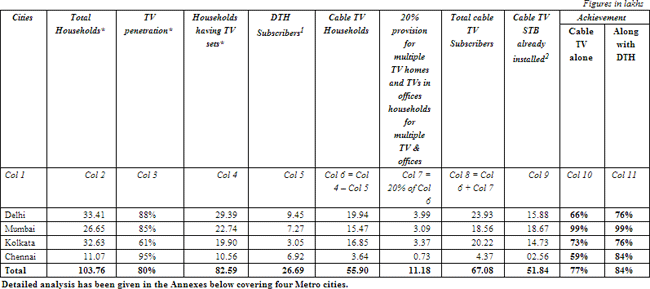
    As per the data made available to the Ministry of Information and Broadcasting by the Multi System operators (MSO), the level of cable TV digitization in Delhi has increased to 66 percent. It has been reported by the six private DTH operators that 9.45 lakh households have got DTH connections in Delhi as on October 9, 2012. This implies that 19.94 lakh households have cable TV connections. Adding a provision of 20 percent to account for multiple TV homes and TV sets in offices etc., it is implied that about 23.93 lakh subscribers require set top boxes. As per the data made available by the Multi System Operators, 15.88 lakh set top boxes have already been installed in Delhi.


    Taking into consideration that the fact that figures given by the ministry have been questioned, the release from the ministry said, “During the initial stage of planning, the data was collated by the Ministry based on the information supplied by the MSOs. On perusal of the data, it was observed that there were grave discrepancies in data, particularly number of Cable TV subscribers in four metro cities furnished by the MSOs.” The Ministry has thus undertaken the exercise to base the data Census of India 2011, released by Office of Registrar General & Census Commissioner, India, which gives authentic figures relating to households and TV penetration in Delhi, Mumbai, Kolkata and Chennai.


    The analysis of data received from the four metro cities reveals that overall 77 percent of cable TV digitization has already been achieved. City wise data shows that the achievement of Cable digitization in Mumbai is 99 percent, followed by Kolkata (73%), Delhi (66%) and Chennai (59%). Taking into consideration, the progress made by DTH in this sector the level of digitization goes up to 84 percent in the four metros.


  • Strong branding, high ad spends key to growth of consumer goods cos

    By Jwalit Vyas


    Consumer goods companies which have consistently invested in their brands in the past few years are likely to outperform their peers who curtailed their advertisement expenditure in a high inflationary environment.


    During the last fiscal, companies such as HUL, Dabur, Marico, Nestle and Jyothy Laboratories had significantly cut down their advertisement expenditure to protect their margins as high raw material prices were hurting. For instance, HUL brought down its advertisement to sales ratio in FY12 by 250 bps to 11.5 per cent, the lowest in the last three years. Similarly, Dabur India’s domestic advertisement to sales ratio was at 10.6 per cent, its lowest in the last four years. Jyothy Laboratories’ advertisement to sales ratio was only 6.5 per cent.


    Compared to this, companies such as GSK Consumer Healthcare and Colgate have a higher advertisement to sales ratio and have been consistent in their brand investments. While GSK Consumer Healthcare’s advertisement to sales ratio has been consistently over 15 per cent for the last few years, it has been around 13 per cent for Colgate. This will allow these companies to sustain their sales growth and enjoy higher pricing power. Also, these companies will have flexibility with their spending in the coming quarters.


    Strong branding also allows these companies to have a better pricing power and, hence, higher profit margins. The PBIDT (profit before interest, depreciation and tax) margins of GSK Consumer and Colgate are the highest among the lot. In FY12, PBIDT margins of GSK and Colgate were above 22 per cent and 24 per cent, respectively, while that of others were below 20 per cent. HUL, Dabur India and Marico’s PBIDT margins were 16 per cent, 17 per cent and 12 per cent, respectively.


    Interestingly, in the June 2012 quarter, companies which lagged behind have also started to increase their advertisement spends. Dabur, HUL, Marico and Jyothy Laboratories increased their advertisement spend by 51 per cent, 30 per cent, 60 per cent and 77 per cent, respectively. This is likely to continue in the coming quarters as advertisement spend is the key driver for sustainable growth.


    While the sales growth in the previous fiscal was mainly driven by price hikes, volume growth will be critical in the current year to sustain growth. As gross margins are likely to improve for all the consumer products companies due to stabilising raw material prices, the rise in advertisement spend will offset this and restrict the improvement in profitability. However, GSK Consumer and Colgate will have no such constraints. Also strong marketing activities in the earlier quarters will ensure strong volume growth for these companies.


    Source:The Economic Times

    Copyright © 2012, Bennett, Coleman & Co. Ltd. All Rights Reserved


  • Ranjona Banerji: When ads hit a miss

    By Ranjona Banerji


    This time I think Airtel has hit a miss: the “what’s mine is yours or what’s yours is mine or what’s mine is mine song” makes you reach for the mute button on your remote. I suppose all good things have to come to an end and Airtel did pretty well with its earlier songs about friendship and sharing. It is testament to good advertising that while I do not actually remember the songs, I do remember them as being listenable.


    The grouchy old man as in Ranbir Kapoor for Tata Docomo has outrun its usefulness and is starting to grate. Sooner rather than later, their own customers are going to start thinking about how they’ve kept waiting on the phone, how the service slows down at the wrong time usually and the difficulty of trying to get a human on the line when you have a complaint…


    Most people are now feeling the same way about Anushka Sharma, especially her of the Reliance 3G ad. Most feel that she’s too nasty. I feel the worst she can be accused of is grossly exaggerating Reliance’s service. I know it’s a script but perhaps Reliance (or its ad agency) might remember that people are not quite that stupid all the time. Speaking of which, why doesn’t that boyfriend just switch to the same service and end her smart-aleckyness? Maybe he likes her just the way she is? He seems to be a tolerant chap with a sense of humour. Or perhaps his service doesn’t have goons masquerading as bill collectors?


    Car buyers although must be quite silly because the “caaaaaaaaar” ad is back. Nissan Sunny is it? I have only one question: whhhhhhyyyyyy? But then I remember the brand so maybe the brand has won but then if I ever buy a car it won’t be this one for sure because I don’t want to sound like a prime twit as I say, “Driver, caaaaaaaaaar le ke aana” to a lift full of strangers. At the very least, I would know the name of my own driver.


    If I had to buy a car, it would be a Renault Fluence not because I like it or I know anything about cars but just so I could shut up my show-offy upstart host with his horrible American accent and his skin-crawl-worthy bragging about his things.


    The winner of the ads I don’t understand category came in this morning papers (and not on television oddly enough) with Blackberry saying an asterisk had something to do with action. I’m not a Blackberry boy (or girl) and I have some other idea about the usefulness of asterisks, so I was at a complete loss. The ad ran over two pages but more space does not always aid comprehension.


    Finally, I now firmly believe that the most irritating song of all is the inspirational one from Hero MotoCorp. All this hysterical urging of India to go has led to all the Indians coming back empty-handed from the Olympics. Trying to make money and tempting fate at the same time? All that you get is bad Karma!


  • Ranjona Banerji: Any more skilling and I’m killing myself!

    Ranjona Banerji

    By Ranjona Banerji


    The Oxford English Dictionary, the last word on lexicography to many, has included many new “Indian” words in it. These are words that are peculiarly Indian like “prepone” or “airdash”, plus “crore” and “lakh”. So bring out the tricolour and let’s have a round of “Jana Gana Mana” to celebrate.


    Journalists across the country, please take a bow. Airdash is definitely a journo word and every Indian newspaper uses lakh and crore. Except, of course, the pink papers who want to be international and so prefer million. As we all know the international community of bankers and investors are falling over themselves to read Indian pink papers. I lie. I sometimes doubt whether bankers and investors can read at all, whatever their national origins. I would also give a journalistic nod to “chargesheet” and “undertrial” since newspapers use both all the time, though presumably, so do the police and the legal fraternity.


    Prepone and airdash are not so bad if you think about it: Both make sense. Though to be honest it’s not often that meetings in India start before the appointed time. And more curiously, airdash was coined when the only Indian airline was Indian Airlines and no would describe the experience of flying with them “dashing”. And, fact is, the words have become a little cliched and jaded and we’ve laughed at them for years.


    Years ago senior subs would tell their young ones to avoid used airdash since it had become a joke. And grammar purists of yore (now called grammar nazis by the Twitter generation who can neither spell nor understand syntax construction) would shudder at prepone.


    But tolerance can only go so far. I now await with horror the day that the Indian use of “lesser” becomes acceptable. For some reason, we don’t like to use the simple “less” when it comes to quantitative measures. Some things just cost less money. No need to make it lesser money. Lesser money would imply that the money itself was devalued. Like what’s happened to the rupee against the dollar. You could at a stretch say that because you used the rupee instead of the dollar to pay your bills, you used lesser money (all right, off with my head). Lesser is a qualitative description.


    But that’s my permanent language bugbear. You might have your own.


    Right now though, I’m worried about the management jargon that enters the mainstream by the “backside” (okay, a cheap joke, but backside usually refers to the human posterior end in common usage rather than the back of some inanimate object which is how it is all too often used). I read a headline in the Economic Times the other day – written by some management type – which asked for more “skilling”. Now this is not an Olympic sport. It is part of an ongoing management trend – led, it seems, by Americans – to make nouns into verbs. So if you want to increase or hone skills, then that presumably is skilling. The great management skill it seems is to kill language.


    Incidentally, Microsoft Word does not seem to like airdash or prepone but that could be because mine is an old version. But what the IT community has done to language is a whole other grouse. The only good news is that Word doesn’t accept skilling either. Yet.