
Tag: news

  • Why are young people abandoning news websites?


    By Nic Newman


    The crisis in journalism caused by the traditional news media’s struggles to cope with the digital revolution has been well documented over many years. But news organisations now face a much more fundamental change driven by generations who have grown up with and rely almost entirely on various digital media.

    Data published in this year’s Reuters Institute Digital News Report shows an acceleration in the structural shifts towards more digital, mobile and media environments. This is where news content is delivered via social media and now, increasingly video-led platforms such as TikTok, rather than via what to a new generation of media consumers look like the more formal and stuffy traditional of “legacy” media, including newspapers and television.

    Not only is consumption of traditional television news and print formats continuing to decline at a relentless rate, but online websites are also struggling to engage news users, despite the tumultuous times in which we live.

    One benchmark of this shift is a question we ask about key gateways that people use to access news. Using average data across all 46 countries surveyed in our annual report, we found that more people choose social media each year, mostly at the expense of direct access via a traditional news website or app. Access via search and other aggregators has also increased slightly over time.


    Use of news websites/apps versus social media to access news:
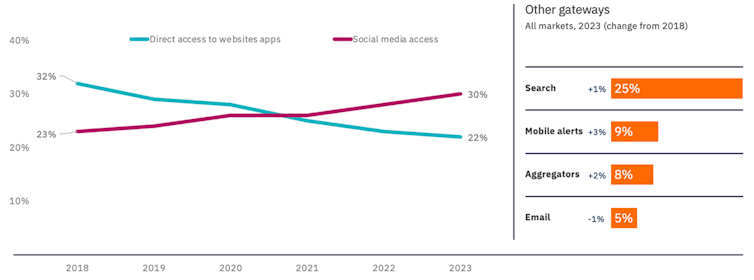
    Graph showing direct news website/app use decline and social news increasing.
    Which of these was the main way in which you came across news in the last week? Base: All who used a news gateway in the last week in each market-year ≈ 2000. Note: Number of markets grew from 36 in 2018 to 46 from 2021 onwards. Markets listed in online methodology.
    Reuters Institute for the Study of Journalism, Oxford University, Author provided


    These are averages, and it is important to point out that direct connection remains strong in some markets – mainly in northern Europe, where there is keen interest in news and relatively high trust. But elsewhere – especially in parts of Asia, Latin America, and Africa – social media or other aggregators are by far the most important gateways, leaving news brands much more dependent on third-party platforms for traffic.

    Generational differences are also a big part of the story. In almost every country we find that younger users are less likely to go directly to a news site or app and more likely to use social media or other intermediaries.

    The following chart for the UK shows that over-35s (blue line) have hardly changed their direct preferences over time, but that the 18–24 group (pink line) has become significantly less likely to use a news website or app.

    This is just one indication of how the generation that has grown up in the age of social and messaging apps is displaying very different behaviours as they come into adulthood.


    Percentage of people using a news website or app:
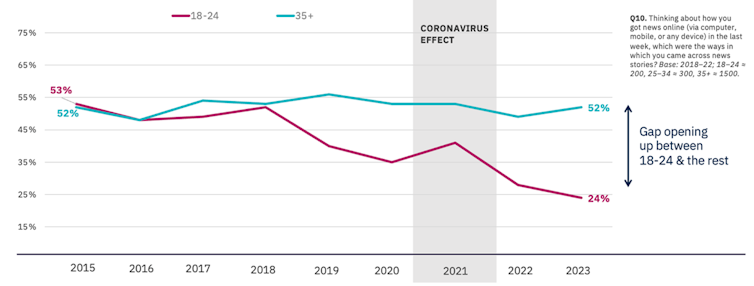
    Graph showing declining use of news websites and apps among 18-24 age group from 53% in 2015 to 24% in 2023 while 35+ group stayed around 52% (see previous two paragraphs).
    Thinking about how you got news online (via computer, mobile, or any device) in the last week, which were the ways in which you came across news stories? Base: 2018–22; 18–24 ≈ 200, 25–34 ≈ 300, 35+ ≈ 1500. Reuters Institute for the Study of Journalism, Oxford University, Author provided


    Dependence on social media may be growing, but it is not necessarily the same old networks. Across all age groups, Facebook is becoming much less important as a source of news – and by implication as a driver of traffic to news websites. Just 28% say they accessed news via Facebook in 2023 compared with 42% in 2016, based on data from 12 countries we have been tracking since 2014.

    This decline is partly driven by Facebook pulling back from news and partly by the way that video-based networks such as YouTube and TikTok are capturing much of the attention of younger users.

    Twitter usage is also reportedly declining following the chaotic set of changes introduced by Elon Musk, even if our survey shows relatively stable weekly reach overall.

    New platforms

    TikTok is the fastest growing social network in our survey, used by 44% of 18–24 year-olds for any purpose and by 20% for news (up five percentage points compared with last year). Our survey results also show that the Chinese-owned app is most heavily used in parts of Asia, Latin America and Africa.
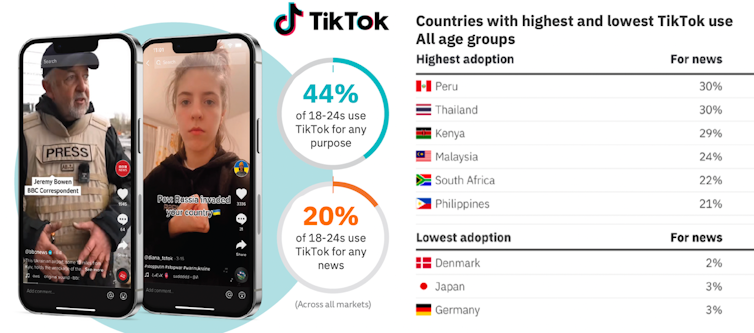
    Graph showing which platforms and websites people have used to access news.
    Which, if any, of the following have you used for news in the last week? Base: Total sample in each market ≈ 2000. Note: TikTok has been banned in India and does not operate in Hong Kong.
    Reuters Institute for the Study of Journalism, Oxford University, Author provided


    The report also provides evidence that users of TikTok, Instagram and Snapchat tend to pay more attention to celebrities and social media influencers than they do to journalists or media companies when it comes to news topics. This marks a sharp contrast with “legacy” – or more established – social networks such as Facebook and Twitter, where news organisations still attract most attention and lead conversations.

    Although news organisations have been experimenting with TikTok accounts, many are struggling to adapt to the more informal tone where creativity is the key to attracting an audience.

    These shifts are additionally challenging for publishers because they often require expensive bespoke content to be created and there are few ways to monetise short form videos, with limited linking opportunities back to websites or apps.


    Younger people less likely to read online

    These platform shifts are part of a wider move away from reading and towards watching or listening to news content online. While all age groups say they still prefer to read news online because of the speed and control if offers, younger groups are more likely to express preferences for watching or listening to news content, as the chart below shows. And this translates into greater consumption of short-form videos and podcasts by this group, according to our data.


    News consumption preferences by age and media:
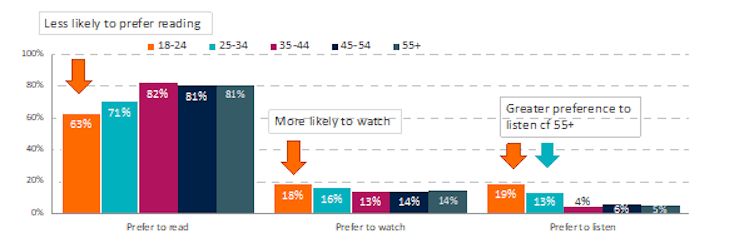
    Graph showing young people are less likely to read and more likely to watch or listen to news.
    In thinking about your online habits around news and current affairs, which of the following statements applies best to you? Please select one. Base UK= 1740 (excl. DKs)
    Reuters Institute for the Study of Journalism, Oxford University, Author provided


    Our research over more than a decade has captured the way that all age groups have adopted digital media, alongside more familiar formats such as TV and print. But now we are seeing the emergence of a generation of social natives that are not bound by traditional definitions of news.

    As our previous research has shown, younger groups expect news to be engaging, participatory and to be available on their terms – in the networks and platforms where they spend their time. Trust is not a given, it needs to be earned – as much by journalists as by any other creator of content.

    For all the difficulties this entails – around trust, attention and business models – this is the media environment that the public is increasingly choosing for themselves. It is one where journalists and news media will need to carve out their place if they want to maintain their relevance and connection with the wider public.The Conversation


    Nic Newman is Senior Research Associate, Reuters Institute for the Study of Journalism, University of Oxford. This article is republished from The Conversation under a Creative Commons license. Read the original article.

     

  • Does a news entity have to publish news?


    By John C. Watson


    Headlines in early March 2023 implied Fox News mogul Rupert Murdoch had made a damning confession. He had affirmed that some of his most important journalists were reporting that the 2020 presidential election was a fraud – even though they knew they were propagating a lie.

    It was an admission during pretrial testimony in a libel lawsuit filed against Fox by a voting machine company that says it was defamed by the lie. For journalism practitioners and devotees, the admission should signal the end of the Fox News empire.

    Nope. It didn’t.

    Such a disgraceful demise would seem inevitable when journalists – professionally trained truth gatherers, employed by a news organisation, which is an institution that exists to provide truthful information – choose not to do so.

    Nope.

    That’s because a business that calls itself a news organization actually does not have to be one – but it does have to be a business. Businesses exist primarily to make a profit and doing actual news isn’t essential. Adam Serwer, reporting for The Atlantic, wrote “sources at Fox told me to think of it not as a network per se, but as a profit machine.”

    News businesses or profit machines can hire anybody who falls off a turnip truck and label them journalists because the job has no standardised requirements.

    The US Bureau of Labour Statistics lists “None” as requirements for work experience and on-the-job training for journalists but indicates a bachelor’s degree is typical. Accordingly, the Fox News business people could choose to spread election lies and insist, as court documents indicate, that it made good business sense to do so because much of their audience did not want the actual truth about that topic.

    These are some of the troubling takeaways from Murdoch’s defence of his news business against a libel lawsuit filed by Dominion Voting Systems, the company implicated by Fox’s election fraud allegations. Fox essentially admits to publishing false information about Dominion, but argues it is nonetheless protected from liability. It is a defence grounded in the First Amendment, which protects press freedom so robustly that it also protects the irresponsible use of that freedom.


    There’s lying … and there’s defamation

    Murdoch’s admission was contained in court documents and was revealed in a New York Times story published on March 7, 2023. The story was about the US$1.6 billion libel lawsuit filed against Fox News by Dominion, the company Fox journalists repeatedly – and falsely – accused of rigging the 2020 presidential election to make sure Donald Trump lost.

    Internal Fox communications, reported by the New York Times, revealed that network journalists and their news executive bosses knew the 2020 election was not fraudulent, yet continued to allow lies about the election – told by hosts and their guests – to be spread to the public.

    Dominion claimed Fox’s audience recoiled when its journalists truthfully reported that Trump had lost the election. Dominion’s attorneys asserted that Fox feared the audience would switch their viewing allegiance to upstart conservative news organizations Newsmax and One America News.

    In a March 31, 2023, ruling, the judge hearing the case cited examples of Fox’s internal communications that demonstrated how journalism values were supplanted by the language and values of business. Among them was this quote attributed to a Fox Corporation board member: “If ratings go down, revenue goes down.” The judge also referred to Dominion’s claim that Fox chose to publish the (false) statements to win back viewers.

    Court documents show Dominion’s attorneys asked Murdoch: “What should the consequences be when Fox News executives knowingly allow lies to be broadcast?” Murdoch replied: “They should be reprimanded, maybe got rid of.”

    That response aligns with principles widely touted by professional news organisations and established in the ethical practice of journalism. Although journalism scholars and practitioners vary in their definitions of what a news organization is and who can claim to be a journalist, there is firm agreement that reporting facts, or at least making a good faith effort to do so, is an indispensable mandate for both.

    Yet Murdoch has not indicated an intention to discipline en masse Fox News employees who violated that ethical principle. Nor is he required to.

    Even the Society of Professional Journalists, the nation’s foremost advocate for ethical journalism, rejects punishments for those who violate its principles. Its ethics code says in part: “The code is entirely voluntary. … It has no enforcement provisions or penalties for violations, and SPJ strongly discourages anyone from attempting to use it that way.” The organisation concedes that news outlets can discipline their own journalists. Because journalists and their employers may be considered to be one entity, any disciplinary action is voluntary self-discipline. Neither journalists nor the news organizations they personify have to be truthful unless they want to.

    Lying in the press is unethical but does not necessarily strip liars of the protections provided by the First Amendment. There is an exception to this: the defamatory lie, one that injures a person or organisation’s reputation. That is what got Fox News sued.


    Assumptions fall

    Murdoch’s surprising statements were revealed in the lawsuit because his attorneys sought what’s called a “summary judgment” by the judge to decide the case without a trial, in order to avoid the prospect of facing a jury. That move makes sense given that some law scholars have found that juries rule against media defendants three times out of four.

    By law, summary judgment is available only when the parties agree on the material facts of the case.

    That meant Fox and Murdoch had to admit to Dominion’s most damning allegations, including confessing to broadcasting untrue statements and engaging in other unethical journalism practices. Even with those admissions, the First Amendment’s protection could still give Fox a chance to win the lawsuit – particularly if a jury did not hear the case.

    Without reaching trial or a verdict, the Dominion Voting Systems v. Fox News lawsuit has already produced some unsettling results. It has challenged journalism disciples’ assumption that news organisations exist to provide the public with truthful information about the most important issues in their civic lives. It has shaken journalism’s faithful who assume that good journalism is never bad for the business of journalism.

    Neither assumption is necessarily valid at Fox or anywhere. Anyone can claim to be a journalist, irrespective of their actual function. Any business can claim to be a news organisation. Functioning irresponsibly in either role is largely protected by the First Amendment and is therefore optional.

    Ethics imposed by independent state bar associations and state medical boards have made professional attorneys and physicians accountable by law as a means of ensuring responsible behaviour in their roles, which are considered essential to society. Journalism ethics, which are news organisation ethics, are wholly voluntary and can be set aside if they compromise profits.

    But if the ethics violations are defamatory, a successful libel lawsuit can impose accountability with a financial cost – money damages.The Conversation


    John C. Watson, is Associate Professor of Journalism, American University. This article is republished from The Conversation under a Creative Commons license. Read the original article.

     

  • Das ka Dum by Dr Bhaskar Das | BARC news ratings will revive next week. Should one really care given that despite no numbers, it was business as usual?

    Bhaskar Das

    We are sure there will be claims and counter-claims once the BARC numbers are out for news channels next week. Let’s read what Dr Bhaskar Das says in Das ka Dum dated March 11. Read on…


    If you wish to access the archives, please go to the Das Ka Dum tab on the website’s top navigation bar.


    Q.BARC news ratings will revive next week. Should one really care given that despite no numbers, it was business as usual?


    A. Data-driven ecosystems are a hygiene reality for any business for enriching the quality of decision-making. BARC ratings are important for this reason only, apart from other adjacent directionalities. So active practitioners in the relevant A&M industry would be interested in BARC data release. The data improves the quality of decision-making,  directly or indirectly, for all concerned.


  • Cannes Lions announce remaining jury line-up

    By A Correspondent


    The Cannes Lions International Festival of Creativity, which this year celebrates 60 years of creative excellence in advertising and communications, has completed the jury line-up by naming the members of the Design, Film Craft, Media, Promo & Activation, and Radio Lions categories.


    The remaining five juries will be led by Jack Klues, Chairman, Vivaki (Media Lions); Joe Pytka, Director, Joseph Pytka Productions, USA (Film Craft Lions); Mary Lewis, Creative Director, Lewis Moberley, United Kingdom (Design Lions); Ralph van Dijk, Founding Creative Director, Eardrum, Australia (Radio Lions); and Rob Schwartz, Global Creative President, TBWA Worldwide, USA (Promo & Activation Lions).


    Philip Thomas, CEO of Lions Festivals, said, “It is a privilege to have an assembly of such esteemed industry professionals in Cannes to judge and award the best work. And we are particularly delighted to count on 11 past Cannes Lions jury presidents amongst the total 308 jury members taking part in this year’s 16 different juries. The time, commitment and integrity applied to their task ahead will have a profound effect on moving the industry forward at a global scale.”


    The extended deadline for submitting entries is 19 April. Information and tips on how to enter are at http://www.canneslions.com/awards/. Judging and announcements of the shortlisted and winning work will take place in Cannes, France, during the festival week, June 16-22.


  • Jaldi 5 with Asheesh Chatterjee: FM will grow five times

    Asheesh Chatterjee, CFO, 92.7 Big FM is positive about Phase III of FM radio licensing and the new spectrum being freed. MxM India caught up with him recently to talk about the FM industry, pre- and post-Phase III.


    01. With Phase III coming into play, do you think that the issues such as royalty, taxes etc that the FM industry has been struggling with, will be sorted?

    I am very optimistic. If you look at the efforts the government has taken towards digitization, the intent is to have a consensus and resolve the issues and make the industry grow. Most of these issues have been identified, and yes, there will be solutions. The phase III guideline itself solves many issues. We tend to look at the glass as half-empty, why not look at it as half-full? There were many things which have been addressed, and some which need to be addressed which I am confident will happen soon.


    02. Does the current RAM measure the listenership of FM radio appropriately?

    Ratings and measurement requires investment. So once you have strong players with a pan-India footprint, they will have the necessary revenues for the investments to make these measurements appropriate.


    Yes, today the measurement is restricted to the top markets, and this is set to expand. You do not need daily or weekly measurement to tell you that radio reaches where literacy has not reached yet or where, because of electricity problems, TV does not work. It is enjoyed as a passive medium, even while you are working. Radio does not really have a prime-time at all. So research will capture all this and much more. I am sure with phase III, and stronger players, there will be sweeps that will be done to bring out the statistics.


    03. Prashant Panday of Radio Mirchi recently said that FM radio will have strong competition from internet radio. Do you agree?

    Digital is one of the areas, which by no means implies that FM radio has little future. FM radio is itself going to grow five times from its current numbers. There is immense future in FM radio. And also, yes, digital radio with its uniqueness to be able to search, social networking, and customize, will offer another product. FM players who have the understanding of the audience, as well as content, will be able to monetize internet radio better than anybody else. However, if you are going to make it a paid service, there are not going to be many takers for it.


    04. Phase III: Challenge or opportunity for FM radio industry?

    I see only opportunity: to make good use of the spectrum that will be freed after the Phase III auction happens, and to execute on product innovation and product differentiation to make a profitable business model for all stakeholders, whether it is the advertisers who will look at this medium for its cost-effectiveness or listeners who will look at it as a passive medium for enrichment and entertainment, and us as radio operators who like to reward both investors and employees. It is going to be a work-work solution for everybody. The opportunity is right there at the section point and we need to execute it to the plan.


    05. Are advertisers taking this medium more seriously in their traditional media mix?

    Advertisers have always taken this medium seriously. Nobody buys you cheap, you sell cheap. The fractured spectrum that some us have had, because we are there in two towns in Gujarat, does not mean that no advertiser can do a Gujarat-plan with you. So those are the problems that will go away, and you will have the spectrum to reach the targeted region or TG. I think once that gets corrected, advertisers will start using FM as the primary medium.


    As told to Ananya Saha


  • Anger Management, a big deal for Comedy Central

    By Johnson Napier


    Comedy channel Comedy Central seems to have struck gold by bagging rights to the newest craze on the sitcom block, Anger Management. So impressed was the network with prospects of this new show starring Charlie Sheen, that it went overboard in acquiring rights to the show.


    Ferzad Palia, Senior VP and GM – English Entertainment, Viacom 18 Media Pvt Ltd reveals to MxMIndia what would be the implications of this expensive buy and how they expect the sitcom to break some advertising rules in the English entertainment market.


    Going by the buzz that’s being created, the acquisition of Anger Management seems to be the biggest thing that has happened for Comedy Central. How far did you stretch yourself into acquiring the rights for this sitcom? And, what was unique about the whole experience?

    When we saw the first 2 episodes of Anger Management at a private screening, we knew that this show is set to be the next big thing on television. We were vindicated when the show broke all ratings records over its first few episodes in the US. It did so well that before we knew it, an unprecedented further 90 episodes were ordered! Charlie Sheen is back… and how! Naturally it was a heavily sought after show. So I must admit that we did need to stretch ourselves to make it happen.


    How would you justify the huge spends on the acquisition of this sitcom in a market like India’s that’s still waking up to English entertainment?

    You will be surprised that India isn’t waking up to English language content. It already has woken up. And not just the metros, across the top 40 towns and is penetrating deeper at a rapid pace. English is one of the fastest growing languages in India for a variety of reasons. Comedy Central is here to grow the category with a distinctive offering. And as I’ve always mentioned to you, we’re here for the long term, so this fits in perfectly with our ambitions & plans.


    Would you be setting new benchmarks where ad rates for Anger Management are concerned?

    Yes. It’s a great opportunity for brands to co-own this franchise with us for a longer term. We’re looking at ‘partnerships’ for this show. Going beyond the traditional ‘spot buy’ format. There are tremendous opportunities that we have to allow brands to integrate themselves through the next few months. The positive response we’ve received over the last 24 hours since the announcement is extremely encouraging, to put it mildly.


    What is the English Comedy entertainment market like in India at the moment?

    We’re extremely happy with the response to Comedy Central India over the last 10 months. We’ve grown the English genre, cut through clutter, received recognition and awards for our brand, content, creative & marketing, have over 100 advertisers on our roster, already the most followed English entertainment channel on Twitter, 8 lakh fans on Facebook, etc, etc… And we’ve only just begun! The market is ripe. And hungry for more, as is clearly evident.


    What is the content acquisition plan for Comedy Central going forward into 2013?

    Lots of exciting things in store. None that I can reveal currently though.


  • Madison Media appoints Amit Duggal as Director Digital

    By A Correspondent


    Madison Media has announced the appointment of Amit Duggal as Digital Director to head its Delhi and Kolkata Digital business. Mr Duggal joins Madison from Mindshare, and will report to V Achuthan Kutty, overall Digital head of Madison.

     

    Mr Duggal has about 10 years of experience in advertising and digital, having worked with agencies like Indiatimes.com, Yatra online, Travelguru.com, Geodesic, Attano.com on the digital side and Rediffusion DY&R, Leo Burnett and Percept on the agency side. His last position was with Mindshare where he was Partner Invention, leading the Digital practice for Pepsico.


    Said Gautam Kiyawat, Group CEO, Madison Media, “We are delighted to have Amit lead our team in Delhi and are confident that he will be able to add a lot of value to our digital clients and help them make Digital a significant driver of their business and also win new business”.


    Mr Duggal said, on his joining Madison, “I am excited with this new opportunity and looking forward to contribute to an impressive roster of clients that Madison has.”


  • CNBC Awaaz honours industry best at Real Estate Awards

    By A Correspondent


    CNBC Awaaz in association with RR Kabel hosted the ‘Real Estate Awards 2012’ to recognize commendable merit of visionaries and professionals from the industry. The event, themed as Modern Marvel, was attended by Housing and Poverty Alleviation Minister Ajay Maken, along with notable names from India’s real estate fraternity.


     

    Nominees for the CNBC Awaaz Real Estate Awards were judged based on criteria like standard, quality of project, customer satisfaction and efficiency. This year more than 8,000 projects across 12 cities were evaluated for the awards.


    On the occasion of the awards Sanjay Pugalia, Editor-in-chief, CNBC Awaaz said, “We have earned the respect of being one of the transparent and most credible recognitions in the real estate industry. It gives us great pleasure to know that our awards are considered as a benchmark in the industry.”


    Awards went out in the following categories:

    Affordable Segment – 100% Complete

    Shipra Estate NCR
    Mid Segment – 100% Complete Brigade Group Bangalore
    Luxury – 100% Complete Lunkad Realty Pune
    Ultra Luxury – 100% Complete Amar Builders Pune
    Affordable Segment – U/c – More than 70% Complete City Corporation Limited Pune
    Affordable Segment – U/c – More than 70% Complete

    Ashiana Housing & Finance ltd.

    NCR
    Mid Segment – U/c – More than 70% Complete Kalpataru Limited MMR
    Luxury – U/c – More than 70% Complete The Advantage Raheja Bangalore
    Ultra Luxury – U/c – More than 70% Complete Queens Court NCR
    Best Commercial Project DLF IT SEZ Chennai
    Best Retail project DLF Emporio NCR
    Most Consumer Friendly Developers Magarpatta Township Pune
    Best Project Execution Mahindra SEZ Chennai
    Best Greenest Project Magarpatta City Pune
    Commercial Greenest Project

    Pritech Park – RGA software System (P) Ltd. and Primal Projects Pvt Ltd

    Bangalore
    Best Integrated Project Magarpatta City Pune
    Best managed projects: Post sales City Corporation Limited Pune
    Most Reliable Builder Sobha Developers Bangalore
    Architect’s choice/Best Design Brigade Gateway
    Best Home loan provider State Bank of India
    Best Real Estate fund HDFC Real Estate PMS
    Best State Government Initiative Rajasthan Govt
    Building world class infrasturcture Jaypee Group
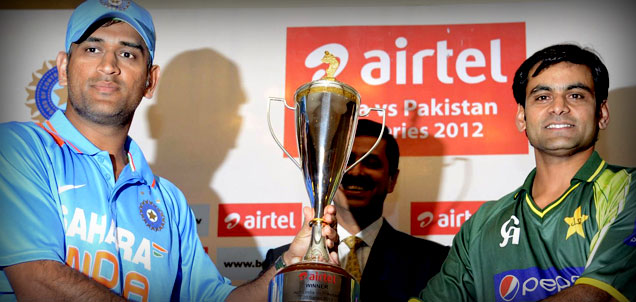
  • Indo-Pak series: Another historic thrash-a-thon?


    By A Correspondent


    Tensions of other sorts are usually forgotten when India and Pakistan meet on the cricket pitch. This time it is a battle of one-upmanship as the two countries are clashing after a gap of five years.


    While the Indo-Pak series of three ODIs and two T20s is a short tour, it is creating enough ripples among cricket-crazy fans. What makes it more enthralling is the fact that India had beaten Pakistan in both formats of the game the last time they landed here during the 2007-08 tour. Of the three Tests that the two played against each other, India won the series 1-0, having drawn the remaining two. As for the ODIs, it was a 3-2 victory in favour of India that did the country proud.


    While it was Saurav Ganguly who was at his superlative best in the Test series that enabled India to take the lead, it was the young Yuvraj Singh who shone with the bat in the ODI format, making him earn the prestigious man-of-the-series award.


    Going by speculation doing the rounds, for broadcaster ESPN-Star the tournament was a success even before it took off. According to some reports, the channel has managed to sell out maximum inventory at two to three times (totalling more than Rs 1.5 billion) the rate compared to the just concluded India-England series. This augurs well for the network given that it has to pay Rs 322.5 million per match for the five match series.


    Sanjay Kailash

    To a query from MxMIndia, Sanjay Kailash, EVP, ESPN Software India Pvt Ltd, said, “We are delighted with the response from advertisers to the India-Pakistan series. India-Pakistan is always extremely sought after and the series therefore was sold at a premium. We have monetised India-Pakistan ODIs at a rate which is double as compared to the historical industry average. Even rates for India-Pakistan T20 are double than the most sought after T20 tournament in the country.”


    Anilkumar Sathiraju

    Sharing his excitement about the series, Anilkumar Sathiraju, AVP & Head, DDB MudraMax, Media, said that on the ratings front he expects the series to be a big hit. “It will be quite good. I am expecting it to be a positive and a good series. Ratings will definitely see a spike as it is India-Pakistan at the end of the day. The fact that a few advertisers are quite gung-ho about it makes it more exciting.”


    Divya Gupta

    Divya Gupta, CEO, Dentsu Media, too had some words of praise for the series irrespective of the fact that India had put up a drab performance in the recent past. She said, “An India-Pakistan series is in a realm of its own; evokes emotions, fervour and fever like none else. It doesn’t matter whatever Team India has achieved /not achieved in the recent past. It is a marquee game, event, media property that viewers and marketers and broadcasters are betting on; and deliver it will.”


    Anita Nayyar

    Giving a more detailed outlook on the series, Anita Nayyar, CEO, Havas Media India & South Asia, said the fact that the series is taking place after many years is in itself a great pull. “From a viewing perspective three of the five matches are scheduled on holidays which will help the cause of viewing. Also the ODIs start at 8pm-primetime making viewers more available. In fact, most India-Pakistan matches have delivered ratings in the range of 5-6. This series should do similar numbers; however, with TAM data not being available the deliveries will be guess estimates.”


    Ms Nayyar’s summation of the series is probably what will matter at the end of this historical sporting tie-up. “Ratings or no ratings, the competition between India and Pakistan has always generated huge interest for both viewers and advertisers, and is considered a safe investment. It is a good way to bid adieu to a tough year and a fine beginning to a new one.”


    If the first T20 encounter between the India and Pakistan in Bengaluru last evening (Dec 25) was any indication, the contest on field is going to be tough. While every match going down to the wire may not be good news for weak hearts, it’s sure to see ratings soar. And advertisers and broadcasters happy.


    Photograph: Fotocorp


  • MxM Monday: Expectations from Phase III FM radio licensing


    By Ananya Saha


    FM Radio is set for exponential growth. Even as advertisers are yet to take this medium seriously, the industry players are waiting for Phase III with anticipation. The industry is positive that the third phase would result not only in differentiated content but will also interest the advertiser and listener alike.


    We speak to private FM players for their expectations from Phase III of licensing.


    By Ananya Saha


    Harrish M Bhatia, CEO, DB Corp Ltd - Radio Business (94.3 My FM)

    We all want Phase III to happen. It is an industry’s requirement to grow. But it is important for the government to remove hurdles like the issue that happenedinChandigarhor not allowing us to carry news. What is the objective of taking AIR news? If it the issue of keeping tab or administering the news we carry, they can ask us to keep our news recordings for 30 days and they can review it. How does the government control cable telecast? Why cannot they trust us?


    From the advertisers’ front, I am sure that the advertising in the medium’ will continue to grow. What is required is proper decisions by the government to ensure that the private FM players also gain.


    Asheesh Chatterjee, CFO, Reliance Broadcast Network Ltd (92.7 Big FM)

    The more number of Spectrum licenses in Top A, B cities will only benefit the industry. It will add to content loyalty. Phase III licensing will result in closure of music royalty issues when the tariff rates will resolve the ambiguity issues that exist at the moment. And yes, the FM players will be investing in Category C and D towns. Kozhikode, Chandigarh and the South will make the things uncomparable. Those areas need a bit of correction.


    These three are broadly the issues, apart from smaller issues such as news. Even while protecting the identity of your brand, we will be able to cover news in the same manner or better manner. Otherwise you are too restricted in communicating it in the same manner.


    Harshad Jain, Business Head, HT Media (Fever FM)


    The highest bidding of Phase II will becomes the lowest bidding price in Phase III and that is a cause of concern. I hope the government understands the fact that the cost of doing business is high. And I hope they do pay attention to this fact apart from solving the issues such as transmitter and infrastructure.


    It is no doubt that the Phase III is going to do better to the industry, but the back-end processes will have to be taken care of and sorted.


    Anurradha Prasad

    Anurradha Prasad, President, AROI and CMD, BAG Networks

    We want the processes of Phase III radio licensing to begin as soon as possible. We, as an industry, do not want something that becomes unviable. Hence, we are awaiting the process to begin soon so that industry gains. You cannot compare telecom and radio spectrum together. The consumer does not pay for radio. The medium requirements are different.


    It looks like the issue of music royalty will get sorted as Phase III licensing comes into play. However, I am concerned that in Phase III, the bidding prices might go haywire and people will not be able to pay, nor would they be able to make it profitable.


    Prashant Panday, CEO, Radio Mirchi

    The objective of any policy should be to ensure growth of the sector. In the case of FM radio, Phase-3 policy should attempt to expand FM in a big way.


    The Phase-3 policy as it stands today only partially addresses the objective. It does seek to expand geographically into some 250 new towns. However the auction methodology (electronic ascending auctions) and high reserve fees (highest bid received in Phase-2 in a similar category town in the same region) will frustrate this goal. The radio industry believes that FM auctions will be a flop with most new cities not being taken up. The industry prefers electronic tendering, just like done successfully in Phase-2. This would also take care of the problem of reserve fees, since they are set post-auctions (25% of the highest bid).


    The policy allows for networking across the network, which should help cut operating costs in small towns. It also allows broadcasters to operate more than one channel in the bigger cities, which should help in consolidation. The policy also allows news broadcast, but limits the content to AIR feeds. This is blatantly unfair, since news without restrictions is allowed to all other media.


    However, the biggest problem is conducting auctions under scarcity conditions. There is only 1 channel in Delhi, Bangalore, Chennai, Ahmedabad and Pune and 2 in Mumbai. This will lead to exorbitant “desperate” bidding. Further, this high bidding will become the base for the next round of auctions, which will put the radio industry into a cost spiral. Instead, the government should accept TRAI’s recommendation of halving “channel separation” to 400 KHz and doubling the number of channels. This way, the government will get more overall license fees, the public more programming variety and the broadcasters reasonable license fees.


    Suresh Sanyasi, National Sales Director, Radio Indigo


    Our expectation from Indigo are fairly simple: we are looking at larger market space in terms of international quality music available pan India. We current fall into very niche A+ segmentation. We are looking at Mumbai,Delhi as a market and may be a couples of Town A and B where we see potential like the way we got Goa where we can harness our brand and give listeners good music. Invariably connecting them with good brands and advertisers and giving them pan-India reach. Currently, if any advertiser wishes to advertise with us, they have to locally listen to our station in Mumbai and Goa. Once, we get license, the advertisers will be able to connect with our brand pan India. We already have offices in Delhi and Mumbai and once we get license, we will start expanding horizontally. We have, maybe about 20%, of business coming out of Mumbai and Delhi irrespective of the fact that they do not have touch-and-feel of Radio Indigo and they have only heard about our brand.


    Once Phase III begins, the market will grow. More radio stations coming in, licensing will become larger, the government is definitely going to get lot of revenues and a lot of employment will be created. There is huge amount of growth that we are looking at.


    However, radio in India has not reached maturity yet. By maturity, I imply, consumption of radio is not a very-well accepted norm right now. I say it comparing it to more mature medium like a television. People buy in terms of brand and advertising people do not know how to use radio. Radio is a very tactical medium. Advertisers do not understand the medium since it is not a visual medium, even as it remains the most cost-effective medium to advertise and there is a definite return that comes through. With larger number of stations coming in, people would like to try out and understand the value of radio in itself.


    We are looking at Phase III with much positivity and optimism.


  • Chitralekha upbeat on social media

    By Ananya Saha


    It took two years for Chitralekha to reach two lakh fans on its Facebook page. According to the official numbers provided by Chitralekha, 96% of these fans are from India with 87% under 34 years. Close to 35,000 active fans make it a highly interactive community. While the group has focussed on FB till now, and is present on Twitter, it will be looking seriously at the latter in 2013.


    Mitrajit Bhattacharya

    While many media brands are taking the social media route to be interact with the audience, it is known that beyond the ‘likes’, not many engage with them on a regular basis. However, Mitrajit Bhattacharya, President & Publisher, Chitralekha Group is upbeat about the statistics. “We are very active on FB as a community. We inform, entertain and empower our fans. For instance, the songs in a specially-compiled music CD with our anniversary issue were chosen by our fans, questions to celebs in our popular FB activity – “Chhoti Si Mulakat” are normally contributed by our fans etc. We also share jokes, pics and breaking news regularly. All these translate into an engaged fan base,” he said, while adding, “Regional brands have a huge power to connect with their audiences as friends. We have been a friend to the Gujarati community for over six decades. Social media helps us to be in touch with them closely, particularly the younger lot. Gujaratis are also very heavy users of digital devices, which help the process of connectivity.”


    The social media strategy of the group extends to Chitralekha’s brand philosophy “of being friend to our fans and being loved to a completely new younger audience.”


    Does an engaged fan base imply an engaged advertiser community as well? Mr Bhattacharya said, “Monetizing social media is a tricky issue, however there are many marquee clients who are actively looking at our online offerings currently.” He insisted that Facebook has played a large role in helping traction onto Chitralekha’s websites.


    With no choice but to be present on social media to stay in the game, Mr Bhattacharya concluded, “Digital is the future. All our major titles are available on tablets and smart phones. Our print copies get delivered to over 100 countries (sometimes, we learn about small countries from our subscriber’s database). Just imagine the power of digital, which avoids the problems of physical distribution due to geographical distances, both within and outside the country!”


  • FM Radio: Facing challenges, embracing growth

    By Ananya Saha


    The Confederation of Indian Industry (CII) organised the CEOs Roundtable on Radio in New Delhi last week, to discuss and chart the growth of the radio industry with the Phase III auction of the FM spectrum coming up, though dates are yet not out, and the ministry is said to be tweaking the loopholes. The conference saw private FM operators being critical of govt policies that did not allow them to carry news on their stations. The event also saw the release of CII- E&Y report – ‘Poised for growth: Fm radio in India’ (Read about it here: http://www.mxmindia.com/2012/12/fm-radio-will-generate-rs-14bn-in-coming-year-ey-report/)


    Prashant Panday

    Amit Khanna, Chaiman, CII Committee on Media & Entertainment and Chairman, Reliance Entertainment, requested the government to encourage diversity in programming by giving incentives. He said, “The existing policy has created clones of same station and has stalled the exponential growth of FM that could have happened.” He also spoke about how the cost of reach of radio was much higher than the cost of reach of radio, thus pushing the FM operators to stick to mainstream genre of Bollywood music to generate revenues.


    Prashant Panday, CEO, Radio Mirchi advocated multiple channels, 25 or more for cities such as Delhi and Mumbai for efficient usage of spectrum and diversification in genres. He pointed out, “FM gets only 40 lakh listeners per week. And daily only about 25 lakh people tune into FM. Why is that we reach 25 percent of population? The population needs variety, and we are often compared to TV when it comes to programming.” He also said that in 4-5 years FM radio will lose business to digital radio as consumer moves to internet radio. “The numbers are clearly growing. Saavn currently commands 10 million listeners. FM spectrum has finite life span. It is important to re-consider spectrum policy before broadcasting goes kaput,” he said.


    Anurradha Prasad

    Anurradha Prasad, President, AROI and CMD, BAG Networks, opined that the all stakeholders related to FM industry are missing the larger picture. “We sell airspace one-hundredth of TV ad revenue. It is clear that nobody is taking it seriously,” she said. She pointed out how advertisers look at radio as a ‘bonus’ medium and not as a serious medium.


    However on a positive note, Ashish Pherwani, Partner, Advisory Services, M&E, Ernst & Young, said, “Phase 3 is going to be imperative for growth of the industry. There are good things happening in the industry that will allow consolidation. Yes, it is important to extend licensing by 10-15 years. The lack of inventory is happening because of lack of licensing. But even then, one out of two campaigns currently use radio is a medium, even when ROI is not as well-defined in this medium.”


    Uday Varma, Secretary, Ministry of Information & Broadcasting, began on a very candid note. He quipped, “If the industry itself is calling a 10-12% growth bleak, what percentage of growth will make it look bright? The industry in itself is not clear what it wants – whether it wants fast growth or slow growth. Of course, the business aspirations of the industry and national interest will not go hand in hand and meet, and it should not for good.” He also pointed out why there is a delay in the auction of Phase III licenses, “There was an issue of migration fee. The process and auction will be done in very transparent manner. There are trade-offs but I am sure we will sort them out with the industry and other stakeholders like TRAI.”


    Mr Varma on a lighter note said, “If you as an industry player are sure that it will die, why expand at all? And if it is so, the government should re-look at the FM policy. We, as an industry, need to begin on a far more positive note. Of course, you cannot wish government away. There is a divergence of motive here – the industry is working for profits and we have to look at the working of the industry as a whole,” while responding to Mr Pandey’s statement that the FM industry will face the music the next 4-5 years. On the question of allowing private FM to air news, Mr Varma asked the industry to begin with AIR news feed and give it a time of 4-5 years.


    The Secretary and Rajesh Kumar Singh, Joint Secretary) Broadcasting (MIB) assured the delegates that Phase III was on the top of their agenda. Mr Singh said, “My agenda was to get the Phase III rolling by March 2013. But we hope to work on the areas that cause concern and do it thoroughly.”


    Harshad Jain

    Harshad Jain, Business Head, HT Media (Fever FM) said, “The market size is roughly Rs 12-1500 crore, for a medium (radio) that is absolutely free for the consumer. Compared to overall media industry, this is the fraction of revenue. The bidding cost for Phase III is unfair to the industry that is so small. While the numbers might look impressive when you see CAGR, the prices of this medium have actually declined keeping inflation in mind.”


    Anil Srivatsa

    Adding to the debate was Anil Srivatsa, CEO Radiowalla Network who said that the reserve price will deter new entrants into the industry. He recommended more frequencies with lesser space between two frequencies. To this, Wasi Ahmad, Advisor (B & CS), TRAI, responded that number of FM channels should be consummate to how many channels can a market absorb while Harrish Bhatia, CEO, My FM wished to make the industry more investor-friendly while pointing out “stations that are backed by news media houses should be allowed to carry news.” On an optimistic note Mr Jain of Fever FM wished that “radio industry becomes a $ 2 billion industry,” while Uday Chawla, Secretary General, AROI, wished for a level-playing field between radio, print and TV.


    Harrish M Bhatia

    The panel and delegates also pointed out how the industry is facing the dearth of good talent. On a positive note, Asheesh Chatterjee, CFO, 92.7 Big FM concluded, “We are going to grow at 30% in Phase III when 245 FM stations would result in four times in inventory with more comprehensive spectrum. Radio is set for huge jump. The ad revenues are falling because we are selling cheap. We, as an industry, have to focus on good content. The growth and the ability to grow lies within us. We need better and concurrent movement.”


    A Must Read for every Professional in Media Industry ….

    Extracted with permission from Authors of ‘The Advertising Mess’


    Universe Projections and a well-known Listenership Survey

    The existing Radio listenership survey from a ‘credible and trustworthy research organisation‘has shown utter carelessness and total lack of responsibility which has hindered the growth of this nascent medium.


    The listenership survey, which launched in 2007, used NRS 2005 universe estimates without applying growth rates for the intervening two years, which means its figures were two years out of sync with reality. This lethargic output was produced after charging humongous fees from the client for subscriptions.


    Logically, in any such media currency, the critical factor is the ‘estimation of the universe’, which needs to be done as accurately as possible. This can be done by using the latest available census figures and applying the intermediate growth rate to arrive at the current universe, OR by using IRS figures (since IRS provides updated universe estimation by demographics on a quarterly basis.)


    Moreover, this listenership survey continued to report these wrong universes for the next 3 years till the end of 2010. Not only was the universe underestimated but the radio penetration figures were also wrongly reported as compared to the baseline.


    When this ‘credible and trustworthy research organisation‘ finally updated the universe in January 2011, some markets showed growth in population by 143% over the previous year. (Obviously, since for five years, the research agency had not bothered to update universe, now there was a sudden leap).


    The basic demographics such as gender ratios changed almost inversely for male : female from 57 : 43 to 41 : 59, socio-economic classes observed stark differences. For example, upper socio-economic class demonstrated a drastic drop where as lower socio-economic classes showed significantly unrealistic rise over the previous year.


    Conventional wisdom says that the demographic proportion takes almost one full decade to show the kind of change in proportion that this listenership survey showed in a single year. Such drastic changes in gender ratio were last witnessed during World War II, when millions of members of the male population were killed in a single year of warfare at the front. They cannot radically change in just one year.


    Can we expect such blunders from an organisation which is looked upon as the ‘Messiah’ of media research in India? Unfortunately, YES.


    Such are the follies of these surveys which are unfortunately highly respected by the industry and form the basis on which most of the MarCom investments are made today.


    Different methodologies lead to different results with disastrous consequences (Diary v/s DAR)

    Different methodologies for the same objective appear to provide different results in research surveys. Each of these methods has their own disadvantages and advantages and that includes how the market perceives them. The different numbers emanating from the usage of different methodologies mean different opportunities to advertisers, broadcasters and agencies for revenue impact, visible return on investment and content formulation.


    Obviously all these methodologies cannot be giving the accurate results. Let’s take an example of MRUC which started India’s first radio listenership survey, ILT (Indian Listenership Track). MRUC had conducted a research to evaluate which methodologies out of DAR (day after recall) and Diary were the most robust and with minimum error. It was found that DAR reported a 55% inaccuracy, whereas Diary reported 85% inaccuracy.


    Post the results of these findings, TAM media research released the first round of Radio Audience Measurement with Diary methodology, pitching hard for real-time capturing of data.


    The radio station which according to ILT was the undisputed market leader for two consecutive years, suddenly dropped to number four position according to RAM, whom do we believe ILT or RAM? Further, this discrepancy occurred when there were only a total of 7 private FM stations available.

    The question is whether real time capturing of data (Diary), which was developed to overcome the inaccuracies of the previous methods (DAR), truly presents the actual picture.


    Another example which can be looked at is a famous radio station which recently converted from 100% Hindi content to 100% English content in Mumbai. When comparing three months of Hindi content (Pre-Launch) with 3 months of English content (Post-launch), the existing listenership survey conducted by a ‘renowned media research agency’ reported NO significant changes in either demographic consumption of the station across age groups, gender and socio economic class OR in tune-ins and time spent. On the contrary, lower socio-economic class showed growth for 100% English content for the same radio station.

    This either shows that all listeners are deaf or it shows how real time capturing of data could mislead due to some lesser known reasons or leakages in validation process or it shows that the data capturing and analysis are being done in a thoroughly unprofessional manner. Or could it be that there is a short-coming in the methodology itself and that fresh, new methods are urgently needed?