Tag: news

  • [MJR] A button to mute screeching panelists, please

    By Ranjona Banerji


    I make this plea on behalf of the ear drums of the nation. As the broadcasters’ association is worried about offensive content and the government is worried about sex, no one has the time to discuss our national loss of hearing. Even noise pollution activists, so worried about every tiny Diwali cracker, are silent on this one.


    Yet every night, guests on TV panel discussions yell at each other, sometimes all at the same time. This is not just confusing, but it is also painful. (And, it must be admitted, a bit embarrassing.)


    The answer I don’t think can be in teaching better manners to the panellists. We can’t now go back to their mummy-daddy and TV channels caught up in the non-stop cycle of breaking news barely have time activate their brains let alone start teaching etiquette.


    Instead, we need technology to come to our rescue. Instead of pleading with their guests to allow everyone to speak and not hog all the allotted time or politely trying to control a posse of middle-aged delinquents, TV anchors should just cut trouble-makers off. The worst offenders will be silenced mid-scream. To amuse viewers, their faces should still be on screen, so we can see them though not hear them screeching away. There is no guarantee that the screamers and yellers will ever learn and those who plead “give me 30 seconds more please” – how do they claim 30 seconds when they take many minutes? – will most likely start yelling “don’t cut me off”. But that doesn’t mean anyone has to listen to them. Anyway, you can barely hear what they’re saying.


    Also, our TV remotes could come with selective mute buttons so that we can filter out the sound from some sources while continuing to listen to others. This feature can be sold as a fun family game, as an alternative to birds killing pigs.


    And what about when the TV anchors annoy you? Now, that, dear viewer, is what the existing mute button is all about!


  • [MJR] 40 is new 60 in media

    By Ranjona Banerji


    Every day when I look in the mirror I know that 50 is getting closer. I do not grudge or regret my advancing years – I’ve enjoyed most of those that have gone by. It’s only when I open a newspaper that I get really sad about my age. Given that no one above the age of 40 can get a job in the media any more, the 13-year-olds who work in newspapers have decided that anyone above the age of 40 is doddering and on the brink of senile dementia.


    Cross 40 and you can be called a senior citizen, elderly, aged and any other such ageist term that you can think of. To actually avail of senior citizen benefits in India, you have to be between the ages of 60 and 65, so that particular descriptive has some technical connotations. But try explaining those to a 13-year-old who heads a news desk.


    Thanks to newspapers, the general public also get influenced. Mid-Day did a very good story earlier this week on how children were arrested for playing cricket in Vashi. The police said that a “senior citizen” had complained and that is why they took action. The senior citizen was 40. That is, at least 20 years before she can get a discount on a railway ticket. Good to know, I suppose, that age still commands respect.


    Wednesday’s Times of India tells us that two senior citizens and another person killed themselves. The first person was 71, the second was 34 and the third was 66. You feel for the 34-year-old – had he waited six years, he would have been a senior citizen too. When senior citizens kill themselves, by the way, they are usually depressed. I am guessing from reading newspapers.


    Oddly, these same newspapers will run stories about how 60 is the new 30 and 40 is the new 11. Clearly, the nine-year-olds who edit these feature sections are too young to read the rest of the newspaper, so have no clue what their classmates, sorry colleagues, are up to.


    Ah well, another day another grey hair.


  • [MJR] Making sense of RBI cuts

    By Ranjona Banerji


    This minor rant is against no one but myself, and my inability to understand the purpose of these one million business news channels on Indian television. There, see, my error in comprehension in the first sentence itself. These channels have nothing to do with news – they have to do with the stock market and sometimes the commodities and properties markets. No connection with business news at all.


    Anyway, in an attempt to get the latest on the RBI’s rate cuts, I travelled through all the stock market channels to find out (This is a mistake I have made before, I must confess. Hope springs eternal… said Alexander Pope. He was neither a stock nor a commodities broker or even a real estate agent, so never mind who he was). Did I find out anything? Of course not. I don’t think the Reserve Bank of India really exists in these exclusive clubs.


    Oddly, the minute I randomly arrived at a regular news channel, there was D Subbarao, RBI governor, telling us what was in store for us: loans, EMIs, fixed deposits, inflation, GDP, government fiscal policy and more.


    O ye of little faith, you might think, slamming TV news everyday and then finding them more that adequate when required. But I have one point in my defence for this little mistake about trying the business route: the stock market channels were really quite good during the unveiling of the Union budget.


    Which means I know where I have to go next year but never again until then, unless of course I want to listen to a language I can’t understand and watch lots of little arrows in different colours going up and down. Although I could always watch entertainment news segments if I want to be really confused…


  • [MJR] A tsunami of hot air and hysteria on Indian TV

    By Ranjona Banerji


    Yes, it is true that there were fears of a tsunami in countries along the Indian Ocean on Wednesday. It is also true that there was terrible damage in the tsunami of December 26, 2004. But there was no need for Indian TV anchors and reporters to start behaving like ambulance chasers as they geared up with excitement to cover this momentous event.


    This high-pitched hysteria for every single event, newsworthy or otherwise, gets exceedingly tedious, especially when there is little modulation in tone or pitch. Most Indian TV news channels didn’t even have adequate information nor do they have credible weather anchors, geologists or meteorologists on call. All they can do therefore is to keep repeating the same thing over and over again.


    On Wednesday, although a tsunami warning was issued, no tsunami had happened yet. There was no call therefore to behave like the end of the world was upon us. This only engenders panic, made worse by the fact that reporters and anchors say one thing and the texts that run across TV screens imply quite something else.


    International channels were a study in contrast. Al Jazeera and the BBC stuck to other world news – Korea, Syria, economic crisis – while CNN concentrated on the earthquake in Indonesia and possible after-effects. There was no breathless reporting; rather the effort was to explain what was happening in a sober and matter-of-fact manner. No attempts were made to audition for a travelling ‘jatra’ party, which appears to be the Indian model. And CNN’s weather expert Mari Ramos was as always excellent in her information and analysis.


  • The Anchor: Tarun Goyal on 4 things that should change in the radio industry today

    By Tarun Goyal


    1. Radio must have full-fledged news:

    Radio should be allowed to air news freely. By allowing the private radio stations to air news limited to only AIR is not sufficient, radio is a local medium, it must be given a free hand to broadcast news.


    2. Copyright issue must be resolved:

    The Government of India must make the copyright policy clear. The government should come out with a formula on revenue share basis as this will change the way the dynamics of the industry. We are sharing 4 per cent of the revenue with the government ofIndia, so why can’t we share the revenues with the music companies? I believe this model can solve most problems facing the radio industry today especially in programming.


    3. Government must be more supportive:

    The government should be more supportive in formatting their policies for radio because the government spending on radio is not sufficient enough for the growth of the industry.


    4. AROI should be more assertive

    Although the AROI is functioning well, the change I would like to see is that AROI should pursue be more assertive in meeting the needs of the radio industry. The AROI must function more aggressively and the government should also take the body seriously as AROI is a body which was formed by the radio broadcasters.


    Mr Tarun Goyal is the Founder, Director of Radio Chaska


  • [MJR] Breakfast with Bollywood and other abominations

    By Ranjona Banerji


    Suppose (warning, blasphemy follows) you’re the kind of person who doesn’t manage to read a newspaper in the morning before you leave for work so you keep the TV on to get the latest through “breakfast news”.


    This is what I found out today: Katy Perry sang and danced and was looking for curry and something in India, said NDTV.  IPL season 5 starts with a match between Mumbai Indians and Chennai Super Kings. Ravi Shastri said Chennai was going to win and Moody said Mumbai was going to win, both on Times Now. Headlines Today said that Akshay Kumar is acting in a new film directed by Prabhu Deva called Rowdy something.


    Given the high drama on TV the night before over the $10 million bounty on Hafiz Saeed’s head placed by the US, I foolishly thought (it’s amazing how foolish I feel when I watch TV) that there would be some more on that. Not on Times Now at any rate.


    NDTV had a thought-provoking report on trafficking of young girls and women from West Bengal, being led into brothels in Pune, Mumbai and Delhi. Anderson Cooper 360 was largely focused on the Republican primaries. The BBC was on Newsday, so that’s bits from here and there, with plenty on China and something on the new James Bond film (I didn’t stop long enough to watch that, had had enough of films thanks to Headlines Today).


    That left CNN-IBN who told me everything I wanted to know about Hafiz Saeed and Pakistan’s reaction to the US bounty.


    My grouse therefore is that I was wrong yesterday for castigating newspaper websites for being too full of cricket and Bollywood and giving TV a clean chit. Or is my grouse that websites are deceptive? Something like that.


  • [MJR] The missing case of espelling & grammaria

    By Ranjona Banerji


    Everydays when I reads a newspapers I am realising that espelling and grammaria are mostly presence in their absent. Many has been noticing these trend for many year but mainly its still annoying. Solution are not being found but thats because effort are not being maid.


    How to be telling peoples in newspapers for examples that “lesser” is being a qualitative comparison and not quantitative. You cannots pays lesser moneys for somethings unless what you means is that the currency you is using is less important or valuable than the normal one. You cans however be a lesser speller than others


    Why be spelling “minuscule” as “miniscule”? It is not related to a short skirt. Why say “path-breaking” when you are meaning “ground-breaking” – why would you be breaking up a path?

    Why be putting a question mark after “How the West was won”. It is not a question. Blames are being put for all these on computer and young peoples who are not taughts English in schools. Then great writer Chetan Bhagats is saying what is the grammarian and espellings so greats anyways. Even great actor John Abrahams is saying anyways and hintings he not going to get more darker and will become more fairer. That is the why the prime ministers will one day be sayings in newspapers headlines “Anyways I doesn’t care abouts Mamata Banerjee. Akhilesh Yadav is lesser troubles”.


    I wills then be looking for the longer rope and the more tall fan for small hangings and other purpose.


  • Will private FM soon be allowed to freely air news?

    By Robin Thomas


    While it is known that private FM radio broadcasters will be permitted to air news and current affairs restricted to AIR (All India Radio), MxMIndia has learnt that all this could soon change with the setting up of a Central Monitoring System by the government.


    Mr Uday Chawla, Secretary General, Association of Radio Operators for India (AROI) has confirmed the development to MxMIndia, “The Government will be setting up a Central Monitoring System for content, following which restriction of content including news will be removed.”


    In fact, in an earlier interaction (interview) with MxMIndia, Ms Anurradha Prasad, President, AROI was of the same opinion that once a central monitoring system is set up there will be no restrictions to air news on private FM radio. When asked why the government is reluctant to allowing complete independence to private FM radio on news and current affairs, Ms Prasad stated, “The issue is of setting up a monitoring system so that radio content can be monitored by the government. Once this is ready, we don’t think the government will have any reason to limit news on FM radio.”


    The monitoring system will allow the government to monitor content aired on radio and perhaps prevent any possible adverse effects of the content aired. It is however not known when the central monitoring system will be set up by the government. At present private FM stations are not allowed to air news and current affairs on air and only a year back in July 2011, the government had given its nod to the MIB proposal which allows private players to carry news bulletins of All India Radio.


  • Times Now tops English news channel genre once again

    By A Correspondent


    Times Now,India’s No.1 English news channel maintained its stronghold on the English news genre for the fourth consecutive year. The channel has yet again reinforced its leadership position, dominating the genre with its unmatched news, views and analysis.


    Times Now lead the genre with a channel share of 33 per cent (TAM: All India 1mn+; CS Male AB 25+ years; All day, 24 hrs; 2011 data till week 53), whereas CNN-IBN and NDTV 24×7 garnered 28 per cent and 19 per cent respectively.


    The channel continues to provide sharp, precise and comprehensive news. With a viewership of 2.3 million, Times Now has emerged as the trusted voice of the people.


    Enjoying prime time viewership, Times Now garnered a channel share of 34 per cent (Prime Time: 19.00 – 23.30; TAM: All India 1mn+; CS Male 25+ AB; All days, 24 hours; Week 1 to Week 53 ’11) as against CNN-IBN and NDTV 24X7 with 30 per cent and 20 per cent respectively.


    The Newshour anchored by Arnab Goswami is the most watched English news show. Garnering a share of 42 per cent with the genre (All India 1mn+; CS Male 25+ AB; Week 1 to Week 53 ’11), The Newshour enjoyed an immense viewership as against 28 per cent and 17 per cent by CNN-IBN and NDTV 24×7 respectively.


    By capturing pertinent news like the uninterrupted live coverage of the Anna Hazare movement or breaking the story on the infant deaths inWest Bengalor even bringing a bird’s eye view of the action during the Parliament’s winter session, the channel has been relentless in highlighting issues and debating key developments that impact the nation at large.


    Times Now has set itself apart as a strong news brand that delivers relevant, insightful and an unbiased reportage of news inIndiaand around the world.


    Times Television Network informs and entertains over 100 million urban affluent audiences acrossIndiawith ET Now, Movies Now, Times Now, & zoOm. The network is available in 21 other countries across the globe. Times Television Network is part ofIndia’s largest media conglomerate, The Times Group.


  • Jaldi 5 with Archana Vohra: itimes is philosophically different

    01. How will the property be marketed?
    We are excited about the launch and right now want to learn how our users are interacting with the new product. Once we get a better understanding we will think about how to grow the audience base.


    02. FB Groups/Yahoo Groups also offers same proposition. How do you plan to make it tick?

    The new Itimes.com is philosophically different from Facebook groups and Yahoo groups.


    03. Is it invitation-only?

    Itimes.com is a open interest network where anyone can create and share interests. It’s not invite or friends led hence relationships are based purely on content.


    04. How scalable is the property?

    From a business model perspective, the focus is engagement and not monetization currently. On the application side, we are scalable to manage large volumes of data and interactions.


    05. What are the challenges that this proposition might face in India?

    Right now we’re trying to build something that gives users a new way to engage with things they care about. So our real challenge is to see if we can develop an experience that makes that happen.


    As told to Ananya Saha


  • [LOOKBACK 2011] The Year for News TV

    By Ritu Midha


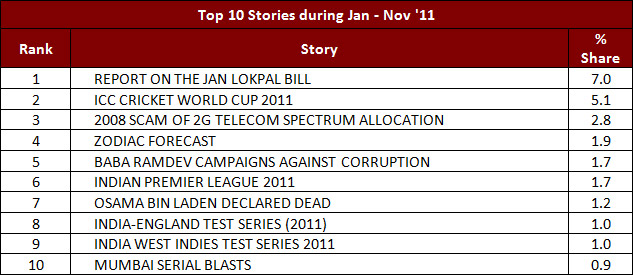
    Anna Hazare got the largest percentage share as far as the news channels go. The other top stories of the year 2011 were Cricket World Cup 2011, 2GScam. Interestingly post these comes Zodiac Forecast, which is two rungs above IPL coverage. Here is a list of top 10 new stories by percentage share:

    Source: Source: News Content Track – A service of TAM Media Research Pvt. Ltd

    Channels: Aaj Tak, CNN IBN, Headlines Today, IBN 7, India TV, NDTV 24/7, NDTV India, Star News, Times Now, News 24 & Zee News
    Period: Jan – Nov, 2011

    Note : Analysis is based on the Telecast duration


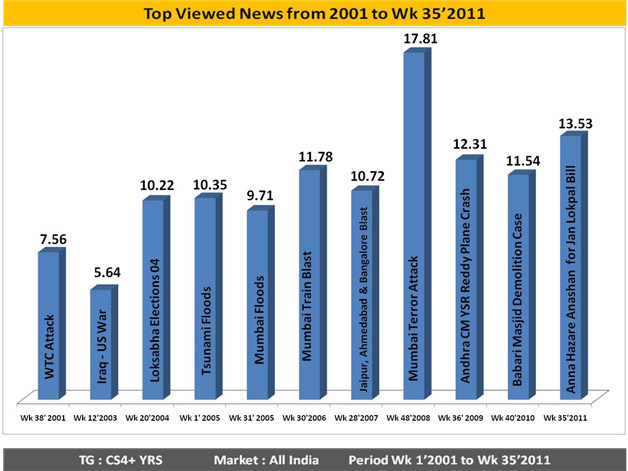
    If one looks at data from 2001, the Lokpal Bill at its peak was the second most watched news in 11 years – second only to the Mumbai Terror Attacks:


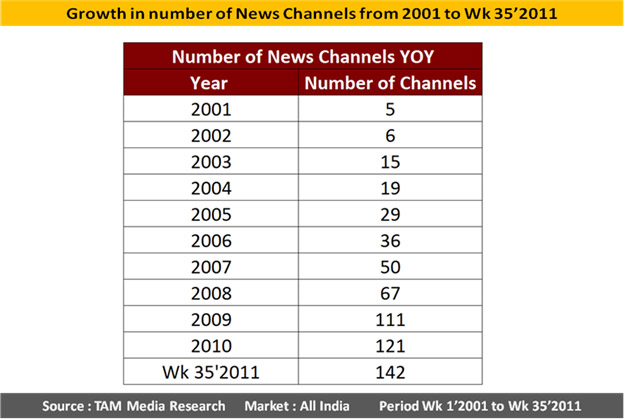
    News, interestingly is the fastest expanding genre with eight new news channels being launched (excluding regional languages) till week 50, 2011: 7 in Hindi and 1 in English.

    Even if on e looks at year on year growth – news is one of the fastest growing genres:

    With the first quarter of 2012 seeing assembly elections including heavyweights like Uttar Pradesh and Punjab – and Lokpal Bill still in the eye of the storm – the share of news channels is expected to grow.

  • The New Big Boss of India’s Biggest Brand


    The search for Ratan Tata’s successor of chairman of the Rs 4.3 lakh crore Tata group has ended with the appointment of Mr Cyrus P Mistry as deputy chairman of Tata Sons. But who’s this 43-year-old Mystery Man?


    Read on for:


    > The Main story on announcement with Mr Ratan Tata’s statement

    > Statement of Mr Cyrus Mistry

    > Profile 1: Avid golfer & foodie, avoids cocktail circuit

    > What Titans Of India Inc Have To Say

    > Profile 2: A reticent man with strategic vision, humility

    > Profile 3: Official profile from the Tata corporate website


    The Main Story


    The mystery over who would succeed Mr Ratan Tata as chairman of the Tata Group ended yesterday as the board of directors of Tata Sons met to appoint Mr Cyrus P Mistry as Deputy Chairman. He will work with Mr Tata over the next year and take over from him when Mr Tata retires in December 2012. This is as per the unanimous recommendation of the selection committee.


    Endorsing the appointment, Mr Tata, Chairman of Tata Sons, said: “The appointment of Mr Cyrus P Mistry as Deputy Chairman of Tata Sons is a good and far-sighted choice.


    “He has been on the board of Tata Sons since August 2006 and I have been impressed with the quality and calibre of his participation, his astute observations and his humility. He is intelligent and qualified to take on the responsibility being offered and I will be committed to working with him over the next year to give him the exposure, the involvement and the operating experience to equip him to undertake the full responsibility of the group on my retirement.”


    Mr Mistry, currently managing director, Shapoorji Pallonji Group, has been a director of Tata Sons since August 2006. He is a graduate of civil engineering from Imperial College, London, and has a master of science in management from the London Business School.


    And this is what Mr Mistry said in his statement:


    “I feel deeply honoured by this appointment. I am aware that an enormous responsibility, with a great legacy, has been entrusted to me. I look forward to Mr Tata’s guidance in the year ahead in meeting the expectations of the group.


    “I take this responsibility very seriously and in keeping with the values and ethics of the Tata group I will undertake to legally disassociate myself from the management of my family businesses to avoid any issue of conflict of interest.”

    But who’s this mystery man?


    Read on:


    Profile 1:

    Avid golfer & foodie, avoids cocktail circuit


    By Reeba Zachariah & Namrata Singh


    The man who will head a group synonymous with Indian industry is an Irish national and shares his birth date (July 4) with the US Independence Day. But in many ways, he resembles the business giant he has been handpicked to succeed. Like Mr Ratan Tata, Mr Cyrus Pallonji Mistry, 43, is described by close friends as soft-spoken , candid and down to earth.


    Again like Mr Tata, Mr Mistry is said to love cars – especially SUVs – and steers clear of the cocktail party circuit. But unlike lifelong bachelor Tata, Mr Mistry is said to be a devoted family man. He is married to Rohiqa, daughter of renowned lawyer Iqbal Chagla, and the couple have two school-going sons. An avid golfer, mr Mistry is known to be a foodie and his favourite holiday destination is Europe. Besides Mumbai , he owns houses in London and Pune.


    According to a Tata group insider, “Mistry is one person who can laugh at himself.” His sense of humour should come in handy in facing the challenges that lie ahead. A person who has shown a preference for the shadows , he will now have to put up with the arclights for years, perhaps decades.


    Tellingly, his Wikipedia profile was created within minutes of the announcement that he had been effectively chosen chairman-in-waiting of Tata Sons. The youngest son of construction baron Mr Pallonji Shapoorji Mistry, Cyrus hails from one of the richest Indian families with a net worth of $7.6 billion. But he will disassociate himself from the family business to avoid conflict of interest.

    Voracious reader with eye for detail


    Mr Cyrus Mistry has been managing director of Shapoorji Pallonji & Company, which is part of the Rs 15,000-crore Shapoorji Pallonji Group (SP Group). An avid golfer and prolific reader, Mistry got the chance to join Tata Sons’ board a year after his father retired as director in 2005. The family is the single largest shareholder in Tata Sons with a stake of 18%. Mistry is also on the board of Tata Elxsi and holds non-executive positions on the boards of several other companies. He is a trustee of the Breach Candy Hospital Trust as well.


    Although he does not have experience in heading a Tata group company , Mr Mistry, a graduate in civil engineering from London’s Imperial College, has been actively involved in the family business. His expertise includes formation of business plans, risk evaluation, business investment strategy and property and infrastructure development.


    Mr Khurshed Daruvala, MD, Sterling & Wilson, in which the SP Group holds 56%, describes Mistry as a “ hands-on leader” who is strategy oriented. “ Ever since Mistry started working with this partnership firm in 2003, the turnover has jumped from Rs 50 crore to Rs 2,000 crore.”


    If this is exemplary, consider what Mistry accomplished after he took charge at loss-making Afcons Infrastructure. SP Group acquired a 53.96% shareholding in Afcons in 2000. In March 2011, Afcons earned a total income of Rs 2,893 crore with a compounded annual growth rate of 21% over the past five years.


    He joined the SP Group in 1991 as a director and became its MD in 1994 in charge of the construction business. His brother, Mr Shapoor Mistry, is actively involved in the real estate and textile business.


    Conservative in his approach, Mr Mistry is said to have an eye for detail. “Once he takes decisions, he sticks with them,” said an insider. He can safely expect to take many crucial decisions in the years to come.


    What Titans Of India Inc Have To Say


    It is a historic and great moment


    -Krishna Kumar, director, Tata Sons


    A young leader means long-term stability for the Tata group


    -A M Naik, CMD, L&T


    There is strong chemistry between Mistry and Ratan Tata. He is very thorough and has good financial insight


    -J J Irani, former director, Tata Sons


    Good sign to have a young chairman -Ajay Piramal, chairman, Piramal group Cyrus symbolizes continuity, yet change


    -Harsh Goenka, chairman, RPG


    He’s mature beyond his years


    -Zia Mody, senior partner, AZB Partners


    Source:The Economic Times

    Copyright © 2011, Bennett, Coleman & Co. Ltd. All Rights Reserved


    And here’s a little more…


    Profile 2:

    Cyrus Mistry:  Tata Sons’ deputy chairman a reticent man with strategic vision, humility


    When senior advocate Mr Iqbal Chagla met Mr Cyrus P Mistry for the first time, he felt there was something special about the man. “He struck me as a young man who will make it big one day,” says Mr Chagla.


    Mr Chagla had good reason to ponder over Mistry’s future prosperity – the younger son of construction tycoon Mr Pallonji Shapoorji Mistry was keen to marry his daughter Rohika.


    On Wednesday, Mr Chagla’s prediction for his son-in-law couldn’t have come true in grander style. In the early evening, Mr Ratan Tata sent out an email to the top five-six executives of all Tata Group companies, informing them that Mr Cyrus P Mistry would succeed him as chairman after December 2012. In his message, the 74-year-old chairman hoped the Tata brass would lend the same support to Mistry as it did to him.


    Not all may choose to do so, but Mr Ratan Tata for his part surely will. Top officials in the group who have worked closely with Mr Mistry say he gets along famously with the Tata Group chairman and is very similar to Tata in nature and attitude.


    Cyrus was Ratan Tata’s First Choice


    They add that Cyrus was the chairman’s first choice right from the time the hunt began for a successor. But Mr Tata was also keen to follow a systematic process of selection, involving shortlisting of candidates – both external and internal.


    So who exactly is Mr Cyrus Mistry, and what makes him the best man to head the sprawling Tata empire? He’s low-profile, reticent and conservative, qualities he has inherited from his father. After graduating in engineering from Imperial College London, Cyrus plunged into the family-owned construction business.


    His father gave him a clear mandate: grow the engineering, procurement and construction activities. Cyrus focused on the Middle East and grew the business in Oman and the region.


    Cyrus’ big break came when the group acquired construction company Afcons Infrastructure Ltd, which undertakes large infrastructure projects in India and abroad.


    The company was acquired at a time India was witnessing a construction boom. As chairman of Afcons, Cyrus oversaw many important projects. The company was involved in the construction of Delhi Metro, and Cyrus often flew to the capital to supervise the work.


    Those who have worked with him say Cyrus possesses a near-perfect blend of hands-on involvement and the ability to give long-term strategic direction. “He has excellent leadership qualities, can think on his feet and combines all this with humility,” says former Unilever honcho Mr Keki Dadiseth, who was at one time believed to be in the reckoning to succeed Mr Tata. Another executive who has worked closely with Cyrus says he has the ability to operate both “as a telescope and a microscope”.


    Among those backing Tata’s choice is Mr Darius Pandole, who remembers Cyrus since their days in the Cathedral & John Connon School in Mumbai. “Cyrus’ is an inspired choice; he will provide long-term stability to the group,” says Mr Pandole, a partner in New Silk Route, a private equity investor. Cyrus is just 43, and even if the retirement age of chairmen in future is brought down to 65, he will still have a good two decades at the helm.


    Yet, there are those who point out that Cyrus has succeeded Tata purely on the strength of his father’s 18.5% holding in Tata Sons, which makes the senior Mistry the single largest shareholder in the holding company of the Tata Group. Others feel Cyrus lacks global exposure and may not be able to tackle the complexities of a diverse business house like the Tatas. But Pandole retorts: “People raised eyebrows when Mr Ratan Tata succeeded JRD. Look at what he’s achieved.”


    Meantime, officials at some of the front line Tata companies are baffled by the sudden announcement. Most have little or no exposure to Cyrus. A senior official in the group said on the condition of anonymity that the Tata Group will now be known more as Shapoorji Pallonji Group. “The Mistrys are known more as sharpshooters, which is in sharp contrast to the Tatas’ trusted brand image,” adds another old hand at a Tata company.


    Source:The Economic Times

    Copyright © 2011, Bennett, Coleman & Co. Ltd. All Rights Reserved


    Profile 3:

    Profile of Mr Cyrus P Mistry from the Tata corporate site:


    “Mr Cyrus P Mistry, 43, joined the board of Shapoorji  Pallonji & Co. as director in 1991 and was appointed managing director of the Shapoorji Pallonji Group in 1994.  He is a graduate of civil engineering from the Imperial College, London (1990) and has an M.Sc. in management from the London Business School (1997).


    Under Mr Mistry’s guidance, Shapoorji Pallonji’s  construction business has grown from a turnover of $20 million  to approximately $1.5 billion. The group’s companies have evolved from pure construction to executing projects under design and build and EPC delivery methodologies, implementing complex projects in the marine, oil and gas, and rail sectors. Under Mr Mistry’s stewardship, the group has registered many firsts in India — construction of the tallest residential towers, the longest rail bridge, the largest dry dock and the largest affordable housing project.  The group’s international construction business now extends to over 10 countries.


    Mr Mistry is responsible for launching the infrastructure development vertical in the Shapoorji  Pallonji Group in 1995 with a 106 MW power project in Tamil Nadu, followed by the development of India’s largest biotech park near Hyderabad in partnership with the Andhra Pradesh government. The infrastructure vertical has also developed two large road projects totalling an investment of USD 550 million.


    The Shapoorji Pallonji Group’s recent foray into agriculture and biofuels, with the leasing of 50,000 hectares in Ethiopia, was also overseen by Mr Mistry.


    Mr Mistry joined the board of Tata Sons in 2006. He has been a director of Tata Power and Tata Elxsi in the past.


    He is also on the board of the Construction Federation of India, the Imperial College Advisory Board, the board of governors of the National Institute of Construction Management and Research (NICMAR), and is a fellow of the Institute of Civil Engineers. ”


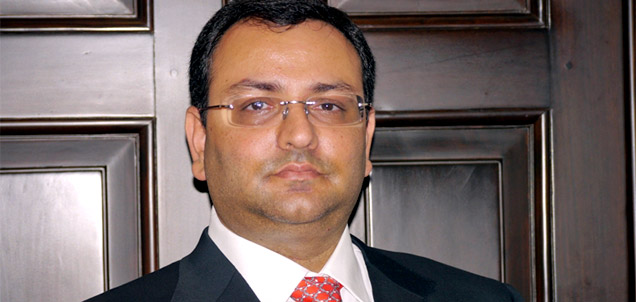
    Photograph: Tata.com