Tag: Netflix

  • Will Skinny Bundles work in India?


    By Indrani Sen


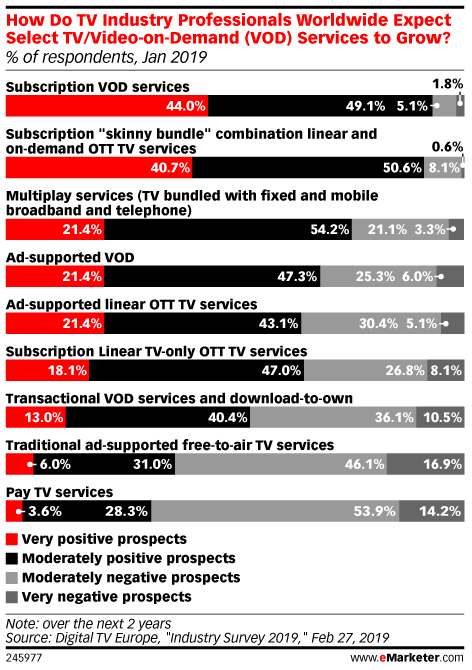
    I recently read an interesting article “TV Industry Eyes Hybrid Linear, On Demand OTT services” in www.emarketer.com based on the findings of Digital TV Europe’s “Industry Survey 2019.” According to the survey, nine in 10 industry professionals worldwide had positive outlooks on the two-year growth of “skinny bundles,” or subscriptions that offer both linear and on-demand OTT services as against subscription of only SOVD services like Netflix and Amazon Prime Video.


    The term “skinny bundle” was first coined to describe pared-down cable TV packages in the United States. In recent times, the concept of ‘skinny bundle’ has been introduced into the digital video sphere with an aim to describe either linear OTT services that offer customizable channel packages or a service that combines linear and on-demand content, as defined in the Digital TV Europe’s survey. As the article explains “The latter definition alludes to linear OTT services like Sling TV and fuboTV, which now have subscriptions that offer additional access to premium, on-demand content from services like HBO and Showtime. But it also represents SVOD services like Hulu, which bolstered its offerings with Hulu with Live TV, a linear service. (Source: https://www.emarketer.com/content/tv-industry-eyes-hybrid-linear-on-demand-ott-services?ecid=NL1001)


    In the US and other European countries, there is a growing trend of “cord-cutters” every year, referring to the consumers who are cancelling their subscription to cable and opting for other digital services. There are also a significant number of “cord-nevers” among younger generation (those who have never subscribed to traditional cable). It would be interesting to wait and watch what impact the growth of mobile internet in India has in the next few years on the cable TV and Dish TV subscribers.


    This model of skinny bundles can be adopted easily to suit the Indian TV industry, against our unique scenario of rapidly growing access to internet through mobile phones. Among the various options of skinny bundles shown in the above chart borrowed from the article, the option of Multiplay services (TV bundled with fixed and mobile broadband and telephone) looks like an ideal solution for Indian TV industry in near future.


    To sum up, it is going to be an exciting time for Indian TV industry from 2020 onwards with constant changes and innovations in the way of doing business. Needless to mention that the TV channels who were early adopters of OTT platforms will enjoy a distinct advantage.


  • Bisleri and Netflix win at Star Re.Imagine Awards 2019

    By A Correspondent


    The second edition of the Star Re-Imagine Awards saw Bisleri and Netflix bagging top honours. Showcasing excellence in creativity (Best Creative on TV and Best Creative on Digital), these campaigns were broadcast on TV and Digital during the recently concluded, IPL 2019 on Star Sports Network. Gautam Thakar, CEO, Star Sports and Guest of Honour, Rahul Dravid; one of India’s finest batsmen and cricketing legend, and the recent under 19 ICC World Cup winning coach, felicitated the winners.


    The awards were attended by stalwarts from the Indian Marketing, Advertising, and Media fraternity who graciously applauded the efforts of all nominees. The winners and other exemplary campaigns were selected by jury members comprising Dave Trott, R. Balki, Rama Bijapurkar, Swati Bhattacharya and Piyush Pandey. With 10 brands making the final shortlist, Bisleri and Netflix were declared winners. The judges selected campaigns that excelled in both – creativity, innovation and those that showed a distinct and unique creative approach on the IPL platform.


    The top honours went to Bisleri, conceptualised by 82.5 Communications, which won the award for excellence in creativity (Best Creative on TV)  while Netflix, conceptualised by The Script Room, was recognized for the Best Use of Integrated Media (Best Creative on Digital)


    Said Gautam Thakar, CEO, Star Sports:  “I am very glad that the second season of VIVO IPL was Bigger and Better on the Star Sports network and Hotstar. This year, the strong regional strategy of having four independent dedicated language channels in Tamil, Telugu, Bangla and Kannada, the Select Dugout and Super Funday feed contributed immensely to the increased reach of VIVO IPL. The success of this year has been even more gratifying, that despite the Indian general elections and TRAI regulations, VIVO IPL continues to grow. It has been an exciting season and on behalf of the Star Sports Network and Hotstar, I would like to thank the creative media agencies and clients who have made VIVO IPL, the Superbowl of India. My heartiest congratulations to Bisleri and Netflix, and to the 300 brands that made this VIVO IPL 2019 the biggest ever.”


    Over 300 brands were on board for the VIVO IPL 2019 across TV and Digital platforms from various sectors like Telecom, Consumer Durables (Handset), Retail and Lifestyle, Food Delivery and Restaurant (Hospitality), E-commerce, Online services, Automotive, Gaming, Online Payment Wallets, Paints and Adhesives FMCG.


    Brands that received Special Mention from the jury (In alphabetical order, includes the two winners):

    Amazon Echo – ‘#JustAsk’

    Bisleri – ‘Har paani ki bottle Bisleri nahi’

    Budweiser – ‘Becks Ice – packaged drinking water’

    Coca Cola – ‘Say it with coke’

    Dream11 – ‘Yeh game hai mahaan’

    Freecharge – ‘Sirf app nahi, appreciation’

    Intel – ‘Change your pc, change your business’

    Netflix – ‘Selection Day’

    Snickers – ‘Hungry? Grab a snickers’

    Swiggy – ‘What a Delivery’


  • Censorship Schizophrenia UnLtd


    By Shailesh Kapoor


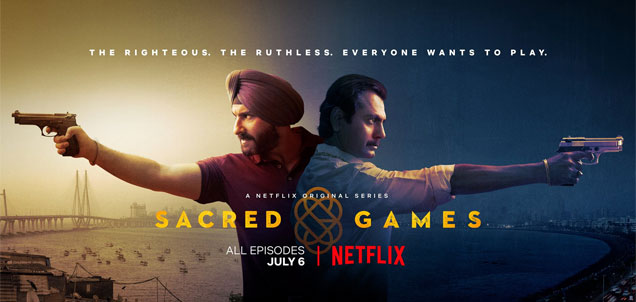
    It’s been exactly a week since Netflix put up the eight-part series Sacred Games, their first serious attempt to build their presence in the Indian market. The series has since received largely positive, even glowing, reviews. Based on Vikram Chandra’s book, Sacred Games is being touted as that the watershed internet show in the short but unremarkable history of “web-series” in India.


    I’m only halfway through the series yet, savoring it at the rate of an episode a day. What immediately strikes you when you watch Sacred Games is the unbridled use of language and visuals to tell the story the makers want to. Profanities, nudity and violence are used in a very matter-of-fact manner, never quite seeming forced, and never making a fuss about their presence in the series.


    It’s par for the course as far as American television is concerned. But in the Indian context, the contrast vis-à-vis rest of the entertainment landscape is striking, to say the least. You can feel that the writers and the makers would have felt a sense of liberation, for being able to say and show what mainstream cinema, let alone television, will ever allow them to.


    Take, for example, the two-three passing comments Ganesh Gaitonde’s character (played by Nawazuddin Siddiqui) makes about the former Prime Minister Rajiv Gandhi. Or the one mention of the vasectomy drive during the emergency. They shock us, pleasantly so, as we applaud how the makers have dared to say it their way. Some of these lines have already stirred a storm, but the Congress will be too limited in its power to pursue their case much. They would rather let it die down on its own.


    Netflix is a part of the large and ever-growing internet ecosystem, and there is no censorship the Indian government has come up, so far anyway, for this medium. The idea of the internet does not lend itself to censorship conceptually, and if someone important in the government woke up on the wrong side of the bed one day and decided to implement content regulation in this space, it would be lead to chaos of the unmitigated variety.


    Sacred Games is rated 16+ and it warns you about the use of bad language, nudity, sex and violence before you start watching it. The same 16+ audiences who have watched Sacred Games had to wait for two months to watch an innocuous film called Padmavati, till the censors forced the makers to change its name and make other “important” changes like covering the queen’s torso in a dance sequence. And yet, that film could not be watched legally in three states of India till it was available on Amazon Prime about three months later.


    For years now, the entertainment business has demanded that we move to a rating system like the West, where government bodies can only decide the minimum age below which a film cannot be watched. It’s a proven method that has been known to have worked across media. It is also a lot more logical and objective, and hence, easier to implement.


    But from pulling TV channels off-air for one day for use of abusive language or nudity (nowhere close to the level seen in Sacred Games) to trying to mess with routine dialogues in a film to not being to do anything at all related to the Internet content, our governing authorities seem to enjoy their schizophrenia.


    The more you try and mess with art, the more ways art will find to get back to you. Sacred Games is that middle finger those censoring films and TV do not want to see. But it stares them in their face anyway.


  • Netflix ready with two new series for Indian audiences

    By A Correspondent


    Netflix Inc has announced two new Netflix original series from India:Selection Day is based on the book by acclaimed author Aravind Adiga and Againis a supernatural, female-led detective series set in New Delhi and written by Marisha Mukerjee.


    “We are excited to be expanding our slate of originals in India. These projects have specifically local subjects, but will be great for our global audience, and are supported by world class talent,” said Erik Barmack, vice president of international original series at Netflix.Selection Day will be produced in partnership with the UK-based Seven Stories.


    “When I first read Selection Day I was completely overwhelmed by the scale and ambition of Aravind’s vision – and moved to my core by its emotional power.….” said Anand Tucker, CEO of Seven Stories. “We are delighted to be working with Netflix on what feels like a new chapter in the age of global storytelling, and we are bowled over by Erik and his team’s passion for this story.”


  • ‘Pixels 2017’ discusses role of video for the future

    By A Correspondent


    Pixels 2017, a day-long conference on digital entertainment, brought to the fore the importance of video and how it will change the way people will consume entertainment in the years to come. Delivering the inaugural address, Neeraj Roy, MD & CEO, Hungama Digital Media Entertainment, said that in the next four-five years, there would be at least five million active users of video driven services.


    Stressing on the importance of this industry, Roy said: “The entire aspect of digital media, video, and the connotation of content is going to be a tremendously significant component as the amalgam of digital India falls in place. The kind of audiences, the kind of communities and the way the industry is progressing, it is going to be the next real estate, leading into mobile payments, leading into e-commerce and the overall growth of the sector.” He further said that “traditional story tellers are more relevant now than ever, and imagination is a key for entertainment.” The event was organised by the Internet and Mobile Association of India (IAMAI).


    Speaking at a panel discussion on ‘Digital Entertainment through a crystal ball’, Kuek Yu-Chuang, Managing Director, APAC, Netflix stated that digital entertainment delivered through internet will have a global taste coming together. He also added that there should be appropriate content for appropriate audiences and advocated parental control, piracy control. According to Chaung, a relationship of trust needs to be maintained between the businessmen and the consumers. In this regard, he cited an example saying that he would not want the consumers of Netflix to be hesitant to provide their credit card details for subscription.


    Meanwhile, Vishal Maheshwari, Country Head – India, Vuclip India, said there should be more innovation on advertising product and the use of right metrics of measurement. Panellists agreed to the point that reinvention is highly required and businesses should analyse and understand what consumers want to pay for.


    According to Ajit Mohan of Hotstar, there will be more screens of consumption rather than just mobile and televisions. He said that the range of content will be wider and more segmented and the consumption would be so high that it will break the traditional stereotypes. Technology will be more consequential.


    Panellists were also of the opinion that there are unique digital opportunities in India in terms of online video. Content delivery will be smarter in the future, however, the target should be to move from subscription base to paid models. That is the only way forward for the industry.


    On the contentious issue of piracy, the panellists said that digital content is vulnerable and there can be laws to control piracy. It cannot be stopped, which is a given. The US and UK have laws, while India doesn’t. By the next year, digital content will go way higher than any linear media and therefore, it is important to bring about control of piracy sites in India.


    Anand Tiwari, Actor & Founder, Still and Still Media Collective in a conversation with Nikhil Taneja, Head-Development of Y-Films, Yash Raj Films, said that content creation is easy going but the delivery and execution is the most difficult part.


  • It’s here! Netflix arrives, will storm screens!


    By A Correspondent


    In the glam town of Las Vegas, at the consumer electronics show CES 2016, Netflix co-founder and CEO Reed Hastings announced its famed service to more than 130 new countries around the world. Including India.


    “Today you are witnessing the birth of a new global Internet TV network,” said Hastings. “With this launch, consumers around the world — from Singapore to St. Petersburg, from San Francisco to Sao Paulo — will be able to enjoy TV shows and movies simultaneously — no more waiting. With the help of the Internet, we are putting power in consumers’ hands to watch whenever, wherever and on whatever device.”


    No comments on Indian partners: Netflix

    For one of the world’s most iconic media and entertainment companies, Netflix is curiously shy of the media. So when we asked the major’s media partners for an interview, we did receive near-instant responses except for to a question on marketing plan and possible premieres for India, but the attribution was to Netflix, no person. We’re publishing the responses as is, and as you’ll figure, there’s hardly any information given out. Guess for Netflix it’s the content that’ll do the talking. Read on….


    Is there an Indian partner?


    We would be unable to comment on private discussions with local partners. Any announcements will be shared with you and available at media.netflix.com.


    Can you name people in the senior leadership team in India?


    Netflix is based in Silicon Valley (Los Gatos, Calif.) where product development and engineering is the focus. The company’s second largest office is in Hollywood (Beverly Hills, Calif.) where the content development teams are located. In Europe, Netflix is headquartered in Amsterdam and in Asia, Netflix has an office in Japan and is planning its regional headquarters in Singapore.


    How many Indian movies? Right now one finds only Hindi movies? I couldn’t find any Tamil movies. What languages do we have?


    There is a limited amount of local content available at launch in some countries. We will add more as the service grows in popularity and we better understand what our members want to watch in each region.


    What’s the library for all movies and TV shows? Number of hours is given, but can you give numbers of movies and TV shows, stand-up acts etc?


    We don’t publish a number of titles because our offering is always expanding and changing. In 2016 we plan to spend about US$5B on programming rights, including many titles that will be exclusive to Netflix around the world. That includes more than 30 new Netflix original series (or seasons of existing series.) Most of these will be available to our members everywhere, exclusively on Netflix. That’s more than one full new season of a series every other week. In addition, we’re expanding our original film initiative, launching more than 10 films exclusively on Netflix in 2016. We also are adding more kids programming and documentaries.


    Any tie-ups with Indian film studios/companies?


    We would be unable to comment on private discussions with local partners. Any announcements will be shared with you and available at media.netflix.com.


    Are these films for India distribution or global?


    We’re working toward being able to offer a fully global service with a global catalog. Examples of titles Netflix has licensed, largely on a global basis include How To Get Away With Murder, Gotham, Jane the Virgin, Zoo and Breaking Bad. We still have territorial licensing, that’s a legacy from the last 7 or 8 years. We’re moving as quickly as we can to have global availability of all the content on Netflix so that there are not regional distinctions. We’re still somewhat a prisoner of the current distribution architecture, we’re trying really hard to get there.


    What’s the target for number of subscribers by end of 2016?

    We provide international member guidance and segment reporting on a quarterly basis with earnings announcements. Netflix ended Q315 with nearly 26M international members.


    Do we see any Indian language interface? Because that’s where the real growth will happen in India?


    Only English will be available in India for now. We haven’t made any decisions about what India-based languages will be added in the future. As we gather member feedback and better understand usage patterns, we will make decisions about what languages to add.


    Broadband speeds are still slow, even though the promise of 4G exists? Are you looking at any tie-ups with ISPs for cheaper bandwidth?

    Netflix automatically adapts the data rate of the video stream to meet the bandwidth available to the member at any point in time. The minimum required broadband connection speed for standard definition is 0.5 Megabits per second.


    For one monthly price, members around the world will be able to enjoy Netflix original series including Marvel’s Daredevil and Marvel’s Jessica Jones, Narcos, Sense8, Grace and Frankie, and Marco Polo, as well as a catalogue of licensed TV shows and movies. And some interesting Bollywood films too!


    In 2016, the company plans to release 31 new and returning original series, two dozen original feature films and documentaries, a wide range of stand-up comedy specials and 30 original kids series — available at the same time to members everywhere.


    “From today onwards, we will listen and we will learn, gradually adding more languages, more content and more ways for people to engage with Netflix,” said Hastings. “We’re looking  forward to bringing great stories from all over the world to people all over the world.”


    Netflix will not yet be available in China, though the company continues to explore options for providing the service. It also won’t be available in Crimea, North Korea and Syria due to U.S. government restrictions on American companies.


    Said Netflix Chief Content Officer Ted Sarandos who was also at CES 2016: With the Internet, global distribution no longer needs to be fragmented. It means that everyone pretty much everywhere should be able to see great films or TV shows at the exact same moment. The technology is there. It’s business models that now stand in the way. Great stories come from everywhere. We’re now working with local storytellers right now…


    Since Netflix launched its streaming service in 2007, the service has expanded globally, first to Canada, then to Latin America, Europe, Australia, New Zealand and Japan to include 60 countries.


    Netflix is available on virtually any device that has an Internet connection, including personal computers, tablets, smartphones, Smart TVs and game consoles, and automatically provides the best possible streaming quality based on available bandwidth. Many titles, including Netflix original series and films, are available in high-definition with Dolby Digital Plus 5.1 surround sound and some in Ultra HD 4K. Advanced recommendation technologies with up to five user profiles help members discover entertainment they’ll love.


    The month’s free trial ends on February 7, 2016. There are three tiers – Basic at Rs 500, Standard at Rs 650 and Premium at Rs 800. The Premium offers Ultra HD, Standard only HD, and Basic doesn’t offer HD or Ultra HD, just the standard definition. One can watch unlimited movies on the regular TV set, laptops, tablets and phones. While Premium allows for viewing on four screens, Basic and Standard are for one and two screens respectively.


  • How Foursquare, Netflix & Spotify are developing agile organizations


    These three case studies – on Foursquare, Netflix and Spotify – give an indicator of some of the methods being deployed by digitally agile organizations to foster this culture of innovation (and growth). Reproduced with permission from Ernst & Young from the report Digital agility now published as part of the Digital Leadership Study Series from EY’s Global Technology Centre and Global Media & Entertainment Centre


    Media and Entertainment (M&E) companies recognize that to achieve the culture of innovation they desire, they must structure their organizations for agility. M&E companies’ vision of meeting high-velocity, continuous change with a steady stream of innovative product, service, distribution, marketing and business model ideas can only be achieved through organizational agility. Research indicates that M&E companies expect to use technology to enable agility and a culture of innovation. Their goal is to break down organizational silos so the business can work synergistically – and rapidly – to deliver products and services that are highly integrated and meet customer expectations. For example, borrowing the phrase “loosely coupled” from software architecture, Netflix labels its own organizational approach “highly aligned, loosely coupled”. That means strategy and goals are clear, and management works hard to ensure they are well articulated and broadly understood. But tactics are executed with minimal cross-functional discussion or approvals, replaced by trust among groups, and leaders who reach out proactively for ad hoc coordination as appropriate. This attracts top-flight talent and affords significant power to solve problems without extensive chains of command that slow decision-making.


    Foursquare’s start-up culture

    More than 35 million people use Foursquare worldwide, the mobile location-sharing-and-discovery application, to learn about areas they are visiting, “check in” with friends or find deals from merchants or restaurants in their vicinity. Its CEO, Dennis Crowley, believes the company is perfectly positioned to become the location-data platform of choice for the internet.


    The mobile world changes rapidly, however, and Crowley is determined to keep Foursquare’s start-up feel, even as the head count has grown from just a handful of employees to more than 160. His executive management committee consists of just five people.


    “A lot of the work we do is consensus-driven,” he explains. “We’ll take the 10 smartest people on mobile and ask, ‘Should we do this or not?’” If a key decision requires a tie-breaker, then an in-person meeting takes place. “There is no CTO that is making the call,” Crowley says. “A lot of times these guys will duke it out, and if the argument goes on longer than a couple of days, then I’ll step in and make the decision.”


    His company, he says, doesn’t have time for formal committee meetings. “Everyone is weighing in on these critical decisions all the time,” he says, “because we’re making 25 of them every single day.”


    He also believes small, innovative companies like his need to rely on their own “gut instincts” in order to maintain their momentum. Building a technology infrastructure is the “easy part, and assembling the user base and getting something that people are passionate about and really feel strongly about, that’s the part that is really difficult.”


    The shared goal is to make each individual customer experience a unique and personal one and to maintain a strong bond with each customer.


    Netflix’s flexible approach

    Netflix, the video streaming service, says its goal is to be “big, fast and flexible.” Indeed, in the first quarter of 2013, its viewership exceeded that of many conventional cable TV channels when subscribers streamed some 4 billion hours of content, a remarkable turnaround from a very public 2011 misstep when it quickly lost 800,000 customers after a poorly communicated attempt to separate video streaming from DVD rental services.


    Most small companies inevitably become bureaucratic and hierarchical as they grow larger. Netflix, by contrast, aspires to grow fast without becoming complex or chaotic, according to company executives. In fact, the company’s recruitment materials note that it doesn’t want to hire “jerks” but high-performing individuals who don’t “wait to be told what to do,” and will also “pick up the trash lying on the floor.”


    Instead of creating lots of rules and hierarchy, it believes in trusting its people to make their own decisions. “We have a very non-hierarchical approach that stresses freedom and responsibility,” explains Jonathan Friedland, Chief Communications Officer and a member of the Netflix executive committee. Executives spend a lot of time “making sure everybody has the right context to forge ahead with what they’re doing” by laying out specific strategic goals and timetables, but without micro-managing or asserting control. In essence, the company tells its staff that over the long run, flexibility is key.


    What does that mean in practice? There are no limits on vacation or sick days at Netflix. No one tells workers when to come and go, or clocks when they do. But doing B-level work will likely earn you a severance package. (Indeed the annual attrition is a chilling 20%.) A-level work results in more money and responsibility.


    The company calls this strategy “Highly Aligned, Loosely Coupled”. “Each of us is responsible for our own particular areas,” Friedland explained. “If we do a good job on it, we keep our jobs. If we don’t, we get fired.”


    Spotify’s squads and tribes

    “Think it, build it, ship it, tweak it.” That mantra, together with its agility-focused organizational structure, has helped build music-streaming service Spotify to more than 6 million subscribers in 20 countries.


    Spotify rapidly releases software solutions it improves iteratively thereafter. Its focus on rapid-fire development influences not only how it designs and releases products, but also how it organizes its workforce. The basic work unit at Spotify is the “squad” – a self-organizing team whose members have autonomy to design, develop, test and release products. Members of a squad sit in the same office, and jointly decide how they will fulfill their specific mission. A squad doesn’t have a formally appointed leader. It does have a product owner who is responsible for prioritizing the work – but not how the work is done.


    To help identify impediments and improve their development methods, squads also meet regularly with an “agility coach”. “Autonomy is one of our guiding principles,” explains Henrik Kniberg, an agility coach at Spotify. “We aim for independent squads that can build and release products on their own without having to be tightly coordinated.” Quarterly audits of its teams identify which squads are working well, and which might require additional support.


    To coordinate within the company, squads are aligned into “tribes” that meet to share information and identify development roadblocks. The number of workers belonging to a tribe is held at about 100. In addition, Spotify organizes its employees into “guilds” and “chapters” to support cross-tribe knowledge sharing.


    Squads are told to release products “early and often”. Rather than distribute “perfect” upgrades or new services, Spotify focuses instead on achieving simple results that can be subsequently perfected. Leaders establish a “minimum viable product” for each product or upgrade being released then gather customer feedback to iteratively improve it. By testing, tweaking and releasing constant upgrades, Spotify expects to remain agile and continuously improve the customer experience.


     

  • Jaldi 5 with Manish Agarwal: Gamification is next big thing

    Reliance Entertainment Digital, the digital arm of Reliance Entertainment is a cluster of leading multi-brand consumer digital company in India. Today, the company’s business encompasses digital entertainment – that’s gaming, VOD and e-commerce across all prominent platforms such as online and mobile its portfolio comprises dynamic brands and companies like Zapak Digital Entertainment, which operates three verticals: Zapak Solutions, Zapak Online & WAP Portal and the newly christened Zapak Mobile (earlier known as Jump Games), Big Adda and BigFlicks Pvt Ltd. Cumulatively, the Reliance Digital business has over 20 million satisfied consumers across all digital platforms.


    MxMIndia interviewed Manish Agarwal, CEO of Reliance Entertainment Digital, and spoke to him on a variety of issues around digital entertainment and gaming in particular.


    01. In many ways the fact that the Reliance group had invested in Zapak in 2005 had indicated to the world that there is much potential in the gaming business. As you look back seven years, would you say, the investments have been worth it? Is there enough RoI?

    Reliance Group remains committed towards its belief that gaming would be a great driver for entertainment for millions of Indians in high-speed-always-connected-broadband era. The group invested in creating India’s first gaming brand and today Zapak is synonymous with gaming. Zapak had segmented market as casual gamers and hard-core gamers and had provided different offerings to both segments. Zapak is the largest casual gaming destination in India in terms of users as well as revenues. However, Zapak had expected the gaming to grow exponentially via MMORPGs among hard-core gamers as was (and is) the case in Korea, Japan and China and had invested heavily in building gaming cafes to enable hard-core gamers to become part of game cult existing in east Asian countries. However, owing to missing link of high speed always-connected-broadband infra in India, hard-core PC-based paid gaming culture has not taken off and Zapak had to re-caliberate its strategy and thinking that MMORPGs will drive the gaming in India. However, the brand name, learnings and highly skilled set of the ONLY team which has the experience of developing, distributing and monetizing casual as well as high-end games puts Zapak in an unique position to exploit exploding mobile gaming market not only in India but compete globally. The recent success of F1 2011, Real Steel, Ben 10 and ICC WT20 games in India and abroad give us confidence that Zapak would be one of the most successful company from India in gaming space worldwide.


    02. We are a country of over a billion people. Sale of digital devices is growing exponentially. Why do you think has the domestic consumption of gaming not grown much in India?

    If one looks at past growth of gaming culture and gaming business worldwide, it has either happened on consoles or on high-end PCs. Consoles and high-end PC would cost more than Rs 50k which is either beyond the purchasing power of Indian or falls in the space of “indulgence”. The high cost of the devices coupled with poor broadband and lack of good devices has resulted in the generation of 30-plus Indians being essentially of non-gamers. However, things are changing very rapidly with the proliferation of smarter hand held devices at an affordable price, generation of Indians between 3-25 years is busy in playing variety of games on their hand held devices.


    This explosion in lead by “snacky and snappy” nature of gaming, making it the best entertainment option for ‘timepass on the go’. 100 million mobile internet and with forecast of mobile internet users growing to 300 million by 2015 offer a great opportunity for players like Zapak to innovate and deliver good quality games to the Indians and also experiment with localization as there is a high probability of creating a scalable & profitable business model on mobile gaming in India.


    03. In terms of production of games for the overseas market, where is the growth coming from? And what are your projections?

    North America is a 5 billion USD market for mobile gaming followed by Japan which is 2 bn USD, China which is 1.2 bn USD and Korea is a 0.9 bn USD market. The mobile gaming market has been growing at a rapid pace across all these markets and market has witnessed true democratization of mobile gaming distribution resulting in new studios emerging with winner every day. The potential revenue per good quality AAA game is upwards of 100 million USD. However, the market is ultra-competitive with ‘winner take it all’ being the reality.


    Given this scenario, it is imperative for a game development studio like us to employ the best of the global talent and create processes and systems which reduce probability of failure. We have consciously adopted strategy of partnering with large Hollywood studios and known IPs like F1 to avoid risk of being lost in 250k games on iTunes store and 800 games getting uploaded every day. Our strategy of having known IP coupled with good quality game has been a demonstrated success with Real Steel and F1. We are looking to augment our slate for next year by partnering with developers worldwide and have very strong lineup of 8-10 large IP-based games for next year. We are confident of hitting double digit million USD revenue with this slate and would like to keep fingers crossed for a massive hit which one cannot predict.


    04. We’ve seen some restructuring at Reliance Digital with Jump Games being rechristened Zapak Mobile. What are your plans for the next year?

    Zapak is synonymous with gaming in India and Jump Games is relatively unknown brand outside India and is a B2B brand in India. As we are looking at aggressive growth in next 2-3 years for the market and for ourselves, we would like to build brand familiarity for one single brand across consumers and stakeholder so that we are able to stand out among the huge clutter of gaming companies already existing outside India and would happen in India. Choice was to build Jump or Zapak outside India and given that Zapak is already synonymous with gaming in India, we decided to consolidate the gaming business under Zapak. Zapak is the only company which offers gaming experience to consumers on all touch points and offers advertisers solutions across all touch points. Zapak aims to become largest gaming company in India by revenues, consumers and IPs if it is not already.


    There has been some quiet on the Big Adda front?

    Big Adda is a horizontal e commerce platform and since e commerce in India is still gross margin negative business, we have taken a conscious call to say no to invest in consumer acquisition and wait for e-commerce to mature in this country before we re-start the investment. We are running a full fledged e-commerce service and maintaining its scale as and when we see an opportunity to create profitable business.


    And with Big Flicks – are broadband speeds the stumbling block for its growth?

    Big Flicks is the first subscription-based on-demand movie streaming service and we have over 2000 movies across languages with distribution reach across all hand held platforms, pc and smart TVs. We believe that there is huge latent demand for movies on demand service at home as well as on-the-go. However, internet speeds are the only thing which inhibits the subscriber base in India to outshine the Netflix subscriber base in US. We believe that high-speed always-connected broadband is closer to reality now than in past and Big Flix is uniquely poised to exploit the inflexion point in broadband growth.


    05. Any trends that you could forecast for us – in terms of what we should look forward to in the next year?

    Micro-transactions via mobile carrier billing coupled with change in revenue sharing by telco in favour of developers and service providers would change the shape of VAS industry in this country. It would result in innovations in content, give a fillip to players who understand pull-based direct-to-consumer services and would lead to growth in data driven marketing thinking.


    Gamification would be the next big thing in digital across enterprise and consumer digital marketing as consumers would like to have fun rather than follow regimentation. Zapak has created advergaming in India five years back and we have evangelizing Gamification to Indian advertisers as this has already caught fancy of advertisers in west and as per Pew research report, gamification is going to be biggest trend in advertising by 2015.


    How is the digital entertainment business doing in terms of talent? Are you getting the right kind of people to join in?

    Talent remains biggest concern on the game development front. The lack of good quality game designers, art directors and producers make it extremely difficult to compete in ultra-competitive mobile gaming space outside India. Likewise, finding talent which can think beyond performance and think of highly engaging 360-degree digital solutions remains a challenge. A business savvy ‘digital baby’ is tough to get hampering the growth of companies like Zapak which thrive on offering cutting edge gaming solutions to advertisers.