
Tag: Netflix

  • Are brands using Inclusive Marketing just for virality?


    By Bhuvi Gupta


    Bhuvi GuptaThe Bhima Jewelers ad. The Kalyan Jewelers ad starring Katrina Kaif and Amitabh Bachhan. The Myntra Anouk ad from 2015. Geeli Puchhi, from the Ajeeb Daastaans anthology released on Netflix.


    What do these all have in common?


    Other than the six-year-old Myntra ad, they all released last week and focus on inclusion and diversity as their central themes. Some sparked conversation and high appreciation, the Kalyan Jewelers ad, which touched upon inter-cultural marriage (though very lightly) focused more on the stars rather than the story was a lost opportunity. I wonder whether the inter-cultural theme was touched upon lightly to avoid a furor similar to the one caused by the withdrawn Tanishq ad


    In the last few years, Inclusive Marketing has become quite common (and hallelujah for that). Unilever’s Dove really started the trend with the Real Beauty Ad campaign in 2004, but for long, Dove was the lone ranger with other major brands peddling narratives focused on the rich and beautiful. This despite the fact that their target audience was not always rich but aspiration rather than acceptance was the calling card. In the last few years, facilitated by the interwebs that the masses have gained exposure to, progressive ideas and conversations around inclusiveness have become mainstream. This has helped to both start and sustain many a cultural revolution while also becoming a part of many brand narratives.


    Inclusive Marketing will continue to catch on as more people become conscious of their biases, and are willing to pay a premium to overcome past prejudices. Brands will play to the gallery, because it is good for business however, in the race for the revenue is where many narratives fumble.


    Inclusive marketing as defined by Salesforce is the creation of content that truly reflects the diverse communities that they serve. This means, they make a concerted effort in elevating diverse voices and role models, decreasing cultural bias, and leading positive social change through thoughtful and respectful content.

    Their six principles of inclusiveness in communication cover the gamut of what inclusive marketing should cover
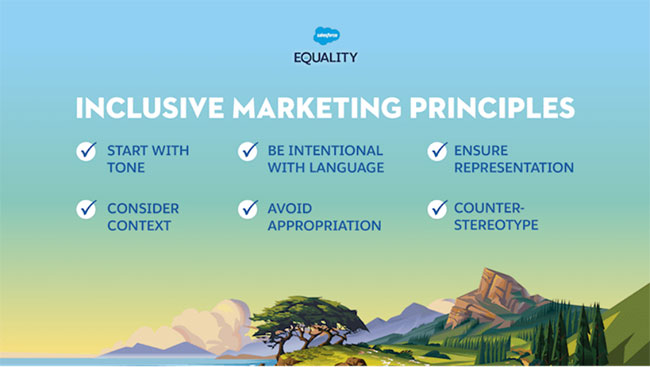
     

    Inclusive marketing principles as defined by Salesforce

    Start with Tone, & Be Intentional with Language

    Both tone and language form a crucial part of inclusive communication. While language most brands are cognizant of ensuring that the tone is respectful is as important.


    Avoid Appropriation


    Many pieces of communication made on marginalised communities miss nuance as there is only so much that research can do. Hence, ensuring that the narrative is written or whetted by people from the community is key to an authentic narrative.


    Ensure Representation

    Marginalised communities anyways have limited opportunity; hence the cast should be as close ethnically to the character as possible. A good example from cinema is the stories told by Dalit film -aker Neeraj Ghaywan who made Masaan and recently the most acclaimed short of the Netflix anthology Ajeeb Daastaans, Geeli Puchhi. Being from the community, Ghaywan’s stories have authenticity about caste and privilege unlike other narratives, because he understands the depth of the issue.


    Consider Context & Counter Stereotype

    The truth is that brands are putting forward messages about inclusion and acceptance because the audience relates. Advertising has relied on clichés and stereotypes for far too long and evolving audiences are finally allowing brands to showcase storylines, which break the glass ceiling. Brands should embrace this and stop showing a fat woman as the sidekick friend or a male boss with women subordinates. This gem from Heineken, which truly speaks to not let perception drive functioning, elucidates this point well.


    Inclusivity can help brands connect on a deeper, more meaningful level with their audiences — which can be a major asset to marketing campaigns.


    In a country like India where the landscape, language culture changes every 100 kilometers, inclusivity and acceptance become all the more important because even the most privileged Indians feel marginalised in multiple ways – the colour of their skin, height, weight, hometown, knowledge of English and umpteen others.


    I can’t tell you the joy I feel when I land up on a ecommerce website only to see models with real proportions (and I am not even plus-sized)


    However, it is imperative that inclusive marketing is not used as a crutch to prop up marketing communication, because audiences are smart. As Salesforce’s principles entail being inclusive without being representative is commercial, and audiences see through the charade, which end up being counter-productive.


    Beyond just a focus on bottom-line and hopes for virality, companies should ensure they are inclusive inside the company by applying these principles to HR and recruitment policies, and in their day to day functioning.

     

  • Time to Rejig the Content Mix?


    By Shruti Pushkarna


    Shruti PushkarnaThe only change we witnessed on January 1 was calendrical. 2020 was a washout, with bad news hitting us consistently from every part of the globe. The ghastly spread of coronavirus wasn’t the only peril we dealt with. Don’t forget the floods, cyclones, frequent earthquakes, economic slowdown following the lockdown, rising unemployment and brutal pay cuts. The only hope in sight was the promise of a vaccine roll-out in 2021. Just as we were getting ready to usher in a world capable with fighting the virus, the World Health Organisation announced that we were unlikely to develop herd immunity in this new year.


     

    On the political front too, countries are busy competing for attention. Apart from the usual blows and soap opera antics, the Narendra Modi government has been unable to placate or negotiate with the protesting farmers. And across the Atlantic, United States made history as the outgoing President Donald Trump incited supporters to storm into the Capitol and ransack offices, leading to the death of a police officer.


    I don’t think it gets any crazier. News coverage has never been so potent. The airwaves are dominated by issues that seemingly affect ‘everyone’. With the fundamental existence of every human being at stake, newsmakers have been busy chasing issues of national importance like never before. This also means that anything labeled as ‘special interest’ or ‘social responsibility’ takes a backseat.


    Unfortunately, disability-related coverage falls in the above category. The media perceives issues facing the disabled to be significant only to a handful of the country’s citizenry. Even though data indicates that fifteen percent of the global population lives with some form of disability. Add to that friends and families of the disabled. Also, the elderly who often acquire age-induced-impairment. Another common belief is that the larger political, social and economic problems have no impact on persons with disabilities.


    News is largely driven by what a select few minds deem ‘relevant’ to the majority. Needless to say, profit generation defines their decisions. Unless one of these decision-makers has any personal experience with disability, we are unlikely to see a change in what’s dished out for national consumption.


    Let’s shift focus to general entertainment. Here too, channel owners decide what sells or what type of content is worthy of mass appreciation. That’s why for years together, our choices were limited to saas-bahu drama, cheap dance and music shows and ludicrous comedy.


    Before subscription-based platforms launched in India, many of us believed the business model would fail in a market driven by cable television and piracy. But clearly we misjudged. Audiences jumped up at the idea of choosing desirable content from different genres. The market finally catered to individual interests as opposed to mass production based on banal assumptions about the target group. Restricted outdoor activity due to Covid-19 has of course taken OTT to a new level of popularity.


    Today, we live in an era where ‘content is king’. There is a market for everything and businesses targeted to a niche are likelier to succeed. The consumers are not only armed with choices but multiple (tech) devices. With squirrel-like attention spans, they are in constant search for what’s relevant at an individual level.


    Streaming services like Netflix, Amazon and Hotstar, have numerous categories such as science fiction, thriller, reality TV, adventure, crime, mythology, biopic and so on. I feel there’s a tremendous possibility of producing content on subjects like disability, or other forms of exclusion that plague the societal mindset.


    The able-bodied are unable to comprehend the challenges faced by those living on the peripheries because they don’t see or hear about it. The media can endow visibility to those who are absent from our normal course of existence. When people start seeing stories of disabled from places of education, work or entertainment, ableism will slowly begin to recede.


    Content producers have a massive influence on the general public vis-à-vis understanding of issues, people and situations. They are responsible for shaping opinions and generating curiosity.


    Are they willing to make their offerings more inclusive in light of the new content consumption patterns? Can we expect to read, see and hear all that impacts every single one of us? Can the specialized content also represent the minorities that remain faceless even in the 21st century?


    If media is a reflection of our society, then the blatant narcissism and apathy should shock us into advocating for change.


    Shruti Pushkarna heads operations of the New Delhi-based Score Foundation where she works as Director-Programmes & Communications. She is a former journalist (part of the founding team of MxMIndia) who has moved full-time to the social sector. Shruti writes for MxMIndia every other Thursday. Her views here are personal. She can be reached via Twitter at @shrutipushkarna


  • @Viacom18: Kunal Gaur to replace Utpal Das as Chief Commercial Officer

    By Our Staff


    Viacom18 has  announced the appointment of Kunal Gaur as Chief Commercial Officer. Kunal will be taking over from Utpal Das who ends his stint at Viacom18 on March 31, 2021.

    Through the past 7. 5 years, Das  led the Commercial, Facilities & Corporate Services functions at Viacom18. He was instrumental in not only shaping and leading these functions but also towards building Viacom18 into one of India’s top media networks through his role as a key member of the company’s leadership team.

    Kunal Gaur, a Chartered Accountant by qualification, has over 19 years of experience across organisations like Star India, Netflix & PWC. Prior to joining Viacom18, Gaur was a part of the Netflix India’s leadership team in the capacity of Director, Production Finance where he was instrumental in crafting budgeting strategies and leading production finance for all original series, film, non-fiction and documentaries.


    Gaur will be reporting into Rahul Joshi, MD, Network18.

  • Spending on videos to reach consumers yielded highest returns: Octane CMO Report


    By Our Staff


    Spending on video to reach consumers during the lockdown period yielded highest return on investment, said the ‘Digital 2021: Adapting to the New Normal, a report prepared by Octane Research and DMAasia.


    Octane Research engaged with 250-plus Chief Marketing Officers (CMOs) and leaders – as part of its research study to gain first-hand insights and perspective on outflanking the impact of the Covid-19 pandemic.


    According to the report, as many as 62 per cent of India CMOs said that spends on video for consumer outreach delivered the highest return on investment. “The digital industry and streaming video players like Netflix, Amazon, Facebook, YouTube and others decided to temporary default their video quality to SD. This initiative was in consumer interest to ensure better access to the internet by maintaining the robustness of cellular networks,” said the Octane’s annual state of online marketing report published on its 10th anniversary.


    The report said video continues to be the most stimulating type of content for the consumer, as well as offering maximum engagement.


    Marketers said that video-along with live streaming—gave their brands the maximum amount of customer engagement, only social media had more. It was also noted blogs and email campaigns have continued to be among the Top 5 channels for customer engagement. Promotion and updates through the use of traditional SMS is also among the Top 5.


    “Content Marketing in India has finally found its place as a separate line item on the marketers’ budgets. Online is driven through effective content management practices and we anticipate surge in this area for the 2021 Annual. Engaging new audiences emerges as the no. 1 area of opportunity for India brands,” it said.


    Video continues to be the most stimulating type of content for the consumer. It continues to offer a solid ROI (return on investment), as 61.8 per cent of our responders deploy content marketing strategies within the videos & webinars.


    The report revealed that a video for “Nutrela” titled #AcchaKyaHua, and promoted with minimal budget, managed to garner over half a million views on Facebook during the lockdown.


    “With movement of people severely limited during the lockdown and even after that, companies swiftly adopted digital mode to reach out to wider section of people, the evidence suggest that the strategy worked,” said Punit Modhgil, Chief Research Officer, Octane Research.


    The research report said about 51 per cent of India CMOs admitted having leveraged branded pages, microsites and social media handles for marketing promotions and consumer engagement. Promotional microsites allow consumers to have a quick, focused journey based on their immediate need, rather than dispersing their attention. They are also cost-effective in increasing a consumer’s engagement by promoting brand specific content.


    CMOs in India also leveraged their brand’s social media handles to actively reach out and engage with their followers. They used their Instagram and Twitter handles to showcase emerging creative talent—and commissioned select creative work to help tell the brand story. The brand ‘Converse’ ran a campaign on new ways to create progress together with consumers.


    As regards emailers and newsletters, 43 per cent of India CMOs participating in the study ranked email third in terms of impact & return on investment generated. According to Campaign Monitor, open rates for email increased by 16 per cent in March and email sends increased by 19 per cent.


    2020 is the year influencer marketing became mainstream with marketers in India and a majority of them plan to invest in 2021 in influencer marketing programs because of its high impact in driving awareness & engaging consumers. Celebrities regularly conducted “Instagram LIVE” sessions to engage their followers. In addition, a number of BFSI (banking, financial services and insurance) and e-wallet brands utilized influencers to inform consumers on how their services were relevant during lockdown. An overwhelming 88 per cent of the participants said they would be trying influencer marketing in the next 12 months as “Consumers trust what influencers say about brands far more than what brands say about themselves in their advertising”.


    Thirty-three per cent of CMOs feel they would be running seasonal campaigns on loyalty programmes and an almost equal number vouched such initiatives in the short-term.


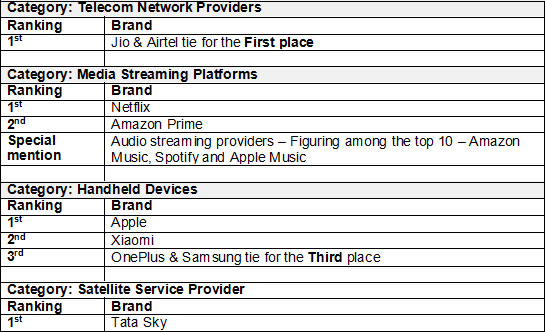
  • Jio,Airtel,Netflix,Apple,Tata Sky top Kantar CX+ 2020 TMT

    By A Correspondent


    Jio, Airtel, Netflix, Apple, Tata Sky have topped the Kantar CX+ 2020 for TMT. The Kantar CX+ report evaluates the CX performance of companies in the Telecom, Media and Technology sectors, using the Kantar’s CX+ index. CX+ is a sector-specific index to look at brands in the context of their category. It uses customer centricity as its core to evaluate CX performance of a company.


    As per a communique, the basic premise of CX+ is that brand and customer experience have become synonymous, in this increasingly connected environment.


    The roadmap to delivering a holistic experience is based on five key CX success factors:

    1. Clarity of brand promise

    2. Empowered employees

    3. Empowered customers

    4. Creating lasting memories

    5. Reinforcement of brand choice


    Additionally, the study also identifies each brand’s Experience Gap – which quantifies the difference between the Brand Promise and the actual customer experience delivered.


    The CX+ index for each brand is derived based on a combination of the CX Performance and the Experience Gap.


    The TMT study covered Telecom Network Providers, Media Streaming Platforms and Handheld Devices. In this study conducted in early 2020, clear winners emerged in each of the sectors.


    Commenting on the launch of the CX+ TMT report findings, Sushmita Balasubramaniam, Domain Lead for CX and Commerce – South Asia, Insights Division, Kantar said: “The landscape across the TMT sectors has changed drastically over the last one year. Consumers’ adoption of and dependence on digital, whether for basic everyday living, working, studying or entertainment has presented enormous challenges to companies in these sectors. And, the changes in usage of products and services will also mean that customer priorities on the kind of experience they are seeking will be different from the pre-Covid era.”


    Added Soumya Mohanty, Chief Client Officer, South Asia, Insights Division, Kantar: “In the current scenario, with tech convergence and emerging global media giants, the world will see vigorous competition in the TMT sector. This is an arena where tech credentials will become increasingly hygiene, CX will be critical. As network services providers, handheld device brands and streaming media providers, all will leverage customer data to build personalised journeys, CX and owning the relationship with the end user will become increasingly important.”


    Kantar CX+ 2020: Leaders in the TMT sector in India


    The Kantar CX+ TMT 2020 study analysed 6,000+ customers drawn from users across the sectors in India and was conducted in early 2020.


  • Bombay Fables appoints Rafiq Gangjee as CEO

    By A Correspondent


    Rafiq Gangjee

    Senior entertainment business professional Rafiq Gangjee has been appointed CEO at Bombay Fables, a writer’s company which produces films as a boutique production house. Bombay Fables recently produced Netflix’s ‘Serious Men’ and announced their next with Nawazuddin Siddiqui.


    Gangjee worked with Yash Raj Films as VP, Marketing and Communications for eight years as also Balaji Telefilms, Eros, Cinestaan and Sundial Entertainment. He also runs a consulting firm at Zabardast Communications which he started way back in 1989. He has also taught genetics at St Xavier’s College, Mumbai, being a marketing manager at a shipping company and also worked with advertising agencies (Rediff, Everest and Speer).


    Said Sejal Shah, Partner at Bombay Fables: “We are beyond thrilled and really lucky to have Rafiq on board at Bombay Fables; the new kid on the block. He has promised to bring structure and vision to our crazy ideas, and mad ambitions. Rafiq will have a tough job fulfilling all our creative dreams”.


    On this new appointment of his, Gangjee said: “We grew up listening in awe and rapt attention to entertaining fables from our parents and teachers. And now, to be a part of a kickass team, and along with them, be able to create and weave awesome fables, is a fairytale in itself. The biggest challenge and fun-thing is keeping up with Bhavesh, Sejal and Gaurav’s childlike creative enthusiasm. As they say, “Too much fun will be had by all!”


  • Dentsu Programmatic targets premium OTT susbcribers under Dentsu Play

    By A Correspondent


    In an effort to plan for activating OTT audiences from premium platforms such as Netflix, Dentsu Play partnered with sibling WATConsult  on Tata Motors and came up with a solution to target premium, behind-the-pay-wall OTT audiences on platforms outside of the OTT through integrations using first-party and second-party data partnerships.


    Ramesh Dorairajan

    Commenting on the success, Ramesh Dorairajan, Head – Sales, Marketing and Customer Care, Electric Vehicle Business Unit, Tata Motors said: “The Great Reset has highlighted several audience trends that will help us enhance our overall brand reach. The increase in OTT content consumption has transformed the way people consume content. This unique data-driven approach from dentsu Programmatic has opened up additional avenues for us to interact, particularly with the audience behind the paywall, while creating a phenomenal impact on our campaign performance as we pioneer an industry-first approach.”


    Gautam Mehra

    Added Gautam Mehra, CEO, Dentsu Programmatic and Chief Data & Product Officer – APAC: “With our industry first partnerships and integrations enabling insights from platforms such as Netflix, Amazon Prime Video, Zee5 and large players in the sector, coupled with our proprietary technology, dentsu Programmatic is proud to have unearthed a unique way to drive business success for clients wishing to target OTT audiences. Using Machine Learning at its core, coupled with intelligence from platforms such as Facebook and Google, we aspire to deliver many such industry leading solutions to common client challenges.”


    Heeru Dingra

    Sharing her views on the same, Heeru Dingra, CEO, WATConsult said: “As OTT platforms grow and evolve at an exponential rate, they seem to emerge as one of the key focus areas for brands as well as marketers. Therefore, dentsu Programmatic’s tool to effectively tap those audiences has efficiently helped us in actioning a campaign for our brand Tata Nexon EV. From targeting the right set of audiences to creating awareness about the brand and attaining the right amount of consideration, it delivered some remarkable results for the brand.”


  • What ‘The Social Dilemma’ gets right, and what it misses by a mile


    By Bhuvi Gupta


    Bhuvi GuptaUnless you have been living under a rock the past month, you have probably watched, heard and discussed the Netflix documentary ‘The Social Dilemma’, which denounces the power that advertising-powered digital media today holds over connected audiences. That you may have read about the documentary’s impact on Facebook or/ and have watched it on Netflix is of course the irony that escapes none of the documentary’s proponents.


    The documentary covers how the objective of social media networks is to maximise the time spent by users on them so that they can better profile their users and serve their customers, i.e. advertisers with better audience targeting solutions, which are for sale to the highest bidder, irrespective of whether it is fake news or diet pills that is being advertised.


    The Internet and social media have dramatically changed our lives in the last decade. There is no denying how much positive change the internet has brought with it – reuniting families, facilitating blood transfusions and donations, and currently enabling a robust WFH culture which is allowing the global economy to function during a pandemic. However, the same connectivity that has been used to bring about positive impact has been exploited to bully individuals, spread propaganda, and win elections.


    The documentary does not make any big revelations. Since the 2016 US Elections, we have consistently heard how political parties have misused social media, specifically Facebook across the world to sway public opinion.  All ‘The Social Dilemma’ does is piece together much of what we already knew, in way that it created impact and will hopefully institute change.


    The Disruptive Power of digital advertising – pro for a marketer, con for humanity

    As a marketer, who has run too many Facebook and Google ad campaigns, my favourite tool to ensure a low CPM and high CTR are the LookAlike Audiences.  For the uninitiated, Facebook and Google allow you to target people similar to an audience that you share with them. All you have to do is list some demographic and interest based qualifiers or share a database of people who have visited your website to create a ‘Custom Audience’ and the platforms generate a Look Alike audience, which behaves just like your ‘Custom Audience’. The first time you use it and see your CPMs go down, it seems like magic. It is not.  It is the power of tracking audience behavior over long periods of time, which has helped classify audiences and behaviour patterns.


    As a marketer, the ability to find such audiences, and to be able remarket to them is a dream. Digital advertising has been a gamechanger for many businesses because of its measurability. Unlike traditional advertising, where you target the masses on Print or TV media and hence have massive spillage, digital ads are shown only to potential consumers, bettering the ROI.


    The flipside is that the ease in targeting audiences, which depict a certain behavior, is the same whether the intent is noble or malicious.  As the documentary explains, incendiary elements actually exploited Facebook’s algorithm to create a hoax scare called ‘PizzaGate’ amongst gullible audiences to successfully link the 2016 Democratic party Presidential candidate, Hillary Clinton with child trafficking, and hence, sway crucial vote banks.


    It has never been easier or cheaper to sway impressionable minds. Even those not so impressionable can get swayed when served fake news dressed-up to sound authentic.


    What The Social Dilemma missed – it’s not only Social Media

    The documentary solely focused on the power of social media networks driven by algorithms which work on a trifecta of engagement of users, growth of the network & increase in advertising revenues, it missed how other platforms which are not reliant on algorithms & ads such as WhatsApp, Reddit, 4Chan have also been leveraged to spread harm via fake news and doctored content.


    This problem is gargantuan, because it has transcended the level of doctored news whose veracity can be easily verified by a simple Google search to include Deepfakes. Deepfakes are synthetic videos in which the face of a pre-existing person is replaced by someone with a high likeness to them. The quality of Deepfakes is so advanced; today that it is very difficult to make out authentic videos from doctored ones.


    Reddit and WhatsApp have both facilitated the spread of fake news and deep fakes, which have been incendiary enough to incite rioting and lynch mobs in India.


    The Monopolistic Power of the FAANG

    FAANG or Facebook, Amazon, Apple, Netflix and Google together are synonymous with the Internet for most of the 4.5 billion people online today.  These companies own complementary parts of the ecosystem and often take advantage of this monopolistic ownership to prohibit competition. While countries in the EU and Australia are instituting regulations to protect their citizens, most countries, including India do not yet have strict regulations or competition laws to prohibit monopolies for digital companies like they do for other industries. As a result, FAANG continues to control what users see on the Internet to benefit their profit objectives. Last weekend, Google banned PayTM from the Google PlayStore claiming Paytm’s IPL promotion, which was offering scratch cards and cash backs was a form of ‘sports gambling’. 95% of India’s smartphones run on the Google owned Android operating system, and hence were shut out from Paytm.  It is ironic that such a ban was instituted when similar promotions have been used by Google Pay (a direct competitor of Paytm). While Paytm was reinstated after it removed the cash back feature, given that the ban was instituted without any warning sets a dangerous precedent for the monopolistic power wielded by Google.


    Hence, adequate regulations and competition laws are crucial to protect the online marketplace.


    Content Regulation

    Unlike rigorous procedures, which govern the licensing of traditional media companies i.e. Print TV and Radio, and industry bodies such as ASCI which monitor the veracity of ads shown in Indian media, digital media has no such eligibility criteria or monitoring to check the credentials of media owners or ‘content creators’.


    While many petitions are currently running against hate speech and defamation on TV news channels, the incendiary content on digital media is going ignored. Content posted online requires stringent checks including both govt. regulations and human monitoring to manage it. Currently, YouTube employs both Artificial Intelligence and human resources to protect copyrighted content. Similar checks and balances are required before any content is posted, as systems driven without human intervention cannot differentiate between fake news, sarcasm, exaggeration etc.


    Last week, former Facebook employee, Sophie Zhang who was employed as a Data scientist released a explosive memo (link – https://www.buzzfeednews.com/article/craigsilverman/facebook-ignore-political-manipulation-whistleblower-memo) on how Facebook did not attempt to stop coordinated campaigns by political parties to sway public opinions and incite civil unrest in countries ranging from Azerbaijan to Myanmar, because their attention was focused on markets which yielded higher revenues for them. The memo brought to the fore many of the problems highlighted by ‘The Social Dilemma’.


    While I do agree with ‘The Social Dilemma’ about individuals taking ownership and governments making regulations to monitor these platforms, I believe that the platforms themselves need to step up to regulate the content allowed on their platforms to both stem their misuse and ensure their long term survival.


    Bhuvi Gupta is a marketer with over 10 years across industries, of which the last six have been in Media & Entertainment. She has been a part of many launch marketing campaigns – specifically at the Times of India group, Republic TV and the latest in marketing a Bollywood film. She will write on A&M (mostly marketing, but often on advertising too) every other Tuesday. Her views here are personal. She tweets at @bhuvigupta3


  • The Most Successful OTT Brands of the Decade


    This is the third in a series of six decade-ender lists in this column by Shailesh Kapoor. The previous lists:

    The most-defining Hindi TV shows of the decade

    The most-defining Hindi films of the decade


    By Shailesh Kapoor


    The OTT category in India saw a major boost in the latter half of the decade, especially 2017 onwards. From a handful of originals and OTT platforms that you could count in single digits, the category took off with the arrival of Netflix and Amazon Prime Video in India. In 2019, more than 100 original OTT shows launched in Hindi language alone. Add regional content, sports, movies, animation etc. to it, and you know that the end of the decade belonged to OTT.
    Ranking “successful” brands in an emerging category can be tricky. This list is based on impact created in the Indian market, both from a content and a marketing perspective. Social media brands have not been considered, and special mentions are due to regional players like Hoichoi, and niche players like FilmCompanion and Ullu, for managing to find a strong need gap and catering to it.


    5. ALT Balaji

    Balaji’s entry into OTT category in 2017 made it one of the earlier entrants. It took ALT Balaji some time to get going, and it can be argued that the launch of the more premium services like Netflix actually helped ALT Balaji position itself as “mass” and more mainstream, especially for the non-metro markets in India. The platform has relied on quantity, launching shows every other week, and Gandii Baat, which explores the erotic genre from the small-town/ rural lens, is arguably its most successful show till date. When compared to other platforms that didn’t make it to this Top 5 list, like Zee5, Voot and Sony LIV, ALT Balaji’s run is impressive, particularly because it did not have much GEC catch-up content to provide an early cushion.


    4. Netflix

    It’s difficult to split Amazon Prime Video and Netflix on rank. Netflix is clearly the more niche of the two, operating as a standalone content service at a much higher price-point than Amazon. When Netflix launched, its price-point was seen as prohibitive by many. It took some time for Netflix to customise, and the launch of the Rs 199 mobile-only service in 2019 was a sign that they are willing to adapt to the unique rules that the Indian market can demand from global players. Netflix’s content strategy has been to focus on less but high-quality content, though some of their 2019 India shows, such as Sacred Games 2 and Bard Of Blood, fall short of that high standard. The platform’s imagery, however, remains strongly associated with high-quality international content, and that’s a sub-genre in which it’s a clear leader.


    3. Amazon Prime Video

    Amazon Prime Video’s launch in India was in line with its global strategy to create content to fuel the retail business through content engagement. Compared to its competitor Netflix, Amazon’s OTT strategy in India relies on higher number of big-ticket launches and more aggressive film acquisitions. Through Mirzapur last year and The Family Man this year, the platform has managed to create top-end Indian content, which puts it in a very credible space as we enter a new decade.


    2. TVF

    TVF (The Viral Fever) is the only content creator in this list of OTT platforms. Being the early innovators (remember Permanent Roommates and Pitchers), TVF had its OTT moments much before the big players came. Some argued that TVF would fizzle out as big budgets come into play, but the platform continues to be amazingly consistent with its quality, and this year’s Kota Factory is the latest testimony to that. Having addressed a definitive segment of the urban Indian youth, especially men, TVF is in a rock-solid position to be the most-sought-after content creator in the new decade.


    1. Hotstar

    Hotstar came before everyone else, in early 2015. And with each passing year, the Star-owned platform has managed to stay ahead of the OTT evolution curve, especially in the area of marketing. Taking IPL digital rights, even before Star had the broadcasting rights, was a clear indication that Star meant business with Hotstar, and this year has seen a lot more action to support that line of thought, with the launch of the VIP service and Hotstar Originals. In the new decade, Hotstar will have to do a bit more to more away from its image of being primarily a catch-up TV and digital sports platform. But that work has already started, it seems.


  • Netflix to partner Viacom18 Studios for three originals

    By A Correspondent


    Netflix has announced three new original series in partnership with Tipping Point, the digital content arm of Viacom18 Studios.


    The series are helmed by some of India’s finest storytellers, notes a communique.


    Said Monika Shergill, Director, International Originals, Netflix: “We believe that great stories can come from anywhere and be loved everywhere. It’s exciting to partner with Viacom18 Studios and take these gripping stories to our members across India and the world. We can’t wait for fans to discover these beautifully crafted, well-produced series made by passionate and incredibly talented teams.”


    Commenting on the partnership Ajit Andhare, COO – Viacom18 Studios, added: “I am delighted to partner with Netflix to debut Tipping Point’s series to the world. Each series is motivated by a film-scale mindset, honed over many years at Viacom18 Studios. We look forward to these distinctive series, with our trademark narratives, entertaining audiences in India and around the world.”


  • The Big OTT Growth Story: Chapter 2


    This is the second in a series of columns by Shailesh Kapoor on the OTT Growth Story in India. Click here for Chapter 1.


    By Shailesh Kapoor


    It’s raining OTT show launches. Over the last few weeks, about two-three major and another five-six minor OTT shows have been launching every week. At this rate, the number of OTT shows that launch in 2019 will be higher than the Hindi GEC shows launched over a five-year period (2015-19). And you may not be wrong in believing that this is just the start, and things can only get more exciting from here.

    While the launch rate has accelerated significantly in 2019, it has been accompanied by a parallel improvement in the quality of content too. Till last year, among the many OTT shows that launched, only a couple would pass muster on quality. Most of the shows that won audience appreciation were from the TVF stable. ‘Quantity over quality’ seemed to be the OTT mantra.

    While that mantra continues to hold true for the second line of OTT players in 2019, there has been a significant jump in the quality of the top shows in 2019. If we look at the Ormax Advocacy Score (a measure out of 100 on how well-appreciated a show was among the audience who watched it), 2019 has some strong candidates in the reckoning.

    November 2018’s launch Mirzapur (Amazon Prime Video) continued to get audience appreciation early this year. Then came the deliciously compelling Delhi Crime (Netflix), which continues to grow its audience base till date, six months since it launched in March.

    The big success of the year, however, is a somewhat low-profile show Kota Factory (TVF). Presented in Black & White, this funny and insightful series on the student life in the education hub Kota has received widespread acclaim from young audiences, become the third-most liked Indian OTT show till date on the Ormax Advocacy scale, after Sacred Games (Season 1) and TVF Pitchers.

    Another potential top-end show dropped last night: Amazon Prime Video’s The Family Man. The unusually-textured spy thriller cum family drama stands apart from the dark and gritty world that shows like Sacred Games and Mirzapur espouse.

    However, all good things come with a word of caution. Almost 80% of OTT shows that have launched still have an Advocacy Score below 50, symptomatic of active audience dislike, even rejection. Many of these have been actively promoted by the respective platforms, indicating that the platform sensed good potential in them. So, even though the top-end has become stronger, the success rate may still be a mere 15-20%, or even lesser. Quantity may still be prevailing over quality after all.

    The Top 10 Hindi films of 2019 based on audience advocacy (word-of-mouth) average at a staggering Advocacy Score of 73. The equivalent number for the OTT category in 2019 is only 60, which is only a notch higher than the Hindi GEC category average of the year. And the Hindi GEC category has not exactly been in the pink of its health in recent times.

    A long tail of flop shows will continue to be churned out in a category where everyone wants a share of the pie. 2019 has been good so far in providing a strong top layer of quality content. This layer now needs to expand from three to four shows to 10-15 shows a year. And 2020 may just be the year to achieve that.


  • The Great Digital Displace


    By A Correspondent


    Digital streaming brands have turned the latest industry ranking by Brand Finance, the world’s leading independent brand valuation consultancy, on its head. Testament to their power to disrupt status quo, digital platforms have claimed five out of 25 spots in the league table, with two brands – YouTube and Netflix – jumping straight onto the podium behind Disney – the industry’s unchallenged leader. As a result of the rise in popularity of on-demand streaming, enjoyed by viewers who no longer need to rely on fixed cable television schedules, most traditional network and studios brands have felt the pinch, sliding down the ranks.


    Online heavyweights YouTube and Netflix have claimed second and third position in the ranking respectively. The last year has seen YouTube’s brand value swell to US$37.9 billion, up 46% from 2018. Meanwhile, Netflix more than doubled its brand valuation reaching US$21.2 billion this year, with its record 105% growth unmatched by any other Western media brand. Alibaba’s Youku (11th) and Baidu’s iQiyi (17th) as well as the Swedish audio-streaming app – Spotify (20th) – have also joined the Brand Finance Media 25 ranking for the first time.


    Competition from online providers has had a marked effect on traditional broadcasting outlets, as one in two of the ranking’s incumbents have either lost brand value or seen meagre growth in the past year. The digital revolution has taken its toll on both sides of the Atlantic, with UK-based BBC (brand value down 9%), Sky (up 2%), and ITV (up 5%), as well as ABC (down 41%), Fox (down 6%), and NBC (down 3%) in the US struggling with the challenge posed by new players in the sector.


    Commented David Haigh, CEO of Brand Finance: “Digital streaming platforms have revolutionised home entertainment, as they are better able to adapt to the needs of modern consumers seeking on-demand and advertising-free content. As customer preferences evolve at a faster pace than ever, the new platforms will need to continue to build relationships with consumers to stay ahead of the curve”.


    Disney’s dreams come true: Unchallenged by newcomers, Disney maintains its position as the world’s most valuable media brand, following an impressive 40% rise in brand value to US$45.8 billion.


    Over the last year, Disney has undertaken several strategic acquisitions in a bid to stay ahead of its competitors. Disney’s acquisition of Star India was an integral move to gain a foothold in the Subcontinent, which is currently the second-largest subscription TV market in Asia. The brand, which already owns a 60% stake in Hulu, is due to take full control of the service imminently, further demonstrating Disney’s pursuit of greater international exposure and dominance within the sector.


    In March 2019, Disney acquired 21st Century Fox for an eye-watering US$71 billion, in preparation for the launch of its own streaming service, Disney+, later this year. Disney now holds the rights to Deadpool and the Fox-owned Marvel characters, to add to its ownership of Pixar’s intellectual property and the Star Wars franchise.


    These purchases have placed Disney in a strong position within the digital streaming media landscape. At US$7 a month, its Disney+ subscription fee is going to be half the price of HBO Now and cheaper than Netflix, which raised its fee by US$2 in January 2019. These factors are set to place the brand as Netflix’s strongest competitor even before the official launch of Disney+.


    US brands dominate ranking: US brands account for 9 out of the top 10 and claim an impressive 18 spots in the Brand Finance Media 25 2019 ranking. Traditionally reliant on the Hollywood powerhouse and the reach of the network giants, the US is now staying ahead of the game thanks to digital players from Silicon Valley.

    However, the nature of the technology behind the digital disruption of the media market makes it easier for brands from other countries to break into the market. As the examples of Youku and iQiyi demonstrate, Chinese media brands may give the US monopoly a run for its money in the coming years. A further challenge can come from European start-ups such as Spotify.


    iQiyi is fastest-growing: With a whopping brand value growth of 326% to US$4.3 billion, iQiyiis not only the fastest-growing brand in the media sector, but across all categories in the Brand Finance Global 500 2019 report. As China’s answer to Netflix, iQiyi hosts over 500 million monthly active users. Recent reports of the brand setting its sights on China’s US$9 billion box office, suggests further rapid expansion over the next year.


    Disney-owned ESPN is strongest: Aside from calculating overall brand value, Brand Finance also determines the relative strength of brands through a balanced scorecard of metrics evaluating marketing investment, stakeholder equity, and business performance. Alongside revenue forecasts, brand strength is a crucial driver of brand value. According to these criteria, Disney-owned sports channel ESPN is the world’s strongest media brand with a Brand Strength Index (BSI) score of 88.9 out of 100 and a corresponding AAA brand strength rating.

    Following some instability over the past couple of years, resulting in the brand’s previous President, John Skipper’s, resignation, ESPN’s strength on the global media landscape has once again resurged. The appointment of new President, Jimmy Pitaro, in March 2018 was a clear sign of the brand’s intent to modernise and marked a shift in its operations. Most notably, the brand launched ESPN+, its streaming service, which hit the one million subscribers mark in under six months. More recently, the network has partnered with the National Women’s Soccer League for the FIFA Women’s World Cup, streaming 14 games live on the ESPN app, exposing the network to 25.4 million domestic viewers.