Tag: Narendra Modi

  • Can the NaMo magic work for the BJP?


    By Johnson Napier


    The Congress party in India may have been doing all it can to stay away from the negative noises created by Opposition. Led largely by the BJP, the foes from the other end are leaving no stone unturned in making sure that the Congress faces its toughest test yet as the country heads into election mode in 2014.


    While this may have been a daunting task until five years ago, led by the man of the moment, Narendra Modi, the BJP is set to face the task ahead. After silencing his critics and assuring his huge fan following that he has what it takes to rule the country with an iron fist, the NaMo chant has been growing louder as the days pass.


    The immediate impact of his appointment as head of the BJP’s election offensive was the resignation of party leader LK Advani and the consequent withdrawal of the same. But with news of infighting and internal differences being the order of the day, the picture may not be as rosy as it seems. MxMIndia spoke to a few professionals who have been associated with image-enhancing initiatives or track the way politics is run in the country and presents the viewpoints.
     

    Sushil Pandit

    Sushil Pandit, Director & CEO of Hive Communications, which has done campaigns for the party in the past, sounded optimistic as he said that Narendra Modi has today emerged as a locomotive for the BJP; the engine for the party’s growth and acceptance. “He represents the best of BJP – its potential, its performance and credibility. He brings a lot of incremental approval to BJP’s existing support base. So brand Modi complements brand BJP and is all set to propel it much further from where it is today,” he said.


    Highlighting the game-changing dynamics being witnessed, Mr Pandit asserted, “Today, a whole host of key determinants have changed in Indian politics including the way the youth of today perceive the leadership, their aspiration, their demand, their definition of what kind of a leader they expect…it has risen far above from the earlier narrow consideration of dynasty, caste, etc and has focussed more on the performance aspect and what is possible. Narendra Modi therefore has emerged as a huge force in converting such aspirations into approval and work for the party.”


    According to him, with a year left before the elections in 2014 there is a great deal of hope and a lot of fervour amongst the masses – factors that should see the party through in the 2014 elections.
     

    Sanjay Mehta

    Sanjay Mehta, Founder & Joint CEO, Social Wavelength, put forth a prudent outlook for the party as he said that the happenings at BJP are a natural outcome of a major change. He affirmed, “It was always suspected to be a challenge for Narendra Modi to move into top position, and be the party’s PM candidate, given his legacy in Gujarat, from 2002. That over the years, he has managed to create a change in the manner in which he is perceived and reached a point where the party sees their best hope in projecting him as their leader, is a huge achievement.” Adding further he said, “In the face of this, to enable the change from the old to the new, and one which is largely acceptable within the party, still has its share of friction, and the Advani resignation etc. are a part of that. All these are an integral part of Indian politics and I do not believe that these impact the party’s brand image to a large extent. It is unlike major corruption or other scandals that have plagued parties too in recent days! More importantly, this has happened several months before the elections,” he reiterated.


    Presenting his stance on the impact being created on brand BJP, Mr Mehta highlighted, “What I hope is that the short-term impact on the BJP brand will not affect the longer term prospects. Assuming that the necessary compromises are made within the party, and thereafter, as a whole, the party is willing to position Modi as their leader, unanimously, that is a strong plank for the party to take forth, into the 2014 elections.” But sounding a word of caution, Mr Mehta said that with LK Advani taking back his resignation, “the only fear is that closer to the elections, he doesn’t again raise his ambitions for the PM position, and create a ruckus then. If that happens, it will hurt BJP much more than the current hiccup.”
     

    Harish Bijoor

    Not holding back his thoughts, brand consultant Harish Bijoor of Harish Bijoor Consults Inc. was forthright as he said, “I do believe brand BJP is hit for sure. The hit is seen clearly in television footage of the leaders of the party and their really overtly saddened faces. This is not good for morale.” However, Mr Bijoor does believe that this is a temporary setback. “The party will bounce back with vigour after the dust settles and the old guard has given way to the new. Modi is a brand man in reality. He is a very savvy leader who uses every modern tool there is in branding. I do believe he will revive the morale for sure.”


    Knowing what it takes for a brand to enhance its image offering, Sridhar Kondiparthi, Chief Creative Officer – India Sub Continent of Leo Burnett asserted that everything that is happening within the BJP and RSS, including a sulking Advani, will only benefit the BJP and Narendra Modi. But sounding a caution, Mr Kondiparthi said, “A reluctant old guard will have no sympathy with the younger voters; India wants a younger and more ambitious leadership.”
     

    Naresh Gupta

    While it is still early days, there is a lot at stake for brand BJP for it to win back the confidence of the masses. It could begin by getting its basics about branding itself right. As Naresh Gupta, Managing Partner, Bang in the Middle, asserts, “Elections and political branding are a bit different from usual brands and consumers do consume them differently. The perceptions are transient and a lot depends on how the competition plays the game. Currently it is affecting the brand. The controversy is not adding to the appeal of BJP. What matters now is what does the market do?”


    As for the way ahead for the party, Mr Gupta affirms, “The elections are still some time away and we can’t say what may happen by then, though going by what’s happening now it will strengthen the brand in a small core but weaken in large potential audience.”


    Mr Gupta may be critical of the party’s success as yet but for the ardent believers of brand NaMo, also the driving force behind brand BJP as of now, the moment certainly seems to be favourable for it to make an impression in the minds of the people.
     

  • Upclose with the NaMo chronicler


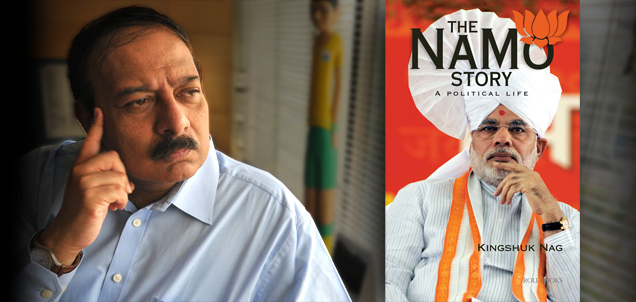
    This month Kingshuk Nag completes 20 years with The Times of India. Many of these have been rather eventful, albeit in a sad way. As Editor of the Hyderabad edition he’s seen the current Telangana crisis and the Satyam fraud unfold and earlier as Editor of the Gujarat editions having been based in Ahmedabad from 2000-05, he witnessed the earthquake and communal tensions after the Godhra carnage. His book ‘The NaMo Story – A Political Life’ has been receiving rave reviews for a balanced account on the the politics and persona of Narendra Modi.


    Mr Nag’s book – his third, the first two being on Satyam and Telengana – was launched in Mumbai at the NCPA on Monday along with a panel discussion hosted by publishers Lotus Roli, the NCPA and Literature Live.


    In this exchange with MxMIndia, Mr Nag is candid about why it took so long for him to write the book, his views on the Gujarat strongman and whether he thinks the CM can be PM


    It’s been a while since you moved on from Gujarat, and Narendra Modi has been in the news all these years. Of course now the stakes are higher given his being a Prime Minister-in-waiting. What took you so long to write the book?

    My first attempt to publish a book on Modi was in 2002 right after the riots. I met a publisher, a leading one, with a chapter that I had written.  The publisher, the lead man who was also the owner read the chapter and said it was great.  But he said he wanted a pro-Modi book written because Modi was being bashed too much. Disgusted I left. I had no experience in book writing so I did not persist.  Three years later I was introduced to the chief editor of one of the top publishing firms. We started talking. I gave him a concept note and chapterization. After a while the guy got back to me and said no this book will make a hero out of Modi. I don’t want it. It was in my third attempt in 2011 did I find a publisher. That’s the reason for the book taking so long.


    What reviewers say
    Definitive must-read book: Ranjona Banerji in Sunday Mid-DayShort and balanced account: Rohit Bansal in Gulf Today


    You’ve watched him up-close when you were in Ahmedabad, editing The Times of India. Do you see a difference in Mr Modi from then to now?

    The basic character of the man has not changed. But after having said that today he is a far more confident man than what he was ten years ago. His body language shows that. His lean mean frame has undergone a metamorphosis. He looks visibly more prosperous. He is today more authoritarian than before. However, it is a fact that he is less inviting of the press than he was a decade ago. That’s because of the riots and Modi is ill at ease answering questions about 2002. So he is apprehensive of media interviews especially meeting national mediapersons.


    So did you interview him again for the book?

    No, I did not interview Modi again.


    In an attempt to be neutral, have you gone a little soft on Mr Modi? Given that your personal views on the CM (especially when you were editing TOI in A’bad) were reportedly dramatically different.

    I don’t think I have gone soft on him. It’s that the context has changed. If I had written the book in 2002 it would have been on the riots.  Since it is written now in 2013 it focuses on the national politics and politics of Modi rather than the riots.  A lot of people are finding fault with me for not writing more on the riots. They are accusing me of diluting my stand but I don’t agree with them.


    Having watched NaMo from close quarters and now from a distance and ditto with the media, do you think the media has changed its stance towards Mr Modi.

    Over the years, the media has become less strident about Modi though the opposition remains. That is because with the passage of time, priorities change. Also, due to efforts of NGOs and the action of higher courts, justice has been done in many riot cases.  Many people are happy with the justice done though Modi may not have been instrumental, for this they are satisfied. Also, with stories of rampant corruption emanating from the centre, Modi is seen in a less negative light . Further, the stories of rapid development of Gujarat have gone a long way in enthralling that section of the media that represents the dream of aspiring India.


    After Gujarat you’ve also seen a leader like YSR in Andhra Pradesh (as Editor of TOI, Hyderabad). YSR’s reign was cut short, but how would you compare the two regional leaders?

    Modi’s strategy in Gujarat has been to create a vote bank or rather to coalesce the votes using Hindutva as the glue. The strategy of YSR was different. He created a vote bank by giving out doles and everything free to the poor and not so poor by classifying them as poor. He gave free power to farmers. Rice at Rs 2 a kg, free scholarship to poor students, free houses to the poor, free medical facilities to the poor… even for operations. 85 per cent of the population got the benefits because of the manipulation of government statistics.


    Your view on all the hype and PR around Mr Modi… Vibrant Gujarat, hiring of a public affairs firm like APCO? Has it helped change perceptions about him.

    Modi realised that the riots had dented his image started wooing industry by giving unparalleled incentives. An essential part of the strategy is to create a hype about investment prospects in Gujarat and the guy who leads the state. Sometimes the hype is so unreal as if Modi is some superman. The hype has changed public perception because a lot of people believe that Modi is a great administrator. Also, remember, that the people are fed up with corruption and are looking for change. Modi is offering himself as the change like Anna Hazare two years ago. Whether the country will accept him as the change is a moot point but right now many find him acceptable


    Have you had a launch event in Ahmedabad?

    No launch event in Ahmedabad.


    Why not? Mr Modi is said to have this army of damn-the-critics brigade. How have they been with you post the book?

    No particular reasons. Actually the book was never launched officially.  Only yesterday in Mumbai, although the book has been in the market for a month and a half.  Modi’s men have not been in touch with me. But I heard that the book was spotted on his table.


    Three rapid-fire questions:

    1. Narendra Modi v/s Rahul Gandhi. Your choice:

    a. Can’t say.


    2. In the run-up to the 2014 elections, your view on whether Narendra Modi will apologise for Godhra and its aftermath?

    No


    3. Do you see Modi as Prime Minister?

    As PM: No


    The Namo Story – A Political Life

    by Kingshuk Nag

    Publisher : Lotus Roli

    Paperback, 200 + 8 page insert pages

    Price: Rs 295


  • Anil Thakraney: The Feku/Pappu tamasha

    By Anil Thakraney


    Two stories from last week caught my attention. One, as the battle of Feku (NaMo) and Pappu (RaGa) got raging on the social media, with both their followers (many of them fake) getting into a mudslinging match, the television media got busy discussing the social media’s impact on politics. On whether all the fan following (or hatred) on Twitter will affect the fortunes of the netas in the next elections. Well, all they had to do was ask me, and save themselves a lot of precious airtime. The answer is a big NO. And I don’t say that because a vast majority (over 95%) of Indians aren’t connected on social media, that would be the obvious explanation.


    I say that because a vast majority of those who are, are likely to be from the Great Indian Middle Class. The class that cribs heavily but never goes out to vote (me included!). The kind of people who have opinions on politics but don’t wish to engage with the process. These people are having fun on the internet, and all they want to do is outsmart each other on the ‘retweet’ value, have a good laugh, and then forget all about it. The people who will actually queue up to cast their votes will, as usual, come from the lower or very lower classes. They have no interest in the social media chatter, they give a damn about who tweeted what. They will vote for the same reasons they always vote: Regularization of their bastis, a new bore well, electricity connection, etc. And they will vote keeping caste, religion, language, etc, in mind.


    In short, enjoy all the outpouring on the internet. It’s fultoo time pass, and nothing more.


    The other story was that ‘super exclusive’ on Times Now. Which involved bowler Sreesanth giving the channel a soundbite, which had him ranting about the ‘Slapgate’, an incident that happened five long years ago! What was funnier was Arnab babu excitedly announcing that ‘this is the biggest cricket controversy’. Wow, Mr Goswami, you call a slapping incident post an IPL match a bigger controversy than the assorted match fixing scandals? Anyway, Sreesanth is upset it’s still being called ‘Slapgate’, he claims he was never actually slapped. Apparently, our man was struck by Bhajji, with the latter using the back of his palm, and not the front. Therefore, according to Sreesanth, that can’t be called a slap. Haha. Two things: One, Arnab babu needs to dig harder for real stories if trash like this is getting him fired up these days. Two, mental Sreesanth needs urgent help.


    ***


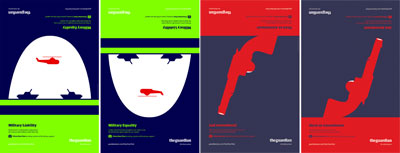
    PS: Interesting campaign by The Guardian for its US launch. Using graphic design, each ad puts out two sides of a heated political debate. The flip side of the ad reveals the flip side of the argument, so to speak. Fantastic work by the art director.


  • Anil Thakraney: Full On Modi Mania!

    By Anil Thakraney


    So, mota bhai has decided to emerge from his Gujarat hideout for a Bharat Darshan. Modi has sniffed a golden opportunity of becoming the nation’s PM in 2014, and is therefore on a media feeding frenzy. No medium is being spared. Conferences, seminars, TV interviews, Twitter, 3D holograms, it’s all happening. And I think he’s doing the right thing at the right time. The janata is maha fed up of UPA’s assorted corruption scandals, and the BJP does have a chance to get back into power, provided, of course, they can hitch up support from regional satraps, and that’s not going to be easy.


    The 360-degree media blitz will not just get Modi quick national attention, it will help him crash Advaniji’s perpetual dream of becoming PM (as also the hopes of other BJP contenders). Once Modi positions himself as the Next Big Thing (which he’s very busy doing), it will be impossible for the BJP to nominate someone else.


    Even better news for the controversial neta is that the media fully reciprocates the love and affection. This is because Modi is a colourful character, a cool orator, and you can be assured of wicked soundbites. In complete contrast with his arch rival, Rahul baba, who’s a huge bore. This attracts journalists to the man like bees to a beehive (Oops! Politically incorrect metaphor, hehe). There’s another reason for the media’s lust for Modi, and I can say this as a journalist: I think each reporter/anchor is secretly hoping that the much demanded and much awaited apology to the Muslims will happen on his/her channel/portal/newspaper. Well, that apology isn’t coming anytime soon, but it keeps the journos on their toes. And I am pretty certain the clever Gujarati leader is aware of this, and is using it to his full advantage.


    Also, luck seems to be running on Modi’s side; Shri Jagdish Tytler, the face of the 1984 anti Sikh riots, is here to help mota bhai’s cause. With the case reopening now, the Congress’s 2002 anti-Modi strategy gets instantly negated. So, expect a Modi media blast right till the next general elections. Of course, whether it will convert into votes, and the PM’s job, is another story.


    ***


    PS: This is not for the attention of Narendra Modi, he already knows how to handle the press. But every stuck-up, self-obsessed Indian movie star and celeb should watch this video. This is Jennifer Lawrence at a press con, soon after winning the Oscar. Witty, charming, disarming, natural. That’s the way to go, people.


  • Anil Thakraney: CEO Modi

    By Anil Thakraney


    In an earlier post, I have matched Brand Rahul with Brand Modi. The television media has only got into the act now, so this should tell you the internet is the medium of the future. But Modi’s speech at the Delhi college gave us an insight into why the corporate honchos adore this man. By the way, I was watching the speech live, and out of curiosity, surfed all the news channels. And found that every single one was fixated on Modi, except for DD News, which was dutifully recycling an ancient Manmohan Singh speech. Sigh! Guess some things never change.


    Anyway, on to Motabhai’s talk show. This wasn’t a political neta speaking. Modi’s speech was a full-on sales pitch by a businessman. It had all the elements in place: Furious marketing of the state of Gujarat, which Modi treats as his personal portfolio. A clear vision for future growth. A tangible business mantra: Speed, Scale, Skill. A positive outlook to the future. And an extremely competitive pitch… he missed no opportunity to tell you why Gujarat (his brand) prospers, while the Rest of India (the brand he wishes to own) has lagged behind. It’s well known that Modi goes out of his way to welcome the Tatas and the Ambanis to his state, and therefore the industrialists never fail to pay him compliments. But after listening to him, I realized that Modi is more a dhandhewala than a neta, which explains his corporate fan following more accurately.


    And that’s a good thing for this nation. We desperately need a leader who can think big, and who has the ability to get work done. A man who operates likes a CEO. Look at the mess that’s happening in Mumbai in terms of infrastructure, and you will understand why Modi is blue chip stock. The Scale is missing, Mumbai is still planning flyovers, when the metro rail should have covered the entire city decades ago. The Speed is missing, projects go on for years and years. And sadly, even the Skill is missing, people keep dying every other day under falling debris. And potholes magically appear on freshly minted roads.


    In short, Officer Modi’s time has come. Now only if he adds one more ‘S’ to his 3S mantra, he’d definitely be PM in 2014. And that ‘S’ is a big ‘Sorry’. To the Indian Muslims.


    ***


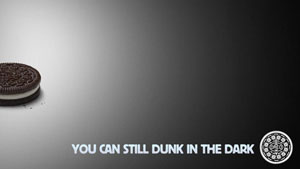
    PS: Brilliant! There was a power cut at the Super Bowl for a few minutes. As most fans (and brand managers) were left groping in the dark, the Oreo guys swung into action. And quickly came up with this winner. Smart work. This sort of on-the-feet thinking you have to admire.


  • Anil Thakraney: Brand Modi versus Brand Rahul

    By Anil Thakraney


    Human beings are brands too. The same principles of product quality, marketing effort, positioning and consumer image apply. Which is why we must evaluate them in terms of pure marketing logic. Today, let’s take up the case of Brand Gandhi Junior and Brand Narendra Modi.


    Brand Modi is a powerful brand, and we already know that. Consumers are crystal clear on the positioning, and the brand consistently delivers what it promises. Brand Modi primarily appeals to the emotion, and backs that up with rational logic. The ‘Hindu Fighter’ image appeals to the majority in the state of Gujarat. And for the fence-sitters, it’s the ‘development’ platform that works. In that sense, Brand Modi is perceived to be a complete brand. Therefore even if the rest of India does not favour the primary image of this brand, the saleability increases on account of the secondary promise. This dual positioning will be of immense value for Brand Modi in 2014. What makes this brand even stronger is its charismatic personality, which is supported by aggressive marketing and promotion. Consumers like to be associated with the brand, and this further strengthens saliency.


    In short, a clear market positioning, consistent delivery, powerful brand values and a huge consumer connect. Clear winner.


    The case of Brand Rahul is the exact opposite. There is no perceptible brand positioning, therefore the consumer is unclear on what it stands for. What makes things worse is that the house from which this brand emanates, its USP, has lost saliency over the years. In addition, Brand Rahul seldom gets promoted in the market place, therefore consumers are kept in the dark on its efficacy. And no one puts money on an ‘enigmatic’ brand, unless it’s a top-end perfume. In addition, on the few occasions Brand Rahul has been made visible in the market, its performance has been a disaster. Therefore, the brand connotes negative values.


    In short, vague brand imagery, lack of product performance and poor marketing effort. Clear loser.


    So if the battle of 2014 is going to be fought between these two brands, simple marketing logic tells us who’s the favourite one to win. Unless, of course, Brand Rahul does a complete turnaround in the coming period, and I doubt that’s going to happen. It’s a hopeless brand.


    ***


    PS: Incredible stuff. It’s impossible to believe these are illustrations, not photographs. Now this is art I truly adore. Hope to find such talent in India… imagine the millions of rupees advertisers can save by avoiding over-paid photographers.


    Link: http://www.creativebloq.com/illustration/realistic-pencil-drawings-11121172


  • [MJR] The Modi merry-go-round continues

    By Ranjona Banerji


    As expected, the release of the report by lawyer Raju Ramachandran into Gujarat chief minister Narendra Modi’s role in the 2002 riots got TV channels into a frenzy. Having whipped themselves up over the “clean chit” given to Modi by the Special Investigation Team, the indictment of the chief minister by the “friend of the court” provided just the kind of contradiction that Indian TV thrives on.


    However, the arguments for and against Narendra Modi and his “crimes” or his “achievements” have become old and tired. As have the panellists. There on NDTV was Jainarayan Vyas putting up a stout defence of Modi. And, of course, a short while later he was on Times Now. Kumar Ketkar, editor of Divya Marathi provided the objective line – while slamming Modi for his well-documented anti-minorities stance – also appeared on both.


    But at the end of the day, little is achieved with such debates. The BJP and Modi’s fan club spew their spiel. Modi’s detractors have their own. The debate moves along predictable lines. The events have become so far away that the details have been forgotten which leads to even more chaos. Both Nidhi Razdan and Arnab Goswami had a tough time controlling some of their panellists who as usual forget all rules of civilised behaviour once a TV camera is turned on them. Smriti Irani of the BJP, for instance, gave us ample proof of how she can now graduate to the “saas” role in a poisonous soap – if they still have them on TV that is.


    (A disclaimer: I was deputy resident editor of The Times of India, Ahmedabad, from 2001 to 2004 and have a fairly good idea of what happened during the riots. Watching people who were nowhere around in those dark days holding forth can be both a frustrating and amusing experience.)


    * * *


    The big TV event of the week is of course the first episode of actor Aamir Khan’s Satyameva Jayate on the Star channels and DD. He dealt with the contentious and emotional issue of female foeticide and India’s skewed gender ratio. It was a well-researched show, with the subject presented from various angles and certainly struck a chord with the audience. The cyber world went gaga, judging from the number of tweets about the programme. Newspapers the next day were also congratulatory.


    If there was criticism – especially on Twitter, the home of manufactured outrage – it was about whether female foeticide was such an unknown problem after all as well as whether any change would happen as a result of the show.


    It is amazing to hear journalists talking about whether social change can result from media efforts, since we know from our own experience what a slow and pain-staking experience that can be. Your 140-character aphorism may take seconds to go out to the world; change on the ground takes a tiny bit longer than that.


    * * *


    An evening at the Mumbai Press Club was a great opportunity to meet up with former colleagues and old friends. The now annual awards for journalists in categories from crime and cricket to politics and the environment is a very good idea. Giving the lifetime achievement award to Vinod Mehta was a winner – since he promptly said that working in Bombay (as it was then) were the best years of his life!


    Applause all around.


  • SIT’s report makes for exciting TV but bad journalism

    By Ranjona Banerji


    The Special Investigation Team as appointed by the Supreme Court to look at the involvement of Gujarat chief minister Narendra Modi in the Gujarat riots of 2002, particularly with reference to the Gulbarg society case has submitted its report. The report is still in sealed cover. But television spent half of last week going to town over the “clean chit” given to Modi and promptly a number of TV debates were held.


    The BJP, quite relieved to get a break from the behaviour of its ministers in Karnataka, sent out its publicity army in full force. TimesNow insisted that it had exclusive “leaks” from the sealed report while every other channel had their “sources” who told them what was in it.


    Newspapers, however, were forced to be more circumspect, although Times of India did initially blow up this “clean chit” – ironically on the same day that it headlined the slamming of Modi by the Gujarat High Court over his government’s inaction during the riots.


    By Friday morning, newspapers decided to wait for the actual report even as beleaguered BJP spokesperson Nirmala Seetharaman was begging channels to wait for the report. Some like Swapan Dasgupta and Yatin Oza were happy to jump the gun and blame secularists, the Congress, Muslims, activists and other wicked people for blaming Modi.


    Much as all this makes for exciting television, it also makes for bad journalism. One can understand our desire for tamasha but one can hope that at least we have some facts before we start jumping to conclusions.


    * * *


    It was interesting to hear Chief Election Commissioner Y Quereshi telling NDTV how hard the commission has worked to encourage higher voter interest during these UP elections. For some reason, after that the discussion became about low voter interest in Mumbai with lyricist Javed Akhtar and columnist Sandeep Desai holding forth. Quereshi did point out that Allahabad’s track record was worse than Mumbai’s.


    * * *


    The arrival of Comedy Central on our televisions has meant the welcome addition of the Daily Show with Jon Stewart to our homes. It is well worth watching at 11.30 every night as the comedian takes on American and world politicians and politics, among other things. No one is spared, which is wonderful.


    Of course, I understand that all Indian people and things are sacrosanct and far above humour and satire and must never be so sullied but still, kudos to Cyrus Broacha and The Week that Wasn’t on CNN-IBN.


    * * *


    While on satire, Europe has to sometimes win the day for its devil-may-care attitude. The clip about Rafael Nadal and the power of Spanish athletes – implying drug use – on the satirical programme Les Guignols, shown on the French + Canal channel has Spain up in arms. Legal action will be taken says Spain, as this is one more in a series of allegations by various French sportspersons and media that Spanish sportspersons take performance-enhancing substances. The clip, available on YouTube, is very wicked!


  • Anil Thakraney: India Inc needs Narendrabhai

    By Anil Thakraney


    If there’s one CM most industrialists adore, it’s Narendra Modi. Ratan Tata and Mukesh Ambani have been pretty vocal in their appreciation of Mota Bhai. Can’t fault them. Modi, being a Gujarati, has dhanda engraved in his genes; he understands business more than any other desi politician. In any case, he stands out big time amongst the chief ministers because the rest are either corrupt (we all know of them, don’t we?) or angsty (Bengal) or inefficient (most of them except perhaps Nitish Kumar).


    And so, Gujaratis flourishing in terms of industrial growth, there has been a lot of development in that state since Modi took charge. This is an undeniable fact. Which is why I am quite sure the corporate world would want Modi to run the entire country in the near future.


    Projects will get cleared faster, infrastructure will get a serious boost and most importantly, whether you like Modi or not, he is not known to be a corrupt man. At least, so far there’s been no evidence to the contrary. He would most likely kick people like Raja and Kalmadi out of the cabinet the moment there’s a whiff of chori.
     

    Yup, he is a doer (Manmohan Singh is a pure theorist) and India Inc needs such a man at the helm. As a case in point, I don’t see projects like FDI in multi-brand retail being so easily knocked off the radar under Modi’s regime.


    However, there’s a big impediment to Modi’s progress beyondGujarat: his massive ego. Okay, so the SIT commissioned by the Supreme Court has exonerated him of direct involvement in the post-Godhra riots, but that still doesn’t change the fact that the violence happened under his watch. That, hundreds of people got killed right under his nose. Just for that, Modi must unconditionally accept his failure and apologize. And move on. That done, who knows, people may move on as well and he could get that black mark erased from his otherwise healthy resume. And look to moving toDelhiwith a larger mandate.


    I really thinkIndia’s industrialists, for their own good, must meet Mota Bhai over chai and dhoklas, and educate him on the importance of ego management.


    * * *


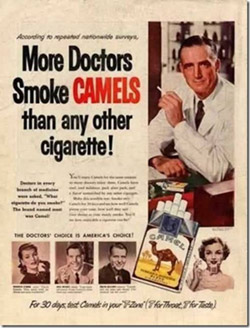
    PS: Blast from the past! Can you even imagine such an ad being allowed to run in 2012. Kahaan gaye woh din? 🙂

  • Modi and Gujarati media: Two swords in one sheath

    By Urvish Kothari

    Blatant and vitriolic criticism of Narendra Modi seems to have become the norm for Gujarati dailies of late. Gone are the days when the Gujarati print media, with an average issue readership of more than 1 crore (according to IRS 2011-Q2), mostly adored the chief minister. It supported, or at least was non confrontational  about his publicity blitzkrieg and his self-projection as a tough, non-corrupt, pro-development, ‘No. 1’ leader with a subtle and not-so-subtle communal slant.

    As is evident from events of the last few months, Modi has been constantly at the receiving end in many issues — be it the arrest of Sanjeev Bhatt or his three-day Sadbhavana Fast. The prominence and the column space allotted to arrest and release of IPS officer Sanjeev Bhatt in the Gujarati media would have been unthinkable a couple of years back.

    While English dailies reported the whole episode with restraint, news and images of Sanjeev Bhatt were being highlighted on first and last pages of Gujarati dailies. Bhatt was made out to be a ‘singham’ — a hero.  The pro-Sanjeev Bhatt coverage was not just about appreciating the uprightness of the officer but was fuelled, to a large extent, by the anti-Modi ‘line’. Gujarati dailies had a field day when the late Haren Pandya’s wife vaguely pointed her finger towards the CM in her husband’s murder.

    Recent rhetoric against the Modi government, which was, in effect, against Modi himself, took off from very unusual point: the issue of cow slaughter. The issue was hardly discussed in the public forum. But suddenly the failure of the Modi government in protecting cows became the war cry in two major Gujarati newspapers.

    The purpose of the intensive news campaign that ran for days was to prove that Modi was un-Hindu, if not anti-Hindu. It was to falsify his deeply entrenched claim of being ‘the saviour of the Hindus’.

    Even the usual non-political Modi-baiters were baffled by the anti-cow slaughter campaign which gathered momentum so suddenly. The stage was set, and then came the burning issue of the appointment of the Lokayukta.

    Gujarati dailies grabbed the issue with both the hands, one daily even lowering its masthead with the news of the appointment of the Lokayukta by the Governor and the government’s legal challenge to it.

    When the Supreme Court referred the Gulbarg Society case back to the lower court and declined to monitor it further, Modi famously tweeted ‘God is Great’ and projected the SC’s decision as a ‘clean chit’. Many news channels echoed his view, but Gujarati dailies were more cautious and less jubilant.

    His three-day ‘Sadbhavana Fast’ was treated with scepticism and a pinch of sarcasm, due to the pomp and politics involved. There was criticism about the expenditure incurred during the fast and even the memory of Mahatma Gandhi was invoked for an uncharitable comparison.

     Gujarati dailies have been vocal in making allegations of corruption and in giving considerable weightage to the statements of Congress leaders in Gujarat recently. A Gujarati daily recently devoted a full page to CAG’s criticism of various departments of the Gujarat government. A clean image no longer remains Narendra Modi’s USP, at least for the Gujarati dailies.

    Mostly unfavourable and critical of Modi, for the reasons best known to them, Gujarati dailies have been conscious not to indulge in anything that may be perceived as ‘secular’ by a majority of their readership. During the Sadbhavna Fast, Modi’s advances towards the Muslim community were met with veiled criticism. One Gujarati daily even frowned at his attempted pro-Muslim approach in a eight column banner head line: ‘Allah-o-Akbar: Modi begins his fast’.

    The real irony is, Gujarati dailies with their massive reach have been successful in reflecting general sentiment but their capacity to generate or shape public opinion has diminished considerably — more so in the case of Modi’s criticism. Yet, there is a strange equilibrium between the anti-establishment stance adopted by the Gujarati dailies and Modi’s wide-spread popularity.

    There is a saying in Gujarati that two swords can’t stay together in one sheath, and that seems to be the case when one looks at the strange co-existence of flourishing Gujarati dailies as well as the sustaining popularity of Modi.

    The writer is a Gujarat-based senior journalist and columnist

  • Why democracy can so easily be an ‘obstacle’

    Four days of a severe throat infection meant little TV news and or newspapers. This I thought would save me from minute by minute updates on the condition of Gujarat chief minister Narendra Modi’s fast for amity or goodwill or whatever he called it. But as it turned out, I was wrong. The fast may have been covered but Modi’s condition was left out of it. So unlike with Anna Hazare, whose weight, blood pressure and such were reported in detail, we were given few clues on how much weight Modi had shed. Also, since the earthquake struck Sikkim on Sunday evening, even our hysteria-obsessed TV channels realised that a natural calamity was more newsworthy than a man-made one.

    Unfortunately, not only is our knowledge about the North-East of India decidedly dim, so is our television coverage as few channels have correspondents or camera crew stationed close by or even perhaps adequate arrangements with local channels. Thus we had to depend on telephone reports and as usual it is not till you get the next day’s paper that you really know what’s going on. Also given our India-obsession, our channels behaved as if the earthquake only affected Sikkim, pretty much ignoring the damage in neighbouring Nepal and Tibet. This is, one assumes, a form of patriotism.

    The damage which obsessive TV – with regard to the coverage of the Anna Hazare movement in particular — can do was brought home to me quite severely while addressing students of a media course at a Mumbai college on Saturday , when one wanted to know how we can get around an obstacle like democracy when it comes to reducing corruption!

    Changes made to the Board of Control for Cricket in India were examined threadbare on television and with many anchors palpably upset that there had been no public executions or floggings after India’s losses in England. It becomes clearer every minute you watch TV news why democracy can so easily be an “obstacle”.


    **

    Newspapers covered Modi’s fast as well but with far more scepticism, many choosing to concentrate on the fissures within both the BJP and the NDA. The Telegraph, Calcutta, has a story with Bihar chief minister Nitish Kumar of the Janata Dal (United) making it clear than Modi was not a suitable prime ministerial candidate. Of course, all this jumping the gun a bit since the next general election is in 2014 and it is unlikely that Modi will be fasting all the way up to then, amity or no amity.

    Tuesday’s Hindustan Times underlined its scepticism of Modi’s amity fast with an editorial, a lead edit page piece by Sitaram Yechury as well as a column by its senior political analyst Vinod Sharma.

    The Times of India reduced Modi to a second edit, ‘Strange Sadbhavna’. The front page concentrated on its Social Impact Awards, to honour people who make India a better place. The Times of India has fine-tuned the knack of being all things to all people, greedy, socially conscientious, middle of the road and of course as with Times Now, decidedly rightwing.

    Also expectedly, newspapers concentrated on the devastation and death toll in all the quake-affected areas and not just on Indian casualties. Clearly, whatever the sure signs of degradation of standards in the Indian media, some of the better practices still manage to rise about the sludge.

    Most mainline daily choose to downplay or ignore US president Barack Obama’s plan to increase taxes to cut down the country’s budget deficit. The pink papers however could not. And weeks after Warren Buffett wrote an impassioned column in the New York Times on how he and his rich friends did not mind paying more tax, Indian papers picked up on it. Of course, this was because of a throwaway line in Obama’s speech – but since the speech was telecast live by all international and business channels, you could not escape it. Indian newspapers and channels seem to have one mantra down pat – never upset rich people. Obama apparently – and the New York Times for that matter – has no such qualms.


    **

    We need someone to explain our country’s nuclear policy to us cogently and intelligently as ever since the Japan tsunami there have been very real fears and very strong protests. Indian television goes overboard and Indian newspapers play it down. Help?!