Tag: Narendra Modi

  • Ranjona Banerji: Much hysteria about the swearing-in

    By Ranjona Banerji


    It is easy to understand why the swearing-in ceremony of the new BJP-led government at the Centre is a big media event. What is not so easy to understand is the breathless hysterical excitement of the television media where a whole day was practically dedicated to this event. As a ceremony went it was just that, but on a grand scale to allow India’s new prime minister Narendra Modi to make a statement.


    News channels then behaved like bookies as they started an endless circle of speculation about who was getting which ministry and on and on. All guests now know how the game is played so they also chip in with their oohs and aahs. These panel dramas have become so well staged that they are now definitely pointless.


    I did not watch the coronation all day so do not know if there was anyone interpreting people’s fashion choices like at a British royal wedding – was there? Like which of her seven lakh saris was Kirrrroooonn Kherrr (not sure how she spells her name) wearing.


    Meanwhile, NDTV Hindi provided some entertainment on social media on Monday morning by telling us that Narendra Modi went to Modi’s Samadhi at Rajghat thus breaking even known-Hindu laws of transmigration. And let us not even discuss the er, compliment paid to Mohandas Karamchand Gandhi otherwise known as Mahatama and Bapu and to Modi as Mohanlal Gandhi.


    Later, the channel ran an apology without telling viewers what they were apologising for. I direct them to that old newspaper joke. Man sues paper for writing that he “has the manners of a pig”. Man wins. Newspaper directed to carry apology. Next day’s paper says man “hasn’t the manners of a pig”. There are ways, boys and girls, think a little.


    After the grand coronation was over – which is what some TV channels were calling it – we then went on to discuss Cabinet berths. Karan Thapar on Headlines Today was effective as usual and for some reason the same people who yell elsewhere remember their manners with him. Rajdeep Sardesai on CNN-IBN had some criticism for the Cabinet formation and the lack of co-relation between earlier promises of “cluster” ministries and what was apparently handed out.


    General Bakshi on NewsX threw Rahul Shivshankar off balance by saying the most important thing to be discussed was how India was following the rightwing trend where nationalism was emphasised and “the other” was targetted. Shivshankar looked like he couldn’t believe that someone could mention words like rightwing right in the middle of this right coronation. It is possible that only the general’s formidable moustache stopped Shivshankar from having a tantrum.


    Arnab Goswami on Times Now looked like that cat that was licking its chops after the cream had been scoffed down and also a little coy. Don’t ask me why.


    In the morning, The Indian Express headline read, “He signs in” thus taking TV’s coronation and turning it into deification. Is the rumour true that Shekhar Gupta will soon join the India Today group?


    Still no clues on which of our illustrious peers who worked so hard to ensure this victory for Modi will be rewarded. If indeed they will.


    **


    Away from all this, would it be fair to ask some newspaper to explain to Tata Sky subscribers why they no longer get Neo Sports and Neo Prime even if they have paid for them? Neo Sports put out a tweet asking tennis fans who want to watch the French Open to demand their rights from Tata Sky. But from what I understand, Tata Sky is refusing. Anyone? Might be a good story even if it involves a little hard work…


  • How advertising helped Modi get on road to PM


    By Shobhana Nair


    It’s a campaign that’s sure to enter India’s advertising hall of fame. A blitzkrieg that marketing boys from across the country are drooling over. The advertising mania around Brand Modi began a few months ago in right earnest. The seeds had been sown by way of a belligerent presence on the social media ended on the counting day.


    Piyush Pandey

    While the victory of Prime Minister-designate Narendra Modi has been attributed to many factors, one can’t overlook the advertising muscle put behind promoting a great brand. As Piyush Pandey, Executive Chairman and Creative Director for Ogilvy & Mather India and South Asia says, “You can only position and market something which is good and based on what the product is all about. Nobody has ever been able to sell a bad product. Nobody can as people are not stupid. So a good product is presented with its attributes and the marketing of the brand which was done by Soho Square is only a presentation of what is good in its intrinsic value.” A team of 25-odd creatives, planners and account management were working round the clock for three months in Mumbai and Delhi on the job. Soho Square, a part WPP’s Ogilvy & Mather India, bagged the account after nine rounds of pitching.  “The brief was to firstly, address the common man’s key issues through a comprehensive agenda and secondly, project Mr Modi as the next PM this country deserves,” shares Anuraag Khandelwal, Executive Creative Director and Creative Head, Soho Square, Mumbai.


    Ad campaigns like Abki Baar Modi Sarkar, Janata Maaf Nahin Karegi and Achche Din Aane Waale Hain were able to convey both – the current sentiment of the country and the BJP mandate – powerfully and effectively.


    Prasoon Joshi

    There was also Prasoon Joshi and his team from McCann’s TAG too who were involved to articulate the philosophical aspect of the party. Desh Ki Pukaar, Modi Sarkaar and Desh Nahi Jhugne Doonga were some of the campaigns which Joshi was involved in. “It is very important to know what your product has to offer and what people need. Only then will it resonate with the people. One of my biggest learning is that you need to have a right product, the right ingredients and you can’t confuse people with 10 things.”


    “Modi was portrayed as a single-minded person of the party with one single mandate. There has to be clarity of focus & product has to be superior. A great campaign in isolation will not work,” says Joshi.


    Ask the brand gurus on why the campaigns worked in favour of Modi and here comes the reply. Jagdeep Kapoor, Brand Guru & CMD, Samsika Marketing feels that the communication and advertising was simply strategic. “It entered the minds and heart, but more important was the great performance of Brand Modi over the decade, which helped them communicate.”


    Harish Bijoor

    Well-known brand expert and CEO, Harish Bijoor Consults Inc gives a thumbs up to Modi’s marketing, “Modi is the ultimate political marketer. He had able support, and he was decisive in the way he managed his campaign. His campaign was a 360-degree campaign that had everyone else watching with awe. The best of product marketing gyaan was brought into this campaign. And it worked. Modi is a product. And this product promised what the people wanted. And in him people saw a strong and decisive leader, someone who was an anti-thesis of sorts to the persona India was used to in the past decade with Manmohan Singh at the helm of affairs.”


    The media buying and planning was handled by Sam Balsara’s Madison World and he admits that a campaign as large as this came with its set of challenges. “Outdoor in UP posed huge challenges because of unfair play by the ruling party in granting permissions for putting up hoardings. The other challenge was negotiations with media, some of whom artificially inflated their rates for political campaigns! Random numbers floating around in the media of the budget of our campaign made our task more difficult.”


    While it may appear to have been all hunky-dory as one looks back at the BJP’s advertising campaign, Piyush Pandey adds: “No brand is built in a few months; a brand is built over a period of time. What Narendra Modi has done in the last 10 years has been valuable to him.”


    Pandey also hastens to add that good advertising wasn’t the only reason for the Modi’s success. “No election is ever won or lost because of advertising. Advertising is only an element. Advertising only presents it. With a great product, I can do great marketing.”  Indeed.


  • The Rise & Shine of Brand Modi


    Even as the final results were coming in, it was clear that one of the many factors why Narendra Modi and the NDA emerged victorious in the General Elections 2014 was the advertising and public relations campaign. Shobhana Nair spoke to Harish Bijoor, well-known brand expert and CEO, Harish Bijoor Consults Inc to discuss the rise and rise of Brand Modi


    Harish Bijoor

    On what has worked for Brand Modi in the last year?

    Hard work. Very hard work. Add to it the fact that Brand Modi started off the block much before elections were announced. Brand Modi established itself first when it saw Narendra Modi as a hat-trick CM of Gujarat. This image was further boosted with development as a cue. And then came the announcement of Modi as a PM candidate of the BJP. This was decisive and focussed branding. And then kicked in the campaign.


    The solus attention on Modi has helped the BJP immensely in this victory. If you remove Modi from the BJP, you will find a huge crevice in terms of the resultant imagery. To that extent, this is a pure Modi win. In many ways, this paves the way for an epochal shift in the way campaigns will be run in this country. The individual will become more important than the party. Parties that hide behind the cloak of group-think will need to think individual personas, American style, in the future.


    Do you think it was smart marketing that gave Mr Modi the comprehensive victory?

    Absolutely. Narendra Modi is the ultimate political marketer. He had able support, and he was decisive in the way he managed his campaign. His campaign was a 360-degree campaign that had everyone else watching with awe. The best of product marketing gyaan was brought into this campaign. And it worked. Modi is a product. And this product promised what the people wanted. And in him people saw a strong  and decisive leader, someone who was an anti-thesis of sorts to the persona India was used to in the past decade with Manmohan Singh at the helm of affairs.


    Would you say the BJP’s ad agencies produce great advertising, or at least advertising that worked?

    They did. I love the “Abki Baar Modi Sarkaar line”, as did I love the jingles that captured the need of the people in bundling hope: “Acchhe din aane waale hain…” And media organizations loved the amount of money that was spent in airing all of this for sure.


    And do you think the Congress loss was caused by bad advertising?

    Not really. In the beginning, it is all about strategy. I do believe the gaps lie in the strategy rather than in the advertising executions. I do believe enough of emphasis on voter insight was not given. The campaign was top-down and ignored the bottom-up possibilities.


    How does Brand Modi not suffer from the same fate as various Opposition/non-Congress governments have in the past?

    Brand Modi is beyond it all for now. His assessment will start happening one year from now. And that will be the biggest challenge to tackle. Every single promise needs to be fulfilled. With care, tracking and passion.


  • Ranjona Banerji: Election of the Trivial & Telegenic


    By Ranjona Banerji


    If this general election is indeed a watershed moment for Indian polity then it is no less a groundbreaker for the Indian media. Television has dominated this election practically setting agendas and leading the battle from the frontlines when it comes to chosen candidates and parties. The battle is won by the trivial and the telegenic. The smaller India grows in terms of communication thanks to telephony and technology, the larger the disconnect from reality: or so it appears.


    If the media is going to play such a significant role from here on, then the elements within the media must come out and identify themselves by their ideological and philosophical bearings. The old argument used by journals that they are all things to all people cannot stand any longer. It is in many cases patently untrue. Further, it has reached a stage where you are taking readers for a ride.


    Television has no such argument at all and instead has created an atmosphere of rumours, allegations and gossip to thrive. Even within the media fraternity, there is a constant stream of stories about which channel has been sold to which political party or who favours which candidate. Some parties are barely being mentioned when it is evident that they will have some bearing on these elections. Thrown a few corporate houses into the mix and you have a great Indian muddle which barely resembles a delicious homemade khichdi.


    Who has financed all these opinion polls to project election results for instance? What is the consumer of news to make of them when ground reports from journalists are at odds with those surveys? In a two-month long voting schedule, a constant stream of opinion polls amounts in fact to trying to influence those who have not yet voted, even if the Election Commission has not cottoned on to it yet. The figures for conducting these polls which are going round the grapevine are astronomical.


    It is time therefore for all newspapers, news channels and websites to declare their political leanings. There is no shame in this. All over the world, the reader and viewer knows what their chosen media outlet stands for. This is not just about individual columnists to declare their leanings. This is about the organisation itself. Given the growth of the influence of the media – and these are strong words – to fool your consumer any more is tantamount to fraud.


    It is evident that it is not just a nudge from one corporate house and a wink from another that dictates media flow. We have seen epic and sudden changes of direction from left to right to centre and back. What most newspapers do to cover this up is provide a variety of columnists on their opinion pages to portray first one point of view and then another to prove that they are “neutral”. It no longer cuts it.


    TV of course is another jungle with its own rules, quite distinct in some cases from print. Editorialising and on the spot opinion-making is now par for the course. As a very senior editor who has a career in both print and television pointed out to me, if a star anchor, who is also the editor, asks a young reporter on live television, “Isn’t the political rally proving what I say?”, what is the young reporter to do? Disagreeing with the boss is not an option. And so news is created, not reported.


    For a long time in India, journalists were more left of centre than right but that was not an absolute truth. For instance Girilal Jain, a colossus in the Times of India was distinctly right of centre and the Indian Express was distinctly anti-establishment in the days when the only establishment was Congress.


    One must distinguish between the need for media outlets to declare their politics and the accusations and muck thrown at individuals on social media. Gutter language and threats will continue. But now the target will be clear and much larger. And in the interests of fairness, everyone will have a target!


  • BJP ads to go on air soon, with Prasoon Joshi songs

    By Pritha Mitra Dasgupta


    The Bharatiya Janata Party, which has just unveiled the outdoor ad campaign for the Lok Sabha polls, will launch 10-15 TV commercials in the coming weeks. The films, which will explore several themes including anti-corruption and women’s safety, are at the script-level and awaiting Narendra Modi’s approval, a person aware of the party’s campaign plans said.


    A source in the BJP ad campaign team said that Sushil Goswami, national creative director of Graphisads, a small Delhi-based agency that handles BJP’s state-level ad campaigns, is also working with Soho Square on the television, radio and outdoor campaigns. When contacted, Samrat Bedi, head of office, Soho Square, refused to comment on the party’s plans stating, “We do not disclose any client’s strategy and plans.”


    The other agency in the running, McCann’s subsidiary TAG, presented three songs written by McCann executive chairman and lyricist Prasoon Joshi as part of its pitch, the person informed. “Prasoon has written a rousing song for Narendra Modi – Saugandh is mitti ki mein desh jhukne nahi doonga, Mein desh mitne nahi doonga.”


    Source:The Economic Times

    Copyright © 2014, Bennett, Coleman & Co. Ltd. All Rights Reserved

    Licensed to republish


  • Etailers make hay with poll merchandise

    By Harsimran Julka


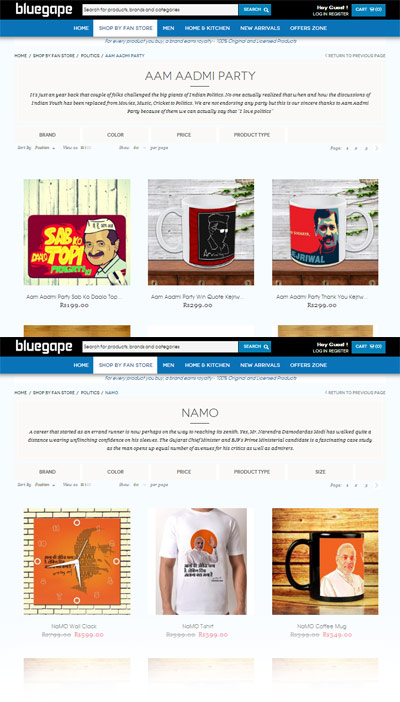
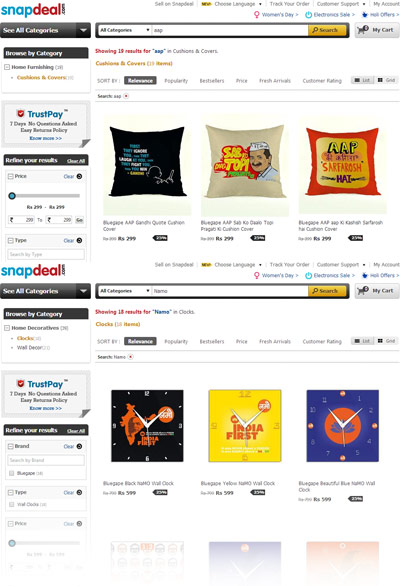
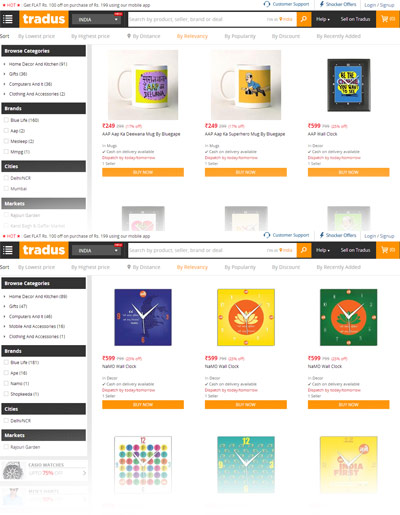
    Several online retailers are cashing in on election fervour by selling a wide variety of political merchandise , helped along by the willingness of citizens to flaunt their political affiliations.


    They are hawking a range of personal accessories, home décor and utility items that are branded with images and logos of mainline political parties which will fight it out for the affection of voters this summer.


    “We just launched our political merchandise category three months ago and are already seeing 30% of daily orders coming from this category,” said Sahil Baghla, founder of merchandise portal BlueGape, who started the business in 2011 while still studying at the Indian Institute of Technology in Kanpur.


    “We capture the political messaging of a party and present in a glamorous fashion on a product just like we would do for a Bollywood movie star. It appeals to the youth instantly,” said Mr Baghla, 22, who raised Rs 1.5 crore for his venture last year.


    Online marketplace Snapdeal that first launched the ‘NaMo’ brand of phones aimed at followers of the Bharatiya Janata Party’s prime ministerial candidate, Narendra Modi, now offers merchandise for followers of the Aam Aadmi Party which include wall clocks and covers for phones and tablets. For BlueGape, customers for Aam Aadmi Party’s caps and T-shirts come mostly from Delhi and Bangalore.


    Narendra Modi brand of mugs, shirts and clocks are popular amongst customers from Andhra Pradesh and Maharashtra. He added that products with Congress’ development theme or Rahul Gandhi as its ambassador are selling less, due to lack of a strong theme.


    “Other political parties such as Samajwadi have mixed messaging which makes it difficult to make a merchandise around a theme for them,” said Baghla, who is aiming for 5,000 orders per day by end of this year. Entrepreneurs said the increase in social media usage is leading to greater willingness amongst people to flaunt their political leanings, a dramatic shift from the reticence evident during even the previous general election in 2009.


    Tony Navin, vice president overseeing business development at Snapdeal, which raised $138 million from eBay last month, said sales of political merchandise have increased fourfold since last month. He said most customers for such merchandise are from tier 2 and tier 3 towns and cities, with an average age of 25- 40 years.


    The trigger for selling political merchandise peaked in January, when sellers on location-based marketplace Tradus started retailing Aam Aadmi Jhadus (brooms) for Rs 5 each.


    “The launch was an instant hit and we sold 2,000 brooms within two hours. Over three days, after the win of AAP in Delhi, about 6,000 brooms got sold on the platform,” said Mudit Khosla, CEO at Tradus, an online marketplace owned by South Africa’s Ibibo Group. With the maturing of Indian democracy, youth are now more open to flaunting their political affiliations, said Saurabh Kochar, founder of online portal Print-Venue , which is backed by German incubator Rocket Internet.


    “We are seeing demand even from individuals who are ordering shirts, caps and even decorative pieces for personal use and to gift to their party donors and members,” said Kochar, a graduate of IIT-Roorkee, who started the online portal in 2012. He is seeking ideas for design of such merchandise.


    Although this business is seasonal, entrepreneurs believe that with India’s large electorate of 81 crore voters, and heightened political activity, it will provide a strong stream of revenue. About 2.3 crore Indians are first-time voters, many of whom are hooked on to social media and will reach out for merchandise that proclaims their loyalties. “The youth now want to speak out about their identity,” said Mr Baghla of Bluegape.


    Source:The Economic Times

    Copyright © 2014, Bennett, Coleman & Co. Ltd. All Rights Reserved

    Licensed to republish


  • Ranjona Banerji: So why did Times make a front-page statement?

    By Ranjona Banerji


    Truth is, we have no political masters, nor do we have any hidden agenda. The only side we take is that of our readers.”

    So what compels a newspaper to make this statement, especially one that declares it is “the world’s largest circulated English newspaper”?

    The Times of India’s edition of January 23, 2014 carried this on the front page. The rather thin (leading to some very ugly hyphenation) single column headlined “To Our Readers” was a declaration that although the newspaper had been accused of first supporting and then turning against the newly formed Aam Aadmi Party, in fact it is for no one and against no one and will support whoever does the “right thing”.

    The newspaper also pointed out its philosophy, such as it is, which includes belief in “the primacy of the individual over the state, and that democracy in its truest sense is the power of one. We believe in personal liberty and in freedom of choice.” There is more in the same vein.

    As to why TOI decided to make this announcement is unclear, except for the allegations that it had switched horses mid-stream regarding the Aam Aadmi Party. But so what? As it itself declares, it has been accused supporting one or the political party in the past and has not bothered to make any front page announcements. Is it because the AAP is the new party of the middle classes, which is TOI’s core readership? Or has someone inside Bennett Coleman suddenly developed a very thin skin?

    The worst that The Times of India has been accused of is not patronage of a political party. The worst has to do with money: the introduction of Medianet where news items are sold for a hefty price and for private treaties, where certain business houses and entities can ensure good coverage for themselves.

    Obviously, there were no mentions of either in this intriguing, and if one may point out, clumsily written and punctuated, front-page editorial declaration.

    **

    However, it is also true that the media seems to be getting polarised politically in a manner last seen during the BJP’s Ram Janmabhoomi movement of the late 1980s. Journals and journalists both declared themselves to be pro-BJP and Hindutva, with an emphasis on a preference for economic reform as well as religious majoritarism. Much of this media anger was also against Congress hegemony and also showed itself in massive support for VP Singh’s breakaway movement.

    Since then, the media has been seen as supporting one or the other political direction although very often the accusations are quite wild. Right now the Indian media is clearly heading towards the Right – except for the gauntlet thrown down by the Aam Aadmi Party and its particular brand of agitation politics. And perhaps that is where TOI’s confusion begins.

    **

    The biggest current problem for the Indian media and television in particular is that it cannot see beyond Delhi. If the Gujarat chief minister was the front page hero for almost six months, he has been ousted by Arvind Kejriwal. Much as the AAP and Kejriwal have changed the game, they are certainly not the only stories in India. Yet day after day we are subjected to a series of Delhi-centric stories.

    Part of the problem is that Delhi has become the epicentre of journalism in India. As a result, once strong regional media entities have been forced to pay extra attention to the national capital. Most TV channels are headquartered in Delhi – Times Now being the notable exception amongst the top English channels. And our star TV anchors cannot see beyond their neighbourhood. Who knows what has been happening in India and the world over the past couple of weeks. All we know is that Sunanda Pushkar thought her husband was having an affair and then may or may not have killed herself and that Arvind Kejriwal slept on the streets next to his car for a few night until he was sent some hot paranthas.


    Ranjona Banerji is a senior journalist and Contributing Editor, MxMIndia. The views expressed here are her own. Ranjona Banerji can be reached at @ranjona

  • The Making of Brand ‘Namo’

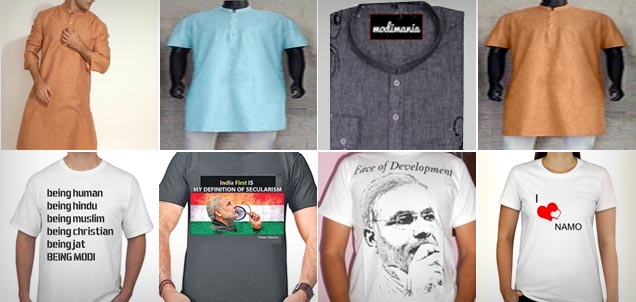
    Kurtas and t-shirts like these on Modimania.com are among the many products riding the Narendra Modi popularity wave


    By Rasul Bailay


    An Ahmedabad-based company has filed to trademark Namo, the acronym by which Gujarat chief minister and BJP prime ministerial candidate Narendra Modi is becoming widely known around the country.


    Take India Beyond Merchandising has filed dozens of applications on various versions of the name in Hindi and English. These include Namo, Namo Lekh, Namo and a sketch of a lion with the tagline – The Lion of India, Namo Mantra – Taking India Beyond and Namo Mantra – The Turning Point.


    The applications have been filed in various trademark classes including beer mugs, paper towels, lunch boxes, bed linen, dairy products, soft drinks, potato chips and others.


    Ketan Amichand Vora, one of the two promoters of Take India Beyond Merchandising, said the company has filed for the trademarks in order to leverage brand Namo.


    In the coming months, the company plans to launch Namo-branded merchandise, toys, colour paints for children, etc, he said.


    People close to Modi have been planning to start Namo-branded stores nationwide to sell various products including the distinctive kurtas that Modi wears, books, candles, incense sticks and various products as part of the effort to drum up support for the candidate in national elections next year.


    One person close to the Namo retail push said the group behind Take India Beyond is the same as that’s associated with the retail venture. They said the retail rollout was on hold as Delhi, Rajasthan, Chattisgarh and Madhya Pradesh were in the process of holding state elections. With these having got over, the plan will now proceed, they said. The venture is in talks with malls in cities including Delhi and Ahmedabad for taking on retail space, they said.


    The applications were filed in September and most of them are currently being processed at the trademark office.


    However, some applications may be contested by others who have already filed to trademark the name under various categories before the Namo brand became famous in the last year or so.


    For example, Gun Sagar Jain has been using the Namo brand since 2000 and has also registered it for the distribution and wholesale retailing of hosiery garments. Namo India Developments applied in September 2012 to trademark the name under building construction, repair and installation services. That application has been challenged, according to the website of India’s Controller General of Patents, Designs and Trademarks.


    Take India Beyond Merchandising is the latest in a string of companies trying to capitalise on the aura of the BJP leader. In the recent past, sari merchants in Surat to hosiery makers in Ludhiana have introduced Namo-branded products hoping to make a quick buck. Market watchers estimate the overall product and merchandising market growing around the BJP leader to be around .’400-500 crore. That’s why Modi’s followers are preparing for a nationwide retail push to sell their own Namobranded products including apparel and general merchandise.


    This initiative comes with two aims – to build on the buzz around Modi and to fuel it further by creating lifestyle products that add to the appeal of the leader. Political analysts say it’s part of the Modi’s well-oiled PR machinery to strengthen his base in the run-up to the general elections next year.


    Santosh Desai

    Some marketing experts are skeptical about a retail campaign bearing fruit. “Namo is a brand no doubt but using the brand to make t-shirts and soaps is another matter altogether,” said Santosh Desai, CEO of Future Brands.


    Source:The Economic Times

    Copyright © 2013, Bennett, Coleman & Co. Ltd. All Rights Reserved

    Licensed to republish


  • VivaConnect takes Narendra Modi live on phones

    By A Correspondent


    The next elections will be fought via the mobile phone and social media. Note it’s not going to be only fought via the phone, but telecom technology is sure to be a huge facilitator of sending the message across.


    Mumbai-based mobile marketing and tech company whose ‘missed phone’ service is deployed by many has unveiled a new product called ‘LiveTalk’.


    LiveTalk, empowers live audio streaming of live events over a simple phone call, wherein one has to call in a published phone number and experience the event live without any internet, smartphone nor a subscription to special or premium add-on services. The caller enjoys this facility at a rate of regular phone call without any extra charges. All one needs to have is a phone connection, be it a mobile or landline!


    LiveTalk was launched on September 15 and deployed for BJP’s ex-serviceman rally held in Haryana. The service connected over a lakh callers across India to hear the party’s PM candidate Narendra Modi’s speech.


    According to a communique, the BJP partnered with firms like Zipdial and VivaConnect and offered a unique mobile connectivity model between mobile users and the party leadership.


    Vikram Raichura, Managing Director of VivaConnect said: ‘We are honoured to be associated with BJP and showcase one more possibility on how by leveraging mobility one can extend overall reach and even cater the far-flung areas to achieve mass involvement on national and international scale.’


  • Amith Prabhu: Modi’s online Public Relations campaign

    By Amith Prabhu


    Want a master class in online public relations? Go no further than the last 50 handles of the 600 followed by Narendra Modi on Twitter. Despite all the controversy he rakes up by things he has done and things he says his inner circle of digital marketers are indeed doing an excellent job of creating the tools that help his outreach. Clues to this avalanche are found in the list of people followed on Twitter


    I belong to the group of people who are the harshest critics of a man who presided over one of the best man-made disasters of the last decade. I write this column purely for academic reasons and don’t wish to bring my ideology to the fore. Three to four things stand out and can be insightful to those who plan similar campaigns in the future and this is neither a blog of praise nor a blog to criticize.


    First things first – he must be the first and only politician to create dedicated Twitter handles in nine regional languages that target the large states where BJP has a presence. These include Hindi, Marathi, Kannada, Assamese, Urdu, Oriya, Tamil, Bangla and Sanskrit. While most of these handles have less than a couple of thousand followers and some in the hundreds the fact that these exists and are active speaks volumes of the gameplan that he plans to unfold in the days ahead. Even the Pope does not have a presence in as many languages.


    The next initiative is the portal india272.com which describes itself as an online and on-ground volunteering platform to help the BJP in its Mission towards gaining a 272+ seat majority in the 545 seat Lok Sabha. In this sentence and elsewhere it is best to read BJP as Modi as these are all initiatives not necessarily by the party organization but by the individual and his supporters. Evidence is in the images used that focus on one person throughout.


    Of the 670 Twitter accounts that are followed there are three categories – organizations that are dominantly news outlets, BJP officebearers from across the country of different level and stature and sycophants who have Namo4Pm in their bio or display name. The Gandhi family finally has competition when it comes to people who swear blindly by them. This hero worship will reach its peak in the digital world as the election season gets closer.


    The personal website and blog: Very few Indian politicians have managed to copy the Obama style of internet presence the way Modi has and proof of this is in his personal website and blog. This single tool of owned media has neutralized all the negative earned media built up over the last decade. The debate on who writes these blogs is secondary. The fact that these exist is something for all other leaders to ponder on.


    The question that everyone asks is how many actual voters do all these outreach tools really reach? And in my opinion the numbers do not matter. Having a presence that enables young voters and the urban population that is well disposed to tablets, apps and the mobile internet is good enough. Modi has taken the lead and politicians from his own party and those from others have a lot of catching up to do.  A digital marketing plan so robust will be hard to match because real followers and likes cannot be bought like votes. In the end it is a perception game and the winner may take it all.


    Amith Prabhu is the founder of The PRomise Foundation which organises PRAXIS – the annual summit for PR & Corp Comm professionals in India. During the day he is a full time employee at a leading Public Relations firm in their Chicago office. He spent the first eight years of his post graduation career in India and is in the US for two years of which he has completed 18 months. Views expressed here are the author’s own and don’t represent those of his past, present, future employer or of MxMIndia. You can connect with him on Twitter @amithpr


  • Vijay Mukhi: Are Narendra Modi’s Twitter followers fake? And what about Shashi Tharoor’s?

    By Vijay Mukhi


    The best job on the planet is being a columnist on Politics and Technology, because no one in this space  talks sense or hard facts and numbers. Breaking news everyday is about Narendra Modi’s Twitter followers being fake, but no one is offering any credible evidence on either side of the debate, fake or real. So, before I throw my hat in the ring and get egg all over me (which is all in days work for me) let me tell you that I believe in the maxim Trust but Verify so before you cast the first stone, please download all the data that I have gathered from Twitter from my website www.vijaymukhis.com. We are also comparing only Narendra Modi and Shashi Tharoor as the other politicians are pygmies on Twitter compared to these two giants.


    Modi, today,  has 19,34,170 followers on Twitter compared to Tharoor who has  18,42,046,  a lead of just under a lakh. Modi and Tharoor share  447,920 followers in common which is around 25% of their followers , Modi and Kiran Bedi share 408,401 followers and Modi also shares 2,98,005 followers with Arvind Kejriwal. Thus, we can safely conclude that there are about 4 lakh people on Twitter who just like following politicians from India — why, we have no answer. This leaves Modi with a maximum of 15 lakh fake followers as fake followers would not share politicians from different groupings.


    How do we define a fake follower? Simple answer, someone who does not tweet. Modi has 6,77,296 followers who have never ever tweeted. Now imagine, why would someone join Twitter and not tweet at all! This is very extremely damning and conclusive evidence, we need no judge or jury to convict that these have to be fake followers. Thus if 35% of Modi followers have to be fake, what more evidence do you need! But, do not open the bubbly to celebrate, Tharoor has only 5,23,843 followers who also have never ever tweeted , which make up 28% of his followers. Can we thus draw a line in sand that says that if up to 28% of your followers have never ever tweeted then it is okay but any percentage above that makes these followers a fake? A more charitable explanation is that there is a silent (in terms on not liking the sound of a keyboard) majority out there on Twitter who do not tweet at all, but simply read tweets. If you take a step further, 12% of Modi and Tharoor’s followers tweeted only once and 7% only tweeted twice. A simply addition tells us that over 46% of Tharoor’s followers and 54% of Modi’s followers do not like to tweet or cannot tweet for various reasons. We need to accept that not everyone likes putting pen to paper even though we have to write less than 140 characters.


    The best evidence of popularity or influence on Twitter is how many people follow you. About 4,85,077 or 25% or a quarter of Mod’s followers have 0 people following them. Aha, this nails Modi finally and this is enough  proof that these followers are fake! The obvious answer is that if you do not tweet then obviously no one will follow you and for Tharoor the number is 2,61,883 or 14%. The percentage of the number of followers who have only 1 or 2 followers following their tweets, sort of remains the same. Thus like sending tweets , we have a whole community of users on Twitter who are so important that nobody follows what they do. Twitter Orphans can well be a new addition to the English language, what say?
    The obvious conclusion is that about half your followers would be inert or inactive or to use the TV analogy, coach potatoes who would surf from politician to politician.

    One sureshot way of finding out whether your followers are fake is to look at how many followers did you add every day of the year. During the month of July 2013, Modi added on a average around 5000 followers per month and Dr Tharoor about a 1000. For May and June, these numbers were also similar. The only conclusion we can draw here is that Modi’s team is very smart, had they added 50,000 followers on one day, they could be caught in the deserts of Rajasthan. But what if I paid an agency (millions on the web that do this for a small fee) to increase Modi’s followers count by a lakh on a certain day, the media would go ballistic and say that Modi was caught with his hand in the desert sand.


    I agree we are getting nowhere. So let’s look at another metric. When did  your Twitter followers create their account on Twitter or an ageing analysis. A whopping 1,02,385 of Modi followers were born on Twitter in April 2013, 94,874 in June 2013 or better still 502, 918 of his followers are under 180 days old on Twitter or created in the year 2103. For Tharoor, this number for 2013 is only 171,459. For 2012, the equivalent numbers are 595,656 for Modi and for Tharoor 360,540. A non-convincing explanation is that India is the youngest country in the world population wise and therefore all of your followers must represent this trend of being young. More than half of Modi’s followers have joined Twitter nearly a million , in the last 18 months only ,maybe just for him. This is why Twitter should give Modi an award for bringing so many people to Twitter!


    Where Tharoor leaves Modi biting the dust is when it when to the quality of followers, and that also by a factor of 2. We simply added up all the followers of people who follow Tharoor and the number was an astonishing 27,89,94,347 and for Modi it was half that at 10,87,44,125. We have not removed duplicate followers from this list. So theoretically when Tharoor tweets and if all his followers retweet his tweet around 27 crore people would see that tweet. Tharoor followers have tweeted over  52,26,34,885 times but Modi’s followers being newer and weaker are half that at 27,57,99,883. On a average, a Tharoor follower has 150 followers who tweets 282 times and a Modi follower would have only 56 followers and tweets much less at 143. Thus an average Tharoor follower would beat a Modi follower in a virtual fist fight as Tharoor has a long and khandhani history on Twitter.  Maybe and we have no evidence for saying this, but a Modi follower may have more pets (aka puppies) than a Tharoor follower. It a foregone conclusion that Tharoor’s followers are twice as strong as Modi’s followers and no guesses who would win a twitter slugfest, in spite of what conventional wisdom says that Modi’s followers are winning on Twitter.


    OMG, read over 5000 characters ie 35 tweets (my editor decides column length in tweets and not characters)  and yet no conclusion on whether Modi has fake followers or not! So, let’s muddy the waters even more. Go to the Twitter page of a user vijaymukhi712 by typing www.twitter.com/vijaymukhi712. This user bears my name and I have actually tweeted 86 times, a pretty active user one would have to admit, to a fake user under any yardstick. Every day my internet avatar ( not sure of the sex as you will soon see) quotes a love tweet so has his heart in the right place. But if you check further, say the 19th of every month, you will see the same love quote. This user is a creation of a computer program (which is why I cannot determine the sex)  which wakes up at 7 in the morning GMT and depending of the day of the month sends out a tweet. I did not have the time to create a database with 365 tweets. Is this a fake user or a non-human user, a word that will enter the human lexicon very soon. Twitter makes it very easy to create a user that needs no verification and we all tweet using some computer a program written by a programmer. Will there be a way to distinguish between a fake user from a machine-created one? May be and a big may be in my next life!


    Finally, all fake things must come to an end and so we come to our real conclusion.


    It is in the best (commercial ) interests of the social web to make it very easy to create fake followers as greater the number of Twitter users, the more money Twitter and the rest of its ilk charges for ads. It’s also is in the best interests of the social web that we have no way of determine a fake from a real user. It helps politicians as it make them more important in cyberspace than they really are. I seriously stopped getting women to date me when they realised that my Twitter followers was around 300. We must realise that a large majority of Twitter users will not tweet, they are readers nor writers. If politicians hired the right technology hackers, they will never ever get caught while massing millions of fake followers. Our Internet population will triple from 120 million today to at least 400 million in the next 1000 days thanks to 4G and this problem of fake followers or fake identities or fake tweets or fake anything will never ever be resolved. This emboldens all of us to say what we want about anyone or anything on Twitter and the social web as verification of any type is a miracle and we all know when the last miracle too place.


    My last two bits: Modi’s followers are as genuine or as fake as Tharoor’s followers are. Take your pick by doing the obvious, by tweeting.
     

  • Narendra Modi is most mentioned political leader on social media: Blogworks study

    By A Correspondent


    As the countdown to the general elections 2014 begins, social media conversations around possible candidates for the top positions have gathered momentum.


    Marketing, communication and research services firm Blogworks has launched the first edition of its monthly India’s Most Mentioned Political Leaders index analyzing the Top 20 Most Mentioned Political Leaders online for the period January 2013 – April 2013.


    Some of the key highlights of the report:

    – The top five ‘Most Mentioned Political Leaders’ online are Narendra Modi, Rahul Gandhi, Manmohan Singh, Sonia Gandhi and Arvind Kejriwal (in that order)

    – Narendra Modi leads with more than thrice as many mentions as the nearest contender, Rahul Gandhi

    – Narendra Modi (63%) is marginally behind Rahul Gandhi (67%) in terms of percentage of mentions by the youth between the age-group of 18-34. It is noteworthy that ArvindKejriwal and Sushma Swaraj’s mentions are from a relatively older age-group of users between 45-54 years of age

    – Narendra Modi has the highest mentions by women (30%) followed by SushmaSwaraj (24%)

    – Though Narendra Modi has the highest total reach on Twitter, M Karunanidhi leads in terms of being connected with the most influential users onTwitter followed by Arun Jaitley, J Jayalalithaa, AnnaHazare and Omar Abdullah.


    A copy of the report can be downloaded from http://www.blogworks.in/post/most-mentioned-1/.