Tag: Narendra Modi

  • 13 years of MxM, 13 years of the slow demise of Indian media…

    13 years of MxM, 13 years of the slow demise of Indian media…

    Ranjona Banerji PhotographIt’s been 13 years since Pradyuman Maheshwari started MxMIndia.com. Congratulations to him, his courage, for putting up with me, and congratulations to his amazing team and contributors.

    It seems unbelievable that I’ve spent 13 years watching and commenting on the Indian media. I remember kicking and screaming when Pradyuman said I had to watch television news. Unlike most people, I never got addicted to 24 hours of vapid material. I prefer reading to listening, which is why I find podcasts intolerable beyond about five minutes. It takes me three days to finish a half an hour podcast. The written media works fine, whether on paper or online. Anyone who has read my columns knows this.

    When we started, though, I did watch a bit of TV news. NDTV was of course the best of the lot, but they all had their moments – India Today, CNN News 18, Times Now and the rest. Arnab Goswami was extremely entertaining, although his spiral into Howard Beale was disturbingly evident. (You haven’t watched Network (1976) yet? Despite all my imploring? Please do!)

    No sooner did the first Narendra Modi government come to power in 2014 than the signs of collapse we had already seen in the Indian media were now no longer hidden in newsrooms. Owners and editors decided that bowing down was the best sign of survival. Actually, I am being kind. Some of them obviously believed in the sectarian policies of the RSS and rejoiced that their time had come.

    I saw the signs when I quit my last full-time job in 2010. The paper changed hands and the new owner openly told us that all this “secularism” would no longer do. Soon after the India Against Corruption movement began, with the support of the RSS, and political strategists used financial fraud as a means to create the myth of Modi.

    The capitulation of the media to political ideology did not in fact quite work out the way its masters and owners thought it would. A gradually flailing economy further ruined by incompetent governance meant that ad revenue was low. The pandemic took a heavy toll on everyone, including the media. Instead of tackling the issue head on, the media carried on with its adulation tactics. It is only when death tolls and general mismanagement became intolerable that some – not all – media outlets realized they owed something to their consumers, not just to the ruling regime. These forays into journalism ended as the pandemic ended.

    But by then, something else had changed. Consecutive lockdowns meant that people got used to an offline life. Digital media, and I don’t mean the traditional media here, took over. YouTube, Instagram and so on, were easier to access for those who had smartphones and the time. Nothing in the traditional media has gone back to what it was, and what it was had been struggling for years with a broken model that everyone knew was broken.

    A lot of this assessment is easier in hindsight. But many of us who watch the media knew that some of it was coming and that the legacy media thought it could continue to run on past glory. Even if that past was about 30 years old. Whether centuries or decades, though, the end result has been the same: if you do not deliver the news as is it is not how your masters want it to be, people will go elsewhere.

    In India, as political fortunes have changed, some in the legacy media have made allowances in their usual sectarian love fests. Those further from Delhi have usually been more courageous. But when you look at how the media has ignored Manipur because it is a BJP-ruled state and how Bengal is being blown up because the BJP wants to make inroads there, you see how old habits die hard.

    This has been the tragedy of the past 13 years. The chronicling of the slow demise of traditional media where I spent most of my life.

    You want me to end on a hopeful note? All right. Stop paying attention to its last throes and move on to credible and intelligent independent digital sources. Or just get doped out on the dopamine hits from Instagram. You’ll learn more than you will from TV debates and have more fun!

    Ranjona Banerji is a senior journalist and commentator. She writes on MxMIndia on Tuesdays and Fridays. Her views here are personal.

  • Brrrrrrr! The news media is shivering!!!

    Brrrrrrr! The news media is shivering!!!

    Ranjona BanerjiIn Monday, as Leader of the Opposition, the first in a long while, Rahul Gandhi gave a speech which had the Lok Sabha laughing with him and the treasury benches squirming, with the BJP all riled up.


    The speech got enormous traction on social media all day, it has got 5 lakh views on Gandhi’s Youtube channel.


    Narendra Modi has not uploaded his Lok Sabha pronouncements to his Youtube channel. One short clip of Modi talking about former vice-president and fellow BJP member Venkaiah Naidu received 22000 views.


    How did our legacy media cover this speech? Often, as is the norm, headlines do not represent the bulk of the copy which follows. For instance, the Times of India headline reads: Lok Sabha sees rare PM Modi vs Rahul Gandhi faceoff. The copy however is mainly about Gandhi’s speech. Since the actual “face-off” was a bit of a damp squib.


    https://timesofindia.indiatimes.com/india/lok-sabha-sees-rare-pm-modi-vs-rahul-gandhi-faceoff/articleshow/111403045.cms


    This “report” from NDTV cleverly attempts to present happenings in Parliament from the BJP’s perspective, and further, is written to mislead the reader into thinking that the BJP and Modi had the upper hand. The reality of anyone who actually watched the proceedings was quite the opposite. Even TOI hints at that.


    https://www.ndtv.com/india-news/pm-narendra-modi-rahul-gandhi-lok-sabha-bjp-rss-not-entire-hindu-community-rahul-gandhi-vs-pm-in-lok-sabha-6008976


    The Hindustan Times also concentrated on the poor beleaguered BJP with this pathetic “point by point rebuttal”. I am unable to understand whether they actually believe their own drivel or were directed to write like this:


    https://www.hindustantimes.com/india-news/on-rahul-gandhis-hindus-agnipath-scheme-charges-bjps-point-by-point-rebuttal-101719878748437.html


    The fact that the BJP misrepresented Rahul Gandhi’s speech – especially his remark about Hindus – has not been covered, rather shamefully.


    Factcheckers have checked the misinformation in the BJP-led government’s “rebuttals” which makes the newspaper’s coverage even more embarrassing.


    The Hindu provides more comprehensive coverage of Gandhi’s speech and the BJP’s reactions:

    https://www.thehindu.com/news/national/you-are-not-hindus-rahul-gandhis-dig-at-bjp-draws-protests-in-lok-sabha/article68355018.ece


    India Today’s tawdry notion of being the “gold standard of journalism” apart, the following link is interesting because it gives the people of India an idea of how the BJP wants to limit how much the people of India are allowed to know. All the items “expunged” from Gandhi’s speech are important subjects for us to discuss. Whether India Today is aware of this or not, well. I’m not going there.


    https://www.indiatoday.in/india/story/rahul-gandhi-lok-sabha-speech-parts-expunged-from-parliamentary-records-2560992-2024-07-02?onetap=true


    A more complete report of Gandhi’s speech comes from the digital non-legacy media, obviously:


    https://thewire.in/politics/in-maiden-speech-as-lop-rahul-gandhi-tears-into-bjp-on-hate-politics-price-rise-and-neet


    What I have not been able to find is another newsworthy event which happened in Parliament yesterday: that Prime Minister Modi was reduced to being just one more MP, one more politician in a Constitutional post. Not a non-biological divine being – both Gandhi and A Raja referred to this – and not the Teacher of the World. This was perhaps more significant that Gandhi’s speech. And the squirming of the worms in the media is directly related to this downsizing.


    Mahua Moitra gave an extremely fiery no-holds-barred speech. Happily, the legacy media was happier with giving Moitra her due. Massive congratulations all around for such courage.


    https://www.telegraphindia.com/india/hear-me-dariye-mat-mahua-moitra-tells-pm-narendra-modi-in-lok-sabha/cid/2030875


    https://timesofindia.indiatimes.com/videos/international/tmc-mp-mahua-moitra-bashes-bjp-in-fiery-lok-sabha-speech-paid-heavy-price-for-watch/videoshow/111410814.cms


    Both Rahul Gandhi and Mahua Moitra emphasized the fact that they do not fear Modi and the BJP.


    Judging from this coverage though, the Indian media though is still shivering and snivelling in its collective shoes. Uriah Heep has nothing on them.


    Ranjona Banerji is a senior journalist and commentator. She writes on MxMIndia on Tuesdays and Fridays. Her views here are personal.

  • Exit Polls: A ‘No Confidence’ Motion

    Exit Polls: A ‘No Confidence’ Motion

    AI generated image showing an abstract representation of the discrepancies between the Exit Poll results and the actual results declared on June 4.


    Shailesh KapoorThe marathon elections are finally past us. But not without a result not many saw coming when the elections season started three months ago. The results on June 4 came as a surprise to many, particularly because a plethora of exit polls funded by mainline news channels of the country had predicted a resounding victory for the Narendra Modi-led NDA, with almost all of them giving the alliance 350+ seats, and some even predicting ‘400 paar’.
    As we know now, even ‘300 par’ didn’t materialise. Since then, there has been intense debate about exit polls, and whether their inaccurate predictions are simply a case of incompetence on the part of multiple agencies, or a result of malafide intent to influence the stock market. I have been asked this question more than a few times over the last 10 days, in my capacity as the head of a media research firm.

    While I’m no stockmarket expert, the scam allegations seem a bit far-fetched. It would take multiple agencies to comply with the perpetrators of the scam, put their reputation on the line, and hope that they make some illegal money off it. The history of scams suggest they are ‘designed’ in a way that they are under the radar, far from the public eye. Exit polls were anything but that. In any case, I don’t see how we will know any more on this topic anytime soon.

    The incompetence argument is a lot more persuasive one. Despite large sample sizes (while not all polls reveal their methodology and sample design, some do), and the claim to have covered all 543 constituencies, and represented different demographic segments adequately, how do so many polls get it wrong? In my opinion, the incompetence doesn’t lie in their ability to conduct field surveys, but in their lack of confidence to look at the findings dispassionately. All quantitative research that comes with the responsibility of predicting an outcome will operate on ranges, rather than exact numbers. And it’s now evident that the exit polls were leaned towards the higher ends of their ranges, and probably stretched them further. One poll made sure its upper end was 401, and another went for the round figure: 400!

    Over the course of this year’s election coverage, we have seen many pollsters become election experts, going beyond analysing their data, and entering domains of political analysis that’s best left to journalists with their ears to the ground. Bafflingly, many editors of mainline news channels have encouraged this, by giving pollsters a platform on their shows every night, even during the period when the Election Commission embargo on exit poll results was in play.

    It may be hard to resist fame, but if it comes at the cost of objectivity, a pollster must examine if it’s worth it. As it is, our news channels operate like echo chambers, and it is hard to not get influenced by their narratives if they are platforming you as an important talking head.

    So, the pollsters have gone wrong in their minds, probably working backwards from a pre-decided outcome they talked themselves into believing. It’s impossible to say what conclusions a more objective analysis on their data would have led them to conclude.

    In any case, exit polls seem to quite a wasteful indulgence for news channels. But it’s a vicious loop, because no channel wants to miss out on an evening’s hype. Just like no pollster wants to be the only one who got it wrong!

  • Thank heavens for independent media

    Thank heavens for independent media

    Ranjona BanerjiThe Indian media’s response to the Supreme Court’s decision of February 15, to strike down electoral bonds as unconstitutional, has been predictable. Sadly, unconscionably and unacceptably predictable. Let’s add condemnable to that as well.


    Had it been any other government which had come up with such a scheme and then had such a response from the apex court, ah well. We all know what the media would have done then. Most likely behaved like the media in a democracy should.


    The measly, mingy reports which have appeared since follow the template in place since 2014: play down any news which puts the Narendra Modi government in a bad light. I don’t have to repeat this because the template has not changed, but it’s here as a matter of public record.


    Since February 15, some very interesting details of how much money has flowed into the coffers of political parties has appeared in public. Mainly via the independent media. That most of the money had gone to the BJP is no surprise to anyone. But the manner in which several companies were arm-twisted into donating, after raids by various government investigating agencies, was remarkably brazen. It is hardly surprising that the Narendra Modi government fought tooth and nail to keep donation details secret.


    It’s thanks to independent journalists like Poonam Agarwal, who relentless covered electoral bonds since they were introduced and news sites like the Reporters Collective, that the general public has any clue about what exactly has been going on.


    https://m.thewire.in/article/politics/unique-numbers-recorded-by-sbi-investigative-journalist-who-bought-electoral-bond


    https://www.reporters-collective.in/electoral-bonds-tracker


    It is also amusing that the Solicitor General of India, Tushar Mehta, stood before the Supreme Court bench on Monday to complain about the proliferation of social media discussion on the matter. The Narendra Modi government has very effectively muzzled the mainstream media. But it has not managed – despite threats and bullying to private citizens as well as to the companies which own and run sites – to completely stop all social media interactions in India.


    An editorial in The Print, on the attacks on international students in Gujarat, who also happen to be Muslim, points out that such attacks are a “diplomatic embarrassment”. This is the crux of how the BJP and its media friends view making any information public: will it embarrass the Narendra Modi government and India or not? If yes, hide the facts. You may argue that other governments have been no different. That is true. But the difference between then and now is that the media did not dance as one Bollywood troupe to the diktats of the government. Unlike now.


    That the State Bank of India did not follow the Supreme Court’s instructions on full disclosure about electoral bonds and donors is a massive embarrassment. That the media did not tear the SBI to shreds is the other embarrassment.


    But most of all is that the media has not taken the Narendra Modi government to the cleaners. What you have here is clear proof of corruption, of blackmail of sorts, by a ruling party. Just contrast the media behaviour after CAG Vinod Rai’s report on the notional losses to the government over 2G auctions during the second term of the UPA to the revelations after the February 15 SC ruling. In fact, there is no comparison.


    And in that contrast, we see the last vestiges of a media in belly-flop stage.


    I see no signs of improvement.


    Anyone?


    Ranjona Banerji is a senior journalist and commentator. She writes on MxMIndia on Tuesdays and Fridays. Her views here are personal.

  • India Today Conclave is back with 21st edition

    The India Today Conclave is back, with its theme of ‘Brand Bharat: An Assertive Nation in an Uncertain World’. The 21st edition of the conclave is all set to “redefine India’s narrative” on March 15-16, 2024 in New Delhi.
    Notes a commuique: “The 21st edition of the India Today Conclave will host thought-provoking discussions, exploring how India, with its political stability and unique social vibrancy, can ascend to the forefront of geopolitics and business. The event promises concise yet impactful debate on India’s role in shaping the global landscape.”

    Speakers at the conclave include Prime Minister Narendra Modi, Home Minister Amit Shah, External Affairs Minister S Jaishankar, and Finance Minister Nirmala Sitharaman, Sadhguru – Founder Isha Foundation, Egyptian Comedian & TV Host Bassem Youssef, Member- Rajya Sabha G V L Narsimha Rao, MLA from Mizoram Baryl Vanneihsangi, Vice President RP Sanjiv Goenka Group Shashwat Goenka, Author & Historian Hindol Sengupta, among others. The line-up also features renowned figures from the entertainment industry, including Akshay Kumar, Tiger Shroff, Orhan Awatramani (Orry) and others.

  • Election Campaigns and the Idea of India – An Account Planner’s Perspective


    By Ashoke Agarrwal


    Ashoke AgarrwalThe election season is upon us. Soon, the taxpayer-funded DAVP-type campaigns touting governmental achievements will stop, forced by election regulations. And political parties will need to dig into their coffers and launch advertising campaigns.
     

    Over the decades, I have been part of the agency teams pitching for such campaigns. Personally memorable was when, in 2009, as a freelance account planner, I was part of two mainstream agency teams, one pitching for the BJP campaign and the other for the Congress campaign. Both campaigns were won by small shops with insider connections.


    The 2004 BJP campaign, ‘India Shining’, was crafted by a mainstream agency, and the result probably put off both major parties from appointing mainstream agencies in 2009.


    In 2019, the BJP overcame the reluctance and had ad stalwarts from not one but two agencies crafting its campaign. The result was the ‘Acche Din Aaane Waale Hain’ and ‘Abki Baar Modi Sarkar’ campaign. The campaign was one of the many factors that drove the election results. The campaign linked a specific promise based on a critical consumer insight – disgust with alleged big-ticket corruption scandals and a slide in the growth rate – to a particular personality. After Indira Gandhi’s campaigns in the late seventies, this was the first time in India that a Lok Sabha election took on the hue of a Presidential election.


    In 2019, the usual wheels-within-wheels decision-making matrix of a party in power did result in a somewhat diluted strategy with the campaign theme ‘Modi Hai To Mumkin Hai’. The presidential tone of the campaign continued, but a deep hook into the existing consumer psyche was missing. 2019 was won, and with a higher margin, because of a general level of satisfaction with the performance of the government and then nationalistic fervour triggered by an external event.


    Anecdotal evidence suggests that the 2019 BJP ad campaign did not have as big a hand in the BJP’s victory as the 2014 campaign.


    The Congress ad campaign themes in 2014 and 2019 were ‘Har Haath Shakti. Har Haath Tarakki’ and ‘Ab Hoga Nyay’, respectively.


    The 2014 campaign was focused on the UPA’s achievements in the past decade and fell flat in being clouded by big-ticket corruption scandals like the Commonwealth Games and 2G. The 2019 ‘Ab Hoga Nyay’ was based on the promise of a significant freebie and might have worked better than it did (for example, the 2023 Karnataka campaign) if the leadership, such as it was, dug into a ‘Chowkidar Chor Hai’-themed Rafale scandal-based campaign, in an unsuccessful effort to avenge 2014 and turn the tables on the BJP.


    More importantly, in 2014, the BJP turned the Lok Sabha campaign into a presidential one, with the electorate being asked to choose one person for the PM’s post, and it continued to do so in 2019. Congress, by contrast, continued to fight a Parliamentary election with no projected PM face.


    So what is in store for 2024? The BJP seemed to have already zeroed in on a campaign theme – some variation on ‘Modi ki Guarantee’. At this stage, the strategic underpinnings of this theme are unclear.


    The theme could be a response to the freebies-driven Congress campaign in Karnataka and Telangana, with the implication that promises made by Modi are more potent, a reactionary stance that cedes space to the opposition.


    On the other hand, if it is a guarantee of a large mission – of translating a vision of India into reality – then the ‘Modi ki Guarnatee’ theme is incomplete and needs to be completed by a vision of India that meets the aspirations of the electorate.


    India is the world’s largest and most diverse democracy, and the aspirational vision of its people’s varied aspirations constitute the idea of India. Is it time for Modi to have a co-star – the people of India? A campaign that projects individual Indians from many walks of life along with Modi. A campaign that pithily translated the many dimensions of the ideas of India that its people have. A campaign with the theme – ‘Aapka Sapna. Modi ki Guarantee’ gives the campaign a forward-looking stance that appeals to the young and increases Modi’s already high relatability.


    What about the opposition INDIA alliance? Sharad Pawar’s contention that they can choose the PM face after winning the election is a textbook example of wanting to put the cart before the horse. In the electorate’s minds, the 2024 election is about choosing a PM, and there will be no contest without the “INDIA” alliance going with a consensus PM before the electorate. Is Mallikarjun Kharge the man? Maybe. However, it is essential to have a clear consensus and projection.


    With a projected PM candidate, the INDIA campaign must launch a key promise based on a clear insight into the electorate. Can the promise be a list of freebies? Freebies, as a promise, can be quickly replicated and even outdone. The BJP learned this lesson, which is evident in Chhattisgarh, MP, and Rajasthan. Instead, the INDIA alliance needs to project an Idea of India that runs counter to the BJP’s and still has as much relevance to the people of India. Aspirations are multi-dimensional, and some of the dimensions run counter to others. For example, in the individual realm, an ambition to be rich contradicts the aim to do selfless work for the community.


    The BJP’s idea of India is a muscular India with economic and hard power. It has chosen GDP growth as the leitmotif of this idea of India.


    Could the INDIA alliance choose an alternative leitmotif – say Gross Domestic Happiness (GDH) – that defines India and grows its soft power worldwide? The idea of GDH is just illustrative, and formulating an idea that will work will require deep research and high expertise. The kind of work that I am paid to do not just write about.


    Translating an idea into a political campaign could be creative work of the highest order. Usually, creativity is lost in the battle of egos, the size of mugshots and the listing of iffy achievements and shady promises. Once in a while, a piece of work crosses these hurdles and hits the bullseye.


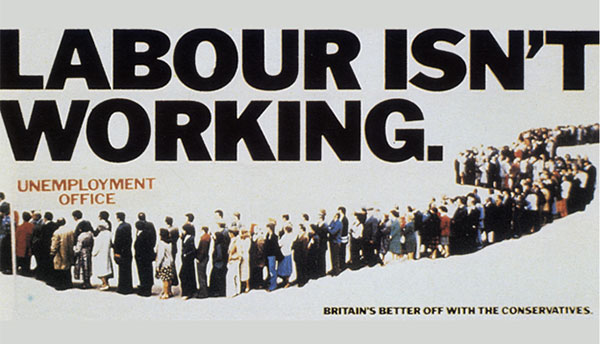
    An example is the 1979 campaign poster by Saatchi and Saatchi for the Conservatives in a Britain troubled by strikes.


  • It’s never too much in the Modi Era


    By Shailesh Kapoor


    Shailesh KapoorIf you haven’t realised it by now, the first half of 2024 is the perfect time to do so. That there is no such thing as ‘Too much Modi’. We are into the second week of the new year, and the Prime Minister has been in the news every single day.


    It started off with his Lakshadweep snorkeling adventure, which stirred up an unexpected, somewhat silly, controversy. Maldives found itself at the receiving end, though they have their own politicians to blame for saying the wrong things, and choosing the worst possible timing to say them too!


    This week, the Prime Minister is on a development tour of sorts. After a well-marketed Gujarat tour, where Mukesh Ambani showered praises on the Prime Minister, Modi is in Mumbai today to inaugurate the Atal Setu, India’s longest sea bridge.


    Next week, the focus will shift to the mega event on January 22 in Ayodhya, where the Ram Mandir will be inaugurated. The guest list (or the absence of names from it) has been making headlines anyway, and we can expect Mon, Jan 22 to be one of the biggest news days in modern Indian history.


    We are already in the pre-election season, and post Ayodhya, the campaign trails and the rhetoric will gain momentum, and we can expect another 4-5 months of headlines dominated by politics, and indeed by its favorite face.


    That Prime Minister Modi has been the mass media’s favorite is well-known by now. But in recent weeks, even the digital media platforms, which have often been critical of the Modi government, have found it hard to resist covering him on almost a daily basis.


    One of the offshoots of the Prime Minister’s media coverage is that it has made news more inclusive for female audiences and the youth. For many years, older men (30+ years) were seen as the core TG of political news in India. However, PM Modi brings with him a ‘fan base’, much like a film or a series franchise would. ‘What did Modi say today?’ is often a topic of discussion in recent years between housewives in small-town India. No surprise, then, that our ratings-hungry news channels cannot stop talking about him.


    Many political experts believe that barring a last-minute surprise, PM Modi is all set to come back for a third term. Modern India hasn’t seen a national leader of such longevity. There has been no Prime Minister to hold the office for 15 years at a stretch since Jawaharlal Nehru (1947-1964). Not even Indira Gandhi.


    We are already in the ‘Modi era’, and a win later this year will extend it by at least another five years. An era that’s defined by a personality, and also by the media’s whole-hearted endorsement of it.


  • Two views on the I.N.D.I.A. boycott of 14 news anchors


    By Ranjona Banerji


    Ranjona BanerjiThe decision not to speak to certain TV anchors by the opposition coalition, I.N.D.I.A., is not an easy one to parse. On the one hand, you might think it’s a good comeuppance for these anchors. In their less offensive – relatively speaking – avatars, these anchors have been propaganda voices for the BJP and for Prime Minister Narendra Modi. In their more sinister personas, they have actively created social divisions and fanned the flames of hatred against Muslims, other religious minorities and Dalits.

    In between they have consistently flayed the Opposition as one entity as well as their individual party components. While giving the BJP-led Government at the Centre, various BJP state governments and the BJP, the RSS and all its attendant organisations a free pass, the opposition has always been placed on the “losing” side of these so-called “debates”. They are not time to put forward their case, BJP spokespersons are allowed to speak over them and so on.

    Several fans and followers of opposition parties have begged them not to appear on these channels, where night after night they are humiliated, their voices cut off and they are put under greater and nastier scrutiny than BJP participants.

    It has taken more than nine years for the Opposition to become a cohesive coalition, and then to make this decision and make it public. According to their statement, they will not attend shows held by 14 anchors. They have not however refused to appear on the channels where these anchors work. So it is not a boycott of television so much as avoidance of certain people.

    Should they have then made this list public?

    They could have done the same thing behind the scenes. Refused to appear on X’s show but agreed to appear on Y’s and so on. Possibly they want to make a point.

    Within the journalists’ communities, opinions are varied and contradictory. When I use the word journalists here, I mean journalists. Not TV anchors who are hate-mongers and BJP propagandists. Many of us – myself included – believe that these TV anchors have long surrendered the right to be called journalists. They do not even qualify as the worst of the ambulance-chasing bottom feeders our profession has specialised in. And any person has the right to decide who they want to speak to.

    Other journalists take the high ground and feel that one should give everyone a fair chance. A boycott does nothing for democracy and the future of a free press. This is an honourable position, and one to be admired. Even if it does ignore the sort of nonsense that goes on in Indian television.

    But most importantly, it ignores the massive elephant in the room when it comes to politicians and the Indian media. The refusal of Prime Minister Narendra Modi to take questions from the media.

    The Indian PM does not interact with the Indian media. He does not take questions. He tries to avoid the media when he travels abroad. And at the recently concluded G20 Summit in New Delhi, he did not allow US President Joe Biden to address a press conference either.

    In functioning democracies, press conferences are part of the process. As is media scrutiny of government actions and decisions. India is a rare democracy where all the questions are asked of opposition politicians but few, if any, of the party in power. You might consider than under such circumstances, India is not a democracy at all in the traditional sense.

    In the light of Modi’s refusal to be held accountable for the actions of his government and his party, and his own actions as well, in the light of the sustained harassment of journalists and media houses who show truth to power, what is the weight exactly of a list of 14 anchors who have no connection to journalism?

    Further, we have the defence of Modi’s position by these anchors and propagandists masquerading as journalists. The hypocrisy is stark: when Modi does it, we’re happy. If anyone else does it, how dare!!

    In the end, here’s a “both sides” story, that bad journalists confuse with objectivity, to keep “both sides” happy. At the height of his career as “the angry young man” of Indian cinema, superstar Amitabh Bachchan boycotted the gossipy, spicy film media. It made no difference to his career, which reached amazing heights of stardom never seen until then. It made no difference to film magazines who wrote what they wanted anyway.

    Make of that what you want!


    Ranjona Banerji is a senior journalist and commentator. She writes on MxMIndia on Tuesdays and Fridays. Her views here are personal.


    By Pradyuman Maheshwari


    Pradyuman MaheshwariAt the outset, we must admit that we are appalled that the I.N.D.I.A. alliance of Opposition political parties has decided to boycott shows and events hosted by certain journalists and anchors on Indian news television. Even though they may have enough reason to be peeved about the way they conduct themselves on television.

    For a political grouping that aspires to be forming the next central government, this is unfortunate. There are ways and means to counter journalists who are biased, and we are certain that the various political parties have enough veterans in their fold who can take on even the most biased and toxic of anchors.

    I am sure a Sanjay Raut of the Uddhav Thackeray wing of the Shiv Sena or Mani Shankar Aiyer can take on the mightiest. Or the DMK former finance, now IT minister. Or a variety of other Congresspersons. Or Derek O’brien or Mahua Moitra. Why not field them?

    There’s also the judiciary, and the Supreme Court under Chief Justice DY Chandrachud can be trusted to be, well, provide justice.

    Also to be noted is that the ban is only on anchors and editors, and not the entire channel or network. Obviously it would’ve been a bit much to ban an entire channel, but why isn’t I.N.D.I.A. doing that? For, the fact is that if Channel X accords a primetime/prominent slot to a Anchor Y, then it is equally responsible for the views that are aired. Unless of course it has an equally unbiased show or anchor leaning against the other side just before or after the journalist who the Opposition considers biased..

    But let’s leave the argument of questioning the I.N.D.I.A. alliance’s decision for now. The vote-casting masses are not as uninformed as some people may think. Else, the people of Karnataka and West Bengal wouldn’t have voted for Congress and TMC respectively. The anchors named by the I.N.D.I.A. alliance (and their ways) existed even when these states went to the polls.

    What has triggered this comment from me, and pulled Mediaah! out of its slumber is the statement issued by the News Broadcasters & Digital Association (NBDA).

    Let’s read the statement first:

    “News Broadcasters & Digital Association (NBDA) is deeply anguished and concerned by the decision taken by the I.N.D.I.A. Media Committee not to send their representatives on the shows and events hosted by certain journalists/anchors. The decision taken by the I.N.D.I.A. Media Committee sets a dangerous precedent.

    “The ban on representatives of the opposition alliance from participating in TV news shows anchored by some of India’s top TV news personalities goes against the ethos of democracy. It betokens intolerance and imperils press freedom. The opposition alliance claims to be the champion of pluralism and a free press, but its decision betrays callous disregard for democracy’s most fundamental tenet – the inalienable right to openly express ideas and opinions.

    “The boycott of certain journalists/anchors takes the nation back to the Emergency era, when the press was gagged, and independent opinions and voices were crushed. NBDA urges the opposition alliance to withdraw its decision of boycotting certain journalists and anchors as such a decision would amount to browbeating journalists and stifling freedom of speech and expression of the media.”

    I am not sure that the comment “The boycott of certain journalists/anchors takes the nation back to the Emergency era, when the press was gagged, and independent opinions and voices were crushed” is correct. The I~~ alliance isn’t doing that. There is no censorship being imposed here.

    My issue with the NBDA is that why doesn’t it issue similar statements against biases that exist in some of the news channels. Why doesn’t it call out the toxicity amongst its member channels. Why doesn’t it damn the fake news dished out?

    Also, why doesn’t it make a statement on the reluctance of the Prime Minister to address a press conference, as most Prime Ministers have done in the past.

    Why is the NBDA shying away from all of this?

    Some of the ‘banned’ anchors listed are leading lights of the NBDA member channels. Am sure they will not be impacted with this boycott. They may even put an empty chair there for effect, as has been done in the past by one or more channels.

    But there is a larger problem which the channels could face. There is a fresh move to  campaign against toxicity of news channels, and this may find a shrill in states ruled by I.N.D.I.A.-affiliated parties.

    I must also add here that the ruling BJP too has a reluctance of some of its top leaders being interviewed by senior editors like Rajdeep Sardesai. It may not be a boycott, but when was the last time you saw Sardesai interviewing the two Big Boys, one-on-one for television or for the various India Today/Aaj Tak conclaves? It’s not a ban for sure, but there is a clear hesitation to be subjected to an interaction.

    While I am glad that the NBDA has issued a statement on the I.N.D.I.A. boycott, it must also look at issues on bias, toxicity and the like with enough speed, even if it is nothing new and needs to done retrospectively.

    Pradyuman Maheshwari is Editor-in-Chief, MxMIndia. His views here are personal.


  • The Moon, Modi, Manipur and the Media

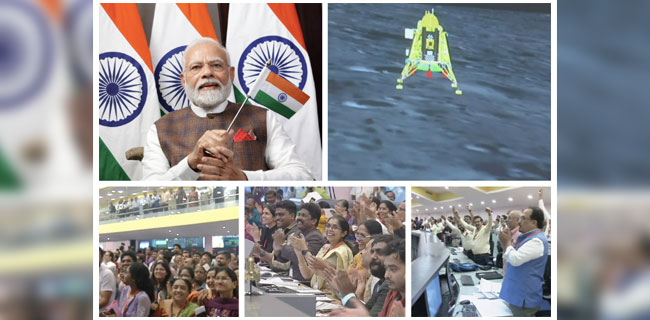
    PM witnessing successful landing of Chandrayaan 3 via video conferencing. Picture (edited) source: Press Information Bureau


    By Ranjona Banerji


    Ranjona BanerjiIndia made history on August 23, when the Vikram Lander made a successful soft landing close to the South Pole of the Moon. No other space-exploring nation has managed this. It was a thrilling moment, when the graphic of the rover touched down on the moon’s surface and the control room burst into applause and cheers.

    A great triumph for India’s space programme, for the Indian Space Research Organisation (ISRO) and all the scientists involved.

    Of course, this is India. Therefore, the Indian media – most of it anyway – and the ISRO feed itself, had focused as much on the face of Prime Minister Narendra Modi as he watched the landing as it did on the landing itself. And then, before we heard anything about the landing, we had to hear the Prime Minister speak from South Africa. There was no connection between the two events, that is the Prime Minister and the moon-landing. But like I said, this is India. Politicians rule.

    The result of this was no science and all congratulatory hysteria. TV channels showed endless images of the moon-landing. All of these were computer generated, but it appears they forgot to tell their viewers. Or maybe the anchors themselves did not know. Who did they think took these images of the landing?

    Later ISRO released the first photos of the moon’s surface, one of which showed the leg of the lander.

    In all the coverage, very little was discussed about why we have undertaken this mission and what we expect to learn from it. You often hear people moaning about India’s lack of scientific temperament. Well, this is why. Our public science outreach is pathetic, science journalism is not encouraged and the result is ignorance. And when ignorance is coupled with jingoism, all you get is a general pall of stupidity.

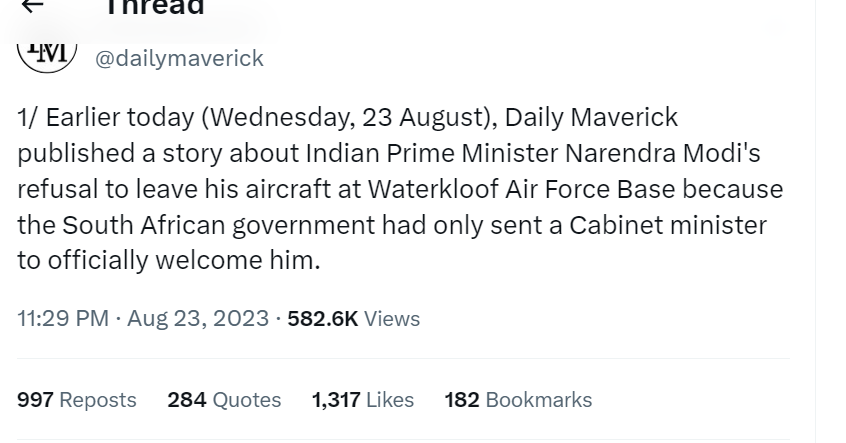
    While on the Prime Minister and South Africa, the Daily Maverick, a South African online news publication with a weekly newspaper, put out an intriguing story, also on August 23. It stated that the Indian Prime Minister landed in South Africa for the BRICS summit and then refused to get off his plane at Waterkloof Air Force Base, because only a Cabinet minister had come to receive him. The headline called it a “tantrum”.
    This is of course a South African publication which owes no allegiance to the Indian government or the BJP. Shocking!
    The day before, President Cyril Ramaphosa had received the Chinese President Xi Jianping, who was on a state visit. PM Modi was not on a state visit.

    According to the Daily Maverick, Ramaphosa then had to despatch his deputy, who was busy with summit preparations, to receive Modi.

    https://www.freepressjournal.in/world/ pm-modi-refused-to-deboard-plane-as-sa-govt-sent-minister-not-prez-to-welcome- him-in-contrast-to-chinas-xi-report

    https://thewire.in/diplomacy/modi-brics-south-africa-plane-disembark-controversy

    So why have I not posted the original report from Daily Maverick?

    That story is as intriguing.

    It took the official system – and I include the BJP IT Cell here – time to respond to this story. Mind you, no Indian media had carried reports any such incident. Instead, they spun the usual tale of NRIs dancing for Modi.
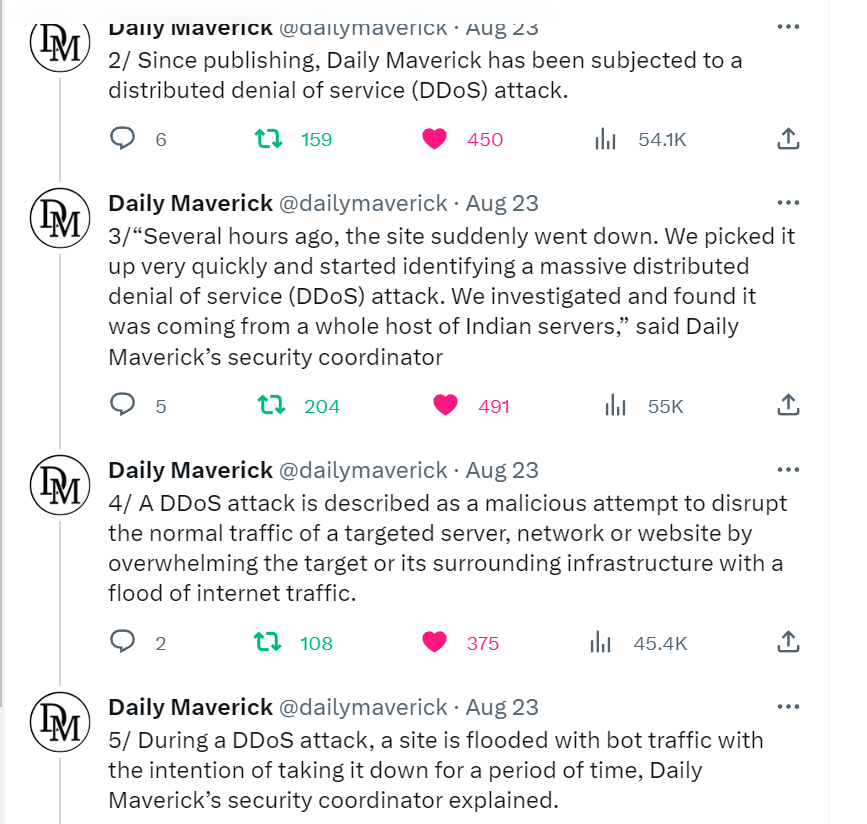
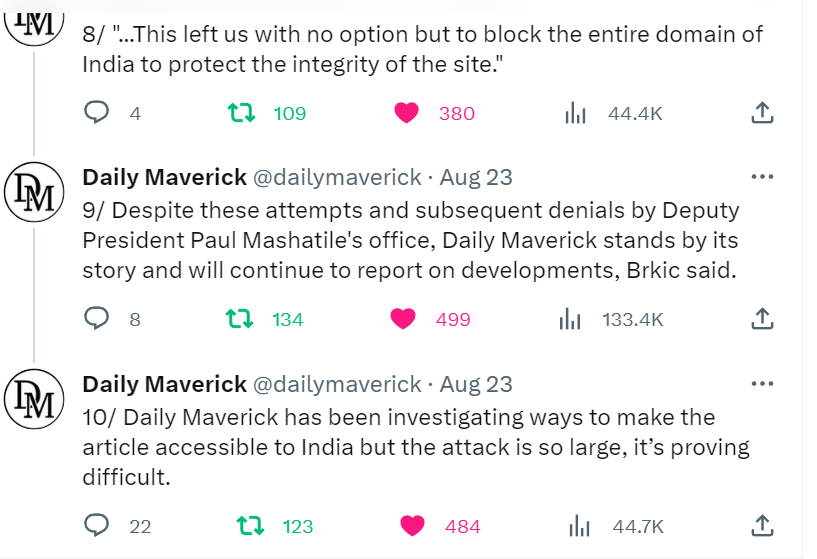
    But people who went to the Daily Maverick site in a couple of hours, found they were blocked.

    According a series of tweets or Xs or posts on X by the Daily Maverick, they were forced to bar India from accessing their site because of a massive cyberattack from India, attempting to take down their site.

    Later, the South African government denied the Daily Maverick claim, while the Daily Maverick stuck to its story (screenshots attached).

    Even now, most Indian media houses have found it difficult to report on this. The Free Press Journal was the first however to show its calibre and courage. And others like The Telegraph, the Newsminute, Wire followed. But for our “godi” or lapdog media, cue in the outrage at a foreign publication daring to report unfavourably on Modi.

    While on the Newsminute, here’s an excellent report, in a fine series, from Manipur. You know, the place not as far as the moon or South Africa, which PM Modi barely acknowledges exists. Almost four months of anarchy, civil unrest, death and destruction there now.

    https://www.thenewsminute.com/article/walked-all-day-four-kids-kuki-woman-recalls-horror-fleeing-her-village-181488


    Ranjona Banerji is a senior journalist and commentator. She writes on MxMIndia on Tuesdays and Fridays. Her views here are personal.

  • Needed a new policy for broadcast sector: Madhavan meets PM Modi

    By Our Staff


    The Association of Indian Entertainment and News Channels, IBDF (Indian Broadcasting & Digital Foundation) President and Disney Star India Country Head, K Madhavan met Prime Minister Narendra Modi and brought to his notice crucial topics regarding the broadcasting sector in the country. He suggested the relevance of introducing a national policy on media and entertainment for the enhancement of broadcasting industry in the country. He pointed out that such a policy shall give better clarity to both media and governing bodies too.


    Notably, the PM has emphasised on the role played by Star Sports in upbringing Kabaddi as one of the much accepted sports in the country after cricket. They also discussed the possibilities of implementing similar ideas to enhance other sports too.


    It may be remembered that Minister Smriti Irani shot into fame after starring in a Star Plus ‘saas-bahu’ serial in the early0 to mid-2000s.


  • When Arnab Goswami took on the Modi government on Manipur…


    By Ranjona Banerji


    Ranjona BanerjiIn the doom and gloom that is India now, there are occasional moments of gallows humour to cheer us up.

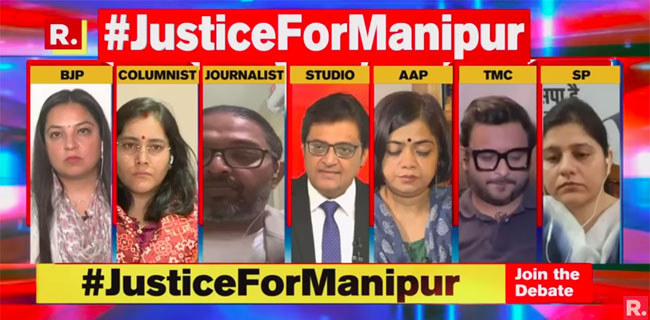
    Like Arnab Goswami screaming that whataboutery on Manipur is wrong, that the Modi government has made a mistake by not sacking Manipur Chief Minister, and so on.

    This is the first time I have seen Goswami’s face in I don’t know how long. So first I was amazed by how young he looks. Then I heard his bombastic shouting and realised it must be good exercise for face muscles. I may try it.

    The clip itself is short. So I have no doubt that Goswami went back to his usual BJP propaganda soon. The channel he runs is supported by the ruling disposition in more ways than one.

    But it was very entertaining.

    We all know, except for old journalists who have forgotten the new rules, even if they championed the hero who changed the rules, that the Modi government will avoid Manipur and do what it can to save Prime Minister Narendra Modi from being questioned on Manipur.

    This is a given.

    But since people will continue to watch TV there is nothing to be done.

    Except entertain yourself on social media.

    Like with the Modi government reaction to the film Oppenheimer.

    And that of former magazine employees who now work for the government. One such wrote a letter to director Christopher Nolan objecting to sex scenes where the Bhagvad Gita was quoted. The objector had not seen the film, but based his objections on social media comments. An honest admission. But also  a good lesson to be careful when journalists liberally sprinkle their copy or TV people their monologues with “sources”. Who knows what their sources are.

    Trolls on Twitter for instance.

    Another such important journalist who once worked for another government has also jumped into the fray on another matter: that the Congress President who is not a Gandhi family member is a puppet of the Gandhi family. This is the same story he has spun for years. But you have to admire his sense of timing.

    With poor Modi being protected from falling airport ceilings, collapsing highways and an increasingly impossible situation in Manipur, it’s all hands on deck to help. And who better than an inside man from the other side?

    I apologise for qualifying journalist with “important”. All journalists are important. Those who live in Delhi and have sources are more important than others.

    I digress. While some old school journalists are up to their usual tricks, others forget the rules have changed and a few try to climb out of the molasses to talk about collapses. Not just Manipur, but landslides, roads, drains and soon, at least 25 per cent of India’s forest cover.

    If you though Manipur was too far away for Delhi to bother about, imagine how far all the Himalayan states are.

    Look out for the amendments to the Forest Conservation Act. Or rather, the new Forest Construction Act. While you sleep, the polity carries on with its destructive policies.

    You could of course also laugh about Elon Musk changing Twitter’s name to X. Extreme foresight about our imminent extinction.


    Ranjona Banerji is a senior journalist and commentator. She writes on MxMIndia on Tuesdays and Fridays. Her views here are personal.


  • When White House condemned venom thrown at reporter…


    By Ranjona Banerji


    Ranjona BanerjiIf ever India’s insecurity as a nation shows, it is in our relationship to the rest of the world. On the one hand, we are constantly looking for affirmation, especially from the West: India is the greatest, Indians are the greatest, best democracy, best prime minister, most popular leader, best national anthem and so on.

    On the other, we are constant “freedom fighters”: Who cares about the West, we are better, our family values are better.

    Often both these exists at the same time in one sentence.

    And let’s not forget that we are a nation that loves to emigrate. You can find Indians everywhere. Far more than you find people of other countries in our land.

    Should I ignore for now the sad fact that those who leave India to settle elsewhere are touchiest about India being criticised?

    Thus the talk around Prime Minister Narendra Modi’s visit to the US.

    Best, greatest, they said, they love us and more.

    But when Modi is asked about the reality of discrimination of Muslims and religious minorities in India, out comes the anger. How dare, what about America and so on.

    And this being today’s India, trolls were quick to pick up on the name of the reporter of the Wall Street Journal who asked Modi the question: Sabrina Siddiqui. Her second name sounds Muslim and that alone was enough to set off the rightwing Hindutva brigade.

    https://thewire.in/media/wsj-reporter-sabrina-siddique-modi-question-human-rights-targeted

    The harassment reached such a point that the White House stepped in to condemn the online venom being thrown at the reporter.

    https://www.thehindu.com/news/international/white-house-condemns-harassment-of-journalist-who-asked-pm-modi-a-question/article67013371.ece

    If anything does not show India in a good light, and raises questions about press freedom in India, it is this.

    Indian journalists who question the government are relentlessly trolled online and attacked in the real world. From Israeli spyware being used on them to hacking of devices to raids, court cases and worse.

    Although we are supposed to pretend that all is well in India, everyone is rich, everyone is happy, to further boost the image and ego of the prime minister, the job of journalists is to tell us that we are pretending.

    Does no one see this?

    Modi returns to India, he asks “what’s happening” as if he does not know, and then has a meeting. Having the problem of violence, anarchy and possible civil war in Manipur, he then proceeds to include the inauguration of a few more trains.

    In other times, history shows us, this is how dictators behave. But in India, you will find a media which promotes and tolerates this dissonant behaviour.

    You also have a media which revels in Islamphobia, in othering anyone who is not a chosen upper caste Hindu – “liberals”, civil rights activists, and anyone who criticizes the Modi government loses Hindu status by dint of criticism – and thus furthering the cause of Hindutva.

    As Manipur burns, there is a massive Hindutva movement growing in Uttarakhand.

    A difficult case like the murder of Ankita Bhandari, where the accused’s father was part of the BJP, is being sidelined. The public prosecutor, says the victim’s father, has been assisting the accused.

    There is little in the national or local media about this, even though the murder created much public interest.

    https://www.newsclick.in/ankita-bhandari-murder-case-public-prosecutor-colluding-accused-know-what-family-said

    At the same time, the targeting of Muslims continues in Purola, Uttarkashi.

    https://thewire.in/communalism/purola-posters-muslims-vacate-shops

    It has taken the high court to somewhat calm things down:

    https://indianexpress.com/article/india/purola-mahapanchayat-uttarakhand-hc-8664504/

    The reason I highlight these cases in Uttarakhand is to underline the fact that India is not Delhi and India is not Modi.

    Like Manipur, Uttarakhand is a small state away from the national gaze. But if Manipur spirals down any further or the Himalayas collapse, it will affect all of India.

    You cannot survive as a democracy if the national media promotes a prime minister who inaugurates trains in the midst of various national calamities.

    It doesn’t matter what the outside world says or does not say. Fake online popularity polls will not change this:

    https://www.deccanherald.com/opinion/second-edit/douse-the-flames-in-manipur-at-least-now-1228980.html


    Ranjona Banerji is a senior journalist and commentator. She writes on MxMIndia on Tuesdays and Fridays. Her views here are personal.