Tag: Meta

  • On-Device Edge AI – The B2C AI Business Waiting to Happen

    On-Device Edge AI – The B2C AI Business Waiting to Happen

    Image generated with prompts to Meta on WhatsApp


    Ashoke AgarrwalAs the ChatGPT excitement fades away, the capital markets are beginning to wonder whether the LLM gold rush is a bust.

    Over the past two years, Big Tech – Google, Meta and Facebook – have sunk hundreds of billions of dollars each in training LLM models and continue to burn hundreds of millions more in inference computing every week as hundreds of thousands of users freeload (or pay pennies) to flood the model with queries that are mostly borne out of curiosity or laziness with not real economic, quality or productivity value add. Further, hundreds of angels and VCs have pumped billions into thousands of AI-driven or AI-adjacent start-ups.

    Although trillions of dollars have been invested in the LLM ecosystem, the business and economic case has yet to emerge.

    In the B2B segment, corporations are busy building machine learning (ML) models that sit atop their proprietary datasets and whatever other data they can access. The ML models (the line between ML and AI) are, in essence, semantic until the day AGI emerges. Predictive pattern building based on complex, structured data and signals will be at the heart of these models. These models will access available LLMs but at the periphery to absorb unstructured data and speed up documentation.

    In the academic and professional world of science and technology research, deep-learning-based ML/AI is an increasing reality. For example, AlphaGo is at the core of research into discovering and synthesising new proteins that will drive the cutting edge of genetics and drug discovery.

    By contrast, the economic case for AI in the B2C arena still needs to be clarified.

    The trillions being spent on creating LLM models and inference testing them by offering them free (or nearly free) to millions of consumers can be likened to the early days of optical-fibre-based bandwidth building, much before the emergence of the deluge of mobile Internet, video-sharing, and streaming. In the final years of the nineties and the early oughts, many wrote off the vast investments in the optical fibre network as white elephants.

    History proved otherwise.

    Device-based Edge AI will create an economically viable future for AI in the B2C arena. This future will be predicated on the investments being made today in LLMs, which have an exponentially increasing number of parameters, increasingly customised hardware and software, and a wide variety of specialist AI agents sitting atop increasingly capable LLMs. Breakthroughs in design will decrease the cost of specialist LLM cloud farms and their environmental impact through greater energy efficiency and better green energy solutions.

    The contours of the device-based Edge AI that will drive the emergence of a viable B2C market for AIs are beginning to emerge.

    Samsung and Google have launched smartphones that are touted to incorporate device-based AI. A slew of laptop brands are also touting AI credentials. However, by the use cases these brands tout, they are marketing gimmicks that harm instead of heralding the B2C AI era.

    Apple’s Intelligence could be the actual start of the device-based Edge AI (EAI) B2C era.

    The launch event of the iPhone 16 mentioned the phone’s AI capability but did not present any use cases. In all the usual slickness of the launch, what went almost unnoticed is that while the hardware and probably the operational software were on the phone, Apple Intelligence would be ready for the consumer to use only a few months down the lines. The reasons could be Apple’s philosophy of not putting out anything half-baked and even regulatory approval.

    Reading between the lines, Apple Intelligence (AI) is the first AI engine focused on deciphering the individual, unlike the written/spoken word, visuals, and video at large that the LLMs are focused on.

    Smartphones are rich repositories of an individual’s lifestyle, interests, attitudes, and behaviour–a finer-grained repository permanently etched. Further variables like smartwatches and fitness rings will continue to add vital data to this repository. With the individual’s permission, the on-device AI can capture more information from conversations, laptops, office computers, and the increasingly innovative IoT devices at home.

    A smartphone-based Edge AI can then be the counterpart of the LLM – the Deep Personal Model (DPM) that is continuously trained to predict and anticipate. An individual needs to interact with her and the world to meet them. For example, if an individual is preparing for an educational test, the DPM could decipher her areas of weakness, alert her to them and provide specific inputs to overcome them. It could create a section of the DPM, her avatar as her professional – an architect, a journalist, a management consultant. This professional avatar could handle her professional communications and routine tasks.

    Another use case is for the DPM to detect signs in her vitals and situational stress and correspond with her doctor’s professional DPM avatar to get remedial recommendations.

    The DPM could take over the essential consumer functions of anticipating and ordering products within set limits and in interactions with market-facing AIs that allow her to access all relevant market knowledge.

    Of course, the consumer will be in complete control of the DPM regarding what personal data it can access and what functions it can perform for the consumer. She would also have the option to turn off and turn on the DPM. She decides based on her perception of access and utility trade-offs.

    The DPM will be charged as a service, much like Apple, at various subscription levels. A few years into the emergence of device-based DPMs, the device could come free with a subscription to a DPM, making the DPM market the largest B2C category in the world.

    The crucial aspect of a DPM’s success is the assurance of privacy and control for the individual. That’s why the DPM must reside on the device, not the cloud. Equally important will be trust in the brand offering the DPM. Apple with its brand positioning on privacy and its track record on that aspect has a leadership advantage in that area


    PS: I first wrote about a concept called “Concierge Intelligence” in my first MxMIndia column published on Jan 6th 2022; thirty-two short months later, the idea of what I now call DPM seems to be around the corner.


  • Instagram launches Creator Lab in India

    Instagram has launched a Creator Lab in India. This initiative aims to provide support to young people across India who are interested in content creation.

    As many as 14 content creators feature in the content on Creator Lab, who represent diverse geographies, genres and growth journeys. Some of them are Aabir Vyas, Govind Kaushal, Meethika Dwivedi, Raghav Sachhar, and The Vixens Crew. The creators will share takeaways around three themes that are essential to achieving sustained success:

    The content is available in English and Hindi, depending on the comfort of the creators who’re part of the videos. Going forward, more content will be added to the Lab, and the content will also be captioned in 6 Indian languages – Tamil, Telugu, Malayalam, Kannada, Bengali, Hindi. Here’s the link to the Lab.

    Said Paras Sharma, Director, Global Partnerships, Meta, India: “We are dedicated to empowering creators to express themselves freely and succeed in their own unique way. We recognize that success means different things to different people, and we are constantly seeking ways to add value through product features, programs, collaborations, and economic opportunities. To support aspiring creators, we are now launching Creator Lab, a resource that provides content by creators, for creators. Our goal is to help creators across the country take advantage of this opportunity and achieve their goals.”

  • Urban Company collaborates with Meta

    Urban Company has collaborated with Meta to jointly develop a series of films promoting its weekly bathroom cleaning service.

    Said Rahul Teotia, Vice President – Marketing at Urban Company: “We are thrilled to collaborate with Meta on this innovative campaign for our Weekly Bathroom Cleaning Service. This partnership allows us to leverage Meta’s cutting-edge platform capabilities to create engaging and impactful content. By focusing on Meta-first creatives, we can better connect with our audience in a way that feels natural and entertaining. This campaign represents a significant step in our digital brand journey, and we are excited to see the positive impact it will have on our brand awareness and customer engagement.”

    Added Shweta Bajpai, Director, Financial Services, Media, Travel & Real Estate (India), Meta: “People are naturally in discovery mode when they come on our platforms, and they are looking to be entertained even while consuming brand messages. We’ve consistently noticed that brand campaigns that build mobile-first creatives built for our platforms perform better across both brand and performance metrics. Additionally, brands can use hyper-local targeting across our platforms to reach their customers accurately. We’re thrilled to work along with Urban Company to create a campaign that builds on the key strengths of our platforms to drive delight for their customers and deliver performance for their business.”

  • Crackdown on WhatsApp University. MCA & Meta collaborate to curb AI-generated misinformation

    The Misinformation Combat Alliance (MCA) and Meta are working on launching a dedicated fact-checking helpline on WhatsApp in an effort to combat media generated using artificial intelligence which may deceive people on matters of public importance, commonly known as deepfakes, and help people connect with verified and credible information. The helpline will be available for the public to use in March 2024.

    Commenting on the partnership, Shivnath Thukral, Director, Public Policy India, Meta, “We recognise the concerns around AI-generated misinformation and believe combatting this requires concrete and cooperative measures across the industry. Our collaboration with MCA to launch a WhatsApp helpline dedicated to debunking deepfakes that can materially deceive people is consistent with our pledge under the Tech Accord to Combat Deceptive Use of AI in 2024 elections. As a company that has been at the cutting edge of AI development for more than a decade, we remain committed to work with industry stakeholders to introduce common technical standards for AI detection, transparency solutions and policies, along with empowering people on our platforms with resources and tools that make it simpler for them to identify content that has been generated using AI tools and curb the spread of misinformation.”

    Added Bharat Gupta, President, Misinformation Combat Alliance:  “The Deepfakes Analysis Unit (DAU) will serve as a critical and timely intervention to arrest the spread of AI-enabled disinformation among social media and internet users in India. Its formation highlights the collaboration and whole-of-society approach to foster a healthy information ecosystem that the MCA was set up for. The initiative will see IFCN signatory fact-checkers, journalists, civic tech professionals, research labs and forensic experts come together, with Meta’s support. We hope the DAU will become a trusted resource for the public to discern between real and AI generated media and we invite more stakeholders to be a part of the initiative.”

    MCA is a cross-industry alliance bringing companies, organisations, institutions, industry associations and entities together to collectively fight misinformation and its impact. Currently, MCA has 16 members including fact-checking organisations, media outlets, and civic tech and are inviting strategic partners to collaborate in this industry wide initiative to combat misinformation and create an enlightened and informed society.

    The concern of course is not just AI-generated misinformation. It’s when human intelligence is at play.

  • IAA to open doors to the Meta office

    The Indian Chapter of the International Advertising Association (IAA), has announced its next event for its Young Professionals (YP). On February 16, IAA’s Young Professionals will get a chance to visit the Meta office and interact with professionals from the social media giant.

    During this three-hour event, Meta professionals will discuss trends that they see in advertising in 2024, the best practices for advertisers using it, and also possible career options with them. Post the presentations, the Meta team will engage with the attendees during high tea.

    Said Avinash Pandey, President, IAA India Chapter: “The IAA Young Professionals membership is a fantastic platform for young professionals to connect, learn, and thrive in this ever-evolving world. Through this event with Meta, we aim to help educate them on how the social media giant functions, how it can be used to build  brands, and also most importantly what it offers for those looking for roles within the company.”

  • The Future of Ad Agencies is in AdTech


    By Ashoke Agarrwal


    Ashoke AgarrwalIn the early naughts, a friend left the ad agency world for academia, calling the ad world “a conspiracy of mediocrity.” I thought he was egregiously wrong and, in my mind, started comparing him to Ignatius J. Reilly, the lazy, obese, misanthropic, self-styled protagonist of John Kennedy Toole’s brilliant book, “A Confederacy of Dunces”.


    I continued to spend decades in advertising and lost touch with my friend. I have always considered the ad world mercurial and more open to new ideas and talent than any other business. At one time, ad agencies were where to have the most fun with your clothes on.


    However, over the past decade, I have started feeling uneasy about the future of ad agencies – both creative and media types. In the era of mass media, the agency was the expert partner that offered insights into the consumer’s psyche and cutting-edge culture and the insider track into the workings of the media.


    Then, as the cushioning of the 15 per cent commission disappeared, agencies shed top-drawer planning and creative talent and lost their edge in consumer understanding and cultural trends. Moreover, the ad world stopped attracting the best crop from the fine arts, social sciences, and business schools, leading to an increasing feeling of superiority among marketing, product and brand managers when dealing with their agency counterparts. Over a decade, creative and media agencies sunk for a seat at the client’s marketing strategy high table to being vendors evaluated on specifications, speed, and cost.


    With the arrival and burgeoning importance of digital and social media, the decline of ad agencies accelerated—the emergence of Google and Facebook as the fulcrums of growing importance and the relentless and cold-headed demands of performance marketing further disempowered agencies.


    With the age of AI fast dawning on the world, another paradigm shift is in the offing.


    Media strategy, planning and operations are already slipping into the realm of algorithms with minimal human intervention. As AI matures, the last vestiges of human input will disappear.


    Two ongoing societal shifts impact creative strategy and development in the post-modern era. The new consumers – the Millennials and Gen Z – are way more advertising and marketing savvy, dismiss the hard sell, and are unaffected by traditional advertising’s hidden persuaders. They get their product information from credible sources and exhibit brand preference and loyalty based on a brand’s resonance with the value systems, concerns, and culture. At the same time, the new Millennium has since mass culture fragmented into millions of niches and tribes with ever-changing configurations of values, concerns and cultural totems.


    In this changing world, brand messaging and campaigns have split into two distinct tiers – performance marketing and content marketing.


    Performance marketing is tracking an individual’s purchase journey and contextual messaging that nudges her into the next favorable stage – click to the brand’s website or click away from a competitor’s website, click on the shopping or click away from it.


    Tracking and identifying the context in performance marketing is already algorithmic beyond human intervention. The messaging in the context of performance marketing is quite simple and is currently pre-designed by humans. As AI develops, the context and the messaging will be more tightly linked and will need no human intervention.


    Content marketing is a complex creative task, especially if it were to address all the relevant niches and tribes with relevant content that resonates with their changing values systems, concerns and cultural mores. While human creative teams struggle with this seemingly endless task, today’s LLMs can do a much better task. As AI systems integrate across tracking, segmenting, developing, and delivering content, even this last bastion of the creative agency will fade.


    So, if today’s ad agency groups are to survive, they will need to morph into AdTech companies with proprietary ad tech that they can deploy as an agency or deliver as a SAAS service to clients’ in-house teams.


    The first phase of ad tech that agencies could innovate and deploy is the development of fully integrated AI-driven AdEngine, based on an assimilated, up-to-date knowledge base-information on all relevant market data across all categories based on secondary and primary sources. While the knowledge base will integrate all available secondary and syndicated research, one of the distinguishing factors of an agency’s AdEngine would be the proprietary research and information it taps into. Based on business & marketing objectives and plans, the agency’s AdEngine would offer an alternative marketing communications strategy along with budgets, targets and pros and cons. Once the client has chosen the marketing communication strategy, AdEngine will execute the plan, with periodic reviews and fine-tuning that the client team can participate in.


    The technology that will deliver AdEngines is feasible today. Meta and Alphabet already have an AdEngine, but they deploy it to maximize their revenue. Tomorrow’s global agency must create AdEngines that maximize their client’s ROI.


    The next stage of AdTech is a decade or two away. Within a decade, a brand’s AdEngine will mature into the AI avatar of a brand. Parallelly, individuals, starting with the more affluent ones, will acquire AI assistants who manage all their interactions with the world – related to work, health, finances, education, training and consumption. I have termed this assistant Concierge Intelligence (CI), first in a post in February 2022 and the latest in a MxMIndia column in December 2023.


    The development of AI avatars at both the brand and consumer end will lead to an era of “AI-to-AI Marketing” while we humans focus, hopefully, on more creative stuff than just buying and selling.


    The AdTech agency will, in such an era, become a company with a consumer product – a CI for individuals- and market it like Apple and Samsung sell their smartphones today.


    Thus, the AdTech route promises to lead from a B2B SAAS service to a B2C product that could rival the size and impact of today’s smartphone market.


    Who will lead the AdTech market of tomorrow? Today’s global ad agency groups have the resources, but will they escape the rut all big successful companies get into? Will it be Big Tech that swallows the AdTech market with the already sizeable technology lead they have? Or will it be pesky start-ups free of legacy systems and pre-conceived notions fueled by the next generation of intrepid VCs? Interesting decades lie ahead!


  • The Third Eye Flutters


    By Ashoke Agarrwal


    Ashoke AgarrwalThe Screen Age dawned with the spread of TV. Today, it has reached its apex with the ubiquity of the smartphone.


    There are now indications that over the next decade, a new age will dawn that lessens humankind’s obsession with the screen.


    I have always considered augmented reality more potent than virtual reality and could not fathom Mark Zuckerberg’s obsession with the Metaverse. A week ago, Zuckerberg revealed a use case for virtual reality technology that made immediate commercial sense in his interview with Lex Friedman.


    The interview itself was perhaps the first public demo of a powerful new technology that Meta has developed – Pixel Codec Avatars (PiCA): “a deep generative model of 3D human faces that achieves state of the art reconstruction performance while being computationally efficient and adaptive to rendering conditions during execution”. Behind the technical jargon is a hot new metaverse experience that led a usually stone-faced gnome like Lex Friedman to drool.


    PiCA is poised to take over the online meeting space at the high end, pending software and hardware developments.


    Beyond PiCA, the interview revealed a shift in Zuckerberg’s attitude that will make Meta more of an Augmented Reality (AR) player than a Virtual Reality (VR) player.


    Zuckerberg speaks about thinking of AR as a shift in how people experience everyday reality in contrast to VR or the Metaverse, which is about people living in a separate reality.


    Zuckerberg now sees an AR world as one that adds a 4th dimension to the 3-D world of time and space we live in – the AR-driven digital dimension – not as static or moving texts and images on a screen – but as an integral part of the lived reality – an integral part that instead of detracting us from our surroundings, immerses us deeper in it.


    Zuckerberg thinks that with advances in AI, IoT, and PiCA technology, we could be, in a decade or so, living in a world where two people wearing Quest 2030, a spectacle light VR set, can play table tennis on a holographic table with holographic paddles and ball! When the game is over the table, the paddles and ball return to the digital world, leaving the real-world 3D space accessible to the next visitor from the digital dimension.


    The failure of Google Glass in the consumer world was because it was just an uncomfortable shifting of the screen from a handheld to a lens in front of our eyes.


    AR is now in its second generation, where leaps in bandwidth and computing power combined with innovations like PiCA will allow for wearable headsets that are as comfortable for all-day use as spectacles and which project digital 3D objects into real 3D space that one can interact with through voice, gesture, and other digital 3D things.


    That will be a whole new paradigm in experiencing reality.


    When it takes hold, it will be the screen’s death. A paradigm that will add a new sense organ to us humans – the Third Eye- bringing into our lives a fourth digital but actual dimension to our old-world three-dimensional reality. The Screen Age brought us distraction and shallowness of thought- almost a collapsing of our world into 2D. What will the Era of the Third Eye get us? It is difficult to predict, but the magnitude of change in the human experience will be almost metaphysical.


    Why do I feel the Third Eye is fluttering, heralding the not-too-distant dawning of the Era of the Third Eye? Besides the revelations in the Zuckerberg interview, another rumour said that Sam Altman of Open AI and the legendary designer Jony Ive (of iPhone fame) plan to collaborate on an AI hardware device. I bet a million dollars that it will be a Third Eye design if they come up with one.


    When I was a kid in the 1960s, we used to drool over the Dick Tracy watch that did all sorts of things and fantasise about what devices advertised as X-Ray glasses would do for us. Over the next decade or so, the world will likely be flooded with Third Eye devices, a combination of a powerful wrist computer and lightweight, normal-looking eyeglasses, delivering an almost godlike dimension to everyday reality.


  • ML, LLM, Graphs & Market Modelling


    By Ashoke Agarrwal


    Ashoke AgarrwalNine months after the launch of ChatGPT, the hype has died down and the real work of building upon the burgeoning availability of Large Language Models (LLMs), of which ChatGPt is but one example, has begun.


    The interest of businesses in the concept of Big Data rose exponentially in 2012. Many expected a paradigm shift in consumer marketing based on nifty analytical systems driven by Big Data. Much was expected in data-driven decision-making, personalisation and customisation, targeted advertising, sharper segmentation, predictive analytics and real-time insights. In 2015, in its report titled ‘Big Data, Analytics and the Future of Marketing and Sales’,  McKinsey laid out the expectations.


    In 2023, the future is different from what McKinsey expected. The paradigm certainly shifted for Google and Meta, who cornered the advertising market based on a humongous amount of real-time Big data and state-of-the-art analytical engines.


    Change also happened for brands that marketed and sold products and services to B2C and B2B markets. However, the difference had little to do with their use of Big Data and advanced analytical systems. It was in the emergence of the digital universe as a product, go-to-market and communication platform.


    Dig a little, and you will find that the thesis that brands under-exploited the opportunity that Big Data presented to them mainly because they used legacy databases and ERP systems from the likes of SAP, Oracle and Salesforces to collect and store their Big Data. As a result, while many created special teams to mine, warehouse and analyse Big Data, most crucial business, marketing and sales decisions continued to be based on traditional business analysis and market research.


    Meanwhile, Google and Meta (then Facebook) invested in an analytical system that eschewed the rigidity of the traditional IT-age relational databases – essentially tables with rigid rows and columns. In a seminal decision that presaged the age of AI, they decided to populate their databases in graphs – a network of nodes with many properties with multiple links to other nodes, with each link specifying a kind of relationship with a property of the originating node and a property of the linking node.


    Such a database structure allowed for:

    :: Fast and more varied analysis

    :: More immediate additions and reconfiguration of the database as conditions change

    :: Better situational analysis and insight discovery through “what-if” analysis that changed node and link configurations


    Based on their ever-expanding, ever-enriched graphs and the use of Machine Learning (ML) driven near-real-time analysis, Google and Meta created a mighty advertising service with the confidence to offer brands a pay-per-click service. As a result, brands willy-nilly outsourced the harnessing of the real opportunity of the digital and Big Data age to Google, Meta and other digital ad exchanges that sprang up.


    It is no surprise that Google and Facebook are among the most advanced AI players today, including in the field of LLMs with Google’s Bard and Facebook’s Llama. The essential process that powers LLMs is that they parse large storehouses of text into triples of subjects, objects and predicates and then model them into graphs with the nodes consisting of subjects and objects and the links signifying relationships in the form of predicates.


    As Google’s and Meta’s LLMs improved power, it turbocharged their graph databases, allowing them to automate the process of incorporating unstructured into their graphs. Perhaps left to themselves, Google and Meta would not have exposed their LLMs to the public as they have done so now but kept it themselves as a background technology powering customer-facing applications. Instead, OpenAI and ChatGPT forced their hand.


    The resultant hype around ChatGPT has kickstarted the age of AI, with the world at large now seriously scrambling to incorporate AI into businesses, Governments, schools, hospitals and wars. Publications like The Economist and others have started ranking Fortune 500 companies based on the potential competitive advantages/disadvantages that AI can deliver to them!


    How will businesses in general and marketers in particular respond to the new horizons of AI?


    The powers of MI, Graph Theory and Advanced Modelling will create a new platform that will change how businesses, if not entire societies, are run. Just as the arrival of digital media changed economies at the core, Graphs with Big Data inputs from structured and unstructured sources (processed through LLMs) will create dynamic market models that will change how businesses are structured, with business and marketing strategy being almost wholly automated with human inputs needed only at the highest meta-strategy level. The shift will be paradigmatic enough for the world to label the resultant business order as the Nth Industrial Revolution, a sub-set of the First AI Revolution that will redefine human society.


    The question is whether individual businesses will seize this opportunity, invest and build proprietary dynamic models that will run their companies, or will they, once again, as they did with the digital revolution, outsource it to the next Google or Meta?


    The stakes this time are higher. Not only will the businesses themselves be more beholden to those who own and run the models, but in the process, society will create AI-driven behemoths that will be the first step to the dysfunctional system that those who fear AI imagine.


    Therefore, it is incumbent on business leaders and thinkers to pay close attention to this evolving opportunity and invest all that is needed to harness it before it becomes an insurmountable challenge.


  • Engagement drops for ChatGPT & Threads, with reason

    Representative graphic. It doesn’t give the exact drop in engagement of ChatGPT and Threads


    By Omar H. Fares and Seung Hwan (Mark) Lee


    ChatGPT recently experienced a decline in user engagement for the first time since its launch in November 2022. From May to June, engagement dropped 9.7 per cent, with the largest decline — 10.3 per cent — occurring in the United States.

    Meanwhile, Meta’s Threads platform experienced a significant drop in user numbers, going from more than 49 million users on July 7 to 23.6 million active users by July 14. In the same time frame, the average time users in the U.S. spent on the app dropped from a peak of 21 minutes in early July to just above six minutes.

    In the tech world, companies are always racing to be the first ones to introduce new innovations, aiming for the “first mover’s advantage.” This refers to a firm’s ability to get a head start over competitors by being the first to enter a new product category or market.

    However, being a trailblazer doesn’t guarantee an easy ride. While there are perceived benefits, there are also a plethora of challenges that arise.

    A news story about what the drop in Meta Threads engagement means for the social media app.

    The recent declines of Threads and ChatGPT attest to this reality, demonstrating that rapid and widespread acceptance doesn’t necessarily lead to long-term success.

    There are a few reasons why a fast adoption isn’t necessarily the key to success including unsustainable growth, inadequate scaling infrastructure and a lack of user retention strategies.


    Unsustainable growth

    The idea of unsustainable growth stems from a platform’s inability to uphold or maintain the quality of the user experience while scaling up at a rapid pace.

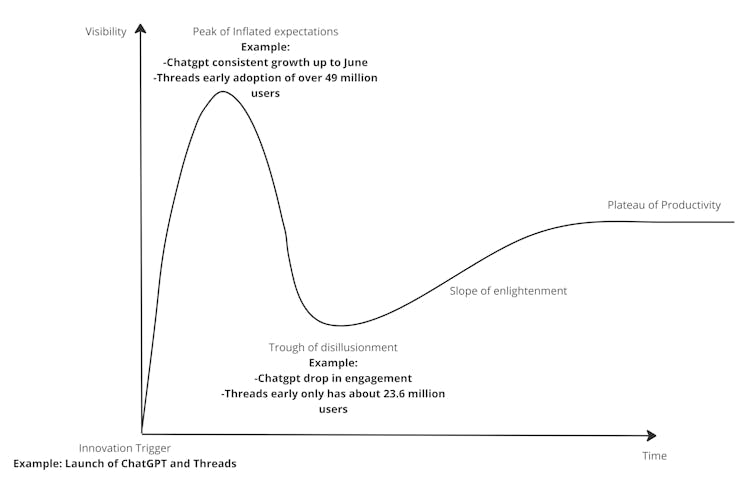
    This is where the real challenge lies: being able to effectively scale up a product or service. It is precisely at this junction that the concept of unsustainable growth intersects with the Gartner Hype Cycle.

    The Gartner Hype Cycle is a model that shows the stages of emerging technology adoption: from the initial hype and inflated expectations, through disillusionment and skepticism, to practical and mainstream productivity.

    A line graph illustrating that Threads and ChatGPT both had a period of significant hype and inflated expectations, followed by a drop in user interest.
    A graph illustrating how ChatGPT and Threads fit into the Gartner Hype Cycle.
    (Omar H. Fares and Seung Hwan Lee), Author provided


    In the context of unsustainable growth, products like ChatGPT and Threads appear to have reached the stage known as “peak of inflated expectations,” where the publicity of a new product generates over-enthusiasm and unrealistic expectations. During this stage, users rapidly adopt the product due to its novelty and the hype surrounding it.

    However, this stage often leads to the “trough of disillusionment.” During this stage, the product fails to meet users’ unrealistic expectations, causing a decline in their interest.

    It indicates the product’s growth may have outpaced its ability to provide an excellent user experience. Without enhancing the product based on user feedback, declining user engagement will ensue.

    This rise and fall underscores the challenge of achieving sustainable growth in the face of rapid adoption. The initial hype often attracts a massive influx of users, but without a clear, scalable strategy for maintaining quality and engagement, platforms can quickly lose their appeal.


    Inadequate scaling infrastructure

    When a platform’s user base expands at a rapid pace, the question of whether that platform’s infrastructure can scale to the demands of its users becomes critical.

    The sudden influx of users that accompanies a successful product launch can be a double-edged sword; it brings a wealth of opportunities for data collection, user feedback and revenue, but also tests the scalability of the platform’s infrastructure.

    If the underlying technology, support services or operational strategies are not built to scale, the product might suffer from slow loading times, frequent crashes or a lack of timely customer support — all of which are detrimental to the user experience and a product’s long-term success.

    For instance, OpenAI, the company behind ChatGPT, had to limit ChatGPT-4 users to 25 messages every three hours due to infrastructure constraints — even for those with a paid membership. While this helps manage the infrastructure load, it presents a challenge from the user’s perspective.

    Users who were accustomed to unlimited interactions with ChatGPT-3 now find themselves paying for a service with limitations. This may inadvertently dampen user engagement and drive some users away, underscoring the delicate balance between managing infrastructure and maintaining user satisfaction.


    Lack of user retention strategies

    One reason why tech businesses struggle to retain users is because they don’t prioritize user-centered design. By failing to incorporate user feedback in product development, businesses can end up offering a product that doesn’t meet user needs.

    In addition, businesses must provide effective support for users. Insufficient or unclear onboarding may leave users feeling lost and overwhelmed, leading them to abandon the product. In the case of ChatGPT, OpenAI provides a basic explanation of platform usage, but users are primarily responsible for exploring it themselves.

    Users experiment with prompts without a clear understanding of how to generate impactful responses, resulting in uncertainty and frustration. This lack of guidance may contribute to lower engagement rates, as observed in the recent decline.

    Lastly, increasing concerns about security threats and privacy have raised questions about how new technologies are protecting their users. The conflict between the need for more personalized experiences and privacy can give rise to a phenomenon called the personalization-privacy paradox.

    As individuals grow increasingly uneasy about how their personal information is stored, the lack of proper regulations can lead to a decline in the use of personalised services or technologies.

    While rapid user adoption is a promising start, it doesn’t guarantee long-term success. Striking the right balance between growth and infrastructure scalability, adopting a user-centric approach, maintaining user trust and investing in continuous innovation are the cornerstones for enduring success in the competitive tech landscape.The Conversation


    Omar H. Fares is Lecturer in the Ted Rogers School of Retail Management, Toronto Metropolitan University and Seung Hwan (Mark) Lee is Professor and Associate Dean of Engagement & Inclusion, Ted Rogers School of Management, Toronto Metropolitan University. This article is republished from The Conversation under a Creative Commons licence.  Read the original article.


  • Snehi Jha is Head of Mindshare Fulcrum – South Asia, joins from Meta

    By Our Staff


    Mindshare has announced the appointment of Snehi Jha as Head of Mindshare Fulcrum, South Asia.


    Jha’s career began at Mindshare Fulcrum in 2002, where she spearheaded strategic media planning for the skin care and oral care sectors. Most recently, she was a part of the Meta India Leadership team.


    Commenting on the appointment, Amin Lakhani, CEO – South Asia Mindshare, said, “I am delighted to welcome Snehi as Head of Mindshare Fulcrum. Snehi’s vast experience and exposure to Platforms, Brand and Media make her the ideal leader. I am confident in her deep industry knowledge and her passion for innovation and DEI which will undoubtedly accelerate good growth and deliver exceptional value to our esteemed client Unilever.” Jha will report directly to Lakhani.


    Added Jha: “I am thrilled to re-join Mindshare, a company that has always been close to my heart. I look forward to working with the talented team at Mindshare Fulcrum and leveraging our collective expertise to deliver outstanding results for Unilever. Together, we will unlock new opportunities, drive innovation, and create meaningful connections in an ever-evolving media landscape.”


  • Can ‘little boy’ Musk match ‘devious’ Meta?


    By Ranjona Banerji


    Ranjona BanerjiA thread is a series of connected tweets on Twitter.
    (Okay, a thread is many other things but in this social media universe we live in, this is one definition.)

    Threads is also the new Twitter-ish app/platform launched by Meta.

    For a while now, users of the world’s most popular and yet largely unprofitable social media platform (which is not about influencers and short videos) have tried to find a suitable alternative.

    The reasons were many, and that’s even before maverick billionaire Elon Musk bid for and was forced to buy Twitter because his tantrum was taken seriously in the world of grownups.

    Twitter’s policies regarding fascist governments, regarding trolls, regarding bigotry led to much unhappiness. Often algorithms would misunderstand sarcasm or anger, which would lead to people being suspended. Redressal methods were not always clear. And the refusal to let users edit simple mistakes was irksome.

    The first big move was a Mastodon, a community-run platform. In the beginning it was great. The trolls did not find it comfortable. So it appeared to be less toxic. The community-monitoring –whatever the technical term is — made it feel safer and friendlier. But in the end, it became a bit boring.

    The tragedy for the newsperson and the news seeker is, no matter the loud protestations to the contrary, good news is not exciting. People’s eyes glaze over and they move on. Many “good news” pages have tried and failed in newspapers. We are creatures of gossip, excitement and most of all, schadenfreude. That is why gossip magazines, or now websites, or Insta accounts about celebrity wrongdoings outstrip more serious journals in popularity. Spice and crime, that’s the base. Gossip runs the human race.

    So maybe the goodie-goodies stayed with Mastodon. The rest moved out.

    The big problem with Twitter, and this has nothing to do with Musk, is that it created an easy to use and share platform. Flaws notwithstanding. You could catch the news from a large variety of global sources. You could open discussions with people from everywhere, famous, infamous, unknown, like-minded and diverse.

    Yes, the trolls could be toxic and difficult. Yes, reporting them was not always successful. But for the person interested in world events and commentary, Twitter is invaluable. Even after Musk removed the safeguards and sacked the staff that attempted to keep Twitter safer, it is still easier to use.

    Threads as of now, has its possibilities. Although it belongs to Meta, which owns Facebook, Instagram and WhatsApp and thus has an enormous captive base, Threads is not the best designed. As of now, it is not easily negotiable. Even if it is a Twitter copy, it is not a clone. Its attempt to be different has not made it any better.

    Perhaps these are minor glitches. Meta has been largely successful in bringing in users – the massive shift to Threads is a case in point – and keeping them sweet. The problem of course is that Meta’s track record shows that it is even worse than Musk when it comes to promoting rightwing bigotry. Meta is also far more adept at invisible manipulation of users.

    Musk is like a little boy with his new toy which he didn’t really want, doesn’t understand and is now uncertain whether to destroy or make it work his way. Meta is devious and has far more experience with social media.

    As of now, Twitter runs on its own steam, on the legacy left behind by its founders. One of whom, Jack Dorsey, has now formulated his own Twitter alternative, Blue Sky, still being tested.

    So if you lose the thread, perhaps you can still fly?


    Ranjona Banerji is a senior journalist and commentator. She writes on MxMIndia on Tuesdays and Fridays. Her views here are personal.


  • Can Threads see the End of Twitter? Perhaps not

    Meta’s new Threads platform is going gangbusters, but that doesn’t mean it will replace Twitter. Logos owned by respective platforms
     

    By Casey Fiesler


    Twitter’s move on July 1, 2023, to limit the number of tweets users can see in a day was the latest in a series of decisions that has spurred millions of users to sign up with alternative microblogging platforms since Elon Musk acquired Twitter last year.


    In addition to a surge in numbers on Mastodon, the acquisition and subsequent changes boosted small existing platforms like Hive Social and has spawned brand new upstarts like Spoutible and Spill.


    Most recently the microblogging platform backed by Twitter founder Jack Dorsey, Bluesky, saw a surge of sign-ups in the days following Twitter’s rate limit, and Meta launched its microblogging platform Threads on July 5. Threads claimed 30 million users on its first day. Even very different forms of social media such as TikTok are benefiting from what many see as Twitter’s imminent demise.


    As an information scientist who studies online communities, this feels like something I’ve seen before. Social media platforms tend not to last forever. Depending on your age and online habits, there’s probably some platform that you miss, even if it still exists in some form. Think of MySpace, LiveJournal, Google+ and Vine.


    When social media platforms fall, sometimes the online communities that made their homes there fade away, and sometimes they pack their bags and relocate to a new home. The turmoil at Twitter is causing many of the company’s users to consider leaving the platform. Research on previous social media platform migrations shows what might lie ahead for Twitter users who fly the coop.


    Several years ago, I led a research project with Brianna Dym, now at University of Maine, where we mapped the platform migrations of nearly 2,000 people over a period of almost two decades. The community we examined was transformative fandom, fans of literary and popular culture series and franchises who create art using those characters and settings.


    We chose it because it is a large community that has thrived in a number of different online spaces. Some of the same people writing Buffy the Vampire Slayer fan fiction on Usenet in the 1990s were writing Harry Potter fan fiction on LiveJournal in the 2000s and Star Wars fan fiction on Tumblr in the 2010s.


    By asking participants about their experiences moving across these platforms – why they left, why they joined and the challenges they faced in doing so – we gained insights into factors that might drive the success and failure of platforms, as well as what negative consequences are likely to occur for a community when it relocates.


    ‘You go first’

    Regardless of how many people ultimately decide to leave Twitter, and even how many people do so around the same time, creating a community on another platform is an uphill battle. These migrations are in large part driven by network effects, meaning that the value of a new platform depends on who else is there.

    In the critical early stages of migration, people have to coordinate with each other to encourage contribution on the new platform, which is really hard to do. It essentially becomes, as one of our participants described it, a “game of chicken” where no one wants to leave until their friends leave, and no one wants to be first for fear of being left alone in a new place.

    For this reason, the “death” of a platform – whether from a controversy, disliked change or competition – tends to be a slow, gradual process. One participant described Usenet’s decline as “like watching a shopping mall slowly go out of business.”

    Meta is launching Threads as an offshoot of Instagram to take advantage of Instagram’s massive user base.


    It’ll never be the same

    The current push from some corners to leave Twitter reminded me a bit of Tumblr’s adult content ban in 2018, which reminded me of LiveJournal’s policy changes and new ownership in 2007. People who left LiveJournal in favor of other platforms like Tumblr described feeling unwelcome there. And though Musk did not walk into Twitter headquarters at the end of October and turn a virtual content moderation lever into the “off” position, there was an uptick in hate speech on the platform, as some users felt emboldened to violate the platform’s content policies under an assumption that major policy changes were on the way.

    What makes Twitter Twitter isn’t the technology, it’s the particular configuration of interactions that takes place there. And there is essentially zero chance that Twitter, as it exists now, could be reconstituted on another platform. Any migration is likely to face many of the challenges previous platform migrations have faced: content loss, fragmented communities, broken social networks and shifted community norms.

    But Twitter isn’t one community, it’s a collection of many communities, each with its own norms and motivations. Some communities might be able to migrate more successfully than others. So maybe K-Pop Twitter could coordinate a move to Tumblr. I’ve seen much of Academic Twitter coordinating a move to Mastodon. Other communities might already simultaneously exist on Discord servers and subreddits, and can just let participation on Twitter fade away as fewer people pay attention to it. But as our study implies, migrations always have a cost, and even for smaller communities, some people will get lost along the way.


    The ties that bind

    Our research also pointed to design recommendations for supporting migration and how one platform might take advantage of attrition from another platform. Cross-posting features can be important because many people hedge their bets. They might be unwilling to completely cut ties all at once, but they might dip their toes into a new platform by sharing the same content on both.

    Ways to import networks from another platform also help to maintain communities. For example, there are multiple ways to find people you follow on Twitter on Mastodon. Even simple welcome messages, guides for newcomers and easy ways to find other migrants could make a difference in helping resettlement attempts stick.

    In this sense, Threads has an advantage over other Twitter alternatives because users sign up via their Instagram accounts. This means Threads’ social graph – who follows who – is bootstrapped by links among Instagram accounts. Users may not be able to easily bring over their communities from Twitter, but they can instantly pull follows and followers from Instagram.

    And through all of this, it’s important to remember that this is such a hard problem by design. Platforms have no incentive to help users leave. As longtime technology journalist Cory Doctorow recently wrote, this is “a hostage situation.” Social media lures people in with their friends, and then the threat of losing those social networks keeps people on the platforms.

    But even if there is a price to pay for leaving a platform, communities can be incredibly resilient. Like the LiveJournal users in our study who found each other again on Tumblr, your fate is not tied to Twitter’s.


    Casey Fiesler, Associate Professor of Information Science, University of Colorado Boulder. This article is republished from The Conversation under a Creative Commons license. Read the original article. An earlier version of an article was pulished on November 3, 2022.The Conversation