Tag: LinkedIn

  • LinkedIn @ 20: Transforming the business networking giant


    By Theo Tzanidis


    When someone says social media, you probably don’t immediately think of LinkedIn. But there’s no denying that the business networking site has gone the distance: it is now 20 years since it was founded in Silicon Valley.


    It was the brainchild of Reid Hoffman, a US entrepreneur who worked on an early social media platform for Apple before launching one of his own in 1997. SocialNet was a dating and professional connections site, but folded two years later after failing to find a big enough userbase in those early days of the web.
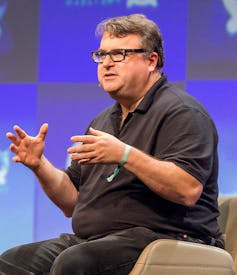
    LinkedIn founder Reid Hoffman talking at a conferece
    LinkedIn founder Reid Hoffman. Photograph credit: Marco Verch, CC BY-SA


    Hoffman went on to become a senior manager at PayPal, and made a substantial amount of money when it was bought by eBay in 2002. This helped him to co-found LinkedIn on December 28 2002 with a team of former SocialNet colleagues, becoming its first chief executive and later executive chairman.


    This was a period when everyone was realising the importance of individual interconnection and peer-to-peer interactions. LinkedIn launched in May 2003, just ahead of Myspace and Facebook. But where they and others like Friendster went after the consumer market, Hoffman’s venture was always focused on business.


    How it grew

    LinkedIn was originally set up as a place where users could share their CVs and establish a network of people who could recommend them. It took a while for the service to find its feet via innovations like allowing users to upload their contacts books (2004), as well as jobs listings (2005) and public profiles (2006).

    LinkedIn went international in the late 2000s, opening an office first in the UK in 2008 and introducing Spanish and French language versions the same year. Jeff Weiner, formerly of Yahoo, took over as chief executive the following year as the company morphed into a proper business.

    It made money from premium features that enable users to do things like messaging outside their network, send promotional emails and access analytics. It also sells advertising space and packages to help recruiters attract talent.

    It floated on the stock market in 2011 with a valuation of US$9 billion. This helped to finance an acquisition spree that has gradually bolted new features onto the platform, such as posting articles (2015) and videos (2017).

    The company was acquired by Microsoft in 2016 for US$26 billion (£21 billion). With Hoffman joining the Seattle giant’s board the following year and Weiner still LinkedIn’s chief executive today, Microsoft has taken a relatively hands-off approach to ownership.


    Pandemic benefits

    Today LinkedIn is arguably the seventh largest social network after Facebook/Messenger, YouTube, WhatsApp, Instagram, Twitter and Tik Tok. In 2021 it had nearly 824 million users across 200 countries and territories, of which 6% (49 million) are premium subscribers, paying a minimum of US$29.99 a month.

    Not only does LinkedIn’s business focus attract an upmarket userbase, they are also youthful. The majority (59%) is made up of 25-34s, followed by 18-24s (20%) and 35-54s (18%). It generated revenues of over $10 billion in 2021.


    World’s biggest social networks
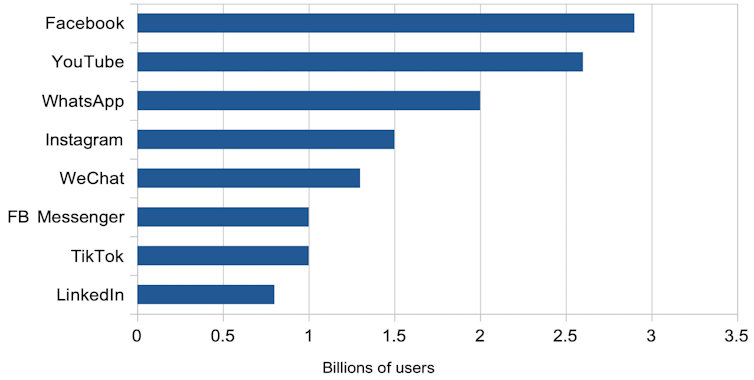
    Bar graph showing the largest social networks by user numbers
    All the data is monthly active users from January 2022, except LinkedIn, which just gives user numbers. Statista


    LinkedIn had a “good” pandemic, with conversations on the platform rising 43% and content-sharing almost 30%. It benefited from a shift in how people networked, related to findings from numerous studies that it’s the “weak links” in our professional networks who are the most important for gleaning critical information that leads us into jobs we genuinely desire.


    At a time when the usual barriers of time and space were less relevant and Zoom calls were ubiquitous, it became the perfect moment for reconnecting with these occasional contacts. Especially with so many people questioning their work situations, LinkedIn was the ideal place to see their posts and reach out to them.


    This meant that LinkedIn played a key role in the great resignation, particularly since like the platform, this movement was dominated by millennials. Users posting about changing or quitting jobs would attract large numbers of likes and comments, inspiring others to do likewise. The fact that so many people were connected on LinkedIn multiplied the effects, making it both the main catalyst and the main solution for employers.


    LinkedIn user growth over time
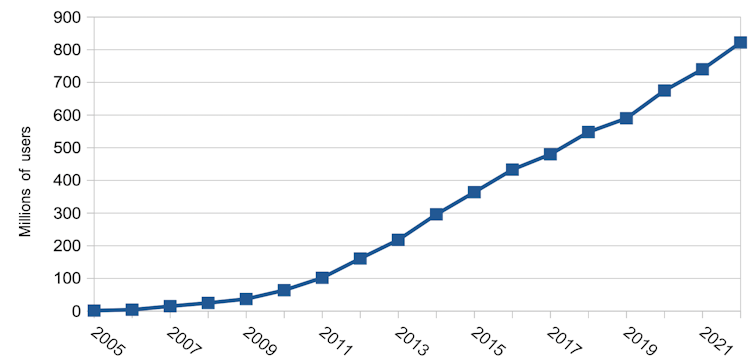
    Line graph showing growth in LinkedIn user numbers over time
    Various sources


    Meet the ‘work-fluencer’

    LinkedIn’s role as a lightning rod for work issues is also likely to determine how it develops, as a new category of social media influencer emerges – the “work-fluencer”. Companies are increasingly finding that employees’ LinkedIn profiles and postings can express the brand better than corporate accounts, allowing them to develop the corporate business network much more quickly and naturallyand naturally.

    When this is done well, employee posts are usually much more authentic than corporate PR. Rather than just curating articles on professional milestones and triumphs, people have become more open and honest about day-to-day work life.

    Over 13 million LinkedIn members have their profile set to “creator mode” to obtain higher exposure for their postings. Many use the hashtag #careertiktok to publish things like their wages and day-in-the-life vlogs about their professions, achieving over 1.5 billion views.

    This new “online watercooler” represents a change in the amount of information people reveal about their work on the internet. Workers are raising formerly taboo concerns like pay transparency, discrimination and professional undermining. Some professionals like lawyers, entrepreneurs and HR experts, have leveraged their posts into new content-marketing businesses and other profitable side hustles.

    Twenty years after LinkedIn was founded, this could enable the platform to enjoy the kind of trust and community growth that other social media networks would envy. Certainly it has challenges – fake accounts are an issue, for example. And LinkedIn inevitably attracts a lot of spam, which is probably one reason it doesn’t achieve the same amount of daily interactions as other social media.

    On the other hand, it benefits from not having a single direct competitor of scale. The nearest big ones would be Facebook Groups or Reddit, but LinkedIn’s purely corporate focus is always likely to be a plus against such players. At a time when traditional platforms like Facebook and Twitter are experiencing difficulties, LinkedIn has a real opportunity to continue succeeding as the one dedicated platform of its size.


    Theo Tzanidis is Senior Lecturer in Digital Marketing, University of the West of Scotland. This article is republished from The Conversation under a Creative Commons license. Read the original article.


  • LinkedIn launches ads for Hindi platform

    By Our Staff


    LinkedIn has launched a new brand campaign to support the launch of Hindi language on the platform. The creative, conceptualised by The Glitch, celebrates Hindi being used in the professional context – bringing to life a breadth of workplace scenarios in warm, emotive ways. The campaign is conceptualised and executed by The Glitch. Actors Vidya Balan and Pankaj Tripathi have been enlisted to support the launch of the campaign as the ‘voice’ of LinkedIn in Hindi.

     

    Said Sivaram Parameswaran, Head of Brand Marketing, Asia Pacific, LinkedIn: “Hindi is spoken by nearly 44% of the Indian population today, and with the introduction of the language on LinkedIn, we hope to foster an even deeper sense of belonging for Hindi speaking professionals in the workplace. With the launch of Hindi, our goal is to bring down language barriers for Hindi speaking professionals on LinkedIn, so more professionals and customers can unlock greater value from the platform through content, jobs, and networking, and express themselves in a language that they are comfortable with.”


    Added Lucille Pereira, Creative Director, The Glitch: “Hindi is a milestone launch in LinkedIn’s journey of becoming more accessible and equitable for Hindi speaking professionals. And to celebrate this landmark moment, we wanted to create a campaign that would build a strong audio and visual association between the Hindi alphabet and workplace scenarios. Ergo, we chose key visual mediums to help people see these Hindi words representing cultural & professional scenarios, and key audio channels with high-profile voiceovers that would help them hear these words – a collective of which helps us effectively land the message that LinkedIn is now available in Hindi as well.”


  • LinkedIn launches in Hindi

    By Our Staff


    LinkedIn has announced its Hindi avatar to provide greater access to professional and networking opportunities to Hindi speakers in India and around the world. With the launch of Hindi, LinkedIn now supports 25 languages globally, notes a press release.


    Said Ashutosh Gupta, India Country Manager, LinkedIn: “In India, LinkedIn has been mission critical to helping people connect, learn, grow and get hired during the pandemic and in this new world of work we are in. With the launch of Hindi, now more members and customers can unlock greater value from the platform through content, jobs, and networking, and express themselves in a language that they feel comfortable in. We have witnessed high engagement and member growth in the last year, and it is at this exciting inflection point that we are strengthening our vision to create economic opportunity for ‘every’ member of the workforce, and taking down language barriers for Hindi speakers across the world.”


  • The Puzzled Zombie Awakens


    By Shashidhar Nanjundaiah


    Shashidhar Nanjundaiah“So, you’re finally looking at my LinkedIn posts!” said an email subject line today. As unusual as it was, its linkage to the world’s biggest incident of the day was clear: After every Facebook-owned platform faced an outage for more than six hours, it felt like the world had come to a standstill. But when I run out of cookies in the kitchen at stealthy midnights, I invade the humble peanut jar. LinkedIn must have basked in surprise surge today as Facebook, Messenger, WhatsApp, Instagram, and Oculus fell victim to a massive outage after-as The Verge explains-Facebook’s border gateway protocol routes, which help networks pick the best path to deliver internet traffic, were suddenly “withdrawn from the internet”. The outage happened around 12 pm New York time, which is 9:30 pm IST, so the impact was understandably somewhat muffled, except for the usual night owls.

     

    It was “seize the day” time for many marketers who depend on social media platforms. Many parallel platforms promised better service. Some derived metaphors and allegories in their advice: “You should diversify your social media apps to stay connected. Similarly when it comes to investment you should diversify between equity, bonds, gold, international equity etc.”


    “My tip for you now is to take these 5 minutes and think about what you were going to post or what you were going to send and ask yourself, ‘what is the purpose?’”


    Some advice was the more familiar variety: “I am writing this while looking out of the window and the rain is torrential. So, I suggest we all look for a rainbow.”


    Some betrayed their schadenfreude, penning ungrammatical delight at what was surely Mark Zuckerberg’s downfall, right?


    And while on social media about social media, can conspiracy theories be far behind—and worse, how do we know they are conspiracy theories—about internal sabotage due to the whistleblower on CBS “60 Minutes”?


    It would be fallacious to assume that people were merely capitalizing on the outage by using alternative platforms, or wallowing in ennui while missing their favourite meme from their politically charged group leaders, or doing a primal scream because they didn’t know what their fave Insta influencer was doing, or feeling helpless because their timed marketing campaigns didn’t take off. Marketing campaigns can mostly wait, but our dependence on seamless communication can’t. In India, these days, many businesses communicate with their customers officially on WhatsApp. (If you don’t have a smart phone, well, you shouldn’t seize the privilege of doing business that depends on your smart phone, right?)


    Constant communication has become an integral part of conducting business because it is a world of mutual surveillance between us and them, thanks to the media. Indeed, a researcher says, today’s media survives on mutual surveillance. Only a few hours before this social media apocalypse, a friend told me, he had met a senior editor who was working through their meeting—on WhatsApp.  In India, we see that phenomenon all the time. Social media has made work so portable that we carry our work on our smartphones even to casual meetings. Our social media dependency—a theory that claims that we learn about our world from the social media—runs far deeper than its self-conferred role of connection and communication, or, as its marketers hope, constancy of engagement.


    Media scholars over the past decade have been busy writing about mediatization: One of my favourite books from the past decade is Media Life by Mark Deuze, who argues that we’re all like zombies, neither alive nor dead. We are inseparable from the media—we no longer merely “use” the media, and the media no longer “influences” us because we have integrated ourselves so much, both “immediatising” and immortalising our lived experience, while media itself becomes ever-evolving at our hands.


    That part is true about social media. It is constantly evolving because we’re constantly morphing it. And social media is right at the centre between the mainstream and the media prosumer—it is the amphibious media crucible where the prosumer constantly adds new stuff, constantly stirring the pot to make facts and misinformation indistinguishable. Little did scholars like Deuze know our lives would be so much more mediatized today, thanks to the pandemic—a mediated pandemic, I call it, so much are we dependent on our media to inform us about the pandemic. Over the past eighteen months or so, we have grown uncomfortably accustomed to staying virtually connected while staying physically disconnected.


    When that constancy breaks, it’s time for the zombie to wake up.


    Shashidhar Nanjundaiah has been a senior journalist and headed schools of journalism and media in India. Currently, as a research scholar based in the United States, he feels the need for better news literacy especially among younger audiences. 


  • Identity Crisis within Social Media

    Image courtesy: https://anchordigital.com.au/


    By Indrani Sen


    Indrani SenThe discussions about the identity crisis faced by the users of social media, particularly the younger generation, started almost from the inception of social media. Lately researchers, academics and industry watchers have been talking about other identity crisises within the social media. The first crisis relates to managing one’s identity on the internet across various work related and social media related accounts/ apps and it is often said that if a person has more than a dozen of such accounts with different IDs and passwords then the person needs a ‘password manager’. A movement has ben going on for some time advocating for an unique identity per every consumer on internet which will enable them to acces all internet accounts with the same ID and password. However, this may lead to a breach of trust between consumers and their individual internet accounts as all personal information shared by them on any account can be accessed through their unique identities.
     

    The second crisis is the intense identity aggregation of consumers by Google and Facebook which has started pushing some internet users from the two giants to other anonymous platforms. For the purpose of marketing through their networks Google and Facebook create such aggregated buckets of identities which many consumers find unacceptable.


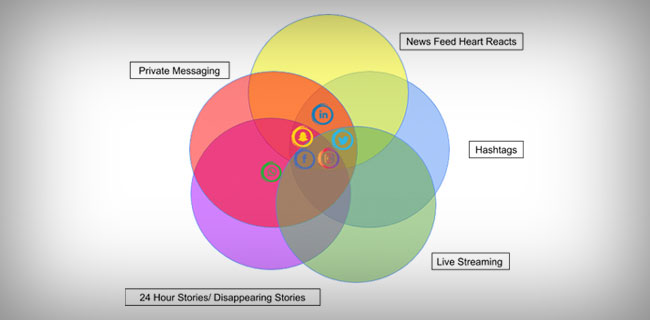
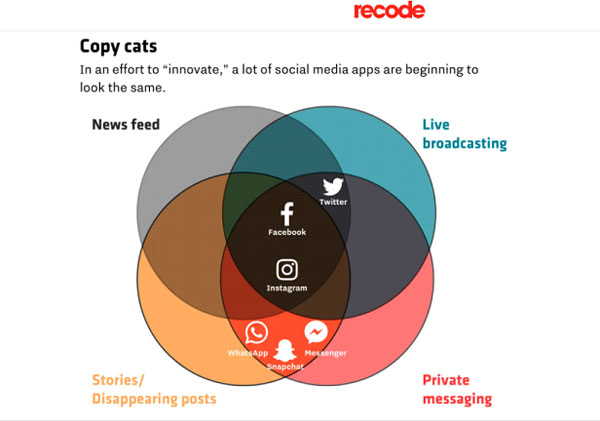
    The third and perhaps the biggest crisis is the loss of identity of different social networks / apps which has emerged during the last 5 due to the blatant copying or adopting of features of another social network. Last week I listened to an interesting podcast on www.emarketers.com talking about “…. what Facebook has become and is trying to be, what to make of social media platforms looking more and more alike, and which of these “copycat” moves might strike gold. We then talk about the significance of Nextdoor going public, how India’s social media content liability laws could impact Twitter (and others), and some changes as to what advertisers can, and can’t, do on social media.” The podcast can be accessed through the following link https://www.emarketer.com/content/podcast-facebook-and-social-media-identity-crisis-twitter-liability-retouching-ads?ecid=NL1009.


    Source: https://www.vox.com

    There is an extensive list of services/ features which have been copied since their introduction in one social media platform by others. In 2010 Instagram launched with the feature “double tap to heart react”. Instagram copied Snapchat’s stories feature first which was followed by Facebook adopting the same application from Instagram. In 2012, Facebook acquired Instagram and adopted the “heart react” feature from Instagram. In 2015, Twitter replaced it “star react” feature with “heart react”. In 2019 Linkedin introduced a set of “react” features including the “heart react”. There are many more such examples.


    In the digital age, we have seen a shift of power from organisations to consumers which has been labelled as ’transformed consumer contexts’ by Neil Perkin and Peter Abraham in their book titled Building the Agile Business Through Digital Transformation. Consumers once experiencing once a satisfactory service or a tool on a social network, expect the same capability from all other social media networks. As a result, this trend of extensively copying from each other has started in the social media sector for winning over the consumers. This trend has attracted lot of criticism as it is becoming increasingly difficult to differentiate among the social media platforms, but no immediate solution for countering this trend is in sight for reversing the identity crisis within social media.


  • LinkedIn launches new marketing features

    By Our Staff


    LinkedIn  has launched new platform features that it claims will help marketers easily reach new audiences with the right content, amplify brand presence, and drive business. These new additions to the LinkedIn Marketing Solutions (LMS) will also provide marketers with deeper audience insights to track campaign performance.


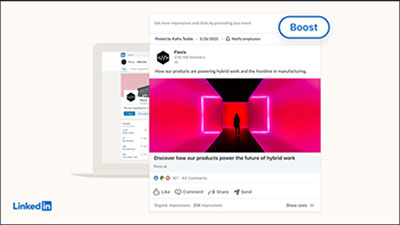
    Commenting on the launch of these new features, Sachin Sharma, Director, LinkedIn Marketing Solutions for India, said, “Navigating through the present volatility and unpredictability has made ‘time’ an even more valuable asset for marketers today, who continue to wear many hats and juggle many responsibilities. Ergo, understanding when and how to easily shift organic marketing activities to paid advertising for maximum impact is imperative. We’ve added new features to the LMS portfolio that will arm marketers with the right insights and resources to help marketers seamlessly reach more of their targeted audiences and grow their brand community, all while measuring impact in easier ways.”


  • LinkedIn unveils global integrated campaign

    By Our Staff

    LinkedIn launched its first global integrated campaign for International Women’s Day 2021. The campaign sees LinkedIn bring together influencers and its community to share content that helps and supports women, creating global engagement across the platform.

    The film, directed by Jessie Ayles, features stories of seven women professionals from seven countries from varied industries. From India, the campaign features pastry chef and entrepreneur Pooja Dhingra.

    Said Senior Director of Brand & Communications, EMEA, LATAM & APAC at LinkedIn, Ngaire Moyes: “Women have faced greater economic hardship through the Covid-19 pandemic, disproportionately losing jobs and income. Decades of progress in gender equality has been undone in a matter of months. This shift has impacted how our female members interact on the platform and we have seen countless examples of the LinkedIn community sharing their stories and supporting each other in whatever way they can. Seeing the way our community pulled together in this crisis was the inspiration for our first international integrated campaign to mark International Women’s Day. Through the #WeCanDoIt campaign, we hope to elevate the voices of our female members across the platform and encourage others to share their personal stories in a bid to help and empower working women around the world.”


  • Gayatri Yadav joins Sequoia as CMO

    By A Correspondent


    Gayatri Yadav

    Gayatri Yadav has joined Sequoia Capital as Chief Marketing Officer – India and SEA. She was until recently with Star India where she led marketing and worked as President, Consumer Strategy & Innovation. She will be based in Bengaluru, which we learn she will relocate to once the Work-from-Home regime ends at Sequoia and the rest of corporate India.


    This is what Shailendra Singh, Managing Director at Sequoia Capital, wrote in a statement on LinkedIn: “During her time at Star, Gayatri led a series of high impact marketing moves, including the network’s launch of Star Sports, Hotstar and the ‘Nayi Soch’ brand plan on Star Plus, which aimed to drive women’s empowerment. She started her career in Procter & Gamble in Brand Management and later joined General Mills India where, as Chief Marketing Officer, she was responsible for launching the Pillsbury brand and for creating multiple categories in the then nascent packaged foods market. In addition to her role as CMO for Sequoia Capital India, Gayatri will also work closely with our portfolio CMOs to help them launch and grow brands.”


    And this is how Yadav responded to the statement, again on LinkedIn: “I am honoured to join Sequoia Capital India and help daring founders build legendary companies and brands. This is a seminal point of time in the development of the Indian entrepreneurial ecosystem and there is a massive opportunity to create global brands out of the region. I am excited to join this amazing team and partner with an incredibly talented set of founders in achieving this mission.”


    Other than Yadav, Ajey Gore has joined as Operating Partner, Technology and former journalist-turned public affairs specialist Shweta Rajpal Kohli (better known as SRK to her former colleagues at NDTV) as Head of Public Policy.


    An MBA from IIM Calcutta, Yadav has worked at P&G (four years), General Mills (14 years) and Star India (nearly nine years) where she worked till October 2019.


  • Interbrand launches Best Global Brands 2019


    By A Correspondent


    Uber and LinkedIn have joined the ranks of the world’s most valuable brands as they made their debut in the 2019 Interbrand Best Global Brands Report. But the 20th edition of the Best Global Brands report was less welcome for Facebook at #14 (USD $39,857m) which dropped out of the top 10. Apple, Google and Amazon retained their hold on the top three rankings.


    Uber joins the Best Global Brands rankings this year at #87 (USD $5,714m) and LinkedIn at #98 (USD $4,836m). According to the Interbrand report, Facebook dropped five places from #9 in 2018 to #14 this year.


    This year’s report positions Apple (USD $234,241m), Google (USD $167,713m), and Amazon (USD $125,263m) as the three most valuable global brands respectively. Apple and Google retained their top positions for the seventh consecutive year. Apple’s brand value grew by 9 per cent to USD $234,241, while Google’s grew by 8 per cent to USD $167,713m.


    The remainder of the Top 10 comprises: Microsoft at #4 (USD $108,847m), Coca-Cola #5 (USD $63,365m), Samsung #6 (USD $61,098m), Toyota #7 (USD $56,246m), Mercedes-Benz #8 (USD $50,832m), McDonald’s #9 (USD $45,362m) and Disney #10 (USD $44,352). – returning to the Top 10.


    Said Ashish Mishra, Managing Director, Interbrand India: “What’s remarkable about our IP’s history of two decades is that today customer expectations lead businesses and brands. The speed of change in expectations is driven by the now possible immediacy, abundance and intimacy. This means the age of static brand positioning is over. This is a tectonic shift we are heralding for the world of businesses and brands. For decades, the entire discipline of brand-building was based on the concept of brand positioning, but in today’s accelerating markets, customer expectations outstrip static brand positions. What is needed now is a move beyond relevance to uncover and unlock people’s real expectations – finding new opportunities to create utility and desire, and capture imaginations. Align stakeholders and the organization to build investment in the most impactful opportunities. Alter the competitive landscape – build interactions with the greatest utility and desire to move beyond expectations and increase engagement.”


  • LinkedIn appoints Ashutosh Gupta as Country Manager for India

    By A Correspondent


    Ashutosh Gupta

    LinkedIn has announced the appointment of Ashutosh Gupta as Country Manager for India, effective September 2, 2019. Gupta will be replacing Mahesh Narayanan, who was Country Manager for India from January 2019 to June 2019.


    Gupta will report to Olivier Legrand, LinkedIn’s Managing Director for the Asia Pacific region and will join the company’s APAC senior management team. He will relocate to India from Singapore to assume his new responsibility. In addition to his country manager role, he will continue to lead the LMS Online Sales Organisation for APAC and China.


    Commenting on Gupta’s role, Olivier Legrand, Managing Director – Asia Pacific, LinkedIn, said, “I am confident that Ashutosh’s strong understanding of the company’s business, his seasoned leadership experience, and deep market experience will drive forward the right strategic plans for India. As a sophisticated sales leader who has worked across regions, Ashutosh is highly skilled at building businesses at scale and evangelising the value of LinkedIn to members and customers. We look forward to partnering with him to foster the India brand.”


    Added Gupta: “India is a strategic market for LinkedIn, and its developing economy and dynamic jobs market is ripe with opportunity for LinkedIn to add value for our members and customers. I also look forward to forging deeper government relationships to inform policy-making with actionable data on jobs and skills, and make LinkedIn an integral part of the national agenda. I am excited and humbled to take on the role of Country Manager to drive LinkedIn India into its new decade.”


  • LinkedIn banks on IPL with its #InItTogether brand campaign

    By A Correspondent


    LinkedIn has kicked off the second phase of the #InItTogether integrated brand campaign on March 23, following its debut brand campaign in India last year. The campaign showcases real members, who have found their passion, their calling, and their dream jobs on LinkedIn.


    Said Srividya Gopani, Director – Brand and Consumer Marketing, APAC and China at LinkedIn: “India is a strategic market for LinkedIn, and we are focused on helping our 55+ million members build fulfilling careers. Our #InItTogether campaign celebrates inspiring member stories of professionals who have leveraged their networks, pivoted to new industries, and created greater opportunity to get closer to their dream jobs. We hope their professional journeys inspire others to find their passion and go after their dream job.”


  • LinkedIn appoints Mahesh Narayanan as Country Manager for India

    By A Correspondent


    Professional networking platform LinkedIn has announced the appointment of Mahesh Narayanan as ountry Manager for India, effective January 7, 2019.


    Narayanan has worked with platforms such as Saavn, Sociomantic Labs, Google, and AdMob.


    He will report to Olivier Legrand, LinkedIn’s Managing Director for the Asia Pacific (APAC) region and will join the company’s Asia Pacific senior management team.


    Said Olivier Legrand, Managing Director – Asia Pacific, LinkedIn: “India continues to be a strategic market for LinkedIn, and we are pleased to have Mahesh join our team to take our business to its next growth chapter. As we continue to invest in the market, Mahesh’s strong track record in leading growth businesses and his deep market experience will bolster our efforts in India.”


    Added Narayanan: “I am grateful for the opportunity to further LinkedIn’s vision and mission in an important market that is rapidly digitizing. LinkedIn has created a meaningful impact on the professional lives of millions of people, myself included, and I am excited to work with the team to deliver even more value to members and customers.”