Tag: Kantar

  • Kantar’s ‘eCommerce On’ studies shopper marketing behaviour

    By A Correspondent


    Kantar has introduced ‘eCommerce On’, a new global study that offers a foundational, shopper-centric understanding of e-commerce across countries and categories.


    Commenting on the study, Sushmita Balasubramaniam, Commerce Domain Lead, South Asia, Kantar said: “We have seen e-commerce evolve rapidly over the years. Online shopping is not just about discounts or convenience anymore. This study has shown us that online shoppers in India are no different from their counterparts in more developed countries – both in terms of their needs as shoppers and why they shop online. The report throws light on how shopping missions and related shopper needs and currencies play out across 15 categories that are shopped online today. And, the criticality of using technology and marketing in the context of how to serve shoppers and address their needs at the relevant moments in the best manner.”


  • Kantar’s #PlanetY provides actionable insights on engaging with Gen Z

    By A Correspondent


    Kantar has launched #PlanetY, a study providing an nderstanding of the attitudes, values and behaviour of today’s youth. The study uncovers insights of two generations – Centennials and Millennials; based on interviews with over 7500 upmarket youngsters (15-29-year-olds) across metros and mini metros.


    Talking about the study, Hemant Mehta, MD, Insights Division, South Asia, Kantar, said,:“Centennials and GenZ are increasingly becoming key consumer segments for the marketers. Selling to the youth is a challenge faced by every brand today. With youth leading their lives online and through their smart phones, it is imperative that marketers understand the various touch points in their target consumers’ lives as well as decode the distinct roles that different digital properties play.  This led us to design a comprehensive study like #PlanetY which tries to decode this consumer segment in a never before seen level of granularity. We are confident that this will help marketers understand their young consumers better and connect with them innovatively.”


  • Kantar report predicts futuristic trends for marketers

    By A Correspondent


    According to Kantar’s global 2020 Media Trends & Predictions report, technology will continue to redefine the media landscape in 2020, creating opportunities and challenges for marketers. As ad spend on social and tech platforms continues to grow; technology innovations will also enable a renaissance in real-world engagement. The report predicts that marketers and media owners will be challenged to develop the skills, engagement models and measurement capabilities to meaningfully engage consumers in the crowded media landscape.


    Kantar predicts there will be a digital paradox; while new and evolving media channels will create opportunities, the deluge of digital touchpoints will make it more difficult to connect with consumers. Marketers will also need to navigate the ‘data dilemma,’ meeting consumer demand for relevant, personalised content, without breaching trust and privacy. And as third-party cookies start to crumble, advertisers will need to find alternative measurement solutions.


    Kantar’s 2020 Media Trends and Predictions fall into three major themes:

    The technology trends transforming the media landscape:

    5G finally gets real: The marketing industry will be one of the key beneficiaries of the 5G era, enabling far greater capabilities to reach and engage with consumers  but taking advantage of the 5G opportunity will require a significant transformation from marketers.

    The battle of the streaming platforms heats up: New players will see the battle of the streaming platforms heat up, but an increasingly cluttered market will drive subscription fatigue among consumers.

    Turning up the volume: Brands will turn up the volume and find their voice as we enter a new age of audio advertising. Newer audio channels are poised to gain mainstream prominence.

    Content meets commerce: Content and commerce will converge as ‘shopvertising’ evolves from shoppable social to shoppable TV and digital out-of-home resulting in a contraction of the closed-loop marketing cycle.


    The spaces that brands can credibly occupy:

    Brands get back to reality: Brands will balance their digital presence with more real-world experiences, meaning we could see a slowdown in the pace of digital advertising growth.

    Brands take a stand: Taking the lead from consumers, brands will become more radical in 2020. But they need to ensure their media strategy is aligned with their values and purpose.

    Just grow up: influencer marketing must measure what matters: Influencer marketing will mature as brands start to collaborate more deeply and take measurement more seriously in 2020.

    Get ready to play: esports goes mainstream: esports will go mainstream over the next 12 months, presenting lucrative opportunities for the media owners and advertisers that learn the rules of the game.


    The context and catalysts for change

    Turn and face the change: The trend towards media in-housing: The trend towards media in-housing will continue as more brands build their own teams of digital experts, pushing agencies and advertisers out of their traditional comfort zones, into a new collaborative and exciting space.

    Cookies start to crumble: Changing the recipe: The demise of cookies could leave many marketers in the dark. Advertisers need to prepare now for the new “mixed economy”. Direct integrations between publishers and measurement partners will enable true cross-publisher measurement for the first time.

    The data dilemma: Doing the right thing with data: Faced with impending legislation like the California Consumer Privacy Act  in January 2020, privacy ethics will come to the fore and marketers will design personalisation initiatives with a people-first, rather than tech-first, mentality.

    Campaign 2020: crowding and clutter: Political advertising will create crowding and clutter in 2020, especially in the U.S. media landscape. Brand advertisers will need to rethink their strategy during campaign season.


    Said Jane Ostler, Global Head of Media Effectiveness, Kantar: “2020 will be an exciting year for marketers. Increased advertising and content possibilities, along with the data generated, create a plethora of opportunities for marketers and media owners. With new opportunities though come new challenges. Emerging foundational technologies could transform media usage, and other industry shifts, such as the demise of third-party cookies, will force marketers to evolve how they measure audiences across screens and wider campaign effectiveness. Other channels, like influencer marketing and the newer audio channels, will face a make-or-break moment; their credibility could be at risk unless they evolve and live up to their promise. Marketers will need to improve their understanding of how different touchpoints effectively work for their brands – online and off.”


    Added Andy Brown, CEO, Media Division at Kantar: “We are launching Media Trends & Predictions at a critical time for the industry. Bringing together expertise and currency-grade data from across Kantar, this collection provides a window into the forces that are shaping the media landscape and we look forward to continuing these important discussions with our clients and partners throughout 2020 and beyond.”


  • Kantar and Frrole announce the launch of ‘TGI Social+

    By A Correspondent


    Kantar has partnered with Frrole to roll out TGI Social+, a tool that will bring together consumer profiles from TGI embedded with social media analytics to provide a comprehensive understanding of online consumers.


    Commenting on the new offer, Hemant Mehta, Managing Director, Insights Division, Kantar said: “We know that consumers express themselves more openly and candidly when they are online. Social media analytics gives marketers a unique opportunity to comprehensively understand their consumers, gather their feedback, their likes and dislikes, their issues and interests effectively. This 360-degree understanding of their consumers can help them tailor their messages sharply and make them more relevant and reach the right audience. TGI Social+ is our unique, first of its kind offer that helps brands to engage and talk to their consumers in their language using relevant themes, at relevant times and on relevant online channels.”


    Added  Amarpreet Kalkat, CEO, Frrole: “We are delighted to partner with a global leader like Kantar to bring together online and offline insights in one place, creating a first of its kind offering that has been missing from the arsenal of marketing teams. It allows both of our customers on the agency as well as brand side to develop a holistic picture of their consumer and the market. It also allows them to answer previously unanswered question during planning and measurement, without having to bother about the hitherto isolated nature of data sources. That will now be a thing of the past for those who use TGI Social+.”


  • HDFC stays as #1 in BrandZ ranking


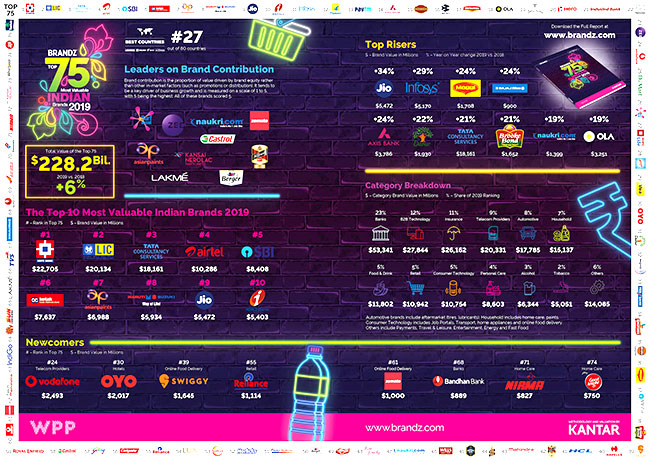
    The BrandZ study, which is the only brand valuation ranking to combine companies’ financial data with consumer insight and opinion, shows that trust is key to develop the stability required for long-term success; highly trusted brands in the Top 75 are worth 129% more than less trusted ones.


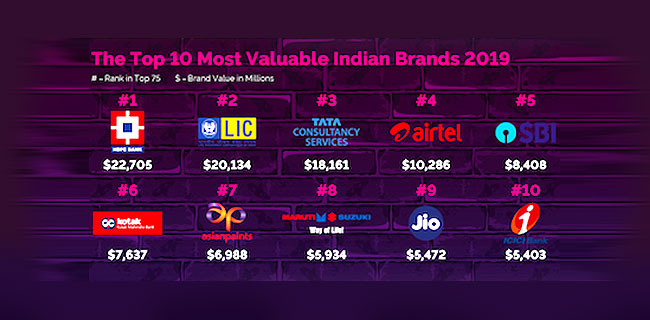
    BrandZ Top 10 Most Valuable Indian Brands 2019

    Rank 2019 Brand Category Brand Value 2019 ($M USD) Brand Value Change
    1 HDFC Bank Banks 22,705 +5%
    2 LIC Insurance 20,134 +2%
    3

    Tata Consultancy Services

    Technology 18,161 +21%
    4 Airtel Telecom providers 10,286 -10%
    5 State Bank of India Banks 8,408 +7%
    6 Kotak Mahindra Bank Banks 7,637 +15%
    7 Asian Paints Paints 6,988 +14%
    8 Maruti Suzuki Automobiles 5,934 -14%
    9 Jio Telecom providers 5,472 +34%
    10 ICICI Bank Banks 5,403 +11%


    Notable brands include ecommerce site Flipkart (No. 12), which increased its brand value 14% to $4.7 billion, while unicorn brands hotel booking site Oyo ($2.0 billion), online food ordering service Swiggy ($1.6 billion) and online restaurant marketplace Zomato ($1.0 billion) are newcomers to the ranking at No. 30, No. 39 and No. 61 respectively.


    The fastest riser in the 2019 ranking is telecom provider, Jio, which climbed one place to No. 9 with a 34% increase in brand value to $5.5 billion. Its disruptive business model has made internet access available to many Indians who were previously unable to afford it, thereby opening up access to digital platforms and services. Vodafone ($2.5 billion) meanwhile was the top-ranked newcomer at No. 24.


    Both digital and offline brands such as D-Mart (No. 25, $2.4 billion) have found success as a result of the rise of ‘middle India’; the growing number of people in the country’s second, third and fourth-tier cities and towns that are changing India’s traditional urban-rural divide.  These previously poorly-served segments increasingly have access to a variety of online services, with Swiggy and Zomato building much of their growth on this shift.


    Said David Roth, CEO of The Store WPP EMEA and Asia and Chairman of BrandZ: “As India flexes its muscles on the world stage, it faces increased macroeconomic headwinds which have combined with a rise in global trade tensions to create a challenging environment.  Successful Indian brands are adapting to these challenges and recognising that longevity requires them to do more than just disrupt the status quo; long-term brand building requires new strategies that major on stability.”


    Added Preeti Reddy, CEO South Asia, Insights Division, Kantar: “Consumer trust is a common thread among successful brands. However, it is concerning that only a few have succeeded in growing trust over the last five years. Those who done so, have done it through open and honest conversations with their customers. Brands would do well to consciously work at building consumer trust – it is the shield that gives a brand the resilience to face headwinds in uncertain times.”


    Said Vishikh Talwar, Chief Client Officer, Kantar Insights Division: “The rise of ‘middle India’ combined with rapid growth of the mobile internet is providing unprecedented opportunities for brands.  But, with an almost overwhelming choice of products and services to buy, consumers are increasingly discerning; the Indian psyche requires that brands cater for local needs with offerings that genuinely improve daily life. Today that’s as much about providing comfort and reliability as it is about generating new experiences.”


    Key trends highlighted in the BrandZ Indian Top 75 study include:

    :: Mobile internet access:Smartphone user numbers in India increased by 18% in 2018 (the fastest rate of growth in the world), mainly due to a combination of Jio’s own low tariffs and the renewed competition causing other telecom providers to reduce their rates.


    :: Buying power:Retail is the second fastest growing category, with online and offline both growing strongly. New entrant Reliance Retail (No. 55, $1.1 billion) opened  nearly 500 new stores and used Jio’s service to connect retail shops with grocery deliveries, while D-Mart ($2.4 billion) focused predominantly on offline, rising two places to No. 25.


    :: The Amazon effect: Amazon and Flipkart compete with many Indian brands across several sectors, with Amazon also opening its largest campus yet in India.  This has increased competition and driven brands to step up their operations to ensure they are meeting customers’ needs.


    :: A confident country: The success of unicorn brands such as Swiggy, Zomato and Oyo is fostering a new-found confidence in India. This is augmented with the increasingly global outlook of these new brands as they actively seek to expand their operations outside India.


  • WPP and Kantar launch their cross-industry initiative, IRG

    By A Correspondent


    WPP and Kantar announced the launch of their latest global cross-industry initiative -Institute for Real Growth (IRG) in India. IRG, notes a communique, is the first programme of its kind to help CEOs, CMOs and other senior business leaders to drive more effective growth strategies.


    The not-for-profit, independent Institute, co-founded by WPP along with Facebook, Google, Kantar, LinkedIn, the NYU School of Professional Studies (NYUSPS), Saïd Business School at the University of Oxford, Spencer Stuart and Mobile Marketing Association (MMA) aims to help organizations focus on sustained, long-term real growth by equipping leaders with best practice approaches to their strategy, structure, capability and leadership.


    The IRG was launched in India at an event titled ‘Real Growth Summit’ held recently in Gurugram and attended by numerous top leaders from major corporates.


    Said CVL Srinivas, Country Manager, India for WPP: “The study highlights that the definition of growth is very subjective in India. This reality makes it critical for businesses to identify what will drive real growth for their business. IRG has been founded for this very reason – to help organisations achieve sustained long-term growth by enabling its leaders with proven approaches which are based on knowledge, innovative thinking and peer to peer coaching and partnership.”


    Added Preeti Reddy, CEO – South Asia, Insights Division, Kantar: “Growth is hard and is becoming even harder. Companies are realising that the old formulas no longer guarantee growth and that growth itself is becoming episodic. They need to develop an architecture for ‘real growth’ and approaches that will deliver sustained all round growth. We are delighted to collaborate with the IRG program and inspire clients and our leaders to embrace these new approaches to meet the challenges of growth.”


    Said Marc de Swaan Arons, co-founder of the Institute for Real Growth: “Together with my co-founder Frank van den Driest, we have expanded on WPP’s global growth study to create an industry-wide program that is focused on helping senior leaders make better business decisions and steer their organisations on the growth journey. IRG is the only platform where growth leaders can learn from world-class Over performers and topic experts and collaborate with peers to solve their specific business growth challenges.”


  • WPP sells 60 per cent stake in Kantar to Bain Capital

    By A Correspondent


    WPP has entered into an agreement to sell 60 per cent of Kantar, its global data, research, consulting and analytics business, to private equity major Bain Capital. The proposed transaction values the whole of Kantar at a headline enterprise value of $4.0bn.


    The WPP Board believes that the proposed transaction will allow Kantar to strengthen its industry-leading position through the combined expertise and resources of Bain Capital and WPP. It also crystallises significant value for WPP’s shareholders, while giving them continued exposure to an attractive business with the potential for further value realisation in the future.


    The transaction values 100 per cent of Kantar at $4bn. The equity value after expected completion adjustments is $3.7bn. After transaction costs, tax and WPP’s continuing investment of $0.4bn to own 40 per cent of the equity in Kantar, net cash proceeds to WPP are expected to be $3.1bn. The consideration is payable in cash. WPP may receive additional consideration over the next three years in respect of certain contingent liabilities, in the event that such liabilities are lower than estimated. Additionally, WPP may receive certain other payments during the life of its partnership with Bain Capital.


    Said Mark Read, Chief Executive Officer, WPP: “Kantar is a great business and we look forward to working with Bain Capital to unlock its full potential. As a strategic partner and shareholder in Kantar, WPP will continue to benefit from its future growth while our clients continue to benefit from its services and capabilities. I would like to thank Eric Salama, his team and everyone at Kantar for their tremendous contribution to WPP – a contribution that will continue as we develop the business together. This transaction creates value for WPP shareholders and further simplifies our company. With a much stronger balance sheet and a return of approximately 8 per cent of our current market value to shareholders planned, we are making good progress with our transformation.”


    Added Luca Bassi, a Managing Director at Bain Capital Private Equity: “Kantar is a market leader in many areas and we are excited to be partnering with its management team and WPP to build on this remarkable platform for growth. We see many opportunities for expansion and will invest in technology to expand the company’s capabilities and reinforce its global leading position.”


    Said Eric Salama, CEO, Kantar: “Our new ownership structure presents a great opportunity for Kantar, our employees and our clients. In Bain Capital we have a partner who shares our ambition, brings relevant expertise and – with WPP – can help us accelerate our growth and impact for clients. We are focused on delivering ‘human understanding at scale and speed’ and the ‘best of Kantar’ more consistently. We will do so by investing more in talent and by becoming a more technology-driven solutions provider.”


  • Irvinder Kaur is India Lead, Analytics Practice at Kantar

    By A Correspondent


    Kantar has announced the elevation of Irvinder Kaur as India Lead for the Kantar Analytics Practice. Kaur will oversee the delivery of analytics offerings and drive the growth for India business.


    Said Preeti Reddy, CEO South Asia, Insights Division, Kantar:  ‘‘Irvinder’s experience across marketing, sales and analytics will help Kantar deliver better marketing ROI solutions for our clients. This is a core focus area for Kantar and we are confident Irvinder will give it the impetus it needs.”


    Added Sunder Muthuraman, CEO APAC and Global Chief Client Officer, Analytics Practice, Kantar: “Irvinder has been a co-creator of innovative data driven solutions with a focus on addressing client challenges in data analytics and ROI management. An approach that not only makes her a trusted partner for the clients, but also a strong business leader for the company.”


  • AI & Voice will transform media landscape: Kantar study

    By A Correspondent


    Kantar has released its perspective of the major trends that will shape the media landscape for brand owners, agencies and media platforms in 2019. The predictions report outlines 12 key trends that will transform the next year in media. Exploring advances from augmented reality, through gender portrayal to vertical video the 12 predictions are:

    – Advanced Analytics and Artificial Intelligence (AI) will resolve the integrated online/offline return on marketing investment dilemma.

    – Voice technology will breakthrough in creative planning and the marketing mix.

    – Chinese leadership in social media and social media analytics will be ‘fast-followed’ by the West.

    – The emergence of the ‘branded experience network’ will transform media management in to ‘internet of everything’ management.

    – Brands will start to take the portrayal of women in advertising seriously.

    – Amazon will emerge from the advertising world ‘shadows’ to make the duopoly an triopoly.

    – Vertical video will lead the way in creativity.

    – The big screen will make a comeback, bigger and better than before.

    – Attitudinal insights combined with predictive modelling will make programmatic buying more agile and accurate.

    – Influencer marketing strategies will pivot to prioritise credibility ahead of reach.

    – GDPR compliance will drive more sophistication in brand data strategies.

    – Augmented Reality (AR) will start to shape both the consumer journey and customer experience.


    Said Eric Salama, CEO, Kantar: “Constant innovation and change in the media landscape continues, but I think the speed of adoption of technologies like artificial intelligence will be surprising. Connected intelligence in all its forms will start to dominate the narrative, as well as new opportunities like voice. How we measure media and its effectiveness is evolving quickly, and the industry needs to work together so our clients can understand the impact of their investments. There has never been a more exciting time in marketing.”


  • Centennials at 21


    By A Correspondent


    Centennials, aka Gen Z, have already eclipsed Millennials as the global cohort driving trends and pushing industries forward, and they’ll soon be a core consumer group across a variety of categories. As the oldest of the generation turns 21 this year, Kantar’s latest report shows how critical it is for brands to keep pace with their values, beliefs and expectations to avoid being left behind.

    While Millennials are loosely defined as those born between 1980 and 1996, Centennials are those born after 1997 (to present).

    There are no special numbers available for India, but we are sure that the insights wouldn’t be dramatically different for the urban set. It will be data on the rural, not very highly educated that would be interesting to read.

    Representing 35% of the global population, Centennials have become an economic powerhouse with a growing influence on spending and brand loyalty. Kantar reveals a generation that are:

    Digitally dependent, yet conscious users of technology

    :: Centennials pick up their smartphones up to 30% more than over 21s and spend up to 35% longer on their devices during the day. Yet just over a third of global Centennials believe they use their phone too much.

    :: Centennials across France, UK and US are even more tied to their smartphones than the millennial cohort: on average Centennials spend 2.40 hours daily on their mobile device compared to an average of 2.12 hours by Millennials.

    :: Centennials are quick to move on if a brand experience doesn’t provide what they want or need; 62% will not use an app or website that is hard to navigate, and 63% say they’ve installed an ad blocker on their mobile phone or desktop.


    Increasingly influential on family purchasing decisions

    :: Families are looking to their youngest members to gather product information, compare reviews and advise on the purchase process; up to three quarters of Centennials report influencing major family spending decisions.

    :: This trend is most prevalent when looking at purchasing decisions made across the food and beverage (77%), furniture (76%) and household goods sectors (73%).


    Using social media differently from previous generations

    :: The way they use social sites differs from previous generations, with Facebook used by Centennials for on an average of 11 minutes per day, compared to Snapchat (30 minutes), Facebook Messenger (28 minutes) and Twitter (22 minutes).

    :: Online, Centennials are more likely to identify with their social media personas than other generations, with 61% admitting that the things they post say a lot/something about them, compared to 56% of Millennials.


    As Centennials age into young adulthood, they will reshape categories and upend industries. Understanding this generation’s values and motivations is key for brands as Centennials take the reins and drive global markets.


    The report summary can be downloaded at http://www2.kantar.com/l/208642/ials-at-21—Kantar-Report-pdf/821dx

  • Kantar unveils new corporate identity & management structure

    By A Correspondent


    WPP-owned data, insights and consultancy network Kantar has announced the launch of a new corporate identity- for the parent brand and its 12-strong family of operating brands- designed to create a unified look-and-feel across the whole business. Operating brands not previously Kantar-branded will now take a Kantar prefix and a new, common typeface.  For example: Millward Brown, IMRB, and TNS will now become Kantar Millward Brown, Kantar IMRB, and Kantar TNS.


    Kantar’s new identity reflects and externalises an on-going change programme that started in January. The programme includes greater collaboration between operating brands and the creation of a new insights group through much closer alignment of the company’s custom brands. In addition, global operations capabilities have been brought together into a single entity and the company is moving towards more aligned shared services in HR, finance and IT. The company will shortly be adding to the portfolio of expert brands with the launch of Kantar Public, uniting its global expertise in governmental and public policy work; and Kantar Consulting, which will draw expertise from several of our brands to provide a full and broader range of marketing and sales consulting solutions and capabilities to our clients.


    Commented Kantar CEO Eric Salama: “The rebranding is a tangible, visible expression of our desire to present clients with more easily-navigable and connected solutions that bring together the best of Kantar’s expertise,” adding: “We believe our clients and partners have started to experience the benefit of this approach – in more rounded, detailed and holistic research and recommendations. And it is helpful that for the first time we really look like a single family of brands serving a common purpose.”


    Along with the rebranding, Kantar is introducing a new tagline, “Inspiration for an extraordinary world”, drawn from its new corporate purpose statement, “To inspire our clients, our people and society to create and flourish in an extraordinary world.”


    Said Preeti Reddy, CEO, South Asia – Insights, on the rebranding: “Clients have consistently asked us to be more collaborative in the way we work with them; faster and more agile at a local and global level. They want the ‘best of Kantar’ on a consistent basis, not just on occasions. Earlier this year, we put in place a whole new way of working to remove siloed thinking and barriers between the Kantar companies to collaboration for client benefits. In South Asia, we will be able to bring together the thought leadership of three powerful brands and harness the power for our clients. This combination brings with it an ability to converge thoughts when required to solve a problem as well as an ability to diverge solutions when clients need choice. That is a unique mix and in, my view, will make Kantar an even more dominant force in South Asia.


    The new identity, developed by WPP branding firm The Partners, will be rolled out across all external and internal communications channels in the coming months.

  • Flashed yesterday: BARC to turn sole TV aud measurement co with TAM meters in tow


    By A Correspondent

    BARC India, the joint industry body formed by broadcasters, advertisers and advertising agencies will acquire the Peoplemeter boxes of TAM India, the television audience measurement joint venture between Kantar Media and Nielsen Kantar. This was announced with the formation of a new meter management company which will run the meter operations and will supply raw data to BARC India. Thus the BARC data will be the sole audience measurement currency in India.

    It may be noted that MxMIndia was the first report that BARC was in discussions for the buying out of TAM. Well, the tie-up is not exactly the same, but we will wait to see what happens.

    Commenting on the development, Punit Goenka, Chairman of BARC India said, “This partnership is a big step forward and in this era of cooperation, we welcome this move forward as a joint industry body. The technology and methodological prowess of BARC, combined with the extra meters and the field force will definitely help the industry progress.”

    “This new venture represents our organization’s commitment to providing precise and stable data around the world, and draws strengths from both BARC India and TAM India,” commented Steve Hasker, Global President, Nielsen. “We look forward to the great coverage and representation this new partnership will deliver.”

    Eric Salama, CEO of Kantar said: “We are happy to cooperate with BARC India to be able to provide clarity and a large single sample for the industry and to keep India as a key market for us.”

    The meter company will have the meter assets and panel management operations of the present BARC Indiaand TAM India panels,which will be jointly owned by BARC India, Nielsen and Kantar with management control resting with BARC India.  To start with, the company will have 34,000 meterscovering all of India,and will supply raw data to BARC, which will use its own statistical processes and sampling design.The details of the formation and roll out of this new company will be shared in the coming weeks.

    TAM India will continue to provide its non-TV ratings services to the market, notably AdEx – Advertising Expenditure for TV, Print, Radio, RAM – Radio Audience Measurement, Eikona – PR Audit, TAM Sports Measurement and S-Group Consulting.