Tag: Kantar

  • Parle tops Kantar’s annual Brand Footprint India report

    Kantar released the 12th edition of its annual Brand Footprint India report. The report ranks the Most Chosen (in-home and out-of-home) FMCG Brands based on Consumer Reach Points (CRPs). CRP considers the actual purchase made by consumers and the frequency at which these purchases are made in a calendar year.

    Key findings: In-Home segment:

    1. With a CRP score of 7980 million, Parle holds the top spot for a record 12th year in a row, followed by Britannia, Amul, Clinic Plus and Tata Consumer Products.
    2. Consumer Reach Points (CRP’s) continue to grow, however is slightly lower than last year. Overall, CRP’s have increased almost 33% in the last five years.
    3. All sectors have seen a CRP growth slow down, except dairy:
    4. Brands chosen more often have greater probability of growing in CRP:
    5. Haldiram’s and Balaji are the only two brands in the 2024 top 25 in-home brand list to grow by more than 30% in CRPs in 2023.
    6. Sunfeast leads the way in biggest penetration gains in 2023 at 6.4. The following brands make it to the top 10 list:
    7. Seven brands in the top 25 in-home rankings show more than 20% penetration increase in the last decade. Britannia leads the way, followed by Surf Excel, Sunfeast, Haldiram’s, Patanjali, Brooke Bond and Vim.

    Key findings: Out of Home segment:

    1. Britannia leads the way in the 2nd edition of OOH brand rankings with 628Mn CRP’s. It is followed by Haldiram’s, Cadbury, Balaji and Parle. The top 5 rankings are all snacking brands and remain the same as 2023.
    2. The five Most Chosen OOH beverage brands in India are Thums Up, Frooti, Amul, Maaza, & Bisleri.

    Speaking about this year’s report and rankings, K. Ramakrishnan, Managing Director- South Asia, Worldpanel Division at Kantar said: “Consumer choice is very reliable strength test for a brand across market conditions and Brand Footprint has been a widely acclaimed ranking system to measure this for over a decade now. As we see over the years, consumers are making increasing trips for purchase and that adds their options and in-turn, their choice. This is reflected in the constant increase in CRP’s. We also introduced an out of home rankings last year as OOH consumption is on the rise and has different choice triggers.”

  • Google, Tata Motors, Amazon, Jio & Apple Most Inclusive Brands in India

    Google, Tata Motors, Amazon, Jio & Apple Most Inclusive Brands in India

    Leading marketing data and analytics firm Kantar has launched its Brand Inclusion Index (BII), a global study which reveals that 75% of consumers say that a brand’s diversity and inclusion reputation influences their purchase decisions.


    A staggering 68% Indians claim to have been discriminated against, and in majority of cases in commercial places and brand touchpoints, which is substantially higher than the global figure which stands at 46%. The study also showcases that DEI is important for an overwhelming majority of Indians, both in life and while making brand choices, with 86% of respondents.


    The first edition of India Brand Inclusion Index study explores skincare, banking, automotive and Technology categories. In its Index of the world’s most inclusive brands, Kantar ranked Google, Amazon, Nike, Dove and McDonald’s in its global top five while in India, it is Google, Tata Motors, Amazon, Jio and Apple. The brands were recognised by consumers for setting a positive example by demonstrating a genuine commitment to diversity, equity, and inclusion (DE&I).


    The study identifies that inclusive marketing is a significant opportunity to drive brand growth. It is clear that brands who fail to address discrimination, risk alienating a significant portion of their customer base. Despite progress made by some brands, the Brand Inclusion Index 2024 reveals a significant inclusion gap that businesses must address. This gap is the difference between the proportion of people in a market who have experienced discrimination and the percentage who believe in the importance and influence of diversity and inclusion.


    Kantar’s Brand Inclusion Index 2024 is a survey of more than 23,000 people in 18 countries, the India leg comprises 1000-plus respondents with an inclusive demographic which is gender expansive, disability, socio-economic class, religion etc.


    The findings of the Brand Inclusion Index sit in the context of preliminary research from the Unstereotype Alliance with Oxford University’s Saïd Business School, using data from Alliance members including Kantar. This study has found that progressive, inclusive advertising drives a significant sales uplift of over 16% when compared with less progressive ad content and has a significant impact on consumer loyalty, buying intentions and a brand’s pricing power. Respondents assess brands on different dimensions – brave brand DEI strategy, diversity, equity, and inclusion – from the absence of negative actions, to the presence of positive initiatives.


    Key findings:

    • There’s an urgent need for brands to address DE&I failures: A staggering, 68% Indians claim to have been discriminated against, and in majority of cases in commercial places and brand touchpoints, which is substantially higher than the global figure which stands at 46%. The study also showcases that DEI is important for an overwhelming majority of Indians, both in life and while making brand choices with 86% respondents
    • Consumer expectations are high, globally: 75% of consumers globally say that diversity and inclusion – or a lack thereof – influence their purchase decisions
    • DEI is yet to make its mark on Indian advertising:
      • More women are seen in Indian ads than global average but they remain bound by traditional roles of homemakers and mothers (7% women are featured in non-traditional roles)
      • Fairness of skin may have transitioned to glow but skin colourism continues to exist in creatives
      • Sizes remain slim and small. (7% diverse body shapes)
      • Ageism dominates with 40+ women represented in less than one out of five ads (15% in India vs 26% globally)
    • Underrepresented groups are most vulnerable: Ad protagonists and characters in India are painted in broad strokes of what they, their homes, beliefs and lifestyles look like, ignoring ethnic minorities, LGBTQ
    • Ads that successfully portray people positively provide greater predicted ROI for advertising investment. There has been growth in the industry in positive portrayal of Males over the last year, but a drop in Female portrayal since last 2 years
    • Globally, people with disabilities and LGBTQ+ individuals report the highest rates of discrimination (81% and 62% respectively), emphasising the need for targeted efforts to create more inclusive environments and content
    • Google, recognised as most inclusive brand in India as well as globally. It emerges as a beacon of hope, ranked by Kantar as the most inclusive brand globally. Consumers, particularly in marginalised communities, praised Google for its unwavering commitment to DE&I in its internal policies, products and marketing, its authentic representation of people from all walks of life and its leading-edge innovation for inclusion
    • Alongside Google, Tata Motors, Amazon, Jio and Apple emerged in the top five winners in India. Category wise, the India top Brand Inclusion Index scorers are – Google (Technology), Tata Motors (Automotive), SBI (Banking), Dove (Skincare).


    Said Valeria Piaggio, global head of diversity, equity and inclusion at Kantar: “It’s a myth that inclusion marketing is about marketing to minorities. Inclusion marketing is expansive marketing. One of the fundamental ways to grow your brand is to predispose more people to it. Yet when brands exclude consumers – whether that’s because people don’t feel welcomed when shopping in stores or their advertising doesn’t reflect diverse communities – it’s an easy miss.


    “Millennials and Gen Z prioritise diversity and inclusion even more than other groups, and as these populations grow in size and buying power these issues will carry more weight. Brands will be rewarded if they stand by their values – especially in the face of vocal communities which stoke the culture wars by pitting minority groups against one another.”


    Said Soumya Mohanty, Managing Director & Chief Client Officer- South Asia, Insights Division, Kantar: “In a country of India’s size, the term under-represented groups can be misleading for brands to use as a guiding light. Minorities can translate into millions of people who may choose or not choose to buy your brand, based on how well they feel seen, heard and voiced in your brands. It is a business imperative for brands to prove that they are serious and committed about DEI. The Brand Inclusion Index – our breakthrough study on brand inclusion – gives clear indications of how to achieve the inclusivity imperative. Our analysis of what’s behind the most inclusive brands is that they all have three things: a well-thought-out DEI strategy that stems from company actions and is committed long-term, impeccable creative execution, and bravery. The element of bravery will be increasingly important. As in other moments in history, when there’s significant social change, there are groups of society that seek to maintain the status quo, feel threatened, and as a result, react loudly,” adding: “To avoid backlash, brands today need to be extra careful. Full inclusion needs to work at both ends of the spectrum: reaching out to underrepresented populations and making them count, while avoiding negative reactions from people who are used to seeing themselves well-represented by brands and don’t want to be left behind. This study brings understanding of how people perceive brands based on their DEI efforts, focusing on populations that tend to be excluded, underserved, or misrepresented. The Brand Inclusion Index gives marketers clear benchmarks for brand inclusion and inspiration from brave brands that are seen as diverse, fair, and inclusive.”

  • HUL stars in Kantar Creative Effectiveness Awards India

    HUL stars in Kantar Creative Effectiveness Awards India

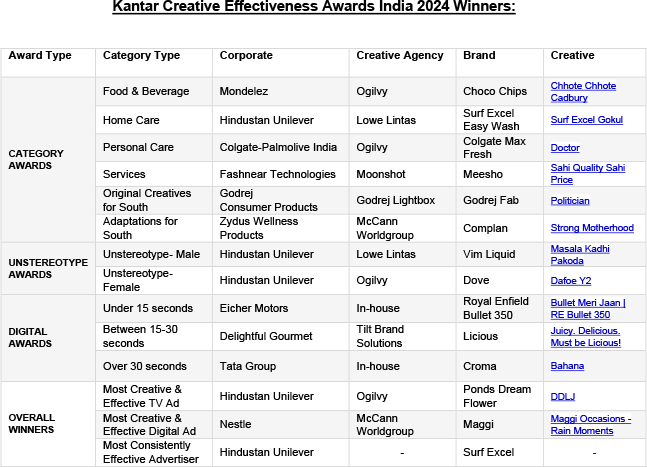
    Kantar, the leading marketing data and analytics company, unveiled the ads that were most effective and creative across India in 2023.  The company tested more than 12,000 creatives for its clients around the world in 2023. Over 11% (1,400+) of those creatives were tested in India. Today,


    In the awards, consumers are the jury. The India report shortlists close to 300 ads, tested across categories, markets, TG’s and media channels.


    The winners list has doubled from last year, with Kantar awarding 10 standout performers in the television ads category and 4 in the digital ads category.


    Television categories include Food & Beverage, Home Care, Personal Care, Services and Unstereotype. New categories introduced include ‘Original Creatives for South’, ‘Adaptations for South’, Most Creative & Effective TV Ad (overall) and Most Consistently Effective Advertiser. Creatives for Digital continue to grow this year as well, with Kantar awarding standout performers in 4 categories- 3 based on ‘Ad Length’ format and one for the Most Creative & Effective Digital Ad, for bringing to life the exciting storytelling possibilities in the digital world.


    All ads exemplify essential characteristics of being creatively engaging and landing persuasive stories that enhance brand sales, notes a communique.


    Commenting on this year’s findings, Soumya Mohanty, Managing Director & Chief Client Officer- South Asia, Insights Division, Kantar said: “Earlier this year, Kantar launched the Blueprint for Brand Growth– a breakthrough understanding of how businesses build strong & profitable brands. One of the growth accelerators for building strong brands is to pre-dispose more people. Great advertising builds pre-disposition and loads the dice in favour of the brands. Creative content can and should punch above its weight”.


    Added Prasanna Kumar, Head of Creative Domain & Executive Vice President- South Asia, Insights Division, Kantar: “Truly creative ads are the ones that are effective. The journey from being just creative to being effective starts by including your key stakeholders – your target consumers, into the process by pre-testing your ads. This year we have seen some original creative ideas shine through by ensuring that they have brand and consumer at their heart.”


    Key highlights from this year’s report: 

    1. Learnings from Kantar’s Blueprint for Brand Growth indicate that great advertising is rocket-fuel for building predisposition: growing meaningfully different brands in a more effective and efficient way. Creative quality, second only to brand size, greatly influences campaign profitability, with double the impact that reach does on brand salience.


    1. Kantar research emphasizes that ads must persuade and convey messages that are novel, credible, relevant, and different to enhance short-term sales. But high-quality ads, which leave a lasting impression, generally perform well in both short-term sales and long-term brand-building (Kantar LINK database), thus reducing the need to spend money on performance marketing.


    1. Beyond brand recognition, generating a strong emotional response is key, because emotion helps build strong memory structures, and most advertising effects are not immediate. Emotion plays a critical role in effective creative- and not just in TV content. 


    Ad learnings from 2023: 

    1. Make purpose personal: 65% of Indians will buy brands that stand for something they can identify with. While purpose or value led creatives open possibilities for highly emotively engaging creatives, the effective ones execute it in a manner such that it becomes personal to the consumers.


    1. License to surprise: Consumers are open to original creative ideas- ones that are hyper creative or break existing category codes. The reward for the brand lies in the ability to integrate the persuasive and meaningful impressions into the creative idea. Pre-testing helps identify the possible risks of comprehension and resonance.


    1. Going Native: Only 28% Indians (vs Global average 75%) have watched any ‘foreign’ content. Over 25 years of Kantar Link™ ad evaluation reveal a striking truth- ad transference across Indian regions is just about a third. This challenges the assumption that a single pan-India creative approach, even with universal and validated consumer insight, will yield positive returns on objectives. Brands are now refreshingly taking on the challenge and opportunity of engaging the Southern consumers differently from Hindi-speaking markets. Investing in original creatives, by going native on multiple dimensions- insights, creative idea & treatment and execution ensures maximizing of reward for the brand.


    1. Go deep & wide: The most efficient route to optimize budgets for creating ads that effectively crossover the transference challenge across the many India’s, is to create regional adaptions by playing with backdrop, celebrity, casting, product window visualization, slogan etc. Go deep and wide is about taking a campaign pan India by starting with a pan India insight, creative idea & treatment but execute with some nativity elements to amplify the resonance with the regional markets. Pre-testing helps to identify whether the mix of insight, story & elements work together as intended and identify opportunities for improvement.


    1. Embed the Brand: The value of creativity starts with the brand. While executional elements like distinctive brand assets and consistency in advertising style are undeniable aids in ensuring that the brand takes credit for the impressions left behind by the creative, it’s potential is amplified when the brand is integral to the story.

    **In our top quartile ads compared to the bottom quartile ads, we observed more consistency (+49%), greater use of established branding devices (+14%), and the inclusion of related music (+26%).


    1. Weave in the product story: Executions that can creatively integrate the specific competitive reasons to consider the brand into the narrative tend to be impactful. The role of creativity is thus not just to entertain but also leave behind vivid impressions that make the brand more meaningful to the consumers.


    1. Specific learnings for the digital landscape: 
    1. Precision targeting is officially giving way to mass media avatar of Digital and there’s an increasing recognition of the importance of brand marketing on digital platforms. Creative Quality getting increasingly critical for ensuring ROI for digital- could unlock 35%+ incremental sales per impression.
    2. Effective content on TV does not automatically mean success in digital – Ads that perform well in TV have only a ~50% chance of performing well in digital.
    3. Emotional resonance significantly enhances digital advertising’s impact on brand building. Ads that evoke stronger emotions are 3x more likely to drive long-term brand equity and 2.75x more likely to generate impact compared to those with weaker emotional connections.


  • Kantar introduces blueprint for brand growth

    Kantar, the marketing data and analytics company, has introduced the Blueprint for Brand Growth, an analysis of more than 6.5 billion global attitudinal and shopper data points from the past decade. The year-long exploration reveals empirically the key drivers of brand growth, and provides a decision-making framework for marketers to better control the levers of growth that shape their brand future.

    The blueprint is the result of collaboration between Kantar’s experts, industry leaders and advanced analytics work combining Kantar’s unique BrandZ and Worldpanel data assets. All focused on one question ‘How can marketers better drive growth?’. It proves that brands grow through being meaningfully different to more people. Brands that are meaningfully different to more people command 5X market penetration today, and have a real advantage in penetration growth over the next two years. *

    To achieve meaningful difference, the three Growth Accelerators and decision-making frameworks Kantar recommends marketers activate are:

    Predispose More People: Creativity, advertising and experience builds meaningful difference as well as mental availability for your brand. When optimally executed, this drives 9X higher volume share, 2X higher average selling price, and a 4X likelihood of growing share in the future.

    Be More Present: Optimising distribution, customer journey, range, pack, pricing and promotions wins 7X more buyers vs those present in only half of buying occasions.

    Find New Space: Innovation focused on identifying incremental spaces (motivations, occasions, tangential categories and services) doubles a brand’s chance of growth. Increasing the number of usage occasions by 10% results in revenue growth of +17%.

    The Blueprint builds upon and enhances existing industry research on how brands grow. It importantly proves that while market penetration growth is crucial, solely focusing on this is insufficient to holistically drive sustainable brand, revenue and margin growth. Kantar’s analysis underscores the role of differentiation – not just distinctiveness – in forging strong mental connections between consumers and brands as well as defending pricing power.

    On introducing Blueprint for Brand Growth, Jane Ostler, Kantar’s EVP of Thought Leadership and Blueprint project lead, commented:  “Our Blueprint for Brand Growth sets a new standard for strategic marketing understanding and excellence. Every marketing leader can use this framework to evaluate their brand’s own competitive positioning and then shape their strategic response and marketing investment priorities. For the first time anywhere, we have combined a decade of attitudinal brand research with actual shopper behaviour to more holistically understand the tangible impact marketing has on growth. Among other elements, we see that emotional connections in advertising are crucial. When optimised, they build differentiation and predispose consumers toward a brand, boosting sales and loyalty. Our newly revealed Growth Accelerators will, instinctively, feel familiar to CMOs. They are now, though, underpinned with new quantifiable evidence of their impact on brand and revenue growth. These are universal truths that every brand can use to focus their strategy and secure the budget for their highest impact activities. “

  • AI market burgeoning: Kantar research

    According to Kantar’s Icube data, Artificial Intelligence (AI) is already touching the lives of 9 in 10 internet users in India, “powered by the enormous computing capabilities on their phones, connectivity, and cloud infrastructure”,

    As per Kantar, the current AI user base of the country stands at 724 million and poised to grow YoY at 6%. These are users who have used any of the AI features like image filters, personalised recommendations, smart devices, etc till now.

    Kantar also found that ‘fitness’ and ‘social media’ apps are driving AI adoption with an average of 2.3 AI led features embedded in these applications. ‘Entertainment’ apps are a close second, standing at 2.0 AI features on average. AI is also touching ‘digital commerce’ and ‘pharmacy apps’ at an average of 1.8 AI features each. Kantar also anticipates that many more digital commerce & entertainment apps will adopt AI features to enhance quality of customer experience and stay in line with the emerging trends. Adoption however is slower in the ‘BFSI’, ‘job search’ and ‘short video’ apps segments, at an average of 1.2 features each.

    As per Kantar, adoption of AI among users is currently high for popular features while enhanced AI functionalities are catching up. Incidence among AI users in 2023:

    1. 88 % consumers used AI based algorithms which analysed their preferences, behaviours, and interests to create personalized recommendations for tailored experiences. This segment grew at 6 % YoY.
    2. 88% consumer also automated various tasks and streamlined routines to enhance efficiency and productivity in their daily lives using AI. This segment grew at 6 % YoY.
    3. 86% used ‘image enhancement filters’ so that the resulting image is improved in terms of sharpness, contrast, brightness or with other features. This segment grew at 5% YoY.
    4. At 21%, ‘smart home automation’ is a smaller segment but growing at 25% YoY.
    5. 15% consumers enhanced their ‘user experience through virtual assistants’. This segment is the fastest growing at 27% YoY.

    While AI technologies are touching most internet users of India today, their usage is expectedly higher among the youth (19–24-year-olds) at 92% and interestingly, at a high 81% for the older (45+ year old) age bracket as well.

    Speaking about AI and addressing the marketers, Soumya Mohanty, Managing Director & Chief Client Officer- South Asia, Insights Division, Kantar said: “AI is inevitable. Historically, technology adoption has always been a dominant determinant of a brand’s trajectory. We at Kantar feel that it is important to help marketers humanize AI to innovate successfully, help activate AI to predict future performance, maximize ROI and use AI strategies to build competitive advantage for sustainable growth. We have created a range of offerings which will benefit marketers and consumers by extension. LINK AI is one such solution, which helps evaluate creative effectiveness at scale and has helped uncover new insights into creating better video ads on YouTube which has a proven track record of growth, following Google’s ABCD framework. Similarly, we have introduced best in class offerings like LIFT ROI, Trend AI and NeedScope AI for various stages of brand growth as well.”

    Added Puneet Avasthi, Senior Executive Director, South Asia, Insights Division, Kantar: “Generative AI is set to become a $1.3T market by 2034 with a possible 42% CAGR growth over the next 10 years. We are sitting at a point of inflection where the next few years will enable a competitive edge between businesses who adopt early and others. As the usage of AI grows rapidly, it is critical for marketers to not use AI in isolation and as a gimmicky fad, but weave in consumer behavioural data into it to remove biases, continue to focus on building equity and not just to run activations. Kantar is at the forefront of this AI revolution and is assisting brand builders to strengthen creative testing, innovation using it’s AI based solutions.”

  • Diversity missing in advertising: ASCI-UA report

    In a country as diverse and multi-cultural as India, advertising that caters to this diverse population is surprising flat in its representation, or so notes the findings of an updated report titled ‘Mainstreaming Diversity & Inclusiveness in Indian Advertising’ by the Advertising Standards Council of India (ASCI) and the UN Women Convened Unstereotype Alliance (UA). Developed in partnership with brand research major Kantar, the study delves into the realm of diversity and inclusion (D&I) within Indian advertising, shedding light on evolving trends, challenges, and opportunities.

    The study scrutinised over 261 ads in 13 languages, and mapped them on eight dimensions of age, gender, sexual orientation, race/ ethnicity, physical appearance, social class, disabilities, and religion. It noted that Indian ads are doing well on the gender dimension, but are weak on other aspects.

    Report Highlights

    Analysis of Indian ads by Kantar’s Link Evaluation Framework indicates a steady increase in female representation, with 45% of commercials featuring women alone, surpassing the global average of 25%. Within the depiction of men and women, women characters are more stereotyped and shown as fair and lean versus men. Portrayal of women is also anchored to care-giving, and that of men to authority.

    The report noted that less than 1% of the ads featured members of the LGBTQI community or people with disabilities.  About 4% of the ads featured older people above 65 years of age.

    In contrast to many other markets, India is a distance away in terms of celebrating the inherent diversity in its ethnicity and skin colour. Only 3% of Indian ads had representation from ethnic groups vs. the global average of 19%, and only 4% showed diversity of skin tone vs. the global average of 27%.

    The study uses the Progressive Unstereotype Metric (PUM) to measure consumer responses to representation in advertising. PUM measures consumers response as to whether the way people are presented in the ad represents a modern and progressive view of society. Global studies have shown that positive PUM results in higher brand affinity and intent to purchase.

    Said Manisha Kapoor, CEO and Secretary-General, ASCI: “Progressive advertising works better for society and for brands. Ads that are stuck in stereotypical depictions are missing a trick in connecting with India’s diverse consumer base.  Collaborating with the Unstereotype Alliance and other partners, ASCI is committed to guiding and supporting the industry in achieving wider D&I representation.”

    Added Susan Ferguson, Country Representative, UN Women India: “As conveners of the Unstereotype Alliance India National Chapter, we are dedicated to fostering inclusivity within the advertising landscape. Over the past two years, our alliance has brought together brands, organizations, and individuals committed to leveraging advertising and media to drive a cultural shift towards diversity and inclusion. We are proud of our collective efforts to dismantle stereotypes and champion a more inclusive advertising industry.”

    Said Soumya Mohanty, MD & CCO- South Asia, Insights Division, Kantar: “We are proud to partner with ASCI and the Unstereotype Alliance in shedding light on the evolving landscape of diversity and inclusion in Indian advertising. Through our research and insights, we aim to drive a more inclusive and representative industry that resonates with diverse audiences.”

    Link to report: https://www.ascionline.in/wp-content/uploads/2024/04/Kantar-ASCI-UA-Report-DI-in-Indian-Advertising.pdf

  • OTT, not communication, tops internet use in India

    OTT, not communication, tops internet use in India

    As high as 86% of internet users in India, that is 707 Mn people, enjoy OTT audio and video services, making it the top use-case for internet in the country. These numbers were revealed by the ‘Internet in India Report 2023’, jointly prepared by the Internet and Mobile Association of India (IAMAI) and Kantar, the leading marketing data and analytics company.

    The report was released by Harsh Jain, Chairman, IAMAI, and CEO and Co-founder Dream Sports, at the inaugural session of the two-day India Digital Summit 2024, being held in Mumbai (Feb 27 and 28). “‘Internet in India’, which is based on the ICUBE 2023 study, covering over 90,000 households across all states and Union Territories of India (barring Lakshadweep), is the most comprehensive survey of internet usage in the country,” he said.

    Puneet Awasthi, Director, Specialist Businesses, Insights, South Asia – Business Development, Kantar, India, presented the key figures of the report.

    The rise of digital entertainment services is also bolstered by the rise of non-traditional devices (smart TV, smart speakers, Firesticks, Chromecasts, Blue-Ray etc) that has witnessed a growth of 58% between 2021-23 at all India level. The adoption is driven by the new generation ‘cordcutters’ as for the first time, there are more people accessing video content over internet only devices (208Mn) than over conventional linear TV (181Mn).

    Other top use-cases of internet in the country are communications, with 621Mn users, and social media with 575Mn users. These are the second and third most popular services availed by Indian internet users. OTT refers to audio/video streaming either from subscribed or user-generated content UGC platforms while Communication refers to text/ voice/ video chat or used email, video conferencing, etc. using an online website or app in the last one year.

    The report points out that users from rural India are driving all these use-cases, accounting for more than 50% of the user base for each use case.

    The growing internet penetration in India surpassed a new milestone of 800Mn as total Active Internet Users reached 820MN in 2023, meaning more than 55% of Indians have used internet last year. Internet penetration grew across the nation at a modest 8% YoY. Rural India (442 Mn) is a clear majority accounting for over ~53% of the total user base.

    From a Male:Female ratio of 71:29 in 2015 we have reached 54:46 in recent times, which is almost at par with the overall sex ratio of the addressable population in the country.

    Reading between the lines the report reveals that the growth has decelerated in both urban and rural areas. Rural India, which has been driving internet growth rates for the last many years has been witnessing a slowdown lately (11% YoY), effectively in the post pandemic period, that is lowering overall growth rates (8% YoY). However, while the growth rate has slowed down, in terms of actual numbers it is still phenomenal, since 8 per cent and 11 percent in a base of over 800 million are huge numbers.

    One of the ways to accelerate the growth may be to focus on Indic languages which shows a healthy sign of growth in some states. The report finds that 57% users prefer to access content in Indic languages, with languages such as Tamil, Telegu and Malayalam having the strongest language preference for content.

    Finally, it is also a matter of great optimism that states with the lowest internet user base is also showing signs of highest growth rates. States such as Jharkhand (46% penetration) and Bihar (37% penetration) are showing above average growth rates of 12% and 17% respectively.

    For a copy of the full report please visit: thought-leadership | India Digital Summit.

  • ASCI unveils study on diversity & inclusion in advertising

    By Our Staff


    The Advertising Standards Council of India (ASCI) and the UN Women convened Unstereotype Alliance (UA), launched their collaborative study on Diversity and Inclusion (D&I) in Indian advertising. The report, prepared by Kantar, focused on ESG (environmental, social and governance) goals of corporates. The study was unveiled at the DEI Edge Summit, co-hosted by ASCI and UA on Thursday.


    Here are highlights of the report, courtesy a communique


    The joint report provides new insights on Indian advertising’s D&I representation versus global practice (leveraging data from the 2023 Global MONITOR survey) and a wealth of original findings on Indian advertising trends accommodating D&I. Some of the key dimensions of D&I representation mapped in the report were age, gender, sexual orientation, race, physical appearance, social class, disability, and religion, across 28 markets around the world.


    The global dimension

    Compared to 33 percent of consumers across the world, 48 percent of Indians expressed the need for more inclusive representation by brands. India’s socially aware consumers are an encouragement for brands on the way to inclusiveness and a wake-up call for those yet to embrace D&I.

    The research scoured through all the new ads that aired in October 2023. Coupled with Kantar’s extensive analysis of advertisements over the past few years, the study provides a snapshot of the patterns, progress, and scope for improvement in DEI in India.


    Key findings of the Indian study: There was a near absence of representation diversity in Indian advertising.   The study found a dismal less-than-1 % representation of the LGBTQ+ community, people with disabilities featured in less than 1% of the ads and only 4% of Indian ads depicted people aged above 65 years.


    Women representation: While the presence of women in ads was comparable to men, sticky stereotypes still prevail. More women are portrayed with fair skin tone (58% of women vs 25% of men on-screen), with less diverse physical appearance (39% of women were shown as slender vs 16% men on-screen) and low non-traditional roles (17.5% of women were depicted as the sole caregiver vs 3.5% men characters) and less authoritative (with male characters three times more authoritative than their female counterparts).


    Women tended to be shown as younger with 86% of them between 20 and 39 years of age compared to 62% of men.


    Said Manisha Kapoor, CEO and Secretary-General, ASCI: “There is no doubt that advertising shapes society. Indian advertising is missing the Diverse and inclusive narratives that can provide a real edge to brands, as can be seen in the study. Along with The Unstereotype Alliance and other partners, ASCI would like to nudge and support the advertising industry in getting its DEI representation right. The opportunity to include diverse perspectives and stories is a powerful one, and the event showcases the immense benefits both brands and society can derive from such progressive inclusions.”


    Added Susan, Fergusan, Country Representative, UN Women: “We, as the conveners of the Unstereotype Alliance India National Chapter, are pleased to host the DEI EDGE SUMMIT in collaboration with the ASCI Academy. Over the past two years, the Unstereotype Alliance in India has united brands, organizations, and individuals who believe in the transformative influence of advertising and media in fostering an inclusive society. Our efforts transcend campaigns; we strive to dismantle stereotypes, fostering a cultural shift that champions diversity and inclusion in advertising industry”.


  • TCS stays India’s most valuable brand


    By Our Staff


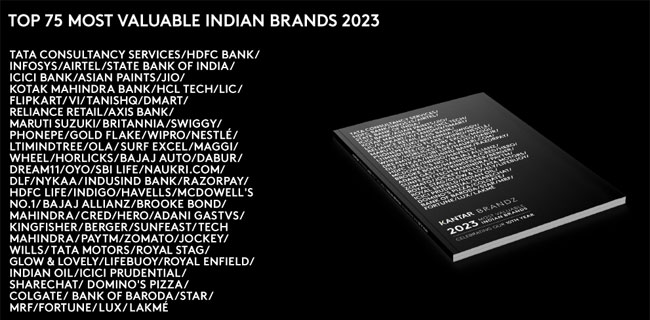
    Tata Consultancy Services (TCS) has retained its #1 position in the 10th edition of Kantar BrandZ Top 75 Most Valuable Indian Brands Report for the second consecutive year, with a brand value of US$43 billion. HDFC Bank, Infosys and Airtel also hold on to their top four positions, while State Bank of India rises one place to enter the Top 5.


    India’s Top 75 brands have a combined brand value of $379 billion, a decline of 4% from 2022 – a modest decrease given the ongoing economic volatility across most of the world. This is testament to Indian brands’ resilience, stability and consistency. The decline has been driven by brands in the Business Technology and Services Platforms category, which have a major presence in international markets, and therefore have been impacted by global pressures, recession threats and geopolitical instability.


    The Automotive category produced the Top 75’s two fastest risers: TVS (No.51; $1.90bn) and Mahindra (No.47; $2.01bn) and achieved the second highest category growth at 19%. India’s automotive brands have quickly responded to changing consumer needs, notably the shift in preference from hatchbacks to SUVs, and the demand for electric vehicles.


    TVS gained 59% in value and leapt 24 places thanks to a number of successful product launches and a 10-year partnership with BMW that gives it leverage in markets such as Europe, the US and Canada. Mahindra, which grew its value by 48%, has made itself incredibly meaningful in Indian consumers’ eyes, and has also significantly boosted its salience.


    The ranking’s 16 Financial Services brands contribute the biggest chunk of its total value. They grew 6%, thanks to the boom in digital banking, led by Axis Bank (No.17; +28%) and ICICI Bank (No.6; +18%).


    Telecom providers also performed strongly, resulting in a 17% rise in total brand value. Airtel (No.4; +29%) took full advantage of the end of the price wars to focus on what makes it special and relevant to Indian consumers’ lives. This included offering differentiated digital services, such as the Xstream entertainment app and Wynk music app. Airtel has also successfully leveraged the rapidly increasing demand among businesses for data and connectivity related solutions, and digital products that enable the delivery of an enhanced omni-channel customer experience.


    There are four newcomers to the 2023 Indian brand ranking, plus two re-entrants. PhonePe – the highest entry at No.21 – has quickly become India’s leading digital payment app by investing heavily in the strength of its infrastructure, building connections with partner banks, and developing a huge network of merchant acceptance points. Also making their debut are fintech brand Cred (No.48; $2.0bn), photo and video sharing app ShareChat (No.67; $1.33bn) and entertainment platform Star (No.71; $1.30bn).


    2023 is the 10th ranking of India’s most valuable brands, during which time the Top 50 have increased almost fivefold in value, from $69.6bn in 2014 to $339.9bn in 2023. The last decade is a story of strength and resilience: 33 of the brands in the current Top 75 were also in the 2014 ranking. The companies behind India’s most valuable brands have consistently outperformed the key market indices – the SENSEX and the NIFTY50 – with share price growth over 10 years of 99.6% compared with 83.2% and 81.7% respectively.


    Kantar BrandZ Top 10 Most Valuable Indian Brands 2023

    Rank 2023 Brand  Category Brand Value 2023 (US$M)
    1 Tata Consultancy Services Business Technology and Services Platforms 42,969
    2 HDFC Bank Financial Services 33,612
    3 Infosys Business Technology and Services Platforms 24,170
    4 Airtel Telecom Providers 22,517
    5 State Bank of India Financial Services 14,483
    6 ICICI Bank Financial Services 12,976
    7 Asian Paints Paints 12,839
    8 Jio Telecom Providers 11,773
    9 Kotak Mahindra Bank Financial Services 10,332
    10 HCL Tech Business Technology and Services Platforms 9,361


    Said Deepender Rana, Executive Managing Director- South Asia, Insights Division, Kantar: “It has been India’s decade. Our GDP has almost doubled with an 82% growth, while the world GDP has grown at 30%. This delta is even more when it comes to the most valuable Indian brands, which have almost quintupled in value (4.9 times), compared to the most valuable global brands, which have grown by 2.4 times. So Indian brands are significant value creators for our economy. We expect this trend to accelerate in the next decade as Indian brands don’t just thrive in India, but also explore growth overseas in their quest to become true multinational giants. Our IT services brands have already done that, with TCS and Infosys already featuring in the Top 100 Most Valuable Global Brand list. The strongest Indian brands have forged powerful connections by consistently adding value to people’s lives, and consumers see them as different to their rivals in ways that really matter. Brands must keep investing in building equity to create future demand, even as they capture existing demand which requires a better balance between short- and long-term strategy.”


    Added Soumya Mohanty, Managing Director & Chief Client Officer- South Asia, Insights Division, Kantar: “There is great diversity within the India Top 75: they are a combination of established names and dynamic young brands, both global and local in footprint. What they have in common is their ability to be essentially Indian. Through a deep and detailed understanding of consumers in the market, and adopting the local culture and ethos, even huge international brands are seen and cherished as ‘homegrown’. The trust and loyalty this engenders has helped Indian brands to suffer less and recover more quickly from the storms that have buffeted them over the past 10 years.”


    Other key highlights from the Kantar BrandZ Most Valuable Indian Brands report include:

    :: Sustainability credentials have a major influence on consumer decision-making – almost 9% of Indian brands’ Demand Power – a Kantar BrandZ measure of the ability to drive predisposition to buy – comes from perceptions around sustainability. However, only 8% of brands in India are seen as leaders in this area, compared to 11% globally, indicating an opportunity for those that can do more.

    :: Differentiation is key to commanding Pricing Power – the ability to justify price charged. Brands that have grown in both Demand Power and Pricing Power over the last year did so by being Meaningfully Different. There are different routes to being perceived as differentiated: a brand could be seen as distinct, to be a specialist, or to have purpose.

    :: The strength of the domestic economy has acted like a shield – Overseas contribution for the Top 30 Indian brands accounts for 31% of brand value, compared with 47% for Japan, 59% for the UK, and 85% for France. This has protected the ranking from the worst effects of international volatility.


    The Kantar BrandZ Most Valuable Indian Brands ranking, report and extensive analysis are available now at www.kantar.com/campaigns/brandz/india 


  • Kantar launches Sensory eValuate in India

    By Our Staff

    Kantar, marketing data and analytics company, launches Sensory eValuate in India as a part of Innovation testing suite. It uses sensory research to help evaluate consumer products using the human senses – touch, smell, sight, sound and hearing.


    Driven by scientific expertise, Sensory eValuate helps to develop and optimise superior products; explore, design, or optimise new and existing products to drive consumer satisfaction, repeat purchase and brand loyalty – giving marketers the ability to protect and maximise the value of their brand equity. The solution covers a broad range of categories including food & beverage, fragrance, personal care and beauty, cleaning products, automotive, physical environments, and consumer goods. Catering to three critical stages of innovation aligned to growth – Identify, Build and Launch, Sensory eValuate provides insights through the process in a layered approach. The new offer complements other solutions from Kantar’s eValuate suite of innovation tools, including Idea eValuate, Concept eValuate, Pack eValuate and Product eValuate, to help clients identify growth opportunities. These solutions are highly flexible and can be customized according to client needs.


    Speaking about Sensory eValuate, Ranjana Gupta, Lead – Innovation, South Asia, Insights Division, Kantar said: “Understanding what product formulation best meets expectations requires specific sensory expertise and methods. Sensory eValuate brings insight to the detailed attribute level of formulations, empowering the R&D capability within client organisations for the creation of the ultimate sensory experience. Understanding how flavour, fragrance, surfaces, or sounds interact with consumer perception is crucial for the success of a product. Getting these elements right has the power to positively impact brand equity, demand a premium price, create memories, and establish a sensory signature that underlies long-term success in the market. Complimenting this with salience and a congruent total offer is the secret.”


    Soumya Mohanty, MD & Chief Client Officer, South Asia, Insights Division, Kantar added: “Innovation requires continual, ongoing effort to ensure that your pipeline delivers the products that will create growth opportunities. Since 1998, Kantar BrandZ has consistently identified three qualities that are the hallmarks of the strongest brands- meaningful, different, and salient. With the launch of Sensory eValuate in India, brand owners will benefit in staying meaningfully different and ahead of the pack. With a 30+ year history in sensory and technical innovation and a total of 1 million plus consumers surveyed across 90+ markets, Kantar’s Sensory eValuate solution can revolutionize product development in India.”


  • Kantar appoints Mary George Parayil

    By Our Staff


    Mary George Parayil
    Mary George Parayil

    Kantar, the marketing data and analytics company, appoints Mary George Parayil as Principal, Kantar Analytics, India. In her new role, Mary will report into Ranjana Gupta, Lead – Innovation, South Asia, Insights Division, Kantar, and will continue to be based in Bengaluru.


    Said Deepender Rana, Executive Managing Director, South Asia, Insights Division, Kantar: “Our clients already use the power and precision of Kantar’s analytics solutions to answer critical business questions. Clients use our pricing analytics offer to enhance profitability and combat inflation. CrossMedia helps allocate campaign budgets across media for optimal brand outcomes. Our AI-infused solutions are a natural evolution of our offer. Link AI is helping our clients test hundreds of creative assets, including digital ones, cost-efficiently in a matter of hours. UMMO uses AI for real-time advice on media allocation to optimise short- and long-term sales. Advanced technology capability is core to Kantar’s differentiation, and we will continue to invest in this area, helping businesses grow with speed and profitability.”


    Soumya Mohanty, MD & Chief Client Officer, South Asia, Insights Division, Kantar, added: “Kantar in India is the leader in brand measurement, and as our client teams work closely with Mary, it will further amplify our ability to provide end to end solutions to modern-day brand problems.”


  • Kantar’s Creative Effectiveness Awards announced

    By Our Staff


    Kantar, the leading marketing data and analytics company, announced its now-annual Creative Effectiveness Awards.  The India report shortlisted close to 400 ads, tested across categories, markets, TG’s and media channels.


    Across television ads tested in India, Kantar has awarded standout performers across seven categories- Food & Beverage, Personal Care, Technology, OTC, Home Care, Services and Short Format (under 15 seconds). Kantar had also introduced an ‘Un-stereotype’ category last year, which focuses on celebrating gender-progressive advertising. This category has been included this year as well. Kantar has also awarded a standout performer for digital this year as well.


    All ads exemplify essential characteristics of being creatively engaging and landing persuasive stories that enhance brand sales.


    Here are the Kantar Creative Effectiveness Awards 2023 India Winners:

    Medium  Award Category Corporate Creative Agency Brand Creative
    TV Food & Beverage Hindustan Unilever Ogilvy Red Label Hospital
    Personal Care Honasa Consumer Korra Pvt Ltd Mamaearth Shaadi Wala Glow Everyday
    Services Burger King Black Pencil Burger King Rs.50 Stunner Menu Stuns Hrithik Roshan
    Home Care Hindustan Unilever Lowe Surf Excel Holi
    OTC Haleon Leo Burnett Iodex Ultragel Iodex Ultragel IPS
    Technology Google Lowe Lintas Google Voice Search Director
    Short format (15 sec or less) Godrej Consumer Products Bates Chi & Partners Jakarta Kala Hit Dark Side of Mom
    Un-stereotype Hindustan Unilever Ogilvy Bru Bru New Pack – Photograph
    Digital Link for Digital Welspun Ogilvy Welspun Welspun QuikDry Towel Ad


    Commenting on this year’s findings, Soumya Mohanty, Managing Director & Chief Client Officer- South Asia, Insights Division, Kantar said, “Our research has found that the most creative and effective ads generate more than four times as much profit as those which score low on effectiveness measures. So cost effective ad testing is possibly a much better option that a costly mistake of airing a wrong ad. Our winners exemplify how testing can progressively refine the ad ultimately leading to better brand results.


    Added Prasanna Kumar, Head of Creative Domain & Executive Vice President- South Asia, Insights Division, Kantar: “With short-form advertising on the rise in India, brands face the task of adapting to newer advertising structures and storytelling styles. Short ads, designed for 15 seconds or less, now require meticulous scripting and visualization to captivate audiences and meet higher standards for entertainment and engagement set by rampant popularity of short-form video content on social media platforms. To cut through content clutter and grab consumer attention in this rapidly changing landscape, pre-testing plays a crucial role for brands. It enables them to develop ads that have a strong impact and are memorable, while also providing valuable insights and learnings along the way.”