Tag: Kantar

  • Dolly Jha moves from Nielsen to BARC

    By Our Staff


    There is more reason to be delighted to publish this bit of info. It’s possibly the first communique we’ve received from BARC India in over a year. Phew!


    Yes, you read it right: in over a year.


    But the news is of greater interest because the general buzz around the industry is that all is not too well at the audience measurement firm. In fact there are some very strong rumours of a certain section of broadcasters considering a rival measurement body. But of course running a measurement body needs loads of money and must have the blessings of the entire ecosystem, including advertisers and advertising agencies.


    Dolly Jha
    Dolly Jha

    Without further digression, here’s the news of the day: Broadcast Audience Research Council India (BARC), the world’s largest television audience measurement body (the communique claims… we would also add: possibly the world’s most controversy-ridden measurement body), has announced the appointment of Dolly Jha as its Chief of Product & Research. Jha has experience of close to three decades across Kantar, ITC Foods and Nielsen, where she spent the last 13-odd years.


    On her appointment, Jha said: “I am excited to join BARC India as the Chief of Product & Research. BARC today runs the largest Audience Measurement system in the world. With all the experience behind me, I am looking forward to contributing to BARC by evolving the measurement further to meet the growing needs of stakeholders.”


    Nakul Chopra
    Nakul Chopra

    Welcoming Jha, Nakul Chopra, CEO, BARC India said in the communique, “It is indeed wonderful that Dolly will join the BARC Leadership Team. As the Chief of Product & Research – she will expectedly bring immense value to our eco-system, both from the perspective of working back from our output, to improve input quality and, over time in helping build value added services that will benefit all our subscribers. Both these vital functions are new capabilities that we seek to add to BARC – given her vast experience, I cannot think of a leader more suited to this role. In her stint at Nielsen, Dolly has already deep exposure and understanding of what BARC does – I am confident that this will augur for an extremely fulfilling partnership. I warmly welcome her and look forward to working closely with her.”


  • BI Worldwide & Kantar unveil Channel Partners Engagement Research

    By Our Staff


    BI Worldwide, delivering loyalty and engagement solutions, conducted a research in association with Kantar Group, marketing data and analytics company, to analyse what inspires, engages, and motivates channel partners in India. The aim was to leverage insights from the research to create robust and reliable tools for brands to understand, measure, and strengthen their channel partner relationships.


    Speaking about the research, Siddharth Reddy, Managing Director, BI Worldwide India said: “BI Worldwide India commissioned Kantar to pioneer a first-ever, in-depth research in the loyalty marketing industry, conducted at this scale. The research brings focus on a holistic relationship between brands and channel partners. Together, we endeavoured to identify the factors that affect channel partner engagement and developed a framework that enables brands to measure and optimise engagement.”


    Added Biswapriya Bhattacharjee, Director, B2B & Technology, Insights Division, Kantar India: “The research is truly one-of-its-kind and delves deep into channel partners’ mindset to understand what inspires and motivates them to give their best. Brands can design results-oriented channel loyalty programs when informed by insights from a methodical and scientific research. KANTAR is delighted to have partnered with BI Worldwide India to bring together a plethora of such data-backed insights and perspectives on secrets to win over channel partners.”


    Key Research Takeaways

    The research uncovers key statistics and insights that brands should consider when designing and implementing their channel loyalty and engagement programs to drive better ROI:

    :: A staggering 78% of channel partners in India are not engaged.

    :: 8 key drivers of engagement influence a brand’s relationship with its channel partners – Operational Excellence, Rewards & Incentives, Recognition, Learning, Brand Affinity, Communication, Well-being, and Events.

    :: Focusing holistically on all the 8 drivers helps brands foster strong and profitable channel partner relationships.

    :: Brands can measure the strength of channel partner engagement, leveraging BI WORLDWIDE’s unique model, developed in consultation with KANTAR, called the Affection Matrix.

    :: Basis performance and preference, channel partners can be placed in 4 different quadrants of engagement of the Affection Matrix – Engaged, Trapped, Unattached and Vulnerable.

    :: A whopping 49% of channel partners feel ‘Trapped’ with the brands they work for i.e. they prefer the brand even though they are not satisfied with it.


    :: Brands can maximise channel partner engagement using BI WORLDWIDE and KANTAR’s jointly-developed, IBC (Invest, Build, and Consider) solution framework.

    :: 68% of channel partners are extremely satisfied with travel-based rewards, followed closely by luxury rewards at 66%, and business infrastructure-related rewards at 64%.

    :: A brand’s best bet is to invest in a strategic mix of rewards that covers the entire efficacy scale – transactional, functional, and aspirational – to amplify channel partners’ loyalty.

    :: 50% of channel partners prefer receiving business communication through app-based messaging platforms, such as WhatsApp and 50% use social media platforms, such as Facebook, Instagram, etc.

    :: Voice, Messengers, and Apps are the mediums to consider while developing channel partners’ communication strategies.


    The research is a deep dive into channel partners’ expectations and equips brands with models to optimise their channel loyalty programs in a complex and layered market like India.


  • The Future of Digital India lies in Voice, Video & Vernacular


    By Indrani Sen


    Indrani SenThe IAMAI-Kantar ICUBE report published in 2020 predicted that internet users in India would increase by 45% between 2021 to 2025 and will touch 900 million. The report also made a forecast that the growth will be driven by higher adoption of internet by users in small towns and rural areas. In 2020, two out of every five active internet users in the country came from small towns and there was a 13% growth in the number of rural internet users between 2019 and 2020. The report also estimated that by 2025, the number of rural internet users will surpass the number of urban internet users. In a country with 29 states based on linguistic divisions and 22 major regional languages (including Hindi), the emerging digital ecosystem is calling for urgent applications of voice and video in vernacular to reach out to the new internet users.


    An article in Economic Times by Rahul Sachitanand published on October 7, 2018 did an excellent analysis of India’s  changing internet landscape covering its past, present and future (https://economictimes.indiatimes.com/tech/internet/voice-video-and-vernacular-indias-internet-landscape-is-changing-to-tap-next-wave-of-users/articleshow/66102478.cms). The article talked about the three waves of internet adoption in India, the first wave (1995-2005) saw the arrival and early adoption of internet and digital content in India followed by the second wave (2005-2015) when internet took the centre stage and a variety of new businesses were built in travel, e-commerce and fintech riding on internet which not only attracted international players and investors but also laid the foundation of Digital India. The third wave, which began from 2015 (2015-2025), saw the validation of Indian Internet market with Flipkart’s sale to Walmart for $16 bn. Data prices crashed as reliance Jio entered the telecom market and mobile became the main device for accessing internet across the country breaking geographic and demographic boundaries.


    I wrote two articles here, the first one “The Deep Divide” published on February 5, 2018 dealt with the difference between the language of communication used by our advertising industry and the language understood and appreciated by their target audience across India in the digital age (https://www.mxmindia.com/2018/02/the-deep-divide/); and the second one published on November 4, 2019 dealt with the inevitable upcoming process of localisation of Indian digital market (https://www.mxmindia.com/2019/11/localisation-in-indian-digital-media-market/). However, in 2019 I was not able to foresee how fast the timeframe of reaching out digitally to the rural internet users would shrink during the three waves of the pandemic, national/ regional lockdowns and forced online education at primary and secondary school levels. A lot of water has passed under the bridge during the last two years and today a number of new entrepreneurs are ready to offer AI solutions for enabling Voice and Video in vernaculars for reaching out to the new Indian internet users from small towns and rural areas.


    The Indian internet which was initially designed in English for the top end of the market is now going through an explosion of vernaculars enabling usage of voice and video for enabling the new users to graduate from utility services to online transactions. Today, it is estimated that more than 60% of smartphone users in India consume various content in their mother tongue and about 30% consume content in multiple Indian languages along with English. Only 10% of the smartphone users consume content only in English and this percentage is expected to decrease with the increase in the number of smartphone users. According to Google, there has been a four-fold increase in rural internet users. India’s data consumption now can be easily compared with developed countries at an average of 8GB per month per user. The transacting audience kas gone beyond the large cities to touch 170 million. The next generation of Indian internet users would prefer to have content, communication and ecommerce in non-English vernaculars and would be more comfortable with voice rather than typing messages in their mother tongues.


    Google has introduced India First and India-only apps to bring in new users to its fold. It has launched support on its Gboard handset keyboard in all Indian languages; its voice assistant can understand and interact in eight Indian languages and its web browser Chrome can translate web pages into eleven Indian languages. More Indian languages would be added to the Google apps in near future.


    For over 10 years, Reverie Language Technologies, a vernacular language venture, has been building capabilities for search and discovery in multiple languages. They have gone beyond translation and have built interfaces to engage via voice the need of the new users of internet by focussing on customer relationship management (CRM) of this emerging digital consumer segments. Over the last couple of years, a whole new B2B sector with digital organisations like vernacular.ai offering AI enabled use of voice and video in vernacular has opened up.  VIVA or Vernacular Intelligent Virtual Assistant is one of the services which are offered by vernacular.ai today. All large ecommerce companies operating in India have started voice enabled transactions in vernaculars.


    YouTube, Hotstar, Voot, etc. along with first TikTok and then desi versions of TikTok have shown us the operations with videos, particularly videos in vernacular can reach a massive scale. Research has shown that close to 90% of marketing companies use videos as the main tool for digital marketing. More than 75% of all B2C content is delivered through videos which have higher engagement rate leading to greater penetration of the messages. In future with technological developments, search operations will be done through voice search or video search in multiple Indian languages.  While voice and video will be adopted in future by the entire digital world, Digital India will be clearly different market by the use of at least a dozen of vernacular platforms.


  • TCS is India’s Most Valuable Brand


    By Our Staff


    Tata Consultancy Services (US$45.5 billion) is the new number one most valuable Indian brand, claiming the top spot from HDFC Bank (no.2, $32.7bn) which had held the position since the first ranking was unveiled in 2014. TCS’s brand value has been accelerated by global demand for automation and digital transformation following the pandemic.


    The Top 10 Most Valuable Indian Brands together contribute just over half of the ranking’s total value. There has been significant movement at the top, in addition to the two most valuable brands switching positions. There are two new entrants – Infosys ($29.2bn) which has rocketed up to no.3 from 12th position, and ICICI Bank ($11bn) which has climbed two places to no.9. State Bank of India ($13.6bn) has also risen four places to no.6.


    There are brands from 23 different categories in the 2022 Indian Top 75. There are a total of 14 newcomers , from 11 categories – including online gaming, education, apparel and real estate, reflecting the diversity and dynamism of the Indian economy.


    India’s strongest brands have bounced back from the pandemic to increase their brand value by a massive 35% CAGR since 2020, when COVID-19 hit the country. India’s top 75 brands are worth a combined $393 billion, equivalent to 11% of India’s national GDP.


    Technology and Banking brands account for over half of the total value. Six B2B Tech brands and 11 Consumer Tech brands contribute 35% to the total value of the ranking, reflecting the rise of Tech India. Overall, B2B brands (tech, payments) are on average almost three times as valuable as B2C brands, reflecting the fact that many of the B2B brands play on the global stage while B2C are more focused on the domestic market. Six banking brands deliver 19% of the total value. Also notable for their performance are Insurance brands, which have performed well as the pandemic increased consumers’ focus on protection of life and health and Telecom Providers, led by Airtel (No.4; $17.4bn) and Jio (No.10; $10.7bn), which took full advantage of growth opportunities as everything moved online, from education to work to parties.


    Key newcomers to the ranking include Vi (No.15; $6.5bn); formed from a merger between Vodafone and Idea, Byju’s (No.19: $5.5bn), the educational technology brand that has become India’s most valuable education brand, and Adani Gas (No.21; $4,5bn).


    Said Deepender Rana, Executive Managing Director- South Asia, Insights Division, Kantar: “India’s leading brands have grown at an exceptional rate, despite global economic headwinds, putting the disruption from COVID-19 behind them. Indeed, they have both driven and benefited from the transformation in consumer and business behaviour as a result of COVID-19, especially where it relates to the use of technology. The challenge now is to sustain momentum as inflation bites worldwide and consumers and businesses adjust to the new normal. Brand owners will need to work harder to identify and build on what makes worth paying for and ensure ROI on their marketing expenditure to avoid a margins squeeze.”


    Kantar BrandZ has identified Four Fundamentals responsible for powering brand growth: Function, Convenience, Experience and Exposure. India differs from other markets around the world, however, in that a brand’s sustainability credentials and purpose matter more.


    Overall, 65% of Indians feel anxious about climate change, and 64% believe businesses must play their part. The highest-ranking brands in the Top 75 are clear on purpose and have a relevant sustainability agenda. These include services platform Zomato (No.30; $3.1bn), which offsets the carbon footprint of its deliveries and packaging. Swiggy (No.20; $4.8bn) elevates consumers’ quality of life with speedy delivery of meals, groceries and healthy items, as does Flipkart (No.12; $8.9bn), while also helping smaller local brands to connect with consumers via its platform.


    Added Soumya Mohanty, Managing Director, Insights Division, Kantar: “Purposeful and sustainable brands are rewarded. Indian consumers look further than the brand attributes that affect them personally – they want brands to improve people’s lives and have a positive impact on wider society. They vote with their wallets, choosing brands they see as ‘doing the right thing’. Indian brands should have a clear view of their purpose, connect strongly with it by embedding it in their culture, talk about it in creative and powerful ways, and deliver on it – without fail.”


    Salience – the ability of brands to spring quickly to mind when a consumer has a need – is also vitally important. India’s Top 10 brands are far more salient than their counterparts in most other countries. However, for growth to be supercharged, brands must also have strong meaning as well. They should have functional meaning – doing a good job of fulfilling a need – but also a layer of emotional meaning. The Kantar BrandZ India Top 75 far exceed other Indian brands on all these of these vital predictors of success.


    Other key highlights from the analysis include:

    :: 57 of the brands in the 2022 Top 75 have been in the ranking since 2018, while 19 have moved up the league table.

    :: The share prices of companies behind strong brands are protected in a ‘bear’ market and recover more quickly. Between August 2014 and June 2022, the SENSEX India Index gained 63.8%, while a portfolio of the most valuable Indian brands rose 81.8%.


    There are eleven consumer tech brands in the Top 75, reflecting the increasingly digital way Indian consumers live, which is 11% of the total brand value. The four most valuable brands in this category are Flipkart (No. 12; $8.9bn), Byju’s (No. 19; $5.5 bn), Swiggy (No. 20; $4.8bn) and Nykaa (No. 25; $3.7bn).


  • How should brands react when prices are going up?


    By Mary Kyriakidi


    Published with permission from an article first published on Kantar.com


    The scary thing about inflation now is not that it’s the highest it’s been in 40 years, it’s that it’s high and trending up. The last time this happened – back in the late seventies and early eighties – recessions followed. Money supply was reduced, and interest rates were raised and, as in a perfectly built chain of dominoes, the last piece to fall was aggregate demand. Consumers spent less, unemployment rose, and, as a result, inflation gradually subsided.

    The last two generations of consumers (and marketers) have only read about high levels of inflation in economic literature, they haven’t had to deal with it in real life. But for the last six months, the rate of change in the prices has been hard to miss. Labour shortages and rising energy, gas and oil costs have inflated consumers’ basket of goods and shrunk businesses’ margin potential.

    History teaches us that strong growth isn’t on the immediate horizon. And that’s ok.


    Growth is achievable if you sort out profit first

    Christensen, Harvard Business School professor and the architect of the world’s supreme authority on disruptive innovation, said that innovators should be patient for growth, but impatient for profits. As sage as this advice sounds, our world currently has a fascination with billion dollar unicorns that hastily sacrifice profitability and sustainable growth at the altar of growth at speed (think WeWork: the making and breaking of a $47 billion unicorn).

    Growth at all costs might take you to the poor box. Such is the finding of a research study by Per Davidson at al. that was later replicated with greater rigour by Cyrine Ben-Hafaïedh and Anaïs Hamelin. The two academics conducted a study covering over 650k firms spanning 28 countries and a variety of different sectors and sizes. Their findings?

    Firms are much more likely to end up in the enviable position of achieving high growth and high profitability if they focus on profitability first, and then expand. They also found that firms are much less likely to become profitable because of their growth.

    We believe the same principles apply to brands of any size. A focus on growth alone is not enough and can even be dangerous. Brands create value through higher margins and greater profitability.


    Success is more likely to start with a profit focus, not growth

    https://www.kantar.com/-/media/project/kantar/global/articles/images/2022/how-should-your-brand-react_chart-1_1500x575.png

    Source: Analysis of 660k European SMEs


    Fixing price is key to profitability

    But hang on, whose job is it?

    Pricing and profitability are unquestionably linked. It has been almost 20 years since McKinsey published evidence that a price increase of 1% could generate an 8% increase in operating profits. Seven years later, foremost pricing expert Rafi Mohammed revisited the question in his book 1% Windfall, in which he argued that profitability would shoot up by more than 10%. In fact, out of all the levers one can pull (including sales, fixed costs and variable costs), an increase in price will have the greatest impact on profitability. The caveat? Not many want to pull it: 3 in 4 CMOs question whether pricing is even part of their remit.

    Although for some, pricing is the overlooked P of the 4Ps of marketing, a brand’s pricing power – its ability to raise prices and still influence consumers to pay without losing business to competitors – is a measure of its perceived value. Once market research is done and segmentation, targeting and positioning have taken place, it’s an opportune moment for pricing. At precisely this moment, marketers are asking: ‘does our target segment believe our product or service is good value?’ before they swiftly move on to reap the harvest of their hard work on behalf of the business.

    But instead of seizing the moment, many succumb to the lures of price promotion.


    Marketers often sabotage their profits

    Why is that?

    Although the very essence of marketing is to sell more stuff to a greater number of people at higher prices, marketers often resort to price promotions. Some of that is simply a necessary evil. Discounting is an established way to maintain or increase physical availability: being price competitive allows you to maintain retailer listings and ideally create short-term growth which opens up new line distribution opportunities.

    However, you need to make sure you are managing against that objective, as perilous downsides will come from it: firstly, price promotions are often a magnate for existing customers – half of them would have bought your product anyway (at full price) and secondly, your competitors will follow suit with a similar sales promotion act. The temptation to do it again the following year just to hit your sales targets will likely land you in a price war, or a ‘spiral of doom’ cycle, and decimate your profits.

    We analysed the chronicle of a price war for one of our clients, a leader in an FMCG brand in Mexico. They were determined to find out whether sales promotions are beneficial or detrimental to their portfolio and to the whole category. A key factor was price elasticity of demand – a measurement of the change in consumption of a product, brand or category in relation to its price. We found:

    :: A decrease of 1% in price brought relatively low incremental volume to the category, i.e., category volume is inelastic (-0.8), whereas demand for the average brand was elastic (-1.37) and resulted in lower volume and brand share.

    :: The price war quickly turned into a game of winning and losing share but did little good to the category and brand portfolio profits.

    :: A 5% decrease in price roughly resulted in a 5% increase in volume. Whereas a larger price cut of 15% resulted in a 22% increase in volume – an action that would, in all likelihood, trigger another damaging price war.


    The anatomy of a price war -in the spiral of doom, the biggest loser is profitability

    https://www.kantar.com/-/media/project/kantar/global/articles/images/2022/how-should-your-brand-react_chart-2_1500x546.png

    Source: Category and brand elasticity of demand during a price war/ FMCG, Mexico


    The perils of discounting are greater for name-brand or national-brand products and services compared to private-label or store brands. Research has shown that share gains made by private-label brands during economic disruptions are asymmetrical: when the economy recovers, private-label brands retain a good portion of their share gains, however, name-brands don’t recover all the market share they lost.

    Possibly the greatest tip about how to survive a price war (advice directed both at brands and retailers) is not to start it by signaling to your competitors in advance what you will do. Shoppers might be lured by a competitive price, still there are other values they seek on top of it. The reasons for choice vary by market (you can find more details in our eCommerce ON booklet) with product assortment, product quality, membership rewards, points programmes, ratings and reviews ranking highly internationally.


    Evaluating your pricing position and Pricing Power is the most important thing to do right now

    A brand’s greatest strength is its ability to justify its price – its Pricing Power – and should be seen as the first line of defense against rising prices and inflation. Indeed, billionaire Warren Buffet rates his investment opportunities on their Pricing Power, so you know that “you’ve got a very good business”.

    At Kantar, we have a process for assessing perceived worth relative to price. It tells you directly how to make pricing decisions and how to prepare for inflation. This measure of worth, a metric from our validated Meaningfully Different framework, is called ‘Pricing Power’. It gives marketers the courage to resist the temptation of price discounting as a knee-jerk response to inflation.

    Mapping the brand equity of thousands of global brands in our Kantar BrandZ database against their current price has enabled us to quantify Pricing Power’s benefits:

    :: For every 4 points of increase in relative price, 1 point of Pricing Power is needed to justify it

    :: Consumers are willing to pay 13% more for brands with high Pricing Power (top 30%) than those with low Pricing Power (bottom 30%)


    We have found many of the brands analysed were in vulnerable positions as their Brand Equity does not support their current price. Is your brand well-placed on the map to defend its price, maybe even capture more profits from each sale?

    The answer rests with your place against the dotted black line in the chart below. The further away you are from the line, the greater the opportunity to re-think your pricing strategy. If your brand sits north of the line, there is likely an opportunity to increase price and, equally, to ease promotional discounting. If your brand is south, it suggests that consumers’ price perceptions do not currently align with real price. This means you may have to advertise more than competitors or accept a reduced margin in the market.


    Reformat your territory around pricing

    https://www.kantar.com/-/media/project/kantar/global/articles/images/2022/how-should-your-brand-react_chart-3_1500x872.png

    Source: Kantar BrandZ


    How brands achieve high Pricing Power

    Three examples from our Kantar BrandZ data:

    1. Loxonim S, an over-the-counter painkiller in Japan, Pricing Power Index: 114

    This category uniquely has three key players, but only one can demand a high Pricing Power – Loxonim S. Consumers’ perceptions of superior performance and its personality associations with ‘expert’ and ‘sage’ archetypes reinforce its sense of difference and ability to justify a higher price.

    2. Method detergent in the USA, Pricing Power Index: 107

    Back in 2016, Method was a small brand with a strong potential for future growth. As more people began to use it and better understand its benefits, its high price point was considered reasonable.

    3. Hypermarket/supermarket chain Kaufland in Germany, Pricing Power Index: 108

    Kaufland might be a bargain store, but its prices range well above those in Aldi and Lidl. The location of its stores, the shopping experience, and the range of goods on offer explain its strong Pricing Power relative to the category.

    Torn between different scenarios of your brand’s perception change? Our mind to sales simulator can predict the likely change in your brand equity and Pricing Power.


    Consumer decision is richer and more complex than price alone3

    Consumer data is key when it comes to fighting inflation. During the 2008-2009 crisis, our Europanel data on Food and Grocery revealed that consumers were absorbing 75% of the inflationary impact. Meaning that for two-thirds of the prices, they shrugged their shoulders and pursued with their purchase.

    And now again we observe the same pattern. It’s not that shoppers are happy with higher prices. But we find no proof that price has taken over consumers’ decision-making, whether it’s choosing the brands that they buy or the focus on sustainable practices. Quality, habit, and convenience rank highly as drivers of choice. Further down the pecking order, price-triggered choice was recorded as low as 11% during our first wave of the Kantar’s Global Issues Barometer.

    The reality is that some brands navigate the inflation waters more gracefully, aided by the lightweight but sturdy paddles of their Pricing Power. These brands are more inelastic than others; their demand doesn’t go down when they increase price, a phenomenon we call in economics ‘price elasticity. But in simpler, everyday terms, pricing is just a muscle that we shouldn’t neglect building, more so in prolonged inflationary conditions. As this muscle gets stronger, it yields healthier margins and better-shaped profits.

    “Pricing is back on the agenda big time” Mark Ritson told me in our recent Future Proof podcast. “You’ve got to make profit otherwise you won’t survive; failure will no longer be forgiven.” For that, understanding your Pricing Power and how to handle price increases become critical, especially as we might have to do it a few times. Not sure how? Get in touch to find out how Kantar can help you get there.

    This article on Pricing Power is the fourth in Kantar’s Modern Marketing Dilemmas series, where themes that have polarised our industry have been discussed.

    Mary Kyriakidi is Global Thought Leader, Brand Guidance.


    This article was first published at https://www.kantar.com/inspiration/brands/how-should-your-brand-react-when-prices-are-going-up. Republished with permission from Kantar


     

  • Ukraine, cost-of-living & climate changes concern areas for India


    By Our Staff


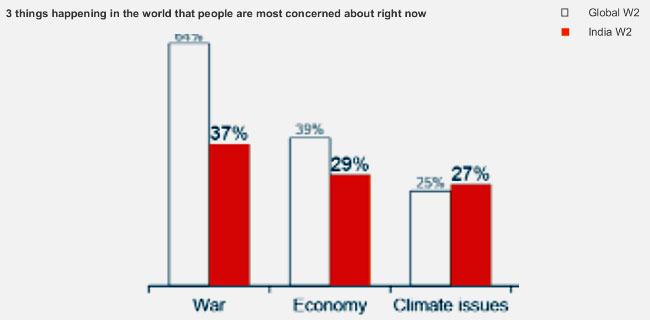
    Kantar’s Global Issues Barometer has found that the invasion of Ukraine remains the #1 concern of people in India followed by economic worries and the cost-of-living crisis. Asked to share their concerns, 37% of people mentioned the war, followed by 29% mentioning economic issues, as their top concerns currently. Climate and environmental issues have also emerged among Top 3 concerns. Covid-19 is no longer seen as a pressing issue like rest of the world, except in China where lockdowns are just lifting.


    Kantar’s Global Issues Barometer study is a detailed analysis of 800 people’s attitudes in India contrasted to 11,000 people across 19 countries (representing 68% of global GDP. The study asked open-ended questions to understand peoples’ real opinions and used Kantar’s TextAI technology to understand and analyse the responses.


    The war in Ukraine

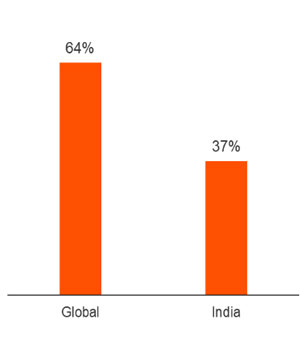
    The war in Ukraine is currently the biggest concern in India like every geographic region surveyed. As expected, the concern is much lower than the European counterparts. There is a high correlation between concern and proximity. 64% of people across the Globe mentioned the war as a concern while only one in three of India’s (37%).


    Figure 1: % Mentions of War


    The cost-of-living crisis

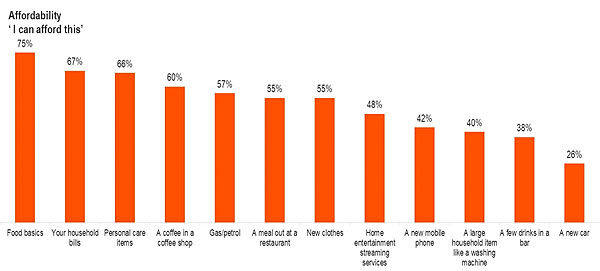
    The cost-of-living crisis is #2 on people’s minds. Price increases in fuel, food & drink and household bills have been noticed the most. Compared to the world, Indians feel the pinch of price increase on white goods more.


    While 35% of the population report their household financial situation is deteriorating, 46% believe the general economic outlook of their country is negative right now. People are struggling to meet their living costs, with 32% of households experiencing difficulties meeting their monthly outgoings and 11% unable to meet their commitments. The problem looks set to continue, a further 71% of people believe inflation will continue to rise even further.


    But there is sliver of hope as two-third of people in India feel secure in their jobs and expect pay rise that will match inflation.


    Figure 2: Affordability


    Eco-anxiety

    Climate inaction is causing remarkably high levels of distress with more than half of people experiencing eco-anxiety.


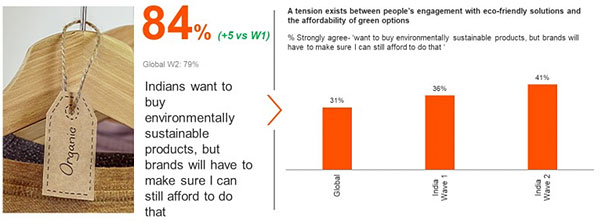
    Two-thirds of the population believe businesses have a responsibility to solve the climate crisis, while 84% of consumers want to buy environmentally sustainable products but need brands to do more work on affordability.


    Figure 3: Eco-anxiety


    Discussing the findings, Soumya Mohanty, Managing Director, South Asia, Insights Division, Kantar, observed: “The current tempest of global events is affecting long-term plans as well as short-term behaviour of Indians. Beyond making cutbacks on general expenditure, people are rationalizing their future savings and working harder.


    Luxury goods, entertainment and holidays look likely to be the sectors to suffer next. Almost half of households (41%) are considering economizing subscriptions to entertainment subscriptions- one industry that did well during the pandemic. Longer-term, almost three fourth of people say the current turmoil is impacting their big life plans; saving for big future life events (47%), children’s education (27%) and retirement plans (24%). So, the impact of this crisis lies in the future as much as in the present and can influence not just financial but also emotional well-being. Brands must therefore recognize what matters in people’s lives and examine brand’s relevance in supporting people overcome these challenges”


    Added Deepender Rana, Executive Managing Director, South Asia, Insights Division, Kantar: “Brands that can offer Green Affordable Solutions are likely to be favoured and become mainstream. With inflation rocketing, in their daily lives, consumers are considering solutions that can help reduce energy and fuel expenditure. They expect brands to do the same and be more efficient, while simultaneously raising the bar on ethical production. If anything, the cost-of-living crisis has reminded people that green products/services shouldn’t come at a premium. Insights from Kantar’s Global Issues Barometer can help brands and businesses understand how to navigate during these uncertain and fast changing times”.


    More on the study at https://www.kantar.com/campaigns/global-issues-barometer 


  • Hansa Research appoints Sandeep Ranade as EVP & Quantitative Research Head

    By Our Staff


    Hansa Research, the market research agency, has appointed Sandeep Ranade as Executive Vice President (EVP) and National Head of Quantitative Research


    Commenting on Ranade’s appointment, Praveen Nijhara, Chief Executive Officer (CEO), Hansa Research said: “We are pleased to welcome Sandeep to our organization. His vast experience will further help advance our research expertise and deliver more valuable insights to our clients. I’m confident he will play an important role in Hansa’s growth in the coming years.”


  • Kantar Multichannel Brand Impact study released

    By Our Staff


    Taboola, the recommendations engine, has announced the results of an independent Multichannel Brand Impact study from Kantar, data, insights and consulting company.  The Kantar Multichannel Brand Impact study measured the effectiveness of video advertising within native environments against other environments, as it relates to helping reach brand impact goals. Key findings include:


    Native video ads in the open web have a stronger impact on brand favorability and consideration than social or video platforms.


    59% of study participants that received a native video ad exposure expressed brand favorability, compared to 50% for social platform exposures and 51% for video platform exposures.


    Brand awareness improved by 26% when adding native video ads in the open web to a marketing mix.


    When study participants were shown native video ads, 33% displayed top-of-mind awareness – compared to just 14% of the control group. When native video ads were combined with social platform video ads, top-of-mind awareness rose to 49%.


    Said Adam Singolda, CEO and founder, Taboola: “Video ads continue to prove valuable to brands, especially as TV dollars are moving to digital,” “With industry estimates indicating that video advertising in the U.S. will reach nearly $50B this year, brands have a lot of opportunities to influence customers, as long as they’re choosing the right platforms and mix of platforms to relay their messages. What the Kantar study and our client work spotlight is that native video ads on Taboola High Impact Placements (HIP) are an essential part of a successful media mix. We provide the editorial environments that people trust, on a massive scale, so brands can amplify their efforts with Taboola.”


  • Kantar launches 2nd edition of  Creative Effectiveness Awards

    By Our Staff


    Kantar, the marketing data and analytics company, has announced winners of the second edition of its now annual Creative Effectiveness Awards. The firm tested more than 13,000 creatives for clients around the world. Around 10% (1300+) of those creatives were tested in India alone. The India report shortlisted over 350 ads, tested across categories, markets, TG’s and media channels.


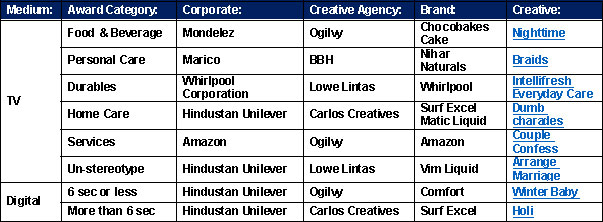
    Across television ads tested in India, Kantar has awarded standout performers in five product categories- Food & Beverage, Personal Care, Durables, Home Care & Services. Kantar has also included a special segment on social causes and this edition spotlights


    ‘Un-stereotype’ which all about celebrating gender progressive advertising.


    Here are the Kantar Creative Effectiveness Awards 2022 India Winners:


    Commenting on this year’s winners, Soumya Mohanty, Managing Director and Chief Client Officer, Insights Division, Kantar said, “The spread of ads that consumers have perceived to be both creative and effective is an affirmation of the fact that the space for creativity even in context of marketing ROI is infinite. While there is no magic formula for creating such ads, we can start with the right ingredients and refine them by testing them out with consumers. Kantar is pleased to share the learnings that we have had in the area while working with the leading marketeers in India.”


    Key highlights from this year’s report:


    >> Kantar’s Strategic Sparks identified for effective and creative TV advertising:


    1. Indians love to ride fulfilling story arcs: Stories create room for empathy, engagement, and vivid memories through which one could influence the way in which consumers think & feel about the brands.

    2. Touch of drama helps: Just the right kind and quantity of spice delivered through creative storytelling and filmmaking,  elevates even the repetitive themes, to make them more personal, relevant and aspirational.

    3. License to be extravagant in visualization: Indians are open to suspending their disbelief for the well visualised film

    4. Layer in emotional meaningfulness: Emotive contexts have the potential to make the consumers warm up to even the dry functional categories.

    5. Show, not tell: Integrating brand payoffs as an organic plot event in the script is a timeless approach toward creating vivid and persuasive memories.


    >> Kantar’s Strategic Sparks for effective and creative digital advertising:

    1. Customized and integrated content yields significantly higher ROI​: Carrying forward creative stories and elements from other media amplify the impact of digital assets.

    2. Shoot for instant meaning: Given the attention poor consumers and short window available, it pays to ensure that the consumers are not called to do any additional work for decoding what they are supposed to think and feel about the brand

    3. Ride the moment: Embrace the topical issues and trends, to engage and be relevant

    4. Strike an emotive chord: Well told stories open up consumers for longer format videos

    5. Hook them early:  Promise of a fulfilling story arc, emotive journey and humor help in ensuring that consumers stay invested beyond 6 seconds.


    >> Unstereotyping: Time to mainstream progressive gender portrayal


    Kantar’s collaboration with the Unstereotype Alliance has led to the development of the Unstereotype metric (UM) which Kantar now includes as a measure of gender portrayal in advertising as an integral part of its Link™ communication pretesting solution. Thus, setting a foundation for marketers to review the potential of their creative executions on this dimension to monitor progress over time.


    Unstereotype metric* (UM) in the long term provides learning and context for gender progressive advertisements. UM is now measured for 14,000+ ads across 70 countries, 3,300+ brands and 251 categories.


    :: Unstereotyping in advertisements is predicted to unlock higher marketing ROI. It signifies strong brand equity and is likely to impact short term sales as well. This impact is not only true for women, but progressive male role models also impact business outcomes across categories.

    :: Progressive ads are more effective and trigger positive engagement. They are in general seen to be more enjoyable, relevant, different and even pleasantly surprising.

    :: Unstereotyping affects various aspects of the brand- power, meaningfulness, difference and saliency especially seen in food & beverage, household and personal care categories.

    :: There are clear and present rewards for brands that seek to be at the forefront of embedding progressive gender roles


  • Magazine readers discerning & influential: NICS 21

    By Our Staff


    Magazine readers in India are far more aware, well off and brand conscious than any other media, including digital. This is revealed by the New Indian Consumer Survey 2021 published by Kantar, the leading data global analytics and brand consulting company. The analysis is of special significance as the fieldwork was carried post the pandemic impact, during August to October 2021.


    The findings are part of a campaign to be released by Dastaan Hub, the brand solutions studio of the Association of Indian Magazines.


    The NICS 2021 is a special edition study in place of TGI and covers a battery of 200 attitudinal statements. Affinity Scores are attitudinal endorsement scores for certain cohorts indexed to All India Urban universe. The special study, based on 25 select statements from this concludes that magazine readers are also the most likely to be influencers and innovators than any other medium, including digital, based on the Affinity Scores.


    Among the statements where magazines show the highest affinity are: ‘People come to me for advice before buying new things’, ‘Shopping online makes my life easier and I do some form of sport or exercise at least once a week.’


    B Srinivasan
    B Srinivasan

    Speaking on the new survey finding, B Srinivasan, President of the Association of India Magazines said: “The survey confirms what we have been always asserting, that magazines by the very nature, attract a very premium readership and one that places great trust in this medium. It is therefore not surprising that the engagement levels of magazines are far higher than that of other media entities”. He further added, “Our readers are more discerning than that of various other media domains. NICS 2021 is a stellar offering from Kantar and effectively studies all-important attitudinal trends.”


    Shripad Kulkarni
    Shripad Kulkarni

    Added Shripad Kulkarni, veteran media agency professional and Advisor, Dastaan Hub studio:  “Attitude statements are a treasure of insights that can be used for sharp targeting. We have seen over various TGI survey rounds that magazine readers are clearly more upmarket and brand conscious influencers.”


  • Sustainability for Durables


    By Our Staff


    Kantar, the leading data analytics and brand consulting firm, unveiled the FMCD Sustainability report, “Walking the Talk on Sustainability with Consumers – a roadmap for India’s FMCD Sector”. FMCD is short for Fast Moving Consumer Durable. The report is a guide for the FMCD marketers highlighting how the intersection of the FMCD sector and sustainability will further enable growth. It aims to provide key sustainability roadmaps for FMCD brands to help them navigate the ecosystem with sustainable solutions.


    The India FMCD market is at an interesting juncture today, a communique on the report notes, adding: “Emerging from the pandemic, the Indian market presents significant opportunities; starting with consumption patterns that have changed significantly – towards safety, premiumness and technologically advanced products. The Kantar report reveals that the Indian consumers are also becoming more conscious about the impact of human activity on climate change and other environmental factors. In fact, when we look at the Indian consumer’s top concerns within the ‘Sustainable Development Goals’ (SDGs) framework, issues beyond poverty and hunger emerge.”


    Said Paru Minocha, Managing Director, Qualitative & Lead- Sustainability Practice, South Asia, Insights Division, Kantar: “The FMCD sector is witnessing rapid growth even in post pandemic phase while we’ve also seen a great consumer shift towards sustainability and the environment urging brands to rethink their strategies. Consumers have greater expectation from companies than from themselves; this is likely to be amplified in FMCD, where personal behaviors post purchase is led primarily by the policies/features of the product and company they use. With this report, we are putting forward recommendations to brands which help in solving customer tensions with sustainable solutions, addressing barriers such as packaging, service models, repairability, and return and recycling policies. There is opportunity for brands to target active consumers who are engaged to the core issue and instill structured business solutions to help overcome them with time”


    Some of the key recommendations for the FMCD brands are:

    1. Embed Green Lifecycle across portfolio and processes

    2. Connect the environment and the everyday

    3. Address Consumer Knowledge Barriers

    4. Mainstream PLM Strategies around Repairability, Packaging, Access-based business models, and Return & Recycling

    5. Meeting accountability expectations


    The India Story: Post-pandemic Consumer Attitudes and Behaviour

    • According to the Kantar report, consumer reactions in the wake of COVID-19 continue to evolve and the Indian market presents several opportunities for the FMCD brands. The report further states that cautious consumption is the norm – Hygiene, Health and Wellness are key consumer concerns, where 91% Indian households are washing hands more often now, 47% Indian households claim increased toilet cleaning, more so in rural (49%) vs urban (43%).

    • While the pandemic caused worry and panic, there was a high demand in the FMCD Health and Wellness space. New-market segments such as Air purifiers, ACs with purification filters, smaller sub-categories such as UVC disinfection categories, UVC Desk lamps, and growth of personal care health tech products such as smartwatches and fitness monitors saw amped-up sales.

    • Data also suggests that consumers are changing education and work codes, with work ecosystems being reshaped by digital transformation. With accelerated digital adoption, there is 125% growth in usages of smart devices among internet users, paving way for the emergence of a smart home. Some of them are – Smart Lights, Smart Speakers, Smart Air Purifiers, Smart Display, Smart Home Entertainment and Smart Cleaning

    • There is also evidence to suggest that ‘value’ is a key factor for consumers since post-pandemic financial concerns have cropped up, where 73% attribute COVID to have impacted household income, while 67% pay greater attention to prices while shopping. This has led to an overall joint accountability of both businesses and consumers towards adopting a stronger sense of collective corporate responsibility.


    Commenting on the focus and relevance of FMCD, Sushmita Balasubramaniam, Shopper and CX Domain Lead, Kantar addedL “Consumers today are more aware and concerned about sustainability and other issues like pollution, carbon emissions, etc. For example, in the mobile phones category, consumers expect brands to address macro environment issues of carbon emissions and plastic pollution whereas in the computing category – carbon emissions, packaging and tax evasion are palpable concerns. In appliances, concerns exist on pollution (air and plastic) and emissions besides packaging. While we see consumers consciously making smarter choices, the responsibility resides with brands and marketeers to provide sustainable solutions to resonate and build credibility with their audiences moving forward.”


  • Consumers expect increased allocation for healthcare in the 2022 Budget: Kantar

    By Our Staff


    Kantar, the insights and consulting company, has just released findings from its first ever India Budget Survey. This survey maps consumer sentiments and expectations from the Union Budget 2022, just ahead of its unveil on Feb 1.


    Most Indians are looking forward to Budget 2022 as they have had a largely positive experience with the 2021 Budget. Two out of three consumers claim that the 2021 Budget positively impacted their household budget in the past year. Consumers in the 21–35 age band are more enthusiastic (68%) as compared to the ones in the older age band of 35-55 which stands at 56%. Overall, most are upbeat about what the 2022 Budget holds.


    As the pandemic continues to enter its third year, consumers expect the government to continue focussing on healthcare with 66% expecting an increase in the healthcare budget allocations and strengthened policies.


    Interestingly, consumer sentiments around electric vehicle subsidies and schemes see traction amongst consumers as well. With increased focus on climate change and sustainable living, 60% consumers expect the government to prioritise subsidies on electric vehicles in the coming year.


    However, fuel prices continue to remain a concern. Majority (72%) expect the government of India to bring petrol and diesel under the ambit of GST, with an expectation it may reduce fuel costs. This expectation is higher among metros (74%) than non-metros (65%).


    Cryptocurrency as an investment avenue is expected to continue making noise this year as well. As per a Kantar’s cryptocurrency survey from July 2021, 19% Indians intended to invest in cryptocurrency in the next 6 months in Urban India. As of December 2021, this number has increased to 32%. This is possibly driven by awareness and exposure that advertising and celebrity endorsements have generated over the last few months. Millennials seem to be keener on trying this new investment avenue as their intention to invest is higher at 32% as compared to those in the age group of 36-55 years which is at 26%.


    Majority expect India to launch its own official cryptocurrency in 2022. There is an overwhelming preference towards investing in India’s cryptocurrency with 79% claiming to invest in that over existing cryptocurrencies like Bitcoin, Ethereum, Dogecoin etc. This is driven by the perceptions of it being more secure due to clear regulations laid down by RBI.


    Commenting on the findings, Deepender Rana, Executive Managing Director- South Asia, Insights Division, Kantar, said; “As we step into the third year of the pandemic, the public wants the government to further invest in public health infrastructure and other favourable policies like tax deductions for insurance, which help alleviate the burden of medical expenses. Concerns about fuel prices come through, as does a desire that government should help us wean ourselves off dependency on dirty and ever more expensive fossil fuels, through e-vehicle subsidies. Meanwhile, as cryptocurrencies take off and the government mulls a tax on crypto transactions, investors want the government to play a role in encouraging yet regulating these innovative finance instruments through India’s own cryptocurrency.”