Tag: IPG Mediabrands

  • 48% of Online Shoppers are Women: IPG Mediahbrands-Google Study

    48% of Online Shoppers are Women: IPG Mediahbrands-Google Study

    IPG Mediabrands, in collaboration with Google, has presented a study titled ‘The Indian Online Shopper 3.0,  a study of consumer behaviour in the digital shopping landscape. This  report surveyed over 7,000 consumers across India, delving into 18 key categories to unveil crucial insights for understanding the evolving online shopping trends.


    Top 5 takeaways:

    The report equips businesses and marketers with invaluable knowledge about consumer behavior, enabling them to tailor strategies that resonate with the dynamic preferences and expectations of the Indian online shopper. Key takeaways include:

      • The Indian Online Shopper is open to hedonistic shopping; however, is still mostly conservative across categories.
      • Shopping missions (motivating factors) vary not only across categories, but also across shopper profiles.
      • 15 years after the advent of e-commerce, Indians still need handholding from online retail platforms.
      • Social commerce is not ready to be a sales channel. However, it’s becoming the most important point of discovery and influence.
      • Marketplace giants are bleeding users to category-specific marketplaces and D2C brand websites.


    Indian Online Shopper Profile:

    Dissecting the Indian online shopper profile, the report examines demographics, consumer classification, household income segmentation, and state-wise behavior analysis. Key findings include:

    • Online shoppers skew younger: 75% of shoppers are aged 18-44.
    • Shopping for household, not just self: Most are married (69%), living with children, and nearly half (49%) live with parents.
    • Significant portion are affluent: 62% of online shoppers have medium to high household income.
    • Concentration in select states: Five states account for over half of online shoppers: Maharashtra (16%), Delhi (12%), Karnataka (9%), West Bengal (9%), and Tamil Nadu (8%).


    Shopped Categories:

    Focusing on 18 categories, the report explores shopping missions, analyzes purchase frequency, and unveils the influences driving online shopping decisions. Key insights include:

    • Rise in emergency purchases: Quick commerce has accelerated purchases in categories like food, groceries, and baby products.
    • High dependence on recommendations & reviews: Shoppers seek expert opinions before buying expensive items like electronics and furniture.
    • Fashion and Beauty ecommerce on the rise: These categories show both impulse and routine buying behavior, driven by ease of online shopping.


    Shopping Sources:

    The study identifies pain points in online shopping, investigates reasons prompting consumers to switch platforms, and outlines the latest trends. Findings include:

    Resurgence of D2C marketplaces: As many brands want more control over the branded space and user shopping experience, D2C marketplaces are witnessing a comeback. Users like buying from D2C potentially due to the perceived quality and authenticity of buying straight from the source.

    Fashion and Beauty lead in social adoption: Influenced by popular trends, creators and celebrities, Fashion and Beauty are fastest growing categories when it comes to social commerce.


    Platform Features:

    Recommended products, live chat, and online catalogues are the most used platform features, with younger shoppers being more accustomed to using experiential, assistive features. Key takeaways include:

    • Shopping experience/assistance features are expected by users: 92% users claim to have used some type of platform feature when they shop online.
    • Product recommendations: Form a vital point of discovery and strong influence in the decision-making process, >2/3 shoppers claimed to switch brands due recommendations on the platform.
    • Loyalty programs: Monetary value and exclusivity are appreciated, but data privacy and low reward value are concerns.


    Influence Points:

    • Top influences: Brand websites, recommendations from friends/family, TV ads, social media, and marketplace reviews.
    • Emerging influences: Live streaming on online platforms, AI reviews, social commerce shops, tech-enabled services, and social curation platforms.


    Shopping Experience Pain Points:

    • Top issues: price (21%), shipping charges (20%), delivery time (20%), product returns (19%), and product availability (18%).


    Said Shashank Rathore, VP, E-Commerce, Interactive Avenues (the digital arm of IPG Mediabrands India): “The e-commerce industry in India is growing rapidly, poised to reach $300 billion by 2030. Quick commerce is now thriving, with over 50 million monthly active users. Amidst these changes, marketers face challenges in understanding audience behaviour across multiple shopping platforms. To simplify these complexities and provide valuable insights, we conducted a detailed study of over 7,000 online shoppers. Our report explores strategic consumer nuances, growth drivers, and online buying behaviour across key demographics, industry categories, and shopping platforms. I am confident that the Indian Online Shopper 3.0 will serve as a valuable resource for businesses and industry professionals navigating this dynamic market.”

  • Interactive Avenues wins social media mandate for RPPL

    Interactive Avenues, the digital arm of IPG Mediabrands, has bagged the social media mandate of Racing Promotions Pvt. Ltd. (RPPL), formula racing and motorsports management enterprise. The agency will be responsible for elevating the digital presence of RPPL’s flagship properties, the Indian Racing League (India’s first franchise-based motorsports league) and FIA Formula 4 (the country’s first FIA-graded racing championship). Interactive Avenues will handle the account out of their Mumbai office.

    Commenting on the collaboration, Akhilesh Reddy, Chairman, RPPL, said: “Our vision is to place India on the global motorsports map and social media is a crucial part of this journey. Interactive Avenues presented a compelling long-term strategy and we’re confident that their expertise in sports marketing will help us consistently grow our fanbase and elevate engagement around the Indian Racing Festival.”

    Added Shantanu Sirohi, COO, Interactive Avenues: “Our partnership with RPPL aligns perfectly with our commitment to drive meaningful engagement and awareness in the sports sector. RPPL is fostering a world-class motorsport ecosystem in India, and we are excited about crafting a distinct social media identify for them, integrating FIA F4 and the Indian Racing League into everyday conversations among sports enthusiasts.”

  • GroupM leads in COMvergence 2023 New Business Barometer

    COMvergence, the independent research and data consultancy which analyses mediaspend investments and produces benchmark studies on new business performances, released its latest New Business Barometer for FY 2023 for India.

    Maruti, Reckitt, PhonePe, Proctor & Gamble (digital), Swiggy, Pernod Ricard,Vivo Mobiles, Beiersdorf, Ferrero, Berger Paints and Jaguar Land Rover were among some of the account moves and retentions that dominated the Indian market from January 2023 to December 2023.

    The Media Agency Groups were led by GroupM by a wide margin with a total new business value of +$654M, followed by IPG Mediabrands at +$200M new business value and Omnicom Media Group with a new business value of +$128M.

    Wavemaker, Mindshare and Lodestar UM led the media agencies’ ranking followed by EssenceMediacom and Havas Media.

    In 2023 COMvergence, assessed an overall of 215 account moves and retentions, with media spends estimated to be around $1.5BN.  Out of these Local pitches dominated the Indian market, whilst 55% of the total pitches held globally were local in nature ( country specific pitches), making India  well above this average with 91%  of total pitches being local whereas global and multi- country pitches made up only 9% of the pie for India.

    2023 saw a whole of 192 local pitches estimated to be around $1399M and 23 global and multi market pitches were estimated to be around $132M in India.

  • Shashi Sinha to be conferred with AAAI Lifetime Award 2023

    By Our Staff


    The Advertising Agencies Association of India has announced that the AAAI Lifetime Achievement Award for 2023 will be conferred on IPG Mediabrands CEO and senior advertising industry executive Shashi Sinha. Notes a communique: “This is the highest honour to be given to an individual in India for her/ his outstanding contribution to the advertising industry. With nearly four decades in the advertising industry, Shashi Sinha is seasoned professional and has dedicated the majority of his career to a single agency group. In a leadership span of 25 years, he progressed from being the head of Media at FCB Ulka to the CEO of all media units under IPG Medianrands in 2013. As CEO, he orchestrated a remarkable turnaround, transforming a little known media group into the most respectable entity among all IPG business units in India. This success elevated the global standing of IPG Media Brands. Simultaneously, his enduring stewardship of Amul for over 37 years attests to the high regard in which he is held. Beyond corporate achievements, he played a pivotal role in the sevenfold growth of Interactive Avenues, a digital agency acquired during his tenure. His emphasis on human resources ensured the retention of original founders within the leadership team at MB agencies. Notably, MB agencies, apart from GroupM, are the only media agencies to have received Agency of the Year Awards at prestigious local shows like Emvies and Goafest Abbies. Renowned for his active presence and guidance in various industry bodies, including roles as the current Chairman of BARC, former President of the Ad Club and former Chairman of ABC and MRUC. His involvement in ASCI, and contributions to IRS editions and AAAI further exemplify his commitment to influencing the advertising landscape. He has also been Chairman of the Awards Governing Council at Goafest. Beyond his professional life, he contributes to social causes through advisory roles in organisations like Akhand Jyoti Charitable Trust and TRRAIN Foundation, focusing on healthcare for curable blindness and supporting the training and placement of people with disabilities in the retail sector.”


    Making the announcement, Prasanth Kumar, President, AAAI, said, “Shashi Sinha’s journey in advertising is an inspiring narrative of leadership, innovation, and resilience. As the AAAI Lifetime Achievement Awardee for 2023, he exemplifies decades of transformative impact, steering media entities to unparalleled success. His tenure as CEO at IPG Media Brands marked a turnaround that elevated industry standards, making it the most profitable entity under IPG in India. Beyond corporate milestones, Shashi’s commitment to industry bodies and social causes is laudable. His achievements reflect not just professional excellence but a deep-seated passion for shaping the advertising landscape and contributing meaningfully to societal progress. Shashi Sinha is truly deserving of this honour.”


    Added Anupriya Acharya, Chairperson of the AAAI Lifetime Achievement Award Selection Committee: “No one deserves this prestigious honour more than Shashi. While his success in advertising is remarkable, his contributions to the industry at large are nothing short of exemplary. It is no surprise therefore, that the entire committee unanimously agreed to bestow this award upon Shashi, recognising his outstanding achievements and significant impact on the advertising landscape.”


    Some of the past winners of this award include Subhas Ghosal, Alyque Padamsee, Mike Khanna, R K Swamy, Piyush Pandey, Sam Balsara, Prem Mehta, Roda Mehta, Ram Sehgal, Madhukar Kamath, Arvind Sharma, Colvyn Harris and others. The date of the awards event has not been announced, though it’s likely to be post-Diwali (that’s around November 12-14, 2023).


  • Interactive Avenues releases social media listening report

    By Our Staff


    Interactive Avenues, a full-service digital agency and the digital arm of IPG Mediabrands, released a comprehensive social media listening report around the intense match which ended in a crushing defeat for Pakistan. Based on extensive data gathered from social media platforms and popular cricket forums, the report deep dives into highlights of the social buzz before, during, and after the match.


    Commenting on the report, Shantanu Sirohi, COO, Interactive Avenues, said: “The India vs. Pakistan match was one of the most talked about matches in this year’s World Cup tournament. Using best-in-class social listening tools, our Social team compiled a comprehensive report which unlocks valuable insights around player popularity and public sentiments, while revealing the most memorable, controversial, and heartwarming moments of the match.”


  • So how ‘responsible’ is Indian media?


    By Our Staff


    Broadcast and digital platforms excel in safety: Both broadcast and digital platforms exhibit consistency in safety with robust processes aligned with industry ethics and standards.

    Broadcasters face sustainability gap:Foundational sustainability efforts are needed from broadcast platforms through measuring emissions, ESG frameworks and making public commitments on Net Zero goals. Digital is a mixed bag, some platforms have plans to improve energy efficiency and mitigate greenwashing.

    • Inclusivity metrics highlight opportunity for growth: DE&I efforts need to be stepped up in broadcast and digital. Significant opportunity exists in enhanced measurement and statistical validation.

    Digital platforms urged to prioritise data ethics:Digital platforms are encouraged to bolster efforts in data ethics, in alignment with the Digital Personal Data Protection regulation.


    The above are key findings on the Indian media landscape in the inaugural Media Responsibility Index (MRI) study conducted by IPG Mediabrands, the media holding company within Interpublic Group. Collaboratively compiled by IPG Mediabrands and its intelligence arm, Magna, the index aims to “elevate awareness and set a higher industry standard for safety in advertising for both brands and consumers”. It serves, notes a communique, as a guiding resource for marketers, allowing them to prioritize brand and consumer safety in their investment decisions across diverse media platforms.


    Said Hema Malik, Chief Investment Officer, IPG Mediabrands India: “The MRI India is a testament to our commitment to responsible media practices in India. Our MRI report propels responsible media practices to the forefront of India’s media landscape, providing brands and marketers with essential tools to navigate the media terrain conscientiously. It reaffirms our dedication to ethical advertising, safety, and shared responsibility in media. While we take pride in Indian media companies leading in Safety and corporate responsibility, the MRI also underscores the imperative for Digital Platforms to elevate their efforts in Data Ethics. It highlights that while Indian media excels in several areas, there’s room to advance Sustainability and Diversity, Equity, and Inclusion, further progressing responsible media practices in our country.”


    The MRI India evaluates media platforms across four crucial Environmental, Social, and Governance (ESG) aligned priorities: Safety, Inclusivity, Sustainability, and Data Ethics. This comprehensive approach equips brands to make discerning investment decisions, with consideration for brand and consumer safety in media strategies. The survey encompasses an extensive questionnaire containing over 200 questions, covering key principles such as promote respect, children’s wellbeing, misinformation, and data collection & use, providing a deep-dive analysis of each platform’s performance within these domains.


    The response from media platforms is a weighted index of all 10 principles across 4 priorities: Safety, Inclusivity, Sustainability and Data Ethics. The index reflects the platforms’ position in the priority areas. Broadcast platforms surveyed cover close to 70% of Television Adex in India.


    Added Harrison Boys, Director, Standards & Investment Product, IPG Mediabrands APAC: “MRI India heralds a new era in media responsibility. It underscores the importance of putting safety, inclusivity, sustainability, and data ethics at the forefront of media strategies. Notably, the MRI showcases how Indian broadcasters excel in Safety, setting industry benchmarks. Furthermore, India’s substantial commitment to CSR projects mandated by the CSR Law aligns perfectly with the UN Sustainable Development Goals, demonstrating a unique opportunity for responsible media practices on a global scale. It is noted, however, that there is a significant opportunity in Sustainability, as well as ensuring Data Ethics practices are class leading in recognition of the regulation.”


  • Nandini Dias, the Constant @ Lodestar UM moves on


    By Our Staff


    Nandini Dias, CEO of Lodestar UM, has decided to move on. After being the agency’s CEO for nearly a decade, Dias joined the agency a little less than three decades back. Her last day with the IPG Mediabrands agency is April 18.


    Said Dias: “I leave Lodestar UM in the hands of a strong, capable, and empowered team that has stayed vested and bonded with me for a long time. In fact, almost all of the top 30 have been with me throughout my tenure as CEO – something that I am particularly proud of. So it was with a heavy heart that I had to break the news to them about my decision to move on. It is rare that one gets the opportunity to hand over the reins after an organisation’s best years, but this year was one of Lodestar UM’s finest. Over a dozen new businesses, over 20 international awards, Campaign’s Agency Of The Year – Silver, RECMA recognized it as the agency with highest Vitality and personally, my being recognised as the Media Agency CEO Leader Of The Year by the International Advertising Association (IAA) and feted by the Governor of Maharashtra. I couldn’t choose a greater milestone year in which to hand over the baton and go out on a high.”


    So what next? No decisions yet, she said. “I started out with a fledgling agency and am handing over the Media Agency of the Year as I move on. So I am looking forward to taking a well-earned break for the first time in my life and am excited to see how things will unfurl.”


    Added Shashi Sinha, CEO, Mediabrands India:  “Nandini has been my partner, ally, and friend for 27 years. She has led from the front to build Lodestar UM ground up to make it what it is today. A dynamic, vibrant top three agency in the country. Passion is what defines Nandini, whether it is creating business solutions, building strong media properties for her clients or making a difference to our society and communities or just bringing her teams together to celebrate a festival or a win, Nandini did it all with remarkable fervor. At a personal level, I will miss her terribly. But I have always believed that a good leader is defined not by what has been built but by what is left behind. Nandini leaves her indelible mark on Lodestar UM in the solid and hugely capable leadership team that she has nurtured and I can say with all confidence that they will only continue to build on her legacy.”


    Over the years, Dias has been recognised with numerous honours by several bodies – starting with being the Media Planner of the Year in 1998 to going on to be the Media CEO of the Year on various platforms in 2016, 2017, 2018, and 2021. In 2018, she piloted a pan-industry citizens’ initiative – WorkToLiveToWork – that pushed a radical solution to save commuter lives on their way to work, for which she was awarded the prestigious ‘Gamechanger Of The Year’ award. She’s won over 100 awards at Asia-Pacific Spikes, Festival Of Media Global and APAC, Creative Media Award, several Cannes Lions and many, many local awards.


  • Wavemaker bolsters global top deck

    By Our Staff


    Wavemaker has named Shipra Roy as its new Global Chief People, Inclusion and Culture Officer alongside Helen Price as Global Chief Investment Officer. Both will be based in London and join CEO Toby Jenner’s global leadership team.


    Roy, who comes to Wavemaker from a position as Chief People Officer for McCann UK and Europe, will oversee all aspects of the people function to ensure that Wavemaker continues to attract the best talent and creates great careers regardless of level, role or geography. Price joins Wavemaker from IPG Mediabrands where she was Head of Global Accountability and Investment. At Wavemaker her focus will be on creating value for clients and commercial opportunities for the agency.


    Said Jenner: “Even in the face of a global pandemic, Wavemaker has had an incredibly strong year and, as our growth journey continues, I’m pleased to welcome Helen and Shipra to the team. They are both tremendous resources in their fields, and I look forward to working closely with them to help us deliver positively provoking, innovative and commercially sound solutions for both our clients and our people.”


  • Mullen Lintas and Indian Newspaper Society create campaign ‘Rupaiyyah Hai Pahiya’ to jumpstart economic activity

    By A Correspondent


    Given the ongoing downturn in the economy, Mullen Lintas has launched a campaign with the Indian Newspaper Society (INS), to “encourage consumers to start spending and to create liquidity in the market, and help boost the country’s economy”. The message will be amplified via INS-affiliated newspapers.


    Commenting on the initiative, Amer Jaleel, Group CCO & Chairman, MullenLowe Lintas Group said: “There’s a training inside Lintas to think scale and to think mass. We involve ourselves with brands yes, with marketing yes, but beyond that our embrace is towards our culture and our economy. Lintas cannot ignore what’s happening to demand and to consumerism as a fallout of the Covid Lockdown. Too much of our work depends on consumer sentiment and to reigniting consumer sentiment becomes not just necessary to our work and survival but it’s a calling, it’s a duty. Very early we recognised that this turn of the cycle will not revive on its own and the wheel of the country’s economy will need everyone to push. Spending with confidence is probably the only people-linked initiative that can bring about this momentum, and so we stuck our shoulder to the task and hope that the country gives it a heave too.”


    IPG Mediabrands forged this collaboration with Indian Newspaper Society to provide the necessary reach. Added Shashi Sinha, CEO, IPG Mediabrands: “This pandemic has proved that if we can survive together, we can revive together. It is this collective that can help in crafting the ‘India Revival’ story. The series of unlockdowns announced by the government via print media is playing its part to spread the word. Consumers are closely linked to print media and the campaign message amplification is best suited for a message such as this. The campaign by Mullen Lintas, with a massive reach supported by INS, is a call to spend in order to save.”


    Said Shailesh Gupta, President, Indian Newspaper Society: “Newspapers are the lifeline of the people and have been responsible to bring about national upheavals. Even though a lot of people migrated to online versions, the readership remained like a rock. It plays a strong connection with the people joining them with the mainstream and bringing them upto speed. A reach such as this can be harnessed for a national initiative like Rupaiyyah Hai Pahiya and help to turn the wheels of the economy. INS proudly supports this campaign.”


    Speaking about the idea for the campaign, Azazul Haque and Garima Khandelwal, Chief Creative Officers, Mullen Lintas added: “We’re happy and proud to have been able to do this campaign for the Nation. Since consumer confidence and discretionary spending is down, our attempt has been to humbly nudge the consumer to not hold back and that Every Rupee Spent is a Rupee Earned for the Nation. That’s how the idea “Rupaiah Hai Pahiya’ was born to encourage consumers to keep the wheels of the economy turning.”


  • US adspends to grow 4% in 2020: GroupM


    It’s still a few days before the first of the India forecasts are released by IPG Mediabrands and Publicis Media. And perhaps some India numbers from GroupM. But here’s GroupM’s review of 2019 and the forecast for 2020. Shape of things to come?


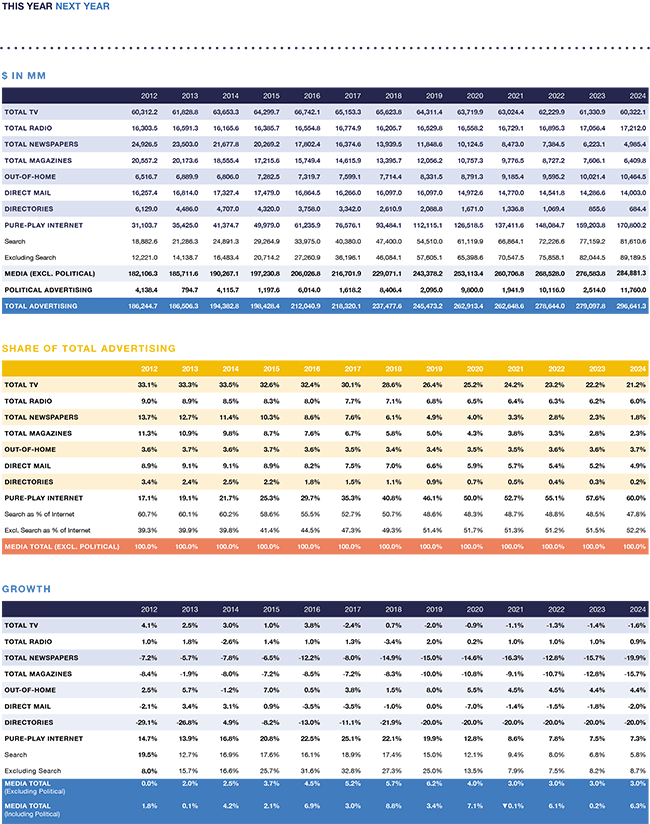
    U.S. advertising will grow +6.2% in 2019 to $244 billion. This will mark a fourth consecutive year of solid mid-single-digit growth for the industry on an underlying basis. Taking out directories and direct mail makes the health of the industry look even stronger, with a +7.6% underlying growth rate for 2019, although including political advertising in all years brings growth down a few notches to +3.8% all in. However we look at it, growth has been robust relative to the general economy, which is generally decelerating on an underlying basis.

    2020 still looks solid; we are forecasting +4.0% growth next year. We expect some softening next year as the economy reverts toward normalcy after a period of growth likely supported by factors including the 2017 domestic tax cut, an expanding federal deficit and low interest rates. As the effects of these fade, heightened trade barriers should concurrently become a drag on the overall economy. The 2020 Olympics also likely provide some marginal benefits, although we note that it can be difficult to identify the degree to which Olympic activity captures spending that would already have occurred or if it causes incremental spending to flow into the advertising market.

    In more tangible terms, the key variables driving our model are personal consumption expenditures (PCE) and industrial production (IP), which combined have a solid 0.8 R2 correlation with normalised (excluding political) advertising. PCE will likely decelerate versus 2019 levels, while IP might go slightly negative. Using these inputs without adjustment would yield a zero-growth domestic advertising market next year, although it would be hard to imagine a three to four percent nominal GDP/PCE growth economy not producing a similar rate of growth in advertising. Further, we know that a range of factors implicitly not contemplated by our model are holding up advertising growth.
     

    Digital-first marketers are likely driving much of the industry’s recent growth. We have previously written about the emergence of massively scaled digital brand owners whose businesses are endemic to the internet. We can point to Facebook, Amazon, Netflix,Alphabet, eBay, IAC, Uber and Booking.com as eight companies that are likely to spend more than $30 billion on advertising globally this year. Most of this spending will go into their home market, the U.S., adding billions of incremental spending every year into the domestic advertising economy. If we add in the next tier of digital endemics that may not have existed even a decade ago at anything like their current scale—think Wayfair, Chewy.com or any of the dozens of other digitally oriented companies spending hundreds of millions of dollars on advertising annually at this point in time—it’s not hard to imagine additional percentage points of growth emerging from these types of marketers.

    Such rapid growth from these marketers as we have seen in recent years should abate, and eventually they should normalise their growth rates. This would contribute to industry-wide ad spend deceleration. However, the U.S. is more likely to produce more of these kinds of marketers in years ahead than are most other economies, and so there is some reason for a degree of optimism around these figures. For example, we expect the new and existing streaming video services to account for multiple billions of dollars in domestic advertising spending by the time these services are all operating at scale.

    Overall, our best “feel” for the advertising market is to forecast a lower growth rate beyond 2021, and we incorporate a +3.0% expectation for subsequent years.

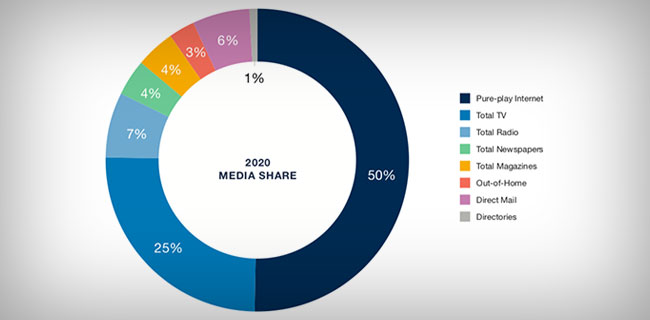
    Advertising revenue to pure-play internet-based companies should grow by double digits next year to reach $127 billion in revenue, representing a 50% share of industry revenue. We forecast digital pure-play media (i.e., excluding digital revenues associated with traditional media owners) will end 2019 with a +20% increase. Growth is still expected to be resilient next year, rising by +13% in our forecast and accounting for 50% of all media we track here. There is undoubtedly still room to grow. We can certainly point to other developed economies that currently see digital advertising accounting for higher shares of industry-wide spending, but we think the aforementioned digital endemic marketers will increasingly replace traditional companies that came before them. As those marketers necessarily skew their spending toward digital advertising, spending shares shift in the aggregate toward digital media.

    TV advertising is soft as we close 2019 and will end the year with a -7.0% decline (-2.0% excl. political), falling to $65 billion in ad revenue. Of course, many of the digital-first brands we’ve been discussing will also spend on traditional media, especially television. While defining a “digital brand” is highly subjective, those marketers are undoubtedly making up for most of the cuts in spending that other marketers appear to be making. Excluding political, underlying television advertising is trending toward a low-single-digit reduction during 2019. National TV advertising will be closer to zero, or even up very slightly, while local is down by low-single-digits. We expect this declining trend to persist, even with new forms of premium TV advertising regularly emerging. Certainly the ad-supported SVOD services will be attractive environments and their enhanced targeting capabilities will also appeal to advertisers. They will partially offset the ongoing erosion of traditional TV’s reach and frequency, but the core set of advertisers that have historically driven TV spending are likely to reduce the budgets they allocate to the medium.

    Outdoor should be the fastest growing “traditional” medium, up by +8.0% to reach $8.3 billion. Among other media, outdoor remains a standout for its capacity to sustain growth. This is supported by ongoing innovation, especially in digital out-of-home and OOH’s relatively unique capacity to generate, capture and sustain attention. These advantages are more apparent to many marketers as traditional television continues to weaken. Digital formats are increasingly important, now accounting for half of spending on OOH, with further share gains still to come especially as more automation takes root, including the emergence of performance-based targeting and data-driven trading. At a category level, digital brands and luxury marketers have provided the industry’s recent boost, and much of this has been concentrated in the largest urban markets. These factors have enabled the medium to grow by +8.0% this year, a level that is not likely to be sustained. We expect more modest +4.0 to +5.0% growth levels over each of the next five years. Notably, this represents a gradual increase in the share of spending in the overall advertising economy, which presently amounts to 3.4%.

    Radio is likely to be flat going forward. Radio appears set to hold on to its revenue base this year and is not likely to grow by much any time soon. While there is growing interest in the medium from national advertisers—especially supported by the likes of Pandora and Spotify as well as the emerging category of podcasting—the traditional base of geographically constrained advertisers that should be optimally positioned to support locally oriented media like radio has weakened over time.

    Print will continue to be weak, although it retains value as a niche medium. Unsurprisingly and despite improvements in measurement and its capacity to engage deeply with consumers, overall, the medium is still set to decline on an ongoing basis. Double-digit declines are likely to persist for newspapers and magazines, even including digital extensions. Directories will likely look worse, with -20% or greater declines going forward. By declining in only low single digits, direct mail looks somewhat more positive.

    U.S. political fundraising is approaching $16–20 billion for 2020; political advertising is expected to be $10 billion or more. So far, our forecasts have excluded politics from media spending because the scale of such activity meaningfully distorts year-over-year growth trends. Disclosures from the Federal Election Commission (FEC) covering the first half of 2019 indicate that total federal election fundraising was approximately $2 billion, up around +45% versus 2018 levels and +46% versus 2016 levels. During the prior two-year cycle, the first half-year accounted for only 15% of fundraising, and during the two-year cycle before that, the first half accounted for 16%. This indicates that fundraising through the end of 2020 will exceed $10 billion and could approach $12 billion for federal races, of which somewhere between 60–70% ($7–8 billion) would likely be disbursed during 2020. Local, nonfederal races are tracked separately and via different sources, but data from FollowTheMoney.org indicates that in 2018, there was a total of $8.7 billion in fundraising during that calendar year alone. Assuming that number rises next year, we could expect $16–20 billion in total political spending on all activities in the U.S. in 2020.

    How much of this will turn into media spending? Our understanding is that in a typical campaign, 60% of funds raised may be deployed into media spending, which would translate into $9.6–12 billion in total activity during 2020, which places our $9.8 billion estimate on the low end of this range. Consequently, we recognise that the current political cycle could lead to higher levels of spending than we currently incorporate into our forecast. As our estimates currently stand, and including political advertising in all years, we forecast 2020 advertising growth of +7.1% on a broadly defined basis (including directories and direct mail) or +8.1% on a narrowly defined basis (excluding directories and direct mail).

    Media is a means to an end; the marketer’s goal should be to optimise the mix of external and internal resources available to drive business growth. Putting all of this into some context, we are mindful that marketers can look at the data included here to gain a sense of the health of their media partners now and over the next several years. However, even a media owner in decline may still be investing in new and better ways to connect with audiences. At the same time, other media owners may be healthy in terms of revenue growth but may be neglecting to invest in everything they can to make their ad inventory more effective. As marketers continue to view media as a means to an end, investments in internal marketing infrastructure, marketing technology software and external services are among the other ways to support marketing excellence. We encourage marketers to put processes in place to optimise the balance between all of these elements. This will ultimately be more impactful than the choice to invest or stay away from any one type of media as it grows or declines in the years ahead.

  • Republic Bharat claims 73million reach in Week 1

    By A Correspondent

    It’s a ratings-dark period for the media and public at least as only subscribers are privy to viewership data from measurement joint industry body BARCIndia. In the light of this, the launch of Republic Bharat, as noted by MxMIndia in an earlier report, would be impacted given the transition of subscribing viewers.

    Arnab Goswami in a Republic Bharat ad

    According to a communique received from Republic Bharat, in Week 1 the channel has achieved a reach of 73million. Notes the release: “In just seven days, Republic Bharat has made tremendous inroads and onboarded audiences that some established brands have taken many years to reach,” adding: “Coming on the back of storming into English news with Republic TV in May 2017, Arnab Goswami’s Hindi news brand’s Week 1 reach is unprecedented when compared to other launches within the Hindi Genre. The Highest reach genre which is Hindi Movies has seen two launches in last three years i.e. Rishtey Cineplex and Sony Wah and both the channels launched with a reach of 5 cr in its opening week and have grown today 3x of their entry reach numbers… Bharat’s extensive focus on big stories within its first week of broadcast creative massive impact with #MamtaBlocksCBI  and #ShardaStings which not only delivered blockbuster impressions on social media but have also got Republic Bharat the #2 position in West Bengal.”

    It may be noted that the above information (73mn reach) has not been verified by MxMIndia with BARC. However, according to the information we have received, that the 73mn reach – given all the distribution issues — would have been higher if the distribution systems weren’t disrupted. As would the numbers of some other channels. Also, we have learnt that with 73mn reach, Republic Bharat is not in the Top 5 Hindi channels bracket, in terms of reach. Though it’s early days still..

    Said Arnab Goswami, Editor-In-Chief and Managing Director, Republic Media Network: “This is a brilliant start. Republic Bharat has beaten six channels and has a reach of seven crore plus in week one. No Hindi channel has had such a start and it’s a matter of time before we hit no 1 now “

    Vikas Khanchandani

    Added Vikas Khanchandani, CEO Republic Network: “We are extremely happy that Republic Bharat has opened the charts with a massive 73 Mn reach in its maiden week. Our distribution and content teams have worked very hard to give us this fantastic start within the mass reach genre. The reach garnered is the highest that any new hindi channel launch has delivered in its opening week in the last 3 years. I am extremely confident that with this magnificent start the channel will move into the top slot much faster than I anticipated. I am extremely grateful to our audiences and partners that have helped us with their support and acceptance within the Hindi news category.”

    Said Shashi Sinha CEO, IPG Mediabrands: “The Republic team has worked hard to deliver a reach of 73 million in its week of launch. They have given a repeat performance on their launch strategy by delivering big/ breaking stories and delivering massive reach. It’s a very good start and will give them an opportunity to build reach and market share in the coming weeks as the news genre sampling is very high in the run up to Elections. The Hindi genre is seeing an entry of another strong brand after a long gap of six years.”


  • Digital will rule UK adspends


    By A Correspondent


    It’s a still a few days before the Zenith, IPG Mediabrands and GroupM forecasts for global adspends is released, but we thought it would be good to carry GroupM’s forecast for 2019 for the United Kingdom (UK), as it could offer some indicators for the shape of things to come for India. Only the Zenith and Mediabrands reports carry detailed numbers for India. The GroupM report for India as well as the Madison forecasts are typically released in early February.


    According to GroupM,  UK advertising is expected to increase to £20.8 billion in 2019, surpassing the £20 billion mark for the first time, up from £19.9 billion in 2018.


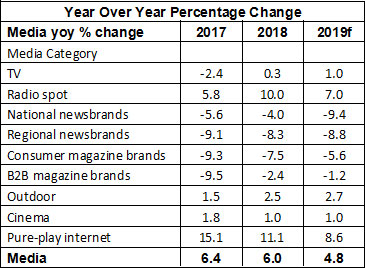
    GroupM’s forecasted distribution of advertising investment is below:


    GroupM forecasts 6.0% growth for 2018, down from 6.4% in 2017. Its 2019 growth prediction from earlier this year is shaved to 4.8% from 5.1%. A significant contributor to global advertising growth, the UK still looks to remain stable due to the high levels of digital advertising growth. Digital is around 60% of all advertising investment and accounts for all net UK advertising growth. The medium continues to grow organically, predominately from SME investment, with signs that larger advertisers are becoming more circumspect about incremental digital investment.


    Pure-play internet increased 11% in 2018 and is expected to continue growing by 9% in 2019. Slower than IAB’s estimated run-rate of 15% for 1H 2018, GroupM sees an inevitable slowdown, although digital is still likely to account for all new net advertising growth.


    Said Tom George, CEO, GroupM UK: “Collaboration and measurement remain key topics for the UK alongside Brexit and GDPR in our advertising forecast for 2019, but in a sea-of-change advertising investment stays buoyant reaching unprecedented levels. It’s encouraging to see the industry pulling together to create new and improved investment propositions. GroupM is highly engaged with all of these efforts to ensure our clients continue to effectively engage consumers.”


    GroupM forecasts television advertising investment to remain flat in 2018, with 1% growth expected in 2019. According to Nielsen, key TV categories soft this year include Food, Household FMCG, Retail, Entertainment & Leisure. Finance (TV’s largest category) and Motors (fifth) are growing high-single-digit in the year to September. ‘Share deals’ remain the principal trading mode in UK TV, which advertisers value for its tolerance of short-run budget revisions, but mixed modes of airtime are becoming more routine as trading embraces more audience falling outside Barb’s ‘gold standard’. Facebook in particular, is still winning share of audio-visual advertising and is heavily video-biased for large advertisers. The main reason is convenience and the lust for ‘performance media’.


    Print media continue to shrink, with newspapers (national and regional) plus magazines collectively shedding about 1.5 share points a year. In 2017, news brands included 12.5% of all ad investment and in 2018 11.1%, with 2019 estimated to drop to 9.8%. Even with mitigation from digital sales (now a large minority of ad sales), this reveals an investment trend of -6% in 2018 and -7% in 2019, as the ‘walled gardens’ capture more share. Armed with research, owners are putting up a united front with reassurance and stable media pricing; this has renewed advertiser enthusiasm for the medium.


    Radio is holding its audience and enjoying rising demand. GroupM forecasts radio spot advertising revenue to rise 10% in 2018 and 7% in 2019. Radio owners will book about £500 million in spot revenue in 2018. This does not include digital and streaming revenues, which are an unmeasured mix of static and dynamic activity, and thus hard to estimate. The annual run-rate is probably above £100 million.


    “Future Brexit fall-out remains a complete unknown, but for now the economy is doing OK. Ad revenue forecasts remain perhaps surprisingly positive, supported by digital commanding a rising share of overall marketing effort from a wider base of marketers large and small. The UK’s fluid media market favours optimism too. Advertisers know they can change spending plans almost at will, with low or no friction,” said Adam Smith, Futures Director, GroupM.