Tag: IPG Mediabrands

  • IPG Mediabrands revises 2016 Adex forecast from 18.4% to 16.2%


    By A Correspondent


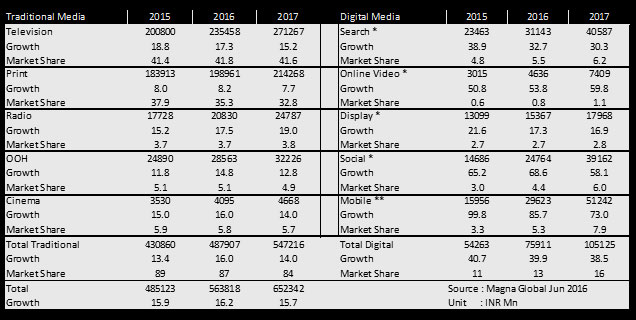
    IPG Mediabrands India has revised its Adex forecast for 2016 made in December 2015 of 18.4% to +16.2% .The size of the industry, is expected to touch 9 billion USD or 564 billion INR equivalents. This half-yearly report is put together by MagnaGlobal, the strategic global media unit of IPG Mediabrands.


    Magna Global also reports an early prediction of the India Adex in 2017, which it says will grow +15.7%. India pips Italy to get into Top 10 list this year and estimated to move up 4 ranks to become the 6th largest advertising market by 2020.


    India will retain its position as the fastest growing economy with real GDP (gross domestic product) growth of +7.5% in 2016. According to International Monetary Fund (IMF), India is likely to maintain the same GDP growth in 2017 as well. Consumer inflation slightly outside of target will force the central bank to hold onto its policy rates. However, the earlier reduction in rates gave the much-needed impetus to automobile, housing, durables and education sectors. The farm sector, if favoured with a good monsoon, will set to rebound its output. The report estimates private consumption to mirror the growth rates and push for higher marketing spends.


    This year, events like T20 World Cup, State elections, UEFA Euro 2016 will generate incremental spends. In addition, the 4G landscape destined to explode will make both service providers and handset manufacturers press the ad spend accelerator and Government investment on infrastructure and social awareness projects will hit a new high. E-commerce and automobile will continue to occupy significantly larger media space.


    Said Shashi Sinha, CEO, IPG Mediabrands: “The outlook is extremely positive as globally India remains one of the fastest growing markets. In fact, India is now one of the top ten advertising markets in the world.”  Talking about the revised forecast, S Venkatesh, EVP, Director Intelligence Practice, Magna Global – India, said: “Basis our initial read of the emerging trends we had envisaged a stronger headwind across digital formats on the mobile platform while the real numbers for H1 2016 suggests a lesser significant acceleration”


    SECTOR WISE DATA

    Television with 42% market share will grow +17%. The biggest contributor to revenue will be the T20 World Cup, Indian Premier League (IPL) and non-cricketing leagues buttressed by E-commerce, Telecom, Auto and CPG advertising. Addressable television and expansion of the measurement into rural India equips advertisers to reach more consumers and broadcasters to monetize now counted audience. Measurement will evolve to include addressable TV audience and though connected TV currently doesn’t pose a threat to linear advertising, it will open doors for more on demand content access. Mushrooming of both domestic and international OTT (over-the-top) players will eventually fragment TV viewing time.


    Print will continue to be the second biggest medium in India with 35% market share and ad sales growth of +8%. Conventionally print heavy advertisers in CPG, BFSI, Automobile and now E-commerce contributes to the segment growth.


    Digital formats continue to disrupt traditional with the highest growth at +40% and increasing its share of market by 2 points to 13%. Videos will be the fastest growing format driven by consumption on mobile devices. Screen time will only increase as smartphones get bigger with better displays and faster bandwidth. Trailing this trend expect advertisers to ear mark higher promotional budgets.


    Radio through foot print expansion along with increase in volume is estimated to grow +18% in 2016.


    OOH will grow +15% in 2016. Both these segments will hold onto their market share of 4% and 6% respectively.


  • Suresh Balakrishna quits IPG, to join WPP’s Kinetic

    By A Correspondent


    Suresh Balakrishna, CEO of the IPG Mediabrands agency BPN (short for Brand Programming Network) who also led media agency Initiative’s non-global accounts as well as Rapport, the out-of-home agency of the group, has resigned. He is set to join WPP’s out-of-home agency Kinetic India as CEO South Asia and Middle East in January 2016. For Balakrishna, although it’s a shift from a manifaceted CEO of a media agency to an essentially outdoorsy company, the regional role is definitely a huge plus. Plus his reporting will be directly to Global CEO Mauricio Sabogal who was incidentally Global CEO of BPN before getting into Kinetic.


    Confirming the development, Shashi Sinha, CEO – India, IPG Mediabrands said: “I am sorry to see Suresh go. He’s been a great asset to the company and an excellent professional.”


    Said Balakrishna: “I have had four very exciting and fulfilling years here. Having said that I am looking forward to my new role. WPP is the world’s largest advertising group and Kinetic is India’s largest OOH company, so taking an established company to greater heights in the South Asia and Middle East region will be a challenge which I am looking forward to.”


    Balakrishna who has donned many hats in media and advertising has been with IPG since January 2012.He will be with IPG till December 31.


  • The Most Annoying Buzzwords of 2014


    We asked the industry’s finest for buzzwords they grew heartily sick off in 2014. Big Data and Viral were the big losers. Read on for the rest:


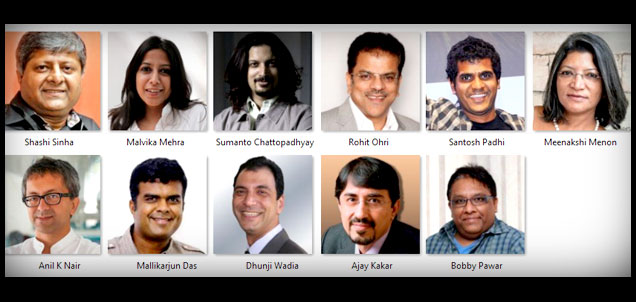
    Shashi Sinha, CEO, IPG Mediabrands

    1. Talent

    2. Compensation

    3. Digital

    4. Television measurement and

    5. Analytics were annoying as the more people spoke, the less they did anything about these things.


    For 2015, for starters, I have high hopes from the new TV measurement which Barc will put out, media agencies getting into content production, collaboration between all constituents of the ad ecosystem, budgets which will hopefully be at landmark levels and the World Cup which we should win again.


    HALL OF SHAME 

    Viral – Most of the time it is just an ad that runs way too long. Get some scissors, people


    Big Data – The ultimate Brahma Astra for the advertising charlatan


    The only viral I know of is the one that requires the intervention of a doctor

    Perhaps the most, abused & misused terminology in the year. Runs the danger of being called ‘Pig Data’.

    It’s just analytics. People have been doing this ever since humankind stepped on this planet.


    Malvika Mehra, National Creative Director and Executive Vice President, Grey

    The 5 most oft used words in 2014 were 1. Guys 2. Let’s 3. Make 4. A 5. Viral.


    Also ‘Take your time (4-5 minutes is great), but please don’t take my money. No budgets this year. And while you are at it, make it so stunning that it is ‘organic’ (unpaid distribution)’. Ji Sirji. ‘But ultimately make me a TVC. And I want a ‘BIG, LAUNCHY’ feel for our product in 30 seconds or less. Chal, paanch second aur le lo’. Ji sirji.


    The Pitch Bitch: ‘Of course we love you guys! We are just opening it up to 10 other agencies to inject some freshness into the brand (and test how much lower will they drop their price vis a vis yours for the same or more amount of work)’. Par Sirji?


    Femvertising: From soap brands, to makers of shampoos, sanitary towels, watches to home appliances and mobile network providers, everybody suddenly wanted to ’empower the woman’. I get the noble intent, but wish the brands would really ‘walk the talk’. Else it’s just a ‘token’ gesture. And consumers see through that inauthenticity.


    Interactive Pre-rolls: With stern warnings of ‘If you skip this ad, I will have to kill not only Jack and Jill and Mary and her little lamb, but also Old MacDonald along with all the cute animals on his farm’.


    Research: Gut instinct is officially dead. It got replaced by the R word. Heard about ‘No guts. No glory’? Not lately.


    Sumanto Chattopadhyay, Executive Creative Director, South Asia, Ogilvy & Mather

    Native Advertising: I imagine people wearing grass skirts and clapper boards singing jingles.


    Vlog: At times we Bengalis mix up our Vs and Bs. That’s what I thought this was all about!


    Content: As in, ads vs. content, content marketing. Like ‘traditional’ advertising has no content? I’m content to pass on this one.


    Social: Yeah, why not? Let’s party. And get paid for it! That’s what I say.


    Seamless: Every element has to seamlessly work with everything else. Imagine if our clothes were like that too! Now that would be some fashion trend.


    Santosh Padhi, Co-founder and Chief Creative Officer, Taproot India

    Pitch: If you do not respect yourself nobody will.


    Research: Like sex determination, it should be banned


    Low Budget: Instead of 300 insertions can we do 280 and improve the quality of the creative?


    Urgent: Premature babies forcefully welcomed will always run a risk


    Celebrity: They are the super highly paid creative directors, why do you need one more creative agency?


    Rohit Ohri, Executive Chairman, Dentsu India and CEO, Dentsu Asia Pacific (South)

    Integrated: Integration is the process, co-creation is the magic.


    360: 360 degree campaigns are consumer conversations in bursts, 365 is everyday relevance.


    Alignment: Alignment is passionless, belief runs deep.


    Structure: Structure constrains, open source liberates.


    Procurement: Vegetables are procured, ideas are partnered.


    Meenakshi Menon, Chairman, Spatial Access

    Big Data: That has to be on the top of my list. It’s just analytics. People have been doing this ever since humankind stepped on this planet.


    Twitterati: Everybody has become an instant expert on Twitter. I’d replace the term with ‘scum.’


    ISIS: ‘Isis’ is supposed to be the goddess worshipped as ideal mother and wife. Our vocabulary keeps evolving, sometimes not in the right direction. I’d call the group as a distortion than assigning them the name of a goddess.


    Homechef: Where mothers cooking for their families had some dignity to it, now we have a whole new concept of women cooking for complete strangers that they invite at home. The food is charged, of course. It’s just a little pretentious a term. Just call them plain old cook, maybe?


    Climate Change: It only gets talked about. Never acted upon. Perhaps replace it with – learn to breathe under water? Or ‘Grow gills?’


    Anil Nair, CEO and Managing Partner, L&K Saatchi & Saatchi

    Integration: The term liberally used when you don’t have a clue of what to do with your brand. It’s been institutionalised now. We will have Chief Integration Officers everywhere in no time. Put an end to this painful word. Replace it with ‘We need to have an idea,’ Sirjee.


    Social Listening: It’s something that our good old researchers have been doing for ages. It’s nothing more than trend analytics, only instead of taking a dictaphone out to record voices, you’re recording them off Facebook and Twitter. Just call it ‘consumer understanding’ and do not make an unnecessary tool out of it, please?


    Viral: The only viral I know of is the one that requires the intervention of a doctor and loads of medicine to go away. I don’t care where this term came from, it needs to disappear. It’s an epidemic that needs an antidote.


    SEO, SEM: Why are we making a mountain out of a molehill? Can we not get caught up in the process and its terminology and revert to a simple non-jargonised world?


    Big Data: For God’s sake, the database just got bigger. But it always existed. The most successful political campaign of this year was based on pure emotional advertising and not big data. Let’s stop jargonising information. Call it what it is (read: information).


    Mallikarjun Das, CEO, Starcom MediaVest Group (India)

    Big Data: A phrase bandied too easily and too much, especially by those who pay scant regard to rationality. The ultimate Brahma Astra for the advertising charlatan.


    Programmatics: A term used in context with media buying, especially on digital, when what they are doing is just using the optimiser.


    Fragmentation: The only problem with using the said buzzword is that it’s often used in a wrong way to strike some sort of terror in a client.


    Storytelling: Need I say more?


    360 degree: This term is like that sugarcane that’s passed through the machine 300 times. There’s no juice left in it and yet it’s being rolled one last time.


    Dhunji Wadia, President, Rediffusion Y&R

    Big Data: Perhaps the most, used, abused and misused terminology of the year. It runs the danger of being called ‘Pig Data’. There are questions regarding the implications of the approach and also the way it is currently done. It needs to look at data holistically – Total Information.


    Digital Evangelists: Don’t need them as you cannot preach to the converted.


    The ‘Selfie’ Contest/Promotion: Replace it with better imagination.


    E-commerce ‘Discount for the Day’: That runs for years together.


    Free App Download: With more and more retailers and brands reaching for e- and m-commerce, there is an explosion of apps to be downloaded. Begs the question, ‘Why would anyone pay to download such an app?’


    Ajay Kakar, CMO, Aditya Birla Group – Financial Services

    “Isse viral kar do!”: Which is what every client says. It’s content, not viral, please.


    “Facebook has 50 million visitors!”: So what? VT station has more people visiting, does that mean we put all our ads there?


    New media: Let’s just say ‘customer’ as opposed to new, old, traditional, or any other kind of media. Creative awards: Awards should be for creatives that work.


    Pitches: Here a pitch, there a pitch, everywhere clients flirting. Serial pitching must end. Let’s call them ‘Brand Custodians’ and not pitchers, shall we? Clients and agencies must stop playing the blame game. If one is the crutch to your success there’s no way one should let go.


    Bobby Pawar, Director and Chief Creative Officer, Publicis Worldwide

    Viral: For the love of likes, it’s just a video until lots of people see and share it. Most of the time it is just an ad that runs way too long. Get some scissors, people.


    ATL/BTL: It implies a caste system of ideas. The good ones go above, the so-called ‘hard working’ ones slide under. It shouldn’t matter where the idea lives, it must be good enough to move your audience. People don’t care, therefore you must.


    But: This is phaasi ka phanda for ideas. It is crueler that a blunt ‘no’. Why? Because it is preceded by some waffling words that give hope to the creative, then ‘but’ shows up and yanks the handle.


    Deadline: Nothing induces a creative butt-clenching moment like this word. Yes sir, three bags full sir, our work is time bound, but does it have to sound so, erm, deadly?


    Purchase: It’s the leading cause of hair-loss among agency CEOs.


    Source:The Economic Times

    Copyright © 2015, Bennett, Coleman & Co. Ltd. All Rights Reserved

    Licensed to republish


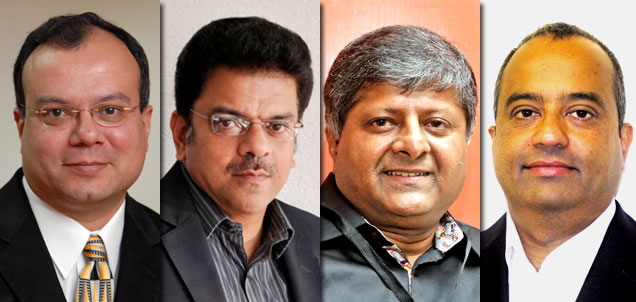
  • Shashi Sinha, CVL Srinivas, Pratap Bose & Rohit Ohri present Outlook for 2015


    Interviews by Shruti Pushkarna


    2015 is acid test year for our industry:

    Pratap Bose, President, The Advertising Club

    I don’t want to sound pessimistic but honestly I have spoken to a lot of people in the industry. It’s a view that everyone’s taking which is the whole thing of being very cautious. There is optimism but there’s cautious optimism. And therefore I think, 2015 is really the acid test year, both for the BJP as well as for our business. The promise is large, the delivery is yet to happen. The strain on the government to actually do something concrete, pivotal around strategy, around implementing, to make things happen is huge. People say it will happen, give us time… I understand that. So there’s a lot of optimism that things might happen but unfortunately we haven’t seen the fruits of that yet. I don’t want to sound like a pessimist but I think we have to take the wait and watch approach. Even if you see the Congress men talk about Narendra Modi right now, they are saying that we’ve heard a lot, he’s made the right impression, the mood is right, but we need to see real time action. To summarise what I said, 2015 is the acid test year for our industry. There’s a lot of hope but I’m still pessimistic about it because it needs to transpire into concrete decisions that grow the economy and move the economy forward. That’s not been seen yet. I tread very carefully.


    Digital is finally kind-of becoming a strong reality:

    Rohit Ohri, ‎Executive Chairman, Dentsu India & CEO, Dentsu Asia Pacific (South)

    I think 2015 will be a promising year for everybody because I think a lot of the work that the new government has started, should show some results. And we are hoping that the positive sentiment will carry through to 2015 and 2016 as well. The other thing is, from the entire advertising and media industry I think digital is finally kind-of becoming a strong reality. It’s no longer just good to do, I think brands are realising that it’s an interesting part of their plans. And I think we are going to see a big change in the next two years in how brands actually communicate online. And what we have seen in 2014 was this big thing about brands creating content, which they did in a mini movie kind of format releasing online. I think that’s something we’ll see a lot more of going forward in 2015. All in all, from a creative perspective, and from a media spends perspective, I think the industry is looking up.


    Government has great plans but they have to push it through:

    Shashi Sinha, CEO, IPG Mediabrands

    I’m hoping and praying that the next year is good. I am hoping that Budget works out well for the government, whatever they decide, they implement because to me, that’s important. This government has great plans but they have to push it through. As we speak, currently GST is held up… so if they pull off a great Budget, life will be good. To me that’s vital. And not because it’s will be a great Budget but that will show their ability to push through and resolve things. But if they still get caught up in this religious thing that is happening, then there’s trouble. So we hope the government succeeds.


    In terms of adspend growth, it’ll be pretty much similar to this year:

    CVL Srinivas, CEO South Asia, GroupM

    We see 2015 to be a good year. On an overall basis, I think in terms of adspend growth, it’ll be pretty much similar to this year. But one must remember that this was an election year so we had a bit of a bump up to growth because of elections. Next year, despite it not being an election year, we see the growth rates to be more or less similar. We see digital growing upwards to 35 per cent like it has been over the past two or three years. We also think television is going to continue its strong growth in healthy double digits and so will the regional print dailies. So, all in all, it looks like an interesting year. We have the ICC World Cup coming up next year so that will lead to spends at some level.


  • Arun Sharma returns to IPG Mediabrands after 10yrs at Airtel


    Arun Sharma
    Arun Sharma

    By A Correspondent

    Senior marketer and until recently head of the media vertical at all business units of Bharti Airtel, Arun Sharma has moved to IPG Mediabrands as Vice President.

    Confirming that Mr Sharma had joined the leading media agency conglomerate on Monday in New Delhi. Shashi Sinha, CEO of IPG Mediabrands, said that he will be working on a group role. “Arun has been at senior positions in the industry and we are glad to have him on board,”  Mr Sinha said.

    A member of various industry bodies, Mr Sharma has a career spanning across 17 years, the last decade of which was spent with Airtel and before that with the IPG Mediabrands group for six-and-a-half years. “It’s a homecoming of sorts for me,”  Mr Sharma said while adding that he is looking forward to the new responsibilities at IPG.

  • IPG Mediabrands’ Lodestar UM bags Samsung biz

    By A Correspondent


    The end-of-the-year has brought in glad tidings for the IPG Mediabrands media services conglomerate in India. Earlier this month, the group’s Initiative bagged the coveted Reckitt Benckiser account. And now comes the news that the Samsung Media Agency on Record will be Lodestar UM.


    Samsung has been with Starcom MediaVest Group, but a multi-agency pitch process saw Lodestar UM win the business. MxMIndia could not reach anyone at Samsung and Lodestar to get a confirmation on the development. IPG Mediabrands runs Lodestar UM, Initiative and BPN as its three media agency networks in India.


    Meanwhile, it is rumoured that IPG Mediabrands could well be earning itself yet another prized account before the year ends.


    Watch this space.


  • Meet the new CEOs of Lodestar UM & Initiative


    By Ritu Midha


    Media agency major IPG Mediabrands has dressed up its top deck with three elevations. Nandini Dias, till now COO, Lodestar UM, will now lead the agency as its CEO and will be based in Mumbai. New Delhi-based Anamika Mehta, the second COO of Lodestar UM, is the new CEO of Initiative. Amar Deep Singh has been elevated to the post of CEO, MAP (short for Mediabrands Audience Platform), comprising Reprise and Interactive Avenues. He was, till now, CEO of Interactive Avenues. With this announcement, the four entities of IPG Mediabrands in India have independent chief executives. The fourth arm – Business Programming Network or BPN has Suresh Balakrishna as CEO.


    Said a visibly elated Shashi Sinha, “When I became CEO of IPG Mediabrands, it was decided that for the first six months I would double act, as the CEO of IPG as well as Lodestar. In Initiative while we had senior level resources there was no CEO. Though we have made announcement of our CEOs now, they have been running the organisations for quite some time now.”


    IPG Mediabrands formally entered India in March 2012. Media agencies Lodestar UM, Initiative, BPN, Reprise, Interactive Avenues, Magna Intelligence and the outdoor business are part of the global media agency conglomerate. Sinha took the responsibility of the CEO of the holding company in October last year.


    Nandini Dias: volume and intensity of external demands will increase manifold

    On how it feels to be elevated to the role of CEO:

    It’s a proud moment for me.  It is not very often that a person remains steady in one organisation and moves up the rank right to the top. I joined the organization 18 years back and never imagined one day I would head it. Since I have always felt tremendous loyalty for the firm and share great camaraderie with my colleagues, it looks like an exciting prospect.


    On the new responsibilities:

    As a COO, I was focused on the internal operations and the day-to-day business needs. With the CEO role, I am aware that the volume and intensity of external demands will increase manifold. Whether it is international, industry groups, or as a brand ambassador of the agency, the interaction with the outside community will contribute to a large part of my responsibilities. I will have to be able to manage the dual roles of being both inside- and outside-focused.


    On equation with clients - will they change?:

    Clients like Mahindra, Amul, Nerolac, Wipro, Zodiac and Tata have been with me all of the 18 years and my relationship with these clients run really deep. In fact in all these organizations, the heads are also people who have risen alongside me and are now in a pivotal role. So I will do all I can to not let the equation change. On the back of my clients, I have found my victories so it is important for me to keep their confidence. There are also clients, I have met socially or in client agency parties but I have not worked alongside. I need to earn their confidence. The heartening fact is that the top 15 leaders who are custodian to these businesses have been with Lodestar UM over 7-8 years. Therefore, there would be a sense of continuity with them.  Having said that, I am also aware that there will be time and knowledge limitations and I need to build in far more efficiency in everything I do.


    On the challenge of leading a large multi-city team:

    That is a big challenge. All CEOs are quasi HR heads. Thankfully, I have watched Mr Anil Kapoor and Shashi managing large teams with great elan. The group has the most steady teams among advertising and media agencies.


    I am alive to the fact that the external pressures tugging one away from day-to-day operations and the limitation of time may take away my awareness and the pulse off the youngsters. And it will feel strange not to know what subordinates are up to.


    However, I believe that, over a period of time, the culture that we have built makes us contiguous and brings us on the same wavelength. So it doesn’t matter which city or where one operates from – the response and behaviour is based on the same principles.


    Immediate action points on agenda:

    I think the first thing to do is internalize that going forward I can no longer be involved in all decisions as Lodestar UM is a large organization. To run the organization efficiently, I will need to articulate and communicate a clearly understood strategy, give definite guidelines on the processes and structures  and take forward the defined values and attitudes.


    Anamika Mehta: Doing and scaling things quickly is critical

    On how it feels to be elevated to the role of CEO:
    Exhilarating but also overwhelming!


    On the new responsibilities:

    Responsibilities and more! A critical task early on is to establish priorities and leverage the opportunity to reset Initiative’s rhythm to the requirements of future.


    It will be as much about driving a shared vision and agenda with teams and client partners. Eventually isn’t it all about driving teams, driving clients’ business and driving the P&L?


    On equation with clients - will they change?:

    All of us at IPG Mediabrands have been ingrained over years with the importance of building and strengthening client relationships at the back of product quality and throughput. We have an enviable track record of the most long-term client relationships in the industry - right from Maruti, Sony, MRF at Initiative or Amul, Tata Group, Microsoft, Wipro, Mahindra in Lodestar UM.


    So it will be a dual theme of ‘give clients what they want’ and ‘business like thinking’! And like in any business today, it will be as much about a hands-on approach with clients and rolling up my sleeves. Doing and scaling things quickly is critical.


    On the challenge of leading a large multi-city team:

    As I mentioned, it is all about prioritizing, driving a shared goal and managing across cities, across clients, across teams in a strategic fashion. I am quite confident our strong second rung of established leaders across cities and our value laden theme will make the journey exciting. And most importantly an open and inclusive culture will help navigate challenges if any.


    Immediate action points on agenda:

    A Barefoot Run in a FBDS way - Fast, Brave, Decisive, Simple. In today’s challenged business environment we will have to be bold, fast-moving with greater and purposeful speed, tough-minded and responsible businesspeople to stay ahead of the game.


    IPG Mediabrands believes strongly in the power of brands to build a better world. Brands matter most when they are aligned with a larger purpose and we are going to be committed to that vision in the long run.


    And last leveraging the strength, scale and clout of IPG Mediabrands India to Initiative’s advantage.


  • Anil Kapoor: An ‘Outsider’ who was more than an ‘Equal’


    All roads lead to the Trident at Nariman Point today (Sept 27) as the Advertising Agencies Association of India felicitates and awards Anil Kapoor, Chairman Emeritus, Draftfcb+Ulka with the Lifetime Achievement Award.


    A little about Mr Kapoor, courtesy the Draftfcb+Ulka website: His love for challenges saw him taking charge of Draftfcb+Ulka (Ulka Advertising, at the time), turning it into the fastest growing agency in India and taking its rightful place as one of the ‘Big Five’. With the formation of Draftfcb in 2006, Mr Kapoor was appointed as Draftfcb President with responsibility for Asia-Pacific region and Africa.


    He was appointed Chairman Emeritus of Draftfcb + Ulka, after a 22-year stint with the company and its other associated agencies. As one who is known to make things happen, his role expanded naturally into industry bodies. He is a Past President of the Advertising Agencies Association of India (AAAI), the Chairman of the Audit Bureau of Circulation of 2007-08 and was also on the Management Board of the National Readership Survey and the Television Audience Measurement Research. He was also on the Editorial Advisory Board of The Economic Times. In May 2002, Mr Kapoor was also inducted into the Foote, Cone & Belding’s Worldwide Board.


    Before joining Draftfcb+Ulka, Mr Kapoor was with the Boots Company, India, for 14 years, where, as the Marketing Director, he launched a string of brands, all of which went on to become No. 1 in their markets. At Boots, he also set up two field forces, one for consumer products and the other for ethical pharmaceutical products. Before that, he was with the legendary agency MCM and though not the cause, he says he had to preside over its closure – quite a learning experience! Now a confirmed Mumbaikar, Mr Kapoor grew up in Delhi and graduated with a BA in English Literature from St. Stephen’s College, Delhi and then did his MBA from the Indian Institute of Management, Ahmedabad.


    Dr M G Parameswaran

    Executive Director and CEO, Draftfcb + Ulka

    I have worked with Anil Kapoor for over two decades and I have seen him in various roles, as Head of Marketing of a large British multinational, as a CEO of a pioneering media company and as a CEO of a struggling ad agency. One thing that defines him is his ‘Never Say Die’ attitude. When he joined Ulka no one thought he had a chance of saving an agency that was fast sinking. In fact someone who is revered in advertising world even told me that I was mad to join Anil Kapoor in his mission of saving an ailing Indian agency. Anil proved all his detractors wrong though his passion, attitude and commitment to the cause. He also showed the industry how to build a strong team and keep it together for two decades. How to build an agency group entirely from within, and without the help of international experts and hand-me-down accounts. He demonstrated how to partner clients at senior levels to launch one successful brand after another,  in tough market conditions. As Ulka became FCB Ulka and later DraftFCB Ulka, his managerial and leadership skills got recognized on the global stage, many times over.


    Anil Kapoor, who was seen as an outsider in the Industry, was soon accepted as an equal and may be as a ‘more than an equal’. He went on to play leadership role in various industry bodies such as AAAI and ABC. He was instrumental in setting up the independent NRS survey in the mid-’90s.  He also played a very vital role in helping the formation of IBF as a body that could work with AAAI to create norms and processes on how agencies work with television.


    We don’t have too many people in advertising industry today who can fill his shoes.  While Anil Kapoor continues to serves as the Chairman Emeritus of Draftfcb Ulka Group and continues to play the role of an advisor to the Group which he built,  he has not been involved with industry affairs for almost a decade. I am sure it is the industry’s loss that he decided to move on. But then, all things have to change, and that is not an entirely bad thing after all.


    Shashi Sinha

    CEO, IPG Mediabrands and Lodestar UM

    They don’t make people like Anil Kapoor these days.


    I have had the good pleasure of working with Draftfcb+Ulka a few years before he joined the agency from a strong client background. In fact that possibly ensured that he was very focused on deliveries.  As someone who helmed the agency for many years and even now as Chairman Emeritus, we and our clients included have always known him to be a no-nonsense man. Forthright, never into any frivolous conversation. He was always focused on the task on hand.


    He had a keen eye on the business and would actively engage with all his clients.  Even now when some of us meet him, his observations are pertinent to the business and may I say: bang-on.


    Anil Kapoor has always been an excellent people manager considering his team has been together for so long.


    I have always had an excellent rapport with him and have found in him a Guru whom I admire and respect.


  • Continuing education, not awards to be focus of new Advertising Club prez


    By A Correspondent


    DDB Mudra Group Chief Operating Officer Pratap Bose was unanimously elected President of the Advertising Club. He replaced Shashi Sinha, CEO, Mediabrands India and Lodestar UM, who held the post since 2011.


    Speaking on his priorities, Mr Bose said that while awards (like the Abby, Effies and recently held Emvies) are important activities of the Club, his priority will be continuing education programmes for the industry.


    Mr Bose and 14 others would constitute the office bearers and managing committee of the Ad Club, the country’s premier advertising club constituting members of the advertising, media and marketing fraternity.


    Other officebearers include Ajay Kakar, Chief Marketing Officer – Financial Services, Aditya Birla Group (Vice President), Raj Nayak, CEO, Colors (Secretary), Ajay Chandwani, Director, Percept (Joint Secretary) and Umesh Shrikhande, CEO, Taproot India (Treasurer)


    The managing committee members are:

    in alphabetical order of last names: Punitha Arumugam (Google), Bhaskar Das (Zee Media), Kunal Jeswani (Ogilvy & Mather), Harit Nagpal (Tata Sky), Rohit Ohri (Dentsu), Josy Paul (BBDO India) and Ravi Rao (Mindshare).


    While outgoing president Mr Sinha (IPG Mediabrands, Lodestar UM) continues as Immediate Past President for a period of two years, Sunil Lulla (Times Television) and Prasanth Mohanachandran (AgencyDigi) have been co-opted on the committee.


    Said Mr Kakar on the constituting of the Ad Club’s top deck: “This year we are fortunate to have a very senior and strong committee comprising people who are not only committing their names but also their invaluable time to the common good of our industry,” Mr Bose too is happy with the core team. “It’s a good mix of people from across the spectrum,” he said.


    The Advertising Club annual general meeting was held in Mumbai on Wednesday (September 11) and the managing committee and officebearers were elected for the year 2013-14. The committee members can seek re-election next year.


    If processes are clear, there will be no problems with Creative Abby: Pratap Bose


    The new Advertising Club President’s has a day job that possibly has him work beyond 24×7. As Chief Operating Officer of the DDB Mudra Group and a member of the agency’s operating board, Pratap Bose joined DDB Mudra from Ogilvy & Mather in 2008, where he worked for 15 years in various capacities, and went on to become its youngest CEO in 2006.

     

    Excerpts from an interview with Bose where he speaks on his priorities, a problems-free Abby and how he hopes to drive the Ad Club forward.


    What will be your priorities as president of the Advertising Club:

    For a long time, the perception has been the Advertising Club is the purveyor of awards. While awards are important and they recognise the best in class, for me the focus is going to be on continuing education programmes. Giving back to the community in various forms - by not just awards, but also education, seminars and learning via interacttion with personalities.


    Speaking of awards and the Creative Abby specifically, while a lot has been cleansed, it touched a new low this year.

    Remember, the Emvies and Effies go without a hitch. It’s only with the Creative Abby. Mind you, there were no issues the year before. Last year, there were a couple of things that sprung up but we realise that these issues can easily be fixed. What I am looking to do is to institutionalise a very transparent and frank discussion on what needs to be done with all stakeholders well before Goafest. I am a strong believer that if you have a process that has a buy-in from everyone and it’s not a diktat, things will sort themselves out. If the processes are clear and there are no ambiguities, we should have no problems whatsoever.


    Some agencies have had reservations about going to Goa. Any thoughts of shifting the awards back to Mumbai?

    It’s not a Goa versus Mumbai debate in my mind. As long as the process is clean and you are fair, rational and honest, I don’t think there’s any issue about Goa and Mumbai


    The Bombay has been dropped from Advertising Club, how successful has the move to go national been?

    I think we’ve made a start. I believe the local ad associations - whether in Delhi, Kolkata, Bengaluru and Chennai should co-exist. We are happy to have them on board… at the end of the day, we are one community. The whole idea is to be inclusive and work for the betterment of the industry. We have made some progress by having the awards judging of Effies and Emvies in Delhi. And there’s no reason why it can’t go beyond Delhi. We could extend to Kolkata, Bengaluru…


    What else in the next two years?

    Well, we are going to looking at all forms of communication. We are talking of a two-day workshop for the entertainment industry and looking at people to help us on film production. So, it’s not just talking to creative guys or planners. We are also looking at developing a new website, a new logo, be relevant on Twitter and Facebook. All in all, lift the image of the club and not just an awards club.


    All this is going to take a fair bit of time… how do you take care of your day job at DDB Mudra?

    (laughs) Well, that’s the reason why I have picked a nice mix of people. I am going to entrust each of them with a responsibility that’s clearly defined and they will all take things forward.


    Abby should continue in Goa: Shashi Sinha


    IPG Mediabrands and Lodestar CEO Shashi Sinha on his two-year term as Ad Club President, the Creative Abby controversy and the demand to bring the Abby back to Mumbai


    The IPG Mediabrands and Lodestar CEO Shashi Sinha is widely regarded as ‘Mr Consensus’ in the Indian advertising and marketing industry. Known to take the industry along in whatever he does which may require wielding the stick at times, Mr Sinha is credited with cleansing Ad Club’s Creative Abby awards process a few years back. In a short interview with MxMIndia, Mr Sinha speaks on on his two-year term as Ad Club President, the Creative Abby controversy and the demand to bring the Abby back to Mumbai


    How do you feel relinquishing charge after an eventful two years as Ad Club President?

    Mixed feelings, frankly. We successfully moved from Advertising Club Bombay to Advertising Club, and making it more national in character. We’ve done well financially. Goafest and the Creative Abby was a problem last year, though my first two years were excellent


    Any unfinished agenda?

    We started with other markets very well, but I wish we had done more on continuing education. I think we got stuck with awards and the plan to go to smaller towns couldn’t be done.


    And the Creative Abby controversy. Any solutions, as you look back?

    We discussed that in the meeting. The solution is that there are rules, put them down clearly, publish them and let there be no deviation.


    There is a demand for the Abby to be held in Mumbai and not in Goa

    Goafest brings the industry together, and I think we should continue to have the Abby in Goa. We are one industry and it shouldn’t be a divided house.


    Do you think the Abby should be given to a private operator like it is at the Cannes Lions?

    Right now, the Abbys are for the industry and by the industry. While we make profits that’s not our primary objective. I think when you hand it over to a private player, the entry and delegate fees will go up dramatically.


    What next?

    I am already actively involved with BARC, heading the technical committee. In fact the last two months that has taken priority over most other things, but I am happy with the way things are going on that front.


  • IPG Mediabrands acquires Interactive Avenues

    By A Correspondent


    IPG Mediabrands, the media holding company within Interpublic Group, today announced the acquisition of Interactive Avenues, India’s largest independent full service digital agency. With close to 200 employees across offices in Mumbai, Delhi and Bangalore focusing exclusively on digital marketing and technology, the acquisition of Interactive Avenues’ renowned media, creative and digital production units cements IPG Mediabrands’ position as a leading digital buying unit in the rapidly expanding Indian market, as well as the second largest media holding company.


    After the launch of Reprise Media in India in 2011, this new move continues IPG Mediabrands’ strong commitment to implementing industry leading digital services across all of its agencies and will allow it to accelerate its timetable for the launch of its new Cadreon offering, notes a communique.


    Interactive Avenues will become an important strategic part of IPG Mediabrands’ Mediabrands Audience Platform (MAP), the group of data driven digital services and technologies that focus on search, display, mobile, social, video, applications and e-commerce.


    Interactive Avenues was founded in 2006 and has one of the top three clients in almost every category including consumer electronics, FMCG, technology, telecom, banking, insurance, travel, ebusiness and education.


    The move further strengthens the network’s digital capabilities in India and makes for an even stronger digital foundation for IPG Mediabrands and its clients in the Indian market.


    “India is a key market for IPG Mediabrands and for IPG as a whole. This acquisitions affirms our commitment to making investments in high growth disciplines and geographies.  We believe India is one of the fastest growing and most important global markets. IA has a fantastic track record in India and great future as a part of IPG Mediabrands,” commented Matt Seiler, Global CEO, IPG Mediabrands.


    “We have a clear vision for MAP in India. Interactive Avenues fits perfectly into this”, said Brendan Moorcroft, Global CEO of MAP. “Because we already have an established partnership with Interactive Avenues, we know their strengths and understand and share their core values..”


    Interactive Avenues will sit alongside established IPG Mediabrands agency Reprise Media in the new MAP structure. The acquisition and integration into MAP India will have no impact on the day-to-day running of the agency which will remain as it is now. Interactive Avenues will continue to operate as an independent brand within the MAP structure. The company’s co-founder Amar Deep Singh will be MAP India CEO.


    “After a dream run of seven years, we are ready for our next phase of growth,” Mr Singh said. “In IPG Mediabrands we have the right partner. They give us access to three fundamental growth catalysts; access to global tools technologies and best practice; access to markets beyond India; and access to global clients in India and beyond. It is a true meeting of minds and cultures, andI am thrilled to be working with such strong local and global leadership. There are exciting times ahead with our plans to develop and launch MAP’s specialist offerings Cadreon, Spring Creek Group and Ansible in India.”


    This marks a successful exit for Interactive Avenues’ current investors, WestBridge Ventures II Investment Holdings formerly Sequoia Capital Investment Holdings II and Anupam Mittal.


  • The plan is to keep rolling out & expanding our analytics expertise: Sue Moseley


    It’s been a few weeks since IPG Mediabrands made its formal entry into one of the most promising markets – India, but it is clear on the traits that would drive clients to engage in solutions of the future. Led largely by data and analytics, the company expects market dynamics to hit a high note once it finds favour with clients across a broad range of sectors. Sue Moseley, Worldwide Director, Research & Futures, Mediabrands IQ Creation on her maiden Indian trip reiterated the company’s global promise of making data an integral part of a client’s growth strategy, especially in a media environment that’s been evolving over the years.


    In conversation with Johnson Napier of MxM India, Ms Moseley outlines the many advantages that an analytics division provides to foster growth plans of clients, on how clients have been queuing up to secure research & analytics services of the company, on how social media would alter advertising options for clients, and the company’s global plans to expand operations in emerging markets. Excerpts:


    Q: You’ve just about taken off in India while you have been around in the other markets for a few years now. Could you elaborate on how Mediabrands has progressed as a sought-after media solutions provider, especially in the realm of research, data and analytics?

    Mediabrands is all about our media assets, with the main agencies being Lodestar UM and Lintas Media Group (Initiative) and around that we have a lot of different companies that bring different expertise to the table. So it is a group of expert and specialist companies engaging in media services. The big advantage that we have found is that by bringing collaboration within the group is that one, there is no duplication taking place and therefore you are able to reinvest in research and development for the good of the company. That’s been very effective with our media agencies where we have come across situations where they both are looking at similar offerings such as research panels and stuff like that – there is no point in both of them doing it separately. Also, Mediabrands has organized its companies into one-to-one marketing, one-to-some marketing and one-to-many marketing companies. So they have companies to effectively deliver on that front. My role in that is handling Mediabrands IQ which is about data, tools and analytics. So it is about making sure that all of the media companies around the world have access to the very best. So it is a combination of delivering global tools and helping the local markets as well. Also, it enables us to learn what the local markets have to tell us, build that into our global tools and then using those global tools to work with global industry tools.


    What the global teams can bring is the experience from other markets such as where we have being doing a lot of analytics where digital and social media is very well established. So we have made the mistakes of learning everywhere else so that we can apply the best practice here. The best example that can be quoted here is our team that we have at Mediabrands with shopper marketing expertise. With the limited interaction I have managed to have with the team here in India, modern retail will see an overhaul with the coming in big retail giants like Tesco, Wal-Mart, etc. And so we have created research tools which looks at the consumer (shopper) and work back the other way round. So we have been sharing the techniques which can be adopted very easily in this market so that they can have a leading edge over everybody else in terms of shopper marketing.


    Q: Do clients of today understand the criticality and importance that an analytics and research division serves towards achieving an imperious objective?

    The demand from our clients running analytics is growing exponentially. The minute they see the power of what we can do they just want to have more and more. So typically, we find that when we start with the client to do a market mix modelling project, which is really to understand what is driving sales and all the different aspects like what is the impact on pricing, promotion, distribution etc and by deconstructing that you can build a better solution going forward. And the intent of this is to help clients save 10-15 per cent of their marketing budget which is the same levels of sales because now you have this science and fact-based behind your planning. We are finding this particularly useful in fast developing markets where you want experimentation and you want to learn about new things but you do not want to damage any new and existing trends. So by doing market mix modelling you can have a 10 per cent budget that you can deploy into testing and understanding newer media, social and techniques which then can be measured and can be used to spiral continuous improvement for our clients.


    Q: How can research and analytics be applied uniformly across the mediums of television, print, radio, etc? What is unique about the way Mediabrands goes about offering solutions to each of these mediums?

    The market mix model we use will tell you the contribution of every single medium – it will tell you how different mediums like television, radio, outdoor, etc are performing. I think where we are different to other companies is that we do that analysis and are able to activate it because the team that built our Econometrics software also built our Planning software. So the planners here that are looking at future activity have software that helps them select channels and optimize effectiveness. Traditionally that would mean just looking at reach and frequency which is the best we’ve got but if we have done one of our big analytics project we automatically load that data into software. So rather than say what is the forecast of this plan in terms of reach and frequency they can then say what is this plan delivering in terms of sales. So we are now shifting from talking about reach to business outcomes in terms of our activities across all possible channels.


    Q: Has it got to do with the recent worldwide shift carried out internally at Mediabrands that saw you progress towards a pay-per-performance model?

    What is happening at Mediabrands is that we are moving towards pay-for-performance compensation model. The reason we feel confident in doing that is because we can take all of this data and analytics and have a good understanding of what is possible, what we can achieve and most importantly, how to achieve that outcome. Our CEO Matt Seiler is passionate about this model and he has the right to feel so – the minute your company is focused very much on your clients profitability it makes the whole culture change that’s much more focussed on that business and that is going to have a much more positive impact on the clients.


    Q: Could you share a few examples of clients who have been exposed and are content with your service offerings?

    We do a lot of modelling work for Chrysler, Hyundai etc in the automotive sector; we do a lot of work for J&J in the FMCG sector; we do analytics for Tesco etc. So we do analytics across a very broad range of sectors. I think the power of putting clever mathematicians in these hubs that we have set up around the world is that they actually like to be challenged. You give them a challenge and they’ll provide a mathematical outcome at the earliest.


    Q: Could you quantify the global growth in client numbers witnessed by Mediabrands over the years?

    The growth has been phenomenal. We started in North America and then we rolled out to Europe and now we are rolling out around the world. From year one where we had 20 clients that number today is in excess of 150 clients. The speed at which this takes root is quite scary. I think this is because it appeals very much to the CEOs and CFOs across companies and is helping them cut marketing budgets during recession because now they have evidence and hard facts around the contribution that communications is making to their sales.


    We have about 150-odd clients now and we expect by the end of the year that figure should go up by at least another 100. And this will come from all our key markets across the globe.


    Q: As you move across borders and from the West to the East, what are the key trends that one gets to observe that are changing the market dynamics where the domain of research and analytics is concerned?

    A market like US is certainly ahead in terms of digital and social media analytics. The big trend that I foresee is in the social media space. I think consumer research has been such a life-blood for our business and I think there is going to be a big switch from consumer research to really deeply mining the social media space.


    Q: There has been a rise in the number of clients who are opening up to the concept of real-time data. How do you view this trend as an analytics expert?

    Real-time requires analysis; what we are doing is trying to get a balance between getting data fast and some of the fast data streams we get are actually from social. So if we can understand and use social to track effectiveness — like say for the automotive industry, website visits and things like the use of car configurator on the site is a very good indicator of subsequent sales. So we can use that data to make much faster decisions because we understand their relationship with sales. But across your total marketing mix, unique things take time to take roots -it isn’t real real-time. I think real-time really means that time span needs to collapse and also it has a big impact in the way the clients work when they set their annual budgets – they now need to rethink maybe to have a more flexible and minimum budget and then do a 20-25 per cent more flexible budget. You cannot make a difference if you have your budget already set at the start of the year. So it’s going to mean big organisational changes within clients and the way they currently work around real-time.


    Q: What are the challenges that real-time technology throws up to research agencies like Mediabrands IQ?

    The biggest challenge we face right now is making sense of the data. It’s now about ‘x’ bytes of data and making sure that we get access to it. Also the computing technology world is progressing rapidly and we now have managers and heads talk about how we are in the clouds with our data storage. It’s a space race to be the first and we are investing very heavily in making sure that we have got the right tools to understand social media to really understand the consumer’s pathway. At the moment there is a risk within the digital space in the sense that the last click you did was search or the last thing you did before you went click and bought something…so all the effectiveness is attributed to the last thing that happened before you made your purchase but it could actually be the other thing including the video that you saw, the blog that you read or the conversation that you were a part of… So we are investing real heavily to do some real analysis to say which of these component parts of the digital stream are adding value etc. So it’s constantly finding new techniques to unravel the data so that we get the real answers. So that’s the real challenge at the moment but it is fun.


    Q: It is said that the future belongs to Asia and Asia is not just about India and China. Where do you see the next big global stories arising from the APAC market?

    Our planning tools are in all of our markets. So we have North America, which is US and Canada then we have the G-14 markets and then we have the World Markets. The G-14 markets are like-minded in their approach so as to bring together the management under one regional manager because as I said, they are like-minded, progressive, most moving forward and that’s where the demands from those markets are different from the world markets. So the G14 markets comprise of Australia, Brazil, China, France, Germany, India, Ireland, Italy, Japan, Mexico, Netherlands, Russia, Spain and UK and World Markets include all other markets from Europe, Middle East and Africa; Latin America; and Asia-Pacific.


    It was only in the middle of last year that we became a G-14 market and I think it’s a challenge in some of our markets – like our Thailand market is extremely progressive and I can imagine because of that and the work that they are doing therefore makes sense potentially for them to make way into the G-14 umbrella and further expand that number.


    Q: As you move forward, and given the economic gloom prevailing around, what is the roadmap you have drawn up to achieve commendable growth for your division?

    The roadmap is certainly about rolling out and expanding our analytics expertise – we are recruiting heavily to build up talent. So rolling out more into shopper marketing and sports analytics would be our core agenda. Also we have set up consumer panels which are now in 51 markets covering 41 million consumers worldwide – we are building on tools so that we are able to extract data and bring it in context to that of the rest of the global market. Also, the other big thing is that we are doing more mining into social media and looking at the sentiment which I think it is really dabbling around the edges because sentiment isn’t the right thing to look at; it is much better to understand strands of conversation, what those topics mean and that is where we are really building our tools around.