Tag: HUL

  • Hindustan Unilever sets up lab to train managers on digital media marketing

    By Sagar Malviya & Amit Bapna


    Unilever has set up its first media lab in the country in Mumbai, which will train its managers on digital media marketing and certify all digital initiatives of its Indian unit before they go public.


    The development signals a sharp focus on digital marketing by the country’s largest advertiser, and may make other marketers too to take the digital world more seriously.


    The lab at Hindustan Unilever’s headquarter at Andheri is the fourth such centre globally for the world’s second-largest consumer goods firm.


    Atit Mehta, media services head at Hindustan Unilever, said so far the company has been focusing on doing the similar things much better than others on digital media.


    “Now, we will be miles ahead from everybody else,” he said. The lab will ensure that all digital media campaigns of the consumer goods giant are compatible – from a basic mobile device to smartphone to tablet.


    The company will also increasingly opt for digital hoardings instead of static old banners. Digital media spends in India, although still very small compared traditional media, is growing at a faster rate than television and print as a rapidly rising number of Indians access internet on phone.


    CVL Srinivas

    Experts say HUL’s latest initiative would make other advertisers too to focus more on digital media. “Presently digital in general is under-leveraged. HUL has definitely been ahead of the curve. It’s only a matter of time before more advertisers start making serious investments in the medium,” said CVL Srinivas, chief executive officer (South Asia) at media buying agency GroupM.


    Vivek Bhargava, CEO of digital agency iProspect-Communicate2, says companies have no option but to take digital seriously as more and more consumers are trying to avoid conventional advertising. He says that if companies don’t allocate serious resources on digital marketing, then it could affect their survival.


    Vivek Bhargava

    Globally, Unilever increased its digital ad spends by about 40% in 2012-13. While Unilever has global partnerships with Samsung, Sony’s Arcade Creative Group and EA Sports, its Indian unit isn’t far behind. In the last few months, several HUL managers have been to global headquarters of Facebook and Google among others for training and digital certification.


    HUL launched a India-specific initiative, BE Digital, last year to draw up a complete digital roadmap for premium brands such as Tresemme, Sunsilk, Lakme, Close-up and Surf, where the target audience online is high.


    Source:The Economic Times

    Copyright © 2013, Bennett, Coleman & Co. Ltd. All Rights Reserved

    Licensed to republish


  • Germs personified on radio for HUL’s Domex

    By A Correspondent


    While most toilet cleaner campaigns focus on TVCs and print, HUL’s Domex has taken to the radio waves in an innovative bid to target the markets of Maharashtra and South India.


    Big FM has carried out an innovative and engaging campaign on the pegs of toilet hygiene and sanitization, called ‘Germs Ka The End’, with characters Jaggu Jaundice, Tatya Typhoid and Danny Diarrhea spreading the message of toilet hygiene and sanitization.


    Led by National Solutions Head Dheeraj Kumar along with his team comprising Zara Zaki, Sreejith Vijayan and Usha Malasi, the campaign also saw a song rendition by music director and singer Bappi Lahiri, titled The End.


    Created against the backdrop of ‘shaayri’, the characterized germs poetically profess the ill-effects of unhygienic and unsanitized toilets through an imaginative exchange of dialogues.


    Ashwin Padmanabhan

    Ashwin Padmanabhan, Business Head – 92.7 Big FM said, “We are happy with the success of the campaign. To be able to tailor solutions to meet client requirements, while also keeping listener sensibilities in mind has been our strength which has been showcased once again with this campaign with Domex. The team has done an excellent job and we look forward to continuing to serve audiences and marketers alike, with innovative and highly engaging offerings.”


    George Koshy, Category Head (Household Care), Hindustan Unilever Ltd said, “Toilet cleaners category cues are such that consumers cringe on seeing any form of advertising. Our germ world campaign is our attempt at making this category easier on the eye. In order to make the germ world and its characters popular, we decided to use music as the medium. Mindshare created a unique tie-up with 92.7 Big FM and Bappi Lahiri to create a fun jingle around Domex’s characters – Jaggu Jaundice, Tatya Typhoid and Danny Diarrhea. Radio is a key medium with our audience residing in our key markets. The song enabled us to enter the realm of radio content and away from the by now done-to-death RJ integrations and station roadblocks.”


  • Mindshare India flag flies high at FOMA


    By A Correspondent


    Ever since he took charge in late 2011, Mindshare India boss Ravi Rao has been living out of his suitcase and smartphones. The back-to-back meeting with clients and pitches leaves him little time for much else. While we don’t think these cruel hours at work are healthy, the hard work is paying off. Mr Rao is delighted by the “good, all-round show – right from the effectiveness award for Slice, Pepsico to HUL winning on the back of strong entries”.


    The competition was indeed tough, including that coming from within the Group M stable. At the Festival of Media Asia, the premier destination for media agencies and professionals, Mindshare was the Network of the Year.


    Other than Mindshare, the top honours went to Million Reasons to Believe in Thailand (Campaign of the Year) submitted by Initiative Thailand for Coca-Cola, OMD Hong Kong (Agency of the Year). The winners in these categories were determined by a points system based on entries appearing in the shortlist and the list of highly commended and winning entries.


    Winners were selected from a shortlist of 117 campaigns, presented to an expert panel of 27 industry judges, led by Leonardo O’Grady, ASEAN Integrated Marketing and Communications Director, Coca-Cola. The gruelling two-day judging process saw much deliberation and debate, resulting in the final list of winners.


    The 2013 Festival of Media Asia Awards were presented at a gala event at the Sentosa Cove in Singapore last night (March 5). Awards were presented to winners vying across 15 open categories, with an additional three grand prix awards. There were over 400 submissions from over 10 markets across the region.


    “We held every entry to the highest standard,” said Leonardo O’Grady, ASEAN Integrated Marketing and Communications Director, Coca-Cola. “We had to make some difficult decisions. Many of the entries were of such a high quality that we struggled to find a clear winner, and one of the things that emerged was that the lines between content and communication have become blurred.”


    Mr O’Grady continued, “The Best Communications and Mobile categories were hotly contested and we have also seen some great wins from Thailand, Australia and India.”


    “Each and every one of these winners deserves the recognition they have received from the jury.” said Charlie Crowe, Founder of the Festival and CEO of C-Squared, the organizers of the event. “We have seen some exemplary campaigns that have been able to change minds and move people. They represent the best work coming out of Asia, and demonstrate the sheer creative energy and calibre of the industry in this region.”


    The Awards ceremony was the grand finale for the three-day Festival of Media Asia 2013, held in Singapore for the second time. This year’s event brought together over 600 influential delegates and over 40 speakers from across Asia and the globe.


    The Festival included case studies, panel discussions, and presentations focused around the theme of Mobility. The Festival’s day programme ended with M.A.P, a speed round of presentations from innovative companies looking to be named Hot Company of the Year (according to audience votes) which saw Future Ad Labs emerging on top, as well as the Rising Star Award for promising young talent which went to Stella Su (Yen-Wen Su) from Starcom Taiwan.


    Ravi Rao

    As for Ravi Rao, he’s sitting back, delighted. At the shortlists revealed for the Media Abby at Goafest, his agency leads with 20 shortlists. Back to the FOMA wins, he told MxMIndia: “I am extremely proud of the teams including those that made it and got shortlisted.” And what’s next: “Another year and now Goafest beckons.” Well said.


    The full list of Festival of Media Asia Award winners is available online at www.festivalofmedia.com/asia/awards.


  • The soap that saves lives, and other marketing stories


    By Meghna Sharma


    The latest campaign by Lifebuoy shows a man walking on his hands from his house to the village temple as people follow him because his son turned five. ‘What’s so special about it?’ is the first thought which comes to mind, and this is echoed by the tourist who witnesses it at the end of the advertisement. The answer is the fact that two million children the world over still die before the age of five due to preventable infections like diarrhoea and pneumonia.


    The advertisement is nothing but taking forward the commitment of Unilever’s health soap, Lifebuoy, of teaching children healthy hand washing habits. The three-minute film seeks to inspire action from viewers to pledge support for Lifebuoy’s handwashing programmes on the ground.


    Saving Lives

    Samir Singh, Global Brand VP, Lifebuoy says, “Our goal is to change the handwashing behaviours of a billion people by 2015. We wanted to tell the world the Lifebuoy story in a deeply emotional way. Our brief was to translate the statistics into something real, personal and powerful. And through this film, that’s just what’s been done.”


    The campaign is created by Lowe Lintas. On the film, R Balki, Chairman and Chief Creative Officer of Lowe Lintas, comments, “A small act like washing hands with Lifebuoy can save a child’s life. This message needs to reach far and wide. So, we created this campaign that can open one’s mind to this amazing message. A campaign that moves people to the extent that they care to share it with others”.


    The campaign aims to share the brand’s purpose. And since, social media and technology play an important role in connecting like-minded people who are eager to do something to make this world a better place. The brand wants to tap into this new community of people to inspire them to spread this message of saving lives.


    “This is not just about an ad, but about creating an act. It’s an act that will make a real difference. An act that allows individuals, professionals and organizations to come together and collaborate around the common goal of eliminating child deaths due to diarrhoea and pneumonia. This film is the beginning of that journey and a clarion call to all to join this purpose,” adds HUL’s spokesperson.


    Roti Alert!

    At the beginning of this year, the brand launched another unique campaign – Roti Reminder.


    The Maha Kumbh Mela which sees almost 100 million people descending upon the city of Allahabad turns into a temporary city in itself. And since the infrastructure available is often unable to service the sanitation and health needs of all attendees, infections tend to occur and spread far more easily through transmission of germs, which happens most commonly through infected hands. Hence, Lifebuoy hoped to aid the patrons and attendees by reminding them about the importance of washing hands and protecting oneself from germs. Lifebuoy not only spread the message at key junctures throughout the city through street hoardings and banners. But reminded people to wash their hands before having food through the food itself!


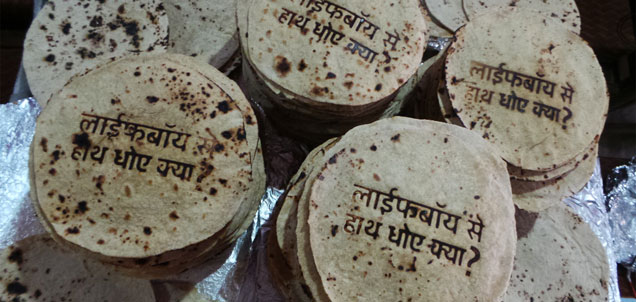
    Lifebuoy created a special heat stamp with the message, ‘Did you wash your hands with Lifebuoy?’ and then hired 100 promoters to stand in 100 kitchens spread across the Maha Kumbh Mela and imprint fresh rotis with the Lifebuoy message.


    Speaking about the genesis of the idea, Sudhir Sitapati, General Manager – Skin Cleansing, HUL says,” The idea came from the insight that hand washing with soap before eating can prevent transmission of many disease causing germs, but people often ignore or forget to do this simple act. A reminder at the right time can go a long way to ensure this habit is followed. This was the starting thought from which we developed a unique intervention – the Roti Reminder.”


    The activation was for a period of one month and started from February 1, 2013. Lifebuoy also provided free soap to attendees at the Kumbh Mela.


    The idea helped Lifebuoy reach out to a massive audience, at a fraction of the cost.


    The on-going commitment

    Over the years Hindustan Unilever has targeted its memorable campaigns towards achieving its aim, and Lifebuoy’s social mission has been to bring safety, security and health to people through the active promotion of hand washing with soap.


    In 2002, Lifebuoy started a campaign known as Lifebuoy Swasthya Chetna, to promote good health practices by actively encouraging people to inculcate good hygiene practices, such as washing hands with soap at least five times a day. From 2002 to 2010, the project touched more than 120 million Indians.


    Lifebuoy reached out to nearly 30 million people in rural India over 2010 and 2011 through a multi-brand rural outreach programme called Khushiyon Ki Doli (KKD) or “Caravan of happiness”.


    Over the past 10 years, Lifebuoy has taken its hand washing behaviour change programmes to millions of people across the world, and now through its latest campaign it is aiming to change the hand washing behaviour of a whole village in central India – Thesgora, a village with one of the highest rates of diarrhoea. The initiative supports Unilever’s goal to deliver on one of its commitment under its Sustainable Living Plan – to help more than one billion people take action to improve their health and well-being.


    By 2015, Lifebuoy aims to change the hygiene behaviour of 1 billion people across Asia, Africa and Latin America by promoting the benefits of hand washing with soap at key times.


  • Reckitt Benckiser’s Dettol Kitchen ad takes on HUL’s Vim

    By Ratna Bhushan and Sagar Malviya


    In a first for Reckitt Benckiser, the launching commercial for its Dettol Kitchen dishwashing and kitchen cleaning gel shows rival Hindustan Unilever’s Vim dishwash liquid clearly, in a move that may trigger a new advertising war between the two European multinationals.


    The commercial, first aired on Friday, marks the first time the Indian arm of the British consumer good major has directly attacked HUL in its advertising.


    Skirmishes between the two firms have been veiled in the past, although both have repeatedly taken each other to court and advertising watchdog Advertising Standards Council of India (ASCI).


    Officials of Reckitt Benckiser were not available for comment on the campaign. An HUL spokesperson too did not offer any comment on the subject. An official close to the developments said it was only a matter of days before HUL takes action against the disparaging ad.


    Experts say that even if HUL files a complaint to ASCI on Monday, the Dettol Kitchen ads released on Friday would have created maximum impact over the weekend.


    “Such ads gives a very strong message psychologically that it’s not just another product and they can compete with the market leader. While HUL almost has a monopoly in the segment, there could be more action now in an otherwise dull segment,” Nitin Mathur, consumer research analyst at Espirito Santo Securities, said.


    ASCI chairman Arvind Sharma, who is also the chairman & CEO of Leo Burnett in Indian subcontinent, said that featuring a rival brand in a campaign alone does not break advertising codes.


    “In general, the consumer complaints council code allows ads to show a rival brand as long as the claims made in the ad are fact-based,” said Mr Sharma who is also the president of Advertising Agencies Association of India.


    The consumer complaints council checks violations in advertising and initiates action as and when necessary.


    With this move, Reckitt Benckiser seems to have given HUL a taste of its own medicine.


    Two years ago, HUL’s ads for Rin detergent took a dig at rival Procter & Gamble’s Tide, clearly showing pictures of Tide in the Rin ad. P&G had moved the court within a day of the ad going on air, and the ad was stopped within days.


    As reported by The Economic Times last week, Reckitt Benckiser, which also makes Cherry Blossom shoe polish and Airwick air-fresheners, has taken its battle over germ-protection with HUL to the kitchen with the launch of Dettol Kitchen. India is only the second country after Korea to roll out Dettol Kitchen, a global innovation led by India.


    Reckitt Benckiser has positioned Dettol Kitchen as a ‘complete kitchen cleaner’, for use as a dish-washing gel and cleaning other kitchen surfaces like sinks and slabs.


    HUL’s Lifebuoy and Dettol have been rivals for close to three decades.


    The 80-year-old Dettol brand, launched first as an antiseptic liquid in 1933, has subsequently been launched across different categories including soap, plaster, handwash, shaving cream, hand sanitiser, and now kitchen cleaner.


    Vim, also an HUL power brand, has been dominating the dishwashing space for close to 100 years. The liquid dishwash segment is estimated at close to 300 crore, which is about 15% of the 2,000-crore overall dishwashing market that includes bars, powders and liquids. Growing at a rapid 40%, the liquid segment is the fastest growing among dishwashing formats.


    Apart from Vim, Dettol Kitchen will compete with Henkel-Jyothy’s Pril and Exo. Dettol has some 53% of the 300-crore handwash category, followed by Lifebuoy at a share of about 30%. But in soap, Lifebuoy has close to14% share, against Dettol’s 8.2% market share.


    The UK, Slough-based firm over a year ago named India as the headquarters for its South East Asia region, and placed India chairman and MD CM Sethi at the helm of 12 countries including Singapore, Malaysia and Thailand.


    The Dettol Kitchen commercial may trigger an aggressive ad war between British firm Reckitt Benckiser and Anglo-Dutch firm Unilever in India ahead of UK Prime Minister David Cameron’s visit to India from today (Feb 18).


    Source:The Economic Times

    Copyright © 2013, Bennett, Coleman & Co. Ltd. All Rights Reserved

     

  • HUL sells Lifebuoy by stamping rotis at Kumbh Mela

    By Sagar Malviya


    At Kumbh Mela, the largest congregation on earth where all big marketers are vying to sell their wares and boost their brands, one promotion that stands out is Hindustan Unilever’s ‘Roti Reminder’ for its Lifebuoy soap brand.


    The country’s largest consumer products firm, along with creative agency Ogilvy, has partnered more than 100 dhabas and hotels at the mela site to serve rotis that are stamped with “Lifebuoy se haath dhoye kya?” (Have you washed your hand with Lifebuoy?) “The ‘Roti Reminder’ gets a consumer’s attention at the exact time when hand washing is critical,” Sudhir Sitapati, general manager, skin cleansing, at HUL, says. That is, right when she sits down to eat roti with her hand.


    The company has made special heat stamps to make an impression of its message on rotis and hired 100 promoters to stand in 100 kitchens across the mela. The campaign started on February 1 and will run for 30 days. The company hopes to put the hand wash reminder on 2.5 million rotis.


    “The Maha Kumbh provides a unique opportunity to communicate this message to a large, predominantly small-town and rural population,” Sitapati says. “In effect, this simple, clutter-breaking idea will help us reach out to a massive audience, at a fraction of the cost.”


    Source:The Economic Times

    Copyright © 2013, Bennett, Coleman & Co. Ltd. All Rights Reserved

     

  • FMCGs saved on advertising cost in the March quarter

    By A Correspondent


    FMCG companies managed to rationalize their costs this March quarter. And one of the areas where they have managed to cut corners is the area of advertisement and promotion expenses.


    For 24 FMCG companies, the selling expenses as a proportion of net sales stood at 12.1 per cent – the lowest in at least the last ten quarters. This proportion stood at 12.9 per cent in the December quarter, 12.6 per cent in the September quarter and 12.7 per cent in the June quarter. Lower spend on advertising has helped companies to fairly protect and in some cases boost their operating margins. Most companies focussed more on below-the-line marketing activities rather than above the line ones.


    HUL has managed to bring down its ad spends by 100 bps from the previous year to 12 per cent of its total domestic sales for the quarter ended March 2012. ITC’s other expenses (comprising its expenditure on advertisement and promotion) stood at 22.6 per cent of net sales – lower than 22.9 per cent in the preceding December quarter.


    Another MNC, Colgate spent 8.5 per cent of its revenues on advertising – the lowest in the last four quarters. It spent 16 per cent and above in the first three quarters of this fiscal on advertising and promotion. Marico was one of the few companies whose advertisement and promotion spend was exceptionally higher at 14.3 per cent of its net revenues.


    Source: The Economic Times
    Copyright © 2012, Bennett, Coleman & Co. Ltd. All Rights Reserved

     

  • Paresh Chaudhry joins Madison PR as CEO, Veena Gidwani to retire

    Paresh Chaudhry

    By A Correspondent


    Madison PR has appointed Paresh Chaudhry as its CEO, who will be based in Mumbai. Veena Gidwani, current CEO of Madison PR will retire on June 30, 2012.


    Mr Chaudhry has over 24 years of Brand Communication and Reputation Management experience across industries and key global markets. He has been a business communication professional with Reliance Industries, Hindustan Unilever, Ranbaxy and Wockhardt. His last assignment was as Group President-Corporate Communications, Reliance Industries, reporting to Mukesh Ambani. Prior to Reliance, he was Head of Communications at HUL and Communications Leader, Unilever South Asia.


    Veena Gidwani

    From building the Corporate Brand of Ranbaxy in N America, Europe and India, to aligning regional communication country teams to bring alive “the transition to one Unilever brand” and driving the Corporate name change from “HLL” to “HUL”, to putting together systems and processes for effective global (internal & external) communications at RIL, Mr Chaudhry has experience and expertise in all areas of Corporate Communications.


    An MBA (Marketing) with a Public affairs diploma from Hong Kong University, he is the founder President of the Indian Forum Of Corporate Communicators (IFCC).


    Sam Balsara, Chairman and Managing Director, Madison World, added, “I am delighted to have Paresh join us. His cross client category and cross country experience should help him add great value to our FMCG clients. Veena has done a wonderful job in building Madison PR into a specialist Brand PR consultancy and meeting the professional needs of our over 40 clients in Mumbai, Delhi, Bangalore and Pune and I wish her a very happy and fulfilling life ahead”.


    On his joining Madison, Mr Chaudhry said, “I am delighted with the opportunity to work with Madison PR, that has carved out a distinct and distinguished niche within the industry and is known for its strong values and relationships with some of the best known companies in Corporate India. I look forward to working with Sam and his team of professionals to take Madison PR to the next level.”


  • FMCGs like HUL, Dabur, Godrej, Marico on consumption-driven growth

    By A Correspondent


    India’s fast-moving consumer goods, or the FMCG sector, has been able to weather the impact of an economic slowdown and rising input costs yet another quarter, as firms led by HUL beat street expectations both on top line and bottom line growth.


    A study of the aggregate financial performance of the leading 10 FMCG companies over the past eight quarters shows that the industry has grown at an average 16-21 per cent in the past two years with average operating margins being 22 per cent.


    Very few other industries can boast of having such a performance track record. “The consumer sector typically is the last and the least to suffer during a slowdown,” said Manoj Menon, senior analyst at Kotak Institutional Equities.


    Most companies are reaping the benefits of the direct distribution expansion mostly in rural India. HUL, for instance, has tripled its rural penetration in the last couple of years. Sales from modern trade have also been a strong growth driver for companies. Marico has posted a growth of over 45 per cent in revenues from its rural and modern trade businesses during FY12.


    The quarter to March performance of FMCG companies like HUL, Dabur, Godrej Consumer Products, Marico, Asian Paints, GSK Consumer Healthcare, Procter & Gamble Hygiene and Healthcare and Jubilant Foodworks is also a reflection of consumption-driven growth.


    Half of HUL’s 20 per cent revenue growth during the March quarter was volume driven. Dabur’s domestic sales rose 19.2 per cent with volumes rising 9.5 per cent. Godrej Consumer Products logged 30 per cent sales in soaps in India – 17 per cent of which was volume-driven. Asian Paints registered 29 per cent growth in its revenues from domestic business, of which 15 per cent was volume growth.


    The company had raised prices by close to 12 per cent on its portfolio during the quarter. Jubilant Foodworks, owner of the Dominos Pizza franchise in India, reported 26 per cent same store growth, which was almost entirely volume-driven despite the company raising its menu prices by 10 per cent. Marico has been able to achieve a 17 per cent volume growth for the March quarter from a total revenue growth of 23 per cent for the quarter.


    GSK Consumer Healthcare registered 14.5 per cent increase in net sales – 7 per cent of which was driven by volume growth and the rest through higher realisations on account of price increases. Nestle was probably the only company to have a largely value-driven revenue growth of 13 per cent during the March quarter.


    Exceptional value growth always carries the risk of hurting volumes. Till now, most FMCG companies have been able to perform well while balancing between volume and value growth. “Over the long run, we see consumer demand being resilient,” Nitin Paranjpe, chief executive officer of HUL, had said at the press conference following the company’s results. According to Mr Paranjpe, the secular trend of consumers is towards uptrading rather than downtrading.


    “The demand for consumer goods is relatively inelastic compared to that of other products,” explained Milind Sarwate, group chief financial officer, Marico. An earlier ETIG analysis of the growth in revenues and profits of leading FMCG companies revealed that companies registered a much faster growth in revenues and profits during periods of high inflation (in 1994-98 and again from 2006 till date) compared with periods of low inflation (1999-2005).


    “During an inflationary period, there is a likely market share gain for organised players from the unorganised regional players,” Mr Menon explained. Larger firms enjoy economies of scale on account of bulk buying and higher pricing power on their reputed brands.


    The ET FMCG Index has a price to earnings multiple of 36 against the Sensex P/E of 16.1. Stocks of Godrej Consumer Products and Asian Paints hit a new high ahead of the companies’ result announcements. Stocks of HUL, Marico, Dabur, Glaxosmithkline Consumer Healthcare and Jubilant Foodworks are hovering near record high levels.


    However, their current valuations are still lower than their all-time record levels. In case the broader economy is sluggish, analysts fear that the going may not be good for the sector in the coming quarters. “Moderation is very much on the anvil,” cautioned Mr Menon. For now, FMCG companies continue to live up to their reputation of being a defensive investment play.


    Source: The Economic Times

    Copyright © 2012, Bennett, Coleman & Co. Ltd. All Rights Reserved

     

  • HUL on a roll with Nitin Paranjpe at wheel

    By Kala Vijayraghavan & Sagar Malviya


    When Nitin Paranjpe took over at the helm of Hindustan Unilever Ltd (HUL) in April 2008 at 44, he became the youngest chief executive to head the Anglo-Dutch consumer products giant’s Indian operations. Now Mr Paranjpe has another one for the record books – he is the only CEO in the past two decades to be recommended by the board for a second stint.


    The man, who joined HUL way back in 1987 as a management trainee, has been reappointed managing director & CEO for another five years beginning April 2013. The longest serving head of HUL was Ashok Ganguly, who was chairman from 1980-1990.


    Of course, there is little guarantee that Mr Paranjpe would continue as CEO till 2018, what with previous CEOs – from Keki Dadiseth to MS Banga – going on to assume larger responsibilities at the parent company, during their stints.


    Paranjpe’s imminent second stint is just what the doctor – Unilever CEO Paul Polman – ordered. In 2010, Mr Polman, the first outsider to head the $40-billion consumer goods giant, mandated longer tenures for the top and middle management. Polman’s directive was to ensure greater organisational stability while tackling increasing competition and business volatility. The CEO’s view was that management stability would ensure quicker decision-making and accountability.


    That’s certainly been the case at HUL; and those benefits have translated in creation of shareholder value. When Mr Paranjpe took charge in 2008, the HUL stock was quoting around 230 levels. Today it is 87per cent higher at a little over 430; the benchmark Sensex has fallen 2.8per cent during the same period.


    Over the past two years, Mr Paranjpe added some 4,500 crore – quite literally the size of some mid-sized rivals – to its top line by increasing sales from Rs17,873 crore in fiscal 2010 to Rs22,394 in fiscal 2012 – a compounded annual growth of 12 per cent. “We want to set goals that are so audacious that, even if they are missed, the performance is still heroic,” Mr Paranjpe told ET.


    “There is an obsessive focus on the consumer that goes beyond just slogans and ensures execution. We are now gearing the organisation to future-proof the business through innovation, improving product quality, dramatically raising execution capability and ruthlessly focusing on costs,” he added. And then there’s the supply chain where the CEO says he “wants to be the best at both ends of the market, the top and bottom. There will be no compromises at any end.”


    The relentless consumer focus – the shareholder cannot be ahead of the consumer, avers Paranjpe – manifests itself in initiatives like Mission Bush Fire, an employee-led market execution and customer interaction exercise initiated in 2010 to get the home & personal care giant to connect with the market place. HUL CEO Nitin Paranjpe and every member of the company’s management committee participate in this project to get direct feedback on how HUL brands are faring.


    “Bush Fire has resulted in a 40 per cent spike in sales in stores wherever the initiative has been implemented, according to internal company estimates. And HUL managers say Paranjpe has led from the front. “There is nothing he expects us to do that he has not done himself. Nitin is out on the road making customer visits almost 15 days a month,” said a senior company official.


    Analysts are calling it a dream run. Abneesh Roy, associate director, institutional equities, research, Edelweiss Securities said: “HUL is in a growth phase with Paranjpe leading from the front with vigour and stability. His reappointment is a move by Unilever to reward his performance and execution capabilities as CEO.”


    HUL’s sales have been growing not just by value over the past several quarters, but also consistently recorded volume growth that is ahead of the market. Despite a spurt in input costs and aggressive spends in ramping up distribution, HUL has maintained its 2008 operating margin at 14.1 per cent during the last fiscal year.


    Company watchers say Mr Polman too deserves credit for HUL’s outperformance as it was the global CEO who injected a sense of aggression and put in place a performance culture across Unilever globally by linking rewards to results. For instance, it was Mr Polman’s decision to hike variable pay to as much as 50 per cent of total salary from 30 per cent as this would lead to hefty bonuses for those who deliver and penalise those who don’t. “We want to strengthen our performance culture and be intolerant of incompetence. Consumer centricity must be a non-negotiable in business and so we have put a lot of pressure internally so that we delight externally,” said Mr Paranjpe.


    Source: The Economic Times
    Copyright © 2012, Bennett, Coleman & Co. Ltd. All Rights Reserved
     

  • HUL to launch Mission Bushfire in 8 cities

    By A Correspondent


    Consumer goods major, HUL is launching Mission Bushfire 2012 this week to cover about 40,000 outlets (including general and modern trade) spread across 8 cities in India- Mumbai, Pune , Delhi ,Gurgaon, Bangalore, Chennai, Kolkata and Hyderabad.


    Mission Bush Fire’ is an employee-led market execution and customer interaction exercise initiated in 2010 to get the home & personal care giant to connect with the market place.


    This year the emphasis will be on the launch of skin care brand, the New Fair and Lovely. HUL employees from across functions will be participating in Mission Bushfire 2012 which will be held for the third successive year.


    HUL CEO Nitin Paranjpe and every member of the company’s management committee participates in this project to get direct feedback on how HUL brands are faring.


    In 2010, over 4000  HUL employees had participated in this mission to interact with the trade and consumers covering 14,000 outlets.


    Bush Fire has resulted in a 40 per cent spike in sales in store wherever the initiative has been implemented, according to internal company estimates. Mission Bushfire is an HUL employee led initiative that aims to create ‘Perfect Stores.’


    A research by HUL shows that 70 per cent of the brand purchase decisions are made

    at point of purchase. Perfect store programme is an initiative started in 2010 with objective of bringing the HUL brands from consideration set to the purchase basket of the shopper. The project is being driven through two initiatives called IQ and Better Stores.


    Project IQ has been instrumental in increasing the assortment and driving placement of new products through strong analytics and customization of tasks at an outlet level.


    Better Stores Project drives the visibility of the brands at the point of purchase through the right visibility mix, focus on plannograming (share of shelf) and advanced merchandising process using hand-held terminal (HHT) technology.


    Source: The Economic Times
    Copyright © 2012, Bennett, Coleman & Co. Ltd. All Rights Reserved
     

  • Ghari ousts Wheel to be Detergent No 1 (in Oct & Nov 2011)

    By Sagar Malviya


    Twenty-five years after launching a laundry brand inspired by Nirma, Ghari detergent appears to have edged out, at least temporarily, Hindustan Unilever’s Wheel from the number one slot in the Rs 13,000-crore laundry industry.


    Ghari, manufactured by Kanpur-based Rohit Surfactants Pvt Ltd (RSPL), had a higher share in October and November than Wheel, a brand that contributes over Rs 2,500 crore, or 12%, of the Rs 20,000-crore top line of Unilever Plc’s Indian unit.


    “As per value market share data, on a 12-month average share basis, the gap between Wheel and Ghari now stands at just 30 basis points; however, Ghari’s shares were higher than Wheel for the last two months,” said brokerage firm Prabhudas Lilladher in a report, dated January 2, quoting numbers from market research firm The Nielsen Company.


    In November, Ghari had a 17.4% share compared with Wheel’s 16.9%, according to people familiar with the numbers. The market researcher will generate data for December in the third week of January.


    Ghari’s achievement is reminiscent of the feats of Ahmedabad-based Nirma, whose eponymous washing power evicted HUL’s Surf from the top slot in 1985. Nirma achieved this by pricing its products considerably lower than Hindustan Lever (HLL), as the company was then known as.


    The resultant rumpus and the incumbent’s fierce response are part of Indian business folklore and have made it to management textbooks.


    HUL, which contributed 6% to Unilever’s top line in 2010, eventually prevailed as Nirma’s challenge faded in the early years of this century, with the global consumer giant stepping up marketing and advertising spend to levels its homegrown rival could not match. Wheel, the detergent whose market leadership is under threat, is very much a product of that period.


    HUL still dominates


    A powder variant of Wheel was introduced in 1988 to take on Nirma’s challenge. Despite the wobbles in October and November last year, HUL still dominates the detergent market with Wheel as the country’s largest brand on a yearly comparison, though the gap has been narrowing each quarter. The Hindustan Unilever spokesman declined comment on the data.


    “Our laundry category has grown significantly ahead of market in both volume and value in the period from January 2011 to September 2011. Wheel also contributed significantly to this with strong double-digit growth driven both by volume and price,” the spokesman added.


    The company said it could not validate the Nielsen data. “We cannot confirm the factual correctness of the market share data you have emailed as it is proprietary data of Nielsen. We request you to contact Nielsen to validate the data.” The Nielsen Company’s spokeswoman said: “As per company policy, I will not comment on brand specific data and will not be able to verify and validate the data.”


    Big hitters from Kanpur


    Both Wheel and Rin, another detergent from the HUL stable, have increased their market shares compared with the same year, but have been lapped by the faster growth achieved by Ghari, which was launched in 1987 by brothers Muralidhar and Bimal Kumar Gyanchandani.


    The Ghari phenomenon, emerging as it did from Kanpur, a business backwater, has been widely celebrated by many as an example of small town entrepreneurial chutzpah. “Losing share isn’t as big as losing leadership in its largest brand.


    In trying to maintain its margins, HUL didn’t adjust the pricing at the challenger’s level and that did the trick,” says a former HUL senior executive who was directly involved with HUL’s operation STING (Strategy To Inhibit Nirma’s Growth) in the late eighties.


    In 2011, Ghari gained not only by growing faster than Wheel but also yesteryear’s price warriors such as Nirma, which has less than 6% share now. “While Wheel may have maintained its market share, its other brand Rin has been consistently gaining share clearly reflecting the company’s premiumisation strategy,” said Anand Mour of Ambit Capital.


    “On the other hand, Ghari has taken share from smaller regional players, especially brands from the southern states, where it entered last year.”


    Ghari’s expansion


    RSPL attributes its growth to a variety of factors, including expansion to more states. The company has entered 10 more states in the last three years and now peddles its ware in 19 states, through more than 3,500 dealers. It has 21 manufacturing units, 15 of which were added since 2006.


    “We will be setting up plants in Bihar, Raipur and Karnataka soon to catch up with our sales growth of over 25% in the last nine months. Even in volume terms, we have been growing more than 10%,” said Mr Sushil Kumar Bajpai, president (corporate affairs) & company secretary, RSPL.


    Also, what’s helped Ghari is the sheer size of its home market Uttar Pradesh, which contributes 17% to total FMCG revenues, according to The Nielsen Company. Judging by its past, HUL is likely to respond fiercely.


    “Hindustan Unilever has a tremendous capability to fight back and they will do it soon,” says Mr Amin Babwani, an independent consultant who has spent three decades with HUL.


    It clearly has the marketing muscle to do so. The company’s existing distribution footprint in rural India, where a brand such as Wheel would sell, reaches nearly 200,000 villages, which is nearly double the industry average.


    “The growth in soaps and detergents segment will come from gradual upgradation of cheaper alternatives, ” said Mr Vijay Chugh of BNP Paribas Securities India in a recent report.


    Source: The Economic Times

    Copyright © 2012, Bennett, Coleman & Co. Ltd. All Rights Reserved