Tag: HUL

  • What they don’t teach you about retail at an MBA course

    What they don’t teach you about retail at an MBA course

    With apologies to none at all

    Vikas MehtaWhen I passed out from business school more than 35 years ago, India had not even entered the world of malls. Retail meant mostly mom-and-pop neighbourhood stores and every FMCG company worth its salt was into the depth of distribution. The role of wholesalers, in the Indian context, could never be overstated. While western marketing authors always used the words distributor and wholesaler interchangeably, In India depth of distribution meant huge dependence on wholesalers. Even for the HULs and the ITCs.

    But B-schools hardly explained the Indian wholesale phenomena. At best wholesale was referred to as buying in bulk, cheaply and then distributing it to retailers and earning good margins. In reality, it was almost the opposite. Sorry, not was. IS. Even today, wholesale is referred to as cheap. In fact there is a neighbourhood modern store in my area which is called Wholesale Store just because it claims to be at least 5% cheaper on almost everything.

    For the uninitiated, wholesalers in India buy across product categories, unlike most distributors. And it’s not just 5-6 categories but maybe 30-40 categories. The idea is to service kirana and groceries in small towns and villages with everything that they need. These shops may buy 20 soaps and five 1 kg detergent powder packs a month. A distributor cannot afford to service them as the margin on those small quantities does not cover even his/her transportation costs. A wholesaler, by servicing the whole gamut of products in a small kirana store, makes margins across product categories that allows it to make profits. And this allows sales at thin margins, in effect sometimes enabling a kirana store to sell below MRP. And that’s why the myth of wholesaler buying in bulk, selling cheap. S/he buys in bulk but across many product categories. S/he sells cheap because his depth of product categories allows him to do so.

    Since the last 35 years, trade has evolved rapidly. Modern trade, which is local supermarkets, emerged. They made shopping a pleasant and an involved experience. From dinghy, badly lit kirana stores, one could touch, feel and see the variety at offer.

    But it was the malls that shaped this modern trade into supermarket chains. The now-defunct Big Bazaar was the pioneer. There was Spencer too. And malls and big supermarkets were made for each other. Malls had big brands. In apparel, footwear. Electronics, fashion, etc. But the problem was that after the novelty wore off, the consumer would not visit regularly. One does not buy branded clothes or footwear or electronics every month. It’s maybe twice or thrice a year. Malls wanted footfalls every day.

    That’s when the concept of anchor stores came in. Consumers need groceries every week. So, if a mall could get a good supermarket, consumers would come in every week. And these would be located either on the top floor of the mall or at the end of a vast one level mall. The idea was that the consumer will get to see other stores and would be tempted to walk in, browse around and get attracted by offers. In fact, within a supermarket too, this concept works. Vegetables or daily products like milk, eggs bread are always at the end of the supermarket. So that you walk through the entire display and are tempted to buy more.

    Now, if consumers come in once a week, can we get them more than once? ‘Super Wednesday’ with the concept of mid-week replenishment came in. Or the concept of cheapest first seven days of the month. Traditionally, the local kirana would give credit which would be paid off in the first week of next month, once payday happened. This was one step ahead. Buy in advance for the month when your pay day happens. Stock up for the month.

    The concept of anchor stores got extended into multiplexes, food courts. All again on the top floor or at the end of the mall. Malls without anchor stores struggle. Even today.

    Retail had definitely evolved

    E-commerce of course changed retail forever. People call it retail at a click, I call it retail on wheels. It brought everything, even apparel to your doorstep. It made you lazy but it opened a new concept call gig workers. The delivery boys and girls. I would love to see some hard facts but I think that Dehradun, where I stay at least 20-30% of two wheelers on road are into delivery. And these have become brands in their own right. Ekart, Delhivery.

    But I digress. We think ecommerce changed the way we shop because they gave discounts. That’s a fact which cannot be disputed. But discounts were the sop. Today, we are used to paying delivery charges. One feels good that a saving of Rs 30 has happened on a Rs 250 order, but we also pay Rs 30 as delivery charges. Delivery charges have become so commonplace that free delivery today, is an effective promotion. That is the price we pay for the wheels. That’s why I call it retail on wheels.

    And today we are in the age of Q commerce. Quick commerce. Retail on steroids as I call it.

    I don’t think it’s about the 10-minute or 15-minute, quick delivery. I think it has touched the psychological sweet spot of completing the full shopping experience in a few minutes. Let me explain.

    Twenty or 30 years ago, shopping meant having a shopping list and going to the market to shop. One would spend maybe an hour or so, but in that one hour choosing, deciding, haggling, weighing and paying would happen. And one would be back home with the full shopping. Done and dusted.

    E-commerce actually stretched the shopping experience into days. Sure, one has a list. One clicks and checks out. But then one has to wait for delivery. It could be 24-72 hours. It causes anxiety. Will someone be at home when the order is delivered? Will all the stuff come? Will there be some mistake in the quantity? Will the quality be satisfactory? To assuage these came delivery on fixed time slots, return policy etc. But it was ironical that the shopping experience took longer to complete.

    Q commerce actually is a panacea to that. It came at a time when consumers were used to discounts. Q commerce offered it. Consumers were used to delivery charges, Q commerce extracted it. In fact, during certain hours Q commerce charges rush surcharge. And yesterday on Blinkit I saw a rain surcharge and it said that it’s raining heavily in the vicinity of the store so…. You get the point.

    But, more importantly, by delivering in 15-20 minutes, Q commerce rounds up the full shopping experience and frees one from all the worries. That’s why it’s been such a big success. It’s like going to your neighbourhood store and buying three-four things and coming back in 10-15 minutes. Except, this neighbourhood store also sells iPhones and pooja thalis.

    And like anchor store,s Q commerce is trying to make you visit more often. Just one example to explain this

    Big Basket every day morning sends me notification of some deals. All offers for Rs 29. Sometimes for Rs 10. Or BOGO. Buy one get one free. Or flat 15% off on bakery. Now it’s a good trick to get one to browse. Rs 10 could be a small Lays packet or a small scrubber or even 100 gms ladyfinger. But with that the bigger packs or larger quantities are also available. So, when I click the option, I may not want 100 gms ladyfinger but definitely 500 gms, so I buy that. In lure of Rs 10 I have entered the store and done shopping which I was not planning to.

    I started this column with the grouse that one never learnt wholesale distribution during MBA, I suspect it doesn’t happen even today. Do MBA courses keep pace with the evolutionary trends? Is Q commerce in the curriculum. Is the difference between Omnichannel retailing and multi-channel retailing being taught? Has the faculty participated along with the industry to understand the evolution? Or are the colleges and Universities just paying lip service by taking a guest lecture or two on the topic. Or holding a webinar?

    This column is not to criticise but to reflect upon how much has changed in the retail sector and are our MBA courses reflecting those changes?


  • Priya Barve joins WPP as Client Lead for HUL

    Priya Barve
    Priya Barve

    Priya Barve has joined WPP as India’s Client Lead for Hindustan Unilever Limited. Barve brings over two decades of experience in advertising and marketing, and has held leadership roles with Google, Mondelez, and Leo Burnett across Asia-Pacific.

    Commenting on the appointment, WPP Chief Client Officer for India, Shubha George, said: “A consummate professional, Priya brings a wealth of experience in aiding business success and digital transformation, as well as key local insights that needed to win in many Indias. HUL is one of WPP’s key clients, one with whom we have had the pleasure of working with for a number of years. We are delighted to see Priya joining the team to lead such an important client relationship and look forward to driving further business growth and innovation together with Unilever.”

  • Ananya Panday partners with Tresemmé

    Tresemmé, the hair care brand, has partnered with actor Ananya Panday. To kick off the arrangement, Tresemmé will launch a series of TV and digital campaigns featuring her.

    Said Harman Dhillon, Executive Director, Beauty & Wellbeing, at Hindustan Unilever Limited (HUL): “We are thrilled to welcome Ananya Panday to the Tresemmé family.  Ananya embodies the spirit of the modern woman who is bold, confident, and aspirational. We strongly believe she is the perfect fit for Brand Tresemme which has always helped women look and feel her best, every day, not just salon days. She will inspire our consumers to embrace their individuality and express themselves through their hair.”

  • Brooke Bond 3 Roses collaborates with CSK for new TVC

    By Our Staff


    Brooke Bond 3 Roses tea brand launched its new TVC Idhu Namma Tea(m), where it has partnered with the IPL team ‘Chennai Super Kings’ for its 15th edition. The campaign highlights the message of ‘Idhu Namma Tea, Idhu Namma Team’ (It’s our Tea, It’s our Team) to connect with the audience by accepting and trusting the new members of CSK.


    Said Shiva Krishnamurthy, Vice President, Tea & Foods (HUL): “Brooke Bond 3 Roses is South India’s most loved tea brand and an icon of Tamil Nadu. Being Tamil Nadu’s favourite tea, we are happy to partner with Tamil Nadu’s favourite tea(m), Chennai Super Kings, during this year’s IPL. Our Idhu Namma tea(m) campaign celebrates Tamilians’ love for 3 Roses tea and for CSK with lots of warmth and affection.”


    Added Ajay Mehta, Senior Vice President, Mindshare: “With the IPL season, we took this golden opportunity to associate with Chennai Super Kings, a team that unifies entire Tamil Nadu and resonates well with the brand’s philosophy of togetherness. The films capture this in a light-hearted manner and that too over a cup of tea.”


  • Wavemaker & HUL win big at Emvies 2022

    By Our Staff


    Pradeep Guha trophy for Young EMVIE Of The Year
    Pradeep Guha trophy for Young EMVIE Of The Year

    Media agency network Wavemaker pipped sibling Mindshare to be Agency of the Yeat the Emvie Awards held on Friday, March 25. The 22nd edition of the coveted Emvies happened in Mumbai with much fanfare and a full house. Hindustan Unilever was Client of the Year.


    The Advertising Club (TAC), this year, received 1054 entries with around 25 agencies participating. There were over 1200 professionals in attendance as 26 Gold and 51 Silver Emvie trophies being presented in addition to 42 Bronze Winners receiving recognition.


    Wavemaker Is The Media Agency Of The Year
    Wavemaker Is The Media Agency Of The Year

    Wavemaker with 395 points was ‘Media Agency of the Year’ and it also bagged the coveted the Grand Emvie for Mondelez India for the Cadbury Celebrations – Not Just a Cadbury Ad (Best Response to Covid 19). Mindshare with 375 points stood second and Lodestar with 160 points stood third.


    Hindustan Unilever Limited was declared ‘Media Client of the Year’. The Best Implementation Team of the Year award went to Wavemaker for Mondelez India Food Pvt. Ltd for Cadbury Celebrations  – Not Just a Cadbury Ad Google, the Presenting Sponsor, instituted special recognition for work done in the area of Inclusion. The campaign that backed the honour was McDonald’s  – Eatqual – One Bite Closer to Equality by DDB Mudra.   This will be a regular category in the EMVIE entry form from the next year.


    Hindustan Unilever Limited Is Best Media Client Of The Year
    Hindustan Unilever Limited Is Best Media Client Of The Year

    The Times of India Group instituted the Pradeep Guha trophy for the category Young Emvie of the Year.  The Pradeep Guha trophy was presented on stage by Partha Sinha, President, actor Dia Mirza, and Papia Guha wife of the Late Pradeep Guha.


    Said Aditya Swamy, Chairperson Of Emvie’s Organising Committee: “It is the privilege of the The Ad Club to shine the light on the best work in our industry and it is our endeavour through our award shows to inspire our community to keep raising the bar.”


    Added Partha Sinha, President, The Advertising Club: “It’s great to be back on the ground. The energy was infectious and the agency and clients had an excellent time celebrating the spirit of excellence. The winners were not only just best in class in India but they were of global standard. No wonder Emvies is called the Oscar of media awards.” said


  • HUL rolls out initiative for waste segregation

    By Our Staff


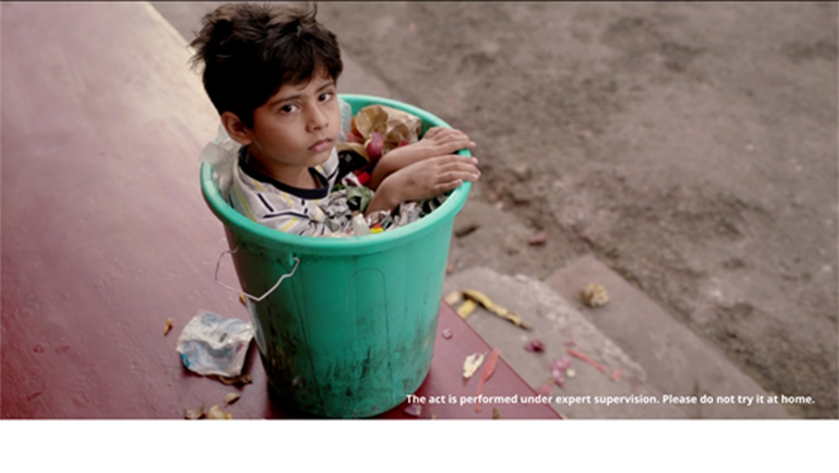
    Hindustan Unilever Ltd (HUL) has launched a campaign that looks to inspire individuals to segregate household waste at source and ensure that waste stays out of the environment and in the circular economy. The ‘Bin Boy’ campaign through its child protagonist ‘Appu,’ aims to drive behaviour change among citizens and urge them to segregate waste at homes and residential societies. Through an engaging narrative and thought-provoking dialogue, the campaign draws attention to the seriousness of mixed waste disposal and need for immediate action.

     

    Speaking on the campaign Sanjiv Mehta, Chairman and Managing Director, Hindustan Unilever Ltd said: “The need for urgent action on the issue of waste segregation has never been greater. At HUL, we recognize our role in this context and have been working with leading agencies in the space and the Government to drive what is a simple, positive action that each of us could do. We work towards empowering communities to reach the goal of swachhata and a zero-waste circular economy. Children are the strongest advocates of change in society and are also the strongest drivers. We believe that our latest campaign with a child protagonist will inspire and unite citizens to create a waste-free, greener tomorrow.’’


  • Lowe creates campaign for Vim dishwash

    By Our Staff


    Vim dishwash brand has launched a TVC as a tribute to successful women. With a tagline ‘Nazariya Badlo, Dekho Bartano Se Aage’, the campaign is a nudge to society to see women beyond archaic roles.


    Commenting on the launch of the campaign, Prabha Narasimhan, Executive Director & VP – Home Care, South Asia at HUL said: “Vim is the market leader in Dishwash by far and has helped make the dishwashing process easier and hassle-free over the ages. We are inspired by the successful women around us who excel in whatever they do, being homemakers and decision-makers. They are already way more than chores, but sometimes get limited by society’s definition of chores being a woman’s primary responsibility. If we offload them from these societal stereotypes and the stress caused by them, there is so much more they can and will be. At Vim, that is precisely going to be our endeavour with ‘Nazariya Badlo, Dekho Bartano Se Aage’.


    Speaking about the same, Prateek Bhardwaj, Chief Creative Officer – Lowe added: “This campaign speaks to the mindset that when a man does the dishes, he’s ‘helping’ the woman of the house. An act for which society applauds him, when in fact it’s something that he should be doing as a member of the household. Nudging the society to realize this double standard that exists was at the heart of this campaign.”


  • Mindshare launches Pujo campaign for Sunlight detergent

    By Our Staff


    Sunlight, the detergent brand, has announced the launch of its new initiative ‘Sunlight Tantir Rong’ to support Bengal’s local handloom weavers.


    Commenting on the initiative, Prabha Narasimhan, Executive Director – Home Care, HUL, said: “Since time immemorial, handlooms have been a part of local culture in West Bengal and many of these weavers who have been adding colours in our lives since generations have been hit hard by the pandemic. We are delighted to launch ‘Sunlight Tantir Rong’, an initiative which will provide the community with a platform to showcase their magical art and talent and bring them at our fingertips. This initiative is a small step towards bringing back colours to the lives of these weavers and their families.”


    Added Ajay Mehta, Head Content Partnership and Experiential, Mindshare: “For an iconic brand like Sunlight being weaved into the local culture of its bastion market is a key unlock to build a strong connect with its target audience. The campaign ‘Sunlight Tantir Rong’ allows us to beautifully bring alive the brands values & purpose by standing for the betterment of the Weaver community in Bengal. A humble attempt to bring back colours into the lives of the local weavers of West Bengal.”


  • Domex challenges Harpic in latest campaign

    By Our Staff


    Domex, the home cleaning/disinfection brand from Hindustan Unilever Limited (HUL), has launched a new campaign that takes on Harpic.


    Commenting on the category and the campaign, Prabha Narasimhan, Executive Director & VP – Home Care (South Asia), Hindustan Unilever Ltd said: “For over two decades now, Domex has been a trusted brand committed to providing superior hygiene and clinical disinfection solutions to consumers across the country. The latest communication is in line with our goal to give consumers the evidence to help make informed decisions determined by scientific insight and technology.  Our extensive studies, research and data-backed certifications underpin the superior science-first formula of the offering. Battling the second wave of the pandemic, we are all well aware that hygiene, safety and disinfection are three facets which will dominate our collective consciousness and as a brand we have been consistently innovating to address, upgrade and deliver on these core parameters being sought by consumers in their everyday lives.”


  • Abhinav Tyagi is SVP-Marketing @ Urban Company

    By Our Staff


    Abhinav Tyagi

    Urban Company (formerly UrbanClap), home services marketplace, has announced the appointment of former HUL hand Abhinav Tyagi as Senior Vice President, Marketing.


    Commenting on the appointment, Varun Khaitan, Co Founder Urban Company said: “We are thrilled to welcome Abhinav to the Urban Company leadership. Working across countries, categories and cultures, has given Abhinav a unique opportunity to understand and develop deep consumer understanding and insights across different stages of category and brand evolution – something we believe can add great value to Urban Company given the width of categories we operate in and continue to develop across the globe. He will play a key role in strengthening our marketing capabilities as we build towards our mission of transforming home services worldwide.”


    Added Tyagi: “Urban Company is on a very exciting journey of radically enhancing the home services experience for consumers and the quality of life for professionals delivering those services. I count myself fortunate to be able to come on board and help build upon the wonderful work being done by the team at UC and look forward to helping take the UC experience to many many more consumers globally.”


  • GEC AdEx in 2020: Commercial ads: 55% share, Promos 45%


    By Our Staff

    TAM AdEx has released the second of its reports on 2020 for television advertising. This time it focuses on advertising on general entertainment channels.

    Here are some highlights

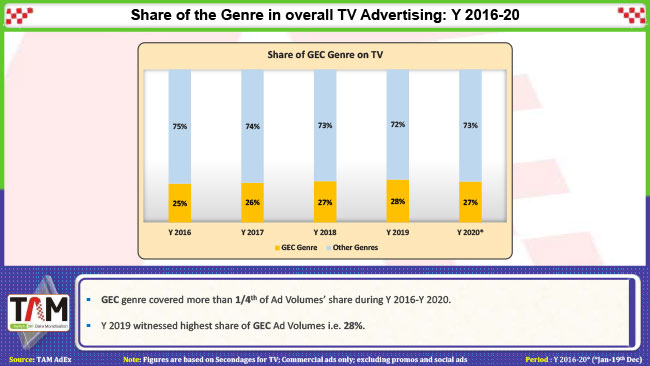
    GEC genre covered more than 1/4th of Ad Volumes’ share during Y 2016-20.

    True Shield Hand Sanitizer was the top brand during Apr’20 to Jun’20 & Aug’20 in GEC Genre.

    Toilet Soaps leads among the Top 10 categories of GEC Genre with 9% ad volume share in Y 2020.

    Ecom-Media/Entertainment/Social Media saw highest increase in ad secondages during Y 2020 compared to Y 2019 in GEC Genre.

    In GEC genre, HUL topped among the GEC advertisers followed by Reckitt Benckiser on 2nd position during Y 2020.

    6 out of Top 10 brands on GECs were from HUL and 3 were from Reckitt Benckiser.

    1.3K+ advertisers & 2.7K+ brands exclusively advertised during Y 2020 on GECs compared to Y 2019.

    Primetime is the most preferred time-band on GEC genre followed by Afternoon and Morning time-bands.

    20-40 second ad commercials were most preferred for advertising on GECs during both Y 2019-20.

    Commercial advertising added 55% share of Ad Volumes on GECs whereas Promos had 45% share in Y 2020.

    Highlights of the report are Advertising Trend during Lockdown versus Unlockdown, Covid Prevention categories, Celebrity Endorsement, Social Ads by Govt. etc.

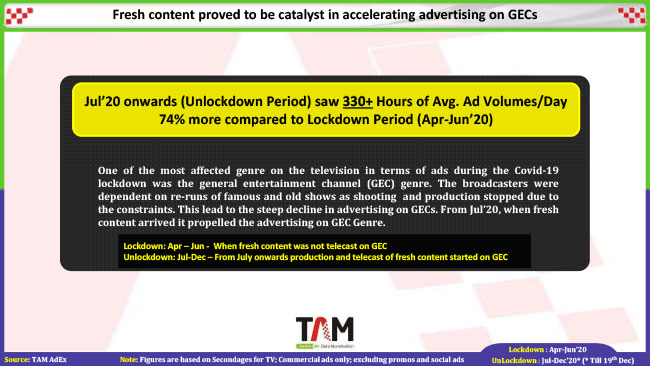
    According to the report, advertising volumes in 2020 saw a marginal rise versus what it was the previous year (2019). Average ad volumes in the all-important fourth quarter of the year rose 39% over the average ad volumes in the first three quarters of the year. There was 90% growth in Average Ad Volumes/Day witnessed during Post Lockdown period.

    FMCG players ruled the list of Top 10 advertisers with HUL leading the list. Four of the Top 10 brands advertised were from Hindustan Unilever and three were from RB. Personal Care/Personal Hygiene sector had 20% share of Ad Volumes followed by F&B with 18% share.

    Please click on this link for the report:

    TAM AdEx – Mirroring Y 2020 for GEC Genre


  • Horlicks’ new TVC celebrates confidence

    By A Correspondent


    Horlicks has unveiled a new new film that highlights the journey of childhood. The film, notes a communique, brings alive the fact that today’s stories should not be limited to the intrinsic physical growth benefits but to the courage and confidence that children display when they grow well.


    Commenting on the latest TVC, Sudhir Sitapati, Executive Director, Foods & Refreshment, HUL said: “India’s nutrition journey is central to the growth of the country. Nutrition is also the primary motivation that drives the mother, as a gatekeeper to the family’s health, so that the child can meet each moment with their full potential. Through this special film, we seek to celebrate the deeper meaning of growth that stems from courage and confidence. We truly believe that children, when enabled to their full potential, will lead the world through change and troubled times.”


    Added Swati Bhattacharya of FCB:  “What does a child growing up mean to a mother? Is it the annual health check-up or do they happen in moments suddenly, unrehearsed taking her by complete surprise? This is a grown-up version of our old promise of taller stronger sharper children, now it takes it to the next level where the child applies it to life.”