Tag: GroupM

  • The Power of Email in Marketing


    By Brian Wieser


    Brian Wieser

    Marketing technology continues to grow in importance, and email software one of the its most important sub-sectors. From analysis of our recurring tracker of headcount data via LinkedIn covering hundreds of pure-play companies in the adtech and marketing technology software sectors, we estimate that the combined group of companies grew by +10% year-over-year during 2Q19, similar to growth observed during the first quarter. Growth among these companies presents a stark contrast with ad tech-focused companies, which account for around a quarter of the activity captured here, and which were once again weak, declining by -1% year-over-year in 2Q19. One sub-sector performing better than this average is the collection we are tracking which are centred around or generally reliant on email service platforms, with component companies expanding by +15% during 2Q19.

    Email software enables media exposures. At a high level, email can arguably be viewed as more of a form of media than marketing technology, focused as it is on capturing consumer attention or driving a consumer action following an exposure. While practitioners who focus on email often characterise the medium as focused on retention or other loyalty-based marketing goals, it can be used to support brand-building objectives typically satisfied by other media. For example, a consumer who has chosen to engage with a brand and provide an email address may do so because they like that brand or its content; however, the brand may not always be top-of-mind without recurring reminders. Email is one way to provide those reminders.

    Email also serves as a critical source of data for marketers. More generally, an email address is often the best representation a marketer has for an individual customer and, consequently, email marketing software can attempt to serve as a “database of record” by capturing data on all of a marketer’s customers. For this reason, “marketing cloud” suites featuring a wide array of marketing technology software are often centred around email marketing software, which helps to plan, execute and monitor campaigns. Most of the industry’s largest players established their presence in this space via acquisition, as with Salesforce buying ExactTarget, Oracle buying Responsys and Eloqua, and Adobe buying Neolane and Marketo. Many other marketing cloud services featuring significant email offerings exist today, such as HubSpot, and then there are a wide range of independent point solutions including Mailchimp.

    Email has many intersections with other forms of media. Most prominently, email addresses are core to important ad products such as Facebook’s Custom Audiences and Google’s Customer Match. This is because of email’s capacity to identify unique customers and to build customized segments of actual customers, lookalikes, prospects and non-customers alike. Further, when brands send engaging content through email, they will have permission from a consumer to land in their inbox and deliver exposure to a subject line, even if the email is never read. This can have the effect of reinforcing media activity on other channels by providing consumers with brand-related reminders. The symbiotic relationship between awareness/acquisition focus of other digital media and retention/loyalty goals of email requires a focus on the right kind of awareness – among consumers likely to be loyal, for example – versus those not likely to become customers or likely to churn quickly. This can dramatically impact the effectiveness of a total media budget.

    Marketers tend to intentionally segregate responsibilities for email. Despite email’s potential to play a more powerful role, it is often segregated within marketers’ organisations, with email falling under teams responsible for CRM and not necessarily aligned with media management. Integration would allow more flow between awareness and loyalty-focused activities. Ideally, more integration between these functions would mean more seamless application of data and better customer segmentation for email and non-email-based platforms alike. The result: more efficient resource allocation overall.

    While there are certainly examples of marketers doing this well, direct brands and others with direct relationships with consumers probably do it better than others. This kind of integration doesn’t appear to happen often enough. Why?

    One rationale frequently relates to the more general separation between responsibilities for loyalty programs and CRM versus media and the different tactical goals associated with each type of spending. Budgets are then assigned and managed separately which reinforces silos. Once this has happened, a marketer’s procurement professionals may entrench these silos because of a common focus on optimizing individual functions rather than entire organisations.

    The need to “break down” silos and integrate marketing activity is not unique to email. Lessons learned from other silo-busting efforts are likely to be applicable here. Marketers can realise benefits from tying email campaigns, CRM-related activities, loyalty programs and other digital-centric activities to paid digital media campaigns. They can more tightly integrate email and digital media budgeting on a more dynamic basis, or they can foster collaboration more generally between different teams.

    Many marketers demonstrated that they can support collaboration between different functions, as with efforts to encourage creative and media to work together in the years following the unbundling of these disciplines. The view that the two related functions work better when integrated rather than segregated is likely as applicable to email and other digital media as it is to creative and media. Marketers who believe that integration should exist in one sphere will probably find similar benefits from others as well.


    Brian Wieser is Global President, Business Intelligence GroupM. This article was originally published at https://www.groupm.com/news/e-mail-message-digital-integration




  • E-comm Trends: Marketplace Thrives, D2C Slows


    By Brian Wieser


    Brian Wieser

    The increasing importance of e-commerce is two-fold:  it shapes the behaviors of consumers and manufacturers and it also has a significant impact on the media industry because of the different ways advertising is used to support different kinds of e-commerce activity. Consequently, variations in growth between direct-to-consumer (D2C), first party online retail and third-party marketplaces are important to monitor.


    Key takeaways:  
    1. E-Commerce is still growing but is decelerating in key markets and will decelerate globally by a couple of percentage points.
    2. Marketplaces are dominating e-commerce and are growing faster than the overall industry.
    3. E-commerce related spending on advertising is growing much faster than total digital advertising and holds implications for both marketers and media owners.


    E-commerce is still growing fast, but it is also decelerating. E-commerce (usually defined as retail sales transacted primarily through internet-based devices, but not including online travel nor including offline sales completed after browsing online) is growing rapidly and transforming how consumers engage with brands around the world; however, the sector is decelerating overall:
    •  According to data from the U.S. Census Bureau, e-commerce in the United States grew by +14% in 2018 following on a +16% growth rate in 2017. However, growth appears to be decelerating further in 2019 as the sector rose by +12% in the first quarter of this year.
    •  China’s official government statistics service indicated online retail sales of physical goods were up +25% in 2018 versus +28% in 2017. Sales slowed further in the first quarter, rising +21%.
    •  Meanwhile, in Europe, trade association Ecommerce Europe estimates +12% growth there in 2018, down from +14% in 2017. While the most recent quarterly data is not yet available for all of Europe, the largest market in the region, the U.K. saw +16% growth in 2017, +14% growth in 2018 and, in the first quarter of 2019, experienced similar deceleration with only +12% growth.

    These trends seem to indicate that global growth will also likely decelerate by a couple of percentage points over the course of 2019 as well.  Within these averages, there will be different rates of growth for different types of e-commerce activity including:
    •  Conventional retail, where an entity takes possession of products made by other manufacturers
    •  Marketplaces, where an entity provides a platform for manufacturers to sell
    •  D2C, where a manufacturer sells products directly to consumers without an intermediary. There is also a dimension of “mass” vs. “niche” focus, and hybrids of each of these concepts can exist in every combination.


    Marketplaces are dominating e-commerce. With annual spending on e-commerce around the world amounting to $2.9 trillion (on Internet Retailer’s estimates), marketplaces account for a majority of activity and are growing faster than the overall industry. The top 100 marketplaces generated $1.7 trillion in sales in 2018, up +20% year-over-year, which followed on 34% growth during 2017 for a similar group of entities. Within this segment of the industry, niche marketplaces have generally grown faster than the overall average in both years as well.


    By contrast, D2C, while harder to define narrowly let alone quantify with much precision, is likely growing much slower. A subset of companies among the U.S. Interactive Advertising Bureau list of 250 direct-to-consumer (D2C) companies, or direct brands, which we have identified as having more than 100 employees as of the end of 2016 indicates employment growth of +17% in 2017 and +9% in 2018. Growth for this group of companies through the end of June amounted to a similar +8%.

    Growth rates deviate for individual direct brands, but also indicate a broader slowdown: the median growth rate for individual companies among this group was +17% during 2017, but only +2% during 2018. Year-over-year median growth for the group was a similarly tepid +4% through the end of June 2019. Of course, revenue growth, will not likely track as closely to LinkedIn data for companies in this sector as in others, such as ad tech or marketing tech, but the data is likely reflective of broader trends. Importantly, the concept of the direct brand is most likely growing faster than these levels indicate as larger marketers incorporate D2C business concepts into their overall strategies and invest more heavily into this sector.


    E-commerce-related spending on advertising is growing much faster than total digital advertising. The U.S. Census Bureau has produced data indicating that electronic shopping retail companies allocated four percent of their gross revenue to their own advertising activities during 2017.  This is similar to the percentage of gross merchandise value (GMV) that Amazon allocates to advertising as well as the advertising/gross merchandise volume ratio for a composite of five other scaled e-commerce pure-plays with explicit advertising spending disclosures including eBay, Wayfair, Stitch Fix, Etsy and Overstock.

    While it is worth noting that smaller e-commerce companies allocate a significantly higher share of GMV to advertising, one could reasonably assume four percent of retail-related e-commerce activity is allocated to advertising in markets where these companies operate.  In a country such as the United States, assuming most of the spending goes to digital media, this would translate to around 20% of total digital advertising activity for the industry’s media owners. Importantly, the four percent of e-commerce activity assumption does not appear hold up in China, the world’s largest e-commerce market, as the two biggest owners of e-commerce properties there allocate less than one percent of GMV to paid advertising.

    Whatever the current share, it is likely rising and growth in ad spending by e-commerce companies is expanding by much more than GMVs.  As we can see from e-commerce company financial statements:
    •  Amazon accelerated its spending on advertising during 2018 as well, with +30% growth last year vs. +26% growth in 2017, although the acquisition of Whole Foods and non-e-commerce initiatives undoubtedly contributed to their outcome.
    •  A composite of eBay, Wayfair, Stich Fix, Etsy and Overstock increased spending on advertising by +23% during 2018 after expanding by +19% in 2018. GMV for this group rose by +9% in 2018 and +7% in 2017.
    •  Looking only at Wayfair, Stich Fix, Etsy and Overstock, advertising growth was +45% in 2018 after growth of +38% in 2017 while GMV was up by only +29% in 2018 and +22% in 2017.

    If overall growth in spending on advertising by e-commerce companies on digital media exceeded +30%, this would have far outpaced total digital advertising growth, which we estimate averaged +20% in 2017 and +19% in 2018 around the world.


    Different types of e-commerce activities will impact digital media ad spending trends in different ways. Marketplaces are media owners themselves and can generate ad revenue from the manufacturers they work with. Individual participants in the marketplace – especially smaller ones – compete to drive incremental sales, and may increase their spending on advertising at a pace that exceeds revenue growth as they compete with other marketplace participants. Conventional e-commerce-related retail platforms also generate ad revenue but will mostly do so from larger manufacturer co-op budgets which are more likely to only grow in-line with sales. Both marketplaces and conventional e-commerce retail have opportunities to expand their roles as sellers by investing more heavily in search related capabilities for their properties.

    And yet, at the same time, growth in these types of e-commerce platforms can help traditional sellers of search advertising because the e-commerce platforms need to spend money to drive traffic to their properties, and search can be a particularly effective way to do this. Faster growth for marketplaces, especially including niche ones, will probably help sustain this trend.

    By contrast, direct brands typically spend much more heavily on social platforms and with influencers, especially as they first emerge. A slowdown in D2C revenue growth could have a decelerating effect on the preferred media channels of direct brands, offset by increases in spending as a percentage of revenue. As social commerce takes on greater importance for all participants in e-commerce, social media platforms could benefit from this trend as well.


    As e-commerce takes on greater importance, implications for media owners follow. When it comes to e-commerce, business strategy is still paramount. As our colleagues at Wavemaker have conveyed, marketers need to begin by focusing on retail planning, the role of each channel, designs of internal structures, catalog strategies and product setups, and retail optimization, operational excellence, commercial excellence, retail analytics and business intelligence as well as promotions and events.  Retail amplification – including paid media as well as reviews – is critical, but it depends heavily on planning and optimization as a starting point. Understanding growth trends underlying e-commerce-related advertising can help to support this latter objective by identifying which media are likely to fare relatively better or relatively worse into the future.


    Brian Wieser is Global President, Business Intelligence at GroupM. This article was published at


  • Agencies: And now, a Commercial Break


    By Brian Wieser


    Brian Wieser

    Strong work, weak industry. With the Cannes Lions International Festivity of Creativity under way this week, many of the world’s creative and media agencies will deservedly receive accolades. However, it will be difficult to not notice the contrast between the high quality of the work on display against the weak business conditions of the industry which produced it.  We previously explored some of the reasons behind those conditions and some alternative ways to analyse them in a note which can be found here: https://www.groupm.com/news/agencies-basis-optimism


    A key topic we did not explicitly review in that previous assessment, but which overlaps with the factors we described (and which serves as a basis for negativity among those with bearish views on the industry), is the insourcing of work commonly provided by agencies to marketers.


    In-housing was once the default option for all marketing-related activities before agencies came along. At least as far back as the mid-19th century, marketers could contemplate whether or not some of the labour required to produce the work they required should be performed by their own employees or by external specialists.   By the late 20th century, most creative and media activity from large brands was outsourced to agencies.  However, marketers still continued to perform many functions in-house.  In many industries, without formally declaring the formation of an inhouse agency, large marketers commonly oversaw the development of creative assets as well as some media buying, especially in print).  Media owners often served as partners in these processes, and agency involvement could be minimal.


    Biddable media, access to data and changing needs encouraged some marketers to revisit insourcing in the past decade. In more recent years, several factors caused many marketers to revisit what they insource vs. what they outsource.  Those factors include:

    :: The rise of search and self-service buying platforms in general

    :: The anticipated emergence of other forms of biddable media

    :: Access to sensitive customer data that could be used in trading integrated with other non-media functions and

    :: The increasing need for tighter time frames in accomplishing tasks.


    While costs or fee concerns (or sometimes, relatedly, fee transparency) might have been cited by some marketers as they considered revisiting in-housing, those who ultimately followed through typically did so because they believed the choice presented strategic advantages.   Some who have explored in-housing ultimately chose not to do so, while some who have in-housed have reversed their choices.


    Others have found hybrid models to be a preferred approach and now work with agencies differently than they did in the past.  Some who have followed this path have taken ownership of more of their contracts, used creative agency production decoupling services or engaged with their media agency’s programmatic consulting services to complement in-housed efforts.


    Knowing how much money has flown in-house is difficult (if not impossible) to assess. Knowing the advantages agencies offer is much clearer. Attempting to quantify the scale of any shift towards insourcing is tricky at an industry level, largely because marketers never publicly disclose spending on the agency-like activities they perform in the first place.  Further, companies merge, demerge, grow and decline over time, making it particularly difficult to make reasonable historical estimates.  It’s safer to recognize that there always has been a significant amount of work performed in-house and there likely always will be.

    By contrast, the reasons why marketers benefit from using agencies are much clearer. At the risk of appearing promotional – although what is the advertising industry about if not that? – it is always worthwhile to be mindful of the advantages that agencies provide to marketers when marketers choose to outsource:

    :: Lower fees on a like-for-like basis for most inputs vs. what the marketer can realize on its own, such as technology licenses or non-biddable media

    :: Application of learnings and best practices, many of which can lead to meaningful cost savings vs. not applying them.  For example, a media agency will typically have superior knowledge on aspects of campaigns (such the optimal length of a campaign flight on a given medium for a given type of advertiser) which can lead to lower overall costs even where like-for-like media inventory costs are identical

    :: Better access to talent, both because of the breadth of the experience talent can receive and the career paths those individuals are more likely able to pursue

    :: Development of proprietary products for use by multiple clients who can then take advantage of an agency’s scale

    :: More institutional experience working with tools, such as data analytics products

    :: Application of insights from across any one media channel to any other channel (for example, assessing the impact of a TV campaign on search effectiveness and vice versa)

    :: Prioritization from partners (such as media owners and technology vendors) both because of scale but also because of presence of greater numbers of staff with relevant technical expertise

    :: Better visibility on the critical issues facing the industry and thus a louder potential voice on topics that vendors and marketers should focus on.  This can help inform the product roadmaps for media owners to better meet client needs.


    The development and execution of world-class ideas will not necessarily be a growth business in any one year.   As well, the work performed by agencies needs to be put into context of other priorities that marketers have, which could include driving short-term costs down or tightening the integration of agency-like-work into core operations in order to better achieve business goals which go well beyond what agencies might be able to help with.  Consequently, it’s not a given that every marketer will always want to work with agencies in the future.   But for those who do, it’s reasonable to assume that they will benefit from the generally superior capabilities that they will durably possess.


    Published on GroupM website at: https://www.groupm.com/news/agencies-and-now-commercial-break


  • Digital spends may overtake print in 2019: GroupM report


    From GroupM’s This Year Next Year report for June 2019 published on June 13:

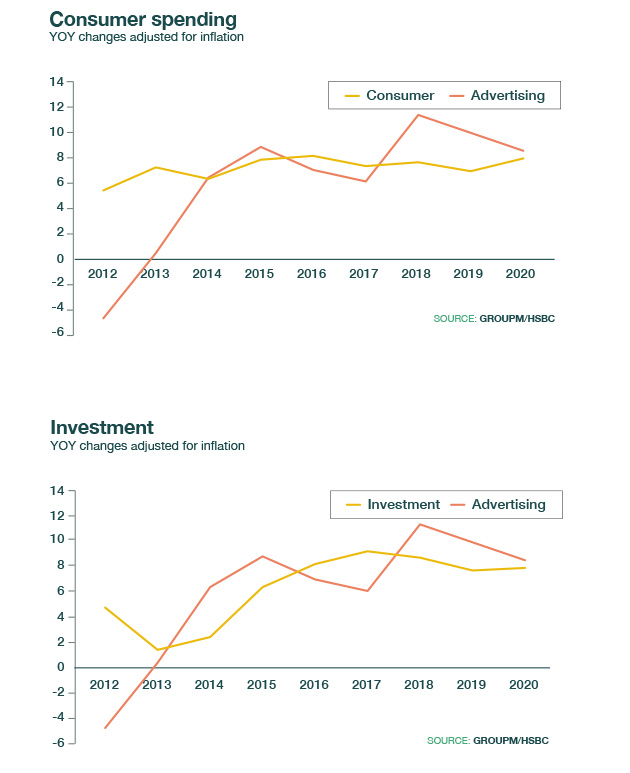
    Economy Recent downward revisions notwithstanding, India is expected to grow 7.1% – 7.5% in FY 2020–2021 (Fitch/IMF), with an investment cycle revival and sustained consumption being the key drivers. Downside risks remain: rising protectionism, a possible slowdown in global economy, and bad debt on bank balance sheets continue to hamper domestic investment. Inflation and deficits will, we think, remain largely under control, as public investment will grow only modestly.


    Auto: modest-to-high adspend growth Recovery is expected in 2020 after a slowdown in 2019. Clearance of old stocks before new emission standards come into effect (April 2020) will boost sales in Q1. As usual, demand for motorcycles and tractors will be linked to a normal monsoon, improvement in farm/rural incomes and job creation – all of which remain uncertain at this point. Passenger vehicle, scooter and commercial vehicle advertising should see modest to high growth.


    FMCG: high adspend growth FMCG will see robust volume growth as demand will remain broad-based. Rural demand will grow much faster than urban demand, aided by direct benefit transfers, farm support prices and other government schemes that increase household income. Urban demand will remain steady as a growing preference for premium and natural/ chemical-free products boosts volume.


    E-commerce: very high adspend growth Robust double-digit growth is likely as e-commerce expands to smaller towns, more millennials/GenZ go online and consumers adapt to digital payments. Internet and smartphone penetration growth will continue at a fast pace, leading to huge opportunities for e-comm players.


    Retail: high adspend growth Consumer trends of experiential shopping and the need for wellness and premium products will drive good volume growth. Foreign brands entering India, consolidation among established players and e-commerce buying stakes in established names are all likely to support growth in retail advertising investment.


    Services: modest-to-high adspend growth Services have been driving the economy over the last few years and will continue to do so in 2020. The major segments of health, travel & tourism and transport will see good growth as consumers’ aspiration to travel and gain new experience rises with income.


    Telecom: modest adspend growth Telecom will remain mixed: Handsets will see tremendous volume growth (especially low-to-mid-priced handsets), but incumbent service providers will see low-to-moderate revenue growth as they fight to retain market share.


    Media: TV will have good adspend growth across key categories; the T20 cricket World Cup will be a fillip. Print will record minimal growth on the back of Hindi and regional language dailies; English will decline. Radio will remain a key medium for localized, tactical advertising and will be driven by auto, retail and FMCG. Cinema and outdoor will see robust growth as more people flock to cinema screens, the number of multiplexes increases and theatre owners use better AV tech to attract audiences. As for digital, strong double-digit growth driven by video and e-commerce display may result in digital spends overtaking print at some point in 2019.


  • Sam Singh goes TikTok to ByteDance. As VP – Monetisation for India

    By A Correspondent


    ByteDance has announced the appointment of GroupM CEO Sameer Singh as Vice President, Monetisation (India). In his new role, Singh will work closely with ByteDance’s partners and clients while leading the advertising, sales and marketing strategies across all of ByteDance’s products in India. Based in Gurugram, Singh will be starting his role in August.


    Commenting on his new role, Singh said, “I am truly excited to join ByteDance, which is one of the fastest growing global technology companies spearheading innovation in the mobile space. In India, ByteDance has transformed the way people create and interact with their content, and I believe that my experience will contribute to ByteDance’s promising journey in this market. I am looking forward to working with my colleagues, our clients, and our partners at ByteDance to create new synergies in the industry.”


    Welcoming Singh to the team, Lidong Zhang, Senior Vice President, ByteDance said, “We are excited to welcome Sameer to the team. We are looking forward to working with him to bring ByteDance’s monetization efforts in India across our various platforms such as TikTok and Helo  to even greater heights.”


  • What makes BATNA an important tool for Marketers


    By Brian Wieser


    Brian Wieser

    Digital platforms and TV networks often appear to be “must-buy” solutions for marketers.

    In the face of a difficult negotiation or displeasure with the actions taken by a commercial partner, one party may feel they have no alternative but to proceed with a transaction. This should occur far less often than it does in reality. We see this play out in media much as it does in other fields of business, especially with large digital platforms and television network owners. Marketers often feel they lack pricing power (even if some fare better than others) and lack as much leverage as they might like around qualitative elements of the media owner’s advertising environment, including content, advertising formats, measurement, viewability and brand safety.

    Procurement-based frameworks can help explain and analyze the situation. Framing this issue using the Kraljic Matrix described in a POV we published previously (“Procurement and Media Buying – Optimizing Forests, Not Trees”) media owners dominating a market will sometimes have inventory that is both strategically important and scarce. If the inventory (or the owner of such inventory) is perceived to be relatively strategic and relatively scarce by advertisers, the media owner will have the power to dominate the relationship with the marketer and generally realize higher pricing more than would otherwise be the case. Procurement theory describes solutions to improve the power dynamic through a range of tactics such as entering long-term contracts in order to secure supply at a fixed price. However, if the seller knows the buyer has few options available to accomplish its goals, pricing and other trade terms may still be worse than they could be.

    An important alternative solution to this problem is to de-couple the attributes of the strategic and scarce inventory and look for something similar somewhere else. De-coupling occurs when we focus on what the buyer is really trying to achieve with a seller (for example, not an ad running alongside a specific content asset uniquely owned by a single media owner, but an engaging environment for a marketer to showcase its brand while borrowing a content brand’s brand equity on some relatively non-specific basis) and then look for different ways to accomplish those goals. This may require flexibility and operational capacity to shift budgets and creative assets beyond proscribed media owners or across media channels. As well, different workflows may be required to accomplish goals in different ways at scale. If alternative suppliers can deliver the audience attributes the marketer desires, the strategic and scarce good could be turned into a strategic and plentiful one, which could produce improved negotiating positions.

    The BATNA is an important concept: advertisers need a credible ability to walk away from any given negotiation. A parallel approach for thinking about managing situations involving must-buy media solutions involves the notion of the “Best Alternative To A Negotiated Agreement” (a BATNA). This concept was developed within the broader field of negotiations by researchers Roger Fisher and William Ury in the 1981 book “Getting to Yes.”. While buyers of media may not commonly use the term BATNA, they typically create BATNAs whenever they can any time there are multiple entities selling broadly similar inventory, as doing so creates a credible ability to walk away from any given supplier. Such a threat can lead to better pricing or other terms than might otherwise have been realized.

    The BATNA concept needs to be applied beyond buying to including planning and marketing more generally and more often. There will be cases where a media owner is so dominant or is perceived as being so important that it’s not possible to find a directly comparable alternative supplier who can meet goals exactly as they have been defined. Marketers reinforce this dominance when they are then specific about the media owner they want to secure media from, or the content assets they want to be associated with as those preferences limit the buyer’s ability to establish a BATNA. BATNAs can be further limited when the creative assets associated with a campaign are relatively fixed (perhaps because of efforts to cost-consciously leverage preexisting creative investments).

    Marketers may benefit if they exhibit flexibility in their use of creative assets, media preferences and media goals as well. While not necessarily optimal for creative effectiveness, marketers may be able to repurpose assets to other channels. For example, TV commercials can be used in cinema or digital video and digital display assets might be used on email or digital out-of-home-based media. If the brand has not historically used all of the media platforms that can serve as substitutes to their preferred media owners, they may lack relevant benchmarks for relative effectiveness against a pre-existing media goal. However, efforts to assess the circumstances under which those alternatives may be used can make the threat of a budget shift more credible.

    Finding an alternative may also sometimes depend on maintaining flexibility to use entirely different goals. A marketer may be buying media because they have decided to focus on brand awareness and have a process in place that assess media placements with brand awareness outcomes. A next-best-alternative might be something entirely different and require the buy-in of a broader marketing department rather than media alone. BATNAs are not commonly applied at this level, but marketers would probably benefit if they could organize to apply them more often.

    If lead-times ahead of campaigns are substantial enough, BATNAs are only limited by the creativity of a given brand and the individuals who steward it, and the flexibility they’re given to accomplish their goals, even with fixed budgets. Depending on the scale of investment required against a strategic and scarce resources, a BATNA is can also include a shift of resources away from paid media to further investment into the creative concept (or insights behind it), the product itself, or some kind of brand experience.

    There should always be alternatives. Marketers should never believe there is no alternative to a specific buy from a specific media owner, at least so long as they have a sufficient degree of flexibility in how they manage their marketing activities. By definition, there is always a “next-best” alternative to support a campaign’s goals, and sometimes the rising costs of a first-best alternative will make the pursuit of a next-best alternative increasingly worthwhile. Applying different strategies to finding those next-best alternatives will help marketers realize their strategic goals while better controlling their costs – financial and otherwise.


    Brian Wieser is Global President, Business Intelligence, GroupM. Republished from GroupM.com


  • 2020 & Beyond


    GroupM’s newest publication, Opportunity and Hazard: 2020 and Beyond, authored by Rob Norman and Brian Wieser, offers perspectives on foundational technologies and issues we believe are most likely to impact consumer adoption of products and services: bandwidth, increasing machine ‘intelligence,’ application of identity, and what comes after the most successful consumer product in history – the smartphone. GroupM’s analysis considers the context of privacy, brand safety and the impact of “direct brands.”  The new publication is available for direct download from GroupM.com (https://www.groupm.com/news/groupm-opportunity-hazard-2020-and-beyond).


    Here’s the end-note that that Rob Norman and Brian Wiser write: “It’s a cliché to say that the only constant is change, but we see no deceleration in high-impact, technologically driven advances.


    The next decade will be dominated by advances in AI and the next wave of commercial and social disruption. In every sector the innovation cycle will speed up, and in all fields there will be greater scrutiny of the possibility of social harm — and hopefully an equal focus on social good.


    More narrowly, in advertising, scrutiny of business models that depend on the monetization of data signals will increase, as will the penalties associated with enabling bad actors. The rewards for actions that make advertising more valuable will be significant. In the media world, existing trends will accelerate. Over-the-top delivery and consumption of video will grow, along with increased bandwidth at reducing prices. Clear winners and losers will emerge in the battle for paying subscribers. Per-user revenue strategies will vary from the flat world of Netflix to locating the 5 percent of all users responsible for 80 percent of revenue for many digital publishers.


    Content producers will search for the economic balance between vertically integrating monetization and the sale of content to the highest bidders. Social platforms will increasingly seek out mixed monetization models, diversifying from advertising to services and commerce.


    The New York Times, with its impressive 2.3 million digital-only subscribers, counts just a little less than 2 percent of its U.S. unique visitors as digital subscribers. That’s out of its approximate 100 million U.S. unique visitors, as recently measured by Comscore. (piano.io) The role of data will continue to change, and for advertisers firstparty data will be of the greatest value for understanding customers. They will use it to create audiences that will be found inside the walled gardens of the platforms, and that match with the context of publishers and the data they have on user behavior.


    Matching privacy and relevance will be of great importance and value. In advertising, the “interruptive” model will persist, but delivery will be increasingly programmatic and addressable. Decisioning will be both automated and autonomous. Over time, the pursuit of mass reach via broadcast means will give way to in-target reach assembled one person, one household or one device at a time. Coupled with enough creativity and variation in messaging to address the varying needs and wants of the many customer cohorts of each and every brand, advertising has the opportunity to maximize efficiency, effectiveness and relevance.


    In other words, advertising will become more valuable. “


  • India’s Sports Sponsorship grew 12% in 2018


    By A Correspondent


    ESP Properties, the entertainment and sports division of GroupM, released the 2019 report on sports sponsorship in India. According to the report, overall, sports sponsorship saw a healthy growth of 12% in 2018. Sports advertising grew to Rs 7762 crores.


    Cricket has gained the ground as IPL hit a maximum. While an overall level of the growth of on-ground sponsorship was 20%, cricket witnessed a momentous upsurge of 34% with IPL Central Sponsorship contributed to revenue of more than INR 600+ Cr ($88+ Mn) in 2018. IPL franchise fee, amounting to approximately INR 291 Cr ($43Mn), ceased to be valid in 2018 rendering a year-on-year comparison irrelevant in that area, netting off this difference, contributing to the 12% growth.


    Vinit Karnik

    Said Vinit Karnik – Business Head, ESP Properties: “2018 was a spectacular year for the business of sports and 2019 will be another power-packed year. There will be a significant rise in sports leagues and tournaments since IPL has inspired other sports leagues such as PKL, ISL, and PBL. From the IPL team sponsorship seeing a growth of 20% or for the first time ever to Kabaddi registering a growth of 31%, factors like these have given sports sponsorship a boost. With IPL now and ICC Cricket World Cup coming up we also expect sports celebrities to be the talk of the town, monopolizing consumer attention and advertising money.”


    The IPL Team Sponsorship tally had a better year, touching INR 300 Cr ($44Mn) for the first time ever saw a growth of a significant 20%. IPL also plays the star act on TV as digital moves up the ladder. 85% of all ad expenditures in sports happened on TV in 2018. Digital grew at 44% as it was triggered by Hotstar and Sony Liv and platforms which continued to drive adoption and carved a niche for itself.


    Emerging sports too saw positive growth signals. ISL (Indian Super League) over the years had grown into a strong property with a calendar spread over six months. Kabbadi had a good year in 2018, registering a growth of 31% over the previous year in on-ground sponsorship. This was further backed by Odisha government announcing a five-year deal with Hockey India for junior and senior- men and women teams. Year also saw Tata Motors become the principal sponsor of Indian wrestling in the non-cricket team sponsorship.


    Also, big money continues to chase the king of chases as cricket widens the lead over the rest of the sports. 2018 saw a 22% growth in Athlete Brand Endorsement Value. Of the INR 482 Cr ($71Mn) spent by brands on sports stars acquisitions, 81% was accounted just by India’s most popular sport. Two cricketers alone, Virat Kohli and MS Dhoni, pulled in 66% of all athlete endorsement monies spent by Indian brands last year. Though Virat Kohli leads from the front touching an endorsement value of approximately INR 200 Cr. Pusarla Sindhu had a momentous 2018 both on and off the court.


    La Liga signed a three-year exclusive agreement with Facebook to show all 380 matches to users in India, Afghanistan, Bangladesh, Bhutan, Nepal, the Maldives, Sri Lanka, and Pakistan. With huge digital groundswell behind viewership trends, digital media should grow disproportionately in the future as a wider viewer base will attract more ad revenue.


    Based on the events across various leagues, tournaments, sponsorships, and non-sponsorships, 2019 looks like a good year for Cricket and emerging sports, which will give rise to bottomless engagement with brands and sporting fans in India.


  • GroupM forecasts 14% adspends growth


    By A Correspondent


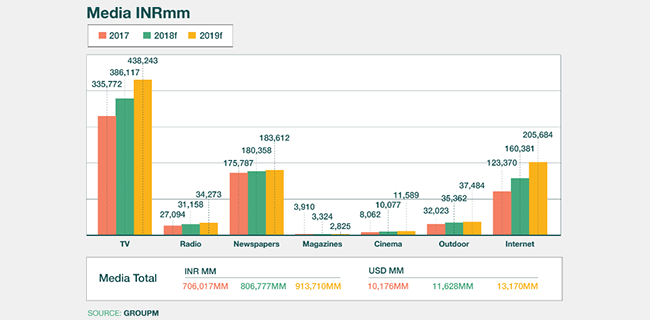
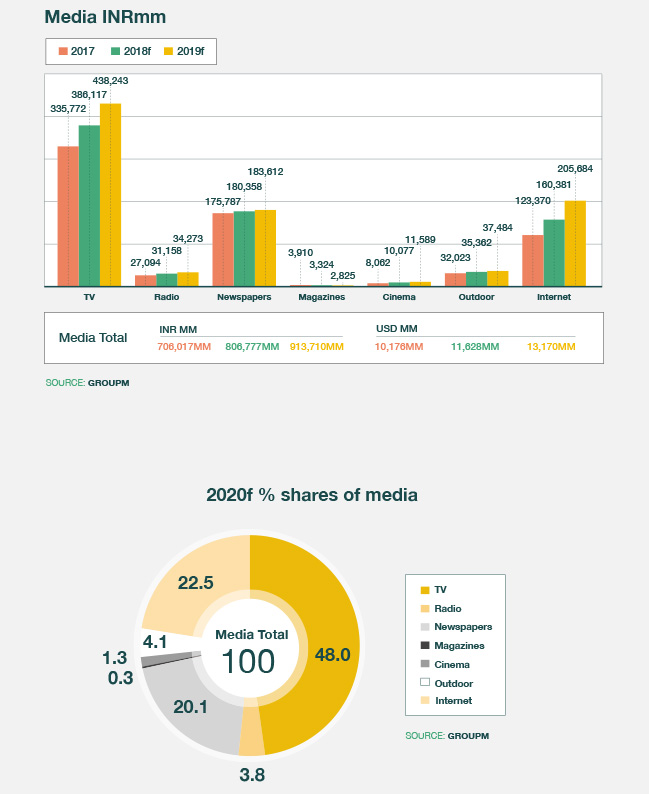
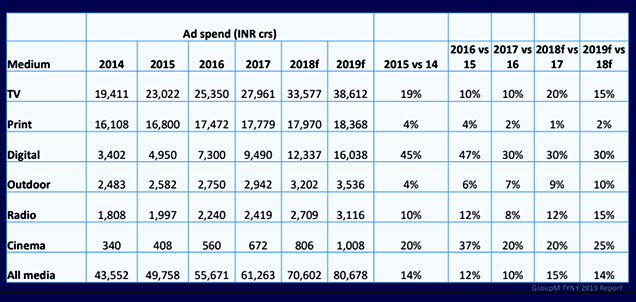
    GroupM, the media investment group of WPP, announced its advertising expenditure (AdEx) forecasts for India for the year 2019.  As per the ‘This Year, Next Year’ (TYNY) 2019 report, India tops the list as the fastest growing major ad market in the world. TYNY forecasts India’s advertising investment to reach an estimated Rs. 80,678 crores this year. This represents strong estimated growth of 14%, for the calendar year 2019 (approx 2x of the GDP growth).


    India will be the third highest contributor to the incremental ad spends, only behind China and USA and the tenth fastest growing country with respect to ad spends across the globe.


    The Cricket World Cup and Elections in 2019 are expected to boost adspends. FMCG, Auto, Retail, e-commerce, Tech/Telecom are expected to contribute to 2/3rd of the AdEx. According to GroupM, the special events of the year (World Cup Cricket and Elections) will add around 3 per cent to the 11 per cent organic growth forecast for the year.


    Speaking on the TYNY 2019 report, Sam Singh, CEO – GroupM South Asia said: “While we are estimating the global advertising expenditure to grow at 3.6%, India would be witnessing the fastest growth at 14% and reach an estimated Rs.80,578 crores. This would be approximately 2x of the estimated GDP growth in India. This also makes India the third largest adex growth to the worldwide ad spends. We expect sustained and stable media investment growth across categories in India”


    This year 37% of incremental ad pends will go towards digital advertising including mobile. The scale at which we are witnessing this digital transformation, GroupM estimates the Digital Adex to continue to grow by 30% in 2019 to Rs. 16,038 crores.


    Added Prasanth Kumar, Chief Operating Officer – GroupM South Asia: “Indian adspends CAGR between 2014-2018 is at 13% and 2019 expected to witness a higher growth. India is unique among key markets and will witness growth in all media segments and not just digital. Offline media is poised to continue to grow and will contribute to being around 80% of ad spends in 2019.”


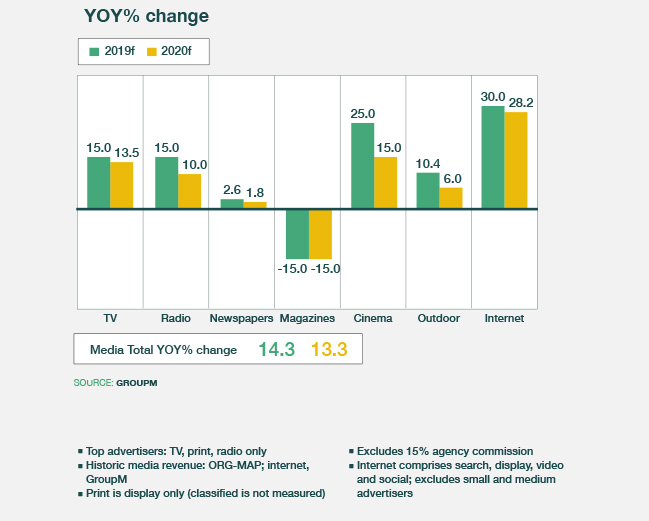
    Television will continue to grow at a steady pace. This year, the growth rate for TV is estimated to be 15%.


    Print is estimated to grow by 2.2% and the share of print to all media is expected to be at 23%. While it is expected for both English and regional languages to grow, regional will see slightly higher growth. Vernacular will continue to thrive on both TV and print.


    This year radio is expected to grow at 15% which is higher than the last couple of years. Cinema will grow at 25% in 2019, as 2018 saw more titles winning audience at the box office. In 2019 GroupM expects cinema to shift from title-based advertising to continued advertising through the year. Lower tax on cinema tickets is expected to drive more footfalls to theatres.


    GroupM also presented some of the biggest trends that will shape the media Industry in India in 2019. The trends presented were around emerging technology, data, content creation and distribution put the consumer at the center and underline the theme of digital driving the change across all formats of media. The trends touched upon the TRAI tariff order implementation as well its potential impact of increasing original programming and investments on content across broadcaster networks.


    Said Tushar Vyas, President Growth and Transformation – GroupM South Asia: “With the surge of technology, better insights and relevant engagement across different platforms, we are expecting marketers to build superior consumer connections for brands. 2019 will witness a faster growth in digital and we are expecting digital to be at 20% media mix. As we are witnessing one in every three Indians digitally connected, we can expect the convergence of data, digital and content to deliver seamless and powerful solutions to brands as well as constantly adding inventive practices into the market.”  ESP Properties head Vinit Karnik also spoke on the occasion.


    TYNY 2019 Media Handout

  • It’s goodbye to RECMA, as GroupM converges on COMvergence

    By A Correspondent


    GroupM has announced that it is consolidating the reporting and analysis of its commercial and business development data with COMvergence. COMvergence is an independent, international research company collecting and analysing data from the global marketing services groups and the marketplace.  This, according to reports, means a goodbye to RECMA, the longstanding agency analysing media agency business and growth.


    Said Elizabeth McCune, Global Chief Growth Officer at GroupM: “COMvergence has taken an open approach to building its methodology and partnerships for data collection and tabulation, giving us the confidence that when we share data from their benchmark reports to clients and their pitch consultants, it is the most accurate and validated view of the size and scope of our business and competitive set across the globe. Our industry truly needs a focus on accuracy and transparency in this area,”


    According to COMvergence’s most recent global billings and market share reports, GroupM is the number one media investment group for 2018, with $45B of cumulative billings and 28.8 percent market share (based on the total billings for the big 6 groups). In addition, three of GroupM’s agencies – Mindshare, Wavemaker and MediaCom – are in the top 10 rankings for global media agencies.


    Holding Company/Agency Intra-Network

    Ranking

    Intra-Network

    Projected Billings 2018 ($M)

    Intra-Network

    Projected 2018 Market Share

    GroupM #1 $45,122 28.8%
    Mindshare #2 $16,516 10.8%
    Wavemaker #5 $12,369 8.1%
    MediaCom #6 $12,108 7.9%
    Essence #16 $2,256 1.7%
    m/SIX #18 $700 0.5%
    Other GroupM (standalone) entities (Team Nestlé US, Motivator India, L’Atelier / LVMH, Team Airtel / India, IKON / Australia) $1,173
    All figures based on November 2018 COMvergence Reporting and represents figures within the top six global holding companies only.


    Said Olivier Gauthier, Founder of COMvergence: “GroupM has been an extraordinary client partner. They, along with the major holding company media groups, have worked with COMvergence since our founding to develop accurate methodologies and a collection of local and global reports that provide true insight into agencies and their performance across the globe.”. Gauthier worked with RECMA until March 2016 and set up COMvergence a month later.

  • ITC awards digital media mandate to Wavemaker India

    By A Correspondent


    GroupM agency Wavemaker has been awarded the consolidated digital mandate by ITC. Wavemaker has been AOR for ITC media since 2017. The account was being handled by a consortium of its agencies under the Dentsu Agencies Network.


    Speaking on the win, Kartik Sharma, CEO-South Asia said: “We are extremely thrilled and honoured to be chosen by ITC to handle their digital mandate as well. This win marks expansion of our partnership with team ITC and reaffirms our investments behind right tools and technology clubbed with diversified talent on the brand. We are confident about our data-led consumer journey approach will help in growing the brand further.