Tag: GroupM

  • Homelane.com appoints GroupM & Famous, unveils new brand identity

    By A Correspondent


    Online home interiors provider HomeLane has appointed Famous Innovations and media agency GroupM to launch the first ever brand campaign with digital as the lead medium while using other mass communication mediums.


    Said Tanuj Choudhry, Chief Business Officer of HomeLane.com: “The goal of going into the market with the brand campaign is to create a relatable brand identity for potential consumers. With GroupM and Famous Innovations are our partners, we are excited to launch the brand across India’s Top 5 cities and make HomeLane the go-to player for home interiors”.


    Meanwhile, HomeLane has also announced a new tagline as part of its rebranding exercise – Interiors Made Easy.


    Said Sam Singh, CEO of GroupM South Asia: “We, at GroupM, are very excited to partner with the Homelane team in their growth and expansion plans. We are geared to create cutting edge solutions and customise our existing  array of products to pair up with Homelane’s futuristic outlook”


    Commenting on the partnership, Raj Kamble, Founder & CCO of Famous Innovations added: “HomeLane is a brand with tremendous potential and we are excited to have joined hands with them at this defining stage in their journey. Setting up a new home is a once-in-a-lifetime momentous occasion for most people, and by promising personalisation, affordability and convenience, HomeLane is solving a crucial problem for consumers. The brand team is a passionate, ambitious and dynamic one, and we saw great synergies in both our company cultures. We look forward to the days to come.”


  • Mindshare announces senior appointments for APAC

    By A Correspondent


    Mindshare has announced two major leadership appointments to its leadership structure in Asia Pacific. The first is the elevation of Prashant Modi to become Asia Pacific Chief Operating Officer. Modi, who was previously Chief Commercial Officer for Mindshare in Asia Pacific, will take on the broader responsibility of managing the Singapore hub and working with Mindshare Asia Pacific CEO Amrita Randhawa on future-proofing the overall company structure and offering.


    Modi has been with the agency and GroupM for over 16 years working across both GroupM and Mindshare in its India and regional office in Singapore. Commenting on the appointment Randhawa said: “There are few people who care about our people and our company as much as Prashant. He is the beating heart of Mindshare and one of our absolutely finest minds. I am delighted that this role is going to give him the canvas he deserves to make an even bigger impact on our organization and on our people.”


    Prashant Modi

    Speaking on his elevation, Modi said: “16 years with Mindshare and it still is a dream place to work with great colleagues and clients. Mindshare has always provided a very open atmosphere to fuel personal growth and I am looking forward to continuing to contribute to our achievements and growing our business further”


    Rohan Lightfoot

    The second appointment is that of Rohan Lightfoot as Chief Growth Officer of Mindshare Asia Pacific. His role is focused on developing high growth opportunities for new and existing clients with an emphasis on new products, innovation and digitisation.


    Speaking on Lightfoot’s appointment, Randhawa said: “Rohan’s been on my must-hire list for years! He is uniquely placed having spent solid time in China, having a blend of creative, media and digital craft experience as well as working on some of the region’s biggest accounts. He understands the changes that the agency needs to deliver in order to continue to be a valued partner for our clients.”


    Added Lightfoot: “I am so excited to be taking on this new role. It’s a perfect fit for my experiences and passions in my career. The breadth and depth of capability at Mindshare is staggering. The challenge of keeping the world’s leading media agency always ahead was impossible to turn down. I’m already loving being part of the team that Amrita is building.”


    Both roles are based in the agency’s Regional Singapore Office and effective immediately.


  • So where do adspends on print stand vis-à-vis TV & digital for 2019?


    By A Correspondent


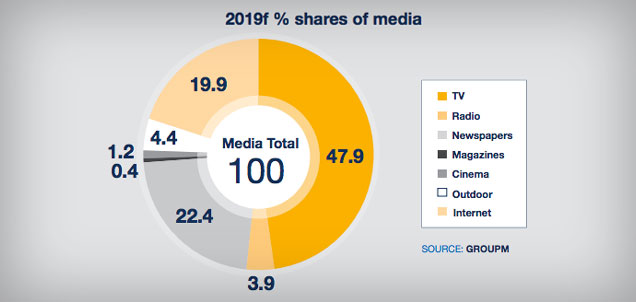
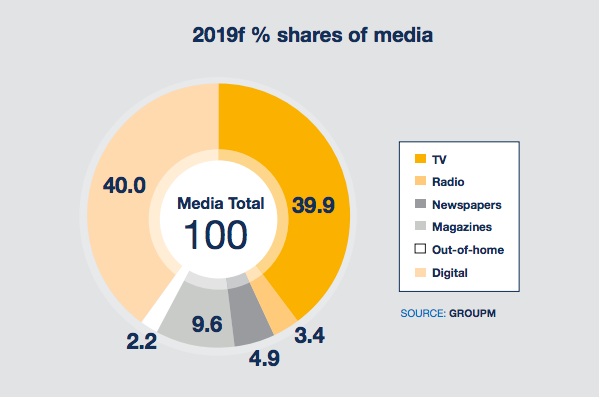
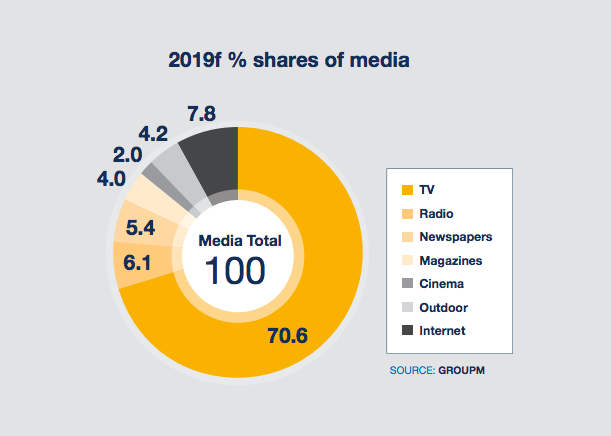
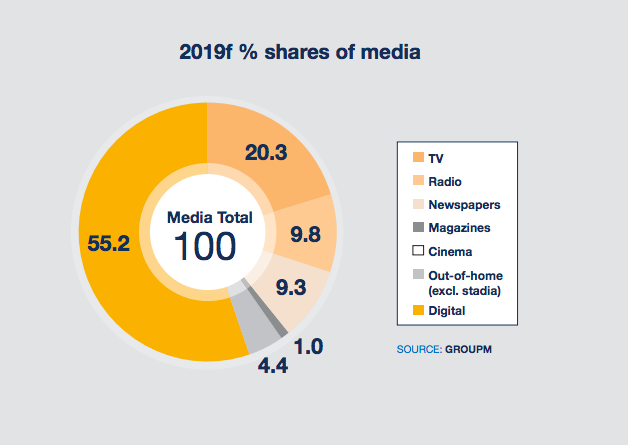
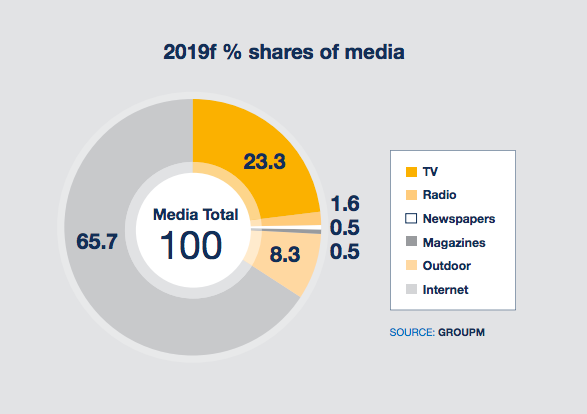
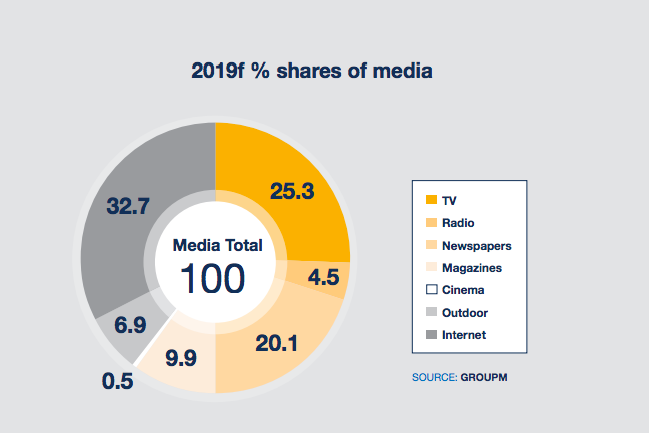
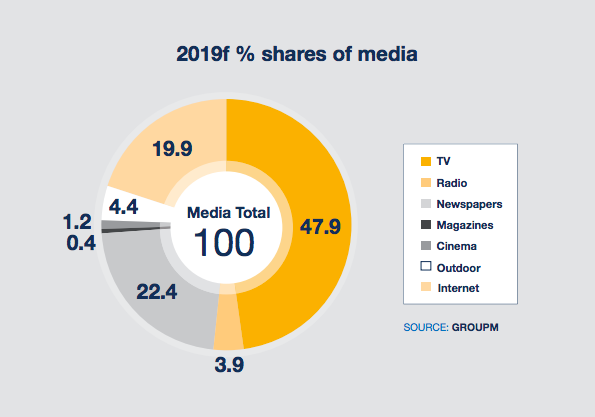
    So where do adspends on print stand vis-à-vis TV & digital for 2019? Earlier this month, GroupM’s TYNY (This Year Next Year) report threw up some interesting data forecasting adspends for 2019 and more.


    We have pulled these pie charts from the TYNY report released by GroupM. Read on… the charts tell the story.


    US


    Brazil


    Canada


    China


    Germany


    India


    UK
  • MMA & GroupM unveil Mobile Ecosystem & ad-Sizing Report 2018

    By A Correspondent


    Mobile Marketing Association, along with GroupM, released its ‘Mobile Ecosystem and ad-Sizing Report’ 2018. The report includes an in-depth analysis of India’s mobile reach, smartphone penetration, rural and urban usage pattern, emphasis on gaming and mobile advertising spends. Advocated by GroupM, the report is a collaborative effort by the marketing and mobile industry.


    The latest report has a quick peek on a basic guide on how programmatic works and its pros and cons, and its future evolution. It also brings an up-to-date on the latest trends in data growth, content play, programmatic, device status; how India is moving towards a new era of mobile marketing, seeing rampant growth in both usages and spends.


    Said Rohit Dadwal, Managing Director, MMA Asia Pacific: “Mobile Marketing is now a mainstream advertising and marketing medium and it is imperative that we start to decipher the various parts of this burgeoning media. We hope the ecosystem study would provide insights to marketers and the industry on the whole on the opportunity and will help in making the right investments for its continuing growth. “


    Added Sam Singh, co-chair of Mobile Marketing Association India and CEO GroupM: “The number of smartphone users is expected to only go up and it just shows how much potential these digital screens have. Hence, we as marketers must understand various facets of mobile marketing. Times are changing fast and we want to enable marketers with the knowledge that can help them in a long run.”


  • 14.3% adspend growth forecast for 2019: GroupM


    By A Correspondent


    Okay, we’ve cheated. We know GroupM publishes a propah India-specific report in Februrary, but we’ve noticed over the years that the global This Year Next Year report released in Decemeber is also fairly detailed.


    So while we carry the report now, please do note that there may well be a full-blown one in the coming months. So here’s the report:


    “The IMF expects real GDP to grow 7.4% in 2019 (12.1% nominal), driven mainly by services and private consumption; manufacturing and agriculture are likely to see moderate and low growth, respectively. Bank balance sheet repair and GST reform is likely to start yielding results sometime in 2019, accelerating a reviving investment cycle, but downside risks remain: continued global trade conflicts and high oil prices are likely to impact the exchange rate, trade deficit, liquidity and inflation.


    Auto advertising growth is expected to be high, as car, scooter, luxury bike and commercial vehicle segments will see good sales growth in 2019, driven by urban demand and infrastructure spending. Rural-led motorcycle sales will be monsoon-dependent.


    BFSI adspends will be moderate to high, as bank adspends remain subdued but insurance and financial services spend robustly to expand penetration, with the government-led health insurance scheme also providing a boost to growth. Digital payments are expected to touch $500 billion by 2020, and insurance to be a $280 billion sector by 2020.


    Consumer durables ad monies will see moderate-to-high growth: low penetration in consumer appliances, shorter replacement cycles in consumer electronics, robust replacement demand overall and unexpected/extreme weather – hotter summers, hazier winters – will all contribute to spends.


    E-commerce adspends will grow fast: a report cites the sector to touch $100 billion GMV by 2020, while Morgan Stanley predicts it to touch $200 billion by 2026 and expects ~50% of India’s internet users to have matured by 2019/20 (five years or more of internet use). Online shoppers are expected to increase from the current 14% of internet users to 50% by 2026. Strong consumer expenditure growth should lift Retail advertising in the order of 12-14% year over year between 2017 and 2020, and the explosion of modern retail, expected to nearly double in size between 2016 and 2019, will drive ad monies.


    FMCG adspends will grow fast, as key drivers remain strong: expanding rural penetration, strong rural demand supported by increased welfare spending in a busy election year in 2019, and steady urban sales and growing interest in luxury and health-wellness products.


    Services ad growth should be strong, as the major segments of travel and hospitality, health care and logistics are all expected to perform well in 2019. The travel market is tipped to reach $40 billion by 2020; logistics are expected to hugely benefit from GST.


    Telecom ad growth will be driven by mobile handsets. 2017 saw 288 million shipments (124 million of which were smartphones). The IDC predicts mid-teen growth in 2019-2020, led by low-priced handsets. Telco spends will be conservative, as incumbents face continued pressure on margins due to intense competition – likely to continue till ~2020.


    TV: sports and elections will drive advertising. Print to grow at a slower rate, losing share to digital; election spending will provide some relief. Radio is expected to do well from auto, mobile handsets and a revival in FMCG, real estate and government spends. Cinema & outdoor will continue to grow, as technology adoption improves ad visibility and from the growth of organised retail. Digital: will see high double-digit growth backed by video (with OTT players/AVOD gaining traction) and other premium inventory.”


    And here’s the final analysis:


    “It will be a toss-up with China for 2018, but this year and next India could remain the world’s fastest-growing large economy, with only the Philippines on its heels. Despite two successive quarter-point repo rate rises in 2018 (to 6.5%), the rupee has depreciated 10% versus the US dollar in the year since our December 2017 forecast, in line with the average of the currencies in our country set. The rate rises were a response to CPI creeping up, and there may be more to come. This reflects the health of India’s domestic demand: like the USA, it is a relatively self-sufficient, low-trade economy, which is a strength when global trade is contracting. HSBC predicts India’s consumer demand growth will peak at an impressive 9.1% (real terms) in 2018 before moderating to around 7%, which only China is likely to beat. However, no country is immune from the demand-sapping effect of pricey oil and a runaway dollar, which would only encourage capital flight from the developing world back to the rising-rate USA.”


    And here’s how India fares in the global perspective:


    India’s prospective 2019 growth this year is the same order as Australia, Russia and Brazil combined, even though India’s ad economy is only a quarter of the others’ combined heft. Such is the arithmetic of 14% ad investment growth with its roots in 7% real growth in India consumer spending (after 9% in 2018).


  • Digital will rule UK adspends


    By A Correspondent


    It’s a still a few days before the Zenith, IPG Mediabrands and GroupM forecasts for global adspends is released, but we thought it would be good to carry GroupM’s forecast for 2019 for the United Kingdom (UK), as it could offer some indicators for the shape of things to come for India. Only the Zenith and Mediabrands reports carry detailed numbers for India. The GroupM report for India as well as the Madison forecasts are typically released in early February.


    According to GroupM,  UK advertising is expected to increase to £20.8 billion in 2019, surpassing the £20 billion mark for the first time, up from £19.9 billion in 2018.


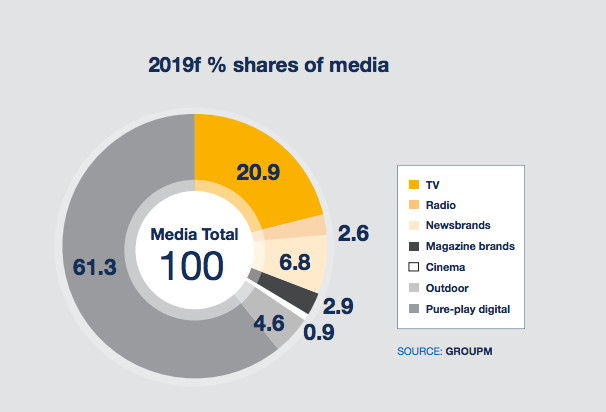
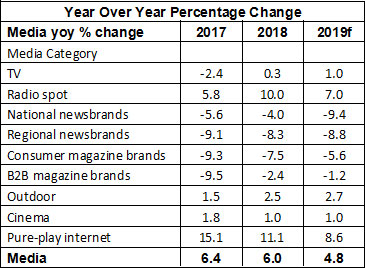
    GroupM’s forecasted distribution of advertising investment is below:


    GroupM forecasts 6.0% growth for 2018, down from 6.4% in 2017. Its 2019 growth prediction from earlier this year is shaved to 4.8% from 5.1%. A significant contributor to global advertising growth, the UK still looks to remain stable due to the high levels of digital advertising growth. Digital is around 60% of all advertising investment and accounts for all net UK advertising growth. The medium continues to grow organically, predominately from SME investment, with signs that larger advertisers are becoming more circumspect about incremental digital investment.


    Pure-play internet increased 11% in 2018 and is expected to continue growing by 9% in 2019. Slower than IAB’s estimated run-rate of 15% for 1H 2018, GroupM sees an inevitable slowdown, although digital is still likely to account for all new net advertising growth.


    Said Tom George, CEO, GroupM UK: “Collaboration and measurement remain key topics for the UK alongside Brexit and GDPR in our advertising forecast for 2019, but in a sea-of-change advertising investment stays buoyant reaching unprecedented levels. It’s encouraging to see the industry pulling together to create new and improved investment propositions. GroupM is highly engaged with all of these efforts to ensure our clients continue to effectively engage consumers.”


    GroupM forecasts television advertising investment to remain flat in 2018, with 1% growth expected in 2019. According to Nielsen, key TV categories soft this year include Food, Household FMCG, Retail, Entertainment & Leisure. Finance (TV’s largest category) and Motors (fifth) are growing high-single-digit in the year to September. ‘Share deals’ remain the principal trading mode in UK TV, which advertisers value for its tolerance of short-run budget revisions, but mixed modes of airtime are becoming more routine as trading embraces more audience falling outside Barb’s ‘gold standard’. Facebook in particular, is still winning share of audio-visual advertising and is heavily video-biased for large advertisers. The main reason is convenience and the lust for ‘performance media’.


    Print media continue to shrink, with newspapers (national and regional) plus magazines collectively shedding about 1.5 share points a year. In 2017, news brands included 12.5% of all ad investment and in 2018 11.1%, with 2019 estimated to drop to 9.8%. Even with mitigation from digital sales (now a large minority of ad sales), this reveals an investment trend of -6% in 2018 and -7% in 2019, as the ‘walled gardens’ capture more share. Armed with research, owners are putting up a united front with reassurance and stable media pricing; this has renewed advertiser enthusiasm for the medium.


    Radio is holding its audience and enjoying rising demand. GroupM forecasts radio spot advertising revenue to rise 10% in 2018 and 7% in 2019. Radio owners will book about £500 million in spot revenue in 2018. This does not include digital and streaming revenues, which are an unmeasured mix of static and dynamic activity, and thus hard to estimate. The annual run-rate is probably above £100 million.


    “Future Brexit fall-out remains a complete unknown, but for now the economy is doing OK. Ad revenue forecasts remain perhaps surprisingly positive, supported by digital commanding a rising share of overall marketing effort from a wider base of marketers large and small. The UK’s fluid media market favours optimism too. Advertisers know they can change spending plans almost at will, with low or no friction,” said Adam Smith, Futures Director, GroupM.


  • Xaxis bolsters APAC leadership

    By A Correspondent


    GroupM arm Xaxis announced the promotion of Atique Kazi to Vice President, Business Development, Xaxis Asia Pacific, and Bharat Khatri to Country Lead, Xaxis India, as well as appointing Daniel Henriksen as Head of Outcome Media Planning, Xaxis Asia.


    Kazi will be succeeded by Bharat Khatri, who has been officially promoted to take on the role of Country Lead for Xaxis India. Khatri has more than 10 years’ experience as a strategic digital marketer, and has spent the last four and half years working relentlessly to grow Xaxis in India.


    “Atique and Bharat have both been pivotal in the remarkable growth that we have experienced over the past few years. Their elevation is well-deserved, as they truly embody a strong resilience in client centricity and a constant focus on product innovation,” said Arshan Saha, President of Xaxis APAC.


    Xaxis also welcomes Daniel Henrikson to the executive team in a newly-created role as Head of Outcome Media Planning. Henrikson brings with him eight years of programmatic experience spanning North America, Asia and Europe. He previously worked in programmatic and performance domains with the Omnicom Group.


    “Global trends are indicating a clear need for marketing that can drive real world results that accrue to a business’s bottom line,” added Saha. “As outcome-driven media becomes an increasing priority for marketers, we have responded by creating a focused role that can help clients to address growing media complexity and better understand the impact of our campaigns on their business results.


  • Clients are happy to pay wherever one demonstrates value


    It’s been a year since GroupM merged its two leading media agency networks – Maxus and MEC. We spoke with Kartik Sharma, CEO-South Asia of the merged entity called Wavemaker on how the business has been in the past year, the credo of ‘Rapid Growth Planning’, winning awards, talent and more. Excerpts from Part Two of an interview with Kartik Sharma… (Part One of the interview can be accessed at http://www.mxmindia.com/2018/11/we-cant-sit-on-past-laurels/)


    One of the challenges in attracting young talent specially at the entry level is the low salary levels in media agencies.

    We relooked at how we attract talent. This is not just about Wavemaker, but we worked with the GroupM leadership team and the composition revisions have already happened. Also, my genuine belief is that while people may talk about compensation, the real reasons why people stick is obviously due to the people they work with. Second thing is if you have a great purpose. It’s easy to rationalise and say I don’t get money and move out of an organisation. Also when you go deep and we sit in exit interviews and we find out that people largely leave for two reasons. Either you have a lousy boss or you are not able to connect with a purpose or not able to see a purpose of what you are doing. As long as you are able to address these two factors well, I think people want to stick much, much longer.


    In the light of the various changes in the media landscape, digital gaining ground and as we enter the new year, do you see a dramatic shift in the way the media agency business is going to be? Also, will be there be a change in the current commissions-/fee-based structures

    See the way the compensation structures were done, because commission-based compensation structure was actually invented more than 100 years ago. Agencies or as they were called agents and we started selling it. But markets are maturing, clients are maturing. Agencies are maturing. I can’t talk for the entire industry but surely wherever one can clearly demonstrate value, clients are happy to pay. Wherever you cannot show value, why should the customer pay?  So there have been many, many instances where we are able to get our fair share based on the work that we produce which often is loosely termed that we are more costly. But its value, the value creation for the business is demonstrated and that job is on us to show and demonstrate why we are asking for whatever compensation. It’s not easy but in many, many instances those are happening even today.


    So, would you be able to give an indicator on what is the kind of increase that you get from your existing clients in terms of percentage?

    It increases when we are able to show value.  I can’t speculate any number. I can’t share anything else…


    Broadly. Are the big clients paying you more?

    Big clients see value and they pay more. Even small clients. Big or small is not the point. We have been able to ask for a reasonable compensation which when compared to many other competitors would be higher. It’s a guess. If and whenever we are given that kind of feedback based on that we deliver. Whenever there is value, clients will pay.


    You were among the early players looking at startups and looking at non-legacy businesses. But now you have grown as an agency.  Do you find that you are still as hungry for those start-up kind of clients?

    Absolutely. We have recently conducted a startup connect in Bengaluru where we invited a couple of good startups which we believed in. We invited some of our media partners and creative partners what they are seeking is kind of, if they were to launch their product and services in the market, what should they be doing. It was an experimental project and has done exceedingly well for us. Some clients are signing up. Once that is done we will announce the name. Some other startups have also started talking to us so I think the hunger to be in that space is very high.

    What startups do is they kind of come with a very different point of view compared to the larger, well-established players. They want growth faster. They want to look at the product and services differently and it challenges us. Recently we have got one very big startup. We will announce once the contract is closed. Our solutions have been so different! Had we not pitched for that business. We have to constantly think that maybe what we could have done different or a standard mode is not what is going to work. It helps us to also think afresh. The solution of the client is very important.


    I know it’s an integrated agency now… but how is the MEC part of the business doing?

    All the clients are doing very well as brands and as categories most of them are doing very well. For eg., Netflix is a case in point. There are other clients. Eureka was an MEC relationship which we have. Today it doesn’t matter if it is Maxus or MEC, it’s a client we are working or. Whatever we have promised to a client we have to deliver on that. Overall, I think all the business that have come from NEC they are all in good space.


    As you go forward to the next year, any specific target or sentiments that you would like us to look at.

    I’m an eternal optimist. I think next year will have its own set of challenges and opportunities. What I am seeing is more use of technology and technology-based solutions. It could be in the area of analytics and actually creating new technologies for clients. That’s broadly where it is. Of course all the traditional media business or use of media will continue but there are many opportunities in the way that we use technology where I am seeing early trends.


  • State of Video, as per GroupM


    By A Correspondent

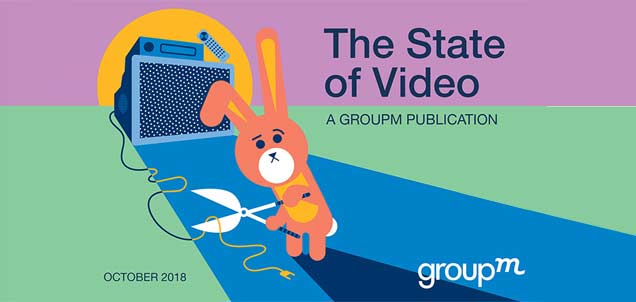
    GroupM, the media agency conglomerated that’s part of the WPP fold, has released its second annual ‘State of Video’ report offering intelligence on consumer video consumption, advertising platforms and demand. Among a series of GroupM reports on the future of advertising, the new publication is co-authored by GroupM’s Futures Director, Adam Smith, and Senior Advisor, Rob Norman.

    It provides in-depth commentary on key trends concerning advertisers: declining linear TV viewing, new addressable television capabilities, competitive digital video platforms, measurement, cord cutting and more.

    Said Norman: “The ranks of television advertisers are swelling with new entrants, mostly direct-to-consumer businesses that have exhausted all the reach and awareness ‘performance’ media afford them. It’s reminiscent of the dot-com boom for television in the late 1990s; maybe it will end better this time. One thing is for sure: linear television is still perceived to be as effective as ever, despite the absence of granular measurement.”

    State of Video Report Highlights:

    Linear TV Viewing Continues Declining:  Globally in 2018, linear TV has shown no new signs of life; ratings continue to fall, even with mainstays like the National Football League (U.S.). Despite this, linear TV has sustained advertiser demand, implying the perception that linear TV is as effective and essential as ever, but for how long and in what balance relative to alternatives?

    Measurement even more important: Measurement has always been essential to accountability, planning and optimization and in the more fragmented world, it’s even more so. Data is used in planning and buying, but is most prevalent in the former. The industry must solve for a measurement solution enabling better understanding of viewing patterns across all screens and channels. This is still a couple of years away even in the most advanced markets. BARB’s Project Dovetail in the U.K. may set the example, albeit with imperfect inclusion, and is expected to combine current TV panel and census data with data from mobile devices.

    Addressable Television: Addressable TV is on the rise but far from ubiquitous. However, 2018’s megamergers may catalyse change. Several company combinations enable vertical integration between content and distribution, creating significant scale with homes served and content viewed. Should these merged companies succeed in making their owned inventory fully addressable on their platforms, it will help realize the long-promised future where TV is a more efficient, targeted and digital-like medium.

    Digital Forces: Amazon, Facebook, Netflix and YouTube remain the top challengers to TV’s incumbent media owners. Among ad-supported players, YouTube leads with a staggering number of non-traditional premium content producers. YouTube’s scaled audiences have been embraced, to varying degrees, by major advertisers. Facebook and Amazon have become competitive acquirers of sports rights in tentative but telling steps this year. While the success of the newly launched Facebook Watch is unclear, Facebook’s future in video should not be underestimated.

    GroupM’s State of Video report can be downloaded at: https://www.groupm.com/themes/custom/groupm/images/pdficon.png

  • Motivator appoints Mausumi Kar as Managing Director

    By A Correspondent


    Motivator has announced the appointment of Mausumi Kar as its India Managing Director effective from October 1. She will report into Sam Singh, CEO of GroupM, South Asia.


    Kar has been associated with GroupM for over 10 years and has handled multiple roles from heading Maxus–North and East, to leading the Google Partnership for GroupM nationally. Before the move, she led the independent SBU that handled the Airtel mandate.


    On the announcement Sameer Singh, CEO of GroupM, South Asia said: “It’s a welcoming change in the organisation. I have seen her work and feel her leadership skills and experience will play a vital role in the firm. I’m looking forward to working with her and wish her all the best for her new role.”


    Talking about her new role, Kar said: “It has been a rewarding journey at GroupM. I am excited and looking forward to the new assignment. My aim would be to become a trusted advisor to my clients and help them in delivering superior value while  delivering the best to our partners . I would like to thank Sam and the leadership team for reposing their faith  in me. I am grateful to my team which has made me shine.”


  • Kumar Deb Sinha moves from Wavemaker to Dentsu’s Story Lab

    By A Correspondent


    Kumar Deb Sinha

    The Story Lab (TSL), the specialist content agency from Dentsu Aegis Network, has roped in Kumar Deb Sinha as the new country head for its India operations. Based out of Mumbai, Sinha will report to Kartik Iyer, President Media Brands and Amplifi – Dentsu Aegis Network India and the Executive Sponsor for TSL in India.Prior to this, Sinha was National Director – Content at Wavemaker India, a GroupM Company.


    Commenting on Sinha’s appointment, Iyer said, “We are very happy to have Kumar Deb Sinha on board. The StoryLab aims to be a significant player in the burgeoning content ecosystem of India with a clear positioning. And we are confident that Kumar, with his experience and expertise, will help us take this ambition forward.”


  • Wavemaker retains media mandate for Policybazaar & Paisabazaar

    By A Correspondent


    GroupM agency Wavemaker has retained the media mandate for Policybazaar.com and Paisabazaar.com. Wavemaker has been media AOR for Policybazaar.com since 2011.


    Speaking on the successful retention, Kartik Sharma, Chief Executive Officer, Wavemaker – South Asia said: “We are delighted to continue our association with Policybazaar.com and Paisabazaar.com. Working with India’s largest Insuretech and Fintech brands for close to 7 years now, has been an extremely interesting and fulfilling experience for the team. By connecting our pillars of media, content and technology, I am confident we can demonstrate our understanding of consumer journey and help the brand achieve their business objectives efficiently.”


    Added Navin Khemka, Managing Partner, Wavemaker India: “It has been a very exciting journey. Our focus has always been on achieving client’s business objectives of building a new category in India. We have demonstrated unmatched media value and innovative media approaches for business results.”