Tag: GroupM

  • Sameer Singh is CEO, GroupM South Asia


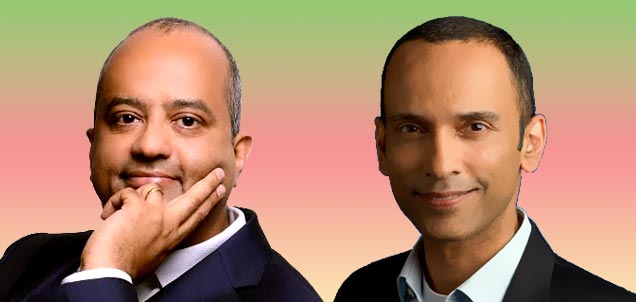
    GroupM has announced the appointment of Sameer ‘Sam’ Singh as CEO of its South Asia operations. Singh will lead the continued development of GroupM’s data-centric enablement for its agencies as they deliver competitive advantage to clients with digital leadership and content. Based in Gurugram starting in July, Singh will report to CVL Srinivas, Country Manager, WPP India and Mark Patterson, CEO, GroupM Asia Pacific.


    Singh joins GroupM from Google India where he was Director- Sales, responsible for the agency business. He was earlier based at Google’s headquarters in Mountain View, California where he worked on measurement, brand consulting, insights and product solutions. In a career spanning over 25 years across various geographies including India, China, UK, USA, and the Middle East, Singh, an alumnus of IIM Calcutta, worked across brand management, marketing services, media, forecasting ROI and research, sales and procurement at Gillette, P&G, GSK and Google. Prior to Google, he was VP, Global Media at GSK where he led their global pitch, set up the global media team and embedded digital excellence.


    Srinivas has been CEO for GroupM South Asia since January 2013. In October 2017, he was given the additional responsibility of Country Manager for WPP India. He will now transition fully to his WPP role.


    On Singh’s appointment, CVL Srinivas, Country Manager, WPP India said: “When planning the leadership succession, we found in Sam the perfect candidate who could take GroupM South Asia to the next level. We have built a strong enabling environment for our agencies with data centricity, digital leadership and content services. Sam has a track record of driving change at organisations focused on media, technology, brands and ROI. I look forward to working with Sam who has been a client, a media partner and a friend for many years”.


    Commenting on his appointment, Mark Patterson, CEO GroupM Asia Pacific said: “Sam is a unique talent and a great business partner with a fantastic track record delivering growth for market-leading world-class businesses across the globe. He now joins another one, and we are excited, proud and pleased to welcome him to GroupM South Asia.”


    Speaking on his appointment, Singh said: “The India market is transitioning to the next level of media sophistication, with GroupM adroitly navigating this space for their clients, and along with their media partners. I am super excited to join the GroupM team on this wonderful journey, and I look forward to bringing to the table, my experiences built at Google, as a Marketer, and while working across emerging and developed markets. I look forward to contributing, and to learning from my colleagues, our clients, and our partners.”


  • Glitch goes content-heavy with the launch of Flux@The Glitch

    By A Correspondent


    Glitch has announced the launch of Flux@The Glitch, a specialised content division. Saransh Agarwal has been elevated to lead content strategy and business for Flux and will report to Varun Duggirala, Content Chief @The Glitch.


    Speaking on the launch, Varun Duggirala, Content chief @The Glitch said:

    “Over the last eight-plus years, we have always relied on a core brand insight driven strategy to build brands across platforms and consumers. It is this very thought process that has helped us create effective branded content as a core part of a brand’s value chain, and we have used that learning to come up with an effective yet fluid system that works for brands, for consumers, for creators and for platforms. The beauty of a fluid model is that it will always be in Flux because the world of content changes every day.”


    Added Tushar Vyas, Chief Strategy Officer, GroupM: “Flux will be empowering brands by providing powerful meeting point between the consumer and the brand across diverse touchpoints- this brings in a unique layer augmenting GroupM’s capability in consumer insight,  planning and activation. Flux will work closely with GroupM Agencies to deliver effective and engaging content solution for our clients across GroupM in India and beyond.”


  • Mind the TV AdEx Gap!


    By Indrani Sen


    For two consecutive years, TYNY by GroupM and PMAO by Madison were released during the same week, giving the industry lot of food for thought and facts and figures to chew and digest. TYNY or ‘This Year Next Year’ closed the estimate for total AdEx 2017 at Rs 61,263 crore with a growth rate of 10% over 2016, while PMAO or ‘Pitch Madison Advertising Outlook’ showed a growth rate of 7.4% in 2017 over 2016 and estimated the total AdEx as Rs 53,138 crore.

    After a year of stagnation and stunted growth in 2017, mostly due to the after effect of Demonetisation and Goods & Services Tax (GST),both the reports predict a better year in 2018 with a growth of total AdEx by 13% and 12% respectively.

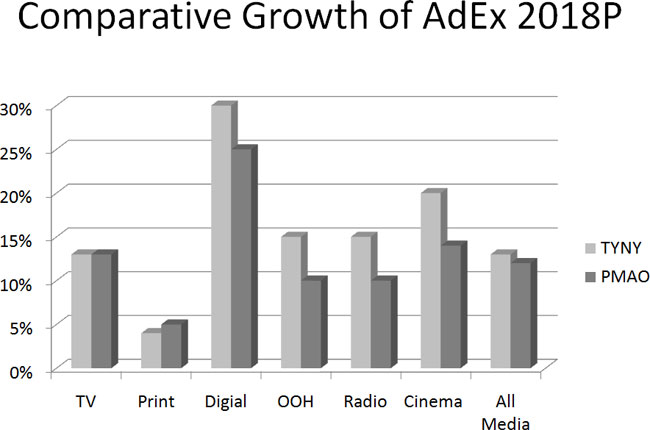
    According to both the reports, Digital is going to have the highest growth in AdEx in 2018, 30% according to TYNY and 25% according to PMAO. Both reports predict 13% growth in TV AdEx and 4% (TYNY) and 5% (PMAO)in Print AdEx. Both agree that the highest growth after Digital will be achieved by Cinema (20% TYNY & 14% PMAO) which has the smallest share of the advertising pie. Both have shown same percentile growth rates for OOH and Radio (15% TYNY & 10% PMAO).

    The chart below shows that PMAO’s estimates for growth for all media, except TV and Print, are more conservative than TYNY.


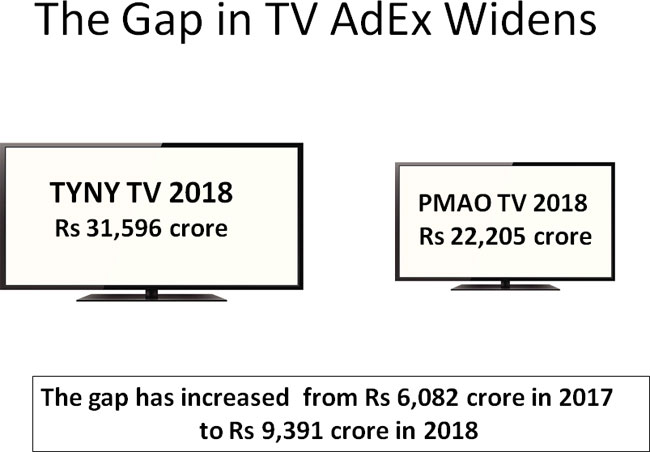
    In my analysis of the two reports last year (http://www.mxmindia.com/2017/02/what-is-the-real-size-of-indian-ad-industry/), I found a difference of around Rs 5000 crore between the two projections made by TYNY and PMAO for all media in 2017. The difference was mainly due to the disagreement between the projections for TVAdEx in the two reports with GroupM’s projection being almost Rs 6000 crorehigher than PMAO’s.

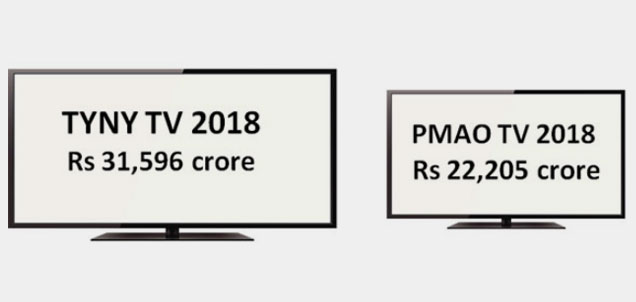
    In the projections for 2018, the gap in the all media AdEx between the two reports has widened to almost Rs10,000 crore with TYNY predicting the total industry size as Rs 69,347 crore and PMAO predicting it as Rs 59,530 crore. As seen last year, most of this difference is due to the Rs 9,391cr difference in the projections of TV AdEx shown in the two reports.


    Unless this widening gap in TV AdEx is reviewed by both the agencies and explained to the industry at large, it would become increasingly difficult for the A&M industry to assess the actual size of the TV AdEx. I think there must be a difference in the methodology followed by the two agencies for estimating TV AdEx which results in the different estimates.

    On behalf of the A&M fraternity, I appeal to both GroupM and Madison for a clarification so that we have a better perspective and understanding about growth of Indian advertising by media over the years.

    Indrani Sen is a veteran advertising professional and is now Adjunct Professor with the Symbiosis International University, Pune. The views here are her own


  • GroupM forecasts AdEx to grow 13% in 2018


    By Rohit A


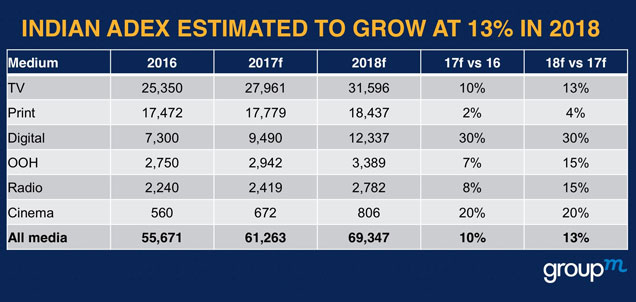
    GroupM, in its annual marketing forecast, predicts 13% growth (vs 10% in 2017) in India advertising expenditure (AdEx). The Indian AdEx in 2018 is estimated to be at INR 69,346 crore ($10.8 billion) compared to INR 61,263 crore ($9.6 billion) in 2017, as per This Year, Next Year (“TYNY”) report released by GroupM.

    As per economic experts, India is well poised with growth outlook of between 7.3% to 7.8% in 2018, giving India the fastest growing economy tag among developing countries. With demonetisation behind us and GST having implemented, a recovery in consumer demand and private investment is expected.

    “As consumer sentiment stabilizes and spending increases, we estimate 2018 to be a relatively better year from an ad spend perspective. Growth in digital media will continue to outstrip other media but unlike most markets”said CVL Srinivas, Country Manager, WPP India and CEO, GroupM South Asia.

    Between 2015 and 2017, Indian AdExgrew at a CAGR of 11% (expenditure of $9.4 billion in 2017 vs $7.7 billion in 2015), compared to World Ad spend, which grew at a CAGR of 3.5% in 2015-17.


    Digital continues its dominance

    While digital share of India AdEx is estimated to be ~18% in 2018 (vs 15.5% in 2017), however this space is expected to grow at a rate of 30% YoY (followed by cinema’s estimated growth of 20%). Digital witnessed the same growth rate in 2017 too.

    In 2018, AdEx in digital is estimated to be at INR 12,337 crore ($1.9 billion) compared to INR 9,490 crore ($1.5 billion) in 2017.

    GroupM estimates, Video advertising on digital is estimated to grow at 54%, as bandwidth improves and data and mobility device become more economical for the consumer.

    As digital becomes 18% of the overall advertising spends in India, measurement and transparency become paramount. Last year, GroupM globally led the conversation on measurement and transparency in digital media, and released viewability standards that are higher than those stipulated by the Media Rating Council in the US. In India too, GroupM is working with industry bodies, brands and publishers to adhere to a standard viewability index that would become integral to the digital ecosystem. Along with viewability, GroupM also held knowledge and training workshops for client teams, on mitigating ad fraud and assuring brand safety.


    Traditional media role in India

    Given diversity in India, Television continues to be the largest medium, with its contribution remaining ~ 45% share in 2018 (same as 2017) and will see a growth of 13% YoY. AdEx in TV is estimated to be at INR 31,596 crore ($4.9 billion) in 2018, compared to INR 27,961 crore ($4.4 billion) in 2017.

    Parliamentary elections in H1 2019 will stimulate advertising from the back half of 2018, says GroupM. Print will see a slight uptick in 2018 from the elections, with key markets in demand. The growth rate for newspapers is estimated at 4.2% with English papers growing slightly slower than Hindi and regional languages. However, print share of AdEx is expected to decrease from 29% in 2017 to 26.6% in 2018.

    Other media such as OOH will continue having a share of 4.9% in overall AdEx and is expected to witness a good traction of 15% growth from premium transit sites (vs 7% growth in 2017).


    Radio with a share of 4% in overall AdEx, is expected to grow at 15% in 2018 (vs 8% growth in 2017). This growth is predominantly due to the launch of new radio stations across the country


    Cinema will continue to grow at 20% in 2018, as the infrastructure investment made last year will attract a larger audience to theatres for a blockbuster experience. The share of Cinema although continues to be approx 1.2% of overall AdEx.


    Digital continues its dominance

    While digital share of India AdEx is estimated to be ~18% in 2018 (vs 15.5% in 2017), however this space is expected to grow at a rate of 30% YoY (followed by cinema’s estimated growth of 20%). Digital witnessed the same growth rate in 2017 too.


    Gamechangers

    As per GroupM, 3Vs will be the key drivers for consumption in 2018 – Video, Voice and Vernacular.

    Voice can have large impact on Indian consumers specially when voice enabled products can accept instructions in regional languages. Currently, the disruption is only at a high-level (Amazon Alexa, Google Assistant, Apple Siri) and it will be interesting to see how Indian consumer and developers adapts to this new change.

    Esports will be a game changer in the sports space, says GroupM. The Olympic Council of Asia recently announced that it will include esports in the 2018 Asian Games and make it a medal sport in 2022.


    Indian ranking in Global AdEx

    India is among the top 5 global contributors of incremental AdEx in 2018 and has a share of 5% (vs 4.7% in 2015).

    India is set to become 10th largest adspends market in 2018 compared to 11th largest in 2017.


    Summary:

    :: The overall India AdEx in 2018 will grow by 13% (vs 10% in 2017)

    :: Digital will lead the growth with a 30% growth rate (~$1.9 Billion ad investment expected in 2018)

    :: Things to look out for – Consumption of video contents; platforms having Voice connectivity; regional contents; e-sports participation; OTT content

    :: India is a unique market where all media have headroom to grow.

    :: India is the fastest growing ad market in APAC and among the fastest  growing markets in the world (amongst Top 5 contributors of incremental AdEx in 2018).


    About TYNY:

    This Year, Next Year (“TYNY”) is part of GroupM’s media and marketing forecasting series drawn from data supplied by holding company WPP’s worldwide resources in advertising, public relations, market research, and specialist communications. The TYNY report is the most comprehensive understanding of the estimated media spends by advertisers in the current year. It also highlights some of the industry sectors that will have a major effect on advertising spends across media.

    TYNY 2018 PC presentation HANDOUT- 13218 – MM
     

  • Wavemaker India retains media mandate for Tata Sky

    By A Correspondent


    GroupM agency Wavemaker has announced the retention of media duties for Tata Sky. Maxus (now part of Wavemaker) has been the media agency on record ever since the DTH service provider launched its operations in India in 2006.


    Said Kartik Sharma, Managing Director – Wavemaker South Asia: “I am grateful to Tata Sky team for selecting us as their strategic media partners right from the start of their launch in India. Associating with Tata Sky for over a decade now has been an enriching experience for all of us. Tata Sky is one of our oldest client partners in India and we are extremely happy to continue our relationship with them. We are excited about our new global framework – ‘Rapid Growth Planning’ which will help Tata Sky in identifying growth opportunities and help in further strengthening the brand.”


    Added Malay Dikshit, Chief Communications Officer – ‎Tata Sky:  “GroupM has been associated with Tata Sky for the past 10 years and it was time that we scanned the media industry for best practices, great leadership and sound commercials. While there were some brilliant and very strong contenders delivering on all of these requirements, team Wavemaker stood a step ahead with their strategic steer and detailed planning. Tata Sky welcomes Wavemaker on board again.”


  • Sonali Malaviya appointed VP – Client Partner at Essence

    By A Correspondent


    Essence, a data-driven global agency that’s part of GroupM, announced the appointment of Sonali Malaviya as Vice President, Client Partner. She will be reporting into Anand Chakravarthy, Managing Director, Essence India and will lead the Google relationship, based in the Gurgaon office.


    With experience spanning over 15 years, Malaviya is a senior marketing professional working with global brands and companies. Prior to Essence, she was the Chief Operating Officer of Colorbar Cosmetics. She was also the India Country Marketing lead at Twitter and helped set up and navigate their marketing offering to some of the biggest domestic and international brands in the market. In the past, she has also held the position of Principal Partner at Mindshare Delhi, and has done stints in leading media agencies and a research firm.


    Said Anand Chakravarthy, Managing Director, Essence India: “Sonali’s diverse experience and her width of exposure working on both the agency and the client side, makes her a real asset to have at Essence and the ideal choice to steward our longstanding relationship with Google. Bring onboard key leadership like Sonali is priority to Essence building a strong differentiated offering in India.”


  • Showbiz rules, and how!


    By A Correspondent


    ESP Properties, the sports and entertainment programming specialist arm of GroupM, has released the first edition of the entertainment marketing report Showbiz, The Indian Superpower. Segmented into three parts – film marketing, the celebrity aspect and content licensing – the first edition of the Showbiz report includes viewpoints of those who work to maximize brand value through film promotions.


    The film entertainment industry is growing at 10% year-on-year in terms of the number of films released. This opens numerous marketing opportunities for brands through alliances and content licensing. In India, marketing budgets for films have grown from 5-6% of production budget, to 10-15%, which is closer to the global average. 20% of films released include brand associations, where brands also share a part of the marketing budget. There is close to 56 hours of entertainment promotion films playing cumulatively through the day across channels. Today producers are working closely with agency partners that help them achieve their marketing objectives efficiently, and drive footfalls into the theatres.


    Vinit Karnik

    Said Vinit Karnik, Business Head, ESP Properties: “The film entertainment industry is an integral part of India’s marketing landscape and drives revenue for film production and exhibition. Traditional film studios and production houses now increasingly rely on advertising and digital media interaction, coupled with research, data analytics and innovation to market movies. At ESP Properties, we bring our client brands and movie marketing together to engage an audience that is spoilt for choice with 1000 movies released every year. Targeted marketing to the consumer has therefore become critical, and this report will give brands and film producers some insights into movie marketing in a media landscape that is so disruptive.”


    India, as a nation, attracts a large film audience, given the popularity of the medium. As the film market grows, the audience too has moved from linear, one dimensional advertising to a multi- channel and interactive dialogue with the film and brand communities. To create deeper engagement with the audience, brands and producers are exploring content licensing as an avenue to bring film characters and storylines into true life experiences. In India content licensing is growing at 7.4% year on year, which a higher than developed markets like the USA, UK and Canada (source: The top 150 Global Licensors report, License Global 2017)


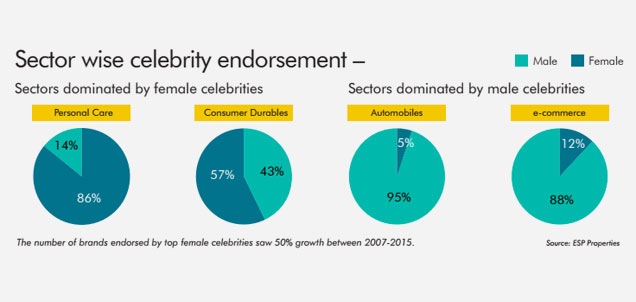
    Another data point that the ESP entertainment report brings out is on Celebrity endorsers. In the last 10 years, 25% of brand advertising on television feature a famous face. While we have seen peaks in ad creatives with celebrities during the summer and festive seasons, this trend is fast moving with the influx of digital avenues. And we see celebrities playing the role of active influencer to the brands rather than just endorsing them.


    As cinema remainsthe No.1 choice of entertainment in the country, the ESP Properties the entertainment marketing report is brief glimpse of the trends, ideas and insights into what will drive the industry.


    Executive Summary of the report

    Brand Alliances:

    • Total co-marketing media spends for Hindi films have reached approximately INR 100 crore around a year, with more co-branding than in-film
    • Keeping aside lack of digital boundaries and the reality of a global village, a regional film artiste still has the ability to converse directly with a specific demographic in a local language.

    That is why 25% of Hollywood films, 15% of south India films, 16% of Marathi films have brand associations

    • FMCG, Apparel and E-commerce for instance, are categories that are most active in in-film integrations and co-branded associations


    Film Marketing:

    • The ‘now-generation’ idea is to create a (film) product that generates positive word of mouth; ‘attracting’ audiences as well as ‘satisfying’t hem
    • Placement in terms of a healthy media-mix accounts for 10-15% of the film’s marketing budget
    • It is vital to identify and amplify the positioning of a film. Once it is identified exactly what kind of audience the film is made for, a marketer can then amplify “positioning elements” that highlight and reflect in all promotions for the film
    • A well-defined promotion plan must be put into place for personifying the cast and then promoting them. The build-up to the characters and creating a sense of one-ness with the audience is the crucial trick (without over-exposing the team)
    • Strategic PR and managing the millions of media outlets is the backbone of a film’s success


    • Partnering with emotion rather than pragmatism is what drives the business of entertainment
    • A typical, full-fledged marketing campaign begins with a teaser and takes the next five to eight weeks to position its stars, music etc. to the target audience


    Media Effectiveness:

    • Making accurate predictions about the scale of a film depends not just on its cost of production but also on how the film utilizes mainstream and ‘new media’ in an effective manner
    • On TV and digital, the song and dialog promotion dispersion is seen at 70:30. Assets related to music still form an integral part of film promotion, with 24×7 music channels assuming importance as vehicles of publicity
    • The film’s promotion budget is higher on television (45-50%) and lower on print (10-15%).

    Digital is getting added (10-15%) and activation is steady (25-30%)

    • The shelf life of a film in theatres is limited to two-three weeks after release (that too, only for big films), the release weekend gets heavy focus. The first weekend is also when production houses expect over 70 per cent of the total collection of the film


    Influencers:

    • Brand chooses endorsers and influencers for multiple reasons- launch, sustenance and revival
    • In a celebrity endorsement, the celebrity is the face of a brand message. In influencer marketing, the influencer is perceived to be ‘creator’ of the entire message
    • Woman power made it to the ‘top three’ of brand endorser list for the first time in 2017
    • Shah Rukh Khan and MS Dhoni have consistently been among the top endorsers in the past decade
    • An influencer’s social media presence is a huge pull for a brand or a film’s promotional plan. It also enables brands to amplify and measure the effectiveness of a campaign


    Licensing the Content:

    • Industry sources predict India’s licensing growth at 7.4 per cent, which is higher than the growth in USA, Canada and UK combined
    • Significant players in the market that represent international and Indian IPs Green Gold who is the market leader among the others who are Disney, Dream Theatre, Viacom, Bradford Licensing, AI Licensing and Sony


    • Hollywood properties dominate the licensing market. Superhero franchises and character-led entertainment takes up bulk of licensing deals. Films such as Captain America and Batman series are windfall for F&B and apparel brands
    • The top 150 global licensors (which include non-film brands too) reported total retail sales of INR 1,751,200 Cr worldwide in 2017. India’s share in the global licensing pie is 5-7%
    • Start-up licensing agencies now eyeing the big millions with popularity of TV series such as Game of Thrones, Indian characters such as Chhota Bheem and Japanese anime such as Doraemon


    Digital Marketing & Strategy

    • The total number of YouTube channels in India at the end of 2016 was 13,99,000+, the views clocking in a neat 22375 crore, our subscribers standing at 4118.5 lakhn and uploads at a staggering 97.5 lakh. Not surprisingly, the top YouTube channel in India across categories is the one that thrives on launching some of Hindi films’ biggest assets – T-Series, followed by SET India and the children’s animation channel Chu Chu TV
    • In the decade of 2007-2017, digital media strategy played a lead role in the industry making a departure from a ‘single-event’ launch or press interaction to an entire campaign spanning weeks or months
    • Hindi films’s most successful digital teams use analytic tools such as ‘Vidooly’ (for video intelligence), Lexalytics (for sentiment scores) and Buzz Engine for film promotions
    • The capabilities of command centers and content analytics will increase exponentially and thus, content (shows, films, events, etc.) will be able to meet larger audiences


    Please click here for detailed PDF


  • GroupM India wins award at the HR Excellence Awards 2017


    GroupM has won a Silver at the HR Excellence Awards 2017, for its India team’s initiatives to drive work-life balance. Speaking on the win, Rohit, Suri, Chief HR &Talent Officer, South Asia said: “At GroupM India, with its agencies spread over several cities, this commitment has faced unique challenges driven by changing social and business realities. To maintain a positive work-life balance and moving towards work-life integration, it has been our endeavor to make continuous changes to our policies and practices in line with the changing social and business realities. With the help of technology and a stellar team of thorough professionals, we are today one of the most preferred employers in our industry, and this award is a testimonial of the hard work in a people centric business.”

  • MEC + Maxus = Wavemaker


    By A Correspondent


    The announcement has been name. The new billion-dollar revenue, media, content and technology agency to be created from the merger of MEC and Maxus will be named Wavemaker. The brand mark Wavemaker reflects the agency’s heritage, born from WPP and GroupM.


    Said Tim Castree, Global CEO of MEC and Wavemaker: “Our purpose is to provide advertisers with the power to transform and grow their business through our Purchase Journey obsession; and importantly to do this through the integration of Purchase Journey insights and data with [m]PLATFORM, GroupM’s proprietary global audience technology.  Our Wavemaker brand and positioning is a compelling manifestation of that purpose.”


    Added Kelly Clark, Global CEO of GroupM: “Wavemaker is an exciting new global agency brand with a powerful proposition for clients. Tim and his team have the full support of GroupM’s scale, resources and expertise.”


    The brand, along with a new visual identity, will go live locally as the merger completes in each country, to be finalised by January 2018. Wavemaker will have offices in 90 countries and over 8,500 employees. Major global clients include L’Oreal, Vodafone, Marriott, Colgate-Palmolive and Paramount.


    While senior appointments have been announced – including that of Kartik Sharma who will helm Wavemaker in India, the reorganisation of the rest of the teams has still not been announced.


    Globally, it is said that there will be redundancies, though the status in India is still not known.


  • iProspect names Rohan Philips as Global Chief Product Officer

    By A Correspondent


    Rohan Philips

    iProspect has announced the appointment of Rohan Philips as Global Chief Product Officer. In his new role, Philips will direct and oversee iProspect’s roadmap for central product development, adoption and commercialisation across its 52 markets. He will report to Global President, Ruth Stubbs, and will be based in Singapore.


    Ruth Stubbs

    Said Ruth Stubbs, Global President, iProspect:“Our ambition is to drive business performance for our clients. This requires a mindset that is inspired by the future, delivered today, and Rohan fully encapsulates this.  A dynamic approach to the development and evolution of our global product set is a vital component in our ability to engage audiences across all platforms and connect brands to consumers. As a business, we must become more sensitive to the challenges clients are facing. With Rohan’s hire, we have now finalised a recalibrated leadership team – specifically designed to address delivering these capabilities for our organisation, Dentsu Aegis Network and the clients that we serve.”


    Philips joins iProspect from GroupM, where he served as Vice President at [m]Platform and Xaxis.


  • Business as usual for Maxus & MEC in India. For now…


    By A Correspondent


    That last bit of the headline is most critical. For now.

    Because the winds of change are blowing across the media agency world. There are huge pressures on operational efficiency – cutting costs and flab wherever necessary, combine forces whenever it’s possible and bracing oneself for a world where technology will drive business.


    And for WPP-owned GroupM, one of the world’s largest media agency and services conglomerates and clearly the numerouno in India, the situation is the same. And like for any smart strategy consultancy, the writing on the wall is clear. Only the fittest and smartest will survive.


    But the decision to maintain the status quo in India, while effecting changes across the world, means a lot.


    Although globally MEC is bigger, Maxus is huge in India. Sibling Mindshare may be way ahead, but Maxus has traditionally been very aggressive in the marketplace. Two years back in fact it beat Mindshare at the Emvies, the annual media agency award conducted by Advertising Club. Recently, it bagged the coveted ITC account which was earlier held by Madison and was fiercely contested that involved multiple agencies.


    MEC was founded in January 2002 with WPP buyingout CIA’s parent, Tempus. MEC was formed by the merger of The Media Edge and CIA. In 2010, the agency was rechristened MEC from Mediaedge:cia.


    In November last year (2016), MEC announced a new global CEO in Tim Castreereplacing Charles Courtier.


    Maxus, on the other hand was formed in 2008, though it did exist in some others before. Lindsay Pattison is Global CEO of Maxus, but last month she was also appointed Chief Transformaton Officer of GroupM. She currently holds both charges.


    This is what Pattison today after the announcement of last evenng:

    Transformational news from @Groupmworldwide today exciting for@Maxusglobal@MECideas and @Essencedigital Proud to be part of this

    — Lindsay Pattison (@lindsaymaxus) June 1, 2017


    Meanwhile, let’s revisit the story that MxMIndia carried on the site last evening:

    GroupM has announced a portfolio restructure which is essentially entails the merging if the global operations and teams of its agencies MEC and Maxus into a new, billion dollar revenue, media, content and technology agency under the leadership of MEC’s CEO Tim Castree.


    However, Maxus will continue to operate as an agency brand in India with the support of the newly formed global agency as well as the GroupM network. Ditto with MEC which will continue as is. In the near future, MEC will be rebranded to reflect the new global brand.


    GroupM’s portfolio will now comprise three successful global media agency networks — Mindshare, MediaCom, and the new company – each with more than one billion dollars in annual revenues, plus an innovative digital-first agency, Essence. GroupM also plans new investments across all of its agencies and its [m]PLATFORM data and technology capabilities.


    “We’re committed to improving our service to clients. These moves will give us greater focus, help us innovate, and improve our speed of delivery,” said Kelly Clark, Global CEO, GroupM in a statement.


    Since Clark became global CEO in October 2016, GroupM has made a number of organisational changes. Clark recently appointed Lindsay Pattison as GroupM’s Chief Transformation Officer to lead a range of transformation initiatives.


    Meanwhile, in a communique, GroupM said it is committed to the expansion of Essence, its digital-first agency, by adding traditional media capabilities and a larger geographic footprint to the agency’s existing media and creative credentials. In time, Essence will also lead several key GroupM client relationships as part of this restructure, the note added.


    GroupM acquired Essence in November 2015. “The leadership team at Essence is excited about the opportunities this creates for our clients and our people,” said Christian Juhl, CEO, Essence. “Our mission is to make advertising more valuable to the world; with this infusion of talent, capabilities and markets, we can do this now on a bigger stage.” Clark named Castree CEO of MEC in November 2016.


    “Maxus and MEC share common values and ambitions. Both networks have a strong local market presence and entrepreneurial drive. Together, we believe we can create an exciting new media, content and technology agency which we look forward to introducing soon,” said Castree.


    “We’ve clearly signaled our ambition to transform, and we mean business,” said Pattison. “This allows us to more meaningfully invest in each agency’s future – retaining and attracting the best talent with inspiring and rewarding workplaces, creating differentiated cultures and approaches, and sharing in a focus on helping clients win.”


    Bottomline:

    It’s business as usual for Maxus and MEC for now in India

    Clients of both agencies needn’t worry. Conflicts, if any, will be ironed out

    There will be rationalisation in teams, with movements from one grouping to the other. This will help populate the team of Essence


    The communication teams of GroupM, MEC and Maxus are tightlipped about giving out any more info, but there is indeed worry about what responsibilities some key folks in both agencies will be given once the merger happens fully.


    For now, Ajit Varghese, CEO APAC at Maxus will continue in his current role, but it will be interesting to see what his next role will be given that Maxus Indiia will continue as is, though for the rest of the world, things will change


  • GroupM merges Maxus & MEC globally. In India both to operate as is

    By A Correspondent

    GroupM has announced a portfolio restructure which is essentially entails the merging if the global operations and teams of its agencies MEC and Maxus into a new, billion dollar revenue, media, content and technology agency under the leadership of MEC’s CEO Tim Castree.

    However, Maxus will continue to operate as an agency brand in India with the support of the newly formed global agency as well as the GroupM network. Ditto with MEC which will continue as is. In the near future, MEC will be rebranded to reflect the new global brand.

    GroupM’s portfolio will now comprise three successful global media agency networks — Mindshare, MediaCom, and the new company – each with more than one billion dollars in annual revenues, plus an innovative digital-first agency, Essence. GroupM also plans new investments across all of its agencies and its [m]PLATFORM data and technology capabilities.

    “We’re committed to improving our service to clients. These moves will give us greater focus, help us innovate, and improve our speed of delivery,” said Kelly Clark, Global CEO, GroupM in a statement.

    Since Clark became global CEO in October 2016, GroupM has made a number of organisational changes. Clark recently appointed Lindsay Pattison as GroupM’s Chief Transformation Officer to lead a range of transformation initiatives.

    Meanwhile, in a communique, GroupM said it is committed to the expansion of Essence, its digital-first agency, by adding traditional media capabilities and a larger geographic footprint to the agency’s existing media and creative credentials. In time, Essence will also lead several key GroupM client relationships as part of this restructure, the note added.

    GroupM acquired Essence in November 2015. “The leadership team at Essence is excited about the opportunities this creates for our clients and our people,” said Christian Juhl, CEO, Essence. “Our mission is to make advertising more valuable to the world; with this infusion of talent, capabilities and markets, we can do this now on a bigger stage.” Clark named Castree CEO of MEC in November 2016.

    “Maxus and MEC share common values and ambitions. Both networks have a strong local market presence and entrepreneurial drive. Together, we believe we can create an exciting new media, content and technology agency which we look forward to introducing soon,” said Castree.

    “We’ve clearly signaled our ambition to transform, and we mean business,” said Pattison. “This allows us to more meaningfully invest in each agency’s future – retaining and attracting the best talent with inspiring and rewarding workplaces, creating differentiated cultures and approaches, and sharing in a focus on helping clients win.”