Tag: FICCI

  • Entertainment in Limbo

    Entertainment in Limbo

    Shailesh KapoorIn more than 25 years of observing the Indian media and entertainment industry closely, there has never been a period like the one we are in currently. Every mainline sector of the industry is going through a phase of stagnancy or descendancy. It is difficult to say if any of this will change anytime in a hurry.

    The television industry has been struggling to hold on to pay subscribers. The drops are not sizeable in percentage terms. But in a country where more than 30% of the population still doesn’t have access to TV, growth should be a given. Instead, we are looking at stagnant numbers. Because BARC India hasn’t conducted a baseline study in a while, this data point is open to debate. On the revenue front, the EY-FICCI report projects positive revenue growth, but that’s a little hard to believe in the current scenario.

    On the content front, big-ticket cricket is the only marquee property type that television has to show. Nothing on mainline Hindi GECs is in that league anymore.

    Over the last couple of years, the popular narrative suggested streaming is the future, and television will slowly make way for it. But the streaming numbers paint a picture of their own. In our recently published OTT report, India’s digital video audience size went up by 14%, from 481 Mn to 547 Mn. But this entire growth comes from the AVOD segment, largely on the back of new audiences who have entered the category via YouTube and social media videos.

    As new audiences enter, one would expect those already there to move to the next level. In case of OTT, this would mean from AVOD to SVOD. That hasn’t happened at all, and the total paid subscriptions seem to have frozen in time. Audiences outside the Top 15 cities are not keen to pay for OTT subscriptions, and the Top 15 cities have reached their saturation point post the pandemic.

    The evident slowdown in content production makes the picture look gloomier. The number of originals on OTT this year may be a good 30-40% less than 2023. Next year could be even lower. Creators (producers, writers, directors) who were navigating multiple projects last year are now in sustenance mode.

    The theatrical category is doing decent numbers, but matching last year’s box-office will be a tough ask. In any case, a handful of big films are driving the box-office, and the long tail has weakened considerably, leading to a lot of scepticism, and a general drop in the number of Hindi releases. We are currently in one such period, where there are no major releases for several weeks after Stree 2’s release on Independence Day.

    The silver lining comes via positive signs on the larger consumer sentiment and demand in the country. Evidently, media advertising will ride on this sentiment. But that could be the only tangible positive for the Indian media industry currently.

    Hopefully, there are positive developments round the corner, which will pleasantly surprise us. For now, the next few months may be those of wait and watch.

  • Kevin Vaz & Arjun Nohwar appointed Chair & Co-chair of FICCI Media & Ent Committee

    By Our Staff

    Kevin Vaz
    Kevin Vaz
    Arjun Nohwar
    Arjun Nohwar

    The Federation of Indian Chambers of Commerce and Industry (FICCI), announced the appointment of Kevin Vaz, CEO – Broadcast Entertainment, Viacom18 as the Chairman of FICCI Media & Entertainment Committee. It also announced Arjun Nohwar, General Manager for India & South Asia for Warner Bros. Discovery, as Co-Chair.

    Said Leena Jaisani, Deputy Secretary General, FICCI said, “FICCI, as the apex industry association, has consistently led the charge in fostering collaborations with diverse stakeholders within the realms of Indian commerce and government.  In navigating the complexities of this dynamic landscape, FICCI remains steadfast in its commitment to driving meaningful policy discussions and facilitating their effective adoption, thereby shaping a vibrant and progressive future for the media and entertainment sector in India. FICCI is confident that Mr Vaz, with his wealth of experience, will bring fresh perspectives and contribute significantly to the continued growth of the Media & Entertainment industry.”

    Said Vaz:  “The Indian Media and Entertainment industry is at an interesting tipping point in time. While the interplay of technology, content and consumer behaviour is reshaping the very definition of the sector, in India there is a clear headroom for growth across categories and a confluence of interests between multiple players in the ecosystem. At a global stage, the soft power inherent to our industry can act as a leverage multiplier to India’s growing cultural influence. I feel honoured to be given the responsibility to lead this committee and look forward to interacting with stakeholders across the board to further our sector’s footprint.”

    Added Nohwar: “Accepting the mantle of Co-Chair at FICCI’s Media & Entertainment committee is an honour for me and I look forward to engaging with industry leaders, government stakeholders, and policy makers. Together, with a shared commitment, we aspire to build synergies that not only guide our industry towards unparalleled growth but also solidify its standing as a global leader. In this endeavour, I look forward to working closely with Kevin Vaz (Chair) and Sandhya Devanathan (Co-Chair), leveraging our collective expertise to chart a visionary course for the industry. FICCI’s steadfast dedication to fostering collaboration and shaping progressive policies is laudable, and I am particularly excited about the prospect of contributing to the dynamic evolution of the Indian Media & Entertainment landscape.”

  • Indian M&E sector grew 20% in 2022: FICCI Frames-EY report

    By Our Staff


    The Indian Media and Entertainment (M&E) sector grew 20% in 2022 to reach INR2.1 trillion (US$26.2 billion), 10% above its pre-pandemic levels in 2019. This was revealed in the FICCI-EY report titled ‘Windows of opportunity – India’s media & entertainment sector maximising across segments’ launched on Wednesday at the FICCI FRAMES 2023 in Mumbai.


    Digital media has grown significantly, reaching INR571 billion and increasing its contribution to the M&E sector from 16% in 2019 to an astonishing 27% in 2022. It is important to note that the digital segment’s share of the entire M&E sector would rise to 50% if data costs were also to be factored in.


    Said Ashish Pherwani, EY India Media & Entertainment Leader: “The Indian M&E consumer base is large but heterogenous, hungry for content but willing to pay only for value, and more than ready to experiment with technology, be it streaming, digital payments, online education, virtual experiences, e-commerce, social media, or gaming. The diverse consumer base, coupled with favourable macroeconomic and demographic factors, have translated into a very exciting time for the sector.”


    Added Jyoti Deshpande, Co-Chair, FICCI Media and Entertainment Committee: “It’s an exciting time to be in the M&E business, as we leverage the three pillars of the industry – content, commerce, and community, fuelled by technological innovation. The sector is expected to grow 11.5% in 2023 to reach INR 2.34 trillion and further grow at a CAGR of 10.5% to reach INR 2.83 trillion by 2025.  Through democratisation of the creator economy and disruption in digital distribution, I dream of an India with infinite storytellers finding infinite platforms to share their stories, engaging with audiences in every language, with India leading the charge across the global entertainment landscape.”


    Experiential (outside the home) segments recovered in 2022: Filmed entertainment, live events and Out-of-home media segments together contributed 40% of the M&E sector’s total growth in 2022.


    Advertising continued to outperform Indian GDP growth: At INR1,049 billion, advertising exceeded the INR1 trillion benchmark for the first time. In 2022, when India’s nominal GDP grew 15%, advertising recovered 19%. It is now 0.4% of India’s GDP, much lower than developed large markets like the US, Japan, and China, which are all between 0.6% and 1%.


    M&A activity continued strong in 2022: There were over 125 deals in 2022 compared to 118 in 2021, of which 65% were in digital, gaming, and new media segments.


    The M&E sector will grow at a CAGR of 10.5% to reach INR2.8 trillion in 2025: The key contributors to this growth will be digital, online gaming and television (together contributing to 65% of the growth), followed by animation and VFX (11%), live events (8%) and films (8%)


    Segmental performance in 2022

    • Television– Television advertising grew 2% to end 2022 just behind its 2019 levels, on the back of volume growth. Subscription revenue continued to fall for the third year in a row, experiencing a 4% de-growth due to a reduction of five million pay TV homes and stagnant consumer-end ARPUs. While linear viewership declined 7% over 2021, 8 to 10 million smart TVs connected to the internet each day, up from around 5 million in 2021
    • Digital advertising– Digital advertising grew 30% to reach INR499 billion, or 48% of total advertising revenues. Included in this is advertising by SME and long-tail advertisers of INR180 billion and advertising earned by e-commerce platforms of INR70 billion
    • Digital subscription– Digital subscription grew 27% to reach INR72 billion. 99 million paid video subscriptions across almost 45 million Indian households generated INR68 billion. Due to a plethora of free audio options, just 4 to 5 million consumers bought music subscriptions, generating INR2.2 billion while online news subscriptions generated INR1.2 billion
    • Print– Advertising revenues grew 13% in 2022 as print remained a “go-to” medium for more affluent and non-metro audiences. Subscription revenues grew 5% on the back of rising cover prices and has stabilized at 15% to 20% below the pre-Covid-19 levels. Digital revenues remain elusive for most newspaper companies.
    • Film– The segment grew 85% to reach 90% of its 2019 levels as theatres re-opened. Over 1,600 films were released in 2022, theatrical revenues crossed INR100 billion, and fewer films released directly on digital platforms. 335 Indian films were released overseas.
    • Online gaming– New players, marketing efforts, specialized platforms and brand ambassadors all worked to grow the segment 34% in 2022 to reach INR135 billion. Regulatory clarity improved, and this could lead to more FDI in this segment. There were over 400 million online gamers in India, of which around 90- 100 million played frequently. Real money gaming comprised 77% of segment revenues.
    • Animation and VFX– As content production resumed, service demand – both domestic and exports – increased, resulting in the segment growing 29% and crossing INR100 billion for the first time
    • Live events– The fastest growing segment of 2022, organized events grew 129% over a depleted base as weddings, corporate events and activations, government initiatives, and large marquee IP with international participation took place after a gap of almost two years
    • OOH– OOH media grew 86% in 2022 and reached 94% of 2019 levels. Capacity utilisation improved in 2022, but rates remained challenged.  Digital OOH screens increased to around 100,000 and contributed 8% of total segment revenues
    • Music– The segment grew by 19% to reach INR22 billion. Film music, which had reduced during the pandemic, returned at scale. 87% of revenues were earned through digital means, though most of it was advertising led, there being around only 4 to 5 million paying subscribers despite streaming reach of over 200 million
    • Radio– Radio segment revenues grew 29% in 2022 to INR21 billion but were still just 66% of 2019 revenues. Ad volumes increased by 25% in 2022 as compared to the previous year, though ad rates remained 20% below their 2019 levels.  Many radio companies are looking at alternate revenue streams to grow faster


  • Avinash Pandey to chair Abby Broadcaster Jury

    By Our Staff


    Avinash Pandey
    Avinash Pandey

    Avinash Pandey, CEO of ABP Network, will chair the Broadcaster Jury at the Abby One Show Awards 2023. The Abby Awards will be held on May 24-26 at Goafest 2023.

    Pandey is President of the News Broadcasters & Digital Association (NBDA) and also the President of the International Advertising Association (IAA) India Chapter. He is also the Director of the Digital News Publishers Association (DNPA) and a former Director of the Indian Broadcasting Foundation (IBF).

    Said Pandey on his appointment: “Being part of the Broadcaster jury for ‘Abby One Show Awards’ gives me an opportunity to reflect on the state of the media, the only business perhaps where truth is tested every minute, every day, every year.”

  • 2022 Priorities for CMOs


    By Our Staff


    In the EY-FICCI report for 2022 which was released with much fanfare on Monday, we found an interesting two-pager on the Priorities for Chief Marketing Officers for the year 2022. The entire EY-FICCI 2022 M&E report is available at https://assets.ey.com/content/dam/ey-sites/ey-com/en_in/topics/media-and-entertainment/2022/ey-ficci-m-and-e-report-tuning-into-consumer.pdf and the content below is on Pages 251 and 252


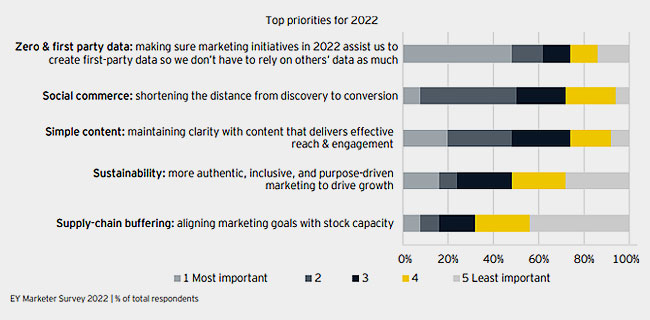
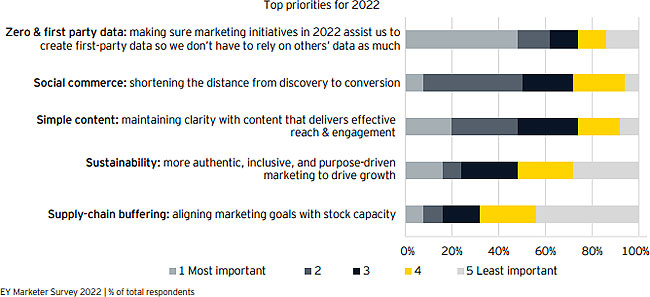
    Zero and first-party data is by far the most important priority for 2022


    • Most Important amongst marketer priorities for 2022 was creating zero and I irst-party data to enable efficient targeting of consumers, particularly given the challenges posed by cookie-less advertising and data privacy regulations

    :: Suggestion 1: Create a fair value exchange for your consumers

    :: Suggestion 2: Step up interactivity and gamification


    • Social Commerce has become an effective way to reduce the time between discovery and conversion and marketers need to understand its nuances and implement social sales channels for their brands at scale

    :: Suggestion 1: Create automatic bot check-outs

    :: Suggestion 2: Maximise role of influencers, tracking their Rol


    • Interestingly, many respondents identified effective content (and its ability to build reach and engagement) as a key priority for 2021

    :: Suggestion 1: Make content purposeful and personalised, based not on what people are searching for, but why

    :: Suggestion 2: Challenge yourself to think about the way stories are being presented [voice, video, visual via mobile and social], while keeping the art of storytelling alive [the heart of the message]


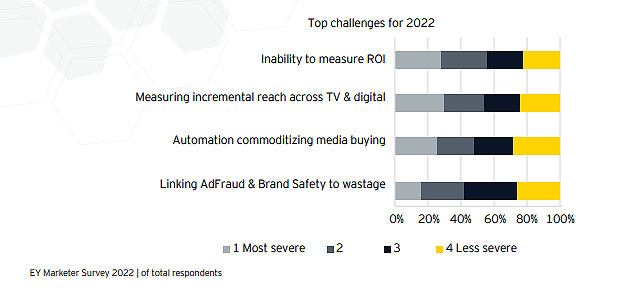
    Inability to measure ROI continues to be most severe challenge for marketers


    • Despite the overload of data generated by digital media, respondents identified measurement of marketing Rol as their number one challenge for 2022

    :: Suggestion 1: Build SMART (specific, measurable, achievable, relevant, time-bound) objectives to justify investments in full-funnel marketing, linked to clear KPls and use evolved attribution models

    :: Suggestion 2: Designate independent, objective owners of the Rol tracking technologies and processes


    • The lack of a common metric across TV and digital campaigns has most markets evaluating their campaign performances separately, and this led to concerns on the genuine incremental reach provided by digital to TV campaigns:

    :: Suggestion 1: Invest in modeling that provides directional guidance on investment strategies

    :: Suggestion 2: Build ways to collect deterministic data sets (actual households or individuals associated with an ad exposure) as a reliable way to control frequency


    Over 70% of respondents had ad fraud management in their top 3 challenges for 2022; yet the problem of linking adfraud and brand safety to wastage is seen as least severe amongst marketer problems. In there, lies an opportunity that must be addressed by the industry at large

    :: Suggestion 1: Continuously detect and protect against fraudulent traffic; boosting standards of measuring digital effectiveness

    :: Suggestion 2: Certify platforms that can demonstrate a proven ability to prevent fraud

  • Advertising to reach INR1 trillion by 2024: EY-FICCI


    By Our Staff


    The Indian Media and Entertainment (M&E) sector grew 16.4% INR1.61 trillion (US$21.5 billion) in 2021, according to the EY-FICCI report Tuning into consumer – Indian M&E rebounds with a customer-centric approach launched on Monday. Assuming no further impact of the pandemic, it is expected to grow 17% in 2022 to reach INR1.89 trillion (US$25.2 billion) and recover its 2019 pre-pandemic levels, then grow at a CAGR of 11% to reach INR2.32 trillion (US$30.9 billion) by 2024.


    Digital media has firmly established itself as the second-largest segment. It grew by INR68 billion in 2021. Share of traditional media stood at 68% of sector revenues.


    Said Ashish Pherwani, EY India Media & Entertainment Leader: “India has always been a different kind of media and entertainment market. High on volume and low on ARPU, yet up top with the rest on technology and ahead of the pack when it comes to digital adoption.” He added “Technology has led to the democratization of M&E in India – content is now created for the people, by the people and of the people. The flow of consumer data provides rich and real-time insights on what the consumer likes and dislikes, when where and how it is being consumed, and whether the price-points are appropriate.”


    Added Sanjay Gupta, Chairman, FICCI Media and Entertainment Committee: “The massive disruption of COVID-19 in 2020 was a seminal event for all industries and more so for M&E as more people relied on it to educate, inform and comfort them during these challenging and complex times. I am pleased to see that, in 2021, the industry and consumers have embraced the choices that have emerged wholeheartedly, and a recovery is well underway with digital serving a pivotal role in it. In particular, the growing animation and VFX segment sets India up well to become the preferred content creator for studios globally.”


    Said Jyoti Deshpande, Co-Chairman, FICCI Media and Entertainment Committee: “India is back post pandemic with a 16% growth in the M&E sector, helping us reach INR1.6 Trillion. After a difficult year and half, we have adapted and evolved with new ways of storytelling and innovation at every step. The creator market has exploded, we have hyper local content meeting cross border collaborations, all of it being leveraged by India’s unique ‘and’ market where the TV, Digital, Print, Radio and OOH not only coexist but complement each other. It’s an exciting time in the media & entertainment industry and I’m eager to see what new horizons we uncover.”


    Here are excerpts from the report as shared by EY:


    Advertising to reach INR1 trillion by 2024:

    In 2021, when India’s nominal GDP grew 19%, advertising growth outperformed and grew 25%. The highest growth was in television advertising of INR62 billion, followed by digital advertising of INR55 billion and then of INR29 billion from a resilient print. By 2024, India’s advertising market should reach INR1 lakh crores (INR1 trillion).


    Digital infrastructure – towards a billion screens by 2024:

    India is getting connected – it now has 795 million broadband connections, over 500 million smartphones and 10 million connected TVs, apart from170 million active TV connections. 390 million Indians played online games, 150 billion streams of online music were consumed, 40 million Indian households paid for 80 million online video subscriptions and 400 million subscribers consumed bundled content in 2021. We expect the number of screens in India to reach 1 billion by 2024-25.


    The great Indian content factory goes global:

    India is amongst the largest content producers in the world – with 150k hours of TV content, 2,500 hours of premium OTT content and 2,000 hours of filmed content produced in 2021. India has over 950 animation and VFX studios, 185k electronic artists and 139 universities – and is fast becoming the content back office of the world.


    There were over 100 M&E mergers and acquisitions in 2021:

    The massive pace of change in M&E led to over 100 deals in 2021 – 86% of which were in new media and gaming. In 2021, many internet companies were listed on Indian stock exchanges. Unicorns in the M&E sector are expected to enter capital markets through a listing on Indian stock exchanges or through a SPAC listing in the United States in the next 2-3 years.


    M&E sector will reach INR2.32 trillion by 2024:

    The Indian M&E sector is expected to grow at a CAGR of 13% and add INR707 billion in three years to reach INR2.32 trillion by 2024. The key contributors to this growth will be digital, films and television (together adding 65% of the growth), followed by animation and VFX (14%) and online gaming (7%).


    Segmental findings

    • Television– Television advertising grew 25% to end 2021 just 2% short of 2019 levels. Subscription revenue continued to fall for the second year in a row; experiencing a 6.2% de-growth due to a reduction in pay TV homes and a fall in consumer-end ARPUs. Connected TV sets, however, increased to 10 million
    • Digitaladvertising – Digital advertising grew 29% to reach INR246 billion. In addition, advertising by SME and long-tail advertisers reached INR117 billion. Included in these revenues is advertising earned by e-commerce platforms of INR55 billion, which is now 16% of total digital advertising
    • Digital subscription – Digital subscription also grew 29% to reach INR56 billion. 80 million paid video subscriptions across almost 40 million Indian households generated INR54 billion, an amount which is around 50% of broadcasters’ share of TV subscription revenues. Due to a plethora of free audio options, just three million consumers bought music subscriptions, generating INR1.6 billion
    • Print– Advertising revenues grew 24% in 2021 as supply chains opened and circulation recovered.  Print provides access to a large base of top-end consumers and remains an integral part of marketers’ brand launch and impact campaigns. Subscription revenues saw a growth of 12% on the back of recovery in direct to home and newsstand sales as well as rising cover prices. Print should continue on its growth trajectory in 2022 driven by hyper-local and regional news products
    • Online gaming – Despite people going back to work as the effects of the pandemic receded, and regulatory uncertainty, the online gaming segment grew 28% in 2021 to reach INR101 billion. Online gamers grew 8% from 360 million in 2020 to 390 million. Real money gaming comprised over 70% of segment revenues. The segment will continue to grow and reach 500 million gamers by 2025 to become the fourth largest segment of the Indian M&E sector.
    • Film– Despite capacity restrictions during the year, over 750 films were released in 2021, as compared to just 441 releases in 2020. Over 100 films released directly on streaming platforms, too. The segment grew 28% but remained at half its 2019 levels. The segment should recover to pre-pandemic levels by 2023
    • Animation and VFX – At 57%, it was the fastest growing segment in 2021, as content production resumed, service exports increased, and the sector adopted virtual production
    • Live events– The segment grew 20% over an extremely depleted base, primarily due to the relaxation of event curbs in a few states and increase in vaccination rates; however, revenues were just 40% of 2019 revenues. It should recover its 2019 levels by end 2024
    • OOH – OOH media grew 27% but remained at 50% of 2019 levels. Capacity utilization improved towards the end of 2021, but rates remained challenged.  We expect it to regain 2019 levels not before 2024
    • Music – The Indian music segment grew by 24% in 2021. 90% of revenues were earned through digital means, though most of it was advertising led, there being around only 3 million paying subscribers due to the presence of a plethora of free listening alternatives
    • Radio– Ad volumes recovered 29% over 2020 but are still 6% behind 2019 volumes. Ad rates fell 13% on average and recovery will only be seen once daily travel resumes fully and the retail sector recovers.  Many radio companies are looking at alternate revenue streams to make good the differential


  • Jyoti Deshpande is Co-Chair FICCI M&E committee

    By Our Staff


    The Federation of Indian Chambers of Commerce & Industry (FICCI) has announces the appointment of Jyoti Deshpande, CEO, Viacom 18 Media Pvt. Ltd. as Co-Chair of FICCI Media & Entertainment Board. This reportedly is the first time that a woman executive from media industry has been appointed as one of the office bearers of this very important vertical.


    Commenting on the appointment, Arun Chawla, Director General, FICCI said:“FICCI has always been at the forefront of collaborating with various stakeholders across Indian commerce and the government to effect meaningful policy discussions and adoption. Given the very dynamic nature of the Media and Entertainment industry this engagement is crucial for the development of the sector and the allied ecosystems. Jyoti’s experience across the value chain of this industry makes her an apt choice to lead the Committee’s holistic advisory agenda. I look forward to working with her.”


    Elaborating on her vision for the industry, Deshpande added: “I feel truly fortunate to be part of an industry that is at the cusp of phenomenal growth, straddling traditional theatres to metaverse and everything in between like television and OTT. I look forward to working with industry captains, custodians of brands that fuel consumption in our economy and the government as we look to leverage the confluence of technology, content and distribution to move the needle rapidly towards the $100 billion industry that we have been aspiring to be for a number of years now. The M&E industry can very much be a true embodiment of the ‘Make in India and Show the World’ mantra and I thank Mr. Sanjiv Mehta and FICCI for offering me this platform to meaningfully collaborate on shaping the future of an industry that I have invested my whole life in and am very passionate about.”


  • Newspaper Industry in India after the Second Wave of the Pandemic


    By Indrani Sen


    Indrani SenThe Indian newspaper industry faced an unprecedented crisis last year after the National Lockdown was declared at a very short notice. Circulation fell drastically when many subscribers, particularly housing societies, shut their doors for the newspaper delivery persons for the fear of the contagious virus being carried by the newspapers or the delivery folk, leading to change is consumption pattern of newspapers. Lack of local transport also prevented the distributors and hawkers from reporting for work. This was followed by withdrawal of commercial advertising as advertisers were worried about a fall in circulation and readership and were themselves affected by choking of distribution pipelines and economic slowdown leading to loss in their sales. The FICCI EY Report on Indian M&E industry 2021 showed that ad revenue of Print came down from INR 206 billion in 2019 to INR 122 billion in 2020.
     

    After the National Lockdown was lifted in 2020, the newspaper industry tried its best to recover their lost grounds. As per the same FICCI EY report, it will take Print four to five years to regain the pre-Covid ad revenues level. However, the industry seemed to be recovering well during the first quarter of 2021 as TAM AdEx data for Jan-Mar 21 showed that 1350 new brands advertised on print during that period.  When compared with Jan-Mar 20, the quarter also showed 9% increase in ad space mostly from Hindi and other language newspapers. Similarly, April-May 2021 recorded better results compared to April-May 2020.


    As per TAM AdEx analysis in May 2021, when the second wave of the Covid-19 was at his peak, there was an average 58% growth in ad space per publication as compared to May 2020. However, all was not well as compared to February 2021 and March 2021, the ad space in Print saw a drop of 42% and 29% in April 2021 and May 2021 respectively. As the phased process of unlocking has begun, the newspaper publishers expect that both the ad volume and value would pick up by August 2021 and grow further during the festive season of 2021.


    It appears that newspapers were better prepared to handle the second wave of the pandemic in 2021 and the lockdowns imposed by various state governments across the country. Along with the process of gradual unlocking, the newspapers now are looking forward to recovering their lost grounds. The credibility of the printed word, the vaccination drive, revival of the corporate sector and good rain forecasts are the other factors which are expected to contribute to the overall growth of the newspaper industry in 2021. The Print industry has appealed to the government for a stimulus package and an increase in FDI in 2021. The government has not responded so far, but the industry is still hopeful of getting, some positive response though no relief was announced in terms of waiving the import duties on newsprint by the finance minister in her 2021 Union Budget.


    The newsprint prices, which saw a decline in the international market (below $300/metric tonne) in 2020, have started going up from the beginning of the calendar year 2021. The price was $670/tonne-$700/ tonne in April-May. The industry expects it to go up further. It appears that quite a few paper mills which used to export newsprint to India and other countries, either shut down their business or migrated to the businesses of producing brown papers and craft papers during last year when their business was hit due to the global pandemic.


    As India is far from being self-reliant in newsprint production, our newspaper industry, struggling to recover from the effects of the pandemic, has been hit further by this demand supply imbalance of newsprints in the international market. Many newspapers are increasing the use of indigenous newsprints to balance out their cost of productions.  However, most newspaper owners feel that this crisis of newsprint prices is not going to last for a long term and expect the international market to stabilise before our festive season in the third quarter of 2021.


    To sum up, the newspaper industry in India seems to be set on the path of recovery after a severe decline of both circulation revenue and advertising revenue in 2020. In recent times, during the second wave of the pandemic, the industry was not much affected and would have been in a better financial position if they were not hit by the crisis of newsprint prices. It is expected that by end of the calendar year 2021, their overall performance may be better than predicted earlier by media analysts.

  • Scanning the Indian Pay TV Market


    By Indrani Sen

    Indrani SenIndian Pay TV market is highly fragmented due to the multi-lingual distribution of TV content through many regional distributors along with national distributors covering the HSM and all major regional markets. As per different available research, 50% + share of the subscribers of Pay TV are currently being held by several small regional players. None of the available estimates except the FICCI EY reports takes into account the subscribers of DD Free Dish while estimating the total TV households in India. DD Free Dish subscribers do not have to pay for the TV content so do not contribute to the pay TV market revenue.

    Media Partners Asia (MPA) has recently published a report titled “Indian Pay TV Distribution 2021” which predicts that by 2025, the Indian Pay TV industry will reach revenue of USD 12.3 billion and total Pay TV subscribers will increase to 134 million in 2025 from 127 million in 2020. According to the same research, DTH homes in India will grow from 58 million in 2020 to 68 million in 2025 at the cost of the cable TV homes during the same period. Compared to estimates published by various other research organisations, the total pay TV subscribers’ base in India seem to have been underestimated while the revenue may have been overestimated by MPA.

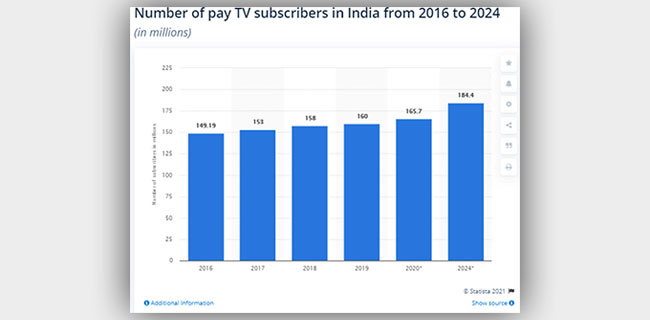
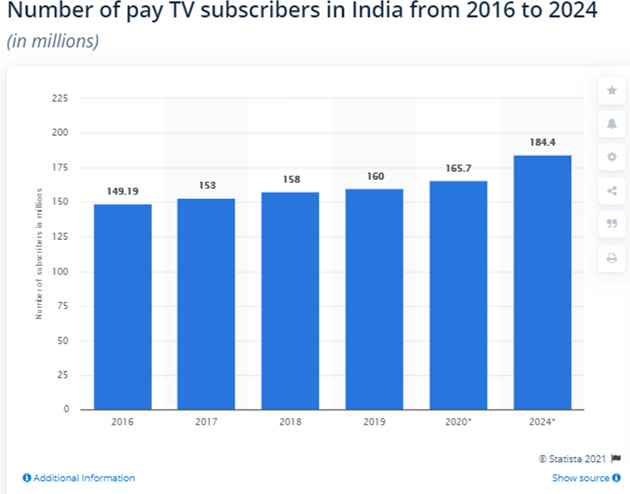
    According to an estimate published by Statista Research Department on March 19, 2021, “India had over 160 million subscribers of pay TV in the year 2019. This figure was around 149 million subscribers in 2016 and was estimated to go up to over 184 million Pay TV subscribers by 2024.” These estimates are higher than the estimates made by the FICCI EY in their report on the Indian M&E industry 2020.

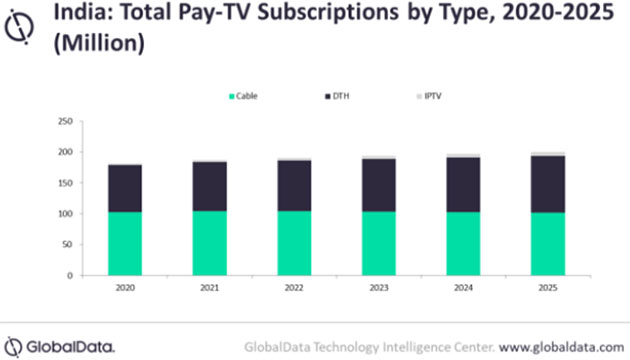
    Another report India Telecom Operators Country Intelligence report published by www.globaldata.com in 2020 supports the estimates of Statista. As per this report, Cable will be the leading Pay TV technology in India throughout the forecast period, followed by DTH with a small presence IPTV which is expected to grow in India at a very fast rate during the next 4 years. As per www.globaldata.com the total Pay TV revenue in India is expected to grow at an annual growth rate (CAGR) of 0.7 percent from USD 3.19 billion in 2020 to USD 3.30 billion in 2025, which is much lower than the FICCI EY estimates.

    The above picture reflects the trends in TV distribution by technology in the global market, though the pandemic has reduced the share of the cable TV subscribers in India. IPTV is expected to grow at a CAGR of 19.4% in India during the next 4 years riding on the fixed broadband penetration in India as well as smart TV sets.

    According to the report published in www.grandviewresearch.com: “The global Pay TV market size was valued at USD 225.9 billion in 2019, registering a CAGR of more than 1.5% from 2020 to 2027.” This report spoke about the growth in penetration of Pay TV in rural households in China, India and Indonesia creating overall growth in the Pay TV industry.


    Source: FICCI EY Indian M&E Industry Report 2020

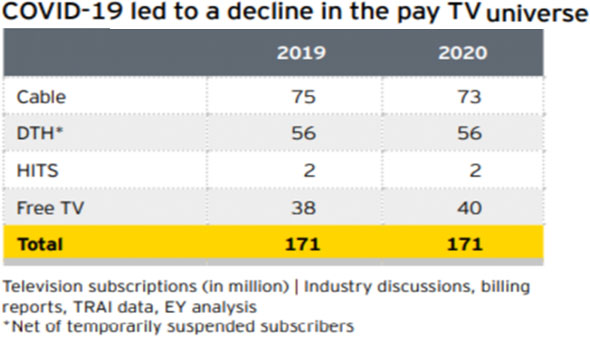
    As per the FICCI EY report on the Indian M&E industry 2020, there are 171 million TV households in India of which 40 million are Free TV households. The report estimates distribution revenue of the Indian TV Industry to reach INR 502 billion (USD 6.72 billion) in 2023 from the current level of INR 434 billion (USD 5.80 billion). The FICCI EY estimates seem to be the best one available currently for the size as well as the revenue of the Pay TV market in India.

  • Advertising goes down 29%


    By Indrani Sen


    Indrani SenThe FICCI EY report on Indian M&E industry 2021 titled “Playing by New Rules” was released last Friday, March 26, 2021 at a virtual event. By now, we know that M&E sector posted INR 1.38 trillion in 2020 (a decline of 24% from 2019). Except Digital Media and Online Gaming, all other media suffered degrowth as an effect of Covid-19. Print media lost its #2 position to Digital Media, while Television managed retain the #1 position.

    Let us turn our focus to the advertising industry, which according to the FICCI EY report, saw the highest single year drop in the history of Indian advertising. The industry saw a degrowth of 29% in 2020, higher than the 24% degrowth of the overall M&E sector. The report describes 2020 as “a watershed year for advertising spends”. A review of how advertising revenue was distributed among different media in 2020 and how did the distribution compare with 2019 is shown in the table below:


    Ad Revenue by Media: Source FICCI EY Report 2021

    Advertising in traditional media experienced a degrowth of 37% from 2019 to 2020, but advertising in digital media remained steady and did not suffer any loss. Advertising in Print sufferred due to reverse migration, changed consumer habits and cost-cutting while advertising in Radio and OOH was affected by reduced mobility of consumers. The experienial industry comprising of Events and Cinema degrew due to lockdown guideline, social distancing norms and consumer fear of crowded places.

    The advertising industry is not expected to recover the losses of last year in next two years (2021 and 2022). While the total advertising spend is expected to regain the pre-Covid-19 levels in 2023, the individual traditional media are estimated to regain the same levels over a period of 5 years: 2021 (none), 2022 (Television), 2023 (Events & Cinema), 2024 (OOH), Radio (2024+) and Print (2025+).  Digital media is expected to grow by 22.5% over the 2019 level in 2021.

    In a Marketer Survey conducted by EY in 2020, 88% of marketers were confident that consumer spends in their sector would grow in 2021. 66% of the marketers felt that their advertising expenditure would grow in next two years. However, 33% of the marketers surveyed felt that their advertising expenditure either would not grow or would decline in the next two years.

    The same survey showed the marketers incresed investments in D2C initiatives during the pandemic in 2020 as shown in the above chart and 74% of them expeted to spend over 20% of their total spends on digital media against 45% who had shown interest in investing in digital media in 2019. A significant increase in digital spend were expressed by most.

    The survey probed further on how the marketers were assessing the state of their future readiness in terms of their digital maturity and found that the advertising agencies are playing a crucial role.

    :: “92% of respondents were actively monitoring their digital readiness, at a time when complex ecosystems are emerging across the business and marketing landscape.

    :: 53% of respondents surveyed depended on their agency partners to update them on leading practices in their digital transformation journeys”

    The FICCI EY report finally sums up the section on advertising by listing how advertisers are turning uncertainty to opportunity through Martech adoption, investments in brand purpose and architecture, hyperlocalisation, building and retaining immersive consumer experience, diversification of media, colaboration and last but not the least ensuring digital effectiveness. The experts’ comments at the end of the section on Advertising makes it clear that in the digital age advertising agencies need to invest in data, technology and analytics to stay relevant for their clients.


  • Phygital and sustainability approaches to yield new growth avenues for the retail-FMCG: Deloitte

    By A Correspondent


    Deloitte Touche Tohmatsu India LLP (DTTILLP, in short, but better known as just Deloitte) and FICCI launched the fourth edition of their joint report called Reboot in the annual edition of Massmerize 2020. FICCI Massmerize is the flagship Retail and FMCG event by FICCI’s consumer committee that works towards collaborating with industry leaders and stakeholders from these industries.


    Built on a six-step approach, this report emphasises the need for consumer brands to r-e-b-o-o-t their businesses in view of the disruption and the changing consumer behaviour.  As businesses need to ‘Realign’ their business models and partnerships, ‘Enhance’ consumer experience through technology and Analytics, ‘Build’ resilient distribution, develop their  ‘Omni-channel’ presence, ‘Operate’ efficiently, and ‘Thrive’ by focusing on sustainability.


    Speaking on the launch of the report, Rajat Wahi, Partner, Deloitte India, said: “while the pandemic brought massive disruptions across the value chain of the consumer sector, most companies adapted by building agile business models and innovative marketing strategies, along with expanding their presence through the online platforms to reach their consumers. The prolonged lockdowns have also dramatically transformed consumer buying behaviour while making them more health and socially conscious.


    Added Dilip Chenoy, Secretary General, FICCI said, “‘India has emerged as one of the most attractive investment destinations with the increasing disposable income, rapid industrialization, and a shift in the demographic pattern. Amongst the significant contributors to this growth story have been the consumer-centric sectors, such as retail, FMCG, and e-commerce. India is one of the world’s fastest-growing major economies and has immense potential. Increased involvement and participation of businesses with the help of supportive policy measures will help capitalize on this potential and achieve the societal goals of inclusive growth and empowerment of the people.’’


    Trends/lessons learnt from Covid-19

    1. Acceleration in e-commerce sales as stay-home phenomena drove significant purchases through e-commerce.

    2. Increased demand from rural: Covid-19 has led to massive reverse migration, which in turn has driven up rural demand, favouring companies with strong rural distribution

    3. Focus on health, hygiene, and nutrition: Health concerns and the need to build immunity have led consumers to buy home sanitation and immunity boosting products.  As a result, these categories have seen major growth since March ‘20 and this is likely to continue into 2021.


    4. Reconfigure distribution to explore omni-channel models: The pandemic, with frequent lockdowns, compelled companies to re-configure their distribution models within a short period, even forging new partnerships and alliances to achieve that.

    5. Existence through phygital approach: As digital-savvy consumers look for a mix of digital and physical engagements, ithas led to retailers building an omni-channel presence to provide best-in-class customer experience.

    6. The Covid-19 crisis has put sustainability in the spotlight and companies are now seeing sustainability through the lens of growth as well as bottom line, and using their sustainability initiatives to better engage with their customers.

  • The Grave Crisis in OOH Continues


    By Indrani Sen


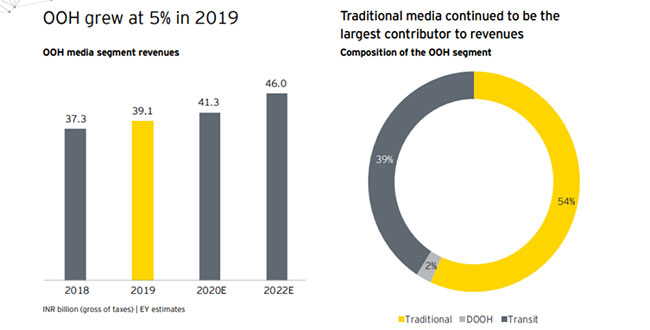
    The EY-FICCI 2019 Media & Entertainment Industry Report estimated that the Indian OOH industry grew by 5% in 2019, taking the industry size to Rs 37.1 billion. The traditional OOH formats, driven by increased advertising opportunities in tier-II and tier-III cities, contributed 54% to the overall revenue. However, according to the report the main driving factor behind the growth is recent development of infrastructure network, including upcoming airports, smart city projects, malls, metros, bus shelters, public utility, coffee shops, etc.


    Source: EY-FICCI 2019 M&E Industry Report


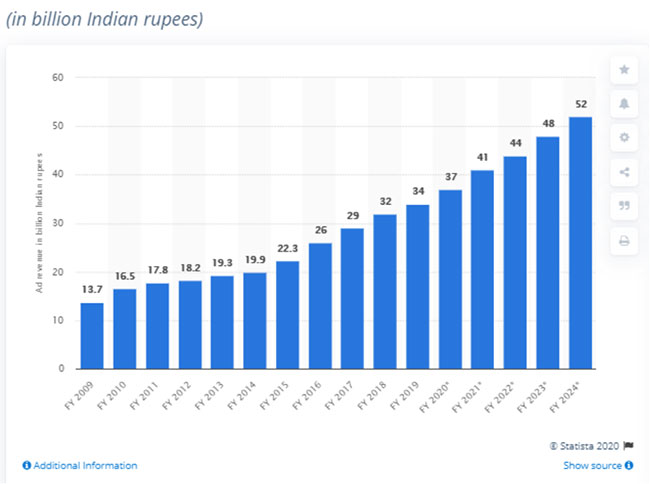
    A couple of years back, www.statistia.com published an estimate of out of home advertsing in India from 2009 to 2024 as shown below. It is interesting to note that overall size of OOH industry estimated In the FICCI EY report is higher than shown in the chart for 2019 (Rs. 34 billion).


    Source: https://www.statista.com/statistics/233491/out-of-home-advertising-revenue-in-india/


    The growth of the OOH industry has been stalled completely as an effect of Covid-19. In the ‘FICCI Frames 2020’ virtual conference, WPP’s CEO Mark Reed remarked that OOH was the most impacted medium due to Covid-19. While we are seeing some signs of revival in digital, TV and print media, the trend has not yet been seen in OOH media under the gradual process of unlocking. While we are still waiting for FICCI EY to release a revised estimate for M&E industry in 2020, the mid-year review of the Pitch Madison Advertising Report 2020 has estimated 35% to 50% de-growth in OOH advertising revenue in 2020.


    At the early stage of lockdown, IOAA also estimated that their annual revenue may see a 50% drop in 2020 and appealed for financial relief to the various state governments who have not yet responded positively. The association also requested the central government to declare the pandemic as natural calamity which is covered under ‘force majeure’ clause of all OOH contracts which also has not received any definite response. In US and couple of other countries, OOH industry registered as small business has received some financial relief, but we have not seen any such relief measures for the OOH industry in India.


    An article published on August 10, 2020 has predicted four key trends for OOH medium in 2020 and beyond (https://www.advendio.com/4-key-ooh-advertising-trends-2020-beyond): 1/ build brand awareness with smart creatives; 2/ adapt value for money messaging approach; 3/ the evolution of touch screen OOH advertisements and 4/ curbside pickup and digital OOH are here to stay. Apart from the first trend, there is hardly any scope seeing of the other trends happening in India. It is high time that our outdoor advertising agencies take stock of their inventories and consider disinvesting in traditional formats and channelize their attention to building up standardised digital OOH formats as per the global trends.