Tag: FICCI

  • Cyril Mangaldas releases FICCI ‘Entertainment Law Book’

    By A Correspondent


    The Federation of Indian Chambers of Commerce and Industry (FICCI) and Cyril Amarchand Mangaldas released the ‘Entertainment Law Book 2020’ report. The report highlights regulatory developments in the field of TV broadcasting and distribution, music, radio, filmed entertainment, and other segments in the Media & Entertainment space. It also includes several thought provoking articles on diverse topics, dealing with the issues in the Media and Entertainment sector. The report was scheduled for launch at FICCI Frames 2020, however given the Covid-19 situation, the conference has been postponed to a later date this year.


    Said Dilip Chenoy, Secretary General, FICCI: “The report touches upon some vital aspects that are playing an influential role in charting the way for the future of the Media & Entertainment industry. The issues lay strong foundations of the possible framework and solutions to developing the laws that will in time, govern the Media & Entertainment industry, in our country. On behalf of FICCI, I express our appreciation to Cyril Amarchand Mangaldas and the members of the FICCI Media & Entertainment Committee for working with us on the 2020 edition of this Report.”


    Said Cyril Shroff, Managing Partner, Cyril Amarchand Mangaldas: “It is an honour and a privilege to present this report on the legal and regulatory issues impacting the Media and Entertainment sector. This report gives a bird’s eye view of all important and relevant developments in the past year, encompassing the entire gamut of the Media & Entertainment sector. I would like to thank FICCI and members of its Media & Entertainment Committee for choosing us as a knowledge partner for the second consecutive year and all those who have contributed their time and valuable insights in making this report a possibility.”


  • Forced confinement leading to increase in TV consumption, but…


    By Indrani Sen


    On March 27, 2020 Nielsen and BARC India shared the first edition of their report “Covid-19 Impact- What’s happening in the TV and smartphone landscape” with the industry at large analysing how the lockdown has increased TV viewership in India. In the first week of the partial lockdown from March 14 to March 20 (BARC Week 11), the all-India TV viewership in minutes/week went up by 8% and TV reach went up y 6%. Overall time spent on TV went up by 2%.


    BARC conducts television audience measurement in India while Nielsen passively captures smartphone behaviour through a 12,000 strong smartphone panel. The time spent on smartphones per user also went up by 6.2%. The time spent/user/week on VOD apps saw an increase of 3%. News apps saw 8% more users per week with an increase of 17% in time spent/user/week stimulated by use of non-English News apps (+87%). Gaming apps saw an increase of 2% in users/week supported by 11% increase in time spent/user/week.


    We will look more closely at changes in TV audience behaviour. In Week 11, average daily viewers grew by 32Mn supported by kids, younger age groups and NCCS A. Viewing time for Television increased by over 70 billion minutes in India with each of 592Mn viewers watching TV daily for 3hr 51 minutes. Strangely, there was hardly any growth in the primetime viewership as the growth in viewership was driven by non-prime time. GECs also grew by 32% in non-primetime slots, but saw a 15% dip in the primetime slots which was higher (23%) in the Hindi Speaking Market (HSM) than the south Indian market (5%). An analysis by genres given below show that news, kids and movies gained the most in terms of daily ATS followed by infotainment, lifestyle and youth.


    Last week, Nielsen and BARC released the second edition of the ‘Crisis Consumption: An Insight Series into TV, Smartphone and Audiences’ report of Week 12 (starting March 21) where four days  coincided with the first week of country wide lockdown, showing an unprecedented growth of  298%  in TV news viewership. The increase in the viewership of news channels was accompanied by a 15% growth of average daily free commercial time (FCT) to 6 lakh seconds in between March 21-27 (Week 12) compared to January 11-31, 2020 or the pre-Covid-19 period reflecting last-minute changes in the allocation of TV budgets.


    All the parameters reported by BARC showed increases during Week 12 with the weekly viewing minutes (total number of minutes spent watching TV) touching 1.2 trillion. The number of people watching TV all seven days a week jumped from 32% to 44%, the average time spent per viewer increased 23% from 3 hours 46 minutes to 4 hours 39 minutes. As a result, the total number of channels consumed per viewer in the week also increased from 16 to 22. This surge is TV viewership is expected to continue during the next few days of the nation wise lock down and the spread of Covid- 19 in India will decide its future course.


    It is heartening to see that the news genre has been able to get additional advertising during this lock down period. Kids’ genre, with 20%+ share of total TV viewership and only 3% share of the overall advertising space, has not been so lucky. However, on the whole the prognosis is not good when we look at ad revenue of TV channels in immediate future. Going by the current trends, TV channels will hardly be able to convert this increase in viewership to increased ad revenue. Financial Express reported on March 21, 2020 (https://www.financialexpress.com/brandwagon/coronavirus-impact-ad-expenditure-to-decline-by-50-55-on-tv-between-april-june-2020/1914445/) “As the novel Coronavirus continues to wreak havoc around the world, television is one such industry which is currently under its grip, besides other sectors. According to industry estimates, advertising expenditure on television is expected to decline 50%- 55% to anywhere between Rs 3,750 crore – Rs 4,125 crore between April-June, that is Q1 FY2021 – if the lockdown continues.”


    The economictimes.indiatimes.com reported on April 2, 2020 in similar lines, though their estimate of the loss was pegged at 30-40% than 50-55% reported by Financial Times – “Top broadcasters, media buyers and advertisers ET spoke with, feel that if the situation doesn’t improve by end of April, the TV industry will end up with a 30-40% drop in ad revenues in April and May.” (https://economictimes.indiatimes.com/industry/media/entertainment/media/broadcasters-stare-at-drop-in-ad-revenues/articleshow/74937708.cms?from=mdr)


    While we wait for FICCI-EY to release an update of their report on M&E industry, FICCI’s recent report on the impact of Covid-19 on the Indian economy has predicted that the pandemic will potentially derail India’s growth story by affecting both the demand and the supply side. We are going through unprecedented times when it is extremely difficult to predict even the immediate future.


  • When Subscription Outpaced Advertising Growth…

    Source: FICCI EY M&E Report 2019


    By Indrani Sen


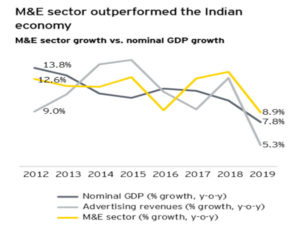
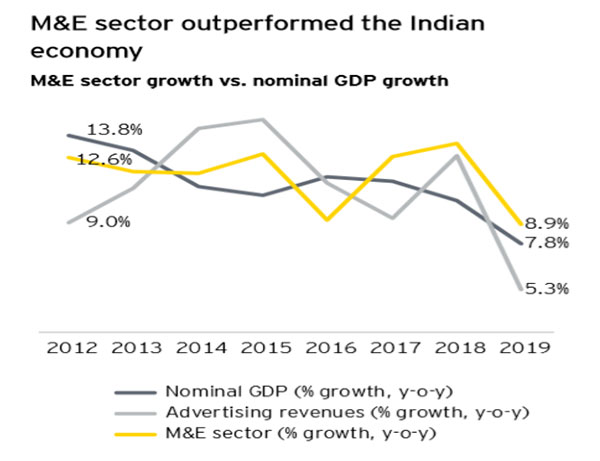
    The FICCI EY M&E Report ‘The era of consumer A.R.T. – Acquisition Retention and Transaction,’ released on March 27, 2020 shows that the Indian Media and Entertainment (M&E) sector outperformed the Indian economy (nominal GDP growth) for the third successive year with a growth of 8.9% over 2018 and reached INR1.82 trillion (US$25.7 billion) in 2019.


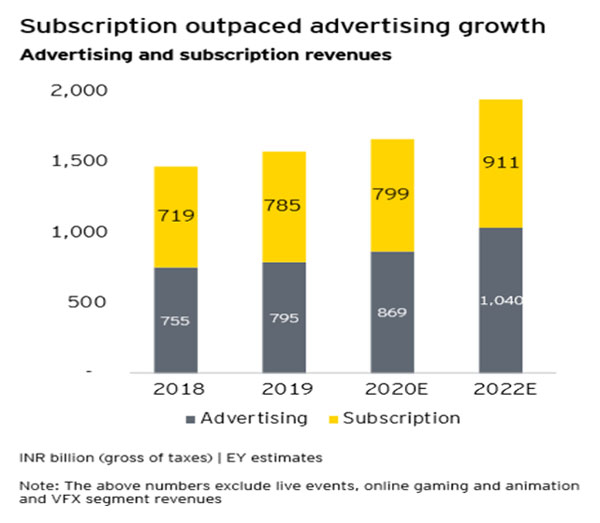
    Advertising revenue grew 5.3% while subscription revenue grew 9.3% in 2019. Subscription growth was driven by OTT video consumption (111%), film (10%) and television (7.5%) which resulted in EY labelling 2019 as “The Era of Consumer A.R.T. – Acquisition, Retention and Transition”.

    Source: FICCI EY M&E Report 2019


    Ashish Pherwani, Partner & M&E Sector Leader, EY India has added a word of caution in his forwarding note. “The current situation around the Coronavirus will, unfortunately, impact the 2020 estimates we have provided in this report, and we will update the same as soon as we can reasonably estimate its impact,” he has written. Coronavirus is going to affect both the Indian Economy as well as the M&E sector. While it is certain that the growth rates of both will see dips, how much they will dip remain a matter of speculation at this stage.


    As things stand now, it is unlikely that the Indian economy will see a negative growth, but it is highly possible that M&E sector may experience the same as it did in 2009 after the international financial crisis of 2008 triggered by the sub-prime mortgage crisis in the US. Effectively, we can use the FICCI EY M&E Report 2019 for reviewing the trends and growth different media in 2019 over 2018, but cannot rely on the future forecasts shown in the report, till EY releases an update.


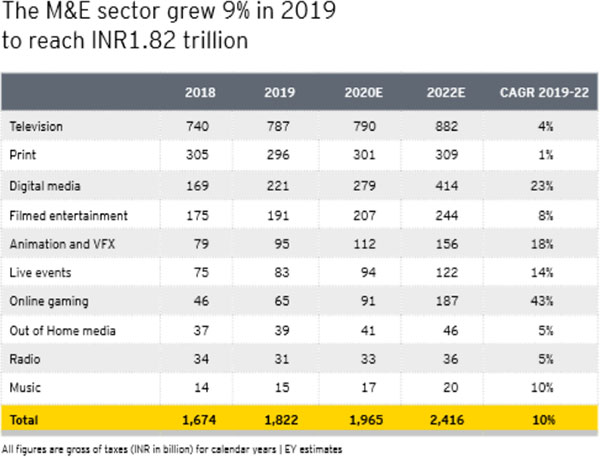
    In 2019, two traditional segments, print and radio ended the year with de-growth in ad revenues, despite their growth curves remaining relatively flat for the first seven to eight months of 2019. However, print remained the second-largest segment after television, followed by Digital media as the third.


    Digital media rode on growth of both subscription and ad revenue and overtook filmed entertainment in 2019 to become the third largest segment of the M&E sector. Digital subscription revenues more than doubled from 2018 levels and digital advertising revenue grew to attain a share of 24% of total advertising spend.


    Online gaming retained its position as the fastest growing segment on the back of transaction-based games and a 31% growth in the number of online gamers to reach around 365 million.


    The following table shows the details of the growth by different media in 2019:

    Source: FICCI EY M&E Report 2019


    A detailed analysis reflects that ad spends increased by INR40 billion in 2019 over 2018 due to INR37 billion growth in digital and an INR15 billion growth in television, reduced by a fall of INR12 billion across local traditional media (print, radio, OOH).  Advertising growth was muted due to overall economic slowdown in 2019 which also impacted festive ad spending.


    Source: FICCI EY M&E Report 2019


    The growth in subscription revenue was driven largely by the proliferation of mobile access, enabling on-demand, anytime-anywhere consumption of content across India, in both urban and rural areas. In a country with 1.3 billion population, we have 688 million internet subscribers and nearly 400 million smartphone users and a tele-density nearing 89% of households. Riding on such statistics, India’s telecom industry is poised to become the primary platform for content distribution and consumption. Today, India ranks as one of the fastest-growing app markets across the world with entertainment apps as well as gaming apps driving significant consumer engagement which is likely to accelerate as people are forced to stay at home and work from home during the current 21 days lockdown and in the event of the lockdown extending beyond mid-April, 2020.


    We can safely assume that in 2020, the effects of Covid-19 will be more on ad revenue than on subscription revenue in the M&E sector.  It is too early to make any estimate regarding the effects on ad revenue of individual segments of the M&E sector. With the rush of migrant labourers wanting to go back to their home states, we seem to be sitting on the tip of an iceberg as we step into the crucial first week of April/the second week of nationwide lockdown to fight the deadly Coronavirus, to hope and to ensure that India does not get into the stage of community transmission.


  • M&E in the Economic Survey


    By A Correspondent


    Leena Jaisani, Assistant Secretary General of the Federation of Indian Chambers of Commerce and Industry (FICCI) has reason to be elated. “Happy to let you know that due to FICCI’s lobbying efforts ,Media & Entertainment in Economic Survey this year,” she messaged us, adding: “Seven pages have been devoted to M&E sector this year from zero space in previous editions. Thankful to Mr Sanjeev Sanyal who promised to get this included when he came to frames and post that did several meetings with us to make this happen.”


    Let’s look at what the Economic Survey presented on Thursday (July 4) says on our M&E sector.


    9.22 The Indian Information Technology / Information Technology enabled Services (IT/ ITeS) industry has contributed immensely in positioning the country as a preferred investment destination amongst global investors and creating huge job opportunities in India, as well as in the USA, Europe and other parts of the world. USA, UK and EU account for ~ 90 per cent of the total IT-ITeS exports. However, there are new challenges surfacing in these traditional geographies. Demand from APAC, Latin America and Middle East Asia is growing and new opportunities are emerging for expanding in continental Europe, Japan, China and Africa. Efforts are being made to further strengthen existing markets, and simultaneously diversify and increase presence in the new and emerging markets in Europe (besides UK which is a mature market), Africa, South America, Israel, Australia, China and Japan through market development and industry repositioning initiative.


    9.23 India’s digital economy has received a tremendous boost through various Government initiatives such as Digital India covering e-Government services, common service centres, BPO promotion schemes, digital payments, electronic manufacturing, Digital Saksharta Abhiyaan, e-commerce, GST network, Make in India, Start-up India, e-health, Smart Cities, and e-agriculture market place/ digital mandis. These initiatives coupled with new and emerging technologies are enhancing the digital economy of the country and are creating IT and electronics led new opportunities for revenue and job creation in both traditional as well as new sectors of the economy such as transport, health, power, agriculture, and tourism.


    9.24 The National Policy on Electronics 2019 (NPE 2019) has been notified on February 2019 by the Ministry of Electronics and Information Technology (MeitY) interalia include creating eco-system for globally competitive ESDM sector; promotion of electronic components manufacturing ecosystem; special package of incentives for mega projects; encouraging industry-led R&D and innovation and promoting start-up eco-system in all sub-sectors of electronics, including emerging technology areas such as 5G, IoT/ Sensors, artificial intelligence (AI), machine learning, augmented reality (AR) and virtual reality (VR), drones, robotics, additive manufacturing, gaming and entertainment, photonics, nano-based devices, medical electronics, defence and strategic electronics, automotive electronics, cyber security, power electronics and automation; providing incentives and support for skill development including reskilling, in the ESDM sector; promoting research, innovation and support to industry for green processes and sustainable e-waste management, emphasis on cyber security and promoting trusted electronics value chain initiatives to improve India’s national cyber security profile etc.


    Media & Entertainment Services

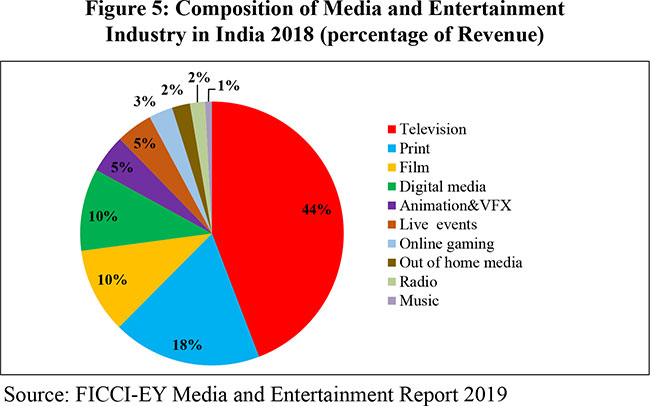
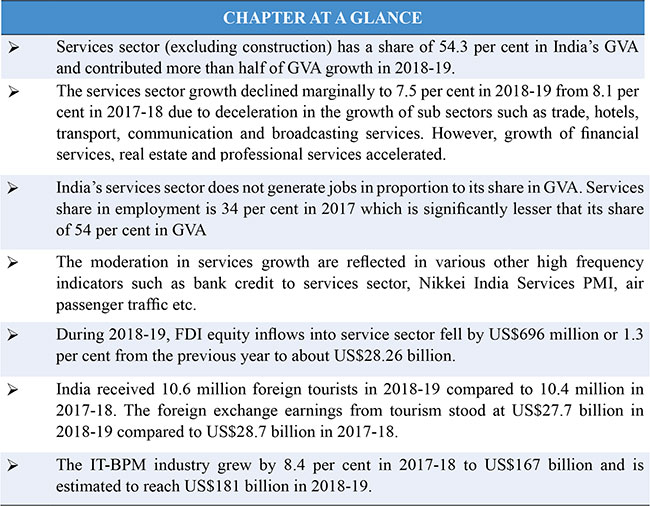
    9.25 The Media and Entertainment sector comprises mainly of television, print, radio, films, music, digital advertising, over the top (OTT-film and television content delivered over internet), visual effects (VFX) and gaming. Technology has rapidly changed the profile of this sector especially in the area of content and carriage. As per the FICCIEY Media and Entertainment Report 2019, the size of the Industry has increased from `91,810 crore in 2013 to `1,67,500 crore in 2018, a growth of 82.44 per cent in the last 5 years. The size composition of the various components of the Industry can be seen in the Figure 5. Audio–visual services have been identified by the Government (2018) as one among the 12 Champion Service sectors for focused development so as to reap its full potential.


    Private Television Sector

    9.26 India is the second largest pay-TV market in the world after China. As per Broadcasting Audience Research Council of India (BARC)/EY estimates, out of the estimated 29.8 crore households in India, TV penetration reached 66 per cent in the country with 19.7 crore TV households in 2018, which is 7.7 per cent increase over the previous Broadcast India Survey 2016 (Figure 6). Of the 19.7 crore TV households, 10.3 crore households were covered by Cable services, 5.6 crore households by Direct to Home (DTH) services and 3.6 crore households were covered by Doordarshan Free Dish in 2018.
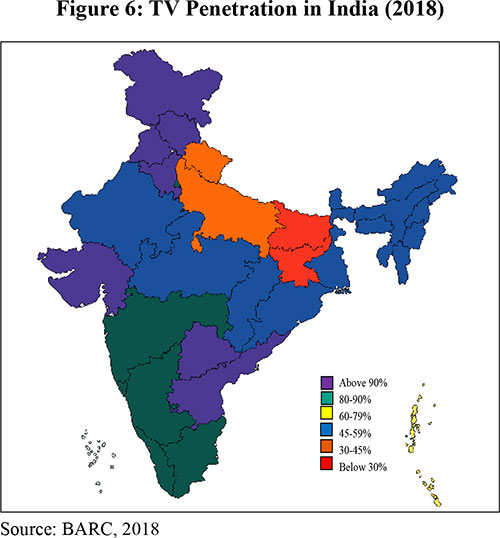


    9.27 As per FICCI-EY Media & Entertainment Report (2019), TV sector grew at 12.1 per cent to reach `74,000 crore in 2018 with advertising comprising 41 per cent of the revenue while distribution accounted for the balance. India has at present a large broadcasting and distribution sector in the world comprising 906 satellite TV channels, 1469 Multi System Operators (MSO), 60,000 Local Cable Operators (LCO), 6 DTH operators and several IBTV service providers. 43 per cent of all private satellite channels are news channels (April 2019). The growth drivers for TV sector include digitisation of cable services, higher uptake of High Definition channels, growth of OTT platform aided by rising smart phone penetration and high speed data adoption.


    9.28 In the distribution sector, Cable TV still dominates the distribution of TV channels in the country through MSOs and LCOs. DTH sector is rapidly becoming a key player in the distribution sector. Apart from Doordarshan’s DD Free Dish, DTH services are provided by six other private players.


    Public Service TV Broadcasting

    9.29 Prasar Bharati is the country’s public service broadcaster with All India Radio and Doordarshan as its two constituents. It came into existence in 1997 with a mandate to organise and conduct public broadcasting services to inform, educate and entertain the public and to ensure a balanced development of broadcasting in the country.


    9.30 Doordarshan has the world’s largest terrestrial broadcast facility with over 1400 terrestrial TV transmitters and also provides free to air DTH services. The terrestrial network of Doordarshan reaches out to every nook and corner with transmitters set up throughout the country. Currently, Doordarshan has 24 Satellite channels, including a channel for farmers, News and Current Affairs, Art and Culture and Sports etc. 67 Studio Centres of Doordarshan spread across the country provide extensive coverage of News and Current Affairs to DD network channels.


    9.31 Doordarshan also operates its own Direct to Home platform viz., DD Free Dish. DD Free Dish has a bouquet of 104 television channels including 24 Satellite channels of DD which operate 24X7 and 11 regional channels which operate for a few specified hours. The bouquet also has 44 audio channels of AIR. Activities of All India Radio are discussed in the section under Radio sector.


    Print Media

    9.32 Print accounted for the second largest share of the Indian M&E industry with revenue of `30,550 crore in 2018 with a growth of 0.7 per cent (FICCI & EY Report 2019). Print Industry is declining all over the world primarily due to huge in roads of internet and TV channels in media industry. India is also no exception to this phenomenon. The share of advertising revenue in Print Media is 71 per cent of the total revenue income while the balance is accounted for subscription revenue. While newspapers accounted for about 96 per cent of the revenue, the rest was through the magazines.


    9.33 As per the Registrar of Newspapers for India (RNI), the number of registered publications in the country as on 31st March 2018 stood at 1,18,239, registering a growth of 3 per cent in 2017-18 over the previous year. However, growth of circulation of publications contracted by 11.9 per cent in 2017-18 over the previous year. The total circulation of publications in the country during 2017-18 was 43 crore of which Hindi, English and Urdu publications were 19.56 crore, 5.34 crore and 2.52 crore respectively. In terms of circulation of daily newspapers, there was a contraction by 11.9 per cent in 2017-18 with total circulation of daily newspapers falling to 24.26 crore. Hindi dailies continue to be the largest in terms of circulation followed by English and Urdu. (As on March 31, 2018).


    Films

    9.34 As per FICCI-EY Media & Entertainment Report (2019), India is the world’s biggest producer of films with 1,776 domestic film releases in 2018. Indian film industry grew at 12 per cent in 2018 with revenue of `17,450 thousand crore. The highest number of films were released in Kannada (243) followed by Hindi (238) and Telugu (237).


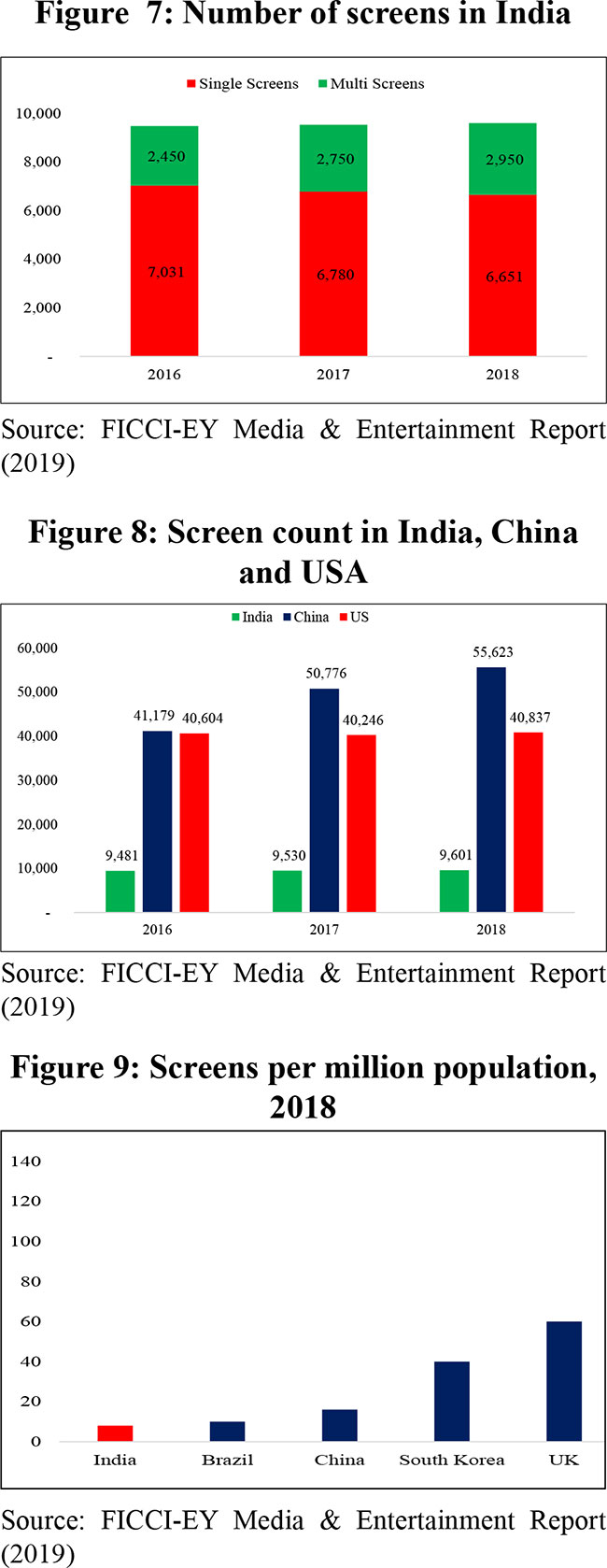
    9.35 Despite producing the most number of movies in the world, India has less than 25 per cent of the number of screens as compared to China or USA. India has 9601 screens, of which 47 per cent are in the five southern states. China has been adding cinema screens at a CAGR of over 16 per cent over the last two years. India’s screens per million of population is also the very low, primarily due to lack of cinema penetration in tier-II, tierIII and tier-IV markets in India. This presents a large untapped potential for the Indian film segment (Figure 7, 8 and 9).


    9.36 In the Overseas Theatre Performances, the highest number of film exports were made to the Gulf region (50) followed by Australia (48) and USA/Canada (46). In terms of value, however, China became the largest international market for Indian film content, accounting for highest collection of US$272.3 million. While the number of screens (both single and multi-screen) have been steadily increasing, the screen count is still lower than large international markets.


    Digital Media

    9.37 The various segments of digital media include- online video viewing, audios, news through OTT platforms and social media etc. As per FICCI-EY Media & Entertainment Report (2019), total number of mobile subscribers stood at 1.17 billion in 2018. Smartphone users increased by 39 per cent to reach 340 million in 2018. Average data consumption doubled from 4 GB to 8 GB per month between 2017 and 2018. Moreover, digital media market grew 42 percent to reach `169 billion in 2018. Internet subscribers grew 28 per cent from 446 million in December 2017 to 570 million in November 2018, driven by rural internet subscriber growth of 49 per cent. Given that there are around 4 billion internet users in the world, one in eight is Indian (Table 9).
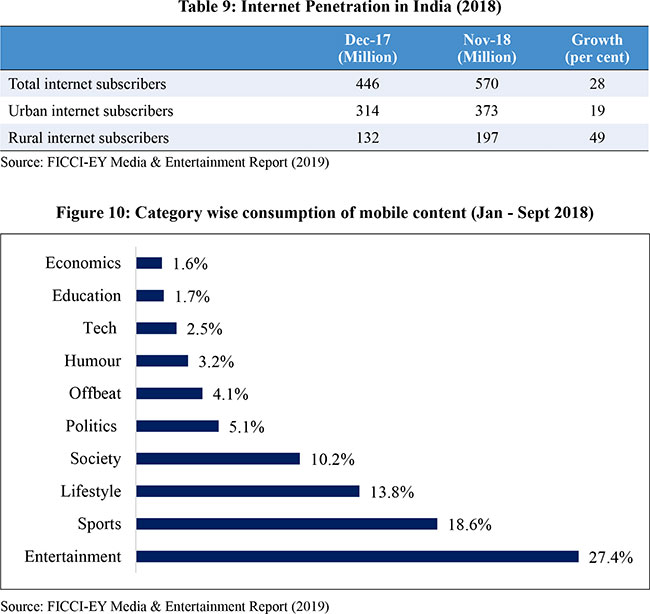


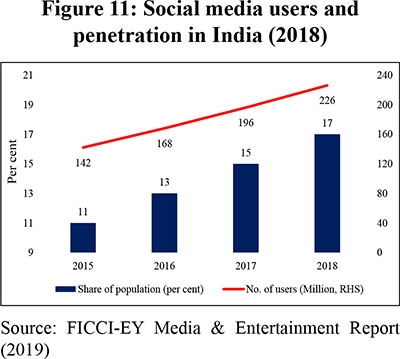
    9.38 According to the total rate of content consumption on UC News Feed platform in India, Entertainment was the largest category in mobile content consumption for Indian users, accounting for 27.4 per cent, followed by sports (18.6 per cent) and lifestyle (13.8per cent) (Figure 10). 9.39 Social Media penetration reached 17 per cent in 2018, up from 11 per cent in 2015. The most active social media platforms were YouTube, Facebook, WhatsApp and Instagram. (Figure 11)


    Radio Sector 9.40 All India Radio (AIR) broadcasts are functional at 479 locations covering nearly 92 per cent of the geographical area and 99.2 per cent of the population of the country. Presently, FM Service of AIR is being provided from 495 transmitters functional at 458 locations across the country reaching nearly 39 per cent of the area and 52 per cent of the total population of the country. Further expansion of AIR FM is being carried out in a phased manner under forthcoming schemes of AIR. In addition, 37 radio channels of AIR are available on Doordarshan’s DTH platform (DD Free Dish) which can be received through a set top box all over the country. 9.41 The opening of private FM radio since 1999 has not only resulted in providing good quality of reception to radio listeners, but also helped encouraging local talent and generating employment to large number of people in various cities. As on May 2019, 380 Private FM channels are operational in 107 cities spread across 27 States and 3 Union Territories. The Government has announced policy guidelines on expansion of private FM Radio broadcasting (Phase-III) wherein the Ministry of Information and Broadcasting will auction 683 channels in 236 cities in subsequent batches. Community Radio Stations are set up with the involvement of various educational institutions and civil society organizations. At present, 250 Community Radio stations have been operationalized. It is proposed to establish at least one CRS in each district with priority to coastal districts and aspirational districts.


    Emerging Media

    9.42 As compared to the traditional media, it is the non-linear media comprising of digital media including OTT, animation & VFX, live events, online gaming, etc. that has been witnessing double digit growth in the media & entertainment sector in recent years. The spread of broadband connectivity, fall in data prices, demand for regional language content have triggered the growth of digital media. The Animation, VFX, gaming and comics sector in India is also a thriving business with even Hollywood movies being outsourced to India for work related to post-production which includes video editing, visual effects, animation, 2D-3D conversion, etc. It is one of the sunrise sectors for India and given the rapid expansion of the sector the requirement of skilled professionals is also immense.


    Policy initiatives

    9.43 The Media and Entertainment sector needs to be holistically reviewed in the light of technological interventions that have redefined entertainment today. The following initiatives have been taken in the recent years to facilitate Media and Entertainment industry.

    • In view of increasing piracy of films by unauthorized recording of films in cinema halls, a Bill has been introduced in the Rajya Sabha in February 2019 to amend the Indian Cinematograph Act 1952. The Bill has since then referred to the Standing Committee on Information Technology for detailed examination.

    • Audio–visual service has been identified by the Government as one among the 12 Champion Service sectors identified for focused development so as to reap its full potential. Ministry of Information & Broadcasting is proposing various incentives to promote audio-visual services. These include: Audio-visual co-production with foreign countries, incentives for shooting of foreign films in India, organization of global film summit and promotion of single screens in Tier II and Tier III cities.

    • With the objective of imparting world class education in animation, gaming, visual effects and employment generation in the sector, Government of India is in the process of setting up National Centre of Excellence (NCOE) for Animation, Visual Effects, Gaming and Comics. Government of India has taken over the possession of land from Government of Maharashtra in March, 2018 at Goregaon, Mumbai. The project is being executed through Indian Institute of Mass Communication, New Delhi.

    • As part of the initiative to encourage talent among youngsters of the North East in the sector of film and television, the Government of India has decided to establish a Film and Television Institute in Arunachal Pradesh. The project has been sanctioned at an estimated cost of `204.32 crore. Foundation stone for FTI, Arunachal Pradesh was laid in February 2019. A temporary campus has been set up in Itanagar where short courses have been conducted.


    Space Services

    9.44 Indian Space Programme contributes to National Development, through the application of space technology, comprising of earth observation, communication and navigation to address issues related to socioeconomic development from macro to micro levels. Over the last three decades, space technology has matured from providing simple mapping applications to development of complex models, decision support and early warning systems, incorporating space and derived inputs. Satellite launch services and satellite database mapping and Geospatial services are areas in which India is making a mark and has huge potential for the future. India has achieved significant milestones in space transportation capability through the operationalization of Polar Satellite Launch Vehicle (PSLV), Geosynchronous Satellite Launch Vehicle (GSLV) and Geosynchronous Satellite Launch Vehicle Mark III (GSLV Mk-III) for launching satellites for earth observation, communication, navigation and space exploration. India became the sixth nation to develop this highly coveted complex cryogenic rocket propulsion technology and also paved the way for the development of a high thrust Cryogenic engine & stage for the next generation launch vehicle i.e. GSLV Mk-III.


    9.45 In the case of Satellite Launching, as on March 2019, PSLV had cumulatively launched 324 satellites that include 45 National Satellites, 10 student satellites built by Universities/Academic institutions and 269 International customer satellites from 32 Countries. PSLV also holds the distinction of launching the highest number of satellites, 104, in a single launch. GSLV Mk-III has successfully completed a suborbital experimental flight followed by two developmental flights. In its second developmental flight on November 14, 2018, GSLV Mk- III launched the heaviest satellite from Indian soil, GSAT-29, and has entered the operational phase. The first operational flight is slated to launch Chandrayaan-2 in 2019, which is India’s second lunar mission and the first landing mission to the moon.


    Bhuvan Services

    9.46 ISRO’s Bhuvan Geo-portal provides multi sensor, multi-platform and multi temporal Satellite Imagery, thematic maps and satellite data-derived information related to Earth Observation & Disaster Management Support. Since its launch in 2009, it has grown horizontally in diverse areas of applications, and vertically, in terms of number of images and thematic & disaster services including high-resolution satellite data. Presently, more than 6500 map services offered by Bhuvan are being used under various applications. Bhuvan has enriched portals of more than 20 Central Ministries/Departments and 30 States, and is also providing Geospatial support for many flagship programmes of the Government.


    Mapping and Geospatial Services

    9.47 Satellite data, synchronous with ground data, are used to estimate crop acreage inseason forecasting of production for 8 major crops in the country viz. wheat, rice (kharif & rabi), mustard, rabi sorghum, jute, winter potato, sugarcane, cotton in the country. Using the techniques developed by ISRO, the Mahalanobis National Crop Forecast Centre (under Ministry of Agriculture & Farmers Welfare) regularly generates crop forecasts at District/State/National level and provides to the Government for planning and decision making. Some of the major satellite data based mapping/Geospatial services developed include Horticulture Crop Inventory, Hydro-informatic products under National Hydrology Project (NHP), Village level Ground Water Prospects, Telegana and Andhra Pradesh Water Resources Information & Management Systems (TWRIS/APWRIMS), Watershed Monitoring under Integrated Watershed Management Programme (IWMP), Monitoring of progress of road construction under PMGSY, GIS implementation of MGNREGA (GeoMGNREGA), Inventory & site Management plans for heritage sites & monuments, Monitoring of stage of construction of benefeciary houses under Housing for All-Urban (PMAY), Geospatial database for Urban Master Plan formulation under AMRUT, etc.


    9.48 Periodic assessment of state of natural resources like vegetation, land cover, snow & glaciar and wetland is also being carried out, in addition to national level assessment of status of wastelands and land degradation.
     

  • Mobile Magic on a High


    By Indrani Sen


    Last week, two interesting reports on usages of mobile and mobile advertising were released prompting strategic planners in media agencies to do quick reviews of the mobile advertising strategies recommended for their clients for the current year.The first one, the  ‘Mobile Internet Report 2017’, jointly published by Internet And Mobile Association of India (IAMAI) and Kantar IMRB predicted that the number of mobile internet users will reach 478 million by June 2018. The second study by InMobi surprised us with the insight that programmatic advertising expenditure on mobile has grown by more than 500% from Q1 2017 to Q4 2017.
     

    The writings on the walls, in this case the small screens, were there for the last few years, but the positive indications started coming from last year. Kleiner Perkins Caufield & Byers partner Mary Meeker descried India as the “most fascinating markets for the internet on the planet” and “an incredibly fierce battleground right now for hardware and software companies” while predicting on the trends of 2017 at the Code Conference on May 31, 2017. https://www.recode.net/2017/5/31/15720378/mary-meeker-india-annual-internet-trends-report-code-2017. Meeker highlighted in her presentation the dramatic and accelerated changes in Indian mobile market from 2016. She said that “Excluding China, Indian users spend the most time on Android devices. People in India spent nearly 150 billion hours on Android devices in 2016. They’ve also become the biggest downloaders of Google Play apps.”


    She further commented that Indian wireless data prices are still relatively high but they have been falling steadily over the years and was down about 50 percent from Q1 2016 to Q1 2017, after the Reliance Jio Launch.  Cheaper wireless data has accelerated the growth of smartphone ownership and has caused data consumption to jump year over year.


    The FICCI-EY report on M&E Industry 2018 showed that internet penetration in India is being driven by Mobile Internet. It estimated that 75% of the overall wireless internet base and 90% of the broadband subscriber base are mobile users, which supports the prediction of IAMAI.


    According to the media release by IAMAI, the number of mobile internet users increased by 17.22% from December 2016 to reach 456 million users by December 2017. Urban India had 18.64% Y-o-Y rise, while Rural India 15.03% during the same period. The report predicts with 59% mobile internet penetration, Urban India will witness a slowdown, while Rural India with only 18% penetration will be next area of growth. The report further confirms that Mobile Internet is predominantly used by youngsters, both in urban and rural areas.


    Programmatic advertising was still in its nascent stages in India in 2016. However, with the growth of digital advertising, it is inevitable that programmatic advertising would also grow in India. The FICCI-EY Report on M&E Industry 2018 estimated that 10% to 15% of all advertising expenditure was through programmatic advertising in 2017. It predicted that by 2020 its share may grow to 50%. The In Mobi report seems to differ from the FICCI-EY Report as it indicates an accelerated growth of mobile programmatic advertising spend by 534% (by ten times) from Q1 to Q4 of 2017.  https://www.exchange4media.com/digital/mobile-programmatic-ad-spend-grew-5-fold-in-2017 study_89173.html. The InMobi report indicates high growth of video content through mobile programmatic advertising has led to an acceleration of the process.


    The “Mobile Magic” is rewriting the script of media planning strategies in India and we may be witnessing major disruptions sooner than predicted by EY in the FICCI ME Industry 2018 Report. EY indicated (Digital Media – Page 42) that overall changes can be expected once programmatic advertising crosses 25% share of the advertising spend as Programmatic advertising then would put pressure on advertising rates which in turn might put pressure on advertising led models.


  • Indian M&E industry at its Digital Tipping Point


    By Indrani Sen


    “All the segments of the M&E sector are showing growth, consolidation and innovation led by digital, both on consumer side and the content supply chain,”noted Uday Shankar, Chairman, FICCI Media & Entertainment Committee in the introduction of FICCI-EY Report 2018.According to the experts from EY, Farokh Balsara and Ashish Pherwani, the Indian Media & Entertainment Industry has reached its Digital Tipping Point. In other words, thereare significant changes happening all around our M&E industry to cause a larger, more important change which will see the transformation of our country to Digital India.


    The FICCI-EY Report 2018 has highlighted quite a few of these changes: distribution of television has become largely digitised increasing its addressability and reach, the OTT platforms for TV and video content are growing rapidly, both print and radio segments are growing continuously with more focus on their digital presence, exponential growth (though from a small base) of digital subscription and online gaming riding on falling data cost, emergence of India as the second largest smartphone market in the world giving easy access of internet to consumers, rapid growth of digital micro-payment ecosystem across urban and rural markets, etc.


    The above changes are expected to grow our digital content consumption substantially which in turn would increase the size of the total industry from INR 1.5 trillion (USD 22.7 billion) in 2017 to INR 2 trillion + (USD 31 billion+) by 2020 at a CAGR of 11.6%.

    Source: FICCI-EY Report on M&E industry 2018


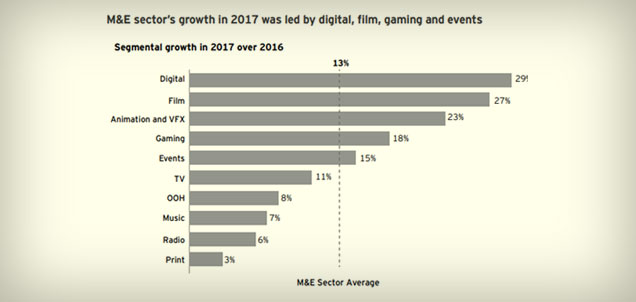
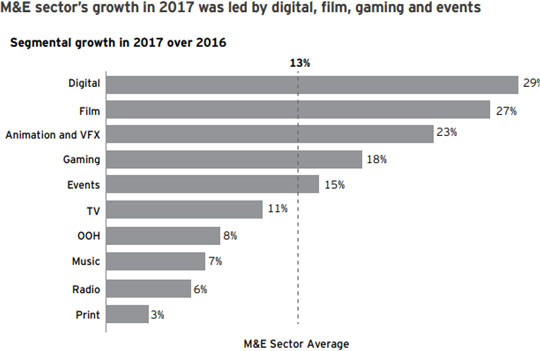
    As shown in the above chart, while the industry grew by 13% from 2016 to 2017, the growth was led by digital, film, animation & VFX, gaming and events. The same trends are expected to continue over the next three years. Another significant trend, which has been seen for the first time in the M&E sector, is outpacing of advertising growth (under10 %) by subscription growth (almost 15%) in 2017 over 2016. This trend will continue to be a major contributor to the Digital Tipping Point.


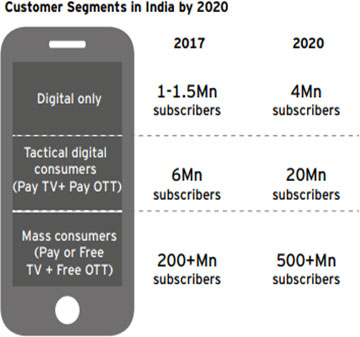
    Based on this new trend of growth in subscription,the report has made a forecast on new customer segmentation which will be an integral part of Digital India by 2020. This new consumer segmentation will be important for the A&M Industry for targeting their audience.


    Source: FICCI-EY Report on M&E industry 2018


    We can assume that there will be a process of continuous migration from the bottom tier of mass consumers to the tactical digital consumers to the only digital consumers as we go forward to the next decade. As far as deployment of resources for advertising is concerned, we will see online media campaigns slowly gaining over the combination of online and offline media campaigns at the top end of the consumer pyramid.


  • @FICCI-FRAMES18: ​How Ratings Reflect Real Viewership


    By A Correspondent


    Partho Dasgupta

    On Day 2 of FICCI-Frames 2018, BARC CEO Partho Dasgupta addressed delegates in the session titled ‘The Future of TV’. The speech was interesting as it drove home the point – based on data of course – that ratings is impacted considerably on viewership behaviour and patterns. The presentation below is self-explanatory, hence we haven’t transcribed his speech here.


  • Arnab Goswami lays bare realities of news journalism at FICCI event

    By A Correspondent


    FICCI Ladies Organisation (FLO) hosted an interactive session with Republic TV founder and journalist Arnab Goswami last week with the theme ‘News as an agent of social change’.
     

    And this is what Goswami said:“India is the only country where media can question any one on any subject including religion, the kind of journalism that we practice, the way we go over-board, boldness being shown by journalist across the nation and bringing out the truth from lies is helping media become agent of social change. This will also help us become global media platform before 2020. That is my dream.


    Speaking about his early days in the media, Goswami said: “Delhi has helped me grow in my career as I have spent around nine and a half years of my professional life in Delhi and always felt that it was not a city that supported pure merit. In 2000-2001, I was about to leave this profession. I was frustrated as a reporter and journalist in Delhi since I felt I was a cog in the wheel. After shifting base to Mumbai which was the best decision I ever made as it helped me do my kind of journalism and what we do is possible for bringing in social change because I was physically separated from the centre of power of this country. This city has taught me the values of merit, independence and professionalism. I owe everything that I am today and everything that I can be, with your support, to the cities of Delhi and Mumbai.”


    Continuing further, he said: “The television media has made politicians of this country accountable for their doings. We play a conscious role towards being a force multiplier for social movements. Such was the case during the India against corruption movement, in which Anna Hazare, Kiran Bedi, Arvind Kejriwal and Prashant Bhushan came together. Today, when media now questions Kejriwal as a politician, people ask me: ‘Have you forgotten that you are the same people, who put Kejriwal on a pedestal?’ But I never supported Arvind Kejriwal. I supported the fight against corruption. Our support was for the Lokpal movement and not for a group that wanted to become a political party.”


    Expressing his views on why he endorses his brand of journalism, Goswami said: “It’s always a tough decision to take the path less travelled. Rival channels have always accused me of being over the top and presenting a dumbed-down version of the news. However, I am a firm believer in my form of journalism. We have created a form of journalism in our country, which does not believe in the ‘underhand delivery’. I look upon us as new-age journalists. It is my responsibility to throw those in power a googly or bouncer once in a while.”


    Towards the end of his speech, Goswami posed a question to the FLO members as he asked:  “What kind of media do you want in this country? Do you want this media, irrespective of how noisy, argumentative and difficult it is? Or would you like to have the tame, quiet and sophisticated media that bowls underhand deliveries?”


    Hmmm.


  • 14% growth over 2017-21: FICCI-KPMG report


    By A Correspondent


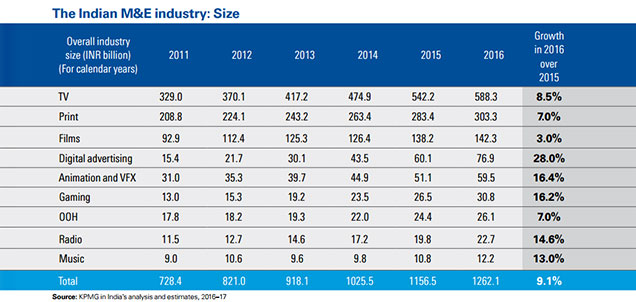
    The Indian media and entertainment industry in 2016 was able to sustain a healthy growth on the back of strong economic fundamentals and steady growth in domestic consumption coupled with growing contribution of rural markets across key segments. These factors aided the industry to grow at 9.1 per cent on the back of advertising growth of 11.2 per cent, despite demonetisation shaving off 150 to 250 basis points in terms of growth across all sub-segments at the end of the year. The ‘FICCI – KPMG Media & Entertainment Industry Report 2017’ launched at FICCI Frames 2017 in Mumbai, aims to capture a comprehensive picture of the industry’s growth story, challenges, future projections, and key underlying themes.


    The big story in 2016 has been the evolution of FTA channels post expansion of rural measurement in the television segment coupled with the impact of the 4G rollout and the resulting price wars. Both these factors have resulted in media consumption penetrating deeper into India, resulting in a realignment of strategy by media companies and advertisers alike.


    Compared to 2016, the industry is projected to grow at a faster pace of 14 per cent over the period of 2017-21, with advertising revenues expected to increase at a CAGR of 15.3 per cent. The year 2017 is likely to witness a marginally slower rate of 13.1 per cent as the economy recovers from the lingering effects of demonetisation and initial uncertainties arising from GST implementation.


    Commenting on the industry’s performance and way forward, Uday Shankar, Chairman, FICCI M&E Committee and Chairman & CEO of Star India, said: “The industry has gulped down the bitter pill of demonetisation trusting its long-term benefits and yet is set to bounce back to a steady growth, thanks to strong fundamentals. Building solid infrastructure and continued government support will help the industry reach the tremendous potential it holds for employment and creating socio-economic value for the country. A commitment towards a quick transition to digitisation will ensure growth for all stakeholders.”


    Added Girish Menon, Director, Media and Entertainment, KPMG in India: “[The year] 2016 was a mixed bag for the industry with digital media making its way to the centre stage rapidly from being just an additional medium. It is compelling existing players to rethink their business models. To accelerate growth, M&E organisations must rebuild their strategies to fit and thrive in the changing, digitally-oriented landscape. Nimbleness and flexibility will be at the core of sustainable businesses…. The long-term factors driving the future growth are expected to remain positive, with growing rural demand, increasing digital access and consumption, and the expected culmination of the digitisation process of television distribution over the next two to three years.”


    Sector-wise analysis:

    Television:

    The TV industry clocked a slower growth in 2016 at 8.5 per cent, attributed to tepid growth of 7 per cent in subscription revenues and a lower than estimated 11 per cent growth in advertising revenues. A key theme in 2016 was the emergence of FTA channels as a key focus area following the expansion in rural measurement by BARC and the resultant increased interest by both broadcasters and advertisers. Additionally, strong performance of sports properties and increased spending for the launch of 4G by telecom operators helped alleviate some of the pressure. The industry is expected to grow at a CAGR of 14.7 per cent over the next five years with advertising and subscription revenues projected to grow at 14.4 per cent and 14.8 per cent, respectively. The projections remain robust due to strong economic fundamentals, rising domestic consumption and growing contribution of rural markets coupled with the delayed, but eventual completion of digitisation.


    Print:

    The revenue growth rates of print continued to witness a slowdown at 7 per cent in 2016, as English newspapers remained under pressure. Regional language papers demonstrated strong growth, but were adversely affected by demonetisation given their high dependence on local advertisers. Print is expected to grow at 7.3 per cent, largely driven by continued growth in readership in vernacular markets and advertisers’ confidence in the medium, especially in the tier II and tier-III cities. Rise in digital content consumption poses a long-term risk to the industry.


    Films:

    Films grew at a crawling pace of 3 per cent in 2016. The segment was impacted by decline in core revenue streams of domestic theatricals and satellite rights, augmented by poor box office performance of Bollywood and Tamil films. Expansion of overseas markets, increase of depth in regional content and rise in acquisitions of digital content by over-the-top platforms are expected to be the future growth drivers that would help the segment bounce back at a forecasted CAGR of 7.7 per cent. However, factors such as dwindling screen count and inconsistent content quality could prove to be limiting factors.


    Digital advertising:

    Continuing to ride on a high growth trajectory with a 28 per cent growth in 2016, digital advertising has captured 15 per cent share in the overall advertising revenues, with a minor hiccup due to demonetisation. 4G rollouts and the resultant data price wars are providing further impetus to the growth as digital consumption and habits are becoming more mainstream. It is projected to grow at a CAGR of 31 per cent to reach INR294.5 billion by 2021, contributing 27.3 per cent to the total advertising revenues. Advancement in infrastructure, evolving audience measurement technology leading to better content and lowering data costs will drive user habits towards greater digital consumption, driving tremendous growth for the industry.


    Animation and Visual Effects (VFX):

    The industry grew at 16.4 per cent, driven majorly by a 31 per cent growth in VFX due to increase in outsourcing work, growing use of VFX in domestic film productions and increase in demand for domestic animated content on television. The industry is estimated to grow at a CAGR of 17.2 per cent over 2017–21.


    Out of Home (OOH):

    The industry registered a slowdown in growth rate at 7 per cent majorly due to adverse impact of demonetisation. OOH is projected to grow at a CAGR of 11.8 per cent primarily driven by development of regional airports, privatisation of railway stations, growth in smart cities, setting up of business and industrial centres, and growing focus on digital OOH.


    Radio:

    Radio recorded a 14.6 per cent growth led by volume enhancements in smaller cities, partial roll out of Batch 1 stations and a marginal increase in effective advertising rates. However, weak uptake in Batch 2 auctions of Phase 3 and delays in the rollout of majority of Batch 1 stations, coupled with adverse impact of demonetisation dampened the overall sentiment. Nevertheless, it is expected to be the fastest growing amongst the traditional mediums at a CAGR of 16.1 per cent, arising from operationalisation of new stations in both existing and new cities, introduction of new genres and radio transitioning into a reach medium.


  • MRSS India executes FICCI mandate on UP Tourism

    By A Correspondent


    BSE-SME listed Majestic Research Services and Solutions Ltd has executed a survey report on UP Tourism. After having established itself by compiling similar reports for Odisha Tourism and Madhya Pradesh Tourism recently, MRSS India report jointly with FICCI for UP Tourism covered a sample of 800 inbound tourists. the state.


    Said Raj Sharma, chairman, MRSS India: “We have been able to build up on our momentum in the tourism sector and the successful completion of the survey for UP tourism has further added to our team’s confidence to aim higher. FICCI is the leader association that rallies for the cause of the tourism industry in India and MRSS is proud to be their knowledge partner for number of such initiatives both now and in the future,” said Raj Sharma, chairman, MRSS India.


  • Odisha tourism mandates MRSS to conduct joint study with FICCI

    By A Correspondent


    In a bid to increase the tourist inflow into the state, Odisha Tourism has commissioned a joint study by FICCI and BSE-SME listed Majestic Research Services and Solutions (MRSS India).


    The study titled Odisha Tourism: The Emerging Destination of India, both for inbound and domestic tourism – A road map will be released on the eve of the state travel mart proposed to be held early this year.The mandate includes a white paper on new emerging and existing destinations of Odisha and the commensurate potential countries from where the state could expect foreign tourist inflow.


    Raj Sharma

    Expressing pleasure at being associated with FICCI as part of the joint study, MRSS India, chairman, Raj Sharma said: “This is one more feather in our cap after being associated with Great Indian Travel Bazar, India Inbound MICE Tourism 2016, Uttar Pradesh Tourism Mart and very recently with MP Tourism. We are extremely optimistic that the inputs from the proposed report will aid Odisha Tourism to attract more foreign tourists and increase their pie in the domestic circuit too.”


  • Majestic Research Services bags MP Tourism mandate to check customer satisfaction

    By A Correspondent


    Madhya Pradesh State Tourism Development Corporation Ltd has mandated the recently BSE-SME listed Majestic Research Services and Solution Ltd to conduct customer satisfaction survey at all its locations across all seasons.


    During the survey the Majestic Research enumerators are going to interview more than 10,000 guests spread across 69 properties owned by MPTDC Ltd as per the survey mandate.


    Expressing pleasure at being shortlisted and selected to undertake the survey, Raj Sharma, Chairman- MRSS said, “In the last couple of years, in conjunction with FICCI, we have launched several reports viz. UPTM 2016, GITB 2016 and MICE 2016 establishing ourselves in the ‘Tourism’ space. The MP Tourism study is a step forward in that direction and should trigger a number of similar projects in the coming few quarters.”


    As per the tender norms by MP Tourism, the study would evaluate the satisfaction levels of guests at the units with their demographic profile owned by it or directly under its governance within a four month time frame.