Tag: FICCI

  • Big role for direct selling: FICCI-KPMG


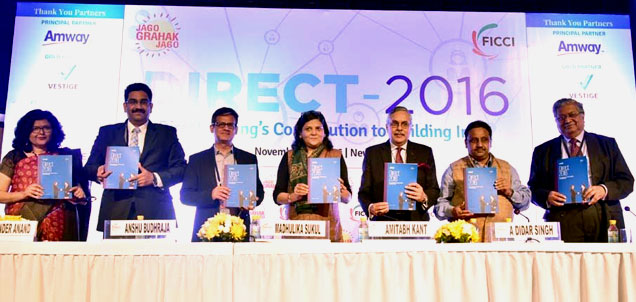
    The direct selling industry has recorded a high double digit growth of about 16 per cent over the past four to five years, notes a FICCI-KPMG report released on Wednesday. The market has grown to become a key channel for distribution of goods and services in the country, especially for health and wellness products, cosmetics, consumer durables, water purifiers and vacuum cleaners.


    Releasing the report titled ‘’The contribution of Direct Selling to Building India’’, Madhulika P Sukul, Additional Secretary, Ministry of Consumer Affairs said was delighted to see the contribution of the sector towards women empowerment and the figures of more than 60% women workforce associated with the sector has been astounding. Sukul urged the industry to join hands with MoCA and work towards the effective implementation of the guidelines for the sector that the ministry has come up with. The Additional Secretary promised that MoCA would continue to work towards the welfare of the consumers with active industry support and encouragement.


    Meanwhile, Amitabh Kant, Chief Executive Officer, Niti Aayog who was chief guest at the event said that direct selling will have to be given a great thrust as it empowers women, MSMEs and promotes manufacturing in India.  Kant applauded the efforts of the Ministry of Consumer Affairs to come up with the guidelines to govern the direct selling industry and is hopeful for its implementation by various states. He added that an effective and time bound implementation of the guidelines would act as a growth stimulator for the budding DS industry.


    He also urged the industry to embrace technology as the industry can deliver better and even faster once technology becomes its strength. He congratulated the direct selling industry for the efforts that they are putting in towards building the national economy and said that the sector is a major contributor towards the Indian growth story and promised to support the industry in addressing the hindrances and bottlenecks in due course of time. Also, he added that there is a huge opportunity that the industry raises in terms of pushing India towards the digital age.


    Later, Anshu Budhraja, GM, Amway India Enterprises presented the industry perspective and said the sector has immense potential in terms of the workforce that it trains and the job opportunities it generates. Budhraja said that the industry needs to work as per the gold standards, of which self-governance is a core concept. He congratulated MoCA for coming out with the much awaited guidelines for the sector and said that the guidelines would help in adding further value to the growth path of the industry. Anshu Budhraja added that “by 2025 the industry is expected to grow to ₹ 72000 crore from ₹ 7200 crore in 2016 providing 1.8 million self-employment opportunity.”


    Praveen Khandelwal, General Secretary, CAIT, emphasised on the need of having a retail policy that will encompass the cross sectorial approach and would help in adding avenues of growth for the sector. He said that there is a need to convert the guidelines proposed for the DS sector into laws towards which the Government is working relentlessly. Also, Khandelwal quoted that the passing of Consumer Protection Bill in the parliament would add more flavours to the development of the sector by reducing the mischief and [onzi operators. He also said that a board of internal trade that would look upon the matters associated with the internal trade and retail sector should be formulated with adequate representation from all the concerned stakeholders from the industry as well as the Government. Khandelwal said that retail, direct selling, e-commerce and SME’s are the four core pillars for the development of the national economy.


    FICCI Secretary General Dr A Didar Singh, Secretary General, FICCI said “Indian Direct Selling Industry is an important component of the Indian economy and acknowledging this, we at FICCI through our focused task force on direct selling is working dedicatedly towards the growth of this industry and seeking regulatory clarity for this new industry. FICCI is working closely with the Central and State Governments on the same and today’s conference is a step in that direction. I would like to congratulate MoCA for implementing the much awaited guidelines to govern the sector. I am certain that the effective enactment of the same would facilitate the further growth of the sector and act as a growth catalyst.


    Dr Singh said that Industry 4.0, or Industrie 4.0, is the current trend of automation and data exchange in manufacturing technologies. It includes cyber-physical systems, the Internet of things and cloud computing. Industry 4.0 creates what has been called a “smart factory” and urged the industry leaders to adhere to same. Dr. Singh also added that the bussing direct selling industry is exceptionally gender friendly and has been a crucial part of women empowerment.


    Direct selling, one of the oldest and traditional forms of selling, is a successful industry operating in over 100 countries, with a market size of USD180 billion. In India, the market was estimated at INR75 billion (2013‐14), and forms around 0.4 percent of the total retail sales in the country. To showcase the potential and highlight the opportunities and challenges faced by the DS industry, FICCI organizes its annual event on Direct Selling ‘DIRECT’ every year.


    The event witnessed intense panel discussions on the topics ‘’Way Forward Post Direct Selling Guidelines’’ and ‘’Direct Selling Contribution in Skilling, Women Entrepreneurship & As Food Distributors’’ which comprised of representation from wide array of concerned stakeholders including the Government and the industry.


    The panels suggested an effective implementation of the guidelines by the states in a time bound manner would yield wonders for the sector and would be an asset to it’s growth trajectory. Also, the sessions highlighted how the direct selling has evolved as a core pillar of the Skill India campaign and trains significant amount of workforce and makes them job ready. Also, the contribution of the DS sector towards the empowerment of women has been significant and the phenomenal number of 62% women workforce involved in the sector is remarkable.


    This year’s KPMG report takes a look at how the Direct Selling industry has positively contributed to several flagship schemes launched by the Government of India in the past 2 years, namely:

    :: Skill India: The Skill India scheme seeks to provide the institutional capacity to train a minimum of 400 million people by 2022. The Direct Selling industry annually trains over 5 million people in marketing and communication skills, personality development and leadership skills.

    :: Make in India: Many Direct Selling companies now make in India. Some rely on MSMEs for manufacturing their products, investing in & providing the right equipment and machines to the MSMEs for production. Driven by these initiatives, several MSMEs have now developed capabilities to cater to the needs of other MNCs and have commenced supplying to them, in the process promoting the Make in India initiative

    :: Women Empowerment: Due to the dominance of women centric products offered under Direct Selling, the industry provides self-employment opportunities to a large number of women. In 2015 alone it has provided self-employment to over 3 million female distributors. By providing income generation opportunities and trainings, Direct Selling promotes holistic development of women.

    :: Digital India: The Direct Selling industry is adopting measures in the digital sphere that not only benefit the Direct Selling entities, but also ensure ease of doing business for its distributors and improved experiences for its end consumers.  Mobile applications and websites have been launched by Direct Selling companies for its distributors to order products, monitor payments and access training modules.

    :: Startup India: Direct Selling entities, are now catering to global FMCG clients. Direct Selling has also promoted startups in avenues such as transportation and logistics, trainings, app development, etc.



  • What will make Digital tick?


    By Anuka Roy


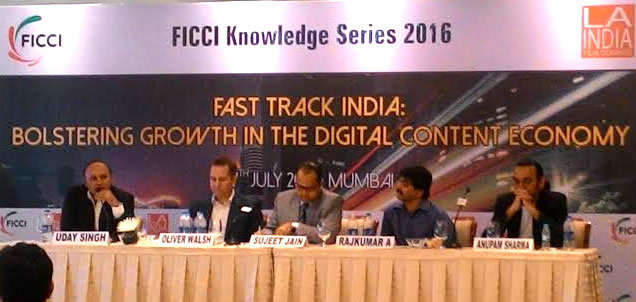
    For the past few years we have hearing that ‘Digital has arrived’. That ‘Digital is the future’ etc. But how has it arrived and more importantly how will it be our future? So, on Wednesday (July 27) some top executives from the India’s motion picture and digital industries concluded that accessibility, affordability, quality content and online content protection will be the key drivers to sustain growth in India’s digital economy.‘Fast Track India: Bolstering Growth in the Digital Content Economy’, a knowledge series forum by the Federation of Indian Chambers of Commerce (FICCI) in association with the Los Angeles India Film Council (LAIFC), assessed the extent to which screen content acts as a key driver of the digital economy in India. The industry experts assessed the current regulatory and infrastructural challenges, reviewed future growth trends and underlined innovative ways of monetising digital content to stimulate growth in India’s digital economy.


    Noted filmmaker and Co-Chairman, FICCI, Entertainment division, Ramesh Sippy started the conference by highlighting the fact that increased connectivity, technological innovation and new content delivery platforms all combine to increase growth. He said that government’s role is pivotal to enabling legitimate content delivery platforms to protect and monetise their content in order to achieve their full potential in a rapid changing marketplace. Digital India has the potential to create opportunities for businesses, promote innovation and create jobs. However online content theft, varying levels of broadband access and affordability in terms of data tariffs continue to present challenges for providers to deliver value to consumers. These factors will have a significant impact on how digital media evolves in the future.


    Girish Menon, Director, Transaction Services, KPMG India moderated as well as introduced the first panel discussion. The first panel ‘Making Sense of the Economics of Digital Media’ featured a keynote presentation by KPMG. Menon said, “The advent of the OTT services and on-the-go content aided with competitive tariffs and falling average retail price of smartphones has helped to drive video consumption in India. However, profitability still continues to be a major challenge coupled with infrastructure and affordability of data tariffs and payments models. It is imperative for the OTT players to address these concerns through innovative means to achieve the medium’s full potential.” Speaking about the future of OTT content services, Ajay Chacko Co-Founder and CEO, Arre said, “As in the case of broadcast TV in India, the relatively infant digital content economy is showing signs of secular, organic growth driven by an increasingly young India. We already have more than 120 million consumers of digital content. As with every paradigm shift, audience shifts will be followed by a shift in advertiser preferences and finally consumer monetisation. So I am quite hopeful that the digital content economy will see the exponential growth that has been witnessed in the 2000-2010 decade in TV, in the next three to five years.” While film producer Vishesh Bhatt, expressed his concern about serious content makers still not understanding the digital ecosystem. However, Karan Bedi, COO, Eros Digital, was optimistic about the future and gave the example of Pokemon Go, about how the game has caught the attention of the consumers. He said: if consumers are compelled by content, they will eventually pay for subscription as well.  Said Archana Anand, Business Head, dittoTV: “In light of the accelerated digital media consumption across the country, it is wonderful that FICCI and the LA India Film Council provides this much needed platform to discuss the market potential of this space and the innovations and challenges thereof.”


    Moving on from the concerns about monetising digital content, the other looming concern is around the rules and regulations of the digital media. The second panel discussion on ‘Regulatory and Infrastructural Challenges for Digital Media’, Abhishek Joshi, Head, Marketing and Analytics, Digital Business, Sony Pictures Networks India Pvt Ltd. said “The OTT industry has graduated from the innovators stage to the early adopters stage within the innovation diffusion curve, based on distinguished product strategies by players in the market. However to cross the chasm to gain the majority market, policy makers will have to play a very big role. Infrastructure and regulatory policies are going to be the biggest differentiators for industry growth for the next 18 months.” Akash Banerji, Head, Marketing and Partnerships, VOOT was very hopeful about the future. According to him, even though the industry is still learning, the consumers will be in a demanding position in the future and eventually mobile data will also come down. Siddharth Roy, COO, Hungama.com, stressed on the fact that branded IP (Intellectual Property) will be one of the key drivers of content regulation. But Rajeshree Naik, Co-founder, Ping Networks, had other concerns. She said that it is the collective responsibility of the industry is to see to it that government stays out of digital media regulations. This session was moderated by journalist and author Mayank Shekhar.


    The final panel discussion was on ‘Building a Robust Enforcement Model to Protect Content In a Digital Economy’ and was moderated by Uday Singh, Managing Director, Motion Pictures Association, India Office. Oliver Walsh, Regional Director, Online Content Protection, Motion Picture Association- International(MPA-I) said, “The Indian film and TV industry supports 1.8 million jobs which are at risk because of rising online content theft. The future of legitimate content delivery platforms depends on effective enforcement measures supported by Indian State Governments. The Telangana Intellectual Property Crime Unit (TIPCU) is a great example of a dedicated law enforcement unit to tackle organised online film piracy and will set a gold standard approach to significantly reduce online infringement of films and television shows. I hope it is the first of many such enforcement units across India.” Rajkumar Akella, Honorary Chairman, Governing Council, Anti Video Piracy Cell, Telugu Film Chamber of Commerce said, “As we have been witnessing in recent days, the problem of online piracy is most urgent. The greatest threat now has become the pre – movie release leakages. Without real time interventions from the government and industry, it will go out of control. In this scenario, the latest initiative – TIPCU by the Government of Telangana, the Telugu Film Industry & the Motion Picture Association, India office, is a very significant step in tackling Movie Piracy, particularly Online Piracy. It is a collaborative, dynamic model,where the Government works seamlessly with the Industry and all stakeholders. The unit will be making optimum use of Technology besides policy, enforcement and outreach. This is a step in the right direction to root out piracy in India.” The General Counsel of Viacom 18, Sujeet Jain suggested the formation of digital courts to deal with piracy and protect online content. Anupam Sharma, Director, Film and Casting Temple, Australia was of the opinion that educating the consumers was the first step in stopping illegal downloading of content. He showcased a short video where the cast and crew of his movie are shown to be thanking the audience for not watching pirated videos and acknowledging the fact that the audiences are also a part of the film industry. This video was made to create awareness against video piracy.


    Biren Ghose, Country Head, Technicolor India, in his concluding remarks, said, “Content is assuming new life in the emerging digital economy. Technology enables innovations in imagery that could hitherto neither be produced nor consumed. FICCI and LA India Film Council need to be complimented on encouraging the conversation for the Indian agenda in this space.” Panelists concluded that a combination of government and private initiatives would need to be rolled out to achieve the ambitious goal of a truly Digital India.


  • How radio can grow: FICCI


    Presenting policy recommendations for the growth of radio broadcast sector in India, as per FICCI. Excerpts


    1. Restriction on ownership of licenses

    Current policy Regulation

    A permission holder cannot run more than 40% of the total channels in a city subject to three different operators in the city.


    No entity shall hold permission for more than 15% of all channels allotted in the country excluding channels located in Jammu and Kashmir, North Eastern States and island territories.


    While such policy restriction may have been designed to address concern around creating monopoly and promoting competition, such policy restriction is actually prohibiting the Industry players to leverage economies of scale and holding them back from making greater investment in technology and content. The Industry believes that there may have been sufficient rationale for such restrictions when the Radio Industry was in its infancy stage.


    However, as the Industry has matured, it is right time that such regressive regulations can be removed to allow the Industry players to scale up their operations and technologies. The Industry bonafide believes that there are sufficient regulations and regulatory bodies such as Competition Commission of India (CCI) which can address the concerns of creating monopolistic market or other unfair trade practices. In view of the above, it is humbly submitted that the government should reconsider its current policy and remove all such arbitrary caps.


    Recommendation:

    It is recommended that the cap on ownership be removed such that national players and strong regional player can emerge that can consolidate operations, bring in economies of scale to the industry, reach grass roots level and acquire more frequencies.


    2. Three Year Lock-in Period

    Current Provision

    The current policy mandates that the shareholding of the largest Indian shareholder in a Radio Broadcasting company cannot be reduced below 51% till a period of 3 years from the date on which all the channels allotted to the company holding permission stand operationalized.


    Existing Radio Broadcasters have already served a lock-in period in previous regime of Phase I and/or Phase II. Further, Phase III imposes a fresh lock-in from the date of operationalisation of all the channels which could possibly extend during batch II auctions.


    Recommendation

    It is recommended that the said condition for three year lock-in period should be waived for new allotments done in Phase III to the existing radio broadcasters as such broadcasters have already served the lock-in period in earlier phases. Additionally, lock-in should not apply to Phase I and/or Phase II broadcasters who have migrated into Phase III. The Lock-in period should be imposed only once.


    3. Sourcing of news & current affairs

    Current Policy Regulation

    Based on the current regulations, the permission holder will be permitted to carry the news bulletins of All India Radio (AIR) in exactly same format unaltered. Consequently, exclusive radio interviews, debates and content sourcing from any other source are not allowed. In the current age of internet access and converged media platforms, access to news and information has become unrestricted. Under phase III, the medium will penetrate deeper into the newer cities.


    Recommendation

    Radio being a free to air medium for masses should not be restricted in terms of sourcing of news and information. It should be considered as the primary medium for dissemination of information at national and local level which will assist in formation of pluralistic opinions and higher awareness amongst listeners.


    Similar to television, radio industry should be liberalized to broadcast independent debates and local news sourced from any wire services, or independently, as they desire. Standard rules of checks and balances as applicable to other news media should apply to FM radio as well.


    4. Service Tax/GST levy on Advertisement

    Advertisement on radio is liable to Service Tax levy. Radio competes with newspaper at local level. There is no levy of service tax on advertisement in newspaper. It is recommended to remove service tax on advertisement in Radio to provide level playing field to Radio. It is recommended that Services Tax and GST should be lowest in radio as it is a free to air medium.


    5. Auction Rules

    In the first Clock Round, the Auction Activity Requirement (AAR) will be set at 80%. Subsequently, the Auction Activity Requirement will be increased in two steps as the Auction progresses, from 80% to 90% and then to 100%.


    In Phase III Batch I Auctions, the AAR went to 80- 90 % after many rounds and then arbitrarily to 90 -100% after many rounds which led to gaming, parking and artificial rate increase.


    Recommendation

    It is recommended that the increase in AAR should be in accelerated manner in Phase III Batch II auctions. AAR of 100% should be reached after a few rounds of 80% and 90%.


  • M&E CAGR 2014-19: 13.9 %, as per FICCI-KPMG


    India is taking its place on the global stage as a market with tremendous growth potential — and a country with exciting investment opportunities.


    Offering the world’s largest youth workforce, an expanding middle-class that constitutes one of the biggest consumer bases, and a robust, well-functioning democratic system, India, along with its pro-reforms government, is now scripting a turnaround story. The global economy is struggling to gain momentum, as China suffers a slowdown, the Euro-zone slips into deflation, and Japan’s economy is too soft to absorb the fiscal consolidation plan. Despite its shaky global economy, India is performing relatively well, with a stable macro-economic environment (inflation eased while the current account deficit came under control) bolstering the economic outlook. The Indian economy is on a strong footing, with an estimated growth of 7.4 per cent in the Financial Year 2015, while growth is pegged at between eight and 8.5 per cent in FY16.


    As a result, there is a marked shift in investor sentiment towards India. Global investors are increasingly beginning to view the country with renewed interest and optimism, thanks to the government at the Centre and its reform agenda. The government’s recent Budget announcements underpinned this sentiment further. An improved business climate, together with policy reforms, could boost the country’s long-term growth potential.


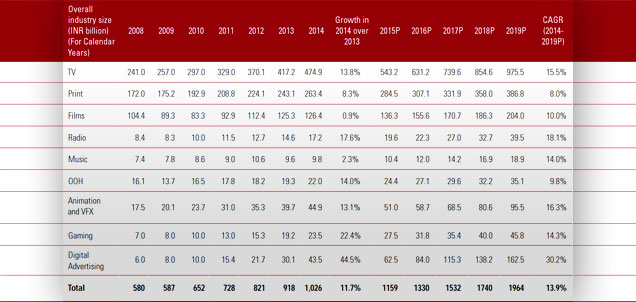
    This growth story then extends itself across the Media and Entertainment sector. We estimate that the Indian market is poised to grow at a CAGR of 13.9 per cent, to increase from Rs 1026 billion in 2014, to Rs 1964 billion by 2019 — a growth rate that is almost double that of the global media and entertainment industry.


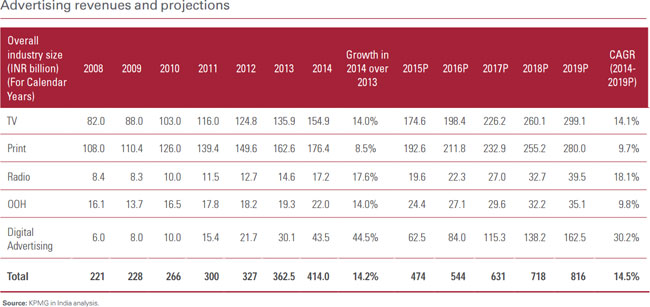
    The growth in popularity of digital media continued to surge in 2014, with a significant increase of 44.5 per cent (over 2013) in digital advertising. At the same time, traditional media continued to exhibit healthy growth rates as well, with the television sector continuing on its path to cable digitization; advertising across media buoyed by the spends during the 2014 Parliamentary elections, and the emergence of e-commerce as a significant new category. Advertising revenues in 2014 grew at a rate of 14.2 per cent over 2013, to reach Rs 414 billion, of which print (43 per cent) and television (37 per cent) captured the lion’s share.


    The media and entertainment sector in the country is poised for exciting times, powered by the growth in digital media consumption, and the supporting environment created by regulatory reforms. The new digital ecosystem, however, brings with it a new set of challenges, like an increasingly-fragmented and on-the go audience and hurdles to monetise digital platforms. To seize the opportunities, front-runners are expected to continue to place consumers, both domestic and global, at the heart of their strategies for content and access channels.


    Collaboration across players may remain the key to success. Efficient and transparent measurement systems at an industry level, and focus on big data analytics at a stakeholder level, can be critical to measure and monitor performance. The momentum generated by regulatory reform needs to be underpinned by strong implementation on the ground, and partnership across the value chain.


    And then a ‘global superpower’ may be a not-too-distant reality.


    Extracted from #shootingforthestars. The FICCI-KPMG  Indian Media and Entertainment Industry Report 2015


  • FICCI-KPMG study indicates M&E sector bucking the slowdown trend


    (L-R) Jehil Thakkar, Uday Shankar, Ramesh Sippy

    By a correspondent


    While 2013 may have been a slowdown year for most sectors, an opposite trend was observed for the Indian Media & Entertainment (M&E) industry that registered growth of approximately 12 per cent, according to the FICCI-KPMG report.


    Overall growth remained muted, noted the study that was caused largely by the slowdown of the Indian economy. The economic slowdown impacted advertising revenue dependent sectors such as TV and print the depreciation in the rupee also affected print, cable and DTH companies adversely but helped export oriented sectors such as animation and VFX to some degree. At the same time, this was countered by the impact of continued digitization of media products and services, and growth in regional media.


    Digitization of cable saw progress of television industry moving in the right direction, with the mandatory Digital Access System (DAS) rollout almost complete in Phase II cities. The impact was felt to the extent that carriage fees saw a reduction of 15-20 per cent overall, however the anticipated increase in ARPUs and subscription revenues for broadcasters and MSOs (Multi System Operators) is expected to be realized only over the next 2-3 years. Other key highlights in 2013 were the inclusion of LC1 (less than class I) markets in TV ratings, the 12 minute advertising cap ruling and the shift from TRP to TVT ratings.


    The study also noted that the film industry recorded a double digit growth, albeit slower than in 2012, with multiple movies scoring big on box office collections. Approximately 90-95 per cent movie screens are now digitized in the country, with a shift in focus to tier II and III cities. Going forward, multiplex growth is expected to slow down, in line with the overall delays and future expectations for retail sector and commercial real estate development, impacting box office growth in the short term


    The print sector too continued to buck the global slowdown trend. The sector grew at a CAGR of 8.5 per cent this year to reach INR 243 billion. Regional markets performed exceedingly well on the back of steady advertiser spends, state election impact and new launches. However, with the validity of IRS data called into question by the industry majors, the sector in the short term suffers from the lack of a robust measurement system, critical for decisions on media planning and allocations.


    The total internet user base in India grew to approximately 214 million by end of the year with almost 130 million going online using mobile devices. Mobile Internet users dominated the total internet user base capturing an overall share of 61 percent. Digital media advertising in India grew faster than any other advertising category. Streaming and download services continued to see growth in the music industry, with the growth in mobiles, in particular smartphones, contributing significantly to increased consumption of music ‘on-the-go’. However, with the continued decline in physical sales, compounded by the significant fall in ringback tone revenues (following the backlash of TRAI guidelines issues in 2012), the sector saw an overall fall in size by 10 per cent in 2013. Going forward, digital revenues are expected to drive growth in the sector. Further, the vibrant live events sector is expected to continue its role as a catalyst for driving growth in artists’ fan-base, and public performance royalties.


    Uday Shankar, Chairman, FICCI M&E committee said, “2013 has been an extraordinary year for the media and entertainment sector – a year of challenges and significant change which saw the industry dealing with a host of issues. Television saw the implementation of the 10+2 advertising cap and significant progress in seeding of set top boxes in DAS 1 and II – setting the stage of revenue growth and expansion in genres. The film sector continued to mature on the back of multiplex expansion and a wide variety of content. Radio and print continue to defy global trends and await positive regulatory intervention that will take these sectors to greater heights. I am certain that the insights and findings from this report will provide a comprehensive and useful lens for all of us in the industry.”


    According to Jehil Thakkar, Head of Media and Entertainment, KPMG in India, “2013 was a year in which many parts of the M&E industry paused and took stock. Focus shifted from top line growth to bottom line growth with companies focusing on operations and efficiency. Inspite of a very challenging macro environment, the industry grew 12 per cent, a far better performance than many other industries. The structural changes taking place in the industry – especially in television and digital, continued to take the industry down the path of fulfilling its potential.”


    This year, the report highlights opportunities that could come from tapping international markets such as the US and Middle East, with a special feature on opportunities in South Africa and Nigeria.


    Going forward, there is need for continued positive regulatory intervention, such as implementation of Phase III for the radio sector. In an increasingly digitized media world, the ability to create compelling and targeted content across multiple channels, will be the bedrock for creating differentiation in a cluttered market, the report observed.


  • @FICCI-MEBC: South Side Story by Deloitte


    Executive Summary of The Digital March – Media & Entertainment in South India

    by Deloitte Touche Tohmatsu India Pvt Ltd (DTTIPL)


    The South Indian Media and Entertainment (M&E) industry is growing in size, driven by the popularity of vernacular content among the region’s populace. While the popularity of film stars remains the most powerful trigger for films, digitization in the television sector is providing consumers access to a higher number of TV channels, a better viewing experience, and other


    value added services. Print, both in its English and vernacular forms, is widening its portfolio and markets to capitalize on the readership base in South India.


    As listeners become more selective, the radio industry in the South is tuning its programming towards local preferences, thus becoming a more integral part of life in South India. In fact, listeners in South India spend more time on radio as compared to those in other parts of the country.


    With a rich M&E industry driven by strong local demand, South India is poised to attain a greater position of strength in the coming years. Converting this potential into reality depends on the industry’s ability to continue to develop quality content as well as to deliver it through best-in-class platforms, both within India and abroad.


    Overview of the South Indian market

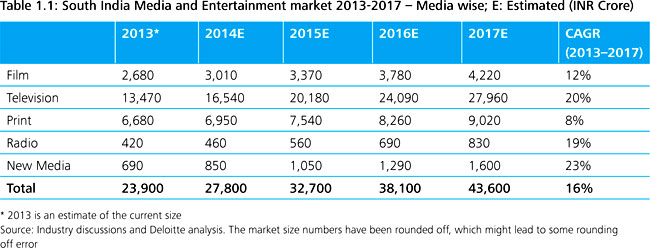
    In FY 2013, the overall South India M&E industry was pegged at INR 23,900 crore. Owing to the evolving ecosystem and demand, the market is expected to grow at a CAGR of 16% to reach INR 43,600 crore by FY 2017.


    Television constitutes the largest segment of the South Indian M&E industry and is currently estimated at INR 13,470 crore accounting for the largest share of the overall market at 56%. The medium is expected to grow at a CAGR of 20% over the next four years due to benefits of digitization being realized. Print is the second largest segment accounting for 28% of the overall market in FY 2013 at INR 6,680 crore. With players identifying innovative ways to reach out to their readers.


    Print industry is also expected to see steady growth going forward. Film, buoyed by an ardent fan following in the South, is the third largest segment at INR 2,680 crore. Radio, with the upcoming Phase III auction and New Media, propelled by the consumer’s demand to access content ‘anytime, anywhere’, are expected to grow at a CAGR of 19% and 23% respectively, over the next four years.


    Table 1.1: South India Media and Entertainment market 2013-2017 – Media wise; E: Estimated (INR crore)

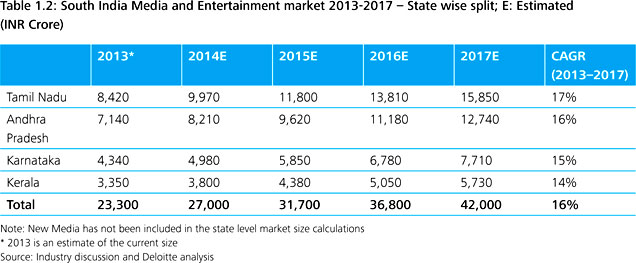
    Tamil Nadu and Andhra Pradesh constitute 70% of the South Indian M&E industry. The M&E industry in Tamil Nadu is expected to grow at a slightly higher rate than the other states of the region, with all four media platforms expected to grow faster in the state.


    Key emerging trends

    Film

    The South Indian film industry with 831 films, accounted for over 50% of total films certified across India. The number of films certified increased by 36% over 2011, primarily driven by a spike in Cable & Satellite (C&S) rights’ prices. However, the number of films released increased by only 8%2 during the same period as some producers chose not to release their films due to the high marketing costs associated, and as a result of a correction in the C&S rights’ prices in some of the markets.


    With over 90% of exhibitors using digital projection, filmmakers are more inclined to shoot their films digitally. The industry continues to embrace technology in other parts of the ecosystem as well, be it experimenting with scouting talent through social media, adopting newer film making technologies in terms of sound and filming, distributing films digitally or embracing e-ticketing platforms. Furthermore, with the onset of digital prints, increase in C&S and remake rights’ revenue, the producers are getting opportunities to recoup their costs in a shorter duration.


    Television

    The Television industry in South India is on a transformation path, driven by the Government’s digitization mandate. It is one of the most flourishing regional media segment in terms of availability of content, reach and distribution. Over the years, it has seen increased action from regional as well as national advertisers. In fact, regional advertisers now contribute almost 40% of the TV industry’s advertisement revenues in states such as Tamil Nadu and Kerala. The industry is also leveraging technology to enable multi-screen viewership of television content for viewers who are constantly on the move. Producers and broadcasters are looking to shoot as well as telecast content in high definition (HD) formats. Going forward, developing innovative programming content, identifying niche genres and expanding markets through new content delivery platforms, is expected to drive the South India TV industry.


    Print

    South India, driven by a high literacy rate and a sizable vernacular readership base (30% of total readership in India) is one of the strongholds of the Indian print industry. Amongst the four regional states, Tamil Nadu and Andhra Pradesh account for ~58% of the total revenue. Most of the markets in the region are dominated by English print in terms of revenue except Kerala, where vernacular prints accounts for nearly 90% of the revenue. However, the advertising revenue from vernacular print in the region is estimated to grow at twice the pace of that of English, largely driven by local advertisers and increasing focus of national advertiser’s beyond Tier 1 cities. Hence, some of the English players are now launching vernacular dailies to not only consolidate their presence in South India but also partake in vernacular growth.


    The industry is testing various business models to identify the right monetization opportunities in online space by developing mobile applications and mobile optimized websites. However, the future depends on how well the industry deals with the weak economic environment as well as the key issues of sustaining subscription revenues, monetizing online content and giving advertisers innovative ways to reach out to the readers.


    Table 1.2: South India Media and Entertainment market 2013-2017 – State wise split; E: Estimated (INR crore)

    Radio

    The radio industry enjoys greater acceptance in the South than in the rest of the country and thus stands out amongst its peers. This is indicated by relatively higher average radio listenership in cities like Bengaluru where people spend about 20 hours / week on radio while those in Delhi and Mumbai spend 13-14 hours / week5.


    The cultural diversity of cities in the South has fueled demand for localized content on radio. This has led to innovations in the type of content as well as the way in which content is being offered, so as to attract and retain audiences in a marketplace which is increasingly becoming crowded. Increasing presence of radio on the digital medium is also enabling it to reach listeners across the globe. With Phase III auction expected in FY 2014, the industry’s horizon will continue to expand. 229 of the 839 frequencies being auctioned are in 83 cities of the four Southern states. Phase III is expected to result in 294 frequencies (existing plus planned) in South India alone6.


    New Media

    The internet continues to have a profound effect on consumers’ viewing habits and the proliferation of devices is altering their media consumption behaviour. With the increasing popularity of mobile broadband (3G) and the impending launch of 4G LTE services, mobile phones are expected to emerge as the preferred platform for consuming content. India already has over 65 Million smartphone users currently.


    Utilization of existing bank of vernacular content, development of vernacular apps and improvement in connectivity infrastructure would define the growth trajectory of New media in South. The shift of users to web and mobile platforms for media consumption is expected to have a direct impact on growth of digital advertising as well. This is expected to grow at a CAGR of about 23% over the next four years. It would be exciting to see how players across M&E sectors experiment and innovate to effectively utilize and monetize new media platforms.


  • Indian M&E industry to achieve 11.8% growth in 2013: FICCI-KPMG report

    By A Correspondent


    The Indian M&E industry grew from INR 728 billion in 2011 to INR 820 billion in 2012, registering an overall growth of 12.6 percent. While, 2012 was a challenging year for the industry, with some improvement likely in the global economy in 2013 and India’s real GDP expected to be in the region of 6.1% to 6.7%, the prognosis for the Industry looks much better going forward. Given the impetus introduced by digitization, continued growth of regional media, upcoming elections, continued strength in the film sector and fast increasing new media businesses, the industry is estimated to achieve a growth of 11.8 percent in 2013 to touch INR 917 billion. Going forward, the sector is projected to grow at a healthy CAGR of 15.2 percent to reach INR 1661 billion by 2017, says the FICCI – KPMG Media & Entertainment 2013 report.


    The report noted that television continues to be the dominant segment; however, it also boasts a strong growth by new media sectors, animation/ VFX and a comeback in the Films and Music sectors on the back of strong content and the benefits of digitization. Radio is anticipated to see a spurt in growth at a CAGR of 16.6 percent over the period 2012-2017, post the rollout of Phase 3 licensing.


    Total advertising spend across media was INR 327.4 billion in 2012. In light of continued economic slowdown, advertising revenues saw a growth of 9 percent in 2012 as against 13 percent in 2011 and 17 percent in 2010. Print continues to be the largest beneficiary, accounting for 46 percent of the advertising pie at INR 150 billion.


    Uday Shankar

    Speaking about the findings of the report, Mr. Uday Shankar, Chairman, FICCI M&E committee said, “2012 has been one of the toughest years in recent times. But it has also been a landmark year for the media and entertainment sector with significant progress in all verticals: the signs are already evident that digitalization will fundamentally change broadcasting, films have scaled-up their ambitions, and radio and print continue to defy global trends. If anything, 2013 promises to be even more disruptive. I am certain that the insights and findings from this report will provide a comprehensive and useful lens for all of us in the industry.”


    According to Jehil Thakkar, Head of Media and Entertainment, KPMG in India, “2012 though a challenging year for the M&E industry, was a year in which important foundations for future growth were laid. The advertising environment went through one of the toughest years in the last decade. However, the implementation of digitization, the stellar performance of the film industry backed by excellent content and digital distribution, the continued growth in regional print and the momentum in new media and the announcement of Phase 3 radio implementation have all finally provided the needed platform to boost the Indian Media & Entertainment industry.”


    Key trends and themes for growth


    Digitization of film and TV distribution infrastructure:

    Digitization of distribution has brought in the promise of more sustainable and profitable business models across media sectors. It has enabled the films sector to make a comeback this year. The industry has achieved 77 per cent digitization of screens and expects to be close to 100% digitized in the next 18 months to 2 years. These developments have resulted in increased ability to invest in differentiated content, marketing, and wider releases – all contributing to greater audience engagement and unprecedented box office success across big and small budget movies alike. Overall, digital technology is expected to drive the M&E sector’s growth in a challenging macro environment, by spurring on end-user spending and transparency.


    Growth in new media:

    The rapid increase in mobile and wireless connections continues to drive the growth of internet penetration in India. With better access, through cheaper and smarter devices, audiences (especially the youth) are consuming more content and are getting increasingly engaged.


    Key beneficiaries are emerging new media segments, which include internet advertising, online classifieds, and gaming, all of which are on a rapid growth path. Going forward, better uptake of 3G connections and the beginnings of the 4G rollout are expected to spur growth further.


    Regional markets remain key centers of growth:

    Advertisers continue to see higher growth in consumption from key regional markets. Hence regional media continues on a strong growth trajectory especially in the print and television sectors. Key media players are focusing on cherry picking acquisitions and expanding their presence in regional markets based on higher rates of advertising revenue growth, and better insulation from the slowdown than in metros, which may be close to saturation in many cases.


  • I expect this year’s theme to throw up more innovative ideas and strategies: Karan Johar

    As Co-Chairman of Ficci Frames 2013, Karan Johar has a very clear mandate at hand for the event. That is to communicate very clearly to the stakeholders on where the industry currently is and where can it be in the future.

     

    According to Johar, while the Indian M&E sector is in a robust growth phase, at the same time it occupies less than one per cent of the global M&E pie. The task will be to work towards a roadmap for Indian films to gross Rs 1000 crore for a film. Though it’s difficult it is surely not impossible, asserts Johar to MxM India.


    Excerpts:

    What is the mandate that you’d be laying out as you open the proceedings on day 1 of Ficci Frames 2013?

    Our mandate is very clear. We have to communicate very clearly to our stakeholders on where we are and where can be. Indian M&E Sector is in a robust growth phase, but at the same time, we are less than one per cent of the global M&E pie. Already, at the Ficci Frames Curtain Raiser show we had made our ambitions clear.


    The Rs 100 crore is limiting the growth and content of our films and we have to aim for Rs 1,000 crore from a film. It may not be possible today. But we have to have a mandate to achieve that. FICCI will work towards a roadmap for Indian films to gross Rs 1000 crore for a film. It is not an impossible task. We have a session on planning and creating a Rs 1000 crore blockbuster.


    We exchange ideas at Ficci Frames and my biggest takeaway is to learn new thinks which I don’t know about. We set the agenda, but overall we learn new things over three days.


    What are your views on the underlying theme – ‘Engaging One Billion Consumers’ – that has been decided for Ficci Frames this year?

    Ficci Frames will be 14 years this year. We have grown leaps and bounds. The next phase of Ficci Frames is to focus and drive the entire media and entertainment sector to take the next big leap — therefore the theme ‘Engaging a billion Consumers’. We are still at the tip of the iceberg and we need to engage and take our products out to those billion consumers. A focused topic like this will bring in a huge mindset change to the industry. I am sure this year’s theme would throw innovative ideas and strategies to our products and business models. I believe that our new agenda will be the change agent for social and commercial development, connecting a billion people.


    As Co-Chairman of Ficci Frames for 2013, what has been the attempt to infuse a dose of freshness in content and ideas at the event?

    The freshness you are talking about can be reflected in the theme that we have shortlisted. We debate ourselves, see around the world, and decide on what would energise the Indian Media and Entertainment sector.


    How would you define the year 2012 for the movie industry in India – in terms of growth and venturing into new frontiers?

    The last two years has been very good for Bollywood. We have tasted success not only in big films but small films too have done very well. More and more people are consuming films than before. The multiplexes are on the rise and more and more are getting added in small towns. The films are released in the vicinity of your neighbourhood. The total box office collections have crossed more than $1 billion in 2012. Overall, the film industry has grown by over 40 per cent.


    Simultaneously, Hindi films are being released in more screens and watched by more people in the overseas market. New territories are also getting added.


    Over the last few years not only has the dynamics of the film business changed but the distribution and marketing aspects of films has changed too. This trend has expanded growth not only in commercial films but regional small budget and Hollywood films too.


    What are the learnings that the film fraternity could take away from Ficci Frames this year?

    Ficci Frames is a platform that brings best of the creative and business minds to engage with delegates. Delegates come to the event to seek different things. Someone’s agenda is to scout talent and another person may have just come to look for finance. Whatever time I have spent in attending sessions, I have learnt the most from them. In fact, I admitted this on the podium last year. There are certain things you are not aware of and sitting on the panel or in the audience you imbibe new things. This must be the experience that others also go through I guess.


    Personally, which are the sessions/speakers that you’re looking forward to at the event?

    I am looking forward to the panel debate on taking our movies to the Rs 1000 crore frontier.


  • No other M&E forum brings together thought leaders and creative heads as Frames: Leena Jaisani

    The 14th edition of Ficci Frames is all set for a gala opening next week at Hotel Renaissance, Powai in Mumbai. Like every year, the organizers attempt to bring all stakeholders of the media and entertainment industry under one roof enabling them to engage with the fast changing M&E ecosystem.


     

    The underlying theme of Ficci Frames for 2013 is ‘Engaging One Billion Consumers’. According to Leena Jaisani, Senior Director – Media and Entertainment, Ficci,We work to make sure the entire media and entertainment sector takes the next big leap in maximising monetization, therefore the theme of engaging a billion consumers.”


    In an interaction with MxMIndia’s JOHNSON NAPIER, Jaisani said that while the industry has made spectacular progress in the last 20 years in increasing the intensity of engagement with the Indian consumer through superior content – there is still a gap in its ability to monetize the engagement and use the resources generated to advance both access and content. “Frames will offer an opportunity to put these developments into perspective, look at the larger picture and engage on such a bold and important theme.” Excerpts:


    01. What has been the attempt by Ficci to make this year’s event more relevant and updated on topics concerning the Indian M&E industry?

    This is the 14th Edition of Ficci Frames and every year we bring all stakeholders of the media and entertainment industry and engage them with the fast changing M&E ecosystem. In today’s digital media world, adapting with the pace of change is key to the relevance of the industry. We try out best to reflect this dynamism at Ficci Frames. Last year, our theme was ‘Embracing the Digital World’. The year before that it was ‘Unlocking Profitability for the media & entertainment industry’. This year it is ‘Engaging One Billion Consumers’. We work to make sure the entire media and entertainment sector takes the next big leap in maximising monetization, therefore the theme of engaging a billion consumers.


    While the industry has made spectacular progress in the last 20 years in increasing the intensity of engagement with the Indian consumer through superior content – there is still a gap in our ability to monetize the engagement and use the resources generated to advance both access and content. Frames will offer an opportunity for us to put these developments into perspective, look at the larger picture and engage on such a bold and important theme.


    02. How according to you has the Indian M&E industry expanded over the last year – in terms of size and revenue?

    We will get to know the exact numbers when we get to take a look at the Ficci-KPMG Report on the sector. We are the right direction and going by trends and performance of the Indian M&E sector we are growing approx. 12 per cent upwards.


    Digitization has given a huge fillip to the broadcast sector. Digital advertising is the fastest growing medium and the growth is largely driven by Internet penetration and proliferation of new devices. Cinema is growing and Hindi films alone grossed over $1billion in box office last year. The regional cinema is also growing. Our overseas growth is on the rise with Indian content reaching out to new territories.


    We are confident that the M&E sector can surprise every other sector in the country in providing inclusive growth, providing employment and wealth opportunities and a large number of population that are not involved in the economic progress of the country will be brought into the fold of growth.


    03. What is unique about the speakers who’ve been lined up for Ficci Frames 2013?

    Every year we have a line-up of almost 200 speakers. We have been doing it year after year. No other M&E forum in this region brings best thought leaders and creative heads from within and outside the country. Our idea is to engage and grow the industry with the brightest minds and shared best practises from across the globe.


    This year we have a healthy mix of studio heads, CEO’s; creative visionaries, film-makers, social commentators and top academics from leading international media schools. It will be an exciting three days with three SAARC ministers for the first time at Frames; Andy Bird and Anne Sweeney the international heads of Walt Disney, Robert Bakish, the international head and member of the Viacom board; Andy Kaplan the head of Sony Pictures Television, Dominic Proctor, the President of Group M; Nita Ambani, the chairperson of the Dhirubhai Ambani Foundation; Film personalities like Mira Nair, Shabana Azmi, Gurinder Chadha, Zoya Akhtar , Anurag Kashyap, Rahul Bose, Kaajol; Priyanka and others and almost every CEO of Indian media conglomerates and India heads of international ones which has always been the hallmark of Frames.


    This year is significant as we are steered by our new Chairman, Mr Uday Shankar, CEO, Star India and Co-chair of Ficci Frames, Mr Karan Johar (who has been a driving force for long). We are also missing the presence of our beloved and leading light – our chairman for over a decade Shri Yash Chopra who passed away last year.


    The year 2013 promises to be an interesting and momentous one for the media and entertainment industry in India. It is the 100th year of Indian Cinema – few industries have survived for a century, let alone grown and remained relevant for such a large population. Cinema has pervaded all walks of our life, has survived the onslaught of technology and is now deeply ingrained in the Indian psyche. It is also the year when the industry readies itself for yet another round of transformation driven by technology.


    04. What has been the attempt to see that all domains under M&E are adequately represented at Ficci Frames 2013?

    We do cover all verticals in the Media and Entertainment spectrum, though cinema and broadcast dominate the sector. We are in a transmedia world today. Today, the business models revolves around maximising the power of content through various mediums and platforms. We are witnessing big changes in the way our industry works. Today, TV serials are tested on the Internet before getting green lighted for a TV show. Popular games become films or TV shows. We have to be focussed, but deliberations are changing. Every vertical is interlinked.


    05. What are the benefits that the Indian M&E industry can pick up from partnering country Korea at Ficci Frames 2013?

    South Korea is the partner country at Ficci Frames 2013 and this year is significant as Korea and India celebrate the 40th year of the establishment of diplomatic relations. There is huge potential for collaboration in films, animation, gaming, technology and service offshoring between the two countries. Leading Korean companies in animation, broadcasting, mobile gaming , and film will be available for biz matching. There is a huge synergy as India is looking at innovation from Korea and vice-versa they are looking at engaging Indian media companies for offshore services – especially in animation, gaming and VFX.


    The Koreans will come with a strong delegation and we have arranged day-long b2b meetings so that our industry can forge commercial ties as well plan mutually beneficent projects. There will be important sessions on Animation on the first day including a case study on the making of Porroro, a series which has world-wide acclaim for industry to take away key learnings.


    06. What are your expectations from the I&B Minister at Ficci Frames 2013? Would you be taking up key issues confronting the industry with the Minister?

    We constantly engage with the Ministry of Information & Broadcasting. We focus at partnering with the government to create a business-friendly along with a high and sustained growth environment. At the same time, Government can influence growth in the sector through enabling media policies and also work towards trimming entertainment tax. The I&B Ministry has done its best in representing Indian M&E sector to the Finance Ministry.


    07. What is the response that you’ve garnered from the corporate sector in terms of participation and sponsorship for Ficci Frames this year?

    The industry has always supported Ficci Frames as the leading annual conclave for the M&E industry in India; and we have always received overwhelming support in terms of participation, not only from Indian industry delegates, but also eminent people from the international arena. We are proud to have established Ficci Frames as an apex gathering of the best minds of the M&E industry from across the world.


    08. What would be the attempt to convert key outcomes that get raised at the event into actionable reality?

    As always, key outcomes in terms of the core issues plaguing each domain will be put in our white paper and submitted to the government after discussion with our Entertainment Committee and then actively followed up. Smaller core-group meetings based on these findings will be arranged through the year.


    09. Personally, which will be the sessions you’ll be rooting for at Ficci Frames 2013?

    I would be looking at every session that offers new ideas on emerging business models and innovation that would help us connecting and engaging with one billion consumers. The session “Engaging A Billion Consumers” is very important as it will set the tone for the conference. Apart from that, “Perception & Portrayal of Women in Film & TV: The Regressive Gene?” is a discussion I am looking forward to along with the panel on “The Gag Orders : Are We Stifling Creative Expression?”. The sessions on Sports Broadcasting and the SAARC Ministers Panel and Making a 1000 crore Blockbuster all are very promising. Actually for me it is very difficult to pick favourites as we have envisaged the entire content of the programme with a great deal of research and hard work and I wish each session success.


  • Uday Shankar is new Chairman of FICCI’s M&E Committee

    By A Correspondent


    Uday Shankar

    The Federation of Indian Chambers of Commercie and Industry has announced the appointment of Star India CEO Uday Shankar as Chairman of its Media & Entertainment Committee. The position was held earlier by film-maker Yash Chopra who passed away in October this year. Mr Shankar will be supported by film-makers Ramesh Sippy and Karan Johar as Co-Chair of the Committee.


    Man Jit singh

    Mr Man Jit Singh, CEO, Multi Screen Media, will now be the new Chairman of the FICCI Broadcast Forum, a position held by Mr Shankar.


    On taking over as the Chairmanship, Mr. Shankar said that he would work with all industry stakeholders closely to formulate an agenda for sustained growth of the burgeoning entertainment sector and keep up regular and meaningful dialogue with policy-makers.


  • Creating balance is important: Rahul Johri


    By Ananya Saha


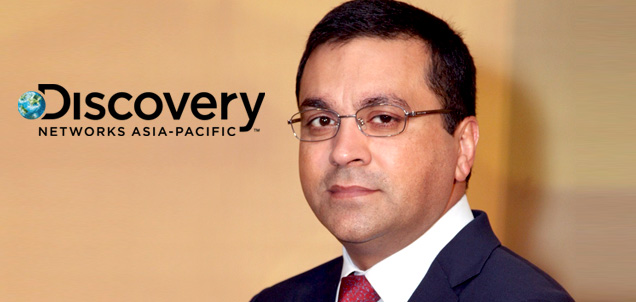
    Rahul Johri, Senior Vice President and General Manager,South Asia at Discovery Networks Asia-Pacific was recently named ‘Media Professional of the Year’ award at the Global Awards for Brand Excellence 2012. He has been associated with the Discovery network since 2001. Over the years, the Indian broadcast industry has seen lots of changes: from a two-channel to too many channels on the airwaves. “Hopefully, digitization will sort this. Well, at the same time, because the viewers are far more exposed, it is an opportunity to bring in a lot more channels, specialised channels and content,” articulates Mr Johri.


    He insists that robust distribution becomes the key in Indian broadcast space, adding: “A lot of channels understand the importance of affiliate revenue, which drives more mature content. If you look at our television landscape, we have channels that are very sensational in nature. Even if not many channels, a good number of channels are. The number of sensational channel exceeds the number of non-sensational ones. That is because if you are free-to-air channel, you are chasing only eyeballs and then you are bound to be sensational. If you are a pay channel, you expect viewer to actually pay for the content, more so in a digital environment where you will pay for what you wish to watch.” He is also hopeful that digitization will see a balance being achieved between the sensational and non-sensational channels, even though the later will not stop beaming completely.


    Mantra for success: Stay Contemporary

    Mr Johri says that staying contemporary and relevant to younger audience has helped channels like his to grow steadily. “Our viewership numbers have grown steadily over the years and it is clear testimony to the fact that this is a young country and 65% of audience is under 30 years of age who are interested in mature content. If you continue to give same fare to three generations, someone will walk out of the room,” he said.


    And contemporary is definitely the buzzword with the channel itself. The branding of Discovery was recently seen in the Yash Raj Film – Jab Tak Hai Jaan where the female lead Akira plays a documentary-maker from the channel. “The way I look it, it is the first from any broadcaster or any marketer that it is a perfect interplay between fact and fiction where Discovery Channel is fact and the movie is fictional. Discovery is seamlessly a part of the script. It is much more than a plain branding. The branding opportunities like this does not present itself everyday – it is like the perfect storm where everything comes together,” observed Mr Johri.


    The fact that in 2001, Discovery was seen mainly as educational channel pushed the broadcaster towards a lot of marketing and promotional activities. “Today, we are not a one-channel service, and hence, our job is more complex. For instance, we have programming from 10 channels in theUS, international channels, we have programming that we are producing. So all that progamming is being sorted here and then sent to various channels that we have here. There was a time when same streams were there but you had to put it only on one. So you choose whatever you thought was right. Today, the job is more complex to identify what goes in TLC or there is a gap here, or it needs to be edited. No doubt that the number of variables has increased manifolds,” says Mr Johri.


    The way forward

    Mr Johri is optimistic of the growth of the Indian media industry even though he thinks that we have a long way to go. He said, “Industry will continue to grow. We have a long way to go. Even though we might think we are a big industry, by global standards, we are not one of the biggest industry or market. There is tremendous opportunity in Indian marketplace. Broadcast companies need to grow over next few years.”


    He also believes that there is no reason that advertising revenues and subscription revenues for a broadcaster will not equal themselves in the time to come. “All over the world, subscription revenues are higher than advertising and I foresee the same trend here,” Mr Johri says


    He, however cautions, “Digitization playing out all over the country is going to be huge task. Once Digitization is completed, then the need for quality and diverse entertainment will grow. Five years from now, if you are in the perfect digital world with 1000 channels, these channels are going to be content guzzlers. While on one side, it will spell tremendous amount of opportunity to content creators and production houses etc, but at the same time how much quality will one be able to maintain? The critical balance between quality and quantity will be a challenge.” He thinks, however, industry bodies such as IBF will help channel the industry growth.


    For the record, Mr Johri is also a Board Member and Treasurer of Indian Broadcasting Foundation (IBF). He is also a member of the media and entertainment committee of Confederation of Indian Industries (CII) and member of the Media & Entertainment Division of Federation of Indian Chambers of Commerce and Industry (FICCI).


  • Paritosh Joshi: Everything I had to know, I heard it on my radio

    By Paritosh Joshi


    Three times this last week, radio has crept into my conversations, with three quite different people. Let me cite just one. We were talking about our preferences between playing music from our CD collection and dialing up a radio station. My guest was enthusiastic in his approbation for the radio, for a very simple reason too. “When you play music from your collection, you always know what’s coming up next,” he said, adding: “and what makes radio fun is it’s an endlessly unfolding sequence of surprises.”


    To which I would add that there is something rather relaxing about leaving the hard work of choosing what plays next to someone else, indeed someone else who is specialized in the art and craft of assembling and running through playlists.


    Got me thinking about radio, so it was the obvious next step to check out what the industry association offered up. Wasn’t hard to locate the website of the Association of Radio Operators for India (AROI). Promptly went there to discover – well, not a lot. Had to get something on the industry and thankfully, the good people at KPMG and FICCI had the latest “Indian Media & Entertainment Industry Report” available for download, which I swiftly proceeded to do. Here’s what I found.


    The Radio industry in 2012 is worth a mere Rs13 billion, ~ US $ 240 million and represents a mere 1.6 per cent of the overall industry of Rs 823 billion, ~ US $ 15 billion.


    In five years, it is projected to grow to Rs 29 billion, still just ~ US 540 million but representing a slightly more respectable 2 per cent of the overall pie. Evidently, this will require it to grow faster than the overall pace, which it is projected to do, clipping along at a 21 per cent CAGR even as the overall number doesn’t quite get to a 15 per cent CAGR.


    Dig deeper and you will find that a lot of the enthusiasm stems from FM Radio Phase III which will introduce private FM to as many as 227 new towns. So that is all it takes to make radio exciting, is it?


    Let’s take a look elsewhere and find out what radio is really about. A good place to start is any of these: Last.fm, “tunein.com” Radio or “shoutcast.com” Radio Directory. All of them are aggregators, like the portals of yore in some ways, which offer you an endless variety of radio stations from across the planet. An important aspect of what is on offer is the range of ‘genres’ by which the stations are classified. Here’s a list of the genres under the broad category, ‘Music’ on TuneIn:


    Adult Contemporary Country Hip Hop Rock Top 40-Pop
    Blues Decades Jazz Soul World
    Classical Easy Listening Oldies Spanish
    College Electronic-Dance Religious Specialty


    Just in case you might think this was a bewildering choice, I have news for you. ‘Sports’ offers a choice of 21 genres, including, trust me, ‘Fantasy League’.


    The point I’m making is quite simple really. Radio is all about precise choices and tightly defined audiences. Stations have an unapologetic and uncompromising commitment to their audiences and are only able to attract them because they stick to playlists that reflect the choices of their highly differentiated audience.


    What does the picture look like inIndia? Our earliest templates from what radio stations must sound like came from Akashvani, the one channel that catered to our teeming millions long before the brash youngsters arrived on the scene with FM Phase I.


    Akashvani was the ‘one size fits all’ / ‘any colour so long as it is black” radio station. From programming in two, even three, languages to carrying everything from mythologicals through adventure serials (anyone remember Inspector Eagle here?), to the News and various topical features, radio did everything – catered, as it were, to the lowest common denominator.


    Look at where we are now. Barring one station that chooses to play a purely Western playlist, all our major metros run a whole bunch of stations whose content is largely interchangeable, mainly because their music and even anchoring style – chatty, hip youngsters doing their clever, irreverent thing, are right out of a cookie cutter.


    Now before I get flamed out by radio folks pointing to the compulsions of recouping sizable licence costs, I must beg forgiveness and hide behind the defence of ignorance. What I do know, however, is this cannot possibly be the best way for radio to go forward.


    Radio must target tightly and then programme obsessively to that chosen audience. “Let me be just like everyone else” is not good marketing in any category, least of all radio. Keep in mind that radio will shift away from airwave frequencies to the Internet. That’s when the same-same (known, I believe, as Adult Contemporary) content will die anyway.


    I began by invoking Queen’s Radio Gaga and can’t help but quoting again from the same, wonderful song at the end.


    “You’ve yet to have your finest hour Radio – radio”


    Paritosh Joshi was until recently CEO, Star CJ. He has been a marketer, a mediaperson and a key officebearer on industry bodies. He is Strategic Advisor, Ormax Media. He can reached via his Twitter handle @paritoshZero