Tag: Covid-19

  • Havas Creative joins Lionsgate to raise funds Covid-19

    By A Correspondent


    Global content studio Lionsgate India has launched an initiative to bring the community experience of watching movies in movie theatres to live streaming, in partnership with Facebook India. Havas Creative Mumbai will be executing the India communication with local flavour further enhanced by celebrity collaborations.


    Said Rohit Jain, Managing Director of Lionsgate South Asia: “In these unprecedented times, Lionsgate has launched this global initiative to support families of millions of people who have been impacted by COVID-19. For this initiative in India, we have partnered with Facebook to create a fundraiser, the proceeds for the same will be contributed to reputed NGOs helping fight this pandemic. This will be a unique opportunity for viewers to extend their support and donate for this charitable cause. Moreover, we are delighted to rope in Ananya Pandey for this cause who will support us to spread awareness on this property.”


    Added Arindam Sengupta, Managing Partner – West & South, Havas Mumbai: “We are honoured to collaborate with Lionsgate to extend their global initiative in India for such a noble cause. In such unprecedented times, we all should do our bit, and LionsgateLIVE is a one such opportunity for Havas.’’


  • Big Bazaar’s Ramzan campaign speaks about the power in prayer

    By A Correspondent


    https://www.facebook.com/BigBazaar/videos/2470490566598043/


    Believing in the power of prayer, Big Bazaar has released a heart touching campaign called, ‘Ibaadat Bhi, Hifaazat Bhi’ (prayers with safety) for Ramzan. The campaign is conceptualised by DDB Mudra and is in line with the brand’s larger initiative of helping every Indian stay safe and protected.


    Created, recorded, edited and scripted all by working from home; the campaign has been successful in making an instant connect with its customers across the country.


    Speaking about the film, Pawan Sarda, Group Chief Marketing Officer, Future Retail said: “The concept shared by our agency DDB Mudra was so unique that we were absolutely sure we wanted to make this film, despite the lockdown constraints. We decided to shoot it with phone cameras. For us the intent was more important than the production value. The agency shot this film with zero budget.”


  • Opportunity Knocks for Sports in India


    By A Correspondent


    Vinit Karnik

    GroupM’s ESP Properties released its ‘Business of Indian Sports Playbook’ in the backdrop of Covid-19. The playbook is a guide for multiple stakeholders like broadcasters, fans, sponsors, right holders, and the government, who play a vital part in the sporting ecosystem.


    It notes that the sports sponsorship industry in India has been growing at a CAGR of 12.8 per cent over the last 10 years, with the overall sports sponsorship market in India crossing the mark of Rs 9,000 crore for the first time, highlighted the GroupM ESP report on the business of Indian Sports in the wake of the crisis.


    Further, it states that mobile gaming will be the biggest gainer in the post Covid-19 era, with 20 per cent increase in the monthly active users during the lockdown in India, with daily average session going up to 45 minutes and frequency of these sessions increasing to 5-7 per day.


    The report also states that the situation is an opportunity for sports in India. India is a sporting nation in the making with the sector showing strong growth in the last 6-7 years. At a world level, everything is a standstill. It therefore needs to focus on athletes and performance of sports and have a strong vision for 2024 and 2028 Olympics. Keeping the fans engaged is an important KPI for a rightsholder and  broadcaster.


    Government partnerships in the sports realm are the need of the hour, it states. Government and sponsors have worked together as Public-Private-Partnerships.


    Talent needs to make full use of the lockdown to enhance relationships with fans via social media. Live talent interaction on social media has caught the eyes of a large fanbase since the fans need to see some action happening between the talent instead of no-action. Gaming & virtual sports should definitely be in the consideration set for active fan engagement, it noted.


    Here’s the executive summary:


    Business of Indian Sports COVID-19 Outlook Context – Sports sponsorship industry in India has been growing at a healthy CAGR of 12.8% over the last 10 years, with overall Sports Sponsorship market in India crossing the mark of INR 9,000 Crore for the first time

    1. 2020 was a year of Tokyo Olympics, T20 World Cup, Euro 2020 along with major tournaments like Vivo IPL. With most of the sports tournament either cancelled or indefinitely postponed, YOY growth / estimation for year 2020 pre COVID-19 will not hold true.


    – While there are many speculations around Sports to be conducted for TV audience only with no fans or limited fans in the stadium, anything is a possibility at this point in time. But from an audience appetite standpoint, fans are hungry and waiting for live sports.


    – Sports is a universal language that connects people regardless of their origin, background, religious beliefs, economic position. Sports brings us together. Once the dust around COVID-19 settles down, sports will play a pivotal role in helping fans deal with the emotional stress, post-pandemic trauma and give people at large reasons to look forward to.


    – This situation is also an opportunity for sports in India. India is a sporting nation in the making with the sector showing strong growth in the last 6-7 years. At a world level, everything is a stand still. We need to focus on our athletes and performance of sports and have a strong vision for 2024 and 2028 Olympics.


    – Mobile gaming will be the biggest gainers in the post COVID-19 era. We’ve already seen 20% increase in the monthly active users during the lockdown in India, with daily average session going up from 30 min. to 45 min. and frequency of these sessions increasing to 5-7 per day as against 3 sessions per day during pre COVID-19. Internationally, we’ve also witnessed rightsholders toying with gaming and virtual sports as a concept to keep athletes and fans engaged in the lockdown times (for example: UAE Tour launching cycling event namely ‘UAE Tour Mubadala Ramadan Virtual Challenge’ on virtual cycling platform Zwift). We see more of these pushing the envelope of virtual and real-world merger.


    – In a parallel world, esports has been trying to emulate traditional sports for some time now to reach a larger and more mainstream audience. It had already become a billion-dollar industry pre-COVID pandemic with tournaments witnessing arenas filled with screaming fans and sponsors increasingly injecting monies in the ecosystem globally. With the lockdown in place and millions forced to stay at home; esports has shifted to online format filling up the void for many of the LIVE sports’ hungry fans worldwide.


    Further breaking the playbook down, here are the key takeaways:


    I. The post COVID-19 time is expected to define “new normalcy” which in turn will have a telling effect on all aspects of business including sports


    II. Keeping the fans engaged is an important KPI for a rightsholder & broadcaster. The lockdown times could be a perfect opportunity for both to make heroes off their fans


    III. Broadcasters should toy around with various non-live sport-ainment formats as the fan acceptability quotient is high right now. Innovative content formats need to be thought of between the talent and broadcaster to make the most out of a fan’s interest in some sporting action.


    IV. Government partnerships in sports realm is the need of the hour. Government & sponsors have worked together beautifully as Public-Private-Partnerships. Post COVID-19 time will call for many such initiatives


    V. Talent needs to make full use of the lockdown to enhance relationships with fans via social media. Live talent interaction on social media has caught the eyes of a large fanbase since the fans need to see some action happening between the talent instead of no-action. Gaming and virtual sports should definitely be in the consideration set for active fan engagement during current times taking a cue from how cricket world cup winner Ben Stokes engaged with his fans through F1 esports Vietnam Grand Prix.


  • SMBs: Transforming Businesses, Transforming Advertising


    By Brian Wieser


    We review key trends related to small and medium-sized businesses (SMBs) during the pandemic. The shifts these marketers are taking to survive now and, ultimately, thrive in the future are a window into the business transformations larger businesses will also take, if they haven’t done so already.


    Small businesses have been hit hard during the pandemic.

    It has often been said that small businesses are the lifeblood of an economy. While the reality is that small businesses have generally been losing share of economic activity to larger ones over time, they retain a significant amount of importance. In the United States, small businesses – defined here as companies with fewer than 500 employees – account for approximately 40% of total payrolls and 47% of total employment, according to our analysis of U.S. Census Bureau data.

    With the pandemic disproportionately hurting small business because of their relative lack of capital, policies designed to help ensure they are positioned to quickly recover are particularly critical in preventing long-term disruption to the economy. In the United States and countries around the world, hundreds of billions of dollars of loans have been authorized specifically to address this issue. Whether or not policies will be successfully administered or sufficient in scale remains an open question.


    Companies with less than $50 million in revenue average $10k in ad spending, account for greater than 20% of total ad spend and a greater share of digital and print.

    How small businesses fare is not only important for the general economy; it is important for the health of the advertising industry and marketers as well.  According to our analysis of 2014 data from the IRS in the United States, the most recent year data was available, companies with less than $5 million in annual revenue—and average spending on advertising amounting to $5,000 annually—accounted for 10% of total ad spending. Companies with less than $50 million in revenue, where average ad spend was $10,000 on average accounted for 21% of economy-wide ad spending. Our guess is that that share likely rose in subsequent years.

    Most importantly, these companies accounted for substantially higher shares of spending on print and digital media given the relatively low price points at which advertising can be purchased in most instances. Their presence matters to larger advertisers because the capacity of many of their media channels to thrive is at least in part also dependent upon the health of smaller businesses.


    The ongoing economic driven downturn appeared ready to pulverize the media owners that small businesses depend on, but their spending may not have declined by as much as we might have expected. 

    However, something somewhat unexpected happened during April: they evidently did not cut their spending by as much as we might have expected. Data provided during Facebook’s recent earnings results indicating “approximately flat” trends during the first three weeks of April represented an approximate reduction of around -20% to -25% from the pace of growth observed during the first couple of months of the year. Spending trends were similar between large and small advertisers alike.

    By contrast, other digital media owners whose revenue bases are more heavily skewed away from small businesses, appear to have experienced more significant rates of deceleration or decline.  While depth and breadth of data and targeting capabilities undoubtedly helps to capture a large share of performance-advertising budgets from marketers of all types sizes, it is hard to ignore that Facebook is a primary seller of media for many small businesses (along with Google, which also saw a similar pace of deceleration during March at least).  To the extent that small businesses make up a larger share of Facebook’s revenues than other digital media owners, we have at least one indication that small business have been disproportionately resilient as advertisers during the pandemic, at least on digital media.


    The expansion of e-commerce activities by small businesses reflected in Shopify data probably helps to explain this trend.   

    E-commerce has plainly expanded at an accelerating clip around the world. For example, Amazon’s online stores saw growth of +25% during the first quarter, ahead of the fourth quarter’s +15% pace. Comments from most of the world’s largest marketers have generally reinforced this view in comments on their own e-commerce sales. Was it also true that the same trends occurred for small businesses?

    Anecdotally, most people can probably describe a favorite local store that closed but who made their products available for sale online in some form. And, as it turns out, data from Shopify – whose customer base is heavily skewed toward small businesses – supports this notion. While smaller than Amazon – whose total global GMV (including its own sales and marketplace sales) was well above $300 billion last year – Shopify’s base of GMV last year of $61 billion is primarily small businesses.

    During the first quarter of 2020, Shopify GMV accelerated to grow by +46%. While GMV through point-of-sale channels using Shopify declined by -71% between March 13 and April 24 relative to the comparable six-week period immediately prior, retail merchants managed to replace 94% of lost point-of-sale GMV with online sales over the same period. A range of other notable statistics provided by the company provide additional snapshots of the transition in commercial activity during the six weeks following the middle of March, illustrating some of the changes in the economy since that time, including:

    • New stores created on the Shopify platform grew 62% between March 13, 2020 and April 24, 2020 compared to the prior six weeks.

    • The number of consumers estimated to have made a purchase for the first time from any Shopify merchant grew 8% between March 13, 2020 and April 24, 2020, compared to the six-week period immediately prior.

    • Over the same period, the number of consumers estimated to have purchased from Shopify merchants they’d never shopped at before grew by 45% compared to the six-week period immediately prior.


    Small businesses finding ways to survive via e-commerce will change their media skew and illustrate business transformation at a small scale.

    Our takeaway from all of these data points and observations is that small businesses are generally going to get hurt much harder than others during the current environment, and larger businesses will probably take shares in every given sector. At the same time, though, smaller businesses that have been able to find ways to adapt to a digital-first orientation by virtue of necessity are positioning themselves to thrive for the economic recovery that will eventually follow.

    And while many of the familiar commercial activities that took place before this year will return as if a pandemic never occurred, it seems hard to image we won’t see a permanent shift for others. The coffee roaster who newly discovered shipping beans in bulk to consumers directly, or the yarn store that found the benefits of a strong online presence outweigh the costs of maintaining a retail environment may very well continue doing so well after social restrictions have been eliminated. These simple illustrations of “business transformation” will inevitably lead to an increased emphasis on digital marketing to support the e-commerce activity that will drive growth in small business sales.


    Implications follow from these takeaways for marketers and media owners alike.

    Marketers who depend even in part on small businesses for distribution of products will need to increasingly adapt their own commercial activities to reflect this shift of orientation. Similarly, media owners who historically depended on small businesses will also need to evolve to reflect the evolving needs of the marketers they work with as well. Otherwise they will lose a more significant share of revenue than they already have.

    Small businesses are not likely to be the lifeblood of the economy in the near-term, but the bigger picture transformations the most successful ones will go through are illustrations of changes that large brands will be well-served to emulate, if they haven’t already done so themselves. The implications that follow for the media owners that large brands generally work with are far from clear, in part because larger media owners still have time to adapt their own offerings to anticipate changes that will become more pronounced for their customer base over time.


    Brian Wieser is Global President, Business Intelligence, GroupM. Republished from https://www.groupm.com/smbs-transforming-businesses-transforming-advertising/


  • MTV salutes Covid-19 warriors with #RahoMusicallyPositive

    By A Correspondent


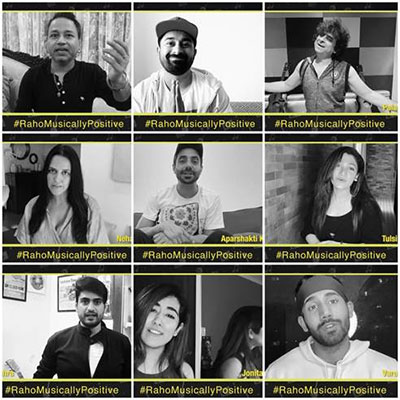
    MTV and MTV Beats has extended a tribute to all doctors, nurses, police, medical staff and frontline workers with a special video campaign – #RahoMusicallyPositive. Viacom18 has joined hands with non-profit organisation Goonj to support individuals, families and communities across India that are financially impacted by Covid-19, including daily wage workers.


    Speaking about the campaign, Ferzad Palia, Head- Voot Select, Youth, Music and English Entertainment, Viacom18 said: “Music has the power to bring people together and instil a feeling of positivity and happiness. With this thought in mind, MTV and MTV Beats partnered with some of the most talented musicians and Bollywood actors to create the #RahoMusicallyPositive song to boost the morale of our frontline workers who are fighting the pandemic on ground as well as each one of our viewers who are battling it by staying at home.”


  • Lessons & Guide for Marketing given Covid-19


    By A Correspondent

    The Covid-19 pandemic has caused shockwaves across the globe with major economies falling into a recession like no other in recent history.

    As the advertising industry considers how to proceed, WARC, the global authority on marketing effectiveness, has released a comprehensive, evidenced-based report: The WARC Guide to Marketing in the COVID-19 Recession.

    The guide includes learnings from past recessions, how the COVID-19 recession is different, lessons from China, key actions that brands can take now, and growth opportunities beyond the lockdown.

    Said David Tiltman, VP Content, WARC: “A global recession is now highly likely, and the shape of the recovery is difficult to predict and will vary by sector. With many brands unable to distribute products and services, the usual advice to “keep advertising” may not apply in all cases, and marketers need to take a nuanced approach based on their brand’s situation.”

    Added Lena Roland, Managing Editor, WARC Knowledge: “This WARC Guide to Marketing in a Recession pulls together the best thinking from across the industry on navigating the post-lockdown period. It presents advertisers, agencies and media owners with relevant frameworks, actionable ideas, and offers examples of how major marketers are already putting plans into practice.”

    The five chapters covered in the WARC Guide to Marketing in the COVID-19 Recession are:

    The playbook for ‘normal’ recessions

    A large body of research studies suggest that significantly reducing adspend in a recession has negative long-term impact on brands in terms of sales, market share, growth and return on investment. Companies that maintained investment recovered more quickly.

    WARC has identified five marketing lessons from previous recessions:

    (1) In a recession, media costs decline. (2) Defend your share of voice – cutting ad spend risks damaging market share. (3) Investing in adspend brings long-term advantage. (4) Decline in share can be hard to reverse. (5) “Going dark” beyond six months can weaken brands.


    Recession 2020: What we know so far

    The COVID-19 recession is the first pandemic-driven downturn of the modern era. It is a healthcare crisis, leading to a severe economic slump. That also makes the shape of the recovery hard to predict, as consequences of the lockdown become apparent and there is risk of further outbreaks.

    Sir Martin Sorrell predicts a “reverse square root” recession – a sharp downturn, a partial bounceback then a plateau.

    Cuts in media spend have been immediate and sharp. According to the latest Advertising Association/WARC Expenditure Report, the COVID-19 outbreak will wipe more than £4bn from the total UK ad spend for the current year, across all channels.

    The 2020 downturn is set to be a demand and supply-side shock, caused first by lockdown and then by critical value chain components breaking down, particularly in China, leading to disruption in product and service delivery.

    In a recent interview with WARC, Sir Martin Sorrell, Executive Chairman, S4 Capital, said: “You can’t say to a client spend your way through this. If you don’t have distribution, what’s the point?”

    In a recent GlobalWebindex survey across 17 markets, 83% of consumers say they have delayed a purchase. But the impact of recession varies by brand and category.

    In a new paper, exclusive for WARC, Les Binet, Group Head of Effectiveness, adam&eveDDB, said: “Different businesses face very different problems, and those problems will change as the crisis proceeds. There is no one-size-fits-all solution. Your strategy should be tailored to your business, and it should evolve as your crisis unfolds.”

    Recession 2020: Actions to take now

    As lockdown measures are lifted and the recession takes hold, WARC offers key actions to help brands rebound. They vary depending on a company’s resources, and if operating in a boom or bust category. Brands should:

    (1) Review their lockdown playbook. (2) Keep advertising if they can. (3) If a brand has to reduce adspend, use other levers to remain visible. (4) Maintain creative where possible. (5) Tailor the approach to brand-building and activation. (6) Kill or cut back on ‘dwarf’ brands. (7) Look for signs of new habit formation. (8) Audit e-commerce capability. (9) Build strategic alliances. (10) Review pricing but try to avoid discounting.

    Early lessons from China

    As lockdown is lifted, Chinese consumers remain cautious and media habits are changing again, meaning marketers should retain a degree of flexibility in their media plans.

    According to Publicis Groupe China, online video, social, and news content will be key during normalization. For outdoor ads, the rebound will be primarily in commuting routes, residential areas, and elevator areas.

    Brands are also starting to reconfigure digital initiatives around e-commerce. For example, Friso China registered new customers into its CRM program through e-commerce incentives (discount coupons).

    Restoring consumer confidence is proving a key challenge in China – and many brands are finding that packaging innovations can help resolve this. Meituan, an online-to-offline service launched contactless shields that protect customers from infection when eating.

    The travel sector, one of the hardest hit by the first wave of the pandemic, should prioritise domestic demand based on the experience in China and North Asia.

    The crisis has broadened the role of the big online platforms, such as Chinese retail giant JD; and China’s wide-ranging apps and digital services, which played an important role in the lockdown, are now doing so in the normalisation period, but data privacy is increasingly a concern.

    Opportunities for future growth

    While the return will be gradual and tentative, and the playbook will vary by region and sector, downturns are an opportunity to initiate and accelerate change. WARC highlights opportunities to help brands on the road to recovery:

    1) Supporting small and local businesses is a powerful strategy: SMEs will be among the hardest hit. Consumers may support initiatives that help rebuild local business and communities.


    2) Finance brands can go beyond communications to support hard-hit consumers: According to Google, online searches for “financial help” recently grew 203% in just one week, as unemployment jumps.

    3) Consumer goods brands can play with pack size to meet consumer needs: For brands seeking to defend market share from private-label, adding value through formats, innovation or value-on pack is going to be critical.

    4) Develop a ‘close-to-home’ strategy: People will be eager to leave their homes, but the potential of a further outbreak – combined with economic hardship – means many will prepare their homes as a safe place of sanctuary and safety. Trend forecasting company WGSN (WARC’s sister brand) predicts home health and hygiene will be a key investment category.

    5) Close-to-home means food stockpiling habits may persist: Conagra, the CPG company, says increased trial of frozen food during the lockdown offers a long-term opportunity for the category. Food companies may benefit from range extension and new product development in frozen and long-life products.

    6) The ‘health economy’ will create new opportunities: The pandemic may be the catalyst for radical and lasting transformation of how health and wellness is experienced and delivered. Brands in categories outside health and wellness may be affected too, and should review opportunities to form partnerships that can reassure or help health-focused consumers.

    7) COVID-19 is accelerating the need for digital transformation: Many of the trends caused or accelerated by the COVID-19 require the rewiring of companies around data and digital services. At a time of significant consumer change, there is an opportunity for CMOs to play a leading role in interpreting those changes and acting as ‘superconnectors’ between internal functions.


    Added Jodi Harris, Global VP for Marketing, Culture and Capabilities, Anheuser-Busch InBev: “Marketing is swiftly moving beyond branding and communications to providing business solutions that address people’s needs… We’re taking on a new leadership role, connecting multiple disciplines within the organization to accelerate programs that make a difference in our communities and people’s lives.”



  • SBI Life’s #MummyKahanHain salutes mothers

    By A Correspondent


    SBI Life’s Mother’s Day film focused on mothers serving communities in face of the pandemic. Conceptualised by SBI Life and executed by WatConsult, the film featured four frontline mother protagonists namely Minal Dakhave Bhosale (Virologist), Neelam Ingale (Pilot), Shanmuga Priya T (Banker) and Shalini (Doctor). Encapsulating the rigorous routine that these ‘frontline warriors’ go through every day, by presenting a slice of life of these four strong mothers who continue to make India proud with their fortitude, persistently working behind the scenes to help the ones in distress amid the pandemic.


    Said Ravindra Sharma, Chief of Brand & Corporate Communications, SBI Life Insurance: “There is nothing as powerful as mothers love, the exemplary courage displayed by mothers working in essential services on the frontlines of this battle against Covid-19 is praiseworthy. We recognise the need to acknowledge the honorable roles played by mothers and the impact they have in our lives and on the world.  #MummyKahanHain is our humble heartfelt tribute to all the mothers who are untiringly working towards protecting the distressed, while risking their own lives and staying away from loved ones. We hope that the real life real stories of our frontline warriors will inspire the larger communities to recognize the silent sacrifices done by mothers and generate for them the much deserved appreciation from all sections of the society.”


    Added Heeru Dingra, CEO, WatConsult: “On the occasion of Mother’s Day, we wanted to salute and thank the mothers who are at the forefront, compassionately standing for the entire nation, in this battle to fight against Covid-19. Serving in the best of their capacities as doctors, police, pilots or more, they are selflessly and relentlessly working day and night to fight the ravages of this pandemic. Though the digital video showcases stories of just a few of these heroes, but this step is in reverence to each one of them out there struggling to combat the global crisis, setting another brave example.”


  • Star India join hands with Project Mumbai

    By A Correspondent


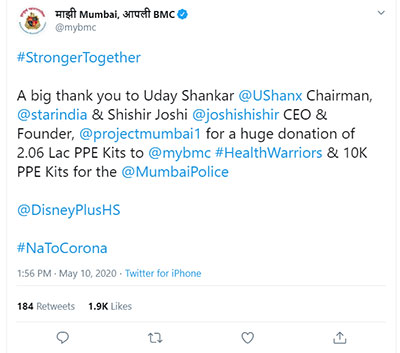
    In an effort to support the Covid-19 outbreak response, Star India and Disney+ Hotstar have partnered with the former journalist Shishir Joshi-spearheaded Project Mumbai to provide over 200,000 Personal Protection Equipment (PPE) kits to health workers at BMC and an additional 10,000 khakhi-coloured kits for the Mumbai Police.

     

    Notes a communique: “Mumbai being the most hit by the pandemic, the support will aid the ongoing efforts in meeting the demand for PPE kits for almost four weeks. Showcasing solidarity with the numerous medical, health, and protection warriors, the initiative seeks to equip the selfless people who are at the front line battling the Covid-19 pandemic.”


  • The Internet Gets Mainstream, Finally


    By Indrani Sen


    On May 8, 2020, the Media Research Users Council India (MRUC) released its findings of the last and final quarter of Indian Readership Survey 2019. Fieldwork of IRS 2019Q4 covered the period from December 2019 through March 2020 and the report has data based on a rolling average of four quarters of IRS 2019 data i.e. Q1+Q2+Q3 and Q4 2019.


     

    The highlights of the readership trends among English and vernacular titles have already been reported and analysed by different industry websites. The highlights of the survey- presented jointly by Nielsen and MRUC – has noted that: “Newspaper readership, is on a slow decline and is a trend seen across Hindi, English and Regional languages”. Vikram Sakhuja, IRS Technical Committee Chairman and Group CEO Madison Media & OOH, Madison World has noted in the press release: “(The) ability to read and understand English has increased and while overall print readership is holding, daily readership has started showing signs of decline.”


    According to the highlights of the report, a “rapidly evolving media landscape with multi-media adoption is seen across consumer strata resulting in large media markets, both traditional and digital with substantial increase in Internet penetration lifting it to mainstream along with TV and Print.” Moreover, the report has acknowledged “There was more number of internet users (Last 1 month) in rural now then urban.”


    Source: IRS2019Q4


    If we consider that the fieldwork for March 2020 ended before the National Lockdown due to Covid-19 was imposed on March 25, 2020, we can easily guess a further surge of internet users has happened across urban and rural India in the last seven weeks. Unfortunately, as the IRS fieldwork also is on hold now, we will have to wait for sometime before we get a clear indication of the media usage during the total and subsequently partial Lockdown enforced by Covid-19.


    IRS2019Q4 highlights have also given us a glimpse of how Indian consumers today are more equipped and more connected than before as shown in the following chart. There would not be significant change in the connectivity except during the lockdown both ‘shop from modern trade’ and ‘online shopping’ may go down and ‘access social media’ may go up substantially.


    Source: IRS2019Q4


    This calls for a total change in the approach of media planning where TV and Digital would have to be planned simultaneously now supplemented by Print, Radio and OOH plans. It would also be beneficial to plan for TV and Digital under the same roof by the same media agency than to distribute the business by traditional media and digital media to two different media agencies.


    Unfortunately, we still do not have single source data for TV and Digital media users which is essential for preparing cutting edge media plans. BARC’s plan for providing such data have been shelved indefinitely reportedly due to non-cooperation by Google and Facebook and instead of finding a solution to that problem, TRAI has now created other problems for the ongoing research on TV viewership with their new directives about TV viewership research. So, as internet continue to surge ahead as a mainstream media, media agencies will keep struggling with data and insights for doing justice to their media plans.


  • The Content Crisis That Awaits Us


    By Shailesh Kapoor


    One blurry week after another, the wait for restoration of normalcy continues. Even as some sections of the economy open up in parts of India and the world, the wait for return to old routine, if there can be anything like that all in these times of Covid-19, is going to be a long one.

     

    Different sections of the media and entertainment industry have been impacted to different degrees. Television has seen viewership boost and redistribution of viewership share across genres and channels. But the advertising moneys are drying up, and for a business that relies on that as its primary revenue source, the next few months can be really tough. Theatres are closed and will be the last thing to open. The film business is hence at a virtual standstill. OTT has emerged strong in this period, with most platforms registering record new subscriptions and time-spent numbers.


    But there’s a bigger crisis that awaits us. That of content availability. Television ran out of original content in early April itself. Most OTT platforms have launched the originals they had completed shooting before the lockdown. A handful of films are ready for release, but many others are in various stages of production. Hence, as we limp back to normalcy, the big question that will begin to bother all three sectors is: When can we start shooting?


    The answer to this question is not a pleasant one. Shoots are inherently chaotic, and even more so in India. Social distancing while visiting a mall or even a theatre can still be ensured, but how do you ensure it on the sets of a film or a show using an elaborate crew to manage a multi-camera set-up? There is close physical contact involved, between actors in a scene, and between actors and their staff, especially those handling hair, makeup and styling. There are a lot of workers involved, and there is equipment and more equipment. Let it be said in no uncertain terms: You cannot socially distance on a set, especially in India, beyond a point.


    Producers have, of course, started thinking of measures they will need to put in place. But at whichever stage shooting restarts, being on a set will still involve its share of risk. While the South film industries may be less impacted (Kerala has already put out some guidelines related to start of shoots), but Mumbai and Delhi NCR, from where a large part of Hindi content is shot, are going to take a while to reach any level of feasibility to start shooting.


    Then there is the additional complexity of travel. Everything is not shot in a studio. How do you shoot abroad? How do you shoot in a small town, for which you have to make an extensive crew travel? How do you get actors residing in other parts of the country to Mumbai, even if you are shooting at the Film City here?


    Halting of production will create a deep-end content availability crisis that could last months. Can OTT survive only on library content? Netflix and Prime Video perhaps can, but what about the newer platforms, and those that get a large share of their daily users from catch-up television? What will GECs show for another three-four months, before they can start shooting? How much can one sustain on nostalgia and how many versions of Ramayan and Mahabharat can you run how many times? I’m surprised more shoot-from-home formats are not out on television already.


    Films is a peculiar case of its own. Theatres may reopen at some stage with social distancing measures, and some of the films that are ready will eventually be released too. But that can take care of only two-three months. If producers cannot shoot much, we will soon have no content available, leaving theatres open but empty.


    We are in for a long haul. And the content availability crisis is in for an even longer one.

  • Magazine association seeks govt intervention

    By A Correspondent


    The Association of Indian Magazines (AIM) consisting of major magazine players across multiple regions and languages has reached out to the Government of India requesting for a bailout package due to Covid-19 or risk closure of business for most of them.


    The association has written to Finance Minister Nirmala Sitharaman, the text of which is as follows:


    Smt. Nirmala Sitharaman

    Honourable Minister of Finance

    Government of India New Delhi


    Respected Smt. Nirmala Sitharaman ji,


    Reg: Request for urgent relief to Magazine Publishers and save the Sector from extinction


    Greetings from Association of Indian Magazines (AIM)!


    At the outset, we would like to thank you for reducing the Customs Duty on newsprint, from 10% to 5%, which had provided some relief to the magazine publishers.


    As you are aware, Magazines play a very important role in the society, by serving millions of readers by providing insights, analysis, chronicling trends and marketing of goods and services. Magazines are not just content but experiences. Taking into account this role played by the magazines in dissemination of knowledge, our constitution has provided many concessions to magazines and are always treated on par with Newspapers.


    The Magazine Industry has been going through hard times. The Advertising revenues have declined as advertisers face the pressure to reduce marketing spends, due to the prevailing macro-economic conditions. Coupled with this, is the rising input costs, resulting in low or no profitability for magazine publishers.


    COVID-19 and lockdown have now cast its shadow on magazine publishing and has thrown our business completely out of gear. Though classified as ‘essential services’, distribution of magazines has been severely hampered during lockdown. Most magazines are printed in one city and transported to others states through the Railways network and it is the postal and local courier services that we rely on for delivery of subscription copies. Both are currently not happening. Due to the economic impact of COVID-19, businesses have deferred their advertising spends, depriving magazines of their major revenues. This has forced magazine publishers, across country, to take drastic steps like slashing the number of pages and skipping issues. However, given the severity of the problem, these measures will not suffice and survival of magazines will be difficult unless Government steps in with a bail -out package.


    At this backdrop, kindly consider the following requests to salvage the magazine publishing sector:


    • Remove the remaining 5% Customs Duty on Newsprint. (Before the Union Budget 2019-20, there was no Customs Duty on Newsprint.)


    • Withdraw the GST on Newsprint or at least make the GST on LWC (paper used by magazines) on par with SNP/ GNP (used by newspapers) at 5%. As per PRB Act, both newspapers and magazines come under the definition of ‘Newspapers’. (Prior to the introduction of GST, LWC upto 70 gsm had no duties or taxes, whatsoever, for end users.)


    • Tax holiday for two years.


    • Allocate 10% of the BOC (DAVP) budgets to Magazines.


    • Soft loans for two years at 5% interest, with a moratorium for 6 months


    • Bring down the GST on Digital Content Writing to 5% from the existing 18%. (Content writing is our core business and to supplement income, magazine publishers have entered into Digital Content Writing)


    • Reduce GST on Events, conducted by magazine publishers, to 5%. (Our Events are extension of our Content and we have created them to engage with our readers further.)
  • 22feet Tribal Worldwide launches new data tool, Covid in Context

    By A Correspondent


    In an effort to raise awareness about the global impact of Covid-19, 22feet Tribal Worldwide, part of the DDB Mudra Group, has launched ‘Covid in Context’, a simple data tool that analyses the impact of the pandemic on a country in relation to its total population.


    The company conducted a two-day product hack sprint to find unique, data-supported means to raise awareness about the ongoing coronavirus pandemic. The initiative brought together a diverse talent pool of developers, analysts, engineers, data scientists and human behaviour specialists within the organization to arrive at solutions using technology.


    ‘Covid in Context’ uses data science fundamentals of first order vs second order data, allowing users to go beyond the absolute numbers of cases by delving deeper and slicing the data in unique ways. The data is automatically updated in tandem with WHO updates.


    Some key insights extracted from the tool:

    In absolute numbers, the worst hit country is USA, but in context to their total population, Italy, Switzerland, Belgium, Spain are more infected than USA.

    Absolute Numbers – USA (1,238,083) > Spain (250,561) > Italy (213,013) > Belgium (50,781) > Switzerland (30,009)

    Infected BPS – Spain (54.39) > Belgium (44.37) > Switzerland (35.50) > Italy (35.62) >  USA (37.92)


    Infected on Tested per cent helps us understand extent of spread. Higher the percentage, higher the community spread.


    France is one of the most affected countries with 15.50 per cent, UK follows with 14.09 per cent, US at 16.02 per cent and India at 3.87 per cent.


    Recovered per cent helps us understand which country’s people and healthcare systems are fighting the virus better


    Australia, South Korea and New Zealand are at around 87 per cent, Switzerland and Germany around 84 per cent, USA at 16.21 per cent and Sweden at 17.55 per cent.


    Preetham Venkky

    Said Preetham Venkky, President – 22feet Tribal Worldwide: “The product hack sprints are a way for our people to fight this invisible enemy. The brief was to pick a fundamental issue and what came to the fore was that information related to number of cases is used by countries and its people to make sense of the situation. The challenge that the tool aims to solve is to show varied and deeper perspectives on widely reported statistics by slicing the data in different ways. The tool can be used by media, policy makers and local communities to get an accurate and relevant perspective of the issue. I am extremely proud of our team who has built this tool rapidly and tirelessly for everyone to use.”