Tag: Covid-19

  • Publicis launches ‘Reboot To A New Normal’ report

    By A Correspondent


    The Publicis Group has released a report ‘Reboot To A New Normal’, a study on the consumption patterns, media usage, purchase behaviour and overall marketing and brand trends in India, in the face of the Covid-19 outbreak. We haven’t seen the report but a communique says it examines the impact on businesses, consumer sentiment and behaviour and the response of brands.


    Said Anupriya Acharya, CEO, Publicis Groupe, South Asia: “The impact of the COVID-19 pandemic has meant that uncertainty has become the norm for brands and businesses across sectors and geographies. Publicis Groupe, through this report, offers some of our latest insights tracing the evident change in consumer behaviour, resilience, and solidarity among brands in these times, conceivable future implications and the reboot in brand response to that.  Most certainly, only the ones who imbibe this change, and more importantly, lead it, will emerge stronger. We look forward to and promise sharing the quest for the new normal, evolving businesses and robust communities.”


    Adds the communique:

    The report marks profound shifts in the wake of the lockdown enforced by the Government of India. Many of these behavioural changes are not transient in nature; they are likely to stay long-term.  While the focus of the report remains on the Indian market, the study also draws on comparisons with other countries across US, Europe and APAC and predicts some of the outcomes ahead for brands.


    Online is clearly the new norm as companies embrace remote work and rapidly digitise operations in order to ensure business continuity. However many still struggle to operationalise work from home initiatives because of cumbersome compliance and technical requirements.


    Indian consumers today are single-mindedly focusing on essential products, sidestepping discretionary purchases such as apparel, electronics and watches.  Immunity-boosting products such as Honey and Chyawanptrash see huge surge in demand, alongside medicines, face masks and hand sanitizers.  As they brace for uncertain times ahead, consumers are panic-buying and tend to hoard supplies. Restaurants and food delivery apps have started offering contactless delivery. The demand however continues to be muted given hygiene-related concerns.


    At the start of the outbreak, ecommerce witnessed huge momentum with people instinctively turning to online channels.  The convenience, promotions and value deals on online grocery platforms has in any case always been a huge draw and the crisis accelerated demand. During this period, online retail received a short-term boost in the fresh food, personal hygiene, and food delivery categories. However the shortage in stock and inability to deliver has led to frustration among consumers and has subsequently impacted sales volumes.


    Television ratings, on the decline over the past year has now experienced an exponential jump because of coronavirus-related news. The trend is in line with other Asian markets such as China and Korea.


    In the period between March 1-21, 2020, Gaming has witnessed a 41% increase  in time spent while Entertainment & OTT have registered a 34% increase.


    Online news has become the de facto  source of information with digital editions of mainline publications seeing  huge increase in traffic.  Between March 16-22, there has been a whopping 61% increase in visits to websites and mobile apps, as compared to a month ago. Regional publications  also see huge online demand, as much as 50% increase, significantly higher than that of English publications.  Publishers may need to shift focus on to digital operations as it remains uncertain whether consumers will continue subscriptions of physical  copies. Understandably, government notifications and health-related news in connection with the outbreak are the most consumed content categories


    Brands are now agents of positive change  and are instrumental in spreading social awareness and information around Covid-19. Examples are: Viacom ‘s #PauseForACause campaign focusing on care-givers,  Bajaj Alllianz’s #DooriHaiZaroori  campaign on social-distancing,  Jeep’s  Explore The Great Indoors campaign on staying safe and indoors, and  Zee’s  #BreakTheCoronaOutbreak campaign urging viewers to wash hands and maintain hygiene.


    With content consumption set to rise, brands are creating content relevant to their consumer, in areas such as health, fitness, DIY, food, mental health  and entertainment. Brands can weather the current conditions by creating relevant content, developing an omni-channel strategy,  addressing consumer anxiety through positive messaging,  realigning brand and media strategy in line with consumer trends, using media in agile ways.



  • Tata Tea urges individuals to care for senior citizens

    By A Correspondent


    Tata Tea has announced that in the wake of the Covid-19 situation and extended lockdown period in the country, they will work towards spreading awareness and facilitating change for the cause of the elderly, who are the most vulnerable during these times, through their social initiative, Iss baar #BadonKeLiye #JaagoRe JaagoRe.


    Commenting on the initiative of Iss baar #BadonKeLiye #JaagoRe, Sushant Dash, President, Beverages– India & Middle East, Tata Consumer Products, said: “JaagoRe has always been a means to awaken people on a relevant social issue, inspire them to take action thereby make a genuine difference in society. For us, it has always been about making a real difference in people’s life and with this initiative also, that is the attempt. The initiative will involve, spreading awareness of the Social Cause viz Helping the elderly, providing relevant tips, tying up with NGOs and providing a common platform for people to connect with them, and share stories of volunteers to inspire others to take action.”


    Added Puneet Das, Vice President Marketing, Beverages – India, at Tata Consumer Products: “It is important to understand and address the medical, psychological and social needs of the elderly whose routine life is disrupted leading them most prone to confusion and helplessness. A simple action like checking on them to see if they need anything and taking steps to help them will make a big difference. Of course, all this needs to be done keeping in line with the Covid-19 guidelines, as provided by the local administration. However, it is time to give back to our elders who have protected and guided us in the right direction. Every small step or action you take to help them, can make a big difference. Hence, we appeal to all to join the movement, and be a catalyst of change with Iss Baar #BadonKeLiye #JaagoRe.”


  • SBI Life unveils emotional anthem in battle against Covid-19

    By A Correspondent


    SBI Life Insurance has unveiled an anthem titled ‘We can, we Will’ anthem that reiterates the power of collective unity and solidarity to fight the spread of Covid-19.


    The anthem has been conceptualised by Be the Bee and the video featuring 27 TV celebrities from various parts of the country was executed by Mindshare. Establishing a regional connect, the celebs can be seen singing the anthem from their respective homes in local languages like Hindi, Marathi, Telugu, Kannada, Tamil, Malayalam, Bengali, Assamese and Odia, thereby reflecting the nation’s true spirit of unity in diversity.


    Said Ravindra Sharma, Chief of Brand & Corporate Communications, SBI Life Insurance: “The Corona virus outbreak has thrown up multiple, unprecedented challenges for people from all walks of life and the entire nation is exploring solutions to tide through this crisis. In these current times of self-isolation, the ‘We Can, We Will’ anthem is our humble effort to lift the spirits of every individual and remind them that as a nation we need to stay together, as with our collective will power we will overcome the biggest of challenges.”


  • Ipsos offers tech-based alternatives for MR to offset lockdown challenges

    By A Correspondent


    Ipsos India is turning to technology-based alternatives for seamless execution of client projects in the face of Covid-19 and lockdown restrictions, which have impacted fieldwork on projects.


    Amit Adarkar

    Said Amit Adarkar, CEO, Ipsos India : “India is different from all our other global markets. 95% of our market research work involves talking to people and observing people, in person. With the lockdown and restrictions, in the wake of COVID-19, we are now turning to a wide array of contactless options for talking to people and observing people riding on technology, ” adding : “We are providing online, mobile and telephonic methods as the supplement or replacement to in-person research. These methods either partially or completely eliminate personal contact; and are faster.”


    “Whether online focus groups or interviews, mobile, video based consumer ethnography, mobile app based or online communities – the efficacy of these methodologies have been proven across at least 65 countries that Ipsos operates in. In fact, communities allow for longitudinal understanding of people’s attitudes and behaviors which is of interest for many of our clients in these turbulent times,” explained Adarkar.


  • Lifebuoy unveils series of initiatives in fight against Covid-19

    By A Correspondent


    Taking the cause of preserving health and preventing the further spread of Covid-19, Lifebuoy has launched a nationwide public awareness campaign educating people on the importance of and steps to hand sanitization, urging citizens to use any soap at their disposal.


    The campaign kicked off across print, television and digital platforms with a message that placed emphasis on the importance of handwashing while also boldly naming its competitors and urging consumers to use any soap that is available to them.


    Commenting on the public awareness campaign, Srirup Mitra, Vice President, Skin Cleansing, Hindustan Unilever said: “Until a cure is found, a simple act of handwashing, when done correctly, can effectively contribute towards reducing the spread of this deadly virus. We at HUL have ramped our production capacities to ensure that Lifebuoy hygiene products are available to consumers and continue our commitment to support the nation and its citizens in this fight against corona virus.”


  • JK Tyre encourages citizens to #StayHome

    By A Correspondent


    In line with the government’s appeal to maintain social distance to counter the spread of Covid-19, JK Tyre & Industries has introduced a social media campaign #DistanceOKPlease to educate people about the importance of staying at home.
     

    Based on the popular Truck Shayari concept, the campaign appeals to the citizens with witty popular slogans that are often seen on commercial vehicles in India. The campaign has gone live across social media platforms of JK Tyre with a focused outreach through Facebook.


    Commenting on the occasion, Srinivasu Allaphan, Director – Sales & Marketing at JK Tyre & Industries Ltd said: It is an unprecedented and highly sensitive time for all of us, which demands us to come together  online to face this problem. It is crucial for brands to take ownership and leverage existing resources to inform the public and increase visibility and influence at the community level. We are making every attempt to raise consciousness about the precautionary steps to avoid the spread of Covid-19.


  • Sri Adhikari Brothers step in to help desperate families

    By A Correspondent


    Sri Adhikari Brothers has pledged to take care of 1000 families in need per month till the Covid-19 pandemic is contained. To ensure swift action, they have associated with BAPS Swaminarayan Sanstha, which is globally known for its social services.


    Commenting on the announcement, Executive Director-Chairperson Markand Adhikari said: “We are amidst a global crisis and there is no real clarity on how soon we will see normalcy. Our country is no exception to these unforeseen circumstances. Thus in line with the appeal made by our Prime Minister, we are doing our bit. In addition to providing external help, we are ensuring that our employees who are our pillars of growth remain unaffected. No pay cuts or lay-offs will be done despite impact on the economy.”


  • Impact of Covid-19 on M&E: KPMG


    By A Correspondent


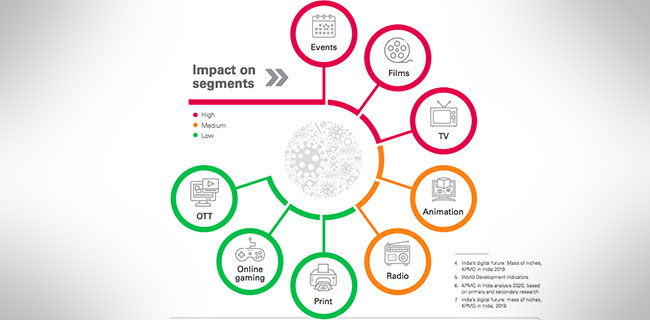
    Given the ongoing Covid-19 pandemic, KPMG has released a report titled “Covid-19: The many shades of a crisis- A media and entertainment sector perspective” which discusses the impact of Covid-19  in the media and entertainment industry.


    The report highlights that media consumption overtime has tended to be income inelastic, however the current environment could result in a dip in media consumption in the near term; and also foresees key trends across Television, Print media, Films, OTT platforms during Covid-19 along with the recovery time for the same.


    Furthermore, the report highlights that due to Covid-19, traditional media could face some challenges in the near to medium term, and there is likely to be a long-term upward shift in the integration of digital technologies into our everyday lives with media and entertainment being an immediate beneficiary.


    Speaking on the ongoing situation, Satya Easwaran, Partner and Leader – Markets Enablement, Technology, Media and Telecom (TMT), KPMG in India said: “The Covid-19 pandemic has resulted in a drastic cut in advertising expenditure across all media. However, with people being homebound, consumption of media and entertainment – and digital media in particular – has seen considerable growth. Post crisis, we anticipate an even greater integration of technology into our everyday lives with a marked digital progression of Indians across socio-economic classes. Monetisation however might remain a challenge in the near term.”


    Added Girish Menon, Partner and Leader – Media and Entertainment, KPMG in India said “The Covid-19 experience is likely to result in a long-term upward shift in the integration of digital technologies into our everyday lives, with India’s ‘digital billion’ trajectory likely to accelerate materially. We expect greater affinity to be seen for at-home entertainment with subscription models, cord-shaving and streaming to larger screens seeing exponential pick-up in the near to medium term. Outdoor entertainment options including – films, events, theme parks – particularly in Covid-19 hotspots could see lingering risk aversion even in the medium term. With monetisation, particularly ad-spend, under pressure, the focus for M&E companies in the near to medium term would be on cash management and profit protection with greater technology integration. Organisations might need to be risk focused and innovate existing business models and processes to survive and emerge stronger.”


    Below are the key highlights of the report:


    Insights into the crisis and its aftermath:

    • Ad-spend pressures to linger on the back of weak economy and lower domestic consumption

    • Longer time lag to return to normalcy for weaker economic sections of the populations

    • Digital consumption to see rapid incremental growth with India’s digital billion trajectory likely to accelerate materially

    • At-home entertainment options (digital, TV, gaming) to see an upswing as ‘lockdown behaviour’ results in habit formation

    • Outdoor entertainment (films, events, theme parks) particularly in Covid-19 hotspots to see lingering risk aversion even in the medium term. ‘Pent-up’ demand behaviour among some sections of population may provide some respite

    • Delayed expansion plans though digital businesses aggressively target market opportunity


    Impact on the Media and Entertainment sector:

    • Supply chain:

    ¤ Innovations in content pipeline: A focus on building a stronger content bank may result in working capital being locked up across the value chain, leading to higher cash flow requirements

    ¤ Innovations in delivery models: With outdoor entertainment and recreation facing challenges in the near term, innovative outreach and delivery models are likely to evolve

    ¤ Greater emphasis on predictive analytics: Companies could place an increasing amount of reliance on Artificial Intelligence (AI)/ Machine Learning (ML) to predict consumer behaviour in these uncertain times


    • Consumption:

    ¤ India vs. Bharat dichotomy could likely widen

    ¤ At-home consumption, particularly OTT and gaming, to see continued accelerated growth

    ¤ Outdoor media consumption: M&E segments such as films, events and theme parks are looking at a prolonged recovery cycle, owing to risk aversion towards social gatherings, particularly in COVID-19 affected cities and hotspots, which unfortunately includes some of the major cities

    ¤ While India’s media consumption remains upbeat during the lockdown, indulgent expenses around purchase of latest hardware, technology upgrades etc. could be postponed for a while

    • Monetisation:

    ¤ Longer timelines for ad spend recovery

    ¤ Penetration of subscription based digital models to accelerate: Digital subscription revenues could see an upswing post Covid-19 as habit formation in terms of OTT video consumption sets in

    ¤ Print will get a new lease of life

    ¤ Medium term downside risk for outdoor entertainment segments: Aversion to social gatherings in the medium term (particularly in major Covid-19 hotspots) could result in lower footfalls and ticket sales for films, events and theme parks

    ¤ M&E services build on domestic opportunities: There is likely to be a greater emphasis on domestic markets in the services space, particularly in the animation and VFX segments, as global pipelines come under severe pressure


    Framework to help companies work through the transition to normalcy:

    • Immediate focus for companies will be on value preservation and protection

    ¤ Protection of the workforce:Focus first on the physical and mental well-being of the workforce with a gradual reintegration process. Time for leadership to deliver clear messages on organizational priorities and provide a fair assessment of the impact of the crisis on their business to employees

    ¤ Stakeholder communication includes not just employees but also external parties including vendors, partners and customers

    ¤ Identify short-term cash flow challenges and enable cost levers for savings opportunities


    • Medium term objective will be value creation

    ¤ Agree and implement the recovery plan

    ¤ Incorporate learnings from the crisis to streamline processes and potentially provide better insulation from such shocks

    ¤ Devise tactical working capital projections in acknowledgement of the changed environment

    ¤ Invest in upskilling teams to adapt to the new normal


    • Long-term vision will be value realisation

    ¤ Carve-out of non-core businesses to unlock value

    ¤ Identify strategically aligned inorganic growth opportunities

    ¤ Develop deep and credible succession plans


  • MMA launches Covid-19 Marketer Support Hub

    By A Correspondent


    Building on the MMA’s core of helping, supporting and connecting brands, media companies, tech enablers and agencies, the global trade group has launched a comprehensive central resource for information on the coronavirus pandemic, as well as guidance for brands on how to navigate marketing during the worldwide crisis.


    Said Moneka Khurana, Country Head, MMA India: “MMA strives to equip marketers even during a disruptive phase like Covid-19. It has always been our endeavour to keep marketers abreast of all that’s been transpiring when it comes to marketing best practices and guidelines across the globe. There’s been a deluge of news and information across the globe on the pandemic. This platform helps in sieving what’s most relevant to marketers and helps in curating the how best to deal with a pandemic when it comes to be a marketer.”


  • Lokmat Media engages staff in lockdown with #Lokmatfamilybesthain

    By A Correspondent


    Photograph shared by Rishi Darda, Joint Managing & Editorial Director, Lokmat Media on Twitter

    The lockdown is on and with the extension to May 3, Lokmat Media realises that while its stakeholders like readers and advertisers have to be taken care of, its own army of employees come first. So, last week, the leading Maharashtra-based media grouph got employees and their families meaningfully engaged in this period of self-isolation. The objective: ensure that employees, their families and readers are mentally fit, motivated, stay away from monotony and are engaged and valued.


    And this was achieved with the #Lokmatfamilybesthain initiative where staff was asked to put up most creative lockdown photo, funny two-minute videos on different themes, participate in a trivia quiz and have Q&A on social media. The person with highest likes to his posts won an award. More than 1527 employees and their families participated in the engagement programme that spanned six hours. Participation for this initiative saw entries from every one including all the board members to senior leaders of the organisation to even the interns in the organisation


    Commenting on the initiative, Rishi Darda, Joint Managing & Editorial Director, Lokmat Media Pvt Limited said: “As more and more people stay home following state-imposed lockdowns or self-quarantine due to rising cases of COVID-19, Lokmat Media has constantly engaged with its readers and the employees who are the backbone behind the brand. There is a saying “when the going gets tough, the tough gets going”. The initiative #Lokmatfamilybesthain was created to motivate and break any form of monotony among the employees by posting interesting and funny posts in the form of photo, video, trivia on social media with #Lokmatfamilybesthain. The activity displays engagement with its network, get the best use of time, un-distancing from social media and keeping morale high.”


  • Will loyal newspaper readers lose the newspaper habit given the 5+ week lockdown?


    By Indrani Sen


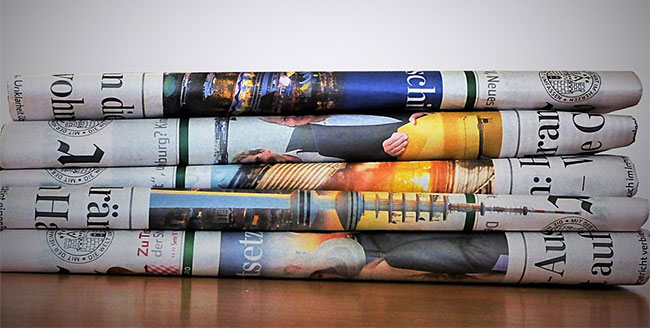
    I have been reading various articles on how the Indian newspaper industry has been performing since Covid-19 struck India. We are all aware about how the newspapers in major cities were forced to stop printing for couple of days due to protest by hawkers’ associations.


    Subsequently, all newspapers resumed regular printing though no one indicated if they were able to print and distribute their regular print orders. Last week, there was a joint statement issued by publishers assuring their readers about the safety measures undertaken by them to ensure that the newspapers reaching their hands in safe condition. Publishers have also claimed that newspaper distribution have largely stabilised across India. In the meantim, hard copies of most newspapers have reduced their number of pages and the lack of advertisements is noticeable even to an untutored eye.


    A sensational article (https://www.ozy.com/around-the-world/the-virus-other-victim-the-worlds-final-hope-of-a-major-newspaper-industry/293705/) published on April 10, 2020 led me to do a quick dipstick survey this weekend over the phone among 31 elderly (50+) upmarket citizens across Kolkata, Mumbai and Delhi to find out if they are receiving/reading their usual newspapers. I found that 26 of them have shifted to reading e-papers and have stopped reading hard copies of the newspapers they used to read regularly till the pandemic struck India.


    Only three of them reported that their building societies are not allowing newspaper hawkers’ access inside the complex. The other 23 have stopped reading the newspapers on their own in order to avoid the chance of getting infected by Coronavirus with some of them discontinuing their subscription even before the lockdown was imposed.


    I tried to probe the root cause of their fear. I found that they are not worried about how the newspapers are printed and despatched from the press, but about the distribution process where many people handle the same under unhygienic conditions at the roadside dumps and distribution points. Some of them have seen the messages from leading newspapers assuring that surface of newspapers do not carry the virus. All of them have received contradictory information through social media and messaging apps and have decided to boycott the hard copies of their favourite newspapers. A couple of them who are early risers are actually happy that they can read the e-copies early in the morning, much before they used to get the newspapers delivered at their doorsteps.


    All of my respondents were not ready to pay for accessing e-papers which they are now reading free of cost. Under the lockdown, those who were not browsing the internet earlier have also learnt to browse for news and have become aware that TV channels deliver the same news faster than the newspapers and keep updating the news throughout the day. Only one of these people had previously downloaded the apps of the newspaper he used to read.


    As many as 52% of the 23 (50 to 60 years in age) were unsure if they would again subscribe to the hard copies of the newspapers which they used to read earlier. The others (60+ age) would like to go back to reading the hard copies more due to the inconvenience of reading small print of the e-papers on their mobiles. All of them would prefer their newspapers to be delivered at their doorsteps rather than stepping out of their home to purchase a copy from a nearby convenience store or newsstands/ shops across the roads. I read the article by my friend Jwalant Swaroop, a veteran from the newspaper industry, a few days back arguing for a change in the distribution system of newspapers in India (https://www.exchange4media.com/media-print-news/its-time-for-newspapers-to-reinvent-their-distribution-model-jwalant-swaroop-happy-ho-103795.html). I am afraid I cannot agree with Swaroop’s view as I think the unique last mile delivery system is keeping the newspaper industry alive in India, in spite of agreeing with his observation on the prevalent unethical practices by the some newspapers to control the newspaper hawkers union and the lack of transparency in the entire system.


    The five respondents (50 to 60 year age) of the dipstick survey, who are continuing to read the hard copies of the newspapers, are more scientifically enlightened and net savvy. They have done through research on the internet about the possibility of hard copies of the newspapers carrying the Coronavirus and have compared it with the possibility of surface of other goods (milk packets, etc.) entering their household on a daily basis. On the basis of their findings, they have decided to continue with their subscription of newspapers.


    Summing up the findings from my dipstick, I can conclude that the newspaper industry in India is facing a grave crisis as many loyal newspaper readers, particularly the elderly elite, are likely to have stopped reading hard copies of the newspapers under the threat of Coronavirus. Five continuous weeks of lockdown followed by a few more weeks of staggered withdrawal would be capable of creating a time window for changing the current newspaper reading habits of Indians, even the elderly elites. Along with the policy for surviving the present crisis of fall in circulation and ad revenue, the newspaper industry needs to simultaneously draft a strategy for winning back their loyal subscribers after the dark cloud of Covid-19 disappears from our Indian sky.


  • Kalyan Jewellers launches ‘Goldsmith Relief Fund’

    By A Correspondent


    Kalyan Jewellers has announced that it will be supporting the daily wage worker community from the Gems and Jewellery industry as well as the Film industry, in association with Amitabh Bachchan’s ‘We Are One’ initiative that aims to support over 1,00,000 families.


    On its part, Kalyan Jewellers will provide 50,000 households with monetary relief during these tough times.


    For the ‘kaarigars’ or artisans and the daily wage workers who are part of the gems and jewellery industry, Kalyan Jewellers has launched the ‘Goldsmith Relief Fund’ and will be working closely with Jewellery Manufactures Association (Kerala), Coimbatore Jewellers Association and Gems & Jewellery Export Promotion Council (Mumbai). The fund will be used to provide relief material and monetary assistance to the daily wage workers.


    Talking about the initiative, TS Kalyanaraman, Chairman and Managing Director, Kalyan Jewellers said, “We are witnessing an unprecedented global pandemic. During these testing times, it is important to support the daily wage worker community which has been most affected due to the shutdown. The Goldsmith Relief Fund is a humble initiative that we have put together to try and bring some semblance of financial relief to the artisans working in our industry.”


    Kalyan will also be partnering with the ‘We Are One’ Public Service Announcement film. Led by Amitbh Bachchan, stalwarts from the film industry have come together to make this short PSA, that clarifies the importance of staying home and maintaining social distancing to break the chain during COVID-19.


    “The film being made is very special as it brings together all the best creative minds of our industry. This will further strengthen the unity among the citizens of our country to fight COVID-19 and enable India to lead the world out of this pandemic,” added T S Kalyanaraman.